MEHER SPIRITUAL CENTER

Meher Baba's Home in the West

July Newsletter 2025

Meher Center Archives

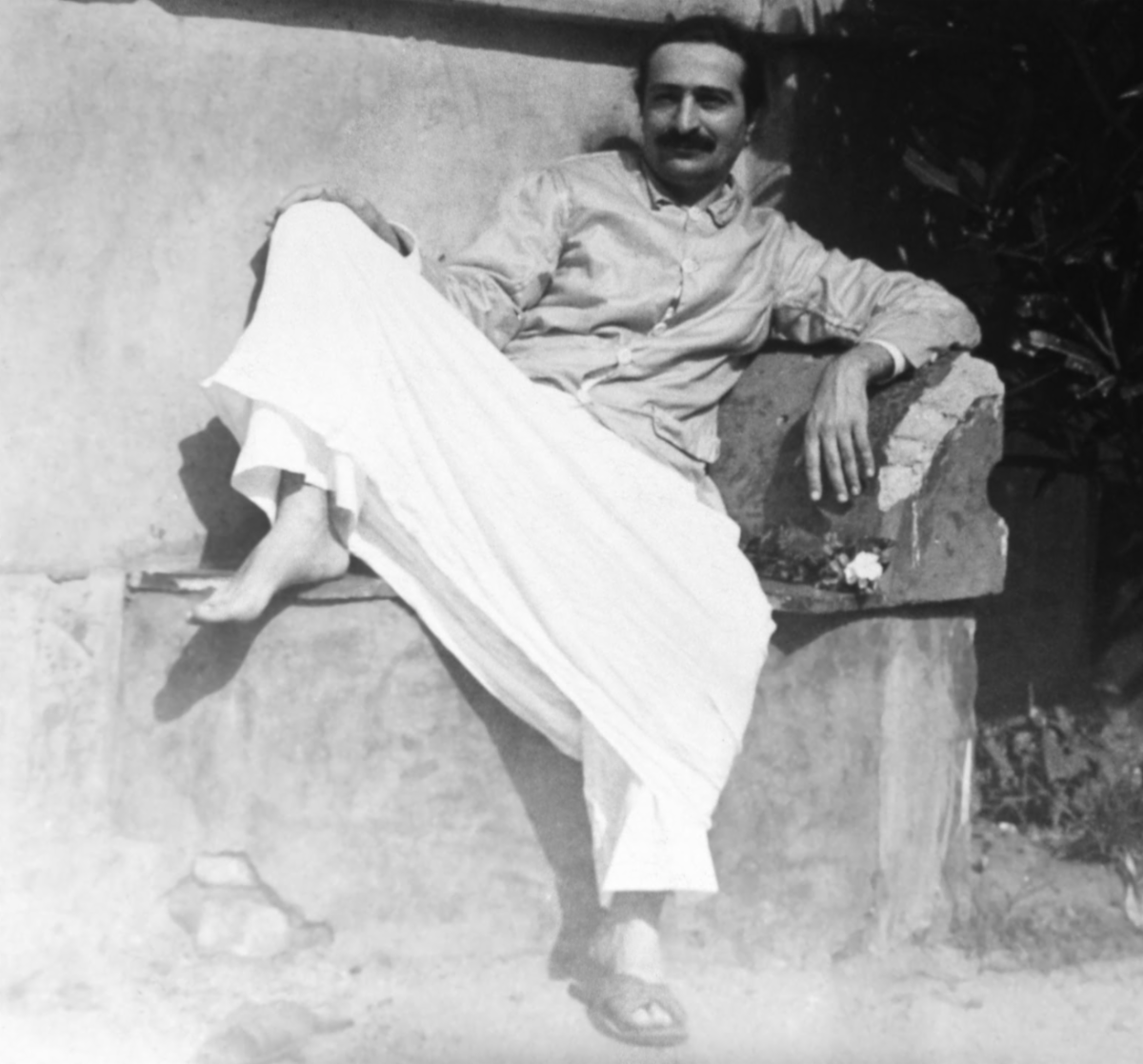
"One who hears the music of God in his heart — such wonderful music, for it is the Original Music — loses his bodily consciousness and sees God everywhere."


Meher Baba


Lord Meher, Online Edition, by Bhau Kalchuri, pg. 3978

Dear Meher Center Friends and Family,


Greetings from the Center. This newsletter is dedicated to the centenary celebrations of Meher Baba's Silence Day on July 10th. Below we give a glimpse into the festivities we had here at the Center to mark this historic day. Whether you were here or at home, we hope that these videos, stories and pictures bring this event with Baba alive in your hearts.


Baba said, "Once you see God within you, you get that conviction (of God). There is no more doubt. Then there is the experience of infinite bliss. I give my blessing to you all. If those who love Me will just for one minute, as now, be silent in their minds just before they go to bed and think of Me and picture Me in the silence of their minds, and do that regularly, then this veil of ignorance that they have will disappear and this bliss that I speak of and which all long for, they shall experience."*


In Meher Baba’s love and service,


Buz Connor

For Meher Center board and staff

*Meher Baba's Visits to England, ed. Margaret Hickman, p.44

"I never realized He wasn't talking, He was so animated, there was so much love."

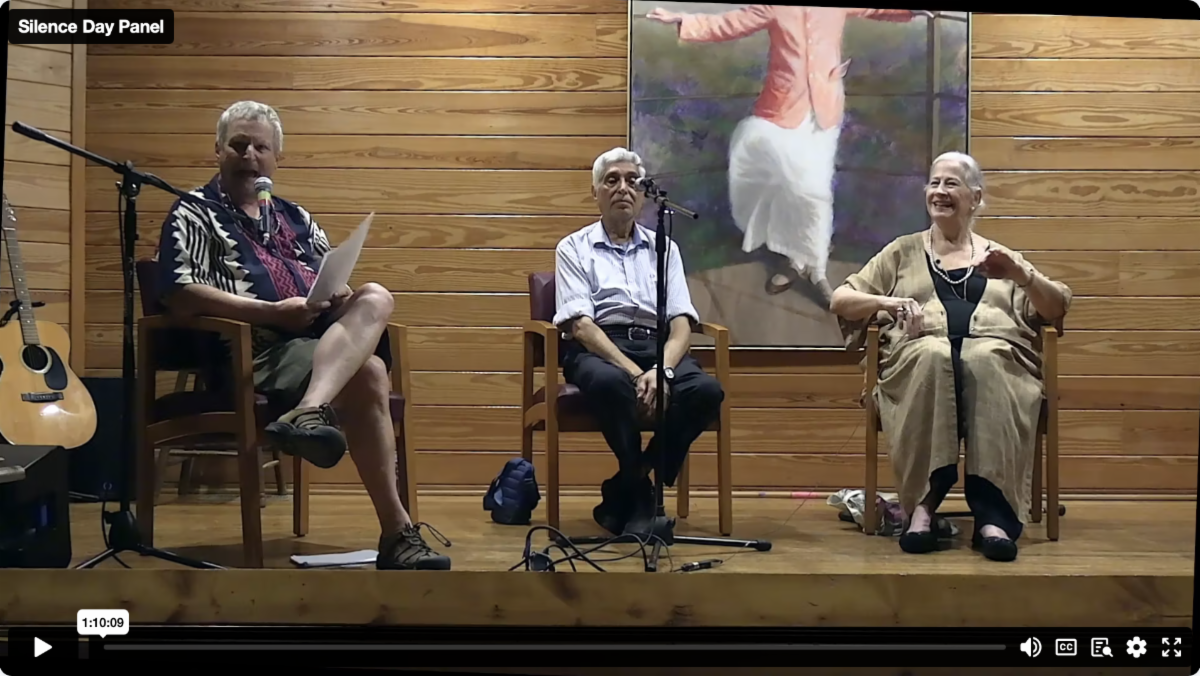
In this heartfelt panel discussion, Vinod Khilnani, Wendy Connor and Irwin Luck share their thoughts about Baba’s silence. All three were lucky enough to have met Baba and experience His silence firsthand. They talk about Baba’s complete naturalness, His ability to communicate volumes with a few simple gestures, and the importance of cultivating His voice within. Daniel Stone thoughtfully moderates.


Video, 1:10:09

Meeting Place at Meher Center, July 11, 2025

Prasad: A Gift from God to Man

By Preeti Hay

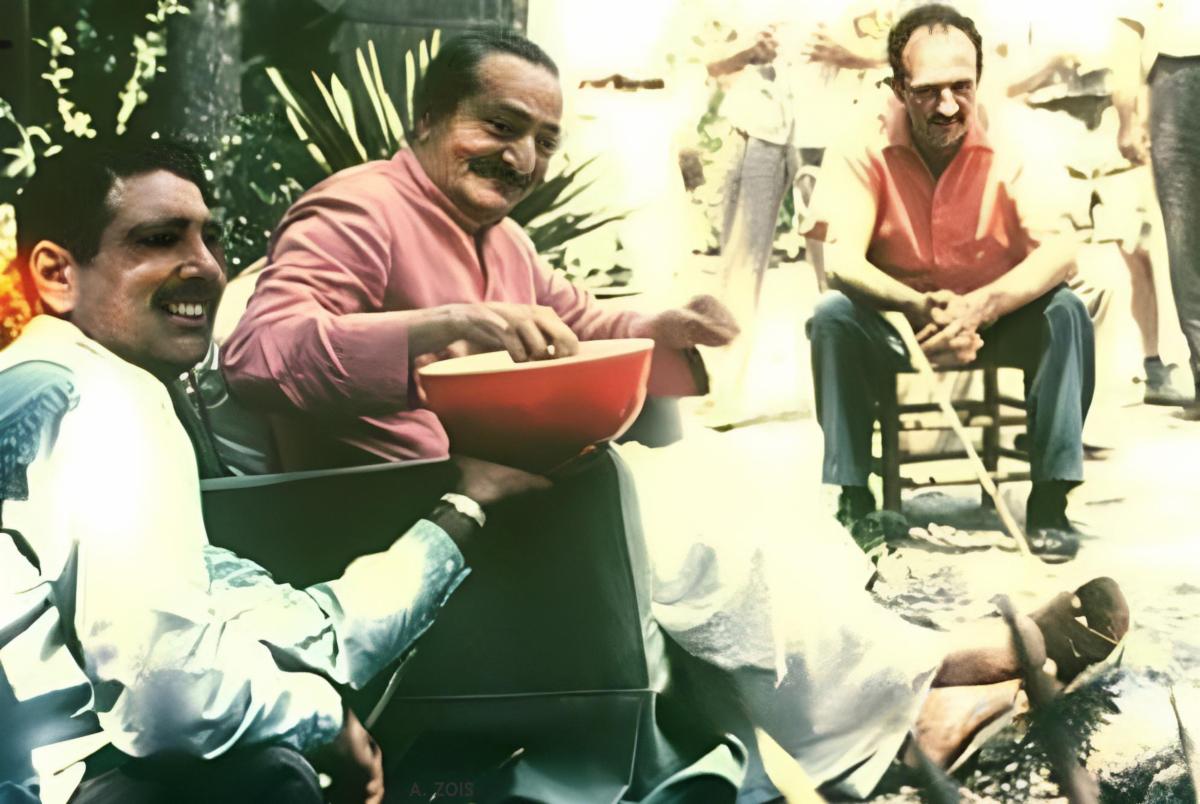
Photo Quality Enhanced from Original by Anthony Zois

This year while planning the 100th Silence Day celebration at the Center, the programming group came up with an idea to serve rava with chai on July 10th. The thought found its roots in the nostalgia of being at Baba’s samadhi for various events such as the early morning celebrations of His birthday at the Tin Shed and on other occasions where one could witness the child-like delight with which the Eastern mandali shared this much-loved treat. 


The word prasad comes from the Sanskrit word “prasada” which means "gracious gift," "blessing," "divine grace," or "offering." In Vedic Literature, prasad is also associated with the word “prassana,” which means “to please.”


It is common practice across the world religions to offer food to God before it is eaten by a congregation or a family. This food in turn is infused with His love and blessings. In Eastern temples and places of worship, prasad has two things in common: it is always sweet and despite its variations, it is traditionally a rendering of what we know today as a type of halwa. The word halwa comes from the Arabic word “hulw” which simply means “sweet.” In India, a similar preparation is called “sheera” which has roots in the original halwa introduced to the Indian sub-continent by the Mughals and completely embraced by Hinduism over the years.


Indian sheera began to be associated with “rava” or semolina which became the primary grain used in the preparation. According to Indian mythology, the dish was first made for Lord Krishna who was known to have a sweet tooth. Meher Baba also told us that Krishna was the first Avatar to institute the custom of prasad.


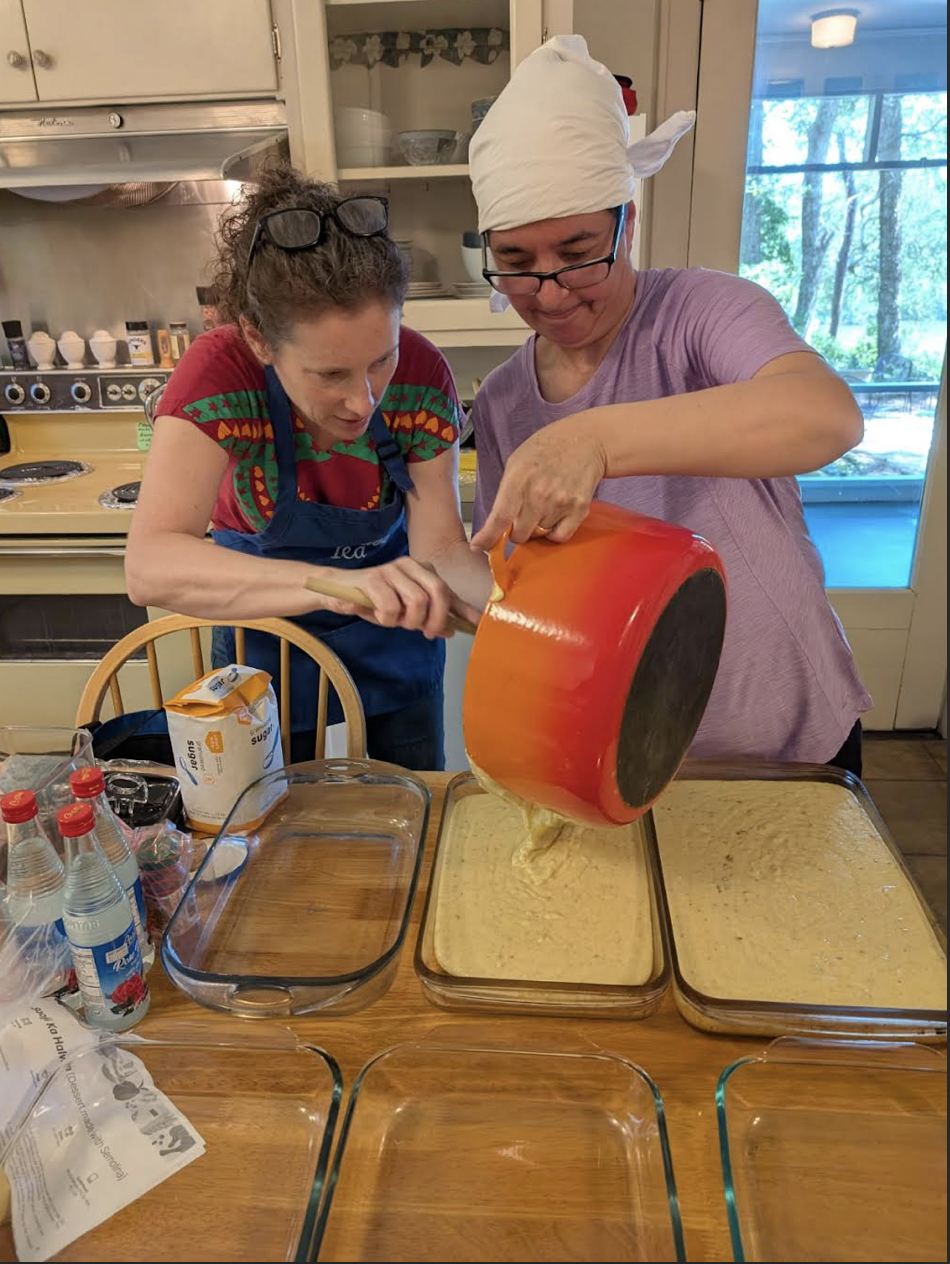
Having been tasked with the job to help create this special dish, I spoke to Keren Rice, a friend and co-worker. As usual, she had some good questions: “Do we have a credible recipe for two hundred people? Is it wise to make a hot dish and serve it on a hot day out in the open? Does it have to be rava?” No, I did not have a recipe. I was not sure if it was wise given the heat. And the only reason that popped up for me, for it to be rava, was simply because it was and is prasad food. That was enough to rouse and convince Keren’s generous and reverent spirit. She took charge and decided to find a recipe and make rava for the two hundred people expected that day. But that was not it, Baba had another player in mind. And her turn was yet to come.


When I went home from talking to Keren, I remembered that the best rava I ever had was made here at the Center by Parinaz Bastani, an Iranian-Canadian Baba lover, who often visits the Center with her family. Just at the time I wondered if I should ask Keren to reach out to her for a recipe, Keren had the exact same thought and acted on it immediately by emailing Parinaz. Parinaz says, “When I received that email, I was stumped. I do not cook with recipes. My style is more intuitive. How then was I supposed to give a recipe? And yet, it was so monumental for the Center to ask this of me. I knew right away that I had to go help make it.” 


But things were not so straightforward for Parinaz. Her dear husband, Feraydun, had been going through intense health challenges that had taken a toll on the entire family. She had felt so hopeless and helpless with her husband’s health. People around her suggested that she needed a vacation but that was the last thing she could think about! When this offer came, she knew that it was not a vacation but a pilgrimage that she had needed.


Despite his own hardship, her husband supported her going and their daughter, Mehera, stepped in to help. Her brother and sister-in-law from Washington DC drove down her special ingredients to the Center on their way to Florida. Now, Parinaz was assured that even if her husband’s health took a turn for the worse, Keren would have the right ingredients to work with. Baba orchestrated everything so that she could leave for just three days. Her travel was smooth and she arrived at the Center on July 9th and got to work right away along with Keren. 

Rava in India is often plain. It contains ghee or butter, semolina and sugar and maybe some nuts. But Parinaz’s rava is a beast of a different caliber. It is fragrant, colorful, rich and irresistible: fit to serve a king. So, what is her special recipe? I ask.


 “It is something I developed over the years,” she says. Her ingredients include saffron, rose water, nutmeg, whole milk, cardamon, pistachios, almonds, raisins and more. “For Zoroastrians, it reminds them of a famous ice cream in Iran called Akbar Mashti, which is often had as an ice cream sandwich,” she exclaims with a sparkle in her eye.


Talking about Iran, she goes on to share with me that her great-grandfather was with Baba in India.

Keren Rice and Parinaz Bastani making rava

He belonged to the same village as Sheriarji, Baba’s father. He was sent back to Iran and married her great grandmother. The family also had a connection to Baidul’s family in Iran. When Parinaz was 18 years old, she met another Baba lover from Iran whose passion for Baba moved her so much that she went to Amartithi in the mid 1990s. And since then, there has been no turning away from Baba.


Incidentally it was here at the Center, in May of 1958, that Baba explained the meaning of prasad. One afternoon, the men were invited to Baba’s House and then all assembled in the garden where Baba was seated. Charles Purdom, later wrote, “The atmosphere gradually became more and more surcharged with the sweetness of His love.” He continued: “Baba told the men to fan out so that they might catch the candy He would throw to each. Eruch held a bowl, and Baba told him to stand to His side. Baba began tossing in His usual way, i.e., looking in one direction and throwing in another! When the candy was not caught, it was returned to Eruch, as Baba said it was not to be retained as prasad.


“Baba explained: ‘This is not a game.’ It was a link between Himself and each lover, for the future.’ After everyone had caught his prasad, and some had a rough time doing it, the group gathered in front of Baba and He began to explain the significance of prasad: ‘It is the gift of God to man. If you eat with the feeling that it is that, you benefit; but if you eat it as mere candy, it has no meaning. Don’t give the candy to someone else.’ It was to be eaten immediately by the recipient.”*


*Love Alone Prevails, by Kitty Davy, p. 531

A Silence Day to Remember

By Melinda Buckwalter

Recently, I was privileged to be at the 100th anniversary of Meher Baba’s Silence at the Meher Spiritual Center. It was a beautiful sunny day and everything sparkled with that “plus quality” as Elizabeth Patterson described it.


There were plenty of lovely opportunities for remembering Baba, in silence, including time for personal contemplation. Highlights of the day's offerings included a well attended silent walk to the beach with a stop off at Gator Lake. Meher Abode and the compound were open for visits. In the afternoon, there was silent chai and rava!


The highly anticipated Silence Day finale was the premiere of Robert Fredericks’ film about Baba’s silence called The Word of My Love. The silent audience watched with rapt attention. What were those rumblings timed so perfectly for the movie’s close? An evening thunderstorm! 


We adjourned to our respective cars, cabins, or kitchens just in time. In the Refectory there was a quick paced game of Silent Uno with the kids at the center table, hands flashing signals. All at once, there was a giant clap of thunder right overhead. We sprang to our feet, startled but keeping our silence. A second one followed on its heels, so loud and simultaneous with the flash there was no surprise that it took the power out. 


Still, we kept our silence. Cell phone flashlights popped on revealing wide eyes. I texted the kids, “Baba breaking His Silence?!” Smiles all around. More like Baba testing our mettle! It was a Silence Day to remember. And though I had a few slip ups, when the Big Bang came I was prepared!

Life on Center: A Silent Walk to the Beach

On the morning of Silence Day, before it got too hot, about 35 people gathered at the Original Kitchen and began walking quietly to the beach along the road. They were led by Cathy Riley and Damien Triouleyre.


Cathy says she was surprised by the intensity of walking silently with so many people. It felt to her like “the air was reverberating” with Baba’s presence.


“It's almost like we were soldiers of silence, you know, marching silently to His tune, even though we weren't really marching,” she says. “But because we weren’t speaking, we were very aware of our steps and Baba’s presence within each one.”


Damien, too, felt the walk was “powerful.” But he also wanted to experience some of the smaller, wood trails to be more closely surrounded by nature. So, he led those who wished to follow for a stop at Gator Lake, which he feels is one of the “sweetest” places on the Center.


“Nature holds silence all the time,” he says. “And so in the woods we could attune to that silence that's there in nature all of the time.”


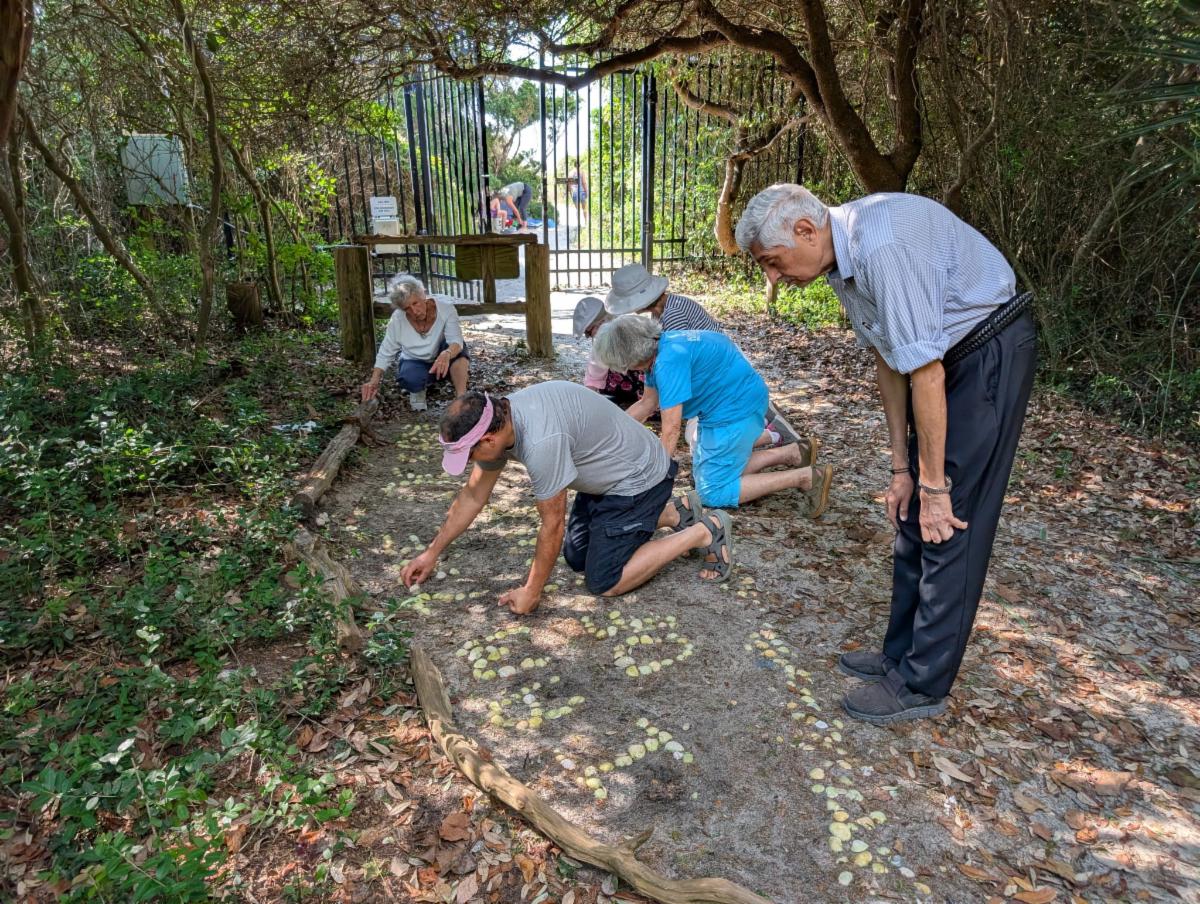
When Cathy and the first group got to the entrance to the beach, she and others noticed that time, rain, wind, and falling leaves had taken their toll on saying “I am the Ocean of Love - Meher Baba” spelled out with shells. And so, spontaneously, she and six or seven other people started removing the leaves and resetting the shells to make each word more legible and stand out clearly. Soon, others joined them and it became an unexpected and delightful work project for Baba.

Silence Day Slip-Ups

by Alexandra Marks

Meher Center Archives

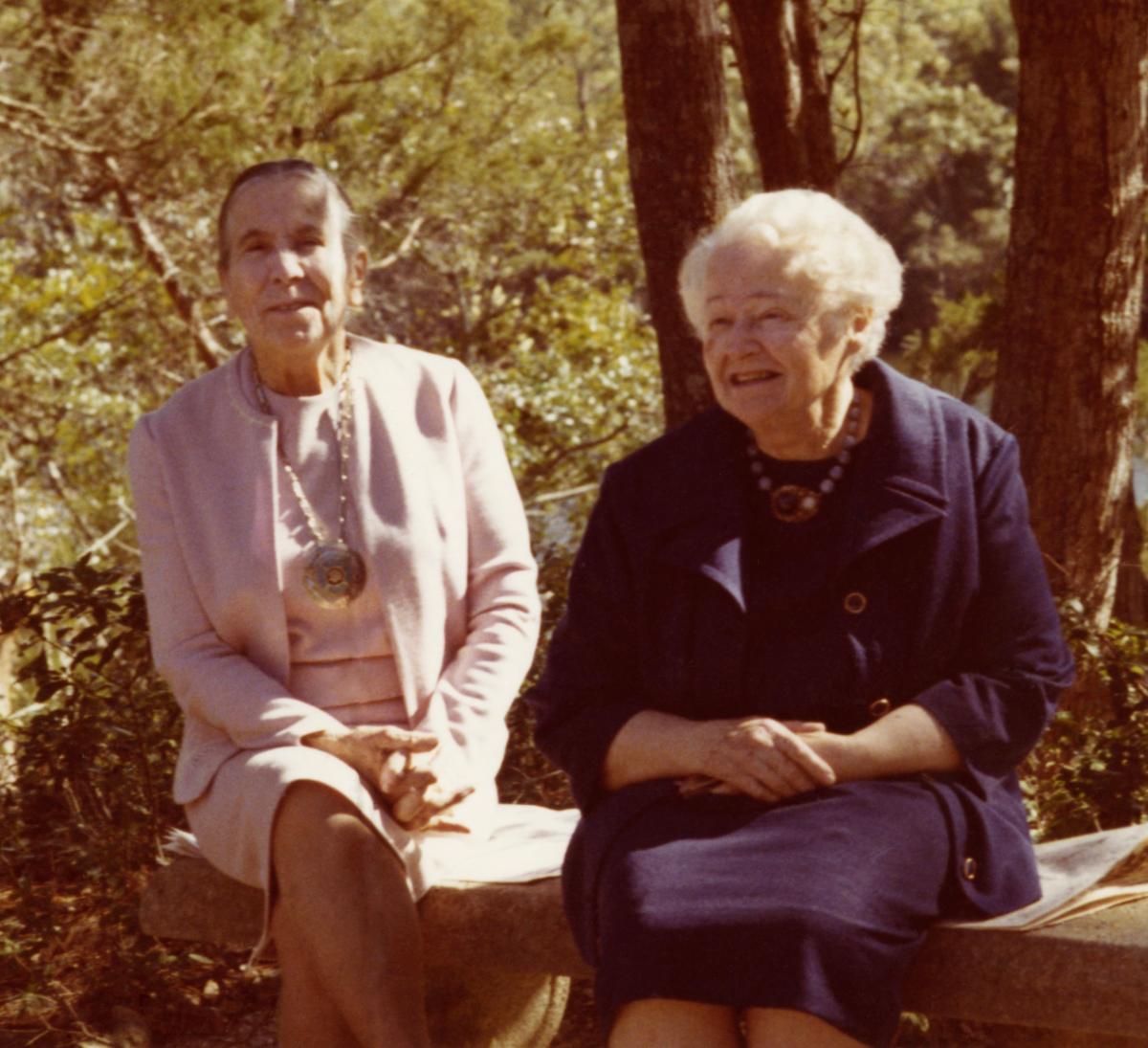
Wendy Haynes Connor has a marvelous Silence Day story. It was during the 1970s, she was at lunch in Dilruba, an annual event, with Elizabeth, Kitty, Margaret, Jane, and Charles.1


“Suddenly, the phone rang and before we could stop her, Kitty jumped up, ran to the phone, picked up the receiver and said, quite cheerfully, ‘Oh we can't talk, it's Silence Day’ and hung up,” Wendy recounts. “When she returned to the table, Kitty saw all of us looking at her with varied expressions of amazement. Abashed, Kitty said, ‘Oh dear,’ and sat down, completely unaware that, within the space of a minute, she had broken her silence again!”


Silence Day slip-ups happen to the best of us. Yes, even Mehera and Mani2 were known to utter a forbidden word or two. From affectionate sweet nothings to beloved animals to “Jai Baba’s” during the prayers, the unintended utterances are great fodder for a good chuckle as well as remembrance of Meher Baba’s infinite compassion. They’re also handy for pricking one’s ego, when one gets a bit too self-satisfied.


Baba’s Silence, of course, is of a magnitude we can’t even begin to fathom. The marking of 100th anniversary this past July 10th, is just a small reminder of the enormity of His sacrifice. He was clear that He undertook and maintained His Silence ”solely for the good of others.”3


“My Silence and the imminent breaking of My Silence is to save mankind from the monumental forces of ignorance, and to fulfill the divine plan of universal unity. The breaking of My Silence will reveal to man the Universal ONENESS OF GOD, which will bring about the universal brotherhood of man. My Silence had to be. The breaking of My Silence has to be - soon.”4


And in Baba’s wonderful way, with His seriousness He also maintains a lightness. That’s evident with His close ones. They clearly enjoyed sharing with Him their own Silence Day slips. In a letter to Jane Haynes in 1962, Mani writes about their recent Silence Day.


 “We were happy ours was observed in Meherazad this year, and next morning we had good laughs over our “slips” as we related them to Baba: dear Mehera had spoken to Mastan and I had talked to the birds!”5


Animals, inevitably, can get the best of us on Silence Day. Wendy recounts another delightful story about Elizabeth. 


"I was walking through the hallway on my way to the kitchen,

when I suddenly heard Elizabeth’s voice coming from her

bedroom. Astonished, I stopped, wondering who she was

talking to. As I listened, I could hear 'tsk, tsk' sounds followed

by several repetitions of “No, you mustn’t do that,” in a gentle

but firm voice.


I poked my head in and discovered Elizabeth trying to shoo

the cat (one of six living at Dilruba) off the bed. The cat had

found the cream for Elizabeth’s morning coffee on her tray

and had successfully licked most of it up. Now, she (Puff) was

pushing her sharp claws into Elizabeth’s legs with the determined kneading motion, characteristic of cats. 


Elizabeth saw me and when I put my finger up to my mouth,

she realized what had happened. Unperturbed, she smiled

a rueful smile and together we managed to pull the cat off her

lap and put her outside.


It hit me, there was only one thing that could make

Elizabeth talk on Silence Day and that was when one

of her beloved pets crossed her path."


I once managed to make it through an entire work day in a busy newsroom without uttering a word. I was feeling very satisfied, rather full of myself you could say. I got home to my apartment, opened the door and announced loudly, “Hey Ollie!” to my cat. So much for my pride.


For Melinda Buckwalter, it’s the plants that get her. In general, she finds Silence Day particularly challenging. That’s because she talks to herself all of the time. 


“I have to bandaid my lips. Usually my first mistake is saying ‘Jai Baba’ out loud during my prayers,” she says. “I don’t have a cat to talk to, I talk to my plants and they are EVERYWHERE! It’s a tough but humorous day for me.” 


Jane Brown Mossman’s Silence Day efforts once brought the police to her door. She was living in New York City and she and her friend Raphael Rudd used to call each other up on Silence Day and use the touchtone keys to play melodies to each other. The phone rang, she picked it up, and realized it wasn’t Raphael, but her roommate’s mother. 


“I blew into the phone just to let the Mom know that someone was there, but of course it just weirded her out more,” Jane says. "About 10 minutes later the NYPD appeared at my door. I just wrote them a note saying I had laryngitis. And, fortunately, they went away.”


One of Damien Triouleyre’s favorite slips involved Bhau, who was on the Center for Silence Day. Bhau wanted to watch “The Ten Commandments” and so, with about thirty others, they piled into Dilruba for a screening. 


“Bhau just loved that movie, you know,” Damien says. “And so we're all focused on it. And in the midst, I got so into the movie, I just started speaking. I made a comment about Moses. People were so shocked. And I was like, that was a valid comment, there’s nothing wrong with that comment. Then I realized I had broken my silence in front of 30 people!”


On this past 100th Anniversary, Martin Sheridan managed to make it through the whole day, lips firmly sealed. In the evening, he watched a video of Charles Haynes giving a talk at Meherana. At one point, Charles stands up and has the audience say the Prayer of Repentance. Martin dutifully stood, and out loud began, “We repent, oh God most merciful…” before realizing what he’d done.


“Well, I guess if I had to break my silence, what could be better than praying for repentance?” he says, with a smile.


To listen to Darwin Shaw share some of his delightful Silence Day slip-ups and stories, click here.


1.Elizabeth Patterson, Kitty Davy, Margaret Craske, Jane Haynes and Charles Haynes.

2.Letters of Love, by Jane Haynes, p. 214

3.“The Awakener,” Volume 5, Number 4, p. 34

4.Ibid, p. 6

5.Letters of Love, Jane Haynes, p. 214

Reminder: Meher Center continues to host virtual programs. To check the program schedule and discourse selection, please visit our Virtual Programs Page.

You can find all previous newsletters and searchable video and audio offerings on our website.


MEHER BABA

ARTICLES

THE CENTER