|
MEHER SPIRITUAL CENTER
Meher Baba's Home in the West
| | September Newsletter 2026 | | |
"In thinking day and night of the Master, the disciple nearly achieves the ultimate objective which is the aim of the diverse practices of meditation and concentration. By putting the work of the Master above his own personal needs, he achieves the aim through complete renunciation."
-Meher Baba
Life at Its Best, by Meher Baba, pg. 21
| | | |
Dear Family and Friends,
Greetings from Meher Center!
A reminder that the Center will host Judith Shotwell and Mary Sutton as our Artists in Residence during the week of October 5th to the 10th. The week-long residence will begin on Monday, October 5th at 7:15 in the Meeting Place, with Mary and Judith being interviewed by Wendy Connor about their lives working in the theater world as followers of Meher Baba. For more information, please click here.
Also, the annual Young Adult Sahavas will be held at the Center from November 12th to the 15th. Please click here for more information.
Meher Baba said:
Do whatever needs to be done, but do it as a spiritual being, as one who knows he is divine by nature and united with the whole of life in essence.
Do it as if you were doing it for Me or for God.
Do it with equal consideration for the interest for all concerned, for God is equally in each.
Do it with the utmost concentration, yet with utter detachment from the result of action. Leave the fruits of action to Me or to God.
Do it as if it were the most important thing in the universe, yet let it be destroyed, or ignored, or ridiculed, without concern; or let it be praised, without elation. Leave the response to Me or to God.
Do it, in short, as if you were not doing it at all, but as if I or God were doing it through you. *
In Baba's Love and Service,
Buz Connor,
For Meher Center board and staff
* The Awakener Magazine, Vol 17, No 1, P 36 Copyright AMBPPCT
| | |
Experiencing the Three Incredible Weeks,
as told by Darwin Shaw
| | |
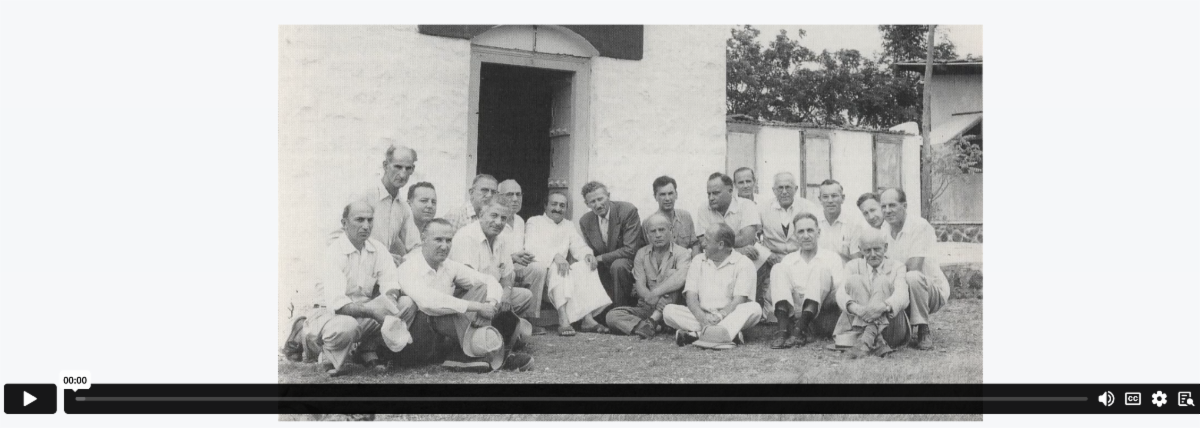
In September, 1954, twenty Western men had the unique opportunity to spend three weeks in the company of Avatar Meher Baba. It was a chance to participate in the Master’s daily life of service and to be in His intimate companionship on a day-to-day basis.
In this exquisite video, Darwin Shaw shares his experience of being at this Sahavas. Recorded by Bill Cliff and put together by Jamie Newell, this talk was given at Beloved Baba’s Tin Shed at Meherabad in 1982. Darwin brings Baba to life for us as we feel His love just as strongly, more than seventy years after that gathering.
Video, 41:57
Courtesy of Jamie Newell
| | |
Footless and Headless
By Ross Keating
| | Photographer: Aubrey Rouse. From the collection of Robert Rouse | | |
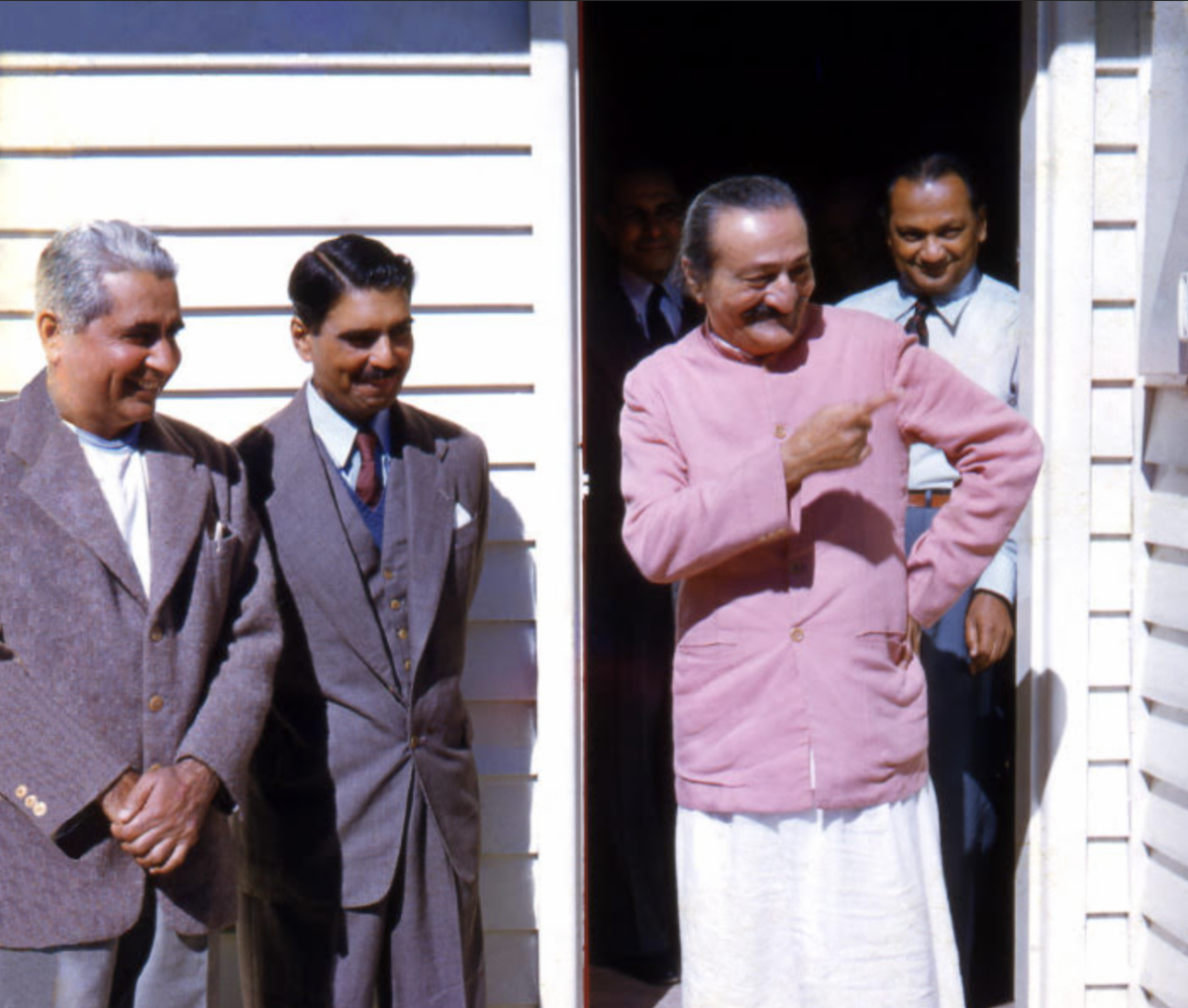
After seeing only part of the movie, The Man Who Never Was, in a city cinema, Meher Baba returned with a small group of His lovers to Beacon Hill on the outskirts of Sydney where He was staying in a stone house built by Francis Brabazon. This took place seventy years ago on the last night of Baba’s first visit to Australia in 1956.
After an early evening meal, everyone assembled in what is known as “The Big Room.” Here Baba gave His last discourse. He said, “He was not for the great crowds of people that bow down to Him and garland Him. He was for that one standing silently, unnoticed in the crowd, who was prepared to lay down their life at a sign or signal from Him.”1
Baba then asked Francis to bring a book of Hafiz’s poetry and got him to read a poem at random.2 Baba said it was not a good translation and periodically interrupted Francis’s reading. At one point, Baba gave His own commentary on the poem, “As soon as the Master says drown, do not hesitate … Don’t worry about what the world will think of you. The world will call you mad, but you should not hesitate. Even if one hair of yours is dipped in the ocean of love, you become wet eternally… From head to foot you become God, if you in this path become footless and headless. How to become footless and headless? Do what I tell you to do. Do not use your mind. When the will of the Beloved becomes your will, then you are footless and headless. Yet all this is impossible...”3
Later in 1960 at Guruprasad, this same theme came up, and Baba pretty much gave the same response, “Obey the Master implicitly. As far as His orders are concerned, don’t use your mind or your head. Do what the Master commands you to do. Let your foot move as per His instructions... This is as good as becoming footless and headless.” 4 And Francis used this same idea in the last couplet of one of his ghazals that he read to Baba: “I tell you, dream not of a white-sheeted scented bed: / In the dust of Lover’s Lane must roll the poet’s head.”5
This is obviously not a new idea, Hafiz was writing 600 hundred or so years ago, yet what makes it relevant for our mentality, for our age, is the fact that Baba has resurrected it for our benefit. He has put this pearl of wisdom into our consciousness in a new setting of His own design.
In 1956 in Sydney, Baba said to become headless and footless for the Beloved “is impossible.” But from my reading of what Baba does, He often leaves the door slightly ajar to make things, that at first seem impossible, possible. I think we do have moments – not a continuous experience – when we are headless and footless in our striving to be His. And these moments play a central role in our lives.
For instance, when we first see something in a new light, or experience an intuition, an insight, an epiphany, a moment of inspiration, then we are momentarily footless and headless, in the sense that we become inwardly still (footless) and lose our self-consciousness (headless). And the strong implication here is that our ensuing actions will be right and natural. I would even go so far as to say that it is in these moments that Baba is somehow “caught” in the act of guiding us.
Part of becoming an adult is in finding our own self-identity, our own voice; to know our own minds, so we’re not prone to be manipulated by others. This is all good and necessary for a healthy, psychological wellbeing. But once this is achieved, I think Baba wants us to live for something greater than ourselves, to live for Him as our Beloved. This living could be seen as a steady movement towards becoming more and more footless and headless. Baba has said His only yoga is “you go.”6
But this shouldn’t be seen as a kind of death sentence (it is really the opposite) for momentarily being footless and headless is a kind of liberation, a sense of real freedom unhampered by imprisoning desires. It is a joyful way of being in the world. Who doesn’t want to be free from their mind constantly pulling them this way and that. Although, as Baba makes clear elsewhere, this doesn’t mean that we give up on our responsibilities.
Being a headless phenomenon, this is not something you can plan to happen, nor can it be cultivated. You simply have to be awake and respond in the moment and not conceptualise what’s happening. If anything, it is like an invitation from Baba, a gift, that can only be accepted without question. But normally we are too self-absorbed or distracted by other things and miss this opportunity.
I think you can see Baba offering this kind of invitation to Bill Le Page during his 1967 stay at Meherazad. At one point during this period, Bill felt totally inadequate and broke down in front of Baba. “Baba,” he pleaded, “I have tried to spread your message [in Australia], but to no avail! I don’t feel myself to be the man required for the job.”7 I think this is a significant moment which we all have to reach at some point in our lives, in which Baba makes us feel our inherent hopelessness without His help. Then according to Bill, Baba made the gesture with His hand, “I will turn the key.” This gesture also contained Baba’s message that “I alone do My work.” In other words, be footless and headless in what you do for Me. Later on, when Bill reflected on his very active life dedicated to Baba, he said that his big mistake was when he “got ahead of Baba and rushed forward too quickly with what he thought Baba wanted him to do.” He lost being footless and headless.
-
Practical Spirituality with Meher Baba, John A Grant, p. 56.
-
Selections from the Rubaiyat & Odes of Hafiz, by Hafiz, trans by a member of the Persian Society of London, pp. 93-94.
- Grant, p. 57.
-
Intimate Times with Meher Baba: Glimpses of the God-Man at Guru Prasad, by Bal Natu, p. 249
-
In Dust I Sing, By Francis Brabazon, p. 12.
-
Lord Meher Online, by Bhau Kalchuri, p. 4537.
-
This full account is to be found in“Cables of Grace: Meher Baba and Australia 1967 – 1969” by Ross Keating, printed in 50th Anniversary of Guru Prasad: The Darshan April – June 1969 (2019) Library Committee A.M.B.P.P.C Trust: Pune.
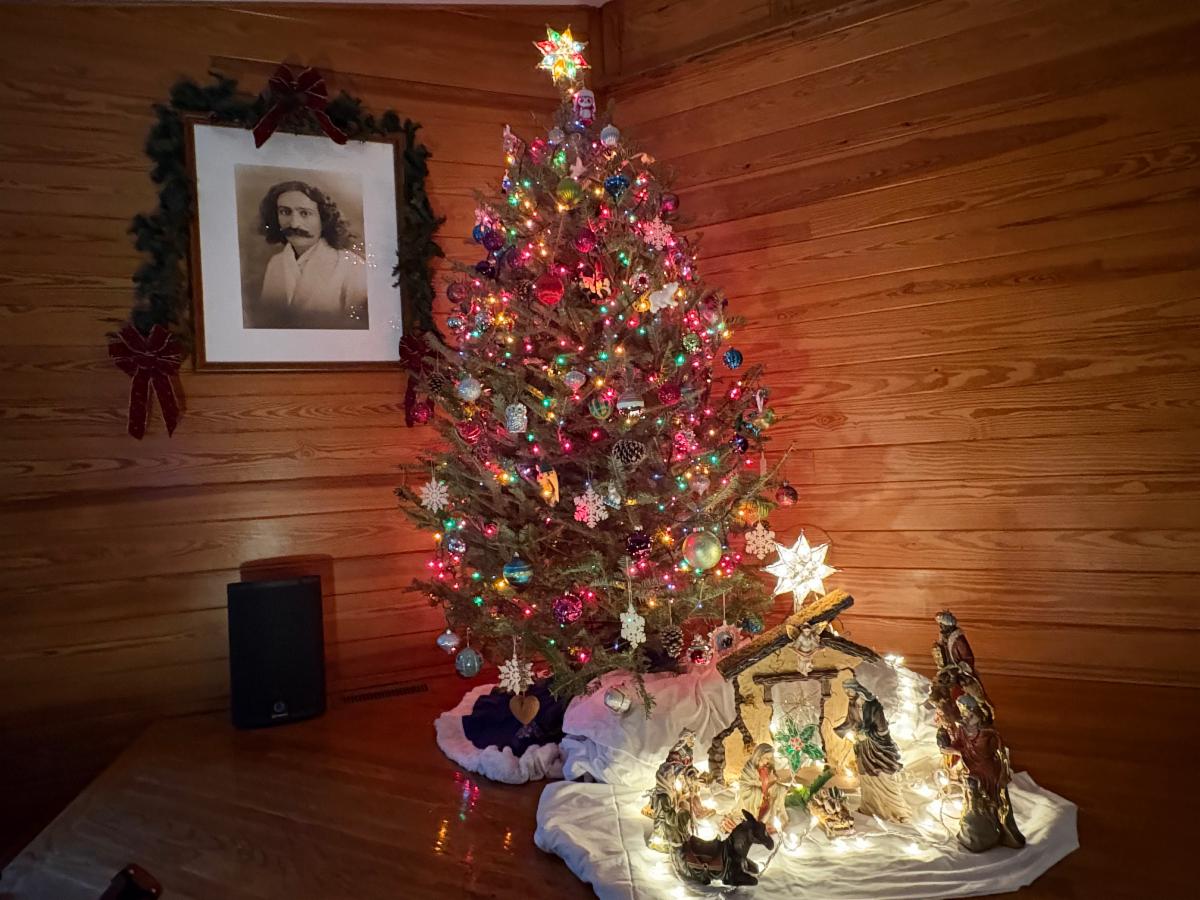
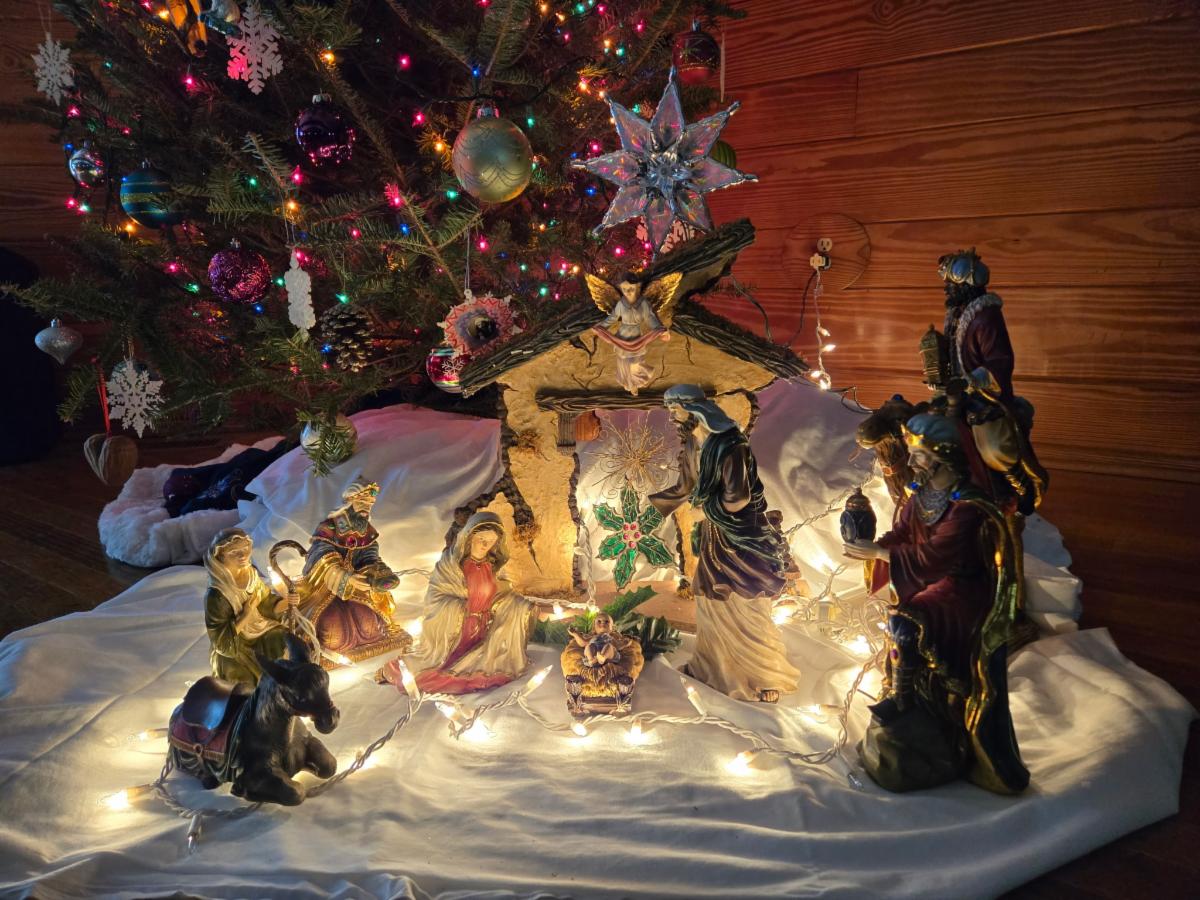
| | Life on Center: The Holidays on the Horizon | | Some of the Center's holiday decorations from past years. | | |
There's something marvelous about celebrating the holidays on Center. Its usual good-natured fellowship is enhanced by the festive atmosphere, and, of course, it's all enlivened by what Elizabeth Patterson called the Center's "plus quality."
Christmas and New Year's have always been popular, and never more so than now. A record number of people signed up for this year's Holiday Drawing for a chance to stay from December 18, 2026, to January 2, 2027. There were 75 entries for this year's drawing, a significant increase over previous years.
"The families love it here, especially the kids," says the Gateway Coordinator, Judi Schoeck. "The energy is so sweet."
According to Judi, there are two main reasons for the increase in holiday reservation requests. First, Baba is regularly sending new people and some are intrigued by the idea of spending Christmas and New Year's Eve on Center. (And chances are, they've heard about the New Year's Eve square dance!) Second, there is a "new crop" of families with young children.
The holidays have always been in demand. Until about 20 years ago, on the first day reservations opened, the Gateway was bombarded with nonstop phone calls, and people lined up on the porch to reserve their space. It was hectic, to say the least.
"It also seemed that a lot of the same people were getting on every year," says Judi. "We put the drawing into play to make it fairer."
The Gateway does its best to accommodate as many people as possible. Right now, about 30 people are on the wait list for all or part of their stay. The good news is that it's a fluid situation.
"Every time somebody calls with an adjustment, we juggle the whole chart and try to get as many people on as we can," Judi says. "It's a case of 'we do our best and leave Baba the rest!'"
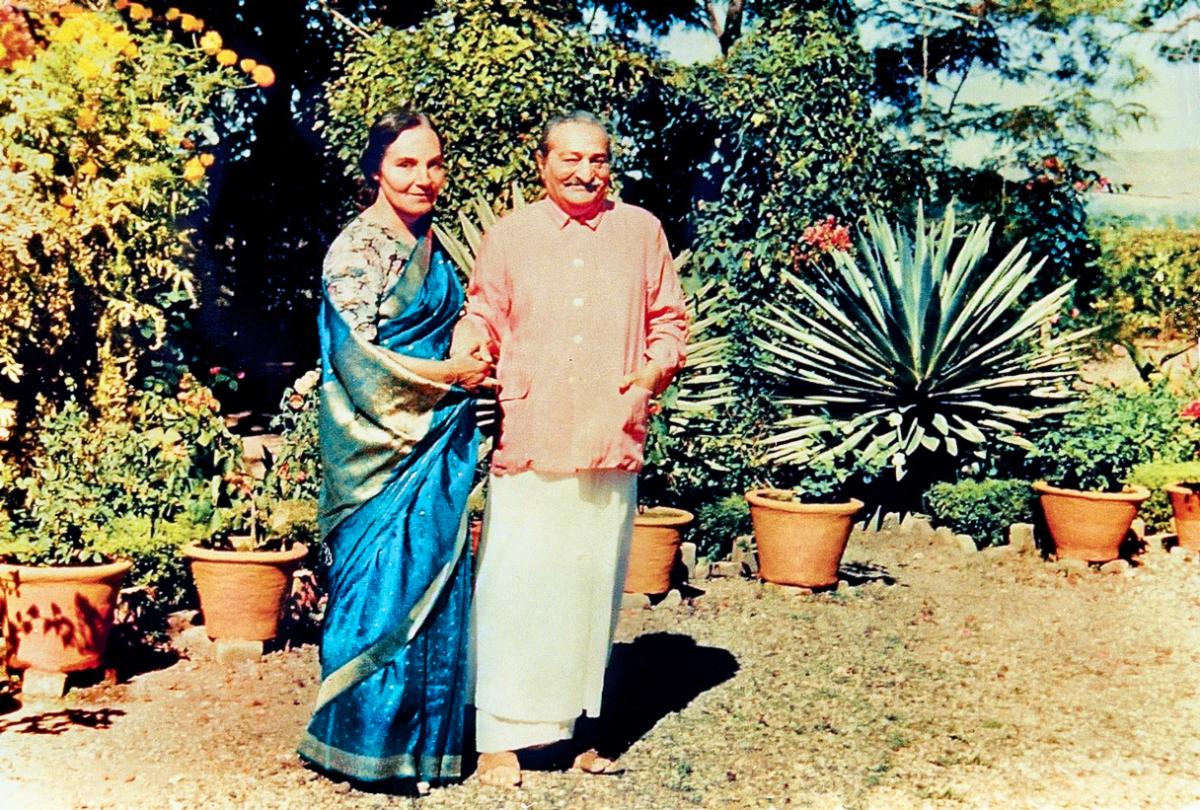
| | Photo Courtesy Meher Nazar | | |
The following is an excerpt from 82 Family Letters by Mani. This was written in the fall of 1963. At the time the weather was changeable, the garden full of beauty, and several birds got to enjoy Baba's grace.
Meherazad, 26th September–3rd October, 1963.
Dearest Family,
I was determined not to begin the letter with a remark on the weather, but found it difficult to dodge past a topic that has been looming largely in our small talk – not because we've been short of subjects for conversation, but because we have had the novel experience of being short of sunshine. Some real hard rains we had prayed for and got, but the long spells of chilly drizzle was not on our list of silent prayers. At such times it was as if the sky had a perpetual cold, its swollen and puffy clouds constantly streaming, its wheezy breath blowing down the back of our necks. On the other hand, now when we get snatches of really sunny days (which means as a rule that it's hot) we wish for more rain. I don't know who it was that wrote: 'As a rule a man's a fool; when it's hot he wants it cool; when it's cool he wants it hot; always wanting what is not'.......
The year has grown some twelve weeks older since our return from Poona. After the first refreshing plunge into Meherazad's quiet life we cease to gasp in renewed wonder at all the little things that make Meherazad what it is, but we can never completely take its blessings for granted. In the moonlight, when the jasmine bushes look like leafy nets that have caught a shower of fallen stars, we still gaze fascinated. And when at dawn these fragrant little flowers cover the garden paths like white carpets, we still find time to stand and stare.
Of course there is the other side to Nature's coin, and competing with the profusion of the jasmine are the midges and the mosquitoes that seem immune to all our attempts to outwit them; and when on an evening we hear the sound of vigorous slaps and claps, it is no cause for concern – one or the other of us is up in arms against these humming horrors. However, pleasing form of life has also been on the increase, and it is already difficult for us to tell the babies apart from the parents – I'm talking of course of the birds: the bulbuls, sunbirds, mynahs and others; while Mrs. Swift is in the process of hatching her family in her little mud bowl of a nest outside our cottage wall.
When some restless or curious fledgling would drop out of its nest, we would put it back in its frantic mother's care. We played the role of anxious aunties when they ventured on their first non-stop flight from one tree to another; for, not all of them are little Lindbergs, and more than once we've picked up a bewildered and bedraggled young bird from one of the water tanks in the garden.
Whenever this happens, after the bird is thoroughly dried by the log fire until its feathers are fluffy and it has regained its aplomb and lung power, before setting it free we invariably take it to Baba. The Beloved gently caresses its sleek head, and sometimes blesses it with a kiss. That is as far as we see of the blessing – how can we fathom its unseen depths? How can we understand the silent miracle of His presence that wipes out hordes of sanskaras, the alchemy of His touch that turns the consciousness of a bird or animal into that of a human being in its next life? As Kabir has said: 'One moment, half a moment, even half of a half moment spent in the company of a Perfect Master, cuts away crores of one's sanskaras.'
If the Perfect Ones of the past have explained this for us, beloved Baba also has done so on rare occasions. For instance when we were in Agra, during our Bus Tour in 1938, one morning we found a bird lying in the grounds, a woodpecker that had been badly injured by the sling-shot of some boy. We brought it in, dressed the wound and bandaged it. Baba held it in His lap, caressed it, fed it. For all our nursing the bird did not survive long, and just before the end it struggled out of its box towards where Baba was sitting and dropped dead at His feet. Baba picked it up, and then said (in gestures of course), "You can have no idea how fortunate this bird is – it will now incarnate in the form of a human being."
We reflect how the receiver of this immeasurable blessing was unaware and unconscious of it – and it is the same indeed with all of us, who can never know the magnitude of our good fortune in having Him in our midst. God's blessings spring from the compassion of His all-knowing Heart, and so they come to us in silence, or in disguise. After all, the greatest Blessing for mankind is the One in disguise – the Infinite in finite form, the Avatar!
| | | | |