Meister mastery: An American
steeplechase dynasty
|
|
Researching the bloodlines of one of the circuit’s prolific producers |
|
Between them, they’ve literally covered every inch of the Brandywine Valley.
Meister patriarch Bunny Meister, and sons Jay and Billy have operated the meets, run in the races, called the cards, bolstered the entries and protected the landscape since Bunny made his racecourse debut at the Radnor races some 70 years ago.
Bunny Meister, now 87, remembers his very first race ride – it was at Radnor. He won the maiden timber that day, what he calls a seminal moment that “drove him into” the steeplechase world.
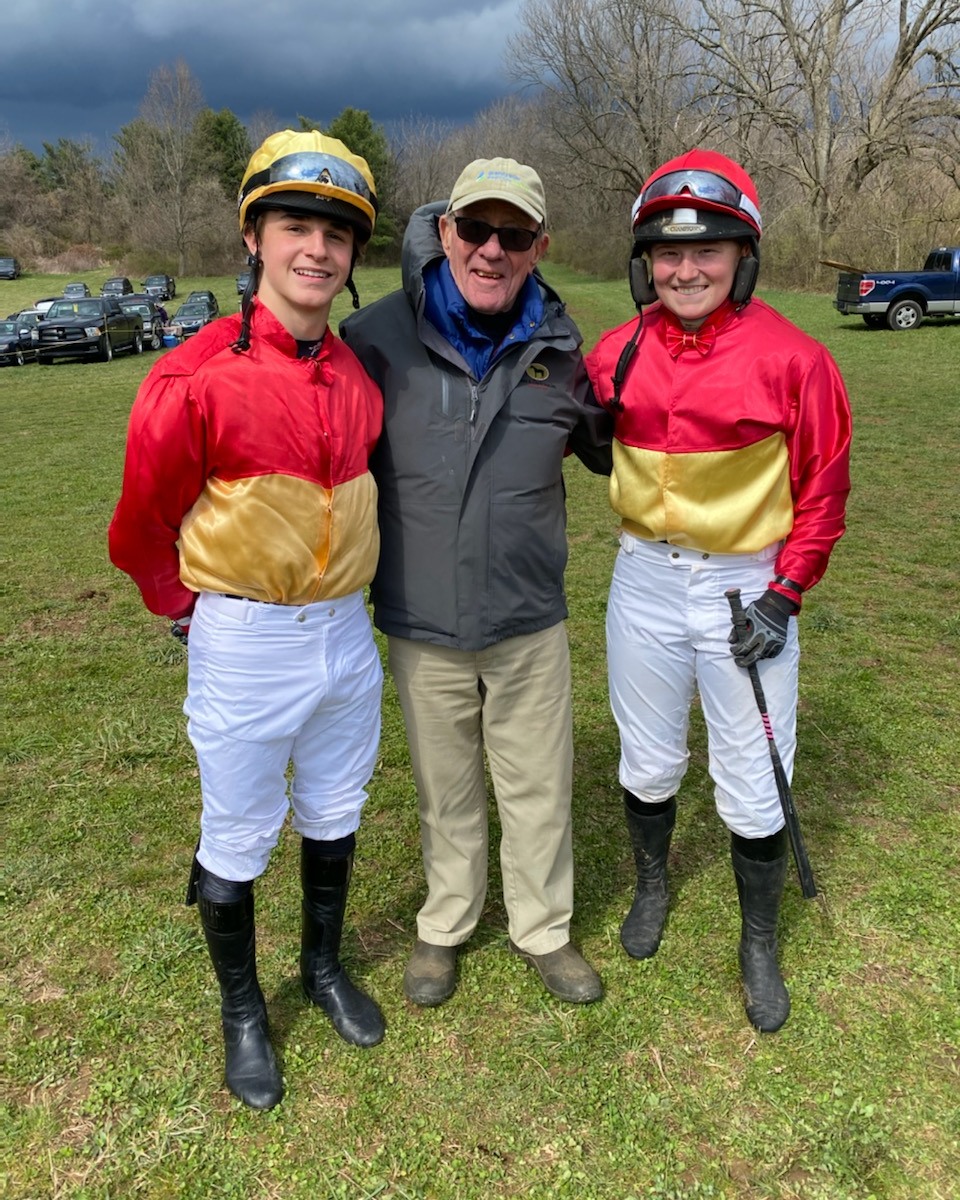
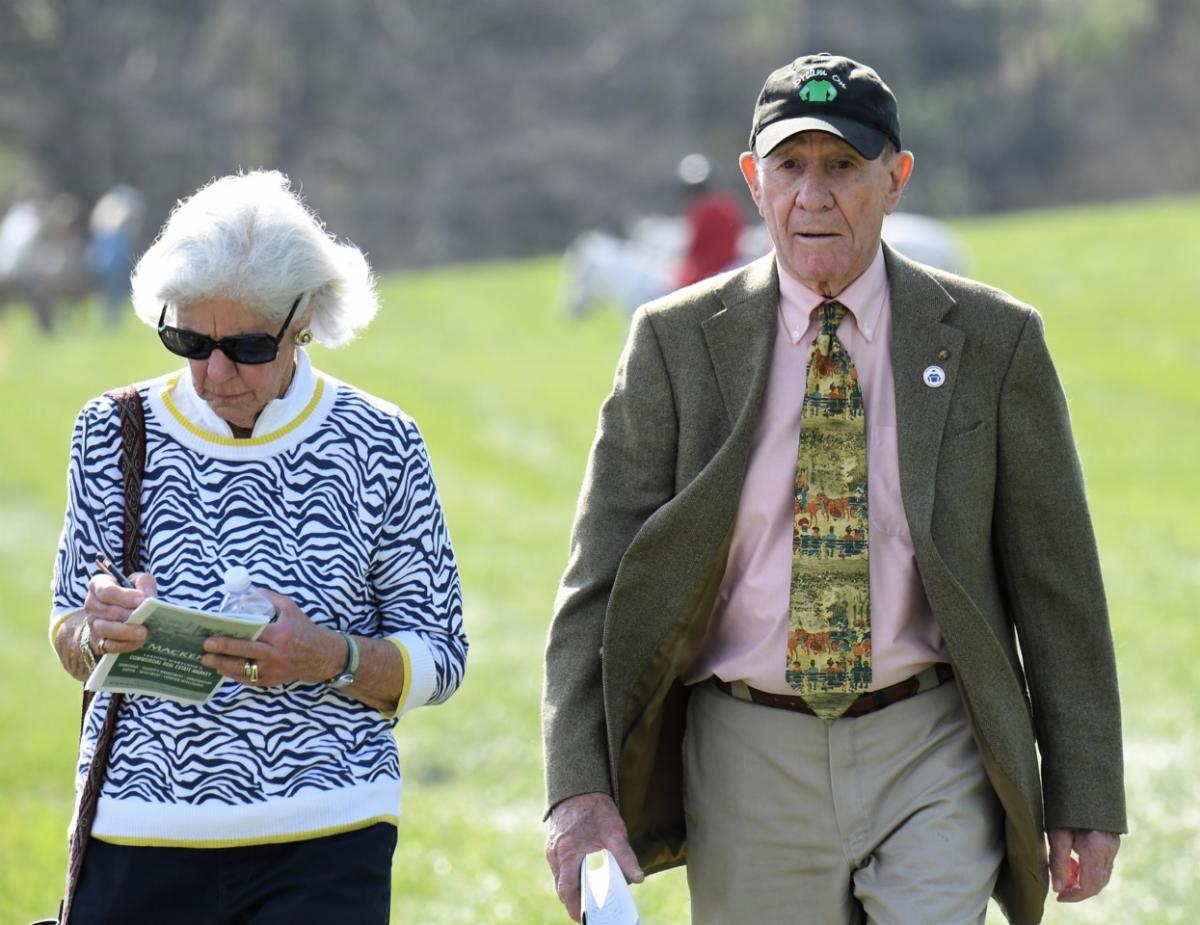
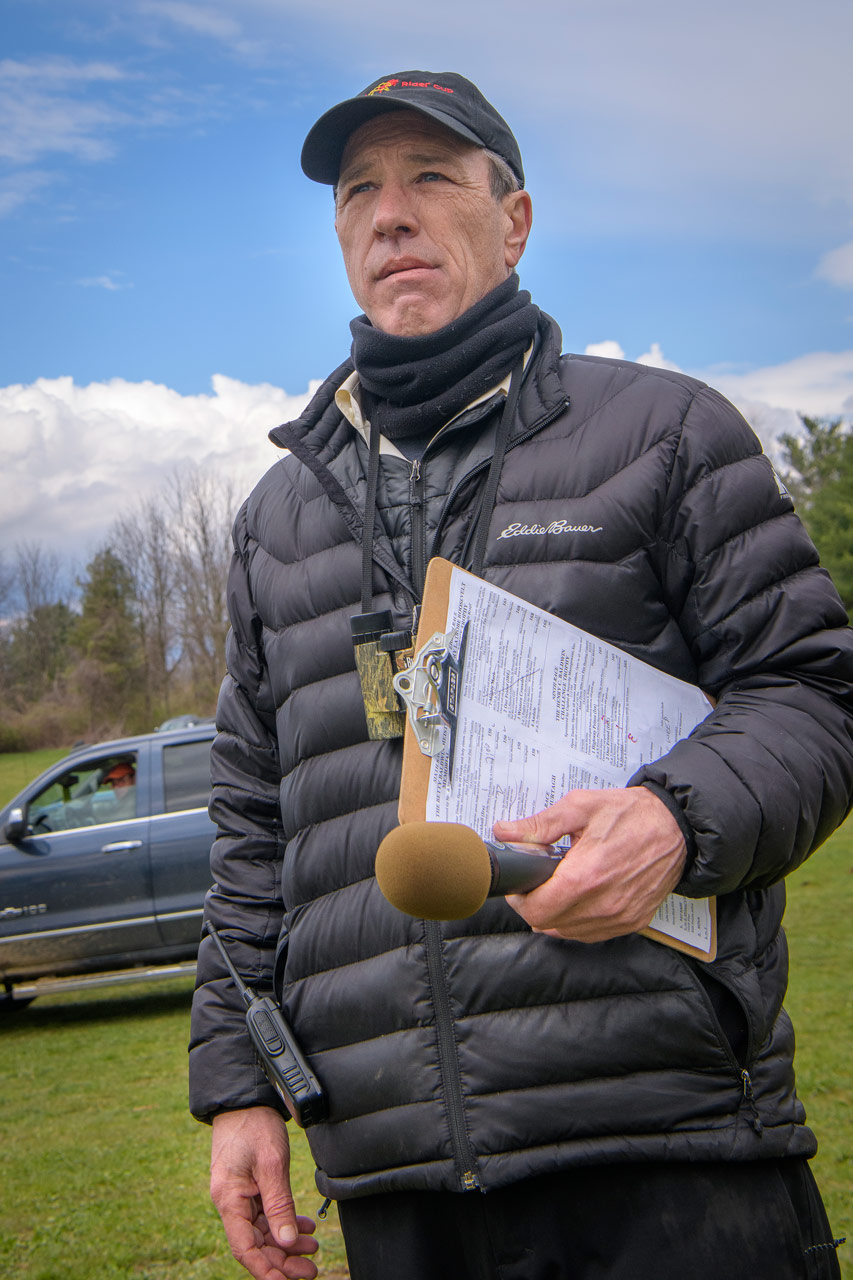
He went on to long chair the Brandywine Hills Point-to-Point and serves on the board of the Brandywine Red Clay Alliance. (Joe Davies photo, above, of Bunny Meister with Teddy Davies and Skylar McKenna at the 2022 Brandywine Hills P2P)
|
|
Bunny whipped in to the Brandywine Hounds, now disbanded but formerly kenneled in West Chester, Pennsylvania, until age 80.
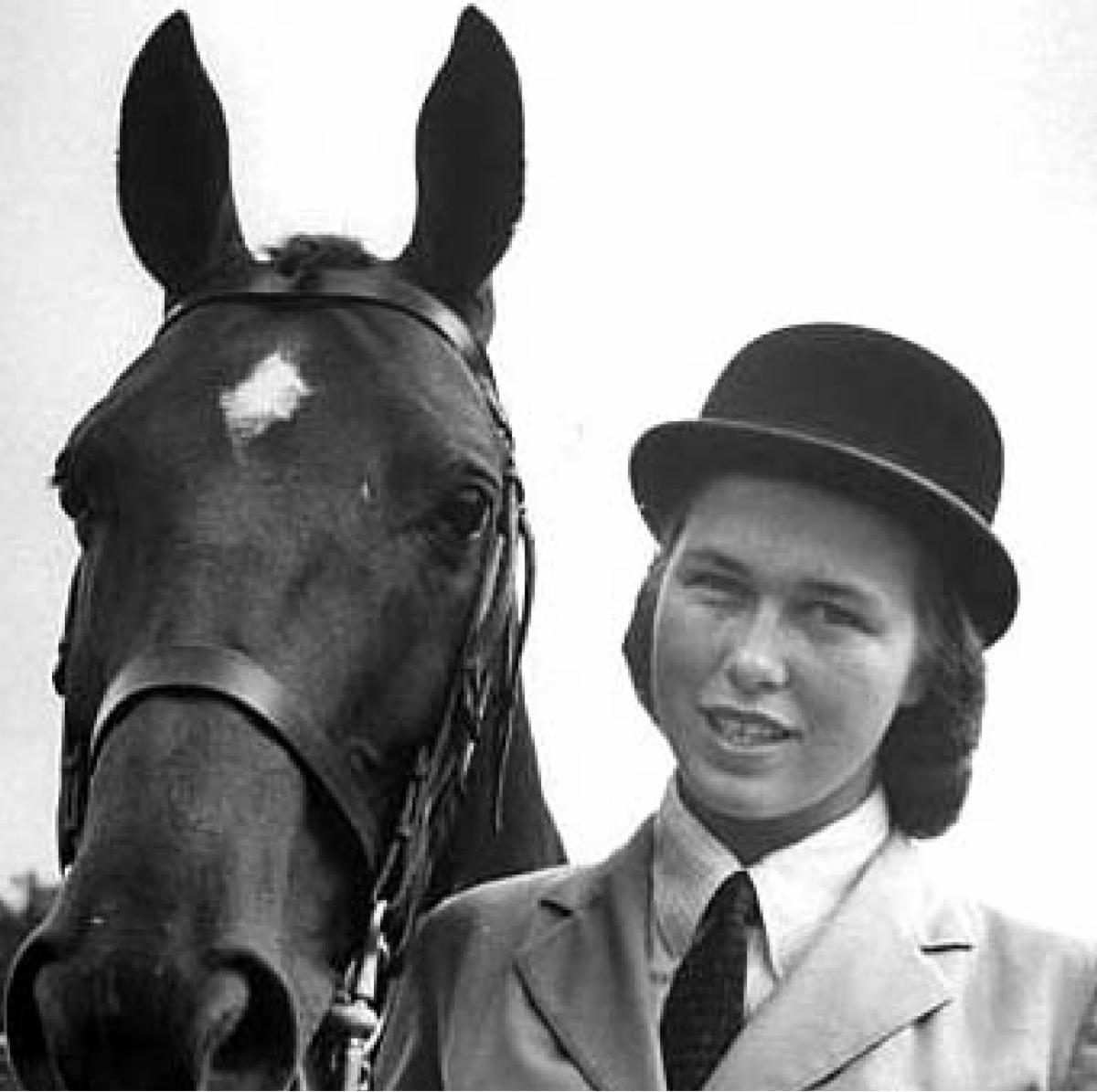
His late wife, Betty Baldwin Meister, was a legendary figure on the circuit, one of the top ladies’ timber riders of her day, and a national show hunter rider.
Their oldest son Carl III – Jay, chairs the Delaware Valley Point-to-Point Association, is on the Pennsylvania Hunt Cup committee and acts as announcer for many of the Pennsylvania and Maryland meets. Middle son Billy was a top timber rider for decades, and is still an active trainer. Youngest son Richard rode as a child but did not follow the family into the horse business.
One of Jay’s daughters, Emma, was briefly a leading light on the Brandywine Valley pony racing scene.
|
Bunny calls Radnor one of his favorite meets. The family home, Tarad Hill, is in the territory.
“Something about Radnor not many people remember – it was the first meet that made you (race) ride in a caliente” helmet, Bunny recalls the year – 1960. “I didn’t have one, of course, so I borrowed one from Paddy Neilson.
“The horse I was on fell at the last and stepped on my head as he was getting back up. I ended up with 17 stitches on the side of my scalp, so I guess I would have been dead if not for that helmet.”
|
|
The Brandywine Valley:
What is it? Where is it?
|
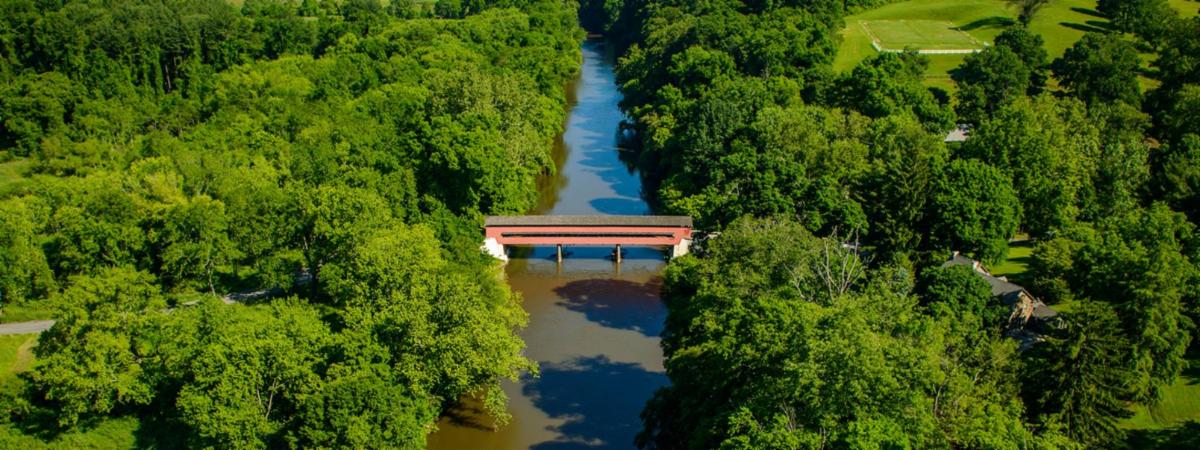
Brandywine Creek runs through the rolling hills of southern Chester County, Pennsylvania – where the Battle of Brandywine in the American Revolution was fought, and northern New Castle County, Delaware – where famously the paper was milled for the Declaration of Independence and America's first currency.
Dutch heritage behind the name is reflected in nearby Fiske Creek and variant names using the Dutch word “Kill” for stream – Bainwend Kill, Brandewyn Kill, and Brandywine Kill. The creek's current name is from the old Dutch for brandy or gin – brandewijn, others say from the name of an early mill owner, Andreas Brantwyn.
The headwaters of both the East and West branch of Brandywine Creek are in western Chester County near Honey Brook. They flow southeast about 30 miles to their confluence 10 miles southeast of Coatesville near Pocopson.
The creek flows past Chadds Ford then enters Delaware five miles north of Wilmington.
The creek continues south through First State National Historical Park and Brandywine Creek State Park, through Wilmington, joining the Christina River and, finally, running into the Delaware River.
Towns in the Brandywine Valley include Downingtown, Unionville and West Chester, Avondale and Kennett Square.
|
|
How’d you get to ‘Bunny’ from Carl J.? |
|
Carl J. “Bunny” Meister Jr. knows the Brandywine Valley as a lifelong resident and landowner, race rider and foxhunter, and as a longtime volunteer – boots on the ground for Radnor Hunt Races’ beneficiary Brandywine Conservancy and Brandywine Red Clay Alliance.
Bunny’s an ardent steward of the land, chairing the Brandywine Valley Association’s capital campaign that’s raised more than $3 million for conservation.
Now 87, he’s still chair of the Brandywine Hills Point-to-Point.
“They call him Mr. Point to Point,” BVA executive director Jim Jordan Jr. said in a Unionville Times article. “It’s the signature event for the BVA and the equestrian community. He gets involved with everything from getting sponsors to getting race officials, and he oversees the course setup.
“Some people talk the talk, but Bunny walks the walk. When he says he’s going to do something, he does it – he’s very dedicated” to protecting the Brandywine Valley.
Carl J. Meister Jr. was born Aug. 3, 1934 in Philadelphia.
|
|
What they used as a nickname at birth is lost to history, but the young Meister earned a better one a few months later.
When he weaned from baby formula to baby food, the story goes, his parents found that he obsessed about strained carrots. He loved them, delighting in the texture, the flavor, the color.
“They’d say I was like a little bunny,” he explains. “That’s how it happened.”
Carl J. became Bunny. And it stuck.
He turned the same kind of attention – near obsession – to horses a few years later, riding as a young child, foxhunting and showing. Bunny was notably skillful, and he was named to the U.S. Olympic training list for the 1952 show jumping team.
But he’d already planned to switch his chief affiliation to steeplechasing, because of the chance viewing of an MGM movie short.
“My friends and I saw this production in the local theater from the Grand National in England,” Bunny recalls. “I decided right then and there that’s what I wanted to do in horses.”
|
|
Neighbor and legendary horseman Bob Tindle helped him get his start, putting him up to exercise his point-to-point and timber horses. Bunny made acquaintance, then friends, then more-than friends, with another of Tindle’s exercise riders, the very beautiful, legendary show rider and race rider Betty Baldwin.
They married a few years later.
Immersed in the hunt, show and race world, they settled on Betty’s family farm, the 132-acre Tarad Hill.
|
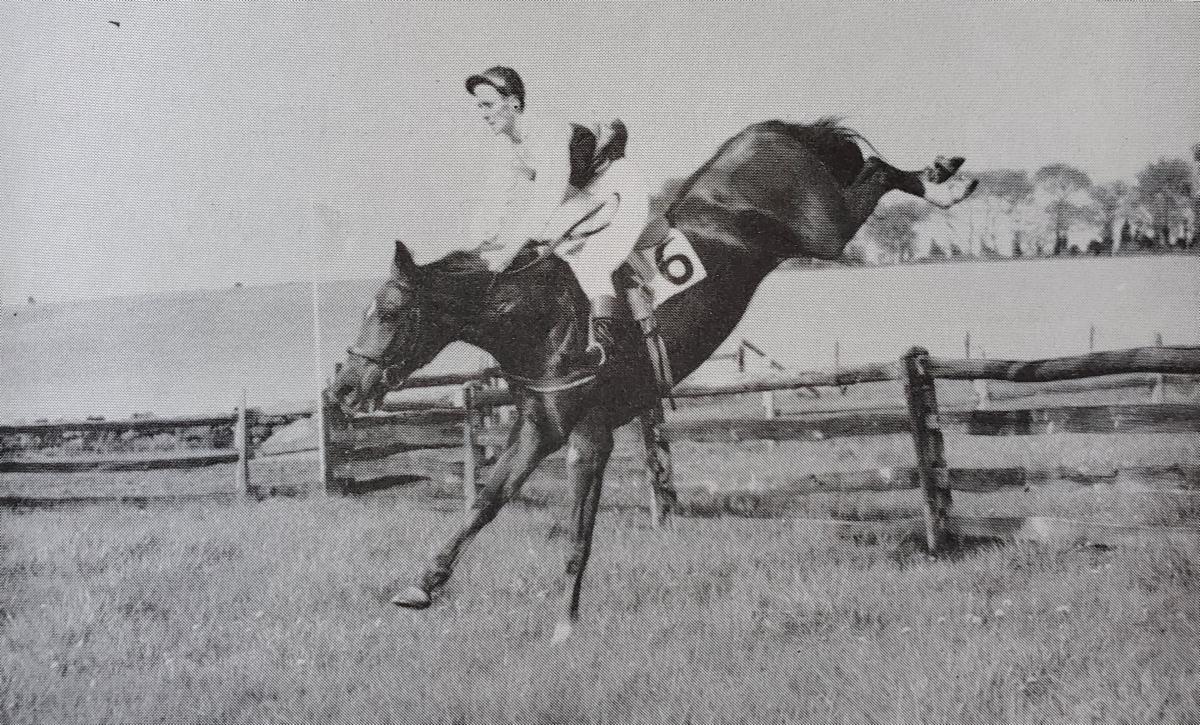
Bunny Meister on Teddy Million at the last fence in a maiden timber at Radnor in 1956. "Steeplechasing in America" says that Meister and Teddy Million "almost came to grief, however the young amateur regained his seat and crossed the wire well in front of his nearest competition." (Freudy photo) |
Bunny started riding races, winning his very first one at Radnor in 1956 on John Strawbridge's Teddy Million, who was trained by Bob Tindle. In the years that followed, the amateur rider tackled many of the circuit’s most challenging courses – My Lady’s Manor, the old Rolling Rock natural brush, Essex and Rose Tree, the Maryland Hunt Cup (four times – twice finished, twice fell) and Grand National, Pennsylvania Hunt Cup, Iroquois (when it was big, living hedges) and Colonial Cup (when it was big, stuffed brush.)
He won the 1959 Iroquois on Burford Danner’s Ambition – quite a memorable trip, both around the course and around the city. “I won two races that day – the timber on Jamaica Boy, too,” Bunny recalls. “We used to have a lot of fun down there in Nashville.
“Too much fun, sometimes. You know how it gets at Nashville.”
One of his all-time favorite racehorses was a sixth-generation homebred – Beep. He was a 31/32nds thoroughbred, Bunny says, all but, back in the days when you could run an unregistered horse both in point-to-points and under rules. Beep had to run as MacBeep in NSA races, since there was a registered Beep racing around the same time.
|
|
Betty Baldwin horse heritage |
The late Betty Baldwin Meister, Bunny’s wife and mother to Jay, Billy and Richard, was born in 1930, daughter of Ted and Sara Baldwin. Ted Baldwin was inducted into the Chester County Sports Hall of Fame for his baseball career in the 1920s; Betty was inducted in 2019.
Betty grew up hunting and showing, in the 1940s and ‘50s campaigning homebred Brandywine to two National Horse Show working hunter championships, winning at Devon, Madison Square Garden, Pennsylvania National and more.
Betty became one of the best point-to-point riders of her time – severely constrained and limited to ladies’ races since women weren’t allowed to compete on an equal level until the 1970s.
She was the first to win a race with Anita Clothier’s Pine Pep, winning the ladies’ timber at the Brandywine Point-to-Point in the mid-1940s. Pine Pep went on to win the 1949, 1950 and 1952 Maryland Hunt Cups with Mikey Smithwick aboard.
Betty married Bunny Meister in 1960; she foxhunted until her death in 1997.
The Betty Baldwin Meister Award is given to the leading lady rider on the Delaware Valley Point-to-Point Association.
|
|
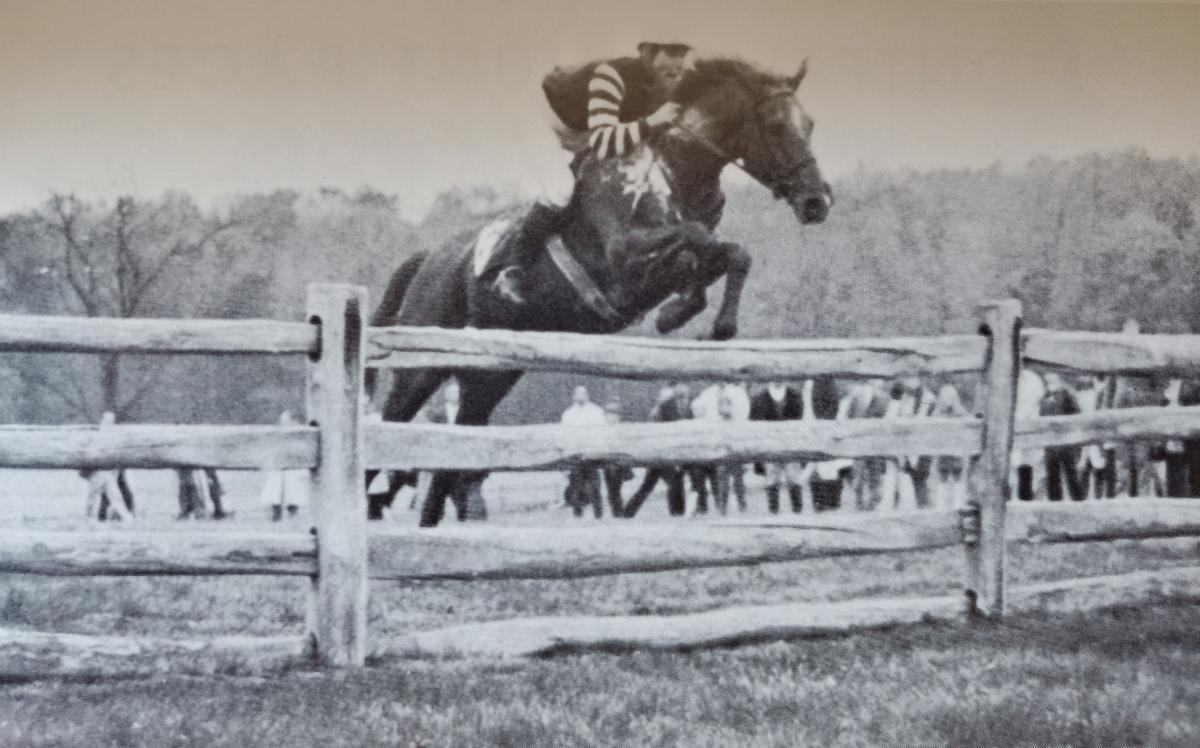
Beep, who Bunny says could jump the moon, won his 1971 point-to-point prep and was fifth in the secondary race at Grand National but fell in the Hunt Cup. In ‘72, he won at Essex and Radnor point-to-points, finishing fifth in Morning Mac’s Maryland Hunt Cup and fifth in the Pennsylvania Hunt Cup that fall (pictured, left, Freudy photo).
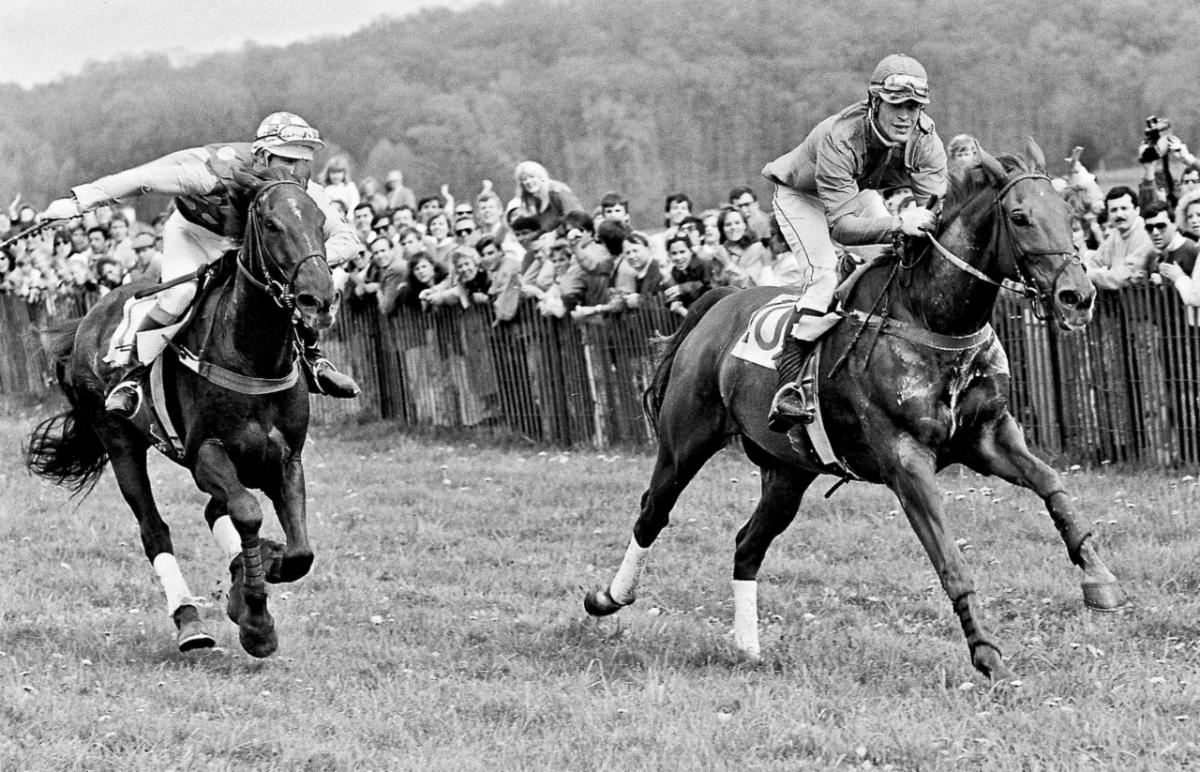
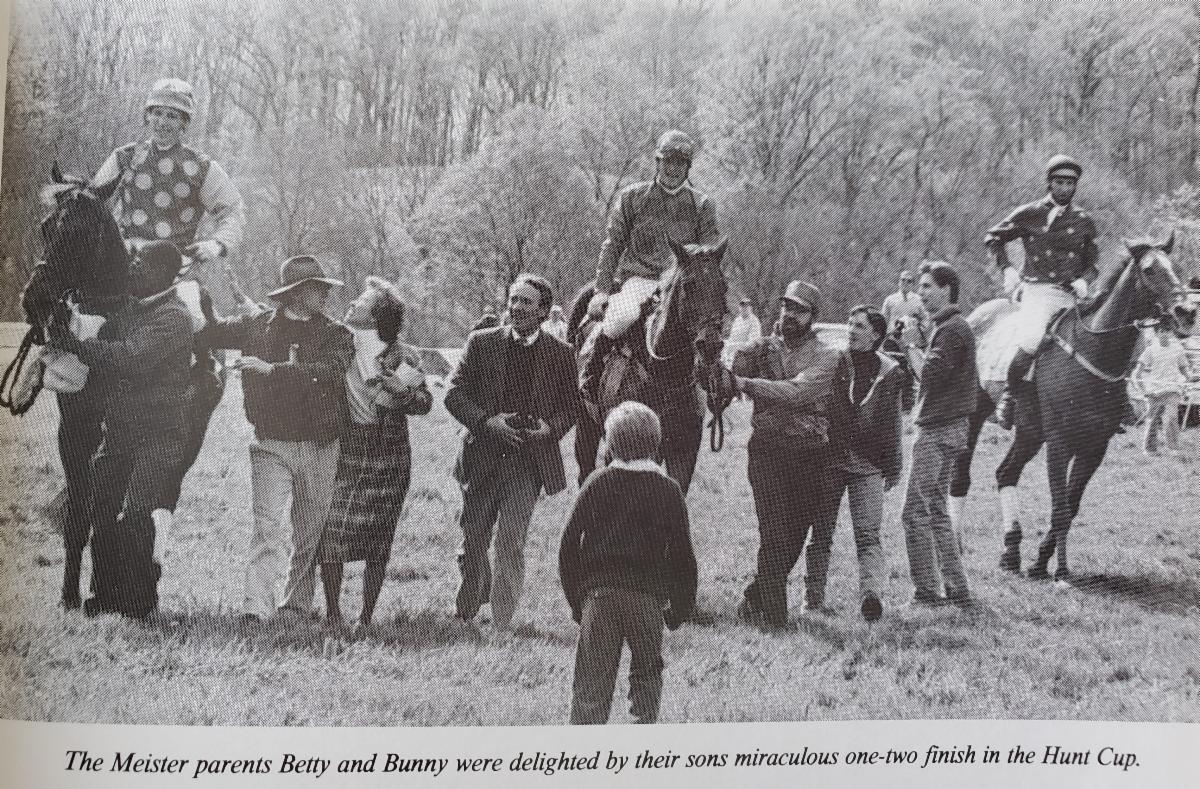
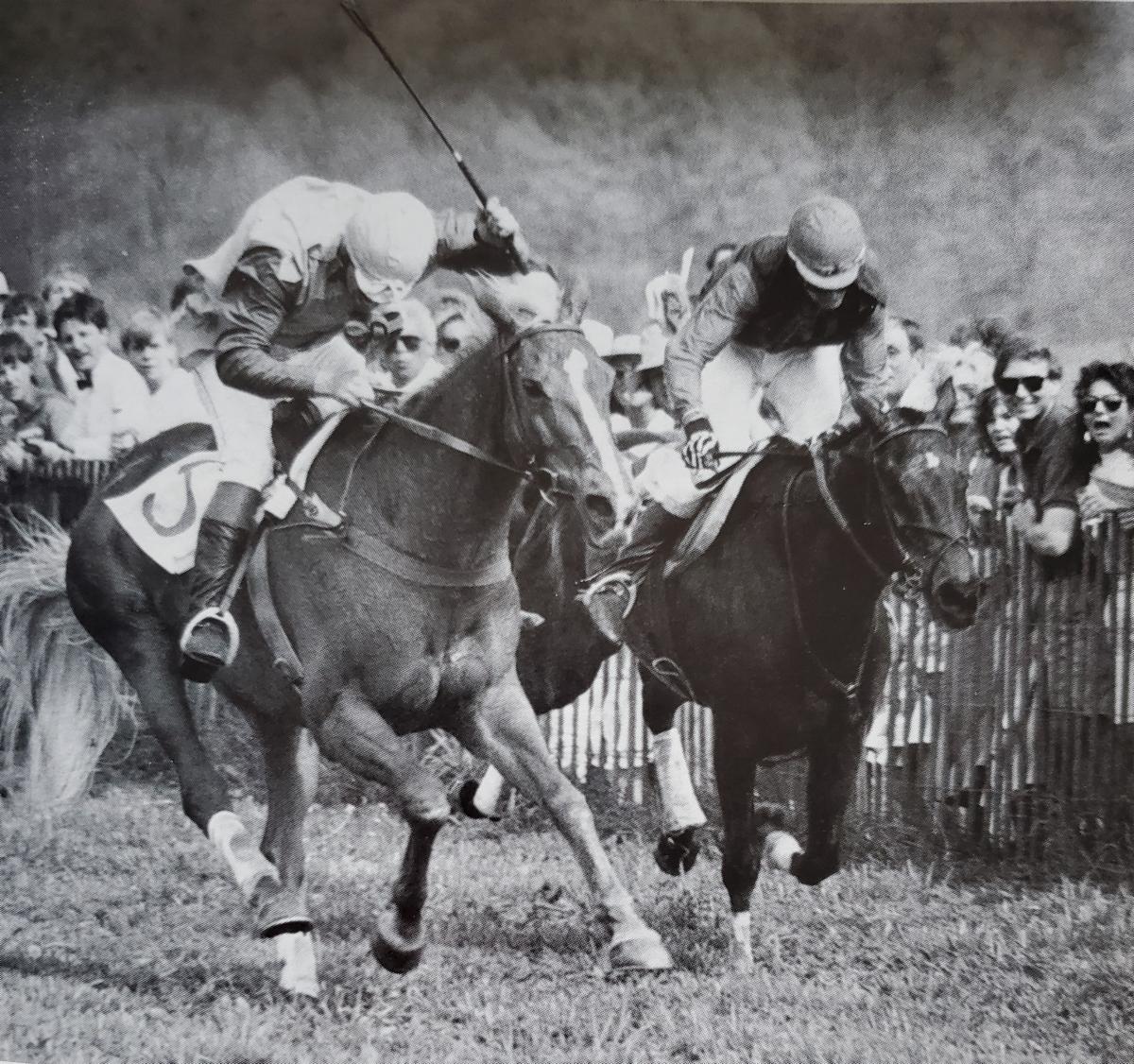
Though Bunny never won the Maryland Hunt Cup as a rider, Bunny recalls the 1988 race in which middle son Billy won (Freeman's Hill), with oldest son Jay second (Tom Bob.)
Bunny led the two boys up the stretch for the win photos, later telling a local publication that “a friend had said to me, ‘You weren’t the greatest rider, but you’re a good breeder.’ ”
|
|
Freeman's Hill, ridden by Billy Meister (right), held off the furious late charge by Tom Bob and brother Jay Meister.
©Douglas Lees
|
|
The Meister parents Betty and Bunny were delighted by their sons miraculous one-two finish in the Hunt Cup.
©Douglas Lees
|
|
These days, Bunny stays busy organizing the Brandywine races and juggling a busy real estate career. He started selling real estate in 1976 with James Cochrane, then, as now, believing he plays an integral role in conserving the rural countryside.
“The best way to preserve land is to have the right people buy it,” he says, “people who can preserve and maintain it.
“A lot of people are moving into ‘hunt’ territory who have no idea,” though he’s quick to point out that most newcomers welcome the hunting lifestyle.
|
Bunny Meister at the 2022 Grand National Steeplechase Races, with Nancy Swayne, the daughter of Bob Tindle. ©Douglas Lees |
|
Bunny Meister – community standout |
⭐ Studied at Trinity College in Connecticut
⭐ Served on the board of the Chester County Historical Society
|
|
⭐ Bunny Meister rode Jill Slater’s Stutter Start to win over timber at the old Essex, New Jersey meet (predecessor to Far Hills) in 1967.
⭐ Billy Meister rode Jill Fanning’s (Slater’s daughter) Freeman’s Hill to win at the Far Hills, New Jersey meet in 1987.
|
|
|
First to the post – Carl J. “Jay” Meister III |
Like his two younger brothers, Jay Meister began riding in utero when mother Betty Jane Baldwin Meister was pregnant. Jay, who turns 61 next week, says he “rode horses (on my own) since they could prop me up in the saddle.
“As much as my dad has to do with my successes in race riding, my mother was the one that put in the blood, sweat and tears. Well, she was the sweat, I guess, and we were the blood and tears.
“I hated every minute in the show ring,” he admits, though it did occasionally provide some levity. “One day at a show, I’m standing at the in-gate, not really wanting to be there but wanting to get it over with,” he recalls. “Some kid is coming out of the ring having all sorts of problems. I remember my mother saying as I rode into the ring, ‘don’t disgrace the family.’
“It became an inside joke.”
Once Jay’s parents eventually relented and set him loose in his first pony race – Central Entry records it as a small pony also-ran at Brandywine Hills Point-to-Point in April 1971. “Everything changed. Then it was fun again.”
|
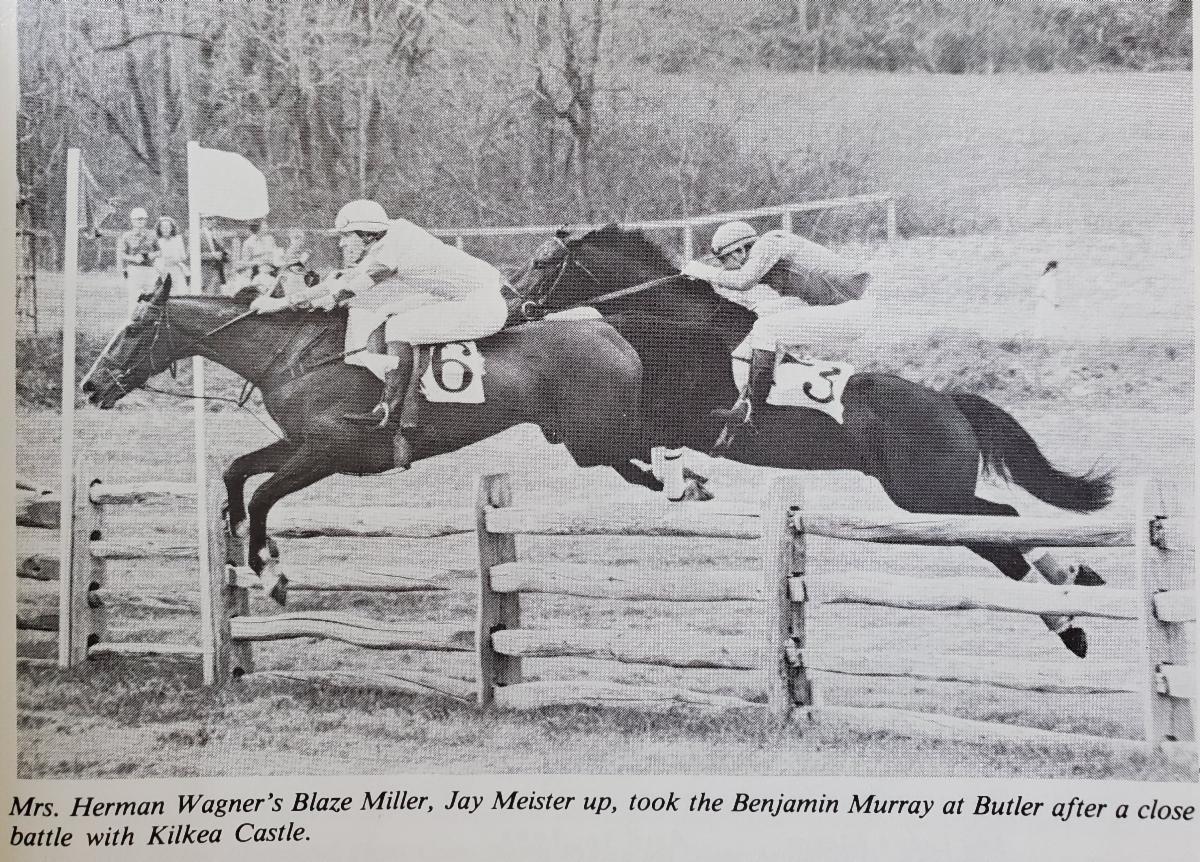
Jay Meister aboard Blaze Miller, winning the 1982 Benjamin Murray Memorial. ©Douglas Lees |
Jay went on to win most of the nation’s biggest timber prizes – Monmouth Hunt Cup (twice) and the Pennsylvania Hunt Cup with Blaze Miller, the St. James timber stake and Virginia Gold Cup steeplethon with Castleworth, and the Grand National timber stake with No Triskadekafobia.
He rode the Maryland Hunt Cup 13 times – twice second: Jay says it was Hunt Cup that revived the inside joke.
One early spring day in 1988, Jay went to neighbor, Olympian and show jumping Hall of Famer Frank Chapot’s to school Tom Bob for the Hunt Cup. As Jay remembers it, Chapot had the horse to refine his jumping form headed into the race. Since he’d never ridden Tom Bob, it was reasonable for them to practice.
“Before I went over, my mother quietly reminded me ‘don’t disgrace the family,’ ” Jay says. “God bless the guy – he let me school the horse in my exercise saddle in their indoor. The horse jumped great, but I knew I’d screwed up, and how little I knew about striding and horse show jumps when the horse jumped ‘in’ an in-and-out a little big and bounced out the one-stride.
“I knew he was ready for Hunt Cup.
“I’d learned from Mikey Smithwick that if a horse can’t jog over a 4-foot fence, you gotta keep schooling ‘til he can.
“I watched Dr. Fisher do that in the hunt field one day. He just clucked and jogged his horse over the biggest fence on the Pennsylvania Hunt Cup course over at Moran’s. That’s what it takes.”
From some 300 mounts 1971-1997, Jay rode 39 winners.
|
Jay at the Brandywine Hills Point to Point in 2022. ©Jim Graham
|
He retired after the 1997 season, but he’s stayed directly involved as Pennsylvania Hunt Cup board member, chair of the Delaware Valley Point-to-Point Association and announcing most of the local meets. Last year, he helped design the new Mount Harmon-Wicomico Hunt Point-to-Point with Brooke Boyer.
He operates The Covert Farm in Nottingham, Pennsylvania with wife and grand prix level show jumping rider-trainer, Priscilla Godsoe. An economics grad from Penn State, Jay worked for his father’s industrial supply business for years, then at at Dean Witter, Morgan Stanley and Smith Barney before joining Ameriprize Financial Services as a financial planner in 2011.
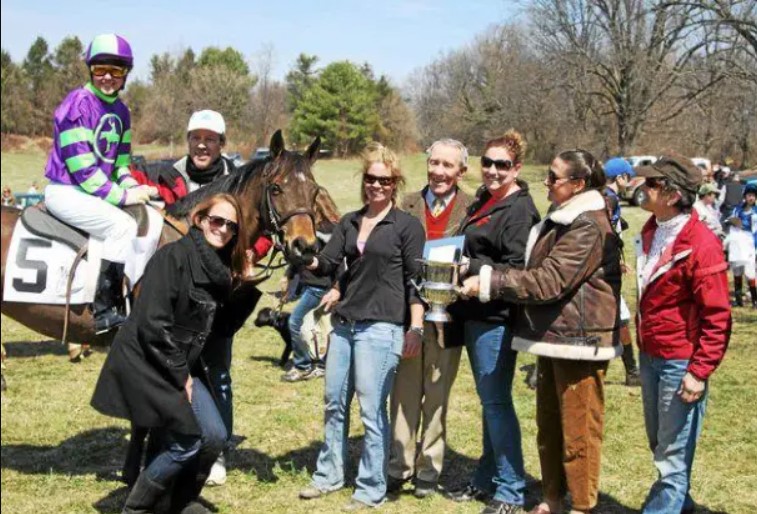
The Meister race legacy ran to a third generation, briefly – Jay’s daughter, Emma, is headed to law school this fall, but she carried the family tradition as a junior rider. She sweept the Brandywine pony series with Mookie Monster in 2013.
Mookie Monster also launched the careers of side-saddle champion Julie Nafe, jockey Skylar McKenna and current NSA leading rider Parker Hendriks.
|
Emma Meister and Mookie Monster in the winner's circle at the 2013 Brandywine Hills Point to Point. ©The Daily Local
|
|
‘Monster’ Man, Billy Meister |
William “Billy” Meister, now 58, says he’s lucky to have been born.
And perhaps lucky to have stayed that way after a run-in with a five-board fence on his game, but pony-sized mount behind the Brandywine hounds one memorable day at age 7.
“My mother, apparently, had two falls (while riding) with me when she was pregnant,” Billy recounts with a chuckle. “I mean, she was eight months pregnant, not one month pregnant. And, here’s the thing – I didn’t even know about this until the first year I trained Twill Do to win the Maryland Hunt Cup.
“At the party after, they’re giving speeches and toasts, and Liz McKnight goes and says that into the microphone while telling a story about me and my family.
“It was news to me. So now I just tell people that’s what wrong with me today.”
Billy hastens to add that he’s kidding, mostly. “I guess I born into riding.”
Like older brother Jay, he embraced foxhunting, the show ring not so much.
He remembers the day he went from the hilltoppers field to first flight in a single bound. It’s something he says seeded his affinity for running and jumping.
One day out with the Brandywine, “quite a serious hunt back in the day,” Billy says, “I accidentally jumped this five-rail post-and-rail on my pony, Candy Cane.”
It set his steeplechase future in motion.
Billy was a football star at Downingtown High, a varsity player, and an outside and middle linebacker in the First Bell League. “I wasn’t big enough, but I was tough enough,” he recalls leveling many a running back when he could get a clear shot.
“They called me Monster Man.”
He quit football because of a knee injury, and went on to study at Penn State, like Jay.
But after three years, he “was missing riding,” so he left school and returned home to Chester County.
He worked for his father’s company for a time, trading that for the horse business full-time when hired by eventual Hall of Fame trainer Mikey Smithwick.
He looked at it as an apprenticeship.
“I did everything there,” Billy recalls the long, hard days at Smithwick’s. It paid off in the end. “You rode, you mucked stalls. I went down there to learn.”
|
Billy Meister and Freeman's Hill (left) won the John Rush Streett Memorial at My Lady's Manor in 1984. ©Douglas Lees |
Billy notched his first stakes wins with Jill Fanning homebred Freeman’s Hill.
Freeman’s Hill won the maiden at My Lady’s Manor and the Grand National in 1984. He was third in the 1985 Virginia Gold Cup and won the 1987 New Jersey Hunt Cup. The pair won the 1988 Manor stake, and took the Maryland Hunt Cup two weeks later (ahead of his brother Jay and Tom Bob). He was second in the Grand National and Hunt Cup in ‘89.
Billy hung out a shingle as trainer in 1988. He started with three horses, including a maiden named The Hard Word that Smithwick was glad to siphon out of his own barn into Meister’s start-up operation.
Billy’s first winner as trainer under rules was Our Avatar in the maiden at the Manor; he saddled (and steered) The Hard Word, a maiden, to win the Maryland Hunt Cup two weeks later.
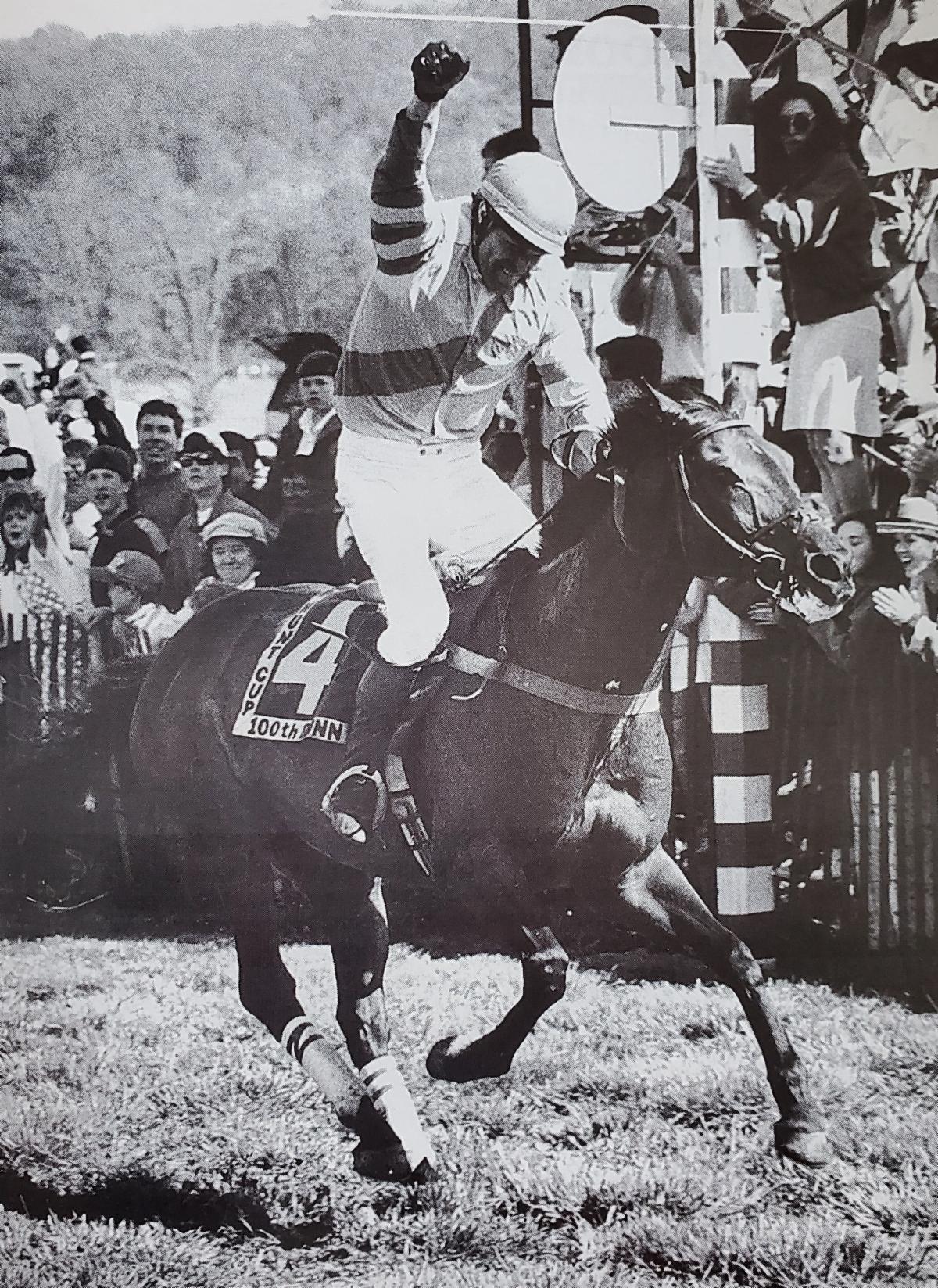
Billy won Hunt Cup three times as rider (1988 Freeman’s Hill, 1990 The Hard Word, 1996 Hello Hal), four times as a trainer.
One of his all-time favorites was Lucy Goelet’s Twill Do, who won the 2010 and 2012 Hunt Cups, fourth in 2013 and ‘14, seventh in 2015.
Rider James Stierhoff had the mount for all five.
After the first win, Stierhoff told Mid-Atlantic Thoroughbred magazine he was “awed by Twill Do’s good sense and cleverness,” something Billy honed in the hunt field on the Yarrow Brae gelding.
|
Twill Do and James Stierhoff crossing under the wire first in the 2010 Maryland Hunt Cup. ©Douglas Lees |
“There are not many horses I’ve ridden that I’ve had such a high regard for. I really just trusted him 110 percent,” Stierhoff said in the article. “You could ask him to do anything and he would do it. I’ll never forget the 2012 Hunt Cup, going into the 13th fence a horse fell directly in front of him. I just slipped the reins and said ‘Well buddy, you can figure this one out and I’m not gonna get in your way.’ He literally tiptoed around the horse and I picked up the reins, galloped into the 14th and kept on going.”
Billy retired from race riding after the 2014 season, citing two obvious reasons – “I was still healthy, retiring sound. And I was sick of dieting.”
|
|
|
From more than 600 mounts, as a rider Billy won 102 races from 1973-2014. As a trainer, he’s saddled almost 140 winners from some 1,400 starters. He’s won a dozen Delaware Valley rider titles, the Bryce Wing Award from the Maryland Hunt Cup, two NSA timber trainer titles and collected a double-handful of Maryland and Virginia series awards.
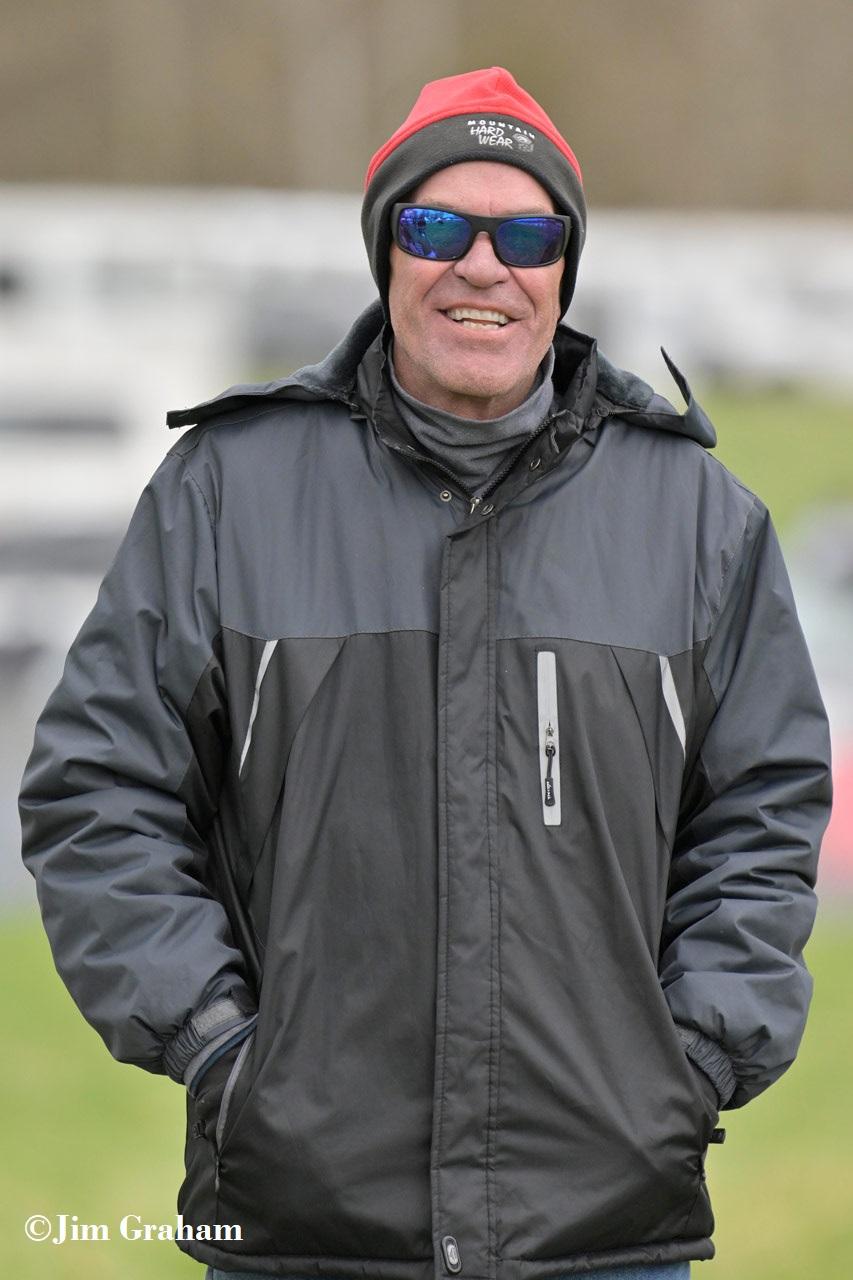
Today, he has 20 or so horses at his Tanyard Ridge Farm in Sparks, Maryland, everything from a broodmare with a foal by her side (back in foal, too, he hopes) to young horses, flat horses “from allowance horses to nickel claimers,” a few ‘chasers and a handful of pensioned timber horses. He hunts – whips in to Green Spring Valley huntsman Ashley Hubbard, on homebred Voler Bar Nuit and 2012 Grand National winner As The Eagle Flys.
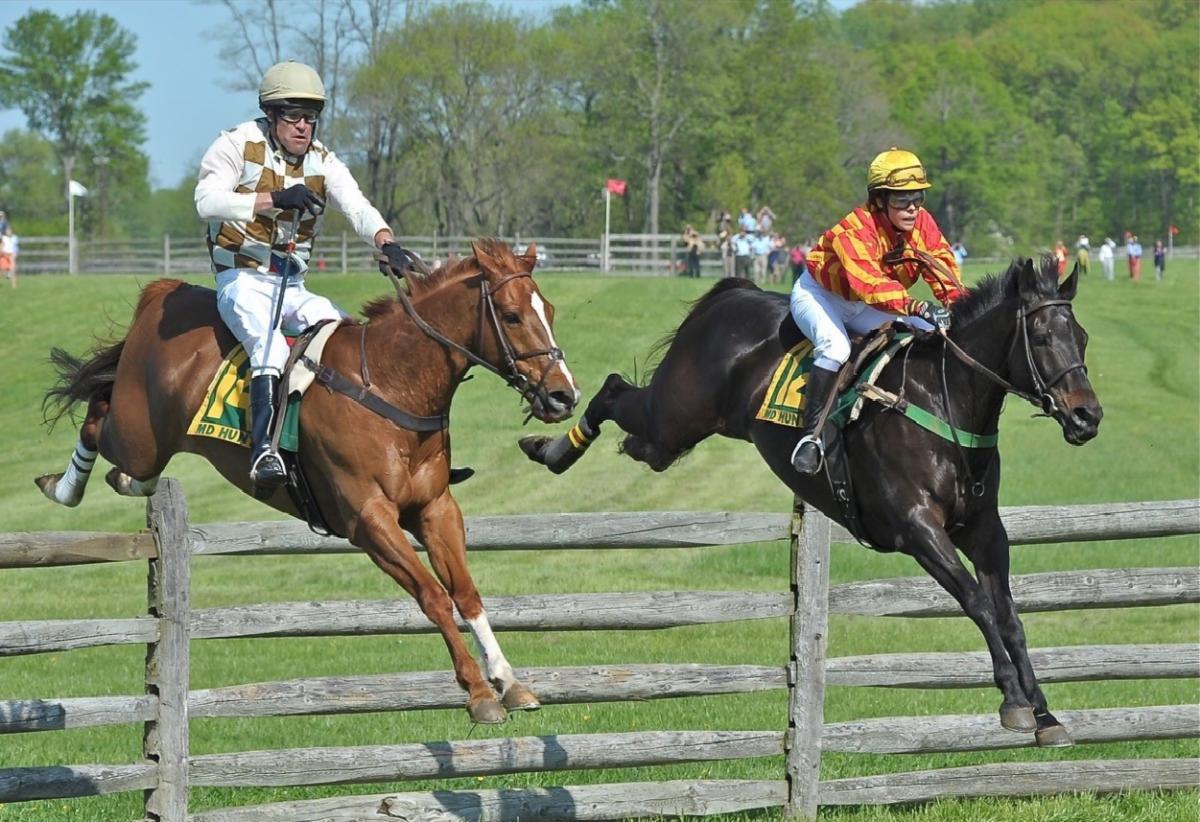
He trains and sells thoroughbred show horses and boards and conditions a few foxhunters. (Jim Graham photo, right)
|
|
From the Horse’s Mouth – Jay Griswold on the generational genius of the Meister clan |
|
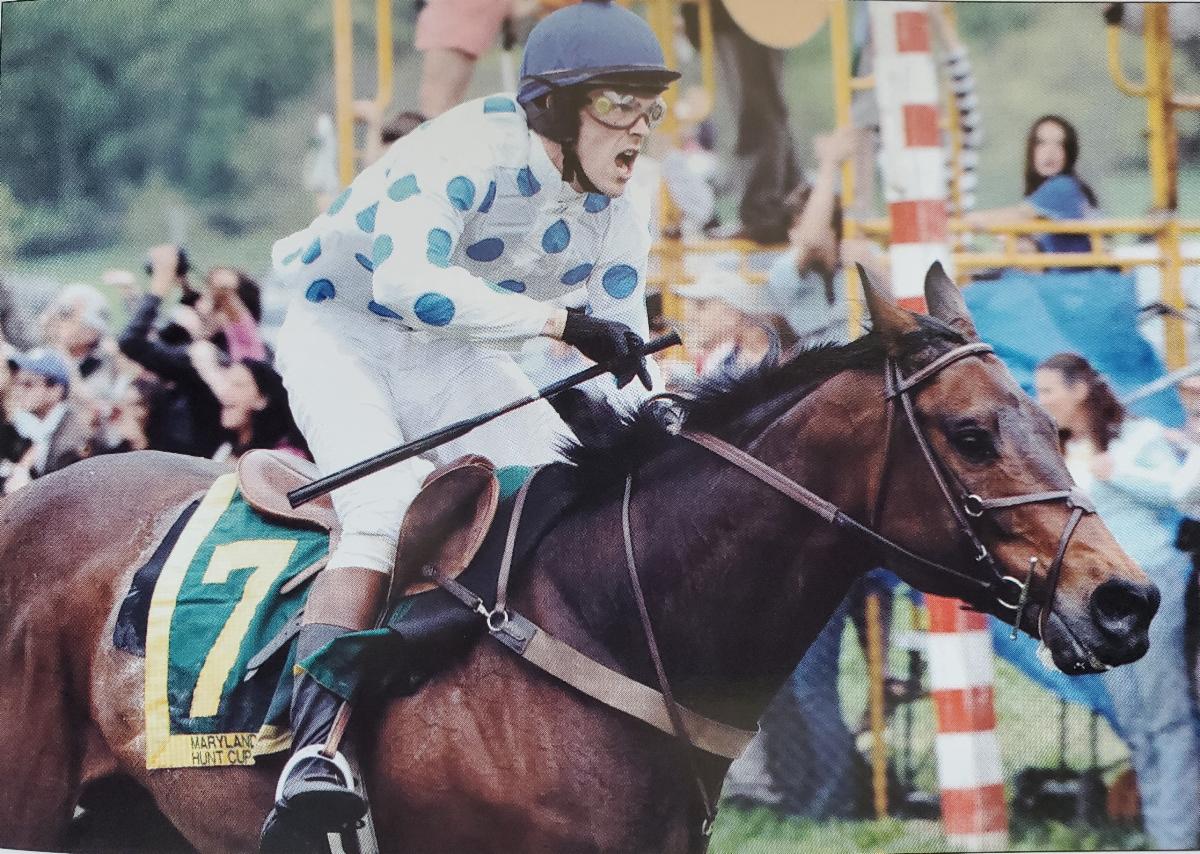
Jay Griswold owned Maryland Hunt Cup winners The Hard Word – 1990 with the Quartet Stables syndicate (pictured, right, ©Douglas Lees), and Hello Hal – 1996 with partner Doug Croker.
Both were trained and ridden by Billy Meister, one in a long line, Griswold says, of phenomenal and pedigreed horsemen and women.
“Billy’s a great guy,” Griswold says. “He was something of a Hunt Cup specialist, and a real natural for us to gravitate to when we wanted to (aim for) the race.
“My god, we had a lot of fun those years.
“All the Meisters are great – Jay rode for my sister (Nancy Knox.) I think they both got their talent from their mother,” Betty Baldwin Meister.
“She was such a great character, her brother (H.C. ‘Jiggs’ Baldwin), too. They were just this family of fearless equine pilots. Betty Jane won a lot of races, and those were the days they made it hard for women to ride.”
|
|
Billy trained out of Griswold’s Wit’s End Farm in Cockeysville, Maryland during the Hello Hal years. Griswold says he’d purchased the little horse – 15.1 – as a field hunter. “He was a handful, but, boy, he could jump the moon. Billy’s so tall, he looked kinda funny on him, but I remember that Hunt Cup. The horse jumped around the course like it was 2’6”, not 5 feet.
“Billy’s so good over a fence, they made it look easy.”
(Douglas Lees photo of Billy Meister and Hello Hal at the wire in the 1996 Maryland Hunt Cup - the win was Billy's third as a jockey and second as a trainer)
|
|
91st Radnor races Saturday |
|
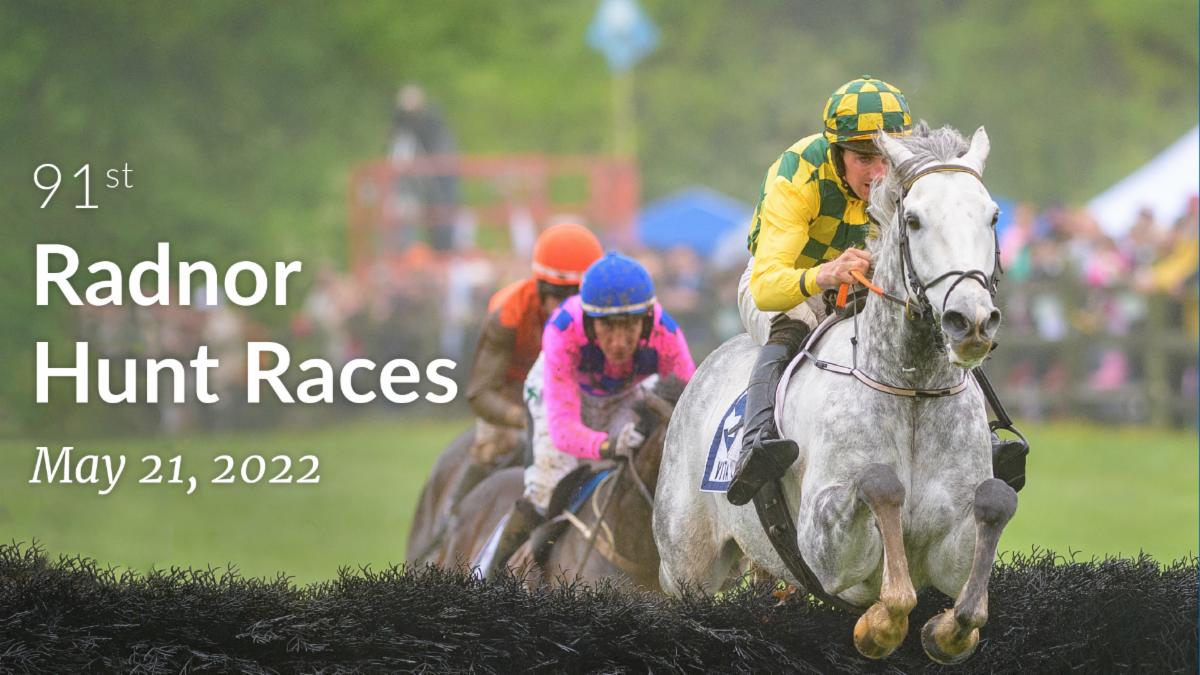
The Radnor Hunt Races celebrate 91 years of racing this Saturday, May 21. The meet runs over the Burley Cocks memorial course in Malvern, west of Philadelphia.
Featured are the Radnor Hunt Cup timber stake and the National Hunt Cup over hurdles.
The Radnor meet first ran in 1930; it’s partnered with the Brandywine Conservancy as beneficiary for more than 40 years. The conservation link was created by longtime Radnor chair, the late Betty Moran and the Brandywine Conservancy’s late co-founder, George A. “Frolic” Weymouth.
The meet has raised more than $5 million that helps protect more than 69,000 acres of open space, including the Radnor course itself.
|
|
|
|
|
|
|