|
At JWB we have had the honor of designing for seniors with Alzheimer’s for many years and the genuine satisfaction of playing a small part in helping these respected elders “Find Their Way” is a true joy.
The space available on these pages prevents me from delving too deeply into how to successfully “Do” Memory Care, but I can give you the broad strokes and some Dos and Don’ts. Here is some of what we at JWB have learned over the past twenty years.
First, “You Need to Generally Understand Behaviors.” I’m certainly not a clinician, but there are some basic behaviors common to dementia residents which dictate spatial flow and the functional hierarchy of spaces. In a memory care home, you are designing for early-stage Alzheimer’s residents who are more physically active when compared to late-stage dementia seniors who can be sedentary. Disorientation and confusion are common among Alzheimer’s residents. This sometimes creates a tendency for residents to “wander”. The challenge design-wise is to create a safe “circuit” for residents to wander without too much restriction. In order to help reduce disorientation and confusion we always try to incorporate way-finding elements into common areas. This can be done by varying the width, length, and shape of corridors along a wandering circuit and by placing identifiable “destinations” to create spatial variety and “markers” along the way.
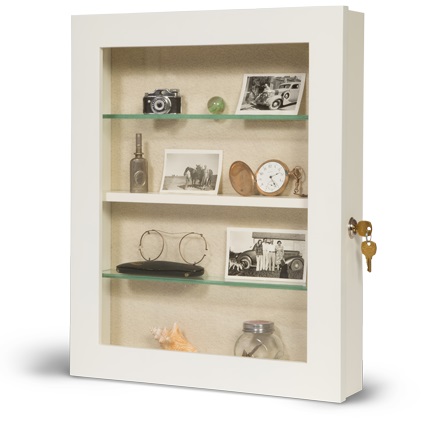
For example, a pocket lounge with an aquarium is created at one point in the circuit and an alcove with a tactile wall hanging featuring colorful flowers is situated at another juncture. The hope is that these spatial milestones help residents navigate and find their way…. “My room is near the fish tank” for example. Additional layers of wayfinding can be added such as recessed memory boxes next to a resident’s door with family photographs and mementos.
Disorientation and confusion often result in a resident losing track of time. Rapid mood swings can also occur. These and other symptoms can lead to severe agitation. Understanding this, we try to locate several “quiet” rooms/spaces where a staff member can try to calm an upset resident.
The same symptomatic “restlessness” that leads to wandering can also promote a “rummaging” behavior. We will often try to create a “rummage room” somewhere along the wandering circuit where this behavior can play-out safely. This could be as simple as providing a bin filled with clothing, pocketbooks, and similar soft items within an enclosed space. This space could double as a quiet room if need be. These quiet rooms and rummage spaces should be somewhat visually distinctive so they too can become wayfinding “destinations” along a wandering circuit.
Since every Alzheimer’s resident can exhibit a range of these behaviors as the disease progresses, it is important to design flexible spaces that can be used for a variety of programs and functions.
Dementia residents can have trouble understanding visual images and spatial relationships. Judging distances and determining color or contrast can also be an issue. Heavily patterned materials and severe color contrasts should be avoided. The tricky part here is to provide enough contrast to define where “the floor meets the walls” but not too much contrast so as to be confusing and agitating.
Click here to continue...
Sincerely,
John W. Baumgarten, RA, AIA, NCARB, LEED AP
Principal & President
|