One Thing I Have Loved Most 
About Being a Provost

In the week leading up to the announcement that I would be stepping down as Provost after nearly seven years, I reached out in advance to specific persons with whom I have worked most closely. In addition to Cabinet, my direct reports, and the staff in the Provost’s Office, two faculty in particular were on that list, Murli Natrajan and Sue Tardi. In the case of Murli, for three of my nearly seven years, he has been the chair of the Faculty Senate. As a matter of regular routine, we have gathered at least monthly for tea at Einstein’s to engage important academic matters ranging from policy issues, to programs in the approval or update pipeline, to the UCC, to a myriad of other topics of shared importance. With respect to Sue, she has been the president of the AFT for all of my time here and together we’ve navigated many challenging issues with impact on faculty.


In my conversation with Sue, we reflected on the AFT-sponsored workshops for faculty on retention and tenure, promotion, range adjustment, sabbaticals, and ART. Those sessions have been one of the most gratifying activities for me, in part for the trust built with the Union to be a co-facilitator with them, but also because for me, reading portfolios is an aspect of the job that is most enjoyable—seeing the wide range of accomplishments across teaching, scholarly, and service domains. Although it is enormously time-consuming, reading how faculty have deployed their talents, and at different points in their career, simply put, reinforces what makes being a college professor such a special calling.


What places this aspect of the provost role at or near the top of what I have loved most, however, are conversations with faculty who accepted my routine invitation to talk about their application in a circumstance where they did not receive the desired outcome. No one did this for me across my faculty career, and I was determined to do what I could to help others be successful in theirs. Such conversations were invariably deep and reflective, and required as much active listening on my part as offering counsel. But by the end of every meeting, I’ve sensed an unusual connection between the two of us that transcended positional differences, and we’ve both benefited from it. I have also seen over time in subsequent portfolios and review processes how it has benefited them or will benefit them going forward. Thank you all for these conversations; you know who you are, and I look forward to seeing you grow and flourish in your careers.

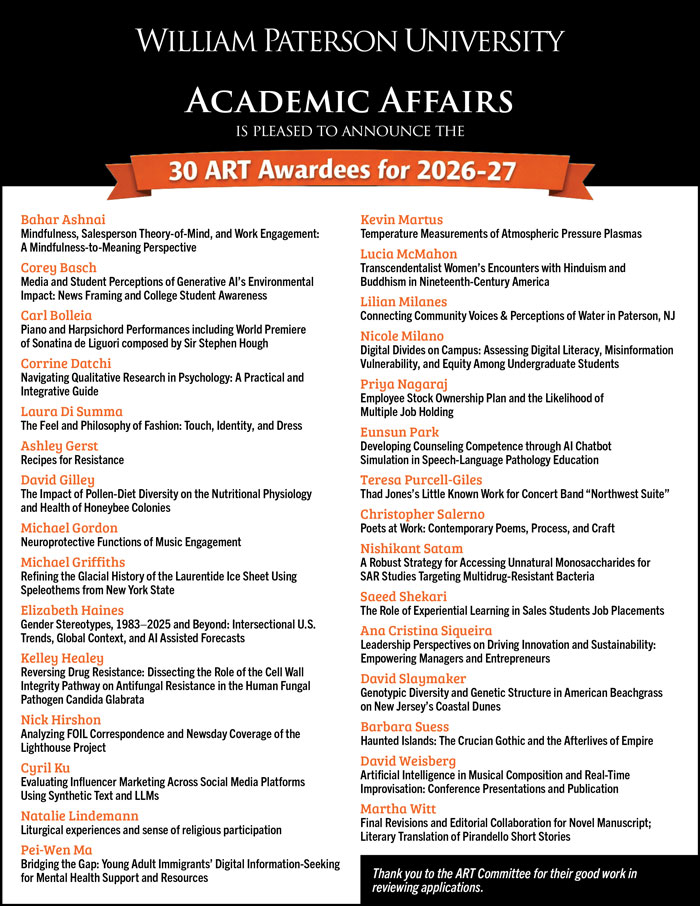
With that as backdrop, and in the spirit of warmth that comes from the wonderful array of scholarship that occurs across this campus, it is my pleasure to relay the names of faculty who received ART for 2026-27. These 30 faculty proposed strong applications that were well aligned with the criteria. Thank you to the ART Committee for your good work as part of this process.

Click on the image to enlarge.

Academic News


Important Curriculum Timelines.
With only a few Faculty Senate meetings remaining this semester, please make every effort to have curriculum proposals to the Senate Academic Programs Council within the next two weeks. Also, please keep in mind that any new major, graduate program, or certificate to be launched in Fall 2027 needs to be reviewed at Senate in early October. Whether a new program or a program revision, having a college review completed by the end of the semester enables Senate consideration at the start of the fall semester when the schedule is typically lighter. 


Adult Learner News. As you know, WP has made it a priority to empower adult learners to finish their degrees, both to advance their personal and professional growth and to support our region's long-term economic sustainability. To that end, the CAPS team is collaborating with Admissions to host an Adult Learner Information and Networking Session on Saturday, April 25, 2026, to support returning students through theSome College, No Degree initiative and help them complete their bachelor’s degrees with us.


On a related note, we recently celebrated the achievements of adult learner graduates via an
Industry Insights workshop they led for WP main campus, non-degree, and WP Online students in exploring career opportunities. 
This Zoom webinar focused on building careers in the in-demand fields of transportation, distribution, and logistics. The event was moderated by 
Dr. Steve Betts. Future panels will feature alumni in different fields, such as allied health professions or professional communications.


The Advantages of Cayuse. The Office of Sponsored Programs a few years ago implemented Cayuse, a tool to streamline the electronic preparation, submission, and tracking of proposals and other research administration processes. It is proving a valuable means of simplifying and speeding the process of grant application preparation and execution, as well as serving as a centralized tool for college leadership (department chairs and deans) to view the array of sponsored program activities of their faculty and staff, and all involved in a grant, not just the PI and co-PIs. Support of certifications such as through CITI training in areas like what is expected to meet IRB protocols and ethics compliance is also now integrated into Cayuse. For a full perspective of trainings available, click here.


Facts & Figures


The Strada Education Foundation publishes a powerful State Opportunity Index that annually measures how effectively U.S. states connect public postsecondary education (degrees and certificates) to workforce opportunities. Some key findings for New Jersey and in national perspective from their most recent report (2025):


  • ROI for a bachelor’s degree: 74 percent vs. 73 percent nationally
  • Percentage of students who had a paid internship:34 percent vs. 
    43 percent nationally
  • Percentage of students who had any work-based learning experience: 
    72 percent vs. 72 percent nationally

Quotables


A few quotes, emblematic of their eras, and that have resonance in our current higher education moment:


“The whole people must take upon themselves the education of the whole people and must be willing to bear the expense of it.” — John Adams (1785)


“The nation that will not invest in the intelligence of its people will be ruled by tyrants, not by ideas.” — Ralph Waldo Emerson (1837)


“The university is so many things to so many different people that it must, of necessity, be partly at war with itself.” — Clark Kerr (1963)

The Provost’s Office is Brenda, Claudia C., Cicile, Jonathan, Kara, Tim, and Josh. You can reach us at 973.720.2122provost@wpunj.edu

Office of the Provost | 973.720.2122 | provost@wpunj.edu