|
My daughter Casey picked Park City Mountain for our ski trip together to Utah after New Year’s Day. She was nervous, having not skied in 10 years. I was nervous there wasn’t going to be enough snow. She discovered that skiing was like riding a bike; one doesn’t forget how. I rediscovered the fun that comes from 10 inches of fresh powder and watching a child experience that bliss for the first time. We found joy together in what makes us fundamentally human—the desire to be present in a moment through listening, laughing, emoting, learning, and being impacted, even changed, by another.
A few weeks ago, 10 faculty led a panel discussion on what they learned from a national AI in Teaching Conference the Provost’s Office sponsored them to attend. All had made a compelling case in the call for nominations on what they hoped to gain and bring back to their teaching and for their colleagues. Nearly 80 faculty and staff tuned in to hear what they had to say and were not disappointed. The presenters had powerful points ranging from the philosophical to the practical, all with application opportunity. In addition, Chris Salerno, director of the Writing Across the Curriculum Program, led a workshop on what is arguably most vexing—navigating AI in the online asynchronous space and preserving authentic writing and learning. He too had valuable insights for the approximately 60 attendees. Links to these recorded sessions are available HERE and HERE respectively (password for latter: Sj8*a6E#).
| |
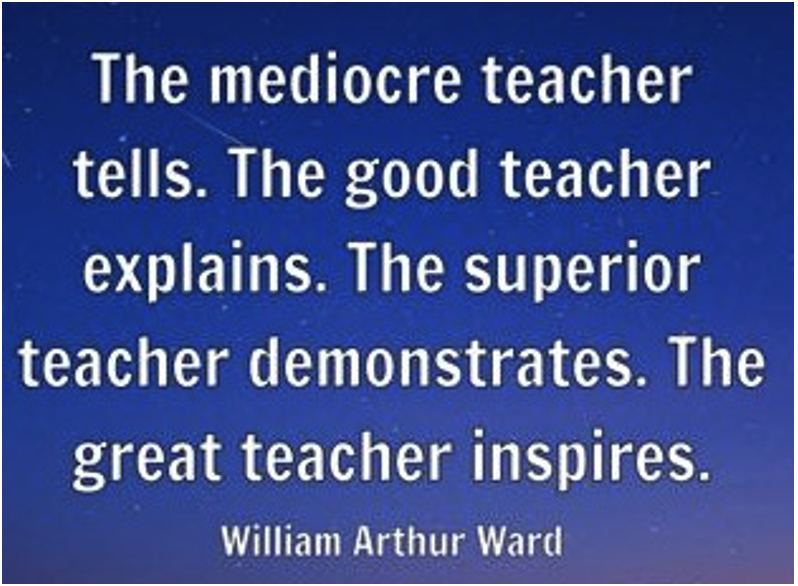
| |  | Under the hood of both sessions, and frankly of the broader discussion of AI, is the implication for one’s future, namely the belief, or fear, that AI will replace knowledge-based jobs. What was most powerful about the sessions, indirectly, but sometimes directly, was that AI can, and arguably should, be harnessed by the instructor to aid student learning, and that it can be done in a way that preserves the centrality of the instructor to the teaching and learning enterprise. Furthermore, there are ways to utilize it that enable more effective course design approaches and with time preparation efficiencies. But it does mean in some cases changing the paradigm of what it means to be an instructor, and of the ways one designs and executes assignments and assessments. Doing so, however, amplifies, not diminishes, the value of the student-instructor partnership for learning, and presaged by three paradigm-breaking teaching and learning articles from the past that I encourage you to consider in the age of AI:
Seven Principles for Good Practice in Undergraduate Education (1987)
Sage on the Stage to Guide on the Side (1993)
From Teaching to Learning: A New Paradigm for Undergraduate Education (1995)
My daughter surprised me with a postcard about a week after our trip, thanking me for it. I didn’t even know she knew what a postcard was, or where to place the stamp when mailing it. But I can tell you I will preserve it for all time. I know you, like me, have real expressions of appreciation from former students, either in letter or email form, perhaps even cell phone text. What led them to do THAT in my mind is what will keep a professor, an advisor, a counselor, a hall director, a coach, a cafeteria staffer, a fill-in-the-blank person relevant at the best colleges in the future. Students seek connection and meaning, and the best place to deliver on it is especially true in the age of AI within learning organizations.
| | |
Academic News
Academic Affairs Spring Address. Provost Powers, Associate Provost Lincoln, Associate Provost Rabbitt, and Dr. Murli Natrajan in his capacity as director of the UCC will be co-presenting this year on the theme of economic and social mobility. Drawing on this new phraseology in the University Mission Statement, their presentation will focus on how it has been manifesting in curriculum, courses, and related academic components of the student experience.
Welcome Tim Lever to the Provost’s Office. Many of you know Tim from his work in the finance area of the University. He has assumed a new role in the Provost’s Office as the AVP for Academic Operations where he has both budgetary and personnel duties, and oversees the Office of Sponsored Programs. He will also be welcoming a campus veteran, Cicile Samiz from the College of Education, as his new chief administrative assistant effective February 17. We welcome both as assets to the Division and appreciate your patience as they get up to speed. They are committed to continued responsive support including aiding the build of further capacity in colleges and departments for self-help in navigating personnel and budget processes, including with Workday.
Office of Sponsored Programs Updates. Congratulations to Carey Waldburger (Biology) for receipt of a NIH Postdoctoral Training grant ($56,000), to David Ferrier (Education) for receipt of a US-DOE Language Resource Center grant ($81,790), and to Quay Davis (CAPS) for receipt of an NJH Dept of Labor Workforce Development grant ($498,360). Also, a shout out to Johanna Prado and Quay Davis who each made submissions for highly competitive FIPSE grants in the arenas of Artificial Intelligence and Upskilling the Workforce, respectively, but were unfortunately not successful.
Academic Program Proposal Updates. Congratulations to the Department of Sociology, Criminal Justice, and Social Work for their certificate in Family and Child Welfare, which was just approved by the Faculty Senate. Program proposals from other departments and colleges are in the pipeline, including healthcare-themed ones linked to a partnership between PCCC, WP, and St Joseph’s Hospital.
| | |
Facts & Figures
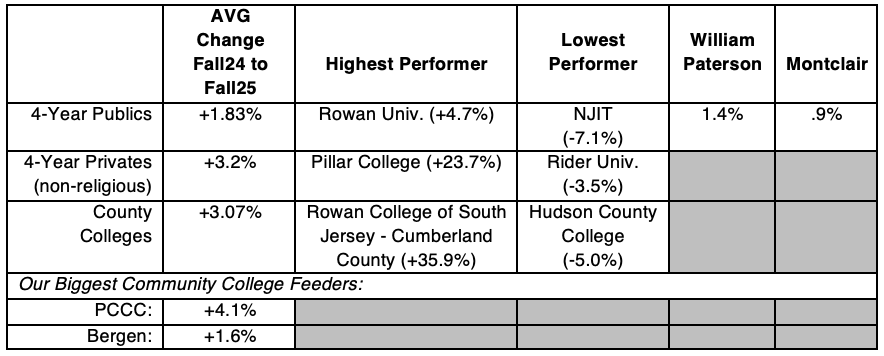
In December/early January of each year, OSHE reports preliminary fall enrollment data for each college in New Jersey (2- and 4-year publics, privates, and for-profits). Here are some noted observations from their report (LINK HERE for more information; scroll to the far right for the Enrollment by Institution tab):
| | |
Quotables
"Shaping the intellectual content of AI may be necessary to address the challenges that confront higher education, but it will not be sufficient. Confronting the material effects of AI on inequalities of wealth and power is even more critical, and the outcome of that struggle is hard to predict. What I do feel certain about, however, is that we need an active strategy. Whether we embrace ed-tech deals or drag our heels, educators are choosing between reactive postures. One way or another, we need to get our hands on the steering wheel of AI.”
—Ted Underwood (2025, November 4). “AI is the Future. Higher Ed Should Shape It.” Chronicle of Higher Education.
“Instructors who have taught in the same way since they were teaching assistants are having to rethink what they are trying to achieve in their classes.”
—Sharon Otterman (2025, January 25). “Some Professors Welcome A.I. as a Teaching Tool.” New York Times.
| | The Provost’s Office is Brenda, Claudia C., Jonathan, Kara, Tim, and Josh. You can reach us at 973.720.2122 • provost@wpunj.edu | | | | |