On Being Relevant in Today’s

Higher Education Marketspace

As some of you know, I was an economics major and English minor as an undergraduate. To this day, I use economic principles to help unpack what I see in the world and deploy writing skills gained from the drafting and critique of my and others’ work. However, I confess that in November of my senior year, I panicked. What am I going to do with these degrees? As things turned out, having been a student leader on campus, I made the fortuitous decision to ask my Dean of Students if it was possible to get a job working at a university. The rest is history.


In the 1980s, college was still seen as a social good—namely, an educated populace is a good thing. Starting in the 1990s, there began a shift to seeing college as a private good, benefitting the individual. Hence, it became the perfect legislative argument for less subsidized support through governmental appropriation or grants and for more of the cost to be borne by the individual and via loans.


The natural evolution of this shifted financing model ramped up complaints to legislators that college is too expensive and thus a questionable investment unless it leads to something concrete post-college. Hence, my senior year epiphany is actively on the minds of students and families at the get-go, and by extension, legislators are in our academic business like never before (read any recent issue of Inside Higher Ed or the Chronicle of Higher Education to see it). The most vivid example in my mind is the U.S. Department of Education’s College Scorecard. Its roots are in the Obama administration and anchored by his 2013 State of the Union Address in which he said this: “And tomorrow, my administration will release a new ‘College Scorecard’ that parents and students can use to compare schools based on a simple criteriawhere you can get the most bang for your educational buck.”

What has me thinking about this especially right now is the annual Program Vitality process. In the last few years, in late February I provide the chair of the Faculty Senate with a report on programs that were placed on probation the prior spring, as well as ones I will be recommending for probation or closure, informed by five years of internal and external data (see this link under Reports for this year’s reports by college and my letter to the Faculty Senate chair found under Supporting Documents). I have a cadence with the Faculty Senate; namely, these are my “currently planned recommendations to the President in mid-April” for which I invite Senate input. And that input has in some cases changed or adapted my final recommendations. What I know, though, is that deep under the hood is anxiety about relevancy. So let me say this, two items on what it is not, and three on what it is:


Being relevant isn’t only about being big. It is right and proper that we have programs of varied sizes, but we do need to pay attention to what leads a student to pursue a program or drop out of one.


Being relevant isn’t only about having majors. The delivery of high-quality general education is arguably MORE important than how many majors a department has. One new way this is being communicated is through a new SCH tab in the Vitality Report data. In addition, relevance comes in the form of focused experiences such as through a certificate that attracts current students, but also external ones to pursue just that.


Being relevant is about being able to clearly articulate what a student gains. By the Numbers on each department’s website seeks to do that. Integrating career-relevant content into courses and curriculum does so as well.


Being relevant is about taking action ourselves lest others do it to us. A number of states are DIRECTING their colleges and universities to take certain program actions. The fact that we are doing it ourselves through program vitality is gaining positive attention in Trenton.


Being relevant is about cyclical assessment and improvement. Program relevance is not an end point but a journey, just like good teaching is not an endpoint but a journey. Hence, all departments should engage their program vitality data and reflect on how to enhance relevance, regardless of what the data may infer and whether or not one’s program is mentioned in my report to the Faculty Senate.


Returning to my undergraduate major and minor, they turned out to be quite relevant, but I didn’t see it at the time. In today’s higher education marketspace, we need to be laser-focused on communicating relevance.

Academic News

Academic Affairs Spring Address. The PowerPoint and presentation transcript for each presenter is posted to the Provost’s Office website. We hope that the ideas shared on ways we do, and can, advance student economic and social mobility resonated, particularly as was described in the presentation by faculty who are doing extraordinary things and students who are the recipients.


Office of Sponsored Programs Updates. Jyoti Champanerkar, Paul VonDohlen, Cyril Ku, and Nan Wang received a $2 million NSF MaCS II grant in support of STEM workforce or graduate program entry for high-achieving, low-income students. Melissa Rosario Jimenez, WP SBDC director, received three awards: a USDA award for rural business development ($128,000), and two subawards from Rutgers for the 2026 SBDC ($282,620) and NJ Business Action Center ($97,000). Sherrine Schuldt received two County of Passaic Department of Human Services contracts for addiction prevention and education, one for $40,608 and another for $56,000. Congratulations to all for these achievements and for the good they represent for our students, the University, and/or the community.


Progress Update on a Faculty Certificate in AI. A Task Force of TAC is working on a certificate opportunity for faculty on AI. A requisite foundational component is envisioned to be ready by May and will be an online self-paced experience, although expected to also be available in a face-to-face session in May for those who might wish to work through it as a group. Intermediate and advanced level content is also envisioned. Under the hood of this initiative is the following:


Faculty should have agency in the degree to which they utilize AI in their work (whether teaching, research, or service), but such agency does not extend to ignoring it or treating it only as a matter linked to student academic dishonesty. Nor does it extend to faculty using it unethically. Engagement/education on AI benefits both the faculty member’s career and that of their students. This initiative is intended to be an investment in faculty, and by extension, their students.


Facts & Figures


College Scorecard range data for all New Jersey Publics (N=13) as posted on the main page for each institution:


  • Graduation Rate in 8 years:
    55% to 88%; WP: 62%
    .
    
  • Average Annual Cost (net price after grants & scholarships):
    $12,000 to $25,000; WP: $18,000
    .
    
  • Median Earnings (10 years after college entry): 
    $57,000 to $84,000; WP: $58,000
    .

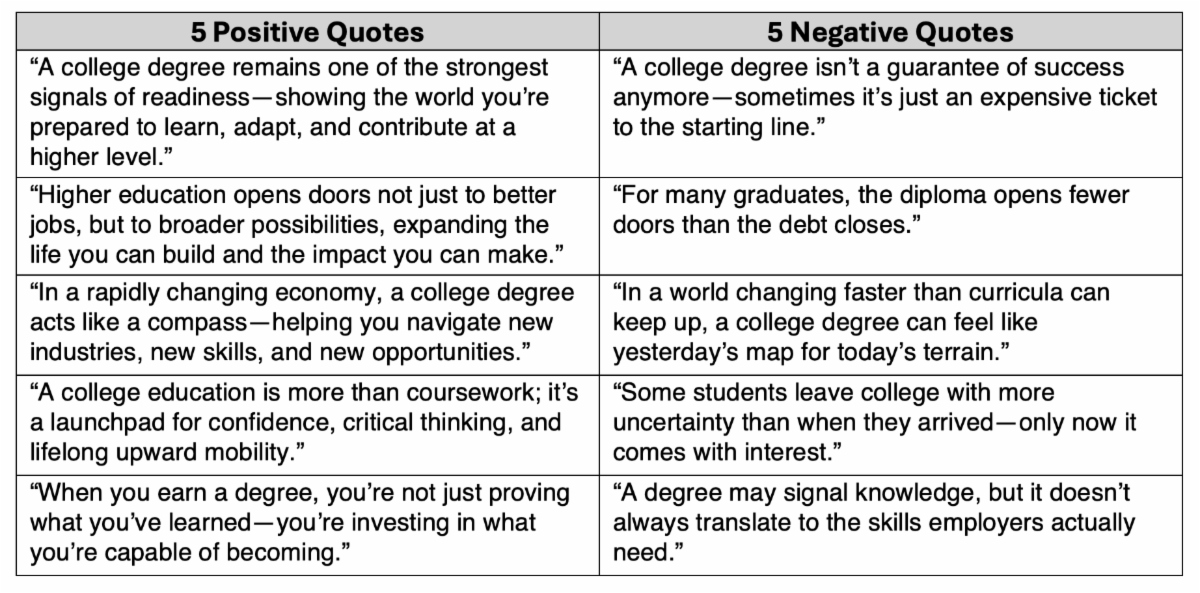
Quotables


I asked AI to mine what is known about the positive and negative value of a college education in the form of five original quotes on each. Here is what it produced:

The Provost’s Office is Brenda, Claudia C., Cicile, Jonathan, Kara, Tim, and Josh. You can reach us at 973.720.2122provost@wpunj.edu

Office of the Provost | 973.720.2122 | provost@wpunj.edu