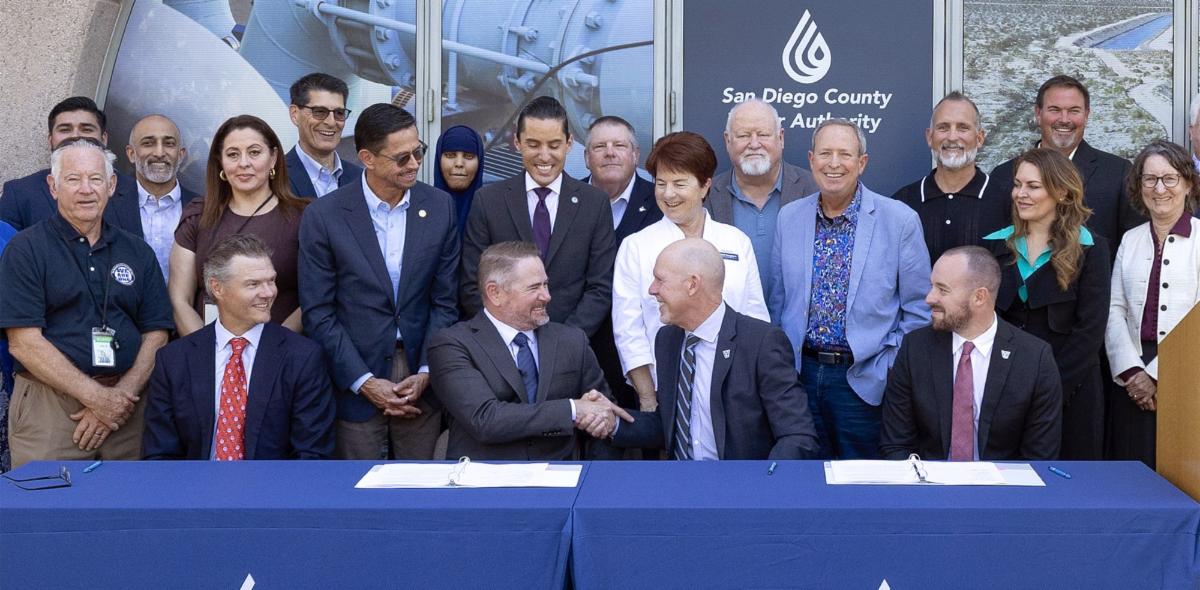
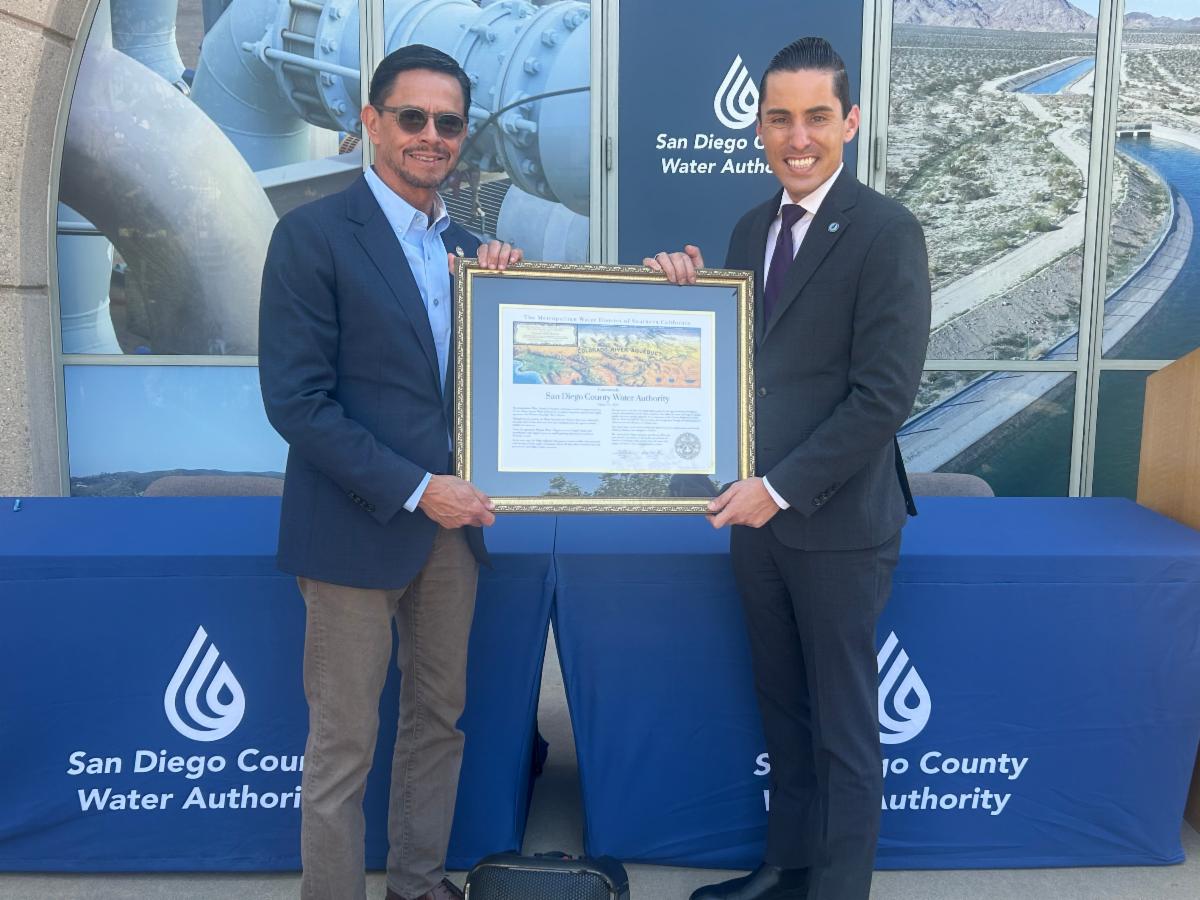
Southern California agencies reach first-of-its-kind water exchange agreement | | Above, Water Authority General Manager and Metropolitan Director Dan Denham shakes hands with Western Water General Manager Craig Miller at the March 19 signing of the agreement. Metropolitan General Manager Shivaji Deshmukh, Board Chair Adán Ortega, Jr., Director Martin Miller, Vice Chair Michael Camacho and Director Mel Katz were among the water leaders at the event. Below, Chair Ortega and Water Authority Chair Nick Serrano. | | |
Metropolitan leaders helped commemorate last week's signing of a historic water supply agreement between the San Diego County Water Authority and Western Municipal Water District.
The agreement is the first of its kind made possible by the legal settlement of litigation between Metropolitan and the Water Authority last year, which allows for San Diego to offer its exchange supplies to other Metropolitan member agencies.
Under the deal, Western Water will receive at least 10,000 acre-feet of water annually over the next 21 years, enough to supply approximately 30,000 Southern California households each year. Western Water, which serves a rapidly growing population in southwest Riverside County, will also pre-purchase about 30,000 acre-feet for future delivery.
The Water Authority said the exchange will allow it to generate revenue to offset costs associated with decades of water supply investments, while helping to reduce wholesale water rate pressures for San Diego County customers.
| |
“Southern California is an economic engine for the nation, and its future depends on a secure and sustainable water supply. Together, we are ensuring our region continues to thrive for generations to come and providing a model that can solve other water challenges in the Southwest.”
Metropolitan Board Chair Adán Ortega, Jr.
| | Metropolitan wins silver for best tasting tap water in United States | | Joyce Lehman, laboratory services unit manager, and Chris Riley, unit manager at Weymouth Water Treatment Plant, celebrate Metropolitan's award-winning tap water. | | |
Tap water served by Metropolitan is among the best-tasting in the nation, a panel of judges decided at the 36th annual Berkeley Springs International Water Tasting competition. Metropolitan took home second place in the municipal category during the February contest. It's the eighth medal the district has won in the international competition in recent years.
Metropolitan’s 2026 silver-medal water was a blend of water imported from the Colorado River, via Metropolitan’s Colorado River Aqueduct, and from the northern Sierra, via the State Water Project, and then treated with an ozone process at the F.E. Weymouth Water Treatment Plant in La Verne. As it leaves the plant, the water receives a small amount of chlorine disinfection to ensure its continued quality and safety throughout the distribution system.
“Metropolitan water quality and treatment staff work hard to ensure the water we deliver not only meets all water quality standards, but also consistently tastes good. While safety is always our top priority, for consumers good taste can be an important confirmation of water quality,” General Manager Shivaji Deshmukh said.
To help ensure great-tasting water and maintain quality, Metropolitan’s Flavor Profile Analysis Panel, a group of employees specially trained in the quality-control methods of the food and beverage industry, meets several times weekly to evaluate samples from throughout the district’s regional treatment and distribution system.
Read the press release.
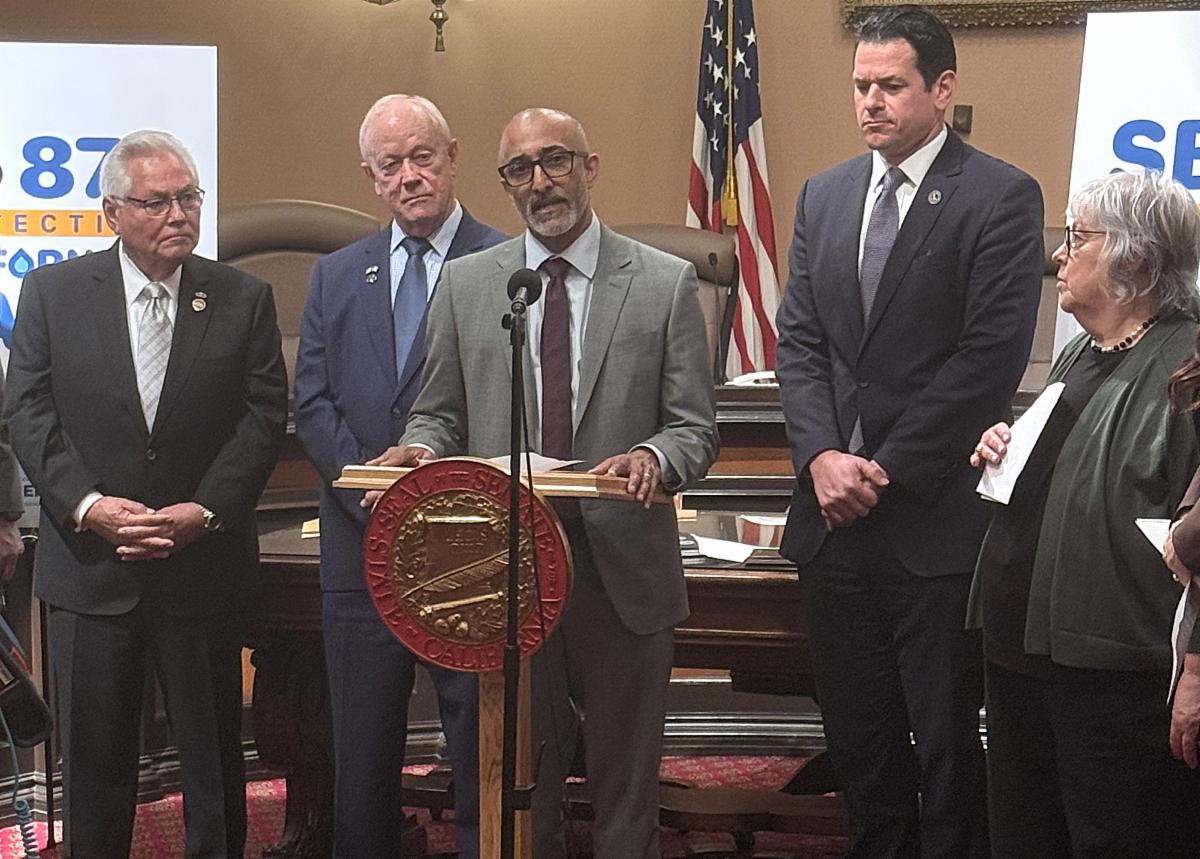
| | Metropolitan joins broad coalition to support subsidence, levee repair funding bill | | From left, Sen. Bob Archuleta, Sen. Jerry McNerney, General Manager Deshmukh, Assemblymember John Harabedian, and Barbara Barrigan-Parrilla, executive director of Restore the Delta, spoke during a March 17 news conference in Sacramento to support SB 872. | | |
This month, Metropolitan joined environmental groups and water providers in advocating for Senate Bill 872, which would invest $300 million per year through 2045 to make repairs to State Water Project canals and levees in the Sacramento-San Joaquin Delta.
The SWP provides about half of the water imported by Metropolitan. Many of the Delta’s levees are at risk of collapse and more than 200 miles of the SWP have been damaged by sinking land caused by over pumping of groundwater. Subsidence has already reduced water delivery capacity by up to 60% in some areas, and total capacity could be cut by 87% by 2043 if the problem is not addressed, according to a Department of Water Resources analysis. Repairs could cost $3 billion.
SB 872 by Sen. Jerry McNerney would commit $150 million a year to fix Delta levees and $150 million to fix SWP canals damaged by subsidence. The money could potentially come from the state’s Greenhouse Gas Reduction Fund, which is funded from the sale of emissions credits.
“The threat to California’s water supply and risk to Southern Californians, who bear no responsibility for the subsidence undermining the aqueduct that delivers our water supply, is unacceptable and requires urgent action,” Deshmukh said. “A long-term, durable funding source is needed to repair and prevent future damage to the State Water Project as well as to sustain Delta levees with more resilient engineered solutions. On this we can all agree.”
Read the press release.
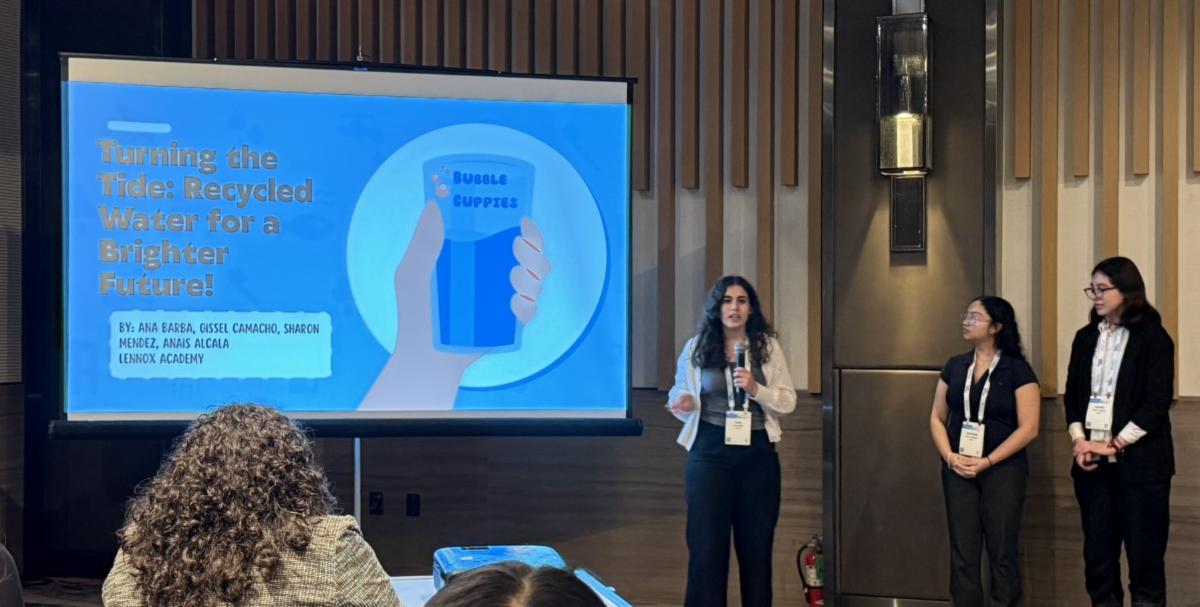
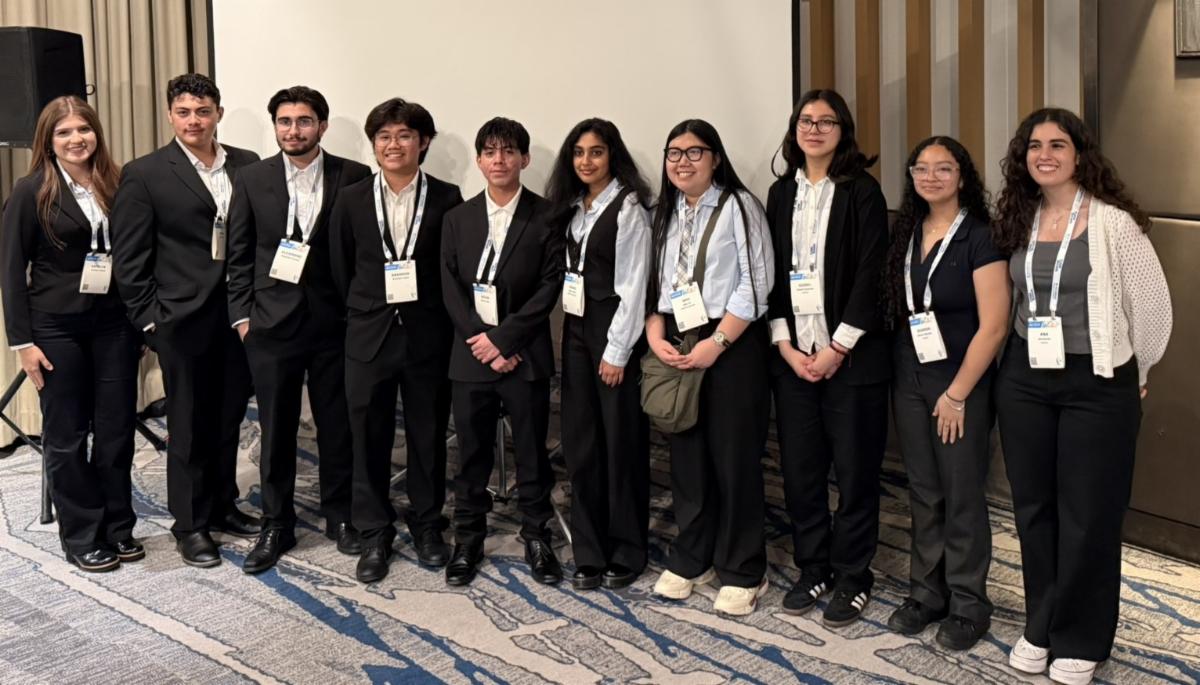
| | Southern California students take on water reuse challenges | Above, students from Lennox Mathematics, Science, and Technology Academy present their ideas for increasing public acceptance of recycled water at the WateReuse Association Symposium in Los Angeles. Below, the three winning teams after their presentations. | | |
Three teams of students from across Southern California shared their real-world solutions to water reuse challenges at the WateReuse Association Symposium in Los Angeles this month.
The teams were selected to present at the conference after winning Metropolitan's first-ever WateReuse Youth Summit in February. The competition challenged students to come up with practical, creative ideas to advance water reuse through engineering, water quality and public acceptance.
| | | |
The three winning teams were:
• Oxford Academy – Engineering Category (Team AQRO)
• Downey High School – Water Quality Category (Team Brine Busters)
• Lennox Mathematics, Science, and Technology Academy – Public Perception Category (Team Bubble Guppies)
| | Metropolitan Infrastructure as Art: F.E. Weymouth Water Treatment Plant | | When the F.E. Weymouth Water Treatment Plant shut down for maintenance earlier this year, Metropolitan's Unmanned Aerial Vehicle and Media Services teams took the opportunity to capture the beauty and style behind the treatment and delivery of reliable, high-quality water. | | | | |