|
Premium Resilience. Premium Outlook.
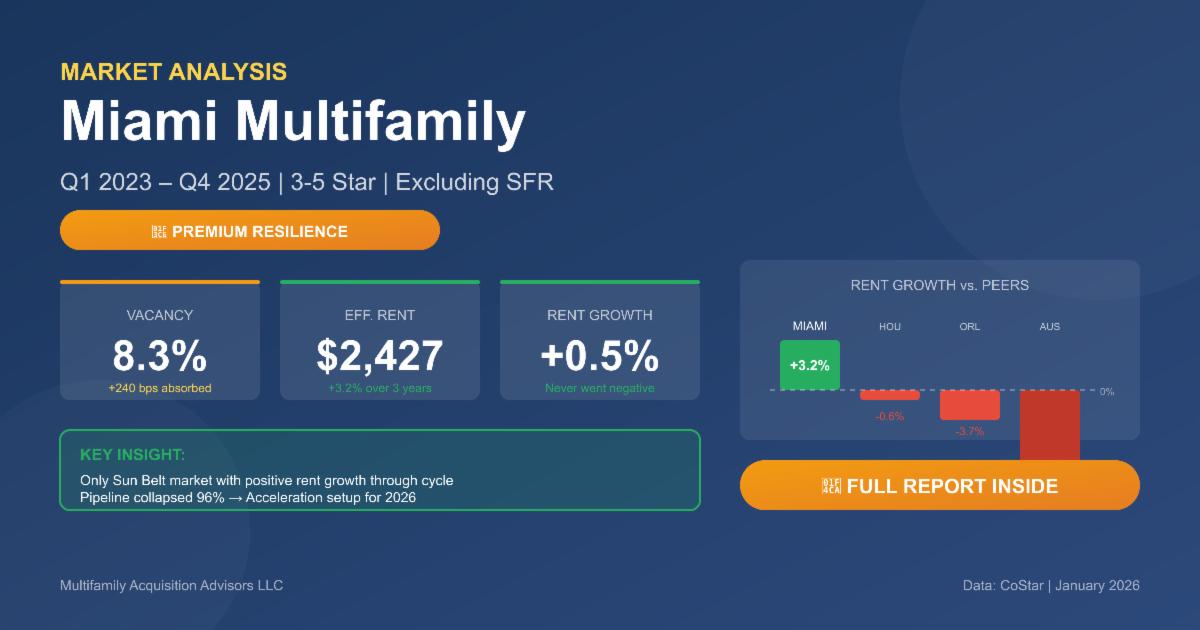
Every Sun Belt market we've analyzed over the past few months experienced rent declines during the 2023-2025 supply cycle.
Austin fell 12%. Dallas dipped before recovering.
Houston flattened. Orlando wobbled.
Every market except one: Miami.
I've just completed a comprehensive analysis of Miami's multifamily market through Q4 2025, and the data confirms what many suspected. Miami operates by different rules.
Effective rents grew 3.2% over three years while other markets were correcting. Year-over-year rent growth never turned negative. It bottomed at +0.2% and has rebounded to +0.5%.
Vacancy rose 240 basis points to 8.3%, but the market absorbed over 25,000 new units while continuing to push rents higher.
This isn't luck. It's structural demand: domestic migration from high-tax states, international capital flows, wealth relocation, and constrained single-family alternatives creating demand layers that pure job-growth markets simply can't match.
And now comes the real opportunity. Miami's construction pipeline has collapsed 96%. From over 26,400 units to just 1,145 today. That's effectively zero. With said demand drivers intact and virtually no new supply coming, Miami isn't set up for recovery. It's set up for acceleration.
What you'll find in this analysis:
- Why Miami maintained positive rent growth when every peer market went negative
- The structural demand factors that create Miami's resilience moat
- How a 96% pipeline collapse sets up 2026-2027 rent acceleration
- Insurance and climate considerations for Florida underwriting
- What Miami's performance means for Sun Belt portfolio allocation
For investors debating whether Miami's premium is justified, this analysis provides some data that may help clarify.
There is a lot of "noise" in our business. Whether you're evaluating potential acquisitions, refinancing existing assets, in lease-up, or analyzing your geographic exposure, this synopsis gives you basic market intelligence on where we've been and where we're going in a 3-minute read.
The multifamily landscape is shifting. Each market area will follow a unique path. Atlanta and DFW illustrate that the negative effects of oversupply can dry up quickly when new construction slows. Houston tells us that markets can react differently to supply shocks. Austin reiterates that the boom markets are often hit the hardest when shocks arrive. Orlando emerges as a potential Goldilocks market. Miami cements its position as an outperformer.
Click the Image Below to Access the Report.
|