News from the President's Desk | | |
Reflections from the Mid-Coast
Reflecting on the people, places, and projects that make the Mid-Coast Chapter thrive.
What a Year We’ve Had - Twenty-Fifth Anniversary!
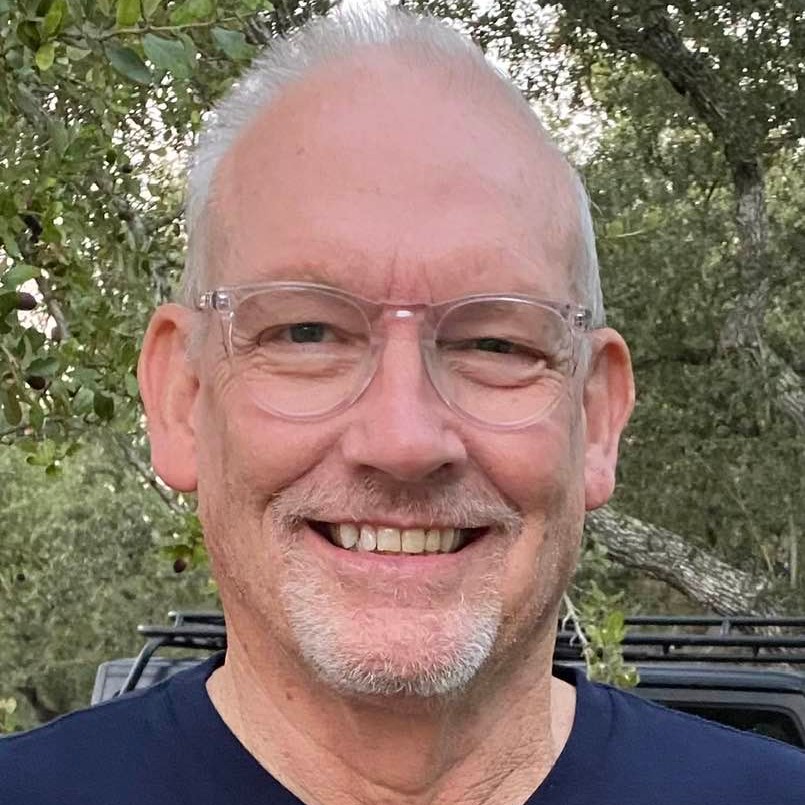
By Steve Ferguson, President, Mid-Coast Chapter TMN
Our Mid-Coast Chapter celebrated its 25th anniversary in 2025—a remarkable milestone for any small nonprofit, especially one with an annual budget under $25,000. The average lifespan of small, nature-focused nonprofits is only three to seven years, so our 25 years say much about the dedication of our volunteers and the enduring value of our mission.
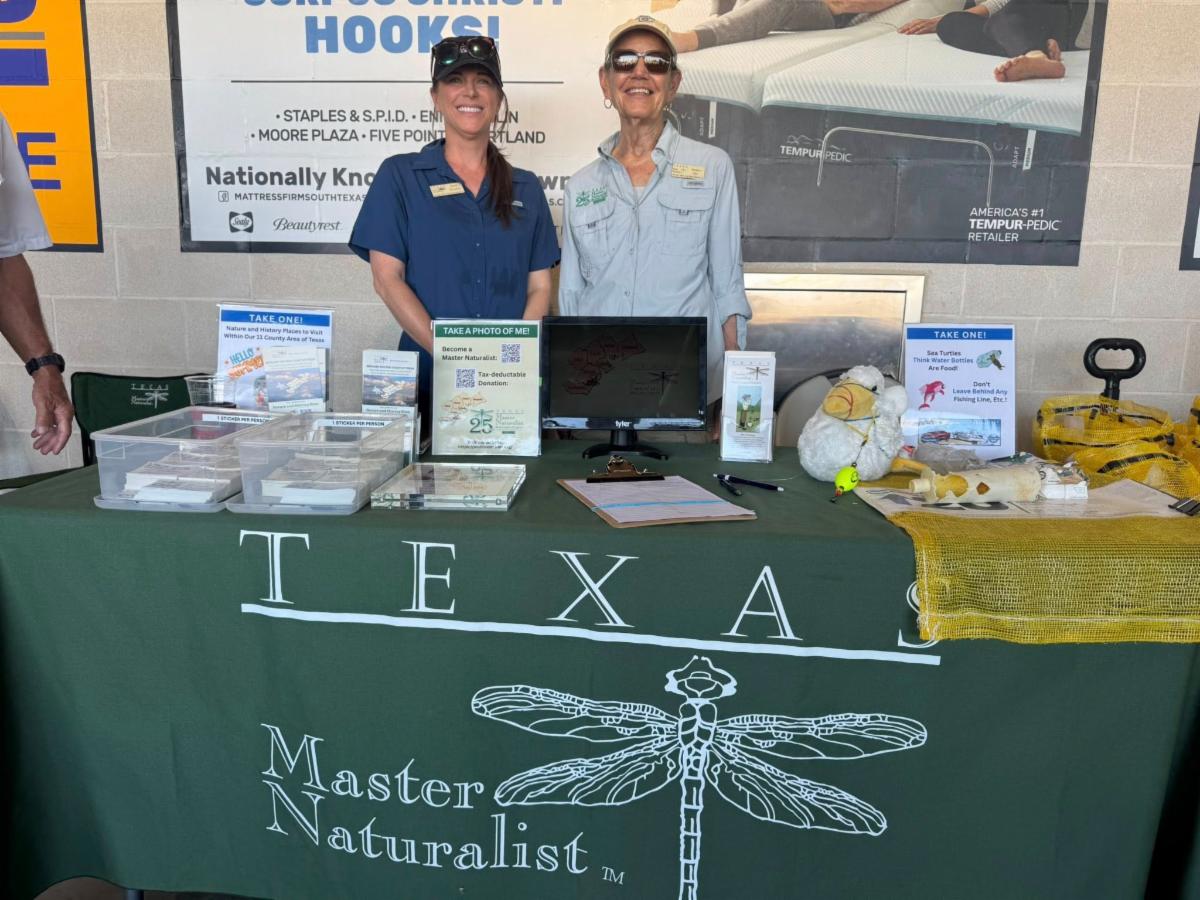
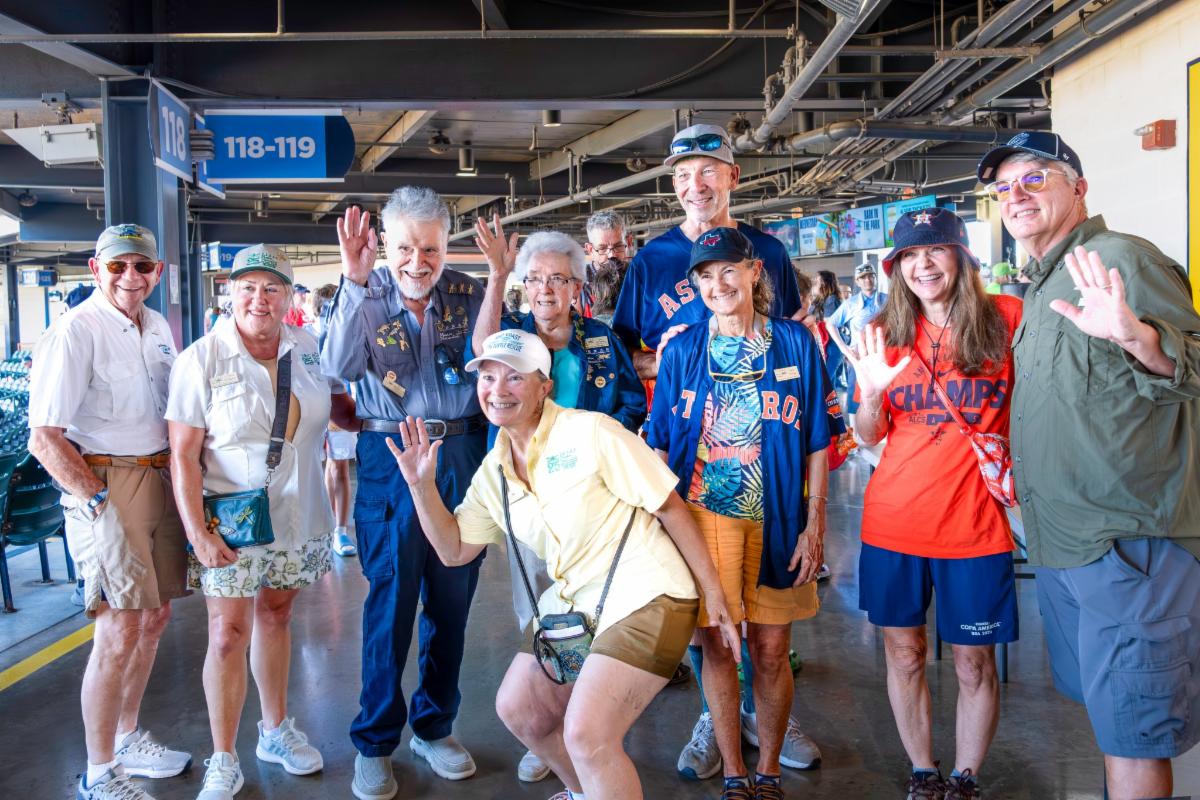
We marked the occasion with chapter-wide projects like our H-E-B Pollinator Garden Initiative, community events, a night at the Hooks game, and—most meaningfully—the graduation of our Initial Training Class of 2025.
Strong, servant-hearted leaders have always sustained our chapter. This year, Debbie Minns, Greg Simmons, and Sally Scroggs received our Chapter Leadership Award, one of our highest honors. They exemplify the spirit of service that defines the Mid-Coast Chapter and our work for the people and natural resources of the Coastal Bend
What We Accomplished
In January, H-E-B selected our chapter for a $3,000 Pollinator Garden Grant—thanks to Donna Bailey’s leadership and the dedication of many volunteers who planted and now maintain six gardens across our region.
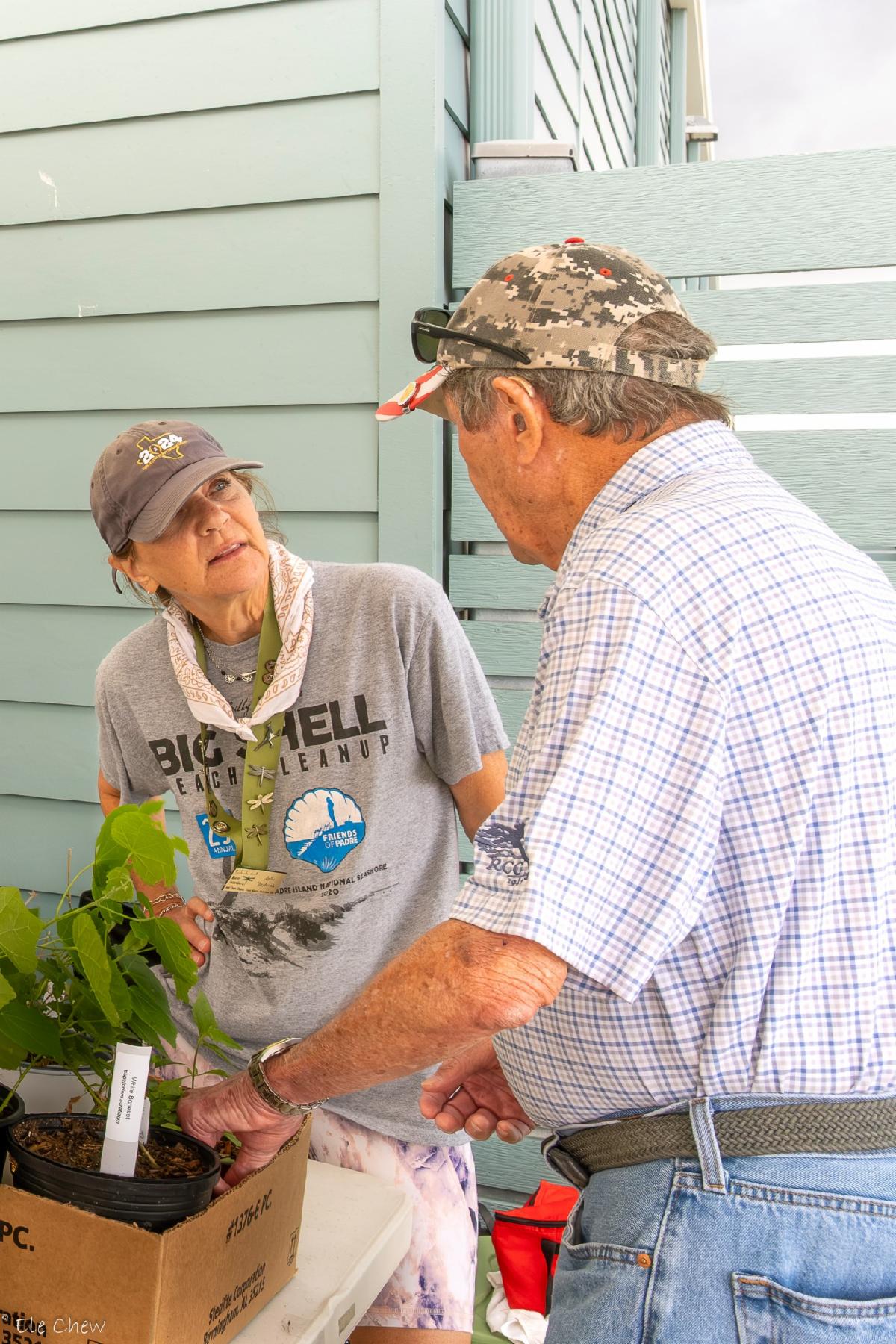
Our Native Plant Sale in September exceeded all expectations. Read Debbie Minn’s article in this issue for details about the remarkable team that made it happen.
Last fall, Tracy Bennett, Maureen Crocker, and Julie Hejducek formed a new
Fundraising Committee that quickly became a game changer. I had hoped they might raise a few hundred dollars. Instead, through persistence and skillful grant writing, they secured $13,400 from foundations, companies, and individual donors—funds that now cover about two-thirds of our 2025 expenses.
We also laid the groundwork for a new Naturalist-Youth Program at Rockport-Fulton High School, developed by a steering committee that includes Maureen Crocker, Amy Nowlin, Bill Burge, and Rachael Diaz (RFHS Science Department Chair). This initiative blends conservation education with hands-on fieldwork and could become a model for youth engagement across Texas.
What’s Next
In January, our Board set three goals for 2025:
- Strengthen relationships with community partners
- Build our fundraising capacity
- Use projects to enhance member engagement and satisfaction
We’ve made progress on all three. Our projects remain at the heart of who we are—the living expression of our mission to educate, engage, and conserve the natural resources of the Coastal Bend.
This year’s successes give us both an opportunity and a responsibility to use our people and financial resources wisely as we expand our reach and deepen our impact. In December, we Plan for Our Future when members of the 2026 Board and others will meet to chart that course for the year ahead.
Before closing, I want to thank Brigid Berger, our Vice President for the past two years, for her nearly two decades of service. Brigid’s creativity, dedication, and teaching spirit have strengthened this chapter—and her friendship has meant a lot to me personally. Thank you, Brigid!
In Closing
This has been a landmark year of growth, generosity, and gratitude. We’ve deepened partnerships, expanded projects, and strengthened our foundation for the future.
Thank you for being part of this extraordinary chapter and community. Together, we’re ensuring that our mission endures—serving the water, the land, the wildlife, and the people of the Coastal Bend for generations to come.
All the best,
Steve
Steve Ferguson
President, Mid-Coast Chapter, Inc.
Texas Master Naturalist
| | 2025 IN REVIEW BY MEMBERS | | |
HUMMERFEST PLANT SALE
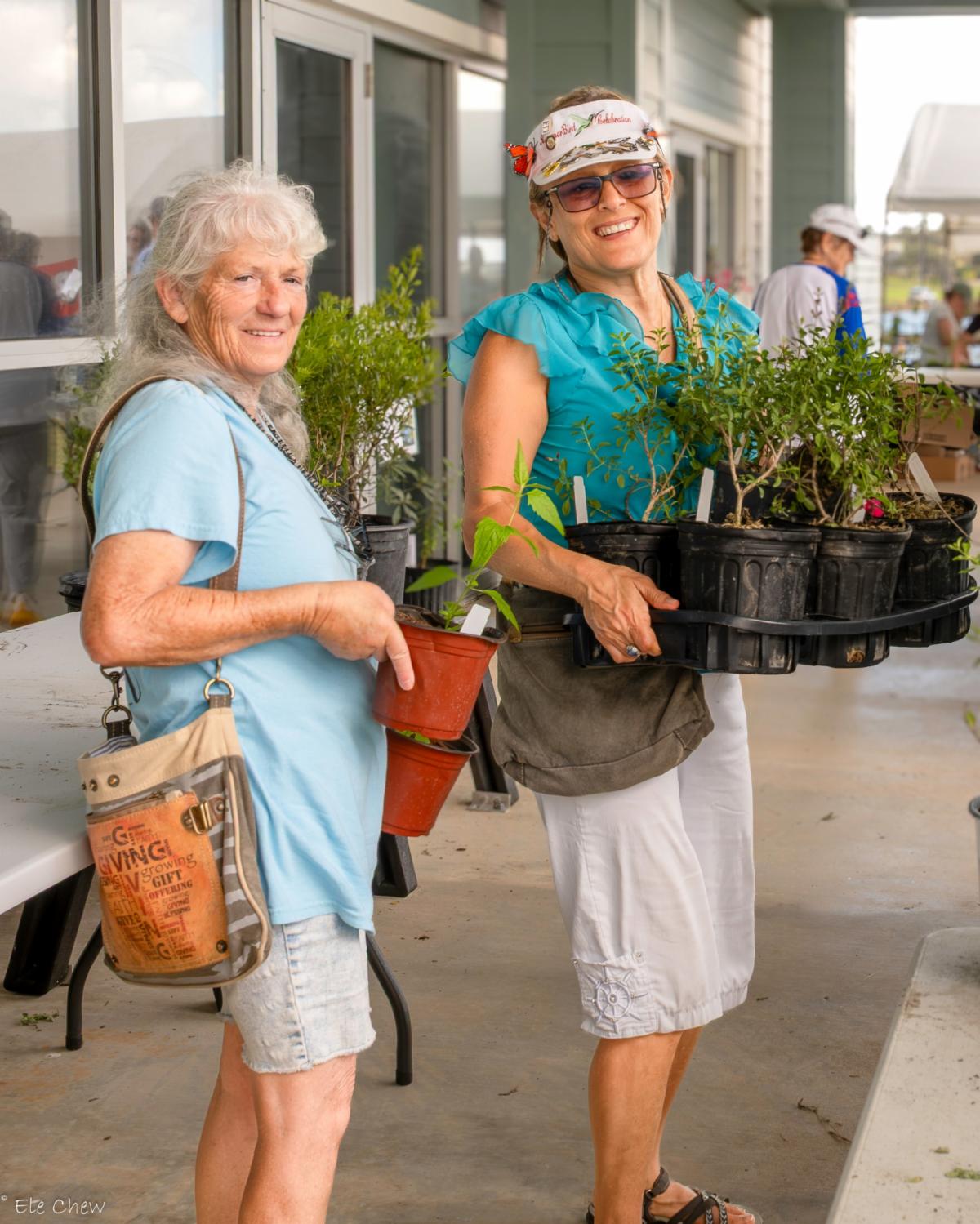
Thank you to everyone who attended our Plant Sale. We enjoyed visiting with you all!
We cleared $18,000 over 3 days, and it will certainly be put to good use in our 8-county area!
We also appreciate the hundreds of hours our Chapter Members put in to making the event happen.
Last but not least, our Plant Sale Chair, Debbie Minns, once again did an excellent job organizing the event and making it fun for everyone along the way.
Mid-Coast Chapter Master Naturalists’ Annual Plant Sale Fundraiser Blooms with Success
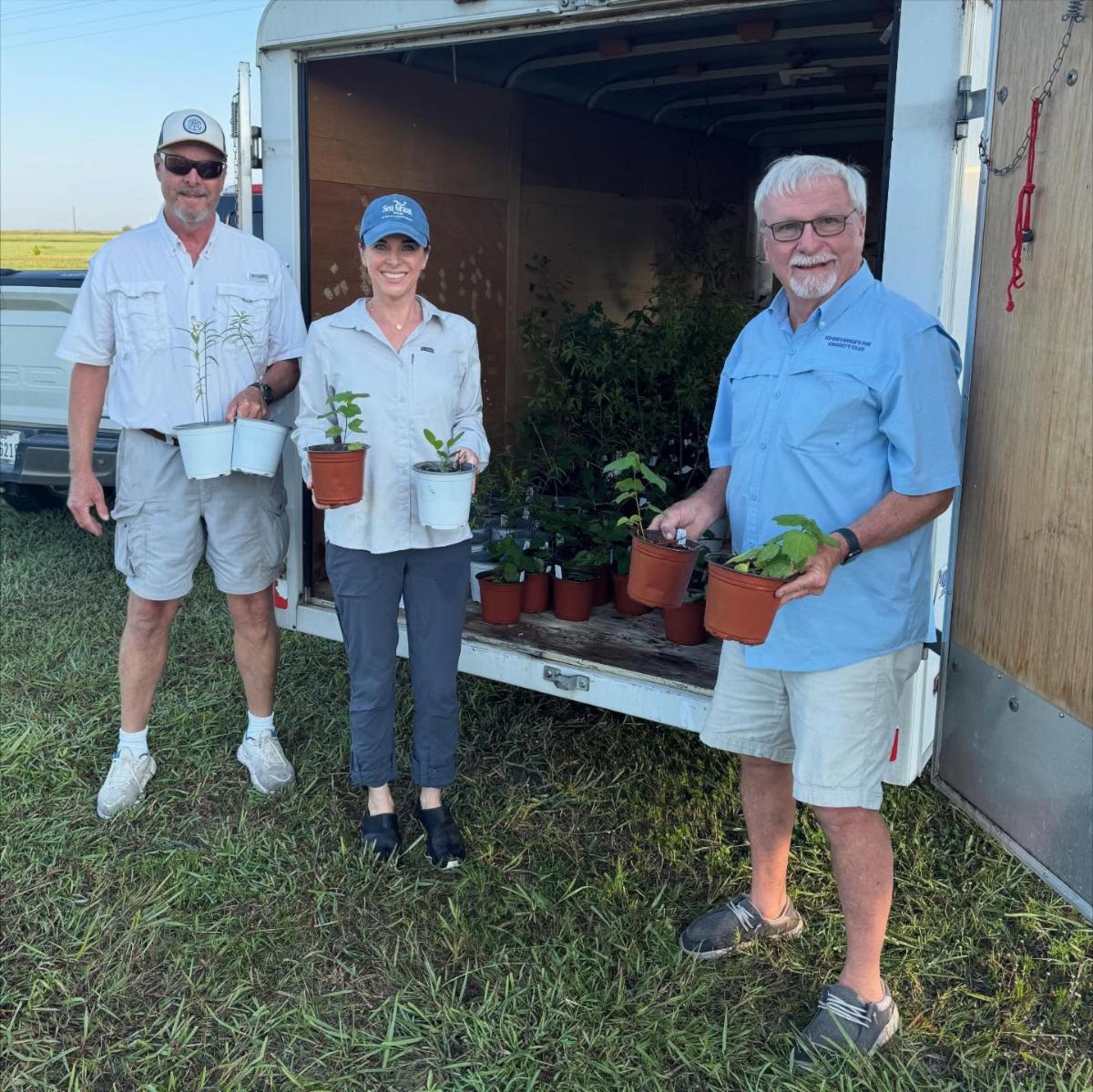
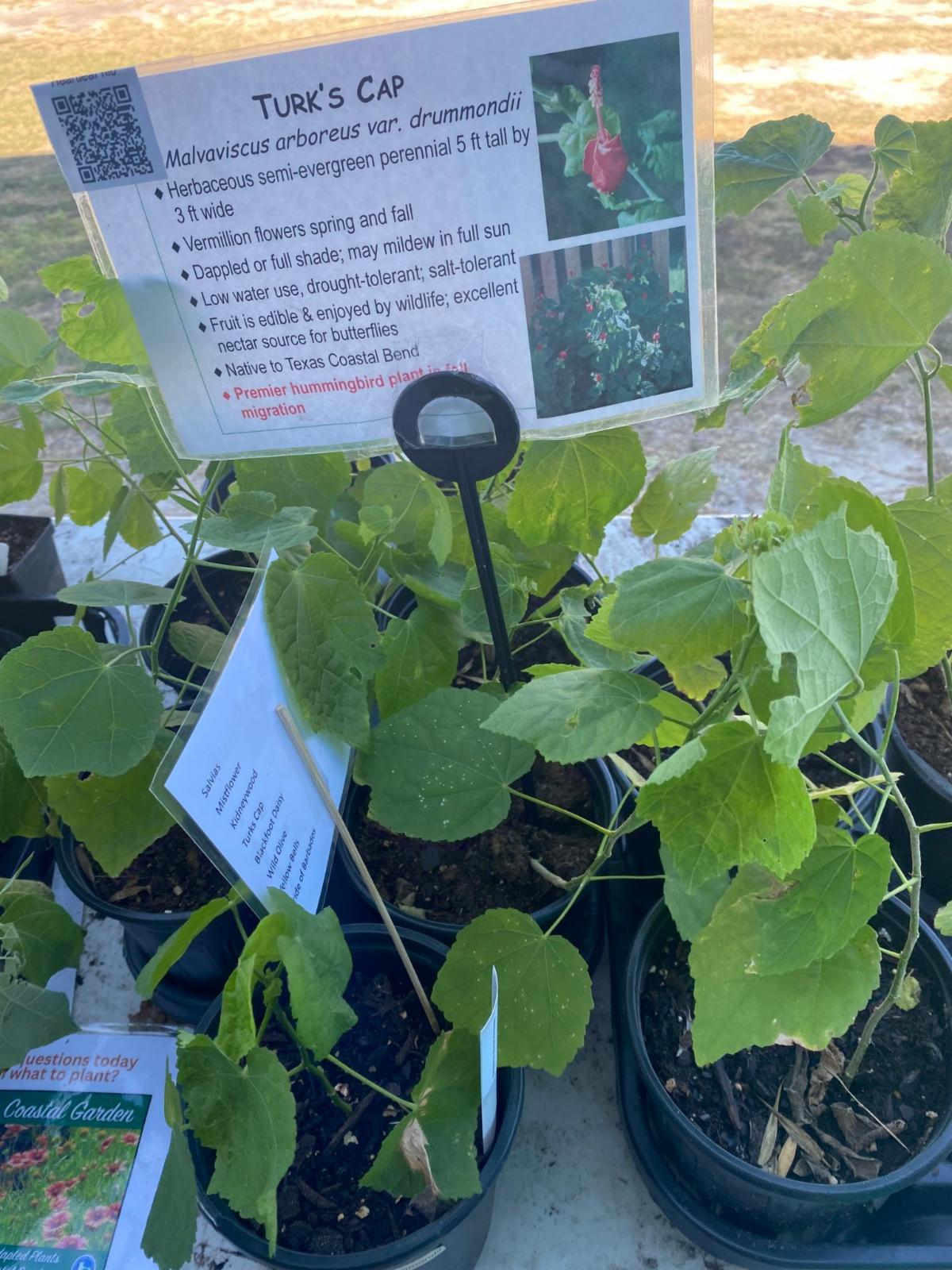
Rockport, TX – September 22, 2025 – The Mid-Coast Chapter of Texas Master Naturalists is thrilled to announce the resounding success of its annual plant sale fundraiser, which raised an impressive $18,000 to support conservation and restoration projects across eight Texas counties, as we celebrate our 25th anniversary as a chapter this year. Thanks to a generous anonymous donation of $10,000 to underwrite the event. Additionally, we received numerous propagated plants from chapter members, with hundreds from the Formosa Plastics Corporation, USA. The Chapter successfully placed over 2,000 native plants in Texas gardens, fostering biodiversity and sustainable landscapes.
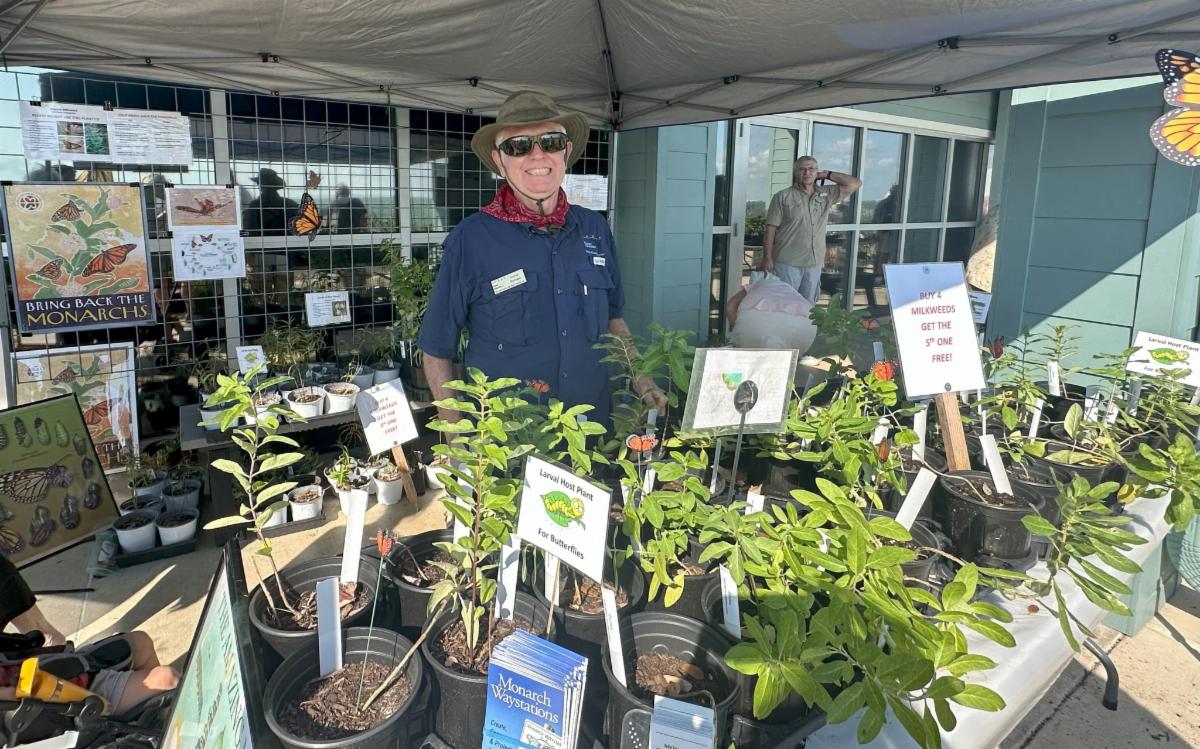
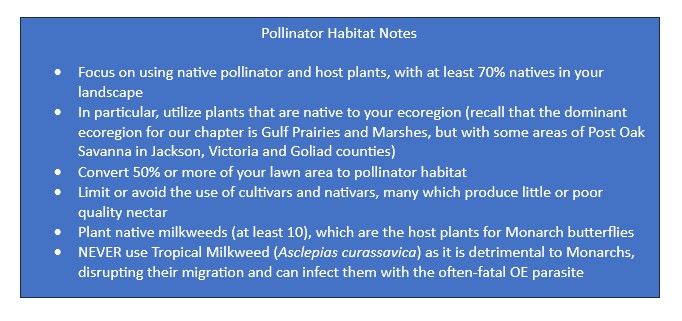
In addition to the plant sale, the event served as a platform to engage the public on critical conservation efforts, particularly the importance of planting milkweed to support Monarch Butterfly populations during their migration through our region to Mexico. Attendees learned about the vital role native plants play in preserving local ecosystems and supporting pollinators.
The funds raised will fuel the Mid-Coast Chapter’s diverse, mission-driven initiatives, aligned with the Texas Master Naturalist Program’s mission to develop a corps of well-informed volunteers dedicated to the beneficial management of natural resources and natural areas within their communities for the State of Texas. Some projects we do that are special to our coastal region:
- Animal Rescue: Supporting the rescue and rehabilitation of birds, sea turtles, and dolphins along the Texas coast.
- Coastal and Migratory Bird Conservation: Protecting vital habitats for coastal and migratory bird species.
- Monarch Butterfly Engagement: Promoting milkweed planting and habitat preservation to support Spring and Fall migrations through here.
- Oyster Bed Conservation: Advocating oyster mariculture to enhance and repair oyster habitats
- Native Plant Education: Creating demonstration gardens and leading habitat restoration projects to showcase the benefits of native plants.
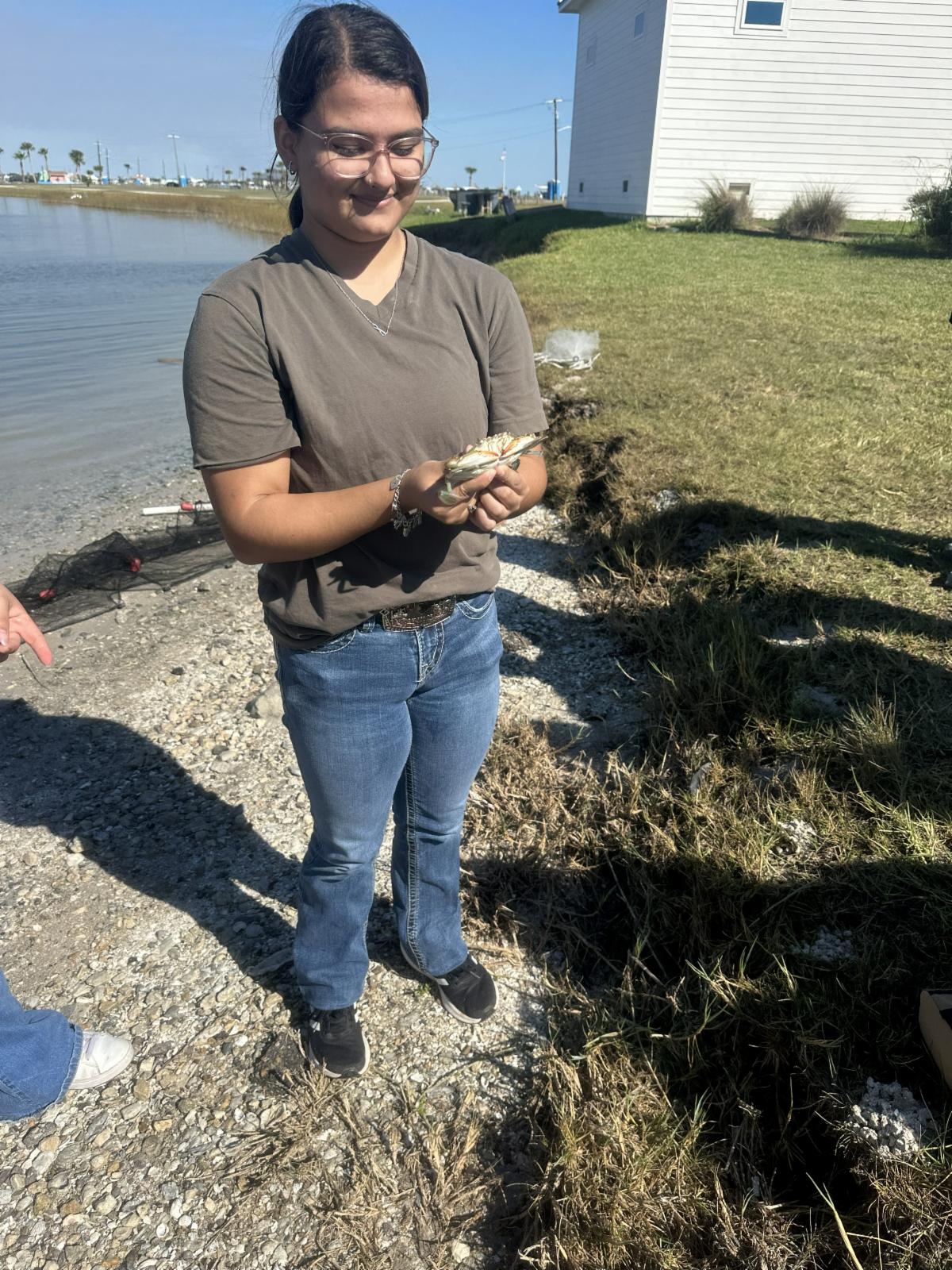
- Protecting Our Waterways: Conducting abandoned crab trap removal, debris cleanups, water quality testing.
- Youth and Adult Education Programs: to inspire community action.
- Mid-Coast Archeology and History: Preserving and sharing the cultural and historical heritage of the region.
The Mid-Coast Chapter is committed to making a lasting impact in Aransas, Calhoun, DeWitt, Goliad, Gonzales, Jackson, Refugio, and Victoria counties. The success of this year’s plant sale underscores the community’s dedication to preserving Texas’s natural and cultural heritage for future generations. Many communities and organizations rely on dedicated volunteers, such as those in the Texas Master Naturalist Program, to implement youth education programs, operate parks and nature centers, and provide leadership in local conservation efforts. This addresses the critical need for well-informed volunteers in community-based conservation.
Thank you to all who attended and supported this event, contributing to the success of our mission to promote conservation and environmental stewardship!
For more information about the Mid-Coast Chapter of Texas Master Naturalists or to get involved, please visit www.midcoast-tmn.org
Chapter Member, Patrick Hardtgan, showcased the importance of planting native Zizotes Milkweed for Monarch Conservation.
| | |
Naturalist-Student Program, SEED
SEED: Students Engaged in Ecosystem Discovery
By Maureen Crocker
The Mid-Coast Texas Master Naturalist (MCTMN) pilot program for high school student engagement is coming together. The pilot semester will begin in January and be open to juniors and seniors at Rockport-Fulton High School.
SEED: Students Engaged in Ecosystem Discovery will be a short and locally focused, mini version of MCTMN’s Initial Training program. It will include topical group learning followed by local site visits to reinforce the classes. Additional field work through volunteer projects will also be an option.
Topics and activities have been chosen to increase students’ awareness of the local ecosystem and its value to the local economy.
● Whooping Cranes - International Crane Foundation Whooping Crane Survey
● Oysters and Oyster Mariculture - Local oyster farm
● Imperiled Live Oak/Red Bay Woodland - Woodland tour with native plant identification
● Bay ecosystem - R/V Katy
Other SEED sessions may include visits to Welder Wildlife Refuge, shoreline cleanup and crab-trap removal.
MCTMN volunteers will serve as Naturalist Guides, attending the classroom sessions and group site visits. Additional Guides would be helpful. Think of it as an opportunity to learn more about these critical topics! If you’re interested, please contact any Steering Committee member: Amy Nowlin, Bill Burge, Rachael Diaz, Steve Ferguson, or me, Maureen Crocker.
We need your help for what could be a life changing experience for the students who participate in SEED, and we hope for you.
| | |
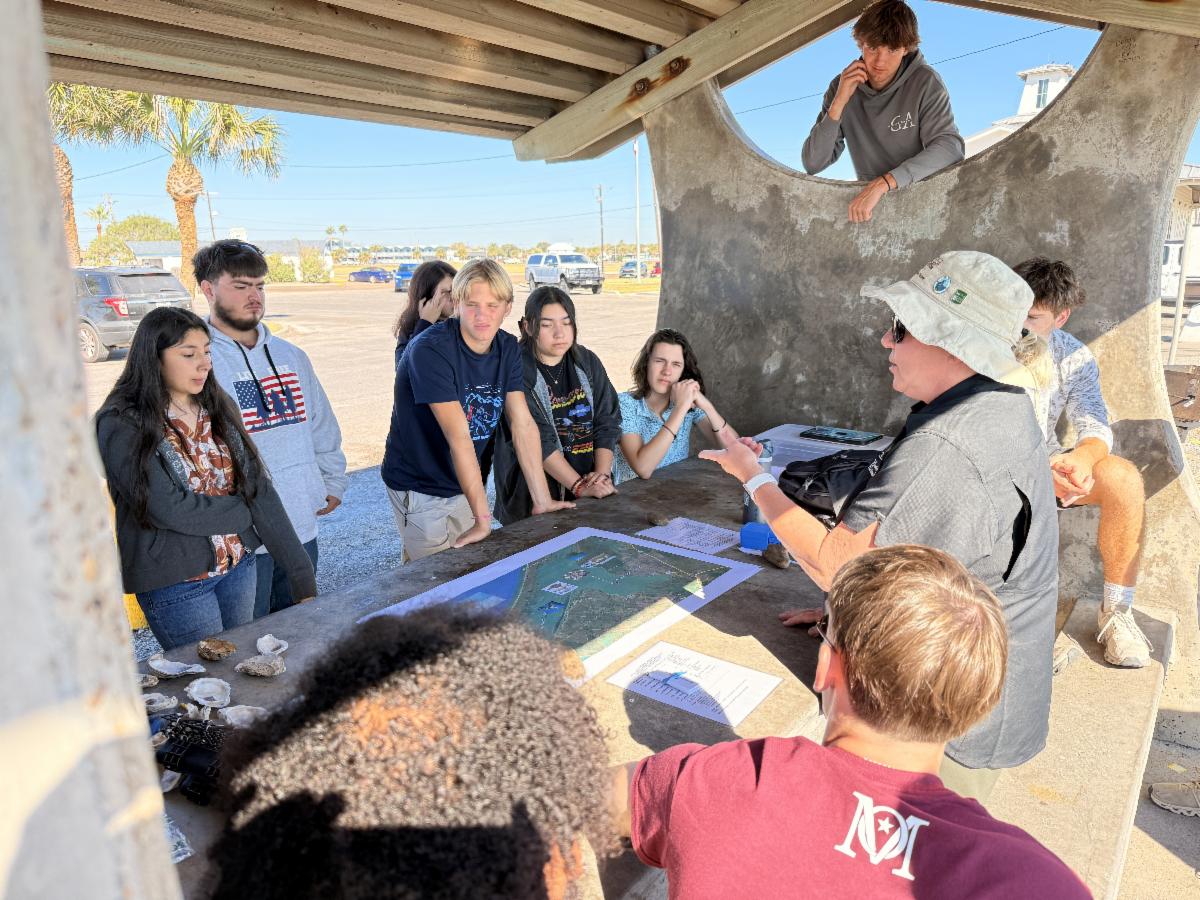
Watershed Engagement with Goliad High School: “Every Drop That Falls in Goliad Ends Up in San Antonio Bay”
D’Ann Williams and Steve Ferguson joined 40 Goliad High School Earth Science students for an eye-opening session on the vital link between their hometown and Texas’ coast.
The core message? “What happens in Goliad needs to stay in Goliad.”
Students explored how their local watershed feeds the San Antonio River and how the San Antonio River flows into the San Antonio Bay ecosystem. Through hands-on discussions, they gained a clear understanding of point-source and non-point-source pollutants—and left with a personal call to action to protect water quality at home, school, and along the river.
Pat Cruz from Texas Sea Grant co-facilitated the program, while Captain Whitney of the Texas Floating Classroom led an engaging rotation on Aransas Bay.
The educator took home custom 36x24-inch posters (bottom photo: the watershed flowing into San Antonio Bay) to display in their classroom—a daily reminder that every action upstream shapes the health of our coast.
| | |
Massive Monarch Migration through Rockport area!
Great Need for More Pollinator Habitat
Tagging Conducted by Chapter Members
Patrick Hartigan, Mid-Coast Chapter Texas Master Naturalist
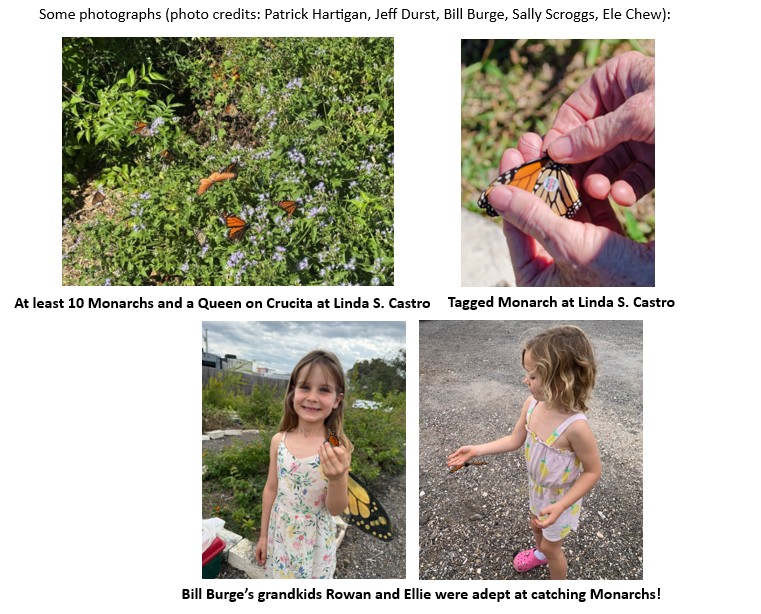
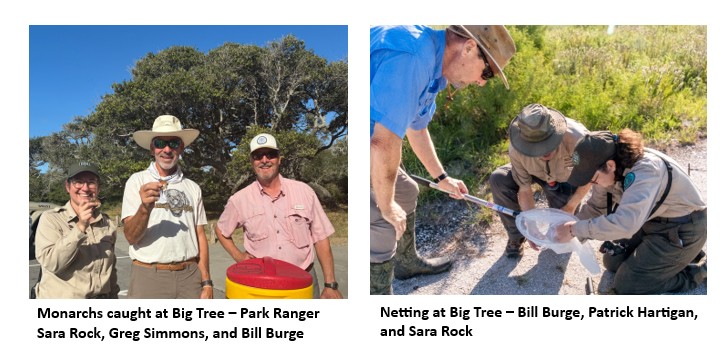
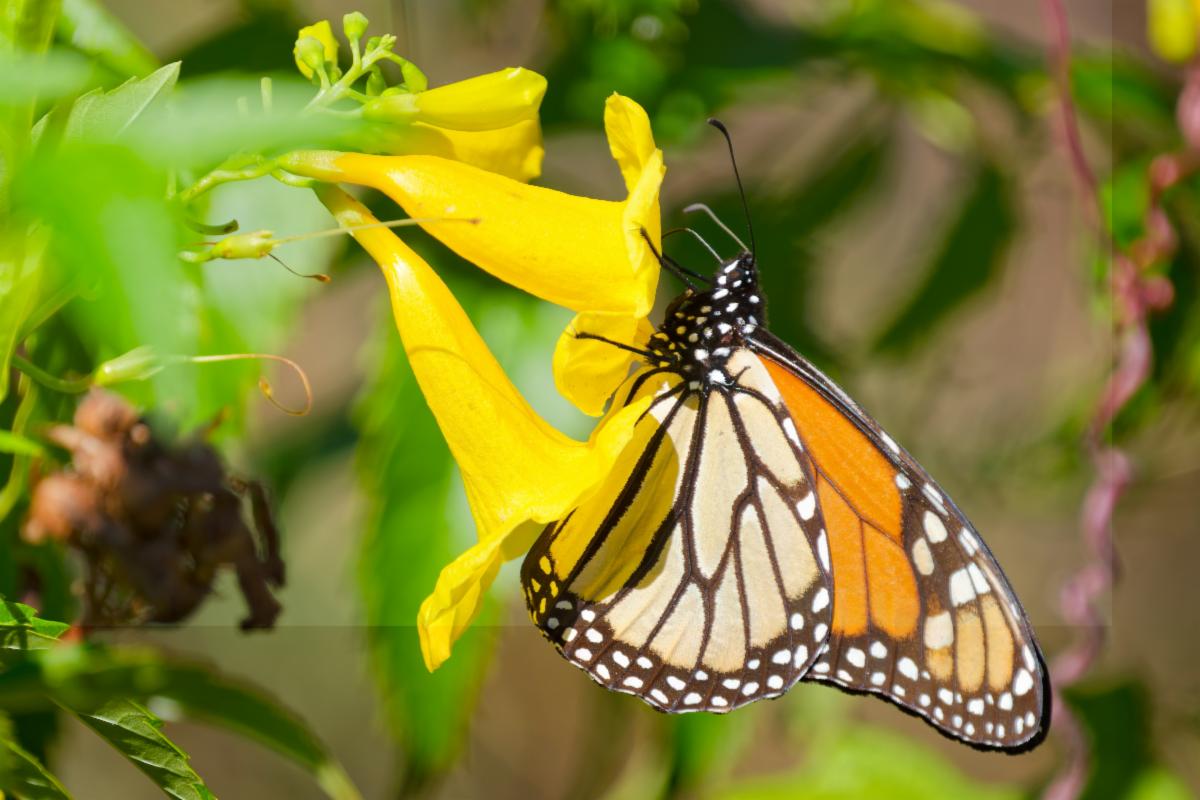
Following a cool front that arrived on the evening of October 28, a mass movement of Monarch butterflies was observed in the Rockport area, with many reports of dozens to hundreds of Monarchs. The spectacle of so many Monarchs attracted the attention of almost anyone who was outside, and hopefully will inspire more people to appreciate this iconic species, the State Insect of Texas. The Monarch’s arrival coincided with ongoing chapter monitoring efforts, including at Linda S. Castro Nature Sanctuary and Big Tree (Goose Island State Park).
The Monarchs we were observing are part of the eastern population, Danaus plexippus, and are likely to have emerged from eggs laid in the northeast United States or southeast Canada. They are en route to wintering grounds in Mexico, an epic journey that can be as long as 3000 miles. By the time they reach the Rockport area, they still have >500 miles to go! To complete this migration, they must have nectar plants to feed on along the way. Thrilling as it was to see so many Monarchs, we should not forget that this is a species in trouble, and good pollinator habitat is at a premium. Sites such as Linda S. Castro are magnets for attracting Monarchs and other pollinators, but are scattered islands of habitat surrounded by a sea of roads, buildings, houses, lawns, ornamental landscapes that produce little nectar, invasive plants, overgrazed pastures, and other degraded habitats. To say that there is a great need for more pollinator habitat would be an understatement. Our chapter has many pollinator projects underway, so it is doing its part in helping the “Bring Back the Monarchs!” campaign, but more is needed. I encourage everyone to incorporate pollinator plants into their landscape and to promote pollinator habitats to their friends, local parks, and businesses.
While monitoring the Monarchs, I observed which plants were attracting the most butterflies. A wide variety of native and adapted plants were being utilized, but several stood out: Cowpen Daisy (Verbesina encelioides), Crucita (Chromolaena odorata) and other mistflowers (Conoclinium sp.), Mealy Blue Sage (Salvia farinacea), Horsemint (Monarda sp.), and lantanas (Lantana sp.). A word about lantanas; it is best to use the true native Texas Lantana (Lantana horrida aka Lantana urticoides), as the various cultivars and nativars sold at nurseries provide less ecological value, and the widely sold Lantana camara is actually an invasive species.
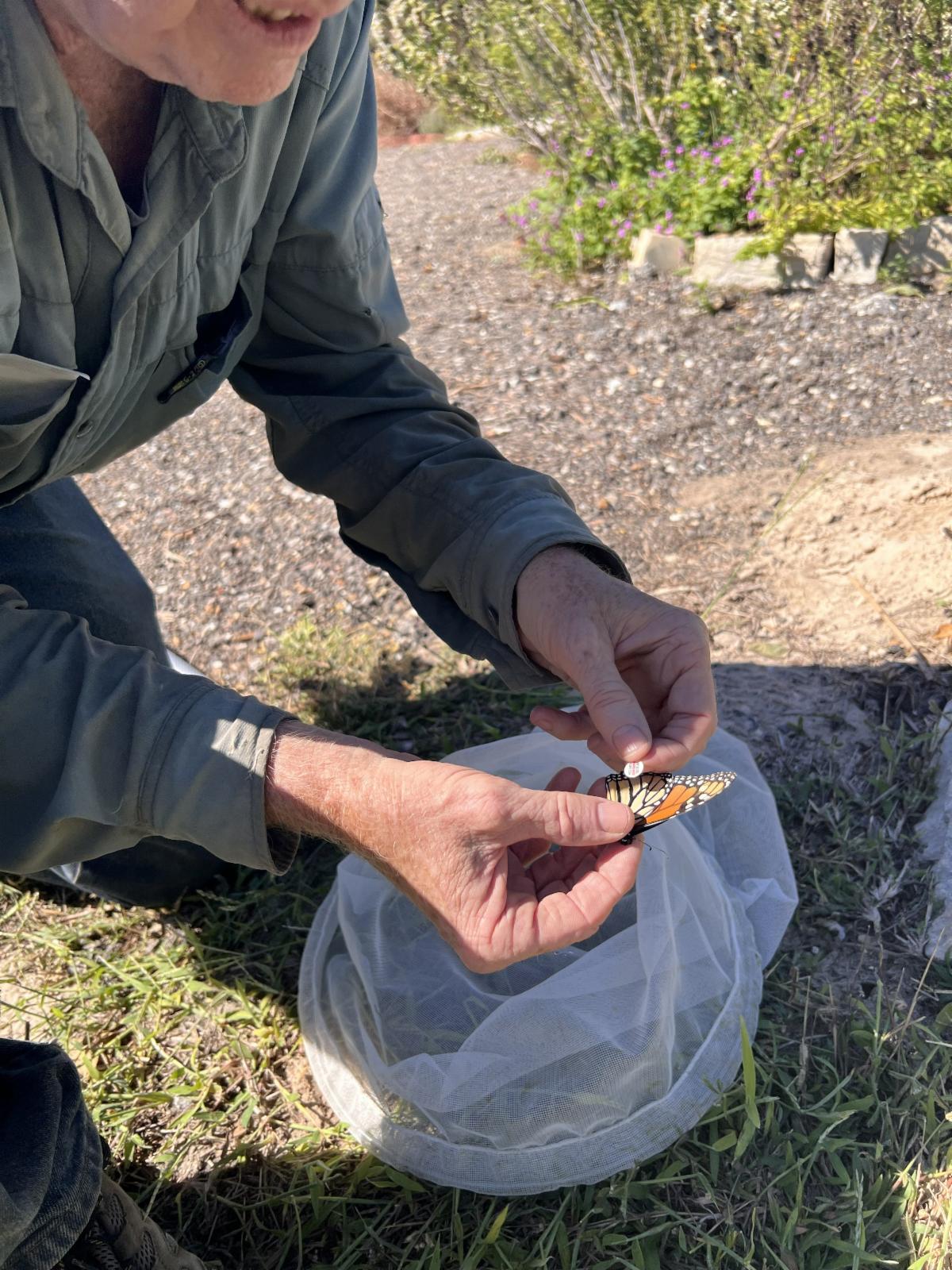
In addition to tallying and reporting the number of Monarchs sighted, tagging was being conducted. I led the tagging program at Linda S. Castro, while Park Ranger Sara Rock led it at Big Tree. In addition, chapter member and experienced Monarch tagger Kimberly Draper joined us. The programs attracted a good turnout of the public and chapter members, spanning multiple generations of participants. Several people displayed exceptional butterfly-catching skills, e.g., Greg Simmons and Bill Burge’s grandchildren, and Ray Kirkwood was no slouch! Our combined effort resulted in over 70 Monarchs being tagged (as of November 3). Interestingly, 70% of the Monarchs I tagged were males. The tagging data will be submitted to the Monarch Watch organization, providing important “Citizen Science” information for tracking Monarch population movements and dynamics.
Please report your Monarch sightings! The following are recommended:
· Monarch Watch app https://monarchwatch.org/app/
· iNaturalist https://www.inaturalist.org/
· Journey North https://journeynorth.org/
Monarch monitoring, including tagging, is conducted under the chapter project Texas Mid-Coast Monarch Monitoring Project, and eligible volunteer hours can be charged to the VMS category FR: Insect Life. For more information, contact me at pdhartigan4321@gmail.com
| | |
PALACIOUS SEAFOOD FESTIVAL
By Beth Hudson
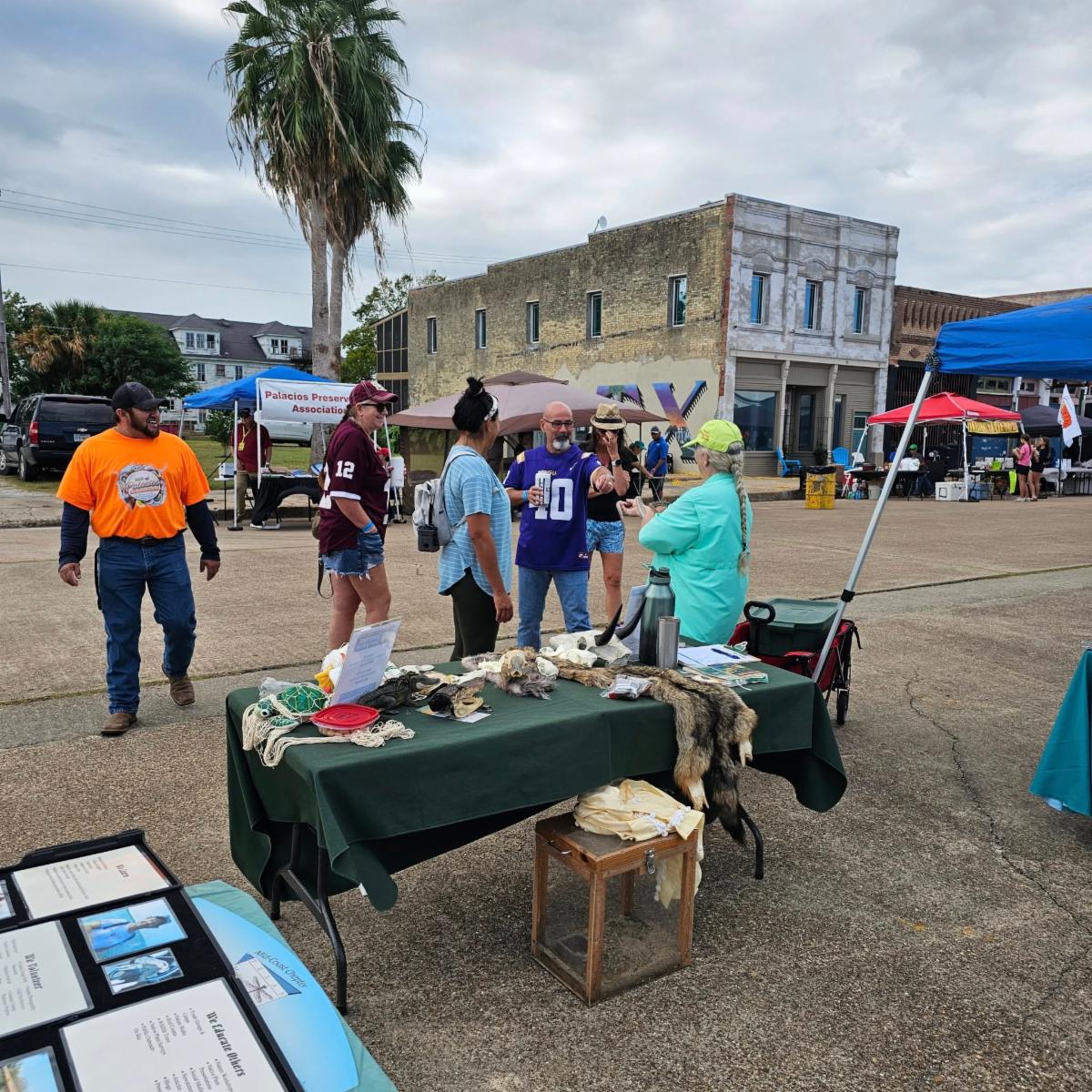
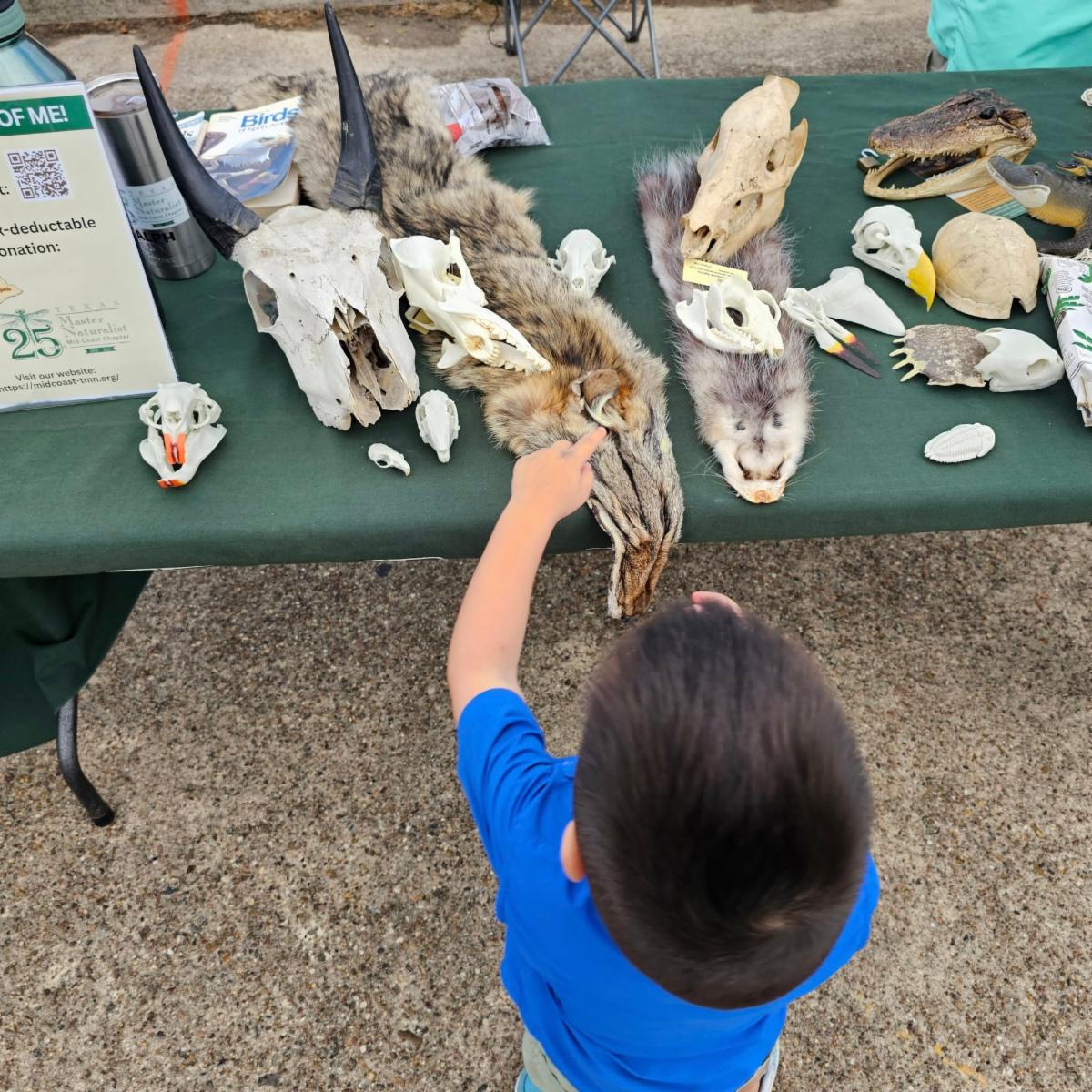
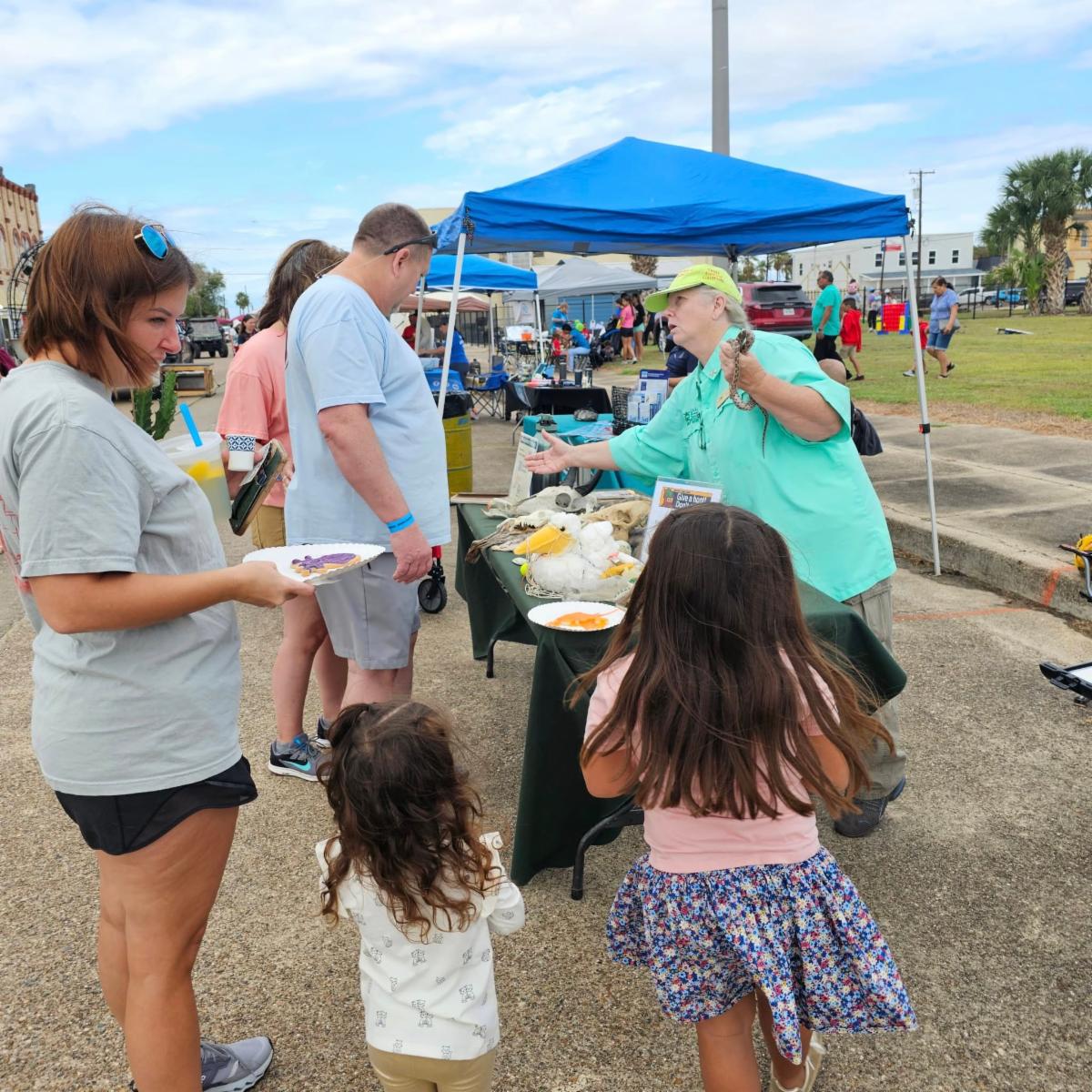
We did a thing! Cindy Baker asked me to join her for an outreach activity at Palacios' Seafood Festival.
We were located right next to Amy Nowlin and friends with Matagorda County Coastal & Marine Resources-Texas A&M AgriLife Extension, and representing the Texas Department of Agriculture with wild-caught shrimp shopping bags. They helped us set up in the wind.
Great location. Great crowd. Great interpretive education from Cindy.
Check out the rapt faces of the fans, young and seasoned.
| | |
Texas Master Naturalist Night at the Hooks Game!
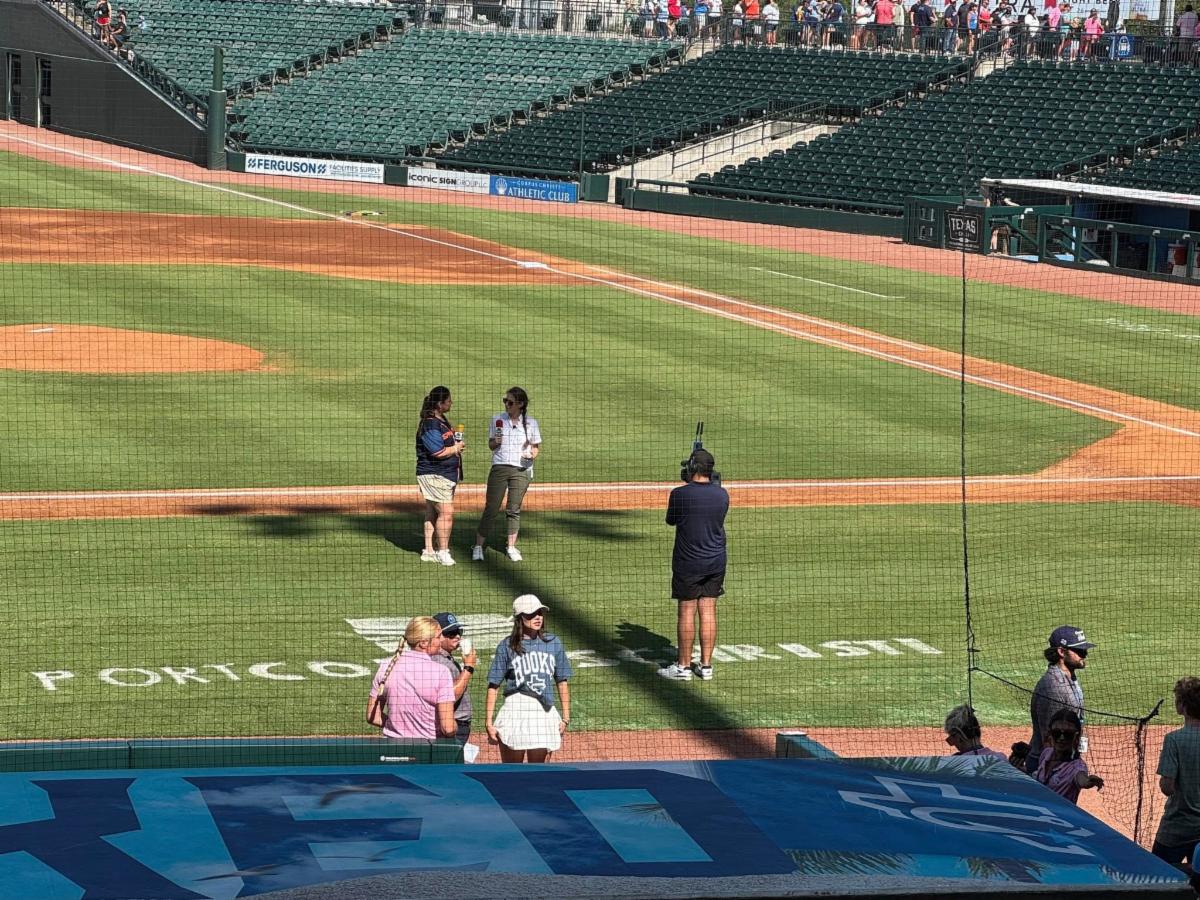
Assistant State coordinator, Mary Pearl Meuth, attended with her kids and did a great job spotlighting the program and throwing out the first pitch! Good work to D'Ann Williams for coordinating the event.
Mark your calendars for Saturday, June 20th, 2026,
for a nature celebration that will include Fathers!
| | |
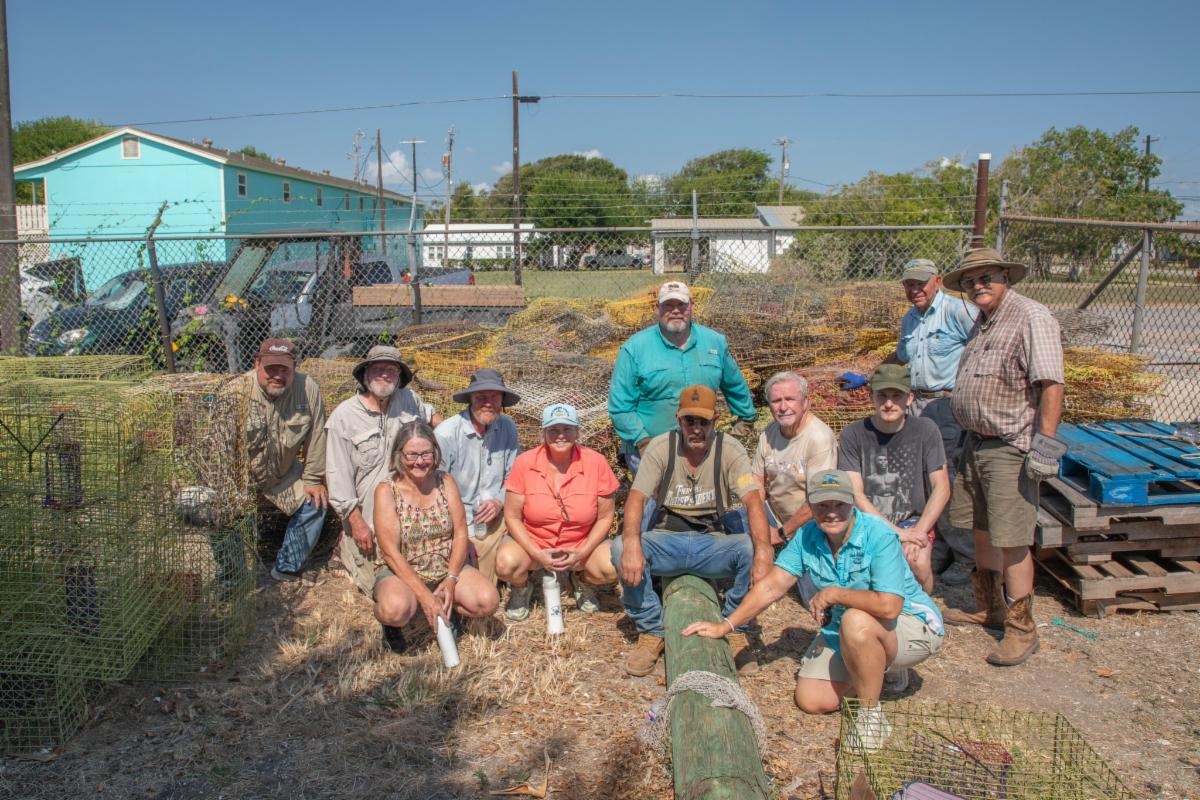
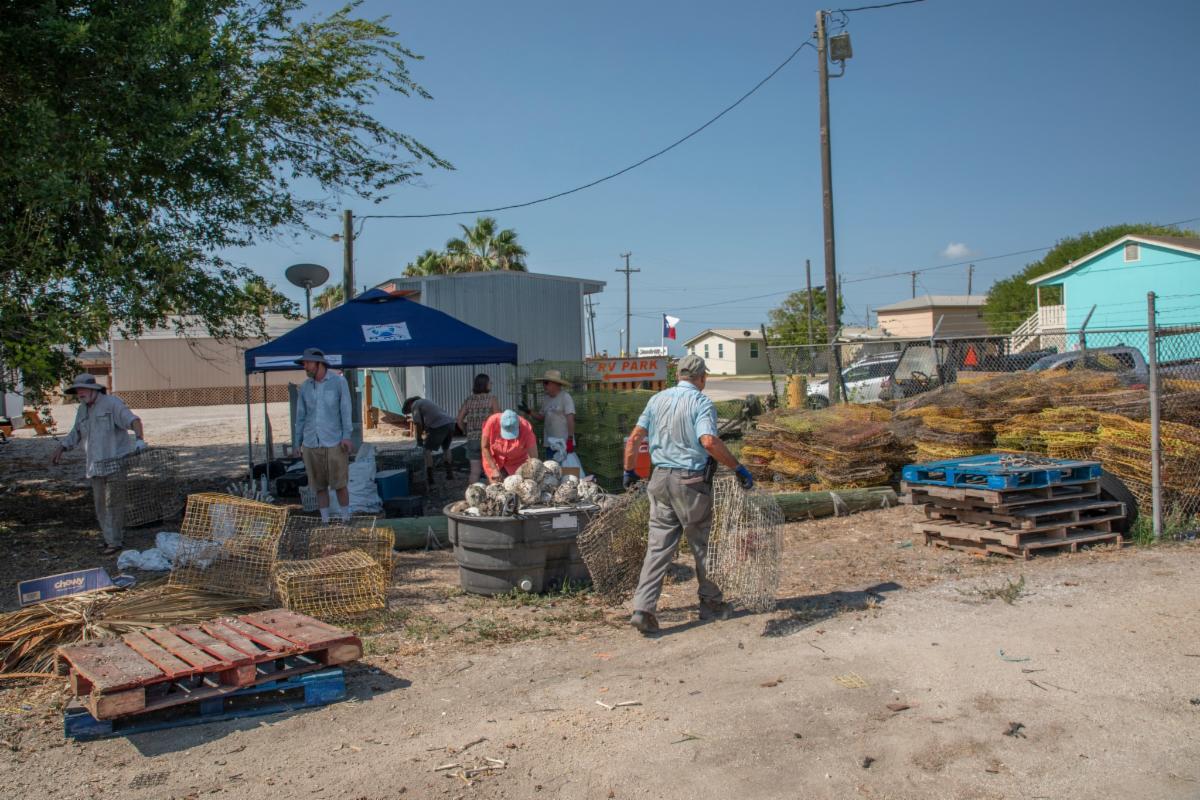
Today was the Retired Crab Trap Event, where we turned trash into treasure... well, into recycled metal!
THANKS to all the crabbers who brought in their retired crab traps. A HUGE shout-out to our amazing partners at @Dockside for providing the space, the coordination, and the best part… the CRUSHER, Chris Sibley!
And we couldn't do it without our incredible volunteers who braved this Texas heat to help dismantle these old traps. You are all MVPs!
Together, we're working to keep the San Antonio Bay productive and healthy.
| | Special thanks to all the Mid-Coast TMNs that helped! Bridged Berger, Brad Jones, Rusty Crane, Donna Bailey, Kimberly Ballard, Patrick Henley, Steve Marwitz and especially the magnificent organizer, Allan Berger | | |
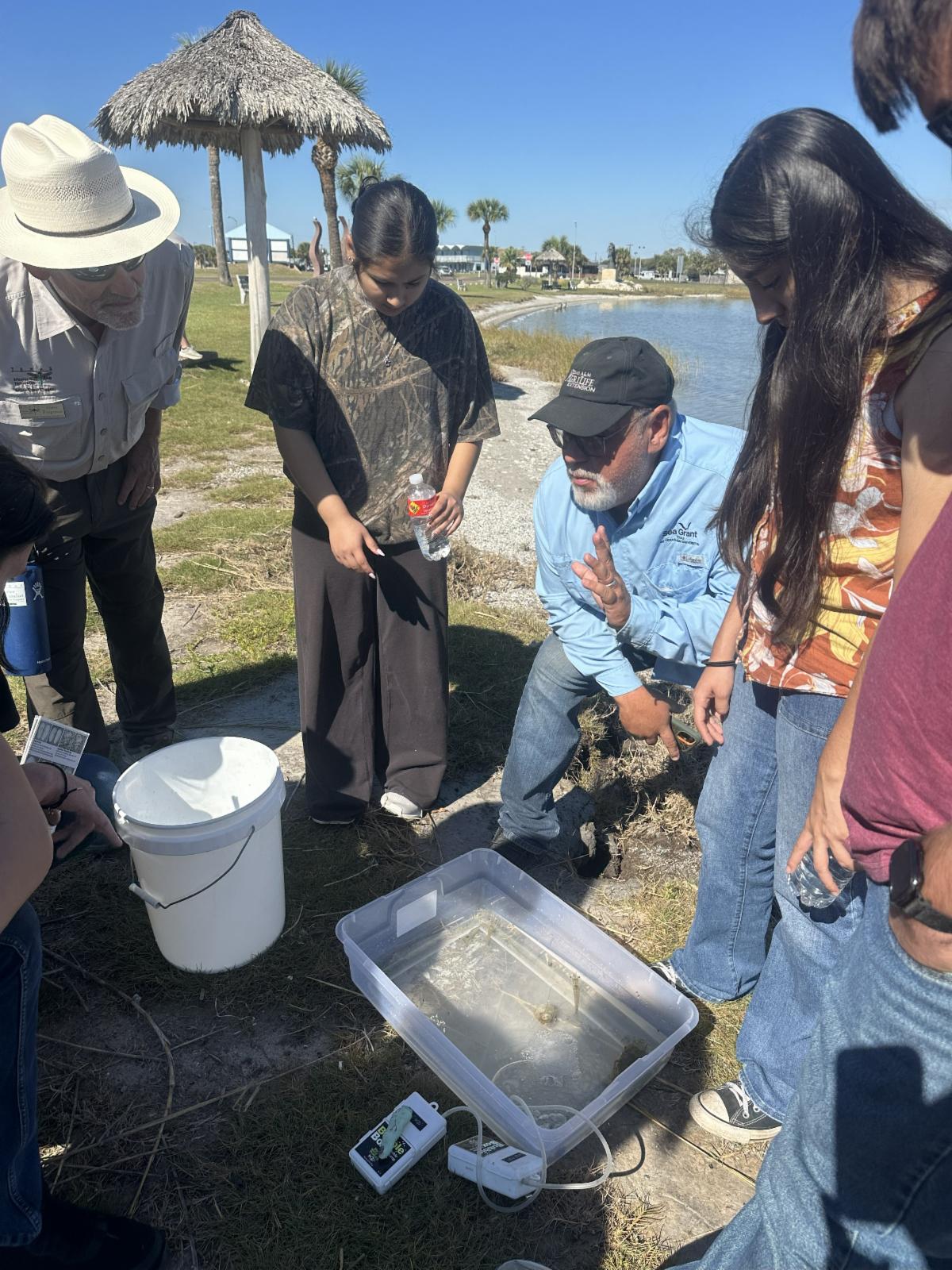
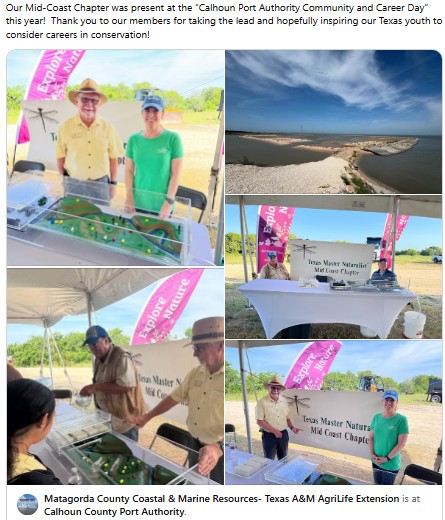
Mid-Coast Texas Master Naturalists and Texas Sea Grant partnered at Careers Along The Coast Days at the Calhoun Port Authority!
Utilizing the flood model - students observed how engineered wetlands can indeed help prevent flooding! @texasseagrant Texas Master
| | | |
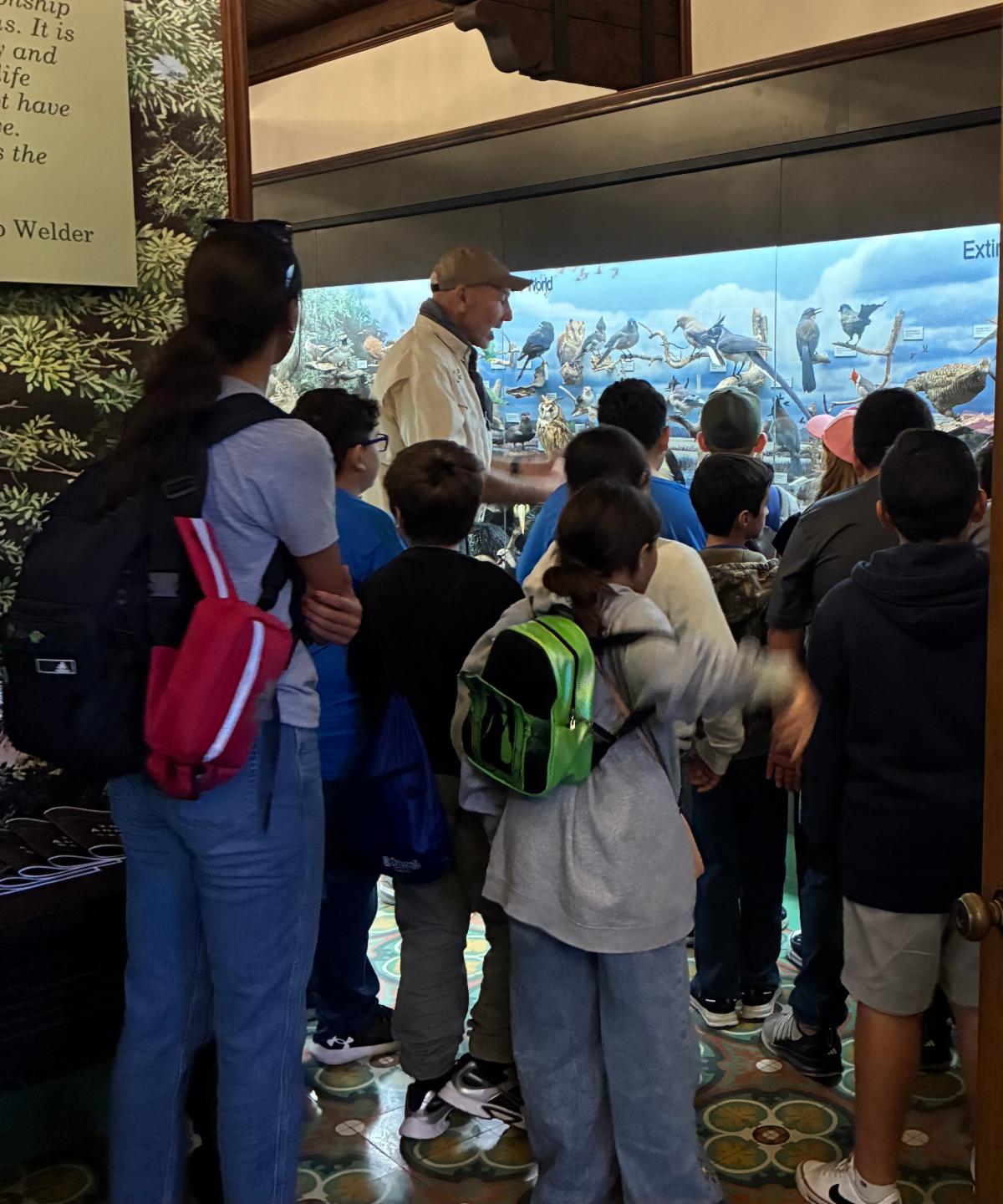
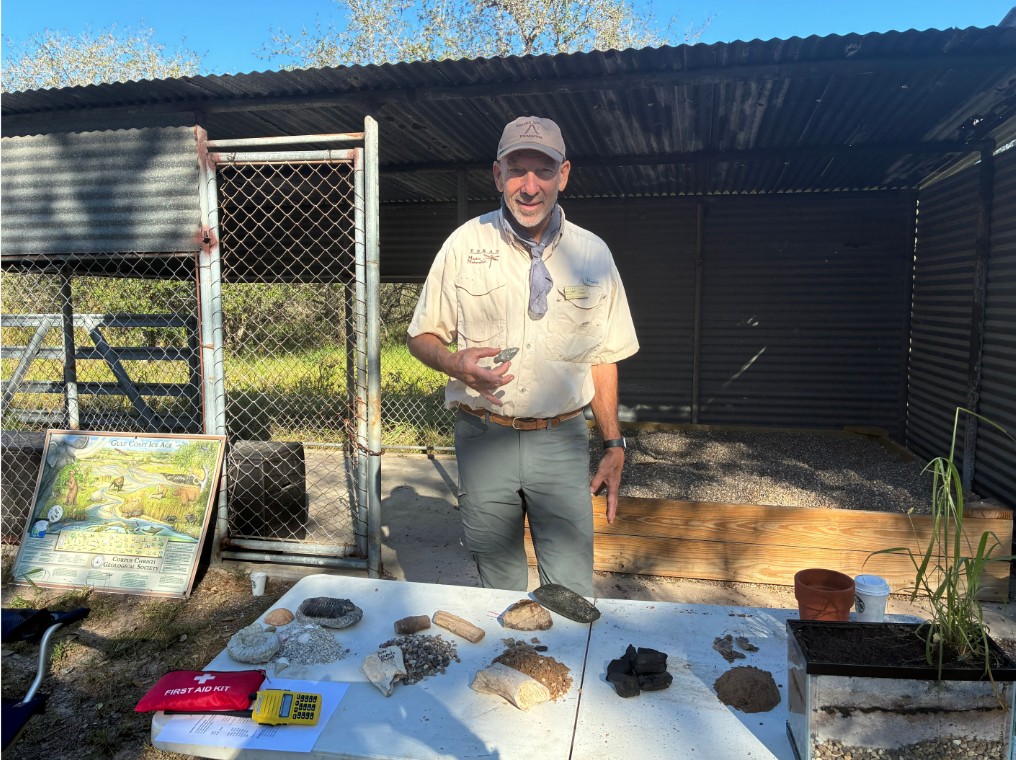
Student Engagement at Welder Ranch!
Our chapter engaged with 5th graders from Santa Gertrudis ISD. Greg Simmons did the Bone Zone Exploration and the museum tour.
| | | |
Doc & Martha McAlister
“A Few Paternal Acres”- Conservation Project
By Wilfred Korth
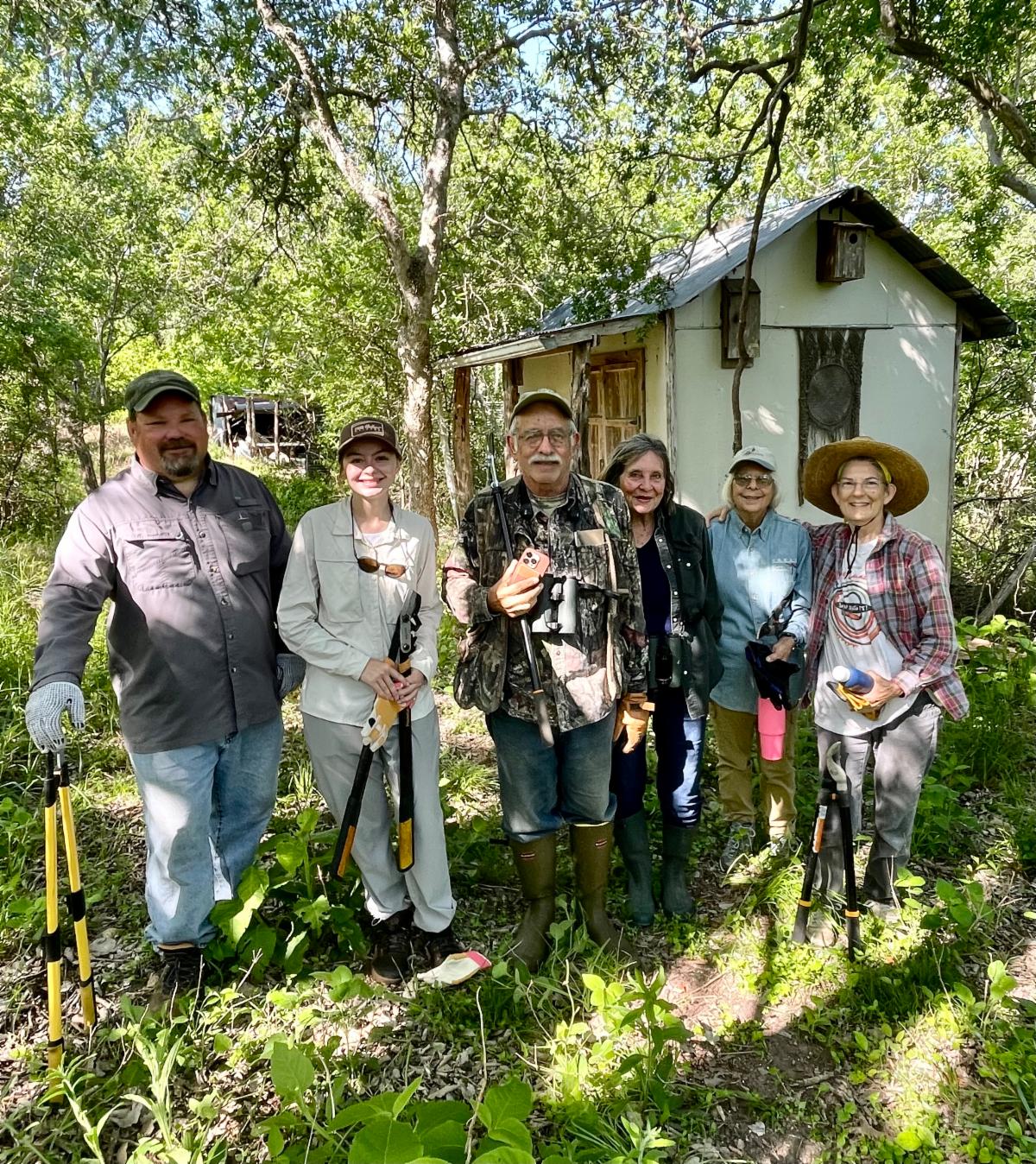
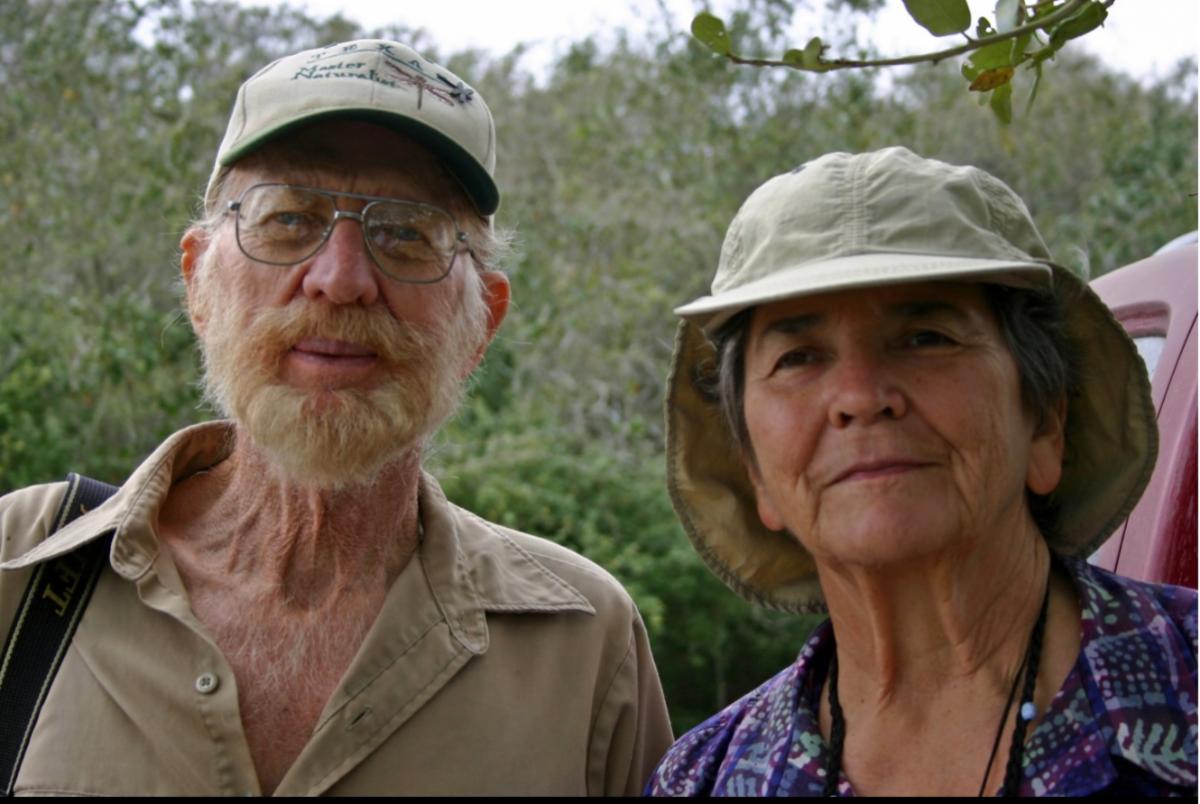
Doc & Martha McAlister were true Texas Naturalist and mentored many of our members over the first 15 years of our Chapters existence. They taught numerous classes to our “members in training“ and willing shared their extensive experience and knowledge with us. Our Chapter created a Documentary film honoring them which is on our Youtube channel.
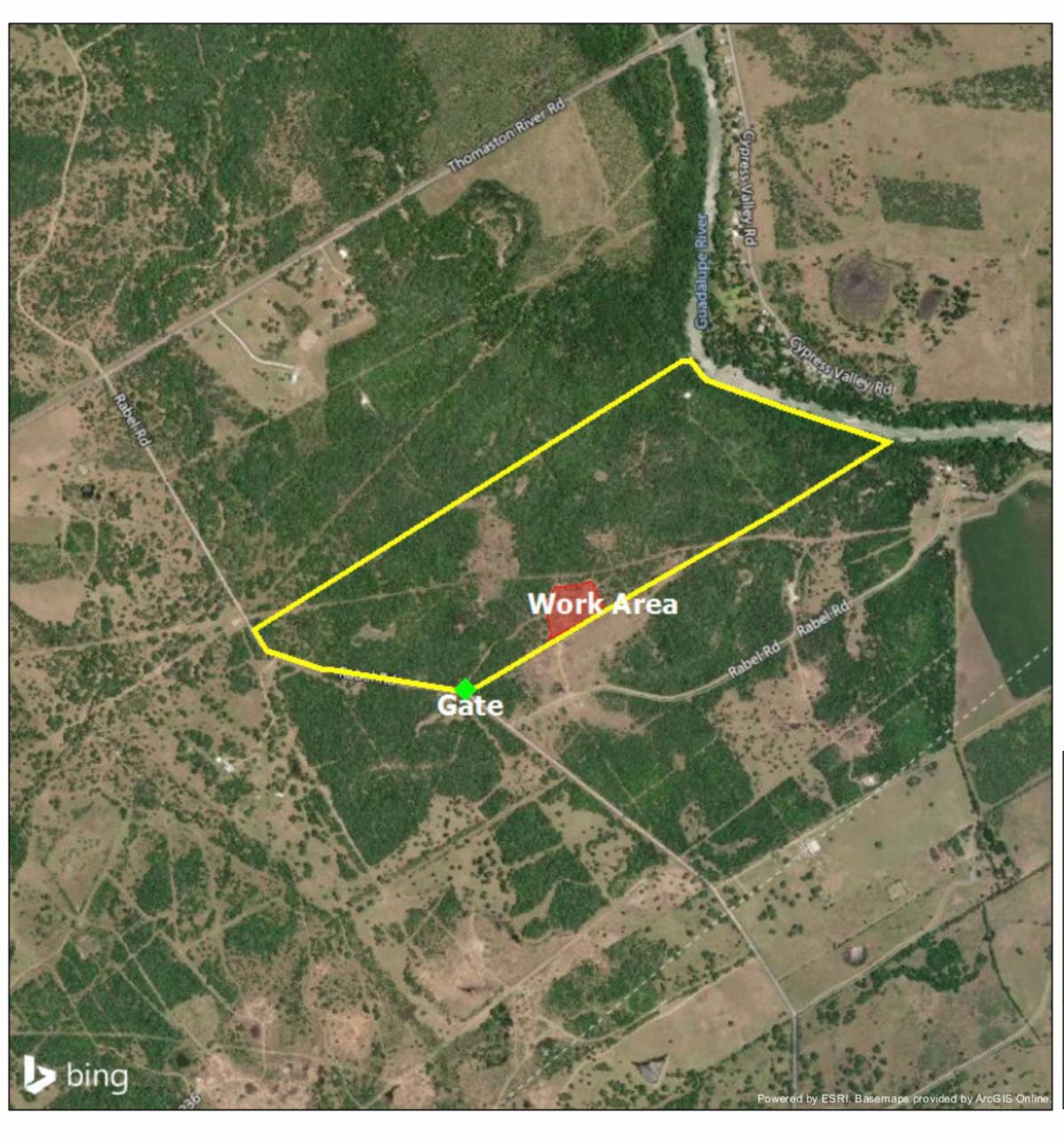
They have an almost 200 acre piece of property on the Guadalupe River South of Cuero in DeWitt County. During their lifetime on the property they worked to conserve the property in it’s natural state. Upon their deaths, their two daughters, who do not live close by, were working on what to do with the property. Several Chapter members approached them about putting the land in to a Permanent Conservation Easement, and protecting and preserving it for future generations. In September, 2023 they did that. The Guadalupe River Conservancy (GRC) now holds the Conservation Easement.
In March, 2024 the GRC sent a request to the TMN-MIDCOAST Chapter asking for help with conservation projects on the McAlister Property. We readily agreed, since it would be a great way to pay back Doc & Martha for all they did for us, and help preserve a unique piece of riverside property. Since that date, volunteers have been meeting on the second Wednesday of every month to work on this property. To date we have completed 4 INat Bio Blitz’s documenting 243 different species, opened up the one roadway thru the property, laid out a trail down to the river, re-established a trail to a pond, and now cleaning up man-made debris from around structures on the property.
Long term - here are the areas the GRC wants us to help address:
For Upland Plant Communities:
- Enhance Native Tree and Shrub Diversity: Through selective thinning of species like Ashe juniper, we hope to promote the growth of less dominant natives, balancing the ecosystem and bolstering biodiversity.
- Invasive Species Management: We plan to tackle invasive species, particularly King Ranch bluestem, by mechanical removal, prescribed burning, or selective herbicide application to foster the spread of native grasses.
- Understory Enhancement for Wildlife: Our goal is to create clearings and edge habitats to diversify food and cover for wildlife, benefiting small mammals, birds, and pollinators.
For Riparian/Riverine Areas:
- Riparian Buffer Zone Enhancement: We seek to widen vegetated buffer zones with native plantings to improve water quality and bank stabilization.
- Invasive Species Control: Johnsongrass removal will be a focus, using mechanical and targeted methods to preserve native riparian vegetation.
- Erosion and Sediment Control: Employing bioengineering techniques, we aim to fortify stream banks and curtail erosion.
- Wildlife Habitat Improvement: Adding snags and woody debris will enrich habitat complexity, enhancing the riparian ecosystem for aquatic species.
These initiatives are critical to preserving and enriching the property's native biodiversity and providing a haven for local wildlife.
Chapter member Wilfred Korth is coordinating our volunteer work on this project. We always need more volunteers. If you would like to help, contact him at 361-542-0374 or naturetour12@gmail.com.
| | |
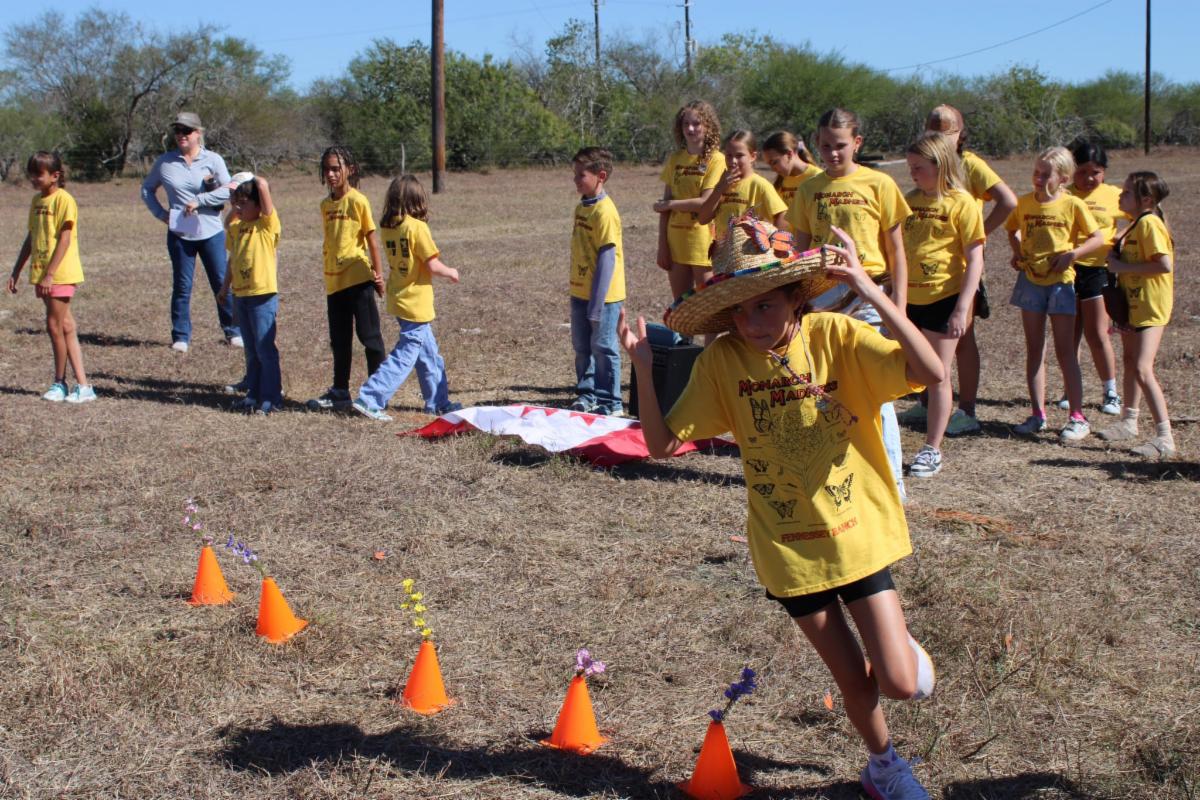
Monarch Madness Relay at Fennessey Ranch Annual Event
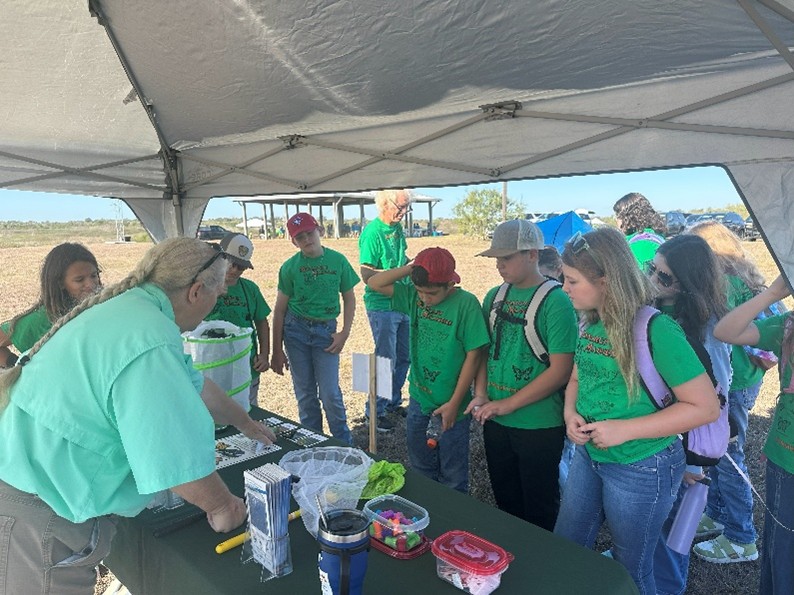
200 Students donned Sombreros and became Monarchs for a day!
D’Ann Williams and PE teacher friend Jane Gann split them into two teams. They kicked off under the Canadian flag, zig-zagged through nectar-cone obstacles for fuel, then through the US flag, and hopped into green sacks as caterpillars → chrysalises → butterflies racing 3,000 miles to Mexico!
Mexico touchdown! Came with funny victory dances + high-fives before tagging the next flyer while fun and fast Monarch Music pumping, giggles non-stop—they begged for more laps!
After, they were sent back at HQ: Tagged for science! AKA: Ink stamps, temp monarch tattoos, real Monarch tags + quick research chat with Cindy.
Future scientists are officially airborne!
Fun Video Link of the Event From Martha McCleod
| | |
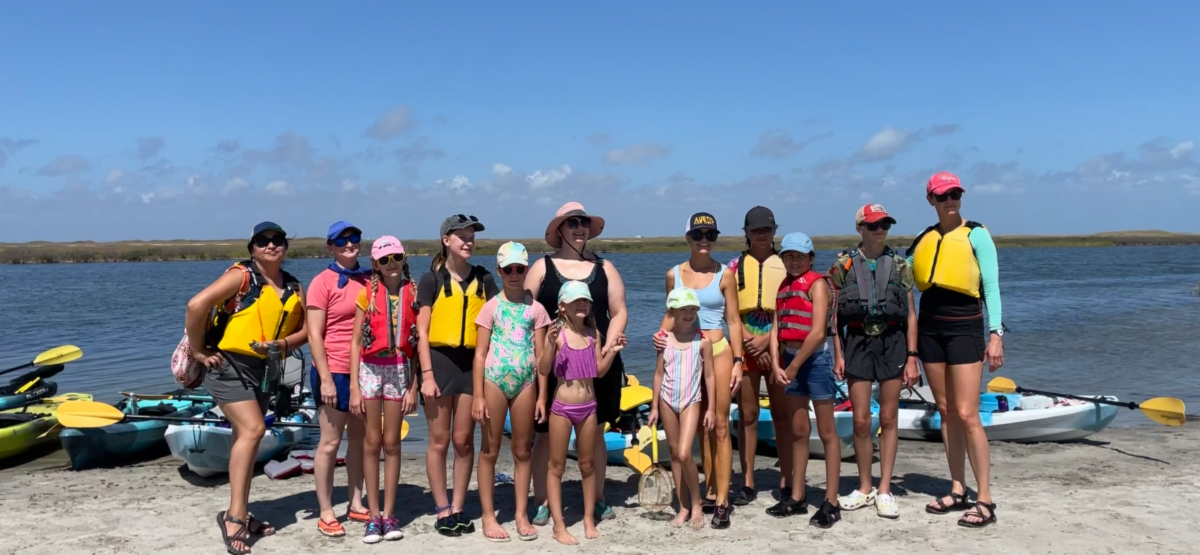
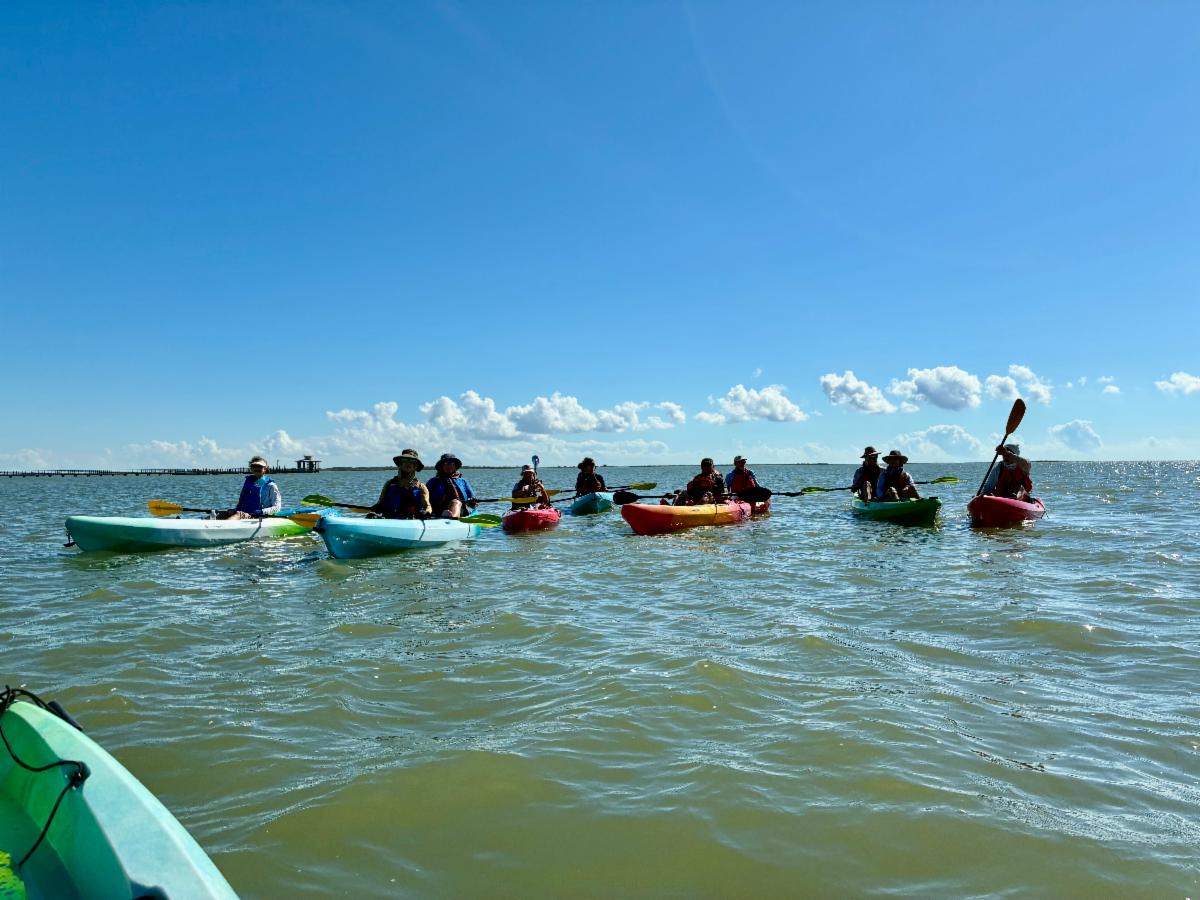
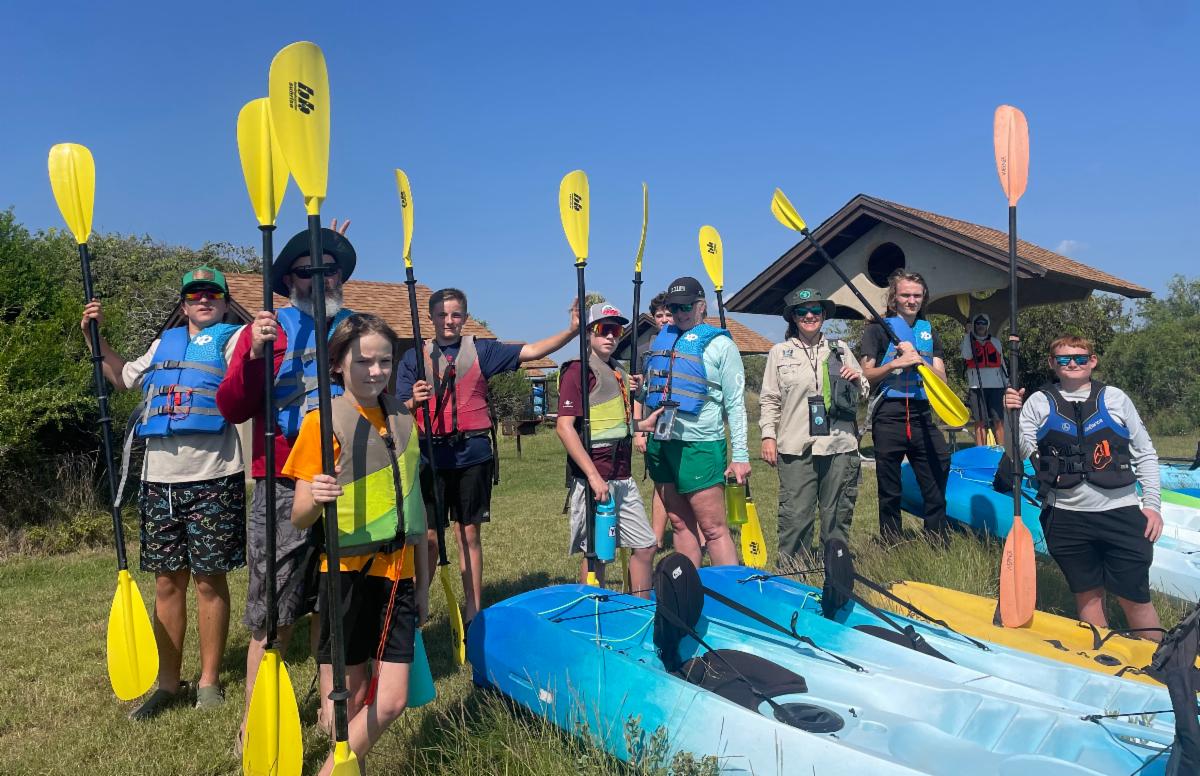
We Team Up with Goose Island State Park and
Conduct Fun Programs
| | Do you need project-hours? | |
Mid-Coast Chapter Members | Do what you love! Give 40 hours of Volunteer Service each year to be the change you want to see in the world. Members work in field research/citizen science, educate kids and adults about the natural world, improve wildlife habitat and manage natural resources, and provide technical guidance to other organizations to meet our Texas Master Naturalist mission. | | | |
AT: Ask an Expert, North American Grassland Ecology: A Conversation with Chris Helzer and Garth Fuller of The Nature Conservancy
Wednesday, November 19,⋅6:00 – 7:30 pm
Virtual
Report as AT: Single Presentation
Join us for an Ask the Expert session with Chris Helzer and Garth Fuller. This is a science-focused expert panel that will tap into both speakers' expertise and passion for North American Grasslands.
For more information and to register:
https://us06web.zoom.us/meeting/register/SuZ2G1zUSq
AT: Living in the Liberated Landscape: My Yard
Thursday, November 20,⋅6:00 – 7:00 pm
Virtual
Report as AT: Single Presentation
All too often in our gardens and landscapes, we think of static compositions of carefully placed and managed plants. But our approach can be more dynamic and arguably more rewarding than that, by taking advantage of plants’ natural abilities to reproduce and proliferate.
Learn how to design gardens that consider the reproductive abilities of plants, the ecological processes that affect those plants, and the wildlife that those plants can support.
To register and for more information:
https://wildones.org/living-in-the-liberated-landscape/
Let me know if you have questions.
Thank you.
Cindy Hielscher
MCTMN Records
| |
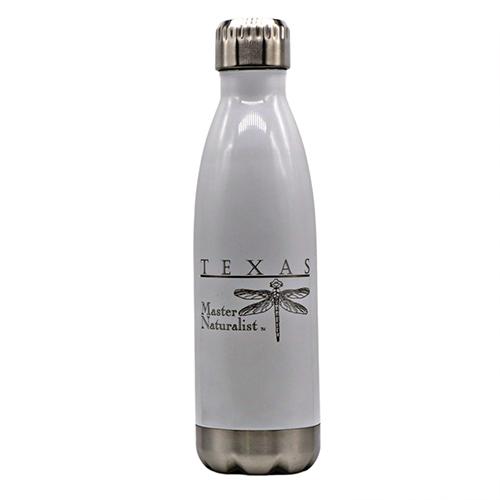
Shop like a Naturalist:
Did you know our website has a link to the AgriLife cool merchandise for Master Naturalist?
Spread the word while you hydrate yourself!
| |
| | |
The Texas A&M AgriLife Extension Service and the Texas Parks and Wildlife Department sponsor the Texas Master Naturalist program.
https://txmn.tamu.edu/
| | | | | | |