|
Silly Boy’s chaotic tenure at the DH+ is over…
… there is a god, thank you.
Gone with him, his management style…
…an aggressive insistence that top-down bullying could shock a wheezing system back to life.
Having put his toys back in the pram, he is off to pick a fresh fight with the Army, Navy and Airforce.
Good luck with that. Here’s hoping, on a wet November Wednesday the SAS drops him on Dartmoor, at three in the morning, and forgets where.
The NHS may finally have the breathing space it desperately needs.
Streeting’s chaotic Health Bill was designed to abolish NHSE and pull its powers into Whitehall.
Officially, it promised to cut bureaucracy and liberate the front line. In practice, it was all about concentrating unprecedented power in the hands of ministers.
The Bill is still in Parliament, but I hear deadlines will slip and the centralising rhetoric is being quietly reconsidered.
The workforce plan stalled, redundancy plans parked and the Target Operating Model shelved.
That leaves a vacuum, and with it… an opportunity.
For decades, NHS policy has swung between two diametric extremes…
… micromanagement from Whitehall and fragmentation at local level.
In the process, we destroyed the 'functional middle’.
Management consultants once made fortunes taking out layers of middle-management.
McKinsey’s work, Power to the Middle, acknowledges what many organisations discovered the hard way…
'… middle managers are not necessarily bureaucracy. Properly empowered, they connect strategy with delivery.'
Is the missing-middle the answer for the NHS?
Look back to the Regional Health Authorities that existed from 1974 to 1996. They weren’t perfect, but their virtue was scale.
They were large enough to;
- plan specialist services,
- capital, workforce and
- performance across populations of millions;
- close enough to understand geography,
- institutions and
- local relationships.
Big enough to act. Near enough to know.
Few enough for the Secretary of State to get their leaders around a table and just enough to be able to get a grip on what’s what.
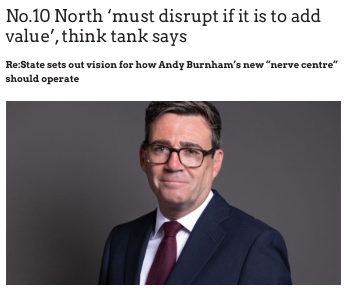
Cocidius’s (King of the North, AD 122) arrival in Downing Street changes the political weather.
Devolution is not an accessory to Burnhamism; it is the organising principle.
If he genuinely intends to push power out of London, he cannot replace NHSE with an even more powerful DH+.
Nor ...
... can he scatter responsibility among 42 ICBs, individual trusts and councils and call it localism.
With eight or ten modern Regional Health Authorities, he could.
Not replicas of the old bodies.
Not another layer of paper-pushers…
… statutory system authorities with a small number of hard responsibilities.
They’d control;
- regional capital,
- plan the workforce,
- commission highly specialised services,
- oversee performance and
- provide the improvement teams that currently appear only after a hospital is in serious trouble.
They would arbitrate when local organisations cannot agree, move resources across institutional boundaries and hold providers to one regional strategy.
Their boards should include NHS leaders, mayors, local government, public health, universities and patient representatives, but…
… stay small enough to make decisions.
The temptation will be to give Regions responsibility for everything from damp housing to workplace wellbeing.
Resist it.
Regional authorities cannot repair every social determinant of health. Their job is to make the NHS work as a regional system and create a partnership with the organisations that influence health.
That means:
- aligning NHS capital with housing and transport plans;
- connecting workforce policy with colleges and universities; and
- pooling defined budgets where prevention or discharge depends on councils.
It doesn’t mean turning the region into one giant committee.
The old regional tier disappeared, but the work didn't. Workforce planning, capital allocation, service reconfiguration, performance management and emergency coordination still have to happen somewhere.
At present they are either pulled upwards into Whitehall or dispersed among organisations too small to command the whole picture.
The Health Bill creates a chance to change course.
Burnham should not simply patch Streeting’s hierarchy or recreate NHS England inside the Department.
He should restore the missing-middle…
… powerful regions, accountable locally, operating within national standards.
Whitehall should decide what the NHS must provide.
Regions should decide how to make it happen.
The centre sets the promise. The regions deliver it...
...from the missing-middle.
|