March 2023 | The Council of State Governments | Midwestern Radioactive Materials Transportation Committee

Midwestern Radioactive Materials Transportation Committee Newsletter

Upcoming Events

*All times are Central Time

March 7 - 8:

U.S. Department of Energy Office of Nuclear Energy (DOE-NE) Transportation Core Group Meeting - Washington, D.C.

March 7:

American Nuclear Society (ANS) Chicago Section Webinar: The NEXT Molten Salt Research Reactor at Abilene Christian University - 7 PM*

March 15:

International Atomic Energy Agency (IAEA) Webinar: Application of Clearance in Management of Waste from Decommissioning - 6:30 AM*

March 23:

National Transportation Stakeholders Forum (NTSF) Webinar: UNF ST&DARDS and Criticality Considerations in SNF Storage - 1 PM*

March 28:

U.S. Nuclear Waste Technical Review Board (NWTRB) Spring 2023 Board Meeting - Orlando, FL

April 3 - 6:

33rd Annual National Radiological Emergency Preparedness (REP) Conference - Indianapolis, IN

April 24 - 27:

Nuclear Energy Institute (NEI) Used Fuel Management Conference - Las Vegas, NV

May 8 - 11:

55th National Conference on Radiation Control - Houston, TX

May 22 - 25:

2023 Annual Meeting of the NTSF - St. Louis, MO

May 22:

Tribal Radioactive Materials Transportation Committee (TRMTC) Spring 2023 Meeting - St. Louis, MO

May 25:

Midwestern Radioactive Materials Transportation Committee (MRMTC) Spring 2023 Meeting - St. Louis, MO

May 25:

Northeast High-Level Radioactive Waste Transportation Task Force Spring 2023 Meeting - St. Louis, MO

May 25:

Western Interstate Energy Board (WIEB) High-Level Radioactive Waste Committee (HLRWC) and Waste Isolation Pilot Plant Transportation Technical Advisory Group (WIPP TAG) Spring 2023 Meeting - St. Louis, MO

May 25:

Southern States Energy Board (SSEB) Radioactive Materials Transportation Committee and Transuranic (TRU) Waste Transportation Working Group Spring 2023 Meeting - St. Louis, MO

June:

2023 Annual Decommissioning Strategy Forum - Las Vegas, NV

June 11 - 15:

International Symposium on the Packaging and Transportation of Radioactive Materials (PATRAM) - Antibes, France

September 11 - 13:

National Cleanup Workshop - Arlington, VA

Join Our Mailing List!
Committee Happenings

Hello Midwesterners and friends! Welcome to meteorological Spring, even if it doesn't feel like it yet. Over the course of the last month, there have been a few changes to the lineup of the Midwestern Radioactive Materials Transportation Committee (MRMTC). On February 1, longtime committee member Angela Leek left state service to take a position with Summit Exercises and Training LLC (SummitET). However, before leaving, Angela and the State of Iowa worked diligently to to hire a successor and appoint them to the committee. Please join us in welcome Patty Riesberg to the MRMTC!


Last month, Patty became Bureau Chief for the Iowa Health and Human Services (HHS) Bureau of Radiological Health. She has 17 years of experience in the radiation field, with the first 13 years spent as a Mammography and Radiologic Technologist. Patty was a manager for multiple mammography departments before joining the bureau as a MQSA Mammography Inspector more than five years ago. Prior to becoming Bureau Chief, she supported radiological emergency preparedness and response through data management for dose assessment. Patty looks forward to continue growing the radiation response and regulations program for Iowa alongside her team of technical experts and technical experts across the nation.


Additionally, with the start of the new legislative biennium, the Council of State Governments (CSG) Midwest has been seeking recommendations for legislative appointments to the committee. The first to accept such a recommendation is South Dakota Rep. Trish Ladner. Rep. Ladner was first elected in 2020 and represents District 30 in the southwest corner of the state, which includes Black Hills National Forest and Wind Cave National Park. She serves on the Agriculture and Natural Resources and the Local Government committees. Welcome Rep. Ladner!


In other MRMTC news, Co-Chair Rodney Pitchford (Illinois), Immediate Past Chair Mike Snee (Ohio), and staffer Mitch Arvidson (CSG Midwest) are heading to Washington, D.C. this week for the U.S. Department of Energy Office of Nuclear Energy (DOE-NE) Transportation Core Group Meeting. Topics that will be covered in D.C. include the relaunch of CURIE, advanced reactors, Integrated Security and Safety Management System (ISSMS) and linkage to rail cars, etc.


A quick update on our Community Preparedness and Planning Pilot Framework Tool project with Southwest Research Institute (SwRI). It has been decided that 20 communities in the region will be analyzed and included in the draft and final reports. These communities are Gary, IN, North Chicago, IL, the St. Louis metro, Benton Harbor, MI, Joliet, IL, the Kansas City metro, Indianapolis, IN, North Platte, NE, Fargo, ND, Bellevue, OH, Clinton, IL, the Toledo metro, La Crosse, WI, Cadillac, MI, St. Paul, MN, Oak Harbor, OH, Columbus, NE, Monticello, MN, Fulton, MO, and Blair, NE. For more details on the project, check out past newsletters like January's.


In another example of the post-COVID return to normal, the region is preparing for the first shipments of transuranic (TRU) waste out of Argonne National Laboratory (ANL) in several years. The shipments will leave the Illinois lab and head to New Mexico's Waste Isolation Pilot Plant (WIPP) this month and in April. Further specifics are confidential, but rest assured the states of Illinois, Iowa, and Nebraska are well-prepared to inspect and escort these shipments as they see fit.


Finally, CSG Midwest is very close to hiring a part-time policy analyst to help staff the MRMTC! Committee members can expect to be introduced to the new hire in the next month and will get the chance to meet them in person at the 2023 Annual Meeting of the National Transportation Stakeholders Forum (NTSF) in May.

National Transportation Stakeholders Forum

Speaking of the NTSF Annual Meeting, registration is now open! Don't wait to secure your spot and hotel accommodations for the year's premier radioactive materials transportation conference. This year's meeting will focus on transparency, openness, and accountability and feature presentations like the "Future of Nuclear Energy, Radioactive Waste Management, and Workforce Retention" and "Consent-Based Siting & Community Engagement Funding Opportunity." There will also be a tour of DOE Office of Legacy Management's (LM) Weldon Spring Site. You can book your hotel room here and start planning what you'd like to see in St. Louis here.


The NTSF Planning Committee held a call on February 21 to discuss the current status of the 2023, 2024, and 2025 meetings. Additionally, the group discussed upcoming webinars and the status of the ad hoc working groups (AHWG). Two of those groups also held meetings that week. That same day, the NTSF Spent Nuclear Fuel (SNF) Rail/Routing AHWG met to welcome new Co-Chair Ray Hubbell (Oregon), discuss and update the AHWG's work plan, and have a general discussion about rail safety.


Then, on February 22, the NTSF Section 180(c) AHWG met to primarily talk about transportation timelines. The group heard about the work DOE has done to create timelines on transportation activities and Section 180(c) activities that will happen prior to SNF shipments. In the next few months, this group will be reviewing and discussing the Transportation Planning Framework.


Finally, you are encouraged to register for the next NTSF webinar. On March 23, presenters from Pacific Northwest National Laboratory (PNNL) and the Nuclear Regulatory Commission (NRC) will discuss "UNF ST&DARDS and Criticality Considerations in SNF Storage." This webinar will introduce attendees to Oak Ridge National Laboratory's (ORNL) Used Nuclear Fuel-Storage, Transportation & Disposal Resource and Data System (UNF ST&DARDS), which is a comprehensive integrated data and analysis tool being developed for DOE-NE's Spent Fuel and Waste Disposition program. A description of UNF-ST&DARDS' capabilities and applications by PNNL staff will be followed by a use-case example by NRC staff, describing how UNF-ST&DARDS assists the NRC in making safety determinations based on the possibility of criticality in SNF storage canisters. Register here!

Focus This Month

Checking In On America's SNF Inventory

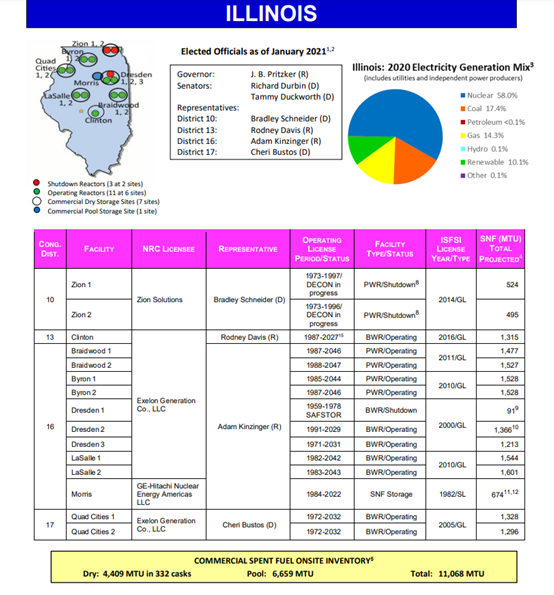
Every so often, DOE revises its Spent Nuclear Fuel and Reprocessing Waste Inventory report. Recently, Revision No. 9 was released to reflect changed in the data regarding current storage locations for SNF discharged through 2021. The revision also reflects Indian Point moving to a shutdown status and adds dates to three reactors that have announced their projected shutdown dates. The purpose of this report is to provide an inventory of SNF in the country located at nuclear power plants and independent spent fuel storage installations (ISFSI).


The 273-page report is overflowing with information, including projected future inventory based on a number of alternate scenarios. Two of these scenarios include the addition of the two Vogtle reactors under construction, and the other includes the assumption that the NRC will approve additional 20-year operating licenses for the nine reactors with applications submitted at the time of the report, including Point Beach in Wisconsin.


Overall, at the end of 2021, the U.S. had approximately 91,400 metric tons of heavy metal SNF. This SNF currently resides at 93 operating nuclear reactors, 26 shutdown reactors, one away-from-reactor SNF storage pool, and at several DOE and other research locations.


Some of the most interesting information can be found in Appendix H, which is a state-by-state breakdown of the nation's SNF. In the Midwest, two states crack the top ten for most SNF. Illinois comes in at number one with 11,347 metric tons of uranium (MTU) while Michigan comes in at number 10 with 3,476 MTU. The state summaries also include data on electrictiy generation mix, details on each reactor in the state, and information on which members of Congress represent storage sites.

Nuclear News

Ohio Seeks to Increase State Oversight of Rail Transportation

While it didn't directly involve radioactive material, the February 3 train derailment in East Palestine, OH, cannot be ignored because of the implications it has on the world of hazardous rail transportation. The 38-car derailment that released hydrogen chloride and phosgene captured the attention of Ohio and the nation.


The Ohio Legislature has sought to address the situation, in part, through House Resolution 33. The resolution urges Congress to pass legislation requiring railroad companies to inform local and state government officials when trains carrying potentially hazardous materials travel through their respective jurisdictions. Of course, these kinds of notification requirements already exist for category 1 material and SNF.


Additionally, the Ohio House Finance Committee are considering several changes to the $3.7 billion transportation budget bill working its way through the legislature. These changes include requiring an incident report be submitted to the Public Utilities Commission of Ohio whenever a rail crossing is blocked for more than five minutes and requiring railroad companies to ensure cameras and sensors on wayside detector systems are properly working.


Here is local news coverage on the resolution from WKBN27 and coverage of the budget bill from Statehouse News.


NRC Recommends License for Wisconsin Medical Isotope Production Facility

In 2019, SHINE Medical Technology, LLC submitted an application with the NRC for a license to operate a medical isotope production facility in Janesville, WI. SHINE provided a presentation of the project to the MRMTC at the committee's Fall 2018 Meeting in Madison, WI. Last month, the NRC issued its final supplemental Environmental Impact Statement (EIS) and recommended the license should be issued. Final licensing must wait until the Final Safety Evaluation Report is also released.


The production facility, which SHINE calls "The Chrysalis" will produce medical isotopes like molybdenum-99 (Mo-99), which is used in dozens of diagnostic medical imaging procedures. In its 2018 presentation to the MRMTC, SHINE said its low enriched uranium (LEU) feed material would come from Oak Ridge, TN via truck, its MO-99 would ship via air to destinations in Missouri and Massachusetts, and that the Class C or lower level waste would likely go via truck to EnergySolutions in Utah, Waste Control Specialists in Texas, and Diversified Scientific Services in Tennessee.


Check out PRNewswire for more on SHINE's facility.


$800 Million Going to Illinois Nukes

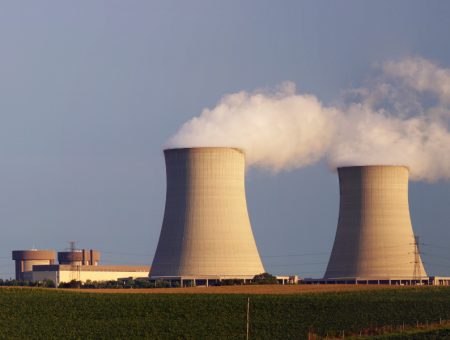
Constellation Energy recently announced it would be investing $800 million to upgrade the equipment at the utility's Byron and Braidwood Generating Stations. The main turbines at both plants will be relaced with high efficiency units that could add up to 135 megawatts of additional output. Constellation said this was enough to power an additional 100,000 homes around the clock every year. Working around scheduled refueling outages, the upgrades could start seeing increased output by 2026 and be fully upgraded by 2029.


This is quite the change for communities near the plants. Only a few years ago there was serious concern that the plants would be shuttered and decommissioned. However, between Illinois' Climate and Equitable Jobs Act of 2021 and provisions in the Federal Inflation Reduction Act, Constellation has recommitted to its flagship nuclear facilities.


Nuclear Street and WREX 13 have further details.

Byron Nuclear Generating Station in northern Illinois will receive major upgrades in the next few years.

Thank you for reading. Watch for the next edition to come out on

April 6, 2023.

Missed a newsletter? Past issues are archived on the committee's webpage.

Please do not reproduce or create new content from this material without the prior express written permission of CSG Midwest.


This material is based upon work supported by the Department of Energy under Award Numbers DE-NE0009117,

DE-EM0004869, and DE-EM0005168.


This report was prepared as an account of work sponsored by an agency of the United States Government. Neither the United States Government nor any agency thereof, nor any of their employees, makes any warranty, express or implied, or assumes any legal liability or responsibility for the accuracy, completeness, or usefulness of any information, apparatus, product, or process disclosed, or represents that its use would not infringe privately owned rights. Reference herein to any specific commercial product, process, or service by trade name, trademark, manufacturer, or otherwise does not necessarily constitute or imply its endorsement, recommendation, or favoring by the United States Government or any agency thereof. The views and opinions of authors expressed herein do not necessarily state or reflect those of the United States Government or any agency thereof.