Migrant Mother
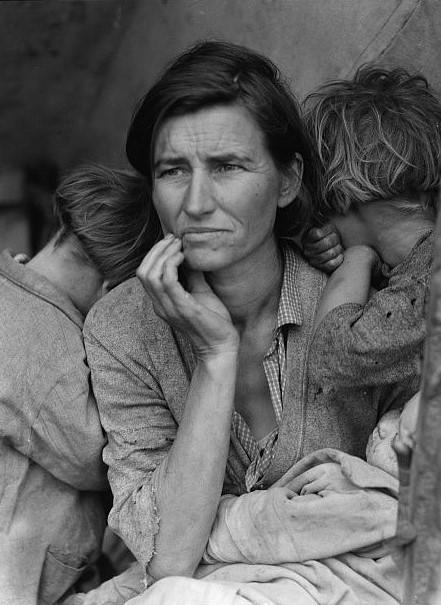
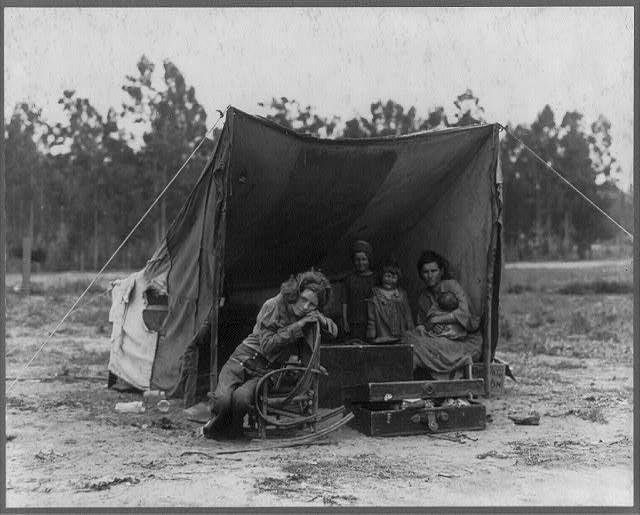
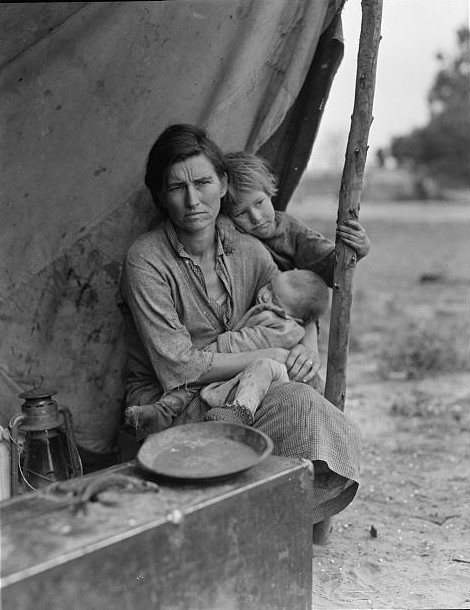
In March 1936 Dorothea Lange, working as a photographer for the Resettlement Administration, discovered a camp of over 2,500 migratory workers -- the majority of them children -- starving near the town of Nipomo, California, south of San Luis Obispo. There she made seven photographs of Florence Owens Thompson, age 32, and her children. The photos were delivered to the San Francisco News which immediately published some of them. Within days of the publication the federal government delivered 20,000 pounds of foodstuffs to the families who were "rescued from hunger."
On March 11, 1936 the News featured one of these photographs, later named "Migrant Mother," on its editorial page.
|
|
What does the "New Deal" mean
to this mother and her children?
This remarkable photograph epitomizes the human side of one of California's oldest and gravest problems -- the plight of nearly 200,000 men, women and children who move from valley to valley with the crops and live in wretched improvised shelters as they perform the labor on which our harvests depend.
Here, in the fine strong face of this mother, photographed at the camp of starving pea-pickers in San Luis Obispo County, is the tragedy of lives lived in squalor and fear, on terms that mock the American dream of security and independence and opportunity in which every child has been taught to believe.
The shame is that California is not only not tackling this problem but that through its wealthiest and most responsible citizens it is deliberately seeking to block the one constructive step that has been proposed to make life a little more secure and little more decent for these people. We refer to the desire of the Federal Resettlement Administration to build 20 sanitary camps for migratory workers, and to the organized opposition of the agricultural section of the State Chamber of Congress to the carrying out of that program.
The conscience of California should find its voice in a demand that the Federal Government be encouraged to go ahead with its plans for these sorely needed camps.
-- The San Francisco News, March 11, 1936, p. 3.
[Editor's note: Dorothea Lange was a federal employee when she made these photographs. Works created by employees of the U.S. government within the scope of their duties are not subject to copyright protection. These images are in the public domain and can be freely reproduced. Five of the seven photographs she made are housed in the Prints and Photographs Division at the Library of Congress. See here. The Resettlement Administration Lange worked for later became the Farm Security Administration,]
|
|
|
|
Florence Owens Thompson
(1903-1983)
Florence Owens Thompson was born in Indian Territory, now present-day Oklahoma. She married, raised a family and, during the 1930s moved to California. "I worked in hospitals, I tended bar. I cooked. I worked in the fields. I done a little bit of everything" she said, to make a living for her six children.
|
|
- As a migrant worker Florence and her family followed the crops in California and, at times, into Arizona. On March 6, 1936, after picking beets in the Imperial Valley, she and her family were traveling on California U.S. Highway 101 when her car broke down.
- The car coasted to a stop outside a pea-pickers camp in Nipomo where they found people camping there. The crops had been destroyed by a freezing rain and thousands of migrant workers were stranded, without work or pay.
-
When Jim Hill, her partner, and two of her sons went into town to get parts to repair the car, Thompson and some of her children set up a temporary camp. As she waited, photographer Dorothea Lange - who was working for the Resettlement Administration - drove up and started taking photos of her and her family. Lange took 7 photos that day, the last being Migrant Mother.
- Lange's photograph of her would become famous as a defining symbol of the Depression Era but, for 40 years after it was taken, Thompson's identity was not known. In the 1970s a newspaper reporter discovered her living in a mobile home in Modesto, California.
- In 1983 Florence Thompson was hospitalized with a serious illness; her family raised $35,000 in donations to pay for her medical care. She died that same year, age 80 and was buried in Scotts Valley, California. Her gravestone reads "Florence Leona Thompson. Migrant Mother - a Legend of the Strength of American Motherhood."
-- Wikipedia.
|
|
Dorothea Lange
(1895-1965)
There are moments when time stands still.
You hope it will wait for you.
|
-
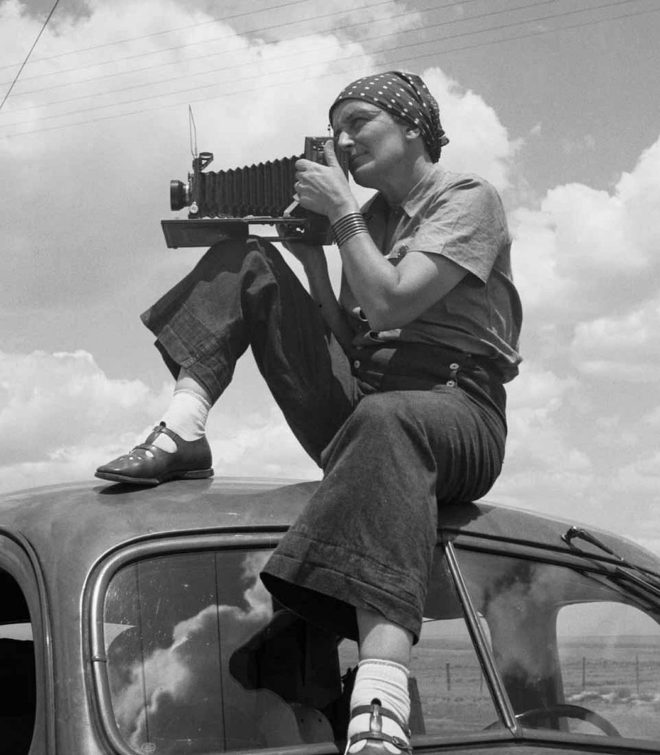
Dorothea Lange was born in Hoboken, New Jersey to second-generation German immigrants Johanna Lange and Heinrich Nutzhorn.
-
At age seven she contracted polio, which left her with a weakened right leg and a permanent limp. "It formed me, guided me, instructed me, helped me, and humiliated me," Lange once said of her altered gait. "I've never gotten over it, and I am aware of the force and power of it."
- Five years later, her father abandoned the family, prompting a move from suburban New Jersey to a poorer neighborhood in New York City. She later dropped her father's family name and assumed her mother's last name.
- After graduating high school in Manhattan, Dorothea declared her intention of becoming a photographer and began working in a studio. In 1918 she traveled to San Francisco with a high school classmate but their savings were wiped out by a pickpocket. Dorothea was stranded in the Bay Area where she would remain until her death in 1965.
- She joined the San Francisco Camera Club and opened her own portrait studio. In 1920, she married Maynard Dixon, the noted western painter, with whom she had two sons.
- In the 1930s -- when the Great Depression hit -- she, for the next five years, traveled the California coast as well as the midwest documenting rural poverty and the exploitation of sharecroppers and migrant workers.
- During World War 2 she went on assignment for the War Relocation Authority to document the forced evacuation of Japanese Americans into West Coast internment camps. "She was eager to take the commission, despite being opposed to the effort, as she believed 'a true record of the evacuation would be valuable in the future.”
- Dorothea Lange died of cancer on October 11, 1965, in San Francisco, at age seventy.
-- Wikipedia; Tim Chambers, Dorothea Lange's Censored Photographs of FDR's Japanese Concentration Camps, 12/7/2016, online.
|
|
(video ; 4 min.)
NBC Learn
|
|
Dyanna Taylor - Dorothea Lange's granddaughter - visited the Library of Congress' Prints & Photographs Division to see the Migrant Mother photographs.
See the PBS video (4.30 min.) here.
|
|
Thanks to Sarah Hermanson Meister for her wonderful book Dorothea Lange, Migrant Mother (New York, Museum of Modern Art, 2019) from which I quoted extensively. A visit to the San Luis Obispo County Historical Museum in California provided the inspiration. Thanks to Alan Schniderman, Marc Mauer, Wikipedia & AFSCME Local 2910 at the Library of Congress.
|
|
|
|
|
|
|