|
"Count it all joy, my brothers, when you meet trials of various kinds, for you know that the testing of your faith produces steadfastness. And let steadfastness have its full effect, that you may be perfect and complete, lacking in nothing (James 1:2-4).
"If you think your suffering is pointless, or that God is not in control, or that He is whimsical or cruel, then your suffering will drive you from God, instead of driving you from everything but God — as it should." John Piper
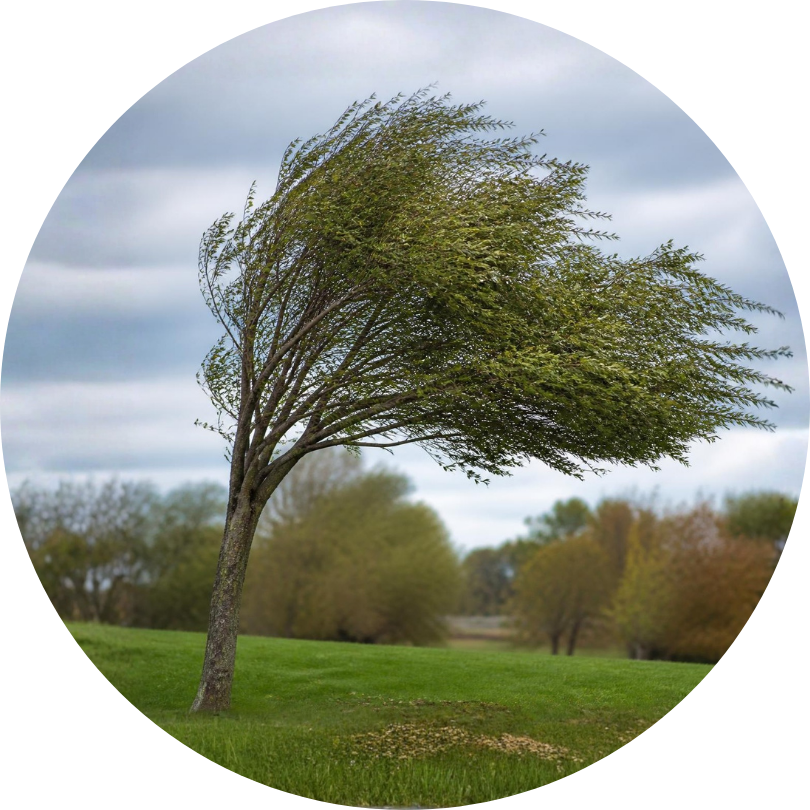
"What did you go out into the wilderness to see? A reed shaken by the wind? What then did you go out to see? A man dressed in soft clothing? Behold, those who wear soft clothing are in kings’ houses ... Truly, I say to you, among those born of women there has arisen no one greater than John the Baptist" (Matt. 11:7-8, 11).
Have you heard of Biosphere 2, an ecotopian experiment from the late 1980s and early 1990s that forgot the wind? I believe the intent was to explore if human life could be sustained in a substitute biosphere for Earth. One of the issues that the team of scientists ran into resulted from a failure to incorporate a seemingly obvious environmental force. Trees in the rainforest biome grew exceptionally fast but collapsed before reaching maturity. Without the resistance of wind, these trees grew tall yet structurally weak trunks.
We can examine our own bodies to learn of a similar adaptation designed by our creator. It was summarized by the 19th-century German anatomist and surgeon Julius Wolff and became known as Wolff’s law: "Bone in a healthy animal will adapt to the loads under which it is placed."1 In other words, bone is a living cell and is constantly remodeling itself, growing stronger as forces are applied to it. Unfortunately, the opposite can happen in the absence of loads — hence, your mother’s warning after spending too much time on the couch.
So what does a story of a German surgeon and a closed-system utopia have to do with the steadfastness described in the first chapter of James? The proverbial wisdom of this book boldly states that God can produce good from suffering. This steadfastness means a greater capacity to endure and stronger roots to become unshakable. Such humble power comes from the revelation that self-sufficiency isn’t in our design (2 Cor. 1:8–9). God knows the enormous value of our faith. Therefore, His providential will allows the sufferings, the seasons of this world, to construct with compassion an evergreen version of ourselves.
And when those you have witnessed to throughout your life find themselves visiting you in the wilderness again, what image will they see? If our eternal perspective with the gift of faith can magnify all that God is for us in Christ Jesus, then it will not be a reed shaken by the wind nor a king in soft clothing. Our current suffering will not be pointless, and our root will be infinitely deeper in good soil (Mark 4). One day we will be that pure reflection of God’s love that we’ve never been. Glory be to the giver of all past, present, and future grace.
1https://en.wikipedia.org/wiki/Wolff%27s_law
|