|
Nebraska is the only state in the union with a unicameral. If you grew up in Nebraska, you were taught that and much more about our state government in the 4th grade. Did you learn about George W. Norris, the former Nebraska U.S. senator? Nationally, he is probably best known as the author of the twentieth Amendment to the U.S. Constitution. All Americans will feel the impact of this come January 20th. Without the twentieth amendment, we would be waiting until March 4th for the new administration to take effect. He is also the senator that introduced the bill establishing the Tennessee Valley Authority, which became the model for natural-resource planning for years following.
For Nebraskans, he was the driving force behind our current "unicameral" system of state government. Though the idea of a unicameral wasn't his, he was driven to see Nebraska become the first state to adopt this system of government. He personally funded the ballot initiative, paying petition gatherers as much as $0.05 per signature and drove the state numerous times campaigning for the initiative (and we thought buying a ballot initiative measure was something new). Some say he wore out two sets of tires during his campaigning.
What were some of the promises of a unicameral system?
- Decreased partisanship
- Elimination of Conference Committees
- Increased efficiency
- Cost savings - which was a big deal during the great depression of the 1930s.
What were some of the downsides of a unicameral system?
- Inadequate representation of agriculturalists and minority groups
- The loss of partisanship
- The loss of checks and balances
In response to the loss of checks and balances, Norris said the Nebraska unicameral would have easy-to-follow procedures and extend greater privileges to the press, allowing for greater public awareness. Norris said,
"Every act of the legislature and every act of each individual must be transacted in the spotlight of publicity"
Norris' requirement of transparency aligns with Article III-11 of Nebraska's Constitution which states in part:
"All votes shall be viva voce."
and
"The yeas and nays of each member of any committee of the Legislature shall be recorded and published on any question in committee to advance or to indefinitely postpone any bill."
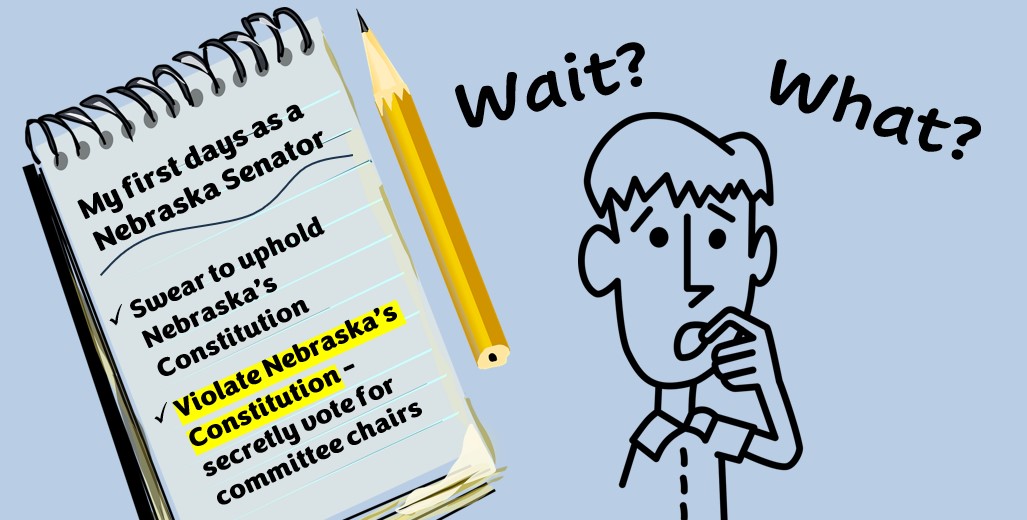
So the question is - why are votes for committee chairs not made public? It was the vision of George Norris' unicameral government. Transparency was to combat the lack of checks and balances of a one chamber legislature and it is in our Constitution!
All new, incoming, state senators will be sworn in before the start of the 109th legislature. For part of that swearing in, they will profess their duty to uphold the Nebraska Constitution. Will they ignore that duty as other senators before them have done when later on that day they will start establishing committees?
|