|
Have you heard anyone talking about taxes?
There has been a lot of talk about taxes this legislative session. Much of it has been garnered by Governor Pillen's desire to cut property taxes by as much as 40%. That push came with record property tax valuation hitting Nebraskans hard at the end of last year.
NFFV thought it would be worthwhile to look at the history of taxes to get some perspectives.
| |
|
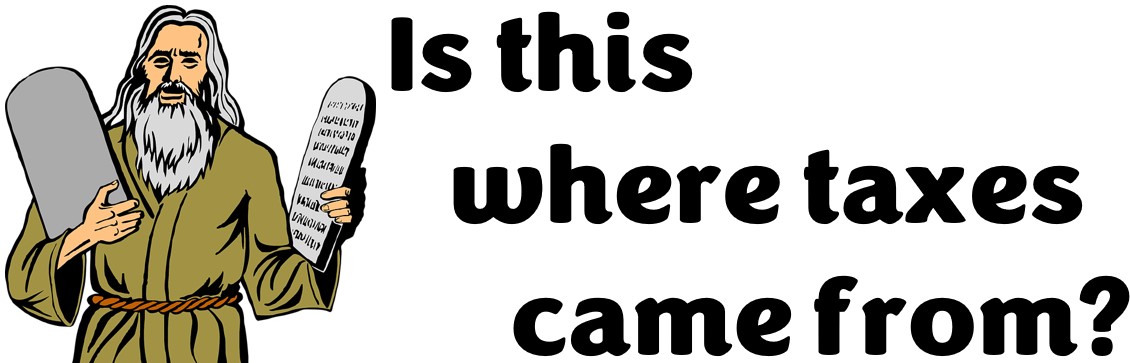
Taxes have been around almost as long as humans themselves. To understand this, let us start with the book that has been around almost as long. That book is the bible. In Numbers 18:25-26
25The Lord said to Moses, 26"Speak to the Levites and say to them: 'When you receive from the Israelites the tithe I give you as your inheritance, you must present a tenth of that tithe as the Lord's offering.
So, the first tax was one set by God as a tithe. The tithe was a requirement of Mosaic Law in which all Israelites were to give 10 percent of everything they earned and grew to the tabernacle/temple. As a note, a tithe should not be confused with an offering.
Should we read into God setting a flat tax verses a progressive tax?
| |
|
So what about our Nation?
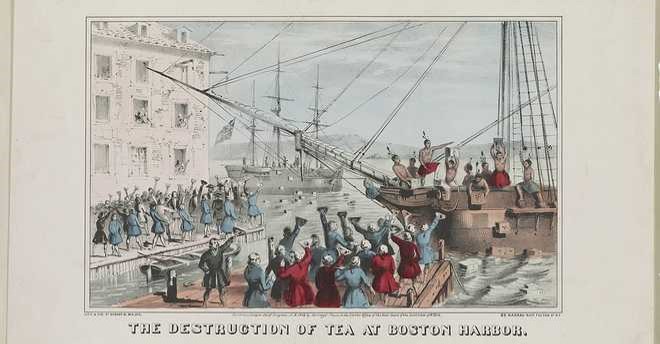
One of the most infamous rebellions against taxes was the Boston Tea Party. Taxes, amongst other items, were a major driver for our nation's independence. Phrases like, "no taxation without representation" summed up our Founders' thoughts on taxation. Many lost their lives so that phrase could hold true for future Americans. The Declaration of Independence called this out and our Constitution codified it. If you are curious about the relationship between these two documents, you can check out the short Hillsdale College video The Declaration and The Constitution.
| |
|
What nation voluntarily surrenders its private property rights?
Did you know the American people voluntarily surrendered their private property rights? Wait, that doesn't sound right! Passed by Congress on July 2, 1909, and ratified February 3, 1913, the 16th amendment established Congress' right to impose a Federal income tax. One of the big misses on the 16th amendment is the 1909 Congress put no limits on the amount the Government could tax. You might be thinking, how does the 16th amendment take away property rights? Stop paying your property tax and see. Fortunately and rightfully, the U.S. Supreme Court ruled last year that governments can not keep the full value of property they seize due to back taxes.
Below are two video that are worth listening to. The first is Paul Harvey's 1965 radio broadcast "Freedom to Chains". He talks about items already mentioned in this alert plus much more. The other is a Ronald Reagan speech from 1964 "A Time for Choosing". It's a speech for Presidential Candidate Barry Goldwater.
| |
|
If you do decide to listen, you will notice similar themes between the two. First, no nation has survived taxing its citizens more than 25% of their national income. It destroys initiative and builds reliance on government. So how is initiative and reliance on government doing today?
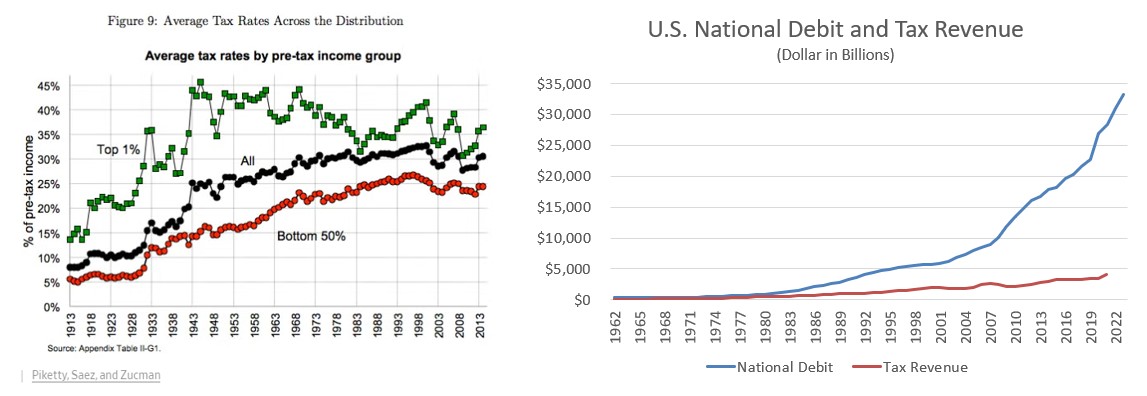
Below are a couple tax charts you may find interesting. The first is pre-tax income rates by group since the 16th amendment in 1913. The second chart is the U.S. national debit and U.S. tax revenue by year since 1962. You can see why so many are saying the U.S. is headed toward a major fall. No individual, company, or country can survive long with an ever-widening debit to revenue gap. In addition, it leads to another tax called inflation and we all know what that is costing us.
| |
As Ronald Reagan stated so well, "no government program voluntarily reduces itself in size", so government programs once lunched never disappear. This brings us back to Governor Pillen's plan to cut property taxes. His plan only reduces your taxes in one area to turn around and tax you in another. Plus, it doesn't address the real driver of property taxes. The real problem is uncontrolled property valuations. Property taxes can be cut 40%, but if valuations go up 50% you are still paying more in property tax. | |
|
Unrealized gains?
Does the 16th amendment give the government the ability to tax unrealized gains? The amendment states:
"The Congress shall have the power to lay and collect taxes on incomes, from whatever source derived, without apportionment among the several States, and without regard to any census or enumeration."
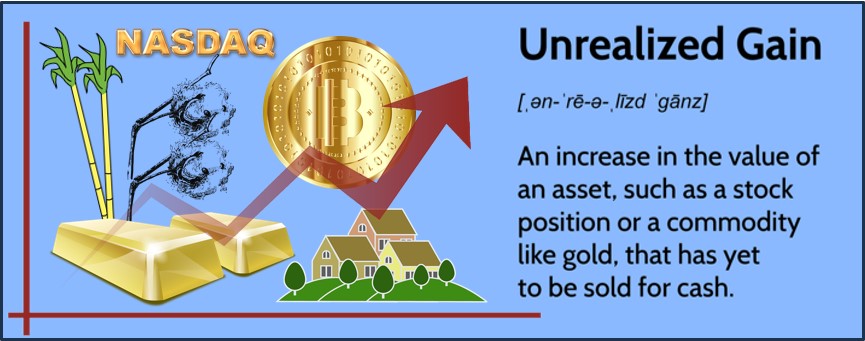
The key words are "collect taxes on income". Unrealized gains are not income so the answer should be no. Now apply that to property valuations. An increase in valuation is not a realized value or gain. However property owners are taxed as though it were. Should this be allowed?
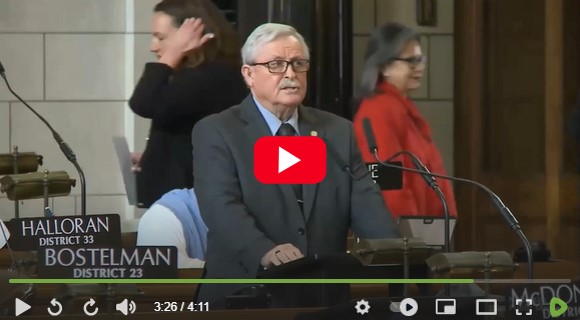
Did you know LB1279 - "Provide an income tax adjustment for unrealized capital gains" was introduced this session by Senator Halloran? The bill would: "imposes an income tax of twelve percent on unrealized capital gains acquired by a corporation, fiduciary, or individual for tax years beginning on or after January 1, 2024". As alarming as this bill is, Senator Halloran introduced it not because he wanted to tax unrealized gains but to prove the point that taxing property valuations is taxing an unrealized gain. It is interesting that one organization supported this bill. OpenSky Policy Institute actually testified in support of taxing unrealized gains!?!
The U.S. Supreme Court took up a tax case in late 2023. "Moore verses United States" covers the question of taxing unrealized gains. The case involves an individual who sued the IRS because they won't refund taxes collected on what they say is an unrealized gain. Though this case is specific to a certain investment, the ruling could have major implications in terms of taxation. Below are a couple videos that summarize the case well and highlight some of the implications. Both videos are from Sean Mullaney. The first video is an overview of the case and the second video is an update after oral arguments were heard.
| |
This Supreme Court has already shown they are willing to correct long established wrongs. Will they do it again with taxes? We should know by June 2024. | |
|
Bringing the discussion back to Nebraska
Right now, a lot of people are trying to "fix" Nebraska's taxes. NFFV has reported on how Nebraska is one of the most heavily taxed states in Minuteman Alert - Another ballot petition. In that alert we discussed an ongoing effort to completely overall the system. The effort is the EPIC Option. Since the alert EPIC Option has garnered quite the opposition. It seems there is a vast number of politicians and organizations who like Nebraska's tax system just the way it is. You can check out the Nebraska Examiner article "Epic battle over taxes shaping up, with one group warning against and 'EPIC' mistake" for a list of groups in opposition. Ironically the new group opposing EPIC named themselves "No New Taxes Nebraska", when in reality, Nebraskans have been getting new taxes every year with the old system! Every year we are told about tax breaks, yet we have an ever increasing tax bill.
The Nebraska Examiner article sites a new Tax Foundation article that states the consumption tax would need to be 21.6% instead of the 7.5% stated by EPIC Option. Keep in mind the Tax Foundation, as recently as October 2023, touted the benefits of a consumption tax in their article "How Taxing Consumption Would Improve Long-Term Opportunity and Well-Being for Families and Children". Which is it? Is a consumption based tax like EPIC bad or is it good? Does that answer change with who is funding the analysis?
This is why Nebraskans need to educate themselves. The question of the consumption tax rate is the key question. Even in the Tax Foundation's negative critique of EPIC, they stated:
"If a 7.5 percent rate on this tax base, as included in the legislation, could really replace all these other taxes, it would be a remarkably good deal that Nebraskans would be well-advised to adopt."
| |
NFFV would like to see the Tax Foundation or OpenSky Policy Institute take up Senator Erdman's challenged to a debate over EPIC. Nebraska's could learn and decide for themselves. Right now, it only appears Senator Erdman is willing to talk. That also should tell us something. | |
|
|
Here is one last point on the Tax Foundation's critique of EPIC. In the article, this statement was made:
"One such focused on Nebraska and found that a one precent increase in the local sales tax rate would result in a 3.94 percent increase in cross-border shopping in a city with an adjacent lower-tax jurisdiction and by 2.53 percent in a jurisdiction that is a 20-minute drive from its closest neighbor".
If that is correct, what does this say about Governor Pillen's plan to reduce property tax by raising sales tax? Will this lead to the same boarder bleed opposer of EPIC contend?
| |
- Educate yourself on consumption taxes. Don't outsource your thinking, not even to NFFV. Think about those that are for and against EPIC. Are they benefiting from the current tax structure? How would they and you benefit from a consumption tax structure?
- If you decide EPIC is right for Nebraska, sign the ballot petition going around. You can also offer to help.
- Don't get to frustrated with taxes. We know what Jesus had to say about them at a time when the Roman government was far worse than today. Matthew 22:17-21:
17Tell us then, what is your opinion? Is it right to pay the imperial tax[a] to Caesar or not?”
18But Jesus, knowing their evil intent, said, “You hypocrites, why are you trying to trap me? 19Show me the coin used for paying the tax.” They brought him a denarius, 20and he asked them, “Whose image is this? And whose inscription?”
21“Caesar’s,” they replied.
Then he said to them, “So give back to Caesar what is Caesar’s, and to God what is God’s.”
| |
If you liked the content provided in this Minuteman, consider donating to NFFV. You can donate by clicking the button below or by mailing a check made to Nebraska for Founders' Values. | |
|
Nebraskans for Founders' Values
PO Box 255
Walton, NE 68461
| |
|
|
NEBRASKANS FOR FOUNDERS' VALUES
Board of Directors Team
www.nffv.org
| | | | |