|
|
NFFV Action Request
Upcoming
Banking, Commerce and Insurance
Committee Hearing
Monday, March 17, 2025
1:30 PM, Room 1507
| |
| |
Support
LB204 - Adopt the Biometric Autonomy Liberty Law
| | The Stated Intent: LB 204 creates the Biometric Autonomy Liberty Law to protect certain biometric data from being collected and exploited without the knowing consent of the individuals the data was collected from, to provide for the removal or destruction of retained biometric data, to provide for enforcement of the act, a sixty day cure period for violations to the act and for relief to individuals impacted by violations of the act. | | |
So what is LB204 all about?
LB204 outlines what biometric data is and mostly requires private entities who collect biometric data to create policies and procedures on informed consent, the safe storage of biometric data, and retention/destruction of biometric data. Additionally, the bill puts limits on implantable devices and includes enforcement language.
Biometric data is defined as a fingerprint, voice print, retina image, iris image, or unique biological pattern or characteristic.
| | |
Who owns your data?
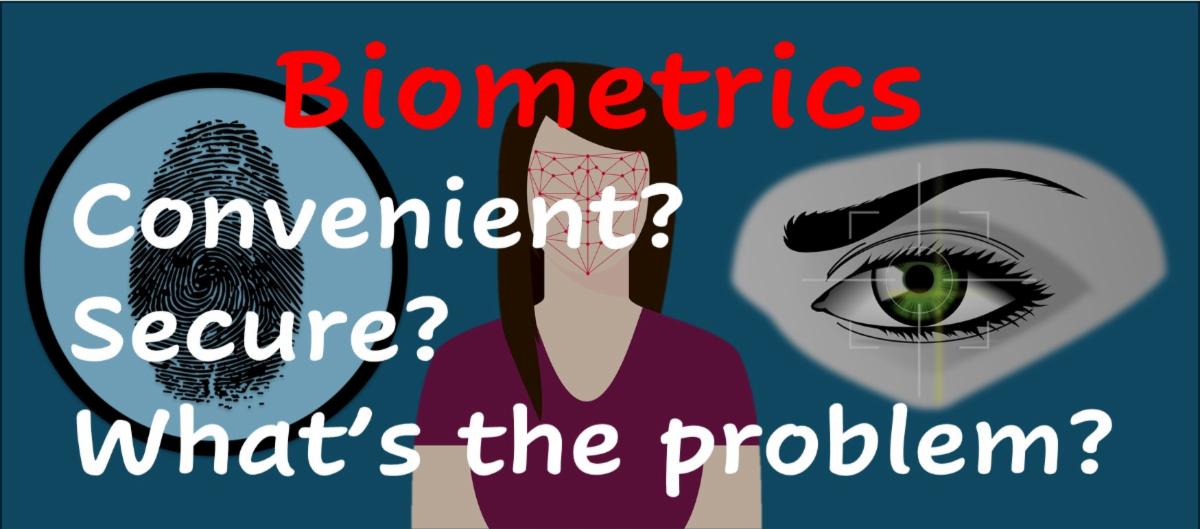
Did you know your data was for sale? How much is your data worth? According to MarketsandMarkets, the global biometric system industry was estimated to be 47.2 billion in 2024 and projected to reach 84.5 billion by 2029. You may not be aware of how biometrics is already a part of your daily life. Your phone may already be using a face scan to gain access. Have you taken a flight lately and had your face scanned at the airport? Do you use your palm or fingerprint to gain access to your work locations? These are all examples of how this technology is being used and expanded upon at a rapid pace in our world. According to MarketsandMarkets, "Increasing integration of biometrics in consumer electronics is fueling the growth of the biometric system market".
Biometric systems are routinely built into software segments, which hold the largest market share. These systems are also utilized with single-factor authentication, a la, face and iris scanning with mobile devices. Biometric systems such as fingerprint and palm recognition are applications used for access control, time, and attendance, and mobile device authentication. Biometrics are a key component in the rapidly-changing healthcare industry and touted as controlling sensitive data, electronic health records, and medication dispensing. As you can see, biometric systems make up a large part of our daily life already. But where is all the data going? Where is it being stored? Who is it being sold to, and what do they plan to do with it? There are many privacy risks.
| | |
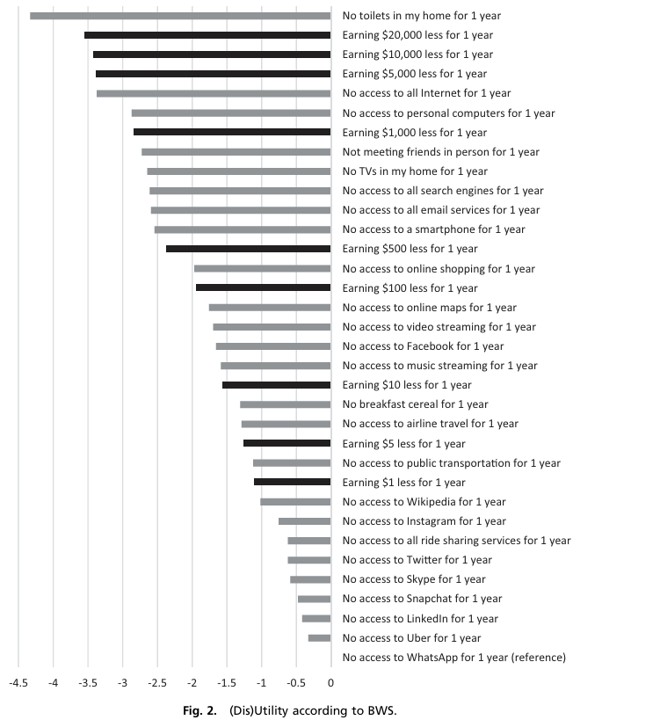
According to a Forbes article, MIT did a massive online choice experiment to determine how many dollars would you accept for not having access to "X"? In this case, "X" were services like indoor plumbing, TV, the internet, social media platforms like Twitter, and eCommerce platforms like Uber.
This sort of data is huge for data-centric businesses. However, this study indicates what people are "willing to accept" for the convenience factor. It all comes down to how much privacy you are willing to sacrifice for convenience or "security". This indicates how willing people are to incorporate biometrics into their daily lives. Interestingly enough in the study, giving up Facebook had a WTA cost of 40 euros whereas email and search engines had a WTA of 8,000 and 17,000 euros respectively. Thus, convenience has a cost factor. The chart below, taken from the MIT study, shows how things stacked up.
| | |
The Implications
Legislation regarding biometric data is new and is being introduced in a growing number of states, with laws only existing in Illinois, Texas, and Washington. Of noteworthy discussion is what happened in Illinois. What may have been good intentions regarding controlling of biometric data ended up costing companies millions in class action lawsuits. Illinois initially wrote their legislation to include fines for each biometric data violation incident. In the case of Rogers v. BNSF Railway Co., BNSF installed gate control systems to allow automatic scanning and fingerprint access for verification. Because BNSF did not provide notice for the purpose of the fingerprint, how the data was being kept, a written consent obtained, and how long the data would be stored, they were found in violation of the Illinois law 45,600 times. With each incident costing $5000, they entered into a $228 million judgment. The Illinois law has since been amended since triggering an extraordinary high amount of damage claims and settlements.
However, what lies at the heart of this issue is privacy and a person's property. In this case, the property is biometric data. What did our Founding Fathers have to say about privacy and property? One can look to James Madison in 1792 and what he attributed as property, which has a larger and juster meaning. The right to property
"embraces everything to which a man may attach a value and have a right; and which leaves to every one else the like advantage. In the former sense, a man’s land, or merchandise, or money is called his property. In the latter sense, a man has a property in his opinions and the free communication of them. He has a property of a peculiar value in his religious opinions and in the profession and practice dictated by them. He has a property very dear to him in the safety and liberty of his person. He has an equal property in the free use of his faculties and free choice of the objects on which to employ them. In a word, as a man is said to have a right to his property, he may be equally said to have a property in his rights".
From the period leading up to our Founding, the broad concept of property included a person's rights, ideas, beliefs, and the creative products of her labor. This is seen today in the protection of intellectual property. Does biometric data fall within the definition of property? The BNSF case shows that biometric data will hold up in the court of law with it's ruling in Illinois.
| | |
Does LB204 go far enough?
Most of LB204 is made null and void for "security purposes" as noted by Section 18 which states "Sections 6 to 11 of this act shall not apply to biometric data collected or possessed for a security purpose". This highlights the balance between "security" and "individual freedoms". How much freedom are you willing to give up for security?
A limited government is one where the government is restrained by the people and not intruding into the private lives of the citizens. Biometric data can be used by the government for surveillance, which is not far fetched, as we saw this on overdrive during the covid era. One just needs to ask the TSA how they are storing biometric data of each person that they scan, how long they are holding the data, where it is stored and if they have gotten approval from each passenger. Government surveillance and data collection should be more of a concern than even private entity data collection. One needs only to look at the massive collection of health data being collected on every Nebraskan with the public-private partnership with Cync Health. If we are going to talk about the ownership of personal data, health information data is just as important as biometric data. If every Nebraskan had the authority over all the data collected on themself and got to choose who could obtain it for a price, that would be a nice source of income for every Nebraska citizen.
While NFFV encourages support of this bill, it needs some work and a discussion must be had to include limitations on the government obtaining and storing biometric data on the citizens.
| | |
Let YOUR senator(s) know:
- Biometric data falls under personal property as states by our Founding Fathers. This property is held by each person and shall not be infringed upon without obtaining permission.
- Biometric data needs to be written to protect the people of Nebraska first and foremost, without exempting the government entities.
- Policies need to be clearly defined about biometric data and people need to have the ability to opt out without interruption of a paid service. People should not be coerced into foregoing their rights to their property.
| | |
Your voice is powerful, make it heard on LB204. The committee hearing is scheduled for Monday, March 17, 2025. NFFV recommends you "Support" this bill.
How to be heard? Here are three ways:
-
Most Effective: Testify in person. Going to the Committee hearing and sharing YOUR story with committee member Senators is very impactful. For first time in person testifier here are some helpful hints.
-
Effective: Submit written testimony. If you can't be there in person then submit written testimony. Not sure how to do that, click here. Note: The deadline to submit and verify a comment for the hearing record for LB204 is Monday, March 17, 2025 at 8:00 AM Central Time.
-
Least Effective: Email your position letter to the Committee Senators and CC your own Senator. For a listing of the Banking, Commerce, and Insurance Committee Senators click here. Note: emails should be sent by noon, the business day before the committee hearing. It's not likely these emails will be included in official hearing minutes, however, there is a better chance Committee Senators will see your comments. You can request they be added to meeting minutes in your email to Committee Senators.
| | If you liked the content provided in this Minuteman, consider donating to NFFV. You can donate by clicking the button below or by mailing a check made to Nebraska for Founders' Values. | | |
Nebraskans for Founders' Values
PO Box 255
Walton, NE 68461
| |
| |
NEBRASKANS FOR FOUNDERS' VALUES
Board of Directors Team
www.nffv.org
| | | | |