|
|
NFFV Action Request
Upcoming
Education Committee Hearing
Tuesday, February 4, 2025
1:30 PM, Room 1525
| |
|
|
Support
LB31 - Require school policies relating to the use of student surveillance, monitoring, and tracking technology by school districts
| |
|
The Stated Intent: LB 31 directs the Nebraska State Board of Education to develop a model policy relating to the use of student surveillance, monitoring and tracking technologies and to require each school district to adopt a policy consistent with such model policy.
At a minimum the policy shall require school districts to do the following:
- Create an inventory of the type of surveillance tools or student surveys that gather personal information considered for use or actual use in the school district, including
- name and contact information for each private company, vendor or governmental entity and cost of such technology;
- description of each tool used including privacy protection measures and data sharing;
- whether or not parents may opt their students out of being subject to such tools;
- if and how data from such monitoring is used and shared with law enforcement or what if any implications for punitive actions under the Student Discipline Act.;
- how each school ensures proper accommodation for students with disabilities or IEPs and how biometric or personally identifiable info is stored, shared, or sold with the private companies, vendors, or governmental entities providing such tools ,and
- clearly delineate what remedies are available to students and parents for violations of personal privacy related to such tools, including but not limited to, the Consumer Protection Act, the Political Subdivisions Tort Claims and Act and section 79-2,104.
The inventory and information related to such information considered for use or utilized by the school districts shall be posted on each schools website and will be made available by hard copy by request.
Beginning May 1, 2026, each school board shall adopt a written policy consistent with the model policy.
| |
|
So what is LB31 all about?
LB31 tries to address concerns about transparency, use of taxpayer dollars, parental rights, and students privacy as it relates to the use of student surveys and student surveillance and those companies contracting with schools.
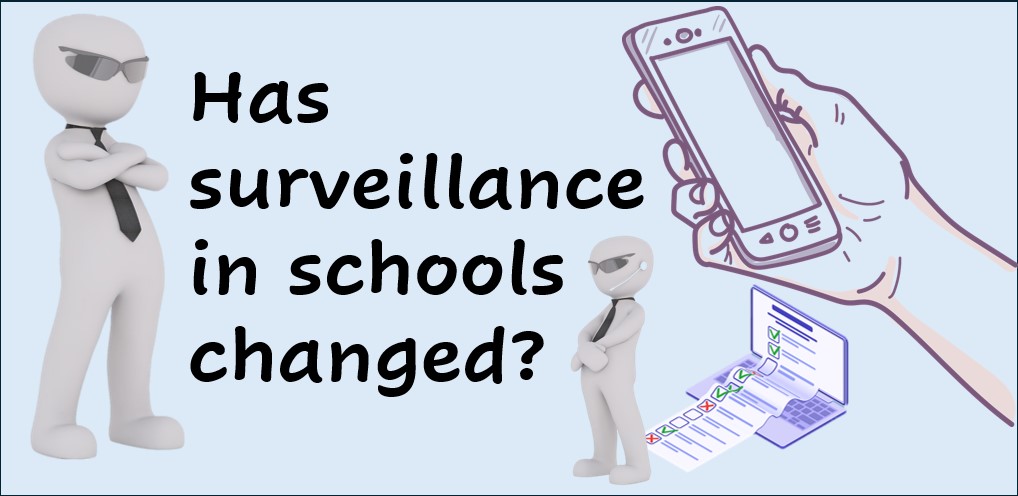
It acknowledges the growing use of tracking systems used by schools across the state - systems like digital hall passes, anti-vaping devices, fingerprints swipes, cameras, and electronic surveys.
Most importantly the bill calls out parent's, student's, and taxpayer's rights:
Parents have a well-established and fundamental right to control their children's education. Students have a well-established and fundamental right to privacy from unwarranted government surveillance. Taxpayers have a well-established right to ensure public entities are good stewards of public funds and a well-established right to transparency for governmental operations and expenditures.
| |
|
What is Surveillance and should we be concerned?
The paper "The ethics (or not) of massive government surveillance" defines surveillance as:
“Surveillance is, simply put, the observation and/or monitoring of a person. Coming from the French word for ‘looking upon,’ the term encompasses not only visual observation but also the scrutiny of all behavior, speech, and actions.”
Schools have always monitored and observed students. Teachers are trained to observe behaviors and actions in order to identify kids who may be struggling. Is that a bad thing? The answer to that may not be as straight forward as it once was. UVALAW published "Students' New Surveillance State". In this article, they explore the darker side to student surveillance. What once was a teacher monitoring students behavior in the classroom has turned into monitoring their every thought through online searches, posts, and surveys. Following are some noteworthy quotes from the article:
“…Tools of mass surveillance that are purchased for use in schools under the guise of advancing security or efficiency goals should not compromise personal liberty or evade citizen transparency.”
“I’ve worked with the Center for Democracy and Technology for years, and they have done amazing qualitative and quantitative research on the chilling effects and the pervasiveness of these surveilled laptops. Something like 89% of teachers reported that their students’ laptops are being monitored by companies like Bark and Gaggle.”
“These are private companies being granted access to all student data and then shielded from liability because they’re acting on behalf of government, which is frankly bonkers. Because they’re private entities, they don’t have to respond to records requests, as government agencies do.”
Does any of that sound concerning to you? So, the question is why surveil at all?
| |
|
What is the Children's Internet Protection Act - CIPA?
The CIPA was a catalyst to school online surveillance. Passed by Congress in 2000 the law's aim was protecting children from exposure to harmful online content. It required schools and libraries receiving federal funding or discounts to implement internet safety policies and use filtering software to block access to inappropriate materials.
According to University of Virginia Law Professor, Danielle Citron, "schools are effectively saying, ‘Because we have to block porn, it requires us to see, block and, crucially, monitor everything students do with laptops,’ even though students use these laptops at home, on weekends, and during the summer and holidays. So, students are being monitored by schools every second of every day. This is happening even though CIPA has a clear disclaimer that continuous tracking of students online is not required.”
The irony here is students are still accessing porn through their school libraries and now being monitored every second of every day.
| |
|
What are appropriate boundaries for surveillance?
It the first article referenced above, MIT Professor Gary Marx argues that before we implement surveillance, we should evaluate the method by asking a number of questions. Some among those he promotes are:
- Are individuals aware that personal information is being collected, who sees it and why?
- Do individuals consent to the data collection?
- Golden Rule: would those responsible for surveillance agree to be its subjects under the conditions in which they apply it to others?
- Was the decision to use a tactic arrived at through public discussion and decision making process?
- Are people aware of the findings and how they were created?
- Are there procedures for challenging the results, or for entering alternative data or interpretations into the record?
- If the individual has been treated unfairly and procedures violated, are there appropriate means for redress?
- Can the security of the data be adequately protected?”
- Are the goals of the data collection legitimate?
- Is there a clear link between the information collected and the goal sought?
| |
|
Then, there are the surveys
This past fall the Nebraska State Board of Education voted to accept a $560,000 grant from the Federal Government to conduct health surveys on students. According to Substack article "The Half Million Dollar Health Survey" by Sue Greenwald M.D.,
“The Youth Risk Behavioral Surveillance System (YRBSS) grant covers a 5 year period, or $112,475 per year. These surveys are intended for both public and private schools.”
Dr. Greenwald goes on to say a
“second survey system included in the grant is called School Health Profiles (SHP). The YRBSS survey alternates school years with the SHP as each are biennial. They use the same state and local personnel and similar data-collection software.”
Taking further excerpts from Dr. Greenwald's article.
- Good news - Parents objections to their children being asked about their gender, pronouns, and sexual experiences has resulted in their removal from the 2025 draft.
- Bad news – “In recent years, statistics gathered on those questionnaires have led to the correlation of suicide and transgenderism. Rather than postulating that both of those conditions correlate strongly with mental illness, the leap was made that schools need to enthusiastically support ‘gender-affirming care’ to prevent suicide. Led by federal government agencies and championed at teacher and counselor training sessions, this philosophy resulted in the unprecedented phenomenon of kids trained to be ‘trans,’ and started on puberty blocking drugs, thereby causing grave physical and emotional harm to many minors.”
So, who is helped by this data? It appears it’s for the benefit of the CDC (Center for Disease Control), WHO (World Health Organization) and the UN (United Nations).
Do they really have the right to require surveys like this? The Protection of Pupil Rights Amendment (PPRA) was meant to protect students from being asked invasive questions at school. The PPRA actually requires parents to opt-in. Unfortunately, the opposite is happening. Families have to opt out, not opt in.
| |
|
Let YOUR senator(s) know:
- This bill correctly establishes parents, students, and taxpayers rights.
- Schools are currently all-in with online curriculum. Chromebooks assigned to students have a unique IP address and therefore every key stroke the student makes on that device can be tracked. The data is being tracked and likely sold by the online curriculum companies, the online Social Emotional Learning companies, and possibly the operating system providers. If you sync your Chromebook to your phone, that data may also be trackable.
- Surveys have become big business and big money to the companies that conduct them and there is a great deal of uncertainty with what's actually been done with the data.
| |
|
Your voice is powerful, make it heard on LB31. The committee hearing is scheduled for Tuesday, February 4, 2025. NFFV recommends you "Support" this bill.
How to be heard? Here are three ways:
-
Most Effective: Testify in person. Going to the Committee hearing and sharing YOUR story with committee member Senators is very impactful. For first time in person testifier here are some helpful hints.
-
Effective: Submit written testimony. If you can't be there in person then submit written testimony. Not sure how to do that, click here. Note: The deadline to submit and verify a comment for the hearing record for LB31 is Tuesday, February 4, 2025 at 8:00 AM Central Time.
-
Least Effective: Email your position letter to the Committee Senators and CC your own Senator. For a listing of the Education Committee Senators click here. Note: emails should be sent by noon, the business day before the committee hearing. It's not likely these emails will be included in official hearing minutes, however, there is a better chance Committee Senators will see your comments. You can request they be added to meeting minutes in your email to Committee Senators.
| |
If you liked the content provided in this Minuteman, consider donating to NFFV. You can donate by clicking the button below or by mailing a check made to Nebraska for Founders' Values. | |
|
Nebraskans for Founders' Values
PO Box 255
Walton, NE 68461
| |
|
|
NEBRASKANS FOR FOUNDERS' VALUES
Board of Directors Team
www.nffv.org
| | | | |