NFFV Action Alert


Upcoming

Executive Board Hearing

Wednesday, February 18, 2026

12:00 PM, Room 1524


Oppose

LR311CA - Constitutional amendment to create a Commission on Redistricting and provide requirements for drawing district boundaries

The Stated Intent: LR311CA proposes a constitutional amendment to be placed on the November 2026 ballot creating an independent redistricting commission.

So what is LR311CA all about?


LR311CA is a legislative resolution proposing a Nebraska Constitutional Amendment. If this resolution is passed by the legislature, it would be left to the voters to approve or reject it in the 2026 election. The resolution would show up on the ballot in a similar way to ballot initiatives. The ballot language would read:


"A constitutional amendment to require appointment of a Commission on Redistricting to draw and recommend to the Legislature the boundaries of election districts."

"For / Against"


Here are some key highlights in the resolution:


A Screening Committee will be established every ten years with nine members, with partisan limits on the members. No political party can have more than five members while it takes six affirmative votes to initiate an action. The purpose of this committee is to appoint the Commission on Redistricting.


The Commission is also composed of nine members, three from the largest political party, three from the second largest political party, and three not affiliated with either of these political parties.


The Screening Committees has the responsibility to "broadly advertise" and randomly select two individuals into each group from a list of candidates "who apply to the Screening Committee, who have the ability to exercise nonpartisan, independent judgment in drawing election districts, and who in the judgment of the screening committee are likely to do so." The Screening Committee will also directly "choose one candidate from each group and appoint them to the commission."


"Any action taken by the Commission, including the election of its chairperson and vice-chairperson and the recommendation of maps, shall have the votes of at least two commissioners from each of the three groups of commissioners."


"Subject to other provisions of this Constitution, election districts shall be drawn in accordance with the following criteria, in order of priority: (a) Complying with federal law, (b) creating contiguous districts, (c) making districts as nearly equal in population as possible, (d) ensuring that districts do not deny or abridge the right to vote on the basis of race or language, (e) minimizing the division of county, municipal, and neighborhood boundaries, and (f) not intentionally favoring or disfavoring any incumbent or political party;"


"The Commission shall recommend to the Legislature maps setting forth the boundaries of election districts. Such maps shall be subject to final approval by the Legislature"

An arms race?


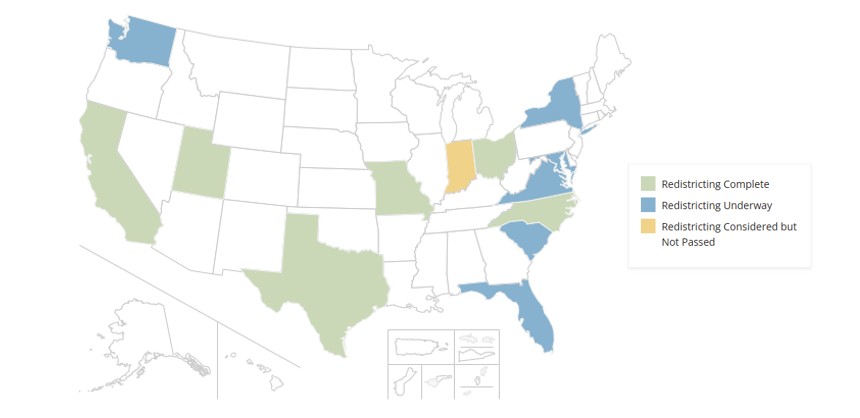
You can not talk about redistricting without taking a quick look at what is going on around the country. I'm sure you have all heard the news about Texas and California redrawing their districts mid-decade. However, there are many more states that have or are in the process of redrawing boundary lines. The map below from the National Conference on State Legislatures give us a visual of what's going on across the country as of February 06, 2026.

Of coarse, the courts are swamped with cases. The Supreme Court has even weighed in a couple of times. They allowed both Texas and California maps to proceed despite the challenges. Lower Courts have blocked some cases and there is ongoing litigation in places like New York, Louisiana, and Alabama.


Before we move from the national look at redistricting, it's worth mentioning a potentially pivotal case at the Supreme Court, Louisiana v. Callais. The High Court, in an unusual move, heard arguments on this case in March 2025 and then again in October 2025. At its core, this case questions a key part of the Voting Rights Act of 1965, specifically Section 2 which prohibits both vote denial (preventing a person from voting) and vote dilution (reducing the effectiveness of votes, especially through gerrymandering or at-large election systems). Challengers argue that requiring states like Louisiana to draw "majority-minority" districts (where a racial minority, such as Black voters, makes up over half the population to boost their voting power) amounts to unconstitutional "racial gerrymandering." This means intentionally using race as the main factor in drawing district lines, which they say violates the 14th Amendment (equal protection under the law) and 15th Amendment (right to vote without racial discrimination). You can read details of the case in Stanford Law School's blogs.


If the Court sides with the challengers and rules those districts unconstitutional, it could be a huge shift, overturning decades of precedents since the Voting Rights Act was passed. Notably, during the arguments, Justice Kavanaugh raised the idea of whether Section 2 should come with a "time limit," suggesting it might not be needed forever. We'll probably get the decision by the end of the Court's current term in June 2026.

Back to Nebraska


Would Nebraska do a mid-decade redistricting? Governor Pillen said "I'm open to all kinds of conversations" according to the Nebraska Examiner in October 2025. He was certainly ready to move forward with "Winner Take All". While its certainly too late for Nebraska to try a mid-decade redistricting, this bill makes it clear some would like to make it extremely hard to ever do so.


From a Founding Fathers perspective, we know our Founder Fathers established a Republic over a Democracy. They feared mob rule with democracy. The majority could easily oppress minority groups or make impulsive, short-sighted decisions. James Madison in Federalist 10 clearly distinguished a republic where power is delegated to elected representative. The Founders established checks and balances, separation of powers, and a written constitution, to safeguard individual liberties and maintain stability. They established a two house legislature; one based on population the other on geography as part of those check and balances. Nebraska gave up the two house legislature long ago. LR311CA would take Nebraska even further from the Founders established Republic by placing redistricting into unelected individuals hands.


Furthermore, Madison in Federalist 56 assumed states will divide into districts naturally: "Divide the largest State into ten or twelve districts, and it will be very difficult to suppose that the interests of the inhabitants will not be very faithfully represented." They did not envision removing this duty from the legislatures. George Washington also believed in elected accountability.


We contrast this with knowledge that our Founding Fathers expressed deep concerns about the dangers of a two-party political system. They feared it would lead to division, corruption, and the erosion of national unity. George Washington, James Madison, and John Adams all gave warnings. John Adams went so far to call the two-party system "the greatest political evil under our Constitution". LR311CA looks to take away the influence one party may have over another.


However, all we have to do is look at Nebraska's own history to know that partisan politics are inevitable. Nebraska is suppose to have a non-partisan legislature. Anyone who gives the legislature even an ounce of attention knows the Nebraska legislature is partisan. There is no hiding it! So what would make anyone think that this Commission on Redistricting would be anything different?


Nebraska doesn't need LR311CA, it needs a two house legislature like our Founders envisioned.

Let YOUR senator(s) know:


  • They were elected to perform a duty. A part of that duty is to establish voter districts. They should not delegate that to someone else. 


  • We know the legislature is partisan. We know this commission will be partisan.


  • The legislative resolution would continue Nebraska's path away from the Republican form of government our Founders established. We should instead be looking at ways to get back to that form of government.

Your voice is powerful, make it heard on LR311CA. The committee hearing is scheduled for Wednesday, February 18, 2026. NFFV recommends you "Oppose" this bill. 


How to be heard? Here are three ways:


  • Most Effective: Testify in person. Going to the Committee hearing and sharing YOUR story with committee member Senators is very impactful. For first time in person testifier here are some helpful hints. 
  • Effective: Submit written testimony. If you can't be there in person then submit written testimony. Not sure how to do that, click here. Note: The deadline to submit and verify a comment for the hearing record for LR311CA is Wednesday, February 18, 2026 at 8:00 AM Central Time.
  • Least Effective: Email your position letter to the Committee Senators and CC your own Senator. For a listing of the Executive Board Senators click here. Note: emails should be sent by noon, the business day before the committee hearing. It's not likely these emails will be included in official hearing minutes, however, there is a better chance Committee Senators will see your comments. You can request they be added to meeting minutes in your email to Committee Senators.

If you liked the content provided in this Minuteman, consider donating to NFFV. You can donate by clicking the button below or by mailing a check made to Nebraska for Founders' Values.

Nebraskans for Founders' Values

PO Box 255

Walton, NE 68461


NEBRASKANS FOR FOUNDERS' VALUES

Board of Directors Team

www.nffv.org