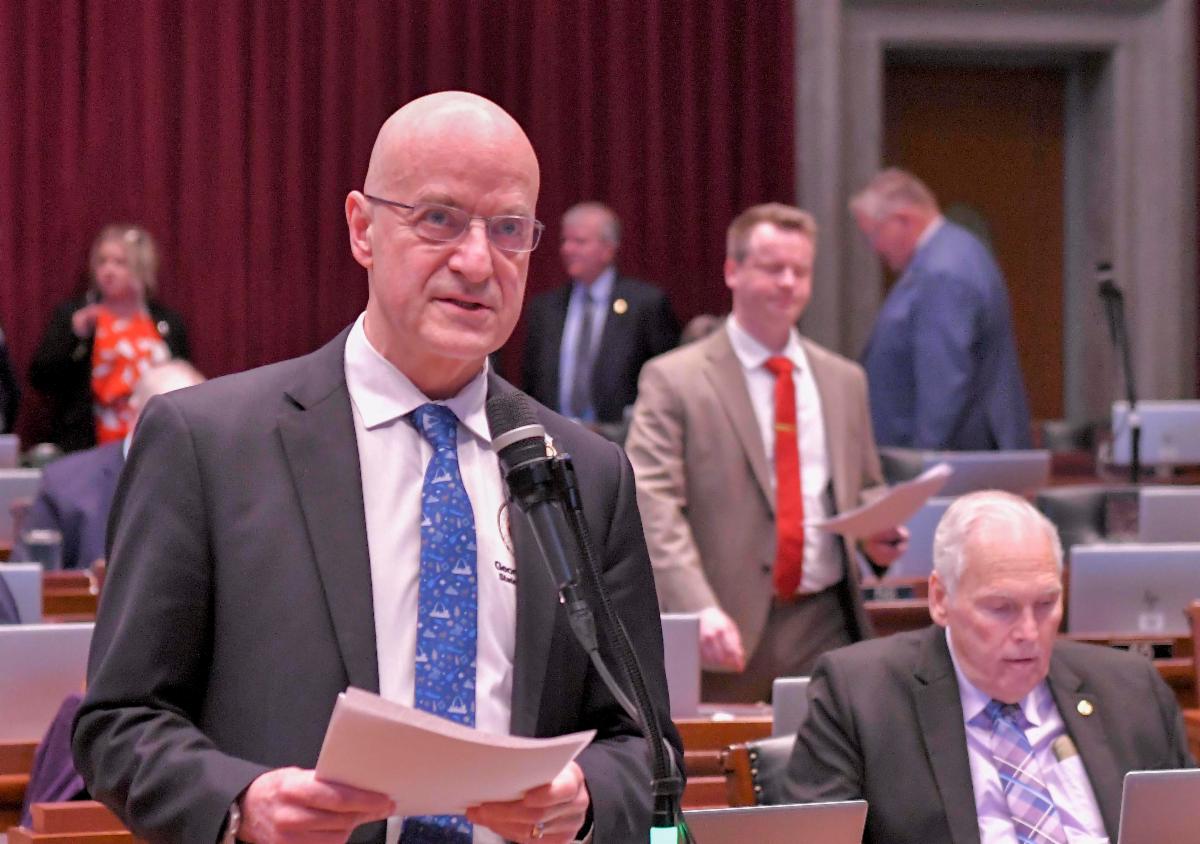
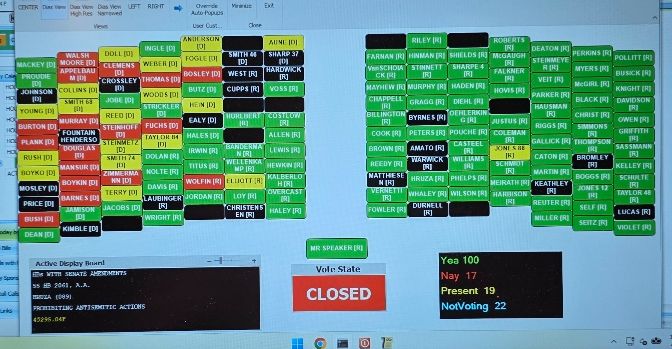
The Missouri General Assembly has given final approval to legislation aimed at addressing antisemitic conduct in public education, following months of debate and negotiation between the House and Senate. It passed out of the Senate unanimously with a 30-0 vote. It was then totally agreed to and finally passed (TAFP) in the House with a bipartisan vote of 100 in favor (82 needed for passage).


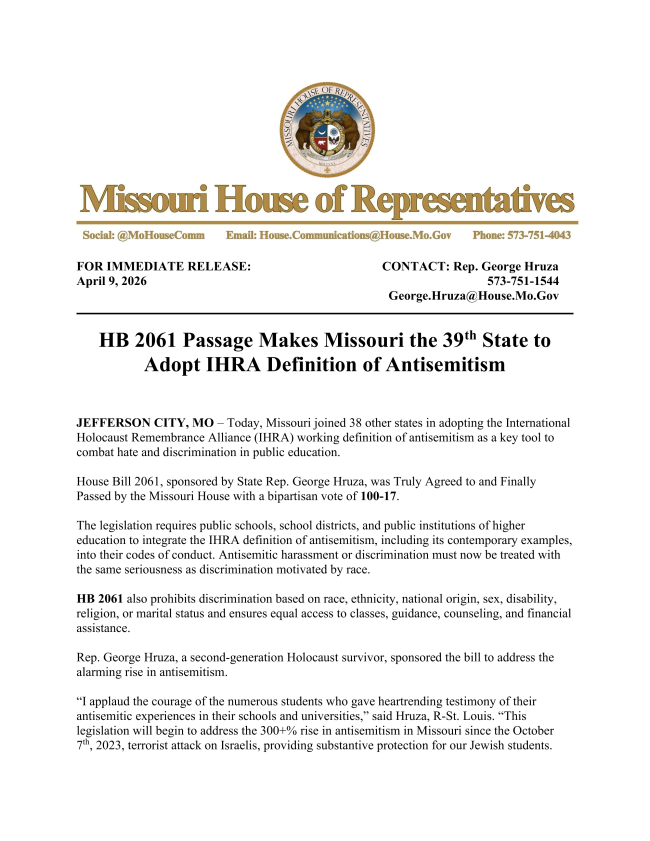
House Bill 2061 requires public schools, school districts, and public institutions of higher education to adopt policies prohibiting antisemitic discrimination and harassment. The measure incorporates the IHRA working definition of antisemitism and directs educational institutions to incorporate that definition into their codes of conduct, treating such conduct in a manner consistent with other forms of discrimination.


The legislation also strengthens broader anti-discrimination protections, prohibiting unequal treatment based on race, ethnicity, national origin, sex, disability, religion, or marital status. Schools and universities must ensure equal access to classes, counseling, guidance services, and financial assistance.


Under the bill, Title VI coordinators within the State Board of Education and the Coordinating Board for Higher Education will monitor complaints of discrimination and harassment, investigate incidents, and submit annual reports to the General Assembly. However, complaints based solely on constitutionally protected political or religious speech will not be included in those reports. The bill reflects key changes made to address concerns raised earlier in the session. Lawmakers added explicit free speech protections, clarifying that the measure is not intended to limit political discourse or criticism of Israel as one would criticize any other nation or government.


The bill also expanded the scope of the reporting and enforcement provisions to apply to discrimination against all races and ethnicities, rather than focusing solely on antisemitic incidents. These reports will be put on each department's website. An additional amendment includes language formally condemning discrimination in all forms.


With both chambers now in agreement, the bill was sent to the governor for consideration. If signed into law, Missouri would become the 39th state to adopt the International Holocaust Remembrance Alliance’s working definition of antisemitism. The Governor has 15 days to sign the legislation. Our Jewish students can be assured that the Missouri Legislature has their back.


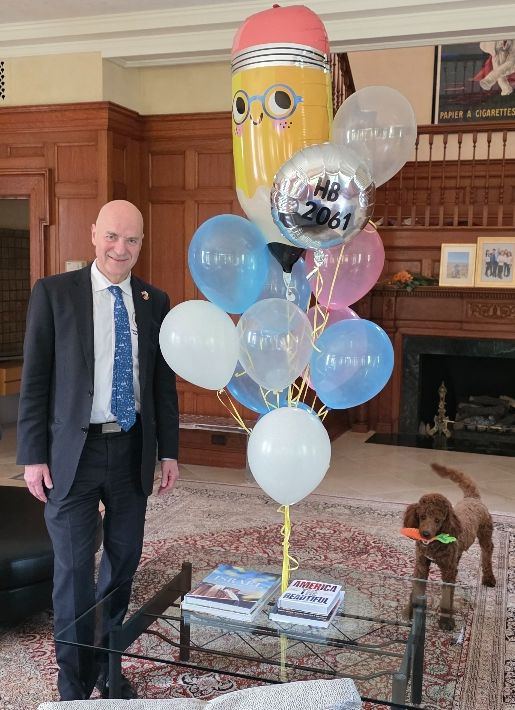
To my great surprise balloons celebrating passage of HB 2061 awaited me upon my return from Jefferson City arranged for me by Carrie.


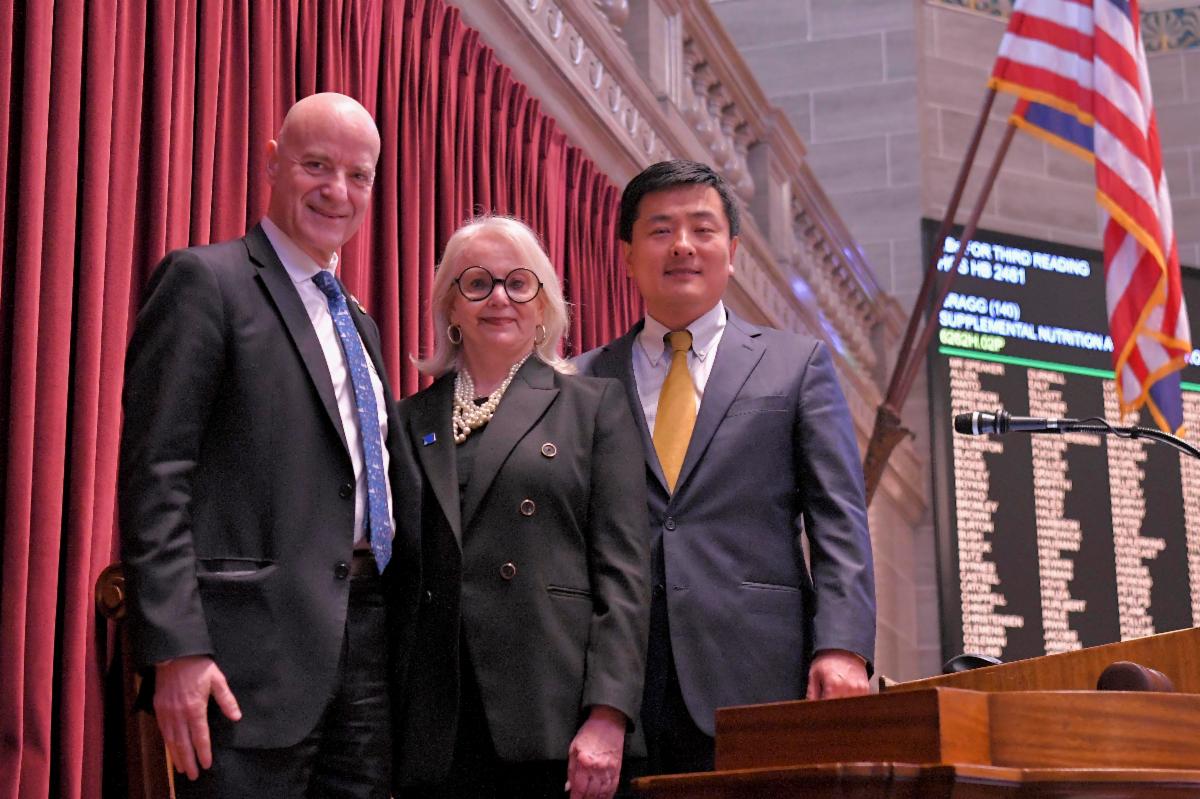
After the TAFP we took photos on the dais with Speaker Jon Patterson, MD and Stacey Newman that worked with us since last Summer to help shepherd the bill across the finish line. A big thank you to Senator Curtis Trent for carrying the bill in the Senate and getting it passed out unanimously.


Media regarding HB 2061:


4.9.26St. Louis Jewish Light. Missouri finalizes antisemitism bill with bipartisan House vote, sends measure to governor

https://stljewishlight.org/news/news-local/missouri-antisemitism-school-bill-passes/


4.9.26 St. Louis Post Dispatch. Antisemitism measure headed to Gov. Kehoe after Missouri House passes it

https://www.stltoday.com/news/local/crime-courts/article_f6d8210f-5abd-4eb3-918d-71de468b3c48.html#tracking-source=home-the-latest


4.9.26 St. Louis Public Radio. Missouri legislature passes bill targeting antisemitism in schools and colleges

https://www.stlpr.org/government-politics-issues/2026-04-09/missouri-legislature-passes-bill-targeting-antisemitism-in-schools-and-colleges


4.9.26 Fox 2 - TV, Channel 2. Missouri House passes antisemitism bill; see how your representative voted.

https://fox2now.com/news/missouri/missouri-house-passes-antisemitism-bill-see-how-your-representative-voted/


4.9.26 Combat Antisemitism Movement. Missouri Senate Passes IHRA Definition Bill to Combat Antisemitism in Public Schools, Governor’s Signature Awaits

https://combatantisemitism.org/cam-news/missouri-senate-passes-ihra-definition-bill-to-combat-antisemitism-in-public-schools-governors-signature-awaits/


4.9.26 KMOV-TV, Channel 4. Bill to combat antisemitism in public schools sent to Missouri governor

https://www.firstalert4.com/2026/04/09/bill-combat-antisemitism-public-schools-sent-missouri-governor/


4.9.26 KOMU -8 Columbia. Jewish organization applauds new antisemitism bill

https://www.komu.com/news/midmissourinews/columbia-jewish-organization-applauds-new-antisemitism-bill/article_e0c3c04f-c7d2-4957-a744-c520017695f5.html


4.10.26 Jewish News Syndicate Missouri legislature approves bill adopting Jew-hatred definition for public schools

https://www.jns.org/news/u-s-news/missouri-legislature-approves-bill-adopting-jew-hatred-definition-for-public-schools


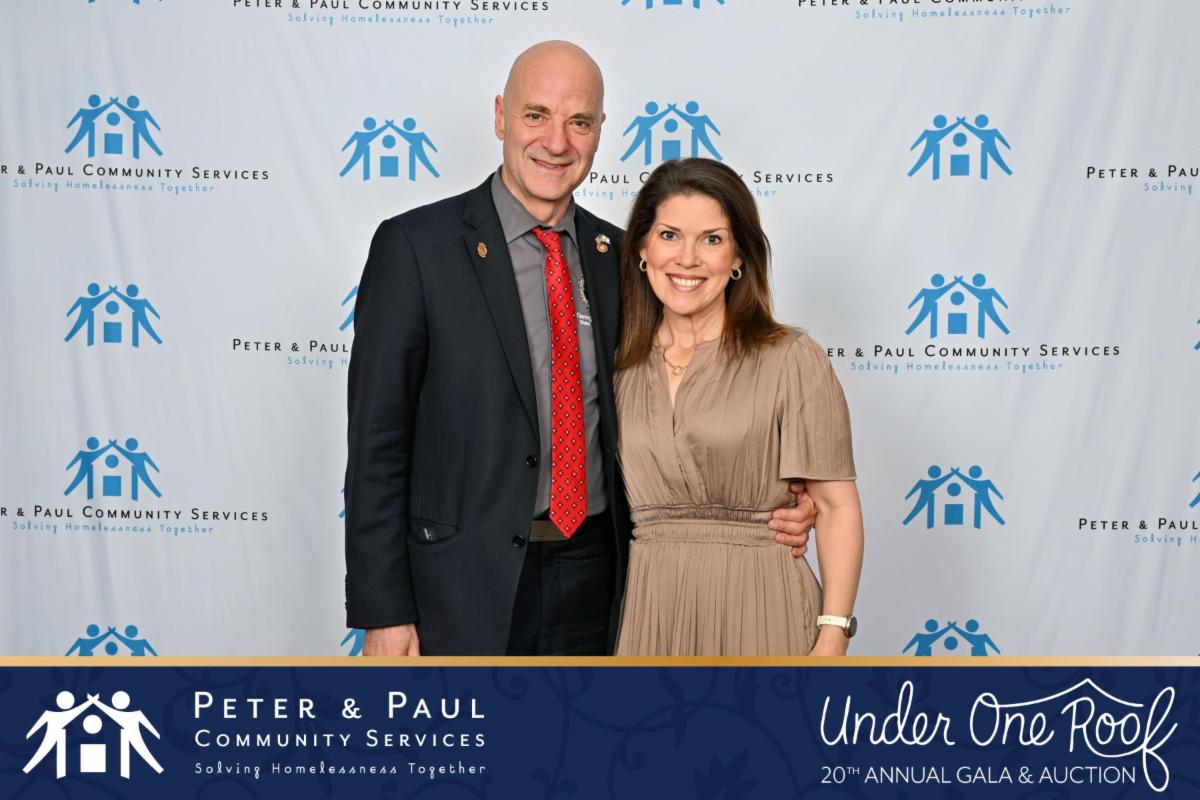
Carrie and i attended a fundraising gala for the Peter and Paul Community Services that helps homeless individuals to get back on their feet.


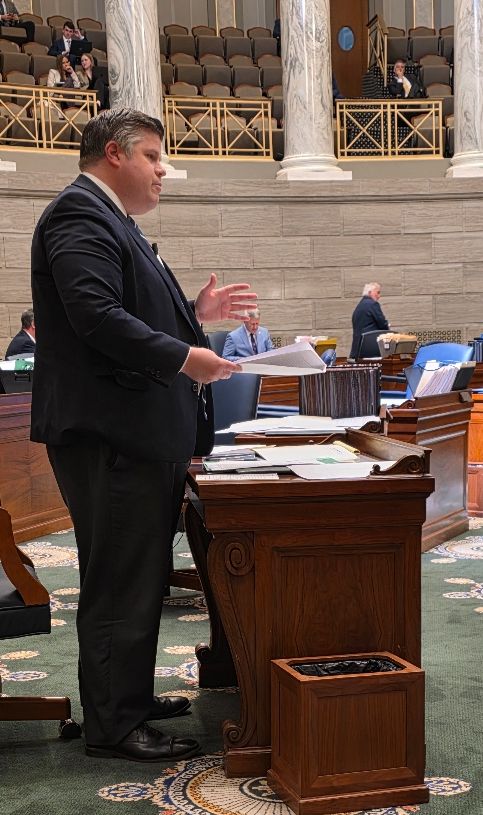
HB 2404 prohibits deed restrictions on public school buildings that prohibits their sale or lease to public charter schools. It is due for a vote in the Senate Education Committee. It is also part of HCS SS SCS SB 973SB 973 that has passed out of House General Laws Committee.


Governor Signs Three Bills into Law, Bringing Total to Four This Session

Missouri marked another legislative milestone this week as Mike Kehoe signed three additional bills into law, bringing the total number of enacted measures this session to four. The newly signed legislation spans public safety, family law, and protections for vulnerable populations—reflecting a continued focus on strengthening Missouri’s legal framework in key areas.

·        

Senate Bill 888 delivers a series of updates to the state’s criminal justice system. The measure improves information sharing between law enforcement and prosecutors, enhances penalties for certain sexual offenses, and streamlines sentencing processes to increase transparency—particularly in how parole eligibility is calculated. The changes are aimed at addressing repeat offenses while giving authorities better tools to track criminal histories, including juvenile adjudications.


·        

House Bill 1908 makes an important clarification in family law by ensuring that pregnancy status cannot be used as a barrier to obtaining a divorce or legal separation. The change is designed to protect women in vulnerable situations and ensure access to the courts regardless of pregnancy.

·        

House Bill 2273 strengthens protections for children and other vulnerable individuals. The law increases penalties for crimes involving minors, updates statutes to address digitally manipulated explicit images, and bolsters efforts to combat child exploitation and trafficking.

With these three additions, the governor has now signed four bills into law this session, signaling early momentum as enacted policies begin to take effect across the state.

-----------------------------------------------------------

Public Benefit Eligibility and SNAP Changes Advance

The Missouri House has approved HCS HB 2481, which modifies eligibility verification requirements for public assistance programs, including SNAP and MO HealthNet. The bill requires applicants to provide proof of citizenship or eligible immigration status and adjusts how temporary benefits are issued when documentation is pending. It also directs the state to explore policy options promoting healthier food choices within SNAP and requires consideration of household income from ineligible individuals when determining benefits.


Firearm Suppressor Regulations Revised

The House has approved HB 1730, revising state law related to firearm suppressors. The bill removes state-level criminal penalties for certain suppressor-related activities beginning in August 2026 and establishes provisions asserting that suppressors manufactured and retained within Missouri are not subject to federal regulation under interstate commerce authority. It also outlines enforcement limitations on state and local cooperation with federal regulations in this area.


New Criminal Offense for Masked Intimidation Advances

Legislation creating a new offense tied to concealed identity during threatening behavior has been approved by the House. Under HB 2848, individuals who conceal their identity while intimidating or threatening others could face misdemeanor charges, with enhanced penalties for repeat offenses. The bill also elevates the offense to a felony when prosecutors determine the conduct was motivated by bias against protected characteristics. Supporters frame the proposal as a public safety measure addressing anonymity in harassment and intimidation.


Presidential Preference Primary Reinstated by House

The Missouri House has passed HCS HBs 2387 & 2480, which would restore the state’s presidential preference primary election. The proposal sets the election for early March of presidential election years and outlines procedures for candidate filing, delegate allocation, and administration. The results would guide how party delegates are allocated, with provisions ensuring alignment with national party rules where necessary. The state would cover most election costs.

House Advances Nuclear Energy Financing Proposal

The Missouri House has approved legislation establishing the “Missouri Nuclear Clean Power Act,” a proposal aimed at supporting the development of new nuclear energy generation. HCS HBs 2122 & 1626 allows certain small-scale nuclear facilities to recover construction costs during the building phase by including those expenses in utility rate structures, subject to oversight by the Public Service Commission. Any cost recovery is subject to refund, and the authority is set to sunset unless extended, reflecting a limited but strategic effort to encourage investment in reliable, baseload energy.


Broadband Equipment Tax Policy Changes Advance

A House-passed measure would update Missouri’s property tax treatment of broadband infrastructure, formally classifying related machinery and equipment as tangible personal property. HCS HB 2711 also creates a temporary, lower assessment rate for new broadband investments placed in service after August 2026, before returning to the standard rate in later years. The approach is designed to incentivize expansion of broadband networks, particularly in underserved areas, by reducing upfront tax burdens during early deployment.


Bill Targets Faster, More Transparent Building Permit Process

Legislation approved by the House seeks to streamline the building permit process while increasing accountability for local governments. HB 1791 establishes firm timelines for permit decisions, requires prompt communication with applicants, and introduces financial penalties when deadlines are missed. It also ensures applicants receive clear explanations for denials and creates a structured process for revisions. Additional provisions address post-disaster rebuilding by allowing limited work to begin before permits are issued, while also scaling back regulatory authority for fire protection districts in residential construction matters. The proposal emphasizes predictability and efficiency in local permitting.

-----------------------------------------------------------

Illegal Gaming Crackdown Shakes Up Long-Running VLT Debate

One of the Missouri General Assembly’s most persistent and contentious issues may be reaching a turning point, as Attorney General Catherine Hanaway announced that Torch Electronics—the state’s largest provider of illegal gambling devices—has suspended all operations statewide following a joint federal investigation.


The development represents a significant escalation in enforcement around unregulated gaming machines, an issue lawmakers have wrestled with for years. While legislation seeking to regulate, legalize, or ban these machines has repeatedly been filed and debated in the Capitol, no comprehensive solution has cleared both chambers, leaving the issue unresolved despite sustained attention from legislators.


Hanaway’s office made clear it does not consider the machines part of any “gray market,” emphasizing that Missouri law already prohibits such devices. Torch’s decision to shut down rather than face prosecution reinforces that stance and could signal broader enforcement actions to come.

With the state’s top law enforcement official taking decisive action—and signaling continued investigations into other operators, manufacturers, and retailers—the pressure on the General Assembly to either codify policy or respond to ongoing enforcement is likely to intensify.

Committees

Economic Development

Emerging Issues

Health and Mental Health

Professional Registration and Licensing

Joint Committee on Tax Policy

Joint Committee on the Life Science (Chair)

Please feel free to contact me. My legislative assistant Mirhad Hasanovic and I would be happy to help with any issues you might have with the State of Missouri.


The District 89 State Representative Office is located at the Missouri State Capitol, 201 W Capitol Ave, Suite 201G, Jefferson City, MO 65101. During legislative session, the office is open Monday-Thursday, 8:00am-5:00pm.


I look forward to hearing from you. My door is always open. If anyone you know may want to join this email update communications list please share this link with them to easily join at Capitol Report Sign-up.


Thank You,


Missouri State Representative, District 89

George Hruza, MD MBA

573-751-1544

George.Hruza@house.mo.gov

Paid for by Hruza for Missouri, Kelly Wuennenberg Treasurer

Facebook  X  Instagram