|
In This Issue:
- Market Update: U.S. 2026 Crop Planting Underway in the South
- Washington, D.C. Update: House Ag Farm Bill Markup Rescheduled for March 3
- Missouri Rice Council Talks Bootheel Ag at the State Capitol
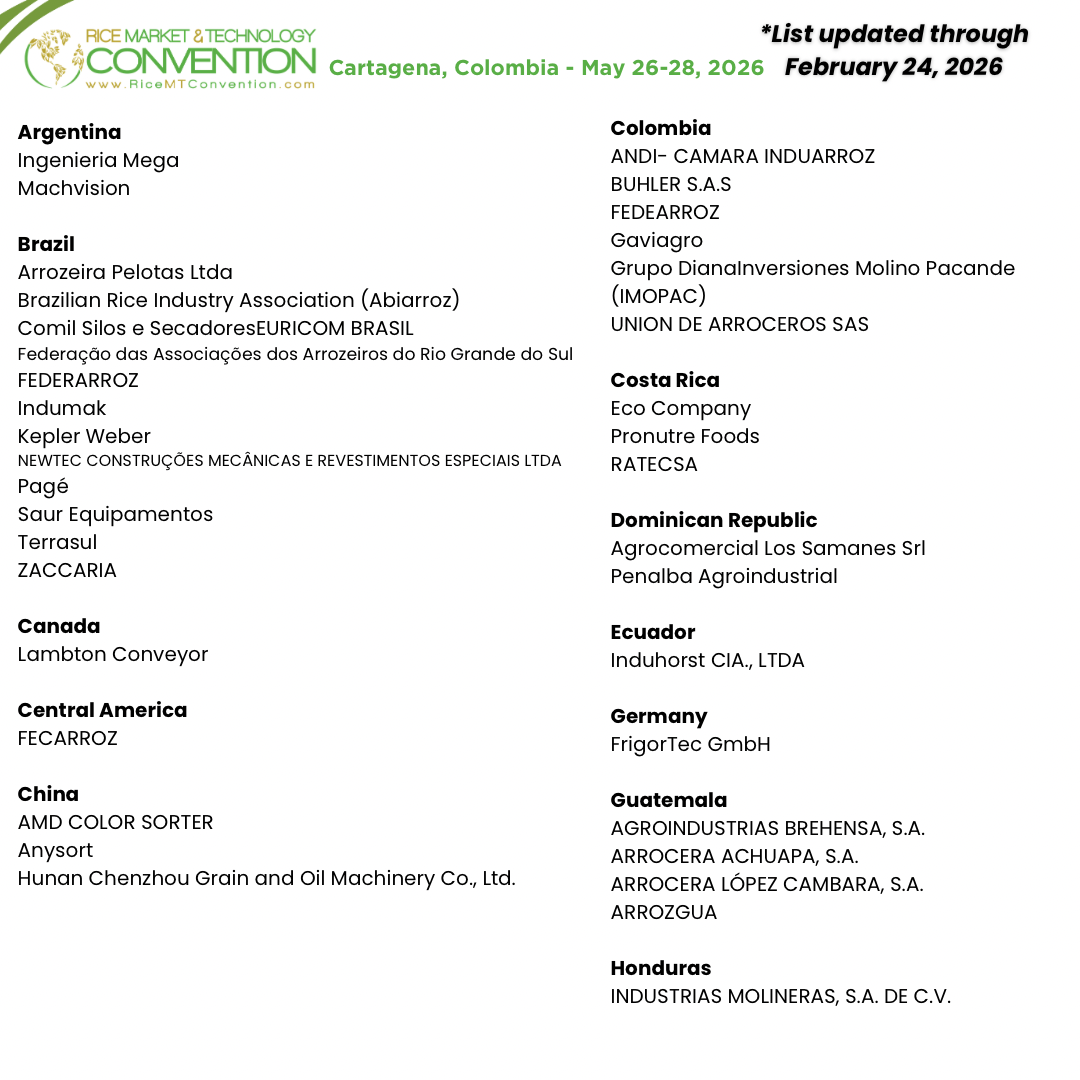
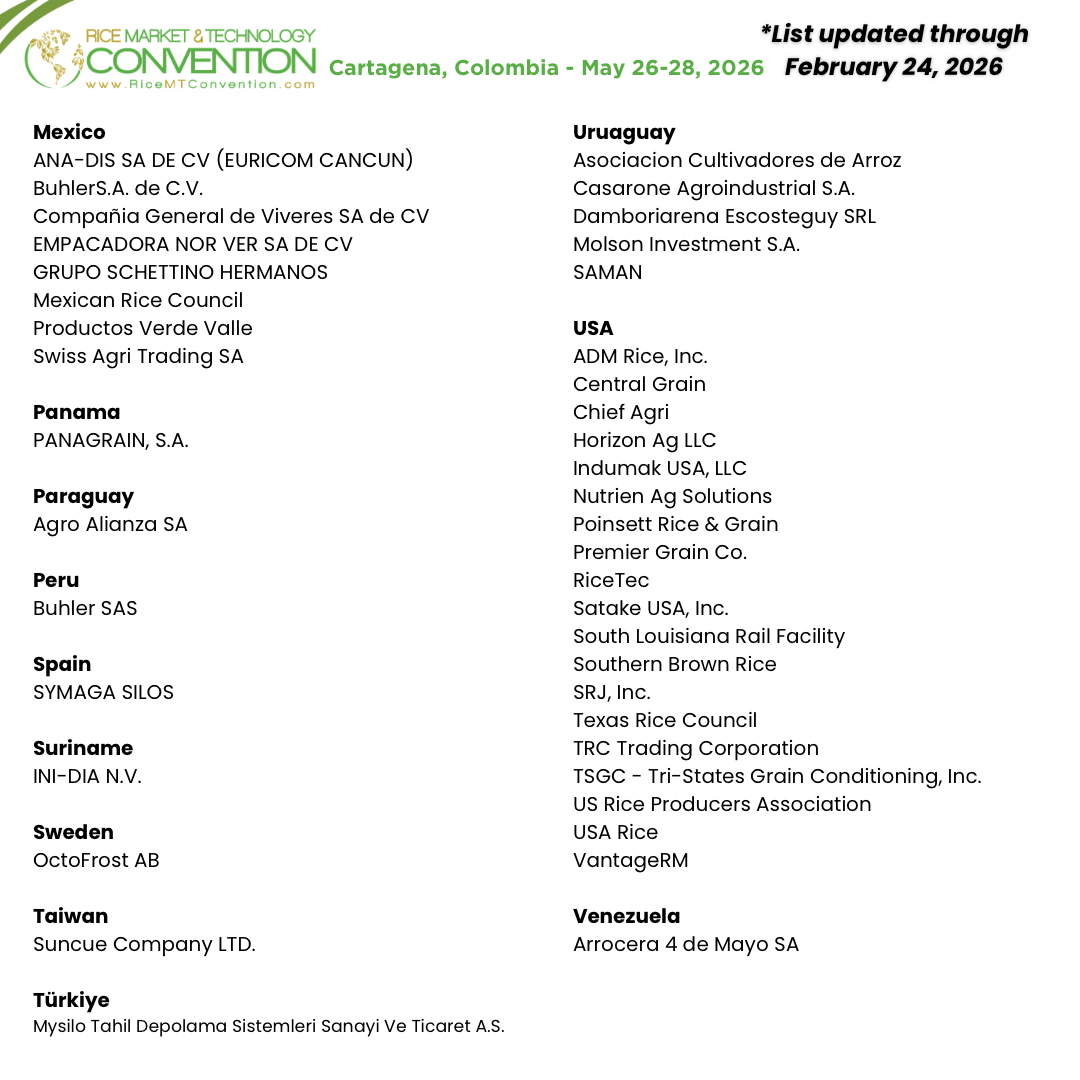
- Companies Registered for RMTC
- RMTC Exhibitor Highlights: Octofrost & Machvision
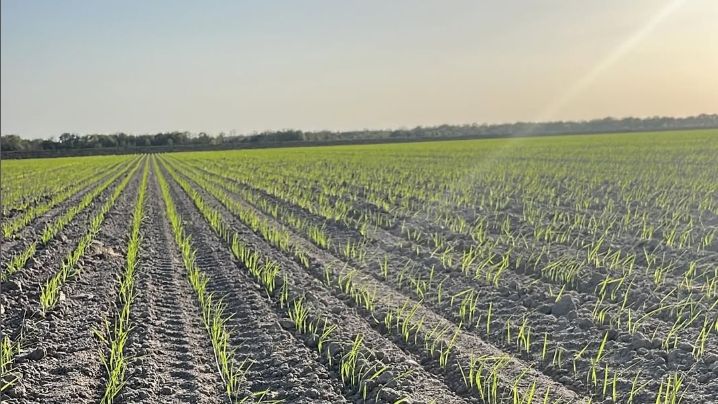
- Photo from Rice Country
| |
| U.S. 2026 Crop Planting Underway in the South | | |
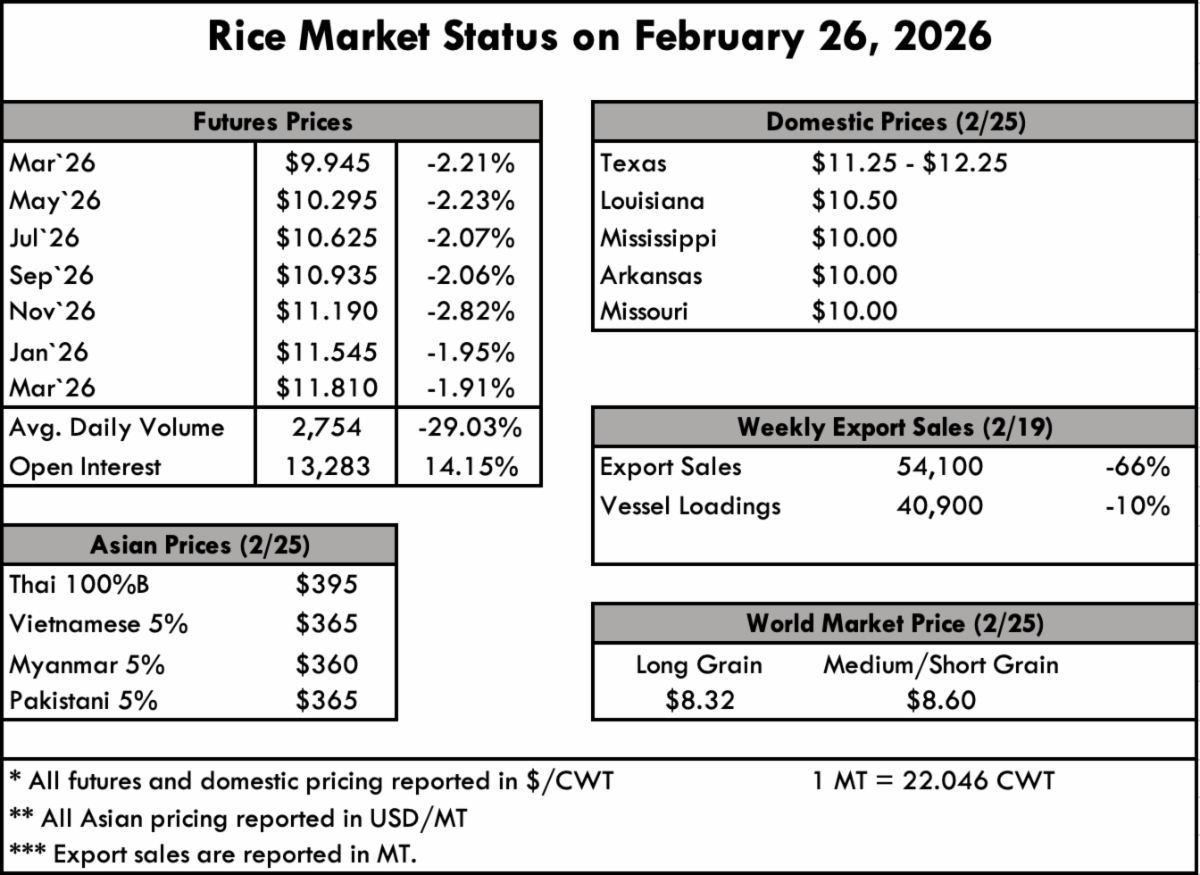
This week, the U.S. long-grain rice market remains cautious as the first seeds have gone in the ground in south Louisiana and likely somewhere along the Texas gulf coast. The carryover of 39 million cwt is like a wet blanket on the prices, with any producer holding physical rice unwilling to sell at current levels. While in many marketing cycles there are factors that can result in volatility, it is difficult to find any at the moment. Even with the anticipated acreage reduction of at least 25% for long grain acres overall, increased prices remain an uphill battle given the global supply dynamic. We would caution anyone hoping to speculate on medium grain acres as well, as California is looking to have a crop at least as large as last year (525,000 acres) if not larger. Significant storms on the west coast in the past week have secured the snowpack and reservoir flows to ensure a full plant, unless there are late storms that will result in prevent plant. Acres in the south will already be committed by then, however, so we can’t recommend speculating on medium grain as a sound marketing strategy.
Despite the weak outlook, it does appear we are bouncing along the bottom at this stage, and no longer in free-fall. Prices have largely stabilized at their current levels in both the Eastern and Western Hemispheres. The Mercosur region will be an extremely fierce competitor in the coming months, though, specifically Brazil and Uruguay where new crop harvest has started. Despite a reduction of approximately 8-10% overall in Mercosur, the market is slow, and a significant carryover of stocks will create tough competition. We understand a Brazilian government announcement of an export subsidy is forthcoming and should be formally announced at any moment. If we are fighting for market share in Mexico, other Latin American countries, or even the EU, markets that have been “secure” in the past aren’t guaranteed to be so moving forward. This is not a new revelation, but it does mean one must be prepared to compete for markets… which is another way of saying the price will remain cheap with stiff competition.
In light of these points, we are fortunate to retain a strong presence in Haiti and Iraq, both of whom continue to procure significant quantities of milled rice on a regular basis. The most recent success with the Colombian TRQ is also buoying the sentiment at the mills for throughput but is still too lackluster to ignite a shortage of supply.
Taking a look at Asia, prices are right in line with where they’ve been for the last three months. Thailand has bene holding firm at $390 pmt, with Vietnam closer to $370 pmt. India, as expected, rests at $360 pmt, setting the tone for the depressed prices worldwide. The spread between the Asian origins and U.S. long grain has been shrinking over the last three months, but unfortunately because U.S. prices have been converging on Asian prices, not the other way around. U.S. Long Grain milled rice quotes reside at $530 pmt right now, higher than Uruguay and Brazil by around $80/ton, but U.S. rice holds a freight advantage to many customers.
The weekly export sales report shows net sales of 54,100 MT this week, down 66% from the previous week and 30% from the prior 4-week average. Increases were primarily for Colombia (16,000 MT), Haiti (15,200 MT), unknown destinations (12,000 MT), Mexico (5,500 MT, including decreases of 100 MT), and Honduras (1,000 MT). Exports of 40,900 MT were down 10% from the previous week and 21% from the prior 4-week average. The destinations were primarily to Panama (18,800 MT), Japan (13,600 MT), Mexico (4,800 MT), Canada (2,300 MT), and Taiwan (800 MT).
| | |
House Ag farm bill markup rescheduled for March 3
On Sunday, February 22, House Agriculture Committee Republicans informed stakeholders that the markup of the Farm, Food, and National Security Act of 2026 would be postponed to the week of March 1 due to the inclement weather impacting a large part of the country, especially the Washington D.C.-Maryland-Virginia region. The markup was originally scheduled to begin earlier this week starting Monday, February 23, and go through Wednesday, February 25th. Now, the markup is scheduled to begin Tuesday, March 3 at 5:00pm ET and is expected to last until Wednesday, March 4.
You can watch the markup live here and can find the following resources for the 2026 Farm Bill below:
President Trump addresses Congress during annual SOTU
On Tuesday, February 24, President Trump fulfilled his constitutional obligation to report to Congress on the state of the nation, delivering the first State of the Union (SOTU) address of his second term before a joint session and an audience of millions watching at home. The annual address usually carries outsized significance, offering President Trump a rare opportunity to speak directly to the country, set the legislative agenda and define the terms of debate for the year ahead and the critical midterm elections in November. The evening was vintage Trump: a lengthy, freewheeling speech that frequently departed from the prepared text with numerous surprises and feel-good moments related to guests in the First Lady’s box. President Trump laid out an economic agenda largely focused on affordability and a muscular foreign policy agenda. Democrats, led by Virginia Governor Abigail Spanberger, drove a sharp counter-message, arguing that he has failed to deliver on his core promise of making American life more affordable and accusing the President of corruption. You can watch a recording of the 2026 SOTU address here.
Supreme Court issues ruling overturning IEEPA tariff authority
Last Friday, February 19, the U.S. Supreme Court released their opinion on the highly anticipated Learning Resources v. Trump case, generally overturning the President's use of International Emergency Economic Powers Act (IEEPA) for tariff authority. The decision was 6-3 with Justices Alito, Thomas, and Kavanaugh dissenting. Shortly following the decision, President Trump invoked Section 122 of the Trade Act of 1974 to impose a global tariff rate of 10%. Following the initial announcement, President Trump posted on Truth Social announcing the global tariff rate will be increased to 15% effective immediately, although related details and parameters are still forthcoming and yet to be confirmed through official documentation from the Administration. This authority is to address a “large and serious balance-of-payment deficit” and can stay in effect for no more than 150 days unless Congress authorizes an extension. Certain agricultural products are exempted, including beef, tomatoes, and oranges according to the executive order (EO) released on February 20. It also states that natural resources and fertilizers that cannot be produced in sufficient quantities to meet domestic demand are exempted. Section 232 and Section 301 tariffs are still in place. See the EO here. See the Supreme Court majority opinion here.
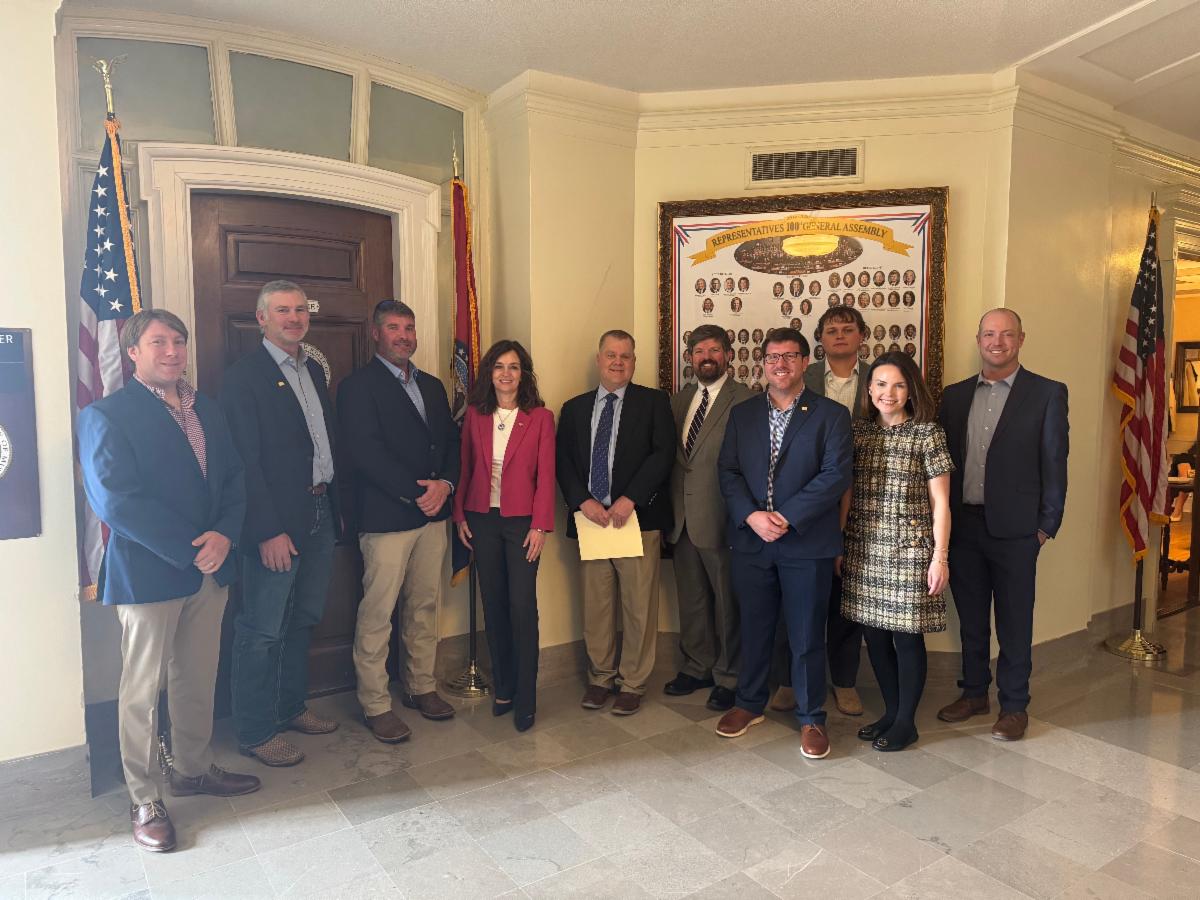
| | MO Rice Council and MO Cotton Producers members meet with State Representative Cameron Parker, whose district includes Dunklin County and portions of Pemiscot & Butler Counties. | |
Missouri Rice Council Talks Bootheel Ag at the State Capitol
Earlier this week, members of the Missouri Rice Council traveled to Jefferson City to meet with legislators and attend Taste of the South, an annual social event celebrating the people and culinary traditions of southeast Missouri.
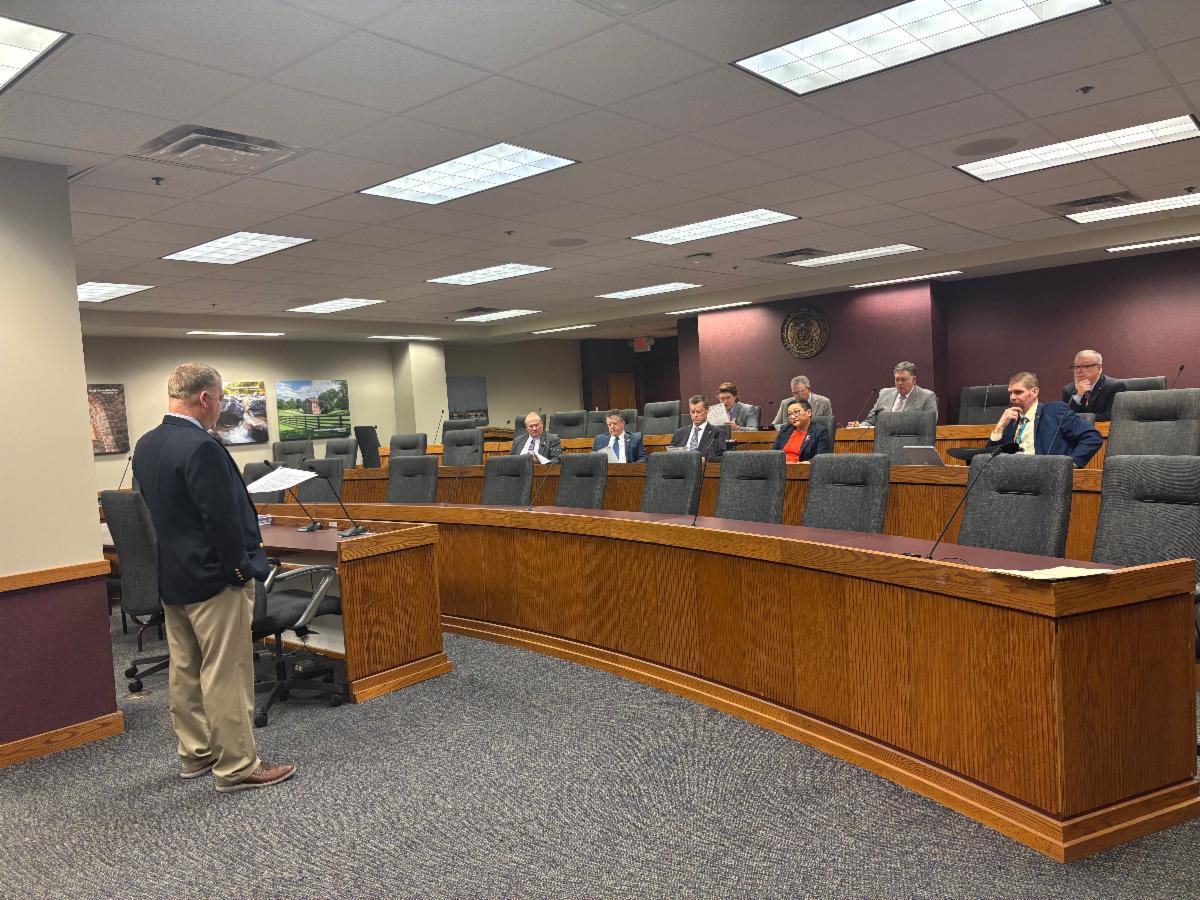
A highlight of the visit was the Southeast Missouri Ag Roundtable, organized by the Missouri Rice Council in partnership with legislators to discuss rice, cotton and peanut production in the state. With only a handful of Missouri counties producing these crops, the roundtable provided an important opportunity to educate lawmakers from across Missouri about the region’s agricultural impact and the issues facing its farmers.
“Opportunities like this are incredibly important because they allow farmers to speak directly with the people making policy decisions,” said Mollie Buckler, President and CEO of US Rice Producers Association. “It helps legislators better understand not only rice production, but agriculture across southeast Missouri. When they hear firsthand from producers, it leads to more informed decisions that benefit both our region and the entire state.”
Before heading home, the group also met with staff at the Missouri Farm Bureau headquarters. During the visit, council members and Farm Bureau staff discussed shared policy priorities, current legislative developments and the challenges affecting Missouri agriculture. The conversation reinforced the importance of maintaining open communication between commodity groups and statewide agricultural organizations as they work together to support farmers and rural communities.
| Missouri Rice Council Chairman Rance Daniels presents to legislators during the Southeast Missouri Ag Roundtable | | RMTC Exhibitor: OctoFrost | |
| RMTC Exhibitor: Machvision | |
| |
FAO Rice Price
Update
| |  |
Food & Agriculture
Regulatory & Policy Roundup
| | | | | | Grain: World Markets and Trade | | | | | | Inter-Rice World Rice Market Report | | | |
May 26 - 28, 2026
Rice Market & Technology Convention
Cartagena, Colombia
More Information
| | |
June 6, 2026
LSU AgCenter South Farm Rice Field Day
Crowley, LA
More Information
| | |
USRPA does not discriminate in its programs on the basis of race, color, national origin, gender identity, sexual orientation, religion, age, disability, political beliefs, or marital/family status. Persons who require alternative means for communication of information (such as Braille, large print, sign language interpreter or translation) should contact USRPA at 713-974-7423. |
| | | |