|
Monday Morning Brief
Interesting business-related news in 10 minutes or less, or your money back.
(Estimated read time without clicking the links, 8 minutes, 38 seconds)
| | |
If you're reading this on Labor Day, well, kudos to you! If you waited until you got back to the office on Tuesday...Happy actual Labor Day!
In celebration of the official end of summer, here are some little-known facts about the holiday:
-
The first Labor Day fell on a Tuesday. About 10,000 workers gathered in New York City on Tuesday, September 5, 1882, for a parade followed by speeches, music, and a picnic. Many participants reportedly gave up a day’s pay to attend. The things people will do for a hot dog!
-
No one can say for certain who invented it. Credit has traditionally gone to labor leader Peter J. McGuire, but considerable evidence points to machinist Matthew Maguire. The similarity of their names has added to more than a century of confusion.
-
New York introduced the first state bill, but Oregon beat it to the finish line. Oregon became the first state to officially recognize Labor Day in 1887. New York, Colorado, Massachusetts, and New Jersey followed later that year.
-
Labor Day was already widely recognized before it became a federal holiday. Twenty-eight states had adopted the holiday by the time President Grover Cleveland signed the federal legislation on June 28, 1894. I guess people were really eager to finally have a day to officially close their swimming pools.
-
The original celebration had two distinct purposes. Organizers envisioned a public parade demonstrating the strength and solidarity of workers, followed by recreation and entertainment for workers and their families. Our modern combination of ceremony, cookouts, and leisure looks a lot like that original plan.
If you ever catch yourself pining for "the Good Old Days," just remember that work wasn't always so cushy. We've got it pretty good. Want proof? Here are some ways the world of work has gotten better:
-
The workweek was considerably longer. Manufacturing employees averaged approximately 55 hours at work each week in 1915. Some cigarette-factory employees worked as many as 65 hours, and U.S. Steel employees worked seven days a week until 1911. Today’s manufacturing workweek is roughly 40 hours.
-
Going to work could be extraordinarily dangerous. An estimated 23,000 industrial workers died on the job in 1913, a rate of approximately 61 deaths per 100,000 workers. The comparable national rate in 2024 was 3.3 per 100,000 full-time-equivalent workers, roughly 95 percent lower.
-
Child labor was considered perfectly normal. Children as young as 10, and sometimes younger, worked in factories, mines, stores, farms, and home industries. Some mill children worked 12-hour days, six days a week. In 1820, children constituted more than 40 percent of mill employees in at least three New England states. Kids today are lazy bums by comparison.
-
Losing a job could mean immediate financial disaster. Workers in 1915 generally had no unemployment insurance, severance pay, or continuation of health benefits. Families depended heavily on savings, relatives, churches, and local charities when wages disappeared.
-
Career choices were far more limited. In 1910, approximately 31 percent of American workers held farming occupations, while fewer than 5 percent held professional or technical jobs. Today, less than 1 percent of workers are employed in farming occupations, and professional and technical work (where there's air conditioning) represents one of the economy’s largest employment categories.
We have plenty of room to improve the modern workplace. Still, Labor Day gives us an opportunity to recognize how far working life has progressed. Shorter hours, safer workplaces, broader career choices, and basic protections that we now take for granted were earned over generations. The “good old days” make interesting stories, but most of us would not want their working conditions.
"Cause the good ol' days weren't always good, and tomorrow ain't as bad as it seems."
Billy Joe ("Keeping the Faith," 1983)
Oh, and here's some stuff you should know that will actually be useful...
Are your I-9 forms correct and readily available? The federal government gave businesses a heads-up on this about two years ago, and things are starting to move now. In that earlier announcement, they made it clear that requests for documents would come with a short window to deliver, as delays would indicate missing or inaccurate documentation, leading to a violation. ICE just changed what counts as a "substantive" I-9 violation - and the fix-it-later era is over. Under the new framework, reclassified errors can trigger immediate penalties of $288 to $2,861 per form, no correction window included. Translation: the audit workflow most HR teams have relied on for years is now the risk, not the safeguard.
If you hire college grads, your new employee pipeline is starting to dry up. Just as employers face a demographic cliff with Boomer retirements, US colleges are facing an enrollment cliff after the population of Americans aged 18 peaked last year. Undergraduate enrollment is projected to decline by 13% in the next 15 years, according to the Western Interstate Commission for Higher Education. Meanwhile, many schools are already in a pickle: Families are increasingly bargain-hunting for the most generous financial aid as they doubt the value of a higher education. Meanwhile, the Trump administration has restricted international student visas, denting enrollment in the process. Corporate training guru, Bob Pike, said over 30 years ago that companies should seek to beef up their training capacity because there has always been and will always be a gap between education and practical on-the-job knowledge. Looks like it's time to finally act on that advice.
Would you hire a gig worker? There is now a small army of people making a decent living working multiple gigs (i.e. Walmart Spark, DoorDash, Uber Eats, Uber, Lyft, Meals Now, TaskRabbit, etc.) and further monetizing their gigs by filming their work and posting about it on YouTube and other platforms. That's right, people are making extra money by having people follow them virtually as they perform gig work. Sounds like we've finally reached Internet Nirvana. Except, this is nothing new. People have been trying out and writing about their side hustles for nearly a quarter century, and even that is nothing new.
Ralph Waldo Emerson wrote in 1841, about the "portfolio resume." A portfolio resume is one full of varied jobs, skills, and "gigs." It's almost the polar opposite of a career formed around a single specialty or company. It's the quintessential Jack-of-all-trades. Hiring managers and company owners looking through a stack of resumes might see these folks as job-hoppers. A closer look might reveal what Emerson saw 185 years ago.
He writes about a man who tries every profession in turn. Drives teams, farms, peddles, keeps a school, preaches, edits a newspaper, buys a township. New work every few years, and he lands on his feet every time.
Emerson says that man is worth a hundred of the polished graduates who studied one thing and waited for a title. "He does not postpone his life. He has not one chance, but a hundred chances."
- The credentialed man has a single bet and spends his career defending it.
- The portfolio has run a dozen experiments and knows exactly what he can survive.
Four unrelated things on a resume is not a gap. It is four things someone already knows they can survive. You don't need them to explain it away. You need to find out what they learned along the way. A hard-charging gig worker might just be your best next hire.
Do you experience "leisure guilt?" 14% of Americans spend their downtime stressing out about productivity, rather than actually resting or relaxing, according to a new study. Over the course of a week, researchers found participants were engaging in leisurely activities 57% of the time they checked in on them, but they were spending one in seven moments that should’ve been fun feeling bad about not getting more done (whatever that means). According to psychologist Adam Grant, that’s dumb. Grant says leisure guilt robs people of “joy and rejuvenation” and that leisure time, which can reduce the risk of depression and increase your chances of getting a promotion, is “not a bug,” but “a feature of a good life.” Great — now you can feel guilty about feeling guilty for trying to chill.
Demographic shifts eventually come for us all - including anarchist-rooted desert festivals. Burning Man, the annual event in Nevada’s Black Rock Desert, kicked off earlier this week, and the folks biking around in goggles and expensive homemade costumes are a little older than they used to be. Just 10% of "burners" at last year’s event were in their 20s, a record low. Gen Z seems less charmed by the “radical inclusion” and "anarchist soul" of Burning Man than previous generations. In 2015, 30% of attendees at Burning Man were in their 20s. But the younger crowd has steadily declined over the last decade, mostly because of the cost. A ticket has ballooned from $390 in 2015 to $550 this year as the festival has struggled to stop hemorrhaging money. With a vehicle pass, camping gear, fees, and food, attendees are typically looking at a minimum $1,000 trip, and that doesn't include the cost of customized attire and freaky local transportation options.
Is your business positioned to serve the sandwich generation? Not as tasty as it sounds, unfortunately. A quarter of US adults are caring for a parent over 65 while raising a child under 18 or financially supporting an adult one. You don't have to reinvent yourself as a caregiving company. You can adapt what you already do. Some examples:
- A handyman could introduce a “Safe at Home” inspection.
- A cleaning company could add refrigerator checks, light housekeeping and family notifications.
- An auto shop could pick up vehicles from caregivers’ workplaces.
- A bookkeeper could organize household bills and documents with appropriate safeguards.
- A salon could offer home visits where licensing allows.
- A restaurant could sell weekly family meal packages sized for two households.
The opportunity often lies in how you package and coordinate your offering, rather than creating an entirely new service.
Words have meaning. "Taxi" and "cab" mean the same thing but come from completely different places. Cab is short for "cabriolet," a bouncy horse-drawn carriage named after a young goat because of how it moved. Taxi comes from "taximeter," the device that calculates your fare. So, when you hail a taxicab, you are technically summoning a goat with a billing system...which honestly explains a lot about the experience.
| |
|
Did someone who loves you send this newsletter to you? Keep scrolling for more good stuff!
Want us in your inbox every Monday morning? Click here to subscribe!
| | |
Scroll down for training & development opportunities and events.
At the bottom of this email:
-
Tip of the Week: Where Time Management Goes Wrong
-
AI Lesson of the Week: Free ChatGPT Just Got a Whole Lot Better
| |
|
Writing Product Descriptions That Sell!
Thursday, September 10th, 3 pm ET
| | | | | |
Do you sell products online, through social media, or at in-person events and want to make your products easier for customers to understand?
This free webinar will help artists, makers, small business owners, and entrepreneurs learn how to write stronger product descriptions that help customers take more interest in their products, understand their value, and feel more confident making a purchase.
This training is valuable for anyone selling physical or digital products online. The skills covered can be used on Etsy, Shopify, personal websites, Facebook, Instagram, TikTok, online marketplaces, social media shops, or anywhere customers read about your products before they buy.
This webinar will focus on helping participants write product descriptions that make their products easier to understand, more appealing to customers, and more likely to sell online. Participants will learn how to write clear, complete, and customer-friendly descriptions that explain what the product is, why it matters, what makes it valuable, and what customers need to know before they buy.
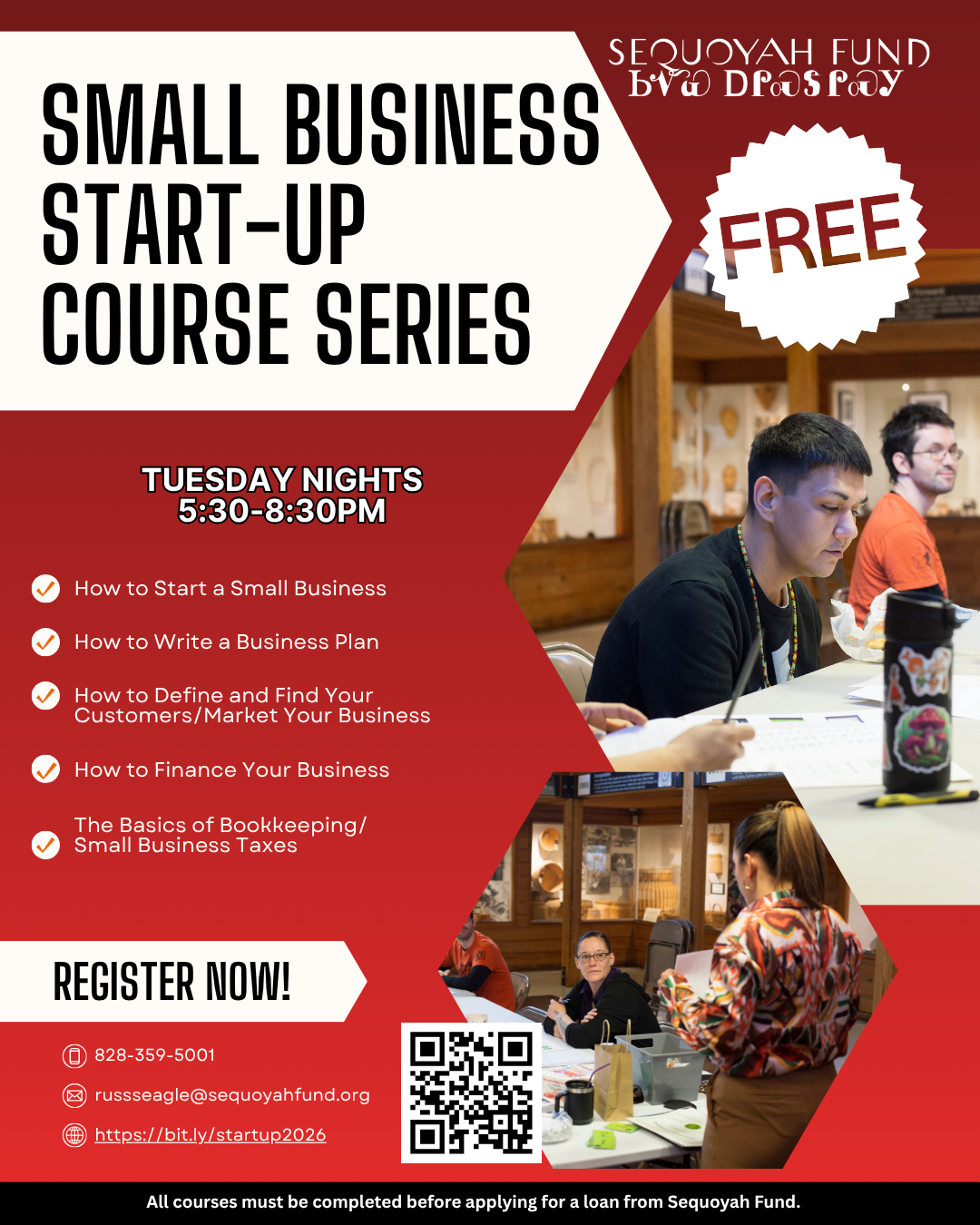
| | Learn How to Start and Operate a Successful Small Business | | |
This FREE course provides a solid foundation for starting and operating a successful small business.
Join the course at any time - No need to start with the first topic.
Think of this course as a hop-on/hop-off sightseeing tour bus! Miss a night? No problem! Catch it next time it's comes around.
Once all topics are complete, you will be eligible to apply for a Sequoyah Fund small business loan.
| | |
Tuesday, Sept. 8, 2026
6:00–8:00 PM EDT
Whether you're launching a business, reviewing your current pricing, or looking for ways to improve your bottom line, this webinar can help you take a closer look at one of the most important decisions you make as a business owner.
| |
Free Webinar
Our friends at Partner Community Capital are offering a free webinar on
Setting the Right Price for Profit.
During this session, you’ll learn how to:
- Understand the true costs of your products or services
- Set prices that support profitability
- Avoid common pricing mistakes
- Make pricing decisions with greater confidence
- Build a stronger foundation for long-term business success
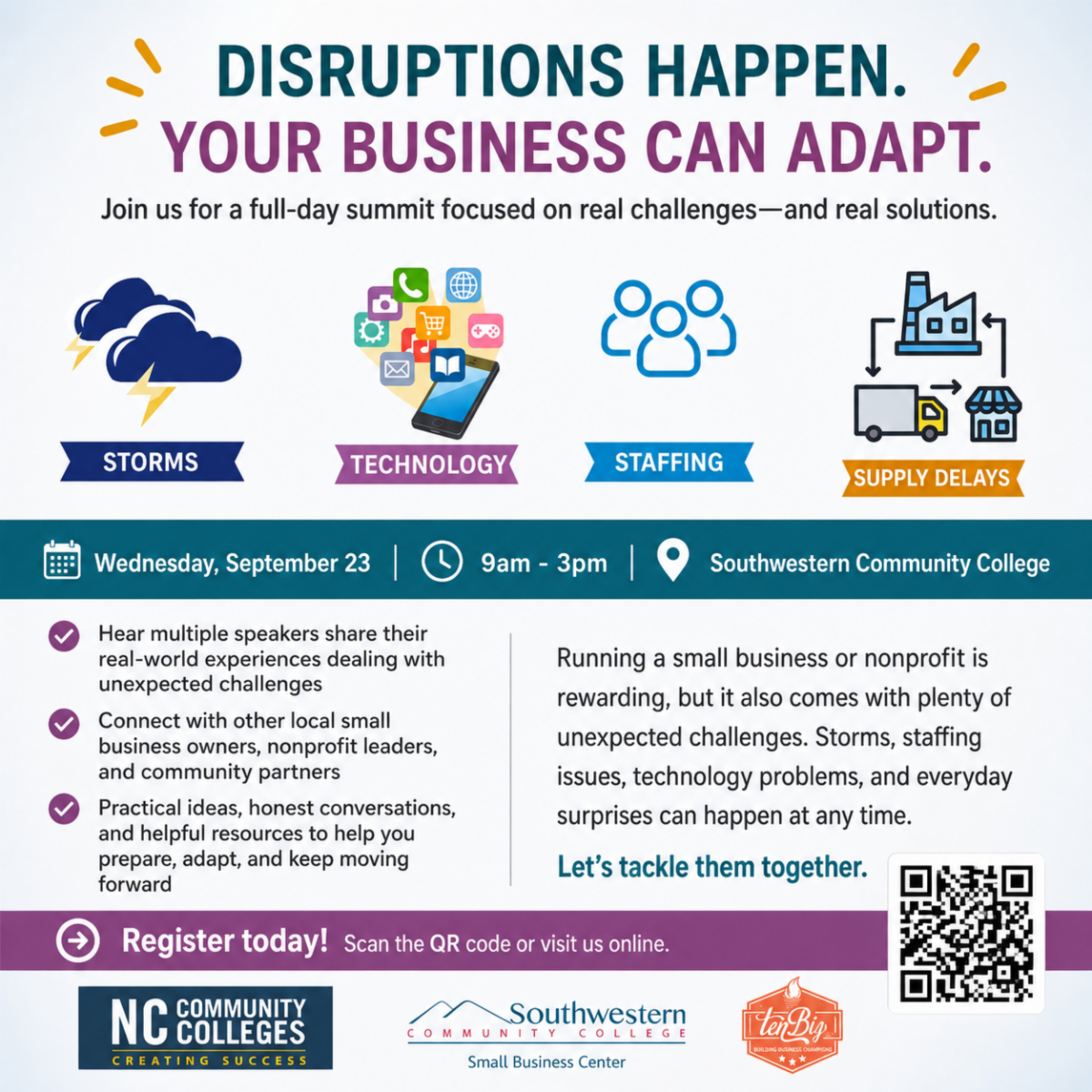
| | | How to Handle Disruptions in Your Business | | |
Prepare Instead of Repair! Starting and running a small business or nonprofit is rewarding, but it also comes with plenty of unexpected challenges.
From storms like Helene and staffing issues to changes in the economy, technology problems, supply delays, or just the everyday surprises that come with serving a community, disruptions can happen at any time.
While we can’t always prevent disruptions, thinking about them before they happen can help ease the burden when they do. Having a plan, knowing where to turn for help, and being prepared to make adjustments can make all the difference.
This full-day summit is designed to bring people together for honest conversations, practical ideas, and helpful resources. We will hear from multiple speakers, learn from real-world experiences, and talk about ways business owners and nonprofit leaders can prepare, adapt, and keep moving forward when things do not go as planned.
Lunch will be on your own with a break provided. There will also be time to connect with other local small business owners, nonprofit leaders, and community partners who understand the work, the challenges, and the opportunities.
Wednesday, September 23 | 9am - 3pm | SCC - Burrell Bldg. 102
| | Cherokee Paths for Professionals Training | | |
Free Leadership Training for Nonprofits, Community Organizations and Tribal Programs on the Qualla Boundary
Grounded in Cherokee values. Sponsored by the Cherokee Preservation Foundation.
All workshops will be held in person at:
The Yellowhill Activity Center
1416 Acquoni Road in Cherokee, NC 28719
| | | |
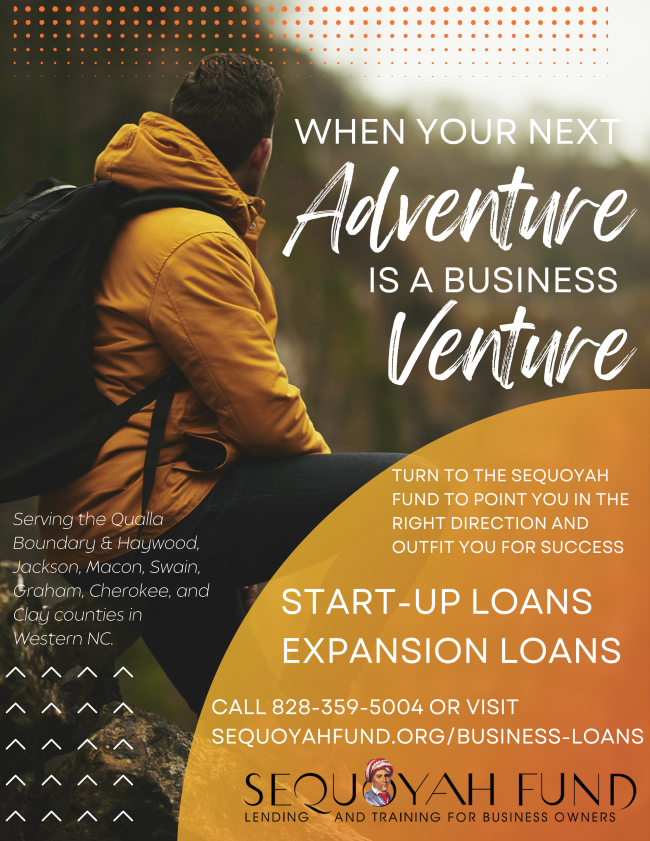
Small Business Start-Up Loans Available!
- Start-up loans up to $50,000
- Interest Rates as low as 5%*
- Terms that fit your business
- Business must be in and owner must reside on the Qualla Boundary or in the seven western counties of NC.
- Business plan required.
-
For more information, contact Dorian Walkingstick at 828-359-5004 or dorian@sequoyahfund.org.
*Credit restrictions apply. Rates may be set as high as 12% depending on creditworthiness.
| | | | | |
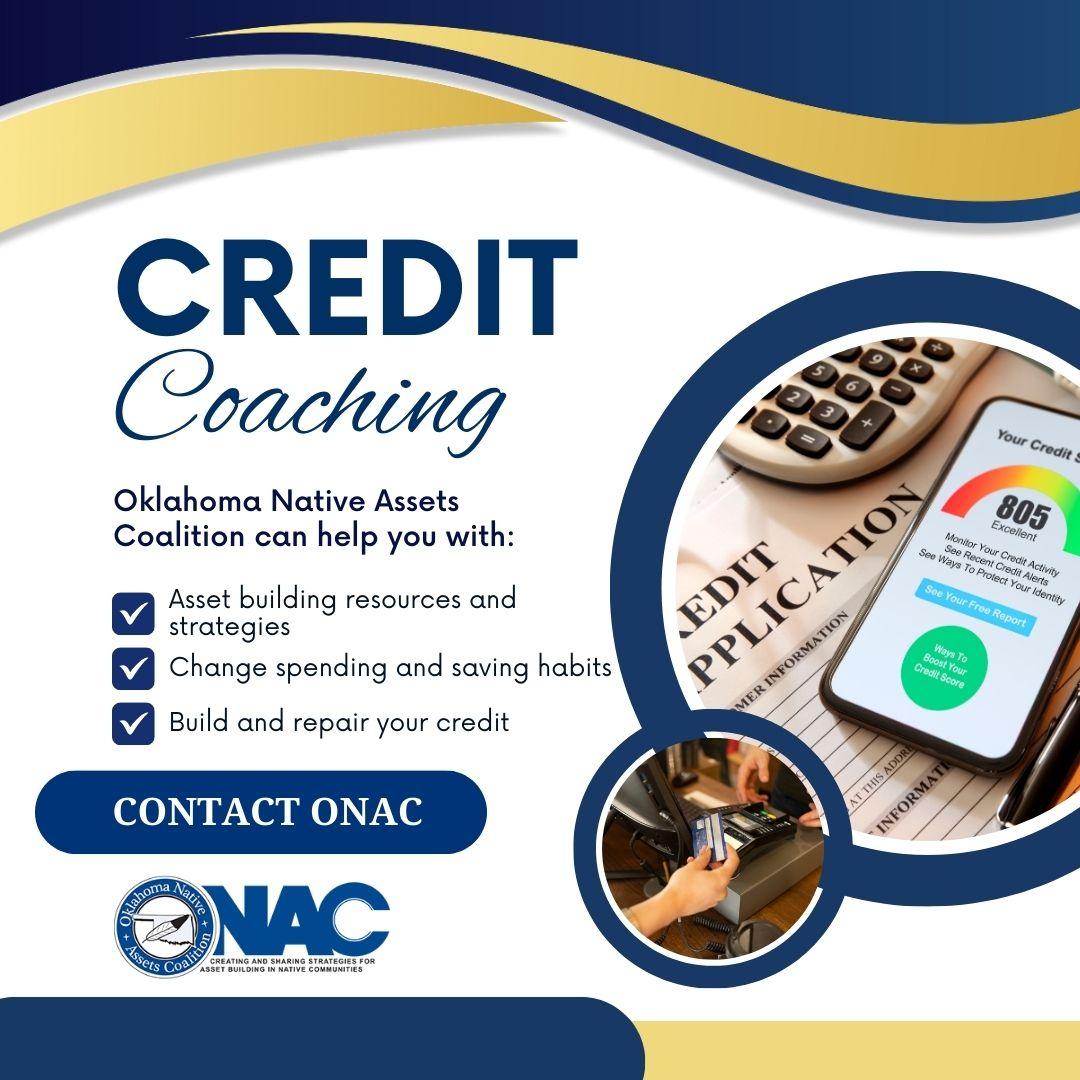
Free Financial Coaching
ONAC offers free financial coaching (by phone and teleconference) to American Indians and Alaska Natives, regardless of where they reside in the U.S.
From June 2020 to present, 1,497 tribal citizens (from 137 Native Nations and 41 states) have registered for the coaching.
This coaching qualifies as a prerequisite for Sequoyah Fund's Credit Builder Loan.
| | |
Register today to become a Got Your Back Recognized Business.
This online program is brought to you by the CREATE BRIDGES Initiative and CREATE Bridges WNC.
| |
Create a Positive Workplace Culture & Retain Employees
The CREATE BRIDGES-WNC initiative has designed a free online course to help business owners in the WNC retail, hospitality, and tourism sectors, as you face staffing shortages and other challenges.
Learn effective leadership strategies, including how to find and keep the right employees, how to offer affordable benefits, how to handle challenging customers and employees, as well as ways to improve your workplace environment. This course offers tools you can immediately put to use in your business. Industry experts bring their own expertise and resources. They address what keeps our business owners up at night and offer new ways to maneuver the current workplace challenges.
| |
Are Your Employees Ready 2 Rock?
Ready to Rock is a 3-hour online workshop series designed to help WNC regional employees learn to develop soft skills such as empathy, emotional intelligence, de-escalation tactics, and more! These soft skills are invaluable in our lives as well as in our work.
| | | | |
Tip of the Week:
Where Time Management Goes Wrong
| |
The biggest mistake people make when trying to improve their time management skills is to confuse availability with capacity.
You see an open hour on your calendar and assume you have an hour available. But the calendar doesn't show mental fatigue, interruptions, preparation, transition time, unfinished work, or the inevitable surprise that shows up without an appointment.
This is why you plan at nearly 100% capacity, then blame yourself when the plan collapses.
It's a horrible feeling. You failed. So, what really went wrong?
The real problem is rarely a lack of time management techniques. It is an unrealistic agreement between the work you've accepted and the capacity you actually possess.
How do you fix it?
Plan only 60% to 70% of your workday. Leave some wiggle room available for communication, transitions, unexpected problems, and tasks that take longer than expected.
Then apply one rule to every new commitment:
Every “yes” must identify what will receive less time, move to a later date, or disappear altogether.
Here's a practical weekly process you can try:
- List the outcomes (not tasks) that genuinely matter this week.
- Estimate the real time required, including preparation and follow-up.
- Put those commitments on the calendar. (My wife knows that if it doesn't make it onto my calendar, it doesn't get done, so she skips the to-do list and adds things straight to my online calendar.)
- Protect some uncommitted space.
-
Renegotiate anything that exceeds your available capacity.
Productive people don't try to fit everything in. They decide what deserves to fit, leave room for reality, and consciously disappoint the least important demands.
| | |
AI Lesson of the Week:
Free ChatGPT Just Got a Whole Lot Better
| |
If you've been using the free version of ChatGPT, your experience is about to get a serious upgrade.
You now get unlimited text chats powered by GPT-5.6 Luna, plus a Think button for harder questions.
This means you won't hit rate limits in the middle of a project. The Think button gives you deep reasoning for those questions that require more than a quick answer.
Paid users get upgrades too.
GPT-5.6 Sol delivers more focused answers with 68% fewer factual errors and a new slider to control thinking depth.
ChatGPT has sliced its models into three distinct layers, depending on what kind of horsepower you need.
-
Sol (Peak Capability): This is their flagship model built for the hardest tasks, including complex coding, advanced multi-step agents, and deep scientific or cybersecurity reasoning. Most of us won't need this much computing power (maybe ever).
-
Terra (Balanced Mid-Tier): This one's the reliable daily driver designed for professional tasks, writing, planning, data extraction, and general business workflows. You'll get a lot out of this, but it still requires the paid version if you don't want ChatGPT taking an extended smoke break in the middle of your project.
-
Luna (Fast & Cost-Efficient): The lightweight option optimized for high-throughput, repetitive, and large-scale background tasks like routing, autocomplete, and quick classification. This is also ideal for those instances when you just need "Google on steroids," editing an email, or doing some quick brainstorming.
| | |
Pssst! Before you go, consider sharing this newsletter on your social media
of choice. We'd love for your friends and colleagues to join us here!
| | | | |