Monday Morning Coffee and Technical Notes

May 18, 2026 View as Webpage

Upcoming Events


 May 18 – Station Log Review


May 26 – Monthly Engineering Webinar. Schedule guest is Paul Mclane Radio World – Review of the NAB Convention


June 11 – Alabama Required Monthly Test (RMT) 12:15 AM


June 16 – Monthly Engineering Webinar Frank Foti, Telos – Processing How we Got to Where we are Today


June 24 – ABA Anniversary tour Auburn Marriott Opelika Resort and Spa

No Audio Alarm


When you get that dreaded alarm, where do you start. 

Engineers know you start with the source (network, local generation, remote feed, etc).


Then you move systematically through the audio chain, using your plant drawing.


What, you don’t have a plant drawing? Well, as Detective Joe Kenda used to say, “my,my,my”. 


Now is the time to create one. A simple line drawing that shows every piece of equipment the audio goes through on the way to the transmitter.


It will save a lot of time in trouble shooting the issue.


ABA 80th Anniversary Tour


The next stop on the ABA Anniversary tour is in the “loveliest village on the plains” Auburn. It will be held on June 24th from 4:00 – 6:00 PM at the Auburn Marriott Opelika Resort and Spa.


We’re pleased to announce that Terry Harper will receive the 2026 Broadcast Engineer of the Year award. The honoree is chosen from nominations submitted by engineers across the state.


This is a free event, and everyone is welcome.  Register here

ABA Engineering Academy


The fall round of engineering classes are coming up in September. The ABA Radio Engineering class will be held the week of September 28th – October 2nd. Our television class is scheduled October 26th – 30th.


These courses are intended for individuals at all levels of experience, including newcomers and experienced engineers, as well as those seeking to deepen their understanding of the technical aspects of broadcasting.


The classes cover an overview of basic electronics, analog and digital audio, history of radio and television technology, creating audio and video streams, RF systems for radio and television along with basic studio operation and FCC rules and regulations.


We’re currently updating our study guides and program to include more relevant material for broadcast engineers, as well as new information about emerging technologies like IP for broadcasting, digital audio and video, SMPTE 2110, and ATSC 3.0.


We also offer students the opportunity to take the SBE Certification exam on Friday if desired.


This 5-day class is held at the ABA Training Center in Hoover, AL (Birmingham). Discount rates for students are available at area hotels. More information about daily subjects covered and online registration is available here.

ABA Engineering Webinar


May 26th is the date for the monthly Engineering Webinar. This is one week later than our normal date, due to scheduling issues.


Our special guest is Radio World Editor-in-Chief Paul McLane, who will highlight key takeaways from the recent NAB Convention in Las Vegas.


Mark your calendar for what will be a most informative program on May 26th starting at 10:00 AM central time. Register online here.

Increase Your Word Power – AVB (Audio Video Bridging)


AVB is a set of IEEE standards for transporting audio and other real-time content over Ethernet.


From a high-level perspective, AVB works by reserving a fraction of the available Ethernet bandwidth for AVB traffic. AVB packets are sent regularly in the allocated slots. As the bandwidth is reserved, there will be no collisions.


ll of the nodes in the system share a virtual clock.

AVB packets have a presentation time that defines when the media packet should be played out. The magic behind AVB is that it splits traffic on the network into two groups; real-time traffic and the rest. All real-time traffic is transmitted on an 8-kHz beat, and the rest is scheduled around it. Every 125 µs, all real-time streams send their data.

Other packets are transmitted when no more real-time data is available, holding up the other traffic


Understanding FCC Rules – Silent Operation


Sometimes a broadcast station will go silent for period of time. This could be for several reasons, technical, legal or financial.


FCC Rules and Regulations outlines guidelines for silent operation in section 73.1740.


“Once a station has ceased operations for 10 days, a notice must be filed with the FCC providing notification that the station is not operational.


If the station remains silent for 30 days, specific permission, in the form of a request for Special Temporary Authority (STA) to remain silent, must be sought from the FCC.


The rules refer to reasons beyond the control of the licensee as providing justification for the station being off the air.  Traditionally, the FCC has wanted a licensee to demonstrate that there has been a technical issue that has kept the station off the air. 


The Commission is reluctant to accept financial concerns as providing justification for the station being silent – especially if there was no clear plan to sell the station or to promptly return it to the air. “


If a station is off the air for 12 consecutive months, then the station’s license will automatically expire.


Operational Guidelines – Station Documentation


Station engineers should be aware of the requirement to maintain the most current copies of all technical documents.

These include:


1. Main Station License or Construction Permit

2. Licenses for all auxiliary transmission operations (antenna or sites)

3. Licenses for any Translators, LPFM, LPTV operations

4. Licenses or construction Permits for any auxiliary operation (STL, TSL, Satellite Uplinks, RPU, wireless microphone and IFB operations,

5. Applications filed with the Commission for any technical modification

6. License Renewal Documents

7. Documents filed with the Commission covering AM or FM digital operation

8. FAA Antenna Structure Registration (ASR)

9. Annual NRSC measurements (AM stations only)

10. Chief Operator Designation


Pro Audio – The Kick 


The Kick drum may be one of the more challenging instruments to mike. Kick drums produce lower frequency sound, meaning that the wavelengths are longer. Therefore, larger diaphragm mics work well in accurately capturing the kick sound. 


Further, with live sound applications in particular, dynamic designs are most frequently the choice because they’re a bit less sensitive and thus aren’t as susceptible to overload. A cardioid or hypercardioid polar pattern is preferable because it will help reject sound coming from the rest of the drum kit.


With a ported head, place the mic about two to four inches into the port. This results in the capture of an optimum sound while helping to keep the rush of air that’s escaping from causing any unwanted noise. It’s also common to either mount a mic completely inside the drum or use an extended boom arm to get the mic close to the batter. When placing a mike inside it is recommended to lay it on a small pillow or pad.


As with all sources, trial and error will allow you to find the “sweet spot” for the desired sound.

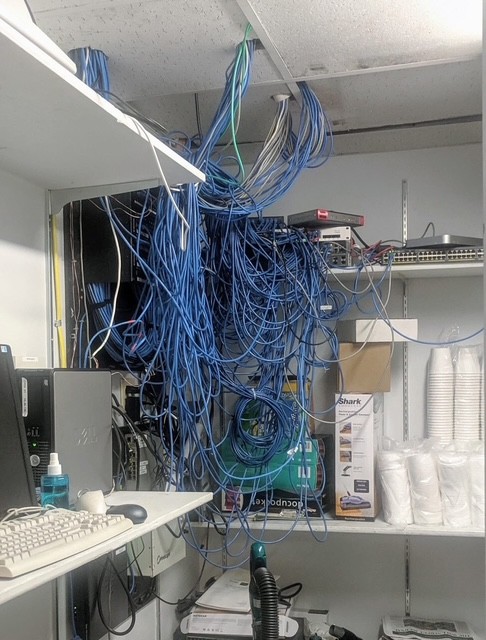
Earl, we have got to do something about this wiring closet!

Quote of the Week

  The day when we shall know exactly what electricity is will chronicle an event probably greater, more important than any other recorded in the history of the human race. The time will come when the comfort, the very existence, perhaps, of man will depend upon that wonderful agent.

Nikola Tesla

Inspirational Quote of the Week


“In the morning, prayer is the key that opens to us the treasures of God’s mercies and blessings; in the evening, it is the key that shuts us up under His protection and safeguard.”

Billy Graham


The information offered in this newsletter is that of the editor and not of any other entity or individual.

We welcome any comments or suggestions about this newsletter, send to lwilkins@al-ba.com