Monday Morning Coffee and Technical Notes

July 27, 2026 View as Webpage

Upcoming Events


July 27  – Review and sign the Station Log


July 29ABA Anniversary tour in Florence. 4-6 PM Renaissance Shoals Resort and Spa


August 6 – August Required Monthly Test (RMT) 12:15 AM

Station Log Review


During ABIP inspections one of the issue we see concerns the Station Log.


73.1820: “The following information must be entered [into the station log]:

An entry of each test and activation of the Emergency Alert System (EAS) pursuant to the requirement of part 11 of this chapter and the EAS Operating Handbook.


Stations may keep EAS data in a special EAS log which shall be maintained at a convenient location; however, this log is considered a part of the station log.”


C-Band update


Last week, the FCC officially adopted rules to auction 160 megahertz of Upper C-Band spectrum (3.98–4.14 GHz) by July 2027.


According to the release “By bridging the Lower C-band and Upper C-band, the FCC will create a single, harmonized “super band” spanning 440 megahertz (3.70-4.14 GHz)—a gigantic swath of licensed, 5G-grade mid-band spectrum that no other industrialized country can boast”.


Current users of this part of the C-band spectrum include major broadcast radio and television networks along with regional networks. Plans are underway to accommodate those users in the remaining part of the C-band and other spectrum.


The auction should be concluded by July 2027 with the transition of present users completed by 2031

ABA Engineering Academy


As a quick reminder the ABA Engineering Academy Radio Engineering class is coming up in September. Seating is limited so get your registration in to ensure a seat.


These courses are intended for individuals at all levels of experience, including newcomers and experienced engineers, as well as those seeking to deepen their understanding of the technical aspects of broadcasting.


The next Radio Engineering class will be offered the week of September 28th – October 2nd. The television class is scheduled October 26th – 30th.


This 5-day class is held at the ABA Training Center in Hoover, AL (Birmingham). Discount rates for students are available at area hotels. More information about daily subjects covered and online registration is available here.

OFDM Basics


We hear a lot about OFDM (Orthogonal Frequency Division Multiplexing) today, but the technology has been used for years, especially in wireless communications and broadcasting. OFDM is the modulation method used by FM stations operating in HD Radio and by ATSC 3.0 television.


It operates by transmitting data on orthogonal subcarriers that carry various information simultaneously, resulting in an efficient method for transferring large amounts of data over wireless channels. These subcarriers are incredibly unique as they are completely orthogonal to one another, meaning they don’t interfere with each other and can be easily separated at the receiver.


In a traditional single-channel modulation scheme, each data bit is sent serially or sequentially one after another. In OFDM, several bits can be sent in parallel, or at the same time, in separate substream channels. This enables each substream's data rate to be lower than would be required by a single stream of similar bandwidth. This makes the system less susceptible to interference and enables more efficient data bandwidth.

Out of Sight, Out of Mind


Every broadcast operation requires the use of some type of structure to support the transmitting antenna or in the case of AM is actually the antenna.


Engineers are required to keep an eye on the marking and lighting as required by the FCC, but what about the structure itself.


As detailed in TIA/EIA 222-F, maintenance and inspection of steel antenna towers and antenna supporting structures should be performed by the owner on a routine base, however, “routine” is open to interpretation.


It is recommended that all structures be inspected after severe wind and/or ice storms or other extreme loading conditions. Shorter inspection intervals should be considered for structures in coastal saltwater environments, in corrosive atmospheres, and in areas subject to frequent vandalism, according to the standard.


The document is more specific on suggesting a time for major inspections: 3 years for guyed towers and every 5 years for self-supporting structures.


Another important item is to create and maintain a “vertical map” of the structure. This drawing should include any device attached to the tower along with the location (height above ground, which leg or face, and coax size). If the device is a tenant, detailed contact information is important. Don’t forget to include location information about all beacons and side lights.


Develop a habit when conducting your weekly transmitter site visits to look at the tower from bottom to top to see if anything looks different from the last visit (all coax lines secured, and all antennas correctly positioned). Look around the site to make sure there are no bolts or hangers lying around.

Pro Audio – Feedback 


Sound feedback occurs when a microphone picks up the sound from a speaker, sending it back through the system to be amplified and emitted again, creating a loop.


The physics behind feedback loops involves the phase relationship between the original and recaptured sound.


Avoiding unwanted feedback requires a systematic approach. Start by identifying the acoustic hotspots in a room—areas where sound reflects strongly, such as corners or hard surfaces.


Educate performers to monitor their positioning relative to speakers, as even small adjustments can break the loop.

Of course, before the event be sure to “ring out” the system. This involves increasing the level of the system until feedback starts then applying a sharp notch filter on the mixer output to remove the feedback, continue this process for other frequencies.


Be careful not to overdo this process that will effect the quality of system

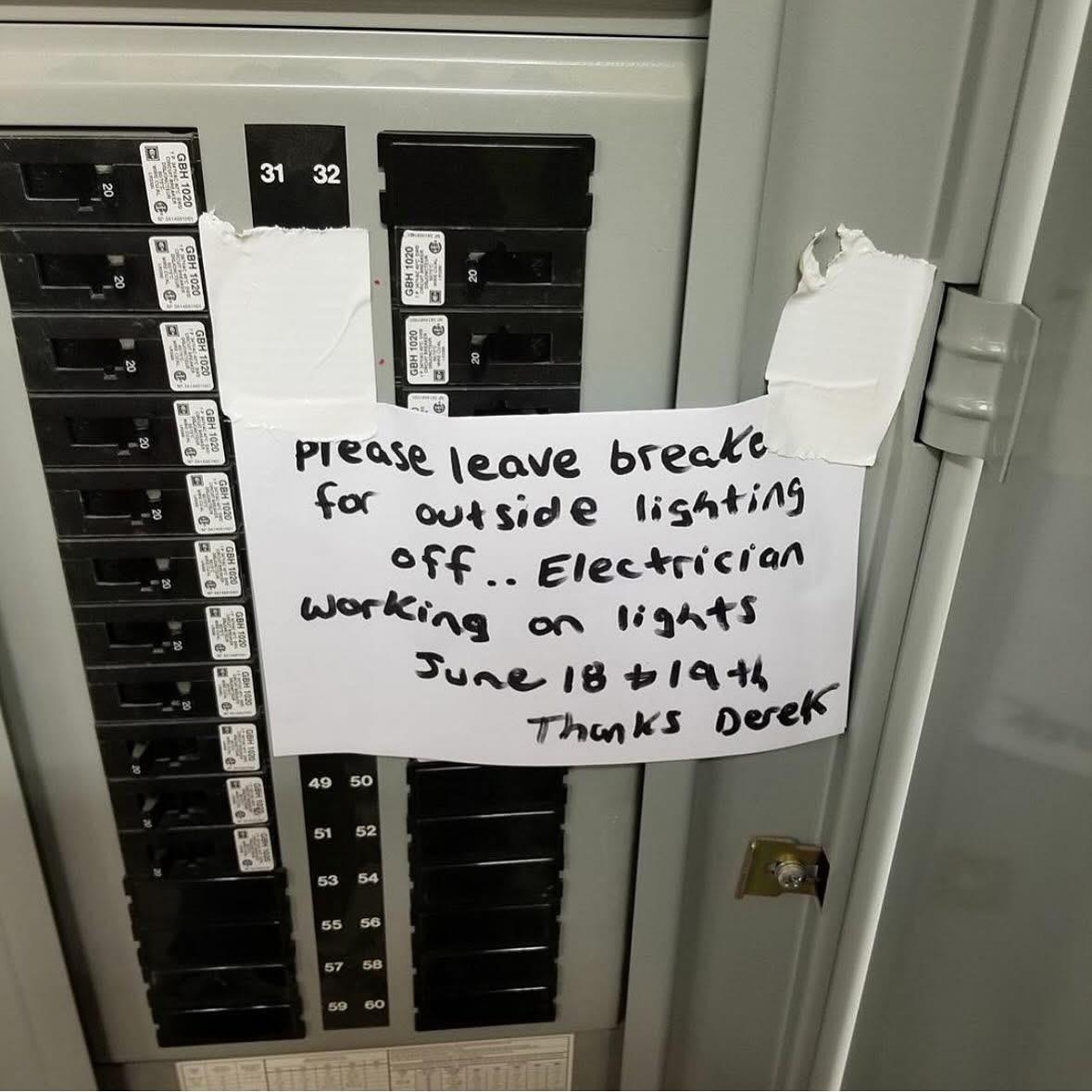
I am not sure if this is an approved "Log out Tag!

Quote of the Week

"Remember, life is all what you focus on. Learn lessons and keep moving forward towards your goals and dreams... "I have not failed. I've just found 10,000 ways that won't work."


Thomas A. Edison

Inspirational Quote of the Week


"Moses spent forty years thinking he was somebody; forty years learning he was nobody; and forty years discovering what God can do with a nobody."


Dwight L. Moody


The information offered in this newsletter is that of the editor and not of any other entity or individual.

We welcome any comments or suggestions about this newsletter, send to lwilkins@al-ba.com