Monday Morning Coffee and Technical Notes

August 18, 2025 View as Webpage

Upcoming Events


September 11 – Alabama Required Monthly Test 11:15


September 21 – 26 – ABA Radio Engineering Class


October 3 - Deadline to fill ETRS form one


November 2 - DST ends


November 3 – 7 – ABA Television Engineering Class


Time to file ETRS form One


The FCC’s Public Safety and Homeland Security Bureau announced that October 3 is the deadline for EAS Participants, including broadcasters, to file their annual Emergency Alert System Test Reporting System (ETRS) Form One – which provides information regarding EAS Participants’ EAS equipment and monitoring assignments along with other relevant data. 


While there is no nationwide EAS test scheduled for this year, the FCC still requires that all EAS Participants annually update their EAS information in the ETRS database by filing an ETRS Form One.


Log in to the ETRS site here. Make sure to have your login information along with the FRN and Facility ID handy.

ABA Engineering Academy


The Radio and Television engineering classes offered by the ABA Engineering Academy have two classes scheduled for this fall.


The Radio Engineering Class will be held September 22nd – 26th and the Television Class will be held November 3rd – 7th. Classes are held at the ABA Training Center, 2180 Parkway Lake Drive in Hoover (Birmingham) AL. Class outlines, hotel information, and online registration are available at the Engineering Academy website.


Remember these classes are offered at no cost, so we encourage you to register early as sitting is limited.

Transmitter Logs/Maintenance Logs


Although the FCC no longer requires the creation of an actual “transmitter log” and the word “maintenance log” does not appear in the rules, it is good engineering practice to maintain some type of records to prove you have checked the required items.


FCC Rules 73.1350 Transmission system operation indicates.

“(a) Each licensee is responsible for maintaining and operating its broadcast station in a manner which complies with the technical rules set forth elsewhere in this part and in accordance with the terms of the station authorization”.


In speaking with FCC field inspectors, I was told that a record of items inspected on a regular basis goes a long way in ensuring compliance.

LPFM/LPTV EAS


Questions come up regularly about EAS obligations for LPFM and LPTV broadcast stations.


Part 11 of the FCC Rules outline the requirements. This part indicates at a minimum EAS Participants must use a common EAS protocol, as defined in part 11.31, to send and receive emergency alerts. This simply means that all EAS Participants must have a operational EAS Encoder and Decoder.


Analog and Digital LPFM radio stations along with analog and digital LPTV television stations are not required to comply with section 11.32 concerning the need for an encoder.


However Part 11 does require that LPFM and LPTV station must maintain an operational Decoder. At the present time no manufacture makes a decoder only,


 If your facility operates both an EAS encoder and decoder (Encoder/Decoder), then you should follow the general instructions in the 2023 Handbook. If your facility operates as decoder-only, you should follow the “decoder only” instructions below for Required Monthly Tests (RMT) and Required Weekly Tests (RWT). 


LPFM and LPTV stations are required at a minimum to monitodr two (2) local sources as assigned by the State Emergency Communications Committee (SECC). In addition, they should also monitor the IPAWS system distributed via internet

Operating Power Measurements


It should come as no surprise to broadcast engineers that one of the major items on their “to-do list” is to ensure the transmitter is operating at the correct output power.


They must verify that the transmitter operates at the authorized output power specified on the station license.


Last week we reviewed the procedure to check and maintain the correct power level for a non-directional AM station. Today we will take a look at a directional AM transmitter site measurements.


Directional systems employ a “phaser” which allows the adjustment of the amount of power and the phase relationship of the power feeding each one of the towers in the array. The phase unit will have a “common point” meter at the input to the phase unit. This is normally the point where correct power output is read. This meter will read the RF current in amps.


As with the non-directional antennas, you will have to use some math (ohms law) to determine the actual power in watts. It is a very simple formula P = I2 X R. Where P is the licensed power, I2 is the antenna current squared and R is the resistance of the  input to the phasor. Normally this resistance is 50 ohms


FCC Rules (73.1560) indicate the power must be maintained as near as practicable to the authorized antenna input power and may not be less than 90 percent nor greater than 105 percent of the authorized power. Since the measurement at the input to the phasor is in amps and the licensed power is measured in watts, stations can create a table indicating the actual antenna current referenced to the licensed power limitations.


Once again, we turn to ohms law I = √P/R. Sample below using 50 ohms :


90%  4500 Watts – 9.48 amps

100% 5000 Watts – 10.00 amps (licensed power)

105% 5250 Watts - 10.24 amps


Another difference in directional systems compared to non-directional systems is that the Commission allows an increase in output to overcome the RF losses in the phasor unit.


Part 73.51 (b) states:

(1) For stations with nominal powers of 5 kW, or less, the authorized antenna input power to directional antennas shall exceed the nominal power by 8 percent.

(2) For stations with nominal powers in excess of 5 kW, the authorized antenna input power to directional antennas shall exceed the nominal power by 5.3 percent.


AM stations using modulation dependent carrier level (MDCL) control technology, must disable the MDCL control operation before antenna current can be read. FCC rules also require while making the measurement that there should be no modulation.


There are several other measurements that are required for directional AM system which we will discuss next week.

Understanding dbFS


It's easy to understand a correlation of the analog signal level to the digital signal level by going number-by-number or level-by-level. 


Decibel full-scale (dBFS) is a unit of measure for the amplitude of digital audio signals. It is critical to understand that though digital and analog signals have similarities, their characteristics differ significantly. 0dBFS occurs when all the binary digits (bits) making up the digital signal are on, or read as 1s and 0s in computer talk.


All of the bits available to make up the signal have been used at this finite point and no additional headroom exists. Trying to increase the level simply doesn't work and causes immediate distortion.


Professional sound engineers set the “true peak” level at -12 dbFS. If you try to push the limit, using a hard limiter you can create another issue call “intersample distortion” during the digital to analog decoding.

Pro Audio – In-Ear Monitoring


In this day and age, we hardly ever get something for nothing. There are always pro’s and con’s to everything.


For many artists and engineers, using in-ear (IE) monitors is the ideal monitor approach. But for others, they’re simply a method of trading one set of problems (extreme volume, tiny sweet spot, feedback potential) for another (sense of isolation, can’t hear amps or audience).


FOH engineers welcome less stage noise from removing the wedges, and artists appreciate hearing only what’s necessary. Yet, the 18–24 dB isolation of in-ear monitors means they often can't hear the crowd or communicate with each other between songs.


To give the artist a feel of the crowd responses, monitor engineers sometimes will mix some ambiance mikes into the mix. There is a fine line helping and hurting the monitor mix. We also see many artists have taken to performing with one earpiece in and the other out. In terms of hearing protection, this is the worst of all possible worlds. The in-ear mix is now competing with

information from the open ear, requiring at least 6 dB of extra level

to be as intelligible as it is with both earpieces inserted.


Some manufacturers have attempted to solve the ambience issue by drilling a small “port” into the plastic shell to let a limited amount of ambient sound to enter the ears coustically. While this seems to work there is no way to control the amount of ambiance sounds getting through.


The goal is to provide artists with all the benefit of an isolating system, plus the ability to communicate on stage and hear those adoring fans. Which approach to ambient listening is “right” depends on the artist and your situation.


Read more at Church Sound.

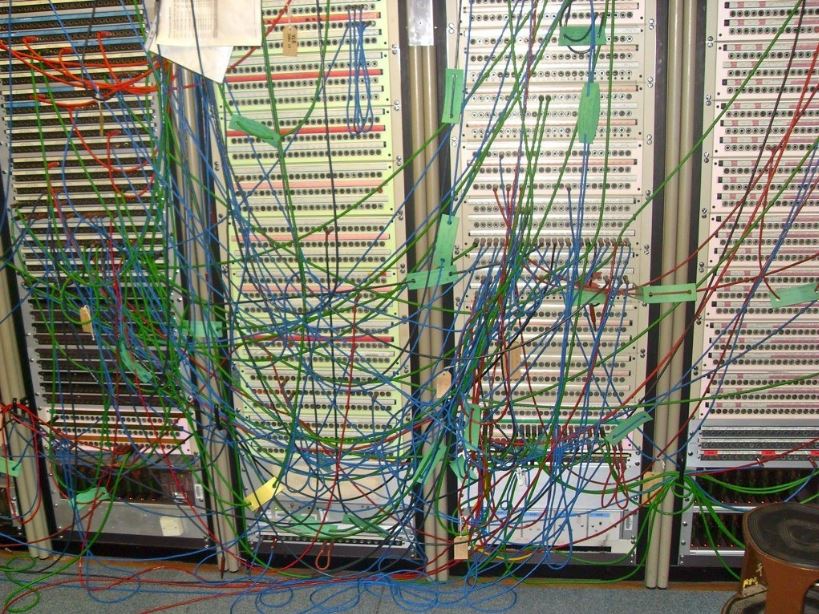
Earl we just lost the feed from the stadium!

Quote of the Week

To score a run, a baseball player must start by getting to first base. Think about it!

Inspirational Quote of the Week


You will never get to the next place God has planned for you by wallowing in the heartache of where you are now!


The information offered in this newsletter is that of the editor and not of any other entity or individual.

We welcome any comments or suggestions about this newsletter, send to lwilkins@al-ba.com