|
A Lively Week in Government Affairs: AGC Gets (More) Political!
By Dustin Steiner, Executive Vice President
| | | | |
It was a busy week for the political and government relations side of the house!
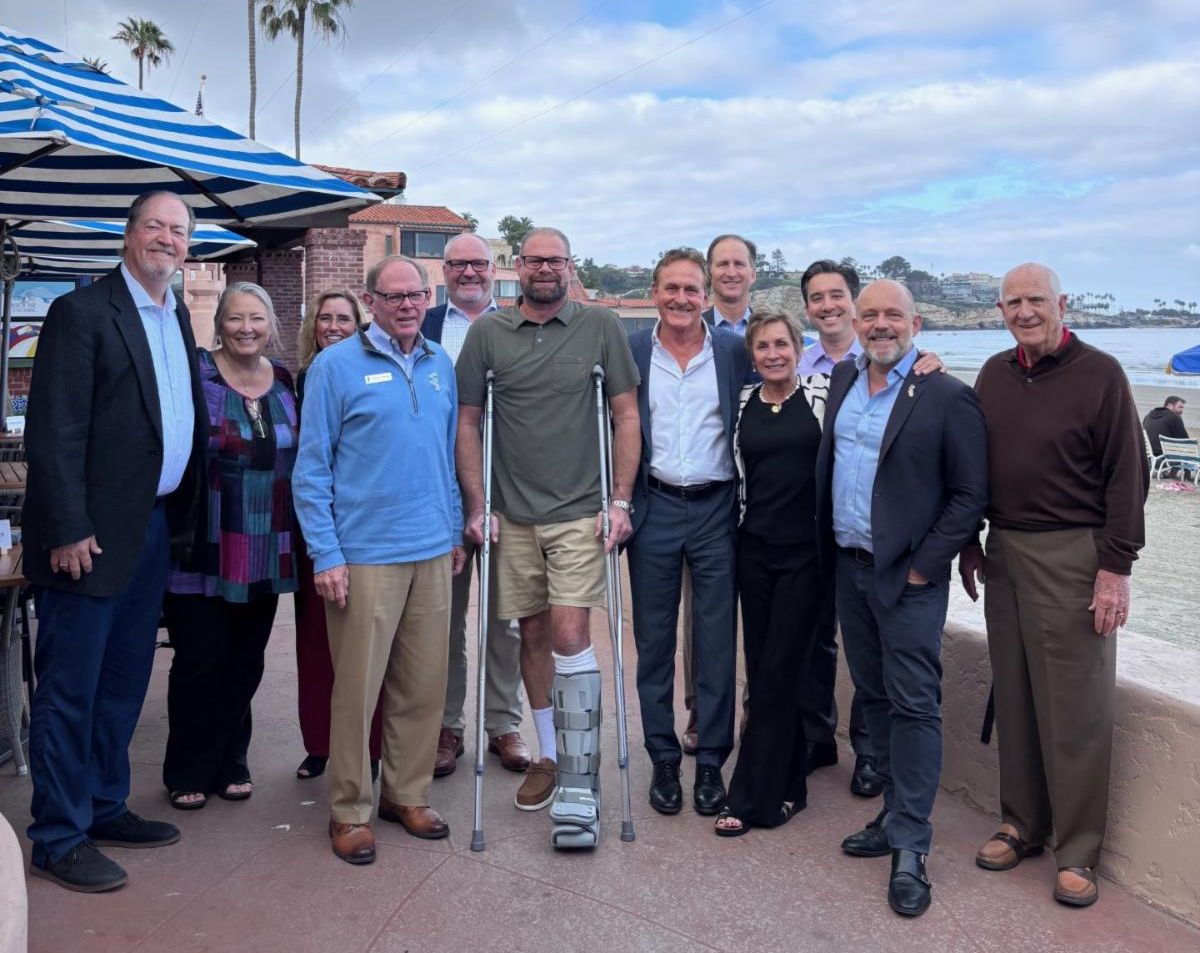
Last week, our Chair’s Circle and Political Action Committee (PAC) welcomed leading gubernatorial candidate Steve Hilton to San Diego with a working breakfast, in which he spent two hours learning about our industry.
Special thanks to PAC Chair Mike Furby (Marathon Construction Corp.) for hosting this event.
| | Our PAC meets tomorrow, and we just confirmed congressional candidate and current County Supervisor Jim Desmond, will be joining us following his switch to the 48th congressional district being vacated by longtime Rep. Darrell Issa (who is not seeking
re-election). We will also have former City Attorney Mara Elliott and San Marcos Councilman Ed Musgrove, who are vying for the seat of termed-out State Senator Brian Jones, as well as former Coronado Mayor, Richard Bailey, who is seeking the seat of termed-out councilmember Jen Campbell. Please join us! RSVP required. | | |
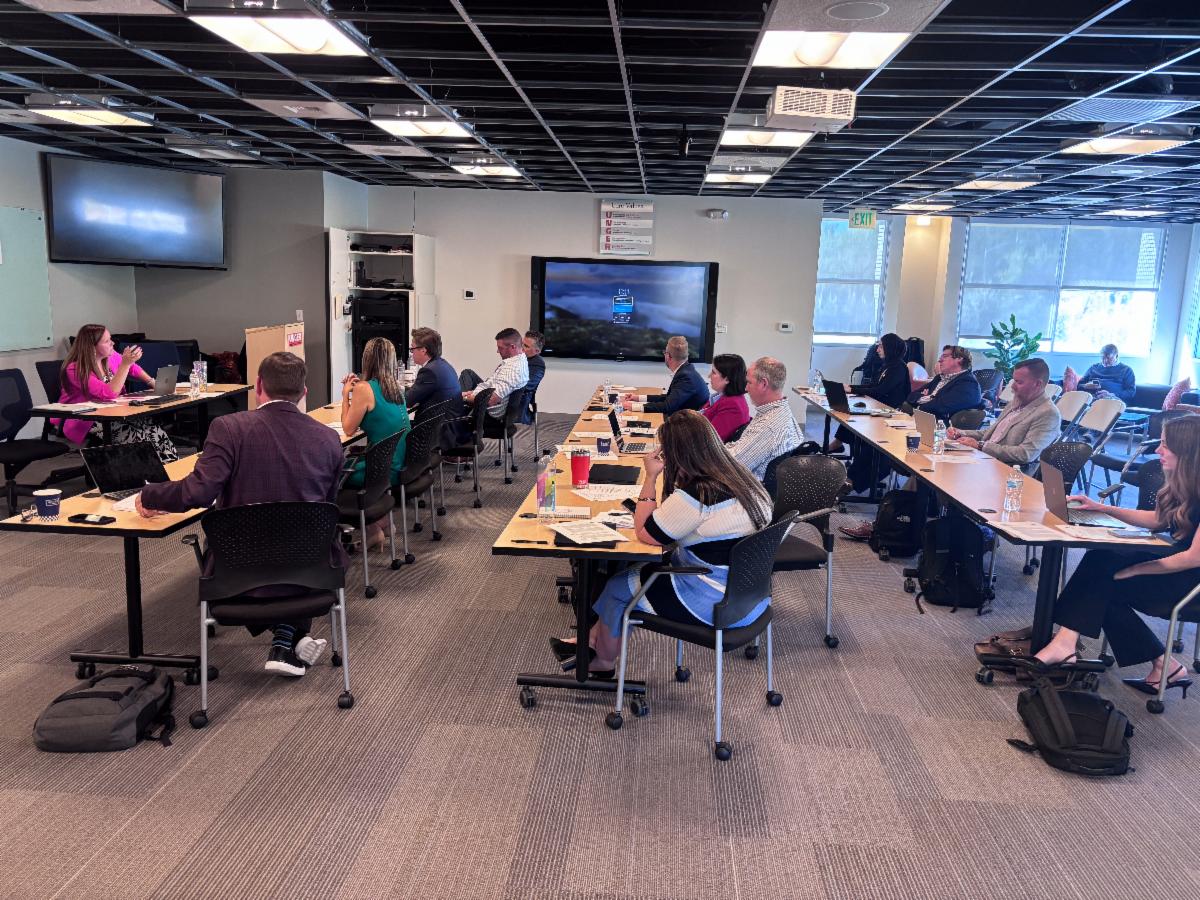
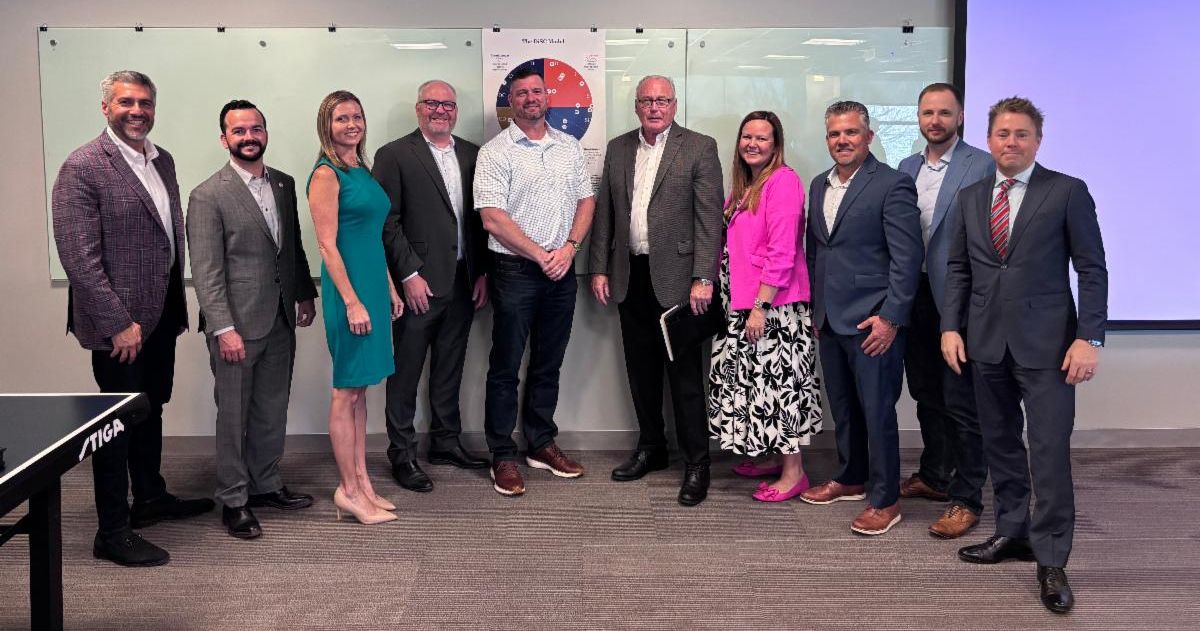
On Thursday, several AGC San Diego Members met with fellow contractors from AGC Cal and our legislative advocates from Pacific Coast Capitol Advisors in Sacramento for our biannual Joint Legislative Meeting.
The State Legislature has already introduced nearly 1,800 bills, and we went through several hundred of them in three subcommittees to take positions of support, oppose, or wait and see.
| | | |
Among the highlights: There appears to be momentum for a 4/10s workweek. Stay tuned! It’s always a productive meeting and AGC appreciates AGC Board Members Wes Wise (Cass Arrieta and Chair of our Government Relations Committee), Mark Weiand (Cox Construction), and Randy Finch (Finch, Thornton, & Baird, LLP) making the trek with us this year!
Mark your calendars for our Legislative Days, May 5 and 6, where we will join our fellow members and walk the halls of the State Capitol meeting with our legislators about the issues that affect our industry. You won’t want to miss it!
| | |
City Infrastructure Funding Challenges Continue to Mount
By Mike McManus, Director of Engineering Construction & Industry Relations
Last week City of San Diego staff reported to the city council on the new five-year outlook for capital projects. As expected, the main news is that once again, the gap between what infrastructure projects are needed and available funding continues to grow.
The City of San Diego (City) Fiscal Year (FY) 2027-2031 Five-Year Capital Infrastructure Planning Outlook (CIP Outlook) provides information on policy, regulatory requirements, and other criteria used by Asset Managing Departments (AMDs) in determining capital infrastructure needs, the basis for revenue projections of capital funding sources, and other considerations relevant to managing a citywide capital program.
The CIP Outlook is an annual moving projection; a new outer year is picked up in every report. This new outer year introduces new needs and identifies facilities that are coming due for replacement that were not due for replacement in earlier years. Because the City was built progressively over time, the replacement need trend is progressive and grows with time.
Adding to increased infrastructure needs are increased regulations and the rising cost of materials and labor. The City staff reported to the city council that they continuously monitors the unit costs in awarded construction projects and updates the project cost to reflect market changes based on bidding trends. The summary findings for the City of San Diego Fiscal Year 2027-2031 Five-Year Capital Infrastructure Planning Outlook are presented in the table below and reflect the upward trajectory of needs over time, as discussed above.
Over the next five fiscal years, the CIP needs are estimated at nearly $13 billion. An estimated $5 billion of funding will be available for future capital needs. An estimated additional ~$8 billion would be required to meet all the needs outlined during the Outlook period. Compared to the prior-year outlook for Fiscal Years 2026-2030, the $12.8 billion in anticipated needs represents an 8% increase. The most significant increase in needs is for the golf asset type, resulting from the addition of the Torrey Pines Golf Course Clubhouse Replacement Project. The gap outlook is compounded by a projected 7% decrease in available revenues for the capital program.
Also reflected in this year’s outlook is an overall reduction in Public Utilities Department capital needs and an associated revenue of 12% to align with the most recent City Council approved rates.
| | |
| Cap Need | Cap Funding | Gap | | FY2027 | $1.5B | $1.1B | $0.4B | | FY2028 | $2.3B | $1.1B | $1.2B | | FY2029 | $2.6B | $1.0B | $1.6B | | FY2030 | $2.8B | $1.0B | $1.8B | | FY2031 | $3.6B | $0.9B | $2.7B | | TOTAL | $12.8B | $5.1B | $7.7B | | |
|
PLAs: California’s Construction Reality Check... Love Them or Hate Them, You Can’t Ignore Them
By Adrianna Lopez, Director of Labor Relations
Let’s be honest: Few three-letter acronyms spark more eye-twitching in the construction world than PLA. For a select few (think policymakers), Project Labor Agreements (PLAs) are seen as a magical shield, guaranteeing skilled local workers, orderly job sites, and projects delivered on time and on budget. But for open-shop contractors, the reality often feels far less enchanted and much more like navigating a maze full of unexpected obstacles and traps around every corner.
Whether you’re open-shop, union-signatory, PLA-curious, or PLA-skeptical, here’s the truth: PLAs aren’t going anywhere. They’re being used more, and discussed more. Not to mention: Many of the bills currently being rushed through for approval before the end of Governor Newsom’s term contain even bigger expansions of PLAs.
So, now that I have your attention, let’s dive in to the unfortunate reality of PLAs in the construction space, particularly in public works, but potentially expanding into the private sector, which is the reality that contractors will soon have to face.
If you’ve been reading PLA Playbook, you should have a strong understanding that a PLA is a pre-hire collective bargaining agreement specific to one project, one contractor, or in the public space, usually specific to an Awarding Body (think SANDAG, MTS, etc.). It doesn’t automatically unionize your company, require you to fire your workforce, or mean Big Labor is taking over your office printer. It does mean you’re agreeing to operate under certain labor conditions for that project, and most importantly, it mandates use of Union workers and payment into Union Trust Funds.
Why Some Contractors Like PLAs
Some contractors appreciate PLAs for the predictability, labor stability, and the ability to hire workers in a challenging labor market. They also like the fact that because many contractors are PLA averse, the bidding pool tends to be much smaller, resulting in a steady flow of available work and opportunities.
Why Some Contractors Do Not
Open-shop contractors often cite increased costs, hiring restrictions, administrative complexity, and jurisdictional rules as concerns. For them, a PLA can feel like being handed a recipe you didn’t write, working in a kitchen you don’t control, and still being expected to cover the cost of the meal.
The Middle Ground
The contractors who succeed under PLAs aren’t the ones who fight them; they’re the ones who understand them. You don’t have to change your identity or join a union, but you do need to understand dispatch rules, workforce limitations, potential increased costs, and how to respond when disputes arise.
Final Whistle
Sure, we can battle PLAs endlessly... but in this region, PLAs aren’t just surviving, they’re multiplying. Contractors should expect more, and I mean many more, of them on the horizon. That’s just the industry we work in, and the challenge we have to face. But as your coach, I’m here to help you strategize, educate, and help you find success should you wish to explore the PLA construction space.
| | |
New California Retirement Mandate: What General Contractors Need to Know Now
By Jalyn Lupo & Luka Vujovich –WestPac Wealth Partners, Affiliate Member
General contractors understand that staying ahead of regulatory changes is part of protecting the business you’ve worked hard to build. Recent federal legislation — the SECURE Act and SECURE 2.0 — along with California’s state mandate, have significantly increased employer responsibilities and expanded retirement plan access. Together, these laws broaden retirement plan eligibility to include expanded access for certain part-time employees, enhance tax credits for small businesses that establish plans, and require California employers to ensure their workers have access to a retirement savings option. Employers who fail to comply may face state-imposed penalties, making timely implementation essential.
What California Requires
Under the California retirement mandate, employers with 1+ employees must either:
Offer a qualified employer-sponsored retirement plan or Register for CalSavers.
CalSavers is a one-size-fits-all Roth Individual Retirement Account (IRA) with very limited contribution limits and no employer flexibility. It doesn’t allow for employer profit sharing, larger tax deferral strategies, or customized plan design like a 401(k) or cash balance plan would. Running your own qualified plan gives you significantly higher contribution limits, stronger tax advantages, better talent retention tools, and full control over investment options and plan structure.
What Counts as a Qualified Plan?
The state accepts the following:
• 401(k)
• Savings Incentive Match Plan for Employees (SIMPLE) IRA
• Simplified Employee Pension (SEP) IRA
• Profit-sharing plan
• Defined Benefit Pension Plan
• Cash Balance Plan
Pros for Contractors
Beyond compliance, offering a qualified retirement plan can provide meaningful strategic advantages. A competitive retirement benefit helps attract and retain skilled labor in California’s tight construction market, strengthening workforce stability and company culture. Federal tax credits under SECURE 2.0 can significantly offset,and in some cases largely subsidize, the cost of starting a new plan. Additionally, profit-sharing, defined benefit, and cash balance plans may allow business owners to make substantial pre-tax contributions, creating significant current-year tax deductions while accelerating personal retirement savings.
Now is the time to initiate or review your current retirement setup to ensure compliance while positioning your company for long-term growth.
Jalyn Lupo & Luka Vujovic are Registered Representatives and Financial Advisors of Park Avenue Securities LLC (PAS). Securities products and advisory services offered through PAS, member FINRA, SIPC. Financial Representatives of The Guardian Life Insurance Company of America® (Guardian), New York, NY. PAS is a wholly owned subsidiary of Guardian. WestPac Wealth Partners LLC is not an affiliate or subsidiary of PAS or Guardian. Insurance products offered through WestPac Wealth Partners and Insurance Services, LLC, a DBA of WestPac Wealth Partners, LLC. | Lupo CA Insurance License #4372391 | Vujovich CA Insurance License #0M95564 | 8805821.1 Exp. 03/28 | This material is intended for general use. By providing this content The Guardian Life Insurance Company of America, Park Avenue Securities LLC, affiliates and/or subsidiaries, and your financial representative are not undertaking to provide advice or make a recommendation for a specific individual or situation, or to otherwise act in a fiduciary capacity. Guardian, its subsidiaries, agents and employees do not provide tax, legal, or accounting advice. Consult your tax, legal, or accounting professional regarding your individual situation.
| | |
AGC San Diego Joins Forces with Build San Diego to Start Small Biz, Veterans Initiative
With over $600 million in anticipated public infrastructure work moving through the county, Caltrans, SANDAG, and the City, AGC San Diego's members, together with public agencies, are looking for small and veteran-owned businesses to fill small business gaps in the bidding pool in short order.
This comes as the Department of Transportation and other federally funded programs have revised Disadvantaged Business Enterprise regulations, shifting eligibility determinations and forcing many small firms to navigate recertification or to complete in larger markets with all small business enterprises.
For many AGC San Diego general contractor members this translates, most notably, into a reduction in the pool of verified firms ready to perform on public agency and federal work.
In response, AGC San Diego and the Build San Diego Foundation collaborated to form the Small Business & Veterans Initiative, as a direct solution to partner the local construction industry with public agencies, trade associations, community associations, and private programs and systemically rebuild/strengthen the regional subcontractor pool offering.
This initiative will offer:
- Contractor registration/documentation support with respective agencies
- Workforce alignment through training and readiness assessments for public agency and federal program support
-
Access to industry specific educational courses and tracks designed to keep your workforce compliant, project ready and COMPETITIVE
-
Good Faith Advertising through AGC San Diego's Plan Room
AGC GC and Specialty Members! We need you to engage in identifying subcontractor gaps, refer emerging firms in need of readiness support, and participate in strengthening the pipeline by helping to expand qualified capacity in our local subcontractor pool.
Want to learn more? Need this assistance? Contact Ilka T. De León at ideleon@buildsandiego.com or 619-499-5782.
Listen in to our podcast this week to hear more about this initiative and the Build San Diego Foundation!
To learn more about AGC's efforts to develop the construction industry through workforce development, join our Workforce Development Committee today!
| | |
Volunteer Opportunity for the Special Olympics Basketball May 16
We are seeking a dedicated "A-(GC)-Team" of 10–12 volunteers to support the Special Olympics Southern California (SOSC) basketball tournament on May 16 in Santee.
We are responsible for scorekeeping, ensuring the games run smoothly for the athletes. This is a high-energy role that balances technical support with active cheering.
To ensure a rewarding experience, each shift includes participation in the event's most impactful moments:
Morning Shift (8:30 AM – 12:30 PM): Includes attendance at the Opening Ceremonies, the most inspiring part of the day.
Afternoon Shift (12:30 PM – 4:30 PM): Includes assisting with the Medal Presentations to celebrate the athletes' achievements.
The event schedule:
8:30 AM: Arrival & Check-in
9:00 AM: Opening Ceremonies
9:30 AM – 12:30 PM: Morning Tournament Games
Lunch: Complimentary for all volunteers by SOSC (Staggered times)
12:30 PM – 4:30 PM: Afternoon Tournament Games
4:30 PM: Medal Presentations & Closing
Ready to join the team? Please contact Marcy Knopman at marcy@agcsd.org to secure your spot. Let’s work together to help these athletes shine!
| |
Last Chance, Students! Apply for Build San Diego Foundation Workforce Bridge Scholarship by this Saturday, March 21!
Know a student in construction at SDSU in CEM or CM? Know someone in the Diesel Tech group at San Diego Community College District?
This is the last week to apply for the 2026 Build San Diego Scholarship program!
Applications are due this weekend; apply now!
| | |
2026
April 1 - 30 - AGC Book Drive - Download Flyer
April 16 - Meet Your GC - McCarthy Building Companies - McCarthy San Diego HQ
Registration opening March 17!
May 19 - Bags & Brew: Meet Your GC Cornhole Tournament - Lakeside
June 1 - Build San Diego Foundation Golf - The Heights Golf Club
June 23 - AGC Baseball Bash - Petco Park
| | COMMITTEES/COUNCILS MEETINGS | | |
March 18 - County of San Diego - 1:00 PM @ County Operations Center
March 18 - Construction Leadership Council (CLC) - 4:00 PM @ Balfour Beatty office
April 1 - Safety Committee - 7:00 AM - Lakeside
April 7 - Affiliate Members' Council - NOON - Lakeside
April 9 - Meetings & Events - NOON - Lakeside
April 15 - Port District Liaison - 11:30 AM @ Port office
April 23 - Airport Liaison - 11:30 AM @ Airport Design & Construction office
April 30 - H.R. Practices Committee - 11:30 AM - Lakeside
| | EDUCATION / SAFETY TRAINING | | |
MARCH TRAINING SCHEDULE
March 18 - CPR/ First Aid and AED Certification
March 18 - Excel Advanced Training
March 19 & 20 - Quality Control Plan Workshop: Achieving Federal Compliance with UFGS Standards - Intermediate Level (Virtual)
March 19 - Adult Mental Health First Aid (MHFA) Certification
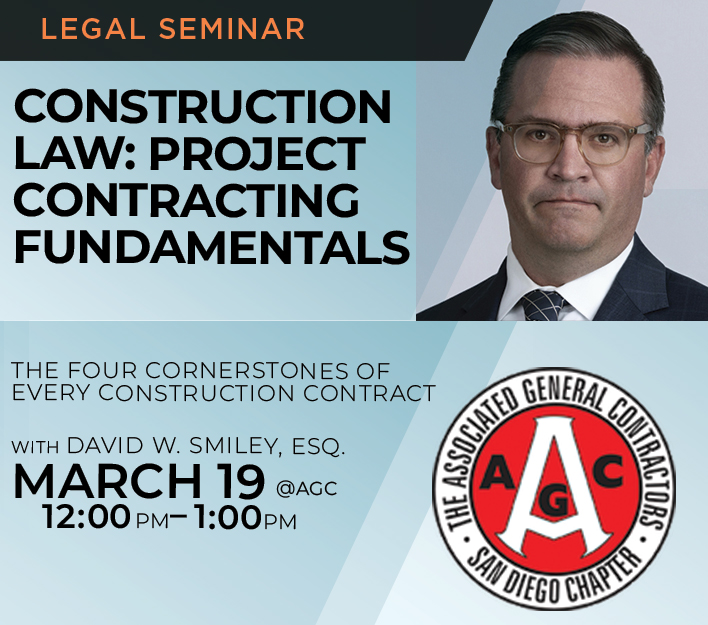
March 19 - Construction Law: Project Contracting Fundamentals, The Four Cornerstones of every Construction Contract - Register by end of day March 16
March 19 - Microsoft Word Advanced
March 19 & 20 - OSHA 10 Hour for Construction, 2-Day Class
March 19, 20, 23 & 24 - OSHA 30 Hour Construction Outreach, 4-Day Class
March 20 - Construction Scheduling - Critical Path Method of Scheduling (CPM)
March 23 - Microsoft Project Professional: Beginning-Intermediate
March 23 - Fall Protection Equipment Inspector Competent Person Training
March 24 - QuickBooks Beginner - Online version
March 26 - MS PowerPoint Beginner/Intermediate
March 26 - BLUEBEAM REVU Takeoffs & Estimation Training
March 27 - E-Learning: Effective Email Communication (Virtual)
March 30 - Microsoft Project Professional: Intermediate-Advanced
March 31 - QuickBooks Intermediate/Advanced - Online version
March 31 - CMMC Compliance & Risk Management: Protecting Contractors in the Federal Supply Chain
VIEW PDF LIST OF MARCH CLASSES
Classes are held at our Ferris Square location in Sorrento Valley, our AGC Headquarters in Lakeside, or online.
| |
AGC East County Facility & Apprenticeship Training Center
10140 Riverford Road
Lakeside, CA 92040
(858) 558-7444
| |  |
AGC Government Affairs Office &
Fall Protection Training Campus
6212 Ferris Square
San Diego, CA 92121
2nd floor
| | | |
About Monday Morning Quarterback
AGC San Diego Chapter's Monday Morning Quarterback is a "hot off the press" and to the point Monday morning briefing on the important issues facing San Diego's construction industry. It is prepared by AGC Chief Executive Officer, Eddie Sprecco, and Vice President Government & Industry Relations, Dustin Steiner.
Please contact Eddie Sprecco or Dustin Steiner with your comments, or with information that should be conveyed to the industry through this service. Well over 3,000 individuals employed by AGC member firms are part of this system.
Disclaimer: Information and advice provided by AGC San Diego staff is general and not a substitute for legal counsel. Before applying any recommendations or policies to your business, consult a licensed attorney familiar with your specific circumstances.
| | | |
AGC San Diego Chapter, Inc.
The VOICE of Construction
(858) 558-7444
agcsd.org
| | | | | |