|
Political Action at the AGC
By Dustin Steiner, Executive Vice President
Last week, your AGC Political Action Committee (PAC) met to interview candidates running for office. We had a great turnout and an engaging discussion. Special thanks to our hosts, Finch, Thornton & Baird.
| | |
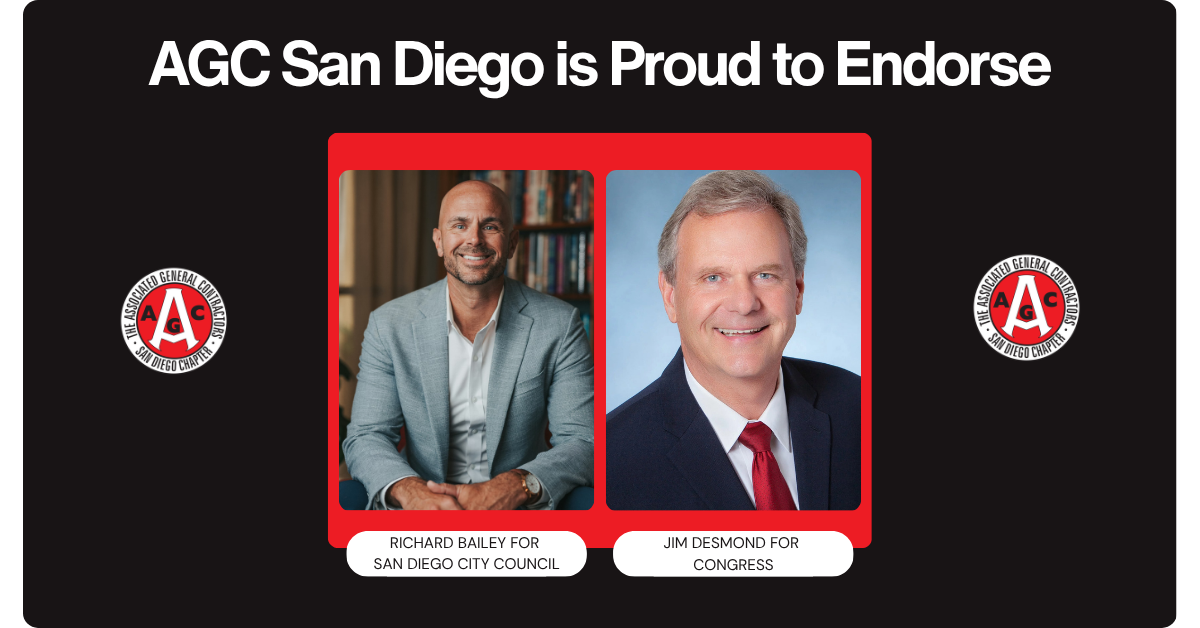
We met with four candidates: Jim Desmond (Congress, CD48), Mara Elliott (State Senate, SD40), Richard Bailey (San Diego City Council, District 2), and Ed Musgrove (State Senate, SD40). The PAC recommended endorsements of Desmond and Bailey, and, on Thursday, AGC San Diego's Board of Directors ratified those two recommendations, making them full endorsements. They join four previous endorsements: Jordan Marks for Assessor, John McCann for Mayor of Chula Vista, Mike Sannella for Mayor of San Marcos and Lindsey Smith for San Marcos Council.
AGC San Diego PAC is not a federal PAC, so we cannot donate directly to Jim Desmond and San Diego City Council members are prohibited from accepting PAC checks, but if you would like to make a personal donation, you can do so by clicking here for Desmond and here for Bailey.
Mark your calendar for our next PAC meeting on April 30, when we will be hearing from Kelvin Barrios, the Director of Government Affairs for Laborers Local 89 about an upcoming City of San Diego sales tax measure and the growing coalition behind it.
If you are a current member of our PAC, invoices are live in your AGC account. If you would like to learn more about how to get involved, please reach out!
We have a lot of momentum in the business community right now. Join us!
| | |
The Interstate Highway System Celebrates its 70th Birthday
By Mike McManus, Director of Engineering Construction & Industry Relations
For decades, the Interstate Highway System has been an essential link in connecting communities and moving trillions of dollars of goods. This year, 2026, the massive highway system has turned 70 years old. While we mark this significant milestone, there are growing calls for more investment as many roads, particularly in urban areas, are highly congested and roads all over the country are showing their age.
Before the Interstate Highway System, most roads were unpaved, making it impossible to pass when it rained. A young Lieutenant Colonel named Dwight D. Eisenhower would experience firsthand the struggles of traveling on these roads when he took part in the first U.S. Army transcontinental motor convoy in 1919. Eisenhower was an observer on that 62-day, 3,251-mile trip. He submitted an official report titled "Principal Facts Concerning the First Transcontinental Army Motor Transport Expedition."
Key details regarding the 1919 convoy and its documentation:
- Eisenhower's report (often referred to as "the truck train" report) outlined the logistical failures of the trip, including the destruction of hundreds of bridges and numerous breakdowns across the Lincoln Highway.
- He also documented that most of the highways in the United States were dirt roads, which, in time of war, would make it difficult to defend our country.
President Eisenhower would also gain an admiration for Germany's Autobahn highway network during his time as Commander of the Allied Forces during World War II. Both of these experiences would later influence Eisenhower's push for a modern highway system when he was president.
After becoming president, President Eisenhower's support helped pass the 1956 Federal-Aid Highway Act, which enacted the construction of 41,000 miles of highway, costing (at the time) around $25 billion. Now as the Interstate Highway System has turned 70 years old, its roads are congested and deteriorating.
Most sections of the highway system's roadway still have their original foundations and need to be "completely rebuilt from the subbase up," according to a 2019 report by the Transportation Research Board, a division of the National Academies of Sciences, Engineering, and Medicine.
In order to modernize the highway system, the report calls for:
- Reconstructing a majority of the interstate highways and bridges
- Upgrading most interchanges to improve safety and function
- Adding capacity along existing corridors
- Constructing new routes
- Converting some existing routes to interstate standards
- Changing some urban roadway segments to maintain connectivity while repairing economic and social disruption
- Improving highway safety features
Improving the Interstate Highway System would require increasing the annual investment from $23 billion in 2018 to $57 billion annually over the course of the next 20 years, according to the report.
It will take both the federal and state governments to find a solution in investing for the highway system's future. A good starting point will be in this year's Reauthorization of the Surface Transportation Act.
| | |
Training Camp: Scopes of Work: Read Them or Strike Out
By Adrianna Lopez, Director of Labor Relations
Most public works contractors eventually discover (often after a headache or two) that scopes of work aren’t optional reading material. They’re essential to staying compliant.
In fact, carefully reviewing each determination’s published scope of work might be the single most important step in getting your classifications right; because scopes DO change, they vary by location, and when Union and DIR scopes differ, the DIR always wins.
Union v. DIR: Who Makes the Call?
Most contractors assume that because a craft’s scope of work appears in their Union’s collective bargaining agreement (CBA), they're covered. Logical? Sure. Correct? Not always.
DIR’s published scopes of work are influenced by union CBAs, but from a prevailing wage enforcement standpoint, here’s the non‑negotiable truth:
If the task is not covered in the DIR scope of work for that craft, it cannot be used. Period.
Investigators enforce based on what the DIR has officially published for that county and that determination, not what is covered in a Union CBA.
County-by-County Curveballs
DIR also publishes county-specific classification notices that can come out of left field. And, if you’re not ready, those mistakes can add up fast. Three strikes, and you’re out.
For example, some Southern California counties classify solar installation under Laborer. Others classify the exact same task under Electrician: Inside Wireman.
Overlapping Scopes: When Two Teams Claim the Same Ball
One major trouble spot is overlapping scopes. For example, the Southern California Laborer scope includes landscape irrigation language that is verbatim to the Pipe Trades irrigation scope.
These battles can land a contractor right between feuding Unions, frequently triggering complaints, misclassification findings, and enforcement at the higher wage.
Final Inning: Coach’s Notes
- Read scopes carefully- because one missed line can turn into an easy out
- Read the scopes often! Determinations change. Counties change. Scopes change. Your process should too.
- Don’t make assumptions... What worked on the previous job might not fly on the next, especially across counties or determination cycles.
- Always double check the DIR scope against your Union scope (when applicable), if they conflict, the DIR calls the play.
Read the scopes, run the play, and chalk up the victory. Go get ‘em slugger!
| | |
Over 20 Construction Leaders Fill Balfour Beatty to Talk Business Development
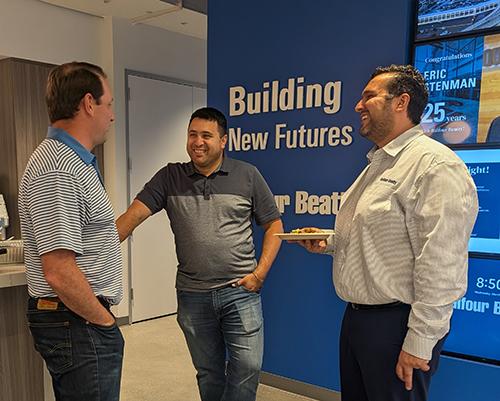
The Construction Leadership Council (CLC) hosted its first meeting of the year on March 18 at the Balfour Beatty office with attendees from GCs, subcontractors, and affiliates to network and share information on everything from upcoming job walks to new technology.
We mean what we say when we say that this committee is built of the leaders of tomorrow; GC attendees from this last meeting included Balfour Beatty, Griffith Company, Hazard Construction Engr LLC, Marathon Construction Corporation, Swinerton, Turner Construction Company, and Webcor.
The meeting started with Balfour Beatty’s Dusan Selezan, a former CLC Chair, presenting to the committee about business development, building relationships, and getting involved in the industry (starting with AGC). The committee shared updates from other AGC councils and committees (Specialty Contractors' Council and Workforce Development Committee), gave more information about the SDSU Reno Teams competition, and planned for the October CLC event this year.
The CLC also shared a callout for speakers interested in teaching our Summer Training series, a series that focuses on basic training in estimating, scheduling, site logistics, and safety, for our SDSU Reno Teams.
The committee is planning their summer Sip ‘n Social recruiting event for June.
If you are interested in learning more about the CLC, join us at this event or join the committee. Email AGC Staff Liaison Kellie Korhonen at kellie@agcsd.org for more information.
| | |
Join Build & Serve Committee and Volunteer with Special Olympics
We are seeking a dedicated “A-Team” from AGC of 10–15 volunteers to support the Special Olympics Southern California (SOSC) basketball tournament on May 16 in Santee.
To ensure a meaningful and rewarding experience, each volunteer shift includes participation in some of the event’s most impactful moments:
Morning Shift (8:15 AM – 12:30 PM)
Includes attendance at the Opening Ceremonies, one of the most inspiring parts of the day.
Afternoon Shift (12:15 PM – 4:30 PM)
Includes assisting with medal presentations to celebrate the athletes’ achievements.
We are in need of general volunteers to assist the SOSC staff throughout the day with various tasks. Volunteers are welcome to stay for the full event or sign up for one of the two available shifts. All volunteers receive a t-shirt and lunch ticket.
Interested in joining the AGC volunteer team?
Please contact Marcy Knopman at marcy@agcsd.org to receive the registration link and more details. Volunteers must be at least 14 years old.
| | |
Build San Diego Scholarship Application Deadline Extended!
Know a student in construction at SDSU in CEM or CM? Know someone in the Diesel Tech group at San Diego Community College District?
Let them know about this scholarship. The application deadline was extended to March 31. Apply now!
| | |
Rear Adm. Bret Muilenburg to Keynote Scouting America’s
Lunch-O-Ree in May
Scouting America has announced that Bret Muilenburg will keynote speak at this year’s 19th Annual Construction & Building Industry Lunch-O-Ree May 7 at the Paradise Point Resort & Spa.
This event will honor our 2021 Past President and current board member, Mike Williamson, President of Pacific Coast Iron, as the Good Scout of the Year.
Get your tickets now here or register for a sponsorship to support the work of the scouts and to celebrate the industry’s achievements in scouting.
Rear Admiral Bret Muilenburg is a highly educated engineer and executive who spent his career leading large construction and infrastructure projects for the Navy worldwide.
With advanced degrees in environmental engineering, engineering management, and advanced management from top universities, Muilenburg served and led teams in peacetime and in high-risk environments, including war zones. His deployments include Bosnia-Herzegovina, Iraq/Kuwait, and Afghanistan.
Muilenburg continued to climb the ranks into even more senior roles, serving as commander of Naval Facilities Engineering Command Pacific and the Pacific Fleet Civil Engineer before assuming command of NAVFAC.
A top leader in the design, build, and maintenance of Navy bases and infrastructure worldwide, Muilenburg is sure to impress with his knowledge of leadership, defense, and community.
| | COMMITTEES/COUNCILS MEETINGS | | |
April 1 - Safety Committee - 7:00 AM - Lakeside
April 7 - Affiliate Members' Council - NOON - Lakeside
April 9 - Meetings & Events - NOON - Lakeside
April 15 - Port District Liaison - 11:30 AM @ Port office
April 23 - Airport Liaison - 11:30 AM @ Airport Design & Construction office
April 30 - H.R. Practices Committee - 11:30 AM - Lakeside
| | EDUCATION / SAFETY TRAINING | | |
MARCH TRAINING SCHEDULE
March 30 - Fall Protection Competent Person Retraining (EM 385 Compliant) (Virtual)
March 31 - CMMC Compliance & Risk Management: Protecting Contractors in the Federal Supply Chain
VIEW PDF LIST OF MARCH CLASSES
Classes are held at our Ferris Square location in Sorrento Valley, our AGC Headquarters in Lakeside, or online.
| |
AGC East County Facility & Apprenticeship Training Center
10140 Riverford Road
Lakeside, CA 92040
(858) 558-7444
| |  |
AGC Government Affairs Office &
Fall Protection Training Campus
6212 Ferris Square
San Diego, CA 92121
2nd floor
| | | |
About Monday Morning Quarterback
AGC San Diego Chapter's Monday Morning Quarterback is a "hot off the press" and to the point Monday morning briefing on the important issues facing San Diego's construction industry. It is prepared by AGC Chief Executive Officer, Eddie Sprecco, and Vice President Government & Industry Relations, Dustin Steiner.
Please contact Eddie Sprecco or Dustin Steiner with your comments, or with information that should be conveyed to the industry through this service. Well over 3,000 individuals employed by AGC member firms are part of this system.
Disclaimer: Information and advice provided by AGC San Diego staff is general and not a substitute for legal counsel. Before applying any recommendations or policies to your business, consult a licensed attorney familiar with your specific circumstances.
| | | |
AGC San Diego Chapter, Inc.
The VOICE of Construction
(858) 558-7444
agcsd.org
| | | | | |