JIM MURRAY
A Boss Named Millie
I guess it's no longer news that women are into thoroughbred racing. Marj Everett owns Hollywood Park. Diane Crump rode in the Kentucky Derby. Liz Whitney breaks her own yearlings, and kisses horses in the winner's circle. Lots of rich ladies own stables and feed sugar to 2-year-olds. One of them bit off Elizabeth Arden Graham's finger once. The stable area is the only place in the world where a "groom" might be a bride.
But, that's the drawing room side of racing. Those are people who buy horses instead of yachts. Quarter-horse racing is a far cry from Chanel No. 5. It's more like Eau de Corral, sweet essence of roundup. This is a sport for guys who roll their own cigarets, eat from chuckwagons, drink coffee from a can, and sleep with their hats on.
*
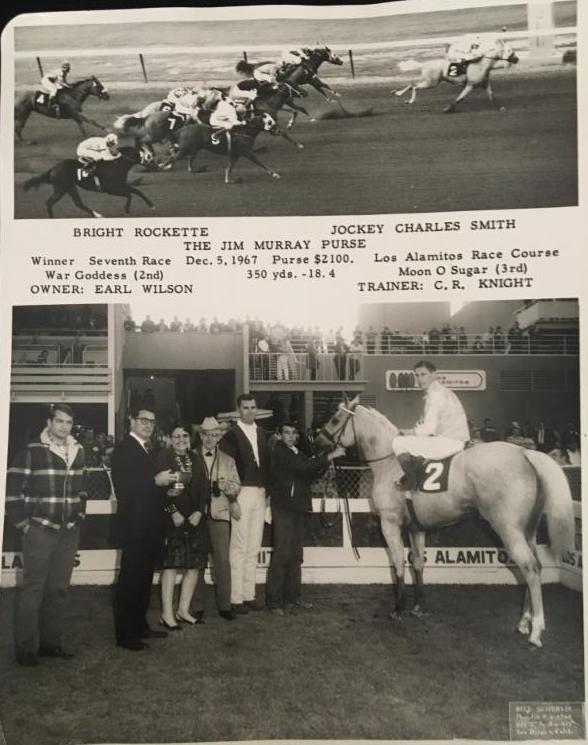
So, when Frank Vessels Jr., for reasons none of us could ever fathom, took his own life a couple of years ago, most of us figured his widow, Mildred, would sell off the family quarter-horse racing empire, the breeding farm, the Los Alamitos racing plant, brood mares, stallions, golf course and go off somewhere you wouldn't smell a horse for years.
Instead, Millie moved into the family home only a furlong away from the finish pole at the track. Her son, Frank Nelson Vessels, moved next door and the Vessels family, which has been synonymous with California quarter-horse racing for a quarter of a century, still is.
Millie doesn't run the business from the back of a pinto or with a vocabulary that's a cross between Annie Oakley and a mule driver. Thoroughly Modern Millie runs it with a Gucci outfit, hair styled in Beverly Hills, and the hand that suns the track wears bracelets. Billie the Kid wouldn't have understood it at all.
Millie didn't want to leave Los Alamitos any more than a Ford would want to leave River Rouge. She has been part of the quarter-horse racing empire here since the days when there wasn't any, and her father-in-law, Frank Vessels, Sr., used to raise Hereford on the 1,000 acres where the track and golf course now stand.
In those days, newly married, she used to drive the tractor that pulled the plow that harrowed the track. Her husband used to stand on the back of it to force the rakes deeper.
The Vessels family used to stage informal Sunday afternoon match races, non-betting, or, at least, non-mutuel, between quarter-horse fanciers from all over the state. The sport grew so popular the family had to cut the meeting down to one a month - which was the last time anyone in the Vessels family moved for fewer racing days. Most of the next few years, Vessels Sr. spent lobbying in Sacramento for the legalization of quarter-horse pari-mutuel betting.
He finally got 11 days in 1951. In December. It only rained 11 of them. The "grandstand" consisted of planked seating covered with a mammoth canvas which held water which didn't run off. "It was my job," laughs Millie, "to go around with a stick with a nail in it and poke small holes in the canvas to let the water seep through before the canvas collapsed on us."
*
The "clubhouse" consisted of houses the family bought at auction which had been condemned to make way for the Santa Ana Freeway. Millie's job was decorating these houses so that they didn't look like tract homes with $2 windows in them.
Those were the days when the people who ran racing - i.e., Doc Strub at Santa Anita, and Jim Stewart at Hollywood Park - thought 100 days of races were all the traffic could bear in Southern California. And they would have to be over by sunup. The "Golden Goose" theory.
They relented in the case of quarter horses on the theory nobody wanted to bet on a race that was only 440 yards long. The truth of the matter is, every horse race is only a quarter of a mile long. The rest of it is just jockeying for position.
Quarter horses are the most popular breed in America. More than 97,000 were foaled last year, three times the number of registered thoroughbreds. Not all of them got to the races. Some are more favored for gymkhanas, barrel-racing, or rodeoing. And the horse-that-won-the-West is winning the East, now, too. Quarter-horse tracks have opened in New Jersey and Louisiana and breeding operations have sprung up from Florida to Oregon.
Night racing, for some reason, proved more of a boon to quarter-horse racing than to harness, and Los Alamitos, which got the munificent sum of 17 days its second year, now runs 79 nights a year of its own racing, plus leasing out the track for another quarter-horse meet and a harness meet.
Millie runs this $750,000-a-night operation from a switchboard phone in her home, from breeding farms to lobbyists to judges' stands. For some, it may be like the schoolmarm running Dodge City, or the law in Tombstone wearing a Givency but, for the present at least, she's the one wearing the badge and, in this new model of the Old West, the marshal is a lady.