Montana Beaver Working Group
| | |
Connecting people and sharing resources to advance the beaver's keystone role
in watershed health
| | |
Beavers Celebrate the 50th Anniversary of the 310 Law
Editorial Note: The photos and words for this story come from Radley "Rad" Watkins, Executive Director of the Missoula CD. You can learn more about Rad and the Missoula CD here.
Working for a conservation district in Montana is a little different than in any other state in the country. In Montana conservation districts have regulatory authority, as well as an obligation to educate, provide technical assistance, and enter into cost-sharing agreements with landowners looking to promote conservation features on their land. Here, conservation districts are also in charge of overseeing the Montana Natural Streambed and Land Preservation Act of 1975, also known as the 310 Law. The 310 Law requires anyone who is doing work that could impact or alter a stream or its banks, including the riparian buffer (the highly diverse area between a stream and drier upland areas), to get a permit before such work begins. There is one exception: beavers.
Beavers are the original architects of the river. They harvest vegetation in the riparian area, dig into the banks, and dam whole streams—all activities requiring a 310 permit. Landowners who want to have a manicured bank are often frustrated that beavers’ work gets done and they don’t need a 310 permit. Sometimes I joke with these landowners complaining about beavers and their unpermitted work, and let them know that we take such violations very seriously. In fact, sometimes the beaver activities are punishable by death. Of course, not by the conservation districts; even with landowner violators—where we do have the ability to levy fines up to $5,000 a day for unpermitted activities—we try to work with people to have them restore nature before we take punitive measures. The poor beavers are not always so lucky.
All that being said, restoration ecologists are emulating the beaver more and more. We are manipulating banks to activate floodplains and allow the ground to get saturated with water, only to release it slowly back to the creek in the hot summer during periods of low water. We are adding woody structures to rivers to create complexity of habitats, providing hiding places for fish and food for the aquatic invertebrates on which they feed. We even have a term for mimicking a beaver dam—BDA (beaver dam analogs)—which not only helps to put water into the soils for storage, but also traps sediment behind them, building up incised stream bottoms and creating splash pools of clean gravel. All of the beaver mimicry does require a 310 permit, even though the work is being done with the best of intentions. The law is regulation, and although the permit is free, it is another step to take for anyone working around a stream. Well, anyone, except beavers.
So this year, the 50th anniversary of the 310 Law, let’s celebrate what nature does. Let’s stop trying to control the world around us and literally go with the flow and let things rewild a bit. We don’t need to clear our riparian areas to make lawns and then spend our weekends mowing those lawns—in fact, that is illegal. Let’s enjoy watching the wild around us and learn about the ecosystem services that land provides. It is good to be industrious, but let’s leave that riparian grooming to the work of the busy beaver.
| |
Hello from Claire Kirk, Beaver Conflict Resolution Technician in FWP R3
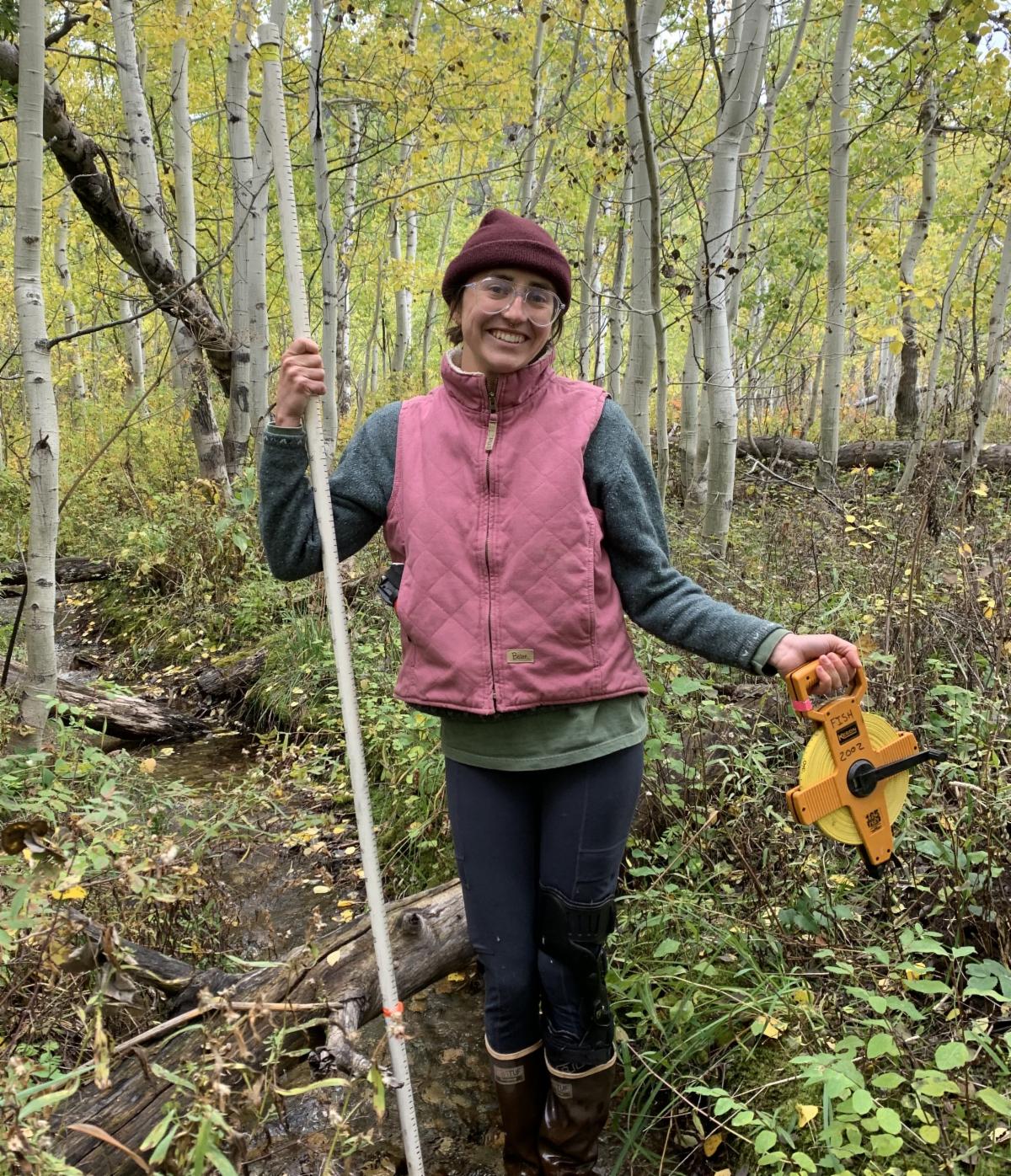
Hello everyone, my name is Claire Kirk. I will be working as the Beaver Conflict Resolution Technician in Montana Fish, Wildlife & Parks Region 3. I am originally from southern Oregon but grew up visiting family in Montana and fell in love with the landscapes and people, and I am now residing in Bozeman! Since finishing my undergraduate degree at Oregon State University in 2021 I have worked as an Ameri-Corps member assisting with a citizen science water monitoring organization, as a fisheries biological technician, and as a lift operator in the winter months. While working in these roles I realized my passion for freshwater conservation and ecology. I am excited to collaborate with our partner organizations and landowners to achieve non-lethal solutions for beaver conflicts. I also look forward to educating the public on the benefits of beaver presence in our local watersheds. In my free time I enjoy snowboarding, hiking, fly-fishing, playing music, camping, and yoga.
| | |
Beaver Science Speaker Series
Beaver Institute
Zoom (link here)
2pm on March 13, April 10, May 8, June 12, July 10, August 14, September 11
The Beaver Institute's Beaver Science Speaker Series is having another strong start! Ellen Wohl, Matthew Guziejka, and Janine Castro led this year's lineup, and the next presenter will be Emily Fairfax on June 12, speaking on "Beavers: Architects of Climate Resilience." This monthly series serves as resource for anyone interested in beaver science, and it offers a platform for researchers to share new findings. Each session features a guest speaker presenting their work, followed by Q&A and discussion. Please enjoy each presentation with this link at 2pm of the appointed day, and if you'd like to catch up on previous installments of this series, you can do so here.
| | |
State of the Beaver Conference 2025
Canyonville, Oregon
November 18-20, 2025
Plans are underway for the 8th Biennnial State of the Beaver Conference, to be held November 18-20, 2025 in Canyonville, Oregon. The presenter list is filling up with some wonderful people and topics, and in addition to registration, there is still room for you to participate as a speaker or sponsor. Please see more details here and reach out to Leonard Houston (beavers@surcp.org) if you have questions.
| | |
Beaver Believers
PBS / EcoSense for Living
April 14, 2025
Pro Beaver Supporters? Public Broadcasting Service? The PBS acronym meant both this past April, when some familiar faces dished out some wonderful, Montana-based content with Eco Sense for Living, a series that empowers viewers to appreciate nature-based solutions. Check out the episode here for some homegrown inspiration featuring our friends Ben Goldfarb, Sarah Bates, Elissa Chott, and Shelby Weigand.
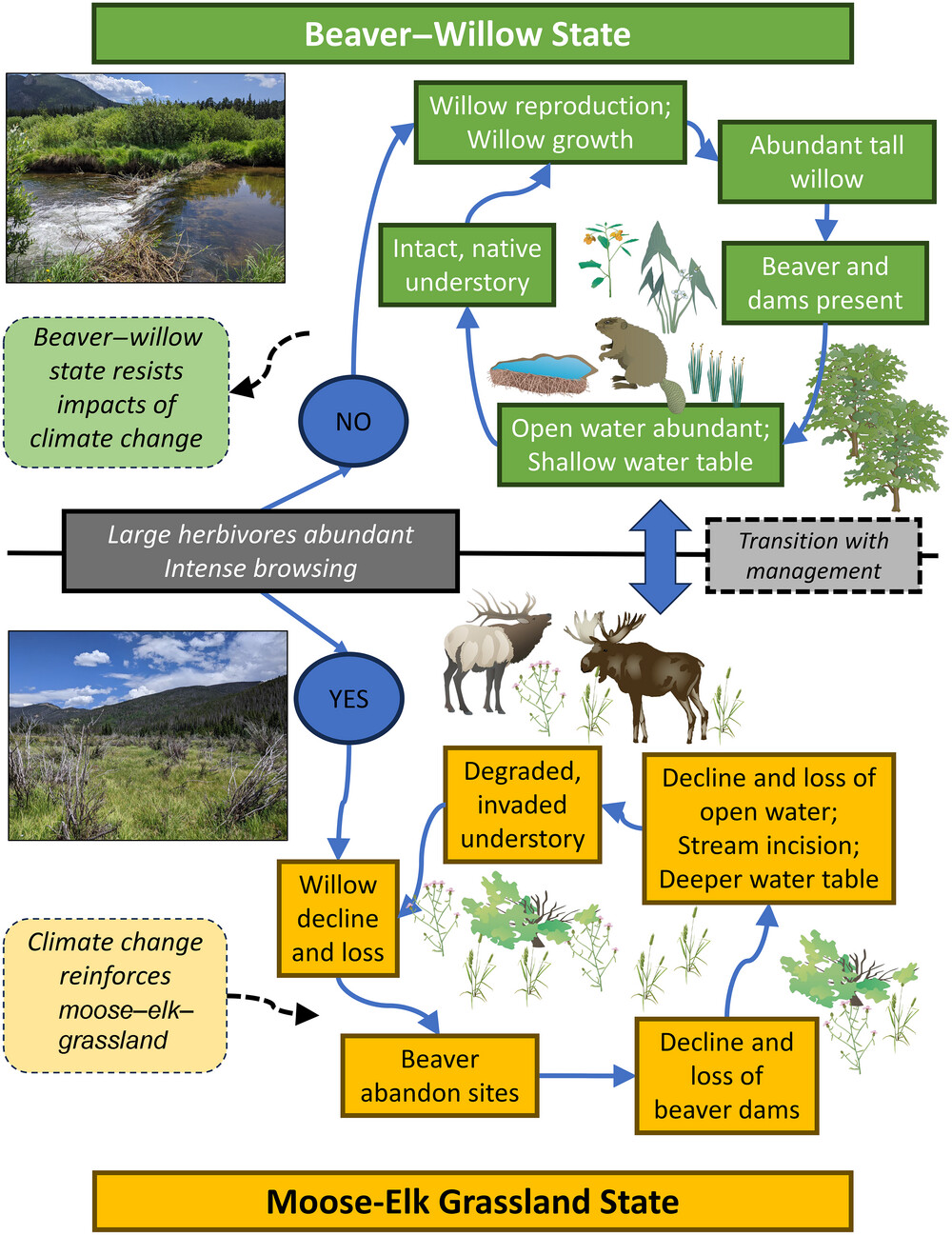
| | Conceptual diagram of key interrelationships driving wetland processes in the Kawuneeche Valley, Rocky Mountain National Park (dark gray box, central dichotomy; green, beaver–willow state; yellow, moose–elk–grassland state; top inset, an active beaver dam and relatively tall willow typical of the beaver–willow state; bottom inset, dry grassland with heavily browsed and damaged willow and invasive plants common in the moose–elk–grassland state). Animal and vegetation graphics are courtesy of Integration and Application Network, University of Maryland Center for Environmental Science (ian.umces.edu/symbols/). Image Credit: Cooper, D. J., Schweiger, E. W., Shaw, J. R., Westbrook, C. J., Kaczynski, K., Abouelezz, H., Esser, S., Nydick, K., de Silva, I., & Chimner, R. A. (2025). Rapid riparian ecosystem decline in Rocky Mountain National Park. Conservation Biology, e70053. https://doi.org/10.1111/cobi.70053 | | |
Rapid riparian ecosystem decline in Rocky Mountain National Park
David J. Cooper et al.
Conservation Biology
May 31, 2025
How and why do riparian ecoystems fall apart? We hear often that they do, but this excellent new paper suggests why "understanding the drivers of ecosystem collapse is critical for resource management, particularly for protected areas mandated to preserve biodiversity." With long-term data, this paper offers nuanced ways to appreciate the niches that each species fills, and what happens when the keystone role of beavers is lost. With strategies assess and reverse ecosystem unraveling riparian ecosystems, this paper shows us why it will be increasingly vital to check ungulate herbivory and reconnect rivers with beaver-shaped floodplains. Read the full paper here.
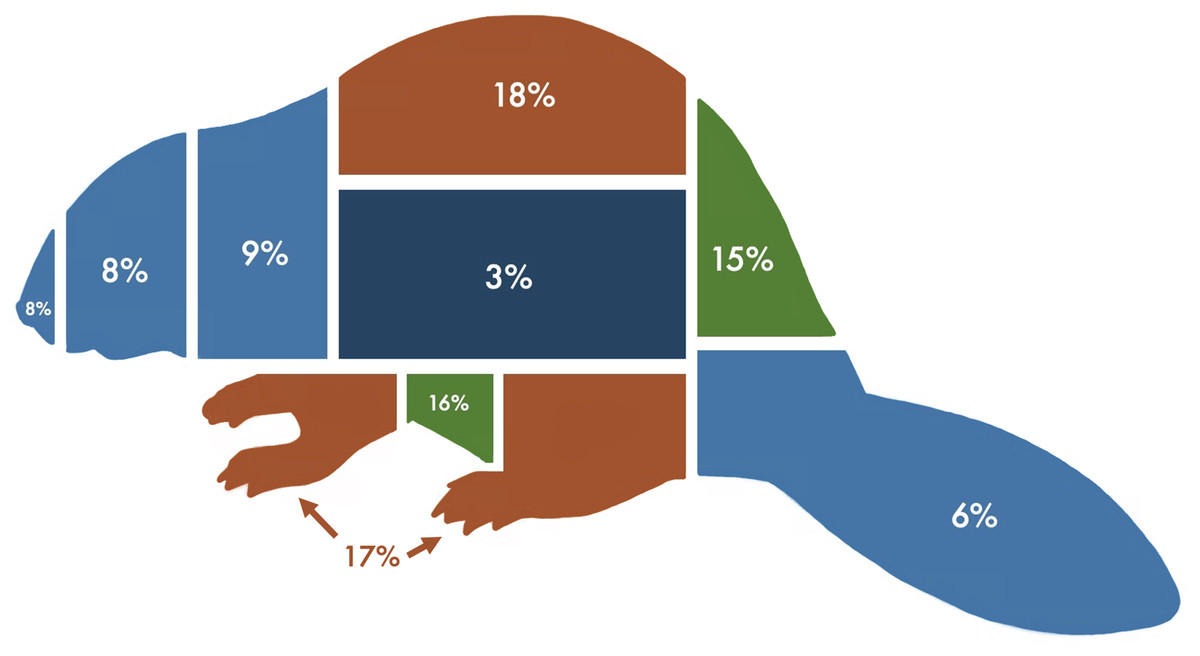
| | This image documents the percent of time each body region beavers (Castor canadensis) (snout, head, neck, back, rump, tail, side, legs, and belly) came into contact with barbed wire hair snares deployed at beaver ponds in 2022 and 2023 in Northern Minnesota, USA. Image Credit: Freund DR, Bump JK. 2025. Evaluation of non-invasive hair snares for North American beavers (Castor canadensis): placement, efficiency, and beaver’s behavioral response. PeerJ 13:e19080 https://doi.org/10.7717/peerj.19080 | |
Evaluation of non-invasive hair snares for North American beavers (Castor canadensis): placement, efficiency, and beaver's behavioral response
Dani R. Freund and Joseph K. Bump
Peer J
April 3, 2025
Commercial fur-vor once pointed to the North America beaver toward extinction. But in snaring a few hairs at time (from live animals), scientists today are proposing a new tool for beaver conservation. Non-invasive methods of passive hair collection from wild animals has revolutionized carnviore research, but Dani R. Freund and Joseph K. Bump have explored adaptations to beavers in Minnesota. Their study considers the potential of this method from a variety of angles, including sampling efficiency, location (on the beaver's body) of sample harvest, cleanliness of samples, the potential for bycatch, and whether snares impede beaver abilities to travel on land. This promising, creative effort documents strategies for success, and it serves as a guide for researchers who seek the hormonal, genetic, stable isotope or other data that hair can provide. To learn more about details and applications of this method for research, and its compelling benefits for reducing stress/risk to beavers in capture, see here.
| | |
Beaver Conflict Resolution Technician
National Wildlife Federation
FWP R4 Lewistown/Great Falls (1) AND FWP R1 Kalispell (1)
Applications accepted until filled
To support its mission, NWF and partners are seeking to hire two Beaver Conflict Resolution Technicians to join our Western Water Team. As part of a small, high-impact team, these positions will report to the Beaver Conflict Resolution Team Lead, and work in partnership with local watershed groups, Montana Fish, Wildlife & Parks (FWP), Bureau of Land Management, and other non-profits/agencies. The terms of these positions will last from approximately May 2025-October 2025 and each will be expected to work 40 hours per week. They will be based out out of FWP Region 4 (Lewistown/Great Falls) and FWP Region 1 (Kalispell). Pending successful completion of work and performance evaluations , if additional funding is secured, terms could be extended, the scope of work expanded, and/or positions rehired in 2026. Learn more and apply here.
| | |
Please send photos, stories, upcoming events, opportunities, and other resources to:
Shelby Weigand - Riparian Connectivity Manager,
National Wildlife Federation
WeigandS@nwf.org
MT Beaver Working Group newsletters are posted online here.
| | | | |