|
Peninsula Diary
Mayo Hayes O’Donnell wrote this article on January 5, 1951 for the Monterey Peninsula Herald. We hope our readers enjoy this look at one of the peninsula’s early forms of transportation.
The First Electric Cars
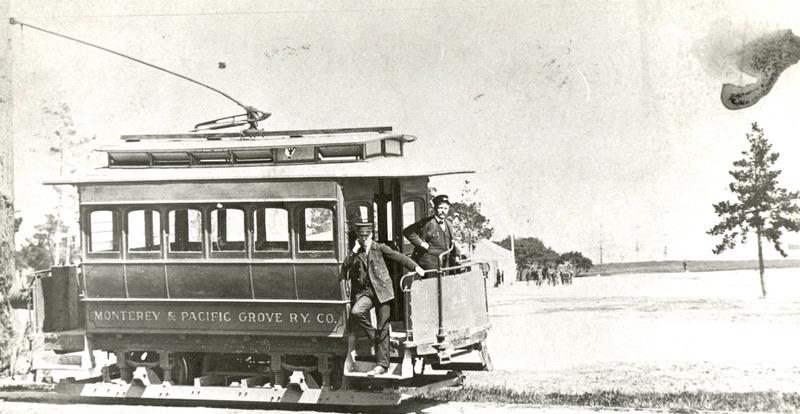
Electric cars once connected Del Monte, Monterey and Pacific Grove. There are still residents on the peninsula who remember when the first car ran over the tracks on Thursday afternoon, June 10, 1903.
The Monterey New Era, published on June 17 the headlines of the day which announced the important event in large black-face type. The old paper was loaned to the Peninsula Diary by Mr. and Mrs. Herbert Slate, who recently purchased the Hess apartments on Pierce street. At the top of the first page the paper is addressed to A. Logan, a brother-in-law of Mr. Hess and a next door neighbor. Both gentlemen have now passed away. Mr. Hess was formerly building inspector of Monterey and Mr. Logan was a carpenter.
The story of the first round trip of the first electric car follows: “After numerous vexatious delays the Monterey and Pacific Grove electric railway is at least in operation, and already the company is doing a big business. The first car made a trip over the road last Thursday afternoon. Chief Engineer Ira B. Funk, who supervised the installing of the big plant from its inception, acting as motorman. On the car when it made its trial trip were Secretary M. V. McQuigg and Manager George E. Somarindyck of Monterey, J.M. Gardner of Santa Cruz and Treasurer R.C.P. Smith of Los Angeles. The trip was made without mishap, and the following day the road was opened for travel.
“Only one car has been running, but by Sunday next, and possibly as early as Friday, the two cars will be put on and a regular schedule will go into effect. By this schedule, the first car will leave Del Monte at 6:30 a.m. and cars will leave every hour thereafter until 10 p.m., the last car leaving Pacific Grove at 10:30 p.m. More cars are expected shortly and when they arrive a ten minute schedule will be given.”
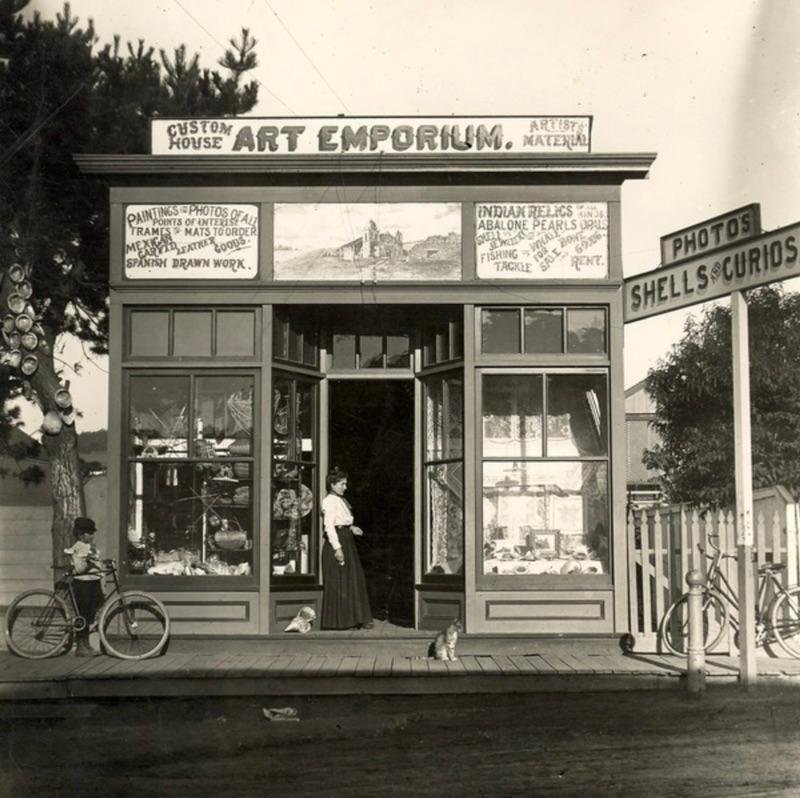
The article is illustrated with a photograph of the car literally filled with male residents of the community. The picture had been taken by the Custom House Studio.
Mrs. Eleanor Frasier of Monterey, who remembers the railroad and many of the citizens who are in the picture, has identified the following: Harry Greene, Robert Miller, Tom Field, Manuel Perry, Manuel Wolter, Juan Malarin, Lee Whitcomb, William Bergschicker, Eddie Smith, Grant Towle, Joe Wolter and William Haynes. On week days there was only one man on the cars and fares were collected at the switches, but on Sunday, so large was the crowd, two men were in charge – one a brakeman and the other the conductor, according to Mrs. Frasier.
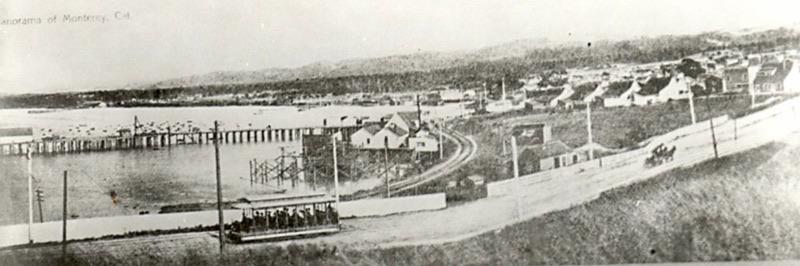
Of course Mrs. Frasier recalls, before the road was electrified, the cars were drawn by horses. In Pacific Grove the track ran along Central Ave., and end at the depot but, except for Sundays, the cars stopped in front of the Methodist church. In Monterey the track was laid along Alvarado to Pearl, down Pearl to Washington and down Washington to the depot, then out Del Monte avenue to Ocean and up Ocean to Eighth, stopping at the car barns on Sloat. Part of the old buildings, where the cars stopped are still standing. It was all single track with switches at various points.
On the day of publication of the New Era, the editors announced that: “On Sunday last car No. 16 of the Monterey-Pacific Grove railroad, with about 75 passengers on board, was derailed opposite the Serra cross about 9:30 p.m. Had it not been for the fact that the power was shut off and the car was traveling very slowly, it would probably have gone over the embankment, which is about two feet high at this point, and the road being very narrow, have crashed down into the gulch below, overturning, and perhaps killing and maiming many.
“The derailment was caused by the placing on the tracks of several spikes and small rocks, and is supposed to have been the work of small boys.”
In the same issue of the New Era, the editor, William Kay, writes a comment very much the same as the local papers might write today, appealing to the pubic to “Save the Landmarks.”
“It is cause for surprise that, with the exception of a contribution of $17.50 from the local carpenters and joiners union, Monterey has contributed practically nothing to the fund now being raised for the preservation of California’s landmarks.
Most of these historic landmarks are located in Monterey – where California’s history began – and their preservation should be, and we hope is, dear to the heart of every resident of the ancient capital.” The editor continues: “From all over the state contributions are being made to the fund, and all over the state – Save Monterey – the movement to preserve the landmarks is receiving hearty support. The town where so many of the buildings are situated, and which will be most directly benefitted, should not be the last to give substantial aid in a good cause.” That was written in 1903.
|