|
November-December 2026
Volume 6, Issue 6
| | |
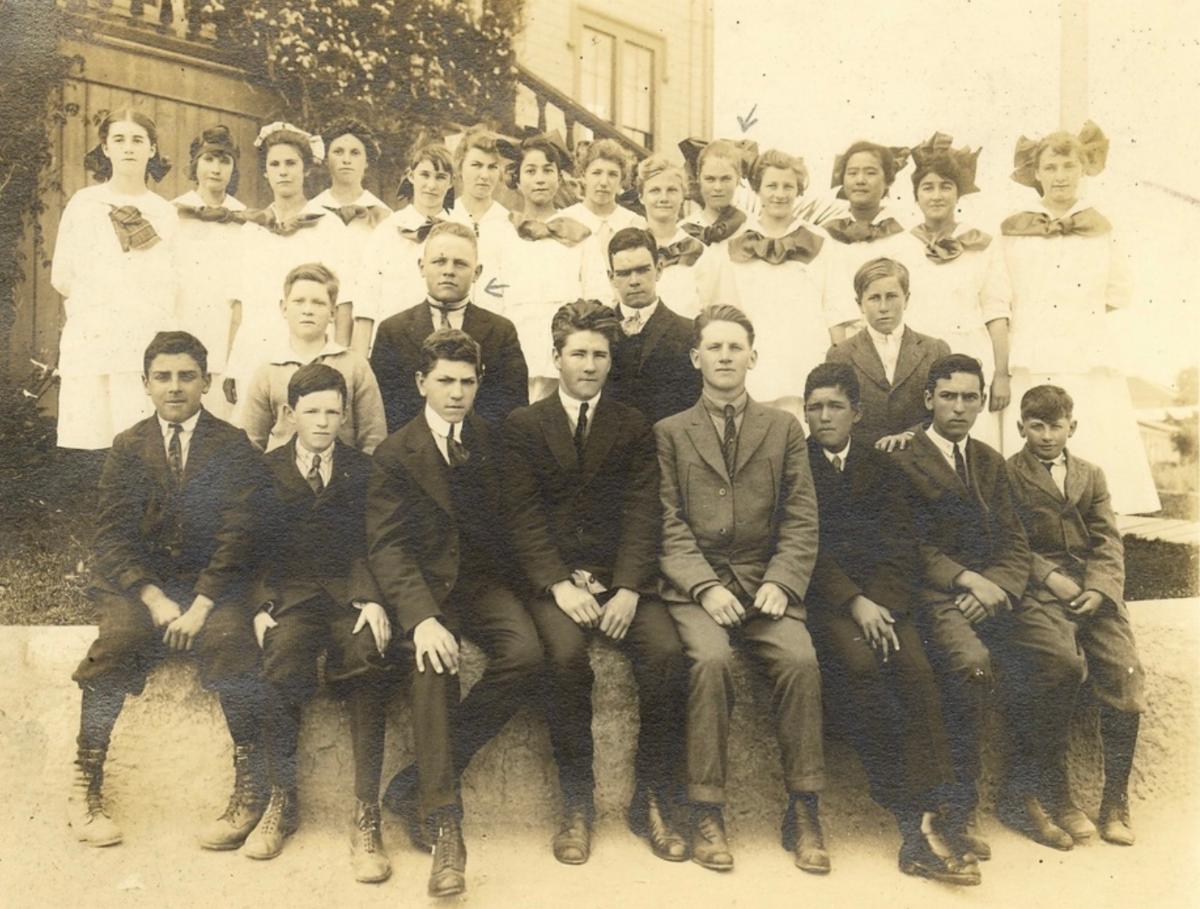
Monterey High School
Class of 1916-1917
| | |
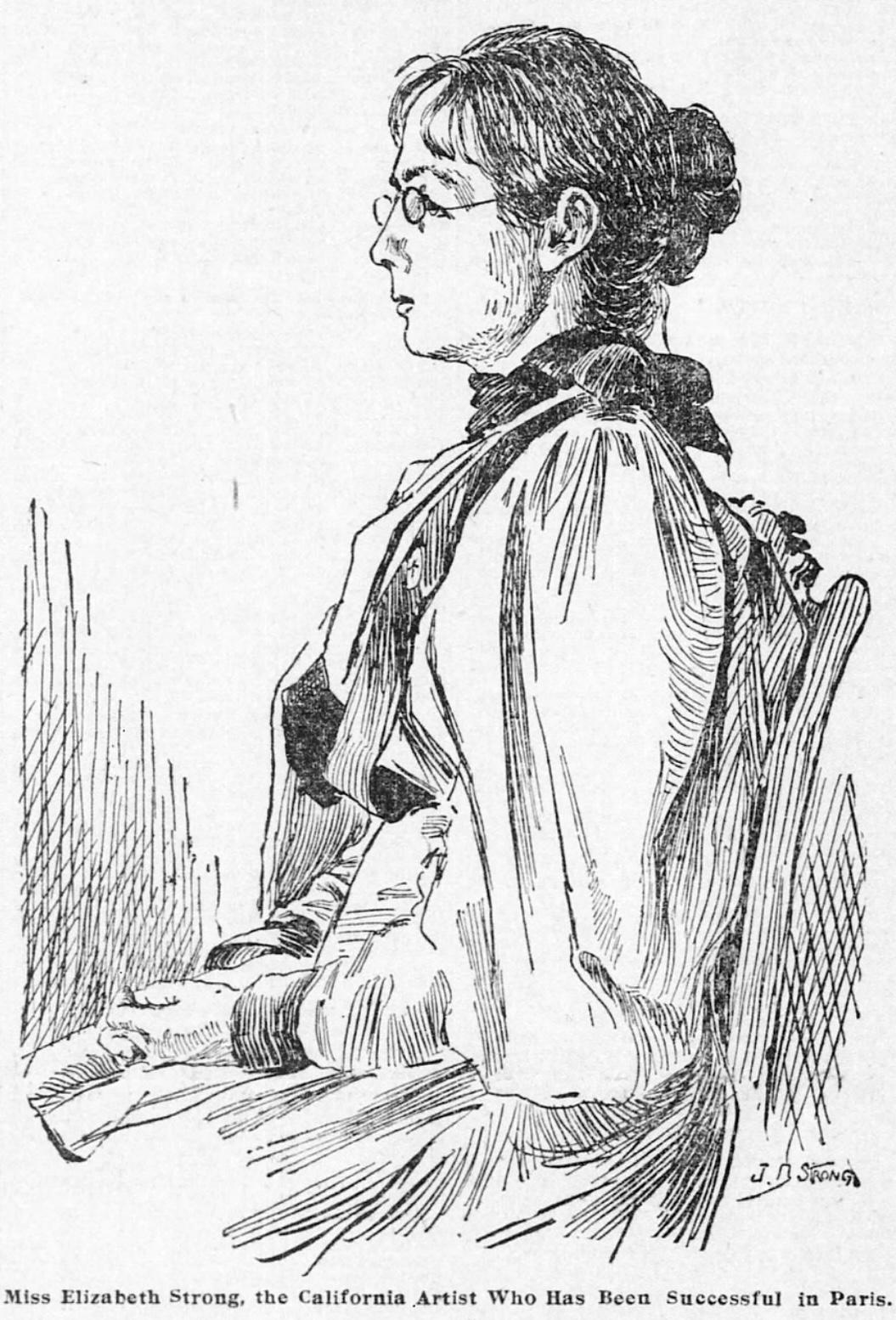
Elizabeth Strong (1855-1941)
Elizabeth ‘Lizzie’ was born in Westport, Connecticut on February 1, 1855 to Reverend Joseph Dwight & Margaret Dewing (née Bixby) Strong. She joined an older brother Joseph Jr. (1853-1899) who would also become an artist. Soon there would be 5 more siblings: Wallace Kealoha born in Honolulu (1856-1928), Ninole born in Oakland (1859-1943), Nathan Bixby born in Oakland (1860-1943), Mark Hopkins born in Oakland (1862-1945) & Dwight born in San Francisco (1864-1938).
Her father, a pastor in Congregational & Presbyterian churches, soon was based in Honolulu from 1855-1858. Next came Oakland & then San Francisco. He was also superintendent of Alameda County public schools & editor of the Hesperian and Pacific Monthly. Sadly, his wife Margaret died in San Francisco on July 24, 1866. She was only 35 years old. Consequently, Lizzie @ age 11 (as the elder daughter) had to assume a more direct role helping to run the household. She recalled in her memoirs that “Oakland city hall now stands on the place where we children had a wonderful playhouse in a clump of willows.” At age 18 she took private art lessons & was encouraged to practice by copying Rosa Bonheur’s animal drawings. She soon enrolled into the SF School of Design & was awarded a tuition scholarship. She rode the Oakland to SF ferry to classes where Virgil Williams was one of her teachers.
One finds in ‘Jennie V. Cannon: the untold history of the Carmel & Berkeley art colonies’ by Robert W. Edwards that “in 1878 she went on a four-month “sketching vacation” to Monterey with her sister Ninole (“Nolie”) and rented half of a house on Alvarado Street. According to Lizzie, the owner and his wife, Mr. and Mrs. Jules Tavernier, were with one exception the only non-Hispanic Americans in all of Monterey. He was so impressed with her talents that he lent Lizzie one of his old studios which her brother Joe later shared. On one occasion the Strong sisters, whose “charm opened many doors” that were habitually closed to “gringos,” entertained lavishly Joe’s friends with a “Bohemian revel” at their rented home. Charles Stoddard and Frederick Somers were among the invited guests. It was reported that the ever proper Lizzie “kept order and dignity.” Joe eventually married the stepdaughter of his Monterey neighbor, Robert Louis Stevenson. In the process of painting the local fauna Lizzie employed a “corralled” deer in her Alvarado-Street backyard for a variety of compositions. Her studies with a single deer reportedly sold for one hundred dollars, whenever a buyer could be found, and were deemed by critics to be “graceful and expressive . . . full of spirit.”
She also traveled through the environs on horseback to paint with other young artists, including the Philadelphian Alexander Harrison who arrived in the small port on his own ship. During a picnic in Monterey her brother Joe recommended an undeveloped site for a resort to an official of the Southern Pacific Railroad. Shortly thereafter the first Del Monte Hotel was constructed on that spot.
By late 1878 she was sharing a professional San Francisco address at 728-729 Montgomery Street, the temporarily vacated Criminal Court, with Jules Tavernier, Charles Dorman Robinson, Julian Rix and Virgil Williams. Through early 1880 she subdivided her own studio with Miss Ella (Nellie) Hopps. Lizzie’s artistic prowess, which was seen as “great” when compared to her diminutive size, was prominently highlighted in the San Francisco press. Although she was once panned by a critic because of her refusal to give him a free painting. At the 1879 Spring Annual of the San Francisco Art Association (SFAA) one reviewer for the San Francisco Chronicle declared that “her deer and fawn disturbed by a passing shower . . . had sufficient skill in color and drawing to make them a living reality on canvas,”…Strong was rescued from near penury by her fellow art student and friend, Mrs. F. M. Pixley, whose wealthy husband was the founder of The Argonaut. Through her patroness, with whom she resided for a year, and the ensuing contacts in high society Lizzie sold sketches of shaggy terriers and “pet portraits for wealthy clients,” some for as much as five hundred dollars. She even exhibited at 21 Post Street, the gallery of Morris, Schwab & Company. In the summer of 1880 she was living in Massachusetts where she applied for her first passport. On the application she was described as "five feet tall with light blue eyes, brown hair, a high forehead, full face and fair complexion.”
Elizabeth lived in France from 1880 - 1889. Among her instructors in Paris were Raphaël Collin (Académie Julian), Alexandre Cabanel (École des Beaux-Arts), G. Dupré, Henry Mosler, Félix Barrias, & Émile Van Marcke. She regularly exhibited (mainly dog portraits) at the Paris Salons from 1883-1888. In 1884 she rented a small farm in Cernay-la-Ville for 11 dollars a month. In the same Edwards book one learns that “at her country home she maintained her own kennel of puppies collected from the Paris pound as well as a small flock of sheep, all for the convenience of painting her beloved pets out-of-doors. Here she often received American friends and artists for prolonged stays. Much of her animal work…was quite popular with buyers of all classes and sold promptly thru Paris art dealers. When she completed her portrait of the angora guinea pig, which belonged to the American sculptor MacMonnies, and sent it off to an exhibit in the American Woman’s Club of Paris, the primary juror and renowned American painter, James McNeill Whistler, became so enamored that he praised it as genuine “Art” and awarded it the highest class of honors.”
Lizzie left France in 1889 & returned to the US.
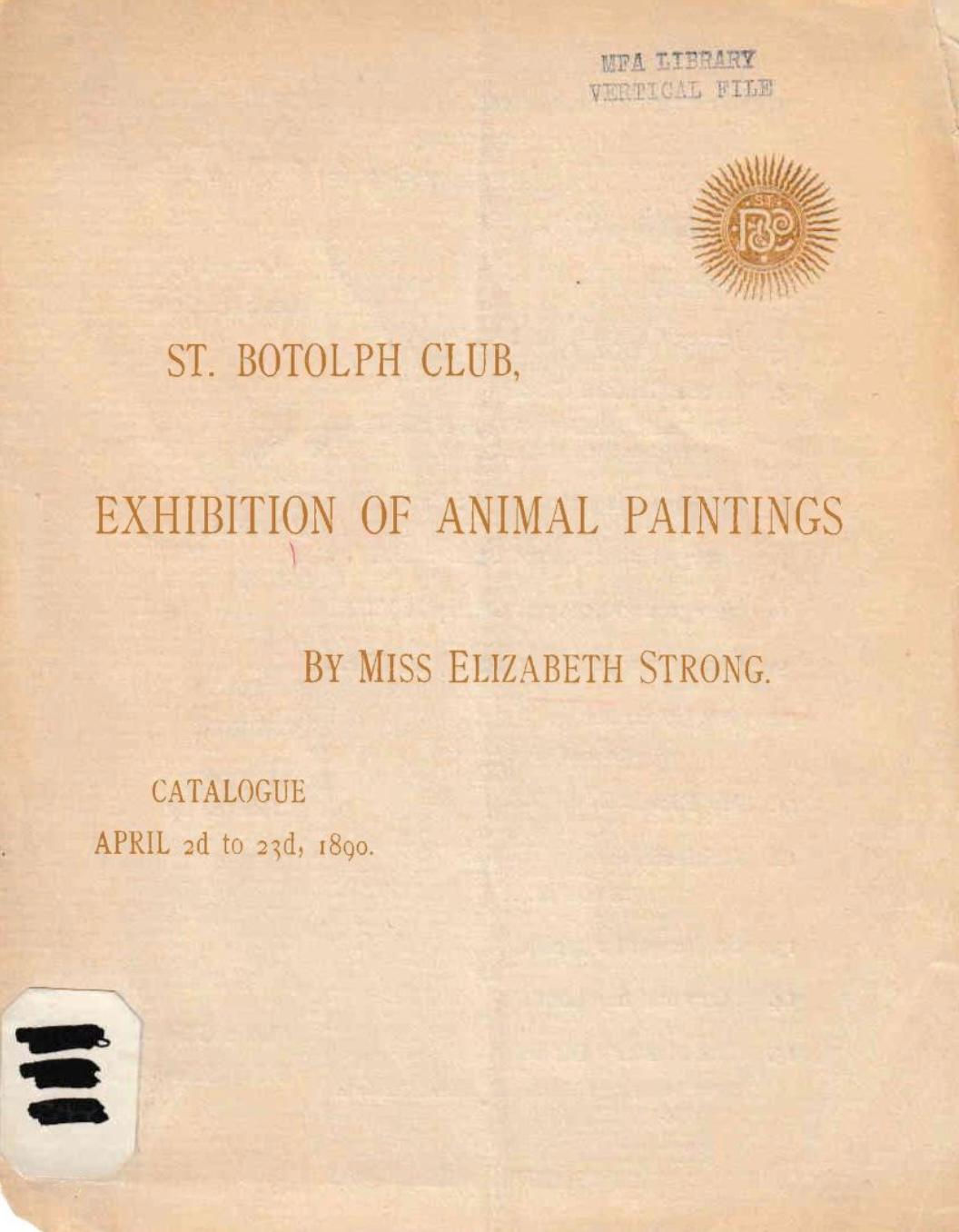
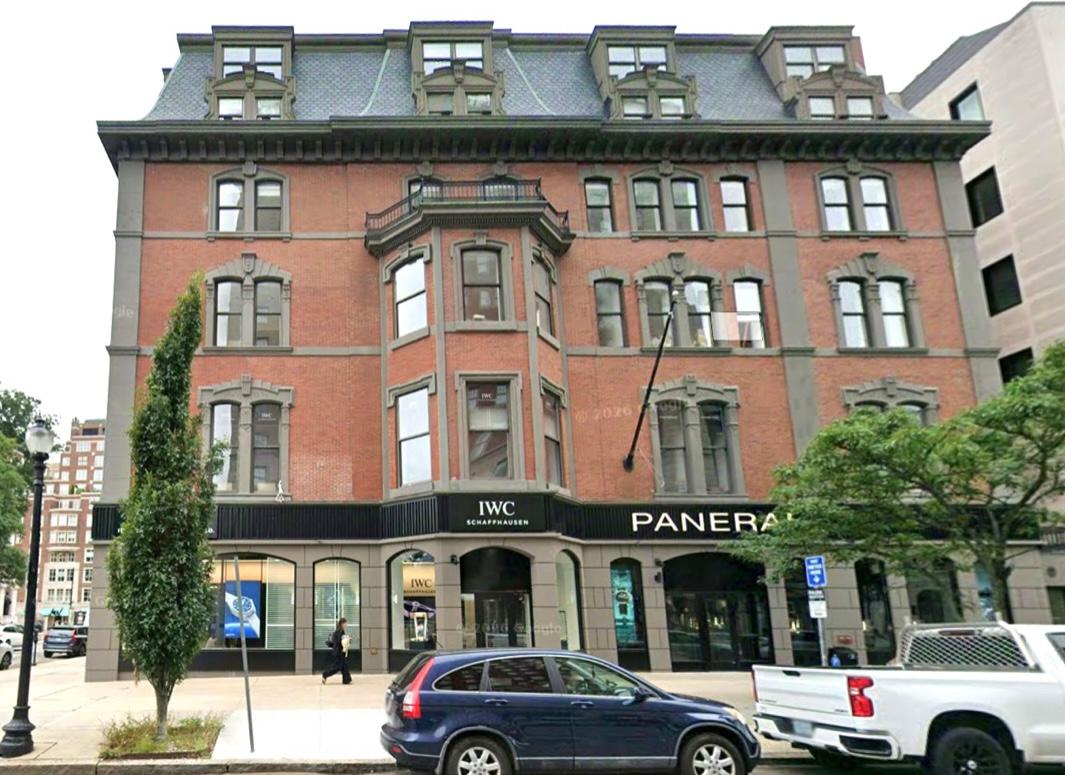
She had her first solo exhibition of animal paintings @ Boston’s St. Botolph Club located @ 2-4 Newbury Street from April 2nd to the 23rd, 1890 where a total of 38 paintings were featured. In the 9/20/1890 Boston Evening Transcript one reads “when the exhibition of pictures by Miss Elizabeth Strong was made at the St. Botolph Club a few months ago, the power of the artist was recognized at once…The name of Elizabeth Strong was by no
means unknown here. She had been a Salon
artist for eight years, and the paintings of animals by the pupil of Van Marcke had been admired abroad by more than one Bostonian.”
Later in San Francisco MHAA’s own Laura Bride Powers reported in the 3/4/1906 SF Call “the exhibition of Miss Elizabeth Strong is still on at the Daingerfield studio @ 246 Sutter street. To all lovers of animal portraits the exhibition is especially attractive, as Miss Strong gets the personality of her animals in a striking degree.”
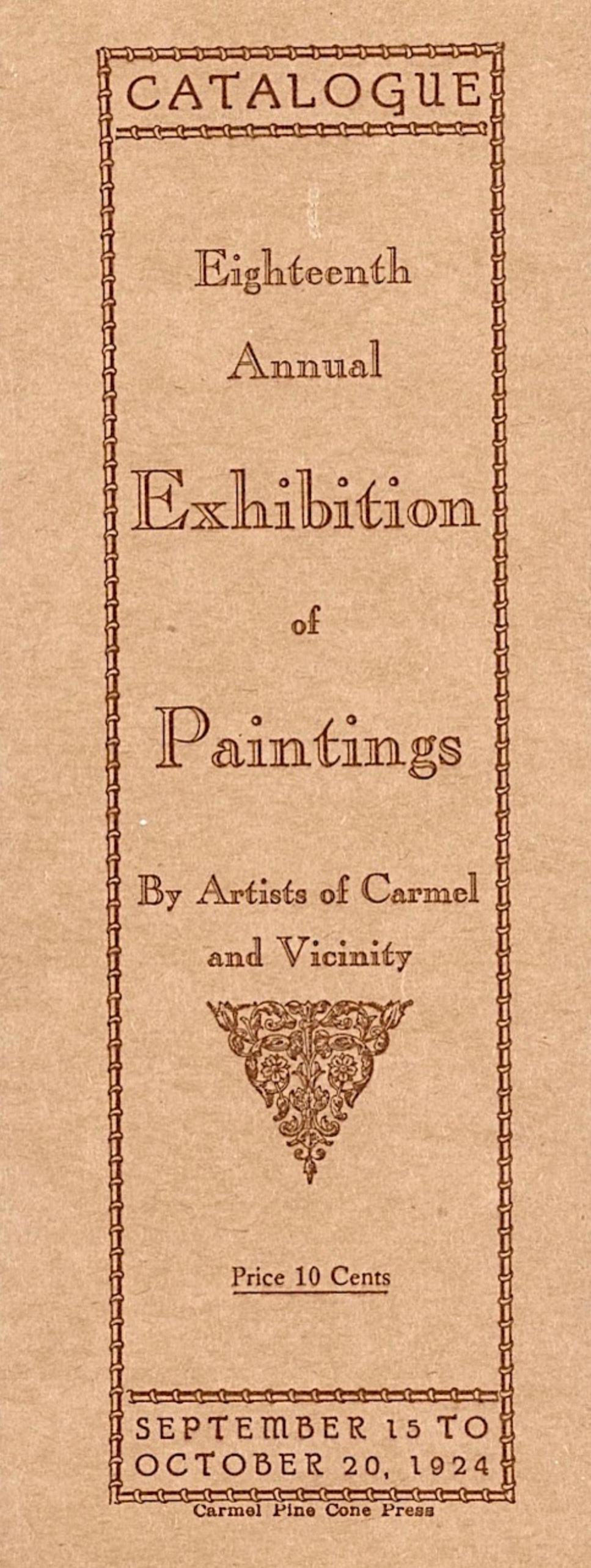
3 years later Lizzie (a Berkeley resident) was notified that her painting of the Cragmont hills of North Berkeley displayed @ the Alaska-Yukon- Pacific exhibition won a silver medal. In 1912 she accepted a position in the art department @ St Mary’s College in Peekskill on the Hudson in New York. In 1920 she was one of approximately 21 Carmel artists included in an exhibition of small paintings & sketches which opened at the Arts & Crafts Hall on 11/22/20. The show was confined to Carmel artists only. 4 years later the 1/9/1924 Pacific Grove Review reported that her Carmel paintings were on view in Pasadena. Later that year 5 of her paintings were included in the 18th annual exhibition of paintings @ Carmel’s Arts & Crafts Hall from 9/15 - 10/20/1924. In the 1930 US Census she & her sister Ninole are listed as living next to each other on Casanova Street.
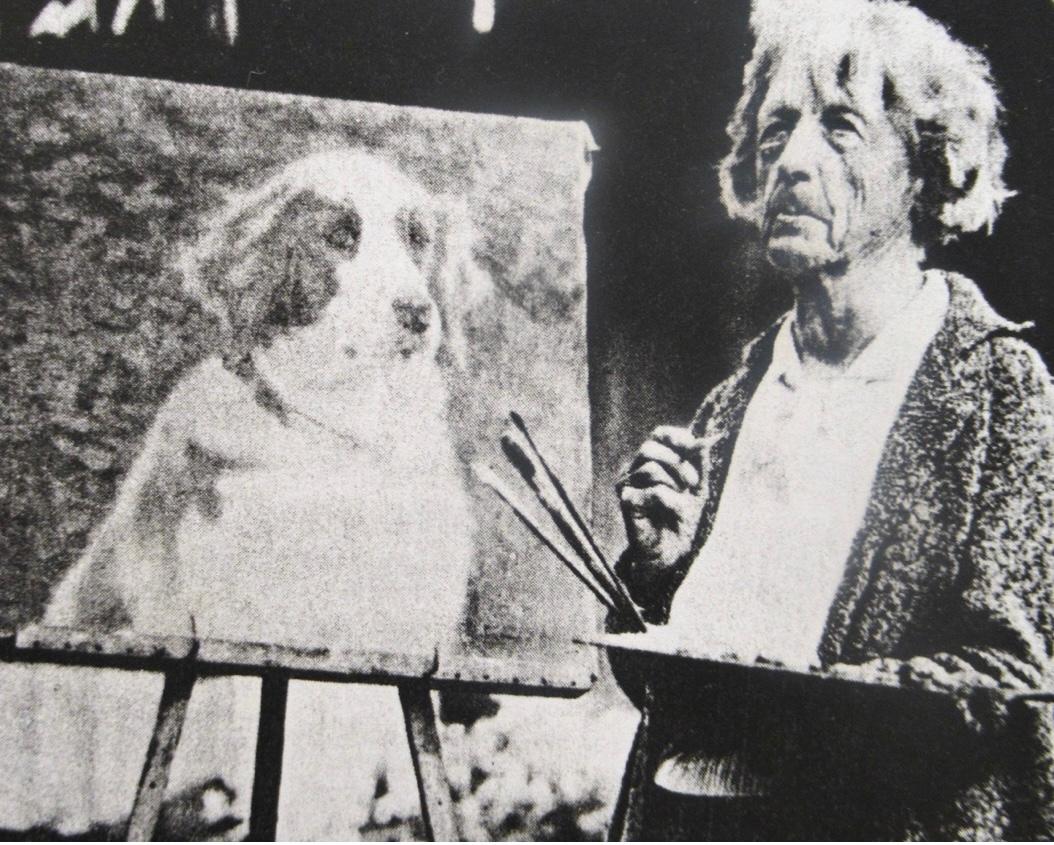
In an article by Lois Collins Palmer in the January 8, 1937 Carmel Pine Cone, Lizzie @ 82 was called the “dean of Carmel artists…the magnificent scenic possibilities of the peninsula lured her away from her animal paintings, and most of her recent work is landscape. Her vivid sense of color…has enabled her to do justice to the peculiarly vivid colors which make this an artist’s paradise. I sat surrounded by her paintings while we talked…and as the dusk came stealing into the room, the paintings…sprang into life and glowed like jewels, a feast of clear, translucent color.” Elizabeth Strong died 4 years later on October 30, 1941 in Carmel.
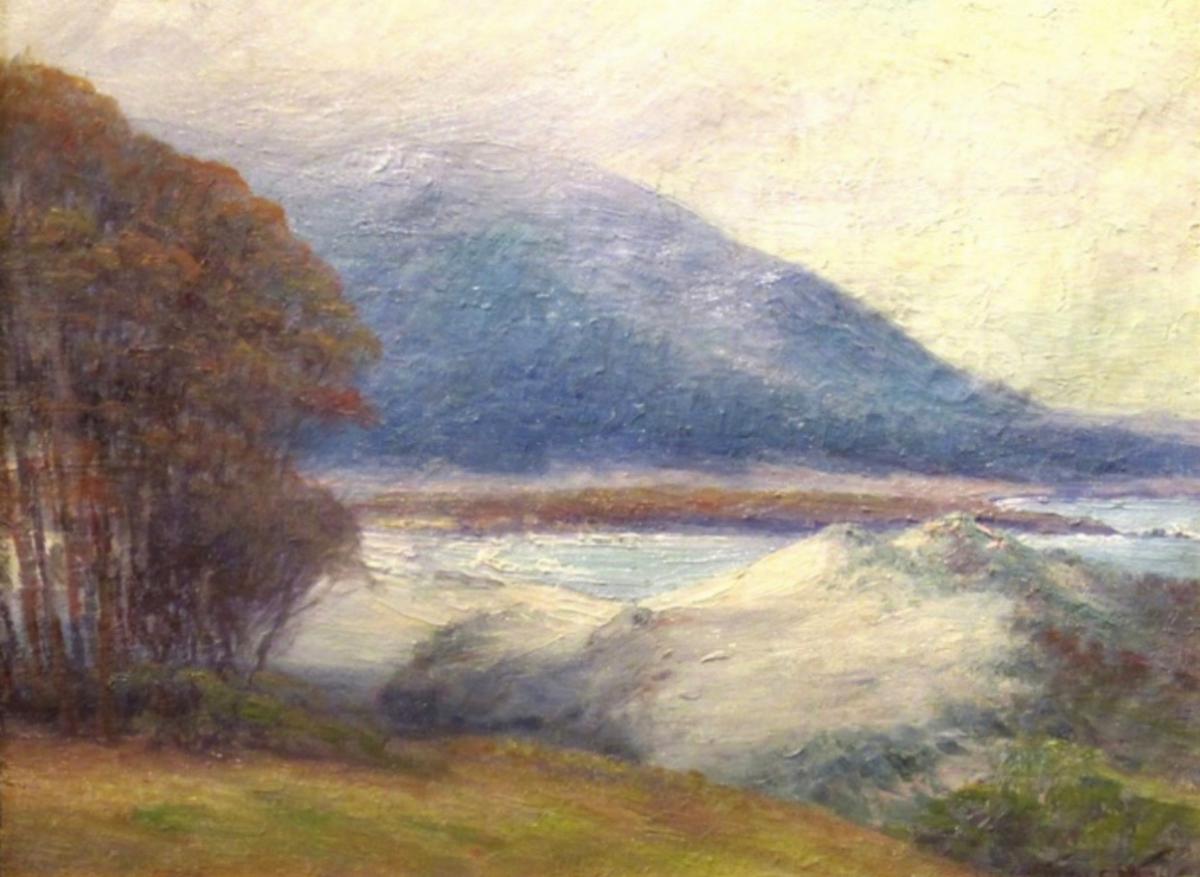
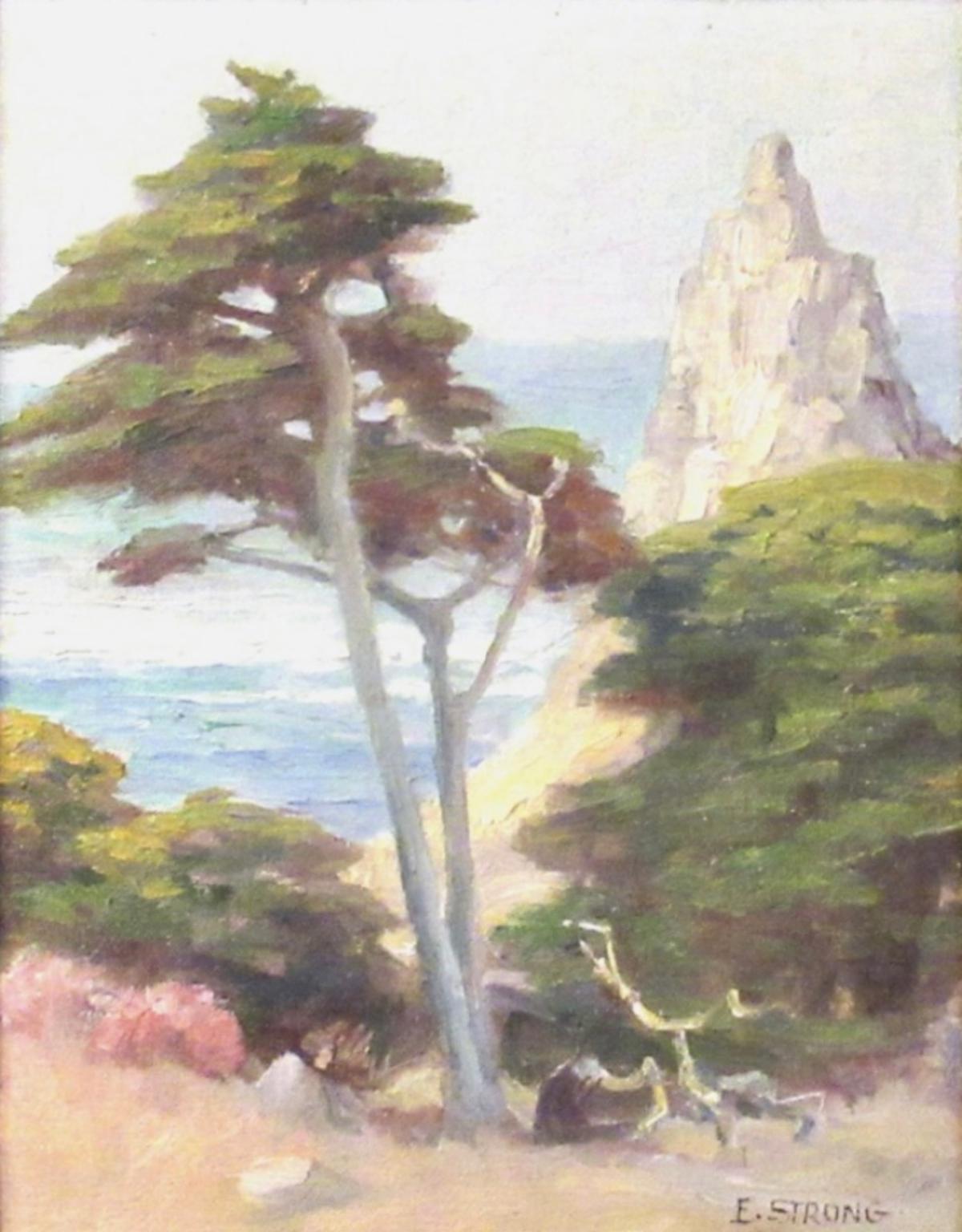
MHAA is fortunate to have 2 of her oil paintings (Monastery Beach & Pt. Lobos) in its collection at Casa Serrano. Per askart.com: “since she specialized in paintings of animals (especially bird dogs), she was sometimes called "the Rosa Bonheur of America." Member: SFAA; Sketch Club (SF); Carmel AA (cofounder); Carmel Arts & Crafts Club. Exh: San Francisco Art Association, 1875-1912; Mechanics' Inst. (SF), 1875-79; Calif. Midwinter Expo, 1894; Calif. State Fair, 1894, 1930, 1935; Paris Salon, 1901; Berkeley AA, 1908; Sketch Club, 1909; Alaska-Yukon Expo (Seattle), 1909 (silver medal); Del Monte Art Gallery, 1910. In: Monterey Museum of Art.
Michael Mazgai
Above : 1896 portrait by Joe Strong San Fransico Call Bulletin
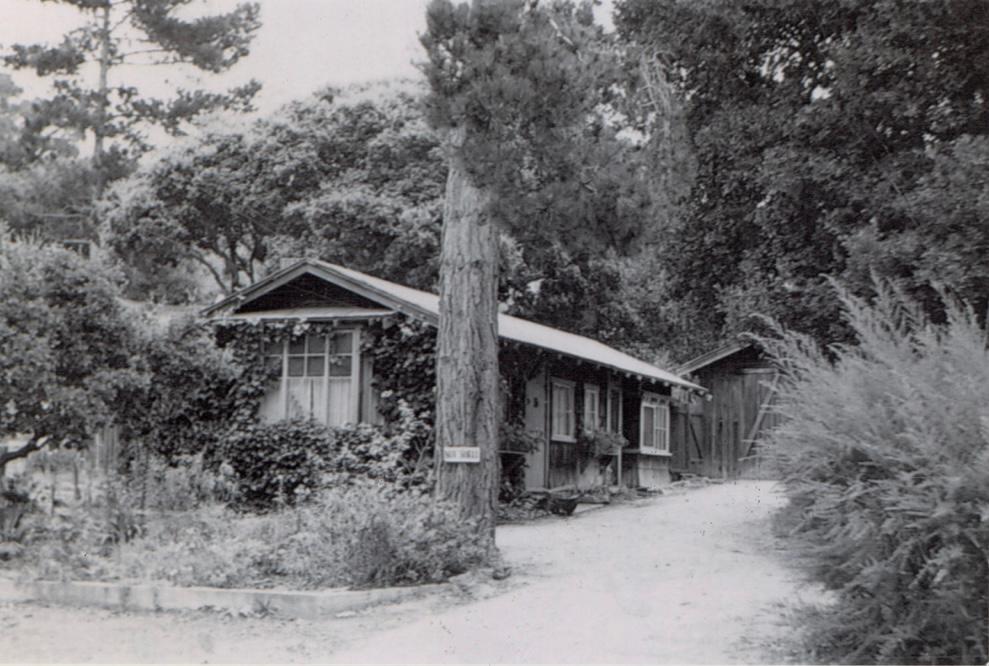
| | 1890 Animal Paintings by Miss Elizabeth Strong (credit MFA Library) | | 2-4 Newbury Street Boston location of St. Botolph Club in 1890 (photo Google Street view) | 1924 18th Annual Exhibition of Paintings (Elizabeth Strong had 5 entries) | Elizabeth Strong's Carmel house on Casanova Street (photo credit Henry Meade Williams Local History Department, Harrison Memorial Library) | 1937 Elizabeth Strong 5/12/1937 in Carmel Californian (photo Monterey Library CA History Room) | 'Monastery Beach' oil painting (photo article author) | 'Point Lobos' oil painting (photo article author) | | |
Lost and Found –
The first in a two-part mystery series
from the MHOD library
| | |
In February of this year, Gary was contacted by Brianna Schwerling, an archival specialist with the city. At some unknown time in the past the association made an apparently undocumented loan to the city, most of which Ms. Schwerling wished to return to us. The return came in ten boxes. A small number of the return are physical items (cannon balls, commemorative coins, banners, even a placemat from Angelo’s restaurant). The next larger category are photographs, a few as recent as the 1970s, though most are considerably older. Among the latter are some panoramic photos, stereoscope slides and even a few tintypes. The largest category by far though consists of documents, thousands of them and practically none of them appearing in the association’s archives. As of this writing, somewhat over half have been added to the database.
Some of these (just about all in fact) are prosaic: financial warrants, tax reconciliation forms, overdue tax bills, articles of incorporation and a myriad of other paper-based sleep aids. Occasionally, something of interest will be found. Among these are a personal letter from Gov. José Castro, said to be his last and written just prior to his murder. Another letter, one of the oldest in our collection, was from the Scotsman David Spence written in 1837. Spence, one of the first English-speaking arrivals to Monterey served two terms as alcalde during the Mexican era, was an aide to Hartnell and served as a state legislator in the American era. An interesting feature of the letter is its appearance. It shows no evidence of aging but even more remarkable is how modern the script appears and the fact that it is easily read. It was written in pencil on brown paper, so we haven’t included a photo but welcome you to stop by the library any Wednesday or Thursday afternoon to have a look for yourself.
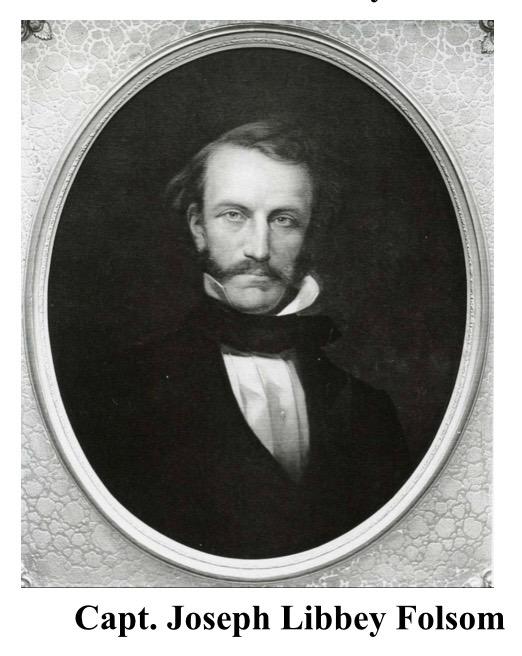
Despite the eclectic nature of the items, they all share one thing in common, a connection to Monterey. All that is, with one exception. Some 300 documents, mostly bills of sale but also checks, bank drafts, correspondence and a proposal to erect barracks at the Presidio of San Francisco were found in various boxes, all related in some fashion to a Capt. James Libbey Folsom, US Army. If you’ve never heard the name but suspect there’s a connection to the city east of Sacramento or the major street in San Francisco you are correct on both counts, they having been named in his honor.
Information on Folsom is scant, although it is known that he graduated with honors from the US Military Academy in 1840, following which he was dispatched to serve in the Second Seminole War. Prior to the cessation of hostilities, he was transferred to Ft. Winnebago, Wis. and shortly thereafter was reassigned to Detroit where he served for three years. In 1844, he was recalled to West Point where he served as an instructor of infantry tactics. Two years later he joined the New York Volunteers regiment, sailing to Yerba Buena where he was promoted to captain and made the regiment’s quartermaster. It would seem Folsom was held in high regard. He was ordered by Genl. Stephen Kearny to select the site for the Army’s depot and was appointed the first duties collector of the port of San Francisco. These assignments are even more significant considering Kearny’s strong dislike of militiamen dating to the War of 1812. Following the end of the Mexican War Folsom was mustered out of the volunteers and returned to duty in the regular Army with whom he would serve for the remainder of his life.
In addition to his duties as quartermaster and port collector, Folsom was appointed a judge in the courts martial of Joseph Hooker and George H. Derby. At the time, Hooker was the adjutant general of the Pacific Division of the US Army, encompassing California and the territory that would become Oregon and Washington. Derby, several years Hooker’s junior, after recovering from an injury in the Mexican-American War was posted to Monterey and is said to have performed at the theater here. He had a satiric wit and would attain fame as the father of western humor, believed to have inspired Harte and Clemens. Derby found in the pompous, arrogant Hooker a natural target, earning Hooker’s enmity. The feud was to culminate in a largely forgotten drama in which Hooker had Derby brought before a court martial for conduct unbecoming an officer only to find himself brought to trial on the same charge. In addition to Henry Halleck, who served as the judge advocate assigned to prosecute both, the trials would draw in a who’s who of the Civil War. A partial list includes Winfield Scott, Wm. T. Sherman, Ethan Hitchcock, Charles P. Stone, Braxton Bragg, Alfred Gibbs and George Stoneman. Although Halleck was able to prove that Hooker had indeed engaged in profiteering by purchasing hay which he resold to the Army at double the price, such was not prohibited by regulation. This was remedied shortly thereafter. For those interested in exploring this story, a book has just been published entitled Military Honor on Trial: The Saga of Joseph Hooker and George H. Derby.
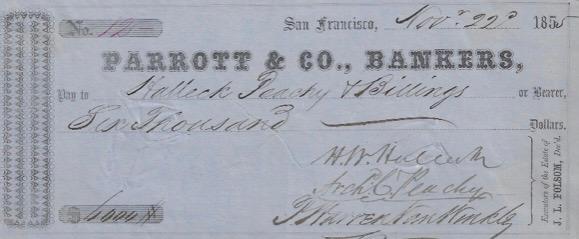
In the small world of an armed force posted to a lightly populated remote outpost, it was almost certain that Folsom and Halleck were acquainted prior to the trial. Regardless, the law firm Halleck founded after resigning his commission would come to represent Folsom in his legal affairs until his death in 1855 at the age of 39. The firm acted as executor of Folsom’s estate, which was considerable and complex. A small part of what we are calling the Folsom archives are checks written to settle the captain’s estate, including one for $6,000 payable to his executors, Halleck, Peachy & Billings.
| | |
The first order of business upon receiving the items from the city was to determine exactly what we had. This involved creating a spreadsheet assigning each item or group of items a unique identification number. The next step, which is approximately half complete, was to capture an image of the item and create an entry in our database, a program called Past Perfect. As we were plodding through the first part of this process the question arose: Why does the association have so much material, mostly ephemera, concerning a little-known early American Californian who, if he ever visited Monterey, left no mark of which we are aware? At that time the link to Halleck seemed the only plausible connection but it was a slim reed indeed.
The explanation came after some digging and will be covered in the next issue.
Van Harris, volunteer at Mayo Hayes O'Donnell Library
Above photo credit -(cleanealogist-Find a Grave)
| | |
EAST OF EDEN-
THE STEINBECK FAMILY & DAVID JACK CONNECTION
This article was written by Kenneth Jack, a Jack Family descendent who lives near Crieff, Scotland.
The streaming channel Netflix is currently showing a serial adaptation of East of Eden, the famous novel by American writer John Steinbeck, starring amongst others, rising UK actress Florence Pugh. The book and television series are set in the town of Salinas where Steinbeck was born and raised. Steinbeck’s maternal grandfather Samuel Hamilton emigrated to the USA from Northern Ireland in 1846, arriving in California in 1851. He married Elizabeth Fagen (Fagan), known as Eliza in 1849, eventually moving to Salinas in Monterey County in 1870. The couple’s daughter Olive Hamilton met and married Steinbeck’s father (also called John).
In Steinbeck’s novel, one of his main characters is loosely based on his grandfather Samuel, and the character Sam Hamilton features prominently in the television series, the part played by ubiquitous Irish actor Ciarán Hinds.
Steinbeck’s grandparents and parents lived in Salinas at a time when former Crieff man David Jack (1822-1909) ruled the roost economically in Salinas and wider Monterey County. Jack has featured in previous issues of this publication.
In early episodes of the television series the Abbot Hotel in Salinas is featured.
This hotel was purchased in 1873 by local businessman Carlisle Abbot, who reconstructed it and named it for himself. Abbot subsequently sold the hotel to the aforementioned David Jack before moving to Arizona.
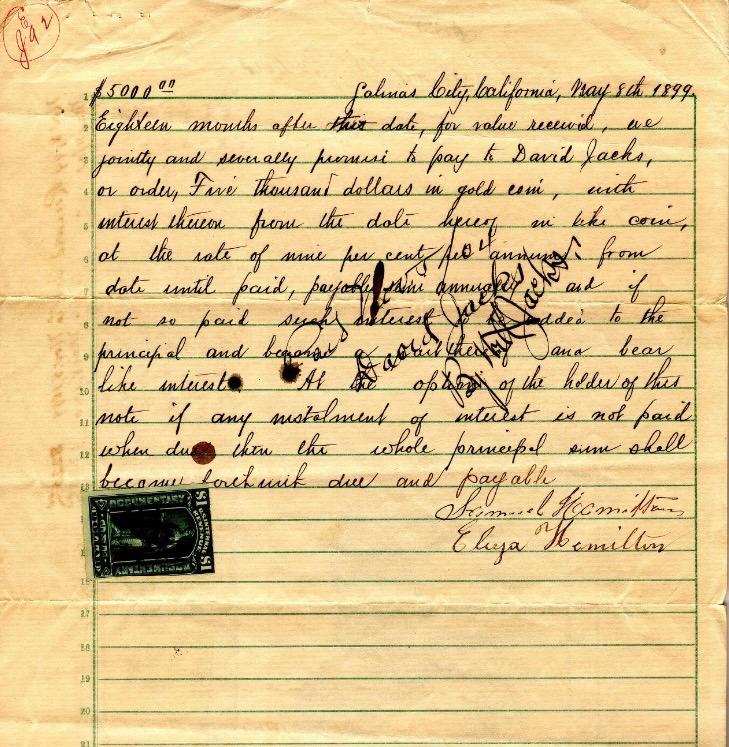
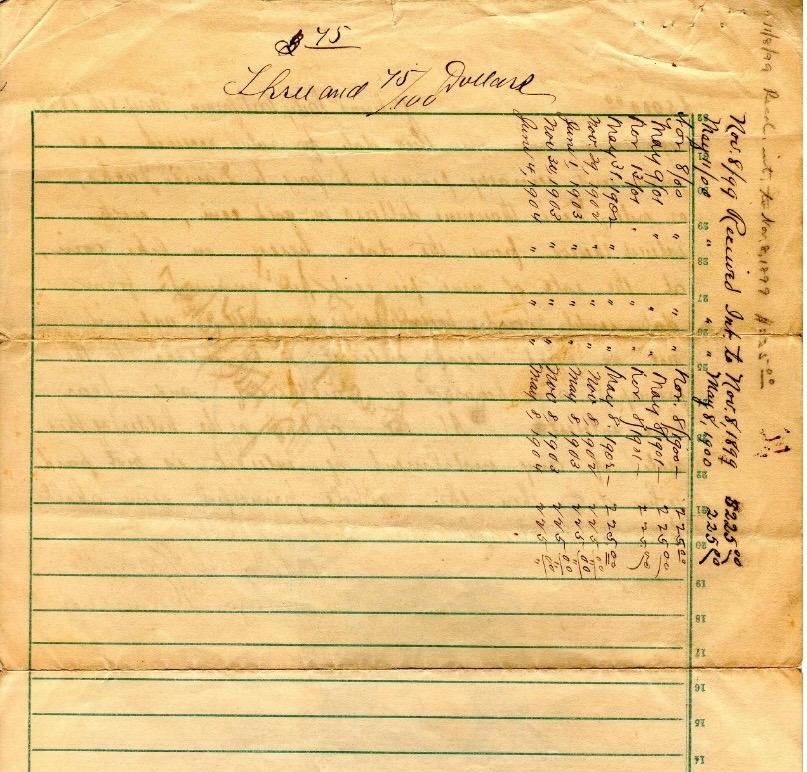
As a local farmer, it was almost inevitable that Steinbeck’s grandfather would come into contact with David Jack, the County’s largest and most active land owner and speculator, as well as moneylender. Evidence of contact with Jack can be found in a promissory note from Samuel and Eliza Hamilton to Jack on May 8, 1899 held at Stanford University in California:
“18 months after this date, for value received, we jointly and severally, promise to pay to David Jack, or order, five thousand dollars in gold coin, with interest thereon from the date hereof, in like coin, at the rate of nine per cent per annum, from date until paid semi-annually, and if not so paid, such interest to be added to the principal, and become an act thereof and bear like interest. At the option of the holder of this note if any instalment of interest is not paid when due, then the whole principal sum shall become forthwith due and payable.”
Samuel Hamilton
Eliza Hamilton
| | Above image found at https://purl.stanford.edu/np420qz6765 | | John Steinbeck referenced two of David Jack’s family in a couple of his works. His son Romie in the novel Sweet Thursday, a sequel to his better-known Cannery Row, and daughter Margaret, in the short story ‘The Harness’, in his novel, The Long Valley. | | |
Local People
John Sanders
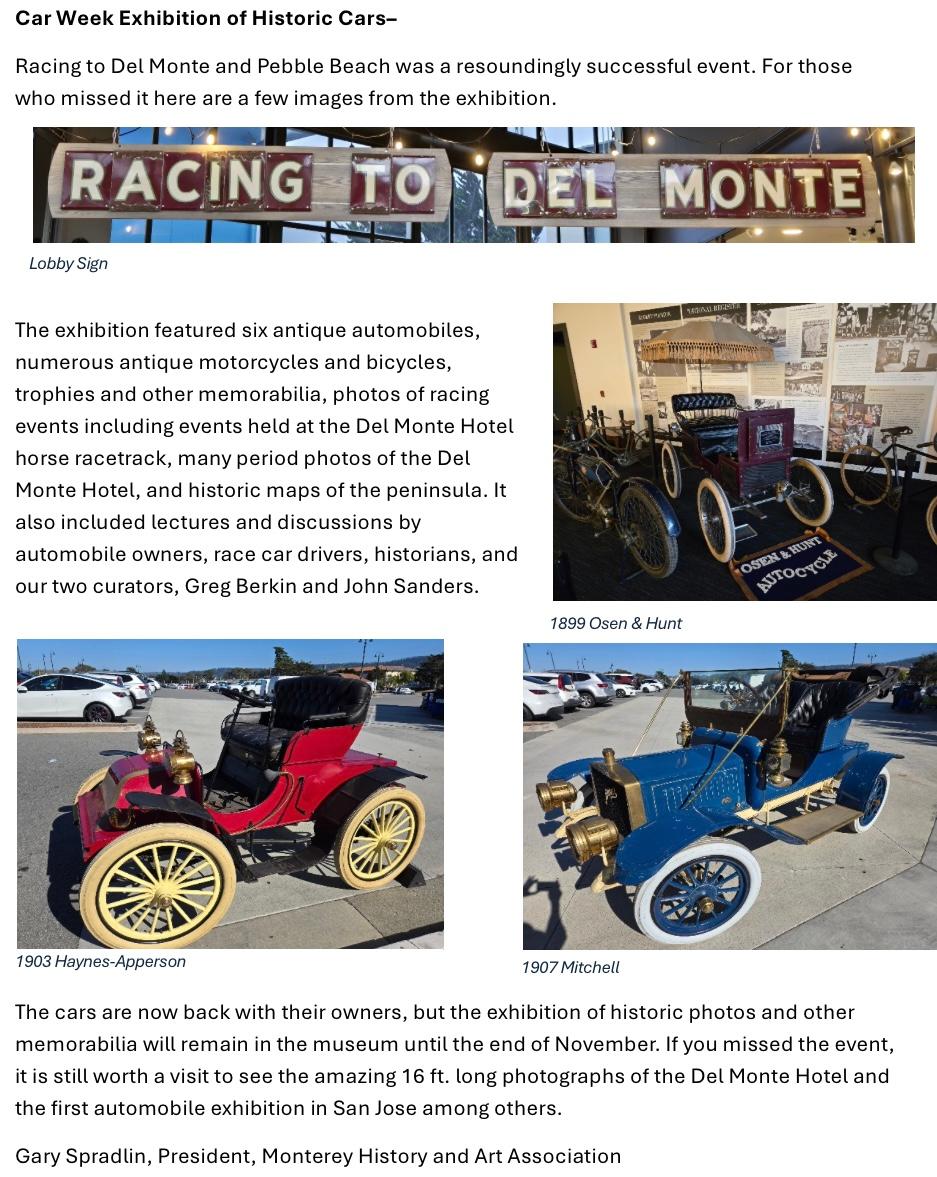
John Sanders is co-curator of the current Stanton Center museum exhibition, Racing to Del Monte & Pebble Beach. The exhibition, which opened on August 7, featured an exceptional collection of historic vehicles provided by History San Jose and several private collectors. Along with his friend and co-curator, Greg Berkin, John developed a series of special events and programs during the exhibition that included legends of racing such as Chris Pook, co-founder of the Long Beach Grand Prix, and renowned silent film historians David Kiehn and Marc Wannamaker. Racing to Del Monte & Pebble Beach is John’s fourth Stanton Center exhibition.
John’s background includes a 31-year career at the Naval Postgraduate School as both a public affairs officer and historian, the latter role assigned to him by an admiral in charge of the Navy’s university. He played a seminal role in preservation of the historic Hotel Del Monte which the Navy purchased after World War II to create a new campus for NPS.
He published hundreds of stories and magazine articles during his NPS tenure and contributed works to several prominent professional publications such as Aerospace America, Defense magazine, the International Journal of Naval History and the Dictionary of Professional Military Education.
In addition to his NPS career, John was a host for the locally produced talk show, Your Town Television, for seven years. His guests included notable artists, astronauts, collectors, dancers, musicians, photographers, politicians and scholars. Several of the interviews are available online, including an interview with noted area photo archivist Pat Hathaway.
He served a sabbatical as director of public affairs for the American Geophysical Union, a 33,000 member scientific society, and held various posts with professional organizations as the U.S. Navy League and Naval Order of the United States. John also was made an honorary member of the Yangtze River Patrol River Rats during his NPS tenure.
Since his civil service retirement, John has focused considerable attention on the history of Hotel Del Monte and the Monterey area, work which has begun to reshape the resort’s historical record. He has developed sufficient evidence to portray Del Monte as California’s pioneering resort theme park and demonstrate its major role in the emergence of winter tourism for the state of California.
In addition, his current exhibition with Greg Berkin has demonstrated the central role played by Hotel Del Monte in the early 20th Century evolution of both auto racing and recreational tourism by automobile.
| |
If you have a friend or relative who would like to share their story about living in or around Monterey, please contact Monterey
History and Art Association at MHAA.org1931@gmail.com
| | | |
Peninsula Diary
Mayo Hayes O’Donnell
Mayo Hayes O’Donnell wrote this article for the Monterey Peninsula Herald on January 18, 1950
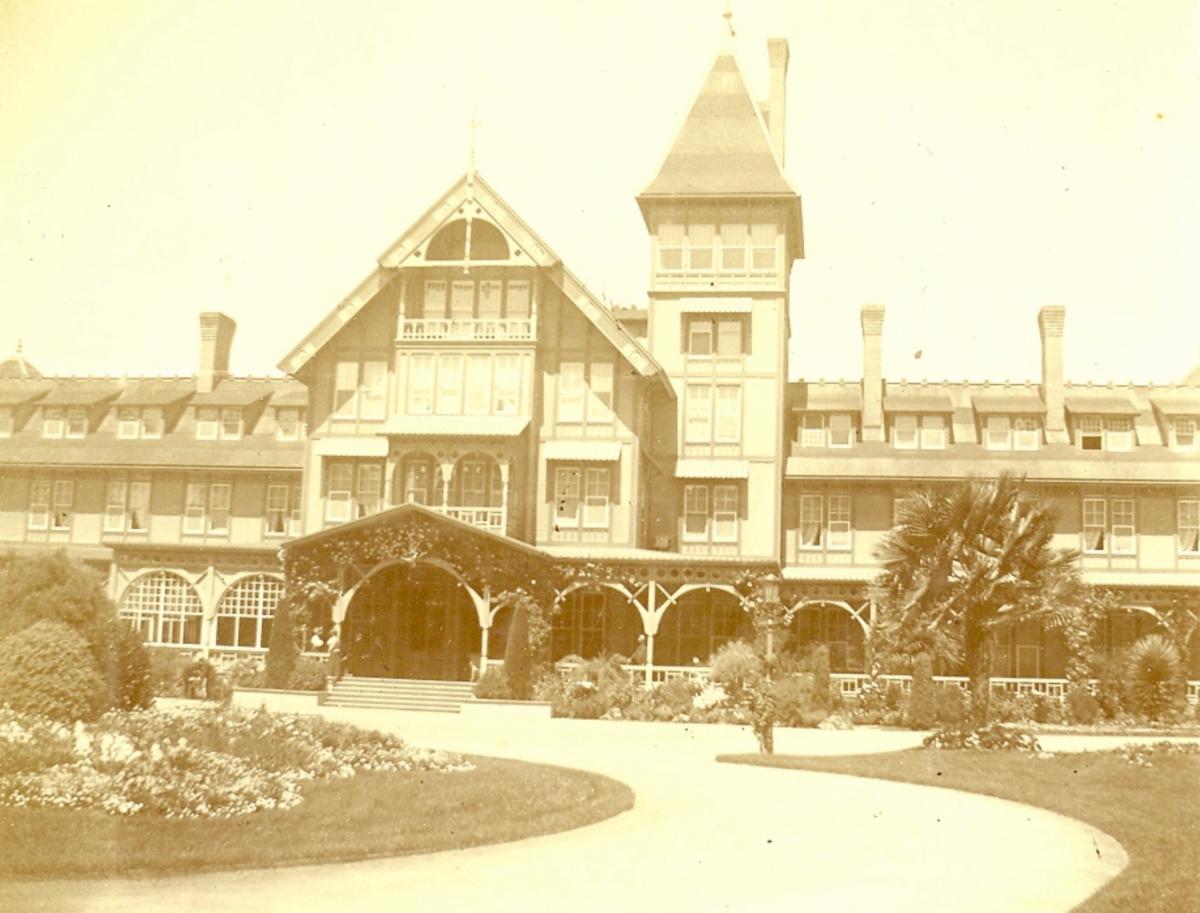
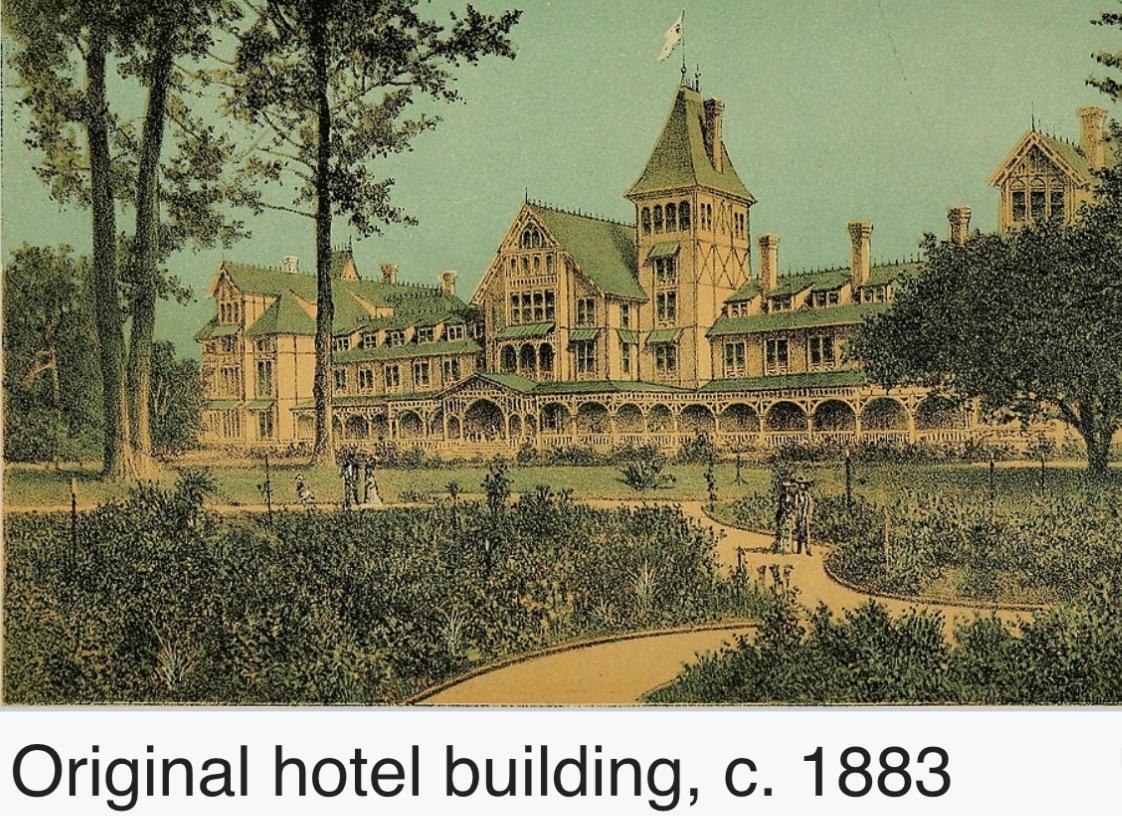
In Volume 1, No. 2 of Del Monte Wave, published in Monterey, February, 1886, by the Del Monte Publishing Company, the following was written of Hotel Del Monte, which at that time was just six years old: “It required only the building of a first class hotel to make Monterey the perfection of a watering place, and this want was amply supplied in 1880, when a magnificent structure was reared about a mile from town. The site was selected in a stately grove of pines, oak, and cedar, the trees being sufficiently scattered to admit of the adornment of the grounds by driveways, footpaths, lawns and beds of flowers. A plot of 126 acres was set aside and enclosed as the hotel grounds, while 7000 acres more were purchased for other purposes.”
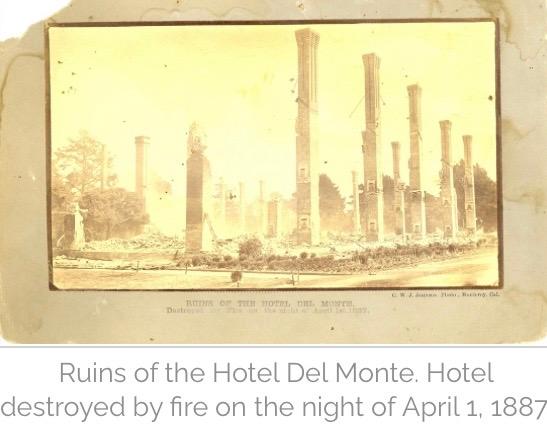
On April 1, 1887, the hotel burned to the ground, and it was not until June 16, 1888, that the second grand opening was held. On that very special occasion the menu cards were most elaborate and ornate. A photograph of the hotel was pictured in green on the cover and blue and white cord was used to hold the cover and the two-page menu and wine list together. George Schonewald was the manager. In that year Mumm’s extra dry was $2 a pint and $4 a quart. The price of the banquet is not given.
The musical programme was given by the “combined orchestras of Mr. Brandt and Mr. Ballenberg, under the direction of Mr. Brandt.”
In that day Mr. Ned Greenway of San Francisco was the social dictator, and he came from San Francisco to direct the dancing from 8:30 till 11 p.m. in the dancing hall, followed by a “Promenade Concert” orchestra directed by Mr. Ballenberg. The banquet was served at 11 p.m. and a parlor concert was programmed for the later hours under the direction of Mr. Brandt.
On Sunday of that historical event there was a morning concert at the Bathing Pavilion at 11:30 a.m. and a sacred concert on the veranda by the combined orchestas at 2 p.m. On the back cover was a picture, also printed in green, of the coast line and pine trees.
For this very interesting collection of old-time menu cards from Hotel Del Monte we are indebted to Mr. Thomas W. Norris of Carmel. Mr. Norris is a collector of Californiana. He is a member of the board of directors of the Monterey History and Art Association and of the Monterey Foundation.
The oldest menu card in Mr. Norris’ collection is the one used Dec. 31, 1887. It is printed in red ink on a piece of white satin ribbon about 3 by 6 inches. It was headed “A Ball Supper” in fancy capital letters and listed hot service, cold entrée, cold ornamental pieces, dessert and refreshments.
The Christmas menu for 1888 has a picture of the hotel with the lights in the windows and a holiday greetings as the frontispiece. Inside is a branch of holly in color. The next Christmas day, 1889, the card was not so elaborate. The cover was a picture of Cypress Point, but the New Year menu for 1894 was really a collector’s item. The cover and paper upon which the menu was printed was the best that could be purchased. The cupids are sitting on a branch of holly, each with a toasting glass in his hand. 1894 is grey-haired and tired looking and has an hour glass on his lap. The whole is tied with white satin ribbon. Mumms had gone up 25 and 50 cents in price.
A Happy New Year 1891, is a drawing of the big hotel glimpsed through the trees on the grounds, with butterflies and cupids and the inevitable potted palms, which seem to appear on every cover. On the back cover is a drawing of the view of the garden from the veranda, with the Victorian wood ornaments supporting the roof. Champagne was back to $2 and $4.
On April 30, 1891, Benjamin Harrison visited Hotel Del Monte, and the menu cards had his picture as the feature of the cover, with Yosemite Falls as the background. Of course there was the American flag and eagle, and much decoration on the inside. Champagne had gone up again.
For New Year’s Eve, 1892, the decoration was an angel surrounded by cupids, with another view of the garden. The back cover had a view of the hotel buildings from the grounds and wide green ribbon was used for the tie. To celebrate the coming of 1893, an angel and cupids were again used and another view of the hotel, with another shade of green ribbon. The Happy New Year greeting for 1894 looked a bit more modern and was really very pleasing, with Santa Claus and a group of happy children surrounding the card, all printed in green and gold, and tied with cord. Two years later an English drinking scene, the men in knee breeches, smoking long clay pipes and sitting before a huge punch bowl, was even more modern, for on the back were reproduced photographs of Monterey cypress and Old Oaks, Del Monte.
On Sunday, April 26, 1896 George H. Arnold had replaced G. Schonewald as manager of the hotel.
| |
Library News
This past month the Library received a donation from a visitor/MHAA member in loving memory of Jack Holt, Sr. We appreciate this very much; the money will be used to support library services.
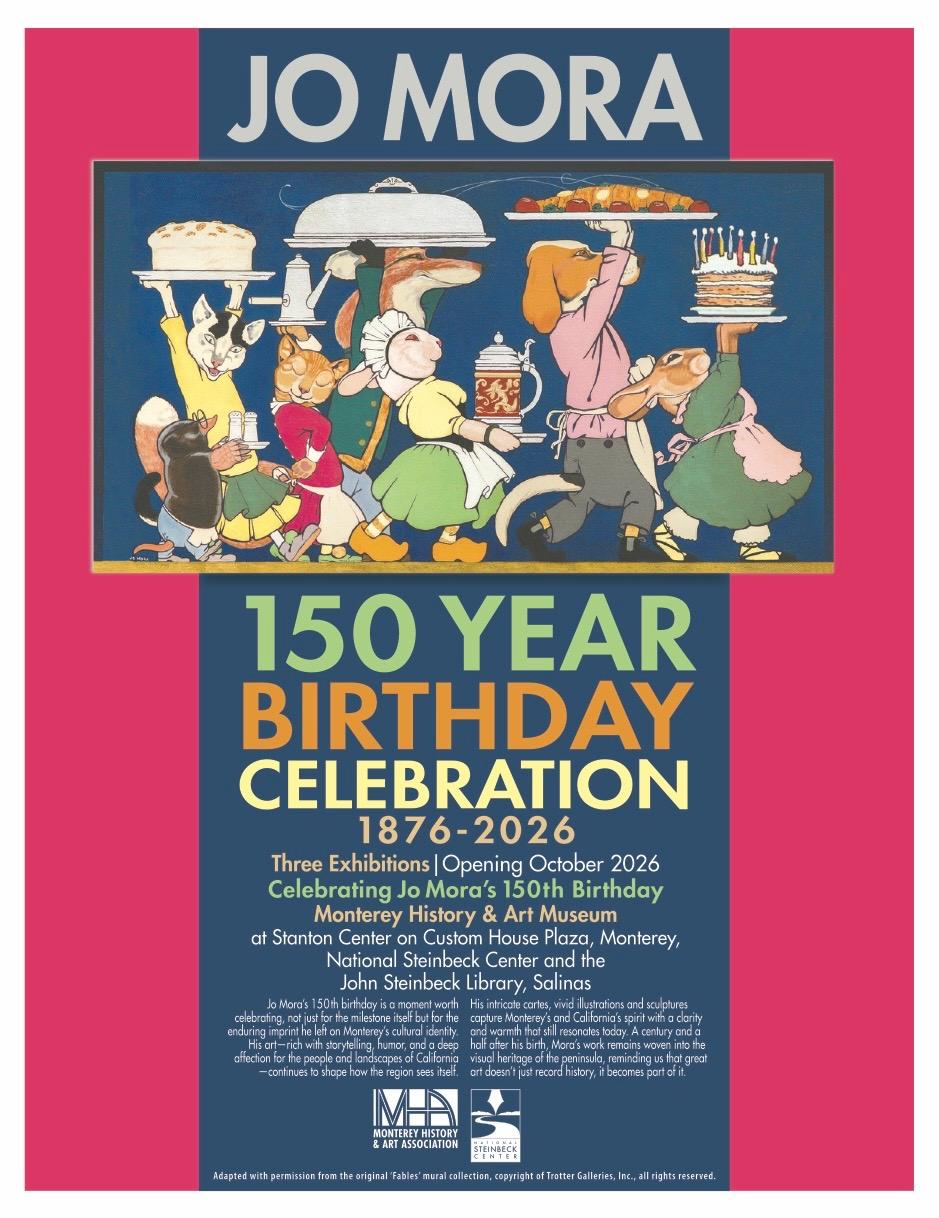
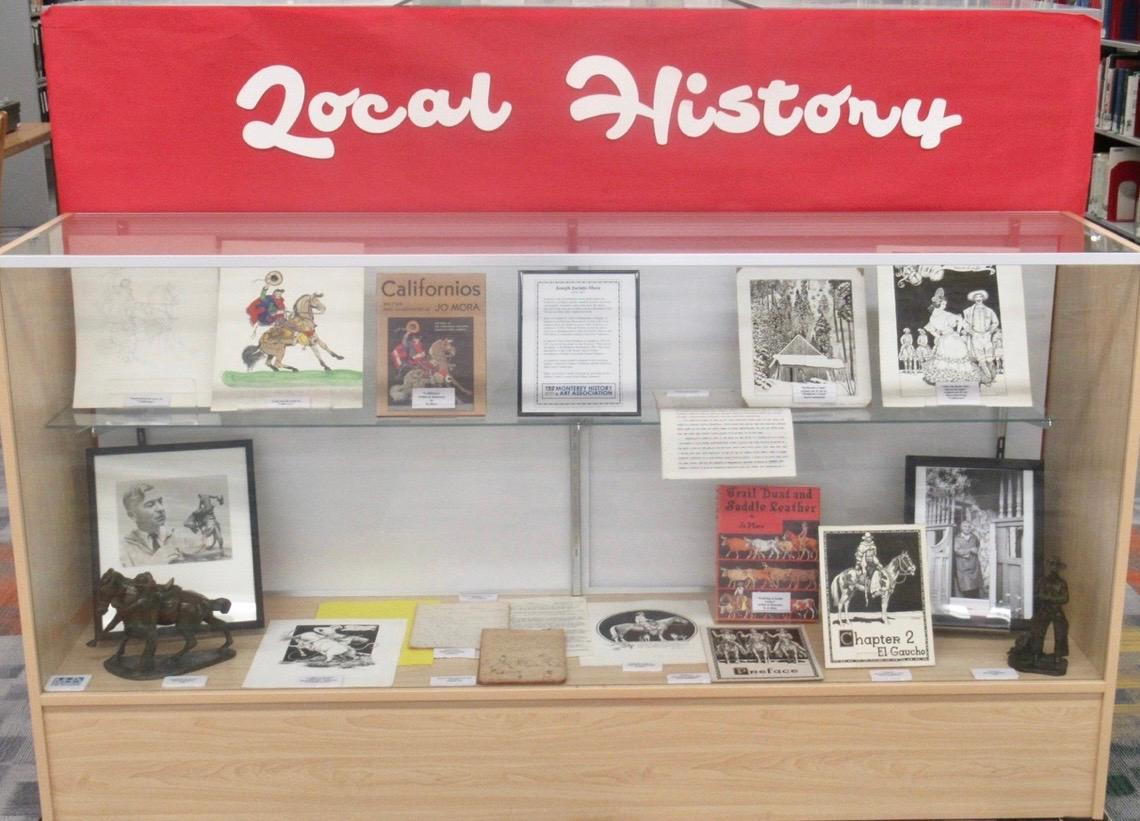
| | Celebrating Jo Mora's 150th Birthday | | |
The Stanton Center exhibit will focus on vintage photographs of Jo Mora and family as seen through the camera work of Lewis Josselyn. As neighbors and family friends, the Josselyn’s and Mora’s rarely missed an occasion together. It would not be inaccurate to describe Lewis as Jo’s personal photographer as he documented most of Jo’s artistic projects once the Moras moved to the Monterey Peninsula in 1920.
The exhibit will be on display from September 26 during regular hours, until the end of the year.
The museum is open
Thursday - Monday
12 noon -4pm
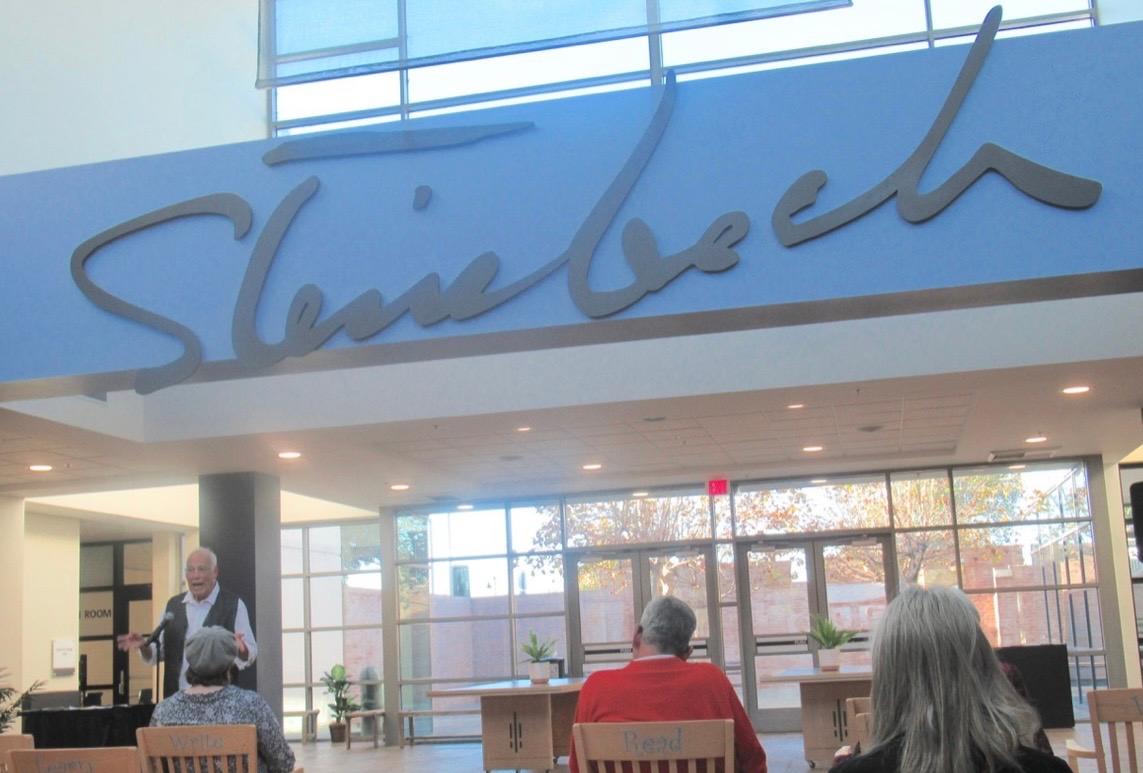
| | The Jo Mora display at the John Steinbeck Library- Curated by MHAA Board Member Susan DeLay. | | The Steinbeck Center has a display that is curated by MHAA Jo Mora archivist Tanya von Giese. | | |
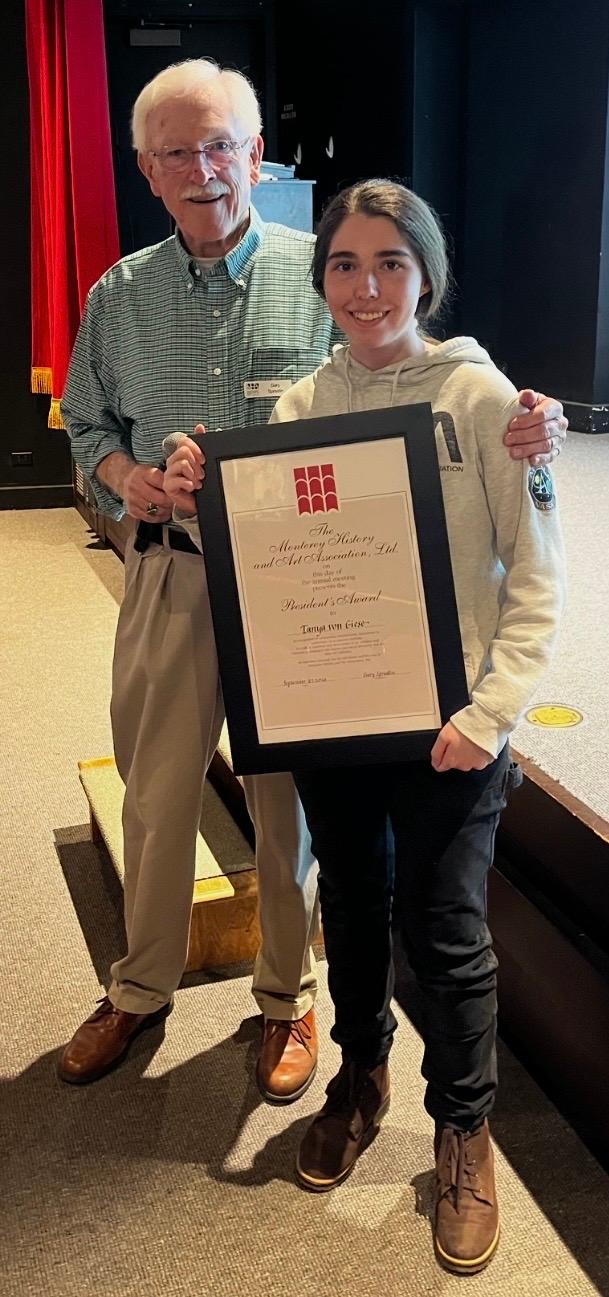
2026 President’s Award
Our 2026 President’s Award recipient: Tanya von Giese
Tanya is the MHAA Jo Mora archivist. She has worked in the Jo Mora archive room for about two years documenting, photographing, scanning the Jo Mora collection and adding records to the MHAA PastPerfect database. There are now more than 2000 items in the database, including books, art works, drawings and sketches, and other artifacts. Thank you, Tanya, for all you do.
| |
Gift Shop
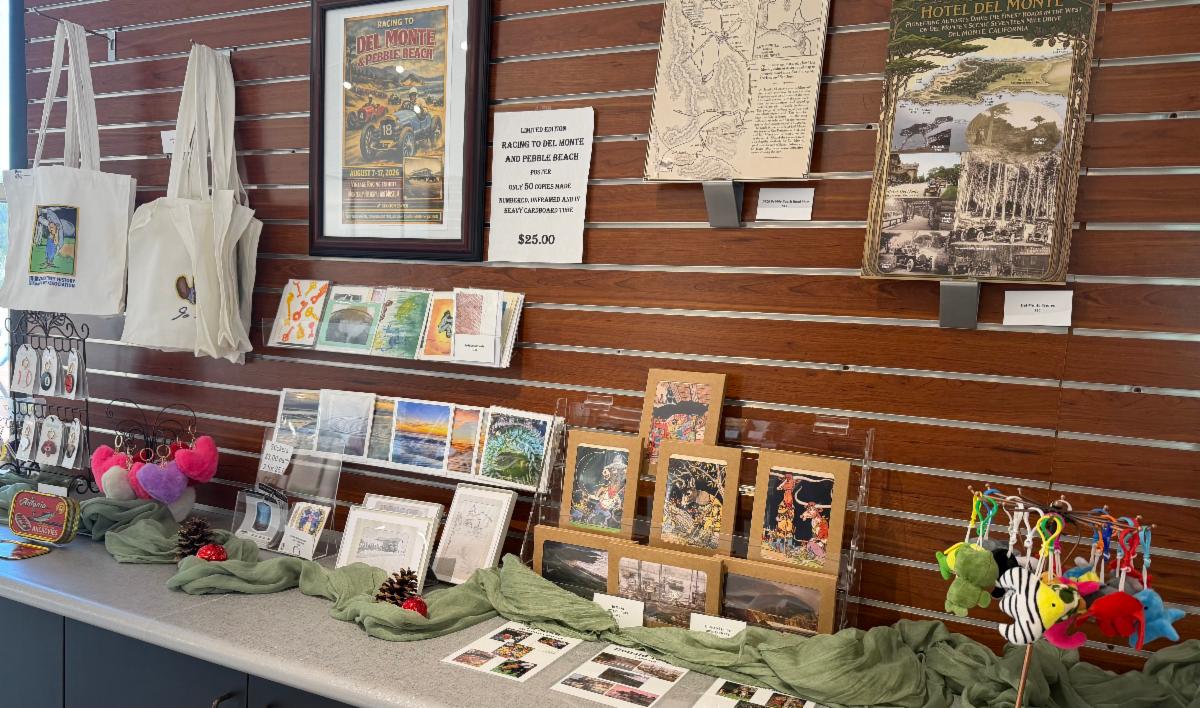
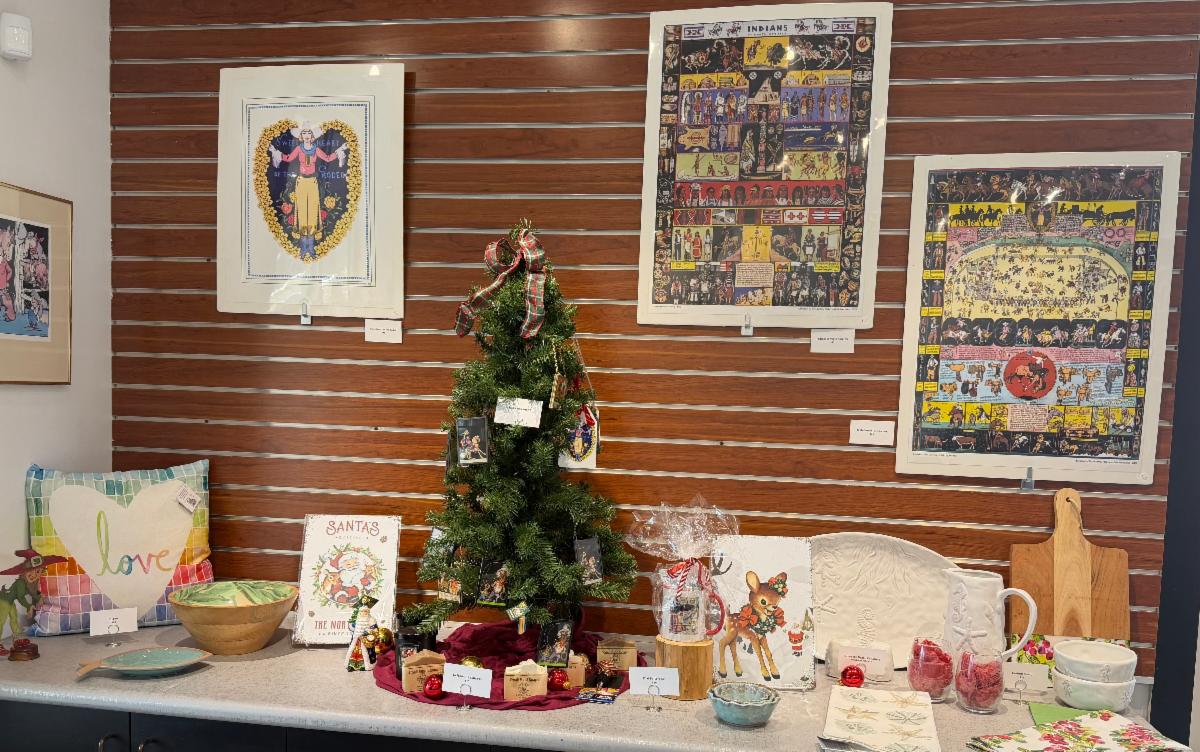
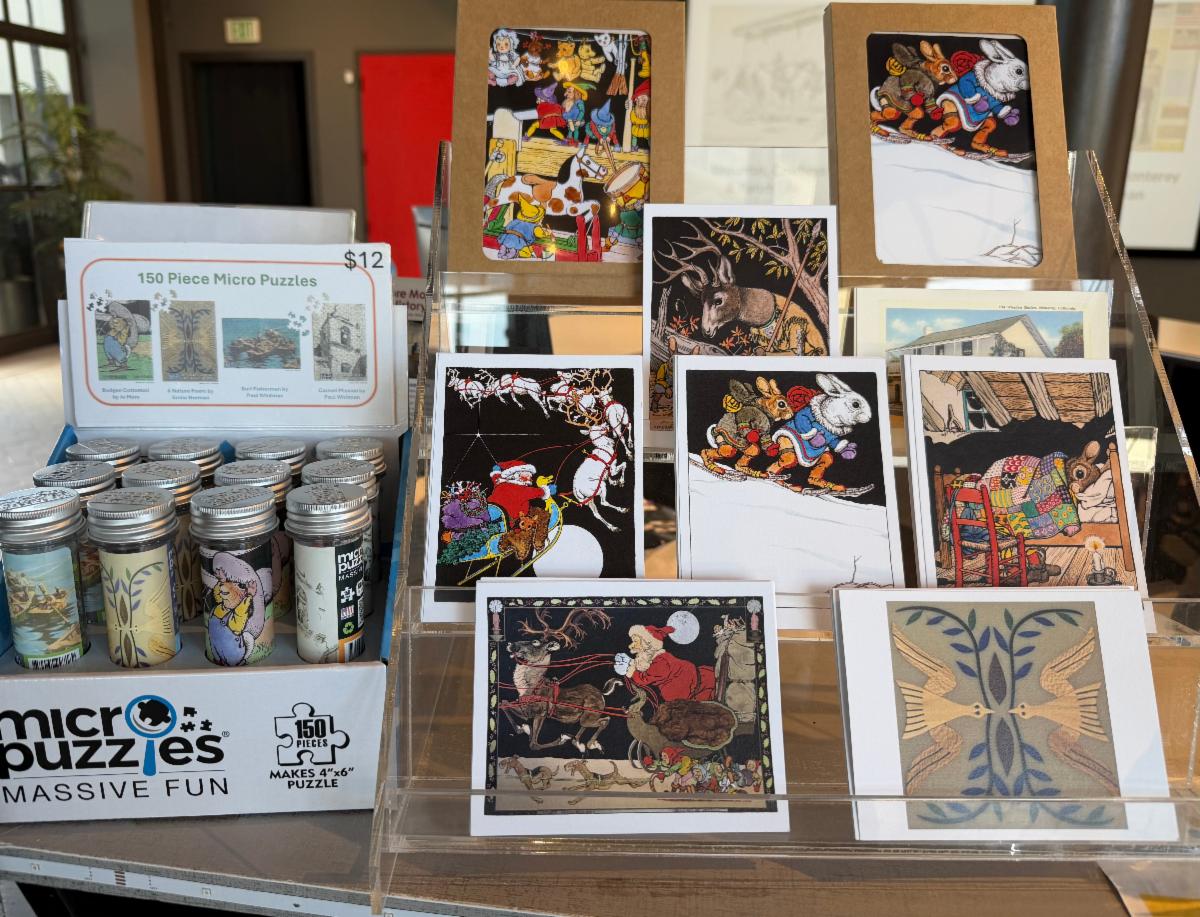
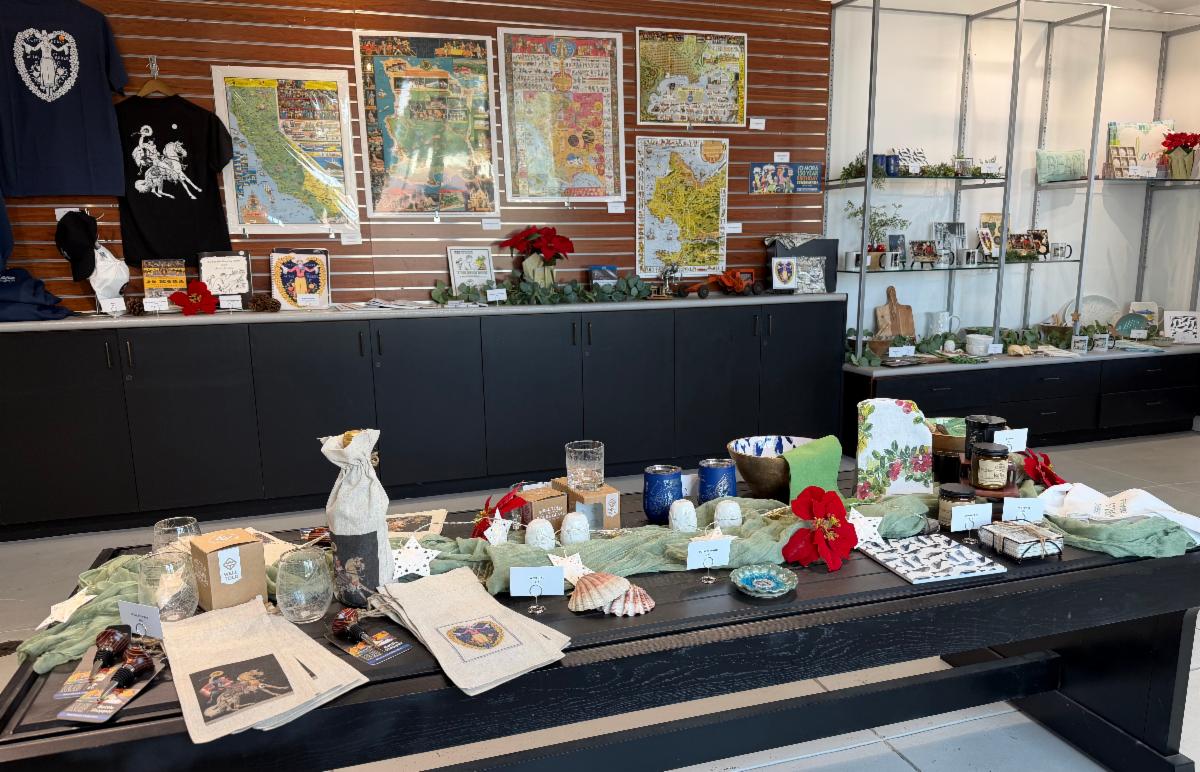
The Gift shop is full of new items. Great gifts ideas or fun items for yourself. Stop in and check out the new products and then visit the exhibits- Remember admission is free for members!
| | |
Monterey History and Art needs volunteers at:
Stanton Center: volunteers are needed to monitor and host events.
Casa Serrano: docents are needed to staff the adobe on Sat. and Sun. from 2-4 pm and to staff special events.
MHOD Library: volunteers are needed Wed. thru Sun. from 1:30- 4 pm to welcome visitors and help with research questions. Other tasks include: scanning material to place on our website and sharing the history of the library and Monterey.
Training will be provided for volunteers at each of these sites.
email us at MHAA.org1931@gmail.com
THANK YOU
| | |
Come visit our exhibits at Stanton Center.
Free admission for MHAA members!
| | |
P.O. Box 1082
Monterey California, 93942
montereyhistory.org
| | | | | |