|
Greetings,
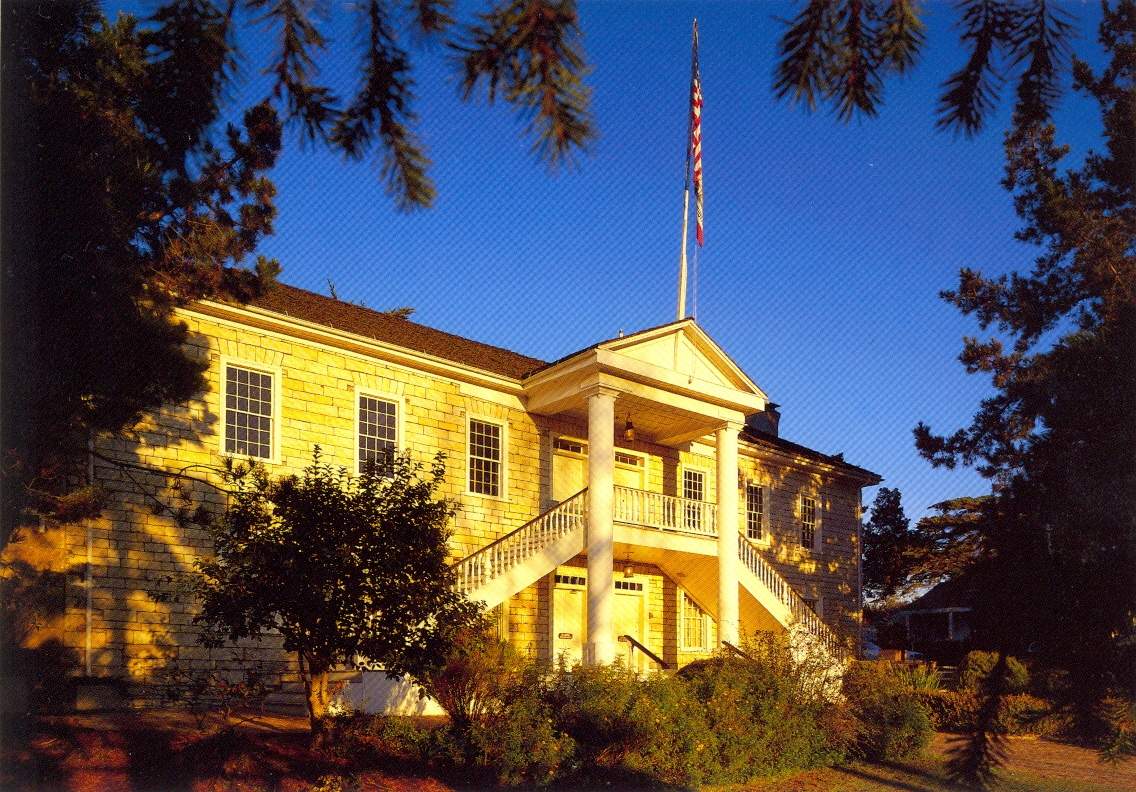
I was working on a flag exhibit at Colton Hall in preparation for America 250 - highlighting some of the stories of the different flags that have flown above Monterey. We have different flags all throughout the City representing different eras, but one sticks out that I never see flown around town: the Alvarado Flag of 1836.
It often takes a while for stories to 'click' in my head. I'm a slow reader, as I often have to read something again to process it and write a lot of notes to help me understand content. So I've read the pieces of this multiple times, but it hadn't really connected until I was thinking about the impact and symbolism of flags inside Colton Hall.
In 1836, Juan Bautista Alvarado (y'know the Alvarado Street in Monterey) led a revolt here in Monterey. I have to be honest that I never heard of this revolt when learning California history prior to being here in Monterey.
Mexico had taken over Alta California in 1822, and the early days of Mexican rule were chaotic. Los Angeles began to negotiate for the capitol to be moved there, yet Monterey was still was the military and commerce seat. Although Monterey was the capital of early Alta California in the Spanish era, the rise of Los Angeles meant that political friction between the southern area and northern areas of Alta California was increasing. Influence from Mexico meant that many of the local "Californios" in Monterey were upset with the lack of local control.
Alvarado was native to Monterey, and his own family had been here since the first Spanish expeditions. During 1836 the Texas Republic was formed in the Mexico territory. While later that year here in Monterey; Alvarado, past governor Jose Castro, and an American named Isaac Graham staged a revolt with a small group of supporters. Lt. Colonel Nicolas Gutierrez was appointed governor after Governor Chico abruptly fled to Mexico. Alvarado and others were upset with the chaos throughout Alta California, and fired a lone canonball from the Lower Presidio into the home of Gutierrez...who then fled back to Mexico. Graham was what you'd call a mountain man from Tennessee, but also the leader of Los Rifleros Americanos - a group of American riflemen. Alvarado claimed an independent California Republic here in Monterey. The incident caused tension between Alta and Baja California.
By 1837 Alvarado rescinded the California Republic, and was named Governor of Alta California here in Monterey; ultimately given more local control. Until 1846 the Governor was chosen by diputacion in Mexico and shifted between Los Angeles and Monterey. This was not the end of the chaotic early years!
In 1840, Alvarado was still Governor and began to fear that Isaac Graham and other Americans were going to start their own coup. With increased power, he had all of the American and British residents arrested and detained in Monterey (save for a few notable businessmen like J.B.R. Cooper, John Sutter and Thomas Larkin) and they were deported to Mexico. The "Isaac Graham Affair" became an international crisis as about 100 American and British were deported to Mexico without due process or any plans for what to do or where to jail them. Eventually the detainees were returned after pressure from the British and American governments; Isaac Graham left Natividad and founded Roaring Camp up near Felton. But that's another story.
Alvarado's lone star flag was a red star on a white background. The red star was later used in 1846 for the California Republic Bear Flag, and is the inspiration for the current red star on the California flag flown today. The "Bear Flaggers" of 1846 used berry juice and brick dust to make a red star.
So when ever you see our California flag flying high - remember that there are two pieces of Monterey trivia on display:
1)The Grizzly Bear is named "Samson" ; when the state legislature chose the official drawing, they used the 1855 Charles Nahl watercolor from Colton Hall.
2)The red star at the top left represents the first California Republic of 1836 during the Mexican period, here in Monterey by Juan Alvarado.
The last original Alvarado flag is at the Autry Museum down in Pasadena. I hope to visit it one day so that I can understand this story a little better.
Warmly,
Brian
|