|
The American Society of Le Souvenir Français Inc.
Monthly Bulletin - Vol. IV. No 7 - July 2024
| |
|
French Pioneers of the American West
Part 4 of a series
(California, Nevada, New Mexico, Oregon, Washington - 1830-1920)
| |
|
Cover illustration:
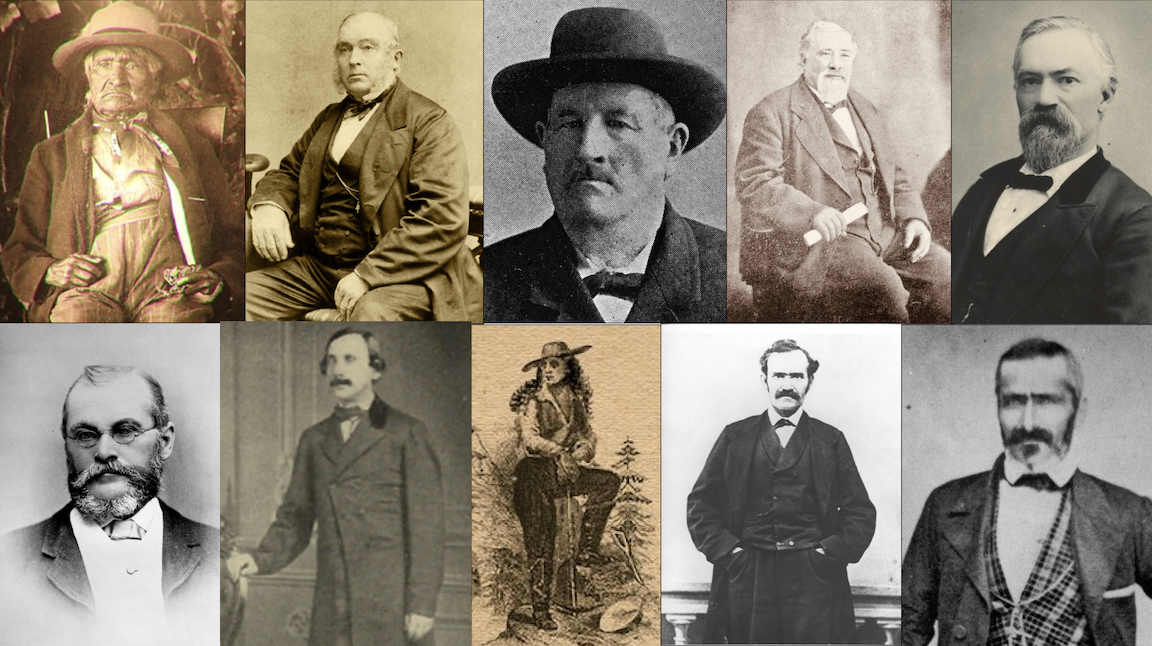
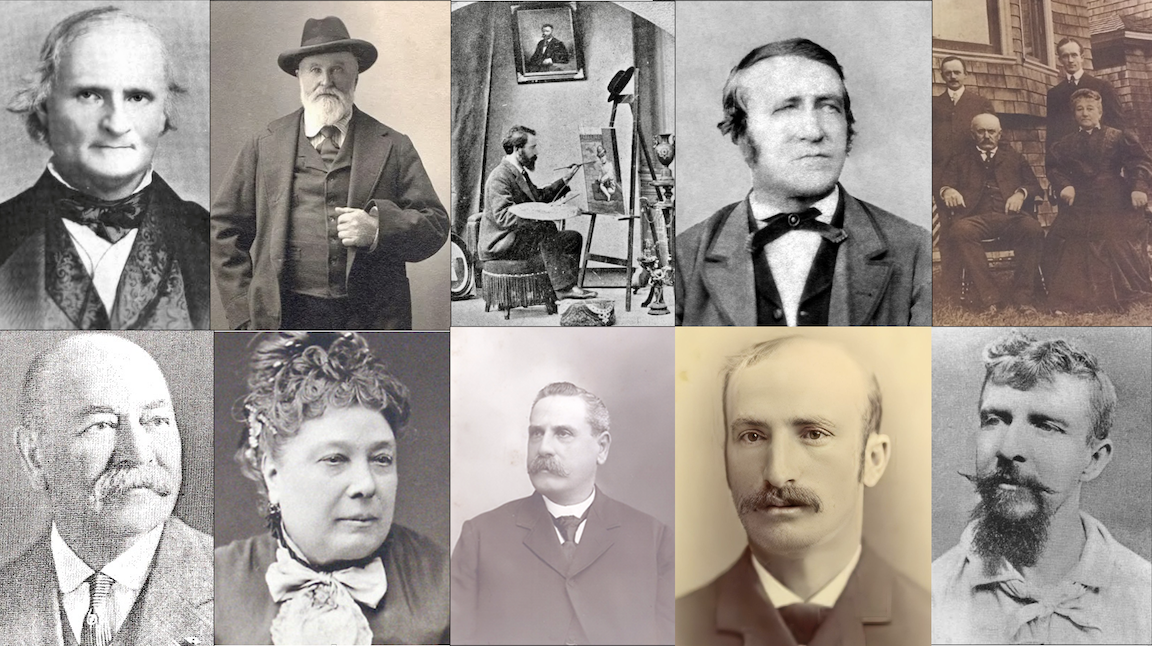
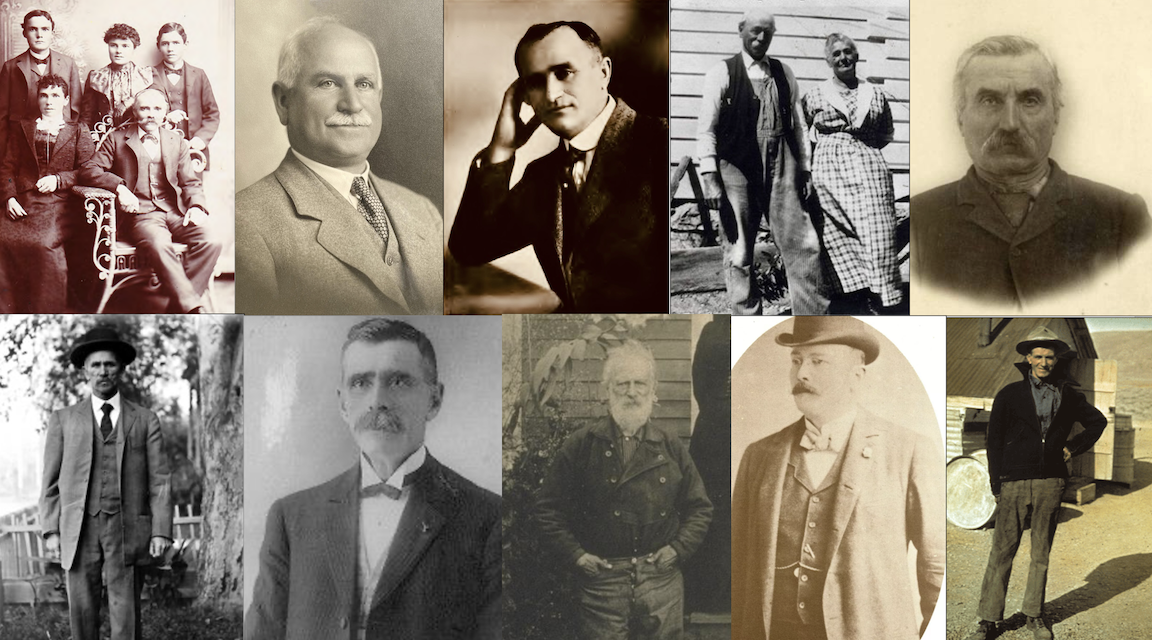
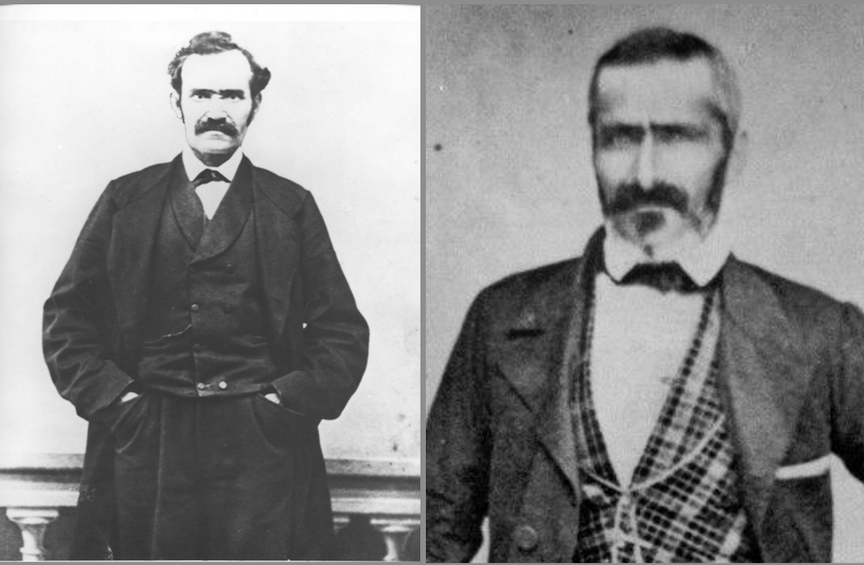
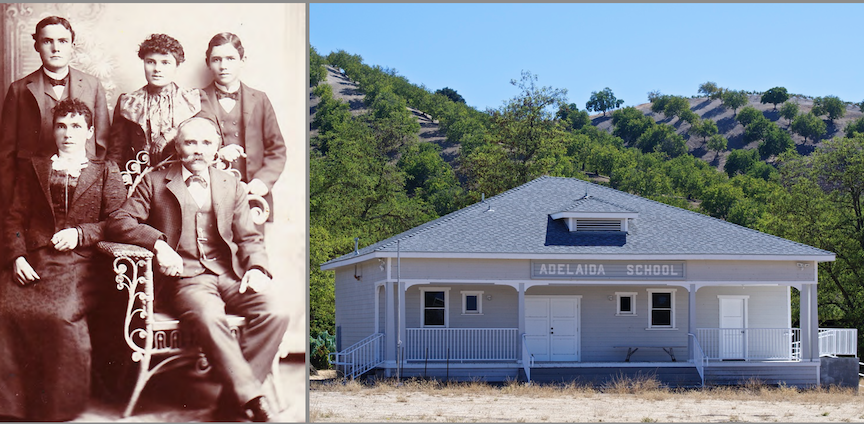
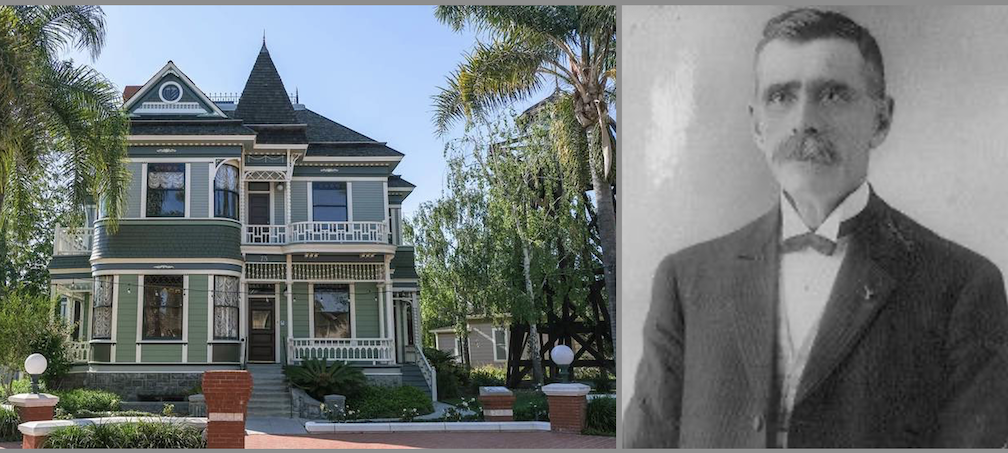
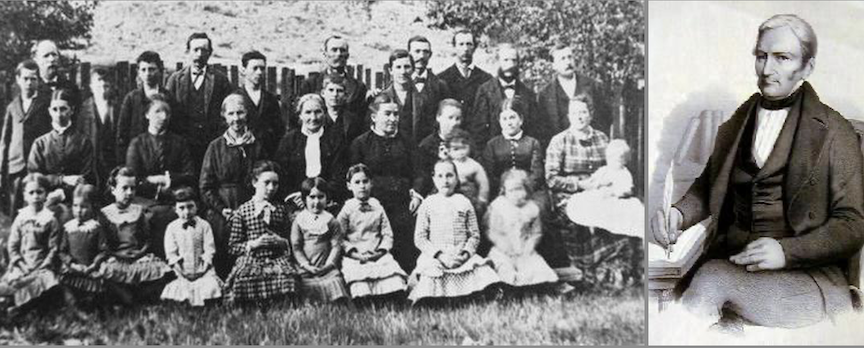
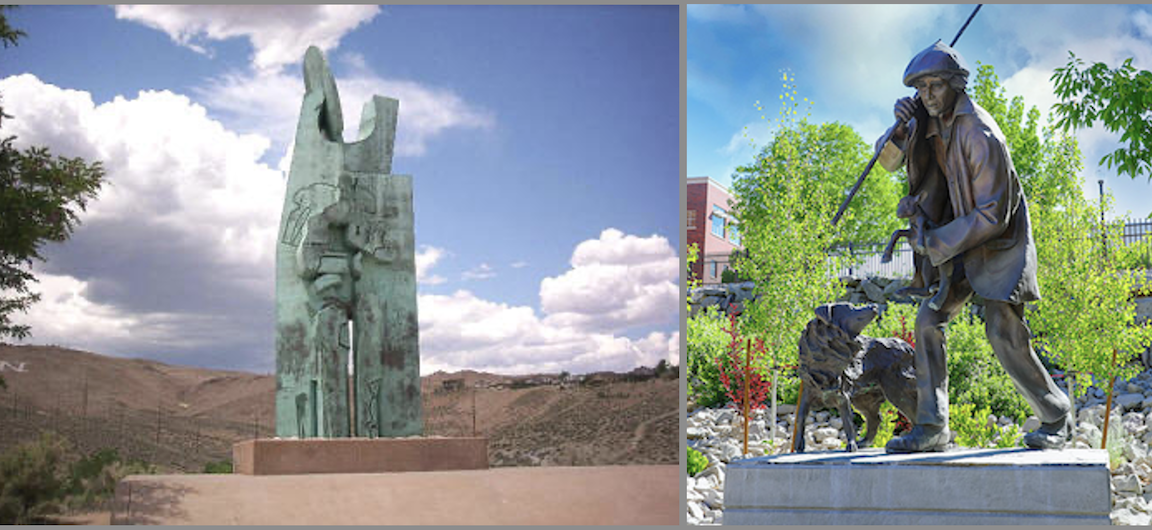
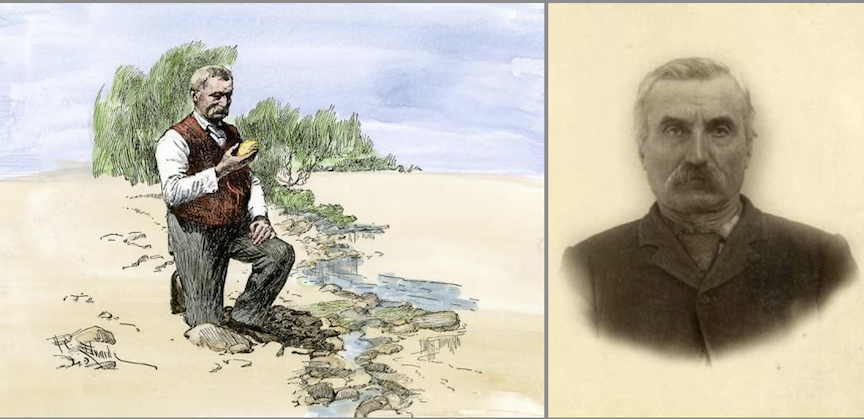
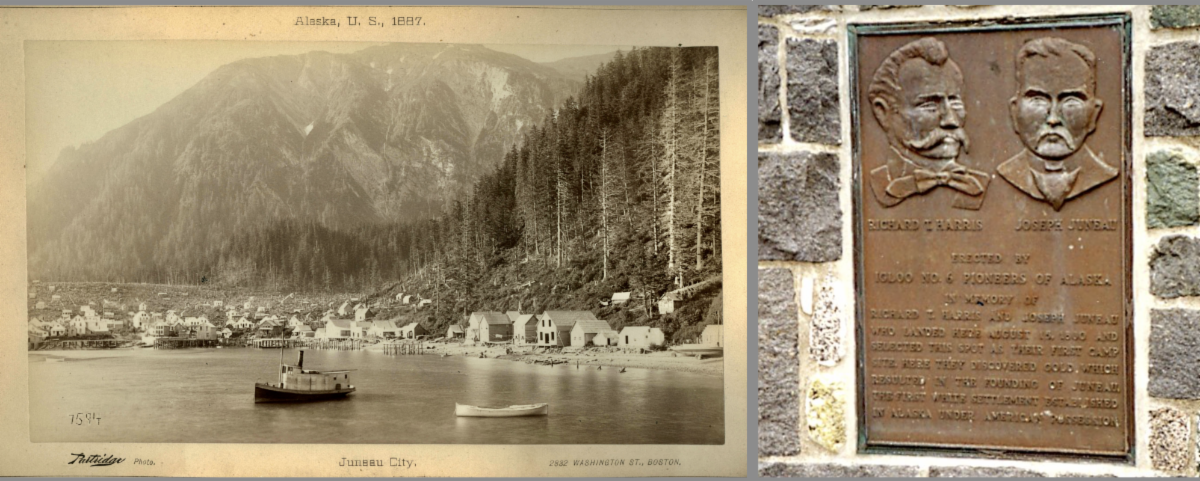
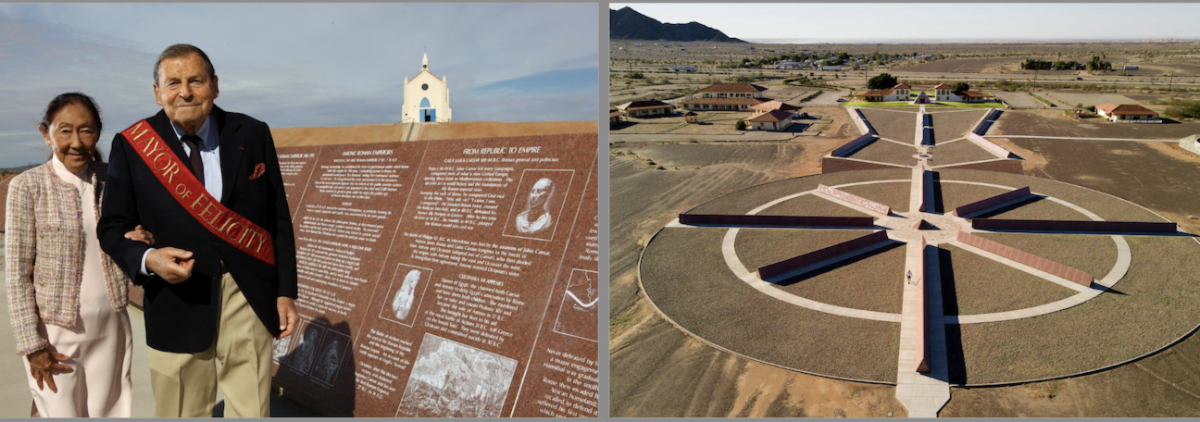
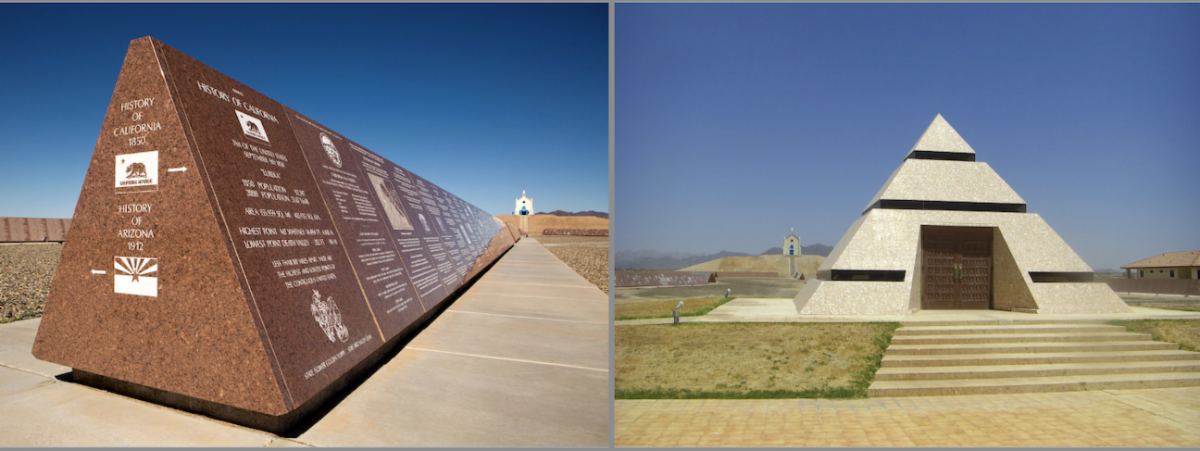
From top to bottom, left to right: Simon Bonaparte Plamondon, Jean-Louis Vignes, Joseph Mascarel, Jean-Louis Sainsevain, Pierre Sainsevain, Prudent Beaudry, Solomon Lazard, Marie Suize “Madame Pantalon”, Louis Pellier, Pierre Pellier, Louis Rubidoux, Pierre Hypolite Dallidet, Henri Penelon, Damien Marchesseault, the Etcheverry Family, Abraham Achille Lévy, Joséphine Félix, Alexandre Gilbert, Alphonse Weill, Jules Tavernier, the Dubost Family, Henri Lévy, Dominique Bordagaray, Jean & Marie Yparraguirre, Joseph Juneau, Philippe Fritz, Justin Petit, Jules Simoneau, Paul Masson, Pierre "Pete" Aguereberry (Photo credits further below).
| |
|
EDITORIAL
It is hard to imagine today that California and the entire West Coast were populated two centuries ago with just a few thousands Spanish soldiers, missionaries, and Natives!
Following the cession of California by Mexico to the United States in 1848, the population grew rapidly. In this Bulletin we will present several French pioneers who were among the very first settlers, even prior to the Gold Rush of 1849. They were all very adventurous, enterprising, and for the most part quite colorful characters.
They are memorialized with monuments and plaques, as they left their mark all over the West, in California, Nevada, New Mexico, Oregon, Washington, and as far as Alaska and Hawai’i.
My personal favorite is Marie Suize, aka as “Madame Pantalon”, a successful gold digger, eventually becoming a wine grower and businesswoman, who faced the judge several times for wearing men’s pants... There is also the aptly named Jean-Louis Vignes, who launched the California wine industry and who has a street in his name in downtown Los Angeles. Speaking of LA, three among the first mayors were French at a time when one tenth of the city spoke French! Or Louis Pellier, aka as the “King of prunes”, or Achille Lévy’s whose eponymous “Bank of A. Levy” continued to be an economic pillar of Ventura County until its acquisition 30 years ago in 1995. Or Joseph Juneau, who co-founded Juneau in Alaska in 1881. Or Jules Tavernier, who helped make Monterey the “Barbizon of the West” and the charming town of Carmel the artistic hub that it is today.
Whether they were gold diggers, ranchers, businessmen, artists or politicians, they all deserve our respect for not only what they accomplished, but for the generally unanimous praise they received from their fellow American citizens, as their obituaries attest. And so we conclude our series of “French pioneers of the West”.
We have included numerous additional entries in our book "French Memories in the United States", which will soon be available for purchase on Amazon in its updated second edition.
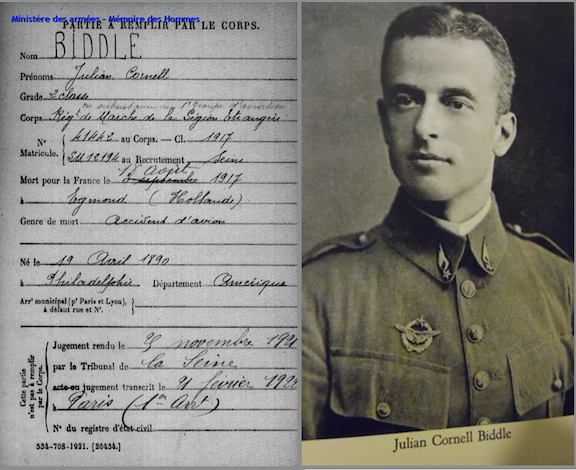
As is now a well-established tradition, we are paying tribute every month to American volunteers who "Died for France" *: Lieutenant Julian Cornell Biddle, who was the first American who volunteered after the United States entered the war in 1917 to be killed at the front. His remains rest in Philadelphia.
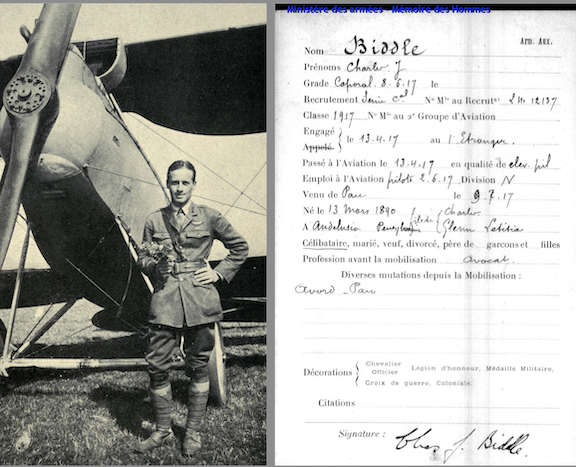
We also pay tribute to his homonym, Major Charles John Biddle, who was a fellow member of the Lafayette Flying Corps, and who died in 1972. Major Biddle wrote his memoirs, The Way of the Eagle, shortly after WWI.
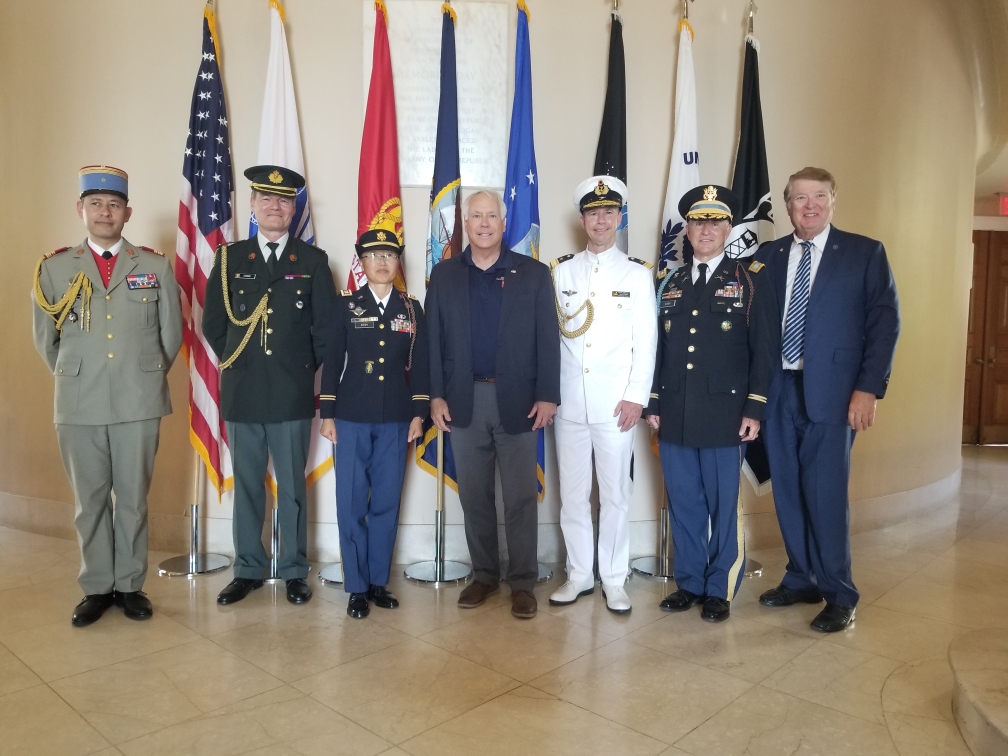
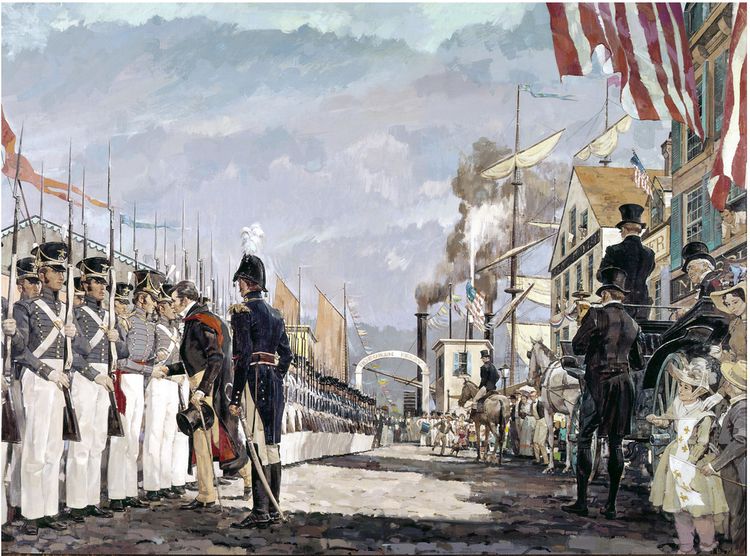
After the numerous patriotic commemorations between Memorial Day and D-Day, the celebrations of the 4th of July, the "Tribute to France" weekend of July 12-13 in Newport R.I. and Bastille Day festivities around the nation, we are now gearing up towards the kickoff in NY of the momentous Lafayette Farewell Tour Bicentennial which will take place next month on August 16.
All the latest details are provided at the end of this Bulletin. We strongly encourage all francophiles in the Tri-State area to greet Lafayette in person in Lower Manhattan!
You can get information on many other events that are organized by the American Friends of Lafayette over 24 States and during the next 13 months at: www.Lafayette200.org. Please support these celebrations with your presence or financial help (the e-boutique is replete with wonderful gifts).
Have a fantastic summer...And if you happen to head West during this season, remember to bring along a gold pan for some fun adventures!
On behalf of the Board of Directors,
Thierry Chaunu
President, American Society of Le Souvenir Français, Inc.
Note*: "Mort pour la France" (lit. 'Died for France') is a legal term and an award given to those who died in a conflict, often while serving the country. It can be given to French citizens as well as volunteers from other countries. The phrase "Mort pour la France" is written on the person's death certificate.
| |
|
Above:
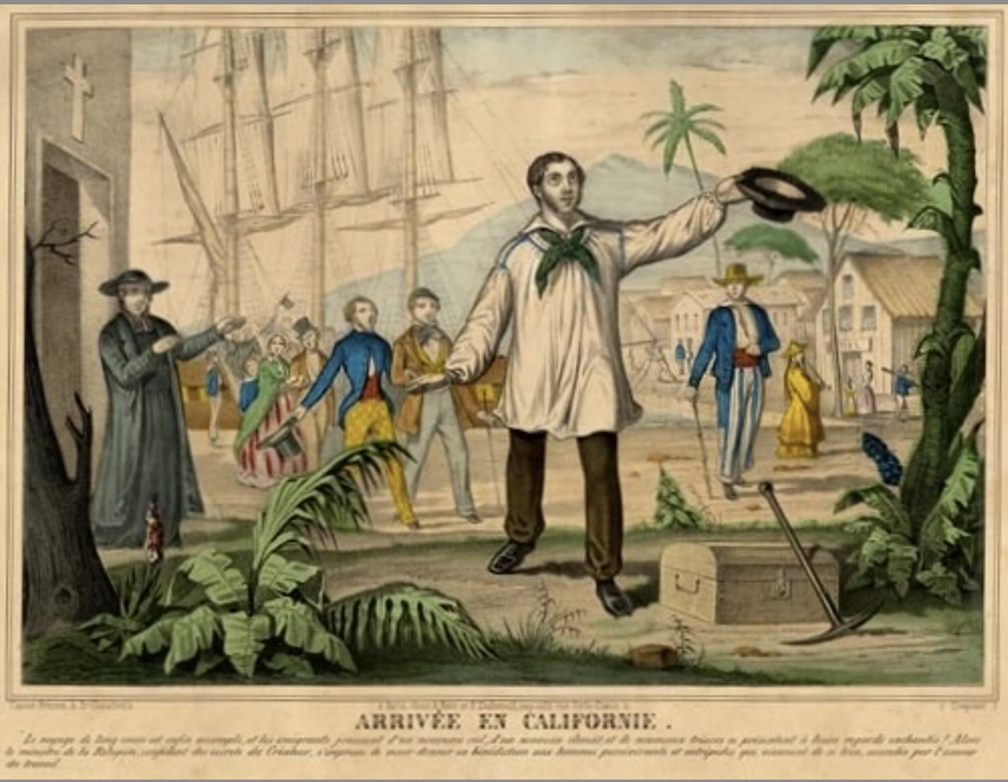
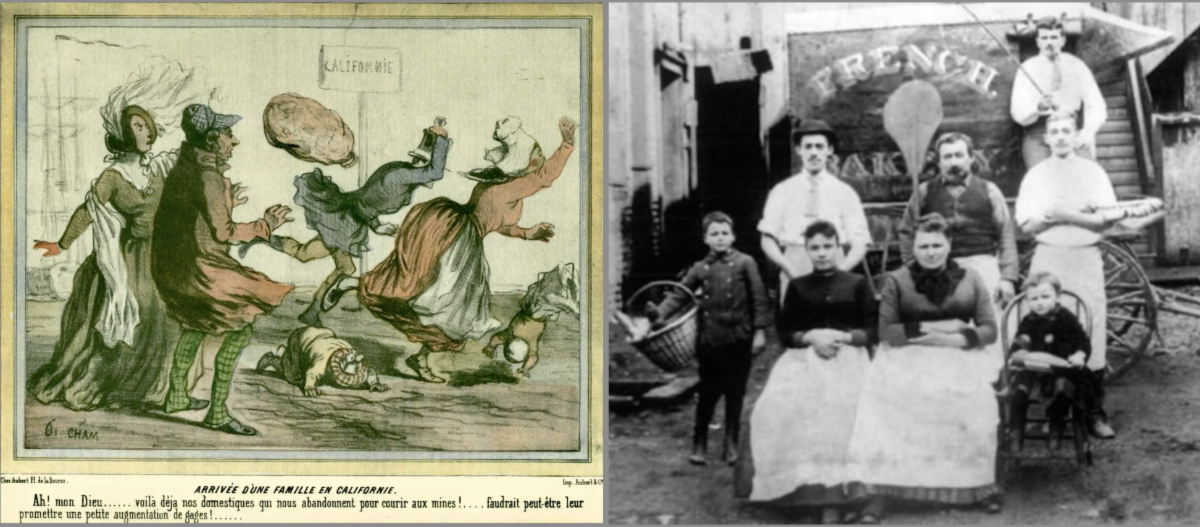
"Arrivée en Californie.” An 1850 lithograph from the California State Library Special Collections
| |
|
Historical Context
Spain was holding over a very vast territory but only in a few coastal missions. The inland was for the most part deserted.
We narrated the 18th Century exploration of La Pérouse in California, Oregon, Washington, Alaska, Hawai’i and the American Samoa this past April in our Bulletin. And we mentioned La Pérouse’s observation in a letter dated September 17, 1786: “You know, Sir, that Monterey is not a colony, but a post merely of twenty Spaniards, maintained by the king of Spain for the protection of the missionaries…”
April 2024: La Pérouse in America
https://conta.cc/3U58W8r (original version in English)
https://conta.cc/3xHEvxn (version in French)
La Pérouse gathered valuable geographic and scientific items from the area, praising its abundant resources and important location. Six decades later, French naturalist and botanist Eugène Duflos de Mofras was dispatched to the Pacific coast in the 1840s and wrote a book describing a large region with only 4,000 inhabitants.
As we have seen in our previous Bulletins, the French Canadians were particularly active throughout the vast Far West from the very early days of European exploration of the American continent.
Coming from the East inland, we narrated their progress in the Rockies, the Far West, Texas in the first decades of the 19th Century.
French pioneers of the American West (Part 3 of a series - the Rockies, the Far West & Texas - 1840-1880)
https://conta.cc/3x4J2Ko (original version in English)
https://conta.cc/4bl3nJL (version in French)
There are dozens of markers bearing witness to this French presence in California, New Mexico, Oregon, Washington, over the last 200 years.
They are listed on our compilation "Memories of France, More than 1,950 sites of French presence in the United States" whose revised and augmented edition will be available in both English and French on Amazon this Fall.
The earliest French speaking settlers and settlements in pre-Gold Rush California are presented below, as well as the French Consulate in Monterey, opened as early as 1843!
| |
|
French Consulate in Monterey, CA., 1843
First country to have official representation in California
| |
|
• King Louis Philippe recognized California's significance by establishing France's first consulate in Monterey in 1843. France became the first country to have a representation in California (Monterey was the capital of Mexican Alta California).
• Louis Gasquet became the first French consul in Mexican California, representing the interests of French merchants, farmers, and trappers.
• His bustling adobe was a focal point during Monterey's "roaring 40's," amidst competing interests from Russia, Britain, and France.
• Jacob Antoine Moerenhaut replaced Louis Gasquet in 1846. He was born in 1797 in Echeren, (arrondissement d'Anvers) near Antwerp, in today's Belgium but part of the First French Republic at the time. After serving in Napoléon's army (at the age of 15), he embarked in a diplomatic and business carreer, advancing French interests in Oceania and helped pave the way for the significant French presence in Polynesia. In 1859 the consulate at Monterey was transferred to Los Angeles, where Moerenhaut was inaugurated on October 29. He took up these new duties with enthusiasm and became widely known and greatly respected.
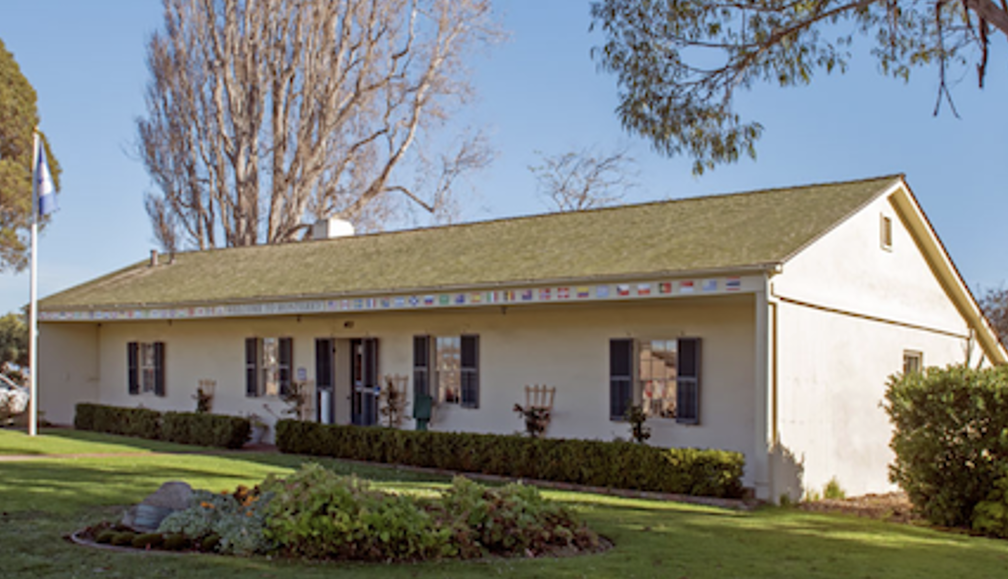
• The consulate was situated in a long, low adobe building at 401 Camino El Estero, which also served as Moerenhaut's residence. He described it as "a spacious house with a beautiful rose garden and orchards".
• Today, in 2018, the building is home to the Monterey Visitors Center.
House & Marker, French Consulate, Monterey, CA
401 Camino El Estero, Monterey, CA 93940
GPS: 36.598667, -121.887433
• Inscription:
“Built in the Mexican period.
Home of J.A. Moerehaut, a French Consul to California.
Erected by Monterey History & Art Association.”
| |
|
Louis Rubidoux
Early settler in Riverside, CA.
| |
|
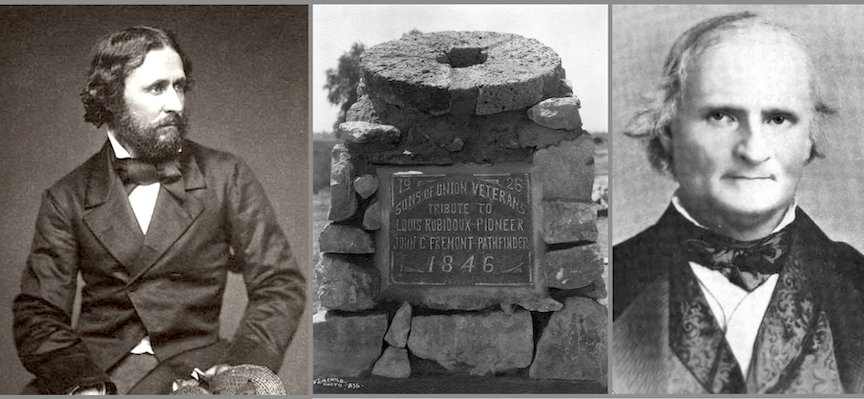
Above:
Right: Louis Rubidoux (1796–1868), The Pioneer, circa 1850, Founder of the City of Rubidoux Owner of Rancho Jurupa, Public Domain,
https://commons.wikimedia.org/w/index.php?curid=126701229
Middle: marker & plaque “Sons of Union Veterans, Tribute to Louis Rubidoux, Pioneer, John C. Frémont, Pathfinder, 1846 - 1926”
https://www.pressenterprise.com/2018/04/26/back-in-the-day-early-pioneering-family-farmed-in-whats-now-jurupa-valley/
Left: John C. Frémont, The Pathfinder, By Unknown author - Public Domain
https://commons.wikimedia.org/w/index.php?curid=71673415
| |
|
• Louis Rubidoux, born Louis Robidoux, (b. St Louis, MO July 7, 1796 ) was the son of Joseph Robidoux III, the brother of Joseph Roubidoux IV, Founder of St Joseph, MO. and the brother of Antoine Roubidoux, founder of Fort Uncompahgre in Colorado (whom we introduced in our preceding Bulletin).
• Robidoux arrived in California in 1844 after having gained significant experience on the Mexican frontier. He had initially moved to New Mexico in 1823 at the age of twenty-seven, where he and his more well-known brother, Antoine, established permanent residences in the 1820s and wielded considerable influence.
• Engaging in fur trading, operating various businesses such as a store, blacksmith shop, and grist mill at different times, Robidoux became a Mexican citizen in 1829.
By 1839, he had risen to the position of mayor (primer alcalde) of Santa Fe. The reasons behind Robidoux's departure from New Mexico to California around 1844 remain unclear.
• He was an early settler in Riverside, California, where he became a successful rancher. He built the first grist mill, operated a winery, and was one of the first supervisors in San Bernardino County.
• He was probably the wealthiest man in San Bernardino County. The County assessment of rolls of 1854 showed that his property was assessed at more than $20,000, a very large sum for that time.
• The town of Rubidoux and Mount Rubidoux are named after him.
• Rubidoux is spelled many ways. On his headstone, it is spelled Robidoux. The city named for his Rancho Rubidoux, also named the little mountain he lived at the bottom of Mt. Rubidoux. Streets and the library in Riverside County are named for him as well. The current spelling of "Rubidoux" evolved from a quirk in the penmanship of Louis Rubidoux, scholars agree. His letter "o"s were open at the top, and were mistaken for "u"s, hence the spelling "Rubidoux."
Marker, “Louis Robidoux”
2001 Agua Mansa Rd, Colton CA 92324
GPS: 34.040867, -117.364983
• Inscription:
“Louis Robidoux was the best known Ranchero in the Inland Empire of his time. Louis and his wife Guadalupe Garcia Robidoux had nine children; Catalina, Louis Jr., Pasquel, Carmalita Adalaid, Marie Benina, Catarina Abundo and Mariano, who died in route to California at about age seven. The town that bears his name, with the modern spelling, is the oldest town in continuous existence in Riverside County. Mt. Rubidoux is the site of the first Easter Sunrise Service in the United States. Louis Robidoux was blessed in inheriting the Holy Roman Catholic Falth.
When the county of San Bernardino was formed in 1853, Robidoux became a member of the board of supervisors and in 1856 became chairman of the board. He was also the first justice of the peace in San Bernardino County.
Robidoux was buried in the Agua Mansa cemetery in 1868 beneath a pepper tree. Robidoux, by sub-dividing his land grant, paved the way for California to become a State.
We are all grateful for his presence in this Land and pray for his eternal soul.
Erected by The Louis Robidoux Family Pathfinders.”
• As you can see in the photo above, John C. Frémont is juxtaposed to Louis Rubidoux in the 1926 memorial. Narrating his life accomplishments would take several volumes...
• John C. Frémont, (January 21, 1813 - July 13, 1890) was the son of Charles Frémon, a French-Canadian immigrant, who kept the accent on the “é” but added a “t” to his last name for an unknown reason.
• He was a prominent American figure known for his roles as an explorer, military officer, and politician. Serving as a United States senator representing California, he made history as the inaugural Republican candidate for the U.S. presidency in 1856, defeated by the Democratic candidate, James Buchanan.
• He worked with French explorer and scientist Joseph Nicollet and met Joseph Renville, J.B. Faribault, Étienne Provost (all of whom we talked about in our previous Bulletins).
• He became a US Army general during the Civil War, the 5th Governor of the Arizona Territory, a US Senator from California, and a Military Governor of California.
• President Abraham Lincoln sought to nominate Frémont as the American ambassador to France, leveraging his French heritage and the widespread support for his anti-slavery stance in Europe. Nevertheless, Secretary of State William Henry Seward opposed Frémont's extreme views, leading to the decision not to proceed with the appointment.
• Numerous mountains, counties, cities, streets, bridges, high schools, hospitals, libraries are named after him in California and several States.
| |
|
French Camp, CA.
"The Oldest Community in San Joaquin County"
| |
|
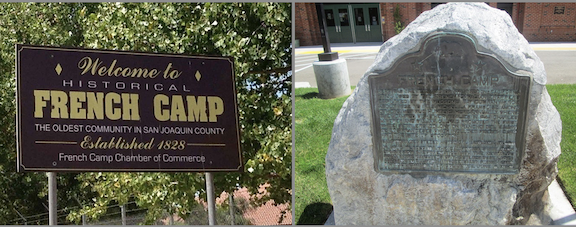
Marker, French Camp, CA, “The Oldest Community in San Joaquin County”
241 4th St, French Camp, CA 95231
GPS: 37.882742, -121.279788
• Inscription:
“French Camp was the southernmost regular camp site of the Hudson's Bay Company southern fur brigades sent from Fort Vancouver (now Vancouver, Washington), established by Michel Laframboise in 1832. Its Spanish name was preserved in a land grant dated January 13, 1844 as Rancho Campo de los Franceses. It is commemorated as California State Historic Landmark 668:
Here was the terminus of the Oregon-California trail used by the French-Canadian trappers employed by the Hudson's Bay Company from about 1832 to 1845. Michel Laframboise, among others, met fur hunters here annually, where they camped with their families. In 1844 Charles Maria Weber and William Gulnac promoted the first white settlers' colony on " Rancho Campo de los Franceses " which included French Camp and the site of Stockton. Rancho del Campo de Los Franceses”.
| |
|
The Gold Rush
The California gold rush began on January 24, 1848, when James Wilson Marshall found gold dust in the American River near Coloma. This event had a significant impact on California and the United States and attracted migrants from around the world. After the discovery, California became part of the U.S. with the Treaty of Guadalupe Hidalgo. News of gold in San Francisco quickly spread, attracting about 4,000 miners by August. Mining continued into the 1850s, peaking in 1852 with around 81 million dollars' worth of gold extracted in one year!
In 1840, California had about 8,000 non-Indian residents, according to the 1850 U.S. census. The exact number of Indian residents is unknown, but estimates range from 30,000 to 150,000 in 1840. The population grew rapidly in the years that followed. By the 1852 "special" state census, the population had grown to around 200,000, with females making up about 10% or 20,000 of the total population.
The growth of population accelerated. By 1860, California had 379,994 residents, and in 1870, 560,247 (US Census).
Among the hundreds of thousands of immigrants, many of them (approximately 35,000, almost 10% of the 1860 population) came from France and left their mark in their new adopted country.
| |
|
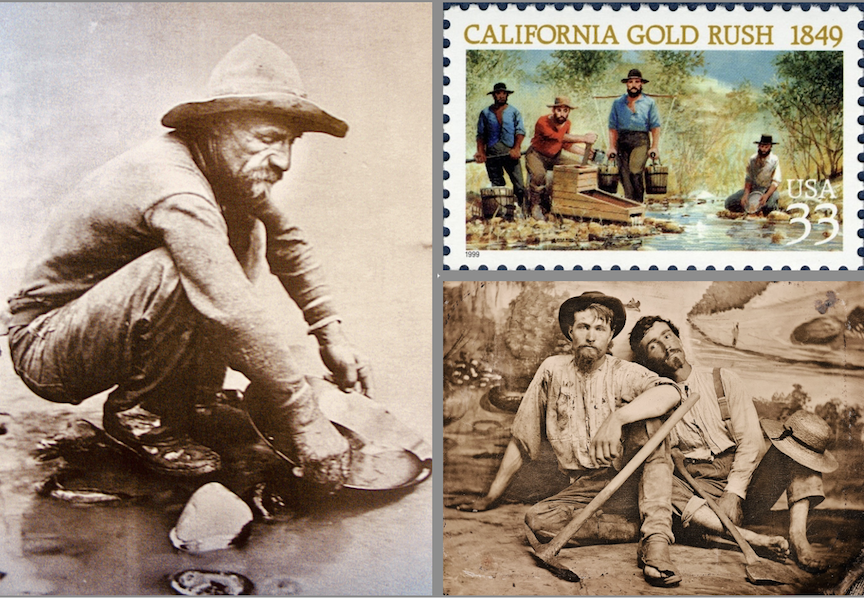
Above:
Left: Forty-niner panning for gold, Photo: L. C. McClure - Brinkley, Douglas: History of the United States. Viking Penguin. New York, 1998. Page 151, Public Domain,
https://commons.wikimedia.org/w/index.php?curid=2125279
Top Right: US Post office stamp, Public Domain, First day of issue: June 18, 1999
https://postalmuseum.si.edu/exhibition/art-of-the-stamp-the-artwork-americas-history/california-gold-rushhttps://postalmuseum.si.edu/exhibition/art-of-the-stamp-the-artwork-americas-history/california-gold-rush
Bottom Right: C. 1860 portrait of an unidentified pair of prospectors by an unknown photographer (collection of the Canadian Photography Institute. NGC, Ottawa)
https://hyperallergic.com/417336/daguerreotypes-of-the-california-gold-rush/
Side Note: Louis Daguerre invented the daguerreotype just ten years before the French government acquired the patent rights to make the process available to the public. The growing interest in photography coincided with the Gold Rush.
| |
|
Millionnaire is the same word in French...
• French immigrants came to California during the Gold Rush to seek prosperity. Around 35,000 Frenchmen arrived in California during the 1850's and 1860's, a time when pioneers had the best chance of finding gold. These Frenchmen and women pursued their dreams of wealth, success, political freedom, and adventure in California and Oregon. Many French immigrants made their fortunes in California's rivers, San Francisco's busy docks, upscale gambling saloons, and secret top-floor rooms of "French Restaurants."
These French sites below are from that era:
| |
|
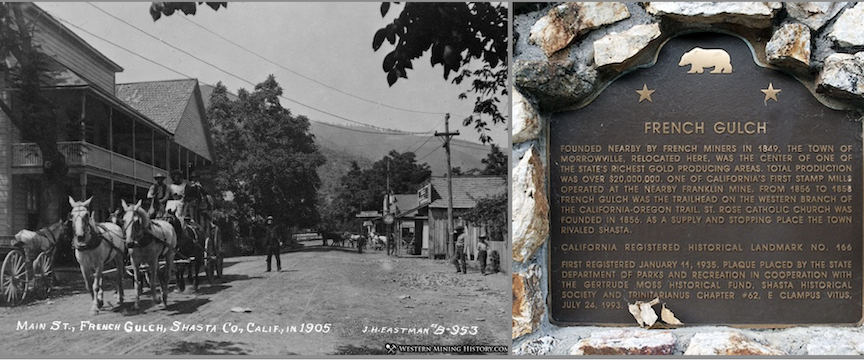
Marker, French Gulch, CA
14138 Main Street, French Gulch CA 96033
GPS: 40.699467, -122.638749
• Inscription:
“Founded nearby by French miners in 1849, the town of Morrowville, relocated here, was the center of one of the state's richest gold producing areas. Total production was over $20,000,000. One of California's first stamp mills operated at the nearby Franklin Mine. From 1856 to 1858 French Gulch was the trailhead on the western branch of the California-Oregon Trail. St. Rose Catholic Church was founded in 1856. As a supply and stopping place the town rivaled Shasta. First Registered January 11, 1935.
Erected 1993 by State Department of Parks and Recreation in cooperation with the Gertrude Moss Historical Fund, Shasta Historical Society and Trinitarianus Chapter #62, E Clampus Vitus”
| |
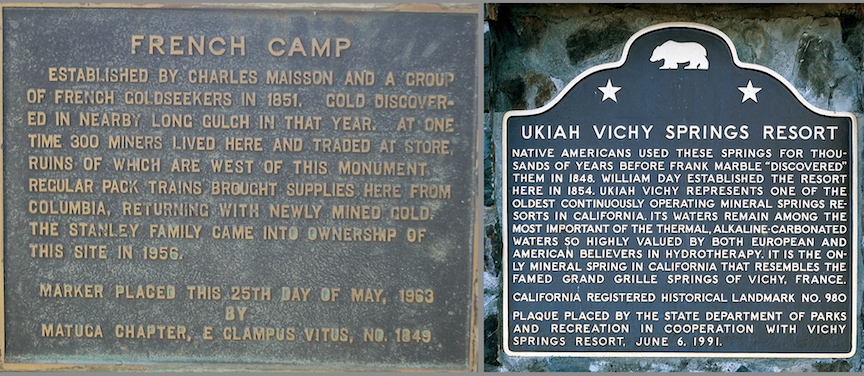
French Camp & Vichy Springs | |
|
Above:
Left: Bronze Plaque, photo by Barry Swackhamer, April 28, 2013
Right: Historical marker, photo: https://noehill.com/mendocino/cal0980.asp
| |
|
Marker, “French Camp”, CA
On private property. Forest Service Road 3N15, Columbia, CA 95310
GPS: 38.078182, -120.363595
• Inscription:
“Established by Charles Maisson and a group of French goldseekers in 1851. Gold discovered in nearby Long Gulch in that year. At one time 300 miners lived here and traded at store, ruins of which are west of this monument. Regular pack trains brought supplies here from Columbia, returning with newly mined gold. The Stanley Family came to ownership of this site in 1956.
Erected 1963 by E Clampus Vitus, Matuca Chapter No. 1849.”
Plaque, Ukiah Vichy Springs Resort”
2605 Vichy Springs Rd, Ukiah, CA 95482
GPS: 39.166750, -123.158633
• French gold seekers reportedly were struck by the similarity between these springs and the waters found at Vichy in Central France.
• Vichy Springs Resort, established in 1854 is a unique almost 170-year-old historic hot springs resort only two hours north of downtown San Francisco. It is the oldest ongoing resort of its kind in California and the oldest continuing business in Mendocino County.
• Inscription:
“Native Americans used these springs for thousands of years before Frank Marble "discovered" them in 1848. William Day established the resort here in 1854. Ukiah Vichy represents one of the oldest continuously operating mineral springs resorts in California. Its waters remain among the most important of the thermal, alkaline-carbonated waters so highly valued by both European and American believers in hydrotherapy. It is the only mineral spring in California that resembles the famed Grand Grille Springs of Vichy, France.”
Erected 1991 by State Dept. of Parks & Recreation in cooperation with Vichy Springs Resort. (Marker Number 980.)"
| |
|
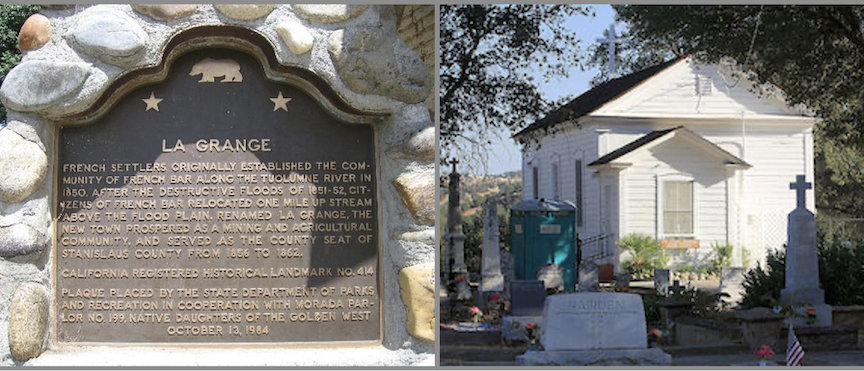
Above:
Right: St. Louis Catholic Church — in the La Grange Historic District, Stanislaus County, northern California, Photos By Saeidb - Own work, CC BY-SA 3.0
https://commons.wikimedia.org/w/index.php?curid=21530013
Left: photo Annette's site, https://www.bbbunny.com/la_grange.html
| |
|
Marker, “La Grange”, CA
30173 Yosemite Boulevard, La Grange CA 95329
GPS: 37.663800, -120.460500
• Founded by French gold diggers in 1852, the town of La Grange was designated as California Registered Historical Landmark No. 414 on November 15, 1948 and placed on the National Register of Historic Places on August 24, 1979
• In 1857, Lodge LaFayette #65 of the Independent Order of Odd
Fellows of California was formed. Also functioning is the oldest church in
Stanislaus County, St. Louis Roman Catholic Church, with a cemetery containing tombstones dating to the mid-1800s.
• Inscription:
“French settlers originally established the community of French Bar along the Tuolumne River in 1850. After the destructive floods of 1851-52, citizens of French Bar relocated one mile upstream above the flood plain. Renamed La Grange, the new town prospered as a mining and agricultural community, and served as the county seat of Stanislaus County from 1856 to 1862.
Erected 1984 by State Department of Parks and Recreation and Morada Parlor No. 199, Native Daughters of the Golden West. by E Clampus Vitus, Matuca Chapter No. 1849.”
| |
|
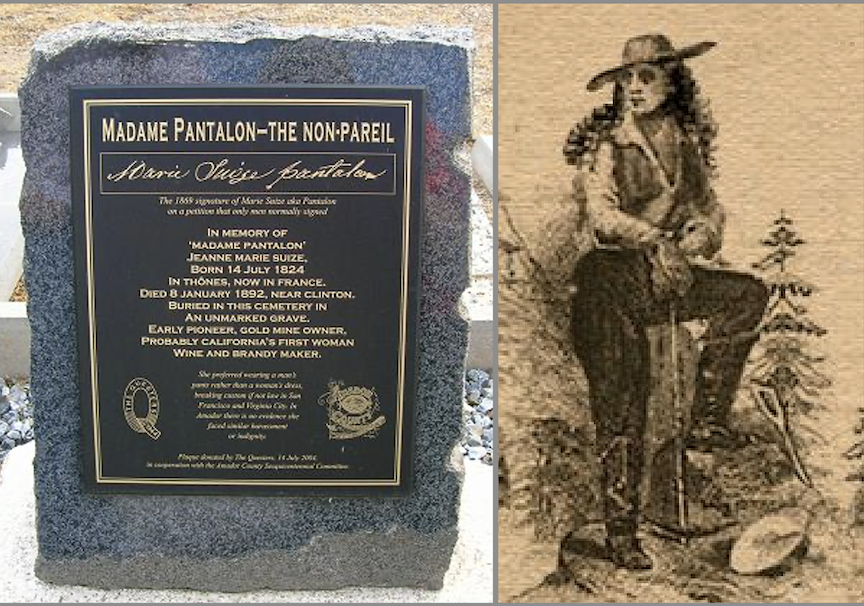
Marie Suize, "Madame Pantalon"
Gold digger, distillery entrepreneur, early feminist
| |
|
• Marie Suize was born in Thône, Savoie, on July 4, 1824 and was a French immigrant who left Paris with her brother to join the Gold Rush.
She became a successful gold digger and eventually became a wine grower and businesswoman, famous for wearing pants, which caused her to be brought several times in front of a judge.
• In many ways, she was a proto feminist. Unfortunately no photographic portrait of her are available.
• She died January 8, 1892 and was very famous in California at the time, as numerous newspapers articles were published about her.
• She also started a distillery business which was quite popular with the gold diggers.
• She was forgotten until 2004, until Amador County celebrated its 150th anniversary, and decided to honor the memory of “Marie Pantalon” by naming her "Sesquicentennial Woman of the Year."
Tomb, “Marie Suize Pantalon” - “Madame Pantalon Non-Pareil”
521-323 Church St, Jackson, CA 95642
GPS: 38.353480, -120.774240
https://thenovelhistorian.com/my-favorite-feminist/
• Inscription :
“In Memory of
“Madame Pantalon”
Jeanne Marie Suize
Born 14 July 1824 In Thônes, now in France
Died January 8, 1892, near Clinton
Buried in this cemetery in an unmarked grave
Early Pioneer, Gold Mine owner,
Probably California’s First woman
Wine and Brandy maker”
“She preferred wearing a man's pants rather than a woman's dress,
breaking custom if not law in San Francisco and Virginia City.
In Amador there is no evidence she faced similar harassment or indignity.
Plaque donated by The Questers, 14 July 2004, in cooperation with the Amador County Sesquicentennial Committee.”
| |
|
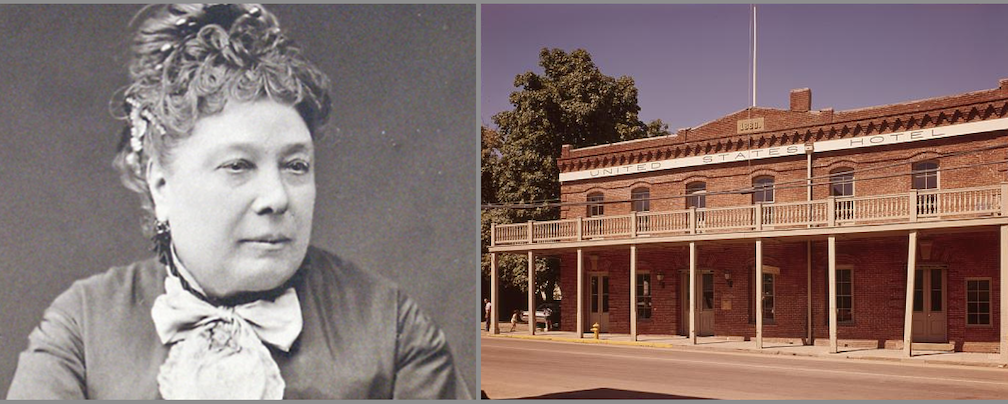
Jeanne de Roboam
Hotelière
| |
|
• Born in Bordeaux, France around 1820, Jeanne de Roboam's background is a mystery. Some say she was from an aristocratic family, while others claim she came from a middle-class background. Her arrival in America is unknown, but she is believed to have reached San Francisco in 1852 on the S.S. Lewis. Like many adventurers in the West, she took the chance to start fresh.
• By the late 1850s, Jeanne was settled in Jacksonville with Charles Laugier. They opened the Franco-American Hotel before 1858. In 1859, Jeanne filed for ownership of the hotel under the “Married Woman’s Property Act.” Laugier was the chef who built the hotel's reputation. Sometime after 1860, Jeanne and Charles parted ways.
• In 1866, Jeanne married George William Holt, a bricklayer. Rumors suggested she married him to fulfill her dream of owning a brick hotel. It was said that Holt had to walk behind Jeanne in public. In 1876, Jeanne built the U.S. Hotel, considered "the grandest on the West Coast".
• President Rutherford B. Hayes and his party stayed there, with Jeanne charging them $75, more than other hotels.
Noting that the Palace Hotel in San Francisco only charged $6 per night for its bridal chamber, Gen. W.T. Sherman, a member of the party, allegedly protested, “We don’t want to buy your hotel.” But Jeanne stood her ground, and supposedly responded, “Well, I thought the President could afford to pay a little more than the common people.”
• Jeanne was a savvy businesswoman, known for her wit and charm. Jeanne was reputed to say, “A glass of wine and small white lies doth not a harlot make”.
• She ran the U.S. Hotel until her death four years later. The hotel still exists!
| |
|
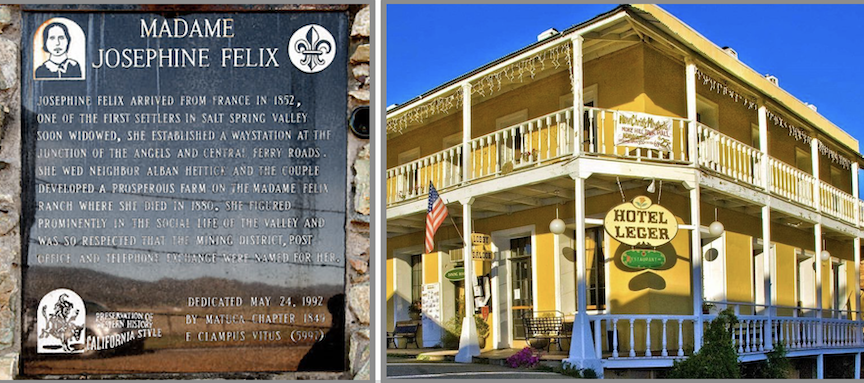
Madame Joséphine Félix
Rancher, entrepreneur, midwife
| |
|
Madame Joséphine Félix
• In the 1840s, California was full of opportunities. Sylvestre Félix, a Frenchman hoping to strike gold, couldn't resist the appeal of the golden hills. In 1852, he arrived in California after a long journey across the country. He settled near the Angels and Central Ferry roads and called for his wife Joséphine to join him. Unfortunately, shortly after her arrival, Sylvester passed away, leaving Josephine a widow.
• Joséphine soon proved to be a very able rancher and farmer. She transformed her home into a traveler's stop, serving food from her farm. It quickly became the town's gathering spot. Josephine also performed the duties of midwife for birthing mothers.
• She later married Alban Hettick, a Swiss farmer, during the Civil War when California became a key copper source for the Union Army. The first copper district in Calaveras County was established in 1860.
• Although Copperopolis is known for copper mining, gold was discovered here in 1858, copper in 1860. On Jan. 13, 1861, the name of the mining district was unanimously approved and subsequently christened as the “Madam Felix Copper Mining District”.
• The Madame Felix Mining District produced 200,000 ounces of gold between 1864 and 1974.
• The town of Copperopolis is located along State Route 4 and is registered as California Historical Landmark.
Marker, “Madame Joséphine Félix”
Mark Twain Union Elementary School District, Copperopolis CA 95228
GPS: 38.021217, -120.695633
• Inscription:
“Josephine Felix arrived from France in 1852, one of the first settlers in Salt Spring Valley. Soon widowed, she established a waystation at the junction of the Angels and Central Ferry Roads. She wed neighbor Alban Hettick and the couple developed a prosperous farm on the Madame Felix Ranch where she died in 1880. She figured prominently in the social life of the valley and was so respected that mining district, post office and telephone exchange were named for her."
Erected 1992 by E Clampus Vitus, Matuca Chapter 1849.”
Georges Léger, Hotel de France, 1851
• The Hotel Léger, in Mokelumne Hill, California is one of the oldest hotels still operating in California. The hotel and courthouse building are registered as California Historical Landmark #663.
• Georges Léger, a Frenchman who came during the California Gold Rush, opened his Hotel de France in 1851, as a wood-framed tent. After restoration following another fire in 1874, the hotel became known as the Hotel Léger, and it has been in operation ever since. The bar, which features a stained-glass back bar with the date 1851 in it, reportedly came around Cape Horn and has been in continuous use.
Marker, “Mokelumne Hill”
Hotel Léger & Saloon
8304 Main St, Mokelumne Hill, CA 95245
GPS: 38.301917, -120.705733
• Inscription:
“Mokelumne is an Indian word, first applied to the nearby river. Earliest settlement was at Happy Valley by French trappers. Gold was discovered by discharged members of Stevenson's Regiment in 1848. Center of the richest placer mining section of Calaveras County and one of the principal mining towns of California.
Corral Flat produced over thirty millions in gold. Sixteen feet square constituted a claim. The so-called 'French War' for possession of gold mines occurred in 1851.
'Calaveras Chronicle' was established in 1850. Fights between grizzly bears and bulls amused early residents. At one time headquarters of Joaquin Murieta . Town was destroyed by fires in 1854, 1864, and 1874.
County seat of Calaveras County from 1853 to 1866.
Erected 1937 by The Calaveras County Chamber of Commerce and The Native Daughters of the Golden West, June 1937. (Marker Number 269.)”
Léon Marniesse, Franco-American Hotel, 1855
• In 1855 a Frenchman, Léon Marniesse, purchased the house and it soon became the Franco-American Hotel. For many years it was a major hotel . Mr. Marniesse owned and operated the building until his death just a year later in 1868. the hotel housed a restaurant, Wells Fargo and Company Express Office, saloon and other businesses, and was a well-known stage stop. Prominent hotel guests were Vice President Colfax, General & Mrs. Philip Sheridan and President Hayes.
Marker, “Franco American Hotel Building”
314 W Miner St, Yreka, CA 96097
GPS: 41.732100, -122.637583
• Inscription :
“From a narrow, two story brick house in the 1850s, to an expansive hotel with a 167 foot frontage, the Franco American Hotel became one of the largest and finest inns in Northern California. Started by the Frenchman Leon Marniesse in 1855, the hotel housed a restaurant, Wells Fargo & Company Express Office, saloon and other businesses, and was a well-known stage stop. Through the years improvements consisted of a “piazza” or balcony across the front, additional suites of sleeping rooms upstairs and a two-story brick dining room. Among prominent hotel guests were Vice President Colfax, General and Mrs. Philip Sheridan and President Hayes. Erected by E Clampus Vitus, Humbug Chapter 73 & City of Yreka.”
Desiré Jules Tricot
• Desiré Jules Tricot was born in Paris on April 4, 1868. His father, Jules Tricot, had been involved in mining enterprises in Grass Valley since the 1850s, and later in Sheep Ranch, owning part of the Chavanne Mine in that community with his friend André Chavanne.
• He gave his name to Tricot City, near Copperopolis, CA.
https://www.calaverashistory.org/fricot-city
| |
|
San Francisco and the French community
in the 1850's
| |
|
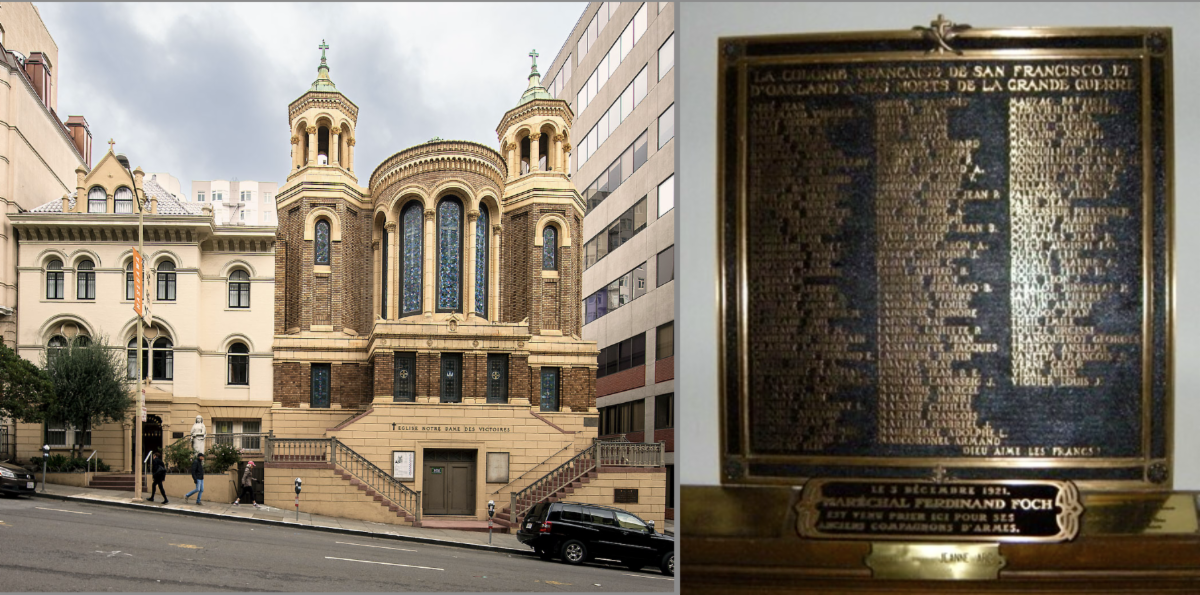
• San Francisco was once called the "Paris of the Pacific" because it was beautiful and sophisticated, like the City of Light. This was also because of the city’s significant French community, which is why it was also known as French San Francisco.
• San Francisco's French community is centered around the Notre Dame des Victoires church, which was constructed in 1864 and reconstructed in 1915 following the Great Earthquake. French-language Sunday mass is still held there.
• In 1852, the population of the city had grown to 36,000, with 6,000 French immigrants residing in French San Francisco.
• In 1851, French gold-seeker Albert Benard de Russailh came to town but wasn't impressed by the local prostitutes. Sadly, he passed away from cholera a year later. His letters were later turned into a book called "Journal de Voyage en Californie 1850-1852", in English"The Last Adventure."
Here are some excerpts:
"There is a great bustle all day long. Men hurry about doing their business; deals are put through easily and quickly, even when they amount to $100,000 or $150,000, and they are helped along by drinks of brandy in any one of the numerous bars of the city. Practically all transactions are discussed and closed with a few drinks, which is the recognized method of coming to an agreement. When buyer and seller have once drunk together, the bargain is definitely concluded. Wagons and carriages crowd along through the ruts of the street, and the docks are packed with all kinds of goods, brought by ships from the ends of the earth, to be traded for gold dust. By evening everything changes and the night-life begins. Business-men and merchants, who work so hard during the day, can think of nothing better to do right after dinner than to push into the innumerable stuffy gambling-houses where in a flash they lose everything they have earned. A few of them, but not very many, go to the theatre to enjoy subtler emotions.
[…] “San Francisco has three theatres and a circus. Two of the theatres are American, the Jenny Lind, and the American; the third is French, the Adelphi.” […] “I come now to the Adelphi Theatre, where every Sunday the French Troupe tries hard to put on something worth while. I confess that they do not always succeed, because they have very little to work with. The company is directed by three women, Mesdames Eléonore, Adalbert, and Racine. The other members of the troupe are Mademoiselle Alexina Courtois, Mademoiselle Bréa, Messieurs Richer, Paul Sasportas, Léon Prat, Yomini, Nitzel.” […]
On the whole, the French Troupe* is about as good as one could expect in California; the ensemble is as satisfactory as possible, and the shows are fairly varied, made up usually of light skits or comedies, farces, short plays of a more serious nature, or musical interludes. The women directing the company will soon have been two years in California, and have not done badly from a financial point of view, as they now own the building, the lot, and the scenery. Perhaps they have not earned all their money in the theatre. People say that there are certain wealthy patrons of the arts in the background, worthy men who have endangered their own fortunes to make Mademoiselle Racine and her partners richer. But I shall say no more, lest I be accused of gossiping: I am only telling what everyone in town knows." -- Albert Benard de Russailh
• San Francisco rapidly changed from a small settlement to a bustling city within a decade. The pursuit of wealth and progress by the argonauts was intense, shaping the city's culture with hard work, competition, and self-interest.
• The French immigrants had a significant influence on social life in San Francisco. They played a crucial role in reshaping the city's lifestyle and social norms. The French sought to recreate the refined settings of their homeland through their restaurants, theaters, shops, and bars. Their etiquette and attire stood out against the norms of the majority, leading to resentment from some Americans and other European immigrants.
• According to the San Francisco Annals:
“The wild glorification of Frenchmen to everything connected with their beautiful France, is often a neglectful insult to the land that shelters them, and which they would ignore, even although they seek not to become its permanent citizens. While many Americans were offended by French chauvinism, in time French customs were nonetheless incorporated into urban life and ultimately helped weave San Francisco's social fabric.”
Notre Dame Des Victoires Church
566 Bush St, San Francisco, CA 94108
GPS: 37.790580, -122.406446
• The French Church, also known as Église Notre Dame des Victoires, was established in 1848 by French priest Père Langlois. He came to San Francisco in 1848 and held mass at St. Francis Church. In 1856, Gustav Touchard purchased a Baptist Church on Bush Street and transformed it into Église Notre Dame des Victoires. After the great fire of 1906, it was rebuilt in 1913. The church's design is inspired by the Basilique Notre-Dame de Fourvière in Lyon, France.
• A plaque list the names of 114 French soldiers conscripted from the area who died during WWI.
• The centennial of the founding of the church is commemorated by another plaque given by the Republic of France in 1956.
• In 1984, the church was designated as a historical landmark.
• Inscription:
"La Colonie Francaise de San Francisco et d'Oakland
à ses morts de la Grande Guerre. Dieu Aime Les Francs."
[The French community of San Francisco and Oakland
to their dead of the Great War. God loves the French.]
[List of 114 names]
Le 3 décembre 1921
Maréchal Ferdinand Foch
est venu prier ici pour ses
Anciens compagnons d'armes"
["December 3, 1921 / Marshal Ferdinand Foch /
came here to pray for his / former comrades in arms"]
| |
|
Southern California:
When many Angelenos spoke French
| |
|
• French immigrants played a central role in the early days of Los Angeles. They fully numbered around one tenth of the European and Yankee population in the middle of the 19th Century.
• Imagine a time, only barely 200 years ago, when downtown Los Angeles was a small "pueblo" village with trees and orchards...and had a prosperous vineyard, planted by a certain Monsieur Jean-Louis Vignes.
• Imagine a time when the first photography of Los Angeles was taken (by a certain Monsieur Henri Penelon) a mere 30 years later, and...
• Imagine a time when three of the Mayors of Los Angeles spoke French...(one of them, Monsieur Joseph Mascarel, hardly spoke English)
• Imagine a time when today's Chinatown was called Frenchtown...
Let us introduce a few of these early pioneers, mostly forgotten today, even if streets bear their names, or a bronze plaque mentions them.
| |
|
Jean-Claude Vignes
“The father of California viticulture”
| |
|
Above:
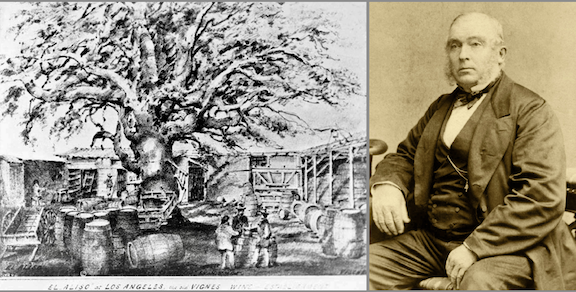
Right: Edward Vischer's pre-1875 drawing of El Aliso in the courtyard of the Vignes winery. Courtesy of the Title Insurance and Trust / C.C. Pierce Photography Collection, USC Libraries.
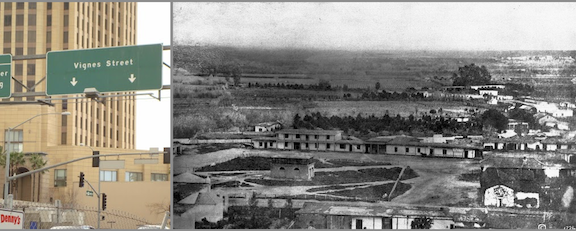
Left: photo of Jean-Louis Vignes https://resoluteoldwest.obsidianportal.com/characters/jean-louis-vignes. A Street in Los Angeles near downtown and the Los Angeles River is named after him. Sadly, a plaque exists but refers to a Public Works project and his story is not told to Angelenos and tourists (as of 2023)
Bottom Left: Vignes Street sign, downtown Los Angeles
https://losangelesrevisited.blogspot.com/2010/08/jean-luis-vignes-catalina-island-and.html
Bottom Right: First known photo of Los Angeles by French photographer Henri Penelon showing "El Aliso" (the nickname of the very tall tree in the background) & Jean-Louis Vignes' vineyards.
https://www.pbssocal.org/shows/lost-la/who-took-the-first-photo-of-los-angeles
| |
|
• Jean-Louis Vignes (or as he was known to his Mexican neighbors, “Don Luis del Aliso”), was a French settler to the Los Angeles area during the Mexican era. He was born on April 9, 1780 in Béguey, a small village near Cadillac and Bordeaux. His father was a cooper, and he became a cooper himself.
• After running into financial troubles in France, or for another obscure reason, at the age of 47 he left home, wife, family, as well as his business and arrived on the other side of the world in the Sandwich Islands (today Hawai’i) in 1827. After Queen Ka'ahumanu’s edict forbidding alcohol, he closed his rum distillery business in Honolulu, and sailed to Monterey, California, in 1831. He eventually made his way to Pueblo de Los Angeles in 1833. Upon arriving in the City of Angels, Jean-Louis Vignes bought 104 acres (0.42 km2) of land located between the original Pueblo and the banks of the Los Angeles River, in today’s downtown Los Angeles. He named his property El Aliso Winery after a famous old sycamore tree, which remembered today by a street named Aliso.
• He planted a vineyard and started preparing to make wine. In 1840, Jean-Louis Vignes became the first commercial wine maker in California and made the first recorded shipment of California wine. By 1850, Vignes was the largest wine producer in California, reportedly selling 150,000 bottles a year before retiring in 1855.
• He also planted the first orange grove in Los Angeles, producing between 5000 and 6000 oranges per season in 1851. He also grew 400 peach trees, as well as apricots, pears, apples, figs, and walnuts.
• Twenty of his family eventually followed him from France: three of his five children (Marie, Jeanne, Jean) and their respective families; his youngest brother (Pierre Esliens); Four nephews (Pierre Sainsevain, Jean-Louis Sainsevain, Jean-Marie Vignes, Vital Vignes) as well as Many friends. For an unknown reason, his wife Jeanne never left France, and died in Béguey in 1842.
• He died in Los Angeles on January 17, 1862, at the age of 82
• The area around Vignes’ estate had, by the 1850s, become the center of French settlers in Los Angeles, which fully numbered around one tenth of the European and Yankee population at the time, and was known as “French Town”.
• In 1856, he made a large gift to the Catholic Sisters of Charity to participate in the financing of the first hospital in Los Angeles, which opened on May 31, 1858. He also contributed to the founding of the first Los Angeles public school.
• Vignes Street was named after him in 1874:
Located in downtown Los Angeles, CA 90012
GPS: 34.059750, -118.233333
| |
|
Damien Marchessault, Mayor of Los Angeles
elected mayor of Los Angeles from 1859 to 1860
and, again, from 1861 to 1865
| |
|
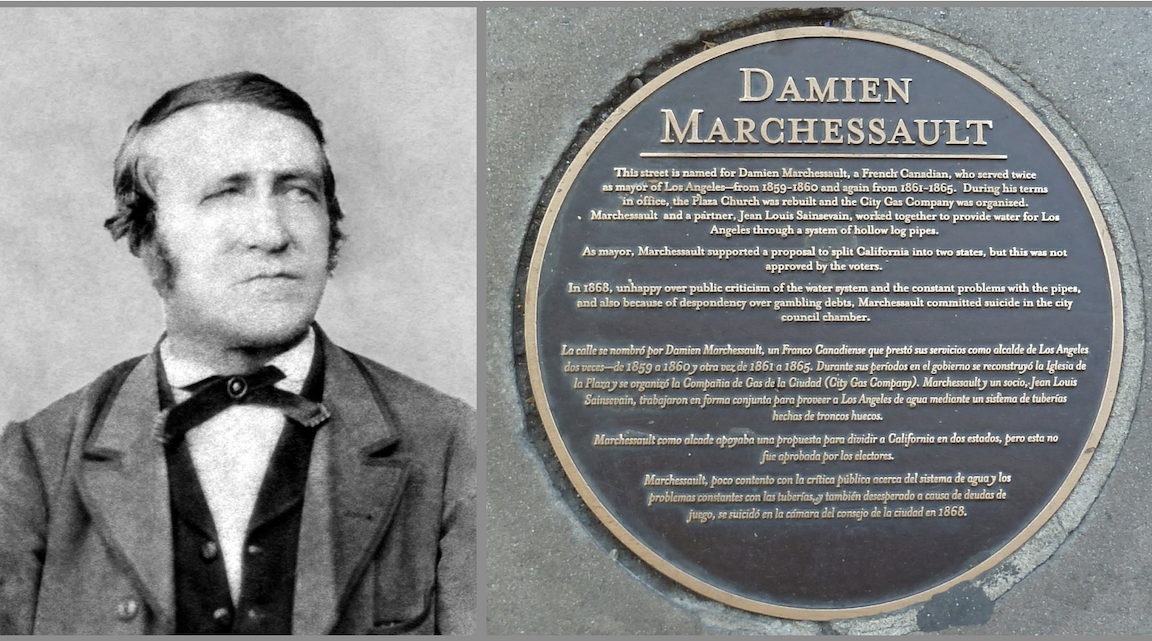
• Damien Marchesseault, also known as Damian Marchesseau or Marchessault, was a prominent French-Canadian politician born on April 1, 1818, in St-Antoine-de-Richelieu, Québec. •• He played a significant role in the political landscape of Los Angeles, serving as the 7th mayor on three separate occasions. His mayoral terms were from May 9, 1859, to May 9, 1860, January 7, 1861, to May 6, 1865, and May 8, 1867, to August 8, 1867. He was known for his carousing lifestyle and his past as a gambler in New Orleans. Alongside his business partner, Victor Beaudry, he established an ice vending company, showcasing his entrepreneurial spirit.
• During his tenure as Water Overseer of the City of Los Angeles, Marchesseault, along with his partner Jean-Louis Sainsevain, undertook the task of laying wooden water pipes beneath the city's streets. Unfortunately, this endeavor resulted in bursting pipes, leading to extensive flooding and the formation of muddy sinkholes.
• Tragically, he shot himself in the head while in the Council Room of the City Hall.
Marker, “Damien Marchessault”
Embedded in the sidewalk in front of the Mexican Consulate,
100 Paseo de la Plz, Los Angeles, CA 90012
GPS: 34.056683, -118.238117
• Inscription:
“This street is named for Damien Marchessault, a French Canadian, who served twice as mayor of Los Angeles - from 1859-1860 and again from 1861-1865. During his terms in office, the Plaza Church was rebuilt and the City Gas Company was organized. Marchessault and a partner, Jean Louis Sainsevain, worked to provide water for Los Angeles through a system of hollow log pipes. As Mayor, Marchessault supported a proposal to split California into two states, but this was not approved by the voters. In 1868, unhappy over public criticism of the water system and the constant problems with the pipes, and also because of despondency over gambling debts, Marchessault committed suicide in the city council chamber.”
| |
|
Joseph Mascarel, Mayor of Los Angeles
Mayor from 1865 to 1866
| |
|
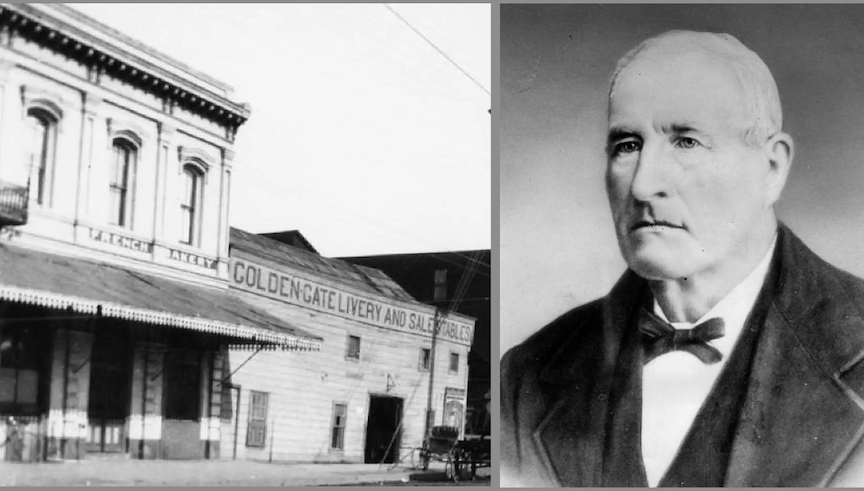
Above:
Right: Joseph Mascarel, French immigrant to California and mayor of Los Angeles from 1865-66.
Photo: Security Pacific National Bank Collection / Los Angeles Public Library
Left: The French district in Los Angeles is shown looking east on Aliso Street from Alameda Street. The building to the left has the sign of his French bakery.
Photo: Security Pacific National Bank Collection / Los Angeles Public Library.
https://frenchtownconfidential.blogspot.com/2016/12/the-warren-buffett-of-early-la-mayor.html
| |
|
• Joseph Mascarel, born on April 18, 1816, in Marseilles, was a prominent figure in 19th-century Los Angeles. He had a diverse range of occupations, including being a sea captain, California landowner, banker, investor, baker, (his bakery can be seen on the photo above) and wine merchant.
• Mascarel's journey began at the age of eleven when he embarked on a French merchant ship. Later, at the age of 21, he joined the French Navy, serving for four years. Despite his extensive travels and experiences, Mascarel, like many French immigrants in California, struggled to fully grasp the English language. He was an imposing figure at 6 feet tall and weighing 200 lbs.
• Eventually, Mascarel arrived in the pueblo of Los Angeles and found employment at Jean-Louis Vignes vineyards. Through his determination and entrepreneurial spirit, he quickly established himself as a self-made businessman. Mascarel played a significant role in the development of early Los Angeles and owned valuable properties in the heart of the city's wholesale district, as well as in San Bernardino, Riverside, Ventura, and Santa Barbara Counties.
• During the American Civil War, Mascarel aligned himself with the Union government and actively worked to counter a strong secessionist movement in Los Angeles. In 1864–65, he served as a member of the Los Angeles Common Council and later went on to become the Mayor of Los Angeles from May 5, 1865, to May 10, 1866.
• As mayor, Mascarel advocated for the prohibition of weapons within the city. However, his limited command of the English language became a subject of criticism during the municipal campaign in 1866. A local newspaper published an advertisement seeking “a mayoral candidate who possessed the ability to read and speak English”. Despite this setback, Mascarel's contributions to the growth and progress of Los Angeles were undeniable.
• The historian H.D. Barrows had this to say to the Historical Society of Southern California: "Mascarel was in many ways a remarkable man. He had clear and eminently practical views, strong convictions and good business judgment, which enabled him to accumulate a handsome fortune. Although he donated considerable sums to charitable and other purposes during his lifetime, his charities, which in his later years amounted to several hundred dollars a month, were, as a rule, unknown to outsiders - that is, to everyone except himself and his beneficiaries".
• When Joseph Mascarel passed away on October 6, 1899, at his residence on 615 Ducommun Street in Los Angeles, his estate was estimated to be worth one million dollars (the equivalent of $38M today).
• Mascarell Avenue (with 2 "L") is named after him.
Located downtown Los Angeles, CA 91345
GPS: 34.269695, -118.456287
| |
|
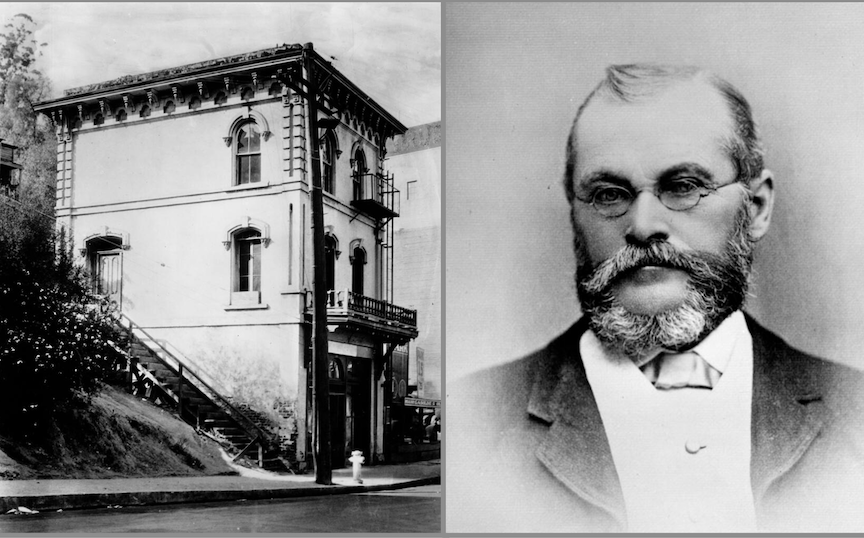
Prudent Beaudry, Mayor of Los Angeles 1871-1873
served three consecutive one-year terms
& his partner
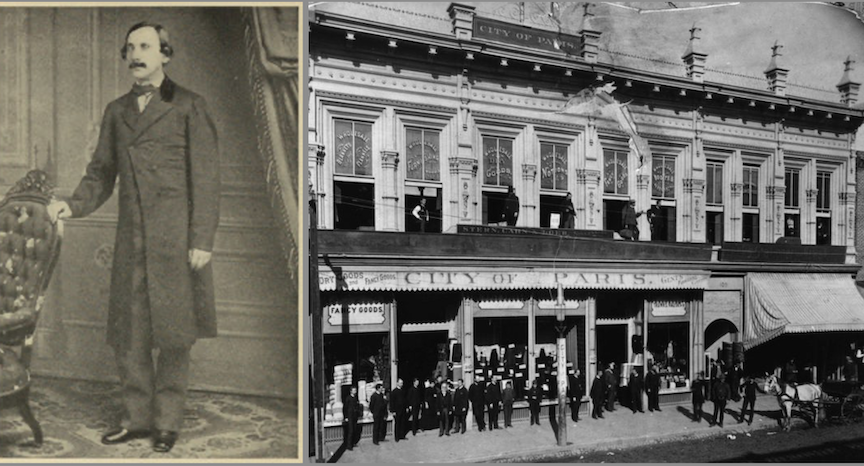
Solomon Lazard
Founder of Lazard Frères and Company
| |
|
Above:
Top Left: Residence of Prudent Beaudry, at 81 New High Street, Public Domain, University of Southern California. Libraries and California Historical Society.
Top Right: Portrait of Prudent Beaudry, Mayor of Los Angeles from 1874 to 1876, By Unknown author - Public Domain, https://commons.wikimedia.org/w/index.php?curid=18439658
Bottom Left: Solomon Lazard, By Unknown author - Jewish Museum of the American West, Public Domain, https://commons.wikimedia.org/w/index.php?curid=84831999
Bottom Right: City of Paris store, Los Angeles, CA [1890’s] on Spring near Temple, #WS1007, S. Lazard & Co. had a large new brick store built in 1866 on Main Street, which eventually became known as The City of Paris after Lazard retired in 1873 and turned the company over to his cousin, Eugene Meyer. Photo: https://www.jmaw.org/lazard-jewish-los-angeles/
| |
|
• Jean-Prudent Beaudry, was born on July 24, 1816, in Mascouche, Quebec, near Montréal. Prudent and his brothers acquired a remarkable education and fluency in English. In 1844, Prudent Beaudry made the decision to leave the family business and join his younger brother, Victor, in San Francisco. Although the Gold Rush was still a few years away, Victor had already established a lucrative shipping and commission enterprise in the city. Before long, the Beaudry brothers found themselves involved in the ice business, with Victor partnering with Damien Marchesseault.
• However, it was in 1867 that Prudent Beaudry made a significant real estate investment that would shape his future. At a Sheriff's Department auction, he acquired the steep hill above New High Street, known as Bunker Hill, for a mere $55. On this land, he constructed a massive reservoir and a pump system that supplied water from the marshy lowlands of Los Angeles to Bunker Hill. Consequently, Bunker Hill became the prime location for the construction of grand residences. This purchase propelled Beaudry into becoming California's first realtor and large-scale developer, in addition to his role as an urban planner. He began purchasing extensive tracts of land, dividing them into lots, and selling them very profitably.
• Prudent Beaudry and his brother Victor displayed astute foresight by continuously acquiring land. Their predictions, which surpassed their wildest dreams, were that the connection of railroad lines between Los Angeles, San Francisco, and the East Coast would result in a massive influx of settlers into Southern California. Their contributions were instrumental in the establishment of the cities of Pasadena and Alhambra.
• Prudent Beaudry served three consecutive one-year terms on the Los Angeles Common (City) Council from 1871 to 1873 and became the first president of the city's newly formed Board of Trade in 1873. In 1874, he achieved another milestone by becoming Los Angeles' mayor.
• Beaudry Avenue in Downtown Los Angeles is named for him, as well as the tallest skyscraper (2023)
Marker, “Bunker Hill” -
50 S Hope St T-275, Los Angeles, CA 90071
GPS: 34.052517, -118.253417
• Inscription (excerpts):
“[..] Eighteen years later, a man named Prudent Beaudry exhibited one of those virtues - hope - when he bought the 20 hilltop acres at a sheriff's auction”[...]
Solomon Lazard, from the Lazard finance dynasty
• Solomon Lazard, also called S. Lazard, was born on April 21, 1826 in Frauenberg, in Lorraine (a suburb of Sarreguemines near the German border) and emigrated to the US in 1844. After New York, San Francisco, San Diego, he settled in Los Angeles, California and started a dry goods retail business with a cousin.
• He started S. Lazard & Co, which later became the City of Paris department store.
• Los Angeles women flocked there to buy the newest French fashion.
• Lazard Frères and Company, the renowned international banking firm, was established in 1848 by cousins Alexandre, Lazare, and Simon Lazard in New Orleans, Louisiana. In the mid-19th century, Los Angeles had no bank, so people either kept their money at home or entrusted it to the Catholic nuns at a convent on Alameda Street and Macy Street. When Eugène Isaac Meyer arrived in Los Angeles in 1859, Solomon Lazard did what his brothers were doing in Paris and Strasbourg: He opened a deposit window in his store called "Lazard et Frères". Brothers Maurice and Elie Lazard later joined the firm after moving to San Francisco in 1851.
• Lazard served on the Los Angeles Common Council in 1854 and then again in 1861–62. In 1873, he became the inaugural president of the Los Angeles Chamber of Commerce.
• In 1869, Lazard, John S. Griffen, and Prudence Beaudry rescued the struggling civic water company and got a 30-year lease from Los Angeles.
Lazard served as the company's President and died in 1916.
They built a water supply system with iron pipes, many of which are still in use today!
https://www.jmaw.org/lazard-jewish-los-angeles/
| |
|
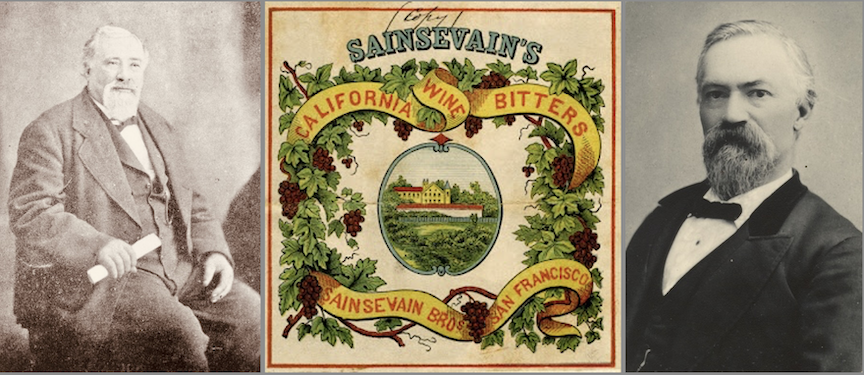
Pierre and Jean-Louis Sainsevain
Wine growers, entrepreneurs, civic leaders
| |
|
• Pierre and Jean-Louis Sainsevain exerted a significant influence on Los Angeles and various regions of California. Their mother, Marie Vignes Sainsevain, was the sister of Jean-Louis Vignes.
• Shortly after Pierre arrived at his uncle's El Aliso vineyard, he embarked on voyages to Santa Barbara, Monterey, and San Francisco by ship, in search of new buyers for his uncle's renowned wine and brandy. Remarkably, he accomplished the very first wholesale wine transactions in the annals of California. At that time, California was still a part of Mexico, and in 1844, Pierre became a naturalized Mexican citizen, assuming the name "Pedro Sainsevain" to secure a land grant of 6,000 acres in Santa Cruz from the Governor. Collaborating with another French carpenter named Charles Roussillon, Pierre established a sawmill and a flour mill, subsequently relocating to Stockton to supply provisions to Gold Rush miners.
• In 1849, Pierre also served as a delegate to the California Constitutional Convention.
• In a notable development, Pierre and his brother Jean-Louis engaged the services of Monsieur Debanne, a former Champagne maker for Veuve Clicquot, to produce Sainsevain Brothers Champagne in 1857. The following year, El Aliso vineyards emerged as the leading wine producer in the state, yielding an impressive 125,000 gallons of wine and brandy. They even dispatched Champagne to President James Buchanan, who lauded its flavor.
• When the French government established its consulate in Los Angeles in 1860, Sainsevain Brothers Champagne was served.
• Jean-Louis became the first Grand Master of L.A.'s Masonic lodge.
• Both brothers continued to launch new enterprises throughout California, including the installation of Los Angeles' first public water supply pipes in collaboration with Mayor Marchessault.
• Jean-Louis passed away in Pasadena in 1889, while Pierre’s death occurred in France in 1904.
• East Commercial Street was formerly named Sainsevain Street
Near Hwy 101, Los Angeles, CA 90012
GPS: 34.053033, -118.233987
We very much regret the change of name!
We recommend further reading on these brothers, and many other French immigrants who helped build Los Angeles at its very beginnings, by clicking on this very well documented blog:
https://frenchtownconfidential.blogspot.com/2016/06/the-incredible-sainsevain-brothers.html
| |
|
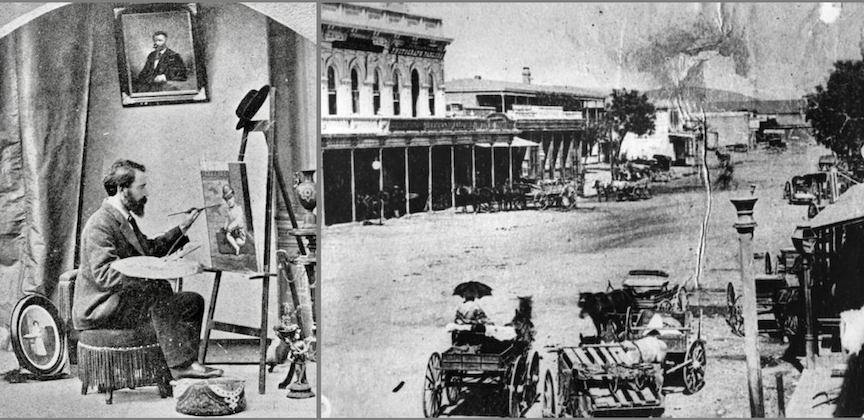
Henri Penelon
Los Angeles first photographer and professional artist
| |
|
• Henri Joseph Penelon, (at times referred to as "Honore," "Horacio," or "Henry”) was born in Lyon, France, in 1827, and died in Prescott, Arizona, in 1874.
• The precise date of his arrival in Los Angeles remains uncertain, although tax records indicate his ownership of a property on Calle Principal, now known as Main Street, as early as 1856.
• Penelon played a significant role as one of the founding members of the French Benevolent Society, established in 1860. Prior to the construction of the French Hospital in 1869, society members provided assistance in caring for the sick and injured within the French community.
• Penelon was married to Emilia Herriot, who was twenty-five years his junior. Sources differ on whether Emilia was born in France or San Francisco, but she undoubtedly had French ancestry. Their daughter, Hortense, was born in 1871, followed by their son, Honoré, around 1874.
• Penelon pursued a career as a photographer, which allowed him to continue working as a painter. His photographs were marked with the inscription "H. Penelon, Artistic Gallery, Los Angeles." He started his daguerreotype studio in Los Angeles from 1853.
• Additionally, Penelon also painted frescoes in the Plaza Church in Los Angeles. His works are rare and of historical value.
• He is credited with introducing to Los Angeles the practice of using cartes de visite, small prints photographs utilized as calling cards.
| |
French sites of Memories in Los Angeles | |
|
A few sites with French memories...
The tangible signals of French presence in a distant past (everything is relative) are quite faint and almost lost in the hubbub of modern L.A.
Still, here are a few:
• The French Hospital was to Los Angeles what the American Hospital is to Paris. Unfortunately, after 167 years the hospital closed its doors on Nov 30, 2017, and is now “Allied Healthcare City”.
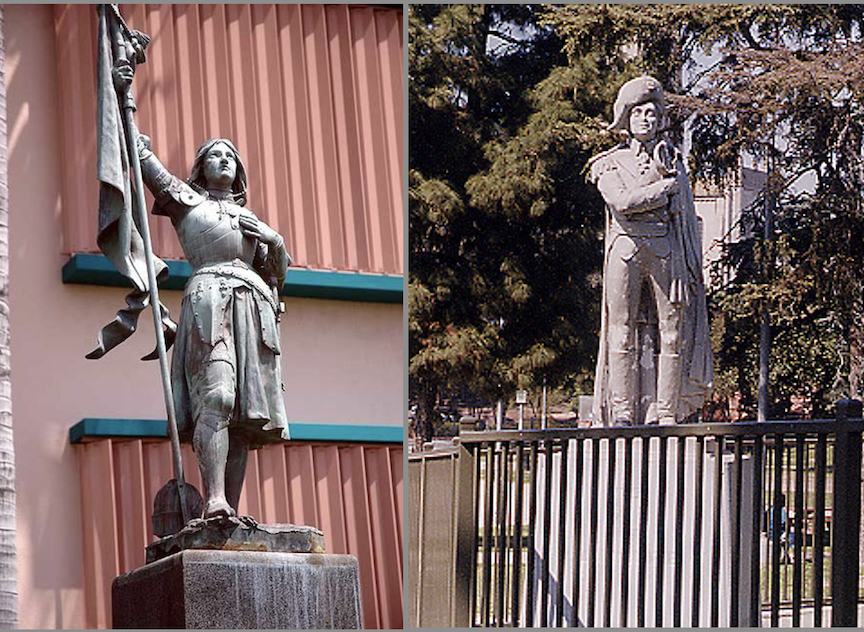
• The statue of Joan of Arc which used to be at the entrance was reportedly given to Children’s Hospital.
Marker, “The French Hospital”
531 W College St, Los Angeles, CA 90012
GPS: 34.064617, -118.239017
• Inscription (excerpts):
“French Roots: Between 1850 and 1860, French and French Canadian immigration to Los Angeles exceeded that of all other nations. In 1883, a French-language newspaper, Le Progrès, began publication. Damien Marchessault, a French-Canadian mining speculator, was elected mayor of Los Angeles from 1859 to 1860 and, again, from 1861 to 1865. A French sea captain, Joseph Mascarel, was mayor from 1865 to 1866. During this time, French was the second most widely spoken language in Los Angeles after Spanish and before English. As a result, when General McDowell came to Los Angeles on an official visit at the conclusion of the Civil War he was interviewed in French.
The French established Los Angeles' first vineyard and were responsible for the laying of the first residential water pipes. They supplied the city with ice and salt, and they opened bakeries and restaurants. The influence of many of these early pioneers can be found in street names such as Beaudry, Bernard, Sentous, and Vignes.
On March 1, 1860, the French Benevolent Society was formed to build a hospital that would be open to all, regardless of race, religion, or nationality. Members contributed an initial $2 when joining and paid a monthly fee of $1. The accumulated revenues led to the laying of the adobe cornerstone on October 4, 1869. Rumor has it that one section of the orignal adobe structure is still encased within what once was called the French Hospital. [...] "Erected 2003 by City of Los Angeles."
The Marquis de Lafayette in poor shape...
• One of two statues of Lafayette in California is in Los Angeles, standing on a pedestal design.
• It was sculpted by Arnold Foerster and unveiled on March 30, 1937. It is made of concrete over a layer of plaster.
• This was a New Deal Project. At the base an inscription says “Federal Art Project, 1937”
• The original location was called Sunset Park, but the name was changed in 1918 to Lafayette Park. Some local bloggers even wonder today why the municipality "caved in" (sic) to French local societies' demands back then.
• The statue is in disrepair and the face of the Marquis de Lafayette disfigured. We hope it will be restored in a not-so-distant future.
Statue of Lafayette, Los Angeles, CA
South Lafayette Park & Wilshire Avenue
5077006901, Los Angeles, CA 90005
GPS: 34.061846, -118.283651
• Inscription (barely legible):
“La Fayette
Voici Mon Epée”
(Here is My Sword)
When Chinatown was Frenchtown....
• Philippe Fritz (born May 1, 1844 in Preuschdorf, Bas-Rhin, France – died Jan 30, 1932 in L.A.) was among the thousands of Alsatian pioneers emigrating to the United States after the Franco-Prussian War of 1870.
Marker, “The Fritz Family homes”
415 Bernard St, Los Angeles, CA 90012
GPS: 34.067033, -118.236300
• Inscription (excerpts):
“The houses at 411 and 415 Bernard Street — today home to the Chinese Historical Society of Southern California and Chinatown Heritage and Visitors Center — were once part of a three-home complex built by Philip Fritz. An immigrant from Alsace, Fritz worked first as a carpenter then as superintendent of buildings and bridges for the Southern Pacific Railroad” [...]In 1886, Fritz built his first home on the property. As his family grew, he added two more in 1888 and 1892.[...]
Bringing water to the dusty desert pueblo of Los Angeles has been a challenge since the beginning and one that multiplied as the city grew.[....] In 1861, Frenchman Jean-Louis Sainsevain erected a forty-foot water-wheel in what is today the area called the "cornfields." The wheel raised water in 15-gallon buckets from the river to a flume, which led to a reservoir centered in the Plaza at El Pueblo. By the 1860s, the zanjero, the person in charge of the system, was considered so important that he received a higher salary than the mayor. In 1868, the city entered into an agreement with John Griffin and two men of French descent, Prudent Beaudry and Solomon Lazard, who together formed the Los Angeles City Water Company for the distribution of all water from the zanja madre [...]
Erected by City of Los Angeles.”
...But the Taix Family carries on!...
• This marker located at the foot of a government tower building is mentioning many names and places we introduced above, with the addition of the Taix Family culinary dynasty, whose 4th generation still operates today this famous restaurant on Sunset boulevard.
Marker, “Roybal Federal Building”
255e E Temple St #300, Los Angeles, CA 90012
GPS: 34.052500, -118.239533
• Inscription (excerpts):
“There is no greater monument to Los Angeles’ ethnic diversity than Little Tokyo, the one-time commercial center of the growing little pueblo. In the neighborhood originally settled by French immigrants...[...] It all came together in the 1830s, when Jean Louis Vignes — exiled from France for philandering and political zealotry — arrived here from Bordeaux. He brought with him grapevine cuttings that he used to found a 100-acre vineyard just south of what is now Union Station.
Soon, other French families with names like Sainsevain, Viole, Penelon, Bouchet, Nadeau and Taix followed, building homes and opening businesses in what quickly became a French enclave. Henri Penelon set up the city's first photography and artist studio. The Viole family opened a pharnlacy while Marius Taix baked bread.[...] Soon thereafter, Penelon, the city's first professional artist, began creating portraits of his fellow Angelenos in photographs and oils at his studio.
Casting Bread on Los Angeles Waters
In 1882, when Taix, the baker from the French Alps, arrived in Los Angeles, he bought a small lot on Commercial Street for $10,000, opened Taix French Bread Bakery and began catering to the 4,000 French who lived here.
The building survived until 1913, when Taix built the Champ d'Or Hotel on the site, and leased out space for a restaurant. In 1927, at the height of Prohibition, federal agents and Taix's pharmacist son confronted the restaurant's operator for selling liquor on the property. The angry restaurateur tossed the young Taix the keys and told him to "do it yourself.” Thus the Taix French Restaurant was born. In celebrating its opening, the same federal agents returned to toast the son's new profession with whisky that he had purchased for "medicinal purposes.” The restaurant served its last specialité3 de la maison at the site in 1964, when the city paid $412,000 for the property that eventually became the Metropolitan Detention Center. Ten adjacent buildings as were demolished, two of which dated to the 1880s. The culinary dynasty continued at a new location on Sunset Boulevard.
Erected 2000 by City of Los Angeles.”
| |
|
Other Notable French Pioneers of California
Many were farmers and ranchers. Some launched an entire industry. Some became rich bankers and entrepreneurs. Several opened hotels and restaurants. The list is long, here are just a few:
| |
|
Louis & Pierre Pellier
Kings of the prune industry
| |
|
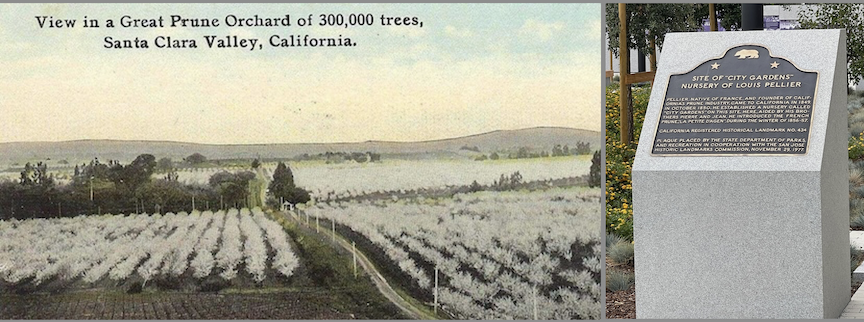
• Louis Pellier (Nov 12, 1817 – June 13, 1872) was born in St. Hippolyte, France, and came to California during the gold rush. He soon realized that fruit being sold for $1 proved more of a fortune than gold. By the early 1850s, he'd opened the City Nursery in downtown San Jose. He was joined a few years later by his brother Pierre. In 1854, Pierre journeyed back to France and returned with a wife, and cuttings and seeds for the nursery. From these, Louis grafted the French prune onto the rootstock of the wild plum, which produced the prune that Santa Clara Valley became famous for.
Marker, “Pellier Park” – Louis Pellier, “The Prune King”
183 St James Street, San Jose, CA 95110
GPS: 37.337833, -121.895667
• Inscription:
“Pellier Park is all that remains of the City Gardens Nursery, established by Louis Pellier in 1850. Here with, his brothers, Pierre and Jean, Louis introduced “la petite D’Agen,” the French Prune, during the winter of 1856-1857. It was this variety that became the mainstay of the California prune industry – the backbone of San Jose’s economy for more than 70 years.
Erected by San Jose History Walk”
Marker, “Prune Capital of the World”
570 East Remington Drive, Sunnyvale CA 94087
GPS: 37.356300, -122.024917
• Inscription:
“Prunes! Enough to feed the British army. I am charmed with your valley and mountains. Words cannot describe it.” -Lord Horatio Herbert Kitchener, English visitor, circa 1920.
The first prune trees in the valley were produced by cuttings of the Petite d'Agen, a French prune, brought from France by Pierre Pellier in 1856. His brother Louis grafted the cuttings to plum rootstock and was so successful that, by the turn of the century, 85,000 tons of prunes were produced here.
Santa Clara County was dubbed the "prune capital of the world” because it was the world's largest single producer. Production peaked in the 1930s at 274,000 tons and prunes quickly became the county's largest crop.
Prunes demand less quality soil and less water than either cherries or apricots. One of the most common varieties found in the Santa Clara Valley was the Imperial which was introduced by nurseryman John Rock in 1886. The first commercial prune orchard in the valley was the Bradley Ranch, 10 acres at Stevens Creek Road and Bascom Avenue.”
Marker, “Pellier Park”
Louis Pellier, “The Prune King”
W St James St, San Jose, CA 95110
GPS: 37.337733, -121.895917
• Inscription of marker:
[This marker is composed of three photographs with captions. Reading from left to right:]
San Jose City Gardens Nursery: People traveled far and wide to visit Louis Pellier’s City Gardens Nursery and purchase orchard and vineyard fruit varieties from Europe.
Louis Pellier: Louis Pellier is credited with the introducing la petite prune d’Agen, the little French prune to the Valley of Heart’s Delight. This fruit make Santa Clara County the largest fruit producing and canning center in the world.
Pellier House: The success of the French prune allowed Louis Pellier to build his home and expand his holdings in Santa Clara County.
Photo[s] Courtesy of History San Jose
Erected by City of San Jose Parks, Recreation and Neighborhood Services/ City of San Jose Redevelopment Agency. (Marker Number 434.)Commission. (Marker Number 505.)
Several other markers, plaques, and murals pay tribute to the Pellier family in Santa Clara Valley and are compiled in the book "Memories of France".
| |
|
Abraham Achille Lévy & Henry Lévy
Founder & Director of the Bank of A. Levy
| |
|
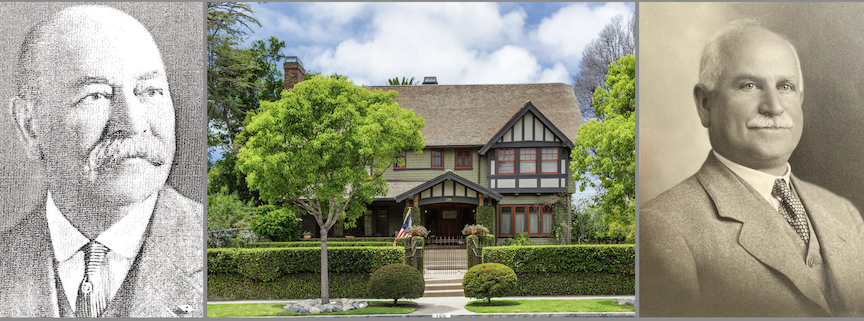
• Abraham Achille Levy (1853-1922) was a businessman, banker, and community leader in Ventura County. Born in 1853 in Mommenheim, France, he was 18 years old when he immigrated to California. In 1873, at the age of 20, he partnered with Moise Wolff and opened a successful general merchandise business. Working at the Wolff and Levy General Store, Levy worked closely with many local farmers and businessmen. He returned briefly to Europe, where he married Lucy Meinette Levy in Paris. Upon his return, he started the Agricultural Brokerage, a new business that served as a middleman between the farmers of the Santa Clara River Valley and markets in San Francisco. His brother-in-law Henry Levy also worked for him and was integral to the business.
• The brokerage business led to the establishment of the Bank of A. Levy in the 1880s. The bank was incorporated in 1905. The Levy family maintained control of the Bank of A. Levy after Levy's death in 1922. The bank became an economic pillar of the county with 17 branches in the county and 65,000 customer accounts until it was bought by First Interstate Bank in 1995.
• Marker, “Henry Levy House”
155 S G St, Oxnard, CA 93030
GPS: 34.201983, -119.186867
• Inscription:
“The Henry Levy House, circa 1914.
Ventura County Landmark #74.
Erected 1982 by Ventura County.”
| |
|
Alphonse Weill
Founder of Weill’s Department Stores
| |
|
• Alphonse Weill was born on December 20, 1852, in Wolfisheim, Bas-Rhin, Alsace. In 1870, Alphonse Weill immigrated to New York City. From New York City, Weill took the train to San Francisco, intrigued by romance of American mining. Weill headed to Havilah in the San Juaquin Valley, where he worked at his uncle Henry Asher’s hotel for room and board.
• In 1875, he became the the sole owner of the store – known as A. Weill’s, and eventually as Weill’s Department Store. His younger brother, Samuel Weill, was briefly a partner.
• He married Henrietta Levy in 1882 in San Francisco, and were the parents of Blanche, Irma, Adele, and Lawrence. He died on December 31, 1946, at the age of 94.
• Alphonse Weill became also one of the original stockholders of the Southern Hotel, the Bakersfield Water Works, and a principal owners and incorporator of the Jewett Oil Company.
• Their former home at the corner of 17th and H Streets is now at the Kern County Museum in Bakersfield.
Marker, “Alphonse Weill's Department Store”
19th St, Bakersfield, CA 93301
GPS: 35.376333, -119.018283
• Inscription:
“Alphonse Weill came from France to Havilah in 1870 and moved to Bakersfield in 1872, was employed by merchant Jacob Weil (no relation), and became his partner in 1873. Subsequently Weill acquired the business and named it Weill's Department Store. A brick building replaced the wood structure in 1887 and was rebuilt after the fire in 1889. Weill died in 1946 and the firm was sold in 1952, but continued to operate as Weill's until 1963.
Erected 1976 by Lawerence & Helen Weill, Bakerfield Bicentennial Committee.”
Marker, “ Weill House”
3801 Chester Ave, Bakersfield, CA 93301
GPS: 35.392600, -119.021717
• Inscription:
“Built on the southeast corner of 17th and H Streets in Bakersfield in 1882, Alphonse and Henrietta Weill’s house was considered “modern” for its day because of the high ceilings, long hallway, and indoor plumbing.
In 1870, Alphonse Weill migrated from France to Kern County. He originally settled in the mining town of Havilah to pursue a career as a merchant. Two years later, Alphonse moved to Bakersfield and later opened his own general merchandise store. Alphonse was a successful businessman operating his store in Bakersfield for more than 70 years.
Henrietta Levy Weill, a native of San Francisco, came to Bakersfield at the time of her marriage in 1882. Alphonse and Henrietta had four children, Blanche, Irma, Adele and Lawrence. A member of numerous civic organizations, Henrietta worked to improve the lives of Kern County residents through education and social service. The Henrietta Weill Memorial Child Guidance Clinic is named in her honor.
The Weill family donated the house to the Museum in 1950.
Erected by Kern County Museum.”
| |
|
Charles LeFranc, Etienne Thée, Paul Masson
The Lafourcade Family, Pierre Hypolyte Dallidet
Wine growers
| |
|
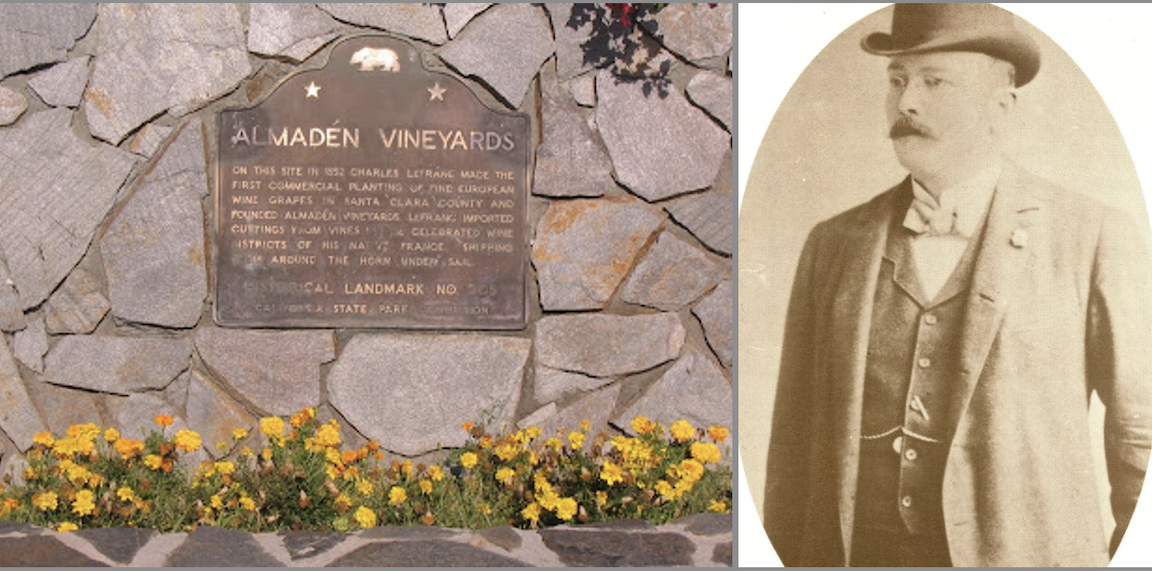
• French immigrants using French wine making methods were the largest group of vineyard owners and winemakers here during the early Gold Rush years, supplying wine to those who came through San Francisco to prospect for gold.
• Old Almaden Winery was founded in 1852 with French vines planted by Etienne Thée. It was passed down to Thee's son-in-law, Charles Le Franc, then to Le Franc's son-in-law, Paul Masson.
• Masson was born on 14 February, 1859 in Beaune, Burgundy, immigrated in 1878 and moved to California, where he met Charles Lefranc. He went back to France in 1880 to finish school, then returned to California due to the wine industry crisis in France.
• After Lefranc's death, Masson bought land in Saratoga, California and started his own winery, naming it La Cresta. He planted 60 acres of Pinot Noir and Chardonnay, and renamed the winery the Paul Masson Champagne Company, now known as The Mountain Winery.
• In 1892, he introduced his first sparkling wine under the name "champagne" at Almaden. Masson was later known as the "Champagne King of California" after winning at the Paris Expo in 1900.
• He was appointed to California's Board of State Viticultural Commissioners in 1913. Masson passed away on October 22, 1940 and was buried at Oak Hill Memorial Park in San Jose.
Marker, “Almadén Vineyards”
5611 Le Fevre Dr, San Jose, CA 95118
GPS: 37.239100, -121.894700
Note: The marker is incomplete, Etienne Thée & Paul Masson should have been recognized.
• Inscription:
“On this site in 1852 Charles LeFranc made the first commercial planting of fine European wine grapes in Santa Clara County and founded Almadén Vineyards. LeFranc imported cuttings from vines in the celebrated wine districts of his native France, shipping them around the Horn by sail.”
Erected 1953 by California State Parks Commission. (Marker Number 505.)
The Lafourcade family:
Marker, “The Lafourcade Family and its Winery”
11899 Foothill Blvd, Rancho Cucamonga, CA 91730
GPS: 34.106067, -117.546217
• Inscription (excerpts):
“In the early part of this century, John B. Lafourcade established an extensive and elaborate wine-making and grape-handling business in an era marked by failed attempts at such endeavors in the Rochester/Cucamonga area. The story of Lafourcade represents an important link in the early history of the Cucamonga Valley. Migrating at the age of 17 from La Houtan, France, the young man arrived in the Pomona Valley in the early 1900s. Lafourcade accepted the challenges posed by the hot, dry climate and embarked on his venture, purchasing 800 acres along old San Bernardino Road, known today as Foothill Boulevard. At first transporting water from the canyons above by wagon, in 1918 Lafourcade drilled the area's deepest well at 630 feet at the purported cost of $33,000 [...] The passage of Prohibition combined with the effects of the Great Depression, spurred the demise of the Lafourcade enterprise, and the family left the area in the 1940s to focus on other entrepreneurial efforts in agriculture elsewhere in California and Arizona.”
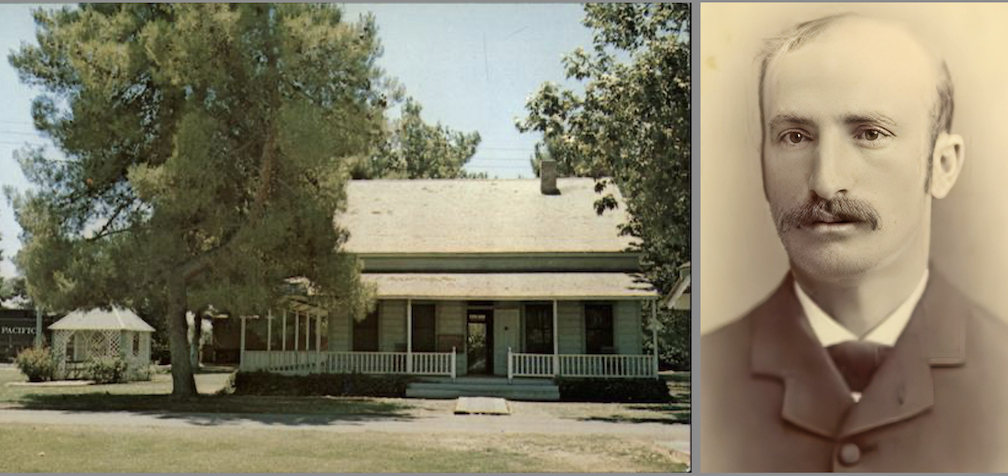
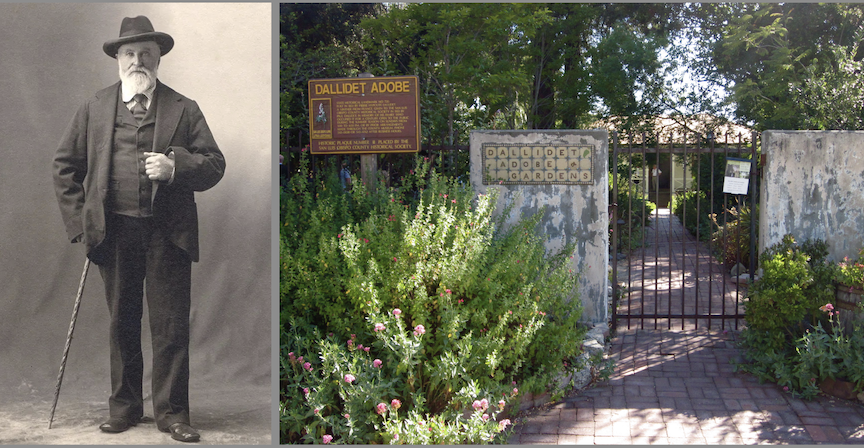
Pierre Hypolite Dallidet,
first commercial winemaker in San Luis Obispo County:
• Pierre Hypolite Dallidet is celebrated as the first commercial winemaker in San Luis Obispo County, and he confirmed his fame when he also became the first commercial distiller in the county.
• His son, Paul Dallidet, transferred it to the San Luis Obispo County Historical Society in 1953, in his family's memory.
• The Dallidet Adobe and Gardens is a California Historical Landmark (#720) in San Luis Obispo, California. The site was originally the property of Pierre Hypolite Dallidet (1822-1909) , who came to San Francisco in search of gold in 1850.
Marker, “Dallidet Adobe”
1185 Pacific St, San Luis Obispo, CA 93401
GPS: 35.280967, -120.656500
• Inscription:
"This was the home of Pierre Hyppolite Dallidet, a native of France, who settled in San Luis Obispo in 1853 and became a vineyardist. His son, Paul Dallidet, gave it to the San Luis Obispo County Historical Society in 1953, in memory of the Dallidet family that had occupied it for a century.
Erected 1960 by California State Park Commission, SLO County Historical Society, Native Daughters of the Golden West. (Marker Number 720.)"
| |
|
Jules Simoneau
Restaurateur in Monterey, CA
and
Jules Tavernier
First artist studio in Carmel, CA
| |
|
Above:
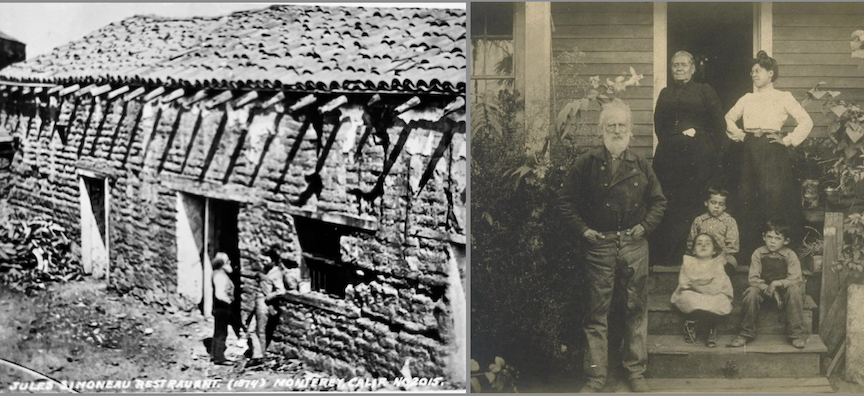
Left: Post Card of the Jules Simoneau's Restaurant (1874), Monterey, California. Standing in the courtyard of the old jail at Monterey in 1874 are tavern owner Jules Simoneau and artist Jules Tavernier. Simoneau used the courtyard to raise chickens that supplied meat and eggs for patrons of his tavern. By Unknown author, Harrison Memorial Library Park Branch Library, Public Domain,
https://commons.wikimedia.org/w/index.php?curid=121750769
Right: Jules Simoneau, age 88, at home in Monterey. His wife, his daughter, & the grand children. 1907
UC Berkeley, Bancroft Library, https://oac.cdlib.org/ark:/13030/tf838nb6qp/?brand=oac4
| |
|
• During the latter half of the 19th century, Jules Simoneau (born in France in 1819, died on Aug 23, 1908) possessed and managed a dining establishment in Monterey. This restaurant served as a popular gathering place for a diverse array of immigrants and Californios. In addition to being a friend of author Robert Louis Stevenson, he also was close to French artist Jules Tavernier (whom we met in our last Bulletin, as he was among the first artist to portrait scenes of the Far West).
Marker, “Jules Simoneau Plaza, City of Monterey”
401 Camino El Estero, Monterey, CA 93940
GPS: 36.597350, -121.894450
• Inscription:
“Robert Louis Stevenson inscribed this message in the frontpiece of his book: “The Strange Case of Dr. Jekyll and Mr. Hyde – but the case of Robert Louis Stevenson and Jules Simoneau, if the one forgot the other, would be stranger still.”
"Jules Simoneau, a French immigrant, came to Monterey in the 1870’s and operated a restaurant on this site. The restaurant was frequented by Robert Louis Stevenson in the fall of 1876. During his stay in Monterey, Stevenson made many descriptive notes which later appeared in is tales. When he fell ill it was Jules Simoneau who nursed him back to health. Stevenson’s gratitude and affection for his friend was later shown by sending him copies of the first American editions of his books with an affectionate note and signature in each. These books and his letters to Simoneau are now in the rare books and special collections section of the University of California Library at Berkeley. This plaza was first dedicated on May 17, 1967."
Erected 1969 by City of Monterey"
Jules Tavernier
First artist studio in Carmel, CA
• Jules Tavernier was born in Paris on 27 April 1844. He studied with French painter Félix Joseph Barrias, but left France in the 1870s and never returned. Tavernier worked as an illustrator for Harper's Magazine and went on a year-long coast-to-coast sketching tour in 1873.
• He arrived in San Francisco in the summer of 1874, then traveled south and founded an art colony on the Monterey Peninsula.
• In 1874, he found a tavern owned by his compatriot Jules Simoneau.
• He briefly set up a studio at the Girandin Hotel (now called Stevenson House). In November 1875, Tavernier and Walter Paris leased space on Alvarado Street, establishing the first dedicated artist studio in Monterey.
• Tavernier's connection with Monterey led to his marriage to Lizzie Fulton in San Francisco in February 1877, whom he initially met in Monterey in 1876.
• He continued westward to Hawaii, where he became known as a landscape painter. He was fascinated by Hawaii’s erupting volcanoes, a subject that pre-occupied him for the rest of his life. Tavernier spent his life in Hawaii, Canada, and the western United States, and died on 18 May 1889 in Honolulu, Hawaii, where a memorial honors him at Oahu cemetery.
| |
|
The Dubost Family and the Petit Family
Early ranchers of California
| |
|
Auguste & Pauline Dubost
• Auguste Dubost (seated above right) was born in Cherbourg, France on 4 Aug 1848 and married Pauline Duquesne in 1880 (seated left, also born in Cherbourg on May 13, 1861).
• They settled in Adelaida as a blacksmith and wheelwright in 1882, however, the entrepreneurial Auguste also operated a lime kiln, stone quarry, and mule business; and in 1889 he opened the Adelaida Post Office in his general store. • An historic plaque now marks the location of the store on Adelaida Road and is the point still referred to as “Adelaida” on many maps.
• Auguste and Pauline raised three children: Alfred (standing left), born in 1883, operated the Adelaida ranch; Frank (standing right), born in 1886, operated the Bellevue ranch; Nathalie (standing center), born in 1881, died of pneumonia while on her honeymoon in 1908. Word of her death travelled slowly, compelling Auguste to found the Adelaida Rural Telephone Company.
Marker and plaque, “Adelaida”
9850 Adelaida Rd, Paso Robles, CA 93446
GPS: 35.646633, -120.873633
• Inscription of marker (excerpts):
“Since 1797 the route of the old padre trail through this area provided a key link to the coast for Mission San Miguel and the lower Salinas valley, especially in the 1860’s for the shipping of mercury, vital to the recovery of California’s gold.
During the mid 1800’s settlers and entrepreneurs flooded into the area, including Auguste and Pauline Dubost who arrived from France in 1882 and opened a blacksmith shop. He moved the Adelaida Post Office to this site in 1889 and became postmaster. He then proceeded to operate a general store, acquire interests in mines, run a portable steam engine to power threshing machinery and a saw mill and had a lime kiln operation for plaster and mortar used in Paso Robles construction. Late word of his daughter’s death, while on her honeymoon to Los Angeles in 1908, resulted in him cofounding the Adelaida Rural Telephone Company, maintained and owned by grandson Raymond Dubost until 1960. By his death in 1917 Auguste Dubost had accumulated nearly 4000 acres of Adelaida ranchland” [...]
Erected 2000 by E Clampus Vitus, de la Guerra y Pacheco Chapter 1.5"
• Inscription of plaque on the side:
In Memoriam
"Universal recognition of the vial role play by pioneer women and their successors in repeated frequently in Adelaida history. We salute them all when we recognize one of our own beloved: Anne Dubost Thorpe 1918 – 1994
Dedicated by the Dubost – Thorpe Families
May 8, 2000"
Justin & Frances Petit
For many immigrants, the road to California was not a straight line...
• Justin Petit was born in 1852 in Fresnes-Saint-Mames, Haute-Saône, and migrated to the United States with his parents Jean-Baptiste and Elizabeth.
• The Petit family originally settled in Clearfield County, Pennsylvania. Later, they relocated to Douglas County, Kansas. After Elizabeth's death in 1870, the family moved to California and made their home in Ventura County.
• Frances died in 1931, and Justin passed away in 1936. They had four children.
Marker, “Petit Ranch House”
730 S B St, Oxnard, CA 93030
GPS: 34.194500, -119.179333
• Inscription (excerpts):
“Original Owner: Justin and Frances Petit. Original Location: 1900 East Wooley Road. Construction Date: Ca. 1896. Architect: Herman Anlauf.
The History:
The Petit family emigrated from France to America in 1853 when baby Justin was two years old; his sister Annette was 12. The Petits settled first in Pennsylvania then Kansas; after Annette and her husband moved to California, the rest of the family followed. Here Justin married Frances Kaufman, one of the five Kaufman daughters whose father was the first American pioneer to farm in the Santa Clara River Valley. The Petits had seven children. Like many early farmers from humble beginnings, the success of their sugar beet and lima bean crops enabled the Petits to grow wealthy in Oxnard. Restored by Petit descendent, Gary E. Blum.
Regarding Petit Ranch House:
Ventura County Historical Landmark statement of significance:
“...It was the first farm residence in Ventura County lighted by electricity. The two-story house had eight porches, seven bedrooms, two parlors, two bathrooms, kitchen, dining room, foyer and maid's room [...] A native of France, Justin Petit became one of the most successful farmers of lima beans, sugar beets and lemons in the County”...
Erected by Oxnard Heritage Square. (Marker Number 100.)"
| |
The “Icaria-Speranza Utopian Colony”
Early French social experiments in California
| |
Above:
Left: Members of the Icarian utopian community settled in Cloverdale, CA in the 1880’s, source: Cloverdale Historical Society, https://www.hmdb.org/m.asp?m=160857
Right: Engraving, Etienne Cabet. The Icarian movement was inspired by an 1840 utopian novel by Étienne Cabet, Voyage en Icarie (Voyage to Icaria). https://commons.wikimedia.org/wiki/File:Etiennecabet.jpg#/media/File:Etiennecabet.jpg
| |
Long before the Sixtie's, California attracted groups desiring to live differently from the rest of society.
• The Icarians were a French utopian socialist movement, established by the followers of politician, journalist, and author Étienne Cabet (1788-1856). Cabet led his followers to America in 1848, where the Icarians established a series of egalitarian communes in the states of Texas, Illinois, Iowa, Missouri, and California. The movement split several times due to factional disagreements.
• The group bought the 885-acre Bluxome ranch on the Russian River. Originally named Speranza, after Leroux's review L'Esperance, the community gained members of Young Icaria and became Icaria-Speranza.
Marker, “Icaria-Speranza Utopian Colony”, 1881
27241-27783 Asti Rd, Cloverdale, CA 95425
GPS: 38.774300, -122.999800
• Inscription:
“Icaria-Speranza was a utopian community based on the writings of French philosopher Etienne Cabet. In 1881, at Cloverdale, French immigrant families led by the Dehay and Leroux families began their social experiment in cooperative living based on solidarity and depending on an agrarian economy. It lasted until 1886. Icaria-Speranza was the only Icarian colony in California and the last of seven established throughout the United States. On this site stood the Icarian schoolhouse, deeded to the colony in 1886.
Erected 1989 by California State Department of Parks and Recreation in cooperation with the National Icarian Heritage Society and the Cloverdale Historical Society”
| |
|
The Basques in the West
Like many European immigrants in that era, Basques faced challenges and sought a better life. They saw America as a place of opportunity and hope, leading them to migrate to the United States in the late 1800s and early 1900s. The Gold Rush of 1849 prompted Basques to go to California for mining. The thriving sheep industry for both meat and wool offered additional job opportunities in the U.S., and the completion of the transcontinental railroad in 1869 made travel to the American West faster, safer, and more affordable.
Basque men often came by themselves, with little schooling, no knowledge of English, and sometimes with the goal of earning money to go back home. A lot of them worked difficult jobs like sheepherding, which most Americans didn't want, for low pay and in tough, isolated, and physically demanding environments.
We highlight below the memorials in their honor and a few of these immigrants who accomplished so much in their new country.
| |
|
• This National monument to the Basque sheepherder was inaugurated in 1989. It is entitled “Bakardade,” or “Solitude” and is the work of noted sculptor Nestor Basterretxea. It depicts a shepherd carrying a lamb over his shoulder. Basques whose ancestors came from both France and Spain for a vibrant diaspora in several Western States.
National Monument, “Basque Sheepherder”
Rancho San Rafael Nature Trail, Off North Virginia Street, Reno, NV 89503
GPS: 39.554083, -119.831850
• Inscription
(side in English, the other side in Basque):
“A figure
As if sculpted by the wind itself
A man solitary and Strong
Held straight by his own Will
Patient Laborer
Facing onto the uncertain horizon
of adventure
Endless stretches of the silences of moon
and stars
Through mountain trails
This monument is
eternal homage and memorial
to the Basque sheepherder.”
Statue, “Basque Sheepherder”
University of Nevada, William A. Douglass Center for Basque Studies
1664 N Virginia St, Reno, NV 89557
GPS: 39.543427, -119.816150
• As the original owners of the Nugget Casino Resort in Sparks, the late Rose and John Ascuaga commissioned artist and Reno native Douglas Van Howd to sculpt the Basque statue for the opening of the casino’s Basque-themed restaurant, Orozko, in 1998. For many years the striking bronze figure of the Basque sheepherder welcomed visitors to the Nugget. In 2021, it was donated to the University and its Center for Basque Studies by the Nugget Casino Resort and relocated to the University of Nevada campus.
• Inscription:
The shepherd
“A tribute to our parents,
Who were among the many
Basque immigrants whose
Courage helped to shape
The American west. Their
Old world values of hard
Work and honesty set the
Standard and America
Provided the opportunity.”
John and Rose Ascuaga, August 4, 1998
The Garat Family:
• The Garats were French Basque who came to Nevada in 1874, where they purchased 320 acres near the White Rock settlement in northeastern Elko County. This began a four-generation ranching tradition that grew into one of the largest ranching empires in the county.
Marker & Statue, “Preserving our Basque Heritage”
1490 Idaho St, Elko, NV 89801
GPS: 40.841367, -115.753467
• Inscription (excerpts):
“On December 29, 1868, representatives of the Central Pacific Railroad started laying out lots for the future town of Elko. By 1870, the thriving town had 5,000 people. There was an immense volume of freight and passenger traffic over the stageline roads north and south from the railhead at Elko to the mining area.
The University of Nevada was originally built in Elko in 1874 and remained here until 1885, at which time it was moved to Reno to its present location.
By the early 1870’s, Elko became the marketing and economic center for northeastern Nevada’s vast range livestock empire. In the 1870’s and 1880’s, great ranching principalities were built on Elko County’s vast rangelands. These ranches were ruled over, absolutely, by such powerful and colorful cattle kings as L.R. “Broadhorns” Bradley, Nevada’s second Governor and its first “cowboy” Governor; the French Garat family, Spanish Altubes, and John Sparks, Governor of Nevada in the early years of this century.” [...]
Erected 1970 by State of Nevada. (Marker Number 106.)"
The Borda Family
• The Basque sheep herding tradition is alive and well in Northern Nevada. In 1914, Raymond Borda (1894-1950), immigrated from the French Pyrenees Mountains, taking a job herding sheep for his Brother-in-Law in Carson Valley. He eventually founded his own sheep ranch there in 1921. The business grew and eventually his sons Raymond “Dutch” and Pete took over. Today, Borda Land and Sheep Company, LLC. carries on with Pete’s son Ted and sisters, Joyce Gavin and Angie Borda Page running the operation.
Marker, “History of the Borda Ranch”
Near Parking space, Kings Canyon Waterfalls, Carson City, NV 89703
GPS: 39.152800, -119.815400
• Inscription:
“Originally a Washoe Indian trail, Kings Canyon served as a gateway to Lake Tahoe following the gold rush to California. Eagle Station was established in 1851 near the mouth of the canyon, Dr. Benjamin King built his ranch the next year, and others followed founding Carson City in 1858.
Lumber was transported down Kings Canyon and timbered the Comstock mines. The immigrant road later served as part of the famous Lincoln Highway, the nation's first transcontinental route. Beginning in 1947, Basque ranchers, Pete and Raymond "Dutch" Borda, pastured sheep in the upper canyon. Carson's City growth posed a barrier to the sheep drives to and from Dayton by the 1970s. The environmentally-conscious Borda family conveyed the scenic, ranch property into public ownership in 1997.”
Erected 1997.”
Juan & Marie Yparraguirre
In the 1890s, San Francisco had a thriving Basque Town. By 1900, hotels like Hotel de France, Hotel des Alpes, Hotel de Basse-Pyrennees, and Hotel Europa formed the Basque town in the Broadway to Pacific Street area. Similar to Los Angeles, Basque-owned hotels were grouped together within a small area.
Jean & Marie came from both sides of the French & Spanish border, he from Etxalar a little hamlet, she from the village of Urepel also right by the opposite border, only a few miles from each other, yet they met in San Francisco. Soon after getting married at Lady of Notre Dame church in San Francisco, they opened a boarding house, and eventually a full-fledged hotel.
Yparraguirre´s Hotel was a popular location among Bay Area Basques in the 1890s. Juan loved music and often invited musicians to play in the restaurant and barroom.
| |
|
Dominique Bordagaray
"One of the oldest bars in California"
| |
|
• A successful farmer and businessman among the old settlers on the West Side in Fresno County, Dominique Bordagaray was born in St. Jean Pied de Port, Basses Pyrenees, France, January 15, 1876, and died in Fresno on November 8, 1953. His wife Louise died in 1978.
• Dominique Bordagaray, migrated to the United States in 1893, settling in Los Angeles in December of that year. Upon his arrival, Bordagaray began working with sheep farmers. He spent approximately two years in the nearby mountains of Millwood Basin, where he self-taught himself English. Upon his return to civilization, his English proficiency was notable.
• At the beginning of the 20th century, Bordagaray managed a hotel in Fresno and expanded his business to include the buying and selling of sheep. He established a sheep-shearing enterprise in Coalinga and was the first to utilize modern sheep-clippers in the area.
• On the Bordagaray homestead just east of Coalinga, he cultivated cotton, maintained several fruit orchards, and operated a vineyard. During Coalinga's early years, he constructed a row of store buildings, including a French laundry, a theater, and various other businesses in the town. In 1917, Bordagaray opened a tavern and rooming house on Fifth Street, which remained operational until it was demolished in the 1983 earthquake. It was commonly known as one of the “oldest bars in California .”
• Dominique Bordagaray was also the father of professional baseball player, Stanley “Frenchy” Bordagaray.
Marker, “Bordagaray’s - One of the “Oldest Bars in the West”
163 Coalinga Plaza, Coalinga, CA 93210
GPS: 36.139500, -120.359750
• Inscription:
“Dominique Bordagaray was born in St. Jean Pied de Port, Basses Pyrenees, France. Immigrated to the United States in 1893. Moved to Fresno Co. in 1895 and worked as a sheepherder until 1908. He established a sheep shearing camp at “Turk”, 9 miles east of Coalinga. Here he became the first man to use modern sheep shearing clippers. He homesteaded 140 acres 11 miles east of Coalinga. He also bought 6 lots on “C” street near Fifth. In 1904 he built a row of store buildings in Coalinga, one was a French laundry where he met his wife, Louisa Devaures. They were married in 1905. Their wedding was held at the Sullivan Hotel, another early Coalinga landmark. In 1913 with a partner he took over ownership of “Jack’s Place on Whiskey Row”. Later he started a tavern and rooming house on Fifth St. in 1917. This Tavern remained until the earthquake of 1983. One of the“Oldest Bars in the West”.
Erected by Coalinga Lions Club.”
| |
|
Pete Aguereberry
Indefatigable Death Valley prospector
| |
|
Marker, "Aguereberry Camp"
Aguereberry Point Rd, Death Valley, CA 92328
GPS: 36.363117, -117.110167
• Inscription:
“There is gold in the hill in front of you, and old- time prospector Shorty Harris and his greenhorn partner Pete Aguereberry discovered it in 1905. Their discovery triggered a short-lived mining boom. The tent town of Harrisburg blossomed on the neighboring flats, and the surrounding hills still bear the scars of dozens of mines.
Of all the prospectors and miners who toiled here, only one - Pete Aguereberry - persisted. Aguereberry worked this claim for forty years until his death in 1945. His home still stands at the west edge of the buildings clustered at the ridge base.
Pete Aguereberry was Basque, born in Mauleon, France in 1874. For most of his four decades here he worked his mine by himself. Remarkable persistence, not financial success, made him one of the most famous prospectors in the Panamint Range.
Federal law requires the protection of the natural and historic resources here and elsewhere in Death Valley National Park. Please leave them undisturbed for others to discover.
To reach Aguereberry's Eureka Mine and the Cashier Mill, follow the road to the left around the east end of Providence Ridge.”
Erected by Death Valley National Park.”
| |
|
Théophile Verlaque & Bernard Etcheverry
First residents of Ramona, CA
| |
|
• Before it was permanently settled, the Ramona area was inhabited by the Kumeyaay Nation of native Americans (Diegueño). In 1886, Frenchman Théophile Verlaque built the town's first house. The Verlaque house, located at 645 Main Street in Ramona, is now home to the Ramona Pioneer Historical Society and its Guy B. Woodward Museum, and in 1991 was listed on the National Register of Historic Places.
Marker & Museum, “Verlaque House (1886)”
645 Main St, Ramona, CA 92065
GPS: 33.045183, -116.863333
• Inscription (excerpts):
“Theophile Verlaque (1823-1913), a French immigrant, was a successful San Diego entrepreneur, saloon keeper, vintner and real estate speculator.
Verlaque was a friend of Bernard Etcheverry, a French Basque immigrant, who by 1880 owned 16,700 acres of the original Santa Maria Rancho land grant and had a thriving rancho. Verlaque and Etcheverry decided that a store and post office could be a successful venture. Verlaque's son Amos purchased two acres from Etcheverry along the stage and freight wagon road connecting San Diego and Julian. The younger Verlaque built a store and post office (1883) and the town of Nuevo (later Ramon) was born.
Verlaque decided to build a country home reminiscent of the homes of his youth in southern France and his many years spent living near the French community of St. Genevieve, Missouri. He had the home erected next to his son Amos' merchantile...”
Marker & Museum, “Verlaque House (1886)”
645 Main St, Ramona, CA 92065
GPS: 33.045217, -116.863350
• Inscription :
“This house, built by French immigrant Theophile Verlaque in 1886, was the first permanent residence in the community of Nuevo, later known as Ramona. It is one of the oldest and best preserved buildings in the San Diego backcountry and is closely associated with a noted Ramona pioneer family. The Verlaque House remains a rare example of an adobe French Colonial style residence in the Western United States. It stands as a monument to the vision and character of the pioneer settlers of San Diego County.”
Placed on the National Register of Historic Places August 7, 1991”
| |
Other notable French early pioneers in neighboring States | |
|
Simon Bonaparte Plamondon, Washington
A good friend of the Cowlitz Indian Tribe
| |
|
A French Canadian by the name of Simon Bonaparte Plamondon, who witnessed over his lifetime the incredible development of the Far West:
Marker, «Simon Plamondon”
100 Front St, Toledo, WA 98591
GPS: 46.438767, -122.845250
“Simon Plamondon, (1802-1901), the son of a Royal Surveyor, was born in Quebec, Canada, in 1800. Losing his father at an early age, he learned to hunt, fish, and trap with neighboring Indian boys. At age 18, Plamondon traveled to the Pacific Northwest to trap for the British North West Company in Astoria, Oregon. He is recognized as the first non-Indian explorer of the Cowlitz River. Plamondon’s marriage to a Cowlitz Indian chief’s daughter provided an important alliance between the British company and Indians of the Cowlitz Corridor. Learning their languages, he worked to develop and maintain good relations with the tribes. Plamondon established a 40-acre farm on the Cowlitz Prairie in 1835, near present-day Toledo. In 1836, the Hudson’s Bay Company sent him to explore the agricultural potential of the Cowlitz Portage. By 1839, Plamondon’s assessment led to the establishment of a 4,000 acre farm on Cowlitz Prairie, just north of present-day Toledo.
Simon Plamondon was elected to the Oregon Provisional Legislature in 1846, and during the next year, the Lewis County Court convened at his home. In addition to numerous political positions, Plamondon also served as Lewis County’s first Treasurer.
The years 1854 and 1855 were marked by stressful relations between white settlers and Indians. Plamondon remained on his farm during this period, providing supplies and protection to the Cowlitz Indians who risked extermination as a result of government policy.
Simon Plamondon died in 1900, three month before his 100th birthday. He is remembered as an adventurous and honest man. Some of Plamondon’s descendants still live on the Cowlitz Prairie.”
| |
|
Abraham & Antoine Ledoux, Taos, NM
Founders of Ledoux, NM
Augustin & César Maurin, Pierre Duhalde, Messila, NM
Early settlers
| |
|
Above:
Left: Downtown Taos, New Mexico. Photo: by Thierry Chaunu © ASSFI 2023
Right: Maurin Building, Messila, New Mexico, Photo by National Park Service
| |
|
• Abraham Ledoux (1784-1846) and Antoine Ledoux (1779 - ?), two French Canadian brothers born in Québec were among the very first trappers in New Mexico. The incorporated village of 'Ledoux' in Mora County and a street in Taos are named after them.
• There are several names and places with a link to Frenchmen in New Mexico: Lamy, St. Vrain, Catron, Ledoux, Girard, L’Archevêque and many more. Or place names, such as the totally obvious “Frenchy’s Field” in Santa Fe.
• Archbishop Lamy, appointed the diocese’s first bishop in 1853, recruited priests from France to come serve in New Mexico – many of them from Lamy’s own Auvergne region. Thus all 5 first archbishops in New Mexico were born in France.
We will tell the story of the pioneering role of the French catholic clergy in America in future Bulletins.
Marker “Ledoux Street”
Historic District, 112 Cam De La Placita, Taos, NM 87571
GPS: 36.406217, -105.575400
• Inscription:
“Ledoux Street was named after the French trapper and guide Antoine Ledoux, who settled in the area around 1844. Earlier the street was named after Charles Beaubien and then later Smith H. Simpson. The area was developed in the fortress style with gates at each end.”
This particular marker below testifies to the dangers of the “Wild West”.
Life, contrary to the example of Simon Bonaparte Plamondon, could be quite brief...
Incidentally, it also illustrates the precursor role of French immigrants.
Marker, “Maurin Building”
2380 Calle Principal, Mesilla, NM 88046
GPS: 32.273933, -106.795450
https://www.nps.gov/history/hdp/exhibits/hispanic/maurin.htm
• Inscription (excerpts):
“This is the oldest documented brick building in New Mexico”
“Augustin Maurin (of French descent) initiated construction in 1860 using burned brick from his own kiln. He was murdered by robbers in his adjoining apartment in 1866.
The heir, Cesar Maurin, came here from France to claim the property. He died of natural causes in 1868.
Frenchman Pedro Duhalde, a former Mesilla saloonkeeper, moved in and was himself murdered by robbers.” [...]
Erected by Doña Ana Historical Society.”
| |
|
Frank Baud, Louis & Théophile Lay
Winnemucca, NV
Entrepreneurs
| |
|
• Frank Baud was a French settler who pioneered the settlement. He helped build the oldest building in Winnemucca, the Winnemucca Hotel, and went on to become the town's first postmaster. He also donated $30 toward the town's first schoolhouse. He died in 1868 and is buried in Winnemucca's Pioneer Cemetery.
• Brothers Louis and Theophile Lay also built a hostelry, which dates back to the 1860s. The early pioneer Frenchmen, after whom Lay, Baud and Melarkey streets are named in Winnemucca, included a Wells Fargo stage terminal in their plans along with a bar that is still active today.
Marker, “Pioneer Park”
100 Museum Ave, Winnemucca, NV 89445
GPS: 40.978806, -117.741972
• Inscription:
“This spot was part of the Pioneer Cemetery where rests Frank Baud and other of the pioneers who founded Winnemucca, earlier known as French Ford. Baud arrived in 1863 and is one of the men credited with naming the town Winnemucca after the famous Paiute Chieftain.
Baud came with Louis Lay from California to work on the Humboldt Canal, a project headed by Dr. A Gintz and Joseph Ginaca who devised the plan to link Golconda and Mill City by means of a 90-mile canal and provide water for the mills in the area. It was never completed. Baud later became a merchant, helped build the Winnemucca Hotel with Louis and Theophile Lay, was the first postmaster, and gave the town a schoolhouse before his death in 1868.”
”Erected 1964.”
Marker, “Humboldt Canal (Old French Canal)”
Winnemucca, NV 89445
GPS: 40.982100, -117.726683
• Inscription:
“The Humboldt Canal, sometimes termed the Old French Canal, coursed southwestward from Preble, near Golconda, toward Mill City. The present highway crossed it at this point, from whence it ran southerly toward the Humboldt County Courthouse on Bridge and West Fifth Streets. The canal was conceived in 1862 by A. Gintz and Joseph Ginaca. The waterway with a projected cost of $160,000 was to be sixty-six miles long, fifteen feet wide and three feet deep, and with a fall of thirty-five feet. Its primary purpose was to supply water for over forty stamp mills planned at and above Mill City, but it was also designed for barge traffic and some irrigation water supply.
Construction of the canal began in 1863. Louis Lay, a French emigrant from California, sub-contracted the first segment. Winnemucca city founder Frank Baud, another Frenchman, came on the project as a teamster.
About $100,000, largely French capital, was expended in building the Humboldt Canal to the Winnemucca area. Because of engineering errors and severe seepage problems between Winnemucca and Mill city, that section was never finally completed or used.
Several portions of the old canal are stil visible in the Golconda area, in various sections of Winnemucca, and at Rose Creek, south of the city.
Erected by Nevada State Park System. (Marker Number 21.)”
| |
|
Alexandre Gilbert
Founding Father and Mayor of Seaside, Oregon
| |
|
Marker, « Historic Home of Alexandre Gilbert”
341 Beach Drive, Seaside OR 97138
GPS: 45.992200, -123.929100
• Inscription (excerpts):
“Alexandre Gilbert, one of the founding fathers of Seaside, was born in the coastal town of LaRochelle, France on April 16, 1845 [...]. At the age of twenty-four and just prior to the Franco-Prussian war (1870-71), Alexandre married Emma Loncol in Paris [...]In 1871, after the war, the Gilberts immigrated to San Francisco, California. In San Francisco, Alexandre developed his skills as a carpenter and cabinet maker. He also built and established the Gilbert House, a hotel and boarding house;
Learning in 1881 that land was "cheap" in Oregon, the Gilberts move north to Astoria.
Struck by the rugged beauty of the Oregon coast and the resemblance to his native France, he saw great potential and spent the next 54 years helping to develop businesses, property, and communities in the area. One of his greatest achievements was the 1 1/2 mile Promenade. Alexandre wanted the beach to remain open to the public, so he acquired the property and then donated it to the city. He also developed the downtown business district called the Gilbert Block. He was Mayor of Seaside during the 1912 fire that burned most of the city [...] In his life, Alexandre worked as a soldier, carpenter, hotel and boarding house operator, saloon operator, insurance and real estate salesman, Port of Astoria commissioner, French consul, and Mayor of Seaside. It has been said of Alexandre that he was "a fine representative of the solid and sustainable business men of Clatsop County" and "a man of great enterprise and forethought," "...a citizen of affluence and influence.” His family simply says, "He was loved.”
Erected by City of Seaside.”
| |
|
Joseph Juneau
Co-Founder of Juneau, Alaska
| |
|
Above:
Right:
Joe Juneau, By Unknown author - Public Domain, Alaska's Digital Archives, Winter & Pond Photographs
https://commons.wikimedia.org/w/index.php?curid=2774030
Left: Joseph Juneau, co-discoverer of gold in Gastineau Channel, searching for promising signs in local ore. Harper’s Weekly, May 14, 1892.
https://commons.wikimedia.org/w/index.php?curid=2774030
Bottom Left: The city of Juneau in 1887 By William H. Partridge - SMU Libraries (Southern Methodist University) - Public Domain, https://commons.wikimedia.org/w/index.php?curid=150422653
Bottom Right: Memorial to the founders of the city, Richard Harris and Joe Juneau, By Zemanst - Own work, CC BY-SA 4.0, https://commons.wikimedia.org/w/index.php?curid=122630168
| |
|
• Joseph Juneau was Solomon Laurent Juneau’s cousin, who founded Milwaukee, Wisconsin
Joseph Juneau, Co-Founder of Juneau, Alaska
Juneau Downtown Historic District
Juneau, AK 99801
GPS: 58.300000, -134.416000
• Joseph Juneau (May 28, 1836–March 1, 1899) was a French Canadian miner and prospector who was born in the Lower Canada town of Saint-Paul-l'Ermite (later renamed Le Gardeur and now incorporated into the city of Repentigny) to François Xavier Juneau dit Latulippe and Marguerite Thiffault Juneau. He is best known for co-founding, with Richard Harris, the city of Juneau, Alaska.
• His cousin Solomon Laurent Juneau is remembered for being Co-Founder of Milwaukee, Wisconsin.
• The first major gold discovery in Juneau, on Douglas Island (across from Juneau), occurred circa 1880. The city has been the political capital of Alaska since 1900.
• The town received its current name at a miners' meeting on December 14, 1881, at which the name Juneau received 47 of the 72 votes cast. Joe Juneau reportedly bought drinks for fellow miners to persuade them to name the city in his honor...
"The steamer Eureka arrived this morning from Alaska, bringing thirteen cabin and ten steerage passengers, and reports as follows: The placer mines at Takou are an assured success. The district cannot be worked out for years. At least $150,000 has been taken out this season, and the best claims were not discovered until August. One claim paid nearly $500, the result of 105 hours of work. The miners are all in good spirits, and for the most part will winter at Harrisburg. They have been making money fast, and are entirely satisfied with the prospect. A great rush is looked for in the spring. . . . The miners held a meeting last week, and had the name of this place changed from Harrisburg to Juno City [sic]. The reason for doing so is that there are so many places called Harrisburg that many letters miscarry." - - Sacramento Daily-Union, December 26, 1881
Memorial, Richard t. Harris & Joseph Juneau
86 Glacier Ave, Juneau, AK 99801
GPS: 58.300618, -134.420060
• Inscription:
"Erected by Igloo No. 6 Pioneers of Alaska"
"In memory of Richard T. Harris and Joseph Juneau
who landed here August 15, 1880
and selected this spot as their first camp site.
Here they discovered gold which resulted in the founding of Juneau, the first white settlement established in Alaska under American possession."
| |
|
Epilogue:
The Past and the Future
| |
|
Above:
Top Left: Jacques-André and Felicia Istel
Top Right: aerial view of Felicity, CA.
Bottom Left: one of 20 granite monuments, narrating the history of the United States, organized and installed in a geometric pattern by subject matter. Two states – Arizona and New Hampshire –- have deemed the museum to be a national site and have proposed that the History of Humanity be recognized as a World Heritage Site.
Bottom Right: Today, a 21-foot granite and glass Pyramid houses the bronze plaque marking precisely the Official Center of the World™. All Photos: https://www.historyingranite.org/
| |
|
French immigrants continue to flock to the West Coast to this very day. Lured by the promise of wealth and opportunities, they are entrepreneurs, artists, restaurateurs, inn keepers, bakers, or high tech scientists or programmers, from Seattle, San Francisco, Sillicon Valley, Carmel, Malibu, L.A., San Diego, Palm Desert, Las Vegas, Phoenix....
They continue to build and innovate, contributing in many ways to the economy and culture of their adopted country, quickly blending among immigrants from all over the world.
Maybe they do not realize they are following on the footsteps of many, many French speaking pioneers and settlers. May they also contribute to the preservation of all these sites of French Memories for their descendants!
Speaking of the Future, we would like to acknowledge a more recent French immigrant, who built his own dream in the middle of the desert near Imperial Valley:
Please meet Jacques-André Istel, who built his own universe...
In the late 1950s, after drilling a well and confirming an aquifer, Jacques-André Istel bought over 2,900 acres of near-worthless desert land “to do something with in the future.” Over decades, inadvertently at first, he decided to create a work for future generations:
The Town of Felicity, CA, “the Center of the World”
Eastbound Interstate I-8, exit #164
1 Center of The World Plaza, Felicity, California, 92283-7777
GPS: 32.750278, -114.765278
• The town was established in 1986 by Frenchman Jacques-André Istel (born 1929 in Paris), who is a famous recreational parachutist and investment banker and later in life, historian, widely responsible for popularizing parachuting in the United States. He is considered "the father of American skydiving.”
• He is also a Korean War veteran, and US Marine Corps Colonel.
• Jacques Istel first bought the land in the 1950 and called it after his wife Felicia. The town's key features are a 21-foot-tall stone-and-glass pyramid, a church on a man-made hill, and the Museum of History in Granite, which Istel has been developing since the town's founding.
• The museum consists of dozens of granite panels, most of them over 100 feet long and weighing approximately 500 pounds, designed to last for four millenia. Etched on the panels is a historical record of humanity as chronicled by Istel.
• There are over 900 historical markers at this location, covering the history of California, Arizona, United States, Humanity, Aviation, Parachuting, French aviation, the French Foreign Legion, and the Korean War.
• Felicity was designated the “Official Center of the World" by the Imperial County Board of Supervisors in 1985.
For further reading:
https://en.wikipedia.org/wiki/Felicity,_California
https://en.wikipedia.org/wiki/Museum_of_History_in_Granite
http://historyingranite.org
There is no doubt future French immigrants will continue to contribute to California and the region's growth for generations to come!
| |
|
Tribute to Lieutenant Julian Cornell Biddle
Escadrille Lafayette
"Died for France"
on 18 August 1918, at Egmond-ann-Zee (Netherlands)
We continue our series started this past October with tributes to members of the Escadrille Lafayette, later part of the Lafayette Flying Corps. For access to our Bulletin dedicated to the Escadrille Lafayette, please click on:
https://conta.cc/3Qz0Xjl (original version in English)
https://conta.cc/3QCRqYM (version en français)
This month, we also pay hommage to his homonym
Major Charles John Biddle
who served in the Lafayette Flying Corps in World War One.
| |
|
Photos above, from Left to Right:
Page from "Livret Militaire" with citation "Mort Pour la France" ("Died for France")
https://www.memoiredeshommes.sga.defense.gouv.fr/fr/ark:/40699/m005239d96f562ee/5242bc43320e8
Buried at Escadrille Lafayette Monument, Marnes-la-Coquette, France.
https://www.findagrave.com/memorial/34306461/julian-cornell-biddle
| |
|
Decoration:
Croix de Guerre
Service:
The son of Arthur Biddle and Julia Biddle, was born in Philadelphia on April 19, 1890. He entered Yale College; and after receiving his degree in 1912, took a secretaryship under Colonel O'Brian, the United States Minister to Japan. In the summer of 1916 he received his Pilot's license at Essington. He was accepted for enlistment in the Foreign Legion, and was sent to the French Military Aviation School at Avord, where he received his brevet and graduated in a very short time. He was then sent to Pau for acrobatics, and on the thirty-first of July he was ordered to Plessis-Belleville for assignment as a battle pilot. On the seventh of August he was sent to Souilly, and afterwards to Dunkirk, where he was assigned to Escadrille Number 73, Groupe de Combat Number 12. On the eighteenth of August, while he was on a practice flight, his plane fell into the North Sea, from an unknown cause. Eight days later his body was washed ashore at Egmond-aan-Zee, North Holland, where the civil authorities reported that it appeared torn by shot.
His remains were transferred to St Thomas Episcopal Church Cemetery, Philadelphia; his cenotaph is at the Escadrille Lafayette Monument, Marnes-la-Coquette, France.
| |
Major Charles John Biddle | |
|
• Charles J. Biddle volunteered and was active in France from 1917, where he flew as a volunteer, initially for the French in Escadrille 73, and then in the American 103rd Aero Squadron (the Lafayette Escadrille), and then the 13th Aero Squadron and 4th Pursuit Group (which he commanded).
For his service Biddle was awarded the French Legion of Honour, the Croix de Guerre, the American Distinguished Service Cross and the Belgian Order of Leopold II. After the war, Biddle rejoined his family law firm in Philadelphia. He died in 1972.
• After the war, Biddle wrote a book entitled The Way of the Eagle.
https://read.amazon.com/?asin=B01M1HWXT2&ref_=dbs_t_r_kcr
French Croix de Guerre citation, 4 June 1918:
"Pilot of marvelous spirit. Attacked two enemy two-seaters successfully behind their lines, probably shooting down the first. Wounded and disabled in the course of the second combat, by sheer strength he succeeded in landing in no man's land and after passing the day in a shell hole, by night he got back to the Allied trenches."
| |
ANNOUNCEMENTS AND SAVE THE DATES | |
|
Our Hermione Fund raising appeal continues!
• This past November, our Society helped launch the US Fund raising campaign to help Save the Hermione and have it sail back in time for the United States Semiquicentennial. This is an ongoing campaign and all donations are tax-deductible.
Save the Date!
On Saturday August 17, throughout the morning starting at 9:00AM, an ongoing presentation on the history of the frigate Hermione followed by Q&A's from the general public will take place on board of the three-mast Wavertree at South Street Seaport in downtown Manhattan, as part of the kickoff celebrations of the Lafayette Farewell Tour Bicentennial.
| |
News from the "Merci Train" 75th Anniversary Celebrations | |
• Our November 2022 Bulletin narrated the incredible story and ongoing legacy of the "Train de la Reconnaissance Française", affectionately called "The Merci Train" (November 2022: "The Merci Train, 49 boxcars of French gifts"
• 2024 is the 75th anniversary of the "Merci Train", a gesture of friendship and gratitude from the French people to Americans who gave 49 boxcars full of gifts for each State in 1949.
• The Merci Train, the 40&8 National Box Car Association and many other local organizations, custodians of the various "Merci train" boxcars in several States are planning celebrations throughout the year. We are honored to help get the word out.
• The Historic Museum of Holly Hill is planning with our Society, represented by Brigitte van den Hove-Smith, Déléguée Générale Adjointe, South East USA a special commemoration in Holly Hill, Daytona Beach, FL at the Florida boxcar on November 11 at 11:00AM, with the French General Consulate in Miami. Stay tuned for more details!
• Another "Save the Date": February 2, 2025 for the re-dedication of the Hawai'i boxcar, currently being restored thanks to Mr. Jeff Livingston, Historian, 40 & 8 Project Manager, Hawaiian Railway Society, and volunteers, as well as the enthusiastic support of the Aloha Chapter, NSDAR, of the Daughters of the American Revolution, Laura Ingenluyff, State Vice-Regent, Hawai'i NSDAR. See the photos below that we just received, showing the incredible efforts that are being deployed to save this historical artifact.
| |
75th Anniversary celebration of the Oregon Merci Train boxcar's arrival in Oregon. Currently at Simpson Park, North Bend, Oregon. July 13, 2024. | |
|
"Tribute to France"
weekend in Newport, Rhode Island
July 13-14, 2024
| |
|
Above:
Top Left: Statue of Rochambeau and Monument to the French Fleet, Kings Park, Newport R.I.
Top Right: Yves de Ternay, Thierry Chaunu, Johnny Carawan, Chuck Schwam with a wreath from Le Souvenir Français
Middle : at the tomb of Admiral de Ternay, Trinity Church, Newport R.I.
Bottom Left: on the steps of Colony House with the Mayor's Proclamations
Bottom Right: wreath from Le Souvenir Français
Below: Click on the arrow to start a video (courtesy of Newport Historical Society) showing the weekend event and the educational activities to the public.
| |
|
An annual Tribute to France
• The weekend of July 13-14 celebrating the French in Newport was organized by the Newport Historical Society, the Alliance Française of Newport, the National Park Service, with the active participation of the American Friends of Lafayette and the American Society of Le Souvenir Français.
• Our Society paid tribute to Rochambeau with a wreath at the foot of the Monument to the French Fleet.
• In a separate ceremony, our Society's treasurer and Board Member Yves de Ternay laid another wreath on the tomb of his ancestor Admiral de Ternay at historic Trinity churchyard. We also paid our respects to the two French Navy officers from the frigate Hermione who are buried nearby.
• On the steps of the historic Colony House, City of Newport's Mayor Xay Khamsyvoravong issued Proclamations honoring our Society and our partners The American Friends of Lafayette.
• The Newport Historical Society and the National Park Service organized a wonderful program with re-enactors, a public concert of drums and fifes as well as public lectures on the crucial role of the French Army and Navy to secure American Independence.
• Prof. Norman Desmarais, Regional Delegate for New England of the American Society of Le Souvenir Français, Inc., historian and professor Emeritus at Providence College, and a re-enactor himself, joined the likes of Lafayette and Rochambeau and the Duke de Lauzun to answer questions from the tourists.
“I like to say Rhode Island is a small state with big history,” said Johnny Carawan, Trail administrator for the Washington- Rochambeau National Historic Trail, during the ceremony to commemorate the Franco-American Alliance.
“We want to help make the past relevant to present day audiences through the reenactments that you, see how all these soldiers who arrived here 244 years ago, the hardship that they endured so that we could we can have the freedoms we enjoy today.”
Our thanks to all the organizations who joined forces to make it such a resounding success. Newport, R.I is a gem of a town, practically unchanged since the days of the French Army and Navy's presence in 1780.
• We are also very grateful for a special guided tour offered by Gloria and Linda Schmidt and Joe Studlick of the Battle of Rhode Island Association. The restoration of Butts Hill Fort in nearby Portsmouth is making considerable progress, and we hope to be able to dedicate someday an interpretative marker honoring the French military engineers who worked on this site.
| |
|
Participation of Le Souvenir Français at the
4th of July parade in Houston, TX
| |
|
Alongside the association of French War Veterans, our Society participated in the 4th of July parade in Houston, TX.
Thanks to Bruno Cateni, Regional Delegate, the banner of Le Souvenir Français was on the leading car of the delegation, as well as all the French flags over the ages, from the Bourbon flag to the French Republic.
Thanks and congratulations to all the volunteers who marched and carried the flags.
Photos: Bruno Cateni, Regional Delegate SouthWest, American Society of Le Souvenir Français, Inc.
| |
|
Celebration of Bastille Day in Central Park, NY
July 14, 2024
| |
|
The annual concert celebration in Central Park on Sunday, July 14 was kicked off by a medley of French and American patriotic and popular tunes performed by the Cadets Lafayette marching Band led by Jacques Letalon and his wife Marie on stage, with the honor guard of the Federation of French War Veterans led by its president Alain Dupuis (also 2nd VP of our Society and Deputy General Delegate of Le Souvenir Français in the United States) with Henri Dubarry and Daniel Falgerho, Board Members of our Society.
The CAFUSA (Committee of French Speaking Societies), of which our Society is a member, and which is led by its President Thomas Vandenabeele, is the official partner with the General Consulate of France in New York to produce this festive event attended by more than 6,000 New Yorkers, and celebrate the French National Holiday in the heart of Central Park.
Photos: Daniel Falgerho, Federation of French War Veterans
| |
|
106th anniversary of the Rock of the Marne!
at the Arlington National Cemetery on 15 July 2024
| |
|
Outpost International President Monika Stoy convened a commemoration of the 106th anniversary of the 3rd Infantry Division's stand on the Marne River in France on July 15, 1918 at the 3rd Infantry Division Monument, attended by the French Defense attachés at the Embassy of France in Washington DC. This was the 3rd Infantry Division's bloody baptism and gave it its immortal nickname, the Rock of the Marne!
Photos: courtesy Monika Stoy
| |
|
August 16, 2024
Kick-off of the Lafayette Farewell Tour Bicentennial
| |
|
JOIN US FOR A MEMORABLE WEEKEND WITH LAFAYETTE!
Free and open to the public
Rain or Shine
All are Welcome!!
Friday, August 16, 2024
9:00AM - 9:30AM: Rendez-Vous at Brookfield Place Marina (230 Vesey Street in Lower Manhattan on the West side, across from Freedom Tower): Music by Cadets Lafayette and gathering for General Lafayette's arrival in person!
9:30AM: Statue of Liberty Fly-Over
10:00AM - 10:30AM: Arrival of Lafayette Flotilla. Lafayette will inspect the troops and be greeted by New Yorkers (you!) waving French and American flags, while the Cadets Lafayette Marching band plays our national anthems, patriotic and popular tunes.
• Cadets Lafayette musical entertainment, 107th Regiment, Lafayette "Reviews the troops" and addresses the crowd, and Color Guard
• American National Anthem sung by Ellie Karp and French National Anthem sung by Virginie Lafayette
10:30AM: Gather at Pumphouse Park (southeast corner of Brookfield Pl)
10:30AM – 11:00 AM: Procession down Broadway to Evacuation Day Plaza (15-minute walk)
Escorted by NYPD with Lafayette and descendants in a horseless carriage
Free and open to the public, (private viewing spot for AFL members only)
11:00AM - 11:45 AM: Evacuation Day Plaza: Welcome and French flag raising by Virginie Lafayette
12:30AM - 12:45 PM: Steps of City Hall, historic speech by Lafayette
Free and open to the public – tickets available
2:30PM – 4:30 PM: National Museum of American Indians - Smithsonian / Alexander Hamilton Customs House: Talk by James Kirby Martin, representatives from the Oneida Nation
* Security note: No backpacks, avoid wearing belts
Enter at group entrance on ground level or at grand staircase in back
4:30PM - 5:30 PM: NMAI - Smithsonian Museum Open for Exploration, free of charge
Saturday, August 17, 2024:
10:00AM - 12:15PM: On board the Weavertree three mast at South Street Seaport, a series of discussions on the historical importance of the Hermione, aka "The Freedom Frigate", presented by Thierry Chaunu.
4:30PM: A special event at Florence Gould Auditorium, French Institute / Alliance Française. Details are below!
Sunday, August 18, 2024:
Lafayette Bicentennial commemorations in New Rochelle, NY, Greenwich, CT
Visit Lafayette200.org for more details.
| |
Announcement from The American Friends of Lafayette:
Join us for a unique afternoon to celebrate the Bicentennial of Lafayette’s Farewell Tour featuring:
- Lafayette back on US soil after 200 years!
- Francis Johnson, composer of early 19th-century classical music (sometimes specifically for Lafayette)
- Mike Duncan, internationally acclaimed podcaster and author of Hero of Two Worlds
When: Saturday, August 17, 2024
Time: 4:30 to 6:00 pm EDT
Where: Florence Gould Theater: 55 E 59th Street, New York, NY 10022
Come see interpreter extraordinaire Mark Schneider. World-renowned as Napoleon but better known to us as General Lafayette, Schneider never disappoints. As we celebrate the bicentennial of Lafayette’s return to America, who better to be in New York than Schneider on the exact day the General was there 200 years before? This is a unique opportunity to connect with history. As Lafayette, Schneider will discuss his time in America during the Farewell Tour and his relationship with Indigenous Americans. This performance is not to be missed.
Hear the music of Francis Johnson, one of America’s first internationally renowned composers. Francis Johnson will be portrayed by Tyler Diaz. Diaz is a musician and scholar who will be performing Johnson’s music. Diaz will also educate us about Johnson, a free black man and activist. Johnson was considered one of the “most celebrated personages in Philadelphia.”To celebrate Lafayette’s visit in 1824, Johnson composed “Honor to The Brave: General Lafayette’s Grand March” he played at parades and balls in the general’s honor. (Read more about Tyler Diaz here: https://www.1838blackmetropolis.com/post/a-fresh-look-at-francis-johnson-philadelphia-s-musical-magnet)
Last but certainly not least, join a lively Q&A session with world-famous podcaster and NY Times bestselling author Mike Duncan. Following his award-winning series The History of Rome, which generated more than 65 million downloads, Duncan has continued this success with his ongoing series Revolutions — which so far has explored the English American, French, and Haitian Revolutions. In addition to his podcasts, Duncan authored one of the foremost books on Lafayette Hero of Two Worlds. Mike will speak about Lafayette and take questions from the audience, including his other love: Baseball!!! (Read more about Mike Duncan here: https://www.quailridgebooks.com/event/duncan22)
TICKETS TO THIS EVENT CAN BE PURCHASED by clicking: HERE
(Follow Mark Schneider on Instagram at: https://www.instagram.com/napoleon_in_america)
| |
|
PAST MONTHLY BULLETINS
OUR GOAL: turn the spotlight on a famous, or less famous, episode or historical figure during the long shared history between France and the United States, with illustrations and anecdotes.
You can have access to all our past 12 monthly Bulletins
(in English and French) by clicking these links below or by
visiting our website: www.SouvenirFrancaisUSA.org
| |
CALENDAR OF EVENTS 2024
List is subject to change. All dates to be confirmed
| |
|
• Thursday, August 15: 80th anniversary of Allied landing in Provence
• Friday, August 16: Kick-off Lafayette Farewell Tour Bicentennial on Broadway at Brookfield Place, procession and flag-raising at Evacuation Day Plaza,
• Saturday, August 16: Presentation of the frigate Hermione restoration efforts at SouthStreet Seaport, see details above or click on Lafayette200.org for more details.
• Thursday, October 17: gala at Mount Vernon, Virginia
• Friday, October 18: stele and boulder with bronze plaque honoring by name the hussars who died at the Battle of Hook, to be installed between our two markers at Abingdon Elementary School park.
• Saturday, October 19: celebration of French-American Victory at Yorktown, dedication of a bronze plaque "Sailors buried at sea” at the French Memorial
• Sunday, November 10: Annual wreath-laying at the 463 "Morts Pour la France", Notre Dame Church in Manhattan
• Monday, November 11: Veterans Day / Armistice Day, 5th Avenue Parade in NYC, Washington DC, Houston, TX
• Monday, November 11: wreath-laying ceremony at the Merci Train boxcar in Holly Hill , Daytona Beach, Florida
Help us make these a reality with your tax-deductible financial support!
You are welcome to specify the project(s) you wish to help.
Un grand "Merci"!
and...
Enjoy a wonderful Summer 2024!
| |
OUR MISSIONS:
• To preserve the memory of the French soldiers, sailors and airmen who gave their lives for freedom, and who are buried in the United States.
• To honor French Citizens who did great deeds in the United States, or with a strong connection with the United States,
• To promote the appreciation for French culture and heritage in the United States, and the ideals that unite our two nations, in order to pass the torch of memory to younger generations.
• To strengthen the long-standing traditional bonds of friendship between the American and French peoples, and to this end: erect or maintain memorials and monuments and encourage historical research, public presentations and publications in the media.
The American Society of Le Souvenir Français, Inc. is an independent American corporation, apolitical, established in 1993 in NY, with 501 (c) 3 non-profit status.
| |
Board of Directors
American Society of Le Souvenir Français, Inc.
Members (2024):
Françoise Cestac, Honorary President • Thierry Chaunu, President, and General Delegate, Le Souvenir Français in the United States • Yves de Ternay, Treasurer • Patrick du Tertre, 1st Vice President • Henri Dubarry • Francis Dubois • Alain Dupuis, 2nd Vice President & Deputy General Delegate, Le Souvenir Français in the United States • Daniel Falgerho, General Secretary • Clément Mbom, Education Advisor • Jean-Hugues Monier, Auditor • Harriet Saxon • Nicole Yancey
Regional Delegates:
Jacques Besnainou, Great Lakes and Midwest • Bruno Cateni, South
Prof. Norman Desmarais, New England • Alain Leca, Washington D.C. •
Marc Onetto, West Coast • Brigitte Van den Hove – Smith, Southeast • Nicole Yancey, Yorktown & Virginia, former Honorary Consul of France in Virginia
| |
Help us implement several historic commemorative projects celebrating the 246-year-old Franco-American friendship and alliance! | |
The American Society of Le Souvenir Français, Inc. is a registered NY State non-profit corporation and has full IRS tax exempt 501(c)3 status. All donations are tax deductible.
Copyright © 2024 The American Society of Le Souvenir Français, Inc.
All Rights Reserved
Merci de nous contacter si vous souhaitez recevoir ce bulletin dans sa version traduite en français.
Contact: Thierry Chaunu, President
500 East 77th Street #2017, New York, NY 10162
| | | | |