|
The American Society of Le Souvenir Français Inc.
Monthly Bulletin - Vol. IV. No 10 - October 2024
| |
|
Tribute to
The American Field Service
| |
|
Cover illustration:
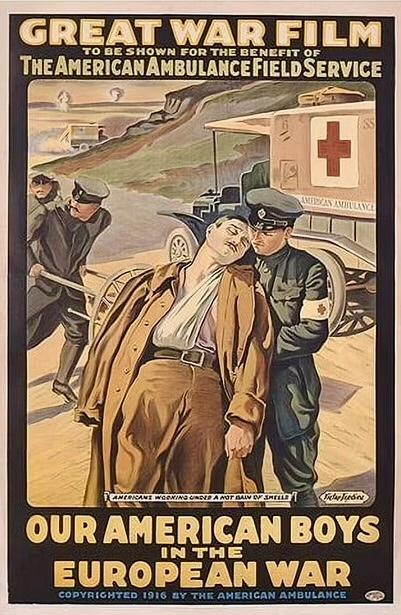
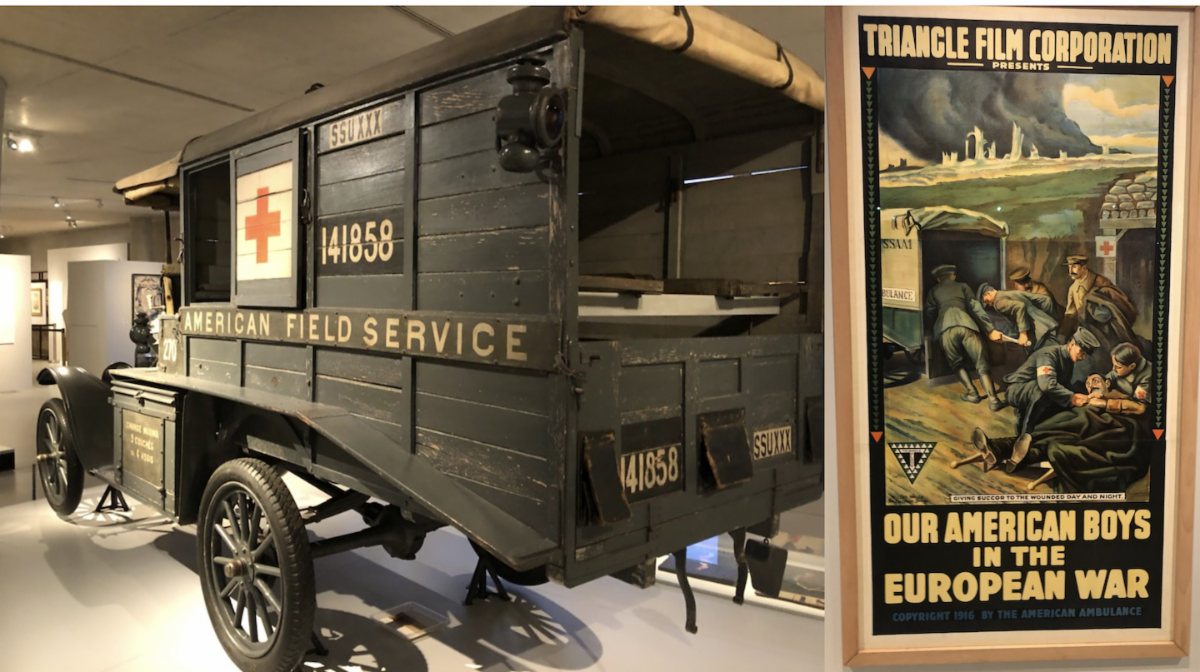
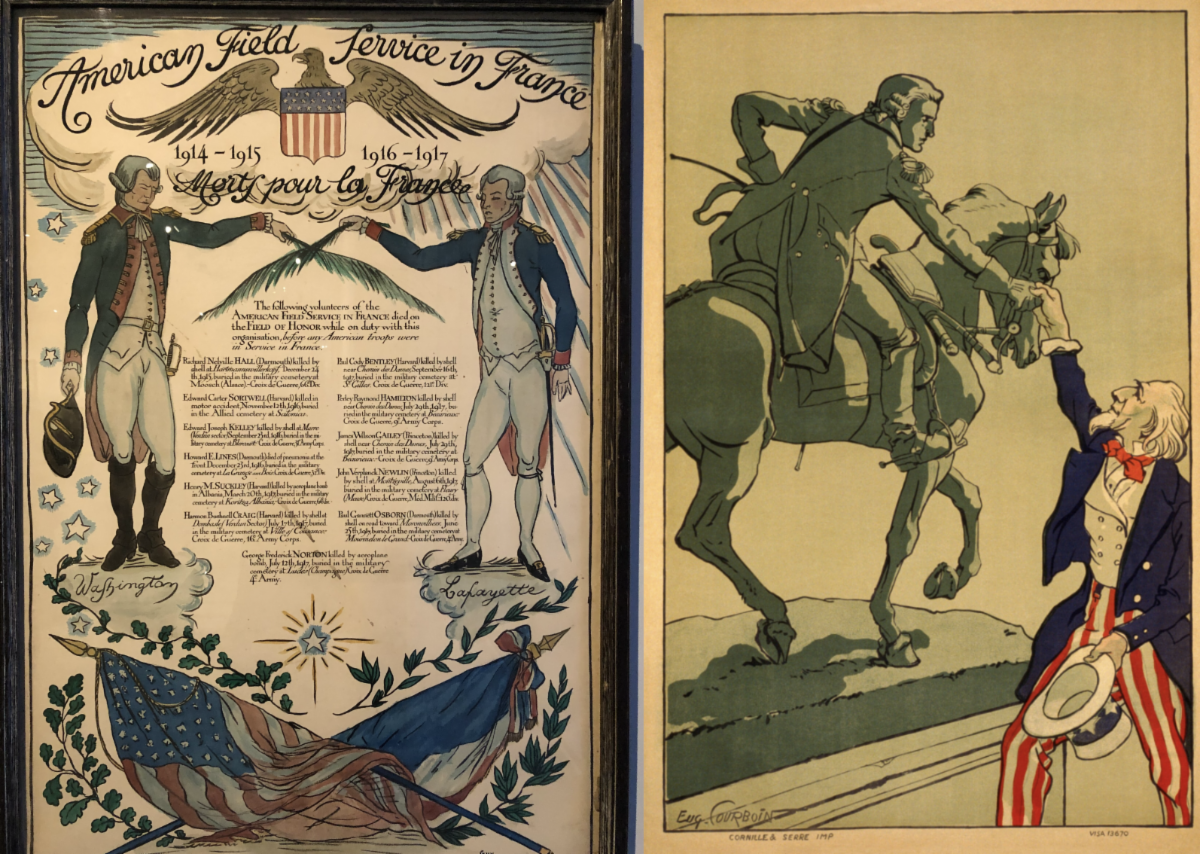
Poster by Victor Tardieu for the movie "Our American Boys in the European War", (1916)
Long considered a lost movie, the film produced by Triangle Corp. has been partially retrieved. Two reels of a revamped version were found recently in the film collection of the Library of Congress. Another version was released in the United States in 1917 as "Our Friend France" and has some additional scenes. Most scenes were filmed by French Army operators.
| |
|
EDITORIAL
Our monthly Bulletins aim at highlighting episodes of the long shared history between France and the United States. Some are very well known, and some are half, if not completely, forgotten. All deserve our remembrance, as our elders accomplished inimaginable feats of bravery, courage, and passion - - especially considering the material comfort in which we live nowadays.
Our monthly Bulletins generally are based on the inscriptions found on monuments, statues, markers, tablets, steles, memorials of all sorts. Instead of long tedious academic studies, they give us a generally accurate story of what happened here and there, and often with touching anecdotes.
This month, we will rely instead on quotes, and excerpts of books, to tell the relatively unknown story of all the brave volunteers who left the comfort of the United States to help France during World War One.
We will pay tribute to the American Field Service, this remarkable organization which revolutionized the way wounded soldiers on the battlefield were rescued. They were composed of young volunteers who chose to go to the front lines while eschewing the obligations of strict neutrality dictated by the official policy of the United States. And they did so in the most unique way: serving as ambulance drivers, taking all the risks under a rain of artillery and machine-gun fire, to save lives.
It is a story not unlike the Escadrille Lafayette, which we narrated exactly a year ago. Like their comrades in aviation, many of these volunteers came from very well-heeled families, and studied in Ivy League schools. They knew about driving cars, an uncommon skill at the time. Some of them became aviators towards the end of the war. They shared a profound affection for France. In fact, many preferred to stay fighting within the French armed forces even after the United States entered the fray.
Surprisingly, a great number of them who served as ambulance drivers, in the American Field Service or related units such as the Norton-Harjes ambulances, or Red Cross ambulances, the US Corps, became famous writers: Ernest Hemingway, John Dos Passos, Julien Green…
The American Field Service lives on today, as it left a very unique legacy. After two world wars, it promoted the concept of international scholarships to help build a better world and promote peace. Like several thousands of young high school students from more than 80 countries, I was privileged to receive such a scholarship and went to spend a full year with an American family in the heart of America, at Lake Forest High School, Illinois. This experience at the young age of 17 changed my life, as it did for all my fellow awardees. It is therefore with a great deal of personal gratitude that I narrate the exploits of these heroes.
We hope that you will consider supporting this incredible organization, which operates in hundreds of high schools in the US and brings foreign exchange to live with an American host family for an academic year. As the current world news demonstrate, these efforts must continue, and the good work of what these heroes started in the bloody fields of France in 1915 must never be forgotten.
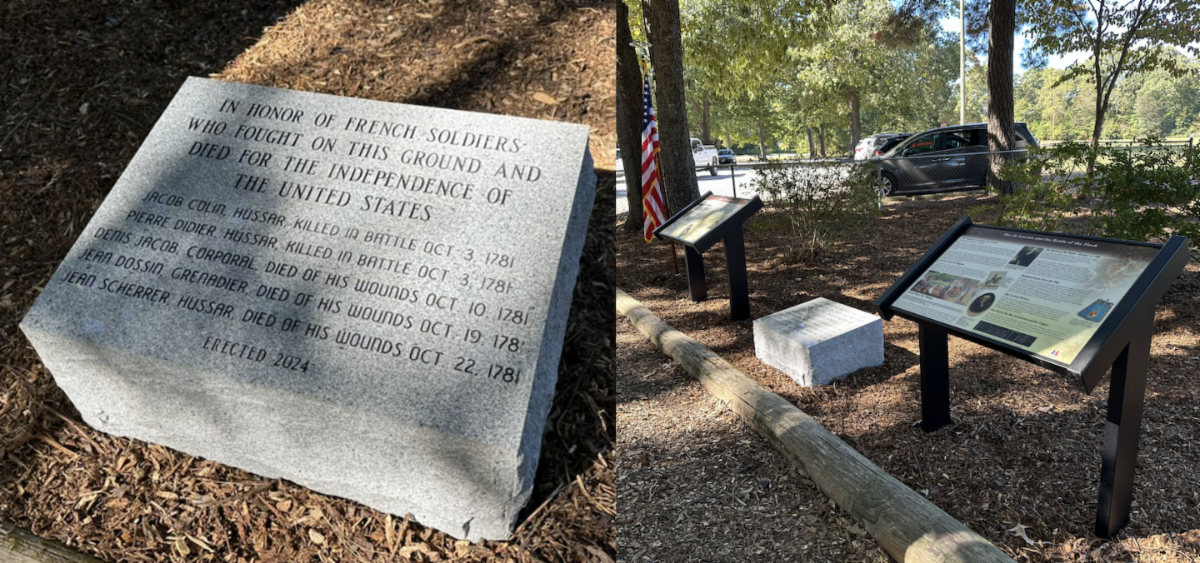
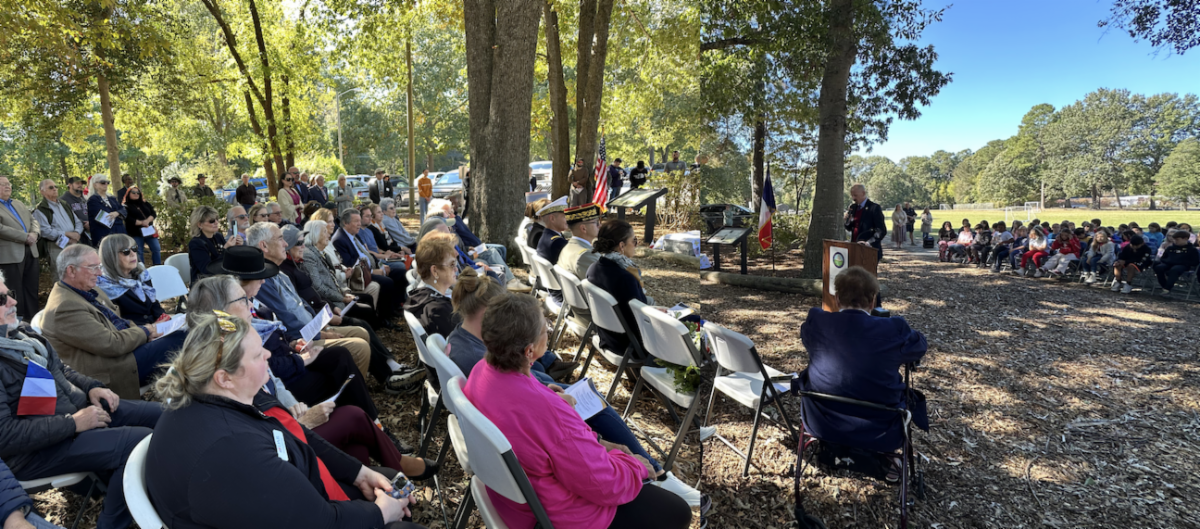
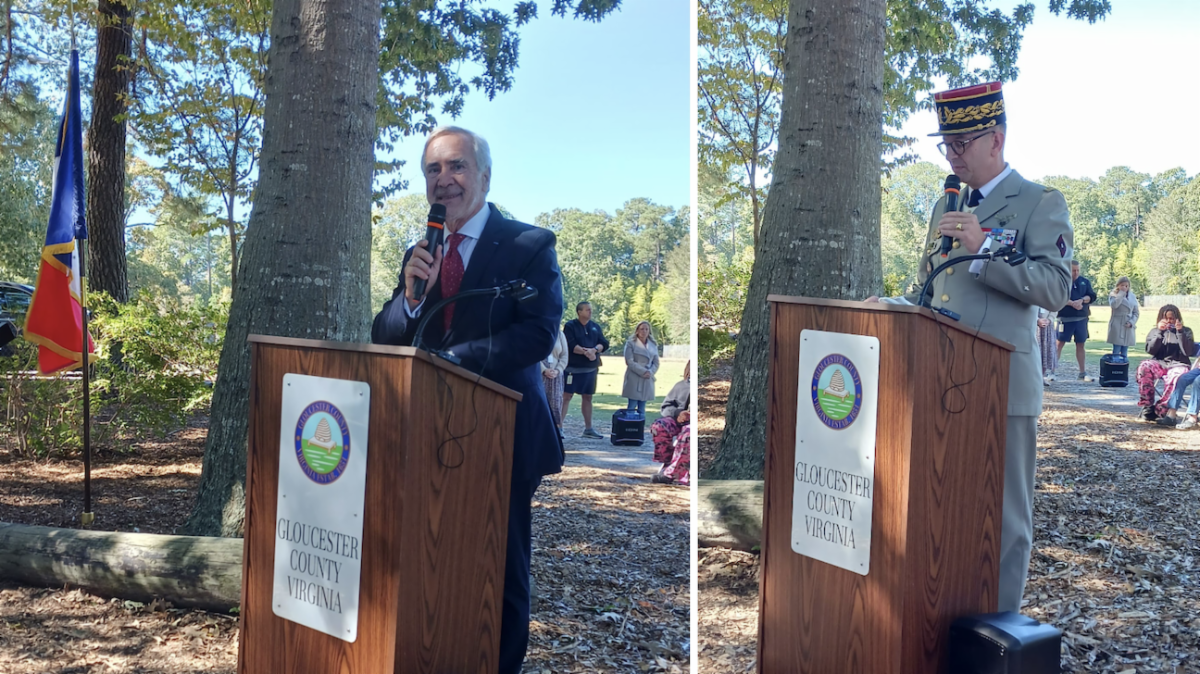
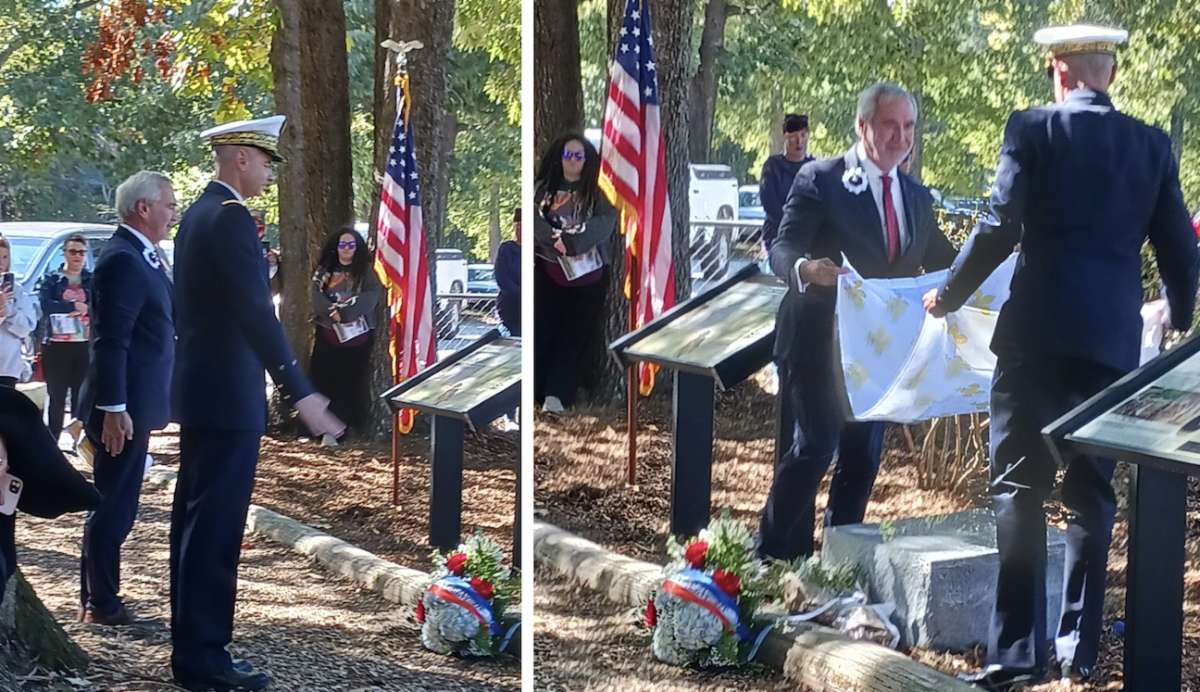
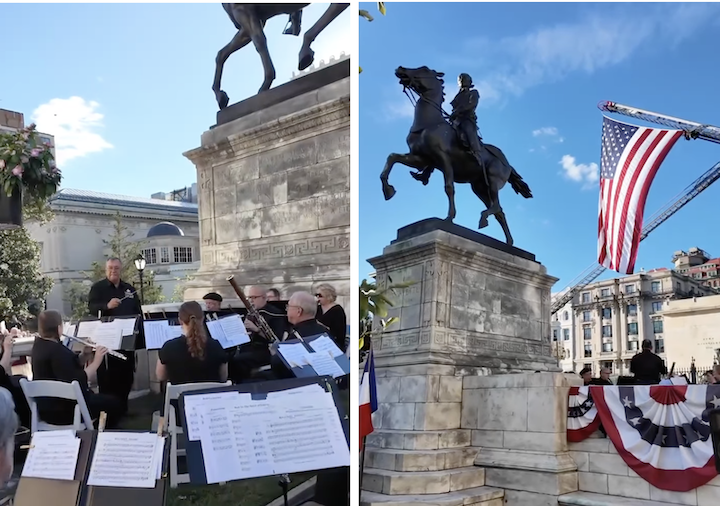
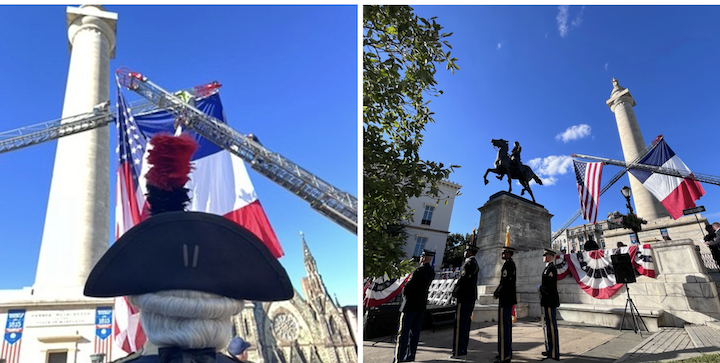
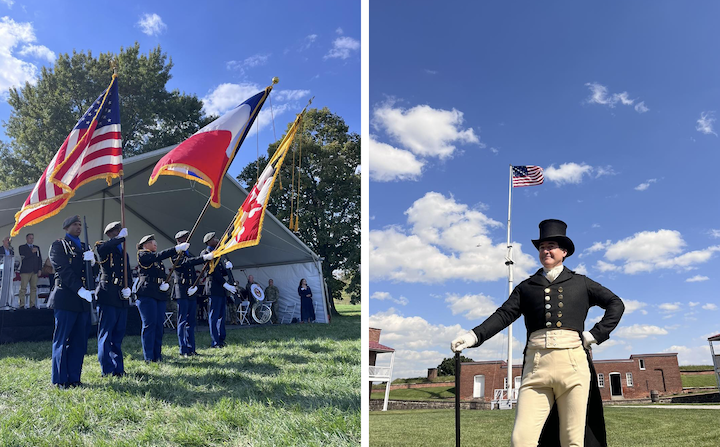
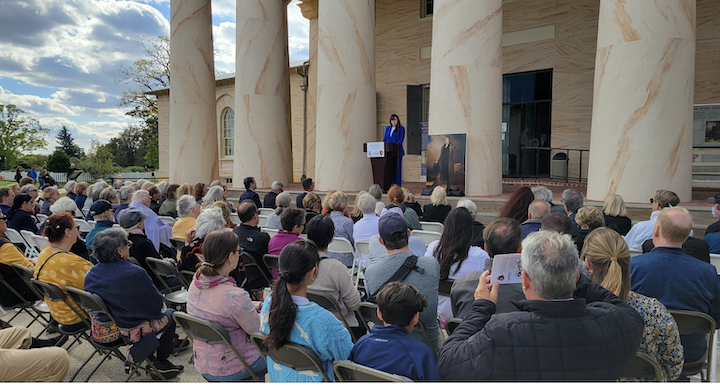
You will find at the end of this Bulletin, as always, a special tribute to a volunteer from the Lafayette Flying Corps, as well as the latest news on the Bicentennial of Lafayette’s Farewell Tour and other announcements. These are all occasions to celebrate French-American alliance and friendship! You will also see the very first photos of the dedication ceremony of our Memorial to French Soldiers in Gloucester, VA. this past Friday, October 18. There will be a more complete coverage on the commemorations of the French-American allied victory at Yorktown in our November Bulletin!
Thank you for your continued encouragements and support,
On behalf of the Board of Directors,
Thierry Chaunu
President, American Society of Le Souvenir Français, Inc.
| |
|
Casualties at an industrial rate:
In April 1917, the United States joined World War I, supporting the Allies: France, Russia, Great Britain, and Italy. The British and French were in the third year of fighting against the Central Powers, which included Germany, Austria-Hungary, Turkey, and Bulgaria.
The Western Front in France and Belgium, became quickly static. The two sides faced each other, between rows of barbed wire, constantly attacking. The war was brutal, with machine guns, flame throwers, poisoned gas, and more powerful, terrifying and accurate weapons the world had ever seen, resulting in high casualties. Overall, there were over 34 million casualties, with nearly 8 million deaths from injuries and illness. Although the U.S. entered the war late, it sent more than 2 million deployed to Europe; 106,378 of them died before peace was achieved.
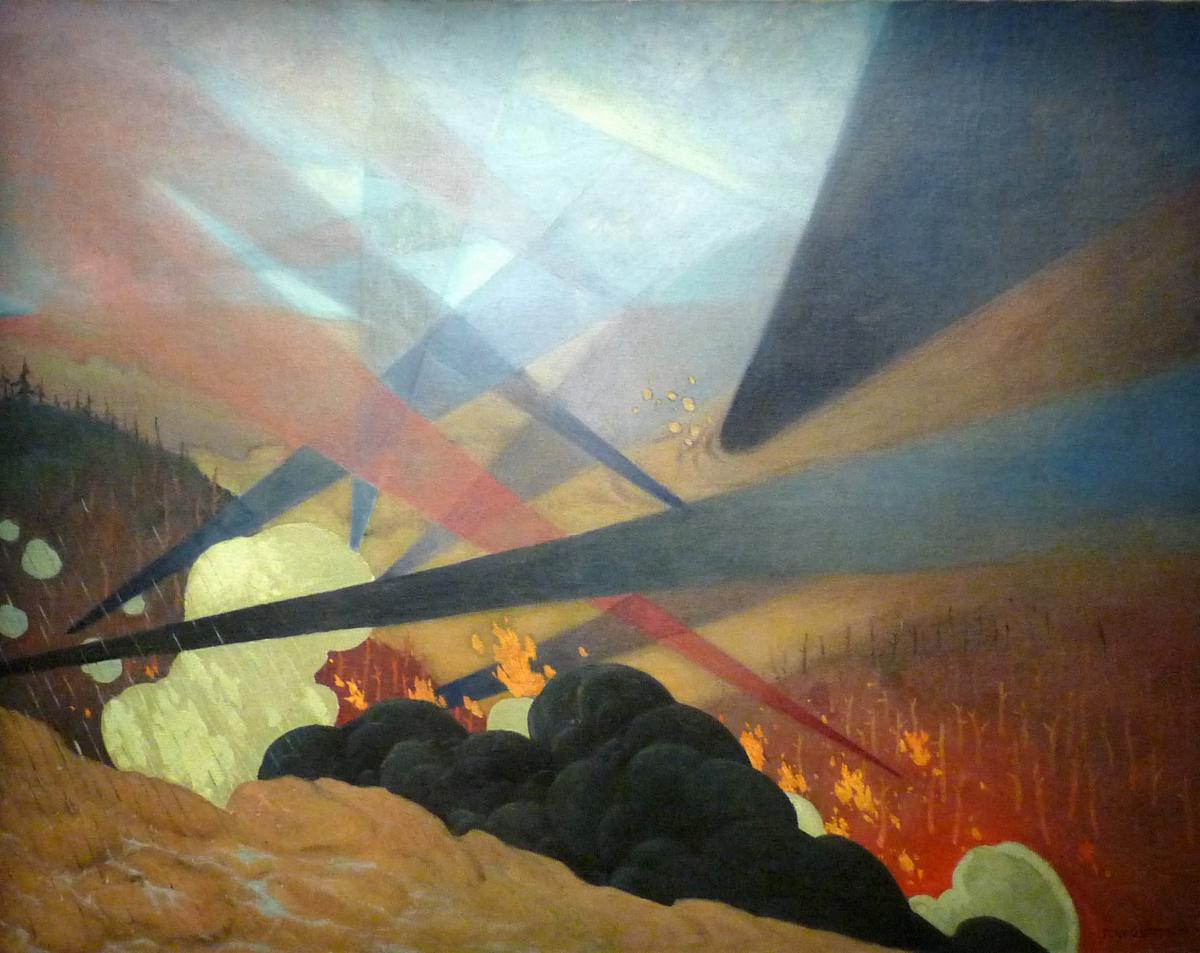
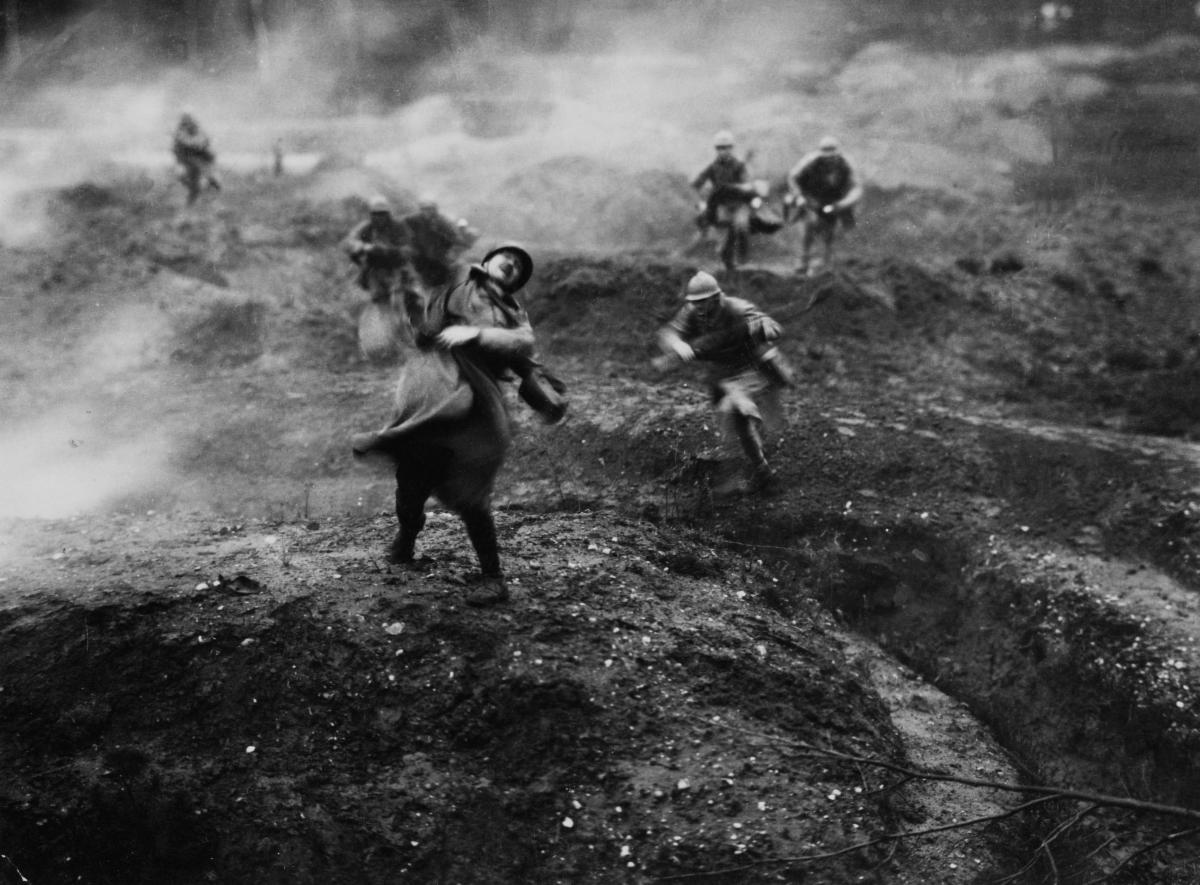
The demand for medical assistance was immense. Major battles drained troops at an appalling pace. At Verdun, for instance, the French suffered 381,000 casualties: 165,000 were killed in action, and 216,000 wounded from February to December 1916...On the German side, 355,000 casualties, including 143,000 dead, all in a few square miles.
World War I was the first war to use mechanized equipment and automobiles. By the fall of 1914, traditional horse-drawn ambulances and hand litters became ineffective. An automobile ambulance could (relatively) quickly transport casualties to hospitals (and not just triage field tents) behind the reach of enemy artillery.
| |
The creation of the American Field Service | |
|
Above:
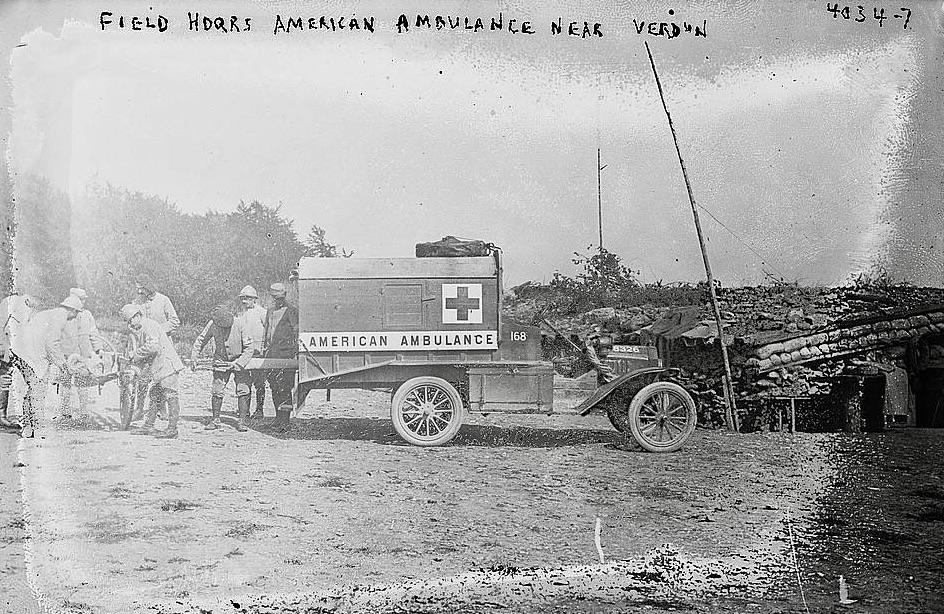
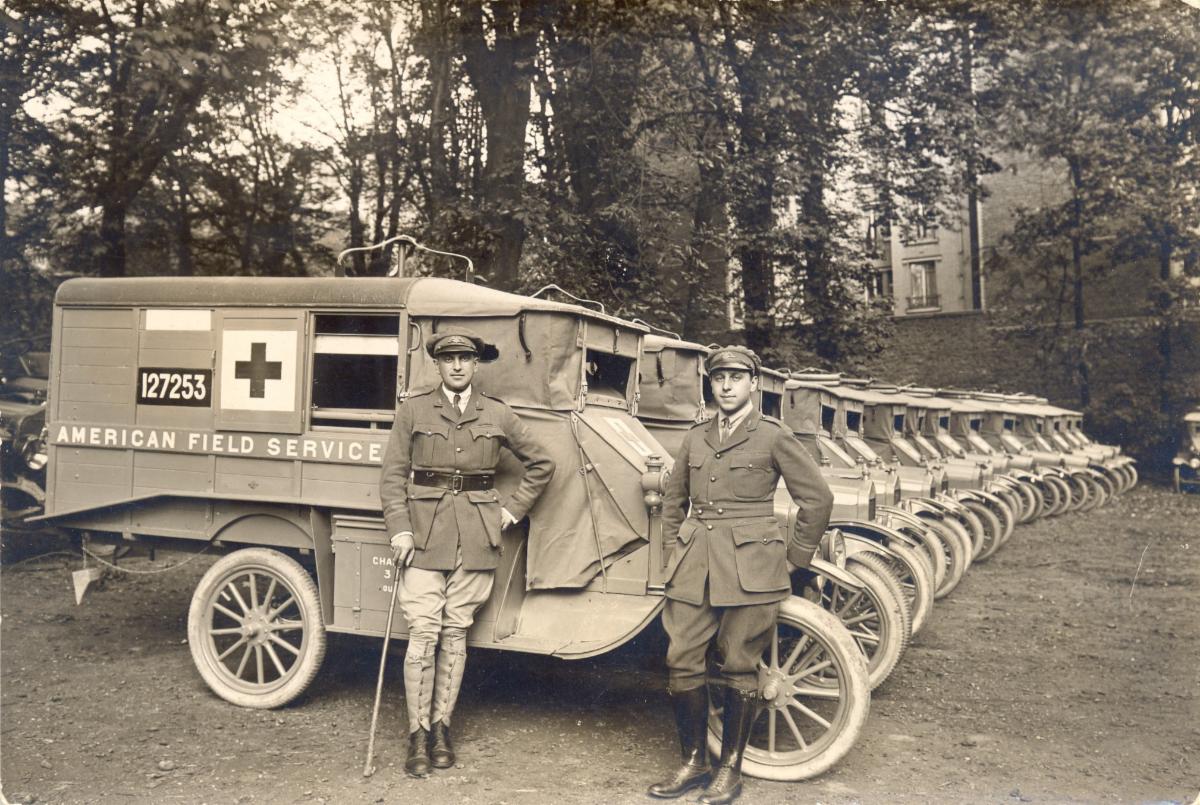
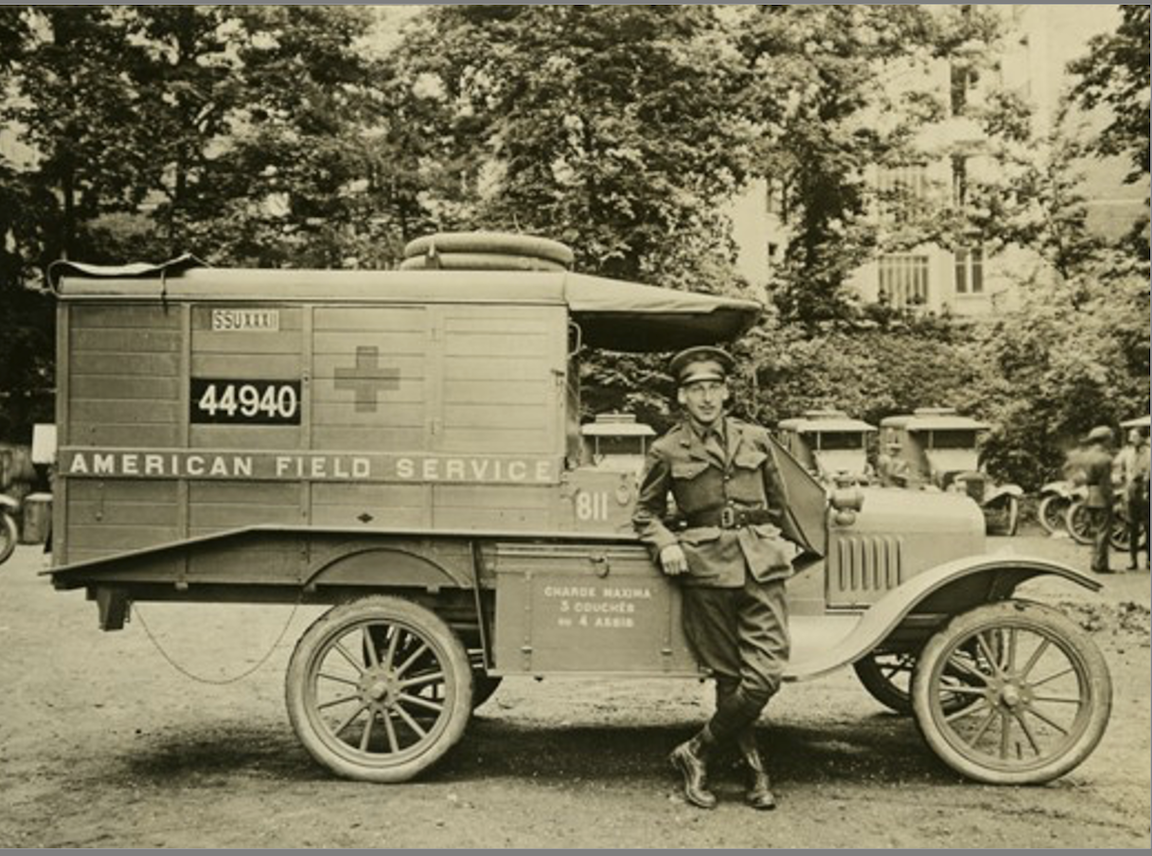
Top: An American ambulance near Verdun, France during World War I. Bain News Service, publisher - Library of Congress, Public Domain
http://hdl.loc.gov/loc.pnp/ggbain.23116
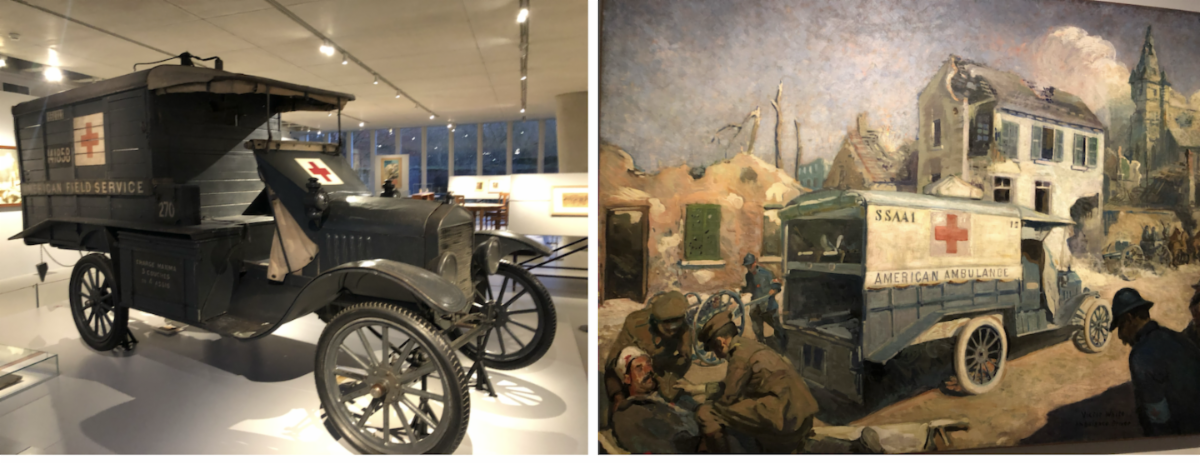
Middle and bottom: Ford Model T of the American Field Service, "La Section n°1 de l'American Field Service à Cappy-sur-Somme", oil on canvas by White Victor Gerald (1891-1954) and a different version of the poster shown above, all on display at the Musée Franco-Américain, Château de Blérancourt, 33 Pl. du Général Leclerc, 02300 Blérancourt, France - Photos: TC © ASSFI 2019
| |
|
"Everyone and everything for France"
When war started in September 1914, the American Colony of Paris immediately created an "ambulance," which is the term to designate a temporary military hospital in French. This was similar to what they did during the Franco-Prussian War in 1870, when the "American Ambulance" operated from tents near the home of its founder, Dr. Thomas W. Evans, a well-known dentist in Paris. Also, American gynecologist Marion Sims had set up a volunteer ambulance service called the Anglo-American Ambulance. In 1914, this reactivated "American Ambulance" took over an unfinished school building, the Lycée Pasteur, in Neuilly-sur-Seine, and was managed by the nearby American Hospital of Paris.
The volunteer drivers in 1914 used motor vehicles, specifically Model-Ts bought from a Ford factory in Levallois-Perret, instead of horse-drawn carriages. In the fall of 1914, as the war front moved away from Paris, the American Ambulance sent volunteer drivers to also assist informally with the British and Belgian armies in the north.
In early 1915, Piatt Andrew, former U.S. Undersecretary of the Treasury and strong supporter of France, new “Inspector of Ambulances,” visited the ambulance sections in Northern France and discovered that the American volunteers were finding the "jitney work" of transporting wounded soldiers from train stations to hospitals far from the front lines to be dull. At the time, French army rules did not allow foreign nationals to approach battle zones.
Andrew met with Captain Aimé Doumenc, who led the French Army Automobile Service, to advocate for the American volunteers. He explained that they wanted to "pick up the wounded from the front lines, face danger directly, and share the experiences of the French soldiers." Doumenc agreed to give Andrew a chance. The results were quick and impressive, leading to the establishment of the American Ambulance Field Service under French Army command by April 15, 1915.
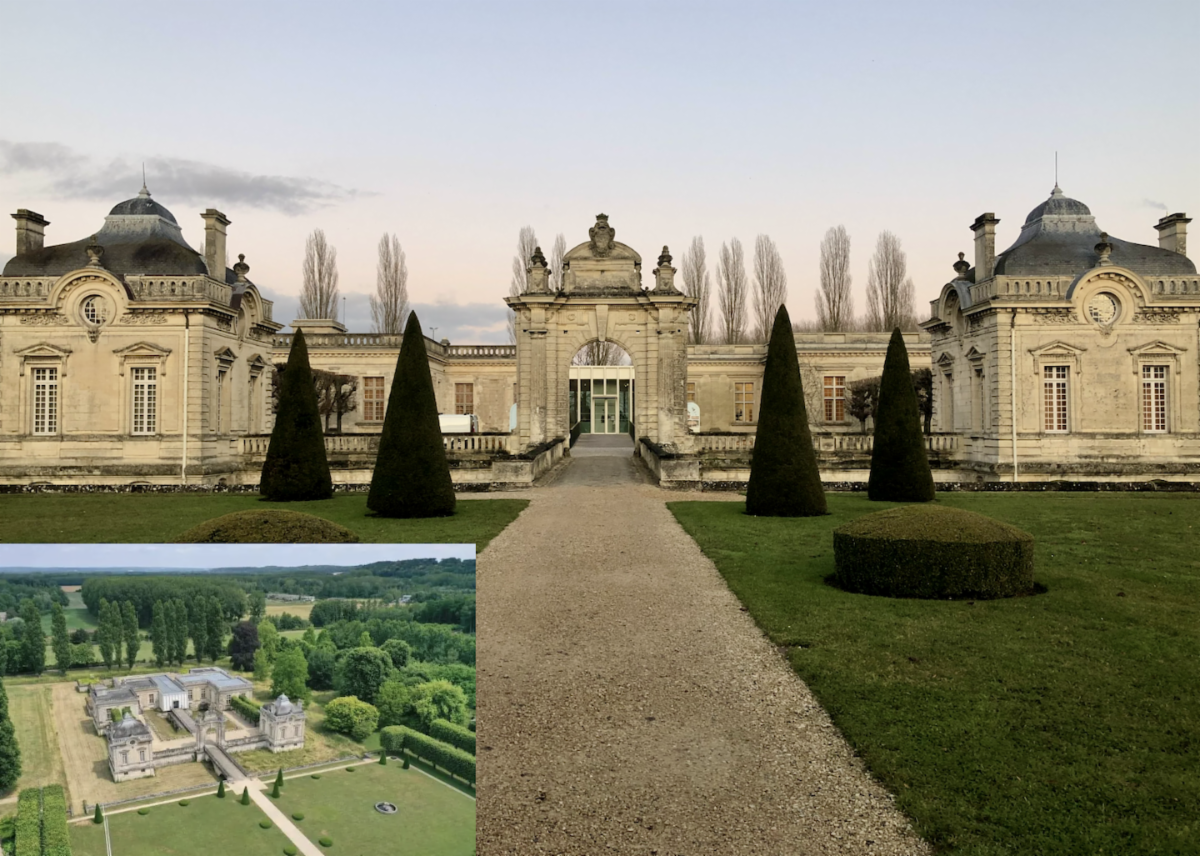
By the summer of 1916, the American Field Service ended its connection with the American Ambulance and relocated from its limited space in Neuilly to the larger Delessert château at 21 rue Raynouard in the Passy area of Paris. There, it expanded quickly over the next year, continuing to provide "sanitary sections" to the French Army and also becoming a recruitment hub for combat pilots for the newly established Escadrille Lafayette...
Its slogan was: "Everyone and everything for France"
Who were these American volunteer ambulance drivers?
The young AFS drivers came from well-known families in the United States and had either attended or were still enrolled in one of nearly a hundred prestigious colleges or universities across the nation. There was also a smaller group from the professional class, including doctors, lawyers, architects, artists, brokers, businesspeople, poets, and writers. Almost all of them knew how to drive cars. This highly educated group also produced numerous letters, diaries, journals, and even poetry.
They expressed a strong love for France and its people in many of their letters.
Before we introduce several of these volunteers, it is fitting that we would first introduce the two Founders of the American Field Service:
| |
|
Piatt Andrew
Founder and first Director of the AFS
Stephen Galatti
Second in command, and future Director General
| |
|
Above:
Inspector General A. Piatt Andrew and Assistant Inspector General Stephen Galatti at the AFS headquarters 21 rue Raynouard in Paris, France. 1917. Photograph by H.C. Ellis. Courtesy of the Archives of the American Field Service and AFS Intercultural Programs (AFS Archives.) This photograph cannot be reproduced outside the guidelines of United States Fair Use (17 U.S.C., Section 107) without advance permission from the AFS Archives.
| |
|
Andrew Piatt
• Andrew Piatt (February 12, 1873 – June 3, 1936) originally from Indiana, was sent to the East Coast for his education. He attended the Lawrenceville School, then went on to Princeton and Harvard, focusing on economics. At Harvard, he taught financial topics, which led to his role as an advisor for the Senate’s Aldrich Committee, the creators of the Federal Reserve System.
• In 1909, President Taft appointed him as Undersecretary of the Treasury. In 1914, he ran for Congress but was unsuccessful as Europe faced turmoil. He then sought a position with Robert Bacon, a former colleague from the Taft Administration, who was leading the American Ambulance of Paris. Andrew was assigned to a unit in the hospital’s transportation service in northern France and was later named “Inspector of Ambulances.”
• Andrew had the insight and political skills to improve the ambulance service. He convinced the French Army High Command to let American “sanitary sections” assist their combat units, which started the American Ambulance’s “Field Service.”
• For the next two years, Andrew oversaw operations with the French Army, while his adjutant, Steve Galatti, handled the practical aspects.
• In late 1917, when the AFS joined the larger United States Army Ambulance Service, other volunteer groups faded away, but “Doc” kept AFS’s identity alive within the USAAS by publishing an AFS Bulletin, transforming “21” into a social hub, and preparing other materials. AFS thus continued after the war, both through an AFS Association and by promoting the French Fellowships. After the war, “Doc” was elected to Congress, marking the start of a new public service career that lasted until his death in 1936.
• His final contribution to AFS was significant: after the Great War, the AFS sponsored French Fellowships, which were graduate scholarships for studying in France and the US (a precursor of the Fulbright Scholarships_.
Stephen Galatti
• Stephen Galatti (August 6, 1888 — July 13, 1964) was born in New Jersey, and attended St. Mark’s School, which prepared him for Harvard, where he became known as the quarterback of the varsity football team. This experience connected him to a powerful network of prestigious alumni.
• After working for Ralli Brothers in London and Calcutta, and briefly at the American Embassy in London when the war began, he arrived in Paris in August 1915 to volunteer for the American Ambulance’s new Field Service.
• Initially, he was assigned to a unit in Alsace but was later called back to Paris to assist Piatt Andrew. When the AFS merged with the U.S. Army Ambulance Service in late 1917, both received officer commissions—by the end of the war, “Doc” held the rank of colonel, while Steve was a major.
• After the war, Steve returned to New York’s financial district and eventually became a stockbroker. When World War II started, “Doc” had passed away, and Steve took on the task of reactivating the American Field Service.
• This time, AFS continued after the war, adapting to the changing nature of conflict as it shifted to Cold War struggles for influence. Under Galatti’s leadership, AFS’s network of “Old Boys” was expanded to include women staff and volunteers, overseeing the missions of both boys and girls in foreign lands. From then on, AFS would advocate for a new cause: international understanding with high schools foreign exchanges scholarships in order to promote peace.
| |
|
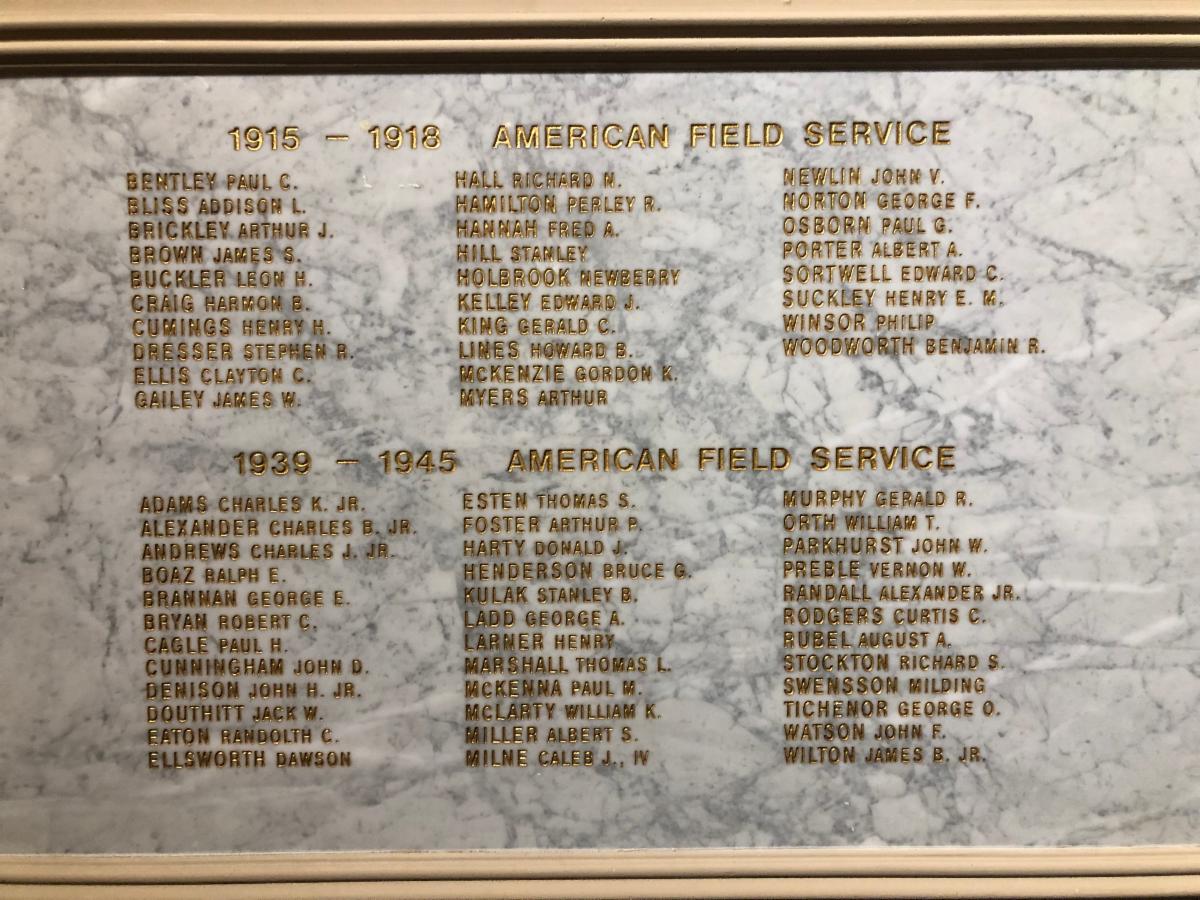
Tribute to 28 A.F.S. Volunteers
who "Died for France"
1915-1918
| |
|
Above:
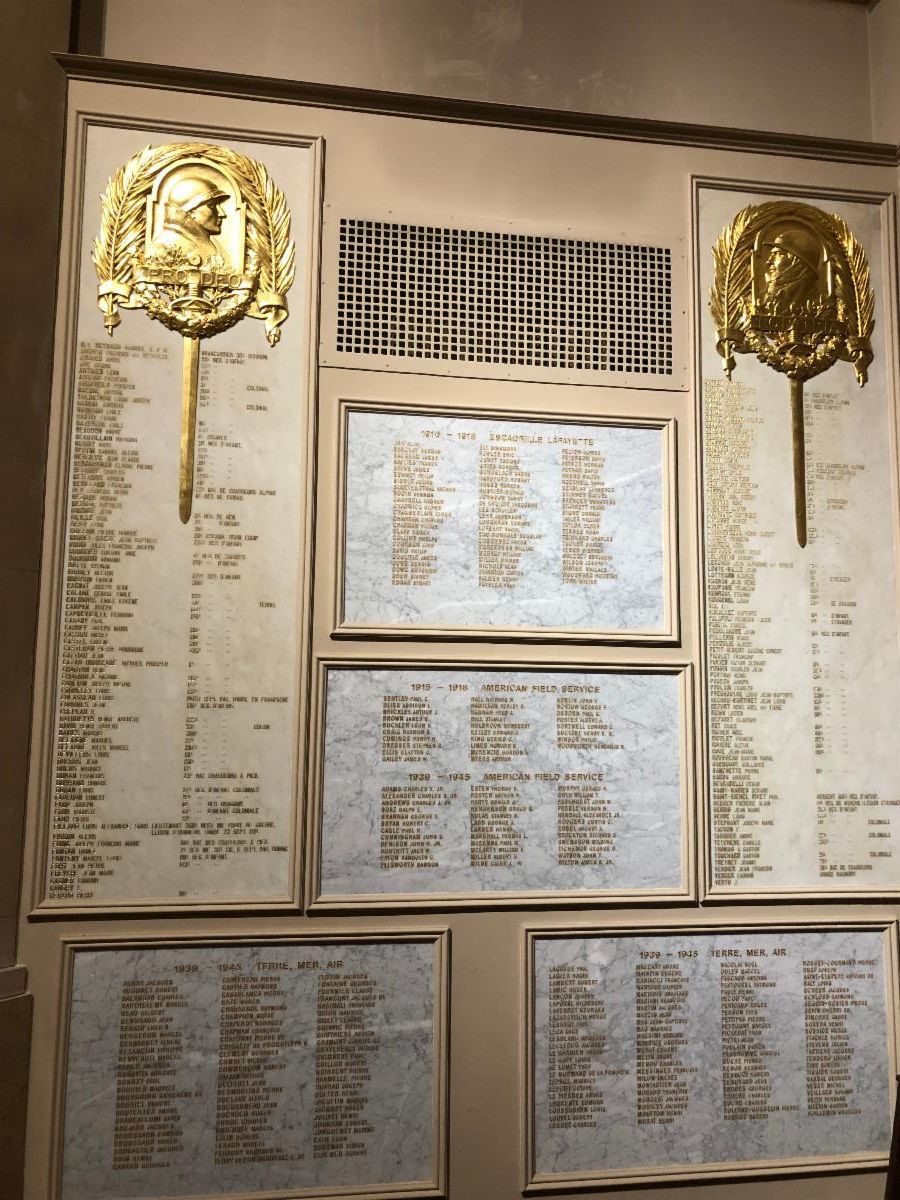
Memorial Plaques, 28 WWI American Field Service Volunteers "Morts Pour la France"*
Église de Notre Dame, 405 West 114th Street, New York, NY 10025
GPS: 40.805025, -73.960249
Photos: TC © ASSFI 2021
We are presenting below these 28 WWI Volunteers who "Died for France". Unless noted otherwise, most of their biographies are excerpted from the "Memorial Volume of the American Field Service in France, Friends of France", ed. by James W. D. Seymour, with an introduction by Lieutenant-Colonel A. Piatt Andrew, published in Boston in 1921, Public Domain, Library of Congress.
We believe that to honor their memories, beyond the annual wreath-laying ceremony on Veterans Day, it is our sacred duty to put a face on their inscribed names and to tell their stories.
"N'oublions jamais!" "Never Forget!" - - otherwise, they die twice.
Note*: "Mort pour la France" meaning "Died for France," is a legal term in France. It is an honor given to those who lost their lives in conflicts while serving the country. This phrase appears on their death certificates. Both French citizens and foreign volunteers can receive this recognition.
| |
|
Above:
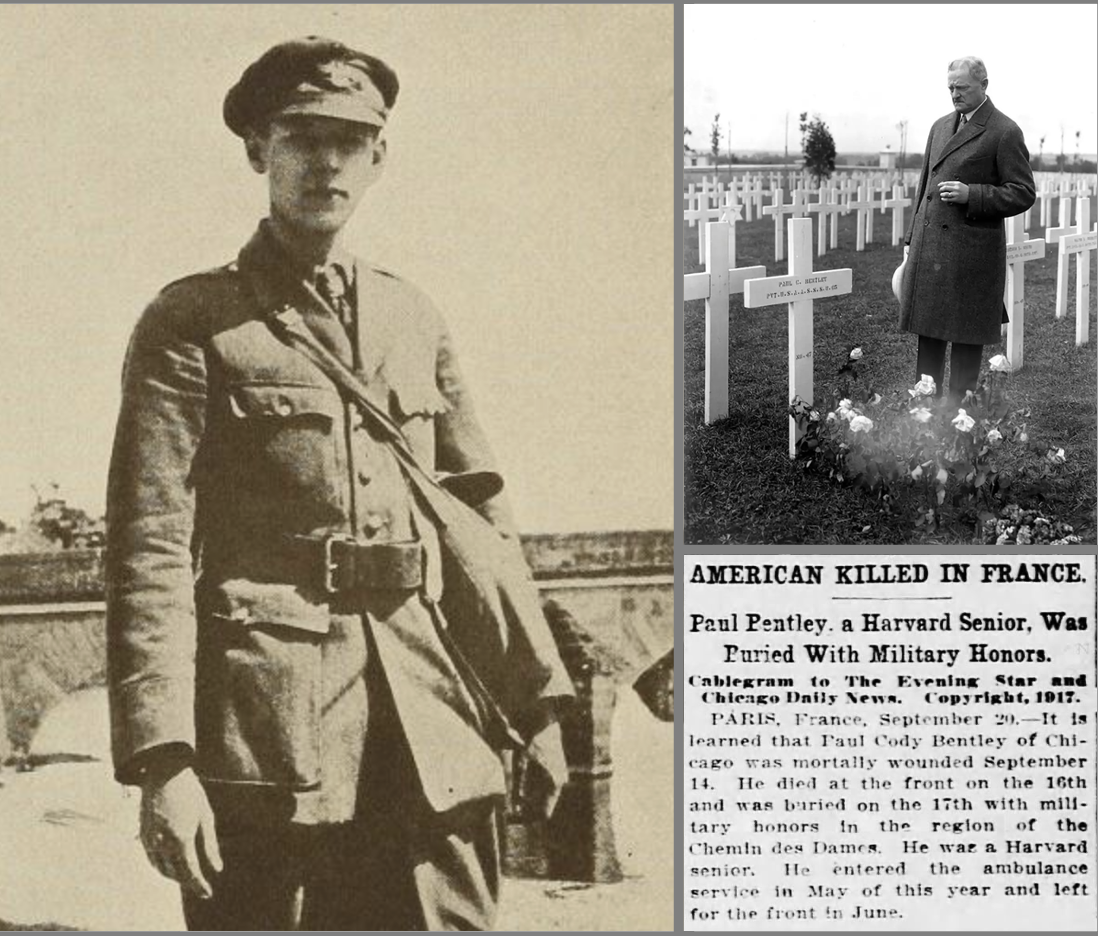
Left: Paul C. Bentley, Memorial Volume of the American Field Service in France, 1922, Public domain
Right: Retired General John Pershing, Chairman of the Commission, at the Oisne-Aisne American Cemetery in France around 1924, visiting Paul Cody Bentley's grave.
| |
|
• Born September 22, 1895, in Cleveland, Ohio. Educated Chicago schools, University of Chicago, and Harvard University, Class of 1917. Joined American Field Service, May 19, 1917. Died September 16, 1917, of wounds received September 13, 1917, near Fismes. Buried at St. Gilles, Marne. Body transferred to Seringes-et-Nesles, Aisne. Croix de Guerre.
• On September 11th Bentley wrote, " I am still very uncertain as to what I shall do next. But uncertainty is the main characteristic of the war. Everything is uncertain... "
• Two days later during a gas attack, his loaded car was struck by a shell, as he drove through the barrage and Bentley, in the words of his citation, ‘lui-même très grièvement blessé, a continué à conduire jusqu’à l'épuisement de ses forces’ (himself very seriously wounded, continued to drive until he was exhausted). At the hospital he rallied bravely for a time, then grew weaker, and died on September 16th.
| |
|
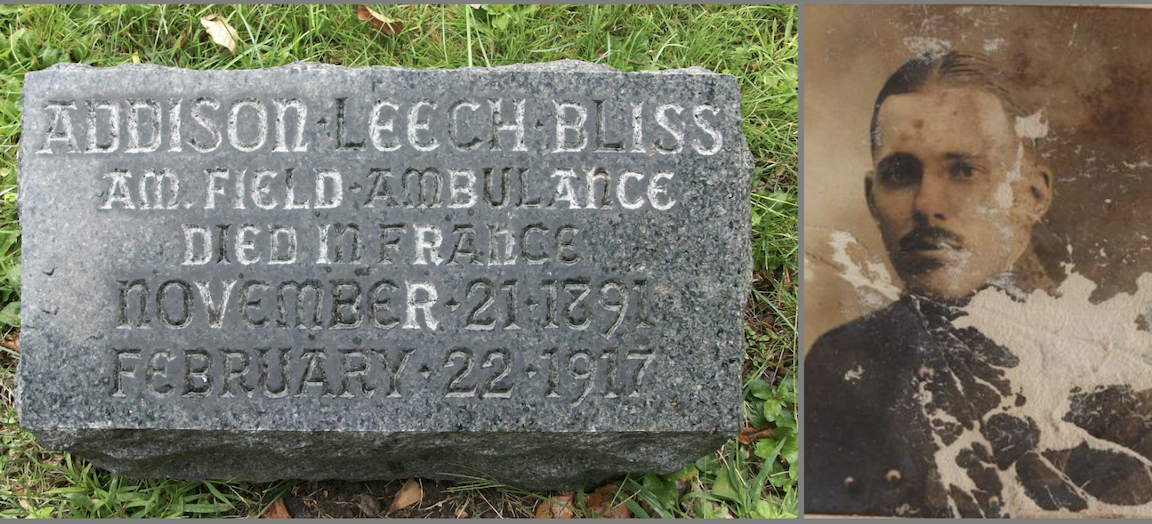
• Born November 21, 1891, in Springfield, Massachusetts. Educated Springfield schools, Fay and St. Mark's Schools, Southboro, Massachusetts. and Harvard University, Class of 1914. Joined American Field Service, January 28, 1917. Died of pneumonia in Paris, February 22, 1917. Buried in Paris, France. Body transferred to Peabody Cemetery, Springfield, Massachusetts.
• "Addison sailed for France on the Touraine, January 28, 1917, a volunteer driver in the American Field Service. After a stormy voyage and while in Paris waiting to be sent to the front, Bliss caught a severe cold from which pneumonia developed, and on February 22d, less than a month after leaving the United States, he died. Two days later he was buried, with very beautiful services, at the American Church in Paris."
| |
|
Above:
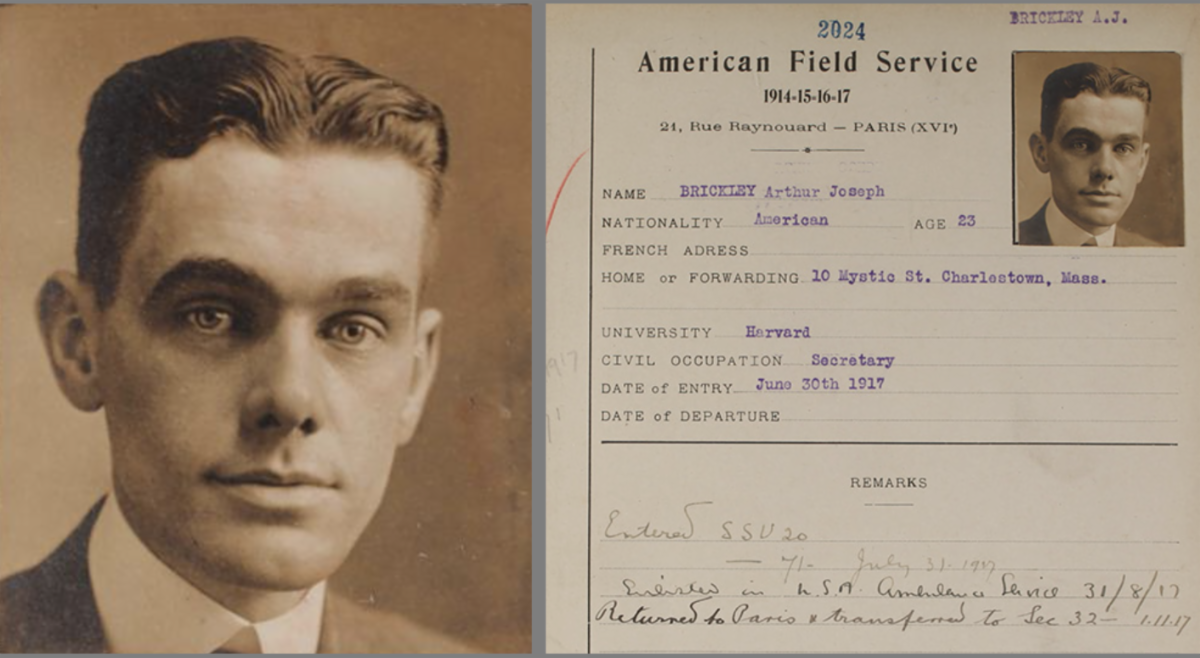
Left: Arthur Joseph Brickley
Right: Courtesy of the Archives of the American Field Service and AFS Intercultural Programs.
| |
|
• Born February 5, 1894, in Charlestown, Massachusetts. Educated Boston Latin School, Harvard University, Class of 1916, two years and College de Rennes, France, two months. Joined American Field Service, June 30, 1917; attached Section Seventy-one to August 31, 1917. Enlisted U. S. Army Ambulance Service, Section 644 (ex-32). Died of pneumonia, December 9, 1918, in field hospital at Appilly, Oise, southwest of Chauny. Buried at Ploisy, Aisne. Body to be returned to America. Croix de Guerre.
• Attached to Section 71 he spent the rainy summer of 1917 on the Somme front near St. Quentin, in the desolate region which had been so recently occupied by the German forces. One of his comrades from this Section writes: 'Brickley lived in my tent along with a dozen others during that dreary summer and I never saw him lose his temper or say a bad word against anyone. I remember a bunch of us peeling potatoes one morning in the rain. Everyone was growling and crabbing except Brickley who still kept his cheerfulness. He was always willing to help anyone and never failed to volunteer to substitute on duty if a man was sick.'
• He spoke French fluently, having at one time attended for a few months the Collège de Rennes, France, and no matter with what French division his section was serving he became at once immensely popular with both officers and men.
• He was awarded the Croix de Guerre for courageous service under fire during the attacks of early September, 1918. There could be no finer tribute to his memory than the words spoken at his grave by Médecin Principal Michel of the 37th Infantry Division, which concludes as follows:
“We all knew and loved this young driver who spontaneously offered his heart, his days and his life to France in peril. Everywhere he went, he stood out for his zeal, his devotion, his excellent temperament and his very high sense of duty. He left the service only to be struck down by the illness that was to rob him of the esteem of his chiefs, the friendship of his comrades and the affection of his family...
...In the name of the Divisional Health Service which you served so nobly, Driver Brickley, farewell!”
| |
|
Above:
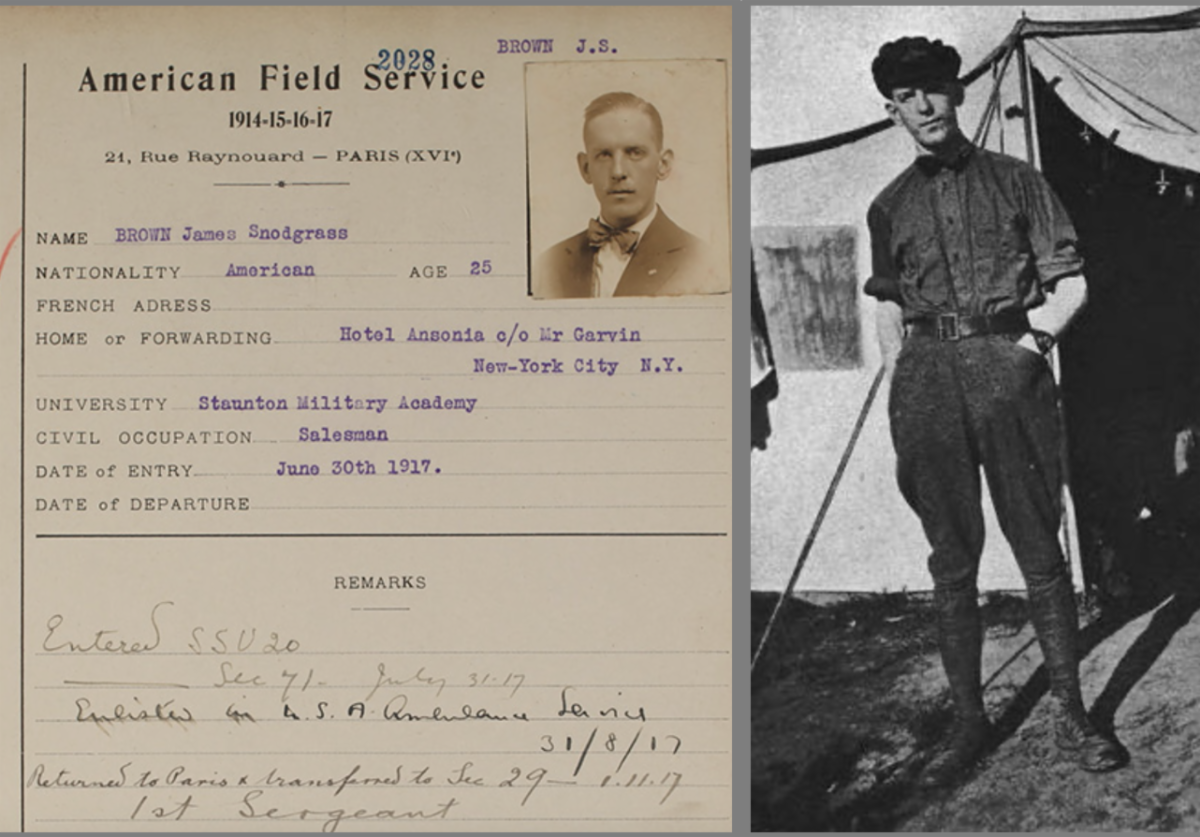
James Snodgrass Brown photo and service file, Memorial Volume of the American Field Service in France, 1922, Public domain
| |
|
• Born February 10, 1893, in New York City. Educated Mount Vernon High School, New York, and Staunton Military Academy, Virginia. Joined American Field Service, June 30, 1917; attached Sections Seventy-one and Twenty-nine, until August 31, 1917. Transferred to U. S. A. Ambulance Service. Ill in Paris. Arrived in America, April 23, 1919. Died April 26, 1919, in Embarkation Hospital Number One, Hoboken, New Jersey, of diabetes and gas-poisoning. Buried in New Rochelle, New York.
• "His ambition was to serve in a camion section, but as the need just then was for ambulance drivers, he was sent to the front with Ambulance Section Seventy-One which took over its quota of Fiat cars at Noyon on July 31, 1917. They spent the greater part of the summer around Noyon in action in the Saint-Quentin sector. Brown was acting Sous-Chef of the Section and when the United States Army took over the Field Service he enlisted in the United States Army Ambulance Service and was given the rank of Sergeant, first Class, and continued his work at the front.
• He was twice gassed, once in October, 1917, and again the following year, and was awarded a "Medal of Honor" with citation by the French Government for his work during a flu epidemic among the French soldiers.
• During the latter part of his stay in France he suffered from the effects of gas and diabetes and was for a time transferred to the Provisional Battalion in Paris. He arrived in Hoboken, on the U. S. Transport Mobile, April 23, 1919, in a semi-conscious condition and was taken immediately to the United States Embarkation Hospital No. 1 where, three days later, he died.
| |
|
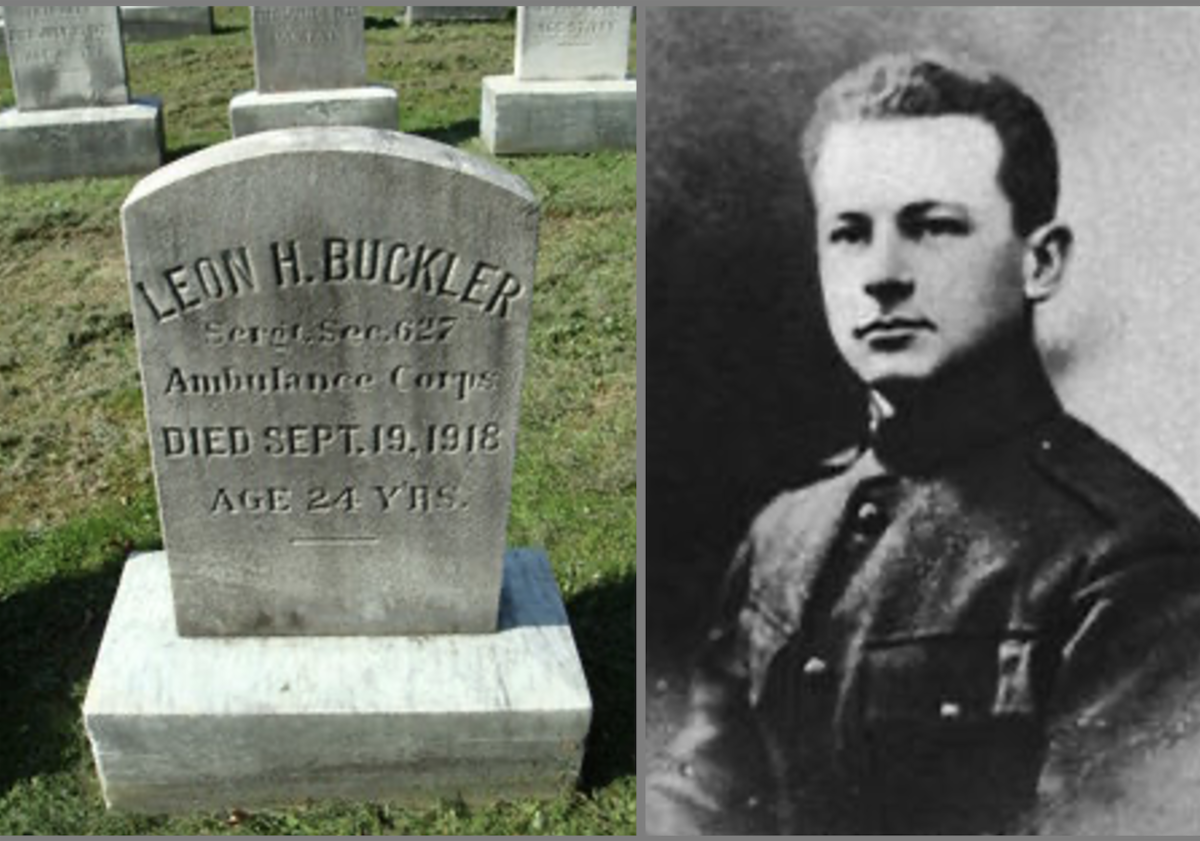
• Born January 6, 1894 in Farmington, New York. Educated West High School, Rochester, and three years Rochester University, Class of 1917. Joined American Field Service, December 18, 1916; attached Section Four to summer of 1917. Attached Field Service Camp, May-en-Multien. Enlisted U. S. A. Ambulance Service with French Army. First Sergeant. Reassigned Section Four (627). Died September 19, 1918, of pneumonia, in Urbes, Alsace, and buried there. Body transferred to Mount Hope Cemetery, Rochester, New York. Croix de Guerre.
• "Buckler showed remarkable courage and no nervousness under the shell fire, and seemed as keen as mustard for the work. He exhibited an extraordinary amount of wiry strength in helping carry the wounded to and from the car, and in helping push the car through the snow and mud. "
• "Later, in the fall of 1917, he enlisted in the United States Army Ambulance Service with the French Army, was made a first Sergeant, and on his own very insistent request, was sent back again to the front with his old Section. Here he continued the faithful record he had always made in the old volunteer days, but in the late summer of 1918, when the Section was working in the mountains of Alsace, he contracted another case of pneumonia, and from this he died on September 19th, in the little village of Urbes in Alsace Reconquise."
• Buckler was awarded the Légion d'Honneur (Chevalier degree) posthumously on November 11, 2011.
• His name is inscribed on the American Volunteer Monument, Place des Etats-Unis, Paris.
| |
Harmon "Ham" Bushnell Craig | |
|
Above:
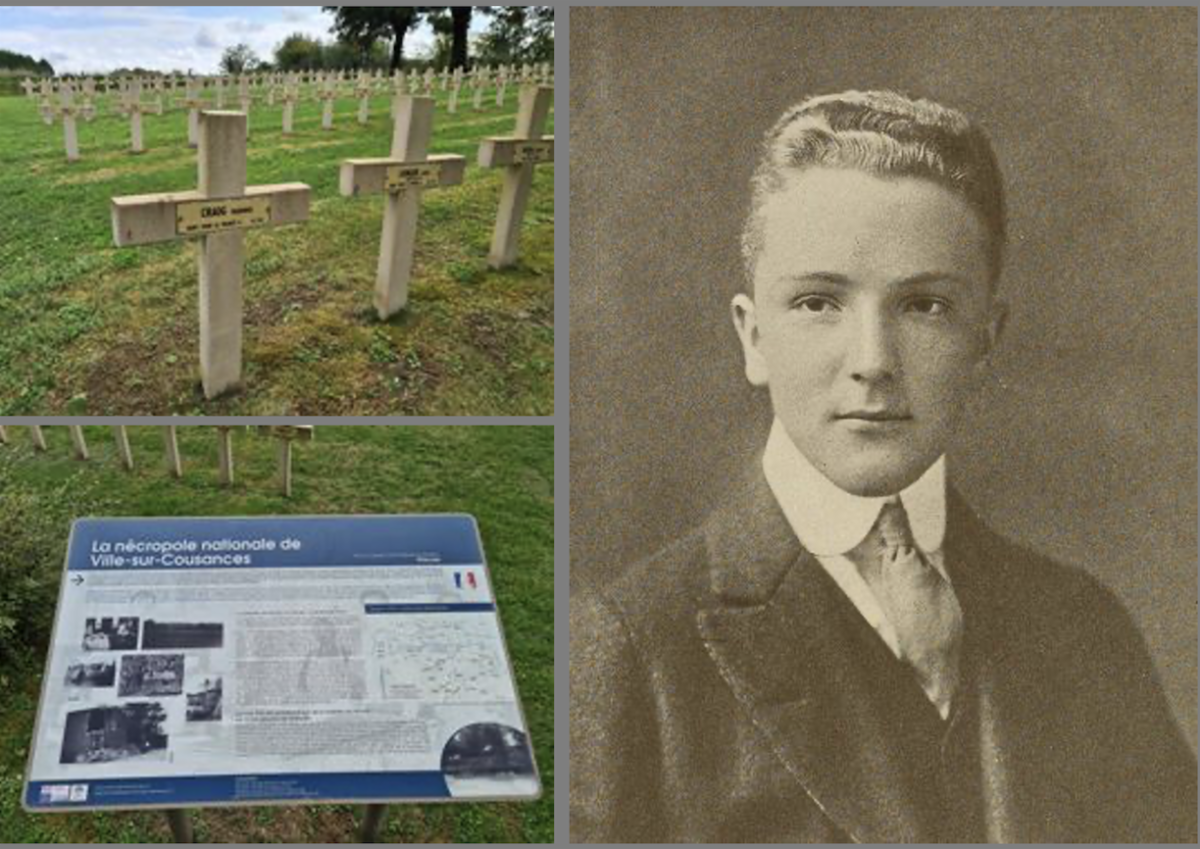
Right: Harmon B. Craig, Public domain: Memorial Volume of the American Field Service in France
Left, top and bottom: Nécropole Nationale de Ville-sur-Cousances, France. He is memorialized on the interpretive marker.
| |
|
• Born July 1, 1895, in Boston, Massachusetts. Educated Brookline High School and Harvard University, Class of 1919. Joined American Field Service, February 19, 1917; attached Section Two. Died July 16, 1917, at Ville-sur-Cousances, of wounds received at Dombasle, Meuse, July 15. Buried Ville-sur-Cousances, Meuse. Croix de Guerre with gold star.
• He is the brother of John Richard Craig Jr. who also served in Section 2.
• On March 2nd (1917) he landed in France, writing in his diary, 'It is wonderful to realize that I am here to help!' and three weeks later he was at the front as a member of Section Two.
• The evening of July 15th, as he was loading wounded into his car in the village of Dombasle, near Verdun, Harmon was wounded in the right leg, when a shell struck only a few feet from his car, killing three brancardiers and severely wounding a French lieutenant. "Ham" refused to allow his wounds to be dressed until the Frenchman had been made comfortable, and the delay, with consequent loss of blood, undoubtedly lessened his own chances. He died next morning, at two o'clock, in the hospital at Ville-sur-Cousances.
• At the hospital where he had been brought mortally wounded, Harmon Bushnell Craig was told that his leg would have to be amputated. Fully conscious and suffering intensely, he smiled, 'Go ahead. I'll only have to buy one shoe then.' A few hours later he died ...
• His Croix de Guerre citation states: " ... particularly on June 28 and 29, showed the utmost energy in performing his duties on an uncovered and bombarded road."
• Craig was awarded the Légion d'Honneur (Chevalier degree) posthumously on November 11, 2011.
| |
Henry Harrison Cumings, III | |
|
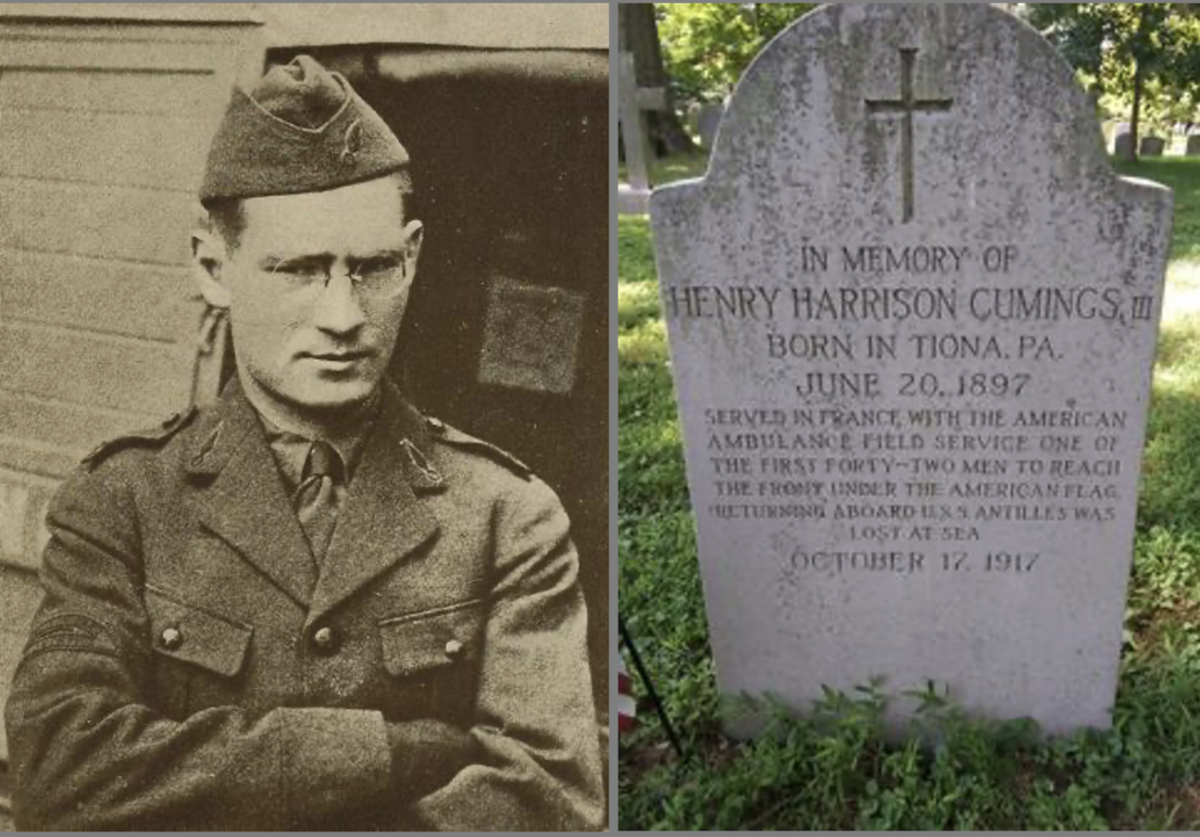
• Born June 20, 1897, in Tiona, Pennsylvania. Educated Buffalo High School, New York, University of Pennsylvania, and Temple University. Joined American Field Service, May 26, 19 17 ; attached Transport Section 526, to September 27, 1917. Died at sea on torpedoed "Antilles," October 17, 1917. Body never recovered.
• "Descended from a line of military forebears dating back to the days of the War of Independence, Henry Harrison Cumings, 3d, felt the urge of service so strongly that he was one of the first young Americans to reach the front under the American flag."
• "In March, 1917, he joined the American Field Service and sailed for France, to drive an ambulance. When the United States entered the war (in April), a call was made by France upon the ambulance service for volunteers for a munitions transport branch. Cumings was one of the first ambulanciers to join the munitions transport service. Cumings was in the American camion units that carried to the French batteries much of the ammunition used in the long and grueling battle of the Chemin des Dames which culminated in the glorious French victory of the fall of 1917."
• His enlistment expired in September, 1917. Previously Cumings had attempted to enroll in the French aviation forces. He was rejected because of poor eyesight. Anxious to re-enlist then in the camion service, he agreed in deference to his mother's wishes to return to the United States, to rejoin the army on this side. Cumings, somewhat envied by overseas comrades, sailed from France on the ill-fated transport "Antilles."
• Three days out, early in the morning of October 17, 1917, the boat was torpedoed. It sank within four minutes. Cumings and 42 others perished.
• Cumings was awarded the Légion d'Honneur (Chevalier degree) posthumously on November 11, 2011.
| |
|
• Born October 20, 1898, in Westbrook, Maine. Educated private tutor and Westbrook schools. Joined American Field Service, May 26, 1917, attached Section Two until September 26, 1917. Enlisted as private in U. S. A. Ambulance Service, Section 552. Died of wounds resulting from accident, March 19, 1919, in Paris. Buried Suresnes, Seine. Croix de guerre, three citations, and American citation.
• "His sympathies were early roused for France and a month before his high school class graduated Stephen entered the American Field Service. just before sailing he wrote: 'We both know, Dad, what I am going into and I may never come back, but it is worth it to both you and me.'
• In May, 1917, "Steve" joined Section Two in the Verdun region. For its work at this time near Mort Homme and Esnes the Section was decorated, and Stephen received his first Croix de Guerre.
• "Twice later he was cited by the French, and on one of these occasions 'when Steve learned he was to be decorated he asked that the medal be given to someone who had not received a cross before,' but the lieutenant refused because 'of all the men to be decorated he had done most to merit it'."
| |
|
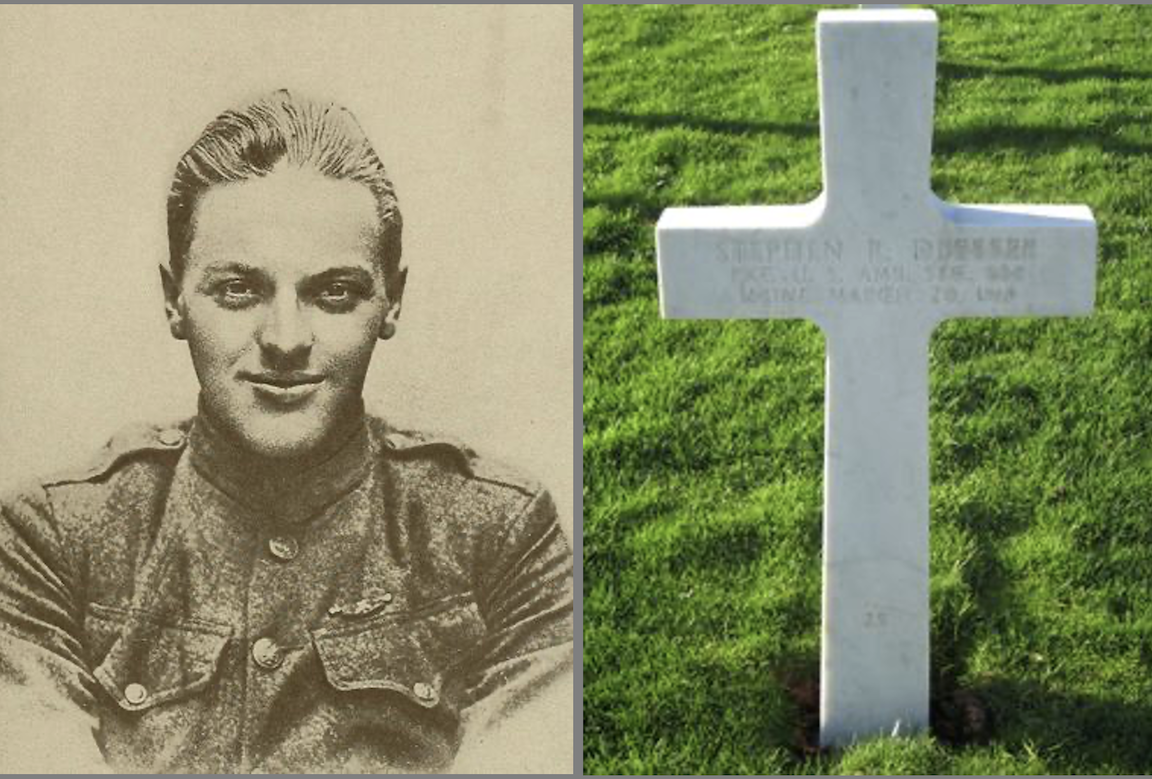
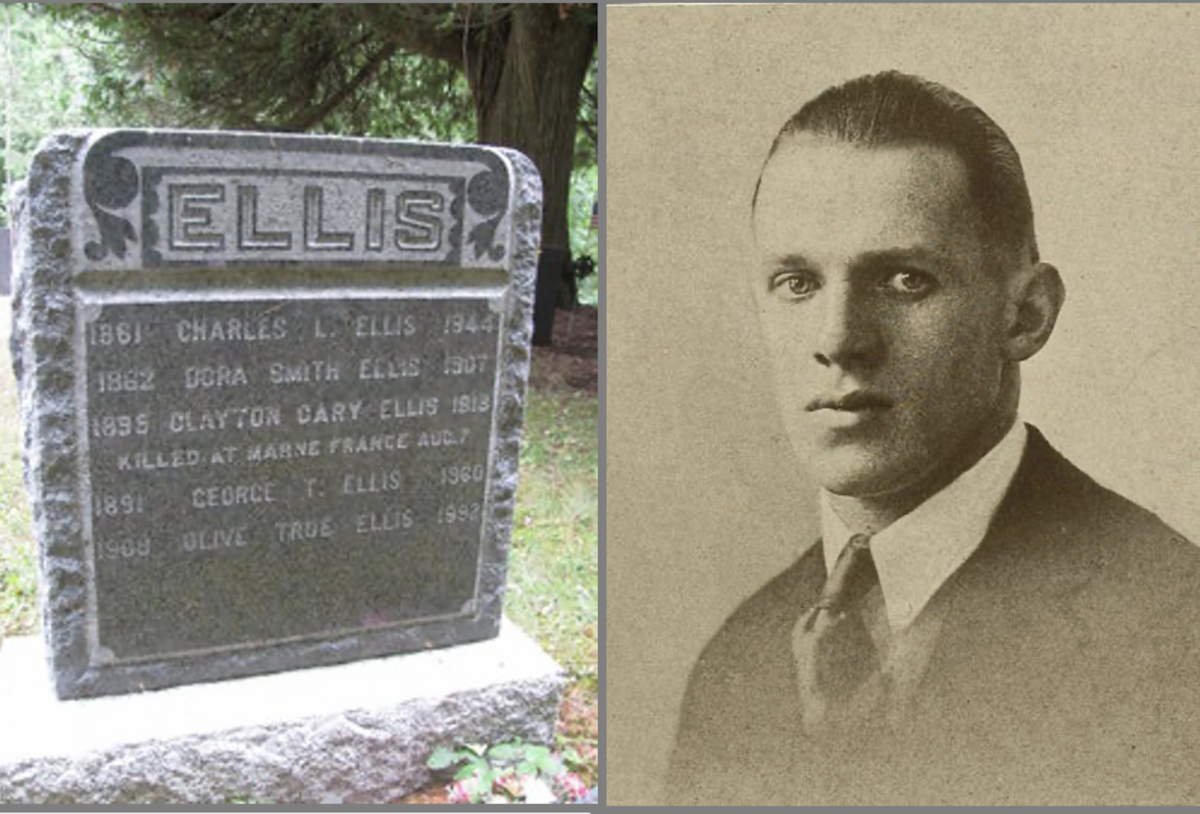
• Born July 13, 1895, in Somerville, Massachusetts. Educated Somerville schools and Massachusetts Normal Arts School, Class of 1919. Joined the American Field Service, May 5, 1917; attached Section Twenty-eight. Enlisted in U. S. A. Ambulance Service, September 17, 1917. Killed by shell in action at Reims, August 7, 1918. Buried Seringes-et-Nesles, Aisne. Body transferred to Longley Cemetery, Sidney, Maine. Croix de Guerre.
• "Long before Clayton Carey Ellis made his ultimate sacrifice in the service of France he had earned, by the happy combining of likable personality and abilities well above the average, the esteem and affection of his French and American comrades in the war just as earlier he had of his schoolmates. "I should not know how to say which was the greater --- the admiration or the love I felt for him" said the aumonier of the division in writing to Clayton's parents, and went on "he was, without exaggeration, one of the finest young men I have ever come into contact with in my career as a priest, and as the whole thing was cloaked in the most sincere modesty, I can safely say that dear Clayton represented for me the ideal of the young man."
• On the night of August 6th (1918), after midnight, he was carrying wounded through the shadowy, blasted streets of Reims when a shell struck close and a splinter pierced Clayton's head, killing him instantly.
• He was quiet and practical, a conscientious, enthusiastic worker, "volunteer for all perilous missions" says his army citation for the Croix de Guerre.
| |
|
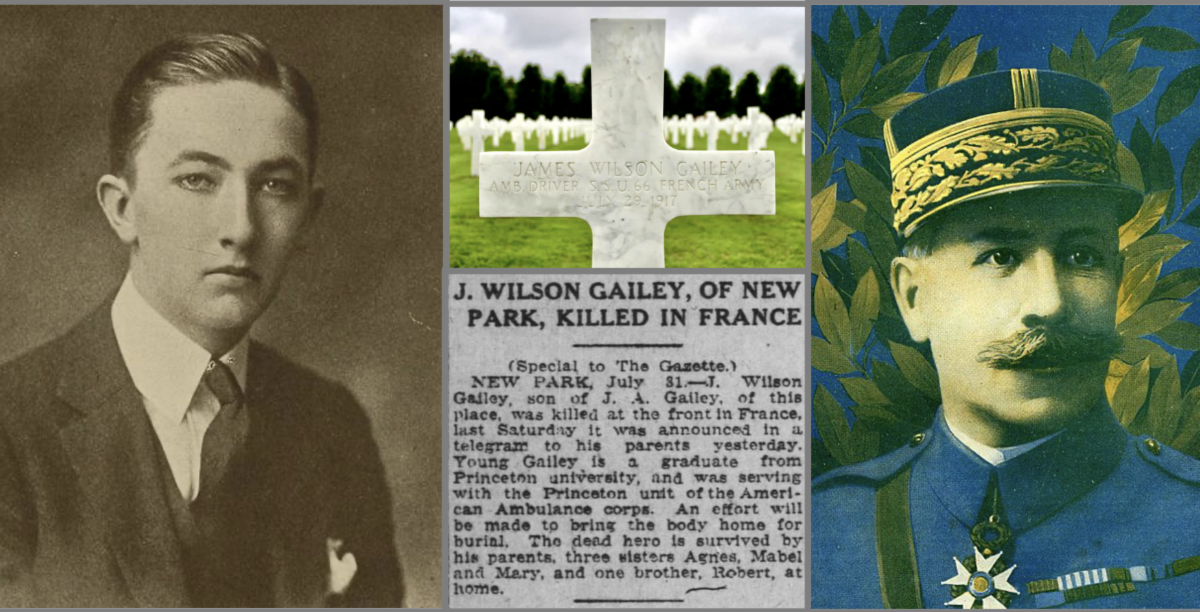
• Born July 20, 1895, in New Park, Pennsylvania. Educated Fawn Township High School, Perkiomen Seminary, Pennsburg, Pennsylvania, and Princeton University, Class of 1917. Joined American Field Service, May 26, 1917; attached Section Sixty-six. Killed by shell , July 29, 1917, Chemin des Dames. Buried Oise-Aisne American Cemetery. Croix de Guerre.
• "Jim" Gailey, a direct descendant of Myles Standish and of twelve Revolutionary figures, sailed for France with the American Field Service in May, 1917. Gailey gave his life for France and America those brief two months later.
• In June he wrote to his family, "I am now really and truly in the war. All the realities of a terrible warfare have been opened before my eyes. For three years I have read about it in a careless, rather unsympathetic manner, but my heart never beat faster for it then. Now I am interested, heart and soul." Before young Gailey had been in France two months he was cited for bravery. A few days later he was awarded the Croix de Guerre with the gold star, in recognition of his supreme sacrifice.
• The story of "Jim" Gailey's war service is necessarily brief. Enlisting in Section Sixty-six in May, 1917, he was sent at once to the Chemin des Dames region, then a theater of some of the most intense fighting on the western front. For three weeks previous to his death, Gailey and his companions had been working day and night, carrying wounded over shell-pocked roads lighted only by occasional flashes from rockets far above the streams of moving artillery, troops, and other traffic of war.
• On the night of July 25th, Gailey, hearing of another ambulance stalled by shell holes and ruins, ran to a neighboring poste through the extremely heavy barrage and transferred the wounded from the damaged car to the hospital. For this he received his Croix de Guerre.
• On the following Sunday morning, the twenty-ninth, just after dawn, Gailey and his companion, Hamilton, were loading their ambulance with wounded when a shell struck the car, killing both the American boys and two of the wounded Frenchmen.
• "They were buried the next day with all the honors of war. French General Henri Niessel, commander of the corps, found time despite the battle to deliver the address of tribute and farewell. Of the ceremony, Colonel Andrew wrote, "Certainly no one who was there could think of a more fitting or moving termination of any human life than such a ceremony on the soil of France in the midst of so many French soldiers and American boys who are daily risking all that they have and can hope for in the great cause."
| |
|
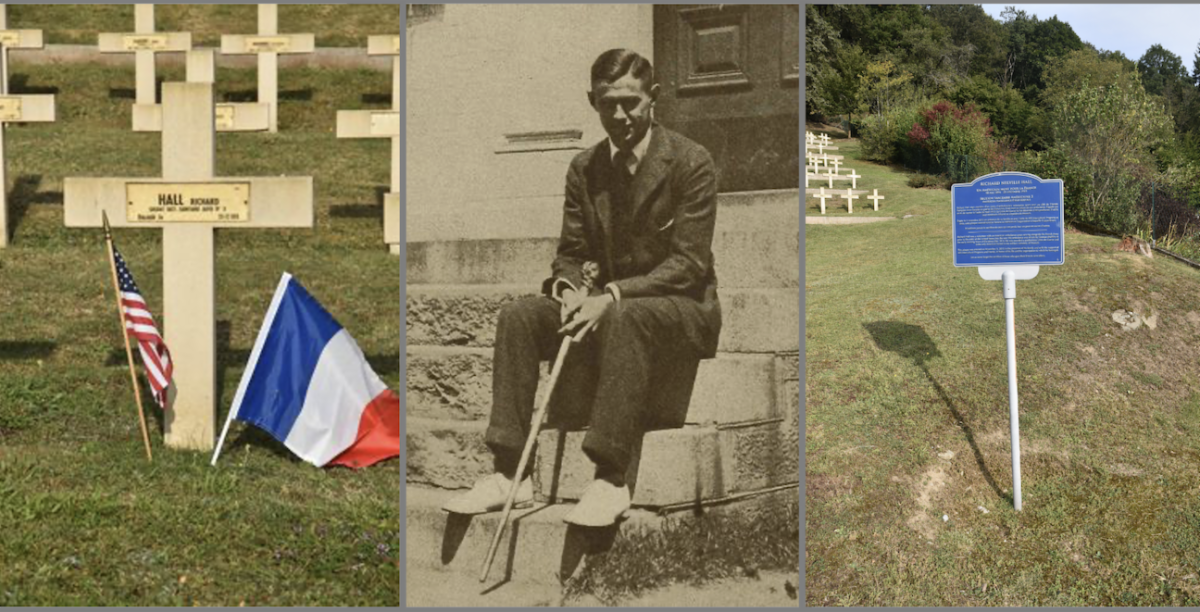
Above:
Top Left: grave at Moosch Cemetery, Moosch, Departement du Haut-Rhin, Alsace, France
Photo by Jean-Loup Frommer, https://www.findagrave.com/memorial/232517592/richard-nelville-hall
Top Middle: Richard N. Hall, Public domain: Memorial Volume of the American Field Service in France
Top: Right: Marker, in honor of Richard Hall and the American Field Service, Moosch Cemetery
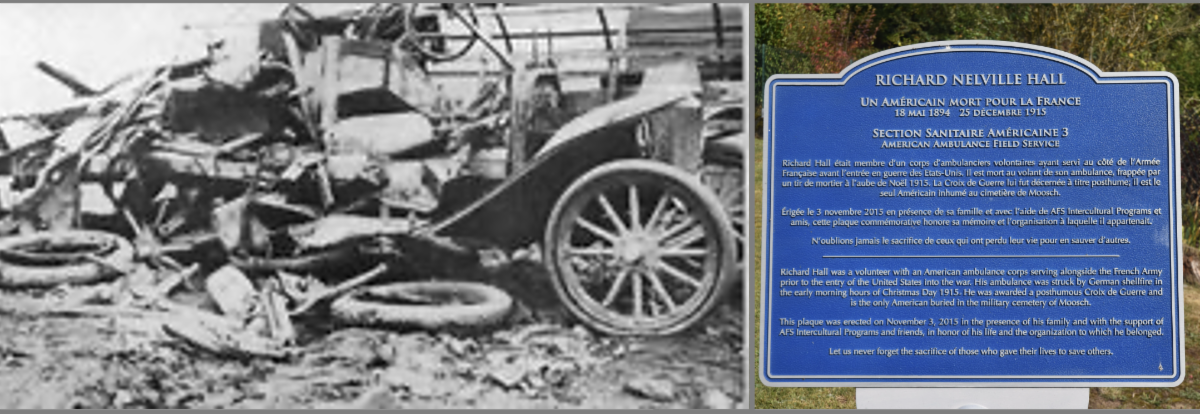
Bottom Left: Richard Hall's Ford Model T after the explosion, Photo provided by Thomas Fife, https://www.findagrave.com/memorial/232517592/richard_nelville-hall/photo#view-photo=243728101
Bottom Right: Close up of commemorative marker in his honor
| |
|
• Born May 18, 1894 in Ann Arbor, Michigan. Educated Ann Arbor schools, University of Michigan, and Dartmouth College, Class of 1915. Joined American Field Service, June 15, 1915; attached Section Three. Killed by shell near Hartsmannsweilerkopf, Alsace night of December 24-25, 1915. Buried Moosch, Alsace. Croix de Guerre.
• He was the first American volunteer ambulance driver on active duty to die in the Vosges, long before his country entered the war.
• At his burial in the Moosch cemetery, the Croix de Guerre was pinned to his coffin, and Major Physician Georges, of the French 66th Infantry Division delivered his eulogy:
"The Good Samaritan that Richard Hall was, he had decided to travel much in concert with us, along our route, to extend a tirelessly helping hand to those of our military compatriots whom the current hostilities would have plunged into misfortune. He has done so for many months with the constant tenacity you know.
On this road, he was killed by an enemy projectile. I salute his remains and express to him and to his emulators in devotion, the members of the American Medical Section No. 3, my deepest and fullest admiration on behalf of the Health Service of the 66th Division.
By order of the General commanding the 66th Division, I pin on this coffin the French Croix de Guerre with citation in the Division Order."
• "The Doctor concluded his tribute by assuring : “The French will not forget! "
• "Ambassador Jusserand (French Ambassador in Washington D.C.) wrote Dick's parents: "More has been accomplished by your son, in the brief space allotted to him, than can be the fate of millions who lead long, plain, ordinary lives."
Marker, Richard Nelville Hall
Nécropole Nationale de Moosch
12-14 Rue du Cimetière Militaire, 68690 Moosch, France
GPS: 47.859244, 7.054763
• Inscription:
“Un Américain Mort Pour la France
18 mai 1894 - 25 décembre 1915
Section Sanitaire Américaine 3
American Ambulance Field Service"
"Richard Hall was a volunteer with an American ambulance corps serving alongside the French Army prior to the entry of the United States into the war. His ambulance was struck by German shellfire in the early morning hours of Christmas Day 1915. He was awarded a posthumous Croix de Guerre
and is the only American buried in the military cemetery of Moosch."
"This plaque was erected on November 3, 2015 in the presence of his family and with the support of AFS Intercultural Programs and friends, in honor of his life and the organization to which he belonged."
| |
|
Above:
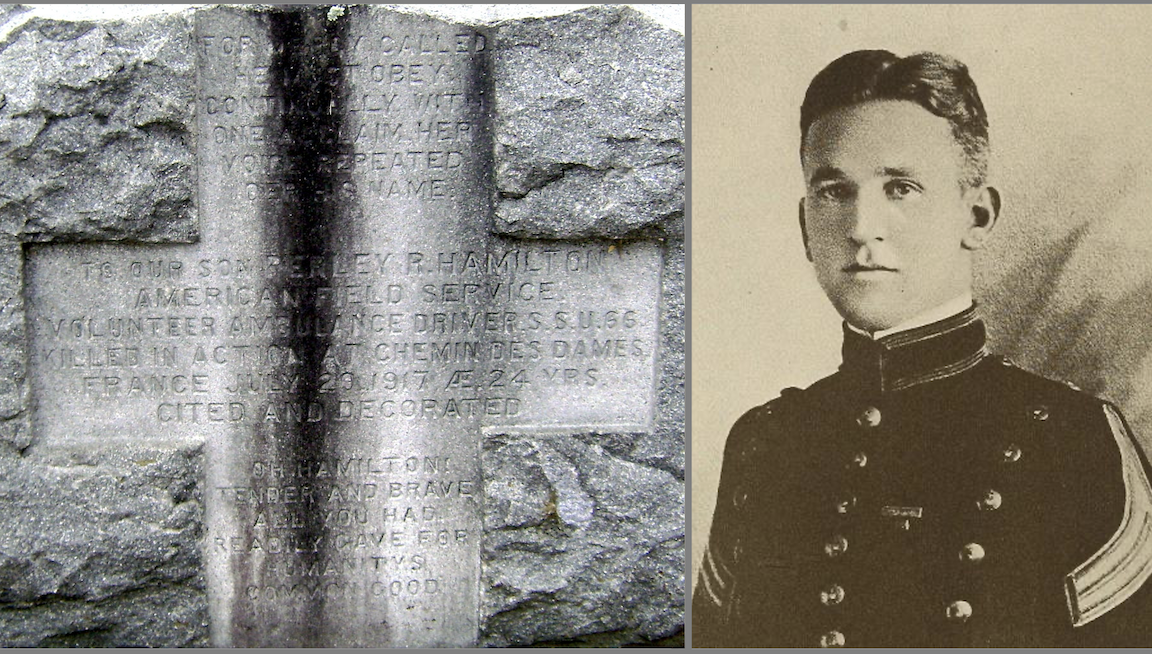
Top Right: Raymond P. Hamilton, Public domain: Memorial Volume of the American Field Service in France
Top Left: gravesite, Woodlawn Cemetery, Clinton, MA.
| |
|
• Born October 30, 1892, in Clinton. Massachusetts. Educated Clinton High School, Fenway School of Art, Boston, and New York Military Academy. Joined American Field Service, June 9, 1917; attached Section Sixty-six. Killed by shell, July 29, 1917, at Village Nègre, Chemin des Dames, near Craonne. Buried Beaurieux, Aisne. Body transferred to Woodlawn Cemetery, Clinton, Massachusetts. Croix de Guerre.
• He was killed while driving for James Gailey (see above) who died soon after.
• ..."Late in the night of July 28, 1917, Perley Raymond Hamilton sat at a little table in a corner of an abri crowded with groaning wounded, writing a hasty note to his mother by the light of a flickering candle-end. He had just received his first letter from her since he left home and he was anxious to let her know his joy in it and to assure her that all was well with him. "I am feeling fine and strong," he wrote, "and I can make up the sleep when the battle calms down a bit." It had been forty-eight hours since he had last slept, but he felt it more important to comfort his mother than to take the rest for which his whole tired body cried out. He was forced to stop, he concluded, because "I am to leave with a load of blessés in a few minutes and must have things ready for them." He sealed the letter and climbed out of the abri. Shells were falling nearby and the éclats whined past occasionally, rattling against the doorway. He cranked his car while his companion, James Gailey, assisted the loading of -the wounded. And then suddenly it happened. There was a quick, terrifying shock --- and blackness . . . . . Their comrades found "Ham" bowed over the steering wheel, still "on duty."
• General Niessel, the commander of the army corps that had so stubbornly resisted the German onslaught along the Chemin des Dames, attended the funeral in person and pronounced the last farewell as he placed the Croix de Guerre upon the coffin.
• Inscription on his gravesite: "For mercy called, he must obey: continually with one acclaim her voice repeated o'er his name. To our son Perley R. Hamilton, American Field Service Volunteer Ambulance Driver, S. S. U. 66. Killed in action at Chemin Des Dames, France, July 29 1917. AE 24 yrs. Cited and Decorated. Oh, Hamilton! Tender and brave, all you had readily gave for humanity's common good."
| |
|
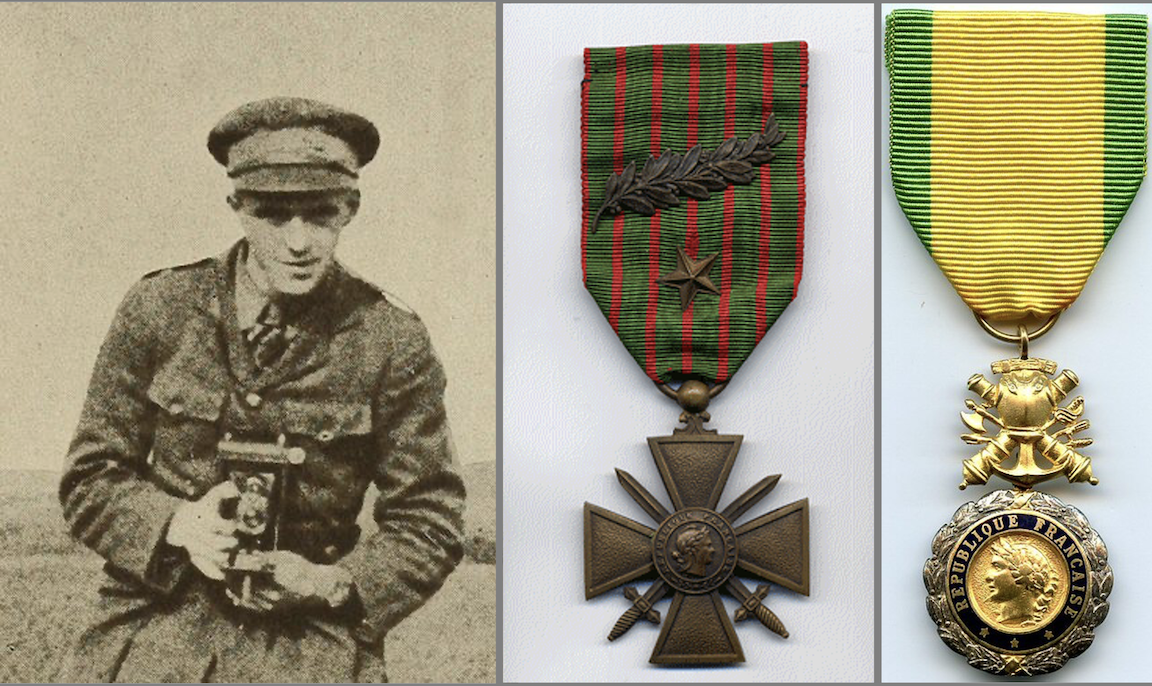
• Born December 18, 1896, in Somerville, Massachusetts. Educated Lexington Schools and Dartmouth College, Class of 1918. Joined American Field Service, May 5, 1917; attached Section Twenty-eight to October 2, 1917. Enlisted U. S. Army Ambulance Service. Wounded by shell, July 15, 1918, in Reims. Died August 14, 1918, at La Veuve Hospital, near Châlons-sur-Marne. Buried Military Cemetery, La Veuve, Marne. Croix de Guerre with palm, and Médaille Militaire.
• ..."On May 5, 1917, he sailed from New York with his brother in the American Field Service, writing to his mother just before the ship left the pier, "We are going into one of the noblest services that exists and we do not want you to feel badly . . . . . whatever may happen we want you to bear it bravely, as we know you will." Both he and his brother left Paris in Section 28 and were soon working in the midst of the heavy fighting in Champagne, where, on June 26th, his friend and college classmate, Paul Osborn, was killed while loading his car at an advanced post. Stanley wrote in a letter to his father telling of the tragedy, a sentence that has a striking interest in the light of his own unselfish death. "If anything happens to me, I pray God that I may be as noble, as courageous and as thoughtful of others as Paul was!"
• "Stan" loved the French; soon he spoke the language easily, delighting particularly in absorbing all sorts of slang expressions with which he would regale a group of admiring "poilus". His smile and unwavering good humor came to be known throughout the division where he was always warmly and affectionately made welcome. Miss Norma Derr, the author of "Mademoiselle Miss" describes him during the exhausting days of June, 1918, as he drove up to the hospital at Epernay. "He was white with dust and haggard after days and nights of steady driving, but just as buoyant and confident as in the old days in Bouleuse when the section was 'calm'. "
• "The German offensive of July 15, 1918, found Section 28 working in the Reims sector. Throughout that long memorable day they toiled, until at last the posts were temporarily cleared of wounded. As several of the men, worn out with fatigue and hunger, were snatching a hasty bite for the first time that day, a call came in for three more cars. Stanley was the first out on the road. Not far from the hospital on his return trip, a shell struck beside the car wounding him in the forehead. He was taken to the hospital at La Veuve and it was thought he would live. He regained consciousness and even wrote to his family in his cheery way, concerned only for the anxiety of his parents. In one of these two letters he wrote, "All goes well except that I worry as to how you are bearing up under the strain of not knowing just what happened to me."
Note*: Poilus: nickname the French soldiers gave to themselves, with their unshaven appearance after months in the trenches.
| |
Newberry "Berry" Holbrook | |
|
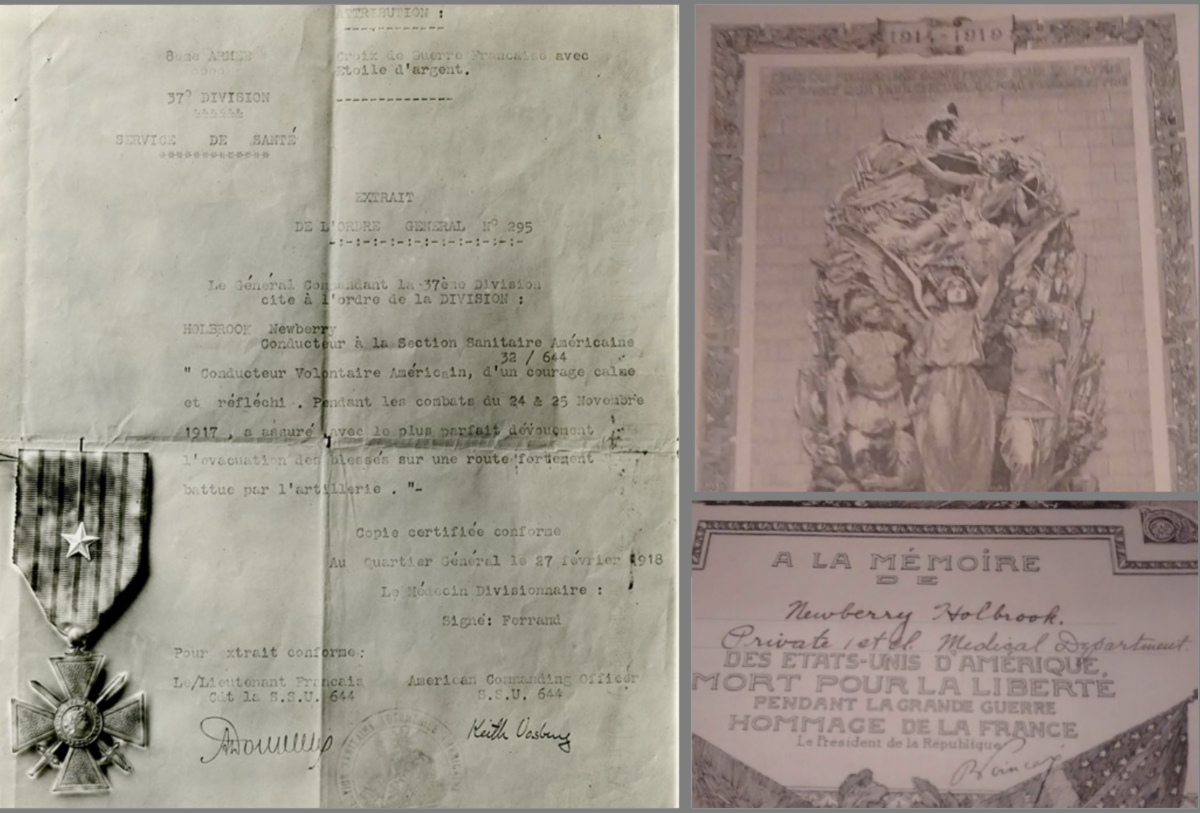
• Born November 4, 1888, in Brooklyn, New York. Educated Morris High School, and Columbia University, Class of 1911. Joined American Field Service, June 30, 1917; attached Section Thirty-two. Enlisted U. S. Army Ambulance Service, September 22, 1917. Promoted to Sergeant. Died, February 16, 1918, of typhoid fever, Essey-les-Nancy, Meurthe-et-Moselle.
Body transferred to Woodlawn Cemetery, New York. Croix de Guerre.
• ..."For work at Verdun during the latter days of November, 1917, he was cited for the Croix de Guerre by the 37th Division of Infantry with which the Section was serving. Of the character of the work which he did the following extract from a letter written by his lieutenant is sufficient proof: "Ever since the section left Paris last August, Newberry, or 'Berry,' as he was affectionately known to all of us, has been my right hand man. He was one of the best drivers, brave, cool, and intelligent. And in our first difficult engagement he actually made more trips, and brought down more wounded than any other man in the section. Personally, I have lost a very true friend; as his commanding officer, I have lost one of my most valued assistants."
• He died on February 16, 1918, at Essey-les-Nancy, of typhoid fever, having refused to leave the section and go to a hospital until but a few days before his death.
• Holbrook was awarded the Légion d'honneur (Chevalier degree) posthumously on November 11, 2011.
| |
|
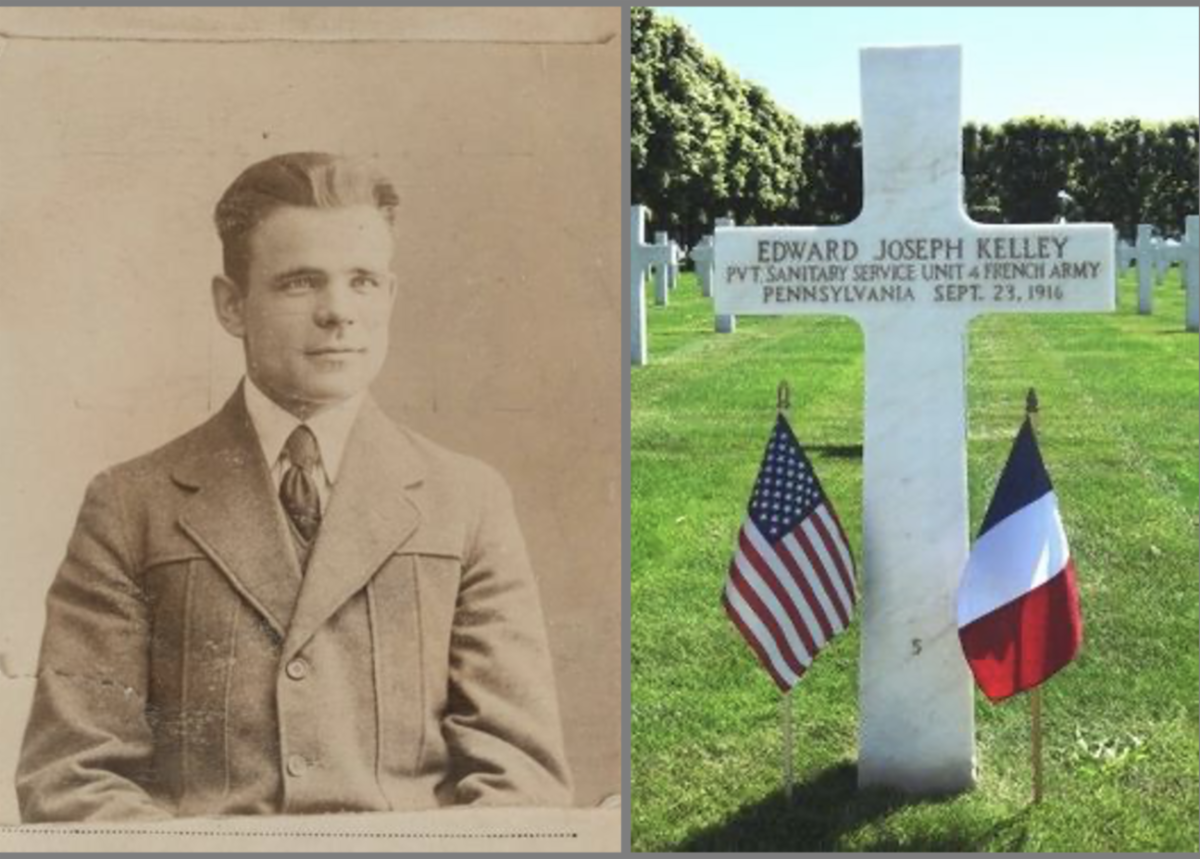
• Born March 19, 1889, in Philadelphia, Pennsylvania. Educated Philadelphia high schools; Rock Hill College, Ellicott City, Maryland; and University of Pennsylvania, Class of 1911. Joined American Field Service, August 26, 1916; attached Section Four. Killed by shell at Marre, near Verdun, night of September 23, 1916. Buried at Blercourt, Meuse. Croix de Guerre.
• ..."Edward Kelly belongs to that small and heroic band of American youths who gave their lives for France while their own country still hesitated to take issue. In the summer of 1916, while employed in the service department of a Philadelphia automobile manufactory, he read a magazine account of the work which Americans were doing in France. On August 26th, he sailed as a member of the American Field Service, with the intention of devoting to the cause the expert knowledge of automobiles which he possessed."
• He had expected to remain in Paris, as may be gleaned from letters written home shortly after his arrival, but an opportunity presented itself almost immediately of joining Section Four at the front and he eagerly hailed this chance to see active service in the field. Section Four was at the time one of three sections located in the Verdun sector, whose work lay in the region of the famous Mort Homme.
• His term of service was to be short. Six days after joining the section, on the night of September 23, 1916, he was making his first trip to the dressing station in the little ruined town of Marre, and was being shown the road by a veteran of the section named Sanders. They had almost reached their destination, a heavily protected cellar, when a German shell struck about three yards in front of the ambulance, sending its fragments in all directions. Kelley was instantly killed and his companion seriously wounded. They were carried back in another ambulance, which was waiting at the post, to Blercourt.
He was buried there with military honors, just a month from the day he had sailed from New York.
• "Piatt Andrew, the commanding officer of the Field Service, wrote a few days later to Kelley's sister, describing the scene: "Imagine a sunny, warm September morning and a village street sloping up a hillside. In the open entry of one of the houses, the front of which was hung with the black and silver drapery of the church and the tricolor of France, the coffin was placed, wrapped in a great French flag, covered with flowers and wreaths, at the head a small American flag on which was pinned a Croix de Guerre with a gold star, the tribute of the Army Corps General to the boy who had given his life for France. Six French soldiers bore the coffin and then followed representatives of our sections, each carrying wreaths, then the General, a group of officers, and after them the fifty or more Americans surrounded by a detachment of soldiers with arms reversed. The scene was one which none there could ever forget."
• Kelley was awarded the Légion d'honneur (Chevalier degree) posthumously on November 11, 2011
| |
|
Above:
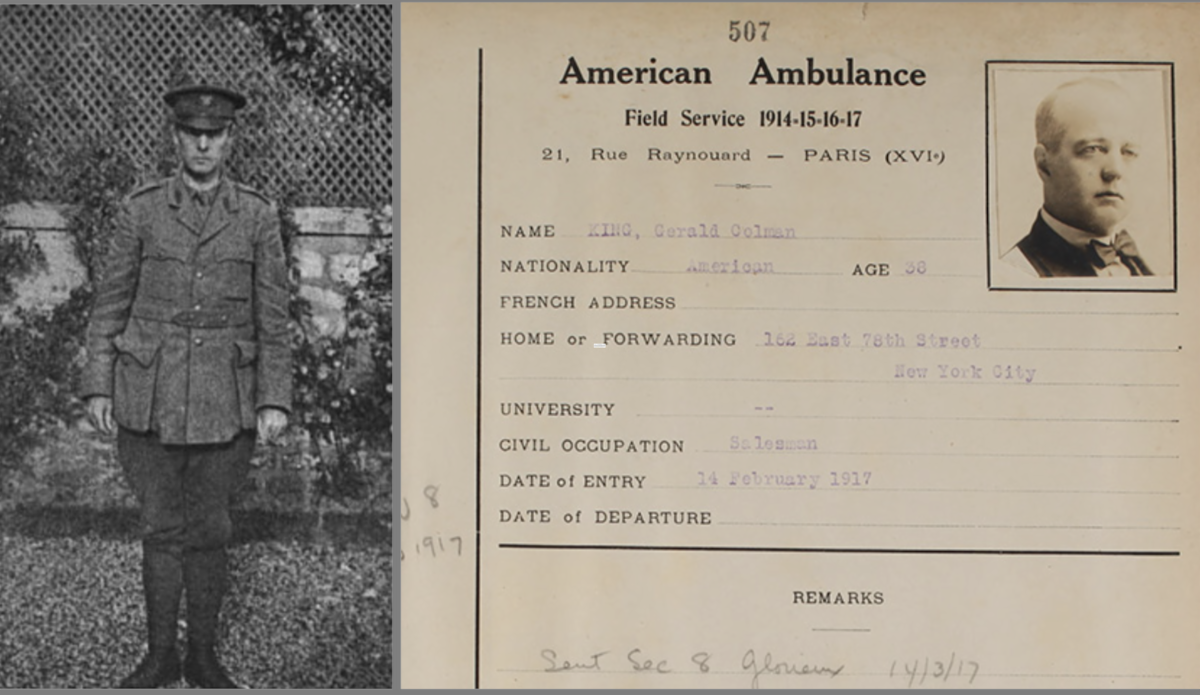
Gerald Colman King, and service file, courtesy of the Archives of the American Field Service and AFS Intercultural Programs.
| |
|
• Born November 22, 1878, in Bellows Falls, Vermont. Educated St. Mark's School, Southboro, Massachusetts, and Pomfret School, Connecticut. U.S. Army, Spanish-American War, as volunteer. Joined American Field Service, February 14, 1917; attached Section Eight. Invalided to United States, May, 1917. Died in hospital, New York City, September 27, 1917. Buried in Grace Church Cemetery, Jamaica, Long Island, New York.
• ..."When America entered the War, King was too old to enlist in the regular army, so he chose at once the only other possible alternative for getting to France to aid that country for which he felt a very deep affection, fostered by blood ties. He enlisted with the American Field Service."
• ..."In recent years King has been well-known as an actor, but he turned aside from the stage to go to France as an ambulance driver, and while there was stricken with paralysis, which terminated in death in a New York hospital after he had been brought back helpless to this country."
• "In recent years King has been well-known as an actor, but he turned aside from the stage to go to France as an ambulance driver, and while there was stricken with paralysis, which terminated in death in a New York hospital after he had been brought back helpless to this country."
• Gerald Colman King was awarded the Légion d'honneur (Chevalier degree) posthumously on November 11, 2011
| |
Howard Burchard "Rainy" Lines, Jr. | |
|
• Born March 5, 1891, in New York City. Educated Anglo-Saxon School, Paris; University of Paris, Sorbonne, "baccalaureat" 1908; Dartmouth College, Class of 1912; Harvard Law School, 1915. Joined American Field Service, September 8, 1915; attached Section One to December 30, 1915 ; reenlisted September 17, 1916; attached Sections Eight and One. Died at the front, of pneumonia, December 23, 1916. Buried Christmas Day, La Grange aux Bois, Argonne. Body now in American Military Cemetery, Suresnes, near Paris, Seine. Croix de Guerre.
• His pneumonia was complicated by meningitis at the front at La Grange aux Bois. He had suffered appendicitis, abdominal injury, chickenpox, and the Spanish influenza, all within a few months of his death, however he kept going back to the frontlines.
• ..."Educated in France, and loving intensely her people and her traditions, Lines was prepared from the beginning to make any sacrifice for her cause. "Devoted and courageous," read an Army Order of the Day, "he was sent to the rear, ill. He returned again eagerly to the front after his recovery, contracted a grave malady, and died for France."
• ..."Howard Burchard Lines died in the Argonne on December 23rd. after a two days' illness due to exposure and overwork. He was buried with military honors on Christmas morning, in a small French village a kilometre behind the trenches. The coffin was wrapped in the French flag, but Howard's comrades did not forget to place the American flag as a pillow under his head. By the courtesy of the French authorities, Dr. and Mrs. Lines and Howard's sister, Miss Mary Lines, were able to be present at the funeral. Howard Lines had served since graduating from the Harvard Law School in the field ambulance department of the American Hospital, and had been recommended for the croix de guerre just before his death. He was tireless in his devotion and cool and unflinching under fire. As classmates and other Dartmouth friends know, Howard Lines was largely brought up in France, and loved passionately the country that was his home. His life was given freely and gladly in the service of France, because he believed, in common with the great majority of American college men, that the cause of France was that of humanity." - The Dartmouth College Magazine, Vol. IX, February 1917, No. 4
• The French Government awarded Lines the Croix de Guerre posthumously in honor of his service.
• There is a memorial commemorating Howard “Rainy” Burchard Lines located at Dartmouth College, at the bottom of the Baker Library, west stairwell, with his correspondence and memorabilia framed on the walls.
| |
Gordon Kenneth "Mac" Mackenzie | |
|
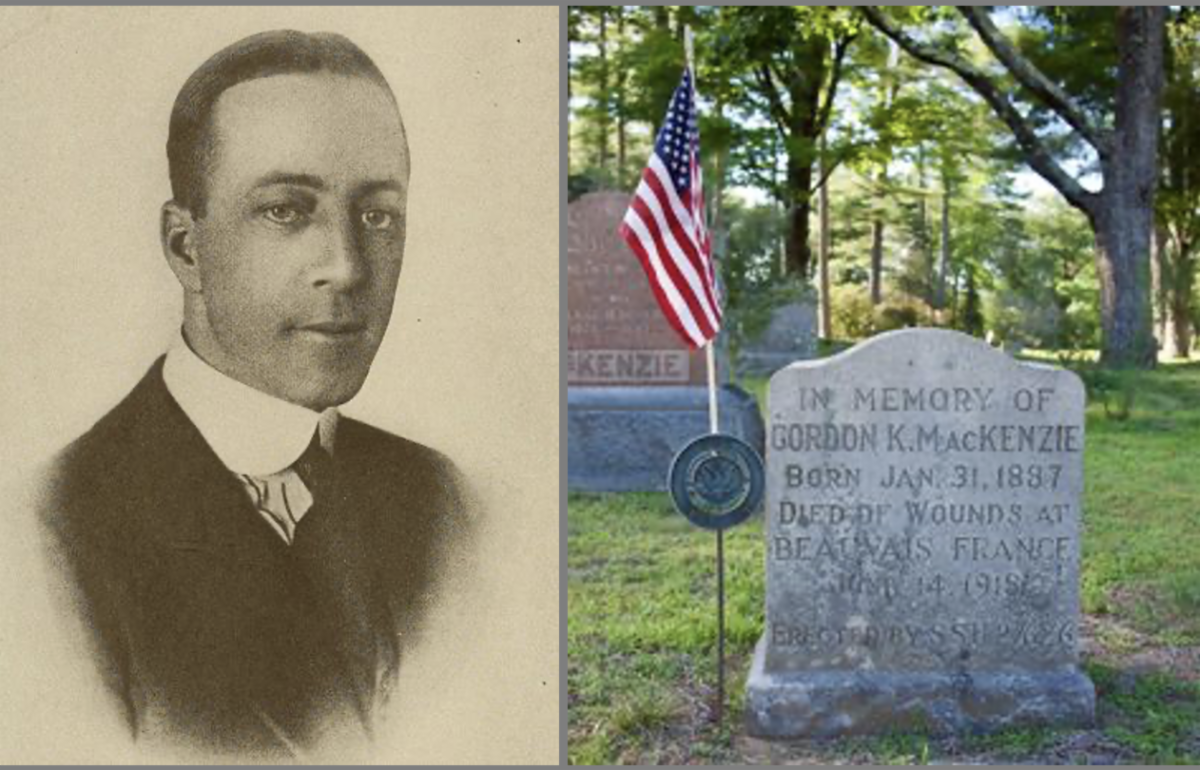
• Born January 31, 1887, in Concord Junction, Massachusetts. Educated Concord schools. Joined American Field Service, November 11, 1916; attached Sections Ten, in Balkans, and Two, in France. Enlisted U. S. Army Ambulance Service, September 26, 1917; attached Section 626. Died in Beauvais, June 14, 1918, of wounds received in action near Montdidier, June 12th. Buried in Beauvais, Oise. Body transferred to Sleepy Hollow Cemetery, Concord, Massachusetts. Croix de Guerre, with palm.
• ..."Mac's" unit served six months in Albania, after which he was transferred to France. He joined Section Two, then stationed in the Verdun sector in the thick of the fighting. With this Section, which afterwards was Section 626, U. S. A. A. S., he served for nearly a year in Lorraine, on the Aisne, and on the Oise. In June, 1918, the 48th Zouaves, to which the Section was attached, was thrown into the counter offensive near Montdidier. The toll of wounded was frightful and the ambulances were worked exhaustingly long hours. On June 12th "Mac" was in a hospital courtyard at Neufvy waiting for his car to be loaded, and meantime feeding some wounded Frenchmen. Without warning an obus dropped, exploded, and blew an ambulance to pieces, killing several Frenchmen and wounding MacKenzie."
• Though the wound was not fatal in itself, blood poisoning set in, and "Mac's" life slipped away on June 14, 1918, in the Hospital at Beauvais. The nurses who attended him wrote of his patience and endurance, of his consideration for others in the ward, and of the fineness of character revealed even in his weakness.
| |
|
Above:
Left: Arthur Myers, Public domain: Memorial Volume of the American Field Service in France
Right: Arthur Myers service file,
| |
|
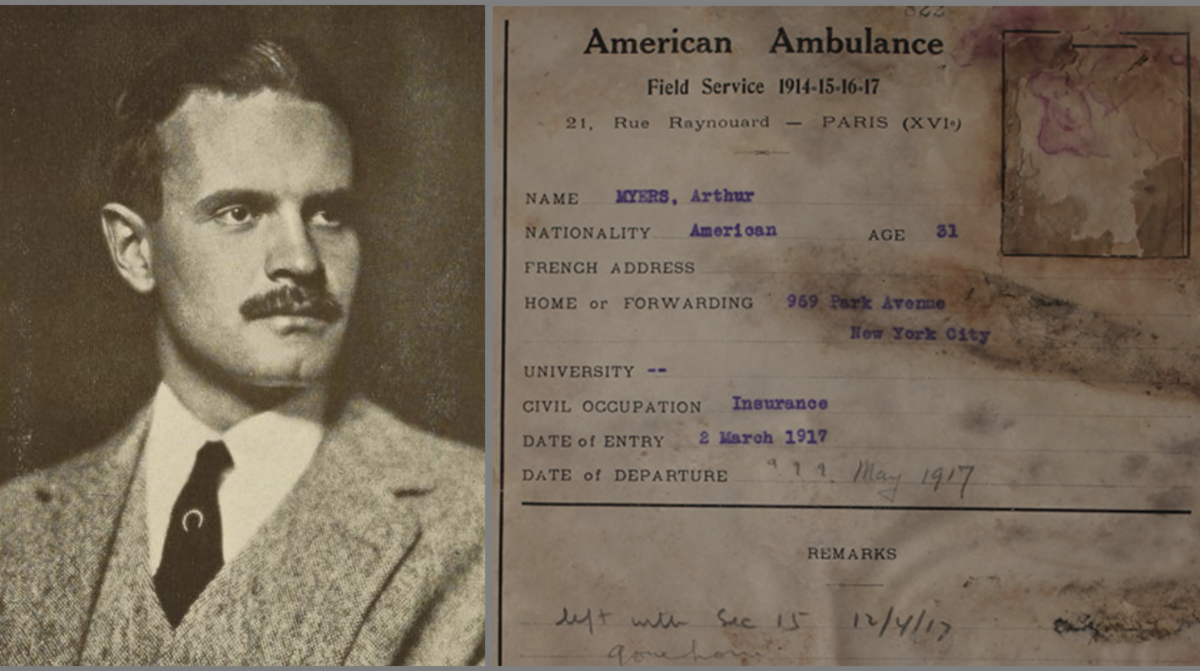
• Born March 22, 1886, in New York City. Educated Cornwall Heights and Brooklyn Polytechnic Preparatory Schools. Joined American Field Service, March 2, 1917; attached Section Fifteen to May. Sent back to America, July, 1917, suffering from shell-shock. Died at home in New York City, October 4, 1917. Buried Green-Wood Cemetery, Brooklyn, New York. Croix de Guerre.
• ..."Arthur Myers had French blood in his veins and had stimulated a natural and profound admiration for France by extensive reading in French history. He felt very keenly the obligation of America's debt to her and the necessity of its payment."
• ..."On one occasion he volunteered to evacuate a badly wounded man from a little poste in the Bois d'Avocourt, over a road that was being methodically "watered " by high-explosive shells, and so excited the admiration of the French sergeant in charge of the poste that he was recommended for and eventually received the Croix de Guerre. He was promoted to the office of sous-chef and won the confidence and respect of the men. His friend, Earl Osborn, wrote, "As chief of Section Fifteen I should like again to bear witness to the bravery and devotion of Arthur Myers."
• "Then we noticed a change in him," wrote one of his closest friends in the section. "He kept by himself and seemed morose . . . . . We little thought it was a symptom of that common disease 'shell-shock,' which so often claims the strongest and best." He kept bravely on till one day after a particularly frightful experience, as he wrote later from Paris, "I got back to the section and felt good for nothing but to lie on my back . . . . . and wonder when the pains in my head would let up." He was sent back to Paris to rest and for a time he seemed to rally, confidently expecting to return to the section; but his weakened constitution had received a severer shock than he realized, and in July he was sent home to America. He grew steadily weaker till on October 4, 1917, he died.
| |
John "Jack" Verplanck Newlin | |
|
Above:
Right: John Verplanck Newlin, Courtesy of the Archives of the American Field Service and AFS Intercultural Programs.
Left:
| |
|
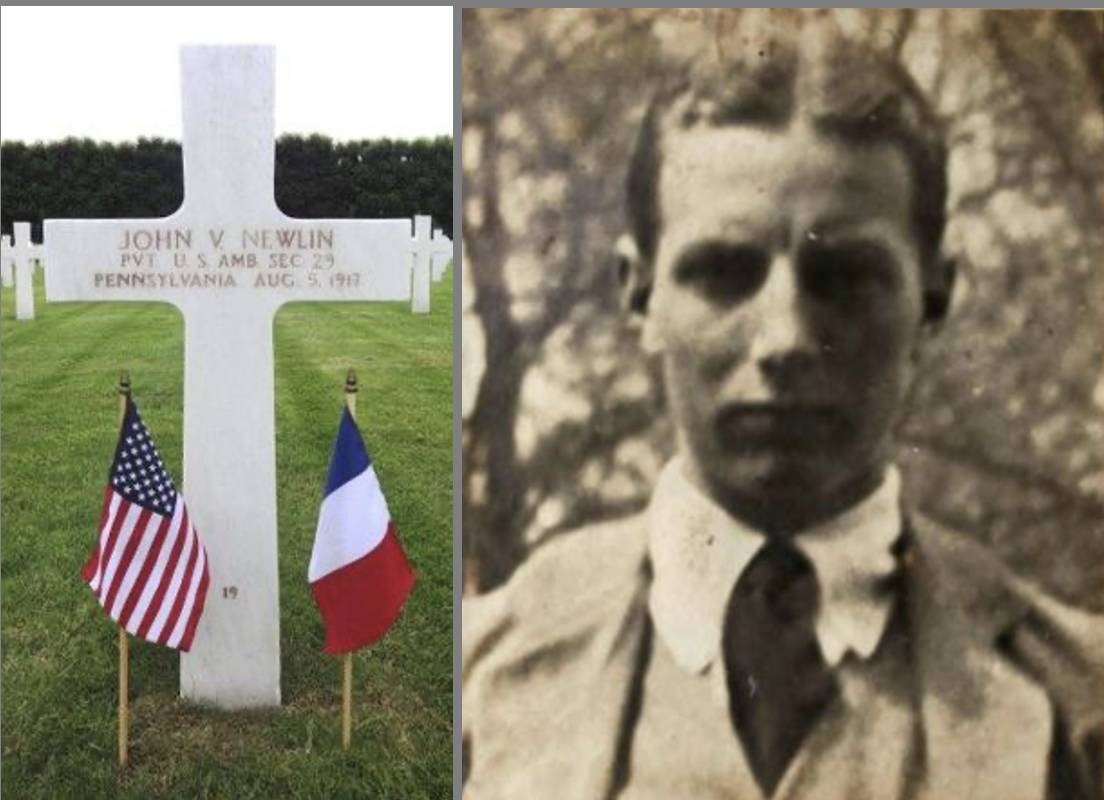
• Born May 16, 1898, in Ardmore, Pennsylvania. Son of Richard M. and Alice Eisenbrey Newlin. Home, Whitford, Pennsylvania. Educated Haverford School, Pennsylvania, and Princeton University, Class of 1919. Plattsburg Camp, 1916. Joined American Field Service, May 26, 1917; attached Section Twenty-nine. Wounded August 3rd, Montzéville. Died of wounds, night of August 5, 1917. Buried Fleury-sur-Aire, Meuse. Body transferred to American Military Cemetery, Romagne-sous-Montfaucon, Meuse. Croix de Guerre, Médaille Militaire.
• ..."Jack" Newlin's military career was short. A member of the class of 1919 at Princeton, where he had been art editor on the "Tiger" and an editor of the "Litt" magazine, he attended Plattsburg during the summer of 1916 and in May of the following year left college to enlist in the American Field Service. His section, S. S. U. 29, left Paris on June 30, 1917, spent about three weeks in the vicinity of Bar-le-Duc, and on July 23rd started work at the front a little to the west of Verdun. It was at the poste of Montzéville on the night of August 3rd, that a shell, landing near the entrance of the dug-out, wounded him severely just as he was on the point of starting his car. He was rushed to the hospital at Fleury where he was operated on the following evening. The next day he rallied sufficiently to see some of his comrades and to receive his citation and Croix de Guerre, but died about midnight.
• Madame Jacquemaire, the daughter of M. Clemenceau (France's Prime Minister), who was a nurse in the hospital in which he died wrote in a very touching letter to his mother:
"Despite everyone's best efforts, the brave child passed away gently and painlessly in our arms. The Military Commander had presented him with the highest awards for his bravery, the Military Medal and the Croix de Guerre. He contemplated these beautiful awards with profound joy. ... ... I'm proud to have known your admirable child."
| |
|
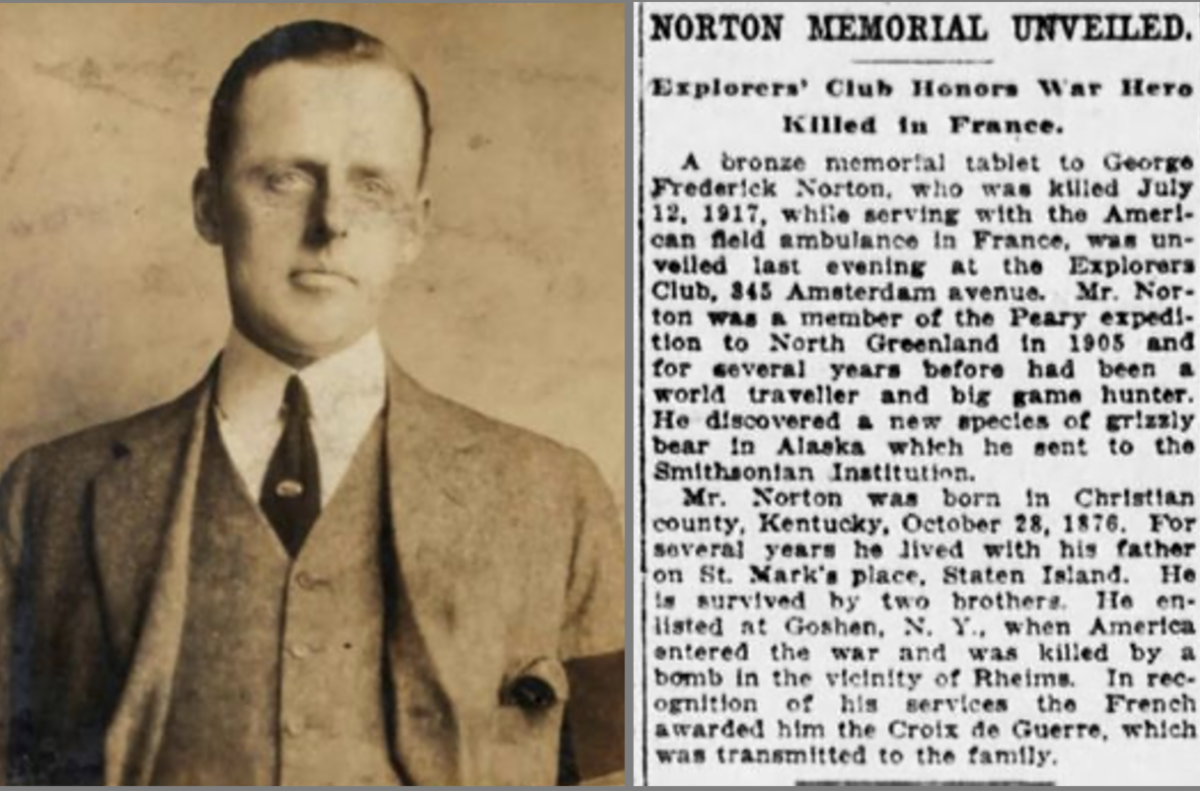
• Born October 28, 1876, in Elk Grove, Christian County, Kentucky. Educated at Lawrenceville School, Class of 1894, and Staten Island Academy. Joined American Field Service, May 26, 1917; attached Section One. Killed at Ludes by aeroplane bomb July 12, 1917. Buried in Ludes, Marne. Body subsequently transferred to Moravian Cemetery, New Dorp, Staten Island, New York. Croix de Guerre, Corps d'Armée citation
• Norton was a member of the Peary expedition to North Greenland in 1905 and for several years before had been a world traveller and big game hunter. He discovered a new species of grizzly bear in Alaska which he sent to the Smithsonian Institution.
• In recognition of his services the French awarded him the Croix de Guerre, which was transmitted to the family.
| |
|
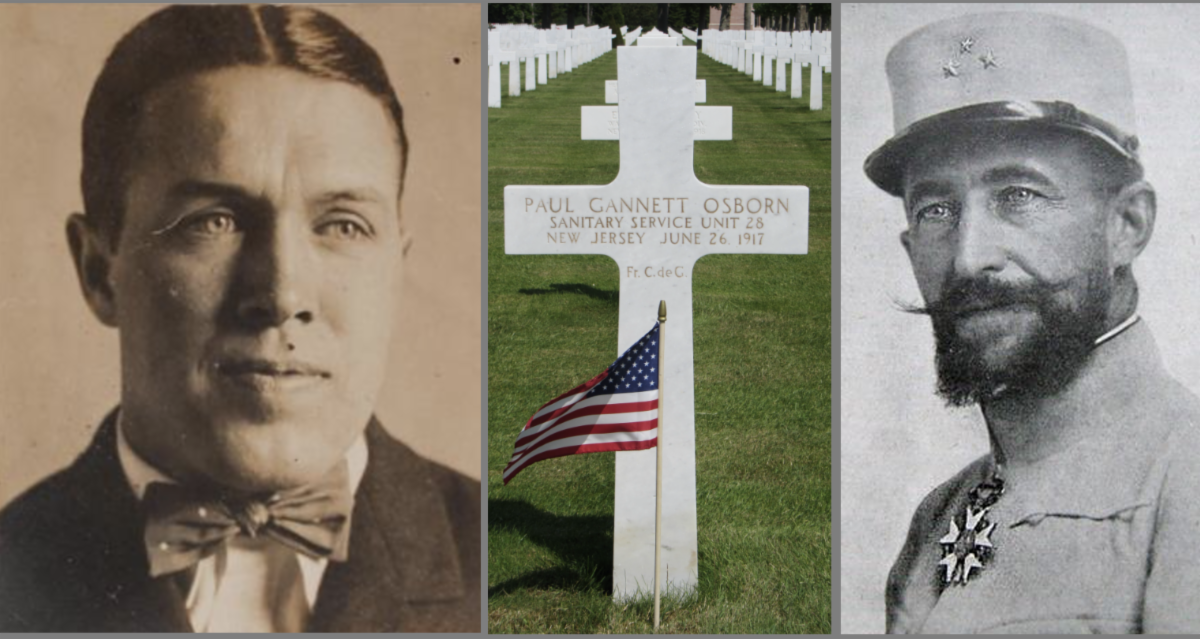
• Born June 24, 1894, in Rochester, New York. Educated Montclair High School and Dartmouth College, Class of 1917. Joined American Field Service, May 5, 1917; attached Section Twenty-eight. Wounded near Village Gascon, Champagne, June 21. Died of wounds, June 26, 1917, at Hôpital Farman. Buried Hôpital Farman, near Mourmelon-le-Grand, Champagne. Croix de Guerre.
• ..."It was on his first night of service at the front, with the American Field Service, that Paul Gannett Osborn was called upon to make his sacrifice. His little span of service was brief, but "the swift, clear glow of sacrificial youth" flamed high, before it died, illuminating all it touched, and leaving the radiance of his memory to burn through the years. To him falls the sad distinction of being the first American killed after our entrance into the war."
• Paul Osborn and his brother together joined the American Field Service with the Dartmouth unit, in May, 1917. Section Twenty-eight, of which Paul was a member, received its baptism of fire on the night of June 21st. Driving over a muddy road, near Village Gascon, Champagne, Paul came upon a comrade's machine stuck in a shell hole, and stopped to help, despite a heavy German barrage. Before the car could be extricated Paul was hit, and mortally wounded. He was hurried to the Farman hospital, near Mourmelon-le-Grand, where every effort was made to save his life, but gangrene set in and he died a few days later.
• The Divisional Surgeon, speaking at the grave, said in part: "Ahead of your armies you came, American volunteers, to submit yourselves to this stern test, and one of you has already sealed with his blood the close fraternity that unites you to the people of France."
• Major General Baratier, of Fashoda fame, closed his beautiful tribute with these words:
"Soldier Osborn, sleep on among your French comrades, fallen like you, in glory! Sleep on wrapped in the folds of the American flag, in the shadow of the banner of France!"
| |
|
Above:
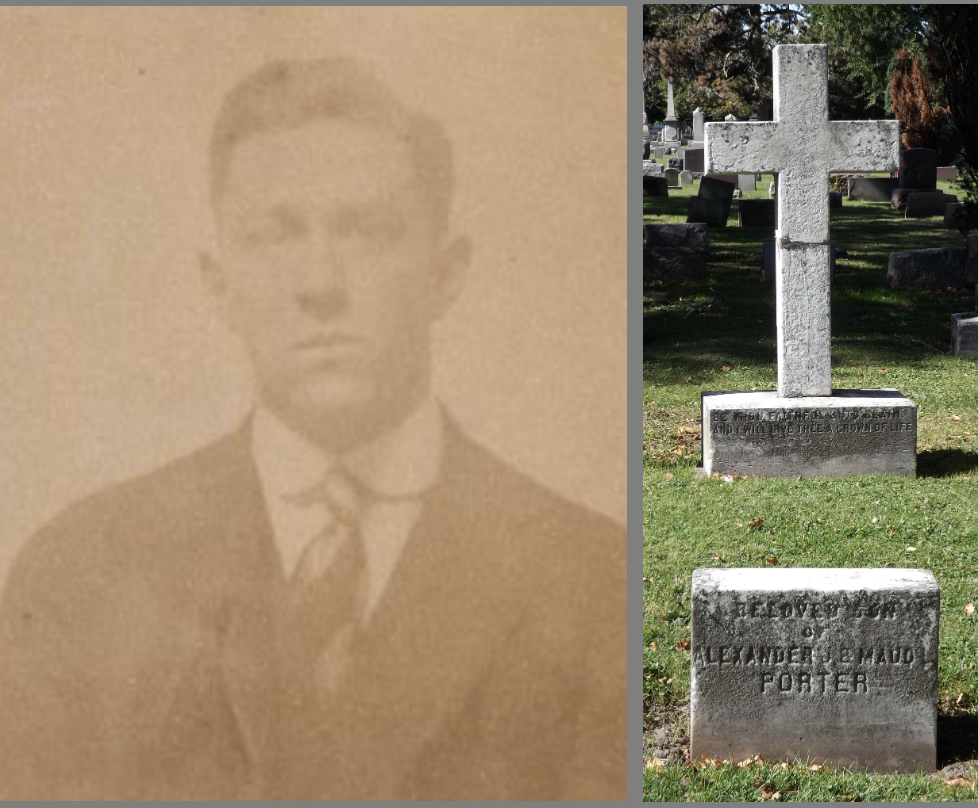
Left: Albert Augustus Porter, Courtesy of the Archives of the American Field Service and AFS Intercultural Programs.
Right: Gravesite, Oakwood Cemetery, Niagara Falls, NY, Photo by Scotdeerie
https://www.findagrave.com/memorial/43173108/albert_augustus-porter/photo
| |
|
• Born September 30, 1896, in Buffalo, New York. Son of Alexander J. and Maud Langmuir Porter. Home, Niagara Falls, New York. Educated Ridley College, St. Catherines, Ontario, and Cornell University, Class of 1919. Plattsburg Camp, 1916. Joined American Field Service, March 12, 1917; attached Headquarters. Died in Paris of pneumonia, April 25, 1917, at Hospital Buffon. Funeral services in Paris. Buried Oakwood Cemetery, Niagara Falls, New York. Croix de Guerre.
• "...In February (1917) he enrolled with the American Field Service. He wrote from New York early in March, a day or two before sailing: "Naturally I feel a little too happy, but it is because I am going to do what I have always longed to do."
• ..."Upon his arrival in Paris he was assigned to Section Four and was on the point of leaving for the front when he contracted measles which necessitated his being sent to a hospital. At last his eagerness was so great that he insisted upon going out to test his strength, but the raw Paris spring weather was too much for him and pneumonia developed. He died on April 25, 1917, when not yet twenty one, a month after reaching France. A military funeral was held at the American Church, the first since the United States had declared war, and was attended by many of his comrades and officers of the Field Service and by prominent American and French residents. His casket, draped in an American flag, was sent back to Niagara Falls."
| |
|
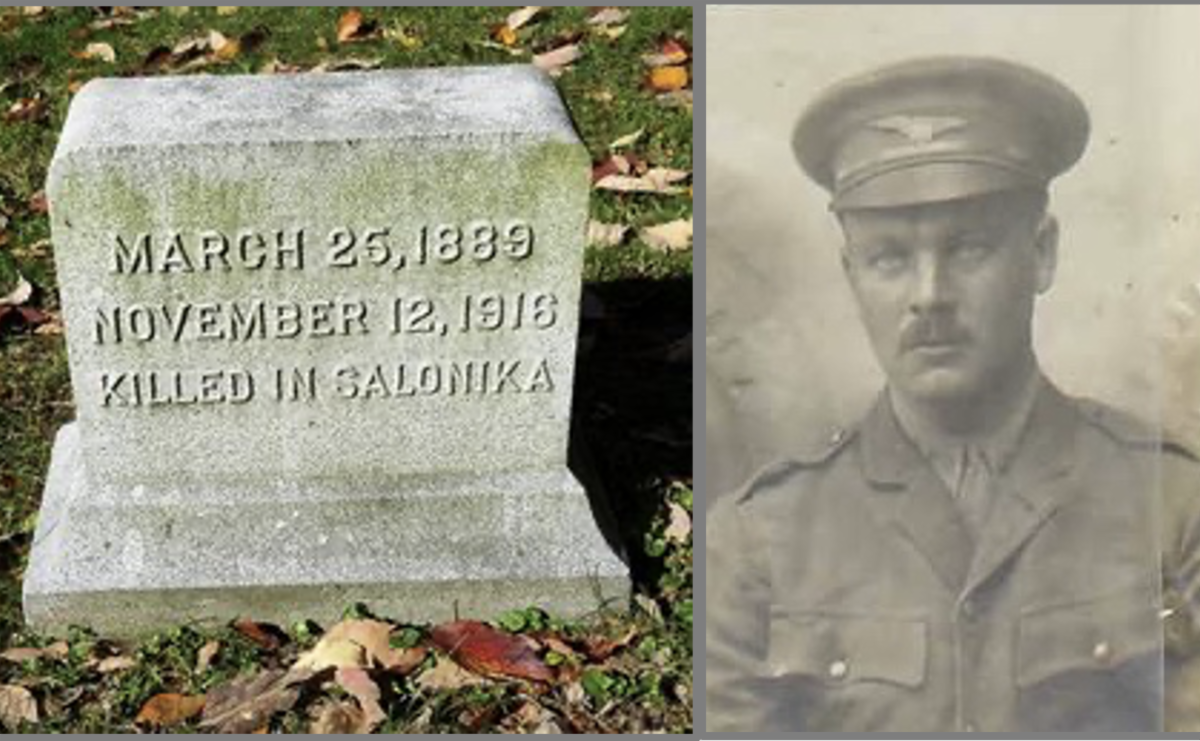
• Born March 25, 1889, in Cambridge, Massachusetts. Educated St. Paul's School, Concord, New Hampshire, and Harvard University, three years, Class of 1911. Joined American Field Service, April 26, 1916; attached Section Eight to September, 1916, then Section Three in Salonica. Died November 12, 19116, of injuries received in accident, Salonica, November 11. Buried, Salonica. Body transferred to Mt. Auburn Cemetery, Cambridge, Massachusetts.
• ..."On the death of his father, a former mayor of Cambridge, he left Harvard College at the end of his junior year and entered the employ of the Ludlow Manufacturing Associates. It was in pursuit of this firm's transactions in jute that he was sent to Calcutta, where he remained for three years. In the spring of 1916, on his way back, to America, he stopped over in Paris and, becoming interested in the work which the American Field Service was doing at the front, enlisted for a term of six months. Section Eight was just leaving for action, and as one of the original members of the section he served from May until September, 1916, in Champagne and around Verdun."
• Late in September he volunteered for duty with Section Three in the French Army of the Orient and was accepted. Barely two weeks after landing in Salonica and while waiting for the cars to be made ready, he was struck by a British staff car while crossing a dark street, concussion of the brain resulting, and he died the following night, Sunday, November 12th, 1916. He was buried in the French Cemetery on the outskirts of Salonica, his coffin covered with a French and an American flag.
• In a letter to Sortwell's mother, A. Piatt Andrew, head of the American Field Service, wrote: "...He is the third of our American volunteers to give his life in the service of France in her hours of peril, and with his sacrifice he has added one more link to the bonds of friendship which have bound our two countries since their earliest days."
• Sortwell was awarded the Légion d'Honneur (Chevalier degree) posthumously on November 11, 2011.
| |
Henry Eglington Montgomery Suckley | |
|
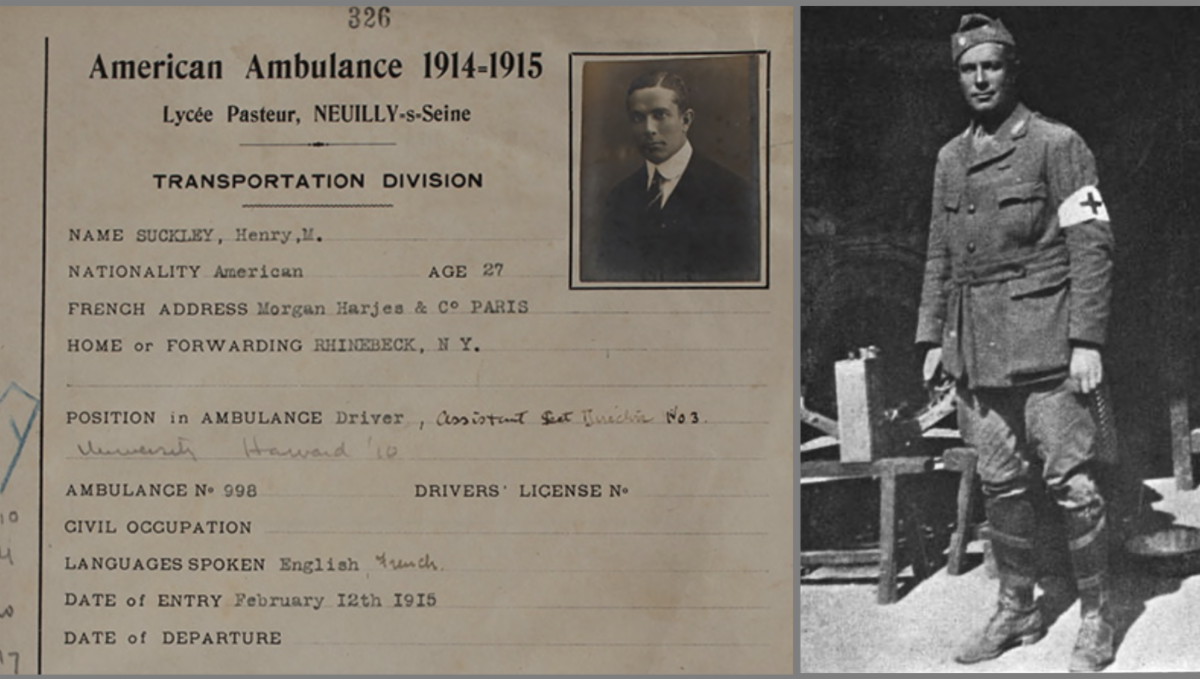
• Born February is 1887, in Orange New Jersey. Educated abroad, Phillips Academy, Exeter, and Harvard University, Class of 1910. Joined American Field Service, February 12, 1915; attached Section Three; Sous-chef, May, 1915 to September, 1916. Recruited for Field Service, in America, September to November, Commandant Adjoint Section Ten, November, 1916. To the Balkans. Wounded by avion bombs , March 18, at Zemlak. Died March 19, 1917, at Koritza, Albania. Buried in Koritza. Croix de Guerre.
• ..."Suckley joined the Field Service in February, 1915, and in May of the same year he went to the front with Section Three. He remained continuously with that unit, on the Alsatian, Lorraine, and Verdun fronts until September, 1916, was awarded the Croix de Guerre for gallantry in action, and appointed Sous-chef of the Section."
• ..."Section Ten was ordered at once to join the Army of the Orient at Salonica, and, when it was given work to do at the front, began immediately to make an enviable reputation. But Suckley, to whose influence as leader so much of its success was due, did not live to receive his share of the credit, for on March 18th there was an enemy air raid over Zemlak, where Section headquarters had been established, and he was mortally wounded by a fragment of a bomb.
He was carried in one of the Section's ambulances to a hospital in Koritza where he died quietly the next morning. He retained consciousness all night and gave directions about the work of the Section and said repeatedly to everybody who saw him, "Don't bother about me."
Citation to the 66th Division:
"Driver Suckley, H., American Medical Section No. 3, American subject (sic)"
"Has once again shown a devotion worthy of the highest praise by ensuring night and day, for fifteen days, with complete disregard for danger, the evacuation of numerous wounded on a mountain road constantly battered by enemy projectiles."
• "These boys who have gone, taking our colors and our spirit into the outposts of civilization, will one day be honored and remembered as having deserved well of their country and having by their example and their sacrifice kept alive a noble tradition and a true American spirit . . . . . In a dark period, perhaps the darkest in our whole history, it is the example of boys like Suckley which gives us hope even in despair." - Editorial, "New York Tribune," March 28, 1917.
• Speaking by his grave the senior French officer present said: "Henry Suckley always joined to the highest qualities of a leader the humble patience of a soldier, believing that the best way to obtain obedience was himself to set an example in everything."
• Suckley was awarded the Légion d'Honneur (Chevalier degree) posthumously on November 11, 2011.
| |
|
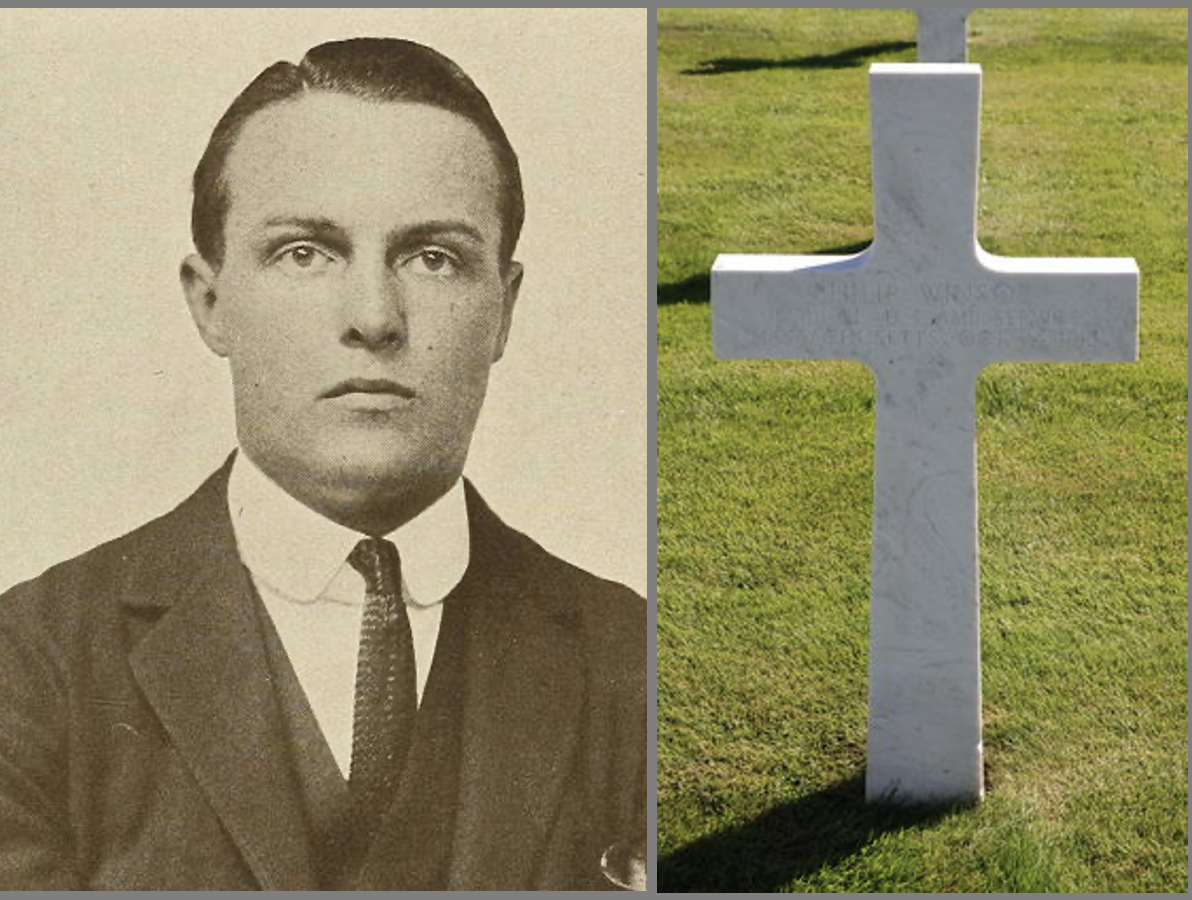
• Born February 6, 1893, in Weston, Massachusetts. Educated Middlesex School, Concord, Massachusetts, and Harvard University, Class of 1915. Joined American Ambulance Service, September, 1916, Neuilly Hospital, until January, 1917. Returned to America. Plattsburg Camp, six weeks. Joined American Field Service , June 20, 1917; attached Section Four. Enlisted U. S. Army Ambulance Service, November 1, 1917. Died in Bussang, October 24, 1918, of pneumonia. Buried in Bussang, Vosges. Croix de Guerre, two citations.
• ..."He entered Harvard in 1911 [...] and received his degree in 1916. In September of that year he sailed for France to drive an ambulance for the American Hospital at Neuilly, in Paris.
• "He returned in January, 1917, and spent the following month in the south with his brother. When war was declared he went to Plattsburg as a candidate for a commission, but after the first six weeks he was dropped from the squad and he himself felt that he was entirely unfitted for a command."
• "Phil" felt that he must get back to France in some capacity and yet he loathed the very thought of war and the horrors it entailed. Most of all he hated the sickening work of carrying wounded, and perhaps because he hated it most he decided to take up the work again, and this time at the front. He was sent out in the early summer of 1917 to Section Four, and when in the autumn the Field Service was absorbed by the American Army, he enlisted in the U. S. Army Ambulance Service.
• He always volunteered for any particularly dangerous task and was twice cited for the Croix de Guerre.
• Winsor was awarded the Légion d'Honneur (Chevalier degree) posthumously on November 11, 2011.
| |
Benjamin Russsell Woodworth | |
|
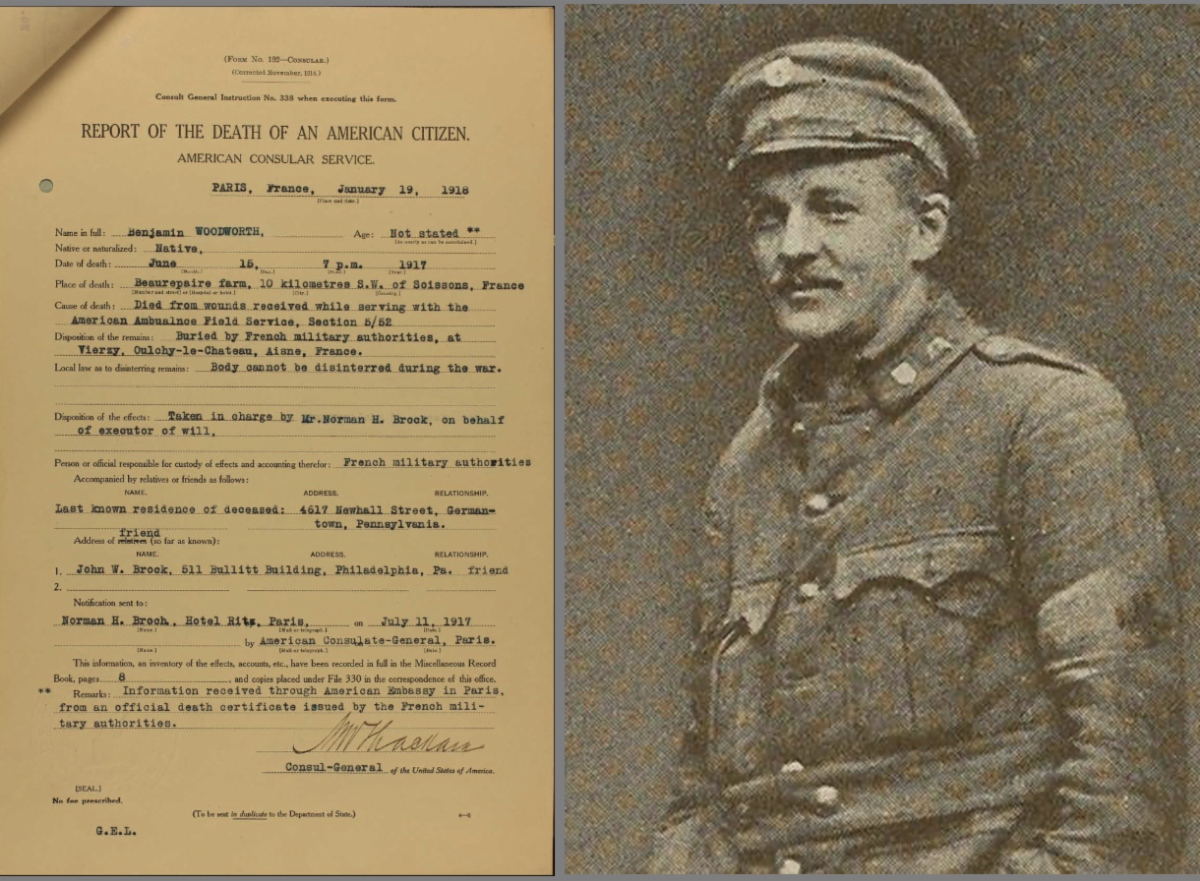
• Born August 5, 1886, in Stockton, California. Educated Milton Academy, Milton, Massachusetts. Traffic Department, Pennsylvania Railroad, Philadelphia, 1905 to 1912. Lumbering, Maine woods. Joined American Field Service, May 31, 1915; attached Section One, to July 5, 1916. On leave in America to October. Rejoined Section One, October 21, 190.- Commandant Adjoint, March, 1917. Killed in aeroplane accident near Soissons, June 15, 1917. Buried, Châlons-sur-Vesle. Marne. Croix de Guerre.
• ..." In the spring of 1915, drawn by the opportunity for action which the war offered, he enlisted in the American Field Service and joined Section One at Dunkirk in June.
• ..."It has meant much to any American who had any share in the life of France during those first years of the war, and how much more to anyone who served as a part of the French Army at the front. One of the members of Section One, writing in the "History of the American Field Service in France," has described an impression of those early days: "At our base, Dunkirk, we shared the life of a town under sporadic but devastating bombardment; still farther forward, in Ypres, we beheld a town bombarded from the face of the earth in a single night. There we shared no life, nor yet in Nieuport, for there was none to share."
• In July, 1916, having served for more than a year with the section, he returned to America. He spent some time in the vicinity of Boston and Philadelphia, getting in touch with old friends, and made a trip to the Pacific Coast to see his mother who resides in San Francisco. While there he was instrumental in collecting the money for an ambulance which he subsequently drove. He reenlisted in October and returned to France, rejoining his old section in the Argonne, and the following March he was appointed Chef while the section was en repos at Vadelaincourt, near Verdun.
• His term of leadership was to be brief. Three months later, June 15, 1917, Woodworth was instantly killed while riding as a passenger in a French aeroplane. The accident occurred as he and Chatkoff, a pilot from an escadrille near Muizon where the section was quartered, were leaving the grounds of the Lafayette Escadrille not far from Soissons. One of his comrades wrote, a short time afterward: "Woody was buried Sunday morning, June 17th, with all military honors, in the little cemetery of the shattered church of Châlons-sur-Vesle, while the guns thundered. Every day some of the men coming back from twenty-four duty at the front line posts stop off a few moments at the little cemetery and we keep his grave covered with wild flowers plucked near the lines."
• His grave at Oise-Aisne American Cemetery and Memorial at Fere-en-Tardenois, Departement de l'Aisne, Picardie, has the inscription "Fr. C. de G." (French Croix de Guerre)
| |
|
Ambulance drivers and "The Lost Generation":
an amazing lineup of talented intellectuals
Hemingway, Dos Passos, Peirce, Green and others...
| |
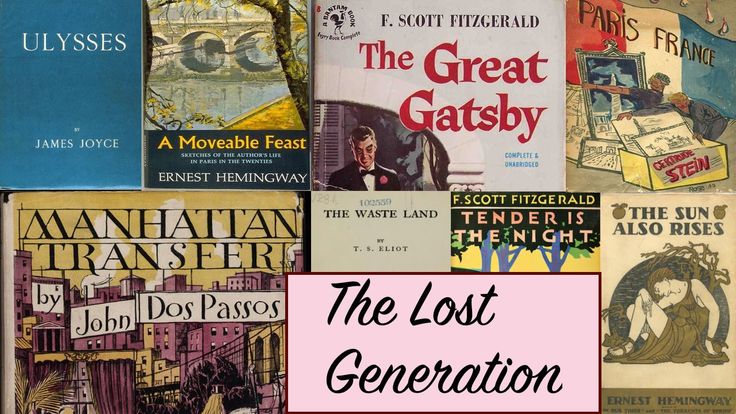
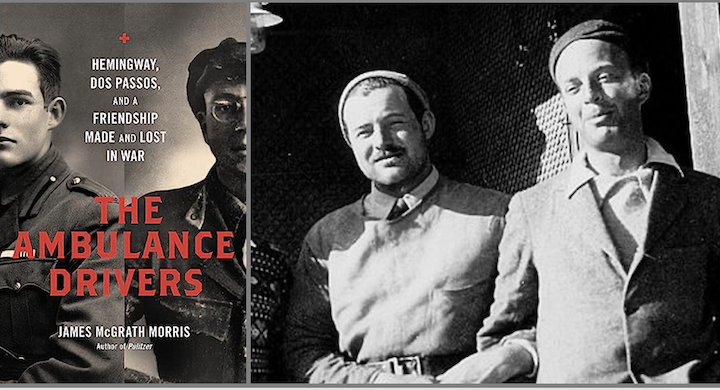
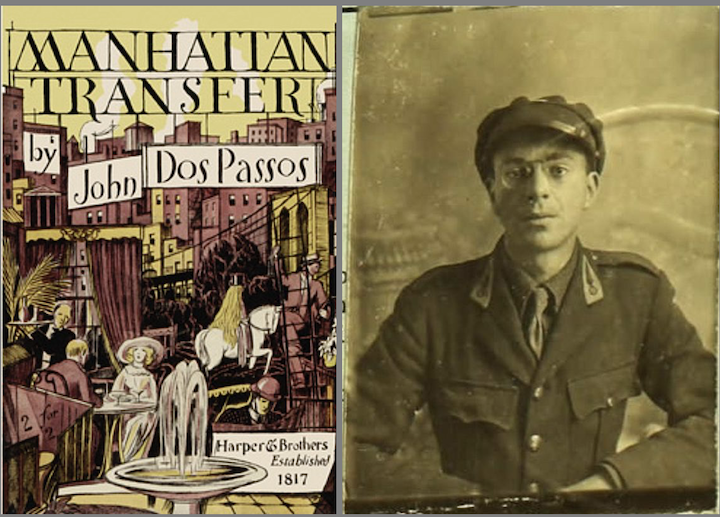
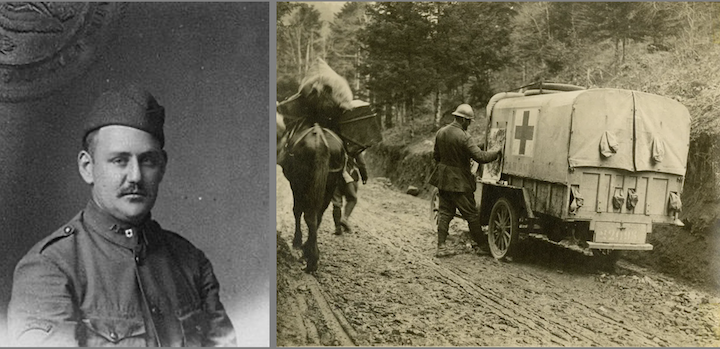
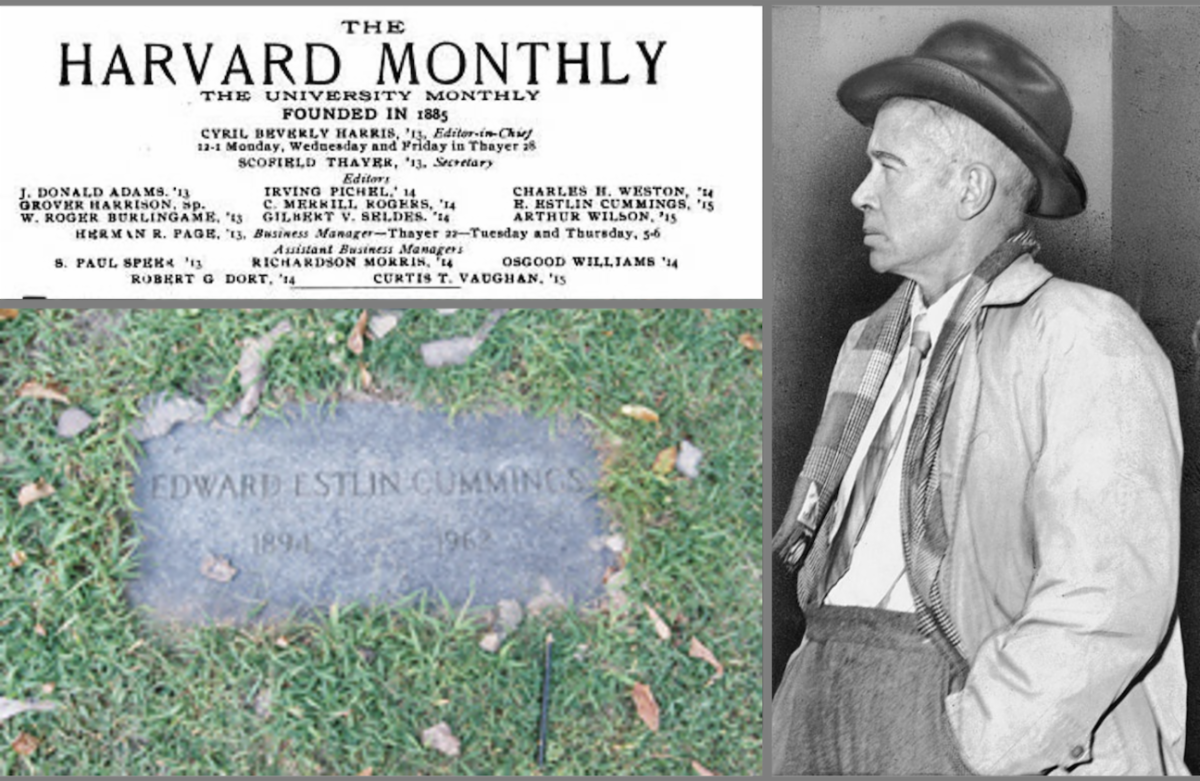
American writers and artists in Paris during the 1920s are known as the Lost Generation. They produced important literary works and movements that still impact literature around the world today. The political, economic, and social challenges of that time greatly influenced their writing. Many of them came from the American Field Service, or other related ambulance services. | |
|
Ernest Hemingway, John Dos Passos,
Waldo Peirce, E.E. Cumings, and others
| |
|
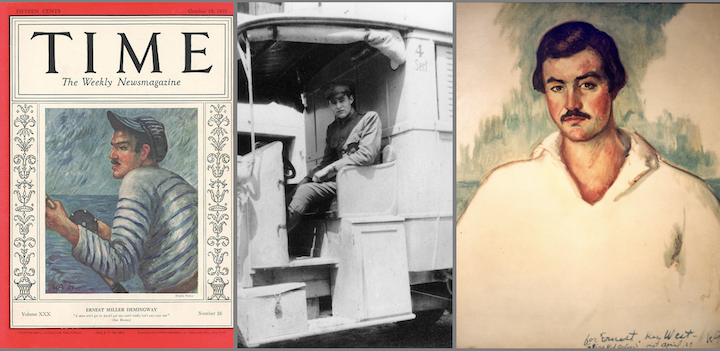
Above: ambulance drivers who became famous, clockwise from Left to Right:
Ernest Hemingway on the cover of Time Magazine, during his short stint as a Red Cross ambulance driver in the Italian front, portrait by his lifelong friend Waldo Peirce,
Book cover of "The Ambulance Drivers" by James McGrath Morris, showing Ernest Hemingway and war-period friendship with John Dos Passos,
Portrait of John Dos Passos in WW1 uniform,
Waldo Pierce painting on the side of his ambulance, and in WW1 uniform,
E.E. Cumings, poet, painter, essayist, author, and playwright.
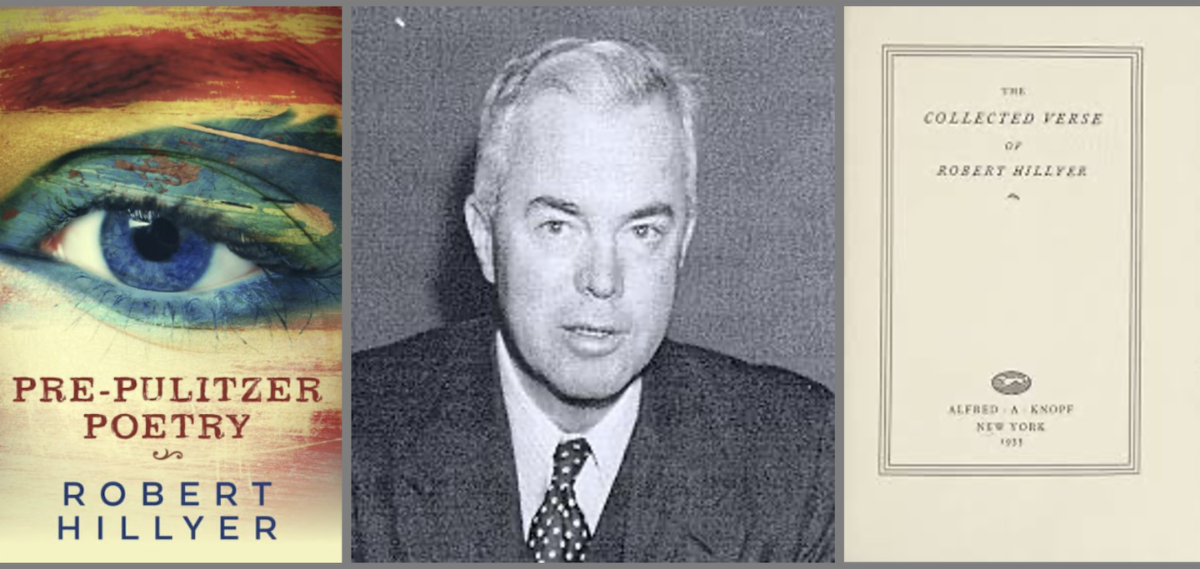
Harvard Professor Robert Hillyer, Pulitzer Prize for Poetry, 1934
| |
|
• As mentioned in our introduction, American volunteers serving in France and related Western fronts in Italy or the Balkans also joined other ambulance units such as the Norton-Harjes ambulances, or the American Red Cross, and/or transferred from the French Army to the US Army after April 1917, some becoming aviators, some preferring to stay in French uniform.
• In addition to having in common a desire to fight for democracy, freedom, and in broad terms, a civilized world, a surprising number of them went on to become world-famous writers, poets, painters, film-makers.
• Many of them stayed in France after the war in the 1920's, and, joined by the likes of Scott F. Fitzgerald, Gertrude Stein (herself a volunteer nurse), lived a Bohemian life in Paris and were called "the Lost Generation", with an impact on intellectual life that continues today.
We are only presenting a few of them below, who all served within the ranks of the American Field Service. They didn't "Die for France" and thus are not inscribed in the plaques at Notre-Dame Church of Manhattan, however they did fight for France in French uniform, and professed a profound love for France and the French people throughout their lifetime.
| |
|
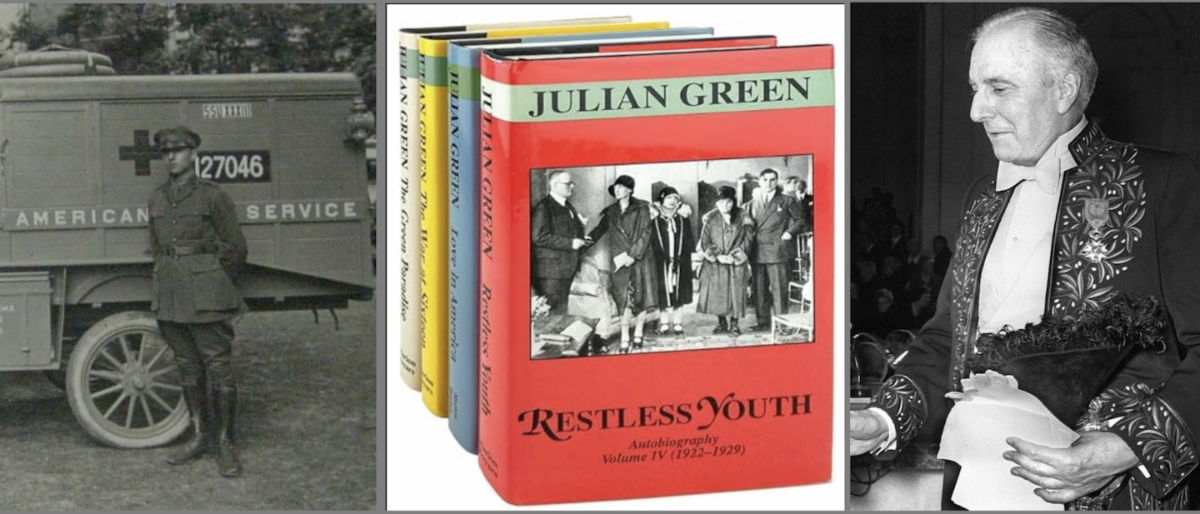
Julien Hartridge Green
"The most French of American Writers"
| |
|
Above:
Left: Julien H. Green next to his American Field Service Ambulance, Courtesy of the AFS Archives, NY
Middle: "Restless Youth", one of the dozens of books published in French and English
Right: Julien Green elected as one of the 40 "Immortals" at the Académie Française in 1971.
Photo: https://www.academie-francaise.fr/les-immortels/julien-green
| |
|
• Julien Green, born "Julian Hartridge Green" on September 6, 1900, and passing on August 13, 1998, was an American author who spent most of his life in France, writing primarily in French and occasionally in English.
• Throughout his extensive career, he wrote novels, essays, and plays, produced a four-volume autobiography, and kept a daily journal that he later edited into nineteen volumes. In 1971, he became the first non-French member of the Académie française.
• Julien's family moved to Paris in 1893. His mother, Mary Adelaide Hartridge, hailed from Savannah, while his father, Edward, was from Virginia. He attended prestigious schools in Paris. At just 16, in 1917, he volunteered as an ambulance driver for the American Field Service, but his enlistment was canceled when his age was discovered. He quickly joined the American Red Cross for a six-month service. In 1918, he enlisted in the French Army, serving as a second lieutenant in an artillery unit until 1919.
• After a short stint as a painter, he shifted to writing in French and quickly found success. In June 1940, he fled to New York. By 1942, he was working with the United States Office of War Information, broadcasting to France five times a week for nearly a year as part of Voice of America, before returning to France in 1945.
• His literary career after the war is extensive and outside the scope of this Bulletin. On June 3, 1971, Green was elected to sit among the 39 other "Immortals" at the Académie française, the prestigious French Academy, becoming the first non-French citizen to do so. In 1996, he stirred some controversy by resigning from the Académie, stating he had no interest in honors and identifying himself as "American, exclusively." The Académie replied that being a member was a permanent honor, not a temporary role. His resignation was not accepted, and he was not replaced until after he passed away in 1998.
| |
|
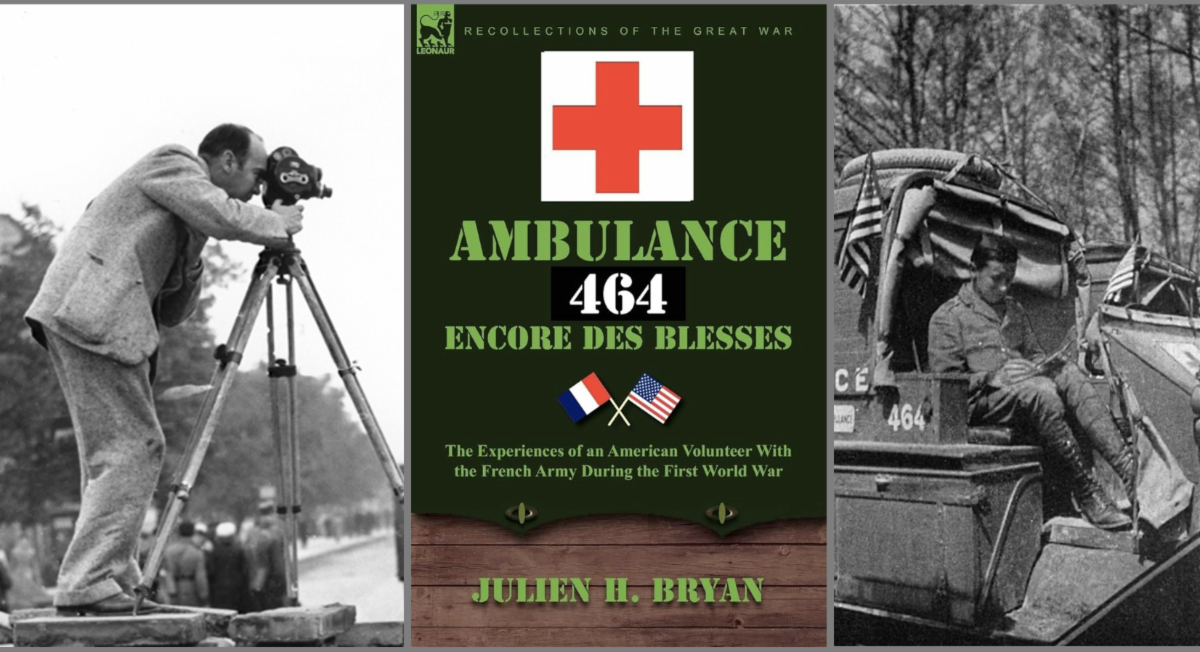
• Julien Hequembourg Bryan was born on May 23, 1899, in Titusville, Pennsylvania, and passed away on October 20, 1974. He was an American photographer, filmmaker, and documentarian. At the age of seventeen, after finishing high school, he volunteered for the American Field Service to assist the French Army during World War I. He drove an ambulance in Verdun and the Argonne and later wrote a book titled "Ambulance 464," featuring his photographs from that time.
• Bryan graduated from Princeton University in 192. Between 1935 and 1939, he captured daily life in Poland, the Soviet Union, and Nazi Germany, documenting the events leading up to World War II. He filmed over 25,000 feet for "Inside Nazi Germany," one of the first American films against the Nazis.
• During the German invasion of Poland, Bryan was the only foreign journalist in Warsaw. He managed to smuggle out his recordings of the invasion as a neutral citizen. Upon returning to New York, he created a short documentary called "Siege," and wrote a book with the same name. The film received an Academy Award nomination for Best Short Subject the following year. His son, Sam, later donated many of Bryan's film reels to the United States Holocaust Memorial Museum's Steven Spielberg Film and Video Archive.
• In 2006, "Siege" was added to the National Film Registry by the Librarian of Congress as "a unique, horrifying record of the dreadful brutality of war."
The 10' film can be viewed at https://en.wikipedia.org/wiki/Julien_Bryan
• His book, "Ambulance 464: Encore Des Blesses" was published in 1918. It recounts his time as a volunteer ambulance driver during World War I. The title refers to his unit, Ambulance 464. The book vividly describes the brutal realities of war. Bryan shares his observations of the front lines, the injuries of the wounded, and the difficulties ambulance drivers faced in getting them to safety. It is a poignant narrative of one man's wartime experience, showcasing the strength and bravery of those who served.
The book is available (pdf download) from the Library of Congress: https://www.loc.gov/resource/gdcmassbookdig.ambulance464enco00brya/?st=list
| |
|
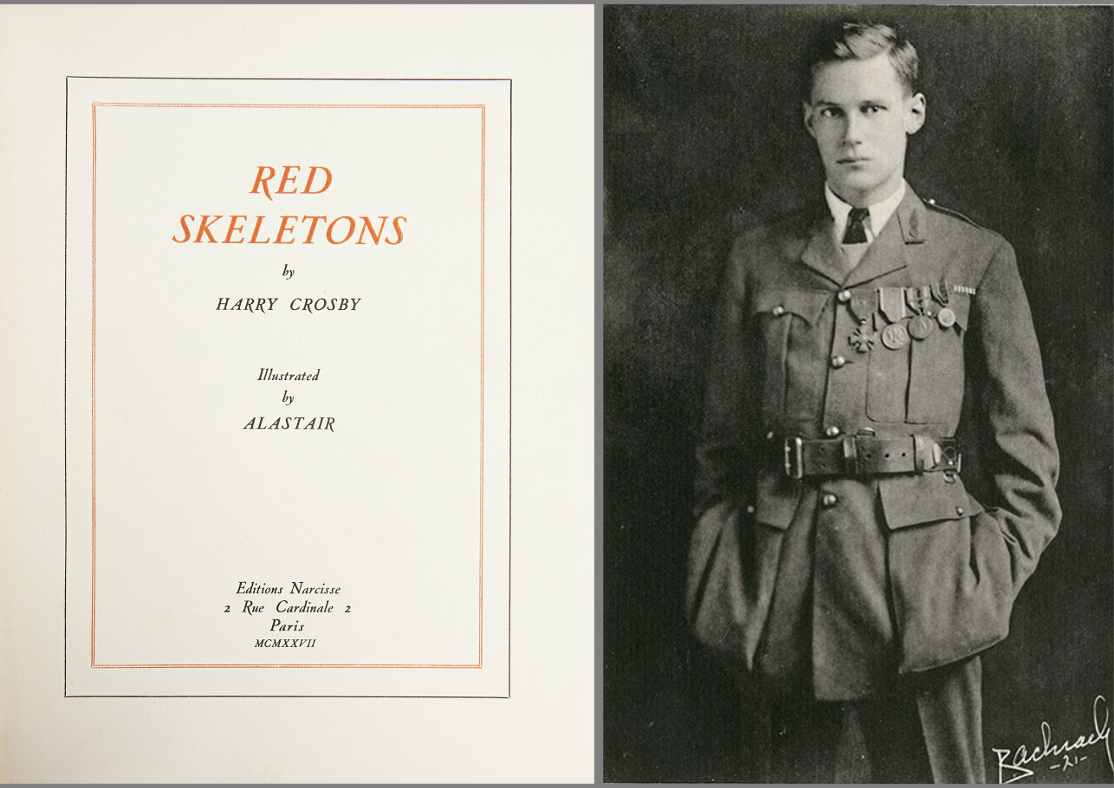
Henry "Harry" Grew Crosby
(born Henry Sturgis* Crosby)
grand-nephew of J.P. Morgan
| |
|
• Harry Crosby (June 4, 1898 – December 10, 1929) was an American heir, World War I veteran, socialite, poet, and publisher, often seen as a symbol of the Lost Generation in American literature.
• He came from a long line of prominent English and Dutch American families, with roots in the Van Rensselaers, Schuylers, Morgans, and Grews. His uncle was J. Pierpont Morgan Jr., one of the wealthiest men in America at the time. His paternal grandmother was a great-granddaughter of Peggy Schuyler, who was related to Alexander Hamilton. His family also included Revolutionary War General Philip Schuyler and William Floyd, a signer of the Declaration of Independence.
• At 19, like many young men from wealthy families, Crosby volunteered for the American Ambulance Service in France, arriving on July 7, 1917. He served in the American Field Service during World War I and later joined the U.S. Ambulance Corps, where he had a close call with death.
• At the end of the war he attended Harvard and graduated in 1921. But life in Boston was too boring for him and he yearned to go back to Europe.
• Crosby and his wife Polly left to Paris to live a lavish life, indulging in drinking, smoking opium, traveling, and maintaining an open marriage. He wrote and published poetry that often focused on the sun's symbolism and themes of death and suicide. His notable books are Red Skeletons (1927), Chariot of the Sun (1928), Transit of Venus (1928).
• He counted among his friends some of the most notable figures of the early 20th century, such as Salvador Dalí, Ernest Hemingway, and Henri Cartier-Bresson. Polly adopted the name Caresse, and together they established the Black Sun Press, which was the first to publish works by several authors who later gained fame, including James Joyce, Kay Boyle, Ernest Hemingway, Hart Crane, D. H. Lawrence, and René Crevel. Crosby died in 1929, involved in a murder-suicide or suicide pact.
In a letter to his mother, he wrote:
"I saw the most gruesome sight I've ever seen. Lying on a blood-stained brancard was a man—not older than twenty I afterwards ascertained—suffering the agonies of hell. His whole right cheek was completely shot away so you could see all the insides of his face. He had no jaws, teeth, or lips left. His nose was plastered in. Blood was streaming all over. Under his eyes the skin was just dead blue...It took us an hour driving between two or three miles per hour to get him to his destination. Of course he couldn't yell as his mouth or what was left of it was a mere mass of pulp. For a while I was afraid our ambulance was to be turned into a hearse, but he was still alive when we got him there. Of course in typical French fashion the doctors held their usual debate of questioning whether it was the right hospital or where his papers were..."
• He is buried at the cemetery of the Longchampt Abbey, Boulogne, Vendée, France. * His parents changed his middle name from Sturgis to Grew.
| |
|
Above:
Right: Malcolm Cowley, photographed by Carl Van Vechten, 1963, Public Domain, https://commons.wikimedia.org/w/index.php?curid=2766671
Left: The Long Voyage, Selected Letters of Malcolm Cowley, 1915-1987, Edited by Hans Bak, Harvard university Press, https://www.hup.harvard.edu/books/9780674051065
Middle: Exile's Return, A Literary Odyssey of the 1920's by Malcolm Cowley, Penguin Classics
| |
|
• Malcolm Cowley (August 24, 1898 – March 27, 1989) was an American writer, editor, historian, poet, and literary critic. He is best known for his poetry collection, Blue Juniata (1929), and his memoir, Exile's Return (1934; rev. 1951). In these works, he documented the experiences of the Lost Generation and played a key role as an editor and talent scout at Viking Press.
• Cowley studied at Harvard University but left to serve in the American Field Service during World War I, where he drove ambulances and trucks for the French army. He returned to Harvard in 1919 and became the editor of The Harvard Advocate, graduating with a B.A. in 1920.
• In the 1920s, Cowley was part of a group of literary and artistic figures who moved to Paris. He became a prominent chronicler of American expatriates in Europe, often socializing with notable writers such as Ernest Hemingway, F. Scott Fitzgerald, John Dos Passos, Ezra Pound, Gertrude Stein, E. E. Cummings, Edmund Wilson, and Erskine Caldwell, all linked to American literary modernism.
| |
|
Above:
Left: Book cover, "A Stop At Suzanne's, and Lower Flights" (1919)
Middle: Grayer Clover, Public domain: Memorial Volume of the American Field Service in France, 1921
Right: Gravesite at Saint Mihiel American Cemetery, France, Route de Verdun, 54470 Thiaucourt, France
| |
|
• Born April 14, 1897, in Chicago, Illinois. Educated Los Angeles and Pasadena schools, California; one year Leland Stanford University; Yale University, Class of 1919. Joined American Field Service, May 19, 1917; attached Transport Section 133 to November 19, 1917. Enlisted U. S. Aviation. Second Lieutenant. Killed in aeroplane accident August 30, 1918, training at Issoudun. Buried Issoudun, Indre, body transferred to Saint Mihiel American Cemetery, France.
• Greayer "Grubby" Clover (April 1, 1897 – August 30, 1918) is remembered as the namesake of Clover Field, the original name for Santa Monica Airport in California.
• Greayer entered Yale in the fall of 1916 after a year at Leland Stanford Jr. University. As a schoolboy he had won the California interscholastic tennis cup and his athletic achievements continued at college. On April 17, 1917, he wrote to his father arguing for permission to join the American Field Service, closing with the cry, "And Oh! I want to make it France!"
• On May 19th, 1917, he sailed and in his father's words, "Never went a Crusader to the Holy Land with more zeal to serve."
• Greayer convinced five of his classmates to join him in this effort.
• He spent six months in the French Army, serving in the Camion Branch of the American Field Service and participating in active combat during the recapture of Fort Malmaison.
• He transferred to the US Army, became a second lieutenant and started his pilot training. On August 30, 1918, while flying across country over Romorantin, his plane skidded and crashed to the ground, killing him instantly.
• "If so good a flyer as Greayer had to fall," Lieutenant J. R. Crowe, his "bunkie," killed two weeks later in the same way, wrote, "I know that it is all chance anyway."
• Clover was also an aspiring writer and kept a diary, which was published in 1919 as "A Stop at Suzanne's: and lower flights". Greayer indicates an intense love of music and a deep-seated admiration for France and the civilization that she represents. Greayer describes a restaurant where many pilots would frequently visit. It was called "Suzanne's," although Greayer mentioned that this was not the real name; it was named after the owner's daughter. She had lost her fiancé, a pilot in the French Air Corps, early in the war. The inn warmly welcomed all aviators and had them sign a guest book. "There he signed his name in the big book, below the names of Guynemer and Fonck and Bishop".
Legacy:
• Clover Field, which later became Santa Monica Airport, was named in his honor. The airport was dedicated to him in 1923 in front of 50,000 people.
• Cloverfield Boulevard in Santa Monica serves as a reminder of the airport's original name.
• Greayer's Oak Park, named after him, is located where West Avenue 38 ends at North Figueroa Street in Los Angeles. On some maps, it is mistakenly labeled as "Greaver."
• He is also commemorated with a stained glass window in the Memorial Library of Los Angeles High School, alongside 19 other graduates who lost their lives in World War I.
| |
|
• Sidney Coe Howard (June 26, 1891 – August 23, 1939) was an American playwright and screenwriter. He won the Pulitzer Prize for Drama in 1925 and received a posthumous Academy Award in 1940 for the screenplay of Gone with the Wind.
• He graduated from the University of California, Berkeley in 1915 and then attended Harvard University.
• While at Harvard, he volunteered with the American Field Service under Professor A. Piatt Andrew. He served in Alsace with SSU 9 until December 1916, then joined SSU 10, working with the French Army in the Balkans, including Albania and Greece. He returned to Paris in June 1917 and joined French aviation units after the AFS was militarized in the fall of 1917.
• After the war, Howard used his language skills to translate works from French, Spanish, Hungarian, and German. He was a liberal thinker whose political views shifted left over time. He wrote about labor issues for The New Republic and was the literary editor for the original Life Magazine.
• In 1921, Howard's first play, Swords, was staged on Broadway. His play They Knew What They Wanted won the 1925 Pulitzer Prize for Drama, was adapted into films in 1928, 1930, and 1940, and later became the Broadway musical The Most Happy Fella. He worked in Hollywood for Samuel Goldwyn at MGM, writing several successful screenplays.
• Howard won the 1939 Academy Award for an adapted screenplay for Gone with the Wind, marking the first time a posthumous nominee won an Oscar.
| |
|
• James Hazen Hyde (June 6, 1876 — July 26, 1959) was the son of Henry Baldwin Hyde, who started The Equitable Life Assurance Society of the United States. At the age of twenty-three in 1899, James inherited most of the shares in the billion-dollar company. Five years later, at the height of his social and financial success, attempts to oust him from The Equitable led to the first major Wall Street scandal of the 20th century, forcing him to resign and move to France from 1905 till 1941.
• At the beginning of World War I, Hyde turned his home and a rental property in Paris into hospitals for the French Red Cross. He volunteered as an organizer and driver with the American Field Ambulance Service. When the U.S. joined the war, Hyde was made a Captain and became an aide to Grayson Murphy, the High Commissioner of the American Red Cross in France.
• During and after the war, Hyde also managed the Harvard and New England bureau of the University Union in Paris. Through this organization, he established a series of annual lectures for American professors visiting French universities. He also gained public support for helping France by publishing several of his own lectures and writings.
• Hyde collected books and documents about Franco-American relations starting in 1776. He was part of the Académie des Sciences Morales et Politiques, the American Antiquarian Society, and the New-York Historical Society.
• Hyde’s art collection of paintings, porcelains, engravings and tapestries was distributed to several museums, including Cooper Union, now the Cooper-Hewitt, the Metropolitan Museum of Art and the Brooklyn Museum.
• Hyde was a founder of the NY Alliance Française in 1953; chosen as chairman of the executive committee of the Federation of French Alliances in the United States; and, awarded the Grand Cross of the French Legion of Honor.
| |
|
Above:
Left: Best man Louis Bromfield (center) at the wedding of Humphrey Bogart and Lauren Bacall at Malabar Farm (May 21, 1945), By Photo from Associated Press published by Tucson Daily Citizen, Public Domain, https://commons.wikimedia.org/w/index.php?curid=58431560
Middle: Poster of Johnny Come Lately, film based on Louis Bromfield's 1938 Novel "Mcleod's Folly"), Movieposterdb.com., Fair use, https://en.wikipedia.org/w/index.php?curid=33857535
Right: Louis Bromfield, By Carl Van Vechten Public Domain, https://commons.wikimedia.org/w/index.php?curid=65269069
| |
|
• Louis Bromfield (December 27, 1896 – March 18, 1956) was an American author and environmentalist. He was a popular novelist in the 1920s but shifted to farming in the late 1930s. Bromfield became one of the first advocates for sustainable and organic farming in the U.S. He received the Pulitzer Prize for Fiction in 1927 for his book Early Autumn, established the innovative Malabar Farm near Mansfield, Ohio, and contributed significantly to the early environmental movement.
• In 1916, he started studying journalism at Columbia University but left after less than a year to join the American Field Service in World War I. Bromfield served in Section 577 of the U.S. Army Ambulance Corps and was attached to the French infantry. He experienced significant combat during the Ludendorff Offensive and the 100 Days Offensive and was briefly taken prisoner by the German army in the summer of 1918. Although he later stated that he received the Croix de Guerre, there is no proof of this award in either French or American military records.
• He left the army in 1919 and started working in New York City as a journalist, critic, and publicity manager. In 1924, Bromfield released his first novel, The Green Bay Tree, followed by his second novel, Possession, in 1925. Later that year, in November, he moved to Paris and connected with key figures of the Lost Generation, including Gertrude Stein and Ernest Hemingway. His third novel, Early Autumn, won the Pulitzer Prize in 1927. He was known for hosting parties that attracted artists, writers, and socialites, with regular guests like Gertrude Stein, Alice B. Toklas, Elsa Schiaparelli, Leslie Howard, Douglas Fairbanks, and F. Scott and Zelda Fitzgerald.
• In 1938, Bromfield was the chairman of the Emergency Committee for American Wounded in Paris, which helped bring back volunteers who fought in the Spanish Civil War. For this work, he was awarded the French Legion of Honor.
• He was a very popular author from the 1920s to the 1940s. His books sold hundreds of thousands of copies and were turned into shows on Broadway and movies in Hollywood.
• When World War II began, Bromfield moved back to the United States to live and work on his new farm, Malabar, near Lucas, Ohio. There, he continued writing and produced several books, including Wild is the River (1941), Until the Day Break (1942), Mrs. Parkington (1943), and What Became of Anna Bolton (1944).
• He entertained many celebrities friends, such as Humphrey Boagart, Lauren Bacall, James Cagney, Joan Fontaine.
| |
|
• Edmund Randolph Purves FAIA (June 20, 1897 – April 8, 1964) was an American architect and the executive director of the American Institute of Architects. He was also a decorated soldier in World War I, serving in both the American Field Service and the American Expeditionary Forces.
• He studied architecture at the University of Pennsylvania. He paused his studies to serve in World War I, working as an ambulance driver with the American Field Service in France from April to August 1917. From September 1917 to 1919, he served as a corporal and then a 2nd lieutenant in the American Expeditionary Forces, participating in six major battles. He received several honors, including the American Field Service Medal, the Croix de Guerre with a Silver Star, the Verdun Medal (pictured above), and the Victory Medal with four battle clasps.
• After the war, he went back to the University of Pennsylvania and earned a B.S. in architecture in 1920. In 1919 and 1920, Purves won several awards from the Beaux-Art Institute of Design in New York City. He was also a finalist in the Paris Prize design contest in 1920. From 1920 to 1921, he studied at Atelier Gromont, the studio of Georges Gromort, in France. In 1927, he helped start the Purves & Day architectural firm in Philadelphia, Pennsylvania. He had a long and notable career as one of America's key architects, holding various roles at the American Institute of Architects (A.I.A.).
• The Edmund Randolph Purves papers are kept at the Library of Congress.
A Note about the Verdun Medal:
• The "Médaille de Verdun" was established on November 20, 1916, by the Municipal Council of Verdun. It is the most highly regarded unofficial medal in France. This medal was meant for soldiers who fought on the Verdun front during World War I from February 16, 1916, to November 2, 1916. However, it was actually given to all members of the French or Allied forces who served in the Verdun area, from Argonne to Saint-Mihiel, between July 31, 1914, and November 11, 1918.
The design of the medal was assigned to S.E. Vernier in 1917, and many other medals were made at the same time.
• Another Verdun medal exists, and different designs and descriptions can be seen on the Web Page of the Smithsonian Institution:
"In 1920, Congress authorized a special gold medal honoring the sacrifice of the citizens of the French city of Verdun during World War I. The Battle of Verdun was one of the most devastating of the war and led to approximately 800,000 casualties. The United States Commission of Fine Arts, established by Congress in 1910, held a limited competition for medal designs in early 1920. Anthony de Francisci’s uniface artist’s sample represents the reverse of the true medal and shows the medieval ramparts of Verdun encircled with lances. Modern artillery shells soar overhead, symbolizing the devastating bombardment of the city as French and American allies fought against the Germans. The motto in the bottom arc, written in French, proclaims “They shall not pass!”
| |
|
Robert Whitney Imbrie
AFS Ambulance Driver, French Army,
First U.S. Foreign Service Officer killed abroad
| |
|
• Robert Whitney Imbrie (April 23, 1883 –July 18, 1924) was the first U.S. Foreign Service officer ever to be assassinated. He was murdered in Tehran, while on a temporary assignment.
• Imbrie studied at Friends Select School, Central High School, George Washington University (A.B. 1902; LL.B. 1905), and Yale Law School (LL.M. 1906).
• In late 1915, Imbrie volunteered as a driver for the American Ambulance Field Service, which was part of the French Army. He worked in France from December 1915 until October 1916, then moved to the French Army of the Orient in Macedonia until April 1917, when the U.S. entered the war.
• For his service during the war, Imbrie received several medals, including the Croix de Guerre, the White Rose Croix de Guerre, the Ambulance Medal, the Field Service Medal, and the Medal of Recognition for serving at the front for six months or more. He was one of the longest-serving volunteer ambulance drivers, with a total of seventeen months.
• Due to his age and a recent illness with typhus, Imbrie could not join the U.S. military. Instead, he joined the U.S. Consular Service and was sent to Petrograd, arriving in November 1917 during the Russian Revolution. By early 1919, he was in Viborg, Finland, and later moved to Crimea, where the White Army was active. However, upon arriving in Turkey in December 1920, he found that situation had also deteriorated, leading to his assignment in Constantinople.
• Imbrie was set to go to Tabriz, Persia (now Iran), but before that, he was sent to Tehran for a short time. During a period of conflict between the Baha'i Faith and Muslims, Imbrie and his wife went to visit a religious shrine. They were advised to stay away from the well because women were there. They followed local customs, but a mob then attacked their carriage. The couple was pulled out and brutally beaten, with Imbrie being stabbed with a saber. The local police did not intervene. He was taken to the hospital, but the mob continued to assault him there. He eventually died from his injuries.
• He was laid to rest with full military honors at Arlington National Cemetery, Section 4 Site 2903.
• His Memoirs "Behind the wheel of a war ambulance" can be downloaded on pdf from the Library of Congress at: https://www.loc.gov/item/18023337/
There are many other notable volunteers who deserve to be honored...Our Society will continue to publish Bulletins in the future.
Below: photos of posters on exhibit at the Franco-American Museum, Château de Blérancourt, France
| |
|
A lasting legacy:
AFS Intercultural Programs
| |
|
Above:
Top: AFS Director General Stephen Galatti in his NY office, circa 1960. Notice the poster on his wall.
Middle: John F. Kennedy and Stephen Galatti, reception of AFS students at the White House. In the 1960s, AFS Winter Program Participants, who were high school exchange students visiting the U.S., regularly met with U.S. presidents in Washington, D.C. before returning to their home countries. The presidents praised the organization for its role in U.S. public diplomacy and often spoke about how AFS Participants helped promote a more peaceful world. Click on the photo to listen to JFK's speech.
Both photos from From "Stephen Galatti, the Visionary", https://issuu.com/afsvm/docs/janus_2017/s/19287923
Bottom: a group of AFS Students from around the world at the AFS Centenial in Paris, 201.
Photo: https://afs.org/archives/timeline/#afs-nav-1960-1969
| |
|
An ongoing legacy for international exchanges and world peace
• The American Field Service resumed its activities when the war broke out again in 1939 under the leadership of Director General Stephen Galatti, and a new generation of American volunteers came to France while the United States remained neutral. Many of them "Died for France" during the Blitzkrieg of May-June 1940, or on other fronts in Africa and the Middle East after the AFS aligned itself with the Free French in 1941, and their names are also inscribed in the plaques of Notre-Dame Church in Manhattan. We will devote a Bulletin to them in the future.
• After 1945, under the continued leadership of Stephen Galatti, AFS transformed itself from a wartime humanitarian aid organization into a groundbreaking international secondary school exchange, volunteer, and intercultural learning organization with a noble vision: to help build a more peaceful world by promoting understanding among cultures.
• Today AFS Intercultural Programs has over 60 organizations worldwide, serving over 80 countries, and providing exchange opportunities for over 13,000 students and teachers annually!
• AFS commemorated its centennial in 2014-2015. From the founding of the American Ambulance Field Service in April 1915 to more than 450,000 former AFS Participants in its centennial year, AFS celebrated its continuation as a volunteer organization daring to create change and dedicated to building an inclusive community of global citizens determined to build bridges among cultures. The worldwide celebrations included youth forums and a global symposium at the UNESCO headquarters in Paris, France.
• The list of notable "AFS'ers" is long and varied and can be seen at:
https://en.wikipedia.org/wiki/AFS_Intercultural_Programs
• Let us just mention, close to us, Mme Christine Lagarde (AFS'74), former Managing Director of the International Monetary Fund and currently president of the European Central Bank, and our own Francis Dubois (AFS'69), former High Representative of the United Nations in several countries, and currently Board Member of our Society.
This concludes our tribute to WWI American Field Service volunteers.
We will devote a Bulletin next year to their successors of WWII.
| |
|
Tribute to two ambulance drivers
who joined the Lafayette Flying Corps:
We continue our series started in October 2023 with tributes to members of the Escadrille Lafayette, later part of the Lafayette Flying Corps. For access to our Bulletin dedicated to the Escadrille Lafayette, please click on:
https://conta.cc/3Qz0Xjl (original version in English)
https://conta.cc/3QCRqYM (version en français)
In keeping with the theme of this Bulletin, we make an exception this month, as we pay tribute to two volunteers ambulance drivers - turned aviators who survived the "Great War":
William Augustus Wellman
| |
|
Above:
Left: William A. Wellman and Celia, his Nieuport 24 fighter, c. 1917 (one of several aircraft named for his mother), Public Domain, https://commons.wikimedia.org/w/index.php?curid=45963424
Center: Book Cover of Go, Get'Em, by William Wellman, The Page Co, Boston 1918, Library of Congress: https://www.loc.gov/item/18018353/
Right: Poster "Wild Bill, Hollywood Maverick", 1995 documentary narrated by Alec Baldwin, https://www.imdb.com/title/tt0114939/
| |
|
• William Augustus Wellman (February 29, 1896 – December 9, 1975) was a great-great-great-grandson of Francis Lewis, who was born in Wales and signed the Declaration of Independence in New York.
• During World War I, Wellman joined the Norton-Harjes Ambulance Corps as a driver in Europe. While in Paris, he enlisted in the French Foreign Legion and became a fighter pilot on December 3, 1917. He was the first American to join Escadrille N.87 in the Lafayette Flying Corps, earning the nickname "Wild Bill" and receiving the Croix de Guerre with two palms. The escadrille N.87, known as les Chats Noir (Black Cat Group), was based in Lunéville in the Alsace-Lorraine area and flew Nieuport 17 and later Nieuport 24 aircraft. Wellman achieved three confirmed "kills" and five probable ones before being shot down by German anti-aircraft fire on March 21, 1918. He survived the crash but had a noticeable limp for the rest of his life.
• Sergeant Wellman received a medical discharge from the Foreign Legion and returned to the U.S. a few weeks later. He spoke at War Savings Stamp rallies while wearing his French uniform.
• In September 1918, his book about his experiences at French flight school and his time at the front, titled Go Get 'Em! (co-written with Eliot Harlow Robinson), was published. He joined the United States Army Air Service but too late to go back to the front and fight under US uniform. Stationed at Rockwell Field in San Diego, he taught combat tactics to new pilots.
• His actions during the war greatly impressed Douglas Fairbanks Sr.
After the conflict, Fairbanks invited Wellman to act in the film "The Knickerbocker Buckaroo" (1919). However, Wellman felt he was not a good actor (and that it was "unmanly") and chose to focus on directing instead.
• His film "Wings," released in 1927, made history as the first winner of the Academy Award for Best Picture at the inaugural Academy Awards.
• Wellman directed more than 80 films and received four Academy Award nominations. Known as "Wild Bill," he directed several classic films, including "The Public Enemy" (1931), "A Star Is Born" (1937), "Beau Geste" (1939), and "The Ox-Bow Incident" (1943), to name a few.
• His final film was "Lafayette Escadrille" (1958), which he produced, directed, wrote the story for, and narrated.
• For his impact on cinema, Wellman has a star on the Hollywood Walk of Fame located at 6125 Hollywood Blvd., Los Angeles, CA 90028 (GPS: 34.101768, -118.323277) but the official website doesn't say a word about his military exploits in France.
Walter Lovell
| |
|
• Walter Lovell (September 9, 1884 – September 10, 1937) graduated from Newton High School (now Newton North High School) in Massachusetts and earned a Bachelor of Arts degree from Harvard College in 1907. After finishing school, he worked in the brokerage business in Boston.
• In January 1915, Walter traveled to England on the RMS Lusitania and joined the American Field Service in France the following month.
• He was sent to Alsace and, after six months, became the second in command of the American Automobile Sanitary Section No. 2 of the Sanitary Service of the 73rd division, showing strong leadership. In May 1916, he received his first Croix de Guerre for bravery. The citation states: "has always given proof of a noteworthy spirit; has constantly set the example of courage to the other drivers, and has been an invaluable assistant to the commander of his Section".
• In the summer of 1916, Lovell, along with Clyde Balsley, Willis Haviland, Thomas Hewitt, Henry Jones, James McConnell, and Robert Rockwell, requested a transfer from the American Field Service to the French Air Service.
• From June 1916 to March 1917, he trained at various aviation schools in Buc, Avord, and Pau, and was officially certified on October 1, 1916, at Buc Aviation School. Lovell joined the Lafayette Escadrille on February 26, 1917.
• During his ten months as a fighter pilot on the Western Front, Sergeant Walter Lovell flew French aircrafts Nieuport 17 and Spad VII on numerous missions, mostly behind enemy lines, and eventually became the adjutant of the Lafayette Escadrille. He achieved one confirmed victory over an Albatros D.V near Dun-sur-Meuse, although many of his other successes went unrecorded, according to fellow pilots like James Norman Hall. His missions all took place on the German side, which is why he only received one official victory confirmation. Lovell left the Lafayette Escadrille in October.
• After joining the United States Army Air Service, Lovell was promoted to captain on January 1, 1918, and then to major in August 1918. He served with the French Aviation Mission in Paris and was the chief aviation instructor in the U.S. from July 1918 until the Armistice.
• Lovell resigned his commissions in January 1919 in Washington, D.C., and moved to Paris, where he had married Helėne Du Bouchet on April 16, 1918. He is buried in Highland Cemetery, Weymouth, Massachusetts.
| |
|
A final note: located just 1.5-hour drive from Paris (80 miles to the north), the Franco-American Museum at the Château de Blérancourt is a destination we highly recommend. This museum features numerous treasures, including a dedicated gallery honoring volunteers of the American Field Service and the Escadrille Lafayette.
Musée Franco-Américain, Château de Blérancourt
33 Pl. du Général Leclerc, 02300 Blérancourt, France
Photo below: TC © ASSFI Nov. 2019 - (inset: aerial view, photo: https://museefrancoamericain.fr/en)
| |
|
NEWS, ANNOUNCEMENTS & SAVE THE DATES
Dedication ceremony
Memorial to French Soldiers
Friday, October 18, 2024, Gloucester, Virginia
| |
|
This past Friday, October 18, 2024, Gloucester County and The American Society of Le Souvenir Français, Inc. proudly unveiled a granite memorial honoring French Soldiers who made the ultimate sacrifice at Gloucester County’s 1781 Battle of the Hook. at Abingdon Elementary School.
The largest cavalry battle of the American Revolution, the Battle of the Hook has often been overlooked. It is one of the most important episodes of the siege of Yorktown, when the Duc de Lauzun's famous Legion of hussars with 300 troops of the "Infanterie de Marine,” and Lieutenant Colonel John Mercer's Select Battalion of Grenadiers, under the overall command of Brigadier General Claude de Choisy, defeated Lieutenant Colonel Banastre Tarleton's British Legion and a detachment of the Royal Welch Fusiliers.
The granite memorial was placed in a position of honor between the two interpretive makers that we dedicated last year.
The public was very moved by the 4th grade class from Abingdon Elementary who sung the Star Spangled Banner. Laura Heydt, Soprano, gave a stirring rendition of La Marseillaise. The Honorable Chris Hutson, Chair - Gloucester County Board of Supervisors gave welcome comments. Brigadier General Vincent de Kytspotter, Ph.D., Head of Military and Defense Mission, French Permanent Mission to the United Nations, offered keynote remarks. Rear Admiral Frédéric de Rupilly, Deputy Chief of Staff, NATO Joint Force Command in Norfolk, and Thierry Chaunu, General Delegate of Le Souvenir Français in the United States and president of the American Society of Le Souvenir Français Inc., unveiled the marker and laid a bouquet.
“This memorial symbolizes Gloucester County’s commitment to telling the Battle of the Hook story and commemorating the Franco-American Alliance. We must never forget the names of the brave soldiers who fought for freedom during the American Revolution,” said Gloucester County Historic Resources Supervisor Robert Kelly.
“We are honored to partner with The American Society of Le Souvenir Français, Inc., the French Military, the Washington-Rochambeau Revolutionary Route National Historic Trail, the Gloucester Historical Society, and numerous historians to continuing shining a light on Gloucester’s pivotal role during the American Revolution,” said Kelly.
The memorial text was crafted by committee that consisted of French Military officers Rear Admiral Frédéric de Rupilly, Colonel Nicolas Durand, Captain Jean-René Degans, and Lieutenant Colonel Mathieu Brulais, along with Thierry Chaunu, Warren Deal, Robert Kelly, Jeff Lambert, Dr. Robert Selig, and Nicole Yancey.
Photos: Courtesy of Brigitte van den Hove - Smith, Deputy General Delegate, Le Souvenir Français in the United States and Regional Delegate, The American Society of Le Souvenir Français, Inc.
| |
News from the "Merci Train" 75th Anniversary Celebrations | |
|
• Our November 2022 Bulletin narrated the incredible story and ongoing legacy of the "Train de la Reconnaissance Française", affectionately called "The Merci Train" (November 2022: "The Merci Train, 49 boxcars of French gifts"
https://conta.cc/3OLtgJ3 (original version in English)
https://conta.cc/3VpKzRP (version en français)
• 2024 is the 75th anniversary of the "Merci Train", a gesture of friendship and gratitude from the French people to Americans who gave 49 boxcars full of gifts for each State in 1949.
• The Merci Train, the 40&8 National Box Car Association and many other local organizations, custodians of the various "Merci train" boxcars in several States are planning celebrations throughout the year. We express our admiration for the fantastic work they are doing and we are honored to help get the word out.
• The American Legion Post 120, guardian of the Florida Merci Train, the Historic Museum of Holly Hill, our Society, represented by Brigitte van den Hove-Smith, Déléguée Générale Adjointe, South East, and other patriotic and civic associations are organizaing a special commemoration in Holly Hill, Daytona Beach, FL at the Florida boxcar on November 11 at 11:00AM.
The American Legion Post 120 will have their standard Veterans Day ceremony at 10am. The Historic Society will then present a boxcar ceremony at 11am.
The museum will be open for visitors starting at 9:00AM to 4:00PM. Visitors will enjoy a light continental breakfast and refreshments. Visitors will have the opportunity to view boxcar history, the film "The Friendship Train" and purchase souvenirs. See details below.
• David Knutson, of the 40&8 National Box Car Association shared this short video: made in 2011, this is an excellent short video on the Forty and Eight story. Created for an interactive media unit for the Southern Museum of Civil War & Locomotive History (In Association with the Smithsonian) for their new education wing centered on the "Merci Train". Credited to Ava Wilkey of the Southern Museum of Civil War and Locomotive History. https://vimeo.com/18495973
There is a link on the homepage of their website: https://texasboxcar.org/
| |
|
Save the Date!
Monday, November 11, 2024
Commemoration ceremony, Florida boxcar
City of Holly Hill (Daytona Beach)
| |
|
Save de Date!
Sunday, February 2, 2025
Dedication of the restored Hawai'i boxcar
Ewa Beach (Honolulu)
| |
|
Above:
Photos courtesy of Mr. Jeff Livingston, Historia, 40 & 8 Project Manager
Hawaiian Railway Society, 91-1001 Renton Rd. Ewa Beach, Hawaii 96706
GPS: 21.331976, -158.046023
"Troop benches have been added in one end of the car to illustrate how 40 men were carried in these cars, 20 per end...The mannequin in the car represents Pvt. John R. Rowe. Rowe is the only known ethinic Hawaiian killed on the battlefield in France, 31 July 1918. The uniform is original to the era and the insignia similar if not identical to that Rowe would have worn. A horse mannequin is planned for the other end of the car. As none of the original gifts contained in the boxcar have been located we've started a collection of period and reproduction pieces that will represent the type of items donated by the people of France. Since the boxcar and displays will remain outside for the foreseeable future we plan to build a weather tight enclosure for the "gifts". While the restoration/reconstruction can be considered complete there is still much work to be done before the 2 February 2025 rededication to complete the story. "
Do not miss this article in the Honolulu Civil Beat:
Denby Fawcett: Restoring A Giant Symbol Of Postwar Generosity And Friendship
Last minute! A horse mannequin was just found - and what a beautiful horse!
Below: Photos courtesy Laura Ingenluyff, NSDAR - Jeff Livingston, Hawaiian Railway Society
| |
|
PHOTO ALBUM
Bicentennial of Lafayette's Farewell Tour
Recent selected events in New Jersey, Delaware, Maryland, D.C.
| |
|
Above:
Photos Kat Smith courtesy American Friends of Lafayette
Video clip courtesy Consulate General of France
https://fb.watch/u0ML-wmLKv/
"Our estimate is 6 million people saw Lafayette. He was a bigger rock star than even the Beatles. He was the original rock star” - - Chuck Schwam, executive director of The American Friends of Lafayette.
Below is a small selection of the dozens of events that have already taken place since August 16 when we welcomed general Lafayette in lower Manhattan.
For more complete coverage we invite you to visit The American Friends of Lafayette's Facebook page at: https://www.facebook.com/AmericanFriendsofLafayette
Every day, almost every hour, you can find the latest updates on upcoming events, and discover everything that you missed! But you can catch up there are still 12 months to go.
Lafayette in Philadelphia:
| |
|
Above: Philadelphia was a particularly special stopover, as it was the place where Lafayette began his military journey in the US and where, as a much older man, he graced the steps of Independence Hall and praised the Founding Fathers for their commitment to liberty. #Lafayette #Lafayette200
Lafayette at Lafayette College:
| |
|
Above:
The AFL had the opportunity to see two exhibits at Lafayette College on Monday, September 30th. The first one were items relating to the founding of the AFL at Lafayette College in 1932. A variety of photographs, books, event programs, and our original flag were beautifully displayed in an exhibit curated by current student Olivia Naum '26.
Ana Ramirez Luhrs, Co-Director of Special Collections & College Archives, also brought out a waistcoat that was Lafayette's, a scarf from the Farewell Tour, and Lafayette's National Guard sword!
After a lovely lunch, we were given a special viewing of the current exhibit at the Williams Center for the Arts, which will run through December 6: https://tinyurl.com/6hcepy8n
Photos and description by THE Jan O'Sullivan
Lafayette in Delaware:
| |
|
Above: Lafayette Bicentennial Baltimore Committee thanks all who attended our 5 days of events in Baltimore!! We ended our suite of events to bid a fond farewell to today’s Lafayette with a cocktail reception and immersive musical performance at a still-standing venue Lafayette visited in 1824: the Peale Museum. The concert treated guests to Lafayette-era music while actors recounted stories of the Major General’s interactions with the fine citizens of 19th century Baltimore. We stepped back in time: Immersing ourselves in 19th-century American and French history.
Our guests enjoyed a culinary feast with a French-American fusion menu.
We explored the Peale Museum.
Thank you for celebrating with live music and theater with an original musical production inspired by Lafayette's visit.
We had a BALL in celebrating Baltimore's significance as a favored stop on Lafayette's Farewell Tour.
THE LAFAYETTE PANELS: In 2024, the beautifully restored Peale Museum had on display historic panels lifting up the life and legacy of Lafayette for guests to take in as they enjoyed a cocktail buffet
THE PARTY BEGINS: Lafayette joins guests to enjoy a glass of “Pônche de Lafayette” to begin the evening
LAFAYETTE HOLDING COURT: Lafayette entertains guests about his October 1824 Baltimore visit in the Peale Museum’s garden where Rembrandt Peale, the museum’s founder, invented the gas light.
BEAUTIFUL LADIES OF BALTIMORE: A chorus featuring many beautiful ladies entertained guests and Lafayette during an immersive concert recreating his 1824 visit to Baltimore.
Photos by Bill McAllen. Click on the photos above to access videos of these events.
| |
|
Above: Colonel Flavien Lanet, Joint Strategic Affairs Attaché from the French Embassy to the U.S., reflected on today’s world in light of historic events during his speech at Mount Vernon Place in Baltimore, Maryland.
His address took place at the Bicentennial Celebrations and the 100-year anniversary of Lafayette’s return to Baltimore, commemorating the dedication of the Lafayette statue.
Our alliance and friendship began with Lafayette, and we’re proud to continue honoring this enduring legacy with our oldest ally France.
We gazed in awe while the giant French and American flags were draped across the Baltimore Fire Department's Engine Ladders between George Washington's and Lafayette's statue at the Mount Vernon place. The Franco-American alliance's first besties.
The beautiful renditions of the French and American National Anthems amongst other numbers by the amazing Jari Villanueva's Doughboy Foundation. @doughboyfoundation Orchestra.
Click on the photos above to access the videos of this celebration.
Lafayette at Fort McHenry
| |
|
Above: Lafayette's Arrival at Fort McHenry: We explored the replica of Washington's dining tent, a historic centerpiece from the 1824 Lafayette visit.
A grand welcome for an old Friend in Baltimore
Lafayette and his entourage ( ROCKSTAR!) stepped into Ft. McHenry’s grounds on the exact date of his 1824 arrival.
We followed the entourage, led by the US Army Old Guard Fife & Drum Corps, and took a seat near the historic Washington’s tent on the Fort’s grounds.
We enjoyed the very music Lafayette heard performed by a regional military band and local singers.
We had the feels witnessing Lafayette’s emotional embrace by his Revolutionary War comrades and Maryland officials exiting from Washington’s historic dining tent.
After the commemorative remarks from gathered French, American, and Maryland dignitaries, we stood in awe to watch the lowering of the Star-Spangled Banner inside the Star Fort.
A Star-Spangled Symbol of Freedom Fort McHenry, located in Baltimore, Maryland, is a historic landmark that played a crucial role in the War of 1812. It was during the British siege of Fort McHenry in 1814 that Francis Scott Key wrote the poem that would later become the lyrics to our national anthem, "The Star-Spangled Banner."Visit Fort McHenry to learn about its rich history, explore its fortifications, and experience the inspiring story of the American flag that flew over the fort during the bombardment.
Photos: The American Friends of Lafayette
Lafayette in Washington, D.C.
| |
|
Above: Welcome to Washington, Lafayette!
Lafayette was welcomed back with a special reception to DC by the American Revolution Institute and the American Friends of Lafayette At the Home of the Society of Cincinnati Larz Anderson House.
On October 12, 1824, the Marquis de Lafayette arrived in the capital city of Washington for the first time during his thirteen-month farewell tour of the United States. Upon his arrival to the nation’s capital, he was paraded into the city, welcomed by the mayor in the rotunda of the U.S. Capitol, and feted with fireworks throughout the city.
Guests greeted Lafayette, view the current exhibition, Fete Lafayette: A French Hero’s Tour of the American Republic, and enjoy hors d’oeuvres and refreshments while toasting the Frenchman’s momentous first visit to the federal city.
We celebrated the bicentennial of the Marquis de Lafayette’s 1824 visit to Arlington House with a stellar presentation by Elizabeth Reese, author of “Marquis de Lafayette Returns: A Tour of America’s National Capitol Region.”
Attendees viewed informative displays about Lafayette and met “Lafayette” himself, interpreted by the American History Theatre’s Ben Goldman.
We would like to say thank you to David Gallalee of the Arlington House Foundation, Major General Bertrand Jardin, the Defense Attaché from the French Embassy,
The Marquis de Lafayette aka Ben Goldman & Elizabeth Reese.
The event was sponsored by the Arlington House Foundation, The American Friends of Lafayette, and the Arlington Historical Society. Hosted by the National Park Service.
| |
|
UPCOMING EVENTS
Lafayette Farewell Tour Bicentennial
For a complete list, visit: Lafayette200.org
| |
|
American Revolution Institute of the Society of the Cincinnati, Inc.
presents:
Fete Lafayette: A French Hero’s Tour of the American Republic
Against the backdrop of a tumultuous election, a beloved hero of the American Revolution returned to America for the first time in forty years. From August 1824 to September 1825, the marquis de Lafayette traveled through the United States, welcomed by thousands of admirers at each stop along the way. Although the tour brought him to each state in the Union, the majority of his time was spent in Washington, D.C., Virginia and Maryland.
Public historian Elizabeth Reese traces Lafayette’s route throughout the National Capital Region, highlighting the locations and people the famous general held closest to his heart.
This program accompanies our current exhibition, Fete Lafayette: A French Hero’s Tour of the American Republic, on view through December 31, 2024.
About the Speaker:
Elizabeth Reese is a public historian whose work is focused on the American Revolution and early republic. In addition to receiving the 2015 Scott Hartwig Public History Fellowship at the Civil War Institute, she has spent over a decade as an interpreter at federal historic sites, including Hamilton Grange National Memorial and the United States Capitol. Throughout her career, she has developed programs on civil rights, women’s history, and America's Founding era. Currently, Elizabeth is the associate manager of marketing at Woodlawn & Pope-Leighey House. She is also the author of The Marquis de Lafayette Returns: A Tour of America's Capital Region (The History Press, 2024) and the chair of The American Friends of Lafayette Bicentennial Committee for Washington, D.C.
View the presentation on Youtube:
https://youtu.be/0nSmBOloIn0?si=uVlekOuiWfOoJWIR
Learn more about our current exhibition, Fete Lafayette:
https://bit.ly/3R4GYt9
| |
|
Lafayette at Spring Hill, VA.
Tuesday, October 22, 2024
| |
|
Event by The American Friends of Lafayette
The Church on the Main
4679 Sir Gilbert Loop, Williamsburg, VA. 23185
Tuesday, October 22, 2024 at 10:00AM
You are cordially invited to attend this commemoration ceremony. It will be a wreath laying event.
This ceremony is a Williamsburg Chapter, VASSAR event. It is in support of the American Friends of Lafayette’s Bicentennial of Lafayette’s Farewell Tour of the United States. It will commemorate General Lafayette’s stop at the site of the 6 July 1781 Battle of Green Spring as he left Williamsburg on 22 October 1824. The ceremony will essentially duplicate our 6 July annual commemoration of the battle but focus more on Lafayette rather than the battle itself.
| |
|
Lafayette at Fort Monroe, Virginia
October 24, 2024
| |
|
Thursday, October 24, 2024
The Historical Chamberlin Ballroom at Fort Monroe
𝐄𝐱𝐩𝐞𝐫𝐢𝐞𝐧𝐜𝐞 𝐚 𝐜𝐚𝐩𝐭𝐢𝐯𝐚𝐭𝐢𝐧𝐠 𝐞𝐯𝐞𝐧𝐢𝐧𝐠 𝐨𝐟 𝐡𝐢𝐬𝐭𝐨𝐫𝐲, 𝐜𝐮𝐥𝐭𝐮𝐫𝐞, 𝐚𝐧𝐝 𝐜𝐞𝐥𝐞𝐛𝐫𝐚𝐭𝐢𝐨𝐧 𝐚𝐬 𝐰𝐞 𝐜𝐨𝐦𝐦𝐞𝐦𝐨𝐫𝐚𝐭𝐞 𝐭𝐡𝐞 𝐛𝐢𝐜𝐞𝐧𝐭𝐞𝐧𝐧𝐢𝐚𝐥 𝐨𝐟 𝐆𝐞𝐧𝐞𝐫𝐚𝐥 𝐋𝐚𝐟𝐚𝐲𝐞𝐭𝐭𝐞'𝐬 𝐯𝐢𝐬𝐢𝐭 𝐭𝐨 𝐅𝐨𝐫𝐭 𝐌𝐨𝐧𝐫𝐨𝐞.
𝐇𝐢𝐠𝐡𝐥𝐢𝐠𝐡𝐭𝐬:
𝐋𝐞𝐚𝐫𝐧 𝐚𝐛𝐨𝐮𝐭 𝐋𝐚𝐟𝐚𝐲𝐞𝐭𝐭𝐞'𝐬 𝐋𝐞𝐠𝐚𝐜𝐲: 𝐃𝐢𝐬𝐜𝐨𝐯𝐞𝐫 𝐡𝐢𝐬 𝐜𝐨𝐧𝐭𝐫𝐢𝐛𝐮𝐭𝐢𝐨𝐧𝐬 𝐚𝐬 𝐚𝐧 𝐚𝐛𝐨𝐥𝐢𝐭𝐢𝐨𝐧𝐢𝐬𝐭, 𝐬𝐮𝐩𝐩𝐨𝐫𝐭𝐞𝐫 𝐨𝐟 𝐰𝐨𝐦𝐞𝐧'𝐬 𝐫𝐢𝐠𝐡𝐭𝐬, 𝐟𝐫𝐢𝐞𝐧𝐝 𝐭𝐨 𝐍𝐚𝐭𝐢𝐯𝐞 𝐀𝐦𝐞𝐫𝐢𝐜𝐚𝐧𝐬, 𝐚𝐧𝐝 𝐚𝐝𝐯𝐨𝐜𝐚𝐭𝐞 𝐟𝐨𝐫 𝐡𝐮𝐦𝐚𝐧 𝐫𝐢𝐠𝐡𝐭𝐬.
𝐈𝐦𝐦𝐞𝐫𝐬𝐞 𝐘𝐨𝐮𝐫𝐬𝐞𝐥𝐟 𝐢𝐧 𝐇𝐢𝐬𝐭𝐨𝐫𝐲: 𝐓𝐡𝐞 𝐂𝐡𝐚𝐦𝐛𝐞𝐫𝐥𝐢𝐧'𝐬 𝐞𝐥𝐞𝐠𝐚𝐧𝐭 𝐛𝐚𝐥𝐥𝐫𝐨𝐨𝐦, 𝐨𝐯𝐞𝐫𝐥𝐨𝐨𝐤𝐢𝐧𝐠 𝐇𝐚𝐦𝐩𝐭𝐨𝐧 𝐑𝐨𝐚𝐝𝐬, 𝐩𝐫𝐨𝐯𝐢𝐝𝐞𝐬 𝐚 𝐬𝐭𝐮𝐧𝐧𝐢𝐧𝐠 𝐛𝐚𝐜𝐤𝐝𝐫𝐨𝐩 𝐟𝐨𝐫 𝐭𝐡𝐢𝐬 𝐬𝐩𝐞𝐜𝐢𝐚𝐥 𝐞𝐯𝐞𝐧𝐭.
𝐌𝐞𝐞𝐭 𝐃𝐢𝐬𝐭𝐢𝐧𝐠𝐮𝐢𝐬𝐡𝐞𝐝 𝐆𝐮𝐞𝐬𝐭𝐬: 𝐈𝐧𝐭𝐞𝐫𝐚𝐜𝐭 𝐰𝐢𝐭𝐡 𝐅𝐫𝐞𝐧𝐜𝐡 𝐚𝐧𝐝 𝐀𝐦𝐞𝐫𝐢𝐜𝐚𝐧 𝐦𝐢𝐥𝐢𝐭𝐚𝐫𝐲 𝐚𝐧𝐝 𝐝𝐢𝐩𝐥𝐨𝐦𝐚𝐭𝐢𝐜 𝐨𝐟𝐟𝐢𝐜𝐢𝐚𝐥𝐬.
𝐒𝐚𝐯𝐨𝐫 𝐋𝐨𝐜𝐚𝐥 𝐃𝐞𝐥𝐢𝐠𝐡𝐭𝐬: 𝐈𝐧𝐝𝐮𝐥𝐠𝐞 𝐢𝐧 𝐚 𝐝𝐞𝐥𝐢𝐜𝐢𝐨𝐮𝐬 𝐚𝐫𝐫𝐚𝐲 𝐨𝐟 𝐡𝐞𝐚𝐯𝐲 𝐡𝐨𝐫𝐬 𝐝'𝐨𝐞𝐮𝐯𝐫𝐞𝐬 𝐢𝐧𝐬𝐩𝐢𝐫𝐞𝐝 𝐛𝐲 𝐆𝐞𝐧𝐞𝐫𝐚𝐥 𝐋𝐚𝐟𝐚𝐲𝐞𝐭𝐭𝐞'𝐬 𝐟𝐚𝐯𝐨𝐫𝐢𝐭𝐞 𝐕𝐢𝐫𝐠𝐢𝐧𝐢𝐚 𝐜𝐮𝐢𝐬𝐢𝐧𝐞.
𝐒𝐢𝐩 𝐨𝐧 𝐇𝐢𝐬𝐭𝐨𝐫𝐲: 𝐄𝐧𝐣𝐨𝐲 𝐥𝐢𝐦𝐢𝐭𝐞𝐝-𝐞𝐝𝐢𝐭𝐢𝐨𝐧 𝐋𝐚𝐟𝐚𝐲𝐞𝐭𝐭𝐞 𝐁𝐢𝐜𝐞𝐧𝐭𝐞𝐧𝐧𝐢𝐚𝐥 𝐖𝐢𝐧𝐞 𝐟𝐫𝐨𝐦 𝐖𝐢𝐥𝐥𝐢𝐚𝐦𝐬𝐛𝐮𝐫𝐠 𝐖𝐢𝐧𝐞𝐫𝐲.
𝐃𝐨𝐧'𝐭 𝐦𝐢𝐬𝐬 𝐭𝐡𝐢𝐬 𝐮𝐧𝐢𝐪𝐮𝐞 𝐨𝐩𝐩𝐨𝐫𝐭𝐮𝐧𝐢𝐭𝐲 𝐭𝐨 𝐫𝐞𝐥𝐢𝐯𝐞 𝐡𝐢𝐬𝐭𝐨𝐫𝐲 𝐚𝐧𝐝 𝐜𝐞𝐥𝐞𝐛𝐫𝐚𝐭𝐞 𝐭𝐡𝐞 𝐞𝐧𝐝𝐮𝐫𝐢𝐧𝐠 𝐟𝐫𝐢𝐞𝐧𝐝𝐬𝐡𝐢𝐩 𝐛𝐞𝐭𝐰𝐞𝐞𝐧 𝐅𝐫𝐚𝐧𝐜𝐞 𝐚𝐧𝐝 𝐭𝐡𝐞 𝐔𝐧𝐢𝐭𝐞𝐝 𝐒𝐭𝐚𝐭𝐞𝐬.
| |
|
An ABMF Scholars Series Conversation
with author and photographer, Rich Sherman
and ABMF Chairman Jim Rosener
Wednesday, October 23, 11:30am - 12:30pm
| |
|
“Never Home:
"Remembering the Military Heroes Who Never Returned”
Wednesday, October 23, 11:30am - 12:30pm PM EDT via Zoom
Please join us to learn about "the Black Professor," 2 Lt Henry Hall Boger.
A 1914 graduate of Ohio State University, "Hank" Boger taught in the Department of Agriculture at Tuskegee Institute. He served with the all-Black 92nd Infantry Division ("Buffalo soldiers"), which was the only unit of African-American soldiers that saw combat in WWI. He was killed in action in the Argonne Forest (France) on November 11, 1918 - the same day the Armistice was signed. He was 31.
Mr. Sherman will also tell the stories of The Cromwell sisters; USAAF 2 Lt Charles Luther Summers; the sons of President Roosevelt; the five Sullivan Brothers – and more!
Reserve Your Seat
Participants are invited to ask questions of the speakers during the Conversation.
Your support is significant to our endeavors. Your purchase contributes to our mission to Remember & Honor: Then, Now, Forever. Proceeds from sales help support commemorative events at ABMC military cemeteries, foster educational programs, and perpetuate the legacy of our fallen heroes for generations to come.
| |
|
Tribute to the Unknown Soldier
On Board the USS Olympia
Independence Seaport Museum, Philadelphia, PA.
Saturday, October 26, 2024, 10:00AM
| |
|
Tribute to the Unknown Soldier
Speech by Léon Meyer, mayor of Le Havre, France
October 25, 1921 (translated from the French)
“I feel a certain emotion in front of this coffin containing the remains of the American Unknown Soldier, because the thought takes me back a few years to the time of the arrival of the American troops, remembering their gaiety and youth, as they marched singing through our streets to their posts at the front, eager to fight.
... You, Unknown Soldier! ...
Were you among those who sang? Were you the one proudly carrying the star-spangled banner? Were you part of their color guard? Or were you the one who, at the head of the regiment, received the homage of the people who threw flowers at you?
They were a bit like you, these flowers picked just before they bloomed, like you, who died full of valor and courage, falling under enemy machine-gun fire.
Whoever you are, I salute you!
You are one of the soldiers from America who fought with courage and ardor, alongside our French soldiers, and you are one of those who displayed their valor and covered themselves with glory.
In the name of the entire population, I bow before your remains and your merits.
And now, set sail for your homeland!
Great honors will be paid to you there; but the blood spilled alongside ours can only cement the alliance and friendship that unite the French and American people...”
Photo Above: At 1 PM on October 25th, 1921 the funeral train arrived in Le Havre. Church bells tolled as French and American troops along with members of the American Legion slowly escorted the flag-draped coffin through subdued crowds to the dock. Women and men wore formal black mourning suits and followed alongside the caisson to the dock. When Minister of Veterans Pensions André Maginot, a highly decorated World War I veteran, limped toward the flag-draped coffin, the growing crowd pushed closer in quiet reverence waiting for his words. Pinning the highest French medal, the Grand Cross of the Legion of Honor, to the Stars and Stripes that covered the casket, Andre Maginot calmly and passionately said:
“The whole of France bows down with me before your coffin, brother from America, they can take you back to the great land from which you came but your French family will always piously preserve your memory and the land of France will not forget that it was to it you entrusted your last dreams.”
| |
|
Save the Dates!
Upcoming Patriotic events in November in New York:
The Federation of French War Veterans, with the participation of the American Society of the Souvenir Français Inc. and Acrefeu (Association of French reserve Officers in the United State), is honored to invite you to the various events that bring us together every year. Here is the program:
Saturday, November 2, 2024 :
10:30 am - Flushing Cemetery - French War Veterans Lot
Wreath-laying ceremony. We will commemorate the memory of all the Veterans buried in the "French War Veterans Lot" and among them in particular of Eugene Bullard, the first African-American pilot combat pilot in history (recognized as such by the US Air Force in 2008), volunteer in the French Army as well as the Lafayette Flying Corps.
11:30 am - Cypress Hills National Cemetery - French Sailors Lot
where 25 French Navy sailors who died in 1918 from Spanish flu are buried. They were serving on board three cruisers, Montcalm, Marseillaise, Gloire. Three of them have been repatriated to their families in France. Our flag bearers will be present at both Flushing and Cypress Hills Cemeteries.
Sunday, November 10, 2024:
11:00 am - Armistice Mass at Église Notre Dame, 405 W. 114th St.
Father Michael Holloran will celebrate Mass, with our flag bearers present. After Mass, we'll lay a wreath at the memorial to the dead of the First and Second World Wars, where we'll honor the memory of our departed members, with a specific Tribute to the 28 volunteers of the American Field Service of WWI. We are honored by the presence of Mr. Daniel Obst, Executive Director of AFS Intercultural Programs.
After the traditional group photo, annual Autumn banquet will take place at Le Monde Restaurant (2885 Broadway between 111th and 112th Streets)
Monday, November 11, 2024 - Veterans Day
9:00am - Fifth Avenue
The Lafayette Cadets marching band will be followed by the Federation, l'Acrefeu (Association des Cadres de Reserve Français aux États-Unis), The American Society of the Souvenir Français Inc. with two giant American and French flags (60'x40') held by troop Scout #1 and other French civic associations, notably l'Association des Alsaciens.
Parade departs on 5th Avenue & 24th Street- We are awaiting for final instructions from the New York City authorities. Please check local press.
| |
|
Announcing a French comics album on La Fayette
| |
|
The only historical "Bande dessinée" (comics book) on the life of the Marquis de Lafayette soon available! Written and drawn by French artists Patrick Giro and Marie Avril. To find out more, discover a summary of the story and see some of the drawings and reserve your own album, go to: https://fr.ulule.com/l-histoire-du-marquis-de-lafayette/
You can place a pre-order to be the first to receive it . It is in French, but pictures are worth a thousand words. A version in English is planned in the future.
Two artists with a passion for comics and history. They have published numerous historical works on various towns and characters in the Charente-Maritime region. Brouage, Royan, Marie Mancini, Champlain, Dugua de Mons etc... Graphic designer, author and illustrator, Patrick Giro is an award-winning illustrator of comics, children's books and novel covers in France (from the age of 14) and overseas. Creator and editor of a comic book fanzine. Produces posters, logos and illustrations for retailers, local authorities and magazines. Marie Avril excels in the choice of colors that really set the mood of this comic strip. Their latest comic, “En route pour la Nouvelle-France”, won the Académie de Saintonge prize. And the one on the history of Royan has already been republished.
| |
|
News from The Odell House - Rochambeau's Headquarters
Hartsdale, NY
| |
|
Above:
Top Right: David R. Wagner Painting depicting Washington meeting Rochambeau at Odell House–Rochambeau Headquarters. Courtesy Dr. Frank T. Bumpus Collection of the Hudson River Valley Institute at Marist College
Top Left, Middle and Bottom: Odell House - Rochambeau Headquarters & Museum Plans
Photos: https://www.odellrochambeau.org/
| |
|
We are pleased to share the news that after a long restoration process, the future Museum is within sight in the next few months, thanks to members of the Friends of Odell House, their Board, their president Susan Seal and her husband David.
Under the contract between the Friends of Odell House Rochambeau Headquarters and Amaze Design, the first phase of the museum planning process has been completed. The final layout shows the space usage within the house, including ADA accessibility to the first floor.
The house will have eight rooms open to the public and some space will be flexible for special exhibits and events.
While the last phase of the physical work is underway, the job of the Friends, the Academic Advisory committee and community stakeholders is to establish the goals and priorities of the museum. This 292-year-old building holds so many stories—from its first construction in 1732 to its role as the headquarters of General Rochambeau and the post-Revolution purchase by John Odell to the life in late 19th and early 20th century suburban Westchester to the present day. The remainder of this year will be spent working together planning how to best present the story of the house and the people who lived there.
A Memorial honoring four soldiers from the Royal Deux-Ponts Regiment who died when the French Army camped in the vicinity from July 6 to August 19, 1781 will be placed in the gardens at the initiative of our Society. The room (lower left corner) in which George Washington and General Rochambeau met to adopt the victorious strategy leading to American independence is miraculously mostly preserved, with the original mantelpiece, doors, window, wood planks and remnants of the original wallpaper. This museum, located only 30 miles north of New York, promises to be another symbol of the French-American alliance. We hope to celebrate the 300th anniversary of General Rochambeau next year at Odell House!
There is still much to be done and your tax-deductible donations are crucial.
Please visit :https://www.odellrochambeau.org/donate
| |
|
Diana Mara Henry, Society member
Announces the publication of her new book:
I Am André: German Jew, French Resistance Fighter, British Spy
| |
|
Just published on October 15th!
I Am André: German Jew, French Resistance Fighter, British Spy,
by Diana Mara Henry from the Life of André Joseph Scheinmann
Who doesn't like a good impostor story? André was a good impostor!
He was a man born with the wrong identity in a dangerous time ...something a lot of people can identify with today.
Born a Jew, in Germany, he was given a new identity fighting as a Frenchman in WW2. Then, from the moment he forged his way out of prisoner of war camp, he was off to the races, in his new career as a translator for the German high command at the French railroads. Right away, he figured his boss to be a British agent, working with Secret Intelligence Service. "Give me a secretary, a nice office, a rug on the floor, a special title, the Germans will be thrilled." He knew how to play them all.
He brought hundreds of French resistors into his MI6 networks, the very earliest operating in Brittany, from the coastline of the English channel with its submarine bases and fuel depots to the airfields where he implanted informers. His memoir, the first part of the book, tells in his own words how he was spirited to London in the darkest days of January 1942, how he was betrayed, how he outwitted the Nazis through 18 months of Gestapo prisons, and upheld many comrades in the concentration camps, including even organizing theatrical performances- strictly forbidden - to lift their spirits.
My part of the book is the rest of the story- everything he did not tell- that came to light after the veil was pulled back, from the archives to his secret stash of letters from his agents- including possibly a lover or two- that his son discovered and turned over to me to complete his story.
Richly illustrated with photographs in disguises created for him by the British Secret Services during his spycraft training in London, styling him as a banker in bowler and pinstripes, a sailor, and a soldier, and his little black book. Anyone who struggles with public versus private identity, or who is fascinated by how one person can resist and fight a mighty power of oppression, will take heart and share secret smiles from the story of Agent André.
The story of an MI6 man is seldom told, not much more the story of the earliest resistance in France before 1943.
"A ripping good yarn," as a former British special ops man calls it. At once a great impostor story, a story of courage, a story of resistance, a story of love and friendship, it is my true pleasure to bring you the story a man that I knew and that you will love. https://www.chiselbury.co.uk/
The Kindle edition is now available for pre-order from
Youtube: https://youtu.be/twsrRr-y3qw?si=_8yDnZeRAt-W00SS
Photos Above: Left: Cover design by Indra Murugiah Right: Tribute ceremony by our Society on November 6, 2022 with Prof. Norman Desmarais, Regional Delegate, Mr. Michel Scheinmann (André Scheinmann's son), the author Diana Mara Henry, and Thierry Chaunu, president of our Society.
| |
|
Our Hermione Fund raising appeal continues!
• This past November, our Society helped launch the US Fund raising campaign to help Save the Hermione and have it sail back in time for the United States Semiquicentennial. This is an ongoing campaign and all donations are tax-deductible.
| |
|
OUR PAST MONTHLY BULLETINS
OUR AIM: To turn the spotlight on a famous, or less famous, episode or historical figure during the long shared history between France and the United States, with illustrations and anecdotes.
You can have access to our past monthly Bulletins
(in English and French) at: www.SouvenirFrancaisUSA.org
Click on the illustrations for further access to sources and references
Erratum and apologies: In our past Bulletin we omitted to include Prof. Clément Mbom among our many Board Members present at at the celebration of Lafayette "Champion of Human Rights" at Eglise Notre-Dame on Sept. 14.
| |
|
• Saturday, October 26: Annual ceremony on board the USS Olympia, Philadelphia, by the Society of Honor Guard/Tomb of Unknown Soldier, to honor the return of the American Unknown Soldier of WWI, with the participation of several military and patriotic organizations, and representatives of our Society and the Federation of French War Veterans.
• Saturday, November 2: wreath-laying ceremonies at the French War Veterans Lot (Flushing Cemetery, Queens) and at the French Navy Sailors Lot (Cypress Hills National Cemetery, Brooklyn)
• Sunday, November 10: Annual Le Souvenir Français wreath-laying honoring the 463 "Morts Pour la France" at Notre Dame Church in Manhattan.
• Monday, November 11: Veterans Day / Armistice Day, 5th Avenue Parade in NYC starting at 9:00AM, parades in Washington DC and Houston, TX.
• Monday, November 11: wreath-laying ceremony at the Merci Train boxcar in Holly Hill , Daytona Beach, Florida.
Please contact Alain Dupuis or Thierry Chaunu for more details on the above.
| |
OUR MISSIONS:
• To preserve the memory of the French soldiers, sailors and airmen who gave their lives for freedom, and who are buried in the United States.
• To honor French Citizens who did great deeds in the United States, or with a strong connection with the United States,
• To promote the appreciation for French culture and heritage in the United States, and the ideals that unite our two nations, in order to pass the torch of memory to younger generations.
• To strengthen the long-standing traditional bonds of friendship between the American and French peoples, and to this end: erect or maintain memorials and monuments and encourage historical research, public presentations and publications in the media.
The American Society of Le Souvenir Français, Inc. is an independent American corporation, apolitical, established in 1993 in NY, with 501 (c) 3 non-profit status.
| |
Board of Directors
American Society of Le Souvenir Français, Inc.
Members (2024):
Françoise Cestac, Honorary President • Thierry Chaunu, President, and General Delegate, Le Souvenir Français in the United States • Yves de Ternay, Treasurer • Patrick du Tertre, 1st Vice President • Henri Dubarry • Francis Dubois • Alain Dupuis, 2nd Vice President & Deputy General Delegate, Le Souvenir Français in the United States • Daniel Falgerho, General Secretary • Clément Mbom, Education Advisor • Jean-Hugues Monier, Auditor • Harriet Saxon • Nicole Yancey
Regional Delegates:
Jacques Besnainou, Great Lakes and Midwest • Bruno Cateni, South
Prof. Norman Desmarais, New England • Alain Leca, Washington D.C. •
Marc Onetto, West Coast • Brigitte Van den Hove – Smith, Southeast • Nicole Yancey, Yorktown & Virginia, former Honorary Consul of France in Virginia
| |
Help us implement several historic commemorative projects celebrating the 246-year-old Franco-American friendship and alliance such as our latest Memorial to French Soldiers in Gloucester, Virginia! | |
|
The American Society of Le Souvenir Français, Inc. is a registered NY State non-profit corporation and has full IRS tax exempt 501(c)3 status. All donations are tax deductible.
Copyright © 2024 The American Society of Le Souvenir Français, Inc.
All Rights Reserved
Merci de nous contacter si vous souhaitez recevoir ce bulletin dans sa version traduite en français.
Contact: Thierry Chaunu, President
Email: tchaunu@SouvenirFrancaisUSA.org
| | | | |