|
The American Society of
Le Souvenir Français Inc.
Monthly Bulletin - Vol. VI, No. 1
January 2026
| | |
America 250:
From Covert Aid to Official Alliance
— The First Phase of French Support
1776-1778
American War of Independence
(Part One of a series in 2026)
| | |
Cover:
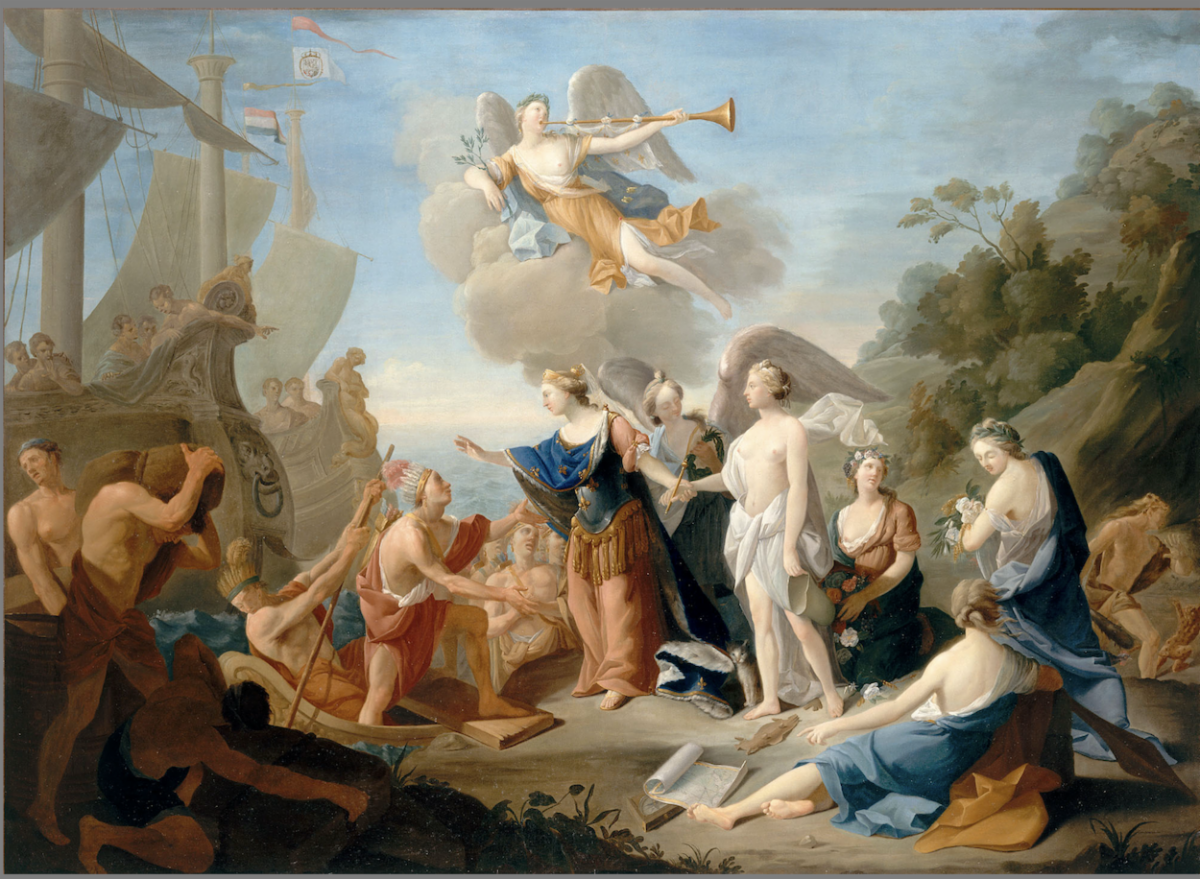
La France offrant la Liberté à l’Amérique (“France offering Liberty to America”) Oil on canvas, 135cm (4’42”) x 186cm (6’10”) by Jean Suau (1755-1841), Musée franco-américain (Blérancourt)
In 1784, the painter won the Royal Academy of Toulouse competition with this painting (1784).
| | |
Editorial
2026 is a special year, as the United States of America will celebrate its 250th Anniversary.
We didn't want to wait for July 4th to celebrate the role of France in the birth of the new republic, which started covertly as early as 1775.
Unfortunately, several of the key players in this seminal event of world history are not particularly well honored or memorialized. The covert maneuvers that took place during the crucial months leading to the Declaration of Independence deserve to be remembered.
As our readers are well aware, we always base our monthly bulletins on existing monuments, statues, plaques and markers, and faithfully transcribe the engraved texts. Since there are not too many linked to this period of history in the United States, we went straight to the source: the incredible diplomatic correspondence of the French foreign ministry at Versailles.
We will therefore recount the crucial roles of King Louis XVI, his minister of Foreign Affairs Vergennes, special envoys Benjamin Franklin and Silas Deane, the activism of Pierre Caron de Beaumarchais, the early interventions of the Marquis de Lafayette and Baron de Kalb. We will also remember the roles of other key players, largely ignored in history textbooks, such as Jacques-Donatien Leray de Chaumont, Charles-François de Broglie, Marquis de Ruffec, Julien Achard de Bonvouloir, and Jacques Barbeu du Bourg...they deserve to be remembered during this semiquincentennial.
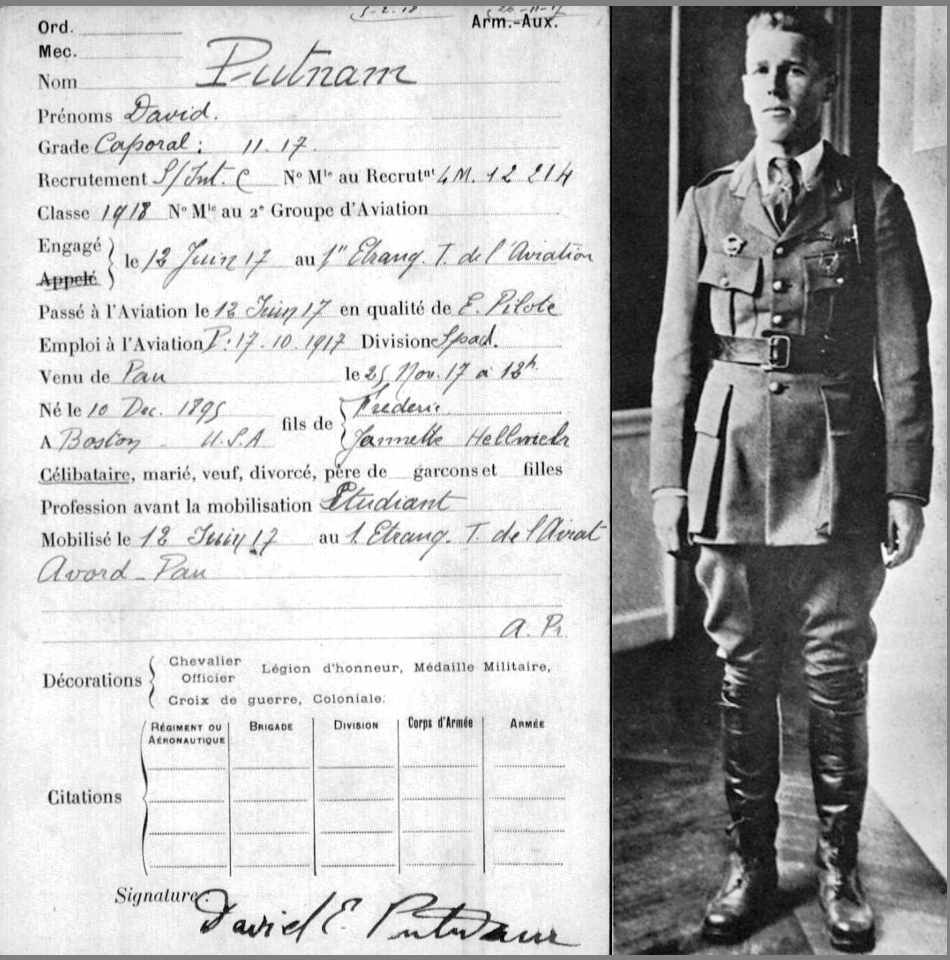
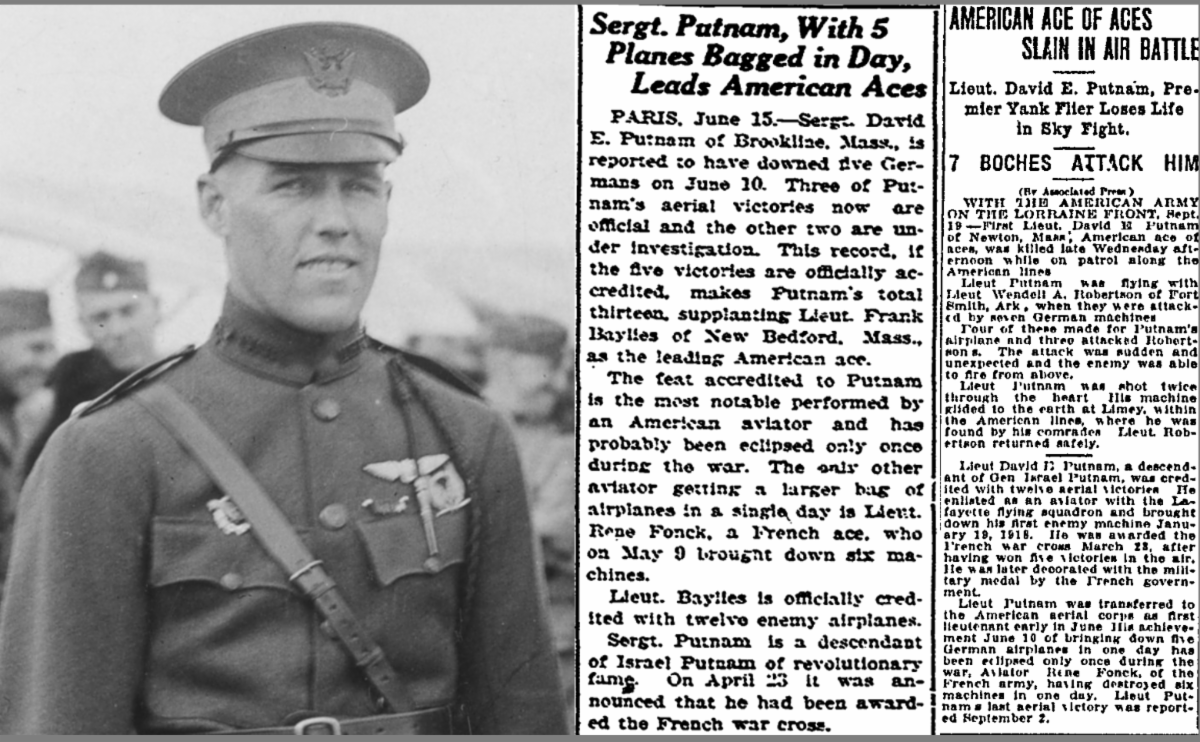
Part Two of this Bulletin will resume our long-established tradition of honoring a particular American volunteer who fought and died for France. This month we will honor 1st Lt. David Endicott Putnam, descendant of Revolutionary War hero Israel Putnam, known as America's “Ace of Aces,” for thirteen confirmed kills, and thirty unconfirmed. He had joined the French Foreign Legion on May 31, 1917 and was shot down on September 12, 1918.
Part Three of our Bulletins, as always, is devoted to sharing announcements from partner associations. In this month of January, we will include a calendar of important dates that will be part of the America250 celebrations.
Last but not least, we invite you to renew your membership for 2026, or consider becoming a member. You will find at the end of this Bulletin a link to send your membership dues, which start at $50 ($25 for Veterans and students). We have several plaques and memorials planned for 2026, and we thank you for your kind and generous support.
Happy birthday, America! May we never forget the shared values that so many of our American and French forebears died for.
On behalf of the Board of Directors,
Thierry Chaunu
President, The American Society of Le Souvenir Français, Inc.
| | |
Historical background
An evolving geopolitical context
| | |
We will not recount the entire history of escalating conflicts between the thirteen colonies and Great Britain that began in 1765.
• Tensions mounted over the decade following the Treaty of Paris in 1763, which marked France's eviction from North America. In summary, dissatisfaction with the colonial rule in the Thirteen British Colonies of North America had been growing since 1763.
• However, it was the Battles of Lexington and Concord on April 19, 1775 involving British regular troops and Massachusetts citizen militias, that officially signaled the start of the American War of Independence (known in the United States as the American Revolutionary War).
• On May 10, the Second Continental Congress, which gathered delegates from the Thirteen Colonies, met in Philadelphia. Among the delegates were George Washington, Benjamin Franklin, John Jay, Arthur Lee, Silas Deane, John Adams, and Thomas Jefferson.
• On June 14, Congress established the Continental Army to provide for the common defense of the Thirteen Colonies. The following day, George Washington was selected to lead the army, officially taking command on July 3. It soon became evident that the Insurgents, as they were called, needed outside help as attempts of conciliation quickly evaporated.
• After declaring independence on July 4, 1776, the union of the thirteen former colonies had to defend that independence by force of arms, thereby beginning a new phase in the conflict: a genuine war for independence. Facing the British army, the Americans needed to forge alliances with other powers to have any hope of prevailing. It was within this context that France and the French became involved.
• Much has been written about the French monarchy's desire for revenge against Britain. While this sentiment undeniably served as a persistent motivating factor, focusing on it alone is overly simplistic and overlooks the prevailing public sentiment, which was genuinely supportive of the Insurgents.
The French monarchy was not philosophically inclined to advocate for republicanism or endorse subjects rebelling against their sovereign, even a British one. Moreover, the French monarchy exercised great caution in avoiding direct confrontation with Great Britain, particularly since French military forces had not yet fully recovered their strength by 1776. The monarchy also sought to secure an alliance with Spain before any potential conflict with Britain. This explains France's initially careful and prudent stance, given the uncertainty about whether the Insurgents' revolt would be crushed, potentially leading the British to seek retribution by invading the lucrative French West Indies.
• At the same time, public opinion, led by French intellectuals, quickly became favorable and enthusiastic about the colonial revolt across the Atlantic. The French public viewed the American struggle positively and celebrated unfolding events. The prevailing mood in this Age of Enlightenment extolled liberty, natural rights, and the informed public, as well as a new generation of aristocrats were highly supportive of the struggle against despotism. Benjamin Franklin's presence in Paris significantly heightened French interest in events across the Atlantic—he was warmly welcomed in the aristocratic and liberal salons of Paris and beloved by the populace. The press and Masonic lodges likewise contributed to popularizing the American cause.
One of the key architects of French support for the fledgling United States was Charles Gravier de Vergennes, Louis XVI's minister of foreign affairs. And one of the most ardent early supporters of the Insurgent cause was none other than Pierre Caron de Beaumarchais, the immortal writer of Le Barbier de Séville (1775) and Le Mariage de Figaro (1778).
In this bulletin, we will pay tribute to many other Frenchmen who played an important role in the birth of the United States.
But of course, nothing happened without the King's consent; thus, we begin by paying tribute to him.
| | |
Louis XVI
King of France and of Navarre
(1774-1792)
First to Recognize, and Key Enabler
of the independence of the U.S.A.
| | |
Above:
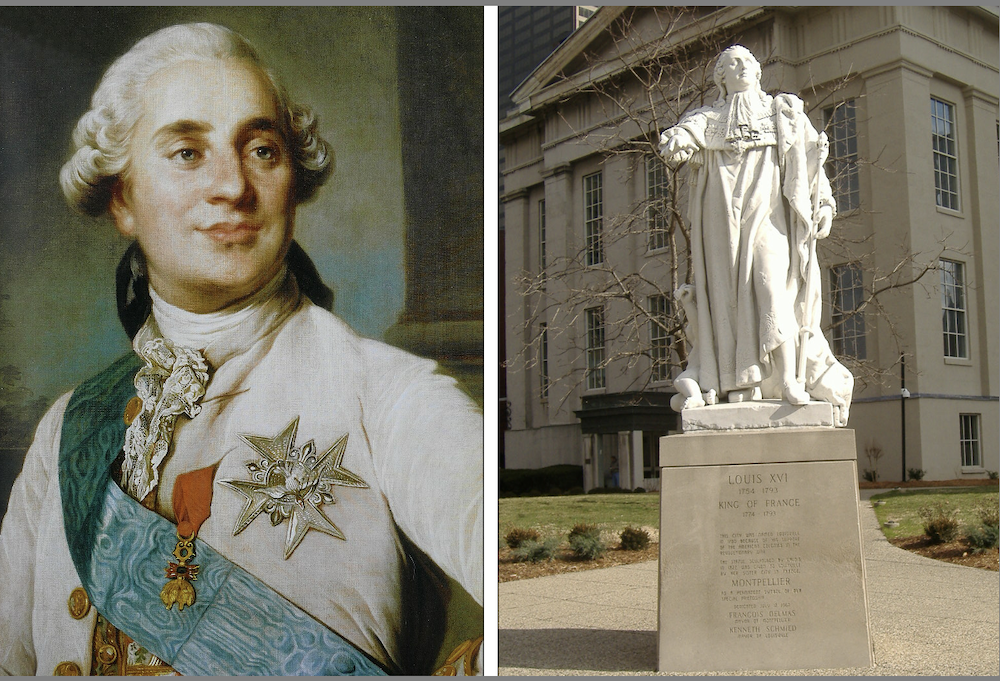
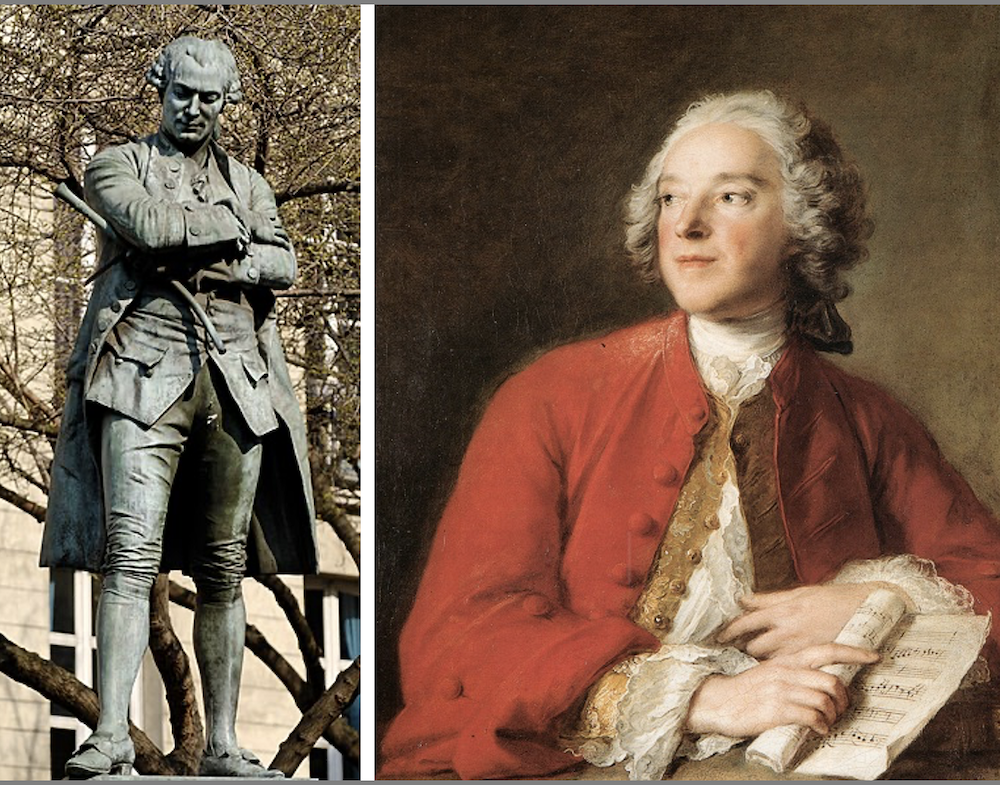
Left: Louis XVI, King of France and of Navarre, painting by Joseph-Siffred Duplessis (detail), Château de Versailles, reproduced in Versalia, revue de la Société des Amis du château de Versailles, n°10, 2007, Public Domain, https://commons.wikimedia.org/w/index.php?curid=124259329
Right: Statue of Louis XVI, Louisville, KY. Photo by Bedford, Public Domain, https://commons.wikimedia.org/w/index.php?curid=93976805
| | |
King Louis XVI (23 August 1754 – 21 January 1793) is often caricatured as irresolute, incapable of taking a decision. It is true that he was genuinely indecisive in many domestic matters.
However, after some initial hesitations, he often proved decisive with respect to American affairs, thanks largely to Vergennes's influence and clear strategic goals.
Yes, he was extremely careful in his decisions, perhaps overly prudent, but he was meticulous, taking a personal interest in the most minute details, very hardworking and steadfast in his overriding goal: restoring French power after the disastrous Treaty of Paris of 1763.
He also appointed to his cabinet some very capable men: Maurepas as his trusted close adviser; his war ministers Saint Germain, Montbarrey, Segur; his Navy secretaries Antoine de Sartine and Charles Eugène de La Croix de Castries; his Finance minister Turgot, his director of Treasury Necker; and the indefatigable Foreign Affairs minister Charles Gravier, Comte de Vergennes.
• Louis XVI rejected any territorial gain from the very beginning, and again after achieving victory. He believed that the industrious nature of the new nation would be beneficial to French commerce, however he and the French Cabinet were quite naïve in this respect.
• While being cautious and eager not to provoke war as he furiously rearmed both the Navy and the Army, Louis XVI personally approved and closely monitored considerable covert aid to the Insurgents: money, ammunition, and equipment
• In all, he is not given all the credit he is owed. As a king, he is often overlooked because it is politically incorrect, for both the American and the French republics to properly honor him for his role in the birth of the United States. Yet again how easy it is to forget that nothing could have happened without him! No volunteer, no transfer of funds, could occur without his express permission.
The wealth of diplomatic archives and internal governmental correspondence is consistent: his handwritten signature with the notation "Approuvé" ('approved') is everywhere, even, as we will see, on some of the smallest matters...
Legacy in the United States:
• In order to thank King Louis XVI for his actions to help the United States become an independent nation, the Virginia legislature named a Virginia settlement in his honor. The town of Louisville was officially chartered by the Virginia Legislature in 1780, and became part of Kentucky upon the commonwealth’s statehood in 1797.
• There are no statues of him in France, of course, but he has (had) his statue in the United States: a 12 feet tall, 9 tons statue in Louisville, Kentucky. This marble representation of Louisville’s namesake was originally commissioned by the king’s surviving daughter, Marie-Thérèse, and unveiled in the 1820’s in Montpellier, France, 36 years after his beheading, during the reign of his brother Louis XVIII. It had been relegated in storage for decades in Republican France until 1956, when Louisville and Montpellier became sister cities. The then-138-year-old sculpture by Achille-Joseph Valois was presented to Louisville Mayor Kenneth Schmied as a gift of friendship between the two cities...
Statue of King Louis XVI, Louisville, KY
Jefferson County Courthouse, 527 West Jefferson Street, Louisville, KY 40202
GPS: 38.254338, -85.760130
(1967-2021 - In storage since):
• Inscription:
“ Louis XVI
1754 – 1793
King of France
1774 – 1793 “
“This city was named Louisville in 1780
because of his support of the American Colonies in the Revolutionary War.
The statue, sculptured by Valois in 1827, was given to Louisville
by her sister city in France, Montpellier
As a permanent symbol of our special friendship.
Dedicated July 17, 1967
Francois Delmas, Mayor of Montpellier
Kenneth Schmied Mayor of Louisville"
This is the only statue of King Louis XVI in the United States. This statue has been damaged during the George Floyd protests of summer 2020. The City Council passed a resolution shortly thereafter to restore it and reinstall it at its original location. However it is today at a standstill and the statue remains in storage today. The city faces two obstacles to reinstalling it: a $200,000 repair cost and public debate over what it represents.
A 2022 survey found 40% of residents believe the 18th-century monarch doesn't reflect their values, citing his ties to colonialism and opposition to democracy. Supporters argue the statue honors French support during the American Revolution, which was crucial to the nation's founding.
Republican Metro Councilman Kramer said in a NPR interview of May, 2024:
"...it symbolizes what the city's founders believed: that France's support was instrumental to the American Revolution...If it hadn't been for the French willingness to be involved in this, if it hadn't been for the distraction [they created], I don't know how you overlook the significance of that..."
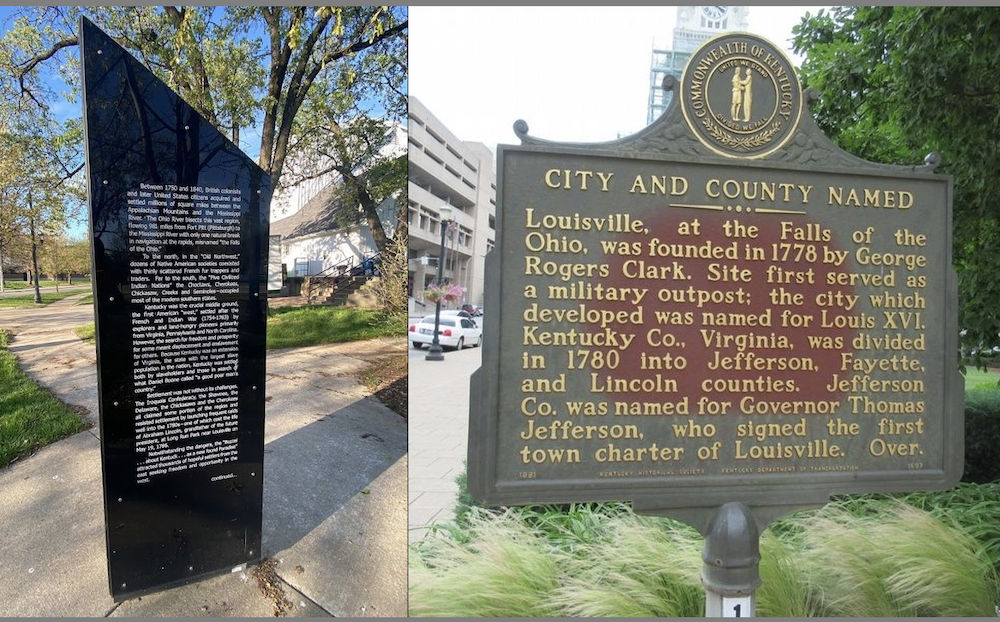
Whatever the future of this statue may be, there are two markers which have been left intact:
Markers in Louisville, KY
| | |
Above:
Left: Photo: by Darren Jefferson Clay, April 7, 2024
https://www.hmdb.org/m.asp?m=245720
Right: Photo: by Michael Herrick, May 19, 2017
https://www.hmdb.org/m.asp?m=104581
| |
• In addition to the statue, there are two markers mentioning King Louis XVI (marked in bold by us) in Louisville, KY:
Marker, « Freedom Park: A Journey to Freedom Settlement»
1911 S 3rd St, Louisville KY 40208
GPS: 38.220133, -85.760417
• Inscription (excerpts):
[...] “To the north, in the "Old Northwest," dozens of Native American societies coexisted with thinly scattered French fur trappers and traders. Far to the south, the "Five Civilized Indian Nations" the Choctaws, Cherokees, Chickasaw, Creeks and Seminoles-occupied most of the modern southern states. [...]
In the spring of 1779, the settlers moved ashore and, at a public meeting on April 17, 1779, established the town of Louisville named in honor of Louis XVI of France.”
Marker, « City and County Named »
Jefferson County Courthouse, 527 West Jefferson Street, Louisville, KY 40202
GPS: 38.254317, -85.760033
• Inscription:
City and County Named.
"Louisville, at the Falls of the Ohio, was founded in 1778 by George Rogers Clark. Site first served as a military outpost; the city which developed was named for Louis XVI. Kentucky Co., Virginia, was divided in 1780 into Jefferson, Fayette, and Lincoln counties. Jefferson Co. was named for Governor Thomas Jefferson, who signed the first town charter of Louisville.
Erected 1981 by Kentucky Historical Society · Kentucky Department o of Highways. (Marker Number 1697.)”
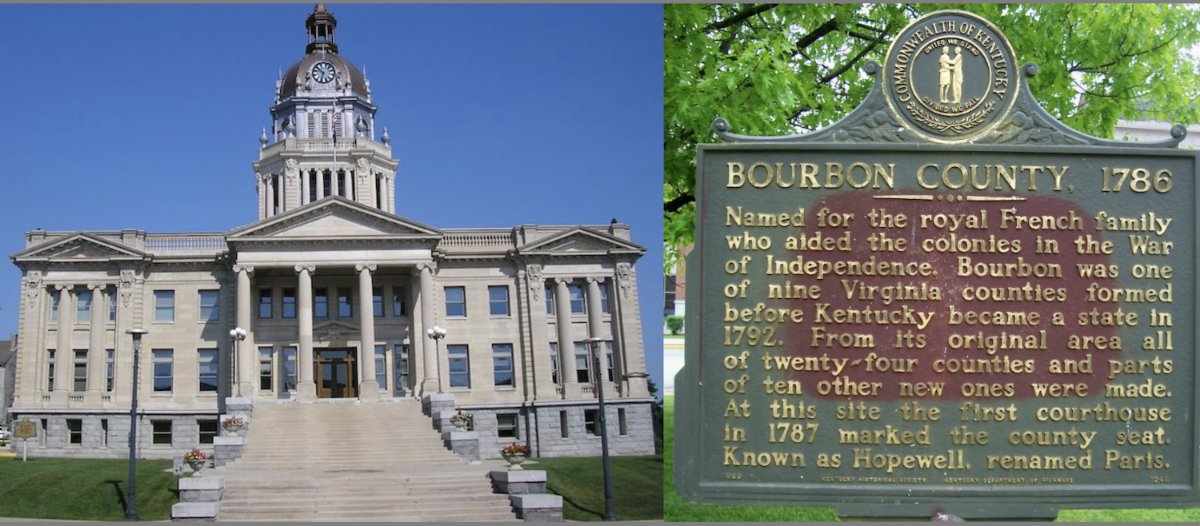
• King Louis XVI is also (indirectly) honored in the United States in the following sites:
Bourbon County
| | |
• Bourbon County was established in 1785 from a portion of Fayette County, Virginia, and named after the French House of Bourbon, in gratitude for Louis XVI of France's assistance during the American Revolutionary War. The county seat is the town of Paris. It is also the birthplace of Bourbon whisky.
Marker, « Bourbon County”
301 Main St, Paris, KY 40361
GPS: 38.212733, -84.249817
• Inscription:
“Named for the royal French family* who aided the colonies in the War of Independence. Bourbon was one of nine Virginia counties formed before Kentucky became a state in 1792. From its original area all of twenty-four counties and parts of ten other new ones were made. At this site the first courthouse in 1787 marked the county seat. Known as Hopewell, renamed Paris.”
Erected 1969 by Kentucky Historical Society and Kentucky Department of Highways. (Marker Number 1246 - Note*: marked in bold by us)
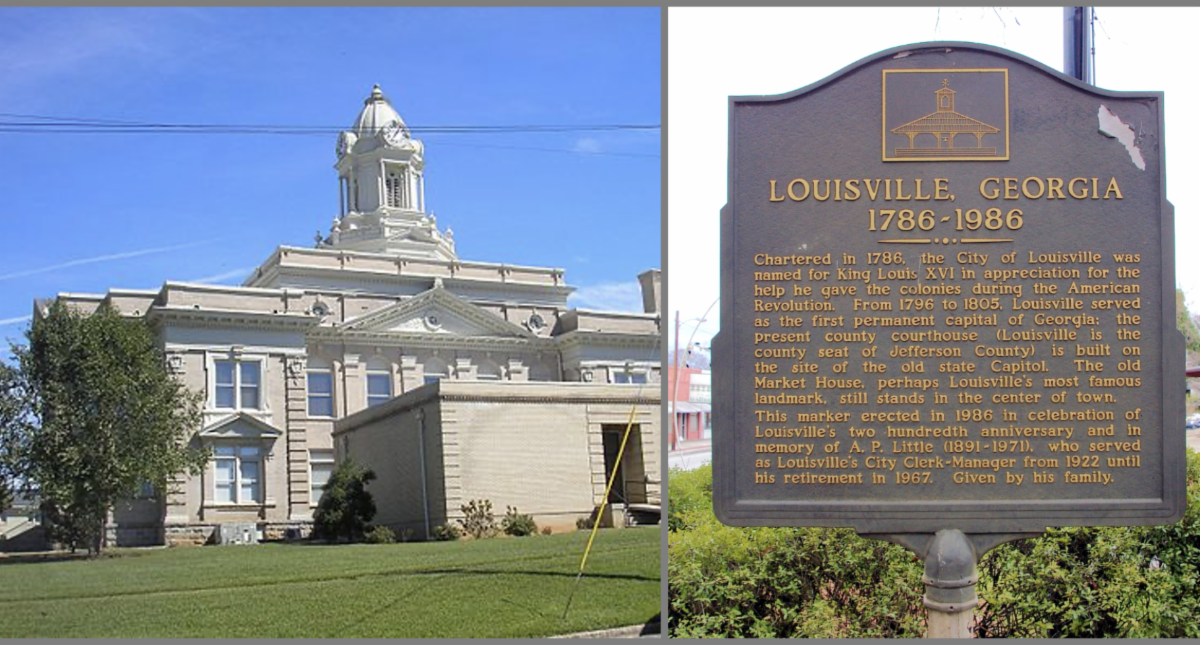
Louisville, Georgia
| | |
• Louisville, GA was officially incorporated on January 26, 1786, with the intention of becoming the state capital, although it took ten years for that to happen. Savannah had been the colonial capital but was deemed too distant from the growing population center, leading to Augusta being designated as the state capital in the 1780s.
• The city was named in honor of Louis XVI, who supported the Continentals during the American Revolutionary War and was still the King of France at the time of the city's incorporation. It took many years for the city to develop, and the state government buildings were finished in 1795. There is an old cemetery for Revolutionary War soldiers located on the western side of the city.
Marker, “Louisville, Georgia, 1786 - 1986”
131 W Broad St, Louisville, GA 30434
GPS: 33.000600, -82.410117
• Inscription:
“Chartered in 1786, the City of Louisville was named in honor of King Louis XVI in appreciation for the help he gave the colonies during the American Revolution. From 1796 to 1805, Louisville served as the first permanent capital of Georgia: the present county courthouse (Louisville is the county seat of Jefferson County) is built on the site of the old state Capitol. The old Market House, perhaps Louisville’s most famous landmark, still stands in the center of town. This marker erected in 1986 in celebration of Louisville’s two hundredth anniversary and in memory of A.P. Little (1891-1971), who served as Louisville’s City Clerk-Manager from 1922 until his retirement in 1967. Given by his family.
Erected by Family of A. P. Little."
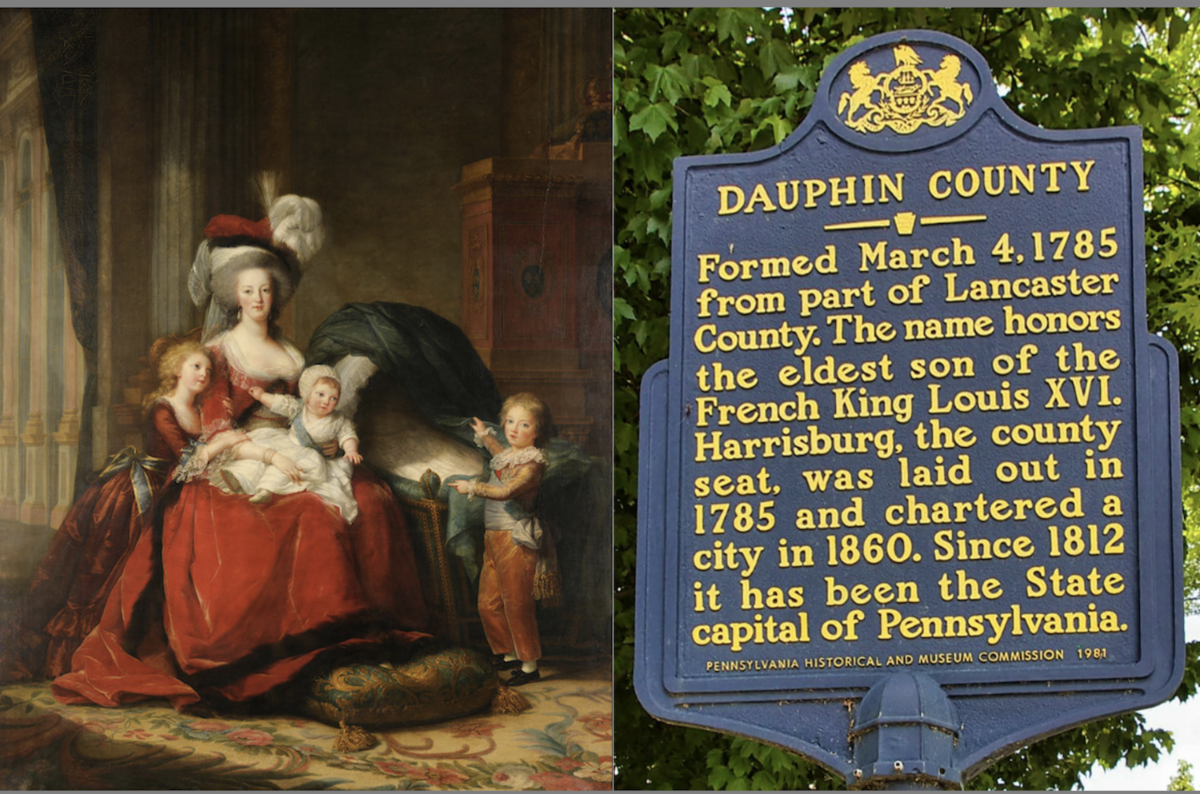
Dauphin County, Pennsylvania
| | |
Above:
Left: Queen Marie Antoinette with her children, 1787 at Versailles; By Élisabeth Louise Vigée Le Brun - Public Domain. (L-R); Marie Thérèse Charlotte, known as Madame Royale at court; the Queen with Louis-Charles, Duke of Normandy on her lap; the Dauphin is on the right pointing into an empty cradle, reminding the public of the recent death of Marie-Sophie-Béatrice. The cabinet used to store jewelry and decorated with fleurs-de-lis glows in the dim light. The Dauphin died on June 4, 1789, at the start of the French revolution, when the Estates-General were meeting, deeply affecting Louis XVI and Marie-Antoinette who were both affectionate parents.
https://commons.wikimedia.org/w/index.php?curid=22553475
Right: Marker, Dauphin County, https://pabucketlist.com/
| | |
• Beyond Louis XVI himself, his immediate family was also honored by American contemporaries, who were very much aware of the reality of his help and demonstrated their gratitude. To wit, these two markers explain that a Pennsylvania county was named after his (then) 4-year old son, the Dauphin, Louis Joseph Xavier François.
• Louis Joseph Xavier François, born on October 22, 1781, and passing away on June 4, 1789, held the title of Dauphin of France. He was the second child and first son of King Louis XVI and Marie Antoinette. In the hierarchy of the French royal family, Louis Joseph was known as a “Fils de France”, which translates to ”Son of France." Unfortunately, he died at the young age of seven due to tuberculosis. Following his death, his four-year-old brother, Louis Charles, succeeded him as the Dauphin and the next in line to the throne.
• Two markers explicitly honors the French royal family (marked in bold by us):
Marker, “Dauphin County“
Across from Dauphin County Bldg & Grounds, 2 Market St, Harrisburg, PA 17101
GPS: 40.258533, -76.882617
• Inscription:
“Formed March 4, 1785 from part of Lancaster County. The name honors the eldest son of the French King Louis XVI. Harrisburg, the county seat, was laid out in 1785 and chartered a city in 1860. Since 1812 it has been the State capital of Pennsylvania.
Erected 1981 by Pennsylvania Historical and Museum Commission.”
Marker, “Old Dauphin County Courthouses”
304 Market St, Harrisburg, PA 17101
GPS: 40.261283, -76.881167
• Inscription (excerpts):
“Two Dauphin County Courthouses occupied this site at the intersection of Market St. and what was originally known as Raspberry Street, later appropriately renamed Court Street. John Harris, Jr.'s original plan for Harrisburg set aside this land for use by the County, which was created from a portion of Lancaster County in 1785 and named for the Crown Prince of France to recognize French support in the American Revolution. As the new county seat, Harrisburg was actually named Louisburg for several years in honor of the French King, Louis XVI, but gained the name of the Borough of Harrisburg by an Act of the State Legislature in 1791” [...]
Erected by The Harrisburg History Project Commissioned by Mayor Stephen R. Reed.”
• There are a few streets here and there, named "King Louis", (not St. Louis St) for instance in New Brunswick, NJ, Secaucus, NJ, Hopelawn, NJ, Whippany, NJ, Perth Amboy, NJ, Staten Island, NY, Cheektowaga, NY, Massapequa, NY, Saint Louis, MO, or Brandon, Florida...
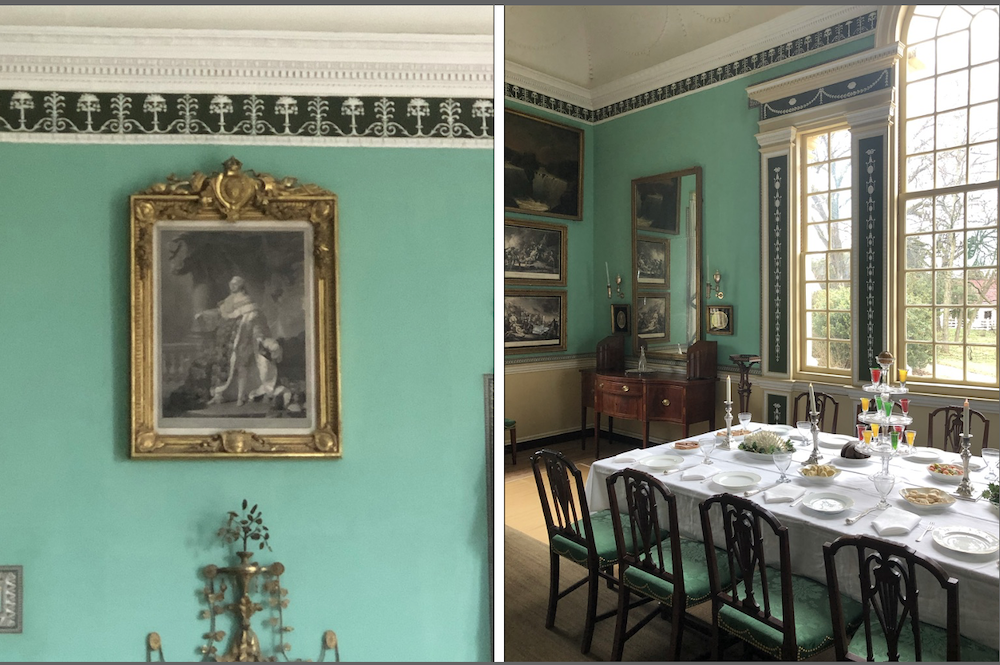
• Often overlooked by tourists visiting George & Martha Washington's estate: a portrait of the king, in their dining room:
Mount Vernon, Virginia
| | |
Above:
Portrait of King Louis XVI, offered by the King to George Washington and hung in his dining room at Mount Vernon, Virginia. Photos: TC © ASSFI 2021
https://mountvernonnewroom.tumblr.com/post/67069735532/a-portrait-of-a-king-at-mount-vernon
| |
There are no statues of King Louis XVI in France, although he is everywhere to be seen at his castle in Versailles, of course.
In the United States, tourists can see a portrait of the King, offered by the King himself to George Washington in 1791, in the general's dining room at Mount Vernon, hand delivered by the then Ambassador of France:
Jean Baptiste, chevalier (later Comte) de Ternant (December 12, 1751 – November 15, 1833) was a French military officer, diplomat, and served as the French ambassador to the United States from 1791 to 1793.
• He was born in Damvilliers, in the province of Barrois (today department of the Meuse) in 1751 and became a lieutenant in the Royal Corps of Engineers in 1772.
• During the American Revolutionary War, he volunteered at the same time as Lafayette to support the Patriots and enlisted in the Continental Army.
Starting in 1778 at Valley Forge as a major, he was promoted to Lieutenant-Colonel on September 25, 1778, and served as a sub-inspector in the Continental Army. He was captured in Charleston on May 12, 1780 and was freed as part of an exchange of prisoners in 1782. He was promoted to the rank of Colonel on October 13, 1783. His official title was "Inspector General and Advisor to the Commanding Generals of the Southern Forces".
In total, he served in the Continental Army for 5 years.
• In 1780, de Ternant was elected to the American Philosophical Society.
• After the war he returned to France in 1784 where he was promoted to the rank of Colonel. In 1785 he served as colonel in the army of the Dutch Republic (still with the assent of the King of France) and shored up the defenses of Amsterdam against the Prussians. He returned to France to serve as Colonel of the Royal-Liégeois regiment from 1788 until 1791.
• He was sent back to the United States for a short time as a French minister in August 1791, while the French Revolution was underway. He was tempted and asked for a reassignment in the military when France fought back the European Coalition forces, only to think it more prudent to stay in the United States when the French monarchy was abolished on September 21, 1792. As expected the Girondins removed him from his position on December 30, 1792, and Edmond-Charles Genet took over.
• During his tenure as Ambassador of France to the United States, he is remembered as the one delivering on December 22, 1791 a personal gift of King Louis XVI to General George Washington: a portrait magnificently framed, incrusted with diamonds, which was displayed at his official residence in Philadelphia, and later displayed in 1797 at Mount Vernon in the general's formal dining room, above the entrance door.
The 1790 engraved portrait was created by Charles-Clément Bervic and replicated the original state portrait painted in 1789 by Antoine-François Callet, who was the official portrait artist for the king. Callet’s full-length painting shows Louis XVI dressed in his luxurious state robes from 1779.This original work, titled "Louis Seize, Roi des Français, Restaurateur de la Liberté," is displayed at The Apollo Salon in the Palace of Versailles.
In the accompanying note, de Ternand wrote:
"Permit me to present you with a new print of the king of the French—I shall feel a very great Satisfaction if you will consider that feeble mark of my lively and respectfull attachment for your person, as worthy your kind acceptance."
That same day, Washington replied to de Ternant to express his thanks, writing,
"I accept, with great pleasure, the new and elegant print of the King of the French, which you have been so obliging as to send to me this morning as a mark of your attachment to my person. You will believe me, Sir, when I assure you, that I have a grateful and lively sense of the personal respect and friendship expressed in your favor which accompanied the Print."
• Louis XVI intended it to be a personal gift: the lower corners of the portrait have cartouches with the initials of the president (“G” and “W”) and the Washington family crest in the center. The top corners feature the monogram of the French king (“L” and “XVI”), while the center displays the French royal coat of arms, topped with a pierced crown, and flanked by a Native American headdress on the right and the French cap of liberty on the left. This combination of symbols highlights the strong connection between France and the United States, formed through their alliance during the Revolutionary War
We resume our narration with a key architect of France's role in the independence of the United States: the indefatigable comte de Vergennes, who convinced Louis XVI to support the Insurgents, and who steadfastly helped them, even when their cause seemed hopeless.
| | |
Pierre Gravier, Comte de Vergennes
Minister of Foreign Affairs of France
Steadfast Supporter of the Insurgents
| | |
A Foreign Minister for the Ages
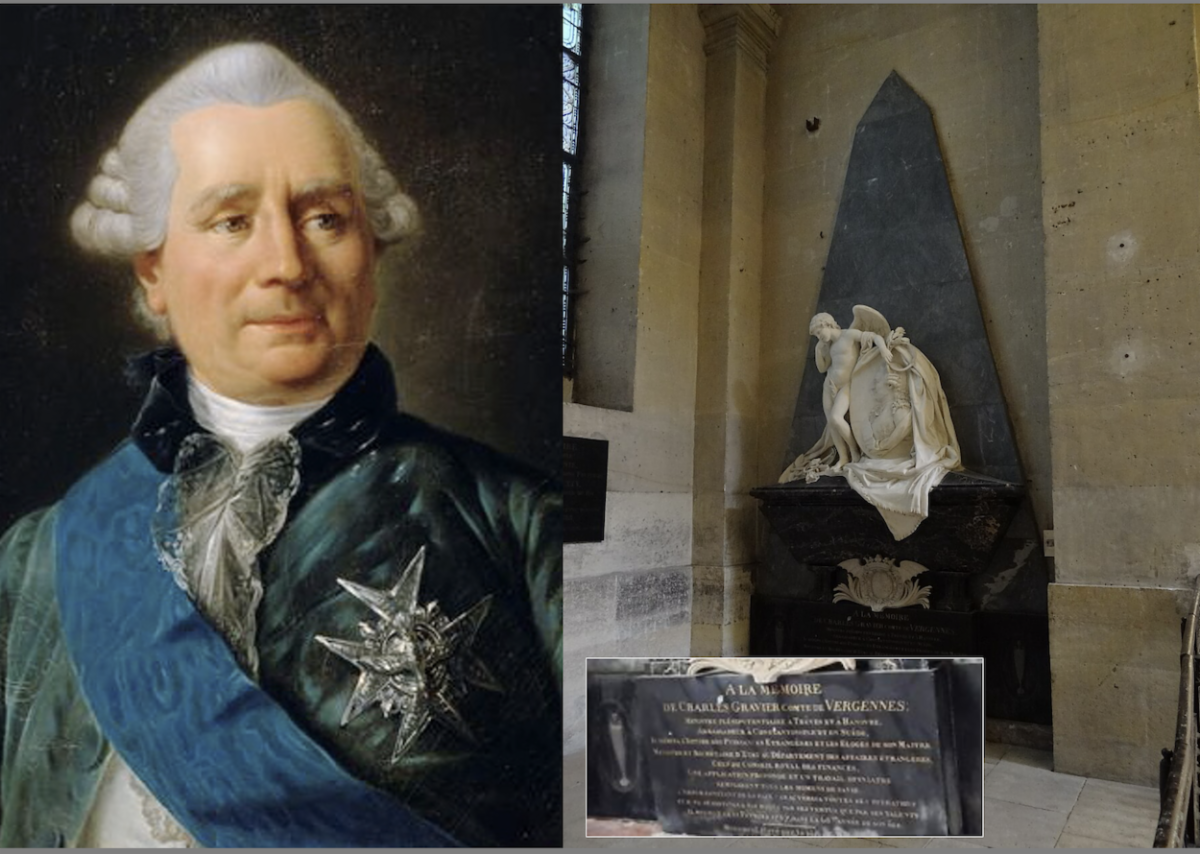
• Charles Gravier, comte de Vergennes (29 December 1719 – 13 February 1787), held the position of Foreign Minister from 1774 until his death in 1787. He was born in Dijon and received his education at a Jesuit institution in the area. Vergennes pursued a career in diplomacy, serving in various capacities in Portugal and Bavaria, becoming the ambassador to the Ottoman Empire and then Sweden. Upon the ascension of King Louis XVI in 1774, he was appointed to the position of Foreign Minister.
• Vergennes had foreseen the implications of American independence as early as 1765, predicting that the loss of Canada would encourage American colonists to "strike off their chains." Prior to France's formal involvement in the conflict, he endorsed Pierre Beaumarchais's initiative for covert French support, as we will see further below.
• Beginning in early 1776, France provided the American revolutionaries with essential supplies, arms, ammunition, and volunteers. In 1777, Vergennes communicated to the American commissioners that France recognized the United States and expressed a willingness to establish an offensive and defensive alliance with the nascent nation.
• In spite of the immense cost of the war fought around the world, Vergennes made sure that money would be available for the Insurgents. A million livres tournois were given in 1776 to start. Later,
“Despite the harshness of the circumstances,” wrote Vergennes to (French ambassador) La Luzerne, and the already worrying state of our finances, a “new free subsidy of six million livres tournois” was granted to the Americans. Remittances had already been received by Rochambeau as well, a million and a half in February, with a letter from Necker saying, “Be sure, sir, that all that will be asked of finance for your army will be ready at once.” Seven million arrived shortly afterwards on the Astrée..." - - Jusserand, Jean J.. Rochambeau en Amérique (French Edition) (pp. 61-62).
• And as to the goals pursued by the French, no territorial claim was desired by King Louis XVI, who could have asked the return of Canada ceded to the British only 20 years before. Vergennes wrote to the Marquis de Noailles, French ambassador in London: "Our engagements are simple; they are aggressive toward nobody; we have desired to secure for ourselves no advantage of which other nations might be jealous, and which the Americans themselves might regret, in the course of time, to have granted us."
• King Louis XVI reiterated his position several times, including during the negotiations leading to the Peace Treaty of Paris in 1783.
• Vergennes' voluminous correspondence, instructions, reflexions, have been compiled in 1884 by historian Henri Doniol in a series of 5 volumes, 700 pages each, titled "Histoire de la participation de la France à l'établissement des États-Unis d'Amérique : correspondance diplomatique et documents" (History of France's involvement in the establishment of the United States of America: diplomatic correspondence and documents"). We haven't seen an English translation in existence, unfortunately. It is particularly instructive to read directly from these sources. The French edition is available for free download at Gallica - Bibliothèque Nationale de France (link above) .
• To alleviate France's financial impasse, Vergennes advised the king to convene the Estates General, but died two years before on February 13, 1787. His castle was destroyed during the French Revolution and his estate confiscated...
Legacy in the United States:
• There are no memorials or markers in his honor in the United States. • However, the town of Vergennes, Vermont was named after him, as promulgated by Governor Ethan Allen and suggested by (then Consul Général of France in New York) Michel de Crèvecoeur.
Note: no marker exists in that town to honor its namesake. In the city's website, a chapter about a walking tour briefly states:
"Vergennes is named for Charles Gravier, the Comte de Vergennes, who served as the French Foreign Minister during the American War for Independence. Due to his personal , financial, and political contributions to the American cause, Ethan Allen suggested the town carry Gravier’s name. "
• In France, his name remains particularly associated with his position, as foreign ministers are traditionally said to occupy the 'Vergennes chair.'
• In his classic book Le Diplomate, Jules Cambon, ambassador of France to Washington (1897-1902), notes: "America and France have erected monuments to La Fayette and Rochambeau, and rightly so; it would have been right for them to honor the memory of Vergennes as well."
| | |
Jean-Frédéric Phélypeaux, Comte de Maurepas,
Minister of State
| | |
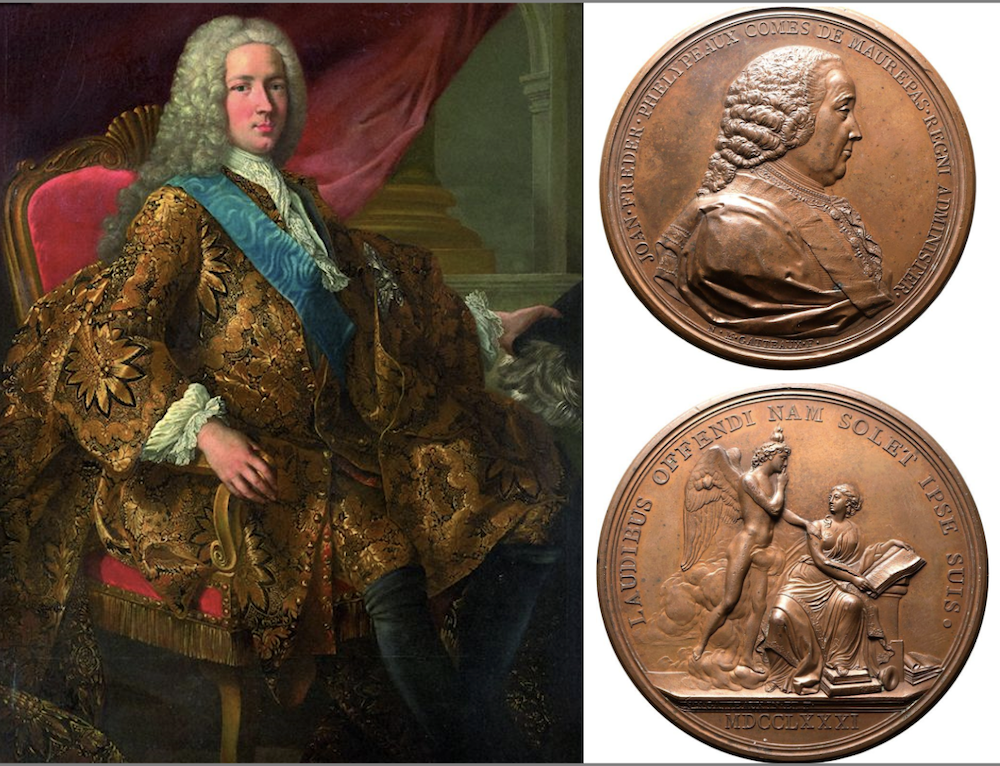
Jean-Frédéric Phélypeaux, comte de Maurepas, was born on July 9, 1701, in Versailles and died on November 21, 1781, in the same city. He was a French aristocrat and politician.
• He served as Secretary of State for the Navy under Louis XV from 1723 to 1749. He was an effective naval minister. It is worth noting that the Royal Navy, surprised by the quality of French ships, immediately incorporated the captured units from the battles of 1747 into its fleet and began to replicate them.
• He suffered a long period of disgrace in 1749, that lasted 25 years. He was exiled to a distance of forty leagues (about 160 km) from Paris.
• When Louis XVI ascended the throne in 1774 he became Minister of State and the de facto mentor of the young king. He held that position until his death. • He is the one who installed Vergennes as minister of Foreign Affairs.
• While extremely cautious about waging war, he did not oppose France siding with the Insurgents.
Legacy in the United States:
He has no plaque or memorial in his honor in the United States. Fort Maurepas in Mississippi, Lake Maurepas and Lake Pontchartrain in Louisiana are not named after him, but after his father Louis II Phélypeaux de Pontchartrain (29 March 1643 – 22 December 1727), successively Marquis de Phélypeaux (1667), Comte de Maurepas (1687), Comte de Pontchartrain (1699), who was in charge of the Royal Household (1690-1714), as well as Secretary of the Navy (1690-99).
| | |
Anne Robert Jacques Turgot
First Minister of State &
Comptroller General of Finances (1774-1776)
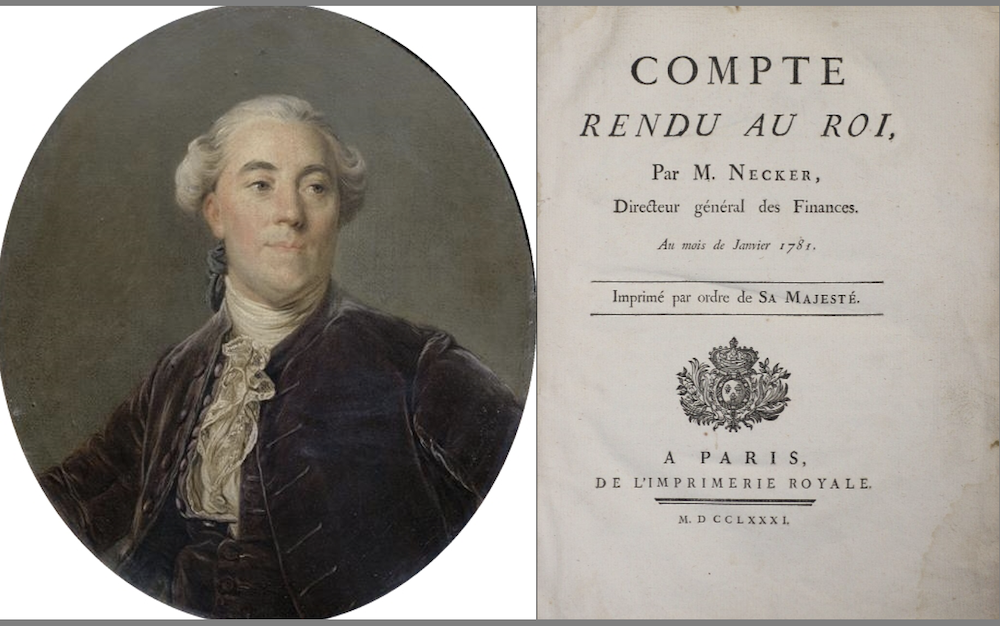
Jacques Necker
Director-General of the Royal Treasury (1776-1777)
Director General of Finances (1777-1781)
| | |
Above:
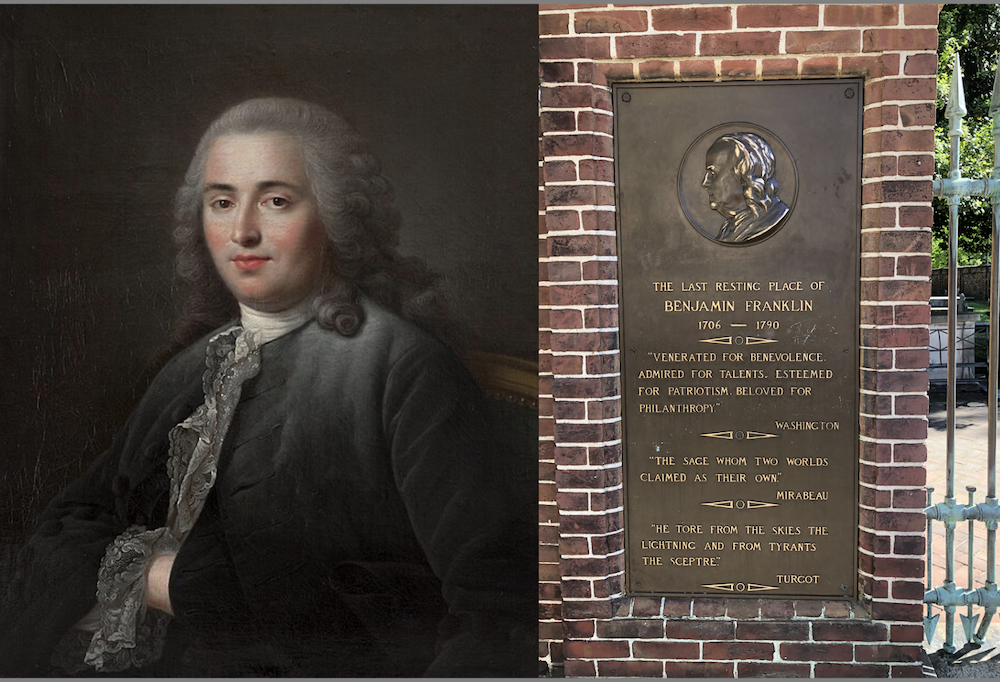
Top Left: Portrait de Turgot By François-Hubert Drouais - Galerie Le Serbon, Public Domain, https://commons.wikimedia.org/w/index.php?curid=86290174
Top Right: Tomb of Benjamin Franklin, Philadelphia, with a tablet quoting Turgot. Photo: TC © ASSFI 2022
Bottom Left: Portrait of Necker, after Joseph-Siffred Duplessis - Public Domain, https://commons.wikimedia.org/w/index.php?curid=725209
Bottom Right: Financial report to the King, 1781. The war depleted the French treasury, one of the main causes of the French budget deficit leading to the Revolution in 1789, by Lombards Library - Own work, CC BY 3.0, https://commons.wikimedia.org/w/index.php?curid=12630134
| | |
• Anne Robert Jacques Turgot, Baron de l'Aulne (10 May 1727 – 18 March 1781), commonly known as Turgot, was a French economist and statesman. He is best remembered today as an early advocate for economic liberalism. He exercised extreme fiscal prudence and was reluctant to spend on foreign ventures, but he followed the King's orders and oversaw the transfer of funds to the Insurgents in the 13 Colonies until his resignation in 1776. We include him in this Bulletin because he is quoted on a bronze tablet above Benjamin Franklin's tomb in Philadelphia—proof that his American contemporaries held him in high regard despite his initial reservations
Bronze tablet, with a quote from Turgot:
Tomb of Benjamin Franklin, Christ Church Burial Ground
340 N 5th St, Philadelphia, PA 19106
GPS: 39.952483, -75.148267
• Inscription:
”The last resting place of
Benjamin Franklin, 1706-1790”
"Venerated for benevolence, admired for talents, esteemed for patriotism,
beloved for philanthropy.” - Washington
”The sage whom two worlds claim as their own” – Mirabeau
“He tore from the skies the lightning and from the tyrants the sceptre” - Turgot"
• It is not within the scope of this Bulletin to narrate Jacques Necker's history of his tumultuous tenure starting in 1777. But he needs to be included, as he opposed Turgot's strong reluctance and actively helped facilitate the transfer of funds to help the Insurgents.
• Jacques Necker (30 September 1732 – 9 April 1804) was a successful banker from Geneva, Switzerland, who acted as finance minister for Louis XVI. He was known for his reforms, but some of his changes led to significant dissatisfaction.
• He played a key role in funding French support for the American colonists by securing large loans from Geneva and other bankers. However, this approach ultimately increased France's debt, which contributed to the financial crisis that sparked the French Revolution. Instead of raising taxes, he financed the war through heavy borrowing, which created an illusion of financial stability but left France with more debt, resulting in his removal and public outrage.
In 1781, Necker released a report that claimed a surplus (the "Compte rendu") to conceal the deficit, which later resulted in backlash and criticism.
• Interestingly, Albert Gallatin, the fourth (and longest serving) Secretary of the Treasury of the United States, was also from Geneva, and very successfully managed the finances of the fledgling Republic!
While Albert Gallatin has his bronze statue at the entrance of the U.S. Treasury Building next to the White House, there is no plaque or marker anywhere in the United States mentioning the support of Jacques Necker to the Patriot cause.
| | |
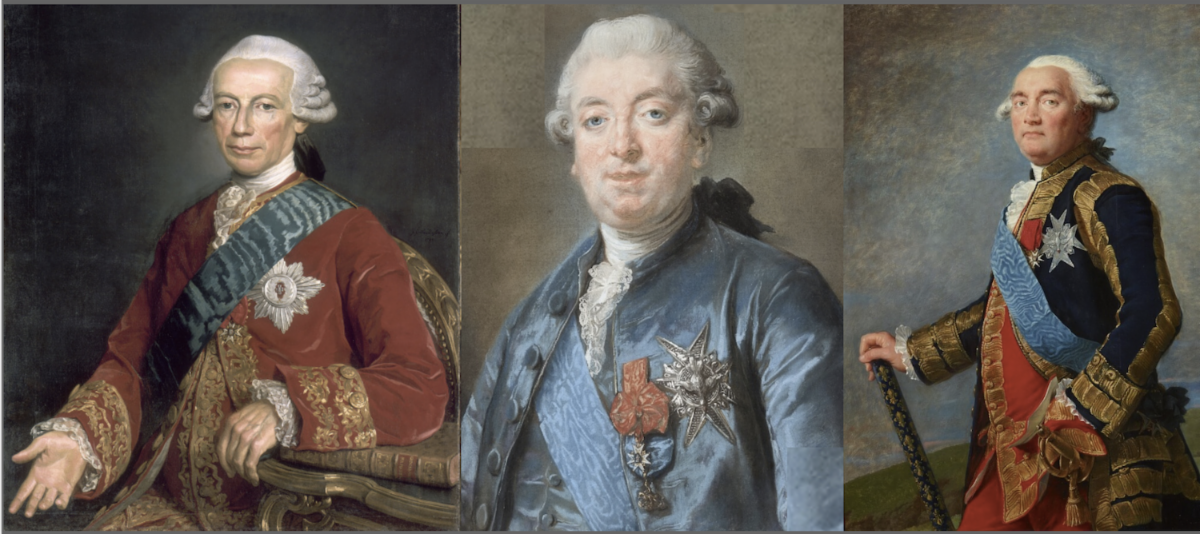
Claude-Louis-Robert, comte de Saint Germain
Secretary of War (1775-1777)
Alexandre Marie Léonor, Comte de Montbarrey
Secretary of War (1777-1780)
Philippe Henri, Marquis de Ségur
Secretary of War (1780-1787)
| | |
Above:
Left: Claude-Louis-Robert (1707-1778), comte de Saint-Germain by Jean-Joseph Taillasson — château de Versailles, Public Domain, https://commons.wikimedia.org/w/index.php?curid=106309573
Middle: Portrait d’Alexandre Marie Léonor de Saint-Mauris, Comte de Montbarrey (1732-1796), by Élisabeth Vigée Le Brun — Château de Versailles, Public Domain, https://commons.wikimedia.org/w/index.php?curid=21657564
Right: Philippe Henri, Marquis de Ségur, copy by Joséphine Houssaye [source RMN Grand-Palais] based on an original kept at the Baron de Villeneuve's residence at the Château des Roches (Indre); other replicas kept at the Musée des Augustins in Toulouse, By Joséphine Houssay / After Élisabeth Louise Vigée Le Brun - Public Domain, https://commons.wikimedia.org/w/index.php?curid=382195
| | |
• Claude Louis, Comte de Saint-Germain (15 April 1707 – 15 January 1778), a French general, was born on 15 April 1707 at the Château of Vertamboz in the Jura. He received an appointment as sub-lieutenant from Louis XV. He left France, as rumors suggested, due to a duel; served under the Elector Palatine; fought for Hungary against the Turks, and when the war of the Austrian Succession began in 1740, he joined the army of the elector of Bavaria (who later became emperor as Charles VII), showing such courage that he was promoted to lieutenant field-marshal. He joined Maréchal de Saxe in the Netherlands and particularly distinguished himself at Lauffeld, Rocoux, and Maastricht. When the Seven Years' War started in 1756, he was made lieutenant-general, and despite being more capable than his fellow commanders and earning the admiration of his soldiers, Saint-Germain resigned his commission in 1760 and accepted a field marshal position from Frederick V of Denmark-Norway, tasked in 1762 with reorganizing the Danish army. He was introduced at court by reformers Turgot and Malesherbes and was appointed minister of war by Louis XVI on 25 October 1775. He aimed to reduce the number of officers and to create order and regularity in the service, but he resigned in 1777.
• He played a key role in bringing in Baron von Steuben, a skilled Prussian officer who was out of work and residing in Paris. He introduced Franklin to von Steuben, believing that his military background would help in organizing the Continental Army and training its soldiers.
• Alexandre Marie Eleonor de Saint-Mauris, Comte de Montbarrey, later Prince of Montbarrey and Prince of the Holy Roman Empire (1774), grandee of Spain of first class (1780), knight of the Holy Spirit, and lieutenant general (1780), was born in Besançon in the Jura on 20 April 1732. He came from a family in Franche-Comté (Dole), which was ennobled in 1537. After a notable military career, the prince of Montbarrey arrived at the court of King Louis XVI, where he was supported by his relative Madame of Maurepas, the wife of the marquis of Maurepas, who was the prime minister of Louis XVI. Through her husband, Madame of Maurepas was able to secure Montbarrey the position of director of war (a role created specifically for him without a defined task) and deputy to the count of Saint-Germain, who was the secretary of State for war. Following the resignation of the count of Saint Germain, with the help of Madame of Maurepas, Montbarrey was appointed Secretary of State for war in 1778.
In 1780, amid the conflict with America, he was forced to resign from his position due to criticism over the misuse of military funds and the scandal that arose from the exposure of military appointments being traded by his mistress, Miss Renard.
• Philippe Henri, Marquis de Ségur (20 January 1724 – 3 October 1801) was a French military leader who served as Marshal of France and Secretary of State for War under King Louis XV and later King Louis XVI. He was the grandson of Philippe II, Duke of Orléans.
He took command of an infantry regiment at the age of eighteen and fought alongside his father in Italy and Bohemia. He was injured at Roucoux in Flanders in October 1746 and lost an arm at Lauffeld in 1747. During the Seven Years' War, he participated in battles at Hastenbeck (1757), Krefeld (1758), and Minden (1759). His skills in governing Franche-Comté in 1775 resulted in his appointment as Minister for War in 1780, a position he held until 1787.
None of them are remembered in the United States with a plaque or memorial. Note, they are not particularly remembered in France either.
| | |
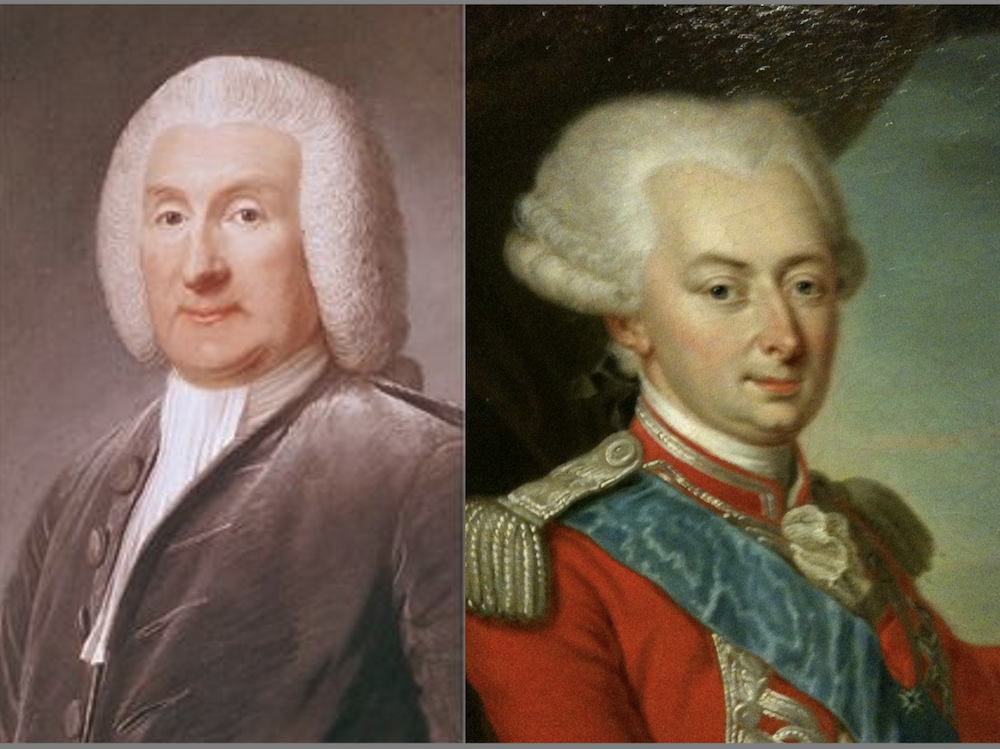
Antoine de Sartine
Secretary of the Navy (1774-1780)
Charles Eugene Gabriel de la Croix, Marquis de Castries
Secretary of the Navy (1780-1787)
| | |
• Antoine Raymond Jean Gualbert Gabriel de Sartine, comte d'Alby, was born in Barcelona, Spain, on July 12, 1729, and died in Tarragone, Spain, on September 7, 1801. He was a French statesman who held the position of Lieutenant General of Police of Paris from 1759 to 1774 during Louis XV's reign and later served as Secretary of State for the Navy from 1774 to 1780 under King Louis XVI.
• His father was a grocer who provided supplies to French troops during the War of Spanish Succession. This made him wealthy and he became a financial advisor to the Court, eventually receiving a knighthood. His son Antoine was made noble in 1755, became Chief Police Superintendent, and was later appointed Secretary of the Navy.
• Antoine de Sartine made the French Navy a force to reckon with, after its revival by Choiseul following the setbacks of the Seven Years' War. Sartine undertook significant reforms through seven ordinances in 1776. Control of the Navy was given to officers, reducing the power of civilian administrators. French ports and naval dockyards, which were placed under the leadership of the comte de Fleurieu. Naval construction was actively promoted. He also restructured the naval artillery and marine infantry corps.
• He quadrupled shipbuilding budgets, allowing for extensive shipbuilding when France joined the American War of Independence at the start of 1778. In just one year, nine ships-of-the-line were constructed in the French shipyards!
At the start of the American War of Independence, Sartine implemented mandatory convoys that delayed departures but ensured safety.
The official destination for ships assisting Americans was usually the French colony of Saint-Domingue (today's Haiti). The situation was tense for shipowners until the alliance treaty with the United States, at which point the Ministry of the Navy reached out to them, encouraging them to equip their ships by granting them "War and Goods" commissions. Ships were transferred to the United States. For instance, the Lion, a privateer outfitted in Nantes for the Americans by Jean Peltier Dudoyer, was renamed the Deane.
• During the French Revolution, he was able to escape to Spain and never returned to France.
Legacy in the United States:
Unfortunately, he has no marker or plaque mentioning him in the United States. A marble bust of his can be seen at Le Petit Appartement du Roi (the King's private quarters) at the Château de Versailles.
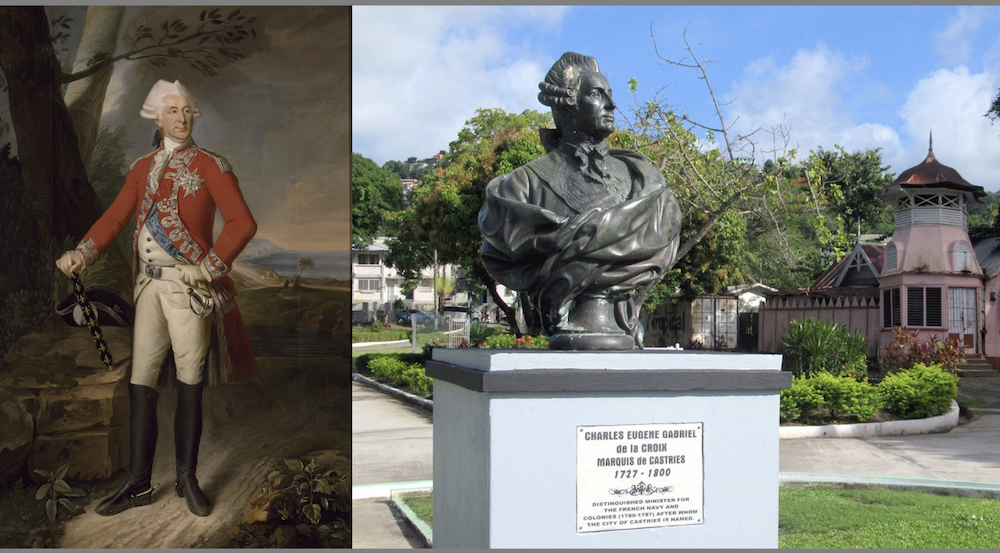
• Charles Eugène Gabriel de La Croix, Marquis de Castries (25 February 1727 – 11 January 1801) was a French military officer and politician.
He joined the régiment du Roi-Infanterie in May 1739 and became a lieutenant on 23 August 1742. At the same time, he served as lieutenant du Roi (king's lieutenant) in Languedoc and was the governor of Montpellier and Sète starting in 1743. He fought valiantly in the Seven Years' War and throughout all of Louis XV's campaigns. He became He served as the "Mestre de camp" of the régiment du Roi-Cavalerie starting on 26 March 1744, and he held the position of maréchal de camp and commandant général of the cavalry from 1748.
He further distinguished himself at the Battle of Rossbach on 5 November 1757, where he was injured twice. He was promoted to lieutenant général on 28 December 1758 and became maître de camp général of the cavalry on 16 April 1759. During the Battle of Clostercamp on 16 October 1760, his calmness helped save a dire situation.
• On 13 October 1780, he was appointed Secretary of State of the Navy, following the recommendation of his friend Jacques Necker. He held this position until 24 August 1787. In 1783, he was elevated to the rank of marshal of France. He reorganized the fleet and introduced a new naval strategy approved by the Grand Conseil, which involved redeploying the French navy to address the global nature of the conflict and assigning more aggressive officers to fleets and squadrons. This strategy resulted in several French naval victories during the American War of Independence. He also made significant legislative changes, streamlining the navy's hierarchy and reorganizing its recruitment process. De Castries was very active in all his roles, which led to his remark, "I would like to sleep more quickly" ("Je voudrais dormir plus vite").
Legacy in the United States:
• Unfortunately, there are no plaques or memorial honoring the Marquis de Castries in the United States. However, he is honored in Saint Lucia, where the capital of this independent Caribbean nation is named after him. The island was disputed 14 times between France and Great Britain, becoming a British colony after the fall of emperor Napoléon in 1814.
• Tourists can visit the remarkable Château at Castries, near Montpellier, where memorabilia from the American Revolutionary War are displayed. The Château also hosted in 2022 a traveling exhibition on the History of the American Unknown Soldier, thus illustrating the long story of alliance and friendship between the two nations.
| | |
Above:
Left: Charles-Eugène-Gabriel de La Croix, marquis de Castries, maréchal de France en 1783 (1727-1801), Par Joseph Boze, Domaine public, https://commons.wikimedia.org/w/index.php?curid=691850
Right: A bust in King George V Gardens in Castries on St. Lucia, Eastern Caribbean, recalls the Marquis de Castries (1727-1800) for whom the city is named. Photo by David Stanley from Nanaimo, Canada, CC BY 2.0, https://commons.wikimedia.org/w/index.php?curid=96659470
| | |
Bronze bust of the Marquis de Castries
King George V Gardens, Jean Baptiste St., Castries, Saint Lucia, Caribbean
GPS: 14.012100, -60.986983
Inscription:
Charles Eugene Gabriel
de la Croix
"Marquis de Castries
1727-1800
Distinguished Minister for
the French Navy and
Colonies (1780-1787) after whom
the City of Castries is named."
• His son Armand-Charles-Augustin de La Croix, Count of Charlus and future Duke of Castries (1756-1842), crossed the Atlantic in 1780 to fight against the English, notably in Virginia at Yorktown, under the command of General Rochambeau.
| | |
• Armand-Charles-Augustin de La Croix, Comte de Charlus, (May 23, 1756-January 19, 1842) was friends with the Marquis de La Fayette at the court of Versailles. In March 1780, La Fayette left for America for the second time to help the English colonists who were rebelling against the power of London and he was probably desirous to follow in his footsteps. Some historians believe he was chosen to be part of Rochambeau's Expédition Particulière because he was the son of the minister. However, he proved to be a competent officer.
• He was appointed second colonel of the Saintonge regiment, which was gathering in Brest to set sail with a large squadron for Newport in North America. In April 1780, he found himself aboard the Jason, a 74-gun ship in the squadron commanded by the Chevalier de Ternay and landed at Newport, R.I., thus participating actively in all the operations of the French Army.
He is buried at the Cimetière du Père Lachaise in Paris.
• He wrote an account of the American campaign, "A middle passage: the journal of Armand-Charles Augustin de la Croix de Castries, Duc de Castries, Comte de Charlus, 6 April 1780 to 29 September 1780"
After this survey of key ministerial figures, let us return to the events prior to the Declaration of Independence and introduce a now-forgotten individual who played a minor but critical role:
| | |
Julien Achar de Bonvouloir
Secret envoy, first link with the Insurgents
December 1775
| | |
Above:
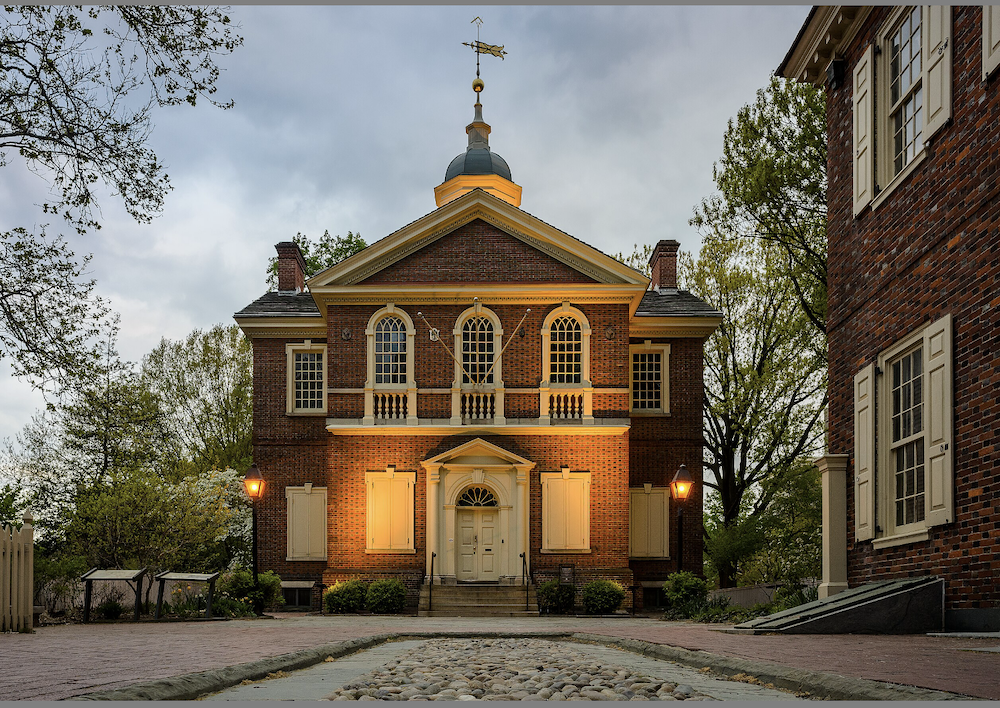
Top: Carpenter's Hall, Meeting place of the First Continental Congress of the US, part of current-day Independence National Historic Park in Philadelphia, By Pbjamesphoto - Own work, CC BY-SA 4.0, https://commons.wikimedia.org/w/index.php?curid=40075080
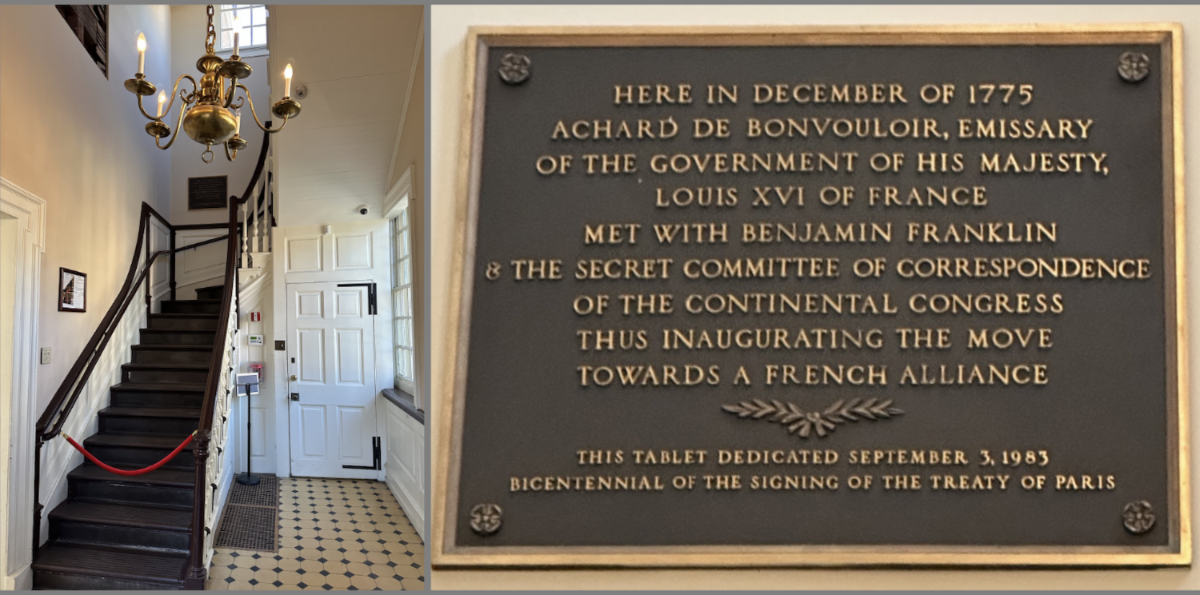
Bottom: Staircase with bronze plaque on top remembering Achard de Bonvouloir. The secret meetings with Benjamin Franklin and colleagues took place in 1775 inside the Library Company's quarters. Librarian Francis Daymon, a Frenchman, served as translator. Photos: TC © ASSFI 2026.
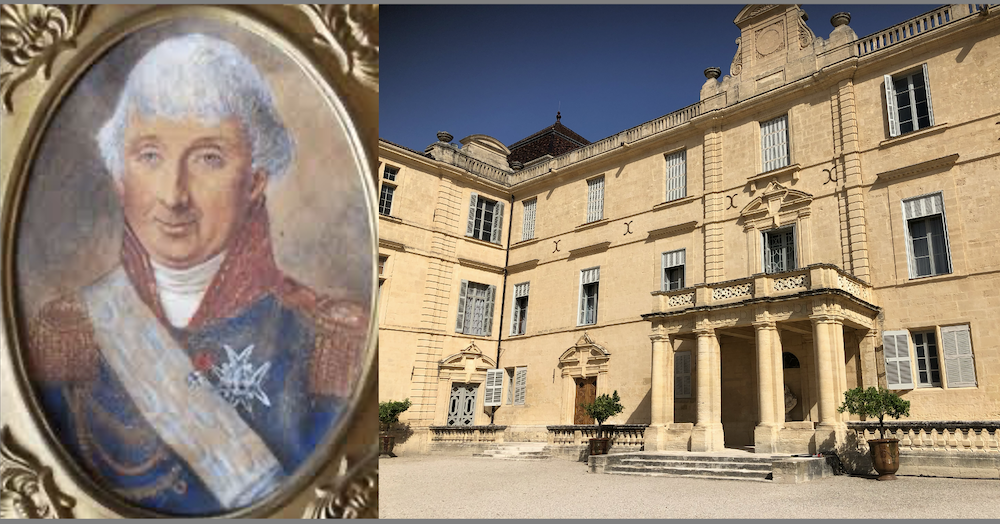
Unfortunately, we have no portrait of Julien Achard de Bonvouloir.
| | |
The Court of Versailles was "in the dark" and needed to assess firsthand the situation in America, the state of mind and the resolve of the Insurgents, before adopting a line of conduct. To do so, the Comte (later Duke) de Guînes, ambassador of France to the Court of St James in London, recommended to enlist the services of a volunteer, Julien Achar de Bonvouloir, who could travel to the Colonies disguised as a merchant.
• Julien Alexandre Achard, Chevalier de Bonvouloir (10 May 1749, in Passais-la-Conception – 1783), an officer in the Régiment du Cap stationed in the colony of Saint Domingue (today Haiti) became a secret French envoy to the American colonies, in 1775, who established the very first contact with the Insurgents, with the assent of King Louis XVI himself.
• Vergennes accepted, and wrote back on August 7, 1775:
"I have brought to the King's attention, Sir, your proposal to send Mr. de Bonvouloir back to America, whose knowledge and insights acquired in that country you seem to value [...] His Majesty has kindly agreed that Mr. de Sartines (Minister of War) should send him, at your request, a commission as Lieutenant in the service of this Regiment, which you will find enclosed. As for the annual salary of two hundred louis that you propose, the King is willing to authorize it […] The King strongly approves of your decision to send Mr. de Bonvouloir with sufficient caution so that, under no circumstances, his mission may compromise us." […] Please condense his instructions, which should be verbal only, to two points that seem to me to be the most essential: one, to give you a faithful account of events and the general mood; the other, to reassure the Americans against the fear that will undoubtedly be instilled in them about us. Canada is a point of contention for them. They must be made to understand that we have no designs on it whatsoever and that, far from envying the freedom and independence they are striving to secure, we admire the greatness and nobility of their efforts. We have no interest in harming them and would be delighted if circumstances would give them the freedom to frequent our ports; the facilities they would find there for their trade would soon prove to them the high esteem in which we hold them".
• The Chevalier de Bonvouloir departed for America on September 8, 1775, but bad weather caused delays, and he did not arrive in Philadelphia until late autumn. In December 1775, he conducted three secret meetings at Carpenters' Hall with Benjamin Franklin and the Committee of Secret Affairs from the Continental Congress: this marked the initial step towards the Franco-American alliance.
• Bonvouloir's report reached Vergennes at the end of February 1776, which helped him persuade Louis XVI to send arms to the rebels through the front company Roderigue Hortalez et compagnie, as we will see further below.
• De Bonvouloir wrote in his secret report:
"They asked me if France would assist them and at what cost. I replied that I believed France wished them well; that if it did help them, it could well be; on what terms, I did not know, but if it did happen, it would always be on fair and equitable terms; that, moreover, if they thought it appropriate, they should make their proposals, that I had good connections, that I would take it upon myself to present their requests without anything more...
I told them:
- You ask what France's intentions are with regard to the colonies in North America. I do not think I am going too far in saying that it “wishes you well, and that it has, I believe, had no other feelings toward you than goodwill.”
- France is well placed to provide you with two good engineers, or even more. All you need to do is ask.
- I do not know whether you will be given free entry and exit from French ports. That would be to declare openly in your favor, and war could ensue. Perhaps they will turn a blind eye, which is what you need. I have the honor of repeating, gentlemen, that I cannot guarantee anything. I am but a humble man; I have good connections, that is all."
• There is a plaque inside Carpenters Hall in Philadelphia recounting the secret meetings with de Bonvouloir, however the staircase is not accessible to the general public.
Bronze Plaque & information panel
Carpenters' Hall, site of First Continental Congress
320 Chestnut St, Philadelphia, PA 19106
GPS: 39.948119, -75.147269
• Inscription:
“Here in December of 1775
Achard De Bonvouloir, Emissary of the government of His Majesty,
Louis XVI of France
Met With Benjamin Franklin
& The Secret Committee Of Correspondence
Of the Continental Congress
Thus inaugurating the move
Towards a French Alliance"
-----------
"This Tablet dedicated September 3, 1983
Bicentennial of the signing of the Treaty of Paris”
• In the main hall, among many panels, visitors can read one that tells the story of Bonvouloir and acknowledges French assistance:
• Text of Panel (segment):
"Gaining French Support
Three Secret Meetings: December 18-28, 1775"
"The colonies needed help to win independence from Great Britain. France sent an agent, Julien Achard de Bonvouloir, to Philadelphia to gather information and communicate French sympathies. He knew Francis Daymon, Library Company librarian;
Daymon introduced him to Benjamin Franklin and John Jay. The four met under cover of night at Carpenters' Hall, as France did not want England to discover its involvement.
Bonvouloir reported back, and this— combined with other arguments— persuaded King Louis XVI to approve support. France began sending supplies, money, and other assistance. Ninety percent of the gunpowder Americans fired was French.
Second floor of Carpenters’ Hall: The secret meetings in 1775 took place in the Library Company's quarters. Librarian Francis Daymon, a Frenchman, served as translator."
• A leaflet handed out to visitors at the Carpenters' Hall tells the story accurately and succinctly:
“On three different nights in December of 1775 on the second floor of Carpenters' Hall, four men met in secret session, all having arrived by different routes, so as not to arouse suspicion about their movements. John Jay was one, Benjamin Franklin was another, Francis Daymon was the third and Julien Achard De Bonvouloir was the last. The purpose of the meetings was to inform Bonvouloir that the colonies were anxious to receive the support of French King Louis XVI in their
struggle for freedom from the British.
Bonvouloir was a French secret agent whose assignment was to present himself as a private citizen. His mission was regarded as being so sensitive and so dangerous that if apprehended, the French would deny his existence, since at that time they were nominally at peace
with Great Britain. His orders were to gather information, to assure the rebellious colonists of French support for their cause and to offer the use of French ports afterindependence had been achieved.
As a result of these secret night-time sessions, Silas Deane was sent to Paris to begin direct negotiations with government officials at the palace in Versailles for money, provisions and technical assistance. It was the initial contact with the French through Bonvouloir in Carpenters' Hall that established the channels through which the new nation obtained military aid. Through a clandestine network, crucial supplies were received almost immediately via friendly West Indian ports.”
• It is interesting to ponder how a relatively improbable chain of events could have such profound consequences. Consider: an offer of service from a relatively unknown individual to an ambassador, who suggests to his minister that they 'try' this option; a skeptical minister who nevertheless discusses it with the king; a king who agrees to have him deliver a bogus officer's title. Yet Bonvouloir managed to secure trustworthy relations with high-ranking members of Congress and establish a strong channel of communication between them and the French Court.
• Around the same time, an ordinary protocol dinner took place in a provincial garrison. Equally improbable elements converge: a young officer invited to the table, listening to a high-ranking English guest—none other than the King of England's own brother on his way to Italy—who suddenly embraces the Patriot cause, when it had been purely a domestic British affair between colonists and their King...
| | |
The dinner of Metz, 1775
Charles François de Broglie, Marquis of Ruffec
&
The idealism of the Marquis de Lafayette
| | |
Above:
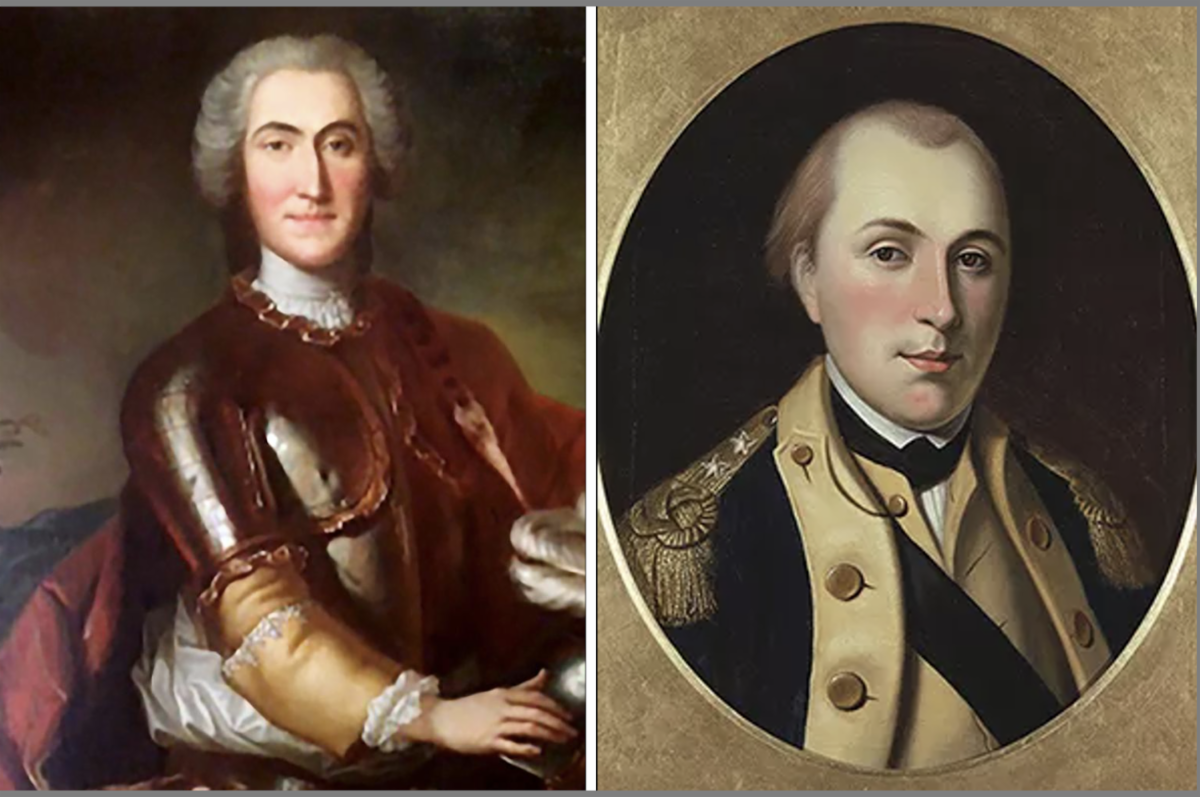
Left: Charles-François, comte de Broglie, marquis de Ruffec © DR
Right: Marie Joseph Paul Yves Roch Gilbert Motier, Marquis De Lafayette by Charles Willson Peale, 1779-1780. Second Bank of the United States Portrait Gallery. Courtesy, Independence National Historical Park.
| | |
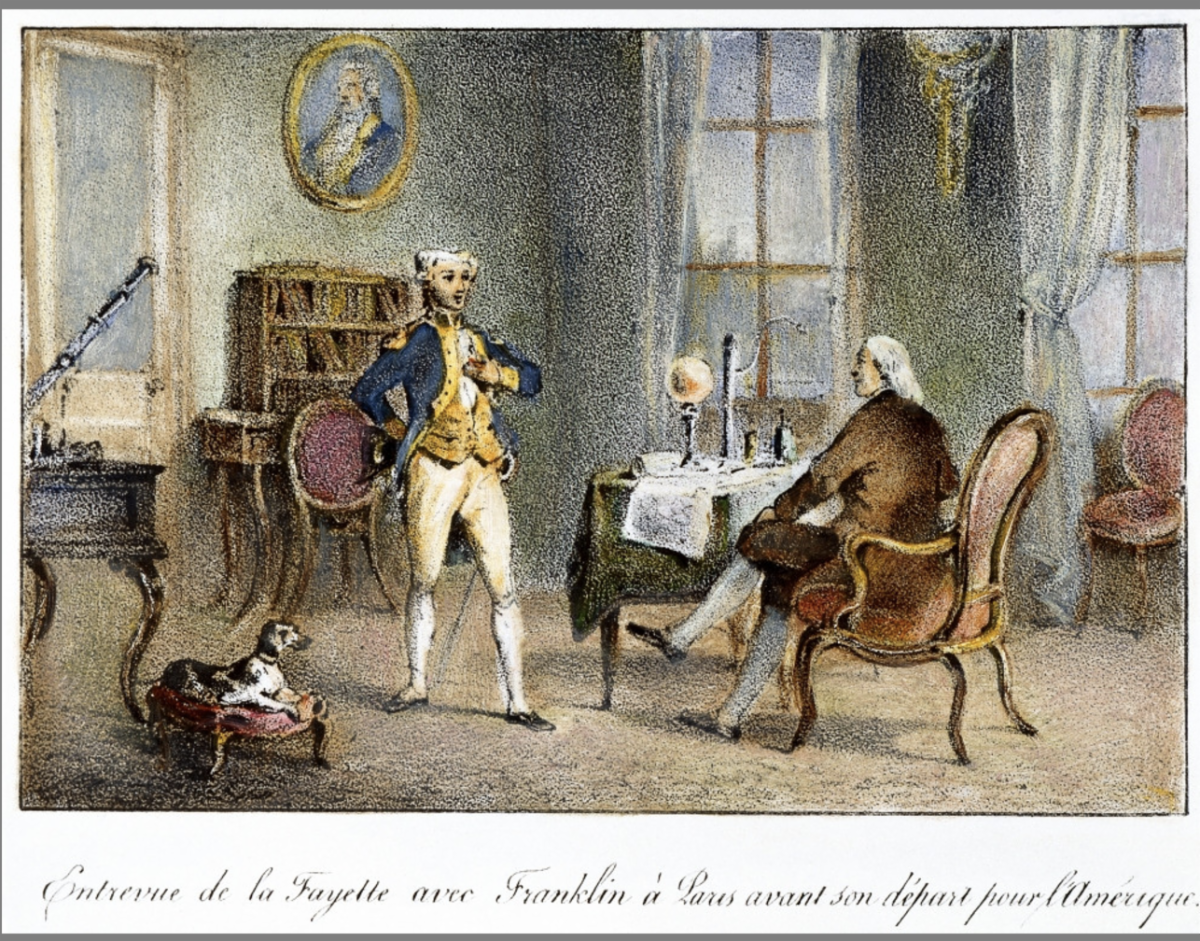
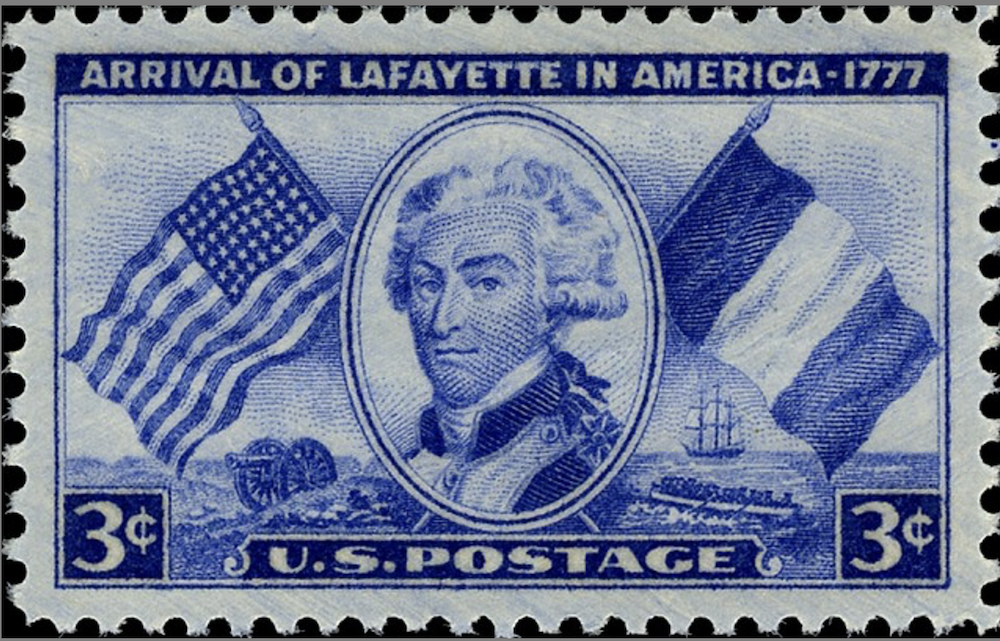
It is not the place here to introduce La Fayette to our readers*. Suffice it to state that he sparked considerable enthusiasm among the public, inspiring many young aristocrats, and single-handedly symbolized the sincerity of the feelings held by a large number of French people in support of the values pursued by the rebels.
• It is well known that Lafayette first learned about the American Revolutionary War at a dinner on August 8, 1775, while stationed at Metz. During this gathering, the Duke of Gloucester (King George III's younger brother) shared his candid views about the Americans and the Patriot cause. The Duke actually complained about the American colonists who had rebelled against British rule and mocked their revolutionary beliefs in equality and the right of people to govern themselves.
Lafayette's reaction was immediate and profound. As he later recalled, when he learned that Americans were fighting a revolution based on principles of liberty and equality, "my heart was enlisted".
• This famous dinner of August 8, 1775 in Metz to which Lafayette was a guest was held by a forgotten figure in this history. Charles François de Broglie, Marquis of Ruffec, (19 August 1719 – 16 August 1781) a soldier and diplomat from the House of Broglie, had served Louis XV and for many reasons was in semi-disgrace when he was named military commander of the region of the Trois-Evêchés in Lorraine. In February 1775, he had elaborated a plan to invade England and had submitted it to the King.
• He was the one to suggest to Vergennes using Baron Jean de Kalb as an early military emissary to the rebelling Colonies.
• At one point, he himself envisioned a destiny in the United States. This didn't happen for a variety of reasons, however, as we will see, he deserves to be remembered as a supporter of the American Revolution. Almost all of the early French officers who enlisted in the Continental Army were from his circle or had served with him, like de Kalb.
Note*: we refer our readers to our August 2024 Bulletin: "The legacy of Lafayette in America"
https://conta.cc/3X90SWQ (original version in English)
https://conta.cc/3YQTmRG (version en français)
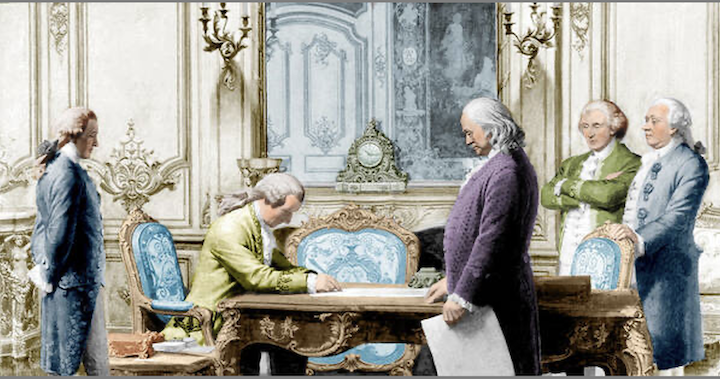
Following the early direct contacts established by Julien Achard de Bonvouloir, another concrete step towards the Alliance came with Silas Deane's mission to France and the thunderous Declaration of Independence of July 4, 1776.
| | |
The Declaration of Independence
July 4, 1776
| | |
Above:
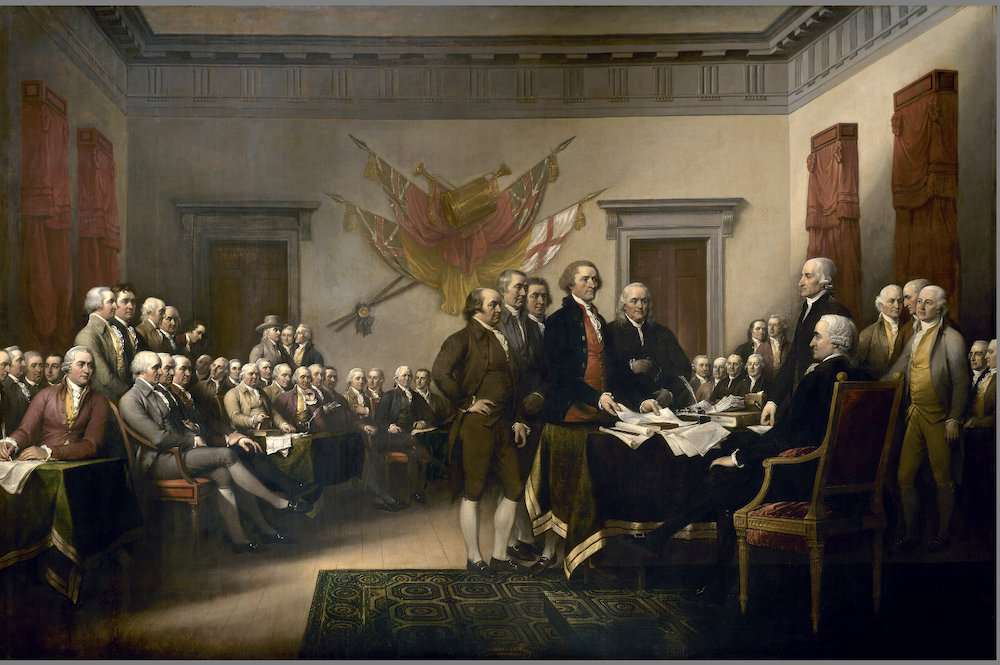
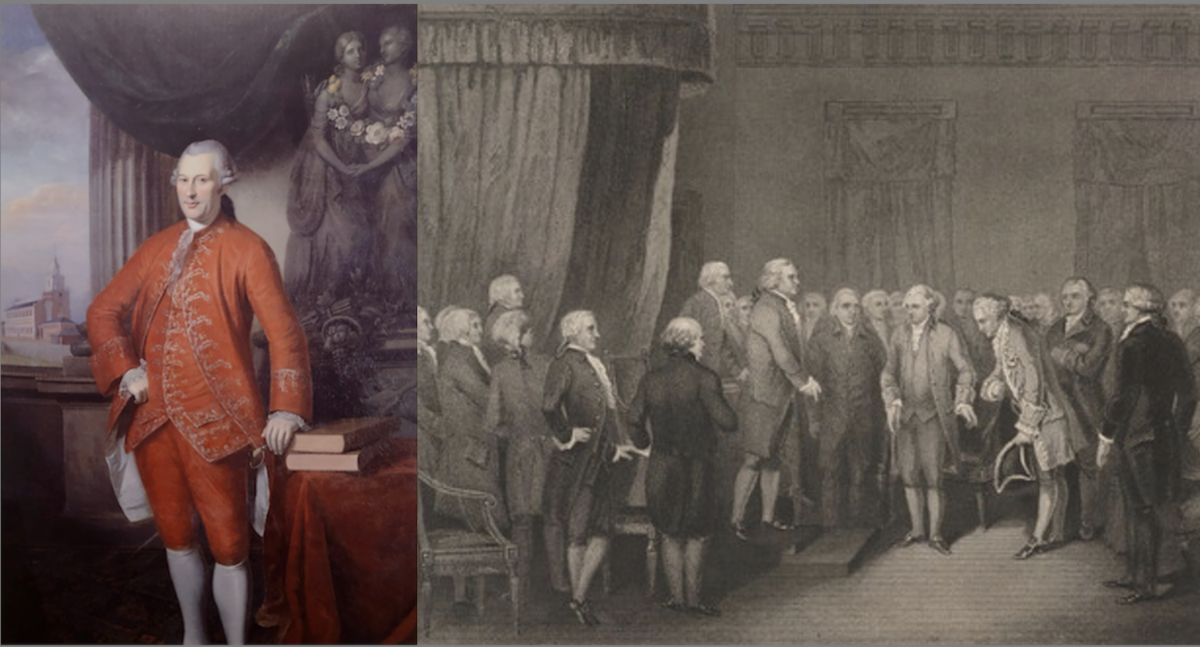
Declaration of Independence, by John Trumbull - US Capitol, Public Domain, https://commons.wikimedia.org/w/index.php?curid=180069
John Trumbull is depicting the five-man drafting committee of the Declaration of Independence presenting their work to the Congress. The painting can be found on the back of the U.S. $2 bill. The original hangs in the US Capitol rotunda. It does not represent a real ceremony; the characters portrayed were never in the same room at the same time.
| | |
Congress appointed Deane as a secret envoy to France on March 2, 1776. He arrived in Paris on July 6, 1776.
• On July 8, the Congress Committee sent the Declaration of Independence, instructing Silas Deane to inform the French government and other European governments (to make it known to this and the other powers of Europe). This letter never arrived, and a second one, dated August, containing a copy of the previous one, did not arrive until November 1776...
• British officials in North America sent copies of the Declaration to Great Britain. It was published in British newspapers beginning in mid-August. In response to the news communicated by the French ambassador in London, Vergennes wrote back on August 2nd:
“The English would undoubtedly want compensation for their losses, and it is only at our expense [...] that they could find it.”
Vergennes was piqued not to have received an official copy from Congress and complained about it in a correspondance dated October 5th to the French ambassador in London.
• Finally, Silas Deane was able to formally present it to Vergennes on November 27th, and informed Congress on the 28th: "I certainly prefer simplicity of style, as well as manners, but something is due to the dignity of old and powerful states, or if you please to their prejudices in favor of long established form and etiquette ; and as the United States of America, by this act, introduce themselves among the established powers, and rank with them, it must of course be expected that at the first introduction, or the announcing of it, some mode more formal, or if I may so say, more respectful, would have been made use of, than simply two or three lines from the committee of congress, in a letter something more apparently authentic, not that either your power or the reality of your letter could be doubted. I mention it as deserving consideration, whether in your application here and your powers and instructions of a public nature, it is not always proper to use a seal ?"
• Vergennes took note of it but demurred, saying, as Deane pursues his account: "[Vergennes said ] ...the United States can receive the same succors and assistance from France, without, as well as with, such an open acknowledgment, and perhaps much more advantageously.” To this and such like arguments I had the less to reply, as you informed me that articles for a proposed alliance with France were under consideration, and that I might soon expect them.” (Silas Deane report to Congress, November 28, 1776, in The Diplomatic correspondance of the American Revolution, compiled by Jared Sparks, 1829, page 68)
• Meanwhile, the Spanish authorities in the Western hemisphere banned the circulation of the Declaration, but it was widely transmitted and translated.
• Formalities aside, as soon as news of the Declaration of Independence crossed the English Channel, an "Extraordinary Council" of the French cabinet was held on August 31, as the news of the American Independence had reached Europe via London. In its minutes, we can clearly see that France had already decided to openly recognize the independence of the United States and if need be, go to war to make it effective:
"Read to the King in the Committee held on August 31, 1776:
Mr. de Maurepas, Mr. de Sartine, Mr. de St. Germain, Mr. de Glagny, Mr. de Vergennes reporting, "Considerations on the course of action France should take with regard to England in the current circumstances":
“Of all the evils that can afflict society, war is one of the most serious; but it is destructive when it takes a state by surprise, a state that has relied too much on its own good faith and that of its enemies, has neglected the precautions on which its security depended, and has spurned opportunities to render its habitual enemy powerless to harm it.”
"The connection that war would form between France and North America would not be one of those fleeting ties that arise and disappear with the needs of the moment. No interest could divide two peoples who communicate with each other only across vast expanses of sea, and the necessary trade relations that would be established between them would form a chain that would be, if not eternal, at least very long-lasting."
"Histoire de la participation de la France à l'établissement des États-Unis d'Amérique : correspondance diplomatique et documents" by Henri Doniol, 1886-1899. Vol.1, p. 567
While it was now virtually certain that France would openly recognize the independence of the United States and go to war to ensure the outcome, it was still necessary to rearm as fast as possible, secure the backing of Spain if at all possible, secure the benevolent neutrality of central European powers (in order to prevent Britain's usual strategy of fomenting continental coalitions against France), and, all at the same time, covertly provide all the material help necessary to the Insurgents.
Enter a certain Pierre Caron de Beaumarchais...
| | |
The activism of
Pierre Caron de Beaumarchais
and his front company
Roderigue Hortalez & Cie
Lifeline of the Continental Army
| | |
• Pierre-Augustin Caron de Beaumarchais (Paris, 24 January 1732 – Paris, 18 May 1799), was a French playwright, watchmaker, inventor, and activist, if the famous author of "The Barber of Seville" and "The Marriage of Figaro." His plays mocked aristocratic privilege and valued intelligence and merit over noble birth, inspiring operas by Rossini and Mozart and foreshadowing the revolutionary fervor that would engulf France.
• Beaumarchais had a significant yet often overlooked impact on the American Revolution, acting as a secret arms dealer and financier for the American side. Working closely with Vergennes, he created a fake trading company named Rodrigue Hortalez et Compagnie to covertly supply the Continental Army with French military resources, weapons, and money. His efforts started as early as 1776, before France officially joined the war as an ally in 1778: on May 2nd, 1776, Louis XVI authorizes the transfer of a million livres to the front company. The supplies he delivered—including muskets, gunpowder, and artillery—were vital for key American victories, such as the Battle of Saratoga in 1777, which played a crucial role in persuading France to formally back the Revolution. Despite taking on significant personal financial risks, Beaumarchais spent years after the war trying to reclaim debts owed to him by the American government, a debt that remained largely unpaid when he died in 1799.
• As America surged with patriotic enthusiasm and insurrection, Beaumarchais cultivated a fervor for freedom and the colonists' struggle. It is a notable irony that many individuals within the rigidly hierarchical, autocratic French society were equally captivated by the principles of the American revolution.
• Initially, Vergennes hesitated. He was aware that the king was not prepared to engage in actions that could be prematurely revealed. In the lead-up to and the early stages of the American Revolution, Beaumarchais operated as a French agent in London. He had established numerous clandestine connections. In late 1775, Beaumarchais drafted a letter (through Vergennes) to the king, suggesting a plan to supply covert arms to the Americans via the West Indies in exchange for tobacco and other American goods. After a brief hesitation, Louis XVI consented.
"PEACE OR WAR.
To the King alone.
Sire,
The famous quarrel between America and England, which will soon divide the world and change the system of Europe, requires each power to carefully examine how the outcome of this separation may affect it and serve or harm it.
But the most interested of all is certainly France, whose sugar islands have, since the last peace, the constant object of regret and hope for the English, desires and regrets that will inevitably lead us to war, unless, through a weakness that is impossible to imagine, we agree to sacrifice our rich possessions in the gulf to the chimera of a shameful peace that is more destructive than the war we fear.
In a first memorandum, submitted three months ago to Your Majesty by Mr. de Vergennes, I tried to establish firmly that Your Majesty's justice could not be offended by taking wise precautions against enemies who are never delicate about those they take against us.
Now that the moment of violent crisis is fast approaching, I am obliged to warn Your Majesty that the preservation of our possessions in America and the peace that you seem so eager to achieve depend solely on this one proposition: we must come to the aid of the Americans. This is what I shall demonstrate... Sire, in the name of God, deign to examine it with me [...] "
(Follow several pages of methodical plea to actively help the Insurgents)
• With the king's consent, Vergennes directed Caron de Beaumarchais to implement his plan and establish a front company known as Rodrigue Hortalez et Cie. This entity was primarily designed to safeguard France's involvement in supporting the American revolutionaries. Beaumarchais, an adept strategist, registered the firm in Spain, ensuring that no documentation could link it to the French government or any other public French institution. The identities of Beaumarchais's financial backers were kept confidential. He also collaborated with the only American representative in Paris, Silas Deane from Connecticut. Covert communications across the Atlantic, reaching London and Spain, initiated the proceedings. Deane would later be joined by Arthur Lee and Benjamin Franklin, leading to intrigues that are better reserved for another discussion.
• Beaumarchais' role in helping the American Revolution is often ignored or understimated. We refer our readers to the book published by the D.A.R. " Beaumarchais And The American Revolution" By Blanche Evans Hazard (1910).
• As Streeter Bass wrote: "It is perhaps not too much to say that Beaumarchais and Deane, by their own efforts, brought the infant United States through the most critical period of its birth" (Beaumarchais and the American Revolution, op. cit. p.12)
Legacy in the United States (besides his plays and operas)
• Like Vergennes, Pierre Caron de Beaumarchais has no statue, no marker, no plaque celebrating his decisive role in the birth of the United States.
• However, his name, as well as the name of his covert company Roderigue Hortalez & Cie. are mentioned in passing in a couple of interpretive markers, next to French guns used by the Continental Army and exhibited in the following locations:
| | |
• Upon the king's endorsement of the operation, Vergennes allocated in June an initial sum of one million livres (equivalent to several million dollars) to Beaumarchais for the procurement and transportation of arms and other military supplies to the Continental Army. Concurrently, Vergennes exerted much pressure on Spain, which matched this financial contribution two months later in August. As we will see further below, although Spain was discontented with British dominance, it hesitated due to concerns regarding American intentions in Louisiana, resulting in a slow response. However, the astute and tenacious Vergennes ultimately succeeded in motivating them to act.
• The front company thrived. In its inaugural year of operations, Rodrigue Hortalez et Cie successfully dispatched by September of 1777, clothing for 30,000 men, 4,000 tents, 30,000 muskets with bayonets, over 100 tons of gunpowder, 216 (mostly 4-pound) cannons and gun carriages, 27 mortars, almost 13,000 shells and 50,000+ round shot via New England merchants with shipping links to the Indies. These supplies were essential for sustaining the war effort, as America possessed minimal industrial capacity.
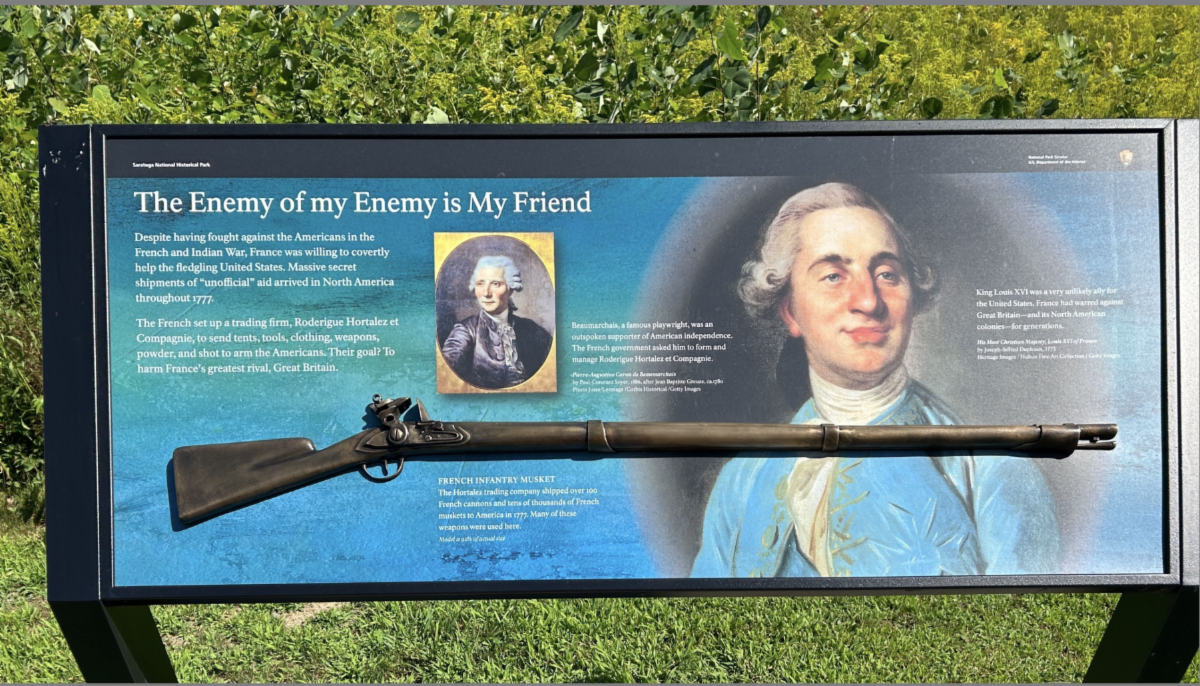
Marker, “The Enemy of My Enemy is My Friend”
Saratoga Battlefield Tour Road, Stop#3, Stillwater NY 12170
GPS: 42.980150, -73.628483
• Inscription:
“Despite having fought against the Americans in the French and Indian War, France was willing to covertly help the fledgling United States. Massive secret shipments of "unofficial" aid arrived in North America throughout 1777. The French set up a trading firm, Roderigue Hortalez et Compagnie, to send tents, tools, clothing, weapons, powder, and shot to arm the Americans. Their goal? To harm France's greatest rival, Great Britain."
Captions:
"Beaumarchais, a famous playwright, was a outspoken supporter of American independence. The French government asked him to form and manage The Roderigue Hortalez et Compagnie."
"French Infantry Musket: The Hortalez trading company shipped over 100 French cannons and tens of thousands of French muskets to America in 1777.
"King Louis XVI was a very unlikely ally for the United States. France had warred against Great Britain — and its North American colonies — for generations.”
Erected 2024 by Saratoga National Historical Park.”
Marker, “The Battle of Monmouth – 28 June 1778“
Monmouth Battlefield State Park, Visitors Center entrance, Manalapan, NJ 07726
GPS: 40.263617, -74.319850
• Inscription:
“In 1777, the Continental Army was in desperate need of more field artillery. When 31 Swedish-style 4-pounders arrived in New Hampshire in April, Commander-in-Chief George Washington directed that “they will be forwarded to Camp, as fast as circumstances permit.”
The French welcomed the war between their British enemies and the Americans. To support the rebellion, in 1776, the French royal arsenals released tons of surplus weapons. Their conduit to America was a fictitious trading company headed by the flamboyant playwright, Pierre-Augustin Caron de Beaumarchais. During 1777, Beaumarchais’ ships delivered 100, 4-pounders to Portsmouth, New Hampshire, and another 53 to Charleston, South Carolina. A few of these were heavy, old-fashioned (1732) guns. The rest were the lighter, more mobile, “Swedish-style” guns.”
Erected by the Battlefield Restoration and Archaeological Volunteer Organization"
The Header on the marker "The Enemy of my Enemy is my Friend", while true, is somewhat simplistic and incomplete. It is undeniable that the cause of the Insurgents had widespread popular support in France, based on idealism, and rooted in the philosophy of the Enlightenment personified by Beaumarchais.
The material help sent by France enabled the Continental Army to hold on during these crucial months. Beyond ammunition, clothing, and equipment, we now examine the human element that gave flesh and blood to an enduring Alliance.
| | The First French Volunteers | |
|
Above:
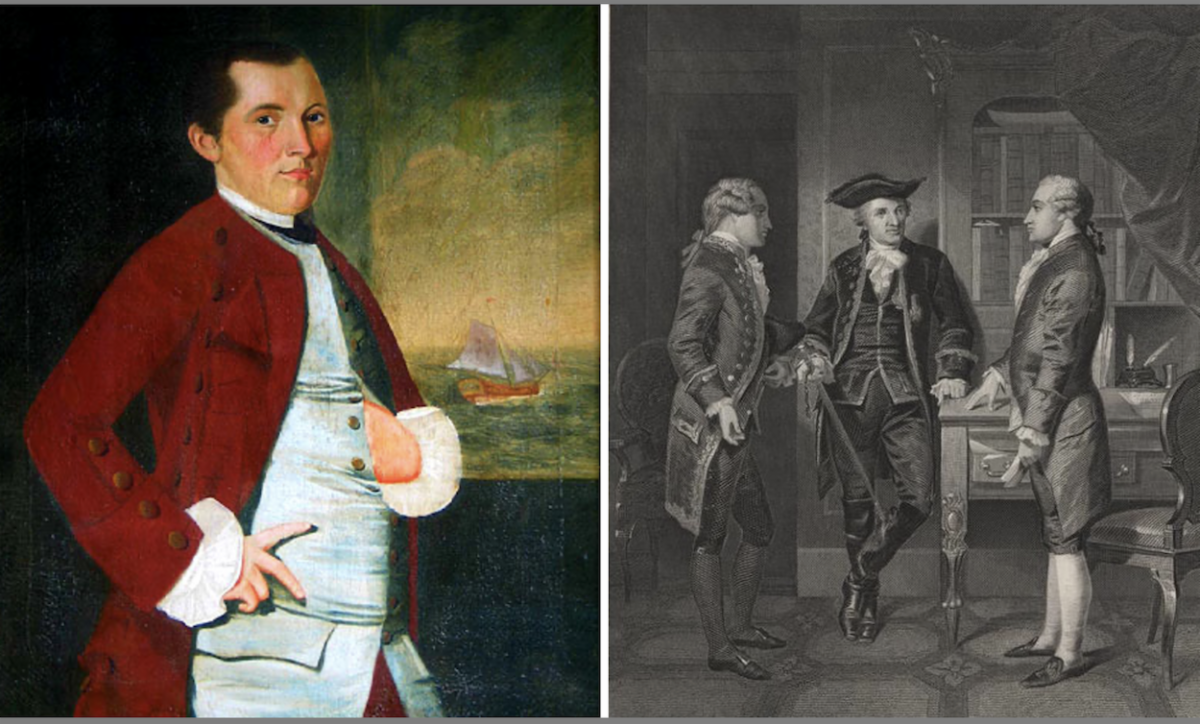
Left: Silas Deane in a 1766 painting by William Johnston, Public Domain, https://commons.wikimedia.org/w/index.php?curid=7314952
Right: 1879 Alonzo Chappel print of Lafayette being introduced by Baron Johann de Kalb to Silas Deane, Public Domain, https://commons.wikimedia.org/w/index.php?curid=34907276
| |
When the declaration of independence of the English colonies became known, it created the strongest impression possible, given the existing means of publicity a century ago. Seeing the power of Great Britain threatened to such an extent, at a time when it appeared unshakeable, people's minds were set ablaze. As in every conflict, up to our contemporary times, volunteers and mercenaries become part of history.
• We often read that their prime motivation was the desire to fight the British, to avenge the defeat of 1763. Put differently, France and French volunteers were not fighting for America, but against the British. This belabors the point, as rivalry between France and England had been going on for centuries. It ignores the influence of Enlightenment philosophers, who exerted a profound influence on many strata of French society, starting with young aristocrats. Lafayette was not the only one to become inflamed at the words Liberty, Democracy, Rights of Man! Besides, it ignores the fact that Anglomania was prevalent in France at that time (and still is today, in many ways).
In sum, while enlisted officers and soldiers sent to America were simply obeying their King's orders (and may have privately objected to helping rebels against a king), and while many volunteers were attracted by the prospect of glory or fortune, or sought to evade career or family issues, it would be incorrect to deny the sincerity of their motivation to fight for America and the Patriot cause.
"I die the death I always prayed for: the death of a soldier fighting for the rights of man.” What can be more sincerely moving than these parting words of Baron de Kalb on his deathbed, after receiving mortal wounds at the battle of Camden?
• The Comte de Broglie was instrumental in recommending many officers to American envoy Silas Deane, who arrived in France shortly after July 1776. Deane's mission was to procure weapons and military supplies from the French. In addition, he also liberally distributed engagement contracts to many officers, promising high ranks in the Continental Army, without due authority, which created confusion and considerable headaches for George Washington.
• The initial French volunteers came in 1775 and 1776, with many hailing from the French West Indies. Many of these first arrivals were later characterized by the skilled Chevalier Dubuysson des Hayes, who served as an aide-de-camp to Lafayette, as "officers burdened with debt and released from their European units." He claimed that the governors of the Caribbean islands were disposing of them by dispatching them to America with flattering letters of recommendation... Indeed, several among them were soldiers of fortune, or downright imposters, and provoked initial distrust.
There were bad apples, surely, but some very attaching characters as well.
• One of them, Artillery Captain Louis d'Ohicky Arundel, of Irish ancestry, breveted from the Artillery Royal School in Strasbourg, left his regiment in Saint Domingue and enlisted as a volunteer. He is believed to be the very first French casualty of the Revolutionary War, when he died (in a freak accident of his own doing, after successfully directing fire against a British frigate) during the action of Gwynn Island, Virginia, on July 9, 1776.
• Along with the S.A.R. of Virginia, we plan to honor him with a bronze plaque on site on July 9, 2026.
• Certain P.O.W.'s who volunteered early were officially not recognized by the French government. For instance,
“Mr. de Kermoran left France in April 1776 to serve as a volunteer; Mr. de Bois-Bertrand, with a rank, left in July. They were the first Frenchmen whose names were added to the list of American defenders. They were taken prisoner and mistreated by the English, and the government was forced to refuse to protect them.” (H. Doniol, op. cit. Vol.1 p. 665).
• They are totally forgotten today, but we plan to honor them appropriately in the future.
• Not all of them were French, but they all either served in various capacities in the French Army, or transited through France and embarked from a French port, with the proper authorization of the French authorities. We can cite Tadeusz Kościuszko or Casimir Pulaski, "the father of American Cavalry", both from Poland, or Friedrich Wilhelm von Steuben from Prussia who trained Continental Army soldiers.
Also mentioned above, Jean de Kalb, Baron de Kalb, born Johann von Robais (June 19, 1721 – August 19, 1780) who was born in Hüttendorf in the Principality of Bayreuth and died in Camden, SC, was a Franconian-born officer who volunteered in the Continental Army. We mention him here for several reasons:
• He had been employed in the secret diplomacy service on the recommendation of the Duke of Choiseul, he was sent to America in 1768 on a cover mission.
• In 1777 he and Lafayette met with Silas Deane, and crossed the Atlantic together on board La Victoire to join the Continental Army. Thanks to the influence of La Fayette, he became major-general on September 5, 1777. During the Battle of Camden on August 16, 1780, his horse was killed under him. He fell to the ground, was bayoneted several times. His friend and aide-de-camp, Chevalier Charles-François du Buysson, blocked with his body the additional blows. However, de Kalb, a prisoner of British General Charles Cornwallis, succumbed to his wounds a few days later.
Legacy in the United States:
deKalb is remembered in many sites in the United States. We will devote a future Bulletin on him.
| |
Above:
Marquis De Lafayette And Benjamin Franklin Meeting For The First Time At Paris In February 1777. Lithograph, French, 19th Century.
https://www.art.com/products/p55413812130-sa-i8119279/franklin-and-lafayette-1777.htm
| |
We will present several of these officers in greater detail in a future Bulletin.
In these early days, the French made a particularly significant contribution to the Patriot cause in military engineering. In July 1777, influential Congressman James Lovell wrote to Washington, noting that French engineers were highly regarded: "The corps of Engineers is very honorable in France; and officers from it are sought by different European Powers."
We refer our readers to a Bulletin in February 2023: "George Washington’s French engineers" which presents several of these volunteers:
https://conta.cc/3XBjqMp (original version in English)
https://conta.cc/412e0Nr (version en français)
• Several were volunteers in the Continental Army (such as the famously intrepid François de Fleury, the father of the U.S. Army Corps of Engineers; Philippe Charles Tronson du Coudray; Jean de Villefranche; Louis de Cambray-Digny, and Etienne Béchet, Sieur de Rochefontaine).
Another engineer recruited by Augustin Caron de Beaumarchais, was none other than Major Pierre Charles L'Enfant, who, like Rochefontaine, stayed at George Washington's service after the Revolutionary War, and who designed Washington D.C.
We refer our readers to our April 2022 Bulletin: "Tribute to Major Pierre Charles L’Enfant"
https://conta.cc/3uR5rqO (original version in English)
https://conta.cc/3JPeFIg (version en français)
• Some were recruited with contracts: The French government secretly helped the rebels by lending them four skilled French army engineers. As Royal French engineers, all attended the Royal School in Mézières. This covert deal was arranged by Franklin and Deane with the French war minister and was signed in Paris on February 13, 1777: Antoine LeBègue de Presle Duportail, who proved to be extremely capable, and worked very closely with George Washington as Brigadier General of the Continental Army. His statue is placed on the pedestal of the Lafayette statue across from the White House in Washington; Jean-Baptiste Gouvion; Louis de la Radière, (who has a bronze plaque at the Military Academy of West Point) and Lt. Col. Jean-Baptiste de Laumoy. They were the only foreigners recruited at the express direction of Congress.
| |
Above:
Top: French postal stamp of 1938 depicting « La Victoire », a ship from Bordeaux with a crew from Bordeaux. The drawing is by H. Cheffer, who indicates after his name “DEL.”, the Latin abbreviation for Delineavit, meaning “he drew.” The text at the bottom reads: LA FAYETTE departs aboard/from “LA VICTOIRE” on March 26, 1777.
https://blog-philatelie.blogspot.com/2010/09/photographie-du-timbre-lafayette-de-l.html
Bottom: 175th Anniversary of Lafayette's arrival in America (A portrait of Lafayette, flags, a cannon, and a ship) First Day of Issue: June 13, 1952, in Georgetown, SC.
https://postalmuseum.si.edu/object/npm_1980.2493.5031
| |
On December 7, La Fayette officially joins the fight for the American insurgents' cause and signs an agreement in Paris with Silas Deane, who promised the young Frenchman the rank of major-general in Washington's army.
Along with Baron de Kalb, he is joined by 13 officers on board of his ship La Victoire.
• In the recently published book (announced in our December 2025 Bulletin)
George Washington's Dilemma, co-authored by Prof. Norman Desmarais and Arthur S. Lefkowitz, the story of 200 of these early French volunteers is told in great detail.
• Much remains to be done to properly honor these early volunteers. With the exception of the Chevalier de Faylols, there are few monuments or plaques on either side of the Atlantic honoring those who joined the Patriot cause.
Let us name them here. Their high idealism is beyond question.
In addition to Lafayette and Baron de Kalb, there were twelve volunteers and three civilians who sailed on board the Victoire in 1777:
-
François-Augustin Du Boismartin - 32 years old, from Barbezieux
-
Louis-Ange de La Colombe* - 22 years old, from Le Puy-en-Velay
-
Charles Bedoulx (Bedaulx) - 25 years old, from Neuchâtel, Switzerland
-
Philippe-Louis Candon - 26 years old, from Versailles
-
Jacques Franval - 26 years old, from La Réole
-
Louis Gimat - 22 years old, from Agen
-
Louis De Vregny - 36 years old, from Strasbourg
-
Jean-Pierre Rousseau de Fayols** - 27 years old, from Notre-Dame, near Ruffec
-
Guillaume de Lessere - 25 years old, from Angoulême
-
Charles Antoine de Valfort - 27 years old, from Thionville
-
Jean Capitaine Ruffec du Chesnoy - 18 years old, from Ruffec
-
Chevalier Dubuisson - 25 years old, from Moulin en Bouvarais
-
Jean Lepa - 18 years old, from Ceran near Rouen
-
Vicomte de Mauroy - came from Bordeaux with Lafayette (native of Burgundy)
-
Léonard Price - 22 years old, from Sauveterre (an American named in reality Edmund Brice, an art student returning home and later becoming one of Lafayette's aide-de-camps. He signed the embarkation documents as originating from Sauveterre)
Note*: he was a childhood friend of Lafayette, from Chavagnac in Auvergne, and served as his aide-de-camp until the French Revolution. Inexplicably, we have no trace of him after his return in 1792 in Philadelphia.
Note**: We paid tribute to the Chevalier de Fayols (also spelled Fayolle) in our March 2021 Bulletin: honoring two French Navy officers from Rochambeau’s army buried in Newport, RI.
https://conta.cc/3vgTuZy (original version in English)
https://conta.cc/3bC7aGJ (version en français)
“They were all under Dekalb's orders, the baron himself said; he afterward called them Broglie's "caravan," and felt answerable to Broglie for their welfare.* Apparently more than half of the officers on the "Victoire" when finally she sailed from Los Pasajes frankly considered themselves Broglie's appointees. The others were Lafayette, Delesser, Valfort, Franval, Gimat, La Colombe, and Brice.”
From “Lafayette Comes to America” by Louis Gottschalk, U. of Chicago, 1935 p. 163
France's involvement in the war halted the stream of French volunteer officers to America, marking the end of a distinctive period in the narrative of the American Revolution.
| Congress seeks official French assistance | | |
• On September 26, 1776, Congress appoints Silas Deane (who, as we have seen was already in France, only now he is officially and openly appointed), Benjamin Franklin, and Arthur Lee as commissioners to the French court.
• Benjamin Franklin leaves Philadelphia for France on October 26 and arrives on December 4 at the small Breton port of Saint-Goustan in Auray. He reaches Paris on December 21, 1776, and the next day, Arthur Lee joins Silas Deane and Benjamin Franklin in Paris.
• Their mission is to raise funds for the American Revolution, acquire weapons and supplies, and negotiate a trade and alliance treaty with France.
"As the Scarcity of Arms, Artillery and other military Stores is so considerable in the United States, you will solicit the Court of France for on immediate Supply of twenty or thirty thousand Muskets and Bayonets, and a large Supply of Ammunition and brass Field Pieces, to be sent under Convoy by France. The United States will engage for the Payment of the Arms, Artillery and Ammunition, and to indemnify France for the Expense of the Convoy"... "Engage a few good Engineers in the Service of the United States."
• Benjamin Franklin, then 70 years old, made his presence known in the Parisian salons. He was quickly and warmly welcomed by the intellectual and noble elite. At that time, Franklin was primarily recognized as an accomplished scientist, notably for his invention of the lightning rod. Benjamin Franklin was known for his cheerful and amiable demeanor, which facilitated his integration into French society. He spoke French, albeit slowly and with a strong accent. Furthermore, for the French, he embodied the values championed throughout the 18th century by the Enlightenment. Louis XVI adopted a wary stance towards Franklin and was considerably less enthusiastic about his arrival than his subjects. For instance, the King did not meet the American ambassador upon his arrival in France and waited until March 20, 1778 to receive him at his Court.
• Arthur Lee, an American diplomat, had previously undertaken similar missions in Spain and Prussia, but he had failed, (the Spanish Court refused to meet him), and no reinforcements had arrived from those two countries at that time. Benjamin Franklin, on the other hand, was familiar with France, having visited it during two brief stays in 1767 and 1769. For this ambassadorial mission, Franklin traveled with two of his grandsons. In total, Franklin's journey lasted nearly nine years, as he departed for France in October 1776 and he did not return to the United States until July 1785.
• The 2024 TV miniseries Franklin based on A Great Improvisation: Franklin, France, and the Birth of America by Pulitzer Prize-winning author Stacy Schiff, admirably portrays all the players and the intrigues of that period.
Benjamin Franklin continues to this day to be a much beloved figure in France:
| | |
The popularity of Benjamin Franklin
"Franklinmania"
| | |
Above:
Benjamin Franklin's reception at the Court of France in 1778 By Anton Hohenstein, ca. 1860 - Musée franco-américain (Blérancourt), Public Domain, https://commons.wikimedia.org/w/index.php?curid=5863964
Benjamin Franklin is considered to be America’s first diplomat. He represented the United States in France from 1776 to 1778 before presenting his credentials to the French court in 1779, becoming the first American Minister (or Ambassador) received by a foreign government
| | |
The arrival of Franklin and Lee intensified the diplomatic climate, as Franklin, encircled by British agents, executed a brilliant strategy to charm both the French populace and its ruling elite. However, the covert assistance from France had already been initiated by Deane and Beaumarchais. When France openly went to war, Beaumarchais' company, while continuing some of its operation, receded into relative obscurity, while Deane faced recall to America due to unproven allegations of corruption.
Benjamin Franklin was extremely popular in Paris during his stay there from 1776 to 1785 as the American ambassador seeking French support for the Revolutionary War. His popularity was due to several reasons:
• His scientific fame - Franklin was already well-known throughout Europe for his electrical experiments and inventions. The French intellectual elite viewed him as a symbol of Enlightenment ideals: reason, progress, and the practical use of knowledge.
• His crafted image - Franklin skillfully emphasized his "simple American" persona, donning a fur cap and plain clothing instead of the powdered wigs and elaborate attire of French courtiers. This made him appear as a virtuous man of nature and republican simplicity, which intrigued Parisians who were becoming more critical of aristocratic extravagance.
• His charm and humor - Franklin was genuinely charismatic, spoke fairly good French with a charming American accent, and became a regular in the salons of Paris.
• He was adored by influential French women of high society, especially Madame Brillon and Madame Helvétius, with whom he exchanged flirtatious letters...
His likeness was everywhere - on snuffboxes, medallions, rings, prints, and even chamber pots! One observer remarked that you "could find Franklin's face on almost every mantelpiece in Paris".
He was surrounded by crowds eager to see him, and ladies of the court vied for his attention at social events.
When he successfully negotiated the important French alliance in 1778, he became even more of a hero, regarded as the wise philosopher who had united enlightened monarchy and republican virtue.
Just as Lafayette is still very rightly revered in the United States, the positive public perception of Benjamin Franklin, also known as "Le Bonhomme Franklin", as a righteous, virtuous, simple-mannered man very much remains the common perception in contemporary France.
| | |
Other forgotten figures
Le Ray de Chaumont
| | |
Above:
Top Left: Portrait of Jacques-Donatien Le Ray de Chaumont (1726-1803) by Louis François Mariage / Jean Baptiste Claude Robin — Musée de Bretagne, Public Domain, https://commons.wikimedia.org/w/index.php?curid=85503703
Top Right: Memorial in Chaumont, N.Y., photo by Cosmos Mariner, July 8, 2010, https://www.hmdb.org/m.asp?m=127899
Bottom: Benjamin Franklin’s residence in Passy, Paris, the Hôtel de Valentinois , a property of Leray de Chaumont (Courtesy of the National Gallery of Art, Washington, D.C.)
| | |
While in Paris, Benjamin Franklin resided at the Hôtel de Valentinois, situated in Passy, then a suburb, now part of the chic 16th arrondissement. This estate was the property of a financier, who has been at times named a "Father of the American Revolution", yet today very much forgotten.
• Jacques-Donatien Le Ray de Chaumont (born in Nantes, 1 September 1726 – died in Chaumont-sur-Loire, 22 February 1803) was a financier, shipbroker and trader, and one of the wealthiest aristocrat in France.
• For an aristocrat of that time, Le Ray's contributions to ordinary Americans were remarkable. He fundamentally believed in the equality of all men and demonstrated this by donating large sums of his own money to buy weapons, supplies, and clothing for the nascent American military.
• He befriended Benjamin Franklin, who stayed nine years for free at his fully-staffed Passy estate (which was at the time at the outskirts of Paris along the road to Versailles, and now part of the 16th arrondissement). His estate, called Hôtel de Valentinois, became in effect the first American Embassy.
• He financed the purchase weapons, supplies and clothing for the fledgling American Insurgents. Alongside Benjamin Franklin, Le Ray de Chaumont collaborated with John Adams, Silas Deane and the Comte de Vergennes to aid the American Revolution.
• The American government requested Le Ray to oversee the equipment and management of the joint French and American naval fleet. In close cooperation with Admiral Charles-Hector d'Estaing, the Commander of the French Fleet, Le Ray's support for the American cause included converting a merchant ship named Duras into a warship, which he then donated to America, naming it USS Bonhomme Richard for Captain John Paul Jones's use.
• He was named a “Father of the American Revolution”, although he is rarely mentioned in history manuals. He spent most of his fortune to help the fledgling United States.
• Loyal to the King, he opposed the radical turn of French Revolution after 1792. His castle at Chaumont-sur-Loire and wealth were confiscated by the revolutionaries.
• The village of Chaumont, NY, is named after him. His son of the same name, known in America as James Le Ray, eventually became a United States citizen and founded the village of Le Ray, New York, distant 22 miles.
Marker, “Le Ray de Chaumont”, Father of the American Revolution
12061 NY-12E, Chaumont, NY 13622
GPS: 44.066950, -76.129667
• Inscription:
“At the behest of Benjamin Franklin at the French Court, Count Jacque LeRay de Chaumont loaned large sums of money to the revolutionary cause. This included three fully equipped warships for Commodore John Paul Jones’ Fleet.
Between 1797 and 1817 the Count’s son, James, purchased tracts of land and most of what is now Jefferson County.
In 1802 a plot of land was surveyed and named Chaumont in honor of our benefactors French estates. In 1874 Chaumont was incorporated into a village.”
Erected Memorial Day 1998"
Jacques Barbeu du Bourg
Friend of Benjamin Franklin and
An early activist of the Patriot cause
| | |
Above:
Left: Portrait of Jacques Barbeu du Bourg 1709-1799, Public Domain, https://commons.wikimedia.org/w/index.php?curid=304729.
Right: Manufacture royale d'armes de Saint Etienne, Par Th. Ogier Musée de Saint-Étienne, Domaine public, https://commons.wikimedia.org/w/index.php?curid=97798662
| |
Another character deserves to be mentioned. Actually, before Beaumarchais took a central role in organizing the flow of covert aid from France to the United States, Jacques Barbeu-Dubourg was actively trying to find ways to help the Insurgents.
• Jacques Barbeu-Dubourg (February 12, 1709 – December 14, 1779) was a French doctor, botanist, author, translator, and publisher, and as such he is very much an "Encyclopedist", advocating the rights of man.
• He met Benjamin Franklin during the latter's first visit in Paris in 1769 and the two corresponded very frequently. He is recognized for translating the works of Benjamin Franklin into French and for creating an umbrella equipped with a lightning rod, which was a commercial failure.
A sincere admirer of Benjamin Franklin, he was excited about the political ideas of young America.
• Starting in May 1776, he actively supports the cause of the Insurgents. Before arriving in France, Benjamin Franklin reached out to him and made him think he would be the primary "Point of Contact," as we might say today, to obtain all the military supplies needed by the Insurgents. Franklin had directed Silas Deane to meet him first.
• The French government initially designated Barbeu-Dubourg as a secret intermediary to provide assistance to the Americans.
• In 1777, he establishes another company. He got in business with banker Grand to equip 1,300 soldiers. He approached J. J. Carrier de Montieu, a former owner of the Saint-Étienne Arms Factory, but Montieu allied with Beaumarchais instead.
He soon competed with Pierre-Augustin Caron de Beaumarchais, but the French government gave Beaumarchais the priority for secret supplies to the rebel colonists.
• As a zealous agent for the American side, he persuades during this time the following to volunteer for the Patriot cause:
-
Philippe Charles Jean Baptiste Tronson du Coudray;
-
Gilles Jean Marie Barazer de Kermorvan;
-
René Etienne Henry Gayault de Boisbertrand (with Pierre Penet) to join the American army and transport arms shipments for the American Congress.
The American militias were short of engineers. It was again Barbeu du Bourg who helped providing some of them.
• Eventually, he was quickly found to be unfit for the role and was succeeded by Beaumarchais. His political acumen was no match for the latter, and his lack of sensitivity in keeping his activities secret embarrassed Vergennes who needed to keep France's help covert during this early phase of the American Revolution.
• As an American specialist of covert actions wrote: "He was too old, he lacked business acumen, and – more serious in a venture of this nature – he was insecure and garrulous."
Streeter Bass, https://www.cia.gov/resources/csi/static/Beaumarchais-and-American-Revolution.pdf
He is not mentioned in any marker or plaque (to our knowledge) in the United States. Still, for his sincerity and passion for the Patriot cause, his personal attachment to Benjamin Franklin, not to mention his considerable scientific work, he deserves to be remembered and praised.
| | |
We cannot evoke Barbeu Dubourg without presenting Jean-Baptiste Vaquette de Gribeauval, who made available many guns to the Insurgents.He recommended Tronson du Coudray, then considered a very competent artillery expert, to be the director of the Continental Army's artillery. He deployed considerable energy to assemble and select old and new armaments from warehouses to the ports and deserves to be recognized.
"...We would not lack officers to serve this artillery; Mr. de Gribauval (sic), already authorized to grant them ad hoc leave, would make the selection himself. [...]"
Letter from Barbeu Dubourg to Vergennes, June 19, 1776
• Jean-Baptiste Vaquette de Gribeauval (September 15, 1715, in Amiens - May 9, 1789, in Paris) was a military engineer who reformed the French field artillery. He joined the royal artillery in 1732. Promoted to officer in 1735, he balanced his military duties with scientific studies.
• In 1764, he was appointed inspector of artillery and promoted to lieutenant general. Starting in 1765, he took part in modernizing the corps of mines and artillery. He tested lightweight field pieces in Strasbourg and proved they could replace the heavy pieces from the old 1732 ordinance of General de Vallière.
He developed the first complete system of French artillery, divided into field, siege, garrison, and coastal artillery. Gribeauval was named the first inspector of artillery in 1776 by the Secretary of State for War, Count de Saint-Germain.
• The lightweight field pieces of the Gribeauval system would give French artillery a significant advantage over that of other European nations until after the Napoleonic Wars (Napoléon himself started as an artillery officer).
• This reform also applied to rifles. A new rifle model was designed. Gribeauval focused on streamlining artillery to make it more mobile on the battlefield and easier to repair through interchangeable parts.
• The primary French mortar used during the American Revolutionary War was the Mortier de 12 pouces Gribeauval, also known as the 12-inch (French inches) mortar. This heavy siege weapon fired shells weighing nearly 200 pounds and was part of General Rochambeau's expeditionary force, playing a key role in the victory at the Siege of Yorktown in 1781. Still, earlier mortars were used, as evidenced at this site.
Legacy in the United States:
Although no marker or plaque mentions him by name, many guns donated to the Continental Army are on display in several museums:
-
Jean Lafitte National Historical Park (Chalmette Battlefield): This site in New Orleans, Louisiana, features two original bronze Gribeauval cannons in its outdoor batteries
-
Fort Ticonderoga: The museum collection includes a rare 12-pounder garrison gun of the Gribeauval pattern. Cast in 1780 during the American Revolution, it is one of the largest fortress cannons designed under Gribeauval's reforms.
-
National Museum of the United States Army: As part of the special exhibition "CALL TO Arms: The Soldier and the Revolutionary War" (open through 2027), the museum at Fort Belvoir, Virginia, displays original artillery pieces from France and the American colonies. It currently hosts a rare bronze cannon that is part of a pair owned by the Society of the Cincinnati.
- Springfield Armory National Historic Site: The armory in Massachusetts historically preserves a variety of Revolutionary War-era weapons and has previously loaned pieces, such as a 1758 French 4-pounder, to other curated exhibitions.
-
Yorktown Battlefield: Part of the Colonial National Historical Park, the Yorktown collection includes restored French cannons captured or used during the 1781 siege.
| | |
Victory of Saratoga
October 17, 1777
Proving American Resilience
Convincing the French to overtly aid
| | |
Above:
Sarratoga [sic] (The Surrender of General Burgoyne to General Horatio Gates, Battle of Saratoga, October 17, 1777), by François Godefroy, Engraver (French, 1743?–1819), after Louis François Sébastien Fauvel, Artist (French, 1753–1838), The Metropolitan Museum of Art,
https://www.metmuseum.org/art/collection/search/388688
| | |
• The Battles of Saratoga in September 19 and October 7, 1777 ended up in an American military victory that directly convinced King Louis XVI of France to officially join the American Revolutionary War. American soldiers achieved this victory, with 90 percent of the gunpowder utilized provided and financed by France. They used in the French model muskets from 1763-66, which had become the standard for the Continental Army. Thank you, Pierre Caron de Beaumarchais!
• News of British general Burgoyne's surrender on October 17, 1777 arrived in Paris on the evening of December 4, 1777. The impact of the news from Saratoga on public opinion was significant and the French Court was now under pressure to support openly the Patriot cause. The American commissioners compared the public satisfaction they observed to that which would greet "a victory won by French troops over France's enemies."
"The stir that the news from America creates in all the idle minds of this country is unimaginable," Beaumarchais writes to M. de Vergennes on December 7; "the English in cafes and theaters no longer know where to hide."
• Thus, on December 17, 1777, the King and Vergennes pledged to acknowledge the independence of the Thirteen Colonies, regardless of Spain decision to join, or not. This American victory provided the evidence Louis XVI needed to overcome his doubts about the American cause and form a formal alliance. His Navy and Army having been considerably rearmed at a very rapid pace, he could openly provide crucial military and sustained financial support, which proved decisive to secure American independence.
Marker, “Saratoga Surrender Site” (marked in bold by us)
Saratoga Surrender Site, Schuylerville NY 12871
GPS: 43.086750, -73.584383
• Inscription (excerpts):
“... At Saratoga, the British campaign that was supposed to crush America's rebellion ended instead in a surrender that changed the history of the world [...]
Word of Burgoyne's surrender travelled fast. King Louis XVI of France was then fully committed to recognize United States independence and became a formal ally of the new nation. This alliance triggered a worldwide war between Britain and France in 1778; French-allied Spain declared war against Britain in 1779. The British declared war on the Netherlands in 1780 for supporting the United States, and the French-allied Sultanate of Mysore (in India) declared war on Britain in 1780.
Faced with a growing list of enemies, Britain's global colonial empire was severely threatened. When another British army surrendered, at Yorktown, Virginia, on October 19, 1781, to a French-United States army commanded by General George Washington, Britain sought peace. The American War for Independence ended in 1783.” [...]
Erected by Saratoga National Historical Park."
| | Persistent reluctance of Spain | | |
Above:
Political Cartoon of 1779, The devil holds the kings of Spain and France together. This was in reference to the Bourbon Family Compact, whereby Spain joined France against England. The publication line mocks British copyright laws -- "Publish'd Novr. 1, 1779 whether by Act or Order is not material provided it sells." Boston Public Library, Print Department
https://commons.wikimedia.org/w/index.php?curid=15933626
| | |
The Pacte de Famille, also known as the Family Compact (Spanish: Pacto de Familia), consists of three distinct yet similar alliances between the Bourbon monarchs of France and Spain. These agreements were part of the resolution of the War of the Spanish Succession of 1701, which placed the House of Bourbon of France on the Spanish throne.
• Although these agreements did not merge the two crowns, they established a framework for cooperation and military alliance. The Bourbon alliance was ultimately disrupted by the French Revolutionary Wars. Following the start of the French Revolution, Charles IV of Spain attempted to intervene to protect Louis XVI. After Louis's execution, Spain became involved in the war from 1793 to 1795, which concluded with the humiliating Peace of Basel. After the French Bourbons were restored in 1814–15, King Louis XVIII of France intervened in 1823 to reinstate Ferdinand VII of Spain.
In 1762 France has transferred Louisiana to Spain. This immense territory West of the Mississippi was under its custody, only to be restored to France in 1801 and resold to the United States in 1803. At the time of the American Revolution, Spain had more vital interests in the Americas than France and was already straining to maintain its vast colonial empire.
Spain's reluctance to support the American Revolution had several causes:
• Colonial empire concerns: Spain had its own vast American empire and worried that supporting colonial rebellion against Britain might inspire independence movements in Spanish America.
• Strategic caution: Spain wanted to weaken Britain and recover lost territories (especially Gibraltar and Minorca) but didn't want to strengthen a potentially expansionist American republic on its colonial doorstep.
• Timing and terms:
A hesitant Spain only entered the war in 1779, after securing promises from France regarding specific territorial goals, and never actually officially allied with the United States directly - Spain was only allied with France, against Britain.
Spain provided material aid but avoided formally recognizing American independence until after the war.
Vergennes vast correspondence with French Ambassador the comte d'Ossun shows considerable frustration at the constant hesitations, rear-guard objections of the Spanish Court. British merchants were better treated in Madrid than the French ones. Even King Louis XVI handwritten letters to his "dear uncle" (they were in fact cousin) Carlos III fell mostly in deaf ears during this early phase which lasted until 1779.
Spanish military actions were very limited overall, despite what certain circles are actively trying to make people believe through social media posts 250 years later,
| | |
On to the official armed intervention of France
War with Great Britain
Treaty of Alliance 1778
Recognition of American independence by France
A note on the expression:
"Oldest Ally"
| | |
Above:
Top: Marble plaque at the Hôtel de Coislin, 4 Place de la Concorde, (angle du 1, rue royale), Paris
GPS: 48.867008, 2.322043
The formal Treaty of Alliance and the Treaty of Amity and Commerce between France and the United States were signed at the Hôtel de Coislin in Paris, February 6, 1778. News of the signature reached the US on May Day, and the treaties were ratified by Congress on May 4, 1778.
Bottom: A depiction of the signing of the Treaties of Alliance, Commerce and Friendship between France and the United States, February 6, 1778, by Charles E. Mills, By Charles Elliott Mills - Public Domain, https://commons.wikimedia.org/w/index.php?curid=45583820
| |
• King Louis XVI stated publicly that he recognized the sovereignty of the United States on December 6, 1777.
• On January 30, 1778, the king gave permission to Secrétaire du Conseil d'Etat Conrad Alexandre Gérard to sign the Treaty of Amity and Commerce and a secret Treaty of Alliance for him.
• On February 6, 1778, Gérard fulfilled this task, and Deane, Franklin, and Lee signed on behalf of the United States.
• Through these treaties, France pledged to uphold the "liberty, sovereignty, and independence" of the United States if war broke out between France and Great Britain.
• France committed to continue fighting until the United States' independence was secured in a peace agreement.
• The United States agreed not to make any truce or peace with Great Britain without first obtaining formal consent from France.
A plaque located at the corner of Rue Royale and Place de la Concorde in Paris states:
"In this building
On February 6th, 1776
Conrad A. Gerard
In the name of Louis XVI King of France
Benjamin Franklin
Silas Deane, Arthur Lee,
On behalf of the United States
Signed the treaties
Of friendship, commerce and alliance
By which France
First of all nations
Recognized the independence
Of the United States"
• The expression "France, America's oldest Ally" in the public discourse of our elected leaders comes and goes, depending on the times. It is historically totally accurate.
• The Office of the Historian of the United States Department of State retired its online section “Milestones in the History of U.S. Foreign Relations". In today's State Department website, broken down by countries, one reads that "France is one of the United States oldest allies" presumably to remain...diplomatic, stay inclusive and not offend any other third party. It is quite amazing as well that the internet abounds with posts on social networks making all sorts of tortuous, truncated and outlandish claims.
• Yet, it is a irrefutable historic fact that France was the first sovereign nation to officially recognize the United States of America by Treaty.
• A search on the internet point to The Netherlands and Morocco as the earliest nations which recognized the United States de facto, if not de jure.
• The Netherlands became the 2nd country to officially recognize the United States, on April 19, 1782 when it signed the appropriate diplomatic instrument.
However the first acknowledgement of the sovereignty of the United States occurred on November 16, 1776, when an official salute was given to the American flag of the vessel Andrew Doria on the Dutch island of St. Eustatius.
• The 3rd country, after France and The Netherlands to officially recognize the US. was Spain, which entered the war as France’s ally only on June 21, 1779, and didn’t recognize American independence until February 20, 1783, just seven months before Great Britain.
• Morocco is often cited as being the first to recognize the United States, because Sultan Mohammed III signed on June 23, 1777 a decree granting American ships protection and free access to Moroccan ports. This one-sided 'recognition' lacked the requisite treaty and the exchange of ambassadors, consisting solely of the acceptance of American vessels. A formal recognition by treaty would not be signed until 1786, after Sweden, Britain, the Papal States, and Prussia.
For a list with detailed explanations, please refer to :
https://allthingsliberty.com/2018/05/the-first-countries-to-diplomatically-recognize-the-united-states/
For a narration on how the news of the French Alliance were celebrated by George Washington and the Continental Army, and how it continues to be celebrated nowadays, please read our April 2021 Bulletin: "Celebrating the annual commemoration of “French Alliance Day” in Valley Forge, PA"
https://conta.cc/3a6pjvm (original version in English)
https://conta.cc/3g9bGPO (version en français)
| |
Conrad Alexandre Gérard de Rayneval
First Minister-Plenipotentiary and
Consul-General to the U.S., 1778-1779
| |
Above:
Left: Conrad-Alexandre Gérard, by Charles Willson Peale - Independence National Historical Park, Philadelphia, Photo by TC © ASSFI 2021.
Right: M. Gerard the French Minister, Introduced to the Continental Congress, 1778. By John Rogers (ca. 1808-ca. 1888), John R. Chapin (1823-1904), circa 1870, Amon Carter Museum of American Art, Fort Worth, Texas
https://www.cartermuseum.org/collection/m-gerard-french-minister-introduced-continental-congress-1778-19812413
| |
• As far as diplomatic representations are concerned, bilateral diplomatic relations began on August 6, 1778, when Gérard presented his credentials to the U.S. Continental Congress as the “Minister-Plenipotentiary and Consul-General” from France. A month later, on September 14, 1778, Congress officially appointed Benjamin Franklin as the “Minister Plenipotentiary from the United States of America at the Court of Versailles.” On March 23, 1779, Franklin presented his credentials to the French court, which accepted them, marking the start of the first American diplomatic mission in history.
• Conrad Alexandre Gérard de Rayneval (12 December 1729 – 16 April 1790) was a notable French diplomat, originating from Masevaux in the upper Alsace region, currently known as Haut-Rhin. He is primarily recognized for being the signatory of the Treaty of Alliance between the United States and France as well as the inaugural French diplomatic envoy to the United States.
• He studied at the Jesuit college in Colmar, then at the Protestant university in Strasbourg, where, at the age of 20, he was awarded a doctorate in law.
Fluent in English and German, he joined the King's Foreign Office.
• He worked as the secretary for the French legation to the Elector Palatine in Mannheim, which is now in Baden-Würtemberg. He also served as the secretary of the French Embassy in Austria. Later, he was called back to Paris to take on the role of secretary of the Council of State and chief clerk in the Bureau of Foreign Affairs.
• In 1770 Louis XV sent him to welcome the daughter of Maria-Theresa, Empress of Austria, young Princess Marie-Antoinette of Habsburg-Lorraine, future Queen of France, destined to marry his grand-son the future Louis XVI.
• In early 1778, following orders from Vergennes, he led talks with American leaders Benjamin Franklin, Silas Deane, and Arthur Lee. These discussions led to the signing of the Treaty of Alliance and the Treaty of Amity and Commerce with the United States on February 6, 1778.
• In March 1778, he became the first official Minister from France to the United States and traveled there with Silas Deane on the flagship of the comte d'Estaing, the 80-gun Languedoc, which was part of a fleet consisting of 17 ships transporting 4,000 French troops. Congress greeted Gérard on July 14, just one day before starting investigations into allegations against Deane.
• His work in America mainly involved funding writers, with Thomas Paine being the most famous, to promote support for a stronger alliance with France. He also had some questionable connections with different Congress members, who accepted "gifts" from him. Most of his messages to Congress were spoken during their private meetings. While living in America, he was awarded a Doctor of Laws ( LL.D.) degree from Yale.
• Ennobled in 1778 as Count of Munster, a title and name he used only exceptionally, he continued to call himself “Monsieur Gérard”.
• On October 20, 1779, suffering from a bad fever, he returned to France. To thank him, King Louis XVI offered him the position of Royal Praetor of Strasbourg.
• From 1781 to 1789, he held the position of Royal Praetor of Strasbourg. He promoted and encouraged the cultivation of new plants brought from America, such as tobacco. He died in Paris on April 16, 1790.
Legacy:
• Unfortunately, apart from a full-length portrait is in Philadelphia's Museum of Independence, (pictured above), there are no markers or memorials in his honor in the US.
In his native town of Masevaux, a college and an avenue are dedicated to him.
On May 27, 1978, the U.S. ambassador Jamie McCourt unveiled a plaque affixed to his birthplace at 22 Place des Alliés.
| |
Anne-César de la Luzerne
Ambassador of France, 1779-1784
Financial backer of Continental Army
| |
Above:
Top Left: Welcome sign, Town of Lake Luzerne, NY, founded in 1792, photo by Trevor W. English,
https://www.townoflakeluzerne.com/
Top Right: S.E. M le marquis de La Luzerne, by Unknown author - NYPL Digital Library, Public Domain, https://commons.wikimedia.org/w/index.php?curid=3422970
Bottom Left: Mural inside Luzerne County Courthouse, 200 N River St, Wilkes-Barre, PA 18711, https://evergreene.com/projects/luzerne-county-courthouse/
Bottom Right: plaque "Declaration Chamber", Congress Hall, Chestnut Street, Philadelphia, PA 19106
GPS: 39.949050, -75.150533
Photo: https://www.nps.gov/inde/planyourvisit/plaques-and-statues-in-the-park.htm
| |
• Anne-César de La Luzerne (born in Paris, 15 July 1741 – died in Southampton, England, 14 September 1791) was an 18th-century French soldier (he was an officer of cavalry) and diplomat who had an influential role to the Continental Congress and new government of the United States of America after it gained independence from Great Britain.
• In 1779 La Luzerne succeeded Conrad Alexandre Gérard de Rayneval as the French Minister to the United States and later served as the official Ambassador of France until 1784. During his time in Philadelphia, established as a base for the Continental Congress, when the British occupied New York City, he never failed to show his sympathy for the young Republic.
• He guaranteed the purchase of food for the troops of the Continental Army in 1780 with a personal loan.
• He kept insisting and advising George Washington and Rochambeau to fight Cornwallis in Virginia instead of attempting to capture New York, and was instrumental in reaching out to admiral de Grasse. We quote a passage from Ambassador Jusserand, who wrote:
“The terms of the problem had been amply discussed in letters and conferences between the chiefs, and the discussion still continued. The one who first made up his mind and ceased to hesitate between the respective advantages or disadvantages of the two projects, and who plainly declared that there was but one good plan, which was to reconquer the South, that one, strange to say, was neither Washington nor Rochambeau, and was not in the United States either as a sailor or a soldier, but as a diplomat, and in drawing attention to the fact I am only performing the most agreeable duty toward a justly admired predecessor. This wise adviser was La Luzerne.
In an unpublished memoir, drawn up by him on the 20th of April and sent to Rochambeau on May 19 with an explanatory letter in which he asked that his statement (a copy of which he also sent to Barras) be placed under the eyes of Washington, he insisted on the necessity of immediate action, and action in the Chesapeake: "It is in the Chesapeake Bay that it seems urgent to convey all the naval forces of the King, with such land forces as the generals will consider appropriate. This change cannot fail to have the most advantageous consequences for the continuation of the campaign," which consequences he points out with singular clear-sightedness, adding: "If the English follow us and can reach the bay only after us, their situation will prove very different from ours; all the coasts and the inland parts of the country are full of their enemies. They have neither the means nor the time to raise, as at New York, the necessary works to protect themselves against the inroads of the American troops and to save themselves from the danger to which the arrival of superior forces would expose them." If the plan submitted by him offers difficulties, others should be formed, but he maintains that "all those which have for their object the relief of the Southern States must be preferred, and that no time should be lost to
put them in execution."
-- With Americans of Past and Present Days, 1912, by Jean J. Jusserand
(Note: modern historians have established that Rochambeau was in favor of that strategy and that Washington rallied to it only in July 1781)
• He was known to entertain lavishly, starting a tradition followed by many of his successors. La Luzerne, "who keeps a state worthy of his sovereign" as a contemporary noted, gave memorable dinners, including one to 180 guests for the celebration of the birth of the Dauphin in 1784.
• In 1783 he was a founding Fellow of the Society of the Cincinnati
• King Louis XVI created him a Marquis in 1785. In 1788, La Luzerne became the Ambassador to the Court of St. James's in London. He passed away on September 14, 1791, in Southampton.
Legacy in the United States:
• Luzerne County in Pennsylvania is named after him.
A marker is located at 200 North River Street, Wilkes Barre, PA 18711
GPS: 41.251563, -75.878172
• Inscription (excerpts):
”Formed September 25, 1786 from Northumberland County.
Named for Chevalier de la Luzerne.
Wilkes-Barre, the county seat, was settled 1769 [...]
Erected 1981 by Pennsylvania Historical and Museum Commission.”
• The town of Lake Luzerne in NY is also named for him (no marker there).
• There is a tablet, titled "Declaration Chamber", which refers to La Luzerne (without naming him) located at:
Congress Hall, Chestnut Street, Philadelphia, PA 19106
GPS: 39.949050, -75.150533
• Inscription:
“Here the Continental Congress sat from the date it convened, May 10, 1775, until the close of the Revolution except when in 1776-7 it sat in Baltimore and in 1777-9 in Lancaster and York, due to the temporary occupation of Philadelphia by the British army.
Here on June 16, 1775, George Washington accepted his appointment by Congress as General of the Continental Army.
Here, on July 4, 1776, the Declaration of Independence was adopted, and on July 9, 1778, the Articles of Confederation and Perpetual Union between the States were adopted and signed.
Here, on November 3, 1781, twenty-four standards taken at the surrender of Yorktown were laid at the feet of Congress and His Excellency, the Ambassador of France.
Here, on September 17, 1787, the Constitution of the United States of America was adopted and signed.
Erected 1910 by The Society of the Descendants of the Signers.”
| |
The French wage war in America
1778-1781
Admiral d'Estaing
General Comte de Rochambeau
Admiral de Grasse
| |
Above:
Left: Portrait of Jean Baptiste Charles Henri Hector, comte d'Estaing, by P. Freislhien artist engraver, Gayant le jeune, printer – c. 1780. National Gallery of Art, Washington DC, Public Domain, https://commons.wikimedia.org/w/index.php?curid=65826900
Right: Attack on Savannah, October 8, 1779 (cropped), By Arthur Ignatius Keller, U.S. National Archives and Records Administration, Public Domain, https://commons.wikimedia.org/w/index.php?curid=174080785
| |
Above:
Left: Portrait of Comte de Grasse, commander of the French fleet at the Battle of the Chesapeake in 1781, By Jean-Baptiste Mauzaisse - Public Domain, https://commons.wikimedia.org/w/index.php?curid=10628855
Right: The Battle of the Chesapeake (September 5, 1781), painting by V. Zveg from the collections of the Hampton Roads Naval Museum, Virginia, U.S., Public Domain, https://commons.wikimedia.org/w/index.php?curid=1177171
| |
Above:
Left: Jean-Baptiste-Donatien de Vimeur, comte de Rochambeau (1725-1807), oil on canvas painting by Charles-Philippe Larivière (1798-1876), c. 1834, on display at the Corps central, Grands Appartements, salle de 1792, Château de Versailles, Public Domain,
https://collections.chateauversailles.fr
Right: Bataille de Yorktown, By Auguste Couder - Palais de Versailles, Public Domain, https://commons.wikimedia.org/w/index.php?curid=7029460
Rochambeau stands at the center of the painting, with Washington beside him.
| |
Vergennes dispatched Admiral d'Estaing with 17 ships, 6,200 sailors, and 4,000 soldiers to the Caribbean, arriving in July 1778. However, the first two years of their military partnership were unsuccessful. The Newport siege in August 1778 was a failure. The same fate befell the Savannah siege in September and October 1779, which had been captured by British forces led by Henry Clinton in December 1778. After d'Estaing lifted the siege, British troops launched an invasion of South Carolina, resulting in the fall of Charleston in May 1780.
The French forces' apparent failure to impact the war significantly strained the alliance. However, this criticism was largely unfair: without substantial French support, the Continental Army likely would not have survived.
The crucial change towards deploying troops to America occurred in late January 1780. On February 2, the king sanctioned the plan known as Expédition Particulière, which involved transporting a sufficiently large force across the ocean to influence the outcome of the American rebellion.
We devoted several Bulletins describing the military operations conducted by the French, and will refer our readers to them:
February 2025 "The Battle of Savannah (1779) and the "Chasseurs Volontaires de Saint Domingue”
https://conta.cc/4ay3TFa (original version in English)
https://conta.cc/4i13c9W (version in French)
July 2025: Tribute to Rochambeau - 300th anniversary, July 1, 1725
https://conta.cc/44D9rNo (original version in English)
https://conta.cc/3IDBW4V (in French)
March 2021: honoring two French Navy officers from Rochambeau’s army buried in Newport, RI.
https://conta.cc/3vgTuZy (original version in English)
https://conta.cc/3bC7aGJ (version en français)
May 2021: honoring the WWII French aviators who died in the USA 1943-1945
https://conta.cc/33Dg7Lh (original version in English)
https://conta.cc/2RKd2Gt (version en français)
June 2021: On the footsteps of Rochambeau (Part 1 – Connecticut)
https://conta.cc/35mkwmJ (original version in English)
https://conta.cc/3gDm1BX (version en français)
July 2021: On the footsteps of Rochambeau (Part 2 – Connecticut & New York)
https://conta.cc/3BjYRtV (original version in English)
https://conta.cc/2UyNBcH (version en français)
August 2021: On the footsteps of Rochambeau (Part 3– New York/New Jersey to Philadelphia)
https://conta.cc/3D4VF6s (original version in English)
https://conta.cc/3szRR8k (version en français)
September 2021: On the footsteps of Rochambeau (Part 4–Philadelphia to Yorktown, Battle of the Capes)
https://conta.cc/3nUFof3 (original version in English)
https://conta.cc/3lLqgOr (version en français)
October 2021: On the footsteps of Rochambeau (Part 5 – Final episode: Victory in Yorktown!)
https://conta.cc/3BOnY8l (original version in English)
https://conta.cc/3AzLSCW (version en français)
June 2022 Bulletin: The crucial role of the French Navy in the War of Independence
https://conta.cc/3u2EjnG (original version in English)
https://conta.cc/39RDLdy (version en français)
September 2023: the Duc de Lauzun and his Legion of hussars
https://conta.cc/460bXLT (original version in English)
https://conta.cc/3tb3hni (version en français)
The victory at Yorktown, on October 19, 1781, made the British realize that they had indeed lost the war and pursuing it would be both futile and too costly. While the bulk of Rochambeau's expeditionary force re-embarked on December 1782, after much celebrations, the Duc de Lauzun's legion of hussards stayed until the signature of the Peace Treaty as a sort of reassurance.
| |
Above:
Top: Left: Statue to Maj. Gen. Marquis Gilbert de Lafayette and his Compatriots, at Lafayette Square, Washington D.C., with as part of its pedestal: Center: Rochambeau and Le Bègue du Portail, Right: De Grasse and d'Estaing, photos by ylowking4 - Own work, Public Domain, https://commons.wikimedia.org/w/index.php?curid=13257206
Bottom: Left: Statue of Rochambeau at Lafayette Square, Washington, D.C., by Daderot - Own work, CC0, https://commons.wikimedia.org/w/index.php?curid=21105014
Center: De Grasse at Fort Story, VA (photo by Col. Mathieu Brulais, French Army), Right: Statues of Washington, Lafayette, De Grasse and Rochambeau at Yorktown, VA. (photo TC © ASSFI 2021)
| |
Main honors in the United States:
The three principal commanders of French forces during the American Revolutionary War are honored with bronze statues at Lafayette Square across from the White House in Washington D.C..
• Rochambeau has his own statue on the S.W. corner, opposite Lafayette statue on the S.E. corner.
• At the base of Lafayette statue, admiral De Grasse has his own bronze statue, next to admiral d'Estaing. The two are seen conversing. On the opposite side of that pedestal, Rochambeau is again portrayed with his own statue, conversing with Le Bègue Duportail.
• In addition, Rochambeau has his own statue in Newport, R.I., while De Grasse has his own statue at Fort Story, VA. The two are also represented in a sculptural grouping, along with Washington and Lafayette, at the Riverwalk in Yorktown, VA.
| |
EPILOGUE
Treaty of Paris 1783
Recognition of American independence by Great Britain
On the importance of commemorating
based on historical facts
| | |
No historian disputes the fact that France was instrumental in enabling the independence of the United States. Still, that fact is often glossed over in history textbooks and public discourse, as if it were some sort of embarrassment. During many decades, the nation-building narrative demanded that the achievements were solely American. France's contributions were therefore often minimized. This state of affairs has improved significantly, but much remain to be done and it is a constant challenge especially with younger generations who are not too interested in history.
We are thus extremely grateful to our partners who share the same values and help us honor our common heritage.
There is also something to keep in mind as we celebrate America250.
It is always welcome to uncover hidden or forgotten historical facts. Recent commemorations have sought to recognize the broader coalition that supported American independence.
However, as several of our partner associations have noted, we must be careful to distinguish between the various forms of support provided by different allies. While Spain's role was real, the military "heavy lifting" and decisive victory at Yorktown was achieved by French and American forces fighting side by side. As engraved in marble on the Yorktown Victory Column (officially named the Monument to Alliance and Victory): it was purely a joint French-American military victory. Recognizing each nation's specific contribution—whether military, diplomatic, or financial—honors the full complexity of the alliance that secured American independence.
We hope that the year of America250 in particular, and the coming years until 2031 in general, will be an opportunity to reflect on this historical Alliance, and that the nation will remember the French soldiers who have been previously forgotten, down to the rank and file. This is why we applaud and are humbled by initiatives such as the town of Middlebury, CT, to erect a Rochambeau Memorial with a bronze sculpture of an anonymous French soldier—well deserved, and with all due respect to their general, the Comte de Rochambeau!
As an independent, nonpolitical, nonprofit memorial association, we will be commemorating many important French-American historical dates and solicit your generous continued donations, in any amount, to help us erect markers and plaques throughout the next five years!"
Important dates in 250 years of Franco-American history:
* September 1775: Julien-Alexandre Achard de Bonvouloir, an covert emissary of Vergennes, came to Philadelphia to gauge the resolution of the Insurgents and give them signals of France's readiness to help.
First diplomatic and military dates (1776-1777)
* 1776-1777: France secretly provides financial aid and supplies to the American cause through Beaumarchais’ fictitious company Hortalez et Cie.
* Silas Deane was appointed on March 2nd, 1776 as Congress' commercial agent and secret representative, He arrived in Bordeaux on June 6th and reached Paris on July 5th. Deane was tasked with purchasing clothing, weapons, and ammunition for 25,000 soldiers, as well as negotiating treaties of alliance and trade with the French.
* June 1776: France provides one million livres to Hortalez & Cie, i.e. the American rebels, the first of several transfers.
* July 4: Declaration of Independence (officially made known to Vergennes in November)
* July 9, 1776: First French officer killed for American independence at the Battle of Gwynn Island, VA. (artillery captain Louis d'Ohicky Arundel) - inauguration of a marker on 9/7/2026 with the S.A.R.
* July 17, 1776: Silas Deane, sent by Congress to France to ask for help, had his first meeting with the Comte de Vergennes, Louis XVI's Minister of Foreign Affairs.
* December 21, 1776: Benjamin Franklin arrives in Paris as ambassador.
* June 13, 1777: Lafayette, accompanied by a group of like-minded volunteers, disembarks in America aboard the Victoire and joins the Continental Army.
* September 11, 1777: Lafayette spills his blood at the Battle of Brandywine.
* Winter 1777: Lafayette and Washington spend the winter with the Continental Army at Valley Forge, Pennsylvania.
Official Alliance (1778)
* February 6, 1778: signing in Paris of the Treaty of Alliance and the Treaty of Friendship and Commerce - France was the first country to officially recognize American independence and to pledge military support by treaty.
* March 20, 1778: Benjamin Franklin's first official audience with King Louis XVI.
* March 17, 1778: Great Britain declares war on France.
(Note 1 : Spain was never officially allied with the United States, but with France. Spain declared war on Great Britain on June 21, 1779, after signing the Treaty of Aranjuez with France on April 12, 1779. Spain tacitly recognized the independence of the United States on March 17, 1783.)
(Note 2: Great Britain declared war on the Netherlands on December 20, 1780. The Netherlands officially recognized the United States on April 19, 1782, becoming the second country to do so officially).
* Every first Sunday in May, commemoration of ‘French Alliance Day’: a mass is celebrated at the George Washington Memorial Chapel in Valley Forge to thank France and King Louis XVI, in accordance with George Washington's decree.
Major military operations
* July 8, 1778: the French fleet commanded by Admiral d'Estaing arrives in American waters off Delaware.
* July 29 - August 29, 1778: Admiral d’Estaing’s operations in Rhode Island
* September 12, 1779 - October 18, 1779: Admiral d'Estaing lays siege to Savannah.
* 1778-1781: French navy engages British forces in several naval battles, disrupting British supply lines. For example, the naval battle between the Hermione and the English frigate Iris on June 7, 1780, and the battle of Louisbourg on July 21, 1781 between the Hermione and the Astrée against 5 English ships.
* May 10, 1780: Lafayette, who has crossed the Atlantic aboard the Hermione, announces Rochambeau's arrival to George Washington in Morristown, New Jersey (celebration of “‘The French are coming’ Day”).
* July 11, 1780: a French expeditionary force of 5,500 soldiers under the command of Comte de Rochambeau arrives in Rhode Island.
* 1780-1781: Rochambeau's army coordinates its actions with Washington's Continental Army:
* September 22, 1780: Hartford conference between Rochambeau and Washington - (Annual celebration of ‘Rochambeau Day’)
* May 21-22, 1781: Wethersfield conference between Rochambeau and Washington.
* June 19, 1781: the French Army begins its march south to join the Continental Army.
* July 6, 1781-August 19, 1781: the French Army encamped alongside the Continental Army near present-day Hartsdale, New York (site of the future Odell-Rochambeau Museum, our stele is due to be inaugurated in spring 2026).
The decisive campaign (1781)
* August - September 1781: Washington and Rochambeau march south to Virginia
(Note : most of the 52 French army encampments to and from Yorktown are the subject of local celebrations. For a detailed list, consult the “Mémoires de France” section of the Souvenir Français website)
* September 5, 1781: Battle of the Chesapeake - French Admiral de Grasse defeats the British fleet, cutting off any possibility of escape by sea.
* September 28 - October 19, 1781: Siege of Yorktown - A combined Franco- American force of some 17,000 men encircles British general Cornwallis. France had committed 10,800 men and 29 warships. The Continental army comprised 5,900 regular soldiers and 3,100 American militiamen (who did not take part in the fighting).
* October 3, 1781: Battle of the Hook at Gloucester, a major cavalry action won by the Duc de Lauzun's legion of hussars.
* October 19, 1781: Cornwallis surrenders, putting an end to the main military operations: at 2pm, General O'Hara hands his sword to Rochambeau, who refuses and asks him to give it to George Washington. An hour later, the 2nd surrender at Gloucester: the English garrison surrenders to the Marquis de Choisy.
* 1782: several celebrations could be held at French army encampments along the Washington-Rochambeau route, see above.
* September 3, 1783: signing of the Treaty of Paris, officially ending the war and recognizing American independence for Great Britain.
Throughout 2026, we will devote Bulletins to specific aspects of the French American alliance throughout the American Revolution and other periods of history in the 19th & 20th Centuries.
Both the American Embassy in France and the French Embassy in the United States (and their respective Consulates) will host a multitude of events and celebrations throughout the year. We invite you to follow their posts on social networks!
| | |
PART TWO
Tribute to the American Volunteers
who joined the Lafayette Flying Corps:
We continue our series started in October 2023 with individual tributes to members of the Escadrille Lafayette, later part of the Lafayette Flying Corps. To access our Bulletin dedicated to the Escadrille Lafayette, visit:
https://conta.cc/3Qz0Xjl (original version in English)
https://conta.cc/3QCRqYM (version en français)
Every month, we are paying tribute to an American volunteer who fought for France, freedom and democracy.
As we proceed in alphabetical order, by sheer coincidence, this month's hero is a descendant of... a Revolutionary War hero, Israel Putnam.
1LT David Endicott Putnam V
"Mort Pour la France"
12 Sep 1918 (aged 19)
Limey-Remenauville
Département de Meurthe-et-Moselle,
Lorraine, France
Note*: "Mort pour la France" meaning "Died for France," is a legal term in France. It is an honor given to men or wome who lost their lives in conflicts while serving the country. This phrase appears on their death certificates. Both French citizens and foreign volunteers can receive this recognition.
| | |
• Born on 10 December 1898 in Jamaica Plains, Massachusetts, Putnam - a descendent of Revolutionary war General Israel Putnam - David Endicott Putnam started an education at Harvard University before deciding to volunteer for service with the French Air Service in 1917.
As late as July, 19I8, he was still flying with the French, but transferred to the American Forces in August. He specialized in flying fighter missions deep behind German lines on the Western Front. As a consequence although he was officially credited with 13 'kills', in all probability he tallied more than double this total.
Putnam was killed in action while on a flying mission on 12 September 1918 near Limey, shot down in his SPAD S.XIII by German ace Georg von Hantelmann. He was aged 19.
During his lifetime Putnam was awarded the French Médaille Militaire and Legion d'Honneur. He was further nominated for the U.S. Medal of Honor and was posthumously awarded the Distinguished Service Cross.
| | |
As a striking parallel, here is another proof of high idealism, when American volunteers enlisted before their country officially entered the first world war:
"...There is no question about the hereafter of men who give themselves in such a cause. If I am called upon to make it, I shall go with a grin of satisfaction and a smile." David Putnam, in a letter to his mother
"An admirable and devoted pilot of exemplary endurance, will and courage. With his escadrille for only six months, he has revealed himself to be an exceptional pilot of skill and competency beyond compare. Untiring, seeks every occasion for combat, pushes his boldness to the limit, and has the initiative to attack the enemy 20 kilometers inside the lines. In less than a month, has officially downed six enemy planes bringing to nine the number of his victories. Already cited twice in orders."
Légion d'Honneur citation
"By his spirit and disregard for danger, he has shown himself to be a pilot of the highest order. He recently attacked a patrol of nine enemy planes and downed one of them. The next day, during the course of a protection mission, he resolutely attacked a patrol of eight enemy planes and downed two of his adversaries, reporting therewith, his 5th and 6th victories. Three citations."
Médaille Militaire citation
"While on fighter patrol, attacked a group of enemy aircraft and shot down one of them.
While on patrol on January 19, 1918, engaged in fierce combat with two enemy two-seaters, pursued them at very low altitude into their lines, shooting down one of them, which fell in flames.
A skilled and daring pilot, he seeks out every opportunity to fight. Attacked two enemy aircraft and shot down one of them within sight of our trenches.
A first-rate fighter pilot. Attacking a patrol of ten enemy single-seaters, he shot down one of them while four others fell helplessly and put the rest of the enemy patrol to flight (seventh victory)."
General Order of the French Army
| | |
Above:
During the First World War, aviators were keen "souvenir collectors." Some would cut and keep insignias from their own planes or from those of friends who had died. The insignia of the 139th Aero Squadron was taken from the SPAD XIII aircraft where David Putnam was shot down and killed.
| | |
PART THREE
NEWS, ANNOUNCEMENTS & SAVE THE DATES
| | |
Prof. Norman Desmarais
Honored for his work
| | |
Professor Norman Desmarais, Regional Delegate of Le Souvenir Français for New England, will be the guest speaker at a joint meeting of the DAR and SAR on Cape Cod on Saturday, January 24th. He will speak about the French in Boston. At that meeting, the Capt Joshua Gray - Jonathan Hatch Chapter of the Daughters of the American Revolution will award him the DAR America 250! Commendation Medal and Certificate which is presented to "non-DAR individuals or groups in the community who have demonstrated extraordinary effort in raising awareness of Revolutionary Patriots and America's 250th Anniversary "
The following day, he will be honored as the Franco-American of the Year by l'Association Francophone de Fall River (Massachusetts) at a celebration of the Fête des Rois. The celebration is usually held the Sunday closest to January 6, but it was delayed this year to accommodate the schedule of the Cajun band Magnolia which will play at the event.
We will provide photos of these two events in our Bulletin next month.
In our Bulletin this past December we were proud to announce the publication of his 51st book, George Washington's Dilemma, co-authored with Arthur S. Lefkowitz. This is first ever account of the 200 French volunteers who joined the Continental Army. They volunteered to serve prior to the entry of France into the war as America's ally. The Continental Congress commissioned them as officers and told them to report to General Washington for assignments. Washington had to decide which of the volunteers had valuable military experience while others were frauds who bluffed their way into the Patriot Army".
The book is available at: Amazon.com
| | |
Announcements from
The American Friends of Lafayette
| | |
AFL Speaker Series
Free Zoom Presentations
On Tuesday, February 3rd, at 7:30pm EST - author Donald Ryan will discuss his book: Colonel William Prescott – Heroic Commander of the Battle of Bunker Hill. Donald will refresh our memories about the pivotal confrontation at Bunker Hill, touch upon the life of Colonel William Prescott, the principal American commander on the field; and discuss why we must not only remember this event, but also honor the soldiers who stood steadfast against a superior enemy force to advance the cause of liberty and self-determination in America.
Please find the Zoom link is here: https://us06web.zoom.us/j/85012132783
~~~~~~~~~~~~~~~~~~~~~~~~~~~~~~~~~~~~~~~~~~~~~~~~~~~~~~~~~~~
On February 12th, 2025, at 7:30pm EST, Dr. Richard Ingram will be presenting: Why Lafayette Matters to Everyone Today. Dr. Ingram is the President of the Lafayette Alliance in LaGrange, Georgia and a significant member of the AFL. He will expertly discuss how Lafayette's legacy still matters. There will be an interesting Q&A portion as well.
Please find the Zoom link here: https://us06web.zoom.us/j/84425285827
~~~~~~~~~~~~~~~~~~~~~~~~~~~~~~~~~~~~~~~~~~~~~~~~~~~~~~~~~~~
On February 24th, 2025, at 7:30pm EST, Paul Spalding who authored the book; Lafayette: Prisoner of State, will discuss the five-year captivity of Lafayette, by a coalition of Austrian and Prussian forces during the French Revolution, including international efforts to win his release. There will be time for you to discuss this important topic directly with Mr. Spalding.
Please find the Zoom link here: https://us06web.zoom.us/j/82646769221
| |
The Washington-Rochambeau
Revolutionary Route Association
(W3R)
| | |
Join W3R for the
Nation’s 250th Anniversary
A message from our friends at W3R:
"We hope you’ll join or renew your membership in W3R-US, to help us spread the word of the march to victory at Yorktown, particularly to the 12 million people who live in a city or town on the trail.
We call them Victory Towns, and this year we are rolling out a program called Victory Towns 250 to engage as many of those communities as possible. Your contribution to our efforts can help us reach more communities, more quickly. Already, 15 Victory Towns have joined our program across the nine states of our trail.
To join or renew your membership, visit our website here. If you’d like to make a larger donation you can do it here.
Do you live in a Victory Town? The trail passes through nine states—Connecticut, Delaware, Maryland, Massachusetts, New Jersey, New York, Pennsylvania, Rhode Island, Virginia—and the District of Columbia. If you live in one of these states, check our interactive map to see if the trail passes through your city or town."
| | |
An Atlantic crossing
from Brest to New York by sailboat
to celebrate 400 years of the French Navy
| | |
The École navale, which trains tomorrow's French Navy sailors at its Lanvéoc-Poulmic site in Finistère, Brittany, and its American counterpart, the United States Naval Academy (USNA), will effect a crossing of the Atlantic in May 2026. A challenge organized as part of the 400th anniversary of the French Navy and the 250th anniversary of American independence.
Click above to help make this crossing a reality!
| | |
Upcoming inaugurations
2026
| | |
Inauguration of a Memorial
honoring 4 soldiers of the
Royal Deux-Ponts
Odell Rochambeau Museum
Greenburgh, NY
Spring 2026 (date to be announced)
| | |
This Spring, once the final landscape of the future Odell Rochambeau Museum is completed, we will inaugurate a granite memorial honoring 4 Soldiers of the French Army who died in the vicinity while American and French troops camped side-by-side. This was the site of Rochambeau's headquarters from July 6 to August 19, 1781, and the site where Rochambeau and George Washington met to adopt the winning strategy to march to Yorktown.
The names of the 4 Soldiers of the Royal Deux-Ponts Regiments engraved on the memorial are:
David Petter, ✝︎ July 18, 1781
Antoine Houllier, ✝︎ July 31, 1781
Adam Steel, ✝︎ July 14, 1781
Johannes Anneury, ✝︎ August 9, 1781
A date will be announced by Friends of Odell House Rochambeau Headquarters and their president Susan Seal.
Click on the photos above to watch the video produced by the Odell Rochambeau Museum, "Dear France, thank you"
| |
Re-dedication of the
Lapérouse Memorial
and inauguration of our Society's marker
Maui, Hawaii
May 2026 (date to be announced)
| | This restoration of the lava rock monument and installation of the marker would not have been possible without the constant support of Marc Onetto, West Coast Regional Delegate. We will announce the exact day of the ceremony (most likely in May 2026) in a future bulletin! | | |
Inauguration
The Rochambeau Monument Project
Meadowview Park, Middlebury, CT
June 27, 2026
| | Inauguration slated for June 27, 2026, 245 years to the day after the French Army under Rochambeau's command camped in Middlebury, CT. | | |
Inauguration of marker honoring
Capt. Louis d'Ohicky Arunder
First French officer Volunteer killed
of the American Revolutionary War
Gwynn Island, VA.
July 9, 1776 - 2026
| | |
On July 9, 2026, we will inaugurate a bronze marker funded by our Society honoring Capt. Louis d'Ohicky Arundel at a ceremony organized by the Virginia Society of the Sons of the American Revolution, exactly 250 years later after the tragic death of the first French casualty of the War of Independence.
In our March 2025 Bulletin, https://conta.cc/4honqcW, we publicized an article written by Mr. Patrick Hannum published in the Journal of the American Revolution of February 26, 2025.
https://allthingsliberty.com/2025/02/cricket-hill-and-gwynns-island-captain-arundels-only-fight/
Above: Map of Action at Gwyn's Island, Chesapeake Bay, By Thomas Jefferson, July 1776, - Library of Congress, Public Domain, https://www.loc.gov/item/mtjbib000158/
Stay tuned for more details!
| | |
Marker honoring the
French military Engineers
who worked at Butts Hill Fort,
Plymouth, Rhode Island
July 11, 1781 - 2026
| | |
On July 11, 2026 (TBC), we plan to unveil, in partnership with the Battle of Rhode Island Association (BoRIA), an interpretive marker recounting the story of the French military engineers who worked on consolidating the fortifications of Butts Hill Fort. Thanks to Dr. Robert A. Selig, the foremost historian on French participation in the American Revolutionary War, the text and illustrations selected for this interpretive marker will be informative, extremely accurate, and inspiring.
More details will be announced soon!
| | |
Inauguration of our
Memorial to French Navy Sailors
Riverwalk, Yorktown, VA
October 18, 2026
| |
In 2022, we installed an interpretive marker dedicated to Admiral de Grasse explaining the crucial role
of the French Navy 1778-1783. It has been seen by thousands of tourists on the Riverwalk, a few steps from the 4 sculptures of General Washington, Rochambeau, Lafayette and admiral de Grasse.
We have received the authorization from Yorktown authorities to install a granite memorial "to the Memory of 3,520 French Navy sailors who lost their lives for American independence", who do not have tombs as there are resting at the bottom of the ocean. We have received the support from the Virginia Society, Sons of the American Revolution. The inauguration is planned for October 18, 2025, on the eve of the 245th anniversary of the joint French-American victory.
| |
Our sculpture of
Antoine de Saint Exupéry and The Little Prince
Miami, Florida
Last mile for our fund raising!
| | |
As of today, we have raised close to $75,000, however we still need $25,000 in order to have the sculpture completed and sent to the foundry. Individual or corporate donations are actively sought!
Please contribute what you can—and inform us if you know any organizations or individuals who might be able to make significant donations.
Please send your donation (specify: Petit Prince)
by ACH wire to:
The American Society of Le Souvenir Français Inc.
TD BANK - 1031 1st Avenue, New York, NY 10022
Routing # 026013673 - Account# 4326011741
Or by check, made payable to:
The American Society of Le Souvenir Français Inc.
500 East 77th Street #2017, New York, NY 10162
or via PayPal:
https://www.paypal.com/donate/?hosted_button_id=WP5E5SCTBTFMN
| | |
This is the time to renew your support!
Please renew your Membership for the year 2026!
Whether you are renewing, joining us for the first time, or after an absence, we send you our warm greetings of welcome.
Your contribution is essential to our activities!
- $ 25 for Veterans and Students
- $ 50 for a membership ($80 for a couple)
- $100 for a Supporting Level membership
- $150 for a Benefactor Level membership
- We are an IRS-qualified 501(c)3 non-profit organization. Donations are tax deductible.
Note: If you joined in the final quarter of 2025, your membership is automatically extended through the entirety of the calendar year 2026.
The list of our activities, achievements, projects, is extensive and can be discovered on our site: www.SouvenirFrancaisUSA.org as well as our monthly Bulletins.
Please help us promote the historical ties between France and the United States. We thank you for your membership and any donations you may make to help us promote our missions and values!
| | |
You can send your Membership or donation
via PayPal:
https://souvenirfrancaisusa.org/donate/
(100% secure - no need to have an account with PayPal - major credit cards accepted)
or
By check, payable to "American Society of Le Souvenir Français, Inc"
Mailing address:
Yves de Ternay, General Secretary
5650 Netherland Avenue #4G Bronx NY 10471
You will receive a Membership e-card, a donation receipt,
and
a unique link to access our compilation of French sites in the U.S.A.
(a $19.5 value)
| | |
The 3rd edition of Memories of France (Revised & Augmented) is now available on Amazon documents 3,000 sites of French presence across all 50 states and five centuries of American history, up from 2,000 from the previous edition.
Join us and receive a special link to access a free PDF version !
| |
OUR MISSIONS:
• To preserve the memory of the French soldiers, sailors and airmen who gave their lives for freedom, and who are buried in the United States.
• To honor French Citizens who did great deeds in the United States, or with a strong connection with the United States,
• To promote the appreciation for French culture and heritage in the United States, and the ideals that unite our two nations, in order to pass the torch of memory to younger generations.
• To strengthen the long-standing traditional bonds of friendship between the American and French peoples, and to this end: erect or maintain memorials and monuments and encourage historical research, public presentations and publications in the media.
The American Society of Le Souvenir Français, Inc. is an independent American corporation, apolitical, established in 1993 in NY, with 501 (c) 3 non-profit status.
| | |
Board of Directors
2025 - 2028
Directors:
Françoise Cestac, Honorary President • Gabriel Chalom • Thierry Chaunu, President • Yves de Ternay, General Secretary • Patrick du Tertre, 1st Vice President • Francis Dubois • Alain Dupuis, 2nd Vice President • Daniel Falgerho • Bertrand Jost • Dr. Patti Maclay, M.D. • Domitille Marchal-Lemoine • Mathias Maisonnier, Treasurer • Clément Mbom, 3rd Vice President • Jean-Hugues Monier, Auditor • Patrick Pagni • Harriet Saxon • Nicole Yancey
Regional Delegates:
Jacques Besnainou, Great Lakes and Midwest • Bruno Cateni, South
Prof. Norman Desmarais, New England • Alain Leca, Washington D.C. •
Marc Onetto, West Coast • Brigitte Van den Hove – Smith, Southeast • Nicole Yancey, Yorktown & Virginia, former Honorary Consul of France in Virginia
| | |
The American Society of Le Souvenir Français, Inc. is a registered NY State non-profit corporation and has full IRS tax exempt 501(c)3 status. All donations are tax deductible.
Copyright © 2025 The American Society of Le Souvenir Français, Inc.
All Rights Reserved
Merci de nous contacter si vous souhaitez recevoir ce bulletin dans sa version traduite en français.
Contact: Thierry Chaunu, President
Email: tchaunu@SouvenirFrancaisUSA.org
| | | | |