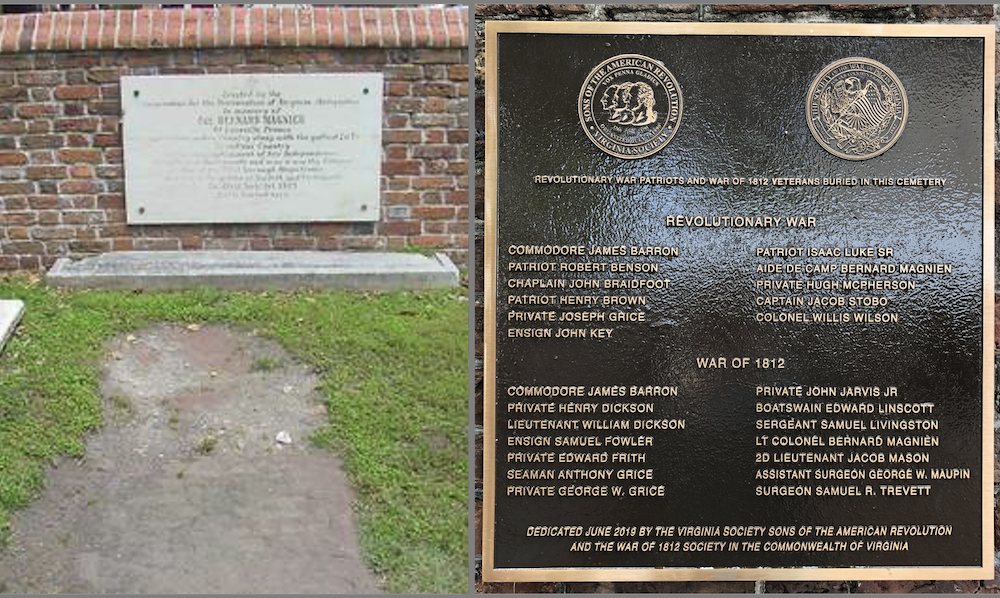
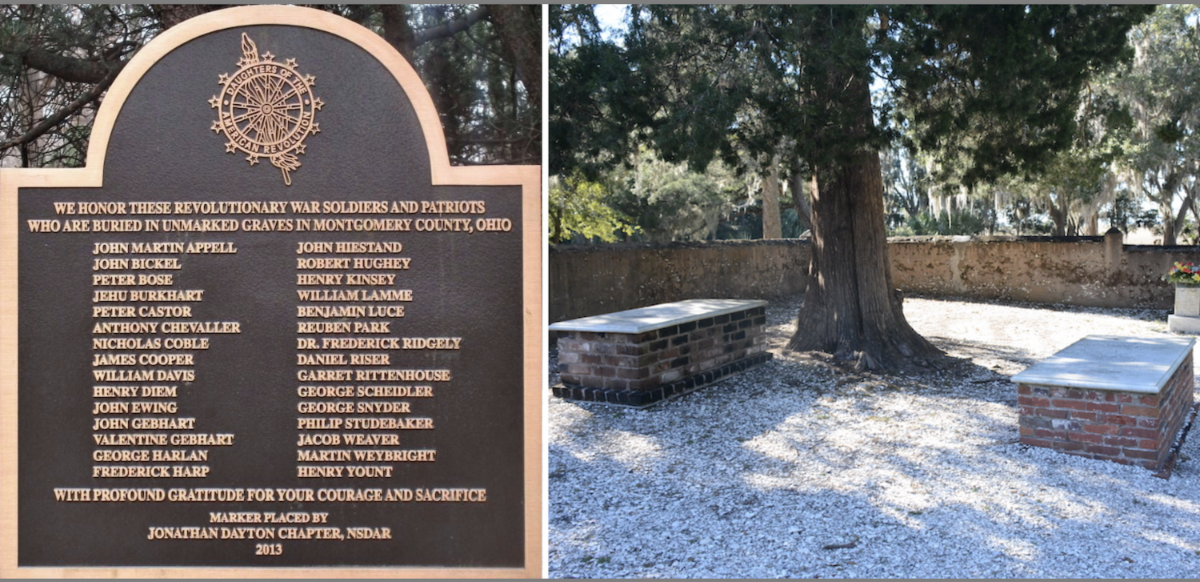
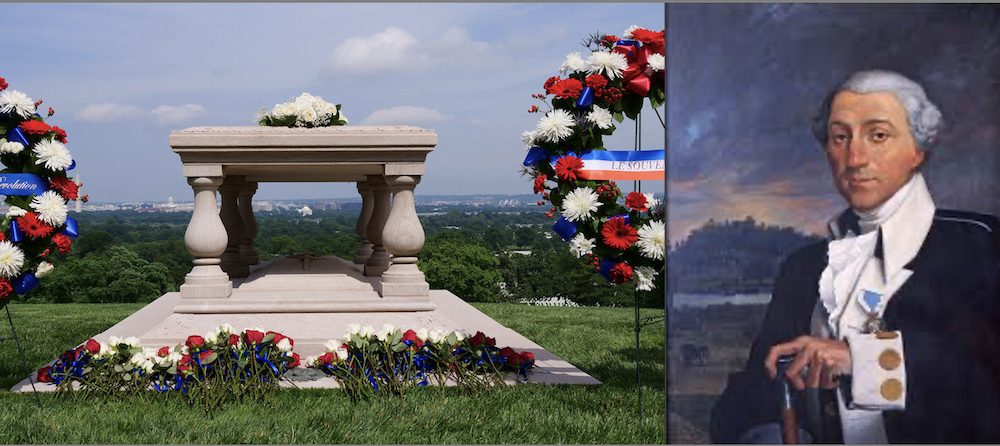
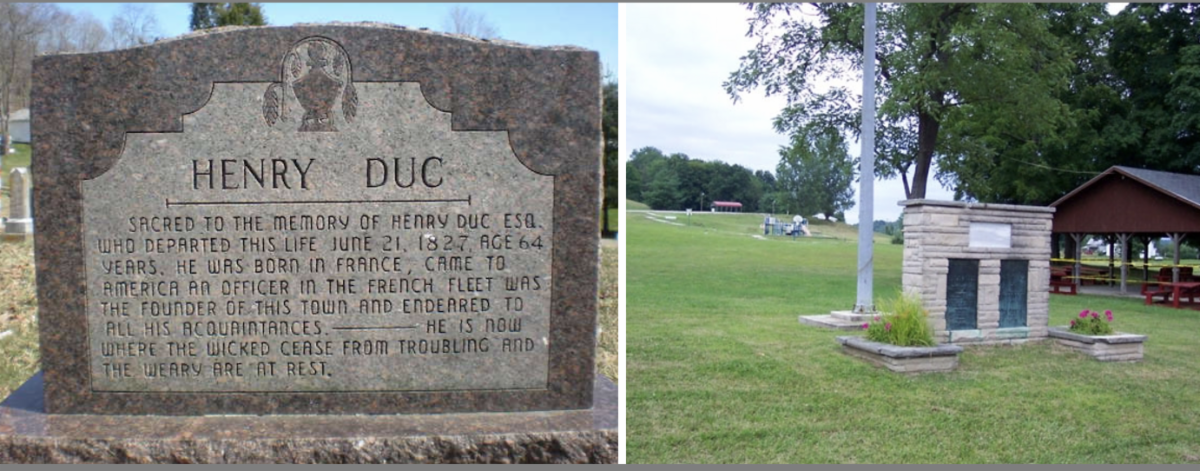
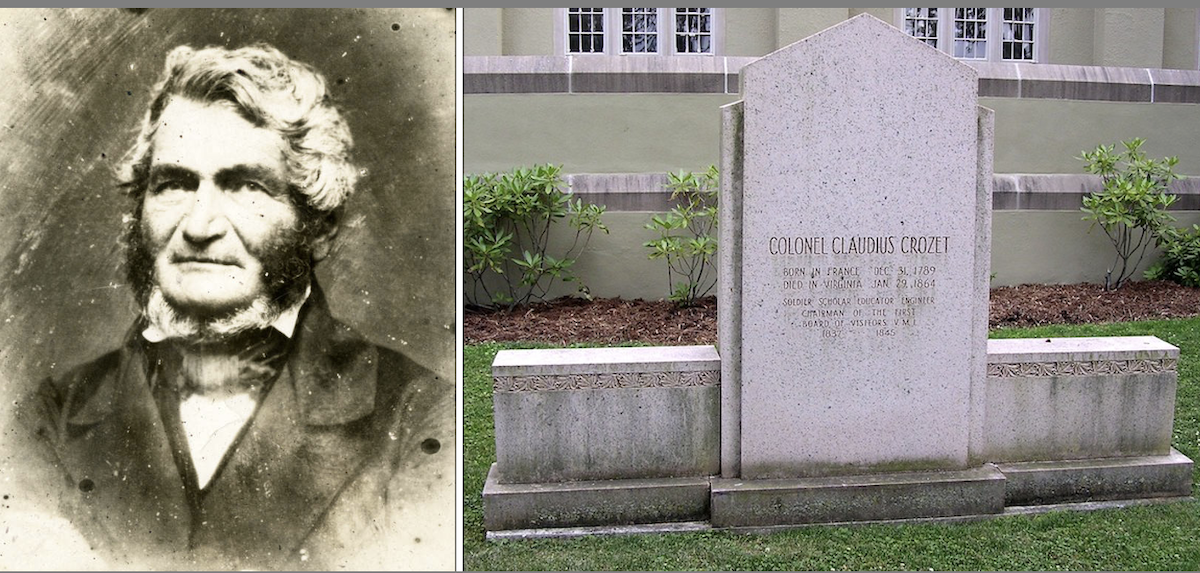
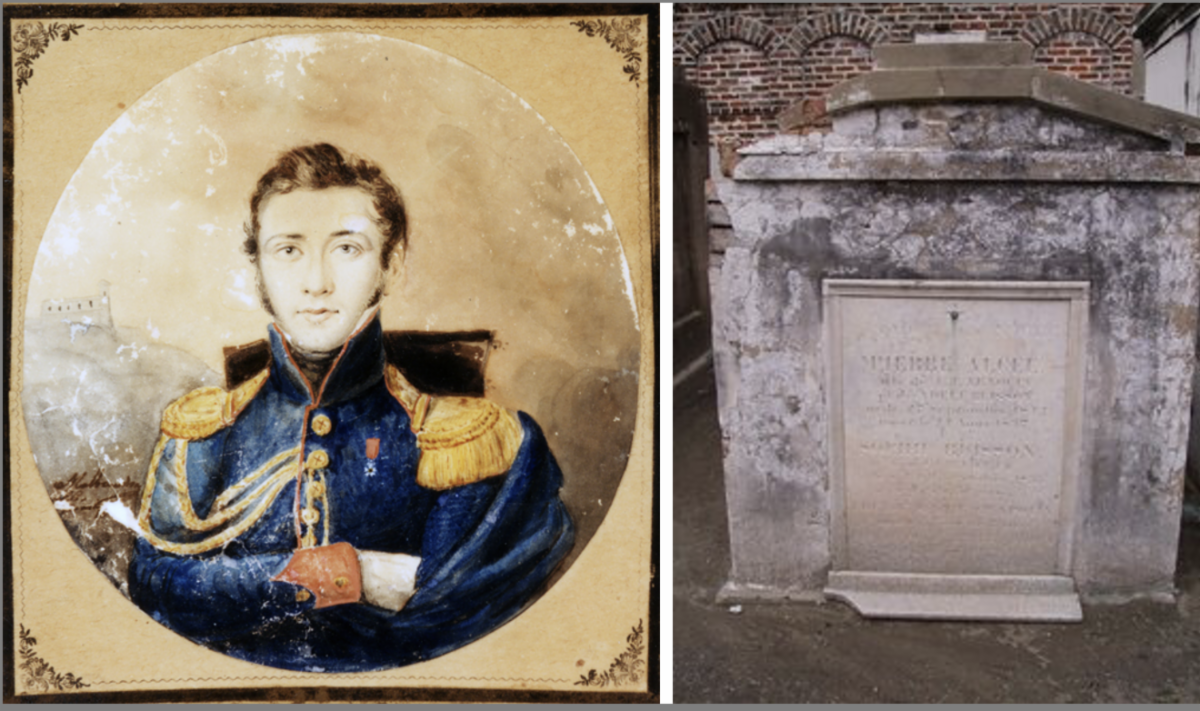
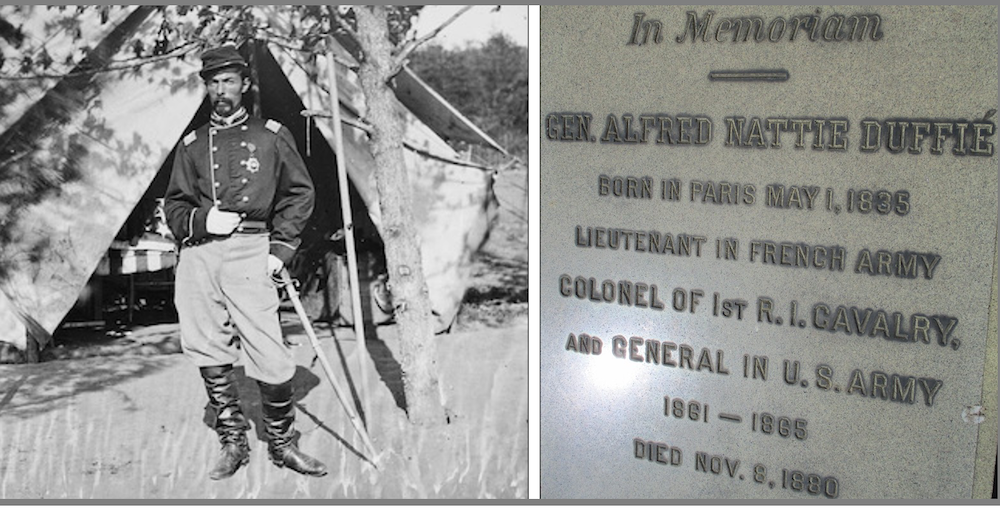
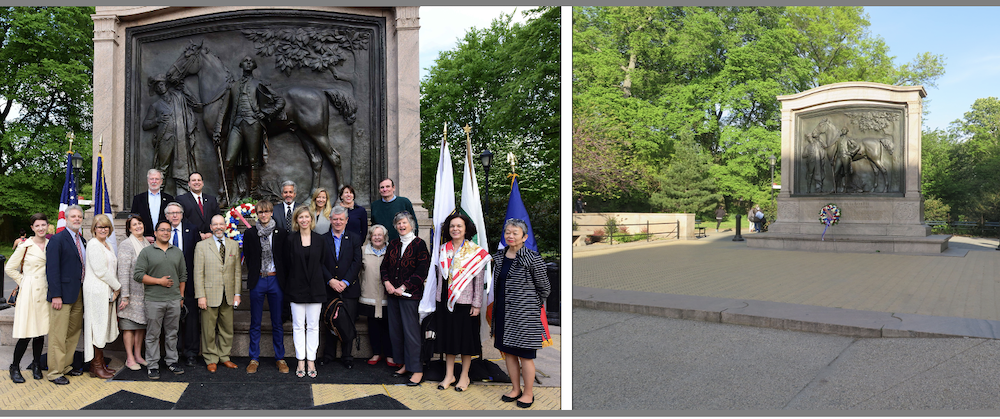
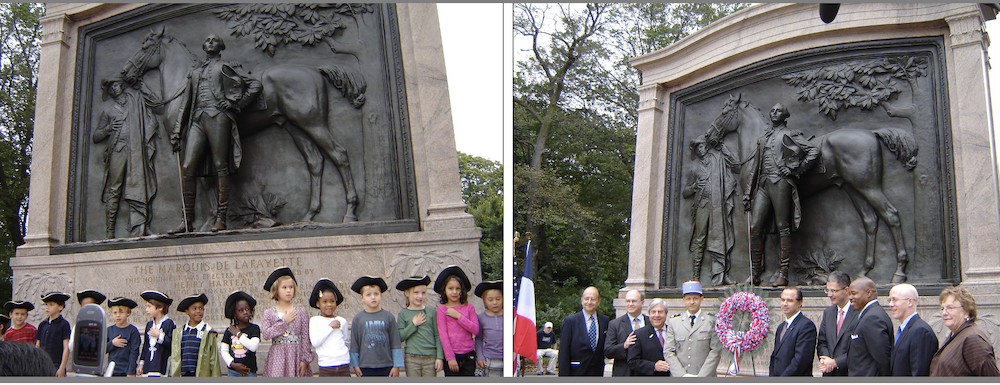
|
The American Society of
Le Souvenir Français Inc.
Monthly Bulletin - Vol. V, No. 11
November 2025
| | |
French Soldiers
in the United States
(a selection)
| | |
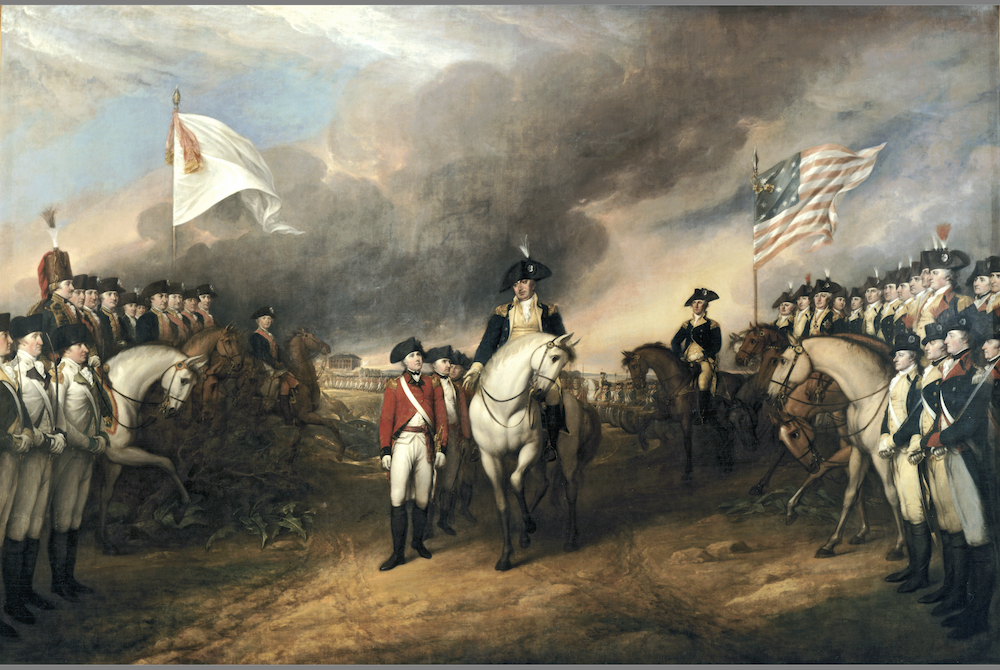
Cover illustration:
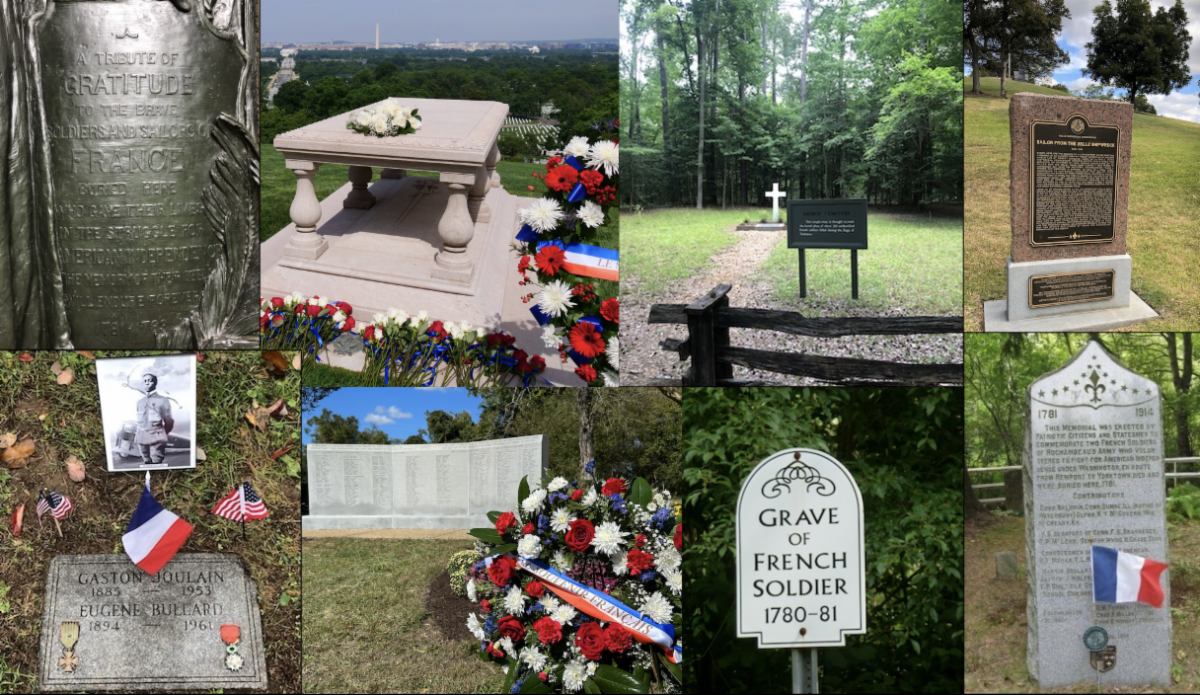
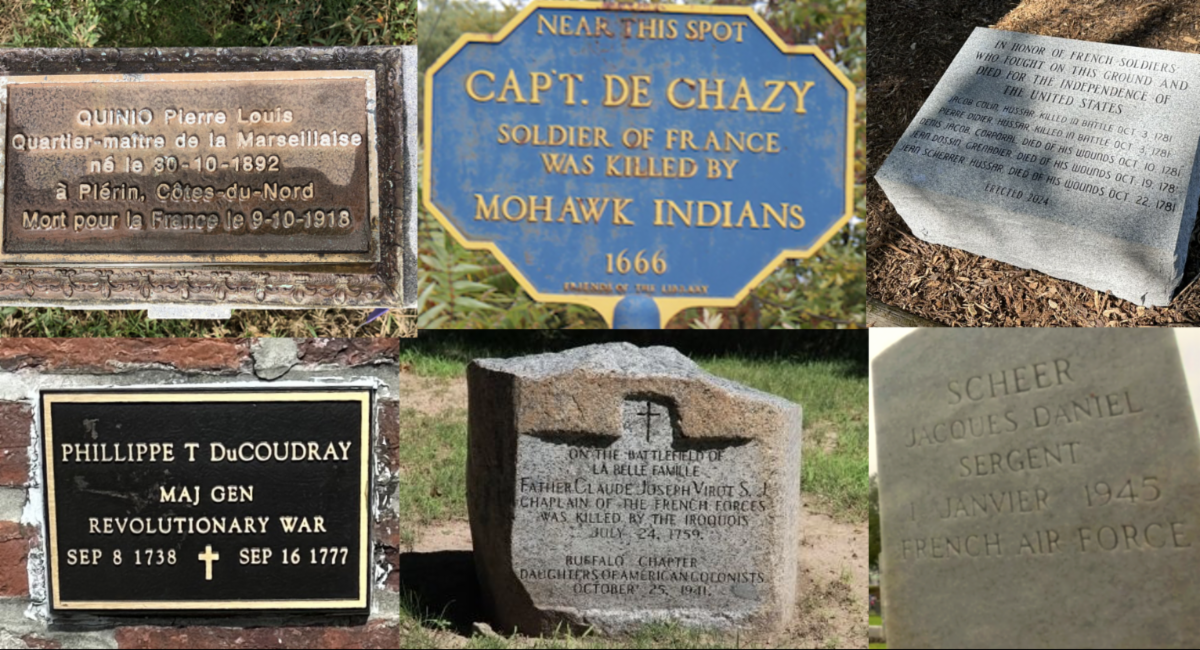
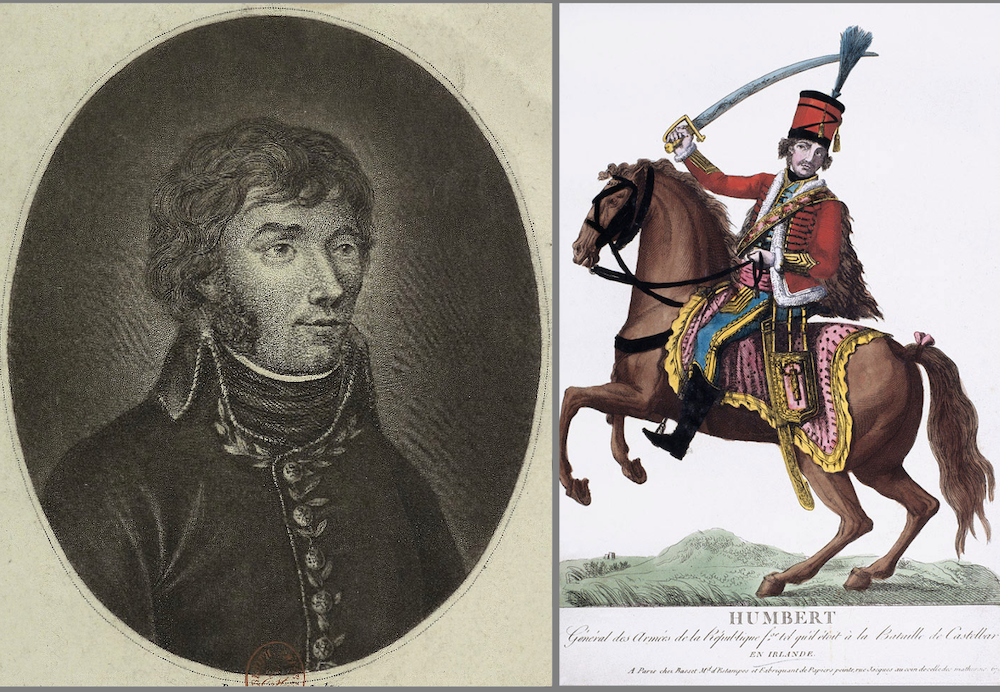
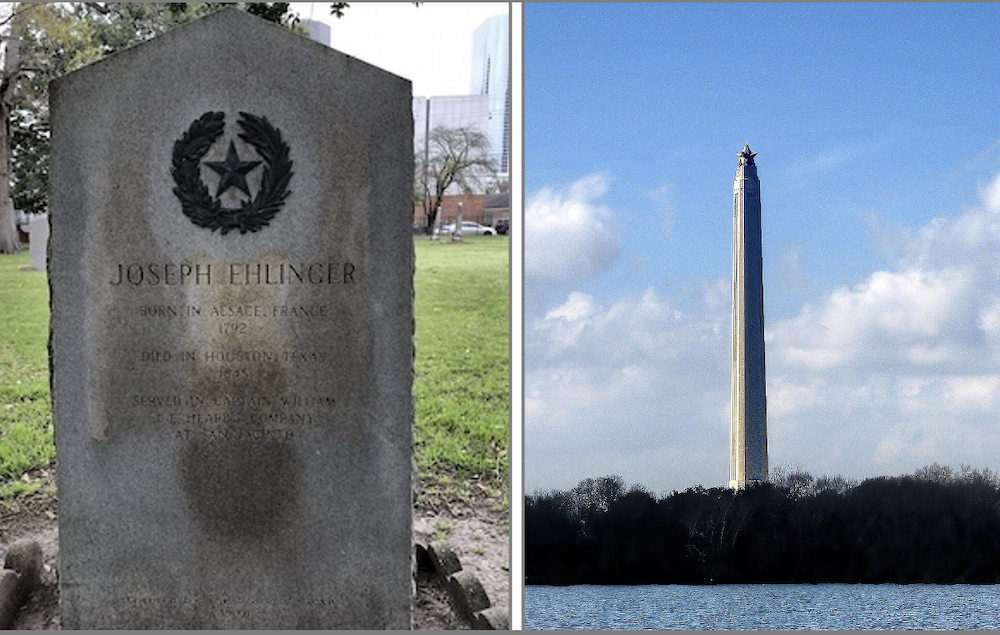
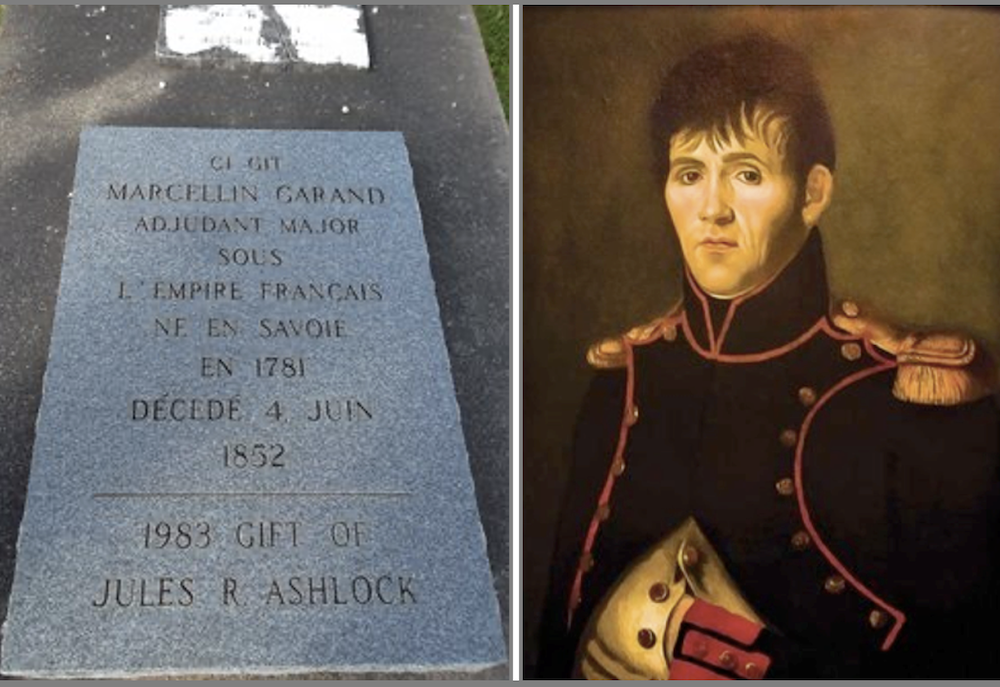
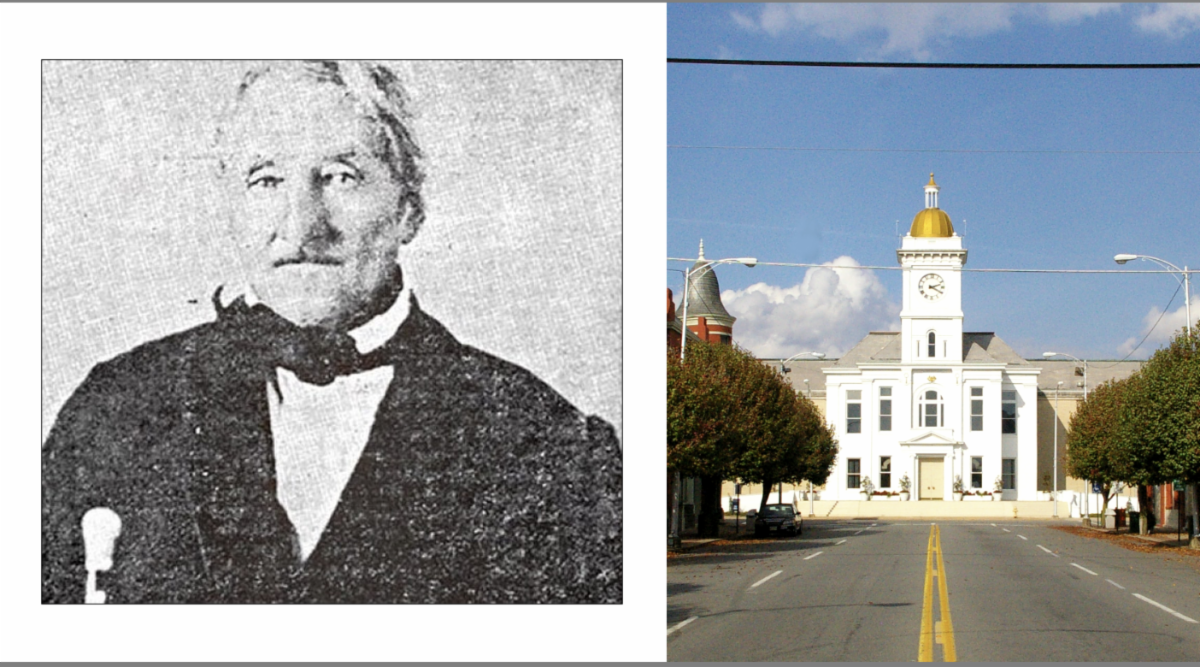
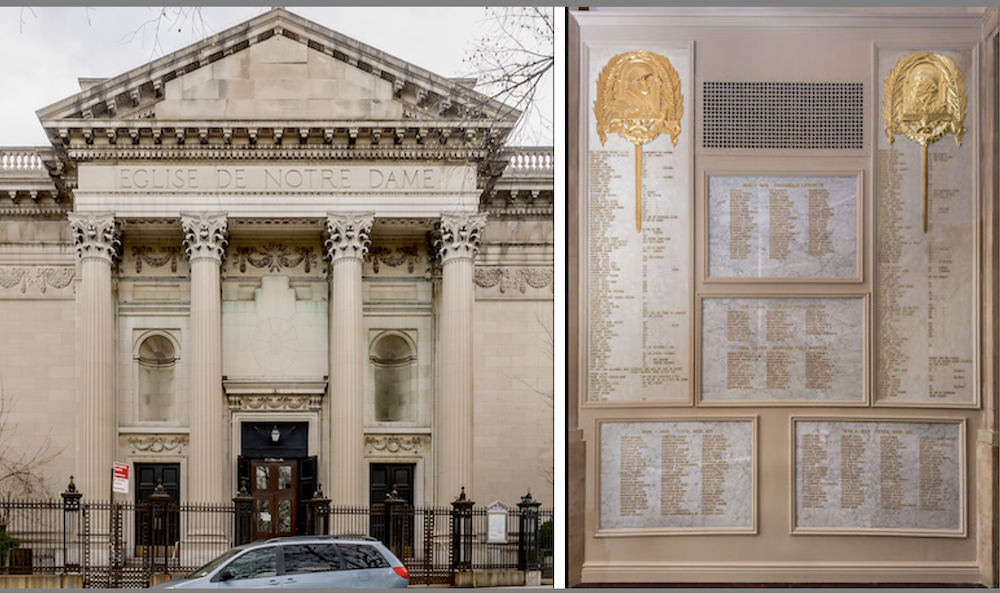
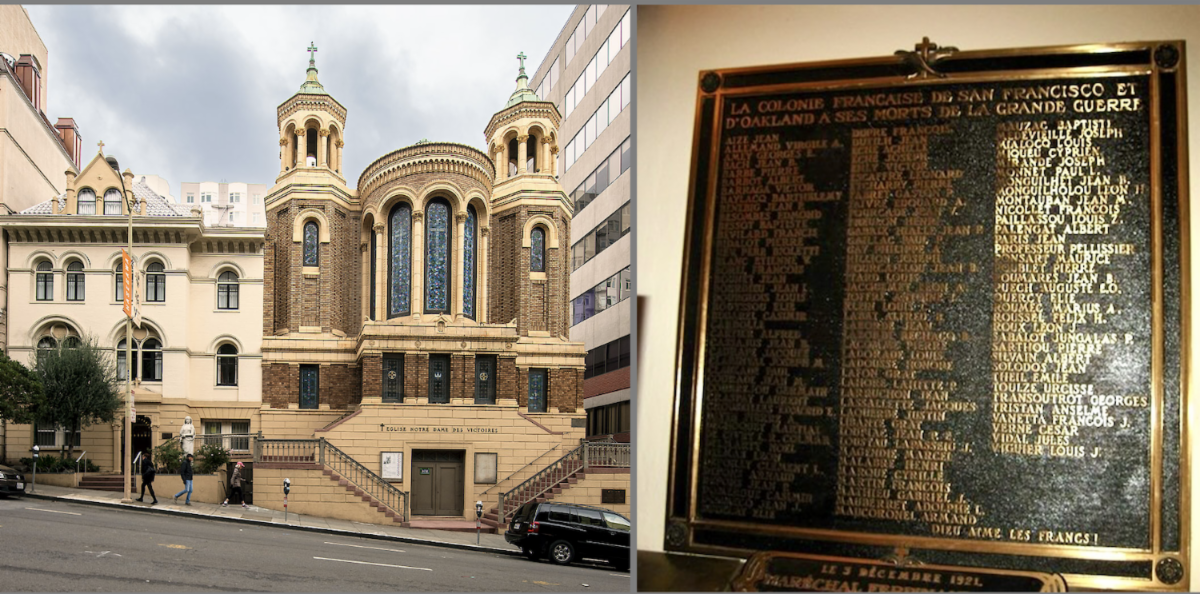
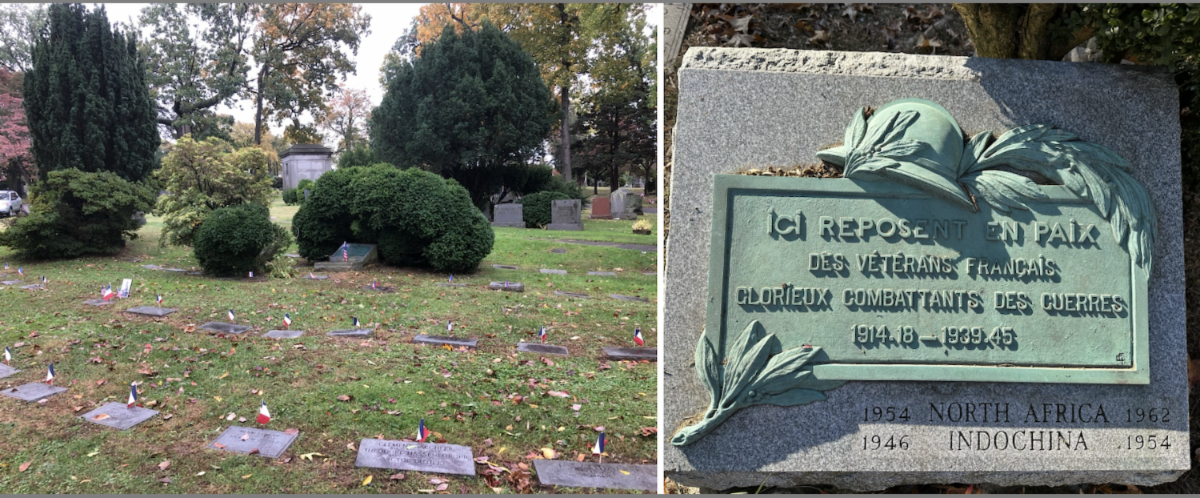
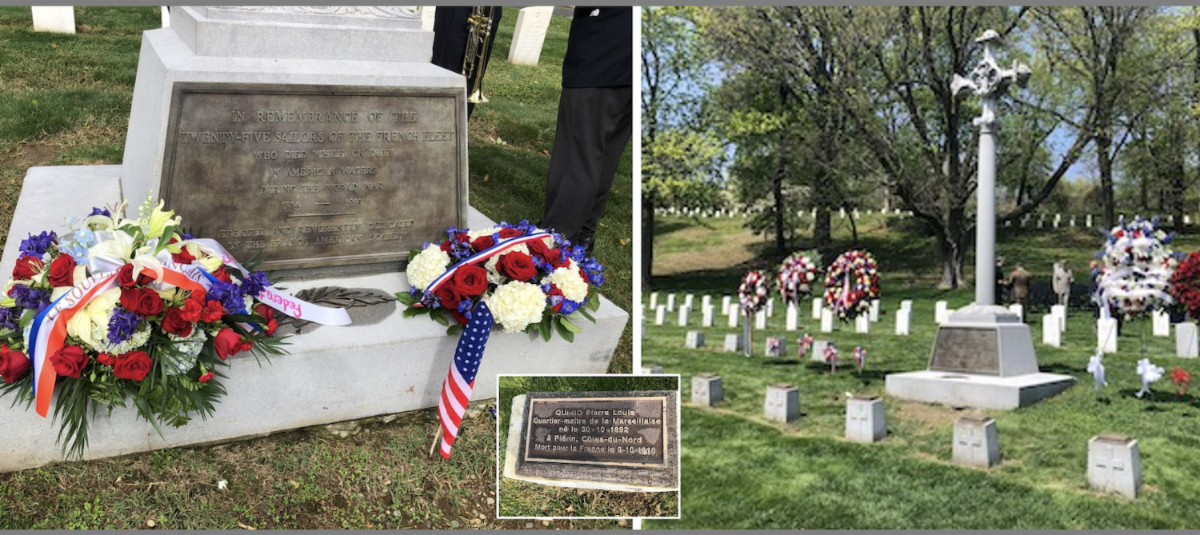
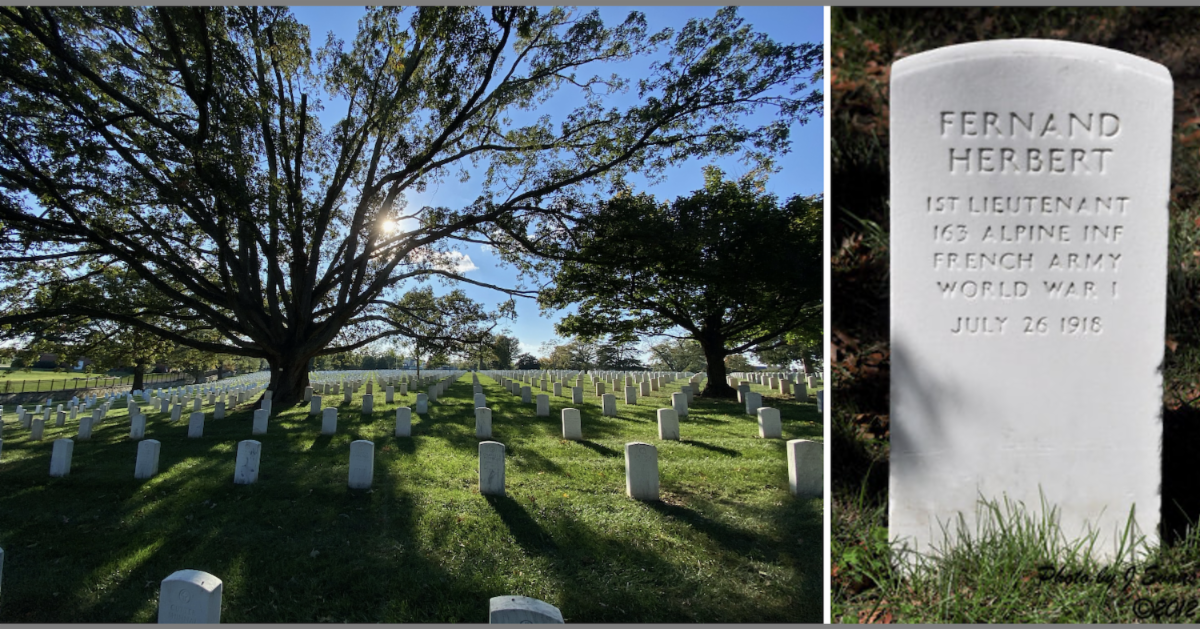
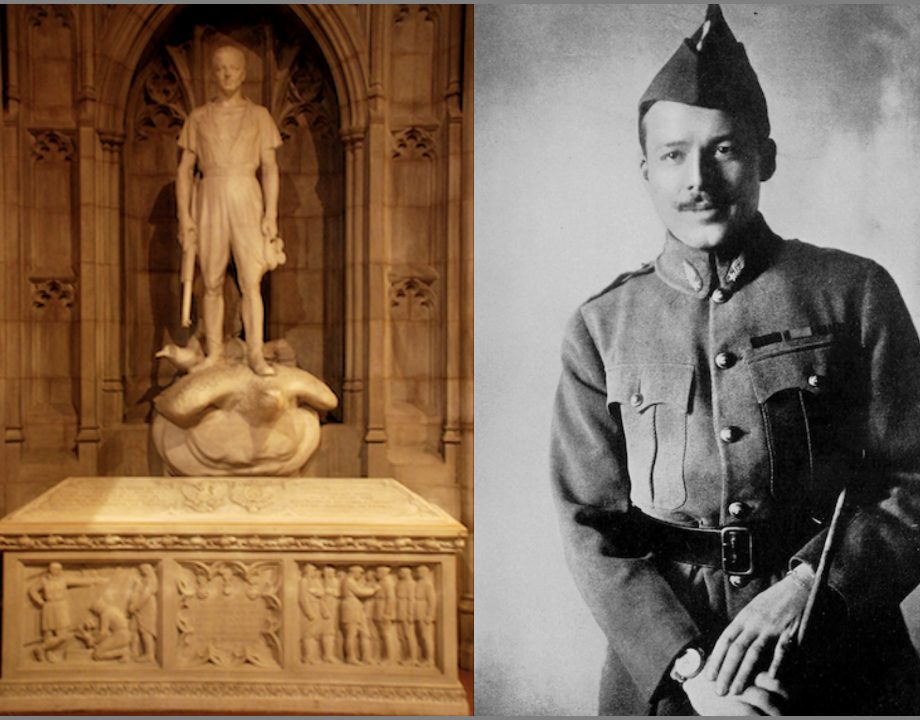
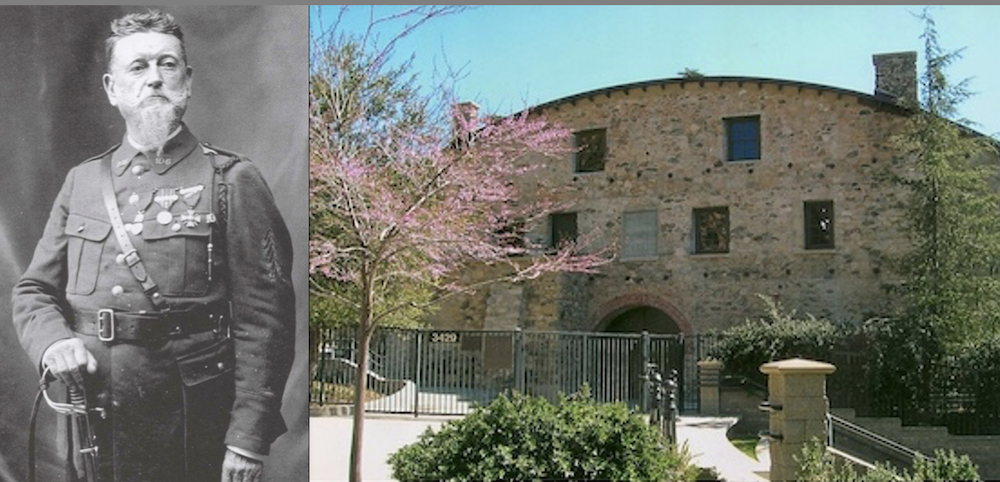
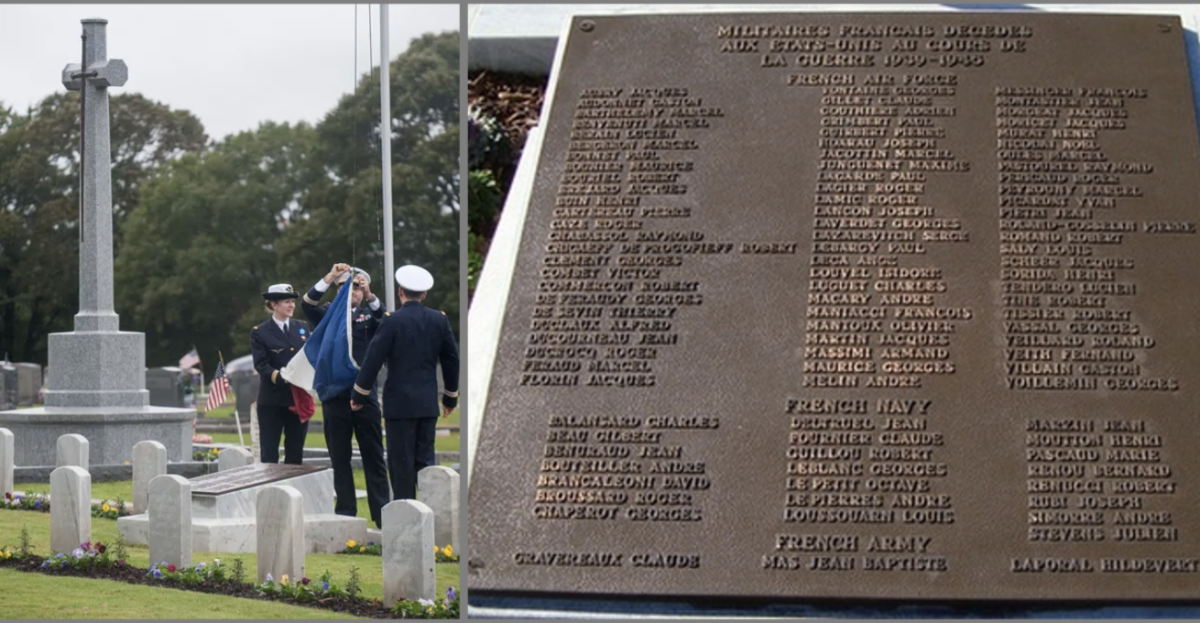
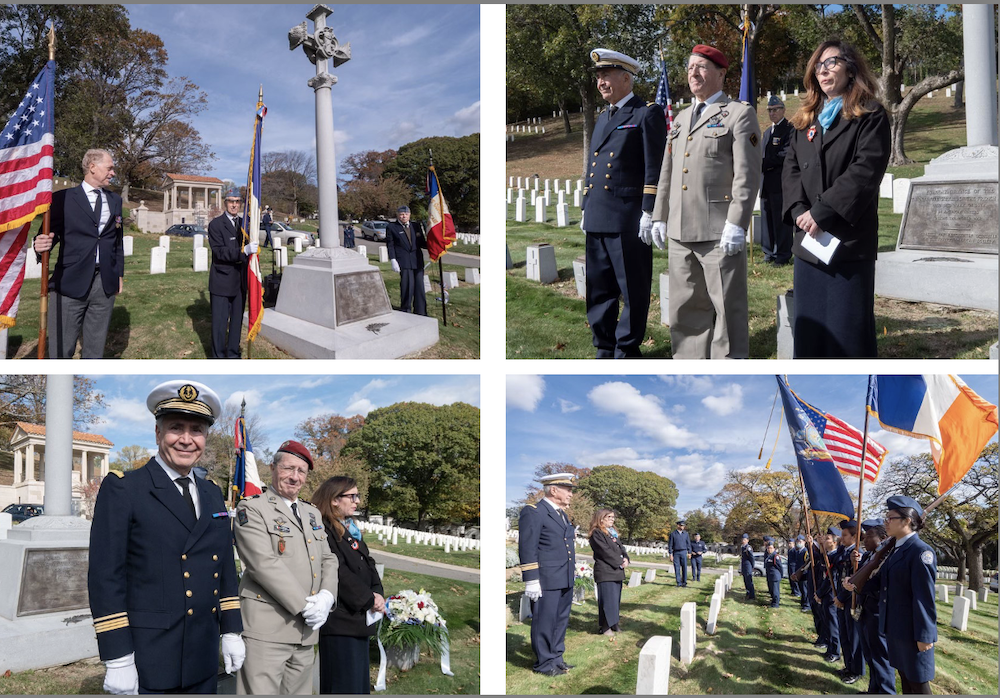
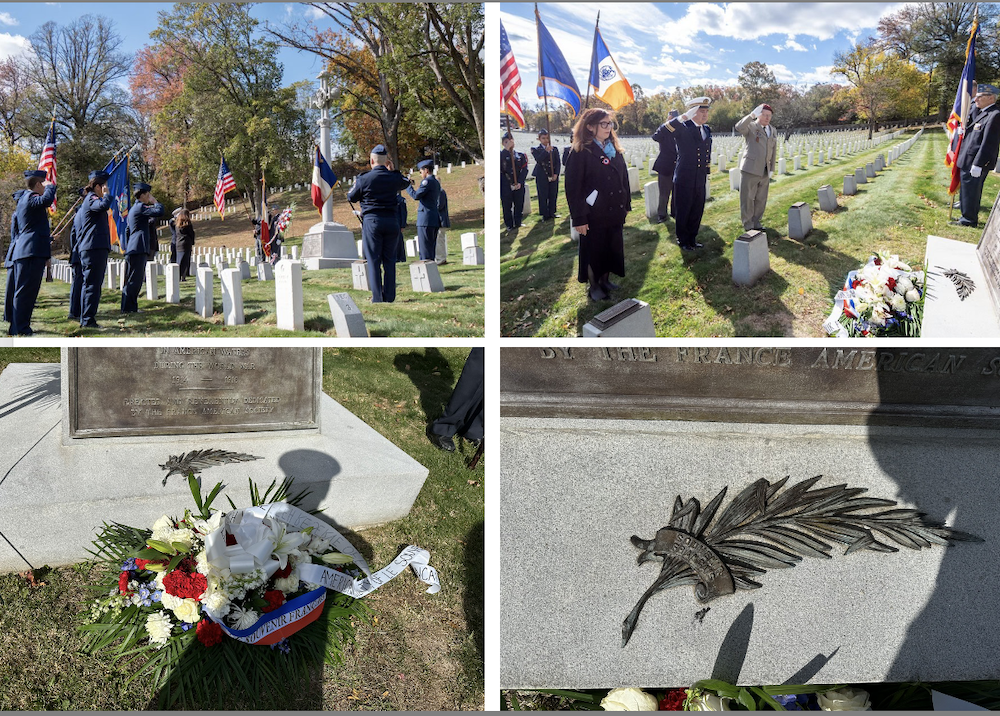
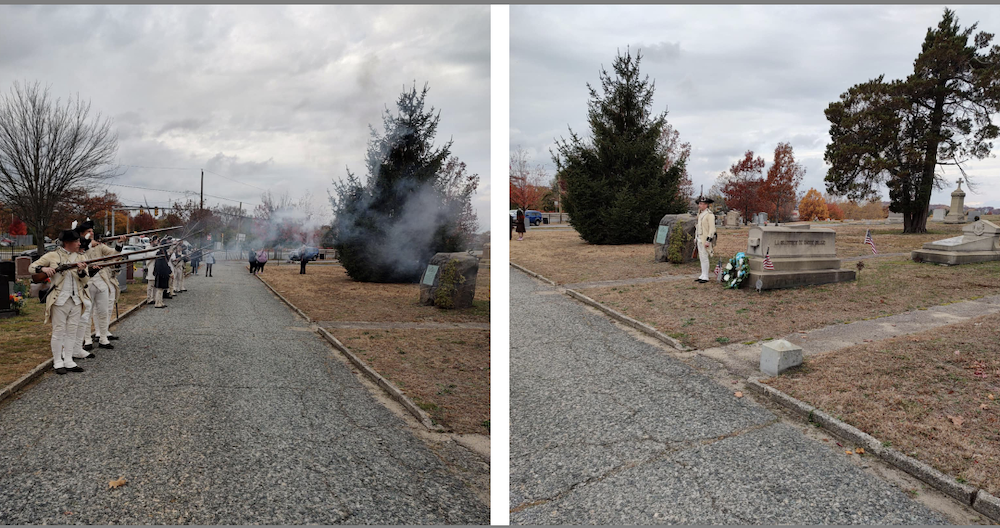
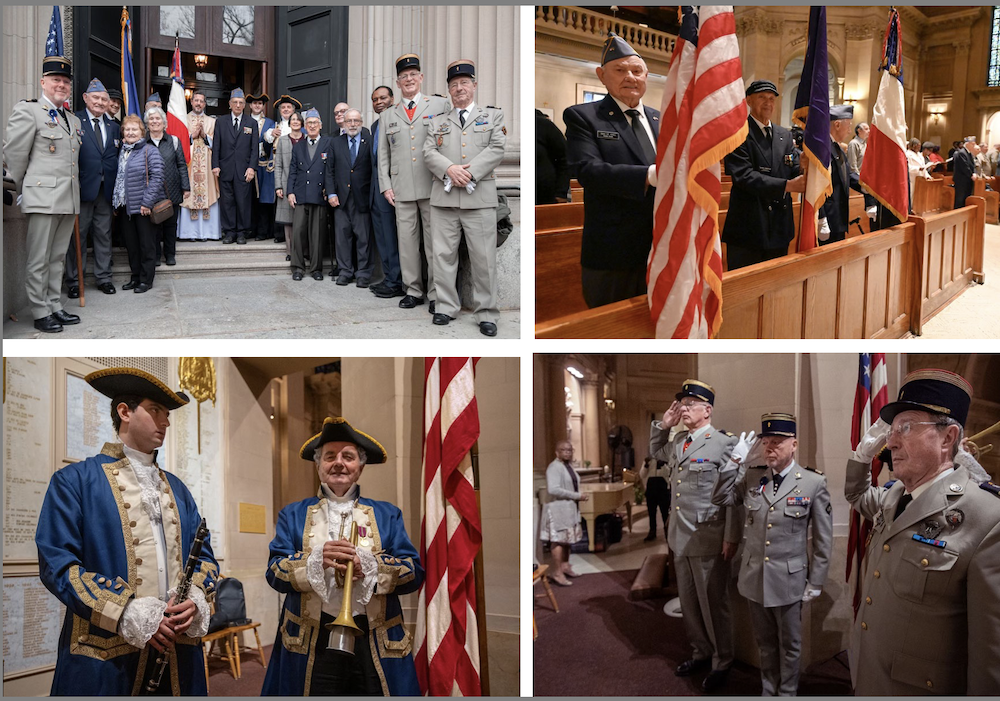
There are many sites of individual tombs and mass graves from the 1600's until 1945 with French soldiers, sailors and aviators. Scroll down the pages of this bulletin to discover some of their stories and accomplishments.
| | |
Editorial
November is a special month, as we celebrate the memory of our departed.
At Le Souvenir Français in the United States, our primary mission is to honor all the French soldiers, sailors and aviators who fell and are buried throughout the nation. While a high number (3,520 sailors and soldiers on board vessels) does not have tombs, as they were lost at sea all along the Eastern seaboard. Others are resting in mass graves, since it was a common practice at the time. Several are resting in cemeteries, some alone, some in small groups, and some alongside their American brothers-in-arms. All their individual tombs are very well kept by local communities, for which we are extremely grateful.
Over the years, we have identified several sites with their precise GPS coordinates. In the case of mass graves, the overall location is known, but not precisely. In at least one instance, they are probably under commercial or residential developments, and we are working to install a marker nearby, at long last. Overall, we have their names, their villages and provinces of birth, the dates of enrollment, the dates of death. Due to the inconsistent nature of their hand-written military records, details are at times sketchy. Revolutionary War-era soldiers from France can be found in Massachusetts, Rhode Island, Connecticut, New York, New Jersey, Delaware, and Virginia.
For those who died in modern times during the two World Wars — yes, there were sailors and aviators who died while on duty in the United States in the 20th century, we even have photos of several of them. They are in New York, D.C., Virginia, and Alabama for the most part.
Another unknown number, most likely in the thousands, rests everywhere that French forts were built during the colonial period, from Upstate New York and Massachusetts, to the Great Lakes, the Mississippi basin and Louisiana. Thus, there are French graves in Upstate New York, North Carolina, South Carolina, Georgia, Louisiana, Florida, Illinois, Arkansas, Missouri, Mississippi, and Texas.
We are meticulously listing all those who have become known to us, and this task will probably never be totally completed. We will update the lists posted on our website with the records fastidiously kept by our Society, not only to honor them with virtual plaques, but also to identify the many locations where markers should be considered. While this process will take months and years, it is our sacred duty to remember them, and to tell, whenever possible, their stories.
Laying a wreath is a meaningful gesture, but telling their stories is just as important.
We are starting this annual endeavor in this November bulletin with a few selections spanning centuries and several states, to highlight the scope and variety of our Society's work. We will continue to do so every November. Please join us in reflecting on their sacrifice and the legacy they left behind.
"Si nous les oublions, ils meurent deux fois". If we forget them, they die twice.
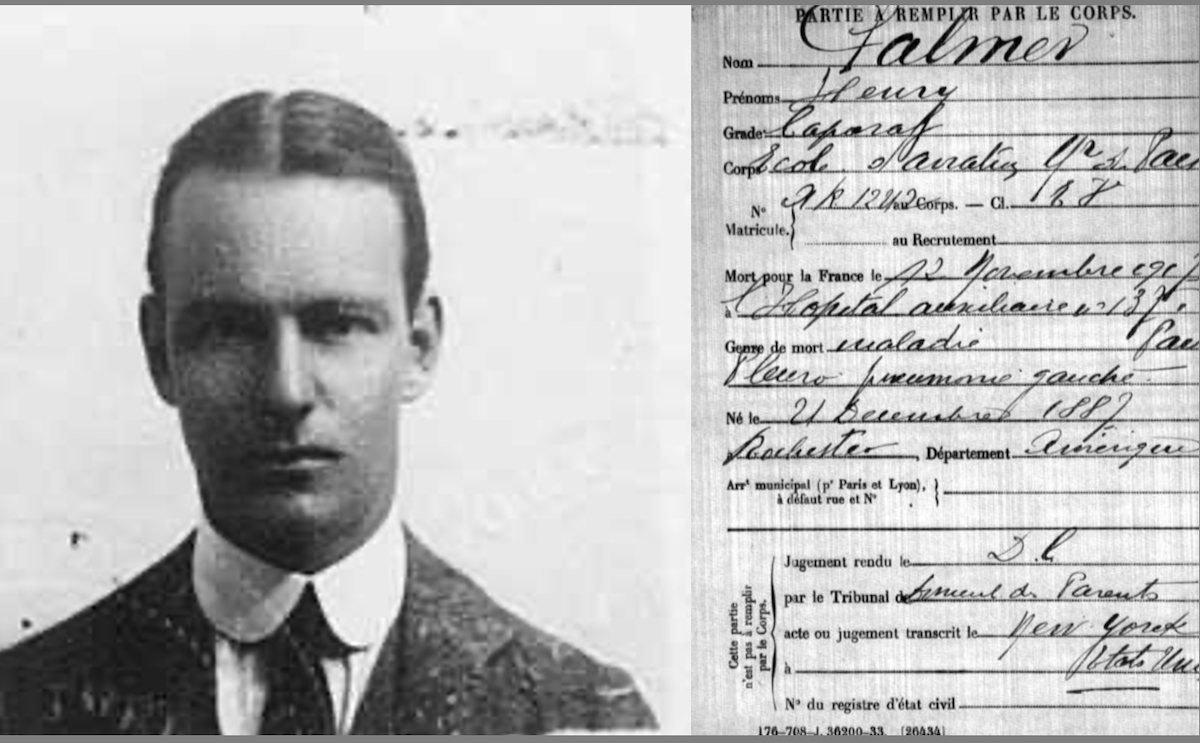
Please scroll down to Part Two of our Bulletin to honor this month another brave American volunteer who "Died for France " in World War One: Corporal Henry Brewster Palmer who died of pneumonia on November 12, 1917 at hospital No 137 at Pau, Département des Pyrénées-Atlantiques, in Southwest France.
Part Three, "News and Save the Dates" will cover events since our last Bulletin. We will also share the latest news from other civic and patriotic associations, as well as our own updates on several important projects your Society has been actively pursuing.
We thank you for sharing our Bulletins and activities with friends and acquaintances, and for encouraging them to join us or support one of our worthy causes — all furthering the long historical ties of friendship and alliance between the United States and France.
We wish you a Happy Thanksgiving!
On behalf of the Board of Directors,
Thierry Chaunu
President, The American Society of Le Souvenir Français, Inc.
Note: The official designation 'Died for France' was established during the First World War by the law of July 2, 1915, and amended by the law of February 28, 1922. We ask our readers to forgive us for applying this designation retroactively to all military personnel from previous conflicts.
| | |
Part One:
French soldiers, sailors and airmen
buried in the United States
An overview...
| | We invite you to discover a few of these brave soldiers who faced incredible hardships in a distant land. Instead of taking a geographical approach, as we often do, we will take a chronological approach. We therefore start our survey with some of the oldest French soldiers and sailors who died in today's United States. | | |
Soldiers and sailors of Jean Ribault's expedition
Florida, 1565
| | |
Above:
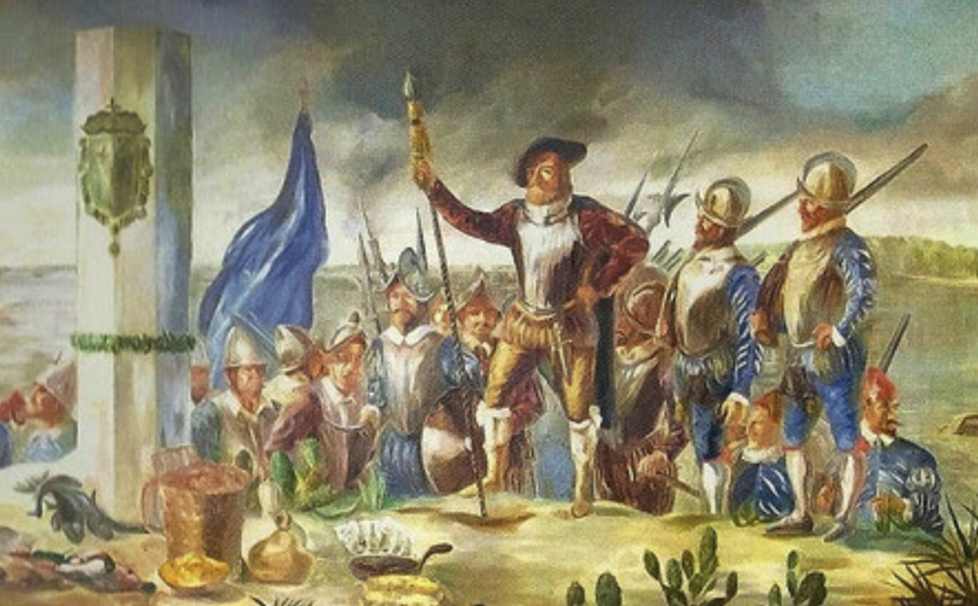
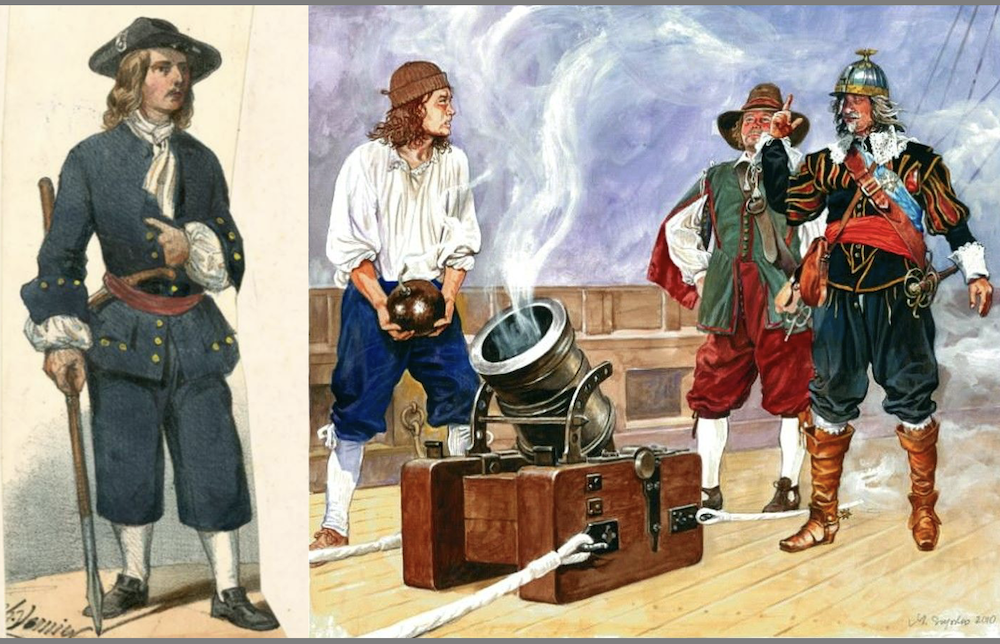
Top: Jean Ribault's 1562 arrival at St. Johns River. (Detail) from mural by Lee Adams, 1959, Jacksonville Public Library. It is on permanent display in the Florida Collection area on the fourth floor across from the reference desk. Photo: https://www.jaxdailyrecord.com/news/2012/may/02/ribault-mural-unveiled-main-library/
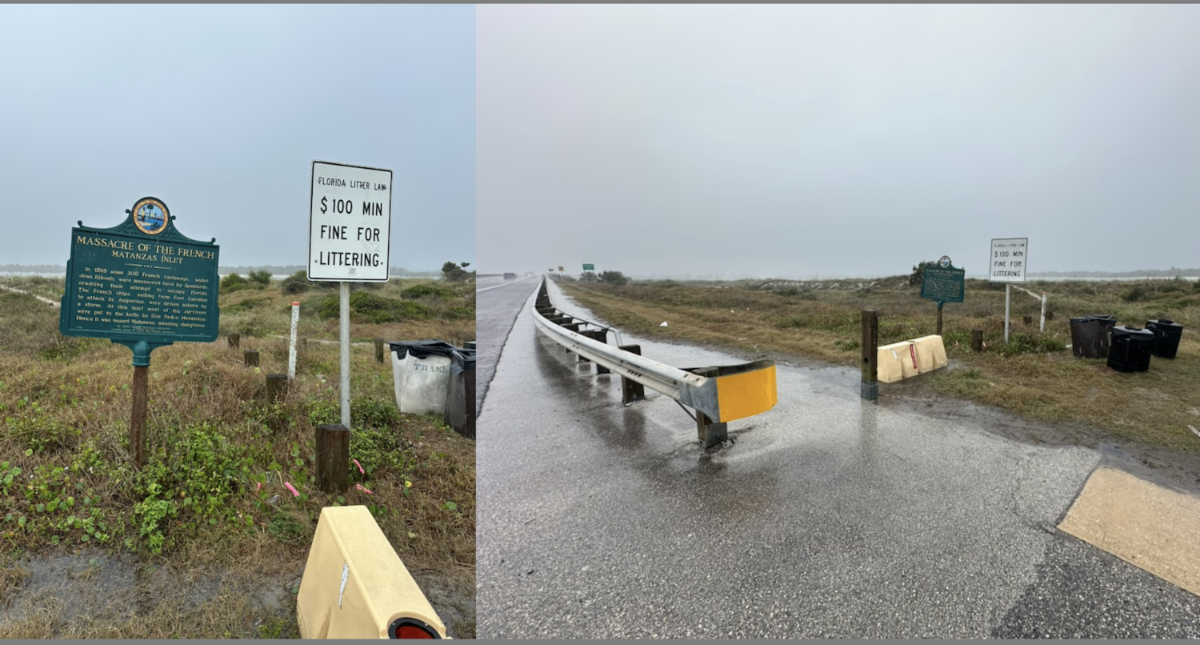
Bottom: the surroundings of the marker at the site of the "massacre of the French" along the highway need a serious cleanup - or relocation to a nearby rest area. Photo: TC © ASSFI 2024
| | |
• Jean Ribault was a French naval officer and explorer who played a significant role in early French attempts to colonize Florida in the 1560s.
Ribault led an expedition in 1562 that established Charlesfort (near present-day Parris Island, South Carolina), one of the first French settlements in North America. In 1565, he returned to reinforce Fort Caroline, a French Huguenot (Protestant) settlement near present-day Jacksonville, Florida.
The Massacre:
• The Spanish, led by Pedro Menéndez de Avilés, viewed the French presence in Florida as both a territorial threat and a religious affront, since the French colonists were Protestant Huguenots and Spain was fiercely Catholic during the Counter-Reformation.
• In September 1565, Ribault attempted to attack the Spanish settlement of St. Augustine by sea, but his fleet was destroyed by a hurricane. The shipwrecked French sailors and soldiers, including Ribault, washed ashore south of St. Augustine at an inlet.
• Menéndez's forces captured the stranded French in groups over several weeks. Despite some accounts suggesting the French were offered the chance to convert to Catholicism, most were killed. Ribault and several hundred of his men were executed at a place that became known as "Matanzas" (Spanish for "slaughters").
• This brutal episode effectively ended French attempts to colonize Florida.
La Trinité being a military ship (presence of a cannon on board) it is likely that several among the slaughtered where French military sailors and soldiers on board. Fort Matanzas nearby is officially a National Monument.
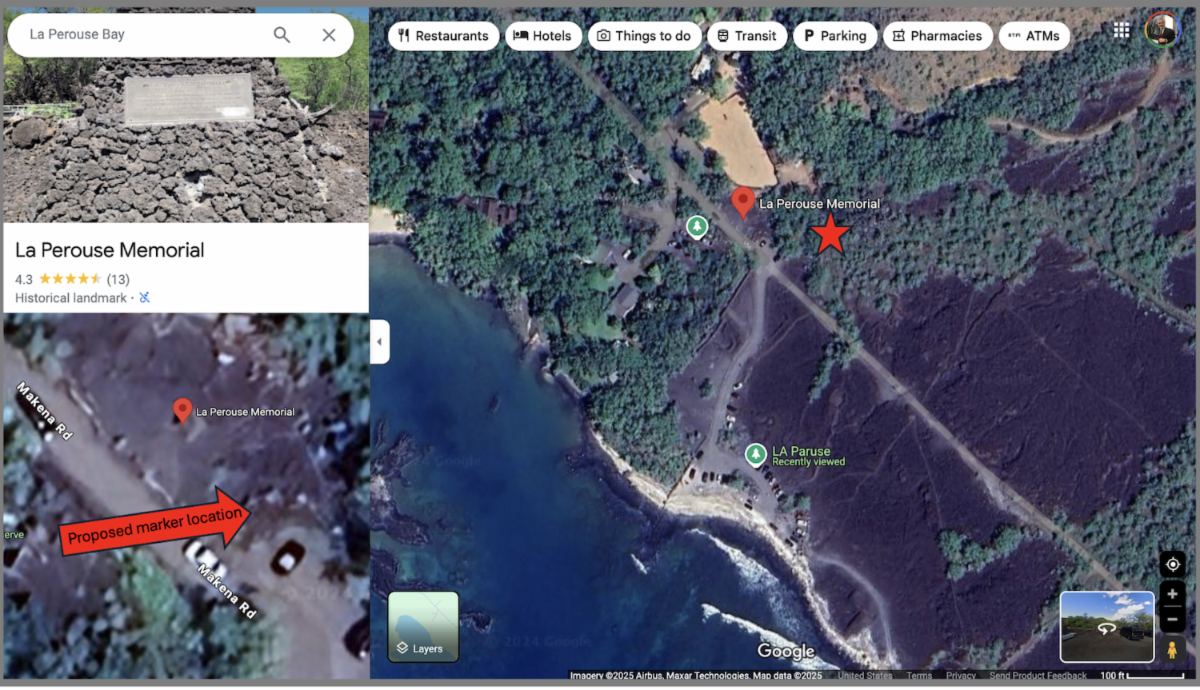
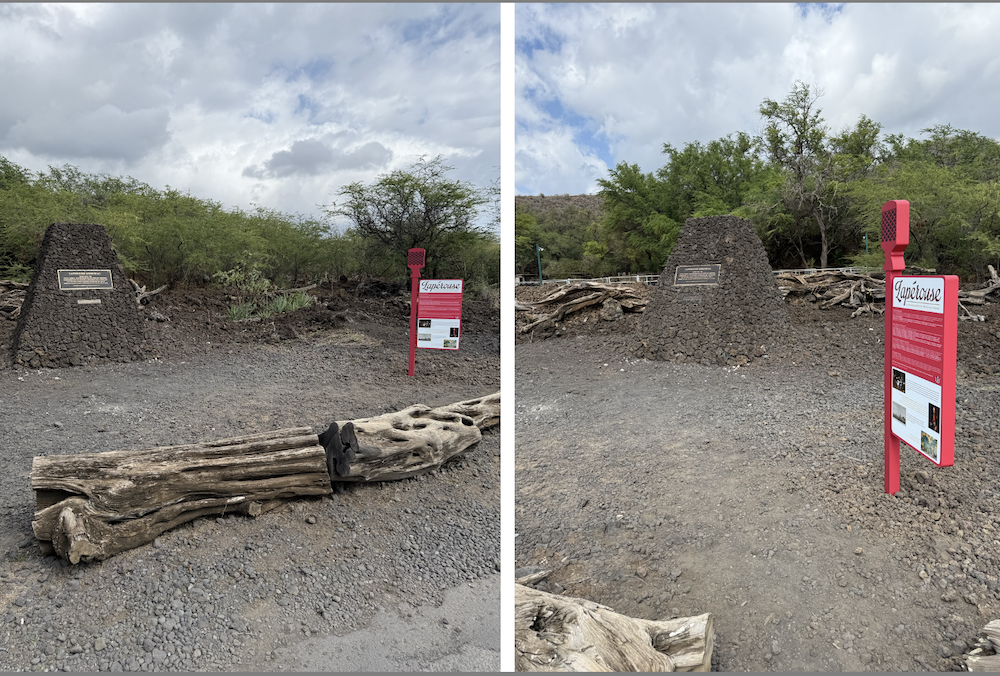
The marker is alongside the highway next to garbage bins. There is a rest area 400ft away that would be much more appropriate. It is one of our projects to ask the locate authorities to relocate the marker (named Matanzas – which means "slaughters" in Spanish) next to other tourist informations panels.
Marker, “Massacre of the French - Matanzas inlet”
Matanzas National Monument Inlet, Saint Augustine FL 32080
GPS: 29.710950, -81.229783
• Inscription:
“In 1565 some 300 French castaways, under Jean Ribault, were massacred here by Spaniards, crushing their attempt to occupy Florida. The French ships, sailing from Fort Caroline to attack St. Augustine, were driven ashore by a storm. At this inlet most of the survivors were put to the knife by Don Pedro Menendez. Hence it was named Matanzas, meaning slaughters.”
“Erected 1962 by St. Johns County Historical Commission in cooperation with Florida Board of Parks and Historic Memorials.”
• Ribault's 1565 expedition consisted of approximately 400 soldiers and 200 sailors aboard his four largest ships with one thousand French colonists,on board his fleet of seven ships.
• Regarding the massacre victims, the first group of survivors who surrendered numbered between 110 and 200, with only around a dozen spared. The second group with Ribault totaled perhaps 300 people, with between 70 and 150 killed after about half decided to take their chances in the wilderness rather than surrender.
• The most detailed information available is about La Trinité's cargo rather than its crew - the ship's April 28, 1565 manifest lists military supplies including 20 cannons, 977 cannonballs, 300 iron pikes, and 100 corsets of armor but no crew roster has been found.
• Individual names of massacre victims appear to be lost to history, though Jean Ribault himself is of course the most famous victim. The wreck of La Trinité was discovered in 2018, so perhaps future archaeological work might yield additional documentary evidence.
• For more information on Jean Ribault and the first colony in Florida, please read our September 2022 Bulletin: It all happened in September…
https://conta.cc/3ds6k35 (original version in English)
https://conta.cc/3r6ZG5r (version en français)
| | |
A sailor of Louis XIV, 1689
Texas State Cemetery
Austin, TX.
| | |
• Robert Cavelier de La Salle had previously explored the Mississippi River in 1682, claiming the entire Mississippi Valley for France and naming it "Louisiana" after King Louis XIV.
• His Texas expedition aimed to establish a French colony at the mouth of the Mississippi River, which would serve as a base to: control the Mississippi River and its vast interior territory, potentially threaten Spanish silver mines in Mexico, and expand French influence in the Gulf of Mexico
• The expedition was plagued by problems from the start:
La Salle's fleet of four ships missed the Mississippi River's mouth entirely, landing instead at Matagorda Bay on the Texas coast (about 400 miles west of their target). One ship was captured by Spanish pirates in the Caribbean, another ran aground and sank, and a third returned to France. The colonists faced disease, Native American attacks, starvation, and the unfamiliar Texas environment. To make things worse, La Salle's autocratic style created discontent among the colonists
• By 1687, the colony (Fort Saint Louis) was failing. While searching for the Mississippi River on foot, La Salle was murdered by his own mutinous men in March 1687. The remaining colonists at Fort Saint Louis were eventually killed by Karankawa Indians in 1688-1689.
Though a complete failure, the expedition alarmed Spain and prompted them to establish missions and presidios in Texas, inadvertently leading to Spanish colonization of the region.
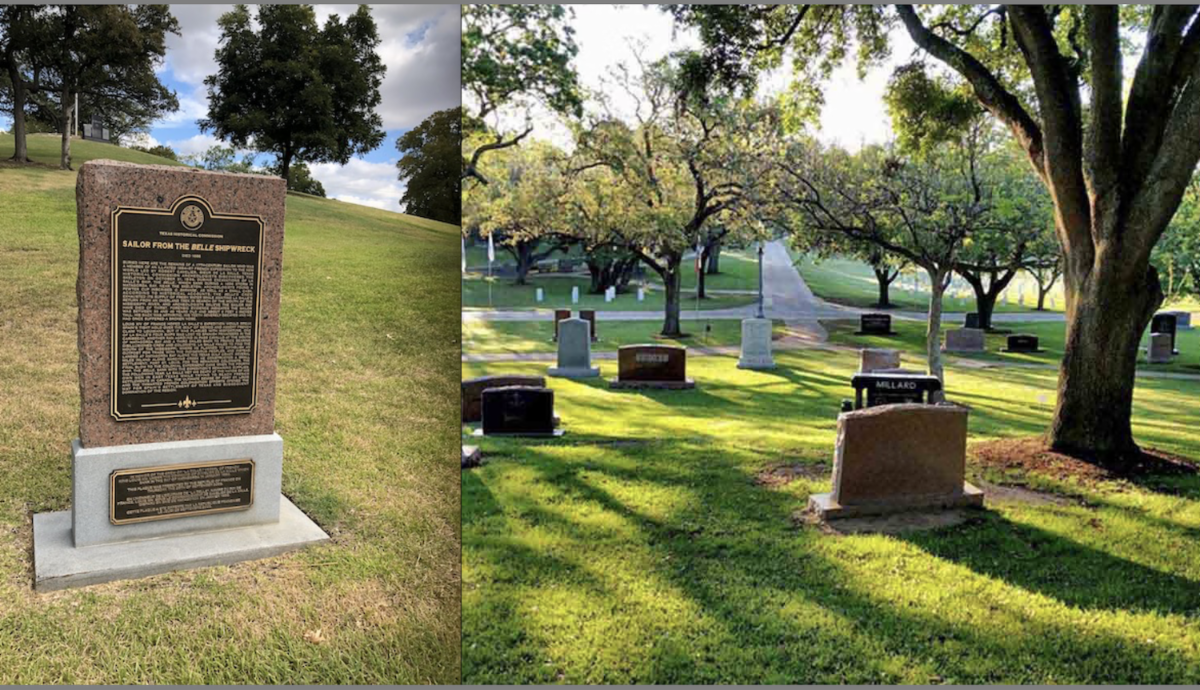
All the French soldiers and sailors are buried in unmarked graves in the area, but one was found a few years ago in the recovered shipwreck of La Belle, a skeleton still holding a tin cup. He was buried in the Texas State Cemeteary in Austin.
Grave Marker, Sailor from the ”La Belle” Shipwreck
Texas State Cemetery
Monument Hill, Section 2 (H2), Row D, Number 1
909 Navasota Street, Austin TX 78702
GPS: 30.266814, -97.725677
• Inscription:
“Buried here are the remains of a 17th-century sailor who was a member of an ill-fated 1684-87 French expedition to the new world led by Robert Cavelier, Sieur de La Salle. Texas Historical Commission archaeologists discovered the skeleton on October 31, 1996, during excavations of La Salle’s ship, the Belle, which sank during a 1686 storm in Matagorda Bay. Near the skeleton, archaeologists found a pewter cup inscribed C. Barange, as well as a small cask. According to historical accounts, the Belle’s crew exhausted its supply of fresh water while awaiting La Salle’s return from an overland trek in search of the mouth of the Mississippi River, and archaeologists believe the sailor may have died of thirst. Forensic evidence indicates the sailor was between 35 and 45 years old and about 5 feet 4 inches tall. His back was arthritic, his teeth severely decayed and he had once suffered a broken nose.
Louis XIV of France hoped La Salle’s expedition would break Spain’s tight hold over the Gulf of Mexico and assert French claim to Louisiana, but it was plagued with misfortune. One of La Salle’s four ships was lost to Spanish privateers in the Caribbean, another ran aground in Pass Cavallo at the mouth of Matagorda Bay and a third sailed back to France bearing disillusioned crew and colonists. La Salle failed to find the mouth of the Mississippi, where he planned to establish an outpost for trade with the indigenous peoples, and instead landed at Matagorda Bay along the Texas gulf coast. Several miles inland along Garcitas Creek he constructed a small settlement, Fort St. Louis, for the remaining colonists. The final blow to the colonial experiment came when the fourth ship, the Belle, sank with the expedition’s remaining supplies. The following year, La Salle met his death at the hands of his own men in east Texas while trying to reach French settlements in Canada. The ultimate demise of Fort St. Louis and the thwarted French colonization efforts opened the way for Spain’s settlement of Texas and subsequent domination of the region.”
Erected 2004 by Texas Historical Commission
• For more information on La Salle expedition in Texas, please read our July 2023 Bulletin: The adventure of La Belle and the sailor of Louis XIV at the Texas State Cemetery
https://conta.cc/3CO91Fi (original version in English)
https://conta.cc/3q6nt8J (version en français)
| | |
Above:
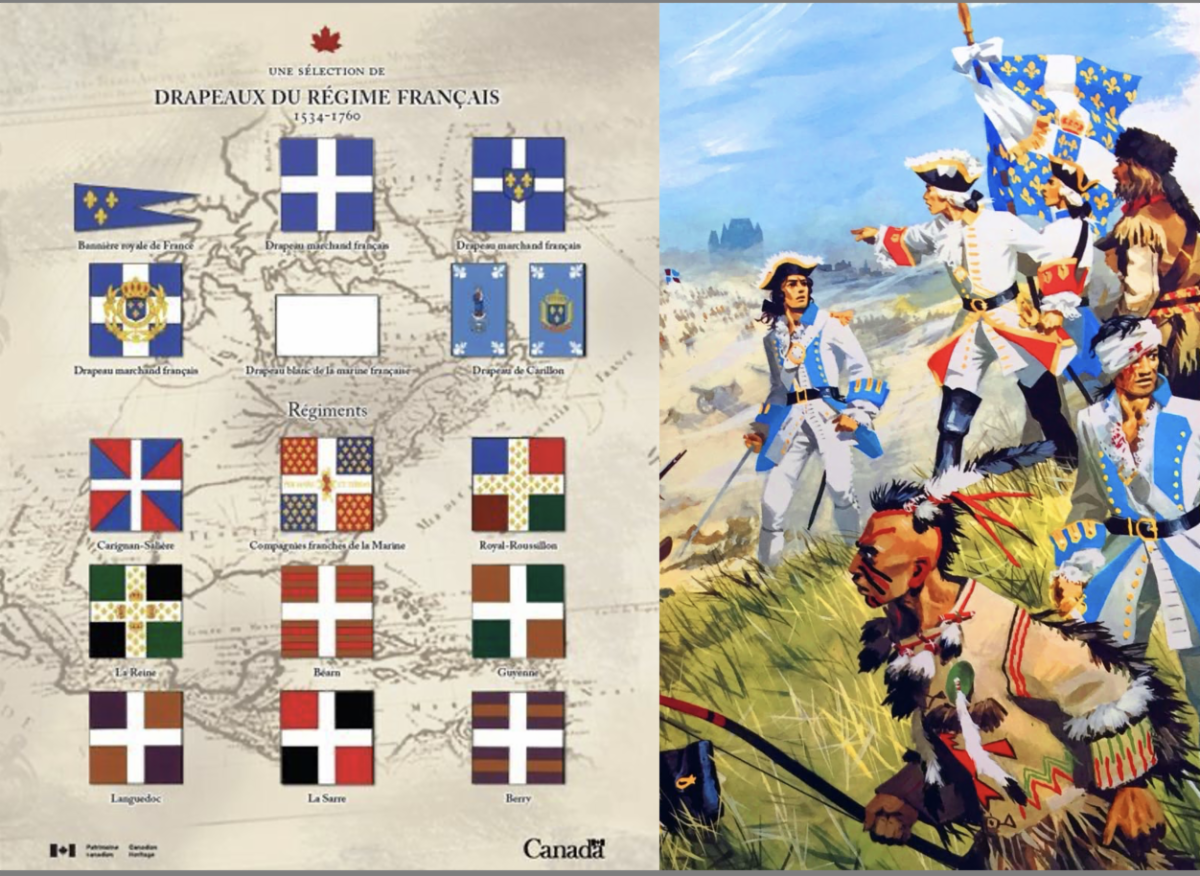
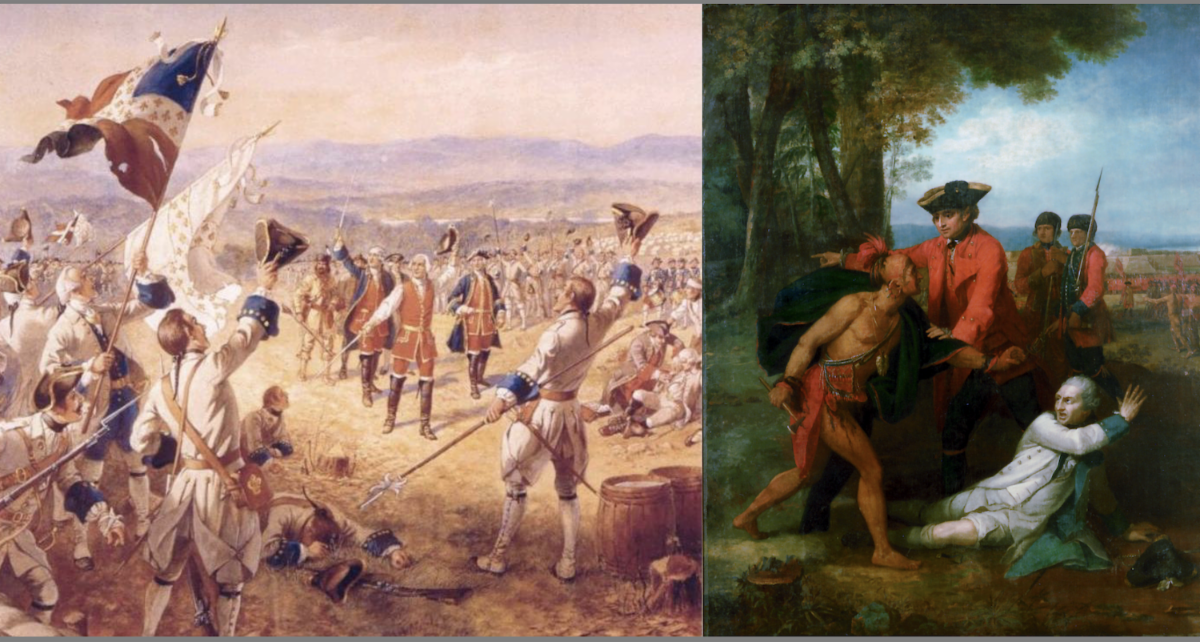
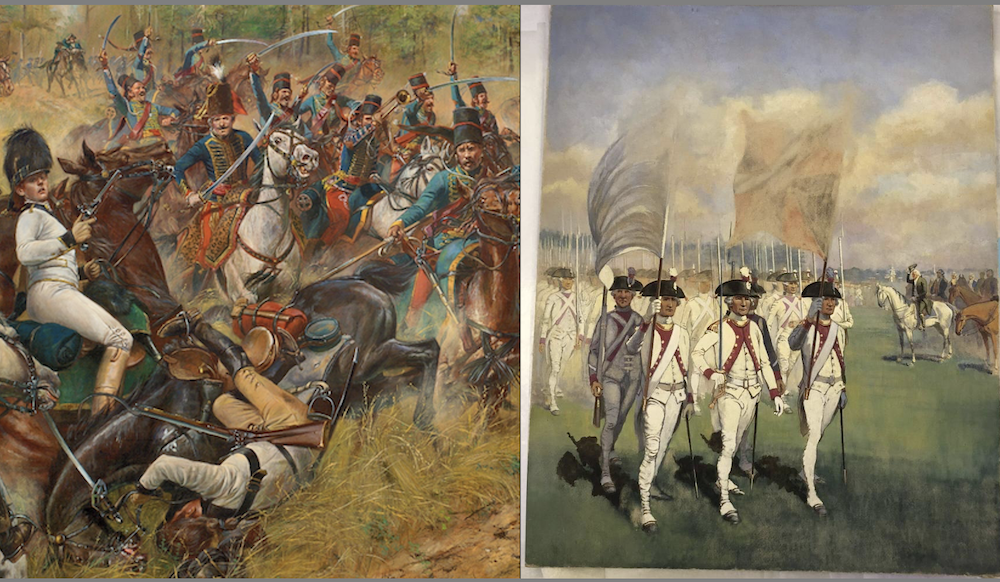
Left: Drapeaux du régime français, Gouvernement du Canada, https://www.canada.ca/fr/patrimoine-canadien/services/drapeaux-historiques-canada/affiches.html#a1
Right: French general Montcalm leading the French army and allied Indian warriors in battle in North America, Seven Years War, https://www.pinterest.com/pin/338966309455885459/
| |
We don't have comprehensive records of where most French soldiers from New France are buried in what is now the United States.
The Challenge:
Unfortunately, we don't have precise numbers or complete records of where French soldiers from New France are buried in what is now the United States. This is because:
- Poor record-keeping: Military burial records from 1650-1763 were often incomplete or lost
- Battlefield burials: Many soldiers were buried hastily in unmarked graves near where they fell.
- Time and development: Centuries of urban development, farming, and environmental changes have obliterated many burial sites
- Scattered locations: French soldiers died across a vast territory from the Great Lakes to the Gulf of Mexico
The French military presence in New France involved thousands of soldiers over this 113-year period, including regular troops (Troupes de la Marine, Compagnies Franches), Canadian militia, and garrison soldiers. Deaths would have occurred from:
- Battle casualties
- Disease (the primary killer)
- Accidents
- Natural causes
Many hundreds, likely thousands, of French soldiers are buried somewhere in the present-day United States, but most in unmarked or lost graves.
Still, we have listed several in our compilation Memories of France. Here are just a few:
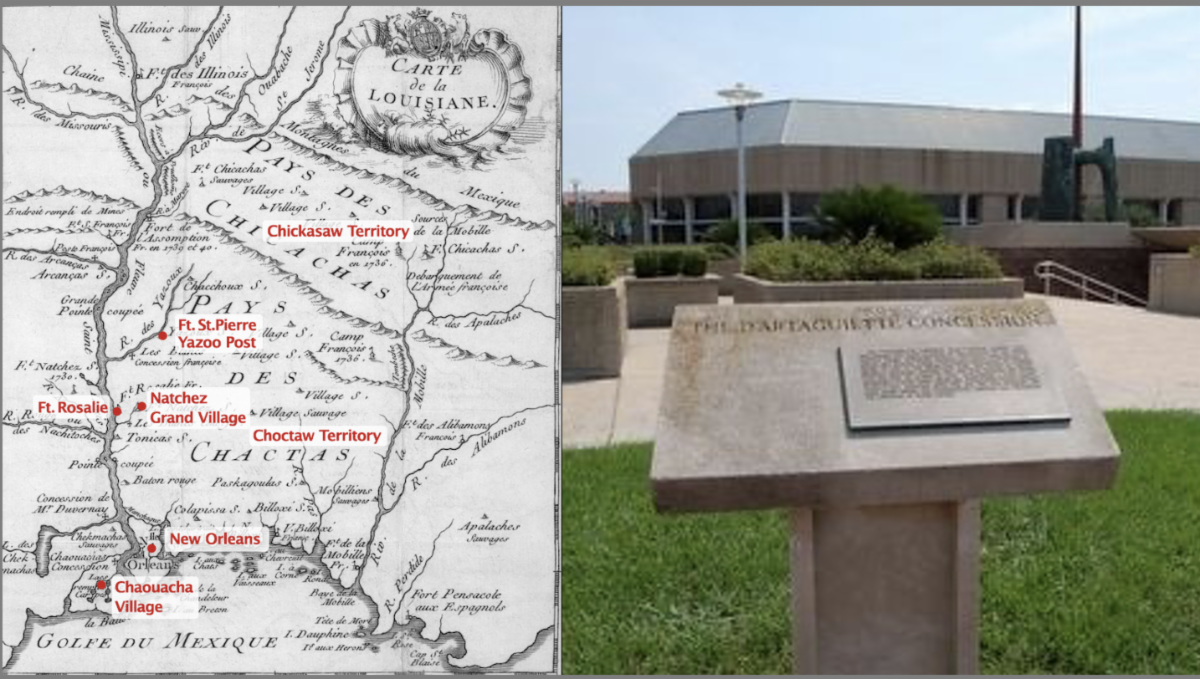
Major Pierre d'Artaguiette
Father Senat, Chaplain
and 18 other soldiers
Pontotoc, Missouri
March 26, 1736
| | |
This story illustrates the immense hardships and sacrifices that these soldiers, chaplains, and colonists endured. This is only one example.
Pierre d'Artaguiette (1684-1736)
• Pierre d'Artaguiette was a French officer born in September 1684 in Mendionde (Basque Country), younger brother of Jean-Baptiste Martin (director of the Compagnie des Indes, Marquis de la Mothe-Saint-Héray) and Bernard, known as “Diron” (also an officer in America). He was a Knight of Saint Louis.
• He arrived in Louisiana in February 1708 at the age of 23. In 1720, he commanded an infantry company at Fort de Chartres (Illinois). Distinguished himself by his “valiant bravery” during the Natchez War (1729-31), he participated in the reconstruction of Fort Rosalie after the massacre of November 1729. Appointed major of New Orleans in 1732, he was then appointed commander of Fort de Chartres in 1734 by Bienville (who thus removed him from the area).
• The Chicachas (Chickasaw), supported by the English and refugees in what is now Tennessee, were stepping up their attacks on the Mississippi, hindering trade between Canada and Louisiana. They refused to hand over those responsible for the massacre at Fort Rosalie
• A coordinated double attack was planned for the end of March 1736, with d'Artaguiette advancing from the north with 30 regular soldiers, 100 militiamen, and 270 allied Indians (Miamis, Illinois), and Vincennes advancing with 40 Iroquois and other reinforcements. Bienville would command the main army (1,000+ men) from the south via the Mobile River
• From January to March, problems accumulated - canoes not ready, storms, waiting for the king's ship (which arrived at the end of February), damaged supplies, flooded rivers, Indian allies discouraged by the rains. Bienville did not leave Mobile until April 2 and did not arrive until May 22-24.
• Unaware of the delays, d'Artaguiette left on February 22 and traveled down the Mississippi in six days. He established his fortified camp on February 28 near Memphis (Chickasaw Bluffs). He left on March 5 for the Chicachas (an 18-day march). Around March 23, he received an obsolete message ordering him to wait for Bienville for “10-11 days”—but Bienville was still in Mobile.
| | |
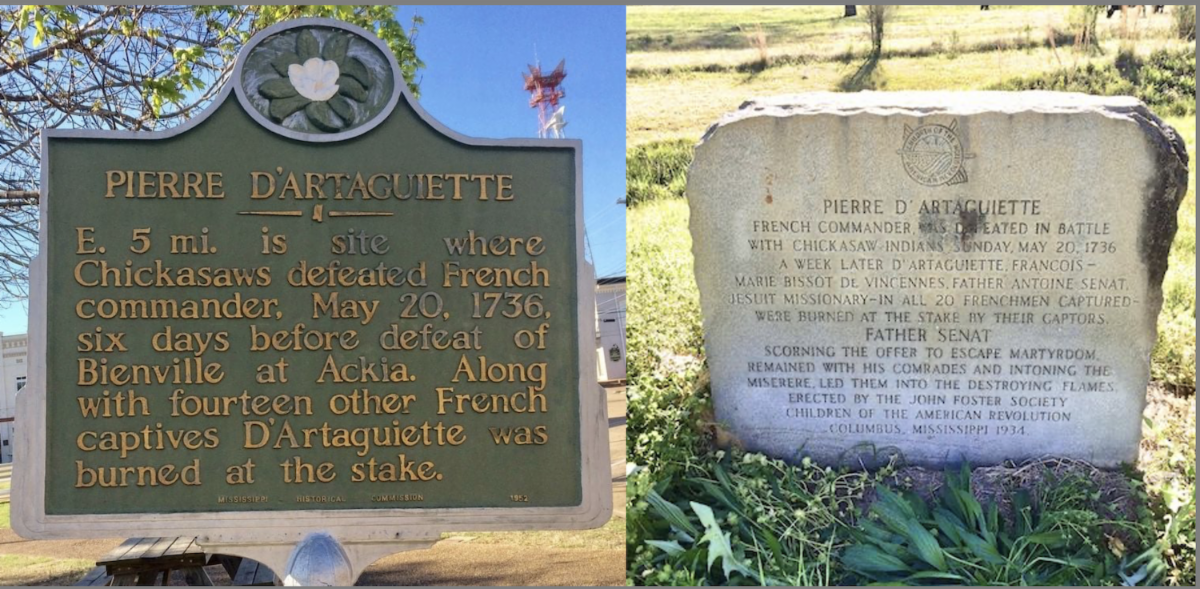
• The disaster of March 25: On Palm Sunday, threatened with abandonment by his starving allies, d'Artaguiette attacked a fortified Chicacha village (possibly Ogoula Tchetoka). He took two mounds, but the third resisted. Surprise: 400-500 warriors emerged from a dozen hidden villages. The Illinois and Miamis (190 men) fled immediately. Caught between two fires, the French were crushed.
• D'Artaguiette, with three fingers cut off by a bullet and wounded in the thigh, refuses to flee on the horse of his servant Pantalon. He continues to encourage his men. A young 16-year-old soldier, Voisin, improvises a retreat, traveling 45 leagues carrying the wounded, pursued for 25 leagues by the Chicachas.
• Casualties and captures: Conflicting sources - Bienville minimizes (32 dead, 3 prisoners), while Le Parisien reports 20 killed and 30 wounded. In reality, around twenty wounded Frenchmen were captured, including the officers Artaguiette, Vincennes, Saint-Ange, Dutisné, Coulonges, and the Jesuit priest Antoine Sénat (chaplain of the expedition).
• Horrific death: Contrary to some accounts claiming that they were spared until May 27, reliable sources (testimony from a freed Indian slave and Richardville, a survivor) confirm that they were tortured and burned alive that same day, from 3 p.m. to midnight. The Chicacha torture was particularly horrible: pine splinters were planted all over their bodies and then gradually set alight. Still, under the guidance of Father Sénat, they kept singing hymns and songs until they died.
• Historical confusion: Historians have long doubted the two-month interval between the two battles. Relying on Dumont, many have set the attack date as May 20 instead of March 25. The commemorative plaques in Pontotoc, Mississippi, and Vincennes, Indiana, contain incorrect dates. The exact locations are still debated: Pontotoc, Tupelo, or Fulton (Mississippi).
• Father Charlevoix (1744), popularized the story in his Histoire et Description de la Nouvelle France. Châteaubriand, after his visit to Louisiana (1791), popularized the episode in Les Natchez (1821).
Among the captured officers and soldiers tortured and killed:
Major Pierre d'Artaguiette, François-Marie Bissot de Vincennes, Louis d'Ailleboust de Coulonges (fils), Pierre Groston de Saint-Ange, lieutenant, Louis-Marie-Charles Dutisné, and Father Antoine Sénat, expedition chaplain, who devoted himself to caring for the wounded. We can add Pierre-Louis Petit de Liviliers fils, Charly de Saint-Ange fils, Coulanges, Duclaude, La Gravière, Belcour, (Pierre-Antoine de), Tonty fils, (François-Louis) Mariauchau d'Esgly, and (Legardeur?) Du Tilly, père. A private letter also gives us the names of three soldiers or militiamen, Lalande, Antoine Carrière, and Dutilly, son (according to Father de Rochemonteix)...
| | |
"The French & Indian War"
(Seven Years' War)
| | |
From the French viewpoint, this conflict (which they called the War of the Conquest, as part of the Seven Years' War, 1754-1763) began as a struggle to defend their vast North American empire - New France - against British encroachment.
French Successes:
Early Military Victories (1754-1757) The French achieved remarkable early successes despite being vastly outnumbered. They had perhaps 60,000 colonists versus 1.5 million British colonists, yet they:
- Defeated George Washington at Fort Necessity (1754)
- Destroyed General Braddock's army near Fort Duquesne (1755) - a stunning victory
- Captured Fort Oswego (1756) and Fort William Henry (1757)
- Under commanders like Montcalm, they used superior tactics, knowledge of wilderness warfare, and strong Indigenous alliances
Strategic Advantages
- Unified military command versus divided British colonial forces
- Effective alliance system with Indigenous nations (Huron, Abenaki, Ottawa, and others)
- Better adaptation to North American warfare
- Control of interior waterways and fortifications
The Turning Point and Defeat:
Why France Lost?
The tide turned dramatically after 1757:
- Britain committed massive resources under William Pitt's leadership
- The Royal Navy blockaded French resupply efforts
-
Overwhelming numerical superiority of the British, lack of strategic and tactical coordination between French, colonial, and indigenous allied forces
- The fall of Louisbourg (1758) opened the St. Lawrence to British attack
- The catastrophic Battle of the Plains of Abraham (1759) led to Quebec's fall
- Montreal surrendered in 1760, effectively ending New France.
Casualties:
Precise casualty figures are difficult to establish, but estimates suggest:
- French regular troops: approximately 2,000-3,000 killed
- Canadian militia: roughly 1,000-1,500 killed
- Indigenous allies: casualties are poorly documented but likely several thousand
The Battle of the Plains of Abraham was particularly symbolic - both commanders (Montcalm and Wolfe) were mortally wounded. However, the greater loss for France was strategic: they lost their entire North American empire, ceded to Britain in the 1763 Treaty of Paris. The rest, West of the Mississippi, Louisiana, "entrusted" to Spain (Bourbon Family Pact).
For the French, this wasn't just a military defeat but the end of New France as a colonial project - a devastating outcome given their early advantages and tactical successes.
| | |
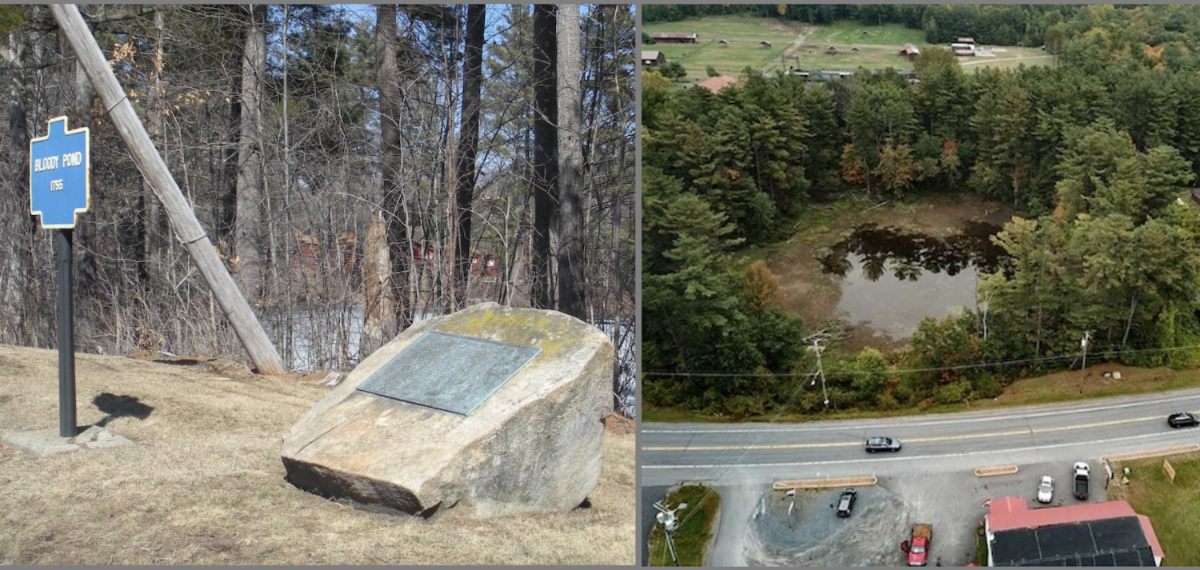
200 soldiers at Bloody Pond
Lake George, NY
September 8, 1755
A mass grave of sorts
| | |
Above:
Left: marker and plaque, photo by John Farrell, March 24, 2009, https://www.hmdb.org/m.asp?m=17376
Right: Aerial view of Bloody Pond, located amidst a vast factory outlet complex
| | |
• Baron Dieskau (full name: Jean Erdman, Baron Dieskau, 1701-1767) was a German-born French Royal Army officer who served as a major general and was sent to Canada in February 1755 to command French troops against the British during the French and Indian War.
• On September 8, 1755, the Battle of Lake George took place between French forces under Baron Dieskau and British colonial forces with Mohawk allies. Dieskau's force included 600 Canadians, 600 Indians, and 200 regular French troops. The battle was won by the British forces, which were made up of American provincials and Mohawk Indians.
• During the battle, Dieskau ambushed a detachment of 1,000 men under Colonel Ephraim Williams in a horseshoe formation, putting them to flight. However, when pursuing to the British camp, Dieskau's 200 regulars were forced to sustain a five-hour fight in which almost all the French regulars perished. Dieskau was shot three times in his legs, and then while helpless at the base of a tree, an enemy soldier shot him through the hips, piercing his bladder. He was captured and remained a prisoner until 1763.
• Regarding casualties, the Colonial losses amounted to 191 killed, 150 wounded and 62 missing, while the French lost 132 killed (mainly among regulars and officers) and 184 wounded. Overall, casualties on both sides were roughly the same at 260-300 dead, wounded, missing, and captured each.
Marker, “Bloody Pond”
1818 US-9, Lake George, NY 12845
GPS: 43.390000, -73.704167
• Inscription (excerpts):
“Here Sept. 8, 1755 (Battle of Lake George) the colonial forces under Lieut. Col. Cole checked the hitherto successful advance of Baron Dieskau and his allies, changing the English rout into ultimate victory. Here likewise on the evening of the same day - Capt. Mc Ginnis assisted by Capt. Folsom with 200 New York and New Hampshire men, fell upon 300 Canadians and Indians encamped near the pond for the night. After a desperate struggle the French force was almost annihilated.
Over 200 bodies rolled into the pool, stained its waters red, and gave it its name. In the conflict Rogers the famous ranger made his debut as a soldier”[...]
Erected 1906 by New York State Historical Association.
Other individual tombs
| | |
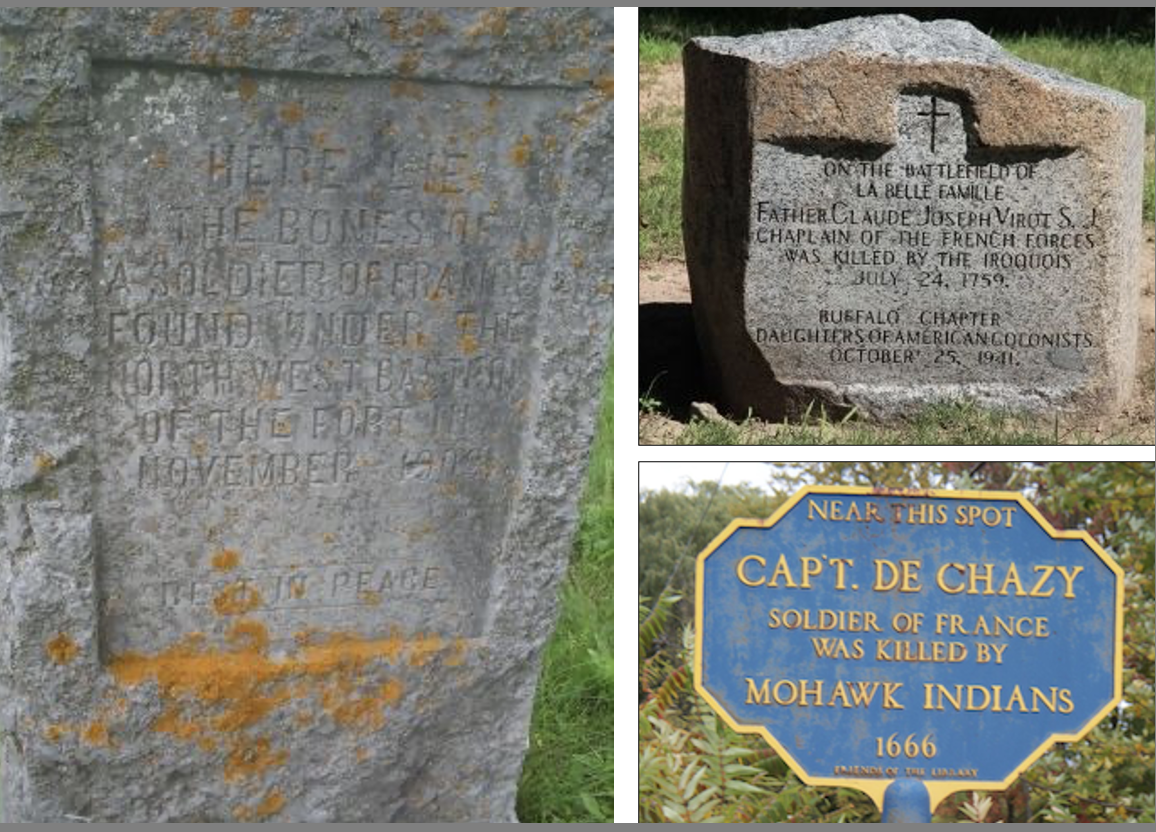
Above: examples of individual grave sites, scattered around Lake George, New York.
Left: individual tombstone of an Unknown Soldier of France, photo by Bill Coughlin, July 11, 2008, https://www.hmdb.org/m.asp?m=9654
Top Right: tombstone of Chaplain Virot, S.J. , photo by Dale K. Benington, July 24, 2013,
https://www.hmdb.org/m.asp?m=67345
Bottom Right: marker, Captain de Chazy, Photo: Image Capture June 2022 © Google Map
| | |
• Fort Ticonderoga formerly Fort Carillon, is a large 18th-century star fort built by the French at a narrows near the south end of Lake Champlain, in northern New York. It was constructed by French military engineer Michel Chartier, Marquis de Lotbinière, between October 1755 and 1757. The fort was of strategic importance during the 18th-century colonial conflicts between Great Britain and France, and again played an important role during the Revolutionary War.
Marker, “A Soldier of France”
Sandy Redoubt, Garrison Cemetery, to the right of the entrance road to Fort Ticonderoga, Ticonderoga NY 12883
GPS: 43.844167, -73.392283
• Inscription:
“Here lie
the bones of
a soldier of France
found under the
Northwest Bastion
of the Fort in
November 1900
Rest in Peace”
Tomb, “Father Claude Joseph Virot, S.J.”
915 NY-18F, Youngstown, NY 14174
GPS: 43.241483, -79.050833
• Inscription:
“On the Battlefield of
La Belle Famille
Father Claude Joseph Virot S. J.
Chaplain of the French forces
was killed by the Iroquois
July 24, 1759.
Erected 1941 by Daughters of American Colonists"
• But there are much older tombs in the area. To wit:
Capitaine de Chazy was part of the Carignan-Salières Regiment from France. Their mission was to ensure safety in the colony of New France during conflicts with the Haudenosaunee, known as the Beaver Wars. Chazy was based at Fort St. Anne, located in what is now Isle la Motte, Vermont, named after Captain Pierre de la Motte from the same regiment.
• Chazy was the nephew of Alexandre de Prouville de Tracy, the Governor of New France. The news of Chazy's death negatively impacted peace talks between Haudenosaunee representatives and Tracy in Trois Rivieres, delaying peace until the next year.
Marker, “Capt de Chazy”
Lake Shore Road (County Route 22), Chazy NY 12921
GPS: 44.904317, -73.382867
• Inscription:
“Near this spot
Capt. de Chazy
Soldier of France
was killed by
Mohawk Indians
1666”
Erected by Friends of the Library.”
| | |
The Revolutionary War
1776-1783
| | |
• In his seminal work "Les 2112 Français morts aux États-Unis de 1777 à 1783 en combattant pour l'indépendance américaine" (Journal de la Société des Américanistes. Tome 28 n°1, 1936. pp. 1-154) published in 1936, Warrington Dawson lists the names of 2,112 soldiers and sailors who died fighting for the independence of the United States.
• Since then, many names have been added, and keep being added to this day by historians and researchers.
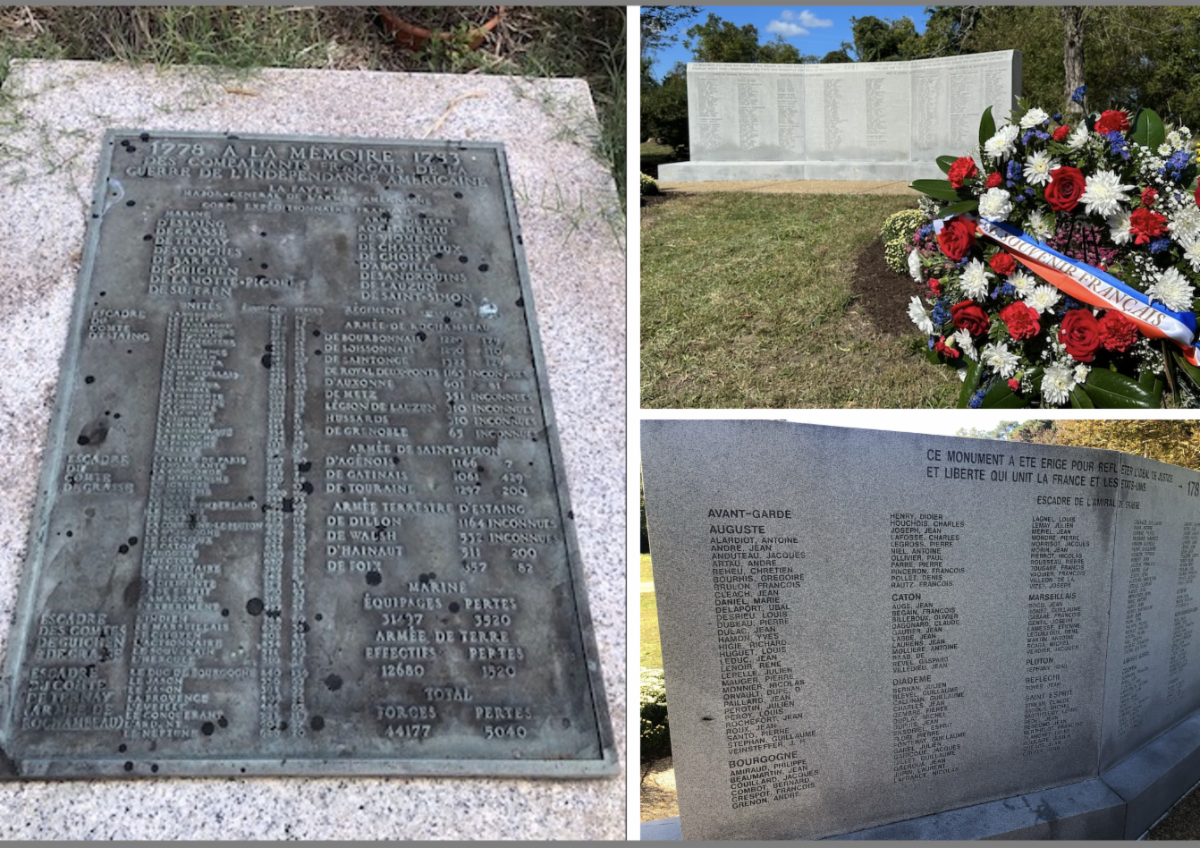
• While the French Memorial Monument in Yorktown only lists those who died in the "Yorktown Campaign", a bronze plaque a few yards away gives an overall number at 5,040, as it includes other campaigns, such as Admiral d'Estaing's Siege of Savannah in 1779, and sailors who died at sea.
Note: the number would be higher if one includes other nearby theaters of operations, directly linked to the North American struggles, such as the Caribbean - - not to mention the Indian Ocean and India, where the French Navy and Army successfully conducted many operations against the British.
Our Society has been in the process of cataloging each name, with GPS coordinates of their tombs or mass graves, whenever possible - - a work in progress, which will be published on our website, as well as excel spreadsheets which we will make available, indicating all relevant sources.
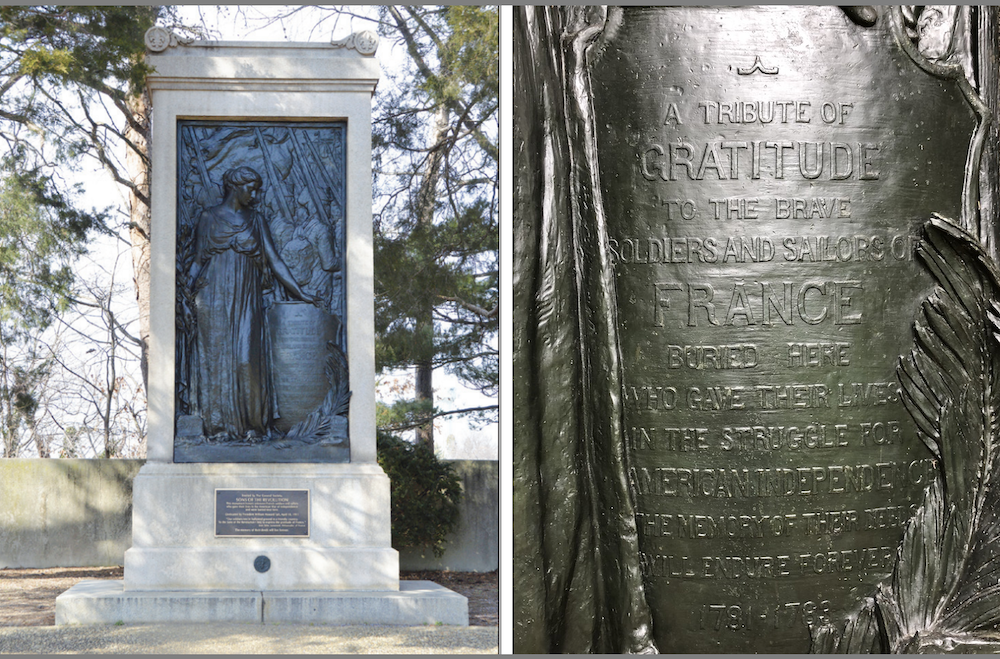
French Memorial Monument
Fusiliers Redoubt, Yorktown, VA
GPS: 37.240875, -76.521614
• This monument honors 600 common soldiers and sailors, who made the ultimate sacrifice and whose names are inscribed on both sides of the stone. About half were soldiers who died during the siege that led to the British surrender on Oct. 19, 1781. The others are sailors killed when the French fleet defeated the British off Cape Henry, known as the Battle of Chesapeake under Admiral de Grasse, thus cutting British supply lines.
• A few feet from the French War monument is a bronze plaque that provide some significant statistics on the sacrifice of French soldiers and sailors who gave their life so that the United States could become an independent nation during the Revolutionary War between 1778-1783.
• French Navy: Total: 31,497 sailors Dead: 3,520
• French Army: Total: 12,680 soldiers Dead: 1,520
Total: 44,177 Dead: 5,040
From original sources (Regimental "controls"), we know, for instance, that 63 are buried in Baltimore, 334 in Newport, 26 in Charleston, 71 in Providence, 81 at "Unknown locations", etc... so, research continues!
It is obviously beyond the scope of this Bulletin to lists all the French tombs and mass graves in the United States of the period. We will just visit a few notable sites in the following pages.
| | |
The First French casualty:
Cpt. Louis O'Hicky Arundel
July 9, 1776
| | |
• Louis O'Hicky Arundel was a French volunteer officer. In the official records of the period, he is called Dohickey Arundel. He signed his name as D’ohicky Arundel.
• He hailed from the Province of Alsace, of an old Irish or Welsh family established in France a century before. He was breveted from the Royal Artillery School of Strasbourg, and served as a lieutenant of artillery on the Island of St. Domingue.
• He was one of the very first French officers volunteers to fight for the "Insurgents". On February 5, 1776, he was recommended to the Continental Congress and his commission as a captain of artillery was dated February 8, 1776.
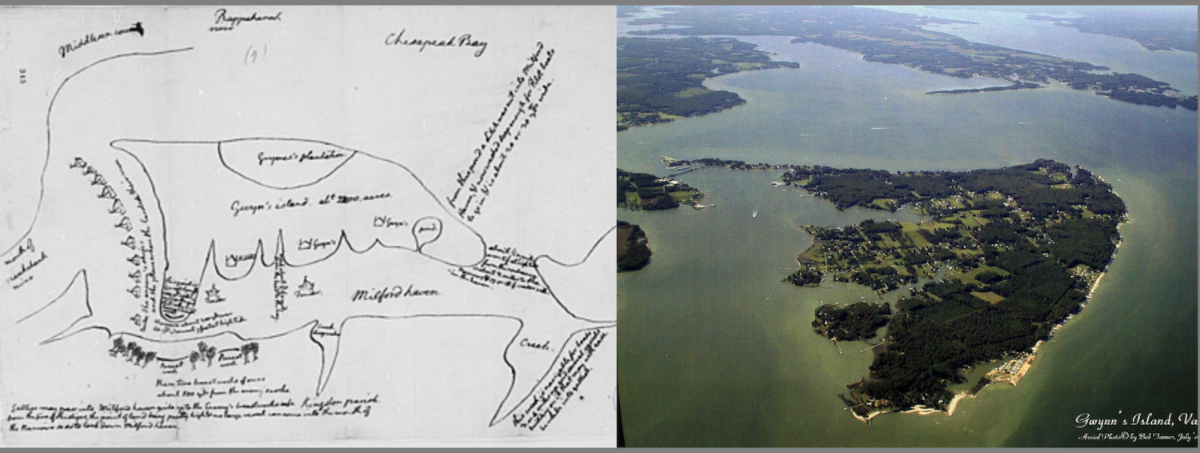
• On July 9, 1776, during an artillery engagement against the British ships Dunsmore (actually a 18 cannon converted merchant vessel from the Virginia Colonial Navy) and the HMS Otter at Gwynn Island, after a rather successful bombardment, Capt. Arundel tried to fire an experimental mortar made from a pine log reinforced with iron. The makeshift mortar exploded, partially decapitating the captain, making him the only reported Patriot casualty and the first French officer to die in the Revolutionary War.
• He is likely buried in the vicinity of this tragic accident, near the US Coast Guard station alongside route 223-Cricket Hill Road
GPS: 37.487689, -76.309460
Our Society will join the Virginia Society of the Sons of American Revolution to honor him with a marker as part of the America250 celebrations. This marker would be on public property at a visible spot.
In our March 2025 Bulletin, https://conta.cc/4honqcW, we publicized an article written by Mr. Patrick Hannum:
https://allthingsliberty.com/2025/02/cricket-hill-and-gwynns-island-captain-arundels-only-fight/
Chevalier de Saint-Sauveur
1750 - 1778
Boston, MA.
| | |
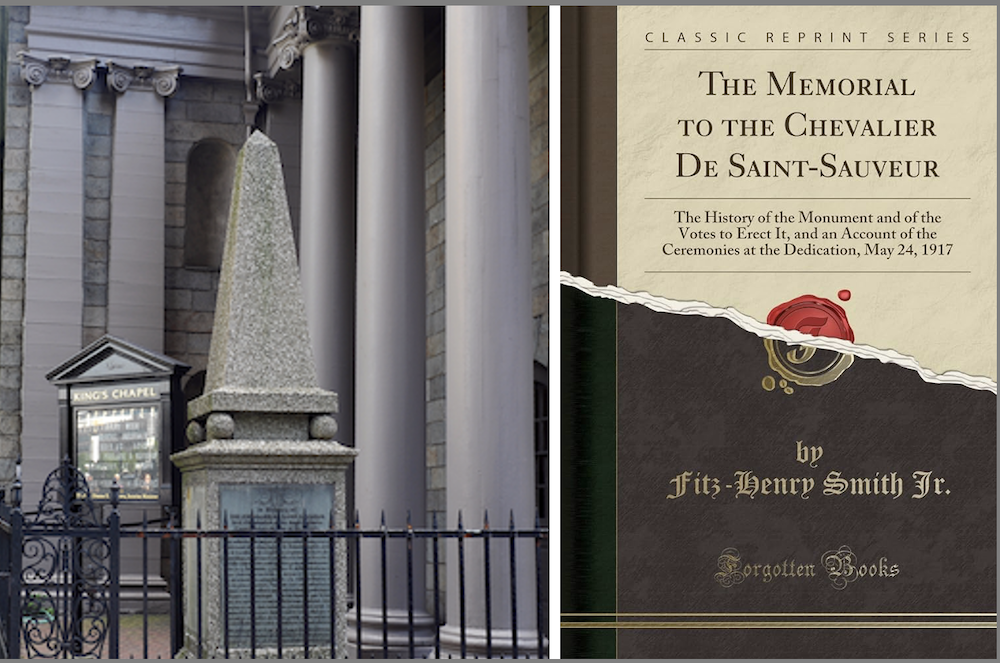
• Chevalier (also Comte) de Grégoire de Saint-Sauveur (1750-1778) was a chamberlain to Count d'Artois, brother of King Louis XVI and future (and last) King of France under the name of Charles X and enlisted Navy Officer on board ”Le Tonnant”.
• The Chevalier was killed by a mob in 1778, after a brawl in a bar, which potentially could have derailed the Franco-American alliance that would be so crucial to American independence. Both LaFayette and Admiral d’Estaing played a role in cooling tensions, as the City’s elders were taken by surprise by this most regrettable incident.
• It is believed that there was resentment from some parts of the population in Boston (mostly a few Tries, loyal to the English, and perhaps encouraged by a nearby camp of British prisoners) at the view of the French being well fed and dressed, establishing bread ovens, when the town was going through a famine. An altercation at the bar took place, and Chevalier de Saint aSauveur drew his sword but was overwhelmed by the mob, who hit him while on the ground with iron bars. He died a couple of days later in horrible suffering with skull fractures.
• City elders promised to the French to erect a monument in attrition, and voted the funds, however it took a century to actually build it. It was not placed until 1917 as Boston leaders attempted to show that support for the French during World War One. In the end, the monument, although prominently placed in front of the King’s Chapel and in full view from the street with an obelisk, with its inscription mostly in French, is mostly ignored by pedestrians.
• To remedy this, we hope to be able to install an interpretive marker in English nearby.
Memorial Saint Sauveur
Intersection of Tremont Street and Beacon Street, Boston, MA 02108
GPS: 42.358134, -71.060216
• Inscription:
In Memory of
The Chevalier de Saint Sauveur
first Chamberlain of his Royal Highness, Count d'Artois, brother of his Majesty the King of France
(English translation - - the inscription is engraved in French):
"This officer, aide-major of the French squadron and lieutenant de vaisseau [on the Tonnant] after having had the pleasure of risking his life for the service of the United States, was fulfilling his duty when he was the victim of a riot caused by malicious people: his death came [on September 15, 1778] with the same attachment to America, the bonds of duty and inclination that attach his compatriots to the city of Boston were only more tightened. May it be so unsuccessful as ever to make every effort one might try to separate France and America. This is the prayer that will be made in the centuries to come to God almighty, every Frenchman and every American who will cast their eyes on the mausoleum of a young man, taken from friends who can only comfort themselves from the loss by seeing such funerary flowers spread on his tomb."
This inscription was prepared by the Comte d'Estaing, the Admiral commanding the first French squadron sent to the United States of America.
Erected 1917."
Admiral de Ternay
Two officers of the Hermione
1780
Trinity Churchyard, Newport R.I.
| | |
Above:
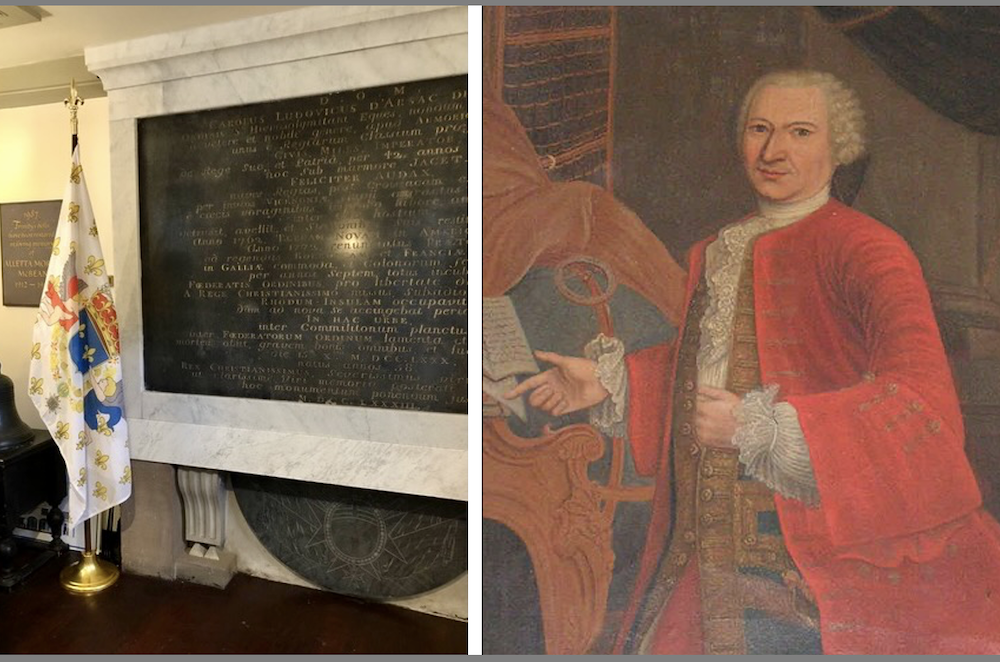
Top Left: Marble plaque transferred inside the vestibule of Trinity Church to protect it from the elements, with the French Royal Navy standard, photo TC © ASSFI 2021
Top Right: Admiral de Ternay, By Unidentified painter - Château de Ternay, Public Domain, https://commons.wikimedia.org/w/index.php?curid=15975136
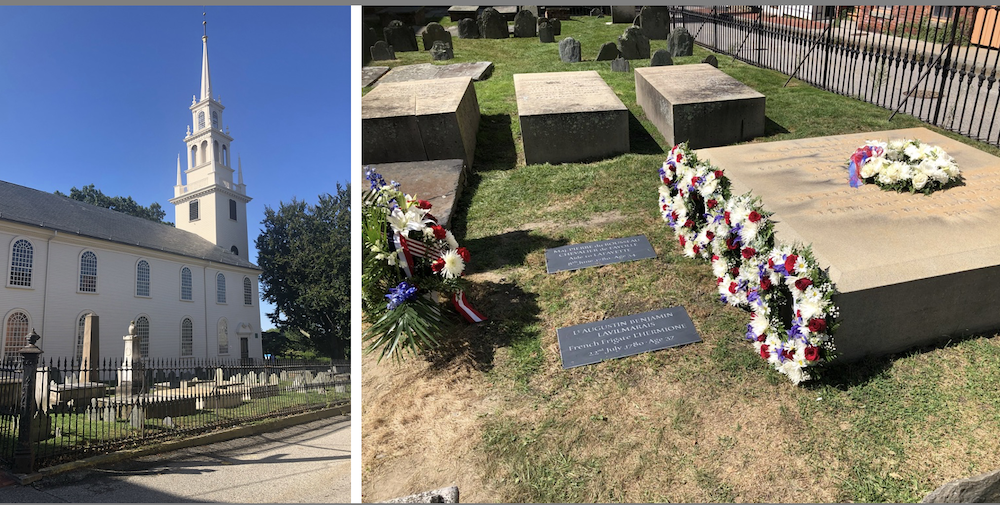
Bottom Left and Right: Trinity Church historical churchyard where the grave markers of the two French officers were placed next to their Admiral, dedicated by our Society on September 20, 2021.
Photos TC © ASSFI 2022
| | |
• Charles-Henri-Louis d'Arsac, chevalier de Ternay (27 January 1723 - 15 December 1780) was the French admiral in command of a squadron of seven ships of the line and three frigates that convoyed 32 transports carrying Rochambeau’s army to America.
• Admiral de Ternay died on December 15, 1780 of typhus shortly after meeting George Washington with Rochambeau in October. On December 16, 1780, a procession starting from the Hunter House on Water Street (now Washington Street) led by military men and nine Catholic chaplains, wound its way through the streets of Newport. A fifteen-gun salute was fired as soon as the casket came into sight of his flagship, the 80 gun ship of the line Duc de Bourgogne, which was anchored in Newport Harbor. A cannon was fired every half-hour for the rest of the day and flags were at half-mast. Newport residents lined the streets to watch as the French military commemorated Admiral de Ternay and lowered him into the ground.
• He was buried in the cemetery of the Trinity Church where his large tombstone is regularly honored. Inside the church’s vestibule is a memorial plaque given by King Louis XVI and the United States Congress in his honor. He was posthumously enrolled in the Society of Cincinnati for his role in the war.
Tomb & Plaques: Admiral de Ternay
Two officers of the frigate Hermione:
Major Pierre du Rousseau, Chevalier de Fayolle,
Lt. Benjamin de la Villemarais
Trinity Church, Newport R.I.
141 Spring St. Newport, RI 2840
GPS: 41.487440, -71.313012
• Inscription (in Latin):
"In the name of God
CHARLES LOUIS d'ARSAC De TERNAY
Knight of the Order of St. John of Jerusalem
Though the Vows of the Order he had never acknowledged
descended from an ancient and noble family of Bretagne
One of the Admirals of the King's Fleets a Citizen, a Soldier, a Chief,
serviceably faithful to his King and country, for 42 years,
now rests beneath this marble."
• For more information on Admiral de Ternay, the Chevalier de Fayolle and Lt. de la Villemaris, please read our March 2021 Bulletin: "Honoring two French Navy officers from Rochambeau’s army buried in Newport, RI."
https://conta.cc/3vgTuZy (original version in English)
https://conta.cc/3bC7aGJ (version en français)
French Soldiers & Sailors
Fort Independence
Boston Harbor, Massachusetts
1780-1782
| | |
• Fort Revere (originally called Castle William by the British ) was called Fort Independence in 1797 and later named in honor of Paul Revere. It was used to protect Boston Harbor dating from the American Revolution through World War II. The fort was re-built and expanded in 1800-1803 under the first system of US fortifications (some sources place it in the second system), as designed by French-born military engineer Jean Foncin.
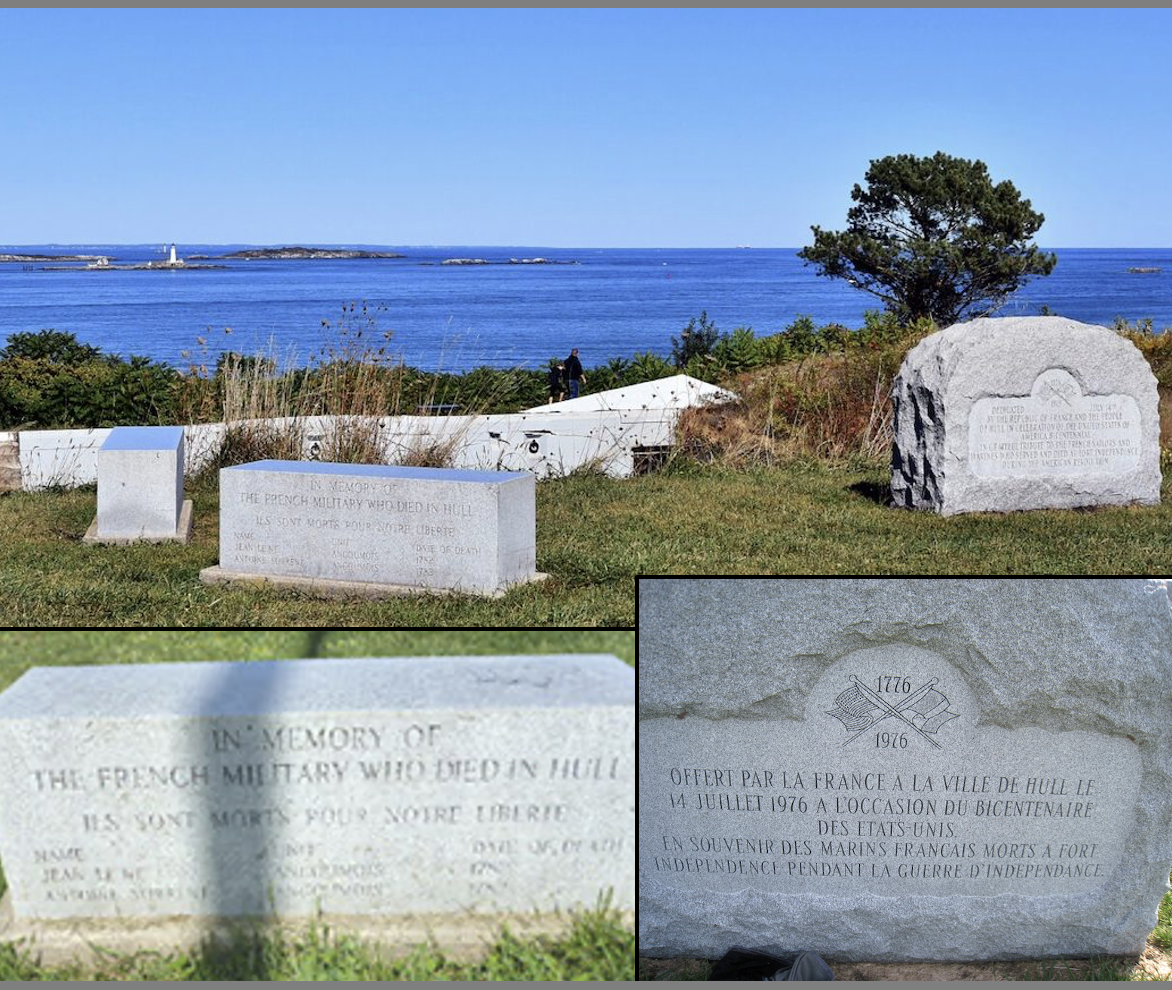
• During the Revolutionary War in 1777-1778 it was manned by a detachment of French Marines under the command of Admiral d’Estaing, and the place of an exchange of French and British prisonners. They died of smallpox and are buried in a slope, but the exact location is still unknown.
• There are presumably between 150 to 200 French soldiers who died here while fighting for America in the Revolutionary War. Those French soldiers, who had been captured in Nova Scotia by the British while fighting for the Americans, were exchanged for English prisoners in Hull, a solid bastion manned by French marines whose job was to keep the British fleet out of Boston Harbor.
• The French marines of Fort Independence buried them on a gentle slope beneath the hill where the fort stood. There were no markers erected then, and no one has yet been able to find the exact location to locate the remains of the soldiers. Locals report that visitors see ghosts in the numerous underground tunnels...
Grave Headstone, “French Military”
60 Farina Rd, Hull, MA 02045
GPS: 42.304483, -70.903417
•Inscription:
"In Memory of
the French Military who died in Hull.
Ils sont morts pour notre liberté.
• Jean Le Ne, Angoumois Unit, died 1782.
• Antoine Sorrent, Angoumois Unit, died 1782.”
Note: we have 30 additional names on our lists.
• Inscription (in French):
“Dedicated July 14th by the Republic of France and the people of Hull in celebration of the United States of America bicentennial. In grateful tribute to the French sailors and marines who served and died at Fort Independence during the American Revolution.
Erected 1976.”
Jean Baptiste Tronson du Coudray
Maj. Gen. Continental Army
Sept. 11, 1777
| | |
Above:
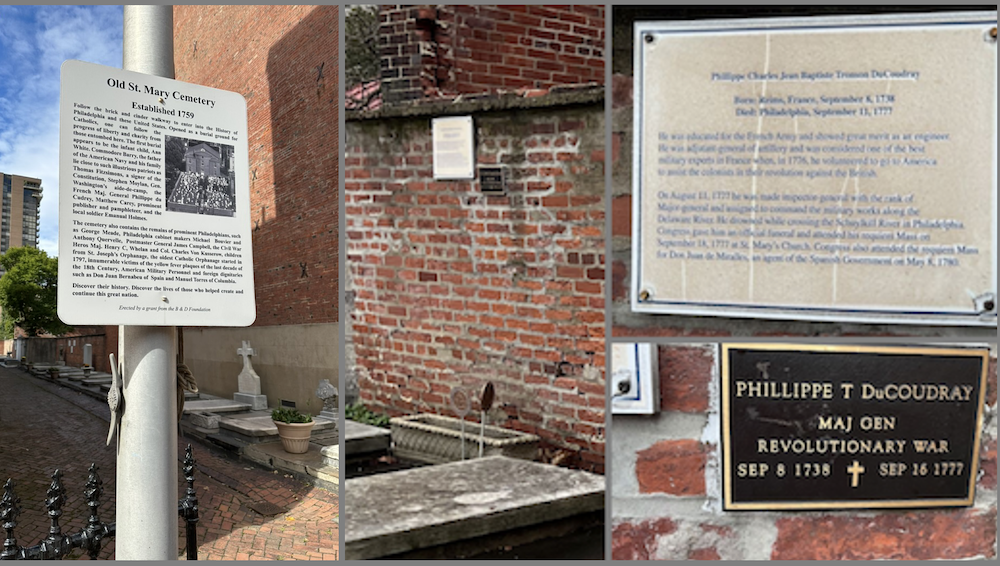
There are no known portraits of the unfortunate engineer. Note, several web sites are mistakenly using other portraits, confusing him with other Du Coudray family members.
Right: Photo by Devry Becker Jones (CC0)
https://www.hmdb.org/m.asp?m=213976
Left: entrance of St Mary's Cemetery, Philadelphia, photo by TC © ASSFI 2025
| | |
• Philippe Charles Jean Baptiste Tronson du Coudray (September 8, 1738 – September 11, 1777) was a French army officer who volunteered for service in the Continental Army during the American Revolutionary War.
He entered the French military and became a noted Artillery officer, writing treatises on gunpowder and metallurgy, eventually reaching the rank of Adjutant general,
• Silas Deane described him as the "first engineer" of the French military establishment, and endeavored to recruit him with the rank of major general and command of the Continental Army's artillery and engineering corps. Overzealous in his drive to recruit volunteers and gathering 200 cannons, Du Coudray annoyed the French Court which wanted to keep things quiet at the time, and was ordered to stay in his residence. Instead, Du Coudray went on and embarked for America in May 1777.
• Upon his arrival, Du Coudray faced strong jealousy from the American officers who resented foreigners being awarded superior ranks and authority. To calm the situation Du Coudray was instead appointed as "Inspector General of Ordnance and Military Manufactories" in August 1777.
• His assignments in surveying the defenses around Philadelphia, Fort Mercer (Red Bank), Fort Billingsport, Fort Mifflin, led to recommendations that were not followed, increasing the mutual recriminations and effectively slowing work.
At one point his strong temper and inability to compose with his superiors and entourage became a critical issue.
• He died prematurely in a tragic riding accident when his horse leapt from a pontoon bridge into the Schuylkill River. His spurs got tangled and he drowned under his horse. His funeral, held at St. Mary's Church in Philadelphia, was attended by many Congressional representatives. He was buried in the church yard, but the exact grave location is unknown, although a tombstone with his (barely legible) initials "JBTC" exists.
• The name “Phillippe” on the plaque on the wall of the cemetery is mispelled, but the last name is at least almost correct (should be in two words). The date of his death is erroneous, it should be Sept. 11, 1777.
Plaque & tomb, «Phillippe (sic) Charles Jean BaptisteTronson DuCoudray»
Old Saint Mary's Parish/Roman Catholic Church cemetery, 242 S 4th St, Philadelphia, PA 19106
GPS: 39.945871, -75.148803
• Inscription:
“Philippe T. DeCoudray
Maj. Gen.
Revolutionary War
Sep 8, 1738 ✞ Sep 16, 1777”
• Inscription:
“He was educated for the French Army and showed great merit as an engineer. He was adjutant-general of artillery and was considered one of the best military experts in France when, in 1776, he volunteered to go to America to assist the colonists in their revolution against the British.
On August 11, 1777 he was made inspector-general with the rank of Major-general and assigned to command the military works along the Delaware River. He drowned while crossing the Schuylkill River in Philadelphia. Congress gave him an official funeral and attended his requiem Mass on September 18, 1777 at St. Mary's Church. Congress also attended the requiem Mass for Don Juan de Miralles, an agent of the Spanish Government on May 8, 1780.”
Soldiers and Sailors killed at the
Siege of Savannah
October 19, 1779
| | |
Above:
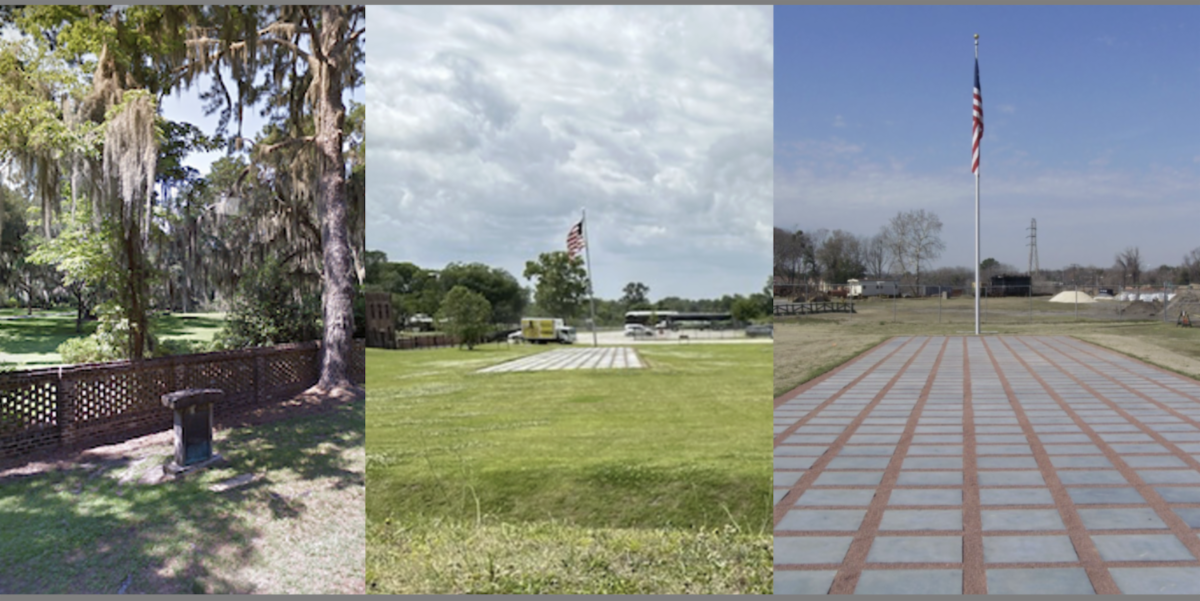
Left: Beaulieu Plantation, Image Capture Jun 2019 © Google 2021
Center: 800 Pavers memorializing the casualties on the battlefield, Photo by TC © ASSFI 2023
Right: close up, photo by Mike Stroud, February 16, 2008, https://www.hmdb.org/m.asp?m=17362
| | |
• Vice-Admiral Charles-Henri d'Estaing had sailed from San Domingo in the West Indies in August; his French troops had been disembarked in September at Beaulieu Plantation on the Vernon River. The French troops and American militia, numbering 5,500, half-encircled the British in Savannah on September 15. Within the city, the British forces were approximately 2630. When the battle ended at Spring Hill that October 9th morning 333 British, French and American soldiers and 32 officers were dead; 377 lay wounded. The dead were buried in a mass grave probably on the site of the present Savannah visitor's Center.
Marker “Beaulieu Plantation”
478 Beaulieu Avenue, Savannah, GA 31406
GPS: 31.934400, -81.111983
Interpretative marker, “To Arms”
Savannah Visitors Center, Parking Lot
315 Martin Luther King Jr Boulevard, Savannah GA 31401
GPS: 32.075800, -81.100800
• Inscription:
“The 800 stones before you have three meanings:
*They represent the approximate number of soldiers killed or wounded in Savannah on the foggy morning of October 9, 1779.
*The stones are arranged as a column, with ten soldiers across. The French and American allies formed five such columns of men to attack the fortified British.
* Inscribed on the stones are names and stories of people throughout the entire Revolutionary struggle from all the states, countries and cultures involved.
To your left stands a granite marker identifying the location of the Spring Hill redoubt, one of 14 British earth fortifications surrounding Savannah in 1779. It was here that the thousands in the French and other allied American columns tried to smash through the hundreds of British and loyalists defending this area. The allied columns were meant to attack simultaneously, in overwhelming force. Due to poor communications, they arrived separately, disoriented and tired from hours of marching in the dark woods. With volunteers leading each column up the foggy slops, the soldiers attacked with fixed bayonets. As the columns advanced, artillery and small arms crossfire killed and maimed commanders and private soldiers alike. The redoubt became a scene of hand-to-hand combat with swords and bayonets clashing.Families from Virginia to the Carolinas, from Poland to Scotland, from France to Haiti, from Germany to England would mourn the loss and suffering of loved ones who spilled their blood on the ground surrounding the Spring Hill redoubt.”
• For a detailed story of the Siege, please refer to our February 2025 Bulletin: "The Battle of Savannah (1779) and the "Chasseurs Volontaires de Saint Domingue”
https://conta.cc/4ay3TFa (original version in English) / https://conta.cc/4i13c9W (version in French)
• Note: many wounded French soldiers and sailors were hospitalized on board French ships, and those who died were likely thrown in either mass graves on shore or thrown overboard. In addition, we have the names of 25 of them who died in Charleston in the following weeks, however the exact location is unknown. No marker exists with their names, which our Society is keen to remedy with the Daughters of the American Revolution.
Col. Louis de la Radière
October 30, 1779
West Point, NY
| | |
Above:
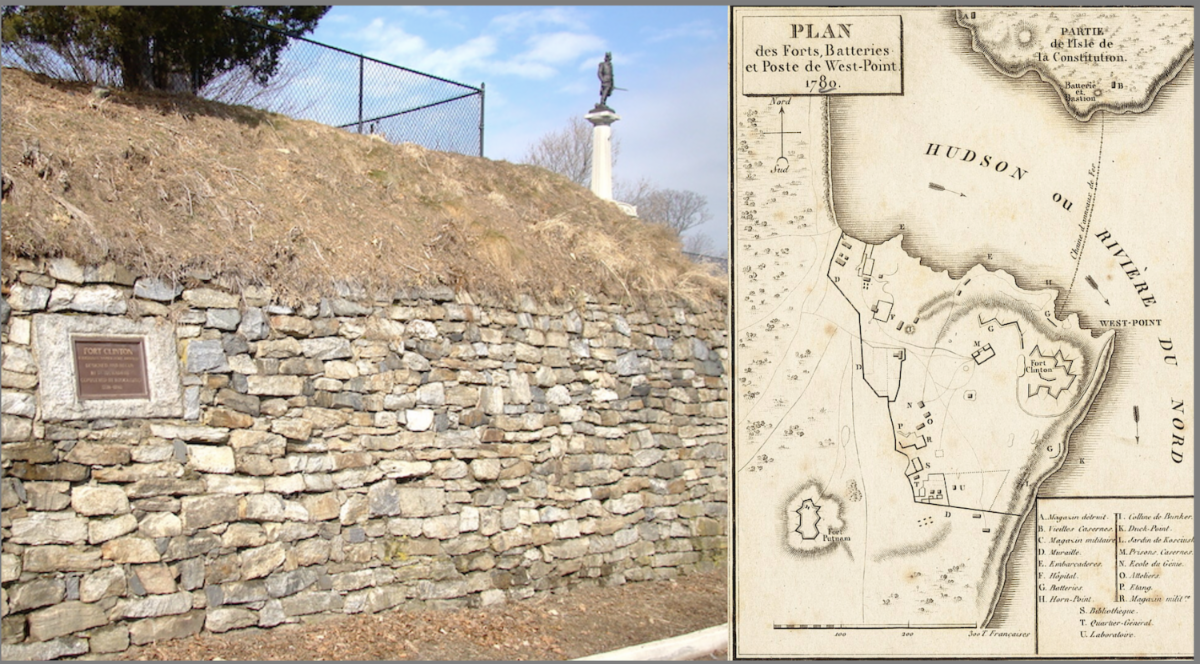
Left: Plaque Louis de la Radière, "Fort Clinton", West Point Military Academy, Photo: By Ahodges7 - Own work, CC BY-SA 3.0, https://commons.wikimedia.org/w/index.php?curid=5928501
In the background is the statue of Kosciuszko, who completed the work after de la Radière died.
Right: "Plan des forts, batteries et poste de West-Point, 1780", Publisher: P. Didot, Uploaded by tm, CC BY 2.0, https://commons.wikimedia.org/w/index.php?curid=27807856
Notice the scale 100 Toises françaises (1:13,000)
| | |
• Louis-Guillaume-Servais des Hayes de La Radière (1744–1779), was a graduate of the French engineering school at Mézières who had attained the rank of captain in 1775. He was one of the four French engineers ((with Duportail, Gouvion and de Laumoy)) whom the American commissioners in Paris engaged for the Continental army in February 1777. Brevetted a major before leaving France in March 1777, La Radière was appointed a lieutenant colonel by Congress on 8 July 1777, and he was promoted to colonel on 17 Nov. 1777. In August 1778 he was sent to Rhode Island to assist with Sullivan’s operations. Col. De la Radière made great contributions to the works at West Point under the direction of Duportail. He was killed at West Point on October 30, 1779.
• In January 1780, George Washington wrote to the president of Congress that “it is to be lamented that Colonel De La Radière is no longer among the number. Congress have no doubt heard of his death, which happened in [October] last, and was regretted as the loss of a very valuable officer.”
Plaque, Louis de la Radière
West Point Military Academy, Clinton Pl, West Point, NY 10996
GPS: 41.394467, -73.952517
• Inscription:
Fort Clinton
(Originally named Fort Arnold)
Designed and begun by De La Radière
Completed by Kosciuszko
1778-1780
• Note: We have three other French soldiers who died at West Point in 1782, who do not have a plaque. We hope to obtain permission to install one with their names and regiments, next to the one at La Radière.
• For more information on de La Radière (and du Coudray presented above) please read our February 2023 Bulletin: George Washington’s French engineers
https://conta.cc/3XBjqMp (original version in English)
https://conta.cc/412e0Nr (version en français)
Mass Grave of
French Soldiers in
Providence, R.I.
| | |
Above:
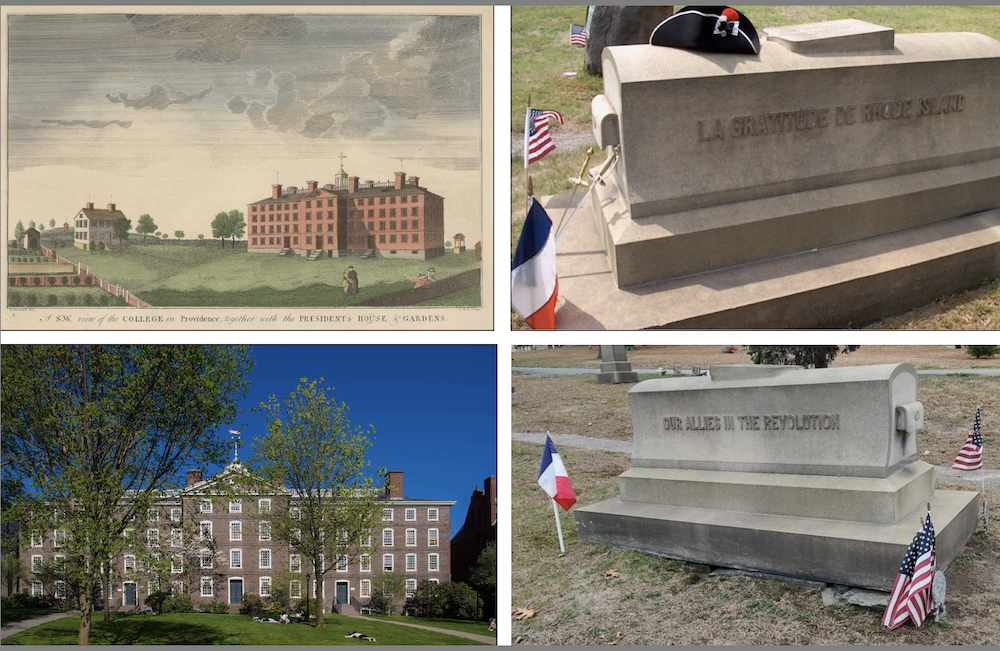
Top Left: By David Leonard, 1792 - https://blogs.brown.edu/bulspecialcollections/2012/08/31/rhode-island-slavery-and-the-university/, Public Domain,
Bottom Left: By Kenneth C. Zirkel -https://commons.wikimedia.org/w/index.php?curid=21517483
Top Right & Bottom Right: Memorial to French soldiers, photos courtesy of Prof. Norman Desmarais
| |
• From the original Regimental "Controls" registers, we have the names and service records of 71 soldiers and sailors who died in Providence or at the Providence hospital during the time of the French Army’s presence in Rhode Island. Most of the soldiers died in September (12) and October (6) of 1780. The registers do not indicate any cause of death, but many probably died of yellow fever.
• The idea for a memorial was conceived by Reverend Frederic A. Denison of Providence, who extensively researched the fate of French soldiers who had perished while stationed in the city a hundred years earlier. After exhumations confirmed the location of the unmarked graves, the city graded the landscape and authorized Denison to raise the funds necessary for a monument. In 1881, the French delegation to the Yorktown Centennial visited Providence to examine the gravesite and decorate the unfinished memorial with floral crosses.
• For the July 4, 1882 dedication, the French Minister of War, General Georges Boulanger wrote, “we will always remember the greeting we received throughout the United States, and in particular in Rhode Island, with sentiments the most sweet and the most cordial.”
• As French Consul-General in Boston A. La Faivre noted, they were the “elite of our land and naval forces” and went on declaring to the citizens of Providence that “on the tombstone, raised by your hands, these two nations, these two sister republics, join hands today across the Atlantic Ocean.”
French Memorial, Providence, RI
North Burial Ground, 5 Branch Ave., Providence, R.I. 02904
GPS: 41.84821, -71.407306
• Inscription:
“Gratitude of Rhode Island”
On other side:
“Our Allies in the Revolution”
Marker, Brown University Hall, hospital for the French troops
University Hall, Brown University, Providence, RI 02912
GPS: 41.826147, -71.403897
• Inscription (excerpts from marker in Memorial Park):
“Brown's University Hall, then known as "College Edifice," was put in use as a hospital for the French army soon after their arrival in Newport. Some of the French soldiers became ill on the voyage from France, and others fell sick over the winter. At least 18 French soldiers are known to have died and been buried in Providence's North Burying Ground”.
• Note 1: Thanks to volunteers including Prof. Norman Desmarais, Regional Delegate of our Society, and re-enactors of the Bourbonnais Regiment, a ceremony is held every year in November to honor them and all the Patriots buried in that site. Scroll down to Part III of this Bulletin for this year's photos.
• Note 2: We also have the names and service records of 334 French soldiers and sailors listed as having died in a hospital in nearby Newport, R.I., who are resting in mass graves, exact location unknown.
Isolated French soldiers
Rochambeau's Army
| | |
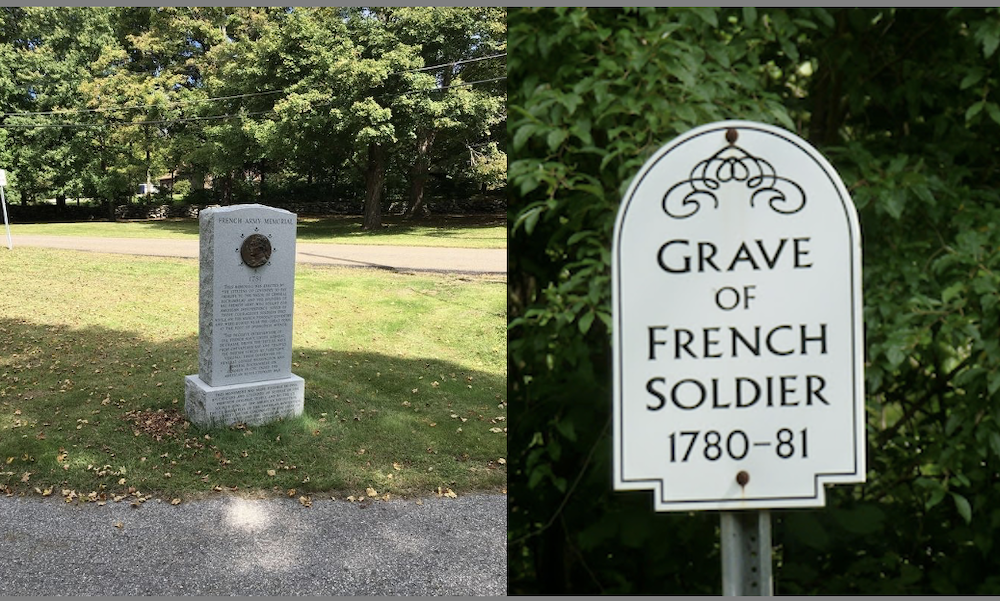
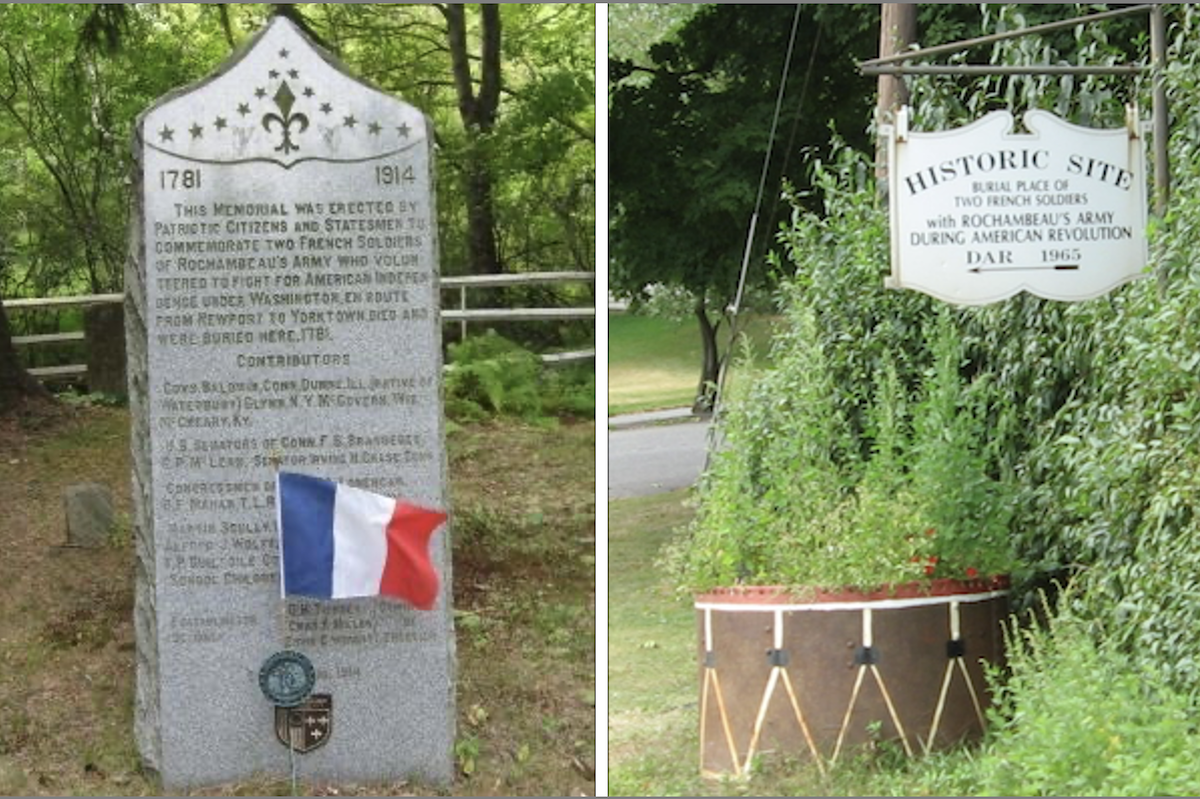
Above:
Top Left: French Memorial, Coventry, CT, Photo by Brandon D Cross, September 16, 2019, https://www.hmdb.org/m.asp?m=190089
Top Right: Sign located on the Colchester Road (Route 207), Lebanon, CT
https://www.carolynstearnsstoryteller.com/3-hauntingly-interesting-connecticut-places/
Below: East Farms Cemetery, Waterbury, CT, Photo credit: Michael Herrick of Southbury, CT
https://www.hmdb.org/m.asp?m=36024
| | |
French Army Memorial, Coventry, CT
At Patriots Park, intersection of High Street and 124 Lake St, Coventry CT 06238
GPS: 41.765782, -72.306203
• Inscription:
1781
“This memorial was erected by the citizens of Coventry to pay tribute to the valor of General Rochambeau and the soldiers of his French Army who fought for American Independence. Seven of those courageous soldiers died while on march through Coventry and were buried near the Great Pond, at the foot of Springdale Avenue.
The decisive intervention of the French Navy, under Admiral De Grasse, drove the British Navy from Chesapeake Bay and trapped The British forces at Yorktown, Virginia. Their surrender to General George Washington and General Rochambeau on October 19, 1781, ended the American Revolutionary War.
This monument was made possible in 1998 by citizens and students of several of the Thirteen original States, and by the CT. Society of Sons of the American Revolution, The Ct Daughters of the American Revolution, The Society of the Cincinnati in the state of Connecticut, and the American Society of Le Souvenir Français.”
Grave of French Soldier (1780-1781)
Located on the Colchester Road (Route 207), Lebanon, CT
The story below originated in a New York Sun article published in 1879 and may be fictional to most historians, however the marker is real.
"While Lauzun's legion of hussars were quartered in Lebanon, in the winter of 1781, some depredations by his troop were committed upon the poultry, pigs, and sheep of the inhabitants, one of the latter being taken from the fold of even good old Parson Williams. When these complaints reached the ears of the duke, in view of the fact that the people of the whole town had vied with each other in extending the most cordial hospitalities and furnishing the most abundant supplies to this whole corps, their chivalrous commander was deeply mortified, and resolved on its summary suppression. A few of the suspected hussars, from fear of consequences, deserted from camp and fled into the country. One of the more prominent of these was soon after recaptured and brought into camp about nightfall. A court-martial was immediately ordered, by which the soldier was tried that same evening, convicted of desertion, and sentenced to be shot, and was shot at sun rise the next morning in the presence of the whole corps, who were ordered out to witness the execution. This summary example effectually ended all further depredations."
History of New London County, Connecticut: With Biographical Sketches of Many of its Pioneers and Prominent Men, by Duane Hamilton Hurd, J.W. Lewis & Company, 1882, page 489.
• There is a Memorial to Two Unknown French Soldiers, serving in Rochambeau's Army, located in East Farms Cemetery, a small hidden cemetery in the wooded area behind the house at:
3092 E Main St Waterbury, CT 06705
GPS: 41.54521, -72.98341
• Inscription:
“1781 1914”
“This memorial was erected by Patriotic Citizens and Statesmen
to commemorate two French Soldiers of Rochambeau's Army
who volunteered to fight for American Independence under Washington,
enroute from Newport to Yorktown, died and were buried here, 1781.”
Mass graves in
West Hartford, and Norwich, CT
| | |
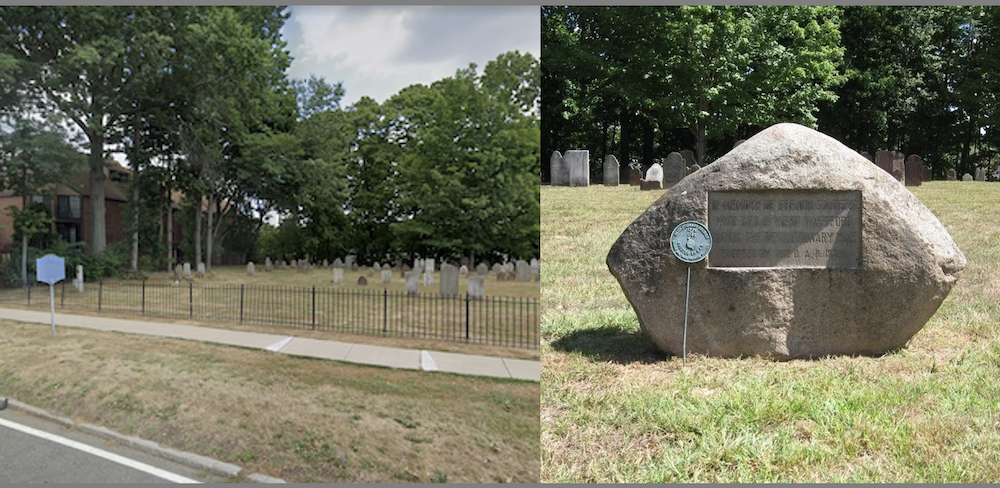
Above:
Old Center Burying Ground in West Hartford, CT.
Top Left: Photos: Image capture© Aug 2021 Google Maps
Top Right: https://www.waymarking.com/gallery
Below:
French sailors buried in Norwich, CT
Photo courtesy of Regan Miner, Norwich Historical Society
| | |
• Located in the front section of the graveyard is a large boulder memorial honoring the French soldiers that died in West Hartford during the American Revolution. It was placed here in 1923 by the Sarah Whitman Hooker Chapter of the Daughters of the American Revolution.
Marker & Plaque, “In Memory of French Soldiers”
Old Center Burying Ground, 34 N Main St, West Hartford, CT 06107
GPS: 41.764250, -72.741883
• Inscription:
“In Memory of French Soldiers
Who died in West Hartford
During the Revolutionary War
Erected by the D.A.R. 1923”
• Note: The Old Center Cemetery’s blue metal marker located a few steps away along the street mentions: “... The cemetery contains graves of [...] American and French soldiers who died in the Revolutionary War. It is maintained and the gravestones are preserved by the town.”
• Tradition based on local testimonies held that twenty French soldiers were buried in Norwichtown in 1778, during the American Revolution.
However, since then, careful historical research has demonstrated that they were not part of the French Army under Rochambeau, nor even serving under Lafayette as the bronze plaque states.
Instead, they were French sailors, most likely from the French merchant navy, made prisoners of war by the British Royal Navy, who died in a local hospital. This was the result of a prisoner exchange between the French fleet in Boston and the British in New York. The Norwich Packet of October 12, 1778 reported: “Last Saturday arrived in this town from Boston, under a proper guard, and this day set out for New York, about 230 British prisoners, taken by the Count de Estaing’s fleet; they are to be exchanged for the like number of Frenchmen, captured by the English.”
Memorial, 20 French Sailors buried in Norwich, CT
Old Burying Grounds, Old Cemetery Lane, Norwich, CT 06360
GPS: 41.548431, -72.093301
• Inscription:
“In Memory of Twenty French Soldiers, who, serving under Lafayette, died while in camp at Norwich town 1778 – Placed by Faith Trumbull Chapter D.A.R. 1901”
Right behind is another plaque installed decades ago by Le Souvenir Français:
• Inscription (in French):
“In Memory of Twenty Companions of Lafayette
Who died for American Independence
To the town of Norwich,
Pious custodian of the French Souvenir, a Grateful France”
Société Nationale Le Souvenir Français “
An inspiring monument in Annapolis, MD.
| | |
Above:
The French Soldiers Monument, Annapolis, MD Photos: TC © ASSFI 2018
| | |
• This monument is hardly visible from the street and difficult to access because it is located at the end of a lot. It is, however, very impressive.
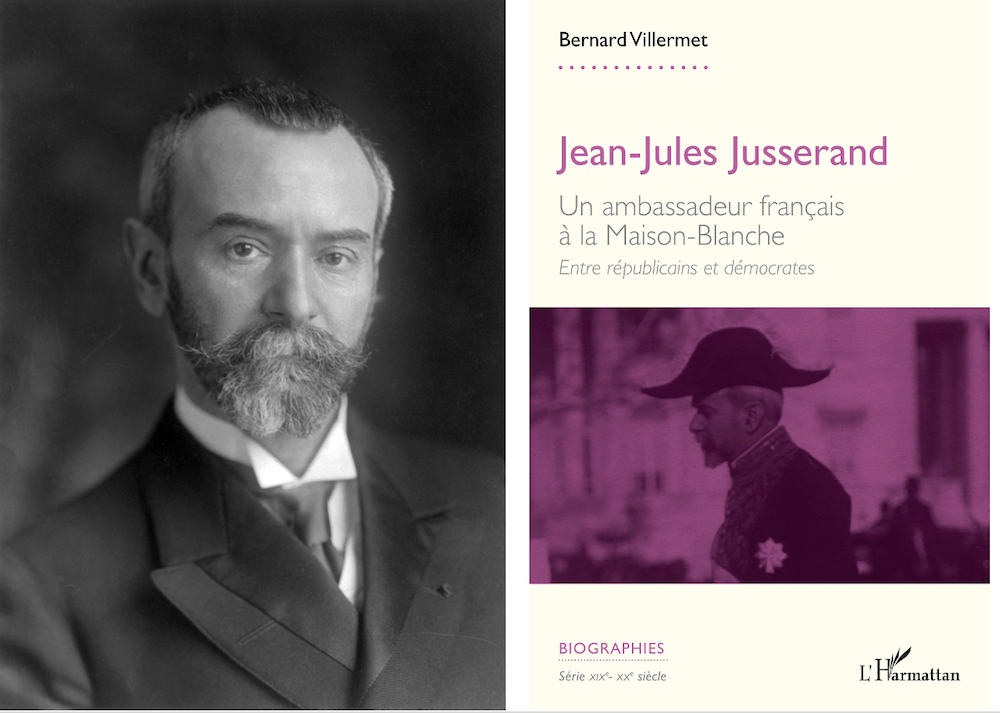
• This monument marks the graves of the French soldiers and sailors who died in America’s War for Independence. It was dedicated on April 10, 1911 by President Taft and French Ambassador Jean Jules Jusserand before a crowd of thousands.
• It is the first known tomb to Unknown Soldiers anywhere in the world. The monument is made of bronze and the work of Baltimore sculptor J. Maxwell Miller.
The French Soldiers Monument, Annapolis, MD
St Johns Street & College Avenue, Annapolis, MD 21401
GPS: 38.984095, -76.49360
• Inscription:
“This monument honors unknown French soldiers and sailors who gave their lives in the American War of Independence and were buried near here.
Dedicated by President William Howard Taft, April 18, 1911
"Our soldiers rest in hallowed ground in a friendly country. To the Sons of the Revolution I beg to express the gratitude of France." - Jean Jules Jusserand, Ambassador of France
The memory of their deeds will live forever.
Erected 1911 by The General Society, Sons of the Revolution."
Legion of Lauzun's soldiers
Battle of the Hook
October 3, 1781
| | |
Above:
Top Left: French Cemetery, Yorktown, VA Photo: TC © ASSFI 2023
Top Right: Possible burying ground, Governor Palace, Williamsburg, VA
Photo: American Friends of Lafayette, courtesy of Mark Schneider https://www.facebook.com/photo/?fbid=975475067940949&set=pcb.975475207940935
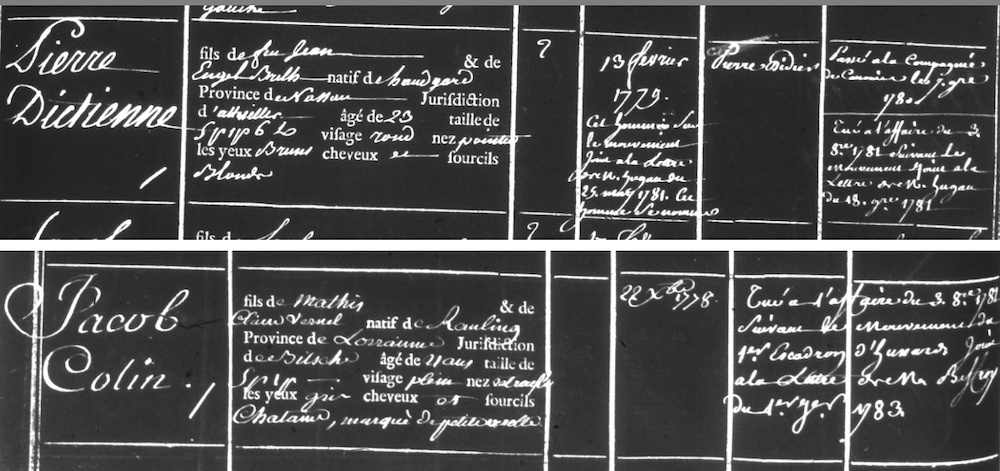
Bottom: examples of two "Contrôles" (muster rolls) of regiments. Pierre Didier (also listed as Pierre Dietienne but with a note giving his proper name Pierre Didier), of the Second Squadron of Hussars, 25 years old when he enlisted on February 13, 1779. Here is the entry from the Lauzun contrôles in the Archives Nationales de France (not SHD), catalogue number D 2c 32, fol 138 recto. (March 1780-1783). Jacob Colin of the First Squadron of Hussars, from Rémeldorf in Lorraine, 21 years old when he enlisted on December 22, 1778, Colin is in contrôle D2C32, fol. 5, recto. Public Domain. Microfilms courtesy of Dr. Robert A. Selig, Ph.D. You can appreciate the amount of time it takes to decipher these hand-written lists!
| | |
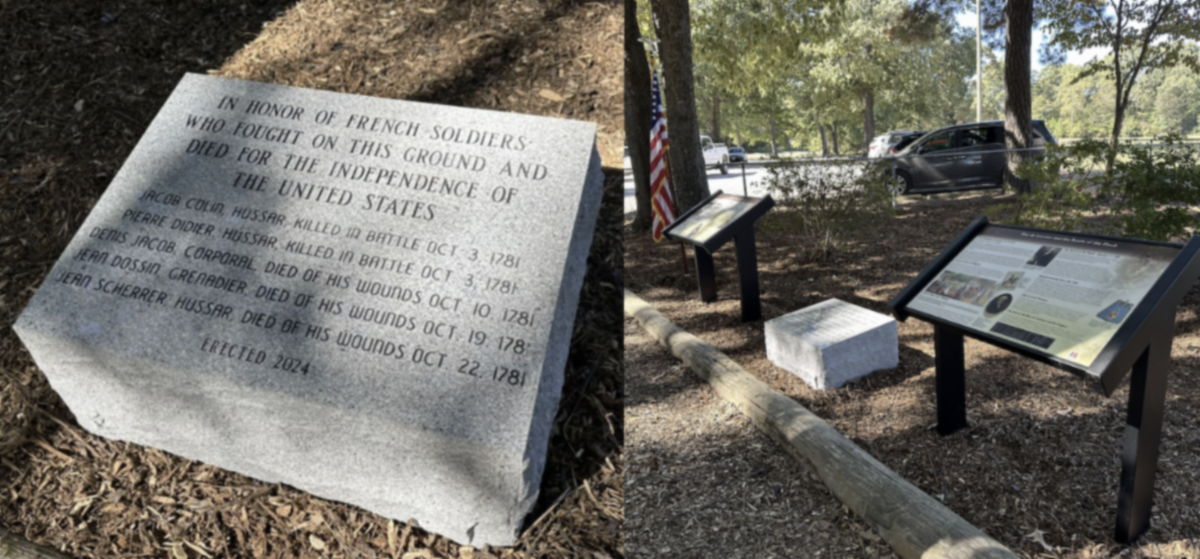
• On October 18, 2024, Gloucester County and The American Society of Le Souvenir Français, Inc. proudly unveiled a granite memorial honoring French Soldiers who made the ultimate sacrifice at Gloucester County’s 1781 Battle of the Hook. at Abingdon Elementary School.
• The largest cavalry battle of the American Revolution, the Battle of the Hook has often been overlooked. It is one of the most important episodes of the siege of Yorktown, when the Duc de Lauzun's famous Legion of hussars with 300 troops of the "Infanterie de Marine,” and Lieutenant Colonel John Mercer's Select Battalion of Grenadiers, under the overall command of Brigadier General Claude de Choisy, defeated Lieutenant Colonel Banastre Tarleton's British Legion and a detachment of the Royal Welch Fusiliers.
• This granite memorial was made possible by Gloucester County – National Park Service – Mr. Warren Deal – The American Society of Le Souvenir Français, Inc. and dedicated October 18, 2024.
• The granite memorial was placed in a position of honor between the two interpretive makers that we dedicated last year. The public was very moved by the 4th grade class from Abingdon Elementary who sung the Star Spangled Banner. We were honored by the presence of Brig. General Vincent de Kytspotter, Ph.D., Head of Military and Defense Mission at the French Permanent Mission to the United Nations, who offered a moving tribute to the hussars, and by Rear Admiral Frédéric de Rupilly who unveiled the memorial.
Memorial, « In honor of French Soldiers“
Abingdon Elementary School Park, 7087 Powhatan Dr, Hayes, VA 23072
GPS: 37.291278, -76.514633
• Inscription:
“In honor of French Soldiers
Who fought on this ground and
Died for the Independence of
The United States”
Jacob Colin, hussar killed in battle Oct. 3, 1781
Pierre Didier, hussar, killed in battle Oct. 3, 1781
Denis Jacob, corporal, died of his wounds Oct. 10, 1781
Jean Dossin, grenadier, died of his wounds Oct. 19, 1781
Jean Scherrer, hussar, died of his wounds Oct. 22, 1781
Erected 2024”
• For a narration of the Battle of the Hook, see our September 2023 Bulletin: "the Duc de Lauzun and his Legion of hussars": https://conta.cc/460bXLT
Mass graves in
Yorktown and Williamsburg
| | |
Above:
Left: French Cemetery, Yorktown, VA Photo: TC © ASSFI 2023
Right: Possible burying ground, Governor Palace, Williamsburg, VA
Photo: American Friends of Lafayette, courtesy of Mark Schneider https://www.facebook.com/photo/?fbid=975475067940949&set=pcb.975475207940935
| |
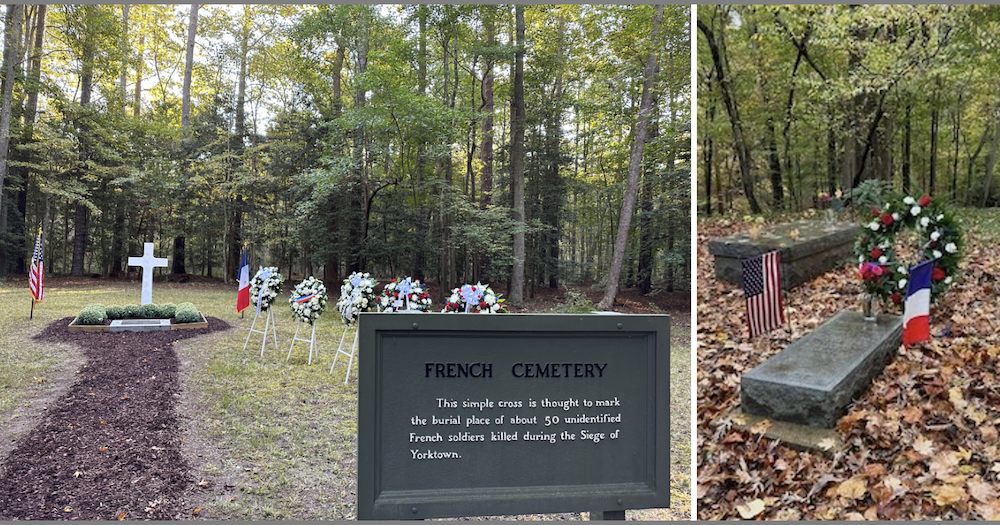
During the Bicentennial of the Battle of Yorktown in 1981, members of the French veterans' organizations attending the celebration noted that there was an area on the battlefield where approximately 50 French soldiers were buried in an unmarked, common grave. Although this area was indicated by a cross and a plaque, none of the names of any French soldier was inscribed there. It has long been a point of cultural tradition in France that the graves of those who died serving France are marked with their names whenever possible, or that the battlefields have a memorial with their names inscribed.
• At the urging of French veterans' groups, the Ambassador of France to the United States, His Excellency M. Emmanuel de Margerie, appointed a committee to correct this oversight. It was the Committee for the Yorktown French Memorial, with Professor André Maman of Princeton University serving as its president. The memorial was to include the names of some 600 Frenchmen who lost their lives in this campaign, including the Yorktown siege and the naval battle of Chesapeake.
French Cemetery, Yorktown
Yorktown Battlefield in Colonial National Historical Park, at stop “I” on the Allied Encampment Tour
GPS: 37.205865, -76.527233
• Inscription:
“ This simple cross is thought to mark the burial place of about
50 unidentified French soldiers
killed during the Siege of Yorktown”
• In nearby Williamsburg, the French Army spent the winter of 1781-1782. The wounded and sick were treated at the hospital which was at George & Mary Building. A plaque gives their names with the inscription:
Plaque « In Gallia Nati Mortui in Virginia 1781 - 1931“
College of William & Mary, Wren Bldg., 111 Jamestown Rd, Williamsburg, VA 23185
GPS: 37.270726, -76.709000
• Inscription:
"Here are inscribed the names of those soldiers of France who died within these walls and in other hospitals of Williamsburg of wounds received during the Siege of Yorktown
[long list of names from the following regiments:
Regiment d’Agenois, Regiment d’Auxonne, Regiment de Bourbonnais, Regiment de Brie, Regiment de Gatinais (Royal Auvergne), Regiment de Metz (Artillerie), Regiment de Picardie, Regiment de Royal Deux Ponts, Regiment de Saintonge. Regiment de Soissonnais, Regiment de Touraine
Erected 1931."
• We still do not know for sure where at least 137 French soldiers and sailors are buried. There is a marble plaque located at Williamsburg Governor Palace Revolutionary War Cemetery, 300 Palace Green St, Williamsburg, VA 23185
GPS: 37.274605, -76.702689 which states that 156 men and two women from the Continental Army rest in this enclosure.
• One site (http://williamsburg.virginia-sar.org/pages/about/locations.html) says that the 156 soldiers buried were mostly French: "156 Revolutionary war veterans of several nationalities, mostly French, and including two women, are buried in the garden behind the Governor's Palace in Colonial Williamsburg. In 1781, the palace was being utilized as a hospital for the wounded from the Battle of Yorktown. The graves, located near the palace, contain the remains of those patriots who died as a result of their wounds, or disease."
• However, another web site (https://colonialghosts.com/the-forgotten-graves-of-williamsburg/) states that: “Perhaps the most historic burying ground is the mysteriously lost burial place of the 137 French soldiers who died in hospital in Williamsburg around the time of the battle of Yorktown in 1781. It was once thought they were among the bodies buried in the garden of the Governor’s Palace, but research showed those to be American men and women. Persistent local tradition locates the French cemetery not far from the Capitol. The Virginia Gazette of June 19, 1931 commented that the “well-nigh obliterated French soldier graveyard is nearly a mile [south east] from the site of the Palace.”
• Another site is located directly behind Griffin Hotel, 136 Francis St E, Williamsburg, VA 23185, GPS: 37.268197, -76.694056 where a few headstones are located, (see photo above) which includes French soldiers according to several sources.
• As recently as 2023, additional research has been conducted, using Lidar technology, but this latest endeavor has not been conclusive.
• Note: Alongside with representatives of the the Society of the Honor Guard/Unknown Soldier, American Friends of Lafayette, W3R, S.A.R. and D.A.R. members, a wreath from Le Souvenir Français is laid every year during the Yorktown Victory ceremonies. Unfortunately, it was not possible this past October 19, due to the government shutdown (access road was closed by the NPS). We were able, however, to do so at the French Monument. Scroll down to Part III of this Bulletin for this year's photos.
• For a narrative of the French-American Victory in Yorktown, read our October 2021 Bulletin: "On the footsteps of Rochambeau (Part 5 – Final episode: Victory in Yorktown!)"
https://conta.cc/3BOnY8l (original version in English)
https://conta.cc/3AzLSCW (version en français)
The six-months return march of the French Army from Williamsburg to Boston is often described as festive, with celebrations at each camp. Still, there were casualties due to illness, such as typhoid fever, or natural causes. We have 343 names of French soldiers buried in the United States following the victory, just for the year 1782.
| |
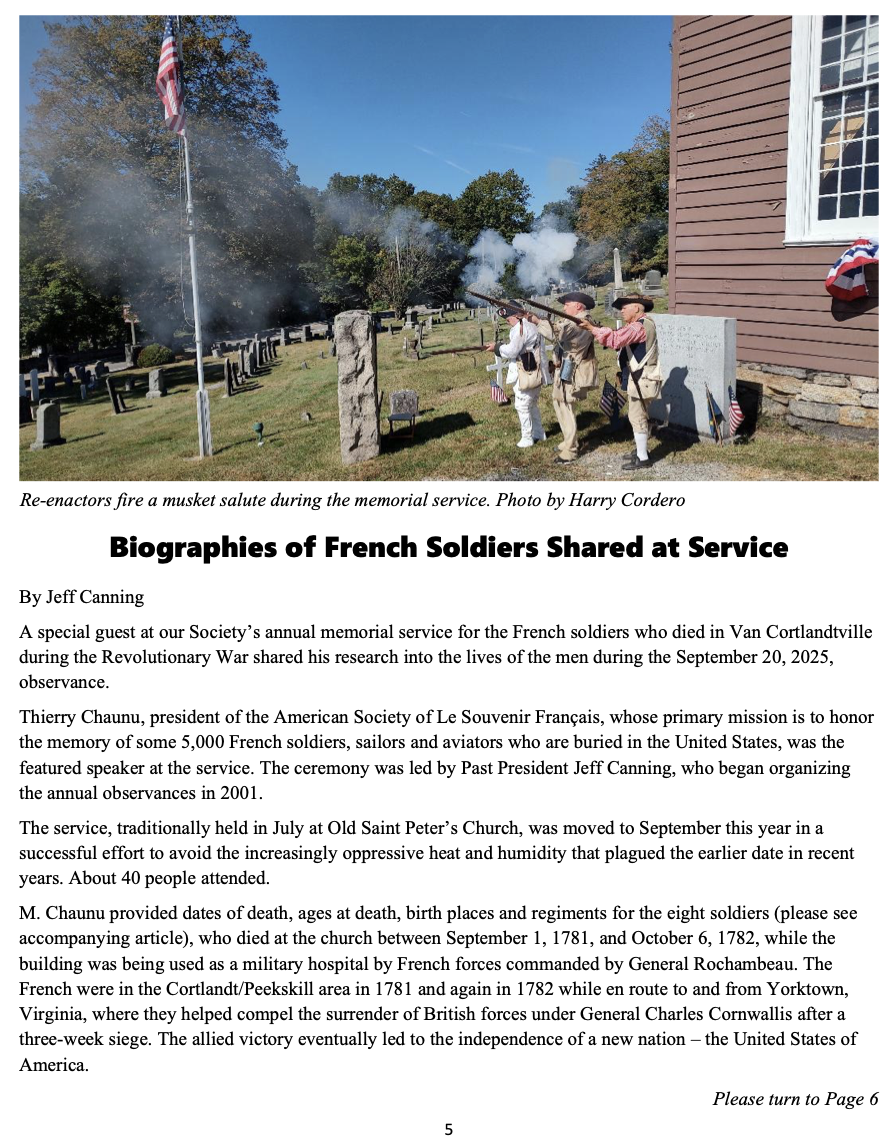
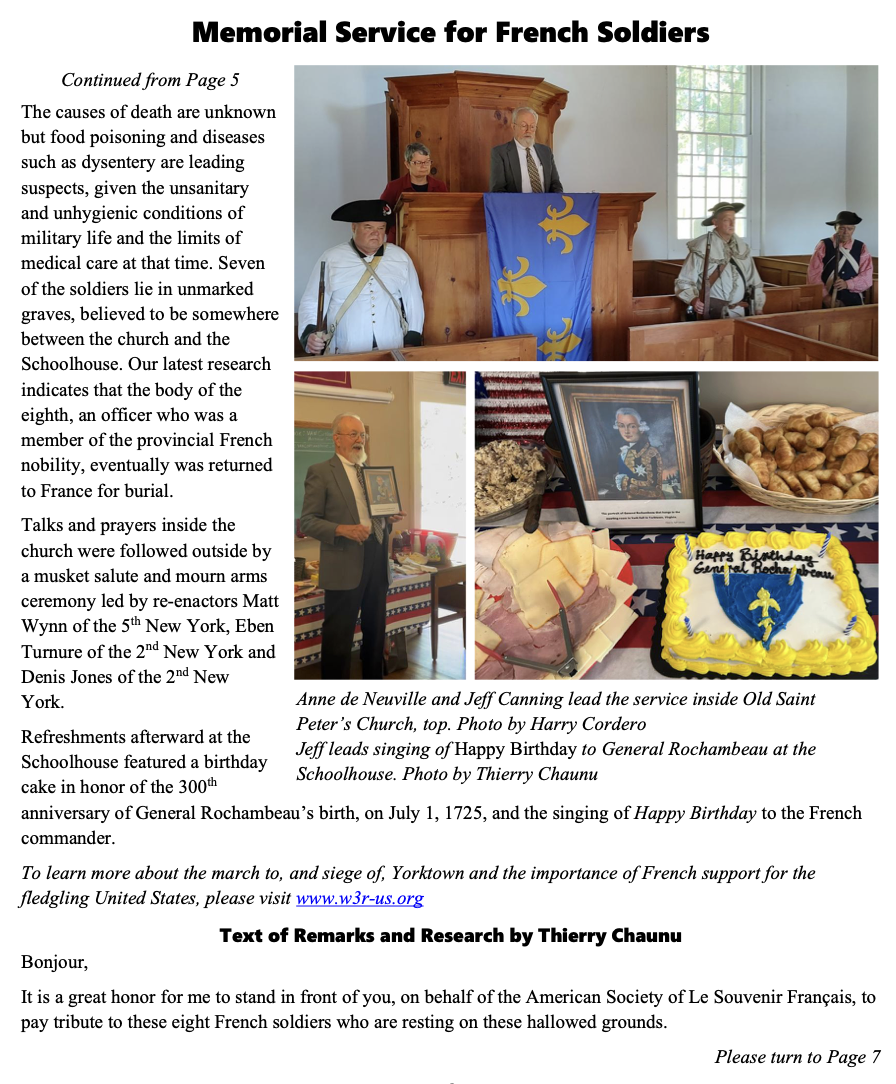
8 French Soldiers of Rochambeau
1781-1782
Cordlandt, NY
| | |
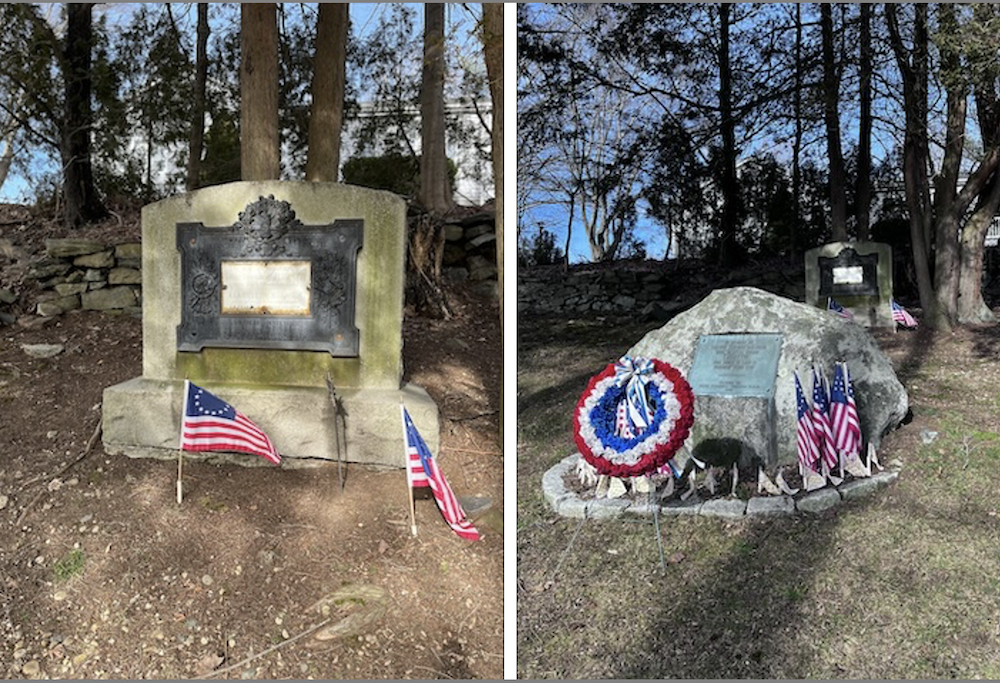
Above:
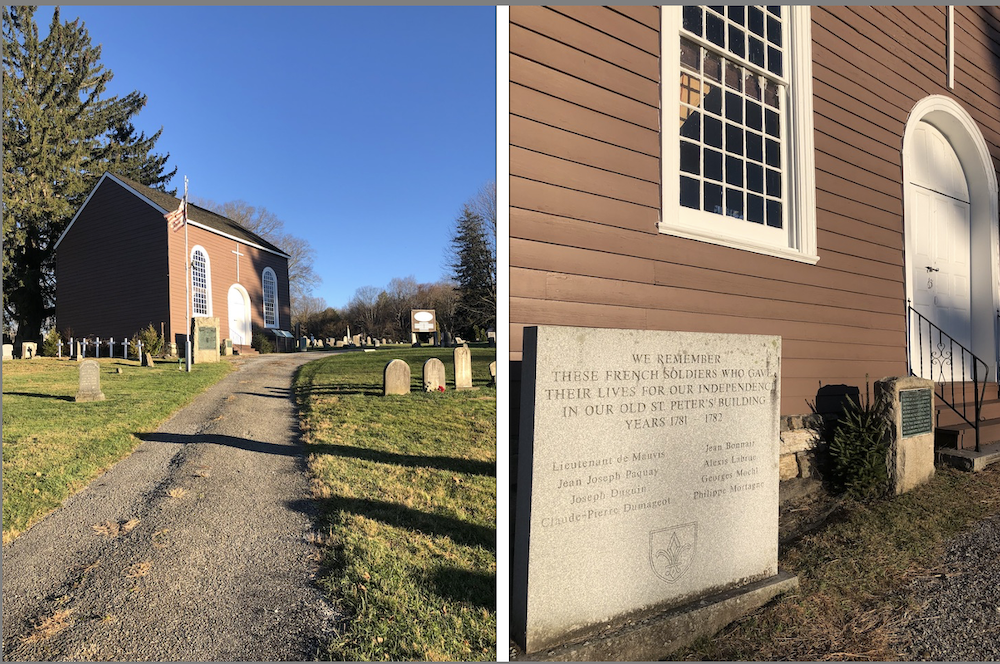
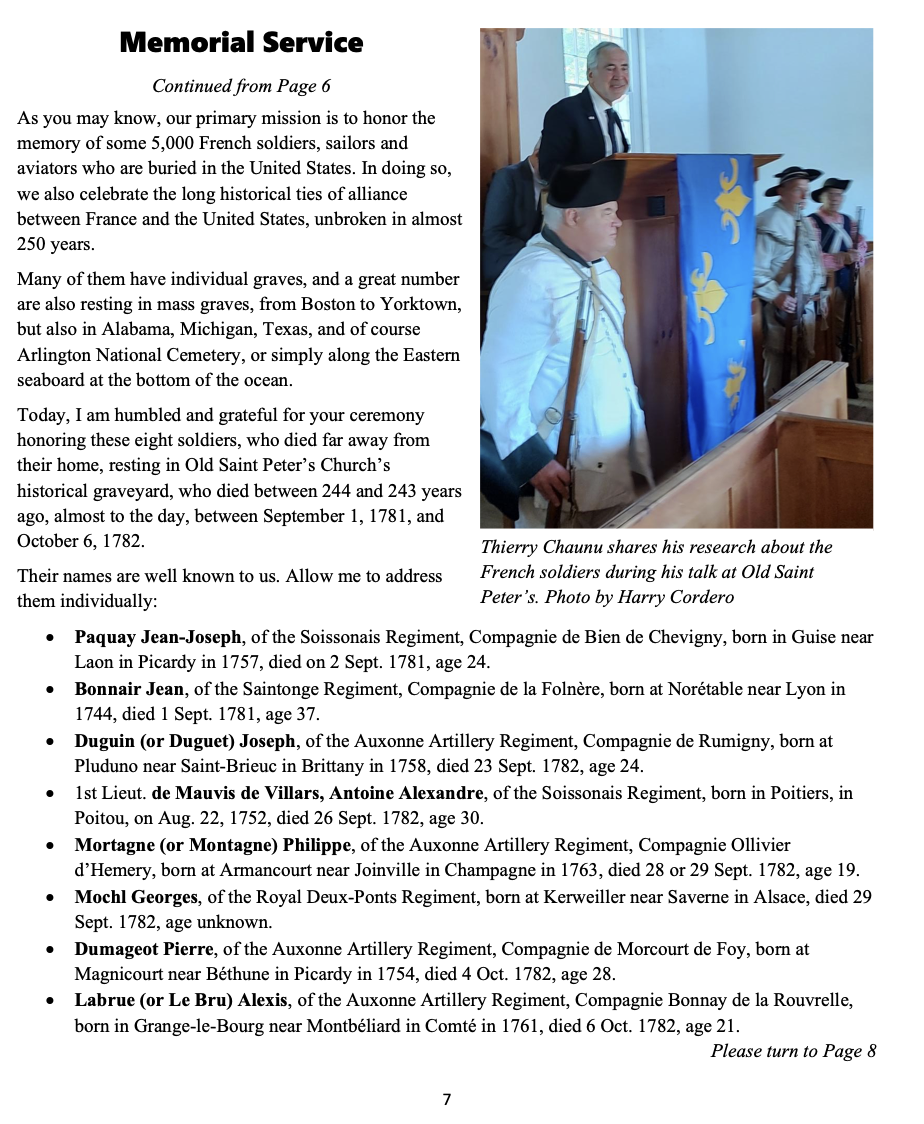
Left and Right: Memorial to 8 French soldiers. Old St Peter's Church, built in 1766 and intact, was used as a hospital during the Revolutionary War. These 8 French soldiers are buried in the cemetery (exact location unknown) among American Revolutionary War Patriots. Photos: TC © ASSFI 2022
| | |
Marker, “Old St Peter's”, and Memorial
Corner of, Old Hillside Cemetery, Locust Ave & Oregon Rd, Cortlandt, NY 10567
GPS: 41.314134, -73.900233
• Inscription:
“Old Cemetery”
“Dates to 1752, many
Revolutionary War Patriots
Here include 8 French
Soldiers and John Pallow
A captor of Major Andre”
• Inscription:
“We remember these French soldiers who gave
their lives for our independence
in our old St Peter’s building
years 1781 – 1782”
Lieutenant de Mauvis Jean Bonnair
Jean Joseph Paquais Alexis Labrue
Joseph Duguin Georges Mochl
Claude-Pierre Dumageot Philippe Mortagne
• Note: Every year the local Chapter of the W3R Association led by Jeff Canning organizes a ceremony, to which we were honored to participate this past September 20th. Scroll down to Part III of this Bulletin to read excerpts from the latest W3R Bulletin.
| | |
French Veterans of the Revolutionary War
All the soldiers and sailors above died while fighting for the Independence of the United States.
However, several French Veterans of the American Revolution chose to remain, or return after the war, to the United States. Some of their individual graves are identified and honored with plaques and markers:
| | |
Dr. Joseph Philippe Eugene Capelle
1757 - 1796
Wilmington, DE.
| | |
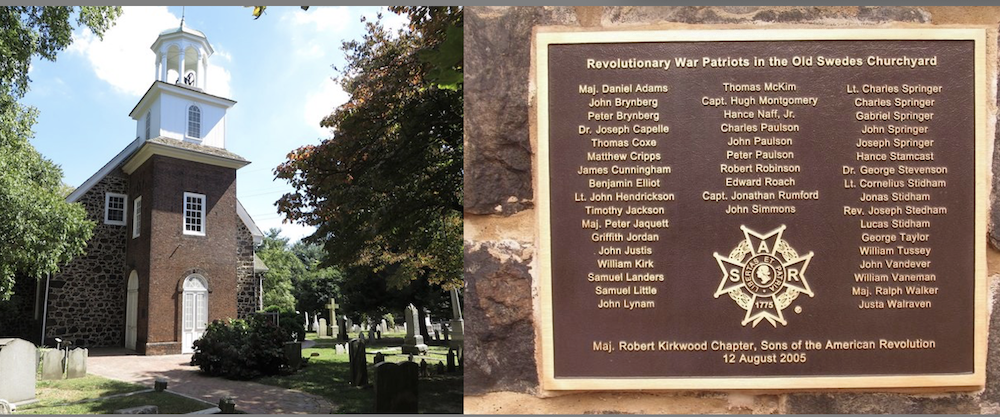
• Dr. Joseph Philippe Eugene Capelle (born in 1757 in Courtray, Flandres) came to America during the Revolutionary War with the Comte de Rochambeau and was later joined the the staff of Lafayette as a surgeon or surgeon's mate. After the war, he settled in Wilmington, DE, and continued to practice until his death. His funeral took place on November 7, 1796 and he is interred at Old Swedes Church in Wilmington.
Marker and tomb, ”Dr. Joseph Capelle”
Old Swedes Church, 720 N Locust St, Wilmington, DE 19801
GPS: 39.738900, -75.540033
• Inscription:
“Dr. Joseph Capelle was a surgeon in the French army serving under General Rochambeau's command. After serving throughout the Revolutionary War, he decided to make his home here in America. He became a respected practitioner, a founding member of the Medical Society of Delaware, and beloved, devoted family man. He died in 1796 after a short illness.
A large company gathered for his burial with singers, full church liturgy and Masonic honors. As his coffin was lowered, it suddenly grew dark, high winds blew, and large crowds from the old sycamores descended among the people. When the crows began flapping their wings over the grave, several superstitious persons were terrified by the events of and fled the scene by jumping over the wall.
Erected by The National Society of the Colonial Dames of America of the State of Delaware. (Marker Number 19.)”
Capt. Denis Nicolas Cottineau de Kerloguen
1745-1808
Savannah, GA.
| | |
Above:
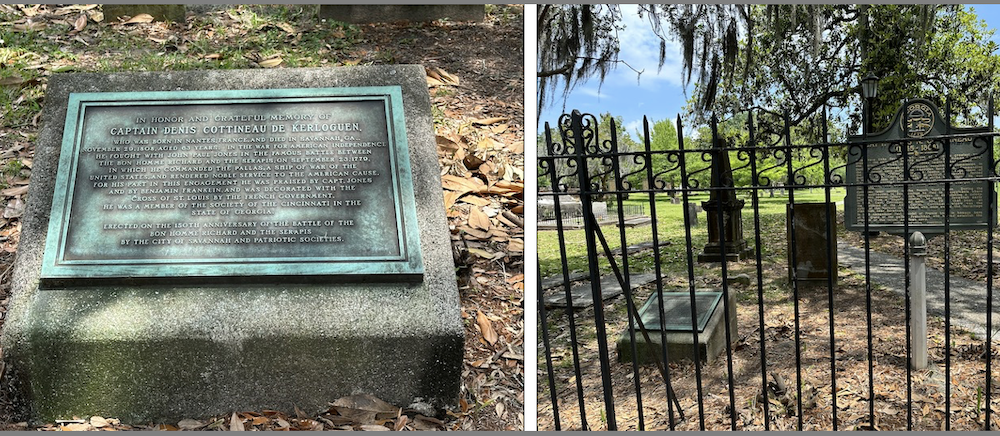
Left and Right: tombstone and marker, Capt. Cottineau de Kerloguen, Savannah, GA. Photos: TC © ASSFI 2023
| | |
Marker & Tomb, “Capt. Denis N. Cottineau (1745-1808)”
Colonial Park Cemetery, 218 Abercorn St, Savannah, GA 31401
GPS: 32.075100, -81.090917
• Inscription:
“This grave links Savannah with one of history's greatest naval dramas - the epic fight in 1779 between the "Bon Homme Richard" and "Serapis" in which John Paul Jones immortalized himself. Denis Nicolas Cottineau de Kerloguen received a commission in the Continental Navy during the American Revolution. Commanding the slow sailing “Pallas” during the famous naval engagement of September 23, 1779, Capt. Cottineau, by skillful seamanship, forced H.M.S. “Countess of Scarborough” to strike her colors. He was subsequently wounded in a duel with another officer, Pierre Landais, against whom Commodore Jones made serious charges after the battle.
Cottineau later settled in the French West Indies. During the slave insurrection in San Domingo he fled to Pennsylvania where he joined several fellow French refugees in establishing a colony. Suffering from a “lingering illness,” he came to Savannah early in 1808. Capt. Cottineau died here, Nov. 29 of that year, at the residence of Abbé Carles. Cottineau’s widow was the sister of the Marquis de Montalet who once owned the Hermitage plantation near Savannah.
In 1928 Ambassador Paul Claudel of France knelt in homage here at the grave of the gallant Frenchman who helped establish the prestige of the infant American Navy.
Erected 1957 by Georgia Historical Commission”
• Inscription:
“In Honor and Grateful Memory of Captain Denis Cottineau De Kerloguen who was born in Nantes, France and died in Savannah Ga.,November 20, 1808, aged 63 Years. In the war for American Independence he fought with John Paul Jones in the famous battle between the Bon Homme Richard and the Serapis, on September 23, 1779, in which he commanded the Pallas, a ship of war of the United States, and rendered noble service to the American cause. For his part in this engagement he was praised by Capt. Jones and by Benjamin Franklin, and was decorated with the Cross of St. Louis by the French Government. He was a member of The Society Of The Cincinnati in the state of Georgia.”
Erected on the 150th Anniversary of the Battle of the Bon Homme Richard and the Serapis By the City of Savannah and Patriotic Societies.”
Lt. Col. E.M. Bechet de Rochefontaine
1755-1814
George Washington's engineer
New York, N.Y.
| | |
Above:
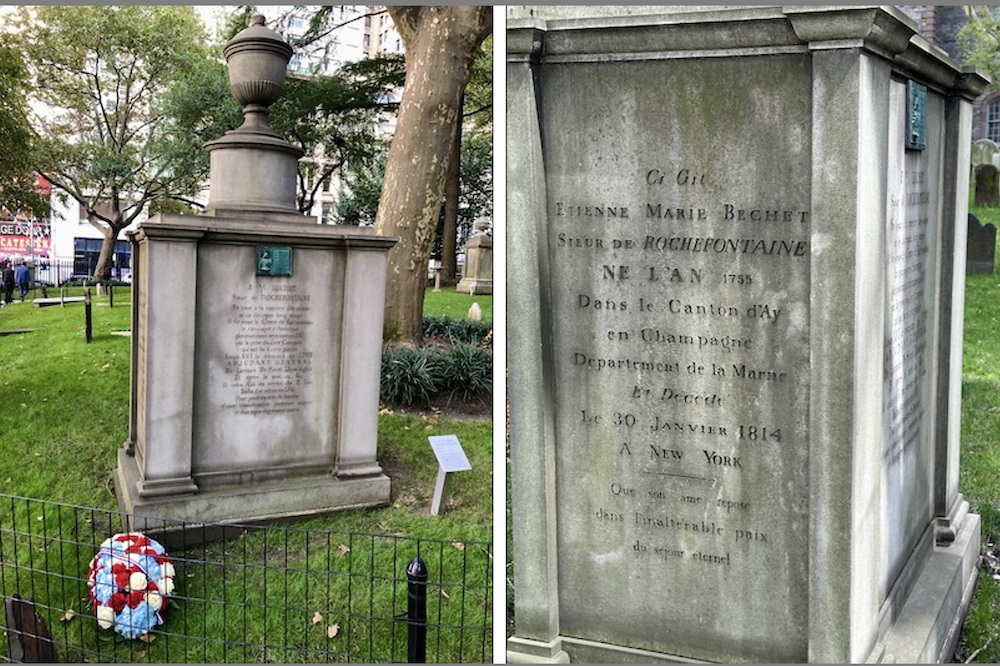
Tomb of Sieur de Rochefontaine, Photos: TC © ASSFI 2021
| | |
• Étienne Nicolas Marie Béchet, Sieur de Rochefontaine. (February 20, 1755 – January 30, 1814) was a French military engineer who served in the Continental Army, during the American Revolutionary War, and later as the Chief of Engineers of the United States Army Corps of Engineers. He was born in Ay, Marne France, and came to America in 1778 after failing to gain a position in the French Royal Corps of Engineers. He volunteered in General Washington's Continental Army in 1778 and was appointed captain in the Corps of Engineers. For his distinguished services at the siege of Yorktown, Rochefontaine was given the brevet rank of major by Congress, November 16, 1781.
• He returned to France in 1783 and served as an infantry officer, reaching the rank of colonel in the French Army. He came back to the United States in 1792 and anglicized his first name to Stephen. President Washington appointed him a civilian engineer to fortify the New England coast, in 1794.
• After the new Corps of Artillerists and Engineers was organized, Washington made Rochefontaine a lieutenant colonel and commandant of the new Corps on February 26, 1795. Rochefontaine started a military school at West Point in 1795, but the building and all his equipment were burned the following year. He left the Army on May 7, 1798, and lived in New York City, where he died January 30, 1814. He is buried in the Churchyard of St. Paul's Chapel in New York.
Tomb - “Lt. Col. E.M. Bechet, Sieur de Rochefontaine”
St Paul’s Churchyard, intersection of Broadway and Vesey Street, New York, NY 10007
GPS: 40.711533, -74.009716
• Inscription in French (West Side):
“Here lies Etienne Marie Bechet / Sieur De Rochefontaine / Born In The Year 1755 / In The Canton Of Ay / in Champagne / Department of Marne / And died / On January 30, 1814 / In New York / May his soul rest / in the unchanging peace / of eternal rest.”
• Inscription in French (South Side):
“E. M. BECHET / Sieur de ROCHEFONTAINE / Devoted himself to a military career / and distinguished himself for a long time. / He fought under the Count of Rochambeau / in the / American campaign, / which ended gloriously in 1782 / with the capture of Lord Cornwallis, / bringing an end to the war. / Louis XVI appointed him in 1792 / ADJUTANT GENERAL / of the Army of Saint Domingue. / After the death of the King, / he entered the service of the United States as a colonel. / Finally, he retired in 1798 / to enjoy, surrounded / by friendship, / the respect he had rightly earned / and a well-deserved rest.”
• Inscription of bronze plaque insert, in French (South Side):
“In Memory Of / Engineer Béchet / To The Former Engineers / Of The United States / The Former Engineers / Of France / 1955”
• Inscription of side marker in English (South side):
“Lt. Col. E.M. Bechet / Sieur de Rochefontaine / 1755-1814 / Revolutionary War Soldier / A French officer who fought for American / independence, Rochefontaine served under / the French General Rochambeau during / the Revolutionary War. He assisted in / the capture of Lord Cornwallis and later / commanded the Corps of Artillerists and / Engineers at West Point Military Academy.”
• Inscription in French (North Side):
“This tomb / Was erected / By Mrs. Catherine Gentil / In memory / Of a worthy and virtuous Father / It is not the proud work / of worldly vanity. / It is a monument consecrated
by Filial Piety. / May the wishes of a pious daughter / rise up to the throne / of the Almighty / and draw divine mercy / upon the respectable object / of her painful regrets.”
• Inscription bronze plate insert:
”Restored by the / Society of American Engineers / 1955”
February 2023: George Washington’s French engineers
https://conta.cc/3XBjqMp (original version in English)
https://conta.cc/412e0Nr (version en français)
Col. Bernard Magnien
1754 - 1819
Portsmouth, VA.
| | |
• Colonel Bernard Magnien is reported to have been an aide to LaFayette during the American Revolution. After the war, he volunteered again and served as an officer in the War of 1812. His obituary mentions that he was part of the 7th Virginia regiment during that conflict. He owned several houses in Portsmouth and Gosport, along with 60 acres near his mansion, 100 acres within a mile of Portsmouth, and another 50 acres a mile and a half from the city on the "old Western Branch Road." Foreman notes that he died without any heirs. He also established a Masonic Lodge specifically for French expatriates expatriates on Middle Street in Bloomsbery Square.
Memorial plaque, Col. Bernard Magnien
Trinity Episcopal Church Cemetery
500 Court Street, Portsmouth, Virginia, USA
GPS: 36.834810, -76.301120
• Inscription of plaque:
“Erected by the Association for the Preservation of Virginia Antiquities In the Memory of COL. Bernard Magnien of Luneville France, Who "Quitted his native Country along with the gallant LaFayette To aid our Country In the accomplishment of her independence. He settled in Portsmouth and was a worthy Citizen. One of the first borough Magistrates And Col. of the Militia of Norfolk and Portsmouth.He died Nov. 1st 1819 and is buried here. “
• Inscription of tombstone:
“Here are deposited the remains of Bernard Magnien, a native of Luneville, in France, who died Nov. 1st, 1819. Aged 65 years. And Margaret his wife, a native of Port le None in Ireland, who died Febry 5th, 1817, aged 70 years. “
Anthony Chevalier
1753 - 1820
Dayton, Ohio
Poulain du Bignon
1739 - 1825
Jekyll Island, GA
| | |
• Anthony Chevalier, also spelled Chevaller, born in St Malo, France in 1753, died 1820, was a solider who fought for the independence of the United States. It is thought his father had moved family to England to escape persecution before Anthony sailed in 1773 from Westminster, England on board the 'Virginia' to come to America. He came as an indentured servant, occupation 'brickmaker.’ In April 1776 he enlisted in 8th Virginia Regiment at Winchester VA and fought in the battles of Brandywine, Germantown, Monmouth, siege of Savannah, and taken prisoner at Charleston. He was discharged at Charleston 21 Apr 1780. Family lore says he was an interpreter between Marquis de Lafayette and Gen. Washington's officers. No evidence found to verify, but Lafayette was at the Battles of Brandywine and Monmouth, and at this early stage his English was not yet fluent, so this story may be possible.
• DAR spells his name Chevaller, although the tombstones of two his daughters in Iowa (Charlotte and Hannah) are all spelled Chevalier.
Marker, « Revolutionary Soldiers”
Woodland Cemetery, 118 Woodland Ave, Dayton, OH 45409
GPS: 39.743649, -84.177452
• Inscription:
“We honor these Revolutionary War Soldiers and Patriots
Who are Buried in Unmarked Graves in Montgomery County, Ohio”
Erected 2013 by Jonathan Dayton Chapter, NSDAR (National Society Daughters of the American Revolution).”
• Christophe Poulain, native of Lambelle, Brittany, was a much decorated French naval captain who fought in the Indian Ocean during the American Revolution, capturing a dozen British ships. His loyalty to Louis XVI in the French Revolution forced him to flee his patrimonial lands. In 1792 on his ship, the Sapelo, he brought his family to the hospitable Georgia coast. With four other French royalists, he purchased first Sapelo Island then Jekyll Island.
Tomb and marker, “Poulain du Bignon and
du Bignon Burying Ground”
Riverview Dr, Jekyll Island, GA 31527
GPS: 31.101900, -81.414833
• Inscription:
“This burying ground contains the bodies of several members of the du Bignon family, descendants of Le Sieur Christophe Poulain de la Houssaye du Bignon, native of Saint-Malo in Brittany. One of four Frenchmen, former residents of Sapelo Island, who purchased Jekyll Island in 1791, Poulain du Bignon became the sole owner a few years later.
In his youth du Bignon was an officer in the French army in India and served for years fighting against the domination of Great Britain. Later he commanded a vessel of war sailing under the French flag. He died in 1814 and was buried here near du Bignon Creek with a live oak tree as his only monument.
Sea Island cotton was the principal crop planted on the du Bignon plantations on Jekyll Island and a large acreage was devoted to its cultivation.
The du Bignon family owned Jekyll Island until 1886, when they sold it to a group of millionaires who immediately formed the famous Jekyll Island Club.
Erected 1956 by Georgia Historical Commission. (Marker Number 63-18.)”
Major Pierre Charles L’Enfant
1764 - 1825
George Washington Architect
Planner of Washington D.C.
Arlington National Cemetery
| | |
• Pierre Charles L'Enfant (August 2, 1754 – June 14, 1825) was a French military engineer who designed the plans for the Capital City of the United States in 1791.
• He arrived in 1777 at the age of 23 with General Lafayette and served in the Continental Army. He was wounded at the siege of Savannah in 1779. He served in General Washington’s staff for the remainder of the war. In 1783 he became a civil architect.
• President Washington appointed L'Enfant in 1791 to plan the new "Federal City" (later named “the City of Washington”). His source of inspiration for majestic avenues and geometric patterns were the gardens of André Le Nôtre at Versailles. The location of the Capitol, as well as the (later called) White House were chosen by him, among other deeds.
• Although he died in total poverty in 1825, at the instigation of the French Ambassador Jean Jules Jusserand, his remains were exhumed and transferred to Arlington Cemetery in 1909 after lying in state at the US Capitol. In 1911, a monument was placed on top of L'Enfant's grave during a dedication ceremony presided by President William Howard Taft.
• In 2022 our Society dedicated a marker co-signed with the D.A.R. explaining who he was and what he did, to the thousands of tourists who visit every day.
Read more about Major L'Enfant's extraordinary story and accomplishments in our April 2022 Bulletin: "Tribute to Major Pierre Charles L’Enfant"
https://conta.cc/3uR5rqO (original version in English)
https://conta.cc/3JPeFIg (version en français)
Henry Le Duc
1762-1827
Founder of Wilkesville, Ohio
| | |
• Henry Le Duc was born in Lyon, Rhône, 25 Nov 1762. He is the Founder of Wilkesville, Ohio. He was an officer in the French fleet under Count D'Estaing. He was in Guadaloupe (probably), when black slaves revolted and massacred most of the whites and escaped to a Yankee ship that landed him at Middletown, Connecticut. At his death, Vinton County had not been formed and Wilkesville was part of Gallia County.
Memorial & tomb, «Henry Duc and the Defenders of Our Country”
401-419 1st Ave, Gallipolis, OH 45631
GPS: 38.806450, -82.205317
• Inscription:
Henry Duc
Founder of Wilkesville
June 10, 1810
Born in France
Departed his life June 21, 1827, Age 64
Came to America an officer in the French Fleet
—————
To the Memory of
Henry Duc
Who departed this life June 21, 1827 aged 64 years
He was born in France, came to America,
an officer in the French fleet,
was the founder of this town June 10, 1810.
It is to him that this tablet is dedicated.
In Memoriam of The Defenders of Our Country
June 10, 1935
| | |
French Soldiers
of the Republic and the Empire
During the 19th Century, many French Veterans of the Napoleonic Empire came to the United States. One may assume they benefited at the time from a special prestige. It is entirely possible that a few of them pretented to be Veterans for this reason. Although we do not know their exact number, we continuously search from them, among websites such as findagrave.com.
Here are some of them:
| | |
Général Jean Joseph Amable Humbert
1767 - 1823
"Vainqueur of Castlebar"
"Hero of New Orleans"
| | |
• General Jean Joseph Amable Humbert (1767-1823) was a French military officer who rose from sergeant in the French National Guard commanded by Lafayette to brigadier general by 1794 - - typical of the fast military promotions for those exhibiting extraordinary leadership and bravery.
• He is best known in Ireland for leading a French expedition to support the Irish Rebellion of 1798, landing at Killala and achieving initial success at the Battle of Castlebar before being defeated and captured by the British.
• After various military appointments and a falling out with Napoleon due to his republican principles, Humbert emigrated to New Orleans in 1810.
• The "hero of New Orleans" title comes from his participation in the Battle of New Orleans during the War of 1812, where he enlisted as a private in the U.S. Army and fought wearing his old French uniform.
• Major General Andrew Jackson, himself the son of Irish immigrants from Carrickfergus in county Antrim, who would eventually become the President of the United States, commented on Humbert’s military achievements, especially his bravery in the Battle of New Orleans. He remarked, "General Humbert, who volunteered his services, has consistently faced the highest dangers with notable courage."
• After this colorful military career spanning multiple continents and causes, Humbert spent his final years living peacefully as a schoolteacher until his death in 1823.
• He remains commemorated in Ireland with a bust erected in Killala to mark his role in the 1798 rebellion.
Marker, “General Humbert”
1208 Conti St, New Orleans LA 70112
GPS: 29.959167, -90.071733
• Inscription:
“ In memory of French General Jean Joseph Amable Humbert 'Vainqueur de Castlebar' who is buried in this cemetery.”
“In August, 1798, a gallant native of St. Nabord, France, General Jean Joseph Amable Humbert commanding a small army of 1019 French troops landed in County Mayo on the west coast of Ireland. A rising star of the French Republic, this daring and courageous soldier arrived at the behest of The Society of The United Irishmen to assist them in their struggle for independence from British rule. Following a signal victory over the British at Castlebar, Humbert established the Republic of Connacht. A short time later his small Franco-Irish army was cruelly defeated by a British force twenty times their number. Living in New Orleans, Humbert valiantly served General Andrew Jackson at the Battle of Chalmette, January 8th, 1815.”
Erected 2015 by Association 3ème Bataillon de Chasseurs des Montagnes - Béarn, France & the County of Mayo, Ireland."
Grave, “Joseph Ehlinger”
1792 - 1845
Grand Army Veteran (Campaign of Russia)
Battle of San Jacinto Veteran
Founder of the City of Ellinger, Texas
| | |
• Joseph Ehlinger was born in Wimmenau, Dept du Bas-Rhin, Alsace, France, and served in Napoleon's army in the Russian campaign.
• He had just married Christine Munsch in March 1834 in her hometown Erckartswiller when they immigrated on board the Pierre Corneille.
• He came to Texas in June of 1835 and served in the Texas Army at San Jacinto in 1836. For his service, he was granted 640 acres, which he chose to be located in present day Fayette and Colorado counties. This extensive acreage included the present site of Ellinger.
• After constructing a house in Fayette County, he went back to Europe to bring his family to their new home. Sadly, he drowned while crossing Buffalo Bayou near Houston. Ehlinger's family moved into the house he built without him being there to witness it.
• Joseph's son, Charles Ehlinger, (born in France 18 Oct 1826 - died 21 Jul 1872 inTexas) became a surveyor and mapped out the original town, which was called Live Oak Hill, just north of what is now Ellinger. This tragic accident prompted Andrea Ondrej, a Czech immigrant, to suggest the town be named in memory of Ehlinger. Charles served as the first postmaster of the town and also became a merchant, farmer, and a Board Member of the First State Bank of Ellinger.
• Charles' son, Joseph "Joe" Ehlinger (born in France 22 Aug 1852 when his parents were visiting family in Alsace - died 15 Jan 1913 (aged 60) La Grange, Fayette County, Texas, USA, was also a U.S. Army veteran.
• In 1873, the Southern Pacific Railroad passed through the area but missed Live Oak Hill by two miles. In 1880, land was given for its current location.
• The name of the town changed from Ehlinger to Ellinger when the railroad arrived, due to a clerical misspelling, according to some, or to facilitate the spelling, according to his descendants.
City of Ellinger, Texas
Grave, “Joseph Ehlinger”
Founders Memorial Cemetery, 1217 West Dallas Street, Houston TX 77019
GPS: 29.757583, -95.379317
• Inscription:
"Born in Alsace, France1792
Died in Houston, Texas1845
Served in Captain William J. E. Heard's companyat San Jacinto
Erected 1936 by the State of Texas. (Marker Number 10655.)"
October 2025: Alsatian Legacy in the United States
https://conta.cc/3WqXAgq (original version in English)
https://conta.cc/42wrB1Z (in French)
Marcellin Garand
1780 - 1852
Adjudant Major in Napoléon's Grand Army
Founder of Plattesville
| | |
• Marcellin Garand (1781-1852) was a native of Savoy, France and retired adjutant major in Napoleon’s Army who settled in Ville Platte in 1824, where he operated a hotel, store and tavern; he also served as the first postmaster from 1842-1848. After his first wife, Brigitte Soileau died, he married Hyacinthe Vidrine (1794-1863), daughter of Jean Baptiste Pierre De Védrines and Marie-Josephe Brignac, with whom he had 8 children. Hyacinth’s estate donated a plot of land in 1865 to Sacred Heart Church. Marcellin Garand is buried in the Old Ville Platte Cemetery.
• Ville Platte is the largest city in, and the parish seat of, Evangeline Parish.
Marker, “Marcellin Garand, Founder of Ville Platte”
120 Court St, Ville Platte, LA 70586
GPS: 30.689733, -92.277550
• Inscription:
“Area first settled in late eighteenth century. Located on Spanish Royal Road. Marcellin Garand, former adjutant major in French army, regarded as founder. Incorporated in 1858. Parish seat of Evangeline Parish.
Erected 1980 by Department of Culture, Recreation and Tourism.”
Antoine Barraque
1773 - 1858
Veteran of Napoleon's Vieille Garde
Campaign of Russia
Founder of New Gascony, Arkansas
| | |
• Antoine Barraque was born on April 15, 1773, in southwestern France. Educated in Paris, he served in the French army under Napoleon Bonaparte, then Napoléon's Grand Army, and not any regiment - - but the Emperor's famous Vieille Garde. In all, he fought at the battles of Marengo, Austerlitz, Jena, Lodi, and Borodino on the road to Moscow.
• Following the end of Napoleon's empire, Barraque immigrated to the United States, arriving in 1816 at the age of 43 and eventually reaching Arkansas. The following year, Barraque married Maria Therese Dardenne, the daughter of his friend, Joseph Dardenne, another French immigrant, and a Quapaw woman.
• Barraque then established a settlement on November 29, 1832, and named for the Gascony region of France.
• Today New Gascony is an unincorporated community in Bogy township in Jefferson county in Arkansas, 13 miles (21 km) west of Pine Bluff, the county seat.
• Barraque street in Pine Bluff, AK, is named after him:
Marker, « Barraque Street»
201 W Barraque St, Pine Bluff, AR 71601
GPS: 34.229550, -92.004417
• Inscription:
“This street was named for Antoine Barraque (1773-1858), native of France, soldier of Napoleon, and one of this area's earliest settlers. Founder of New Gascony in this county, he was a man of property and Indian sub-agent. Trusted and liked by the Quapaw nation, he led that tribe to their new home pursuant to the Treaty of 1824. A distinguished citizen of early Jefferson County, Antoine Barraque has descendants still living in Pine Bluff.”
Erected by Jefferson County History Commission.”
Colonel Claudius Crozet
1789 - 1864
Veteran of Napoléon's Grand Army
Co-Founder, Virginia Military Institute
Lexington, VA
| | |
• Claude "Claudius" Crozet (December 31, 1789 – January 29, 1864) was a soldier, educator, and civil engineer. He graduated from Polytechnique and served in Napoléon’s artillery in the Grande Armée. He was captured by the Russians at the Battle of the Moskova in 1812. After Napoléon’s abdication in 1815 he emigrated to the United States. During the crossing he befriended fellow engineer Simon Bernard.
• He became a prominent professor of engineering at West Point and brought descriptive geometry to the US. His Elementary Course of Civil Engineering” was a manual used by several generations of cadets.
• He co-founded and became president of the Virginia Military Institute.
• He built the Blue Ridge train Tunnels, a technological prowess at the time, and the town of Crozet, Virginia, is named for him.
• Virginia Military Institute was granted permission in 1942 to move the remains of Col. Crozet to a place of honor on the campus. A condition of the removal specified “a monument [be] erected in Shockhoe Cemetery to mark his former resting place and the graves of the rest of his family.”
“Colonel Claudius Crozet”,
aka “The Pathfinder of the Blue Ridge”
Virginia Military Institute, 402 VMI Parade, Lexington, VA 24450
GPS: 37.790200, -79.433750
• Inscription :
“Born in France Dec. 31, 1789 - Died in Virginia Jan. 29, 1864”
“Soldier Scholar Educator Engineer
Chairman of the first
Board of Visitors V. M. I.
1837 1845 “
Granite marker & Plaque “Colonel Claudius Crozet”
Shockoe Hill Cemetery, Range 9, section10, Hospital Street Richmond, Richmond City, Virginia, 23219
GPS: 37.551586, -77.432011
• Inscription:
“Claudius Crozet, Soldier-Scholar-Educator-Engineer. Born December 31, 1789 at Villefranche, France. Died January 29, 1864 at Midlothian, Virginia. Graduate of L’Ecole Polytechnique, 1807. Captain of Artillery under Napoleon. Captured in the Russian Campaign, 1812. Professor of Engineering, U.S. Military Academy, 1816–1823. Civil Engineer, State of Louisiana, 1832–1833. President of Jefferson College, Louisiana, 1834–1836. Pioneer developer of highway, canal and railroad projects. First President, Board of Visitors, Virginia Military Institute, 1837–1845. Principal Engineer, State of Virginia, 1823–1831 and 1837–1845. Chief Engineer, Blue Ridge Railroad and four tunnels near Afton, VA, 1849–1857.
“This Tribute to the genius whose extraordinary foresight and ability first pushed the avenues of transportation of the Commonwealth of Virginia from the Atlantic Waterways, through the mountain barriers to her western bounderies (sic) on the Ohio River, has been erected by The Virginia Military Institute, 1948. Claudius Crozet’s remains were re-interred on November 11, 1942 at V.M.I. where a memorial is dedicated to his honor."
Pierre Charlet
1783 - 1866
Veteran Napoléon's Grand Army
Founder of Napoleonville, LA
| | |
• Pierre Charlet (born in Mieussy, Haute-Savoie, France, Oct 6, 1783 – died in Plattenville, Louisiana, January 3, 1866, aged 83) was a French solider who served in Napoléon’s Grand Army.
• He named the settlement in honor of the French Emperor Napoléon.
• He is buried in the cemetery of Our Lady of the Assumption Catholic Church in the nearby community of Plattenville in Assumption Parish
• He married three times, with Estelle Francoise Landry (buried in same cemetery), then with Olympe Juge, and finally with Marie Elizabeth Chavand and had 9 children: Alphonse Charlet, Eugène Charles, Grégoire Lucien Charlet, Gustave Charlet, Jules Joseph Charlet, Pierre Alcée Charlet, Zéphire Charlet, Pierre Charlet...
Gravesite, Pierre Charlet, Founder of Napoléonville
Assumption of the Blessed Virgin Mary Cemetery
5610 LA-308, Plattenville, LA 70393
GPS: 29.990402, -91.023092
• Inscription (in French):
“Natif de Grenoble France
Soldat de Napoleon I
Décédé le 3 Jan 1866 âgé de 83 ans”
Pierre Benjamin Buisson
1793 - 1874
Veteran of Napoléon's Grand Army
Brigadier General, Confederate Army
| | |
• Pierre Benjamin Buisson, (born in Paris on 20 May 1793 – died on 30 May 1874 (aged 81) in New Orleans) was a Veteran of Napoléon’s Grand Army and was the oldest Confederate brigadier general, he participated in the failed 1862 defense of New Orleans.
• Raised in Paris he graduated from the L'Ecole Polytechnique, where his academic record was mediocre, in 1813 then after further training at Metz served as a Lieutenant in the 6th. Artillery of Napoleon's Grande Armée; though again considered a marginal performer he was twice decorated for bravery, receiving the Legion of Honor and the St. Helena Medal.
• Moving to New Orleans in 1817 he soon became prominent as a civil engineer and architect, laying out Lafayette Cemetery and many of New Orleans' streets as well as in 1819 designing its famous Customs House. Buisson worked as a printer and newspaper publisher, served as Surveyor of Jefferson Parish from 1832 until 1855, and also authored texts on astronomy (1849) and light infantry tactics (1861) while being active in the Militia from 1824 on and commanding the Orleans Battalion of Artillery.
• At the start of the Civil War Buisson was named to the Committee on City Defense and placed in charge of New Orleans' fortifications.
• He was appointed Brigadier General of Militia on February 17, 1862, but when the Union fleet invaded on April 24th of that year many members of his 22nd. Louisiana Volunteers became discouraged and fled, their poor showing thereby ending General Buisson's military career.
• After leaving active service he resumed his work as a surveyor and remained in New Orleans until his death.
Tomb, “Pierre Benjamin Buisson”
Saint Louis Cemetery No2, 300 N Claiborne Ave, New Orleans, LA 70112
GPS: 29.910733, -90.060433
Alfred “Nattie” Duffié
1833 - 1880
Soldier of Napoléon III
Brig. Gen. of the Union Army
| | |
Above:
Left: Col. Alfred N. Duffie, Colonel of the 1st Rhode Island Cavalry, Bull Run, Virginia, July 1862, Photo by O'Sullivan, Public Domain, https://commons.wikimedia.org/w/index.php?curid=47032940
Right: Alfred N. Duffié cenotaph at North Burial Ground, Providence Rhode Island. Photos: courtesy Professor Norman Desmarais, Regional Delegate, New England, American Society of Le Souvenir Français Inc.
| | |
• Alfred Napoléon Alexandre Duffié (May 18, 1833 – November 8, 1880) was a French-American soldier and diplomat.
• Born in Paris, he started his military career as a dragoon officer in the imperial army and served in the Crimean War. Soon after being promoted 2nd Lieutenant in a regiment of hussard, he met and fell in love with an American girl from a prominent New York family, resigned his commission and set to emigrate to the United States to marry her.
• He embellished his early military career in France, claiming he graduated from St Cyr Military school. He enlisted in the Union Army in 1862, quickly become a captain, then a colonel, commanding the 1st Rhode Island Cavalry Regiment. Although initially rejected as a foreigner, he quickly won over the Rhode Islanders by his firm but fair discipline, his sense of humor and bravery. He was promoted to Brigadier General in 1863. He became a naturalized US Citizen in 1867, appointed US Consul in Cadiz, Spain in 1869, and died there in 1880.
• After his death, some of Duffié's former officers from the 1st Rhode Island Cavalry established a subscription toward a monument to their old leader, to be placed in Providence.
Memorial / cenotaph:
Alfred “Nattie” Duffié, General of the Union Army
North Burial Ground, 5 Branch Ave., Providence, R.I. 02904
GPS: 40.639367, -74.120171
• Inscription:
"Gen. Alfred Nattie Duffié
Born in Paris May 1, 1835
Lieutenant in French Army
Colonel of 1st R.I. Cavalry
and General in U.S. Army
1861 - 1865
Died Nov. 6, 1880"
• For more detailed biography on Duffié, please read:
March 2025 Bulletin: “French generals of the U.S. Army”
https://conta.cc/4honqcW (original version in English)
https://conta.cc/4iNaUF4 (version in French)
| | |
French soldiers from
World War One &
World War Two
| | |
Memorial Plaques in New York
The "463" who "Died for France"
| | |
Memorial Plaques, French War Veterans
Église de Notre Dame
405 West 114th Street, New York, NY 10025
GPS: 40.805025, -73.960249
• These plaques list the names of 463 French draftees and American volunteers in the United States, Members of the Lafayette Escadrille and the American Field Service who died for France. Originally designed and installed in 1921, these plaques were augmented and completed by Colonel Roger Cestac, president of the American Society of Le Souvenir Français in the 1980s and were transferred from the Church of St Vincent de Paul to the Church of Notre -Dame in 2018.
• The list of names can be found on our Society’s website: https://souvenirfrancaisusa.org/honor-roll/#ww
• This project was made possible thanks to Monsignor John Paddack, at the request of Françoise Cestac. Funds were raised by the French-American Community of New York, and in particular from our main benefactors Jean-Hugues Monier, members of members of the Federation of French War Veterans, the American Society of Le Souvenir Français Inc., the Association des Cadres de Réserve Français in the United States (ACREFEU), the Committee of French Speaking Societies (CAFUSA), and also with donations from Metropolitan France.
• A Mass to celebrate Victory Day and Saint Joan of Arc is held yearly on the Sunday closest to May 8th.
• A Mass to celebrate the Armistice of 1918 is held yearly, on the Sunday closest to November 11th.
Most of them died on the battlefields and are buried in France, but some were brought back by their families to the United States. We are in the process of cataloging each and every one, in order to identify the location of their burial places. We are selecting (further below) one of them, the American pilot Norman Prince, who fought under French uniform in the famous Escadrille Lafayette and who is buried at National Cathedral in Washington, D.C.
Another wall with a bronze plaque, with additional names (only a few overlaps), is located at Notre-Dame des Victoires Church, just a few steps from Union Square in San Francisco, honoring those originating from the West Coast who died during WWI. Note, we also have the names of many who served in the US Army during WWII.
Memorial Plaque
The 114 who "Died during the Great War"
Notre-Dame des Victoires, San Francisco
| | |
• A bronze plaque list the names of 114 French soldiers who died during WWI.
• The list of names can be found on our Society’s website: https://souvenirfrancaisusa.org/honor-roll/#ww1
Plaque, « La colonie française de San-Francisco et Oakland à ses morts de la Grande Guerre »
Notre Dame des Victoires
566 Bush St, San Francisco, CA 94108
GPS: 37.790580, -122.406446
• Inscription:
"La Colonie Francaise de San Francisco et d'Oakland à ses morts de la Grande Guerre. Dieu Aime Les Francs."
[The French community of San Francisco and Oakland to their dead of the Great War. God loves the French.]
[List of 114 names]
Le 3 décembre 1921 / Maréchal Ferdinand Foch
est venu prier ici pour ses / Anciens compagnons d'armes"
["December 3, 1921 / Marshal Ferdinand Foch /
came here to pray for his / former comrades in arms"]
Many French Veterans of WWI coming from the West Coast and who resumed their lives in America at the end of the war are buried in civilian cemeteries in California. Our Society has identified several of them.
In New York, there is a dedicated lot for French War Veterans:
The Carré des Anciens Combattants
(French War Veterans Lot)
Flushing Cemetery, Queens, N.Y.
| | |
Above:
French War Veterans Lot, Flushing Cemetery, New York, NY Photos: TC © ASSFI 2022
| | |
French War Veterans Lot
Flushing Cemetery, 163-6 46th Ave, Queens, NY 11358
GPS: 40.753415, -73.802131
• This lot named "Carré des Anciens Combattants Français » is the property for perpetuity of the Federation of French War Veterans. At one point in the 20th Century they numbered in the thousands.
• As a U.S. corporation registered in the State of New York, the Federation has jurisdiction over all the States in the Union, Canada and Mexico. It thus initiated the formation of many chapters, including Philadelphia, Washington, Boston, San Francisco, Los Angeles, Chicago, Mexico and Holyoke, which have in time, become independent. Its insignia was designed by Cartier in 1919.
• Today there are distinct associations of French Veterans that are composed of former military personnel.
• On All Saints' Day the French War Veterans honor former comrades who rest in this magnificent cemetery after having fought in WW1 and WWII, the Indochina War, the Algerian War and the battles in Tunisia and Morocco.
• In the center is Corporal Eugene Bullard's tomb, the "first Black American fighter pilot in history". He volunteered in the Foreign Legion, then fought in the French and American Air force in 1917 and decorated with the Medal of Chevalier (Knight) of the Legion of Honor by General de Gaulle in 1959.
• Please read his extraordinary life and accomplishments our February 2021 Bulletin "honoring Eugene Bullard, America's First-ever Black Fighter Pilot"
https://conta.cc/3scOXoB (original version in English)
https://conta.cc/2NIjFHJ (version en français)
There is also a lot for French WWI Sailors who died while in New York.
They were officially designated as "Morts Pour la France" ('Died for France', as they died in the line of duty) and are buried at Cypress Hill National Cemetery, next to their American brothers-in-arms (and a few British allies).
Carré des Marins Français
(French Sailors Lot)
Cypress Hill National Cemetery
Brooklyn, N.Y.
| | |
Above:
Close-up on the bronze plaque at the foot of the Celtic Cross memorial (almost all of these young sailors were from Brittany) - Inset: an individual bronze plaque Photos: TC © ASSFI 2022
| | |
• A ceremony organized every November closest to All Saints' Day (or during calls by French Navy ships) by the Federation of French War Veterans, joined by the American Society of The Souvenir Français Inc. and the ACREFEU (Association of French Reserve Officers in the United States) to honor the 25 French sailors who died in New York from the Spanish flu in 1918. Three of these sailors were repatriated to France.
•These sailors who died of the Spanish Flu in 1918 while their ships were loading supplies in New York. They served their country in the line of duty and were thus officially designated « Morts pour la France » ('Died for France'),
• They served aboard the battleship cruisers Montcalm, Marseillaise, Gloire, and the AMBC (Armed Merchant Ship) Bordeaux.
French Navy Sailors Lot
Cypress Hills National Cemetery
625 Jamaica Ave, Brooklyn, NY 11208
GPS: 40.687916, -73.882838
• Inscription:
"In remembrance of the
Twenty-five sailors of the French Fleet
Who died while on Duty
In American Waters
During the World War
1914 - 1918
Erected and reverently dedicated
By the France American Society"
WWI French Soldiers
Arlington National Cemetery
| | |
Above:
Left: French graves, Arlington National Cemetery,
Right: one of the 9 soldiers individaul headstone. Photos courtesy of Richard Azzaro, co-Founder and president, the Unknown Soldier Foundation
| | |
• Most were sent as instructors to the American Expeditionary Force and died of illness or accident in the line of duty in New Mexico, Alabama, or D.C.
• They are periodically honored by the Society of Honor Guards / Tomb of Unknown Soldier as well as the French War Veterans of Washington DC and our Society.
• Our Society has all the relevant military information.
• Their list and service records can be consulted online at: https://souvenirfrancaisusa.org/honor-roll/
Rank / Name / Service Branch / Section / Grave
1st Lt. Fernand Herbert / French Army / 3/ 4141
1st Lt. Jean Jegou / French Army / 3 / 4141
Capt. Gaston M. Roger Cheno / French Army / 3 / 4142
Lt. Felix Courriere / French Army / 3 / 4142
2nd Lt. Henri Coquelet / French Army / 3 / 4143
Sgt. Paul Temperli / French Army / 17 / 19279
Gunner Felix Sabut / French Army / 17 / 19405
Antoine Brun / French Army / 17 / 19407
Sgt. Maurice Jacquet / French Army / 17 / 19156
A large number of American volunteers who fought in France under French uniform are buried in military or civilian cemeteries in France, or at necropolis or dedicated monuments such as the Escadrille Lafayette Monument in Marnes-la-Coquette right outside of Paris.
Still, at the request of their families, others were brought back home in the United States. Here is one example:
Sgt Norman Prince
Pilot, Escadrille Lafayette
1887 - 1916
| | |
Above:
Left: Norman Prince, By Unknown photographer - War Records of the Knickerbocker Club, 1914-1918 (1922), Public Domain, https://commons.wikimedia.org/w/index.php?curid=97564806
Right: Statue and mausoleum of Norman Prince, National Cathedral, Washington D.C., photo: https://commons.wikimedia.org/w/index.php?curid=3714060
| |
• Norman Prince (August 31, 1887 – October 15, 1916) was an American aviator and leading founder of France's Lafayette Escadrille, recognized as “Mort Pour la France”
• In January 1915, Prince, who possessed a high level of proficiency in the French language, as he spent his childhood summer vacations at his family's estate, embarked on a voyage to France, where he ultimately succeeded in persuading the French authorities to grant permission for the establishment of the American Escadrille (squadron) in April 1916.
• Serving as a sergeant in the French air service, Prince actively engaged in 122 aerial combat encounters, officially achieving five victories. Additionally, it is believed that he successfully downed four more enemy aircraft, although these claims were not officially verified
• On October 12, 1916, Prince served as an escort during a bombing mission targeting the Mauser rifle works in Oberndorf, Germany. During this operation, he successfully shot down an enemy plane. Tragically, upon returning to his air base, Prince's landing gear collided with telegraph cables, causing his aircraft to overturn and crash.
• As a result of this catastrophic incident, Prince sustained severe injuries and succumbed to them on October 15, 1916. In recognition of his bravery and sacrifice, he was posthumously promoted to the rank of sous lieutenant and awarded the Legion of Honor.
• His remains were repatriated to the United States and interred in an elaborate tomb at the National Cathedral in Washington, D.C.
Mausoleum & statue, “Norman Prince"
National Cathedral, 3101 Wisconsin Ave. NW, Washington, DC 20016
GPS: 38.930623, -77.070775
• To learn more about the American volunteers who served under French uniform as part of the Escadrille Lafayete, read:
October 2023: Tribute to the Lafayette Escadrille
https://conta.cc/3Qz0Xjl (original version in English)
https://conta.cc/3QCRqYM (version en français)
• Our Society projects a memorial for the 78 French sailors and their 2 Canadian pilots who perished on November 24, 1918 with their mine sweepers Inkerman and Cerisoles in Lake Superior. We hope to announce more details in 2026.
• Also, to be noted, most, if not all, French and Americans "Morts Pour la France" listed on the plaques in NY and San Francisco are buried near the battlefields in France. But, there are many Veterans who returned died later and are buried a bit everywhere in the United States. We honor them also.
One of them is famous enough to have a street in his name in Los Angeles, and a trail in Glendale; yet his military bravery is not publicly recognized. We hope to add a marker someday!
Georges Le Mesnager
(c. 1850 - 1923)
From California
One of the oldest "Poilus" of WWI
1914-1918
| |
Above:
Left: Georges Le Mesnager in uniform, during WWI.
Right: Le Mesnager winery, is located at: Deukmejian Wilderness Park, 3429 Markridge Rd, Glendale, CA 91214, GPS: 34.249342, -118.252978. Recognition of Le Mesnager on his former estate is scant.
Photos: https://www.cvhistory.org/winemaking.htm
| |
• Georges Le Mesnager (born in the city of Mayenne, Département of Mayenne, circa 1850 - died in France 1923) came to America at age 16. He started a wine business in California in1867 with fellow French immigrant Pierre Durancette.
• He returned to France in 1870 to join the Franco-Prussian War. After France lost the conflict, Le Mesnager returned to Southern California and explored various ventures. He raised sheep, established a French market in downtown Los Angeles, cultivated grapevines in Glendale, served as a county court translator, edited a French newspaper, and eventually launched a winery using his own grapes.
• His first winery was located in downtown Los Angeles at the intersection of Main and Mesnager Street (Mesnager Street is named after him), and he produced well-respected wines. As his business expanded, Le Mesnager acquired more land, including a significant portion in La Crescenta.
• At the age of 64 at the start of World War I, Le Mesnager enlisted again to fight for France, joining as a private due to his age. He was injured five times, returned to Los Angeles to heal, and then went back again to France to continue fighting. He earned three medals, including the Legion of Honor and the Croix de Guerre. He is one of the oldest "Poilus" in WWI.
• After the war, he returned to La Crescenta, only to see his wine business destroyed by Prohibition. Following a stroke, Le Mesnager and his wife moved back to France in 1921, where he passed away two years later at the age of 72.
• In 1986, the City of Glendale acquired the 700+ acre property, which is now Deukmejian Wilderness Park. His legacy is not fully recognized even on his own estates; the park is not named after him, nor is there a marker telling his remarkable story, which we would like to remedy in the future.
• You can read many more details about his remarkable deeds at:
https://frenchtownconfidential.blogspot.com/2017/01/georges-le-mesnager-las-favorite.html
| |
100 Soldiers, Sailors & Airmen
who "Died for France"
while on duty in the United States
• A bronze plaque at Oakwood Cemetery in Alabama lists the names of 100 French Airmen, Soldiers and Saiilors who lost their lives in the line of duty while in the United States from 1940 until 1945. (See photo below)
• Their names, service records and for many of them, their photos, will be published on our website.
| |
20 French Air Force Cadets
Oakwood Cemetery
Montgomery, AL.
| |
Above:
The cemetery is the most visible reminder that French student pilots once raced across the skies of Alabama. Van de Graaf Field is now Tuscaloosa Municipal Airport. Gunter Field, now Gunter Annex, is no longer an airfield but an Air Force educational facility.
Photos: Maxwell Air Force Base – US Gvt Public Domain https://www.maxwell.af.mil/News/Display/Article/1007354/allied-airmen-remember-their-fallen-comrades/
| |
French Air Force WWII Cadets
Oakwood cemetery, Montgomery AL
829 Columbus St, Montgomery, AL 36104
GPS: 32.382379, -86.297058
• The cemetery holds 20 French Air Force airmen who lost their lives flying training accidents in the Southeast U.S. during World War II. The “Carré” (”Square plot”) is located adjacent to the plot where their British counterparts are buried, administered by the Commonwealth Graves commission (CWGC).
• From June 1943 to November 1945, 4,084 Frenchmen followed their British comrades to the U.S. During that time, 75 French Air Force airmen, including the 20 flight cadets buried at Oakwood Cemetery, died in training, land acccidents or illness.
• “They fell far from the battlefield and from home,” said French Air Force Lieutenant-Colonel Fabrice Imbo, a student at the Air War College. “They made the ultimate sacrifice for France and our freedom.”
• Every year, French, British and Canadian officers studying at Air University at Maxwell Air Force Base take the Sunday before Veterans Day to honor their fallen comrades who died in Montgomery during flight training during WWII.
• To learn more about the French Air Force Cadets sent for training in the United States during World War Two from 1943 until 1945, read our May 2021 Bulletin: "Honoring the WWII French aviators who died in the USA 1943-1945"
https://conta.cc/33Dg7Lh (original version in English)
https://conta.cc/2RKd2Gt (version en français)
• Over the past few years, our Society has honored the memory of French War Veterans from WWI and WWII, including French Resistance members, at their individual grave sites in various locations, with family members in attendance. For instance, Pierre Whelan in Queens, NY, Resistance hero André Joseph Scheinmann, alias Maurice Peulevey in New Bedford, MA., Anna Marly (the composer of the Chant des Partisans) in Palmer, Alaska.
| |
Epilogue:
Respects to all Veterans
| |
Above:
U.S. Army WII Veteran André Chappaz, born 1925, is 100 year-old.
| |
His name is Andre Chappaz, and he was honored on National TV on Veterans Day a few days ago. He turned 100 this year.
We chose to honor him in our Epilogue, as he was born to French parents who immigrated in 1935, and to show how each soldier has a unique story to tell.
• Andre Chappaz is a WWII veteran who served with the 1885th Aviation Engineer Battalion in the Pacific, building airfields on Guam and Okinawa.
• When Andre left for the South Pacific, he took his pencils, pens and drawing paper with him. Chappaz spent 4 months in Guam, eight months on Okinawa and 72 days at sea, chronicling his experience in about 100 drawings. He also helped to build airfields for B-29 bombers on the Mariana Islands and Ryukus. While on Okinawa, he was part of the 10th Army that was staging for the invasion of Japan. Hokkaido was designated as the unit’s landing area.
• Tech 5 Chappaz’s awards include: Good Conduct Medal, American Defense Medal, Asiatic Pacific (w/2 bronze service stars), WWII Victory Medal, Japanese Occupation Medal, Marksman Badge (M-1 Rifle) and Meritorious Service Patch.
• After the war, he used the G.I. Bill to finish art school. He worked for 30 years as an advertising artist and designer. Chappaz used his art background to chronicle his experiences through drawings, which he would create from memory to depict daily life, his fellow soldiers, and specific missions.
We invite you to view these video interviews:
https://www.youtube.com/watch?v=fW5l92iQEzQ
https://www.dvidshub.net/video/772182/voices-world-war-ii-andre-chappaz
https://www.youtube.com/watch?v=TWhD8BtTOqQ
https://soledadmemorial.org/plaques/sergeant-andre-c-chappaz/
Unfortunately, we can no longer hear firsthand about the experiences of all the brave soldiers we presented in this bulletin. But we can still hear from veterans who are alive, and we should pay attention to what they have to say.
There are other ways we can pay tribute to all those who served their country:
When our cataloging is completed and uploaded on our website, we will invite you to visit their tomb with a direct link to findagrave.com, where you can place - for free - a bouquet of flowers and a message. You can thus "adopt" one of these Veterans and honor their memory.
| | |
PART TWO
Tribute to the American Volunteers
who joined the Lafayette Flying Corps:
We continue our series started in October 2023 with individual tributes to members of the Escadrille Lafayette, later part of the Lafayette Flying Corps. To access our Bulletin dedicated to the Escadrille Lafayette, visit:
https://conta.cc/3Qz0Xjl (original version in English)
https://conta.cc/3QCRqYM (version en français)
This month we are paying tribute to another American volunteer who fought for freedom and democracy:
Corporal Henry Brewster Palmer
"Mort Pour la France"
November 12, 1917 (aged 20)
Pau, Pyrénées-Atlantiques, France
Note*: "Mort pour la France" meaning "Died for France," is a legal term in France. It is an honor given to men or wome who lost their lives in conflicts while serving the country. This phrase appears on their death certificates. Both French citizens and foreign volunteers can receive this recognition.
| | |
• Henry Brewster Palmer was born on December 25, 1887, in Rochester, New York, the son of Mr. and Mrs. Charles H. Palmer, from New York City.
He was educated St. George's School, Newport, Rhode Island, and Harvard University, Class of 1910.
He was employed in the Bond business in New York and San Francisco.
He Joined the American Field Service on June 24, 1916; attached Section Three in France and the Balkans to May 11, 1917 where he served as a volunteer ambulance driver in the French Army of the Orient .
He enlisted in the Lafayette Flying Corps, June 7, 1917, shortly after the entry of the United States in the war.
He was trained by the French Air Service and breveted as a pilot in Avord in Southwest France. However he fell sick and died of pneumonia, November 12, 1917, at Pau, in the Département of Pyrénées-Atlantiques.
He is buried at the Escadrille Lafayette Monument, Marnes-la-Coquette, France.
Henry Brewster Palmer received this stirring tribute:
"Henry was indeed a splendid type of young American,---the kind we are proud to have French people see," wrote one of Henry Brewster Palmer's friends. Handsome, reserved, sensitive, he showed by every word and action his character and his breeding, and few who knew him failed to surrender to the charm of his personality. His interests were many and varied. He loved music and travel and books, and was an ardent sportsman. At St. George's School and at Harvard he played every game, and after graduation he continued his athletic career at golf, riding, and particularly at mountain climbing. From its beginning in 1914 the war came closer to him than to most Americans, through his love and admiration of the French for whom he had a strong sense of kinship, and in 1916 he welcomed the opportunity to enlist in the American Ambulance Field Service, aiding France, and at the same time satisfying his longing for adventure. He worked for several months at Pont-à-Mousson with Section Three, and when it was selected to go to Salonica he went joyfully along, glorying in the chance "to do something of value for France." "I know you want me to do my share," he wrote to his mother, "and you would undoubtedly be more desirous if you could only see the wonderful spirit and self-sacrifice which every French woman is showing in these terrible times." His next letters came from "the wilds of Serbia," ---charming, intensely interesting letters,--- written with much keenness of perception, and breadth of vision, and full of fine bits of description. He gave himself utterly to the exhausting work, made doubly difficult by the rough hilly country and the ever present fever, and his devotion was recognized by the award of the Croix de Guerre, "for courageous action in removing wounded in the region of Monastir."
In May 1917 he returned to France in the Lafayette Flying Corps. The history of the Lafayette Flying Corps says of his training: "Palmer was considered one of the most brilliant Bleriot pilots among the later group at Avord. A flyer by instinct, he had a delicacy of touch and precision of eye that were wonderful, and his landings, light as eiderdown, were a delight to watch." "Henry's record in the school was as nearly perfect as one can be," wrote a friend ... he never did the slightest damage to a machine." In the remarkably short time of three and one half months he received his brevet and left Avord for Pau for final training. There on November 12, 1917 he died of pneumonia and was buried with full military honors in a corner of the hillside cemetery overlooking the shining river, whence, on clear days, one can see the white and purple Pyrénées."
"Cyrus Chamberlain, who was with Henry at the time of his death, and who was killed two months later, wrote, "He was one of the best and cleanest of us all," and the tribute is eloquent of the way in which men thought and spoke of him. Charles Bernard Nordhoff trained with Henry and his appreciation is typical of the countless friends who wrote to his mother on learning of his death: "Always unruffled, cool, steady, and courageous, he would certainly have made a name for himself had he lived to get to the front, and his loss means not alone a void in the circle of friends who loved and admired him, but the loss of a bold and skillful pilot to France."
From: Memorial Volume of the American Field Service (1921)
| | |
PART THREE
NEWS, ANNOUNCEMENTS & SAVE THE DATES
| | |
Tribute to 8 French soldiers
buried at Old St. Peter's Church
Cortlandt, NY
September 20, 2025
An update from the W3R Newsletter
| | |
Luncheon celebration at
George Washington Chapel, Valley Forge
with
Nathalie de Gouberville
Descendant of General Rochambeau
and Philippe de Gouberville
October 14, 2025
| | |
On October 14, pour partners and friends of the Washington Memorial Heritage, who organizes the annual "French Alliance Day", hosted a lunch at the Rectory of the magnificent George Washington Memorial Chapel in Valley Forge to welcome Nathalie de Gouberville, descendant of Rochambeau, and her husband Philippe de Gouberville. Renowned sculptor Pierre Lefebvre, (who is a longtime Member of our Society) presented on behalf of the Washington Memorial Heritage a very special present to Nathalie de Gouberville. Yu can see his bust of Rochambeau in the background.
Photos courtesy of Washington Memorial Heritage
| | |
Commemoration of the
Saratoga & Yorktown victories
St. Paul Chapel, Broadway, NY
October 18, 2025
| | |
"On October 18, 2025, we attended the Twelfth Annual Commemoration of the American of and Yorktown organized by the Lower Manhattan Historical Association and The Sons of the Revolution in the State of New York. These battles were major turning points in the struggle for American Independence.
Our friend Thierry Chaunu, President of the American Society of Le Souvenir Français received the Frederic P. Vigneron Award in recognition of his efforts to keep alive the long history of friendship between the United States and France. The speakers included Susan Seal, President of Friends of Odell House Rochambeau Headquarters, Ambrose Richardson III, President of the Lower Manhattan Historical Association, James S. Kaplan, Chairman of the Lower Manhattan Historical Association, and Myriam Gil, Deputy Consul General of France."
Text & Photos: Daniel Falgerho, Federation of French War Veterans
| | |
104th Anniversary of the
Return of the Unknown Soldier
Society of the Honor Guard / Tomb of Unknown Soldier
Washington Navy Yard
October 25, 2025
| | |
Every year, the Society of the Honor Guard, Tomb of the Unknown Soldier, organizes a ceremony to commemorate the return home from France of the Unknown Soldier of WWI. It is joined by the American Gold Star Mothers, Inc., and Sons and Daughters In Touch.
"On behalf of the Society of the Honor Guard, Tomb of the Unknown Soldier, I want to extend my heartfelt thanks to each of you for your participation and support during the 104th Anniversary Commemoration aboard the USS Olympia at the Washington Navy Yard.
Your presence and contributions made this event a truly meaningful tribute. Honoring the historic voyage that brought home our Nation’s Unknown Soldier and preserving the spirit of remembrance that unites us all.
SSG (R) Joseph L. Hull, CEO, LCSW
SGHTUS BoD and Commemorative Chair"
Photos: Society of the Honor Guard, Tomb of the Unknown Soldier
| | |
Annual ceremony
French War Veterans Lot, Flushing Cemetery
French Sailors Lot, Cypress Hill National Cemetery
November 1st, 2025
| | |
"November 1, 2025
Following tradition, we met to pay homage to our departed comrades[ ](http://comrades.at/)at the French War Veterans section of Flushing Cemetery where an and at Cypress Hills National Cemetery where twenty five French sailors were buried in 1918.
Thanks to our friend Terrance Halliday, former Commissioner of Veterans’ Affairs and Major Fanton, US Air Force, a Color Guard of Air Force ROTC Cadets joined us in both ceremonies.
An American hero, Eugene Bullard was buried in 1961 among the French War Veterans, Having traveled to Europe, he joined the French Foreign Legion in 1914, served in Infantry then learned to fly and served in the French Air Service.
Myriam Gil, Deputy Consul General of France, Patrick du Tertre, President of the Association of French Reserve Officers and Thierry Chaunu, President of the American Society of Le Souvenir Français laid wreaths at Bullard’s tomb and at the French War Veterans’ memorial monument."
Text & Photos: Daniel Falgerho, Federation of French War Veterans
| | |
Homage to French Soldiers and
American Veterans
November 6, 2025
Providence, R.I.
| | |
Thanks to volunteers including re-enactors of the Bourbonnais Regiment, with Prof. Norman Desmarais, Professor Emeritus, Providence College, author of numerous books and articles, and Regional Delegate of our Society, a ceremony is held every year in November to honor the French soldiers of the American Revolution and all the American Revolutionary War Patriots buried in North Burial Ground, Providence, R.I.
Photos: courtesy Raymond Patnaude
| | |
Annual Tribute to 463 "Morts Pour la France"
Église Notre-Dame
Manhattan, NY
Sunday November 9, 2025
| | |
A wreath from the Federation of French War Veterans, our Society and ACREFEU was laid in front of the plaques listing the 463 "Morts Pour la France" originating from the East Coast in WWI and WWII.
"The World War One veterans who created our association in 1919 established the tradition of meeting for mass on the Sunday closest to Veterans’ Day. Keeping this tradition alive, we met last Sunday at the Church of Notre Dame to attend mass celebrated by Rev. Peter Heasley, Pastor.
We had the pleasure to see our friends Roxane Sirotto, Ling Yu, Antoine Treuille and Anne Marie, Professor Clement Mbom, Jacqueline Vanier and Claire Lesteven-Williams.
In a ceremony of homage to our dead Colonel Arnault Rouger of the French Military Mission to the UN, Colonel Antoine Treuille and Lieutenant-Colonel Patrick du Tertre, President of the Association of French Reserve Officers in the US laid a wreath in front of the plaques bearing the names of American Volunteers of the American Field Service, of members of the Escadrille La Fayette and of French Combatants who died in the two World Wars.
Our friend Jacques Letalon, Director of the Cadets La Fayette performed the traditional themes and the National Anthems.
The Federation was represented by Alain Dupuis, President, Henri Dubarry, Treasurer, Jean Le Gall, Color Guard, Michel Dumerchat, Color Guard, Michel Longchampt and Daniel Falgerho, Vice President.
We met for lunch with at Brasserie Le Monde with Roxane Sirotto, Jacqueline Vanier, Ling Yu, Antoine Treuille and Anne Marie, Jean Le Gall and Maria, Michel Dumerchat and Nancy, Clement Mbom, Patrick du Tertre and Alain Dupuis."
Text & Photos: Daniel Falgerho
| | |
Veterans Day
Armistice Day, November 11
Houston, TX.
| | |
For the Houston Veterans Day parade, Bruno Cateni, Regional Delegate of the American Society of Le Souvenir Français, Inc. built a float featuring the Hermione, a.k.a. the "Freedom Frigate".
"On this November 11th Veterans Day, we were honored to participate once again in the Houston Veterans’ Day Parade.
The French Veterans of Texas are deeply honored to have marched once again through the streets of Downtown Houston, joined by Souvenir Français and the Forty & Eight, to uphold the memory and the enduring Franco-American brotherhood. Also, among us were a representative of the Royal Dutch Marine, a Belgian national who loves France and a young Frenchmen who volunteered to march at our sides.
The Souvenir Français featured a float representing the historical Frigate L’ Hermione that carried the Marquis de Lafayette to America, to his decisive intervention in securing the American Patriots' victory in the Revolutionary War.
The Souvenir Français also provided historical French Flags that flew in the USA during key events.
This year’s luncheon offered by the French Consulate was crowned by the poignant return of Seaman John Joseph Sheehan’s ID bracelet to his daughter Joan. A truly moving event presented by the French Consul Frank Marchetti.
Thank you to our members for the solidarity in preparing this year’s event, Thank you for the support of the Friends of the association and our spouses. We are so grateful for the crowd that cheered us on through the streets of Houston.
We thank US Veterans for their steadfast courage and service. We continue to honor the fallen of the Great War and the Second World War, those citizens like us, from all walks of life, who wielded might and strength, guided by sound leadership and faith. They charged against evil itself, forging decisive victories for free nations. We must never take for granted the peace that has held strong in our homelands for over eighty years—a fragile gift, hard-won, paid with the ultimate price of death, deep wounds and generational scars. The void left by these strong generations of fallen men is certainly felt more today, as weakness creeps into our societies.
Their sacrifices are the foundations of our freedom. As French veterans in Texas, we carry their torch—as a reminder on how to forge the path ahead.
May their legacy endure on this dawn of the 250-year anniversary of the US Independence.
Vive la France! Vive les États Unis et Vive la Liberté!
Thank you."
Text: French Veterans of Texas (a non profit organization of Former French Military Personnel from Texas, Oklahoma, Arkansas, and Louisiana) - Photos Credit: Chris Hernandez Genevieve Bati
| | |
Veterans Day Parade
5th Avenue, New York
November 11, 2025
| | Under a freezing wind and rain, members of the Federation of French War Veterans, of the Association of French Reserve Officers in the United States, and of the American Society of Le Souvenir Français got together under the umbrellas of TheFrenchWillNeverForget.net. We were joined by Scouts of Troop#1. | | News from the "Merci Train" | | |
"Merci train" story: click above or: https://vimeo.com/18495973
• Our November 2022 Bulletin narrated the incredible story and ongoing legacy of the "Train de la Reconnaissance Française", affectionately called "The Merci Train" (November 2022: "The Merci Train, 49 boxcars of French gifts"
https://conta.cc/3OLtgJ3 (original version in English)
https://conta.cc/3VpKzRP (version en français)
• The Merci Train, the 40&8 National Box Car Association and many other local organizations, custodians of the various "Merci train" boxcars in several States are planning various events throughout the year. We invite you to check their respective websites and follow them on social networks. We express our admiration for the fantastic work they are doing and we are honored to help get the word out.
| | The Hawai'i Boxcar honored! | | |
We were thrilled to receive news that the the restoration of the Hawai'i Merci boxcar eceived the Honor Award from the Historic Hawai'i Foundation. The accompanying text states:
" Merci Boxcar - O'AHU
The French railway car gifted to Hawaii in 1949 was one of 49 "Merci" boxcars sent by France to the U.S. filled with gifts to thank Americans for the "Friendship Train" that had sent aid to post-World War Two Europe in 1947. After decades of deterioration, the boxcar was restored by volunteers between 2013 and 2025, preserving original features and recreating historical details. Merci Boxcar now serves as an educational artifact at the Hawaiian Railway Society Museum highlighting Hawaii's role in global goodwill and diplomacy.
Honoree: Hawaiian Railway Society, National Society of the Daughters of the American Revolution; AECOM; Laniakila Pacific, Mercitrain.com" (should be Mercitrain.org)"
We address again our sincere congratulations to all the volunteers who worked tirelessly to restore this historical boxcar, notably Jeff Livingston (esteemed Member of our Society) and the Daughters of the American Revolution.
Announcing the publication of a Children Book
| | |
THE UNFORGETABLE BOXCAR, a book aimed at educating children and adults about the Gratitude Train is now available on Amazon!
The Unforgettable Boxcar: The Untold True Story of International Goodwill, Hawaiian Tradition, and a Heroic Little Boxcar Paperback, by Janet and Kerry Lorimer.
This is the uplifting, nearly forgotten true story of the millions of average people from two nations and one territory who united in friendship and gratitude using an ancient Hawaiian concept and a small hero on wheels to remind us that kindness and love are unforgettable.
The Unforgettable Boxcar follows J-58220 on its journey from an average freight car in 19th-century France to its current home in Hawaii. Along the way it becomes a profound symbol for American veterans, a vehicle for war-torn France to shine, and a gift from a grateful nation for the stunning display of Hawaiian island pride and American support, celebrating the human spirit that endures even in our darkest moments.
https://www.theunforgettableboxcar.com/
| | |
A special gift from the
Region Hauts de France
SNCF & ONaC in preparation
| | |
At the initiative of Mr. Louis Teyssedou, professor at a vocational High School in Amiens, Département of the Somme, Région Hauts de France, the French National Railway, the Hauts-de-France region, and the French National Office of Veterans Affairs and War Victimes (ONaC) will donate a "40&8" boxcar to the District of Columbia to celebrate America250.
Back in 1949, it was decided that a "Merci Train" boxcar would be split between Hawai'i and D.C., since they were not States of the Union (Hawai'i received the boxcar, while D.C. received its contents of gifts).
A consortium of four vocational high schools in Amiens are creating new gifts using the students' expertise and skills.
Stay tuned for additional news in the coming months!
The 2026 Merci Train calendar is here!
| | |
The 2026 Merci Boxcar Calendars are available!
Proceeds go to the National Box Car Association to help fund activities and programs supported by the NBCA.
Calendars are $15 each, 2 for $25 or 5 for $50.
Please contact Dave Knutson via email at djk3002@yahoo.com if you are interested.
| | |
Update on our restoration of
the Lapérouse Memorial
in Maui, Hawaii
Phase Two completed!
| | |
La Pérouse Memorial, Maui, Hawaii
Off Makena Road, Kihei, HI 96753
GPS: 20.600745, -156.419877
Photo: Image capture Google maps
| | |
• After a couple of years, finally, the restoration of the Lapérouse Memorial is complete! Thanks to the generous support of Marc Onetto, Regional Delegate of Le Souvenir Français in the West Coast and keen admirer of this great explorer, the support of the Consulate General of France in San Francisco, as well as the support of Mr. Sumner Erdman, owner of Ulupalakua Ranch on which the monument is erected, our Society has completed the restoration on June 1st.
• The structure made of lava rocks was crumbling, and the bronze plaque had become illegible over the years.
Phase Two now completed: Interpretative marker
Our interpretive marker in the Hawai'ian style made by a local signage manufacturer (photo above) was installed on Friday, November 7th, 2025. It will explain to the tourists who was Lapérouse, the scientific and peaceful purpose of his 1786 circumnavigation exploring the Pacific, Alaska and California, and notably his friendly relations with the natives of Maui. This signage, inspired by other Hawaiian historical markers, was made possible by the generosity of Marc Onetto, Regional Delegate of our Society for the West Coast, and board member Jean-Hugues Monier.
Phase Three: official rededication of monument and dedication of marker:
The planned rededication on November 12th in the presence of H.E. Mr. Laurent Bili, Ambassador of France to the United States, has been postponed until next Spring.
We will alert you in due time on the new date, hopefully on or around May 29 or May 30, 2026, which would coincide with the 240th anniversary of Lapérouse visit to Maui.
| | |
Update on our
Projected sculpture of
Antoine de Saint Exupéry & The Little Prince
Phillip & Patricia Frost Museum of Science
Downtown Miami, Florida
| | |
Dear Friends of The Little Prince,
Generations of children -- and with them generations of adults -- have fallen under the spell of Antoine de Saint Exupéry’s The Little Prince since its 1943 publication. Appearing in over 600 languages to date, it is the most translated book of fiction in the world. Dozens of plaques and statues commemorate the Little Prince who touches down from his lonely planet to offer a bouquet of wisdoms to this one.
As an international city, very much a crossroads of the Americas, Miami surely deserves a monument to the Little Prince, that most endearing of cultural ambassadors.
The American Society of Le Souvenir Français, Inc., and the France-Florida Foundation for the Arts, both non-profit 501 (c) 3 organizations, are proposing a bronze sculpture of Saint Exupéry and his most beloved creation for the Phillip and Patricia Frost Museum of Science. The statue would be installed on the esplanade near the museum entrance, in the heart of downtown Miami.
The life-size bronze sculpture designed by renowned artist Jean-Marc de Pas will depict the aviation pioneer, WWII hero, poet, and novelist Antoine de Saint Exupéry in his flight suit, holding the hand of his “petit bonhomme”. Another de Pas sculpture currently sits along a wall opposite Central Park on Fifth Avenue in New York City. It has been an overnight success with the public, who have lined up daily for photos since its 2023 inauguration. We expect the same in Miami, especially at a museum and planetarium frequented by so many families and young children.
This project, a gift to one of Miami’s most vibrant cultural institutions, has received the official endorsement of H.E. Mr. Laurent Bili, Ambassador of France to the United States and Mr. Olivier d'Agay, President of the Antoine de Saint Exupéry Youth Foundation and grand-nephew of the author of The Little Prince. On behalf of our Honorary Committee, we are soliciting your tax-deductible assistance in underwriting the sculptures, along with their transportation and installation.
Any donation of $100 or more will be duly recognized. Names of donors above $1,000 will be engraved on a plaque to be installed inside the Museum, according to the following levels:
Bronze $1,000-$5,000 // Silver $5,000-$10,000 // Gold $10,000-$20,000 Platinum: $20,000 or more.
We gratefully acknowledge a generous donation from Venturi, via Mr. Gildo Pallanca Pastor, the Consul General of Monaco in New York, and from Christian Dior Parfums. Their names will be added to the plaque and we will continue to express our gratitude to them in the coming months and the future inauguration, hopefully in a year from now.
As of today, we have raised close to $75,000, however we still need additional donations in order to have the sculpture completed and sent to the foundry. Individual or corporate donations are actively sought!
Please contribute what you can—and inform us if you know any organizations or individuals who might be able to make significant donations.
Please send your donation (specify: Petit Prince)
by ACH wire to:
The American Society of Le Souvenir Français Inc.
TD BANK - 1031 1st Avenue, New York, NY 10022
Routing # 026013673 - Account# 4326011741
Or by check, made payable to:
The American Society of Le Souvenir Français Inc.
500 East 77th Street #2017, New York, NY 10162
or via PayPal:
https://www.paypal.com/donate/?hosted_button_id=WP5E5SCTBTFMN
| | |
The Rochambeau Monument Project
Meadowview Park, Middlebury, CT
| |
Above:
Top: Rendering of the Rochambeau Memorial Statue at Meadowview Park, Middlebury, Connecticut by Tony Falcone.
Bottom: Sculptor Tony Falcone in his studio with a model of the future statue
| | |
The Rochambeau Memorial Project
in Middlebury, Connecticut
Needs Your Help!
Middlebury’s Role in the American Revolution
The Rochambeau Monument Project is a major initiative of the Middlebury Historical Society, commemorating a pivotal moment in our town’s Revolutionary War history.
Timed to coincide with the 250th anniversary of the Declaration of Independence and the start of the Revolutionary War, the monument honors the French troops who marched through Middlebury in 1781 under the leadership of General Jean-Baptiste de Rochambeau. Their presence was part of the critical French-American alliance that helped turn the tide of the war. More than 2,000 of these soldiers died in the fight for American independence.
The monument will be installed at Meadowview Park in 2026.
This monument will honor the encampment of General Rochambeau’s French army in Middlebury on June 27-30, 1781 during their historic march to join General Washington.
As Ms. Alice DeMartino, Board Secretary of the Middlebury Historical Society wrote:
"What makes this monument especially distinctive is that it does not portray a general or statesman— instead, it honors the French foot soldiers themselves: the men who marched, suffered, and in many cases died for American independence. Their courage and sacrifice are too often overlooked. Our project includes a major fundraising effort, a commissioned sculpture by Tony Falcone, and educational materials for the public".
We invite you to visit our dedicated website to learn more:
https://www.middleburyhistoricalsociety.org/
The groundbreaking ceremony took place on Saturday, October 7, which was attended by our 1st Vice President, Col. (H) Patrick du Tertre. We will publish photos in our December Bulletin "The Year 2025 in Pictures".
| | |
A French town remembers...
Inauguration of
a Memorial site
honoring American G.I.'s who died for
the liberation of Brest, Sept. 1944
City of Gouesnou, Finistère
November 16, 2025
| | |
A few months ago we were approached by the Municipality of Gouesnou, a suburb of Brest in Brittany, regarding their projected memorial. The overriding concern was to make sure all the American soldiers who died in Gouesnou during the Liberation of Brest in 1944 have their names engraved on the 6 piers of the Memorial, and none would be left behind.
We in turn reached out to our partners and friends Mr. Richard Azzaro, Founder and president, and Mr. J.R. Neubeiser, historian at the Tomb of the Unknown Soldier Foundation (SHGTUS). In close coordination with local historians in Brittany, and after combing through hundreds of documents from all U.S. Army units engaged, a total of 229 G.I.'s have been formally identified as having made the ultimate sacrifice during this epic and protracted battle.
Why it matters:
Letter from Family Member of Pvt. Robert M. Barrett to J.R. Neubeiser:
“From the bottom of my heart, thank you so VERY much for your diligence and efforts! This is so very touching to finally have a photo and confirm the whole story of our uncle’s heroism. Our mother was young when he died and their mother died a few years later, leaving much unknown to us until now. Words cannot express my gratitude!”
From Richard Azzaro to City of Gouesnou officials and volunteers:
"I share this last exchange between Neub and the Barrett family.
Your initiative and singular leadership brought this to such a heart warming conclusion. It is moments like this where words fail but flowers help us express the profound joy to bring this young man home to his family.
His remains are under the tender care of the people of France. Thanks to you his heroism and sacrifice; the way he lived is now within the hearts of his family and in a real sense in the hearts of all who act upon our sacred duty to never forget.
On behalf of all those whose voice time has quieted I salute you and offer my undying respect and gratitude.
Richard A. Azzaro
Co-founder and President, Tomb of the Unknown Soldier Foundation
Co-founder and Past President, Society of the Honor Guard, Tomb of the Unknown Soldier
Email from J.R. Neubeiser to City of Gouesnou officials and volunteers:
"As you near the finish line, a roaring “Congratulations” Thomas, “Deni” and Dimitri. Your leadership and hard work is exemplar and the results are spectacular. The name of Gouesnou is now known and remembered throughout America. But more importantly you understand and practice the basic belief of the Society of the Honor Guard Tomb of the Unknown Soldier – “Soldiers Never Die Until They Are Forgotten – Tomb Guards Never Forget.” So… it is proven the people of Gouesnou will never forget!
American blood spilled on the soil of Gouesnou will be honored for future generations – as children grow they too will never forget. Could we ask for a better gift? No – merci beaucoup for the gift of remembrance. America salutes you, your dedicated team and the people of Gouesnou."
Historian, Tomb Guards
This important transfer was made possible through the combined efforts of many in the SHGTUS community including the city of Gousenou, United4Vets and Bryan Schell of the American Legion Paris Post 1. Special thank you to Pierre Oury, a United Airlines pilot and member of United4Vets, who is an esteemed Member of our Society and also a member of The American Legion Paris Post 1, who played a key role in coordinating with United Airlines, Cavalier Logistics and Exaciel in France to ensure the successful transport of the NFG plaque from the United States to France.
| | |
The Tomb of the Unknown Soldier Foundation sent their signature "Never Forget" marker to be permanently installed among the flower bed by the Memorial.
Photo above: (Left) Denis Bertin, volunteer and member of the local Gouesnou Historical Society holding the marker with (Right) Thomas Evan, City Manager of the City of Gouesnou, who, along with Gouesnou Mayor Stéphane Roudaut and local historian Dimitri Poupon, were the driving force behind this momentous project.
The granite pillars were installed last month, as well as the life-size bronze sculpture of a G.I. (covered with tarp until the official inauguration date of Sunday, November 16, 2025). Invitations to families, U.S. Army Veterans and active duty personnel were sent, and the ceremony will be attended by officials of the U.S. Embassy in Paris.
We will publish photos of the inauguration in our December Bulletin "The Year 2025 in Pictures".
| | |
Announcing a book on
French Ambassador
Jean Jules Jusserand
| | |
Readers of our Bulletins know how deeply admirative we are of French Ambassador Jean-Jules Jusserand, and his numerous accomplishments.
We were therefore pleased to be approached by Mr. Bernard Villermet, author of a new book, “Un ambassadeur français à la Maison-Blanche” to promote it.
It is available on Amazon (click on the photo above for direct access).
We plan to host a book signing event in New York in a not-so-distant future, stay tuned!
Ambassador Jusserand was featured in our January 2025 Bulletin "Notable French diplomats in the United States (1778-1938)”
https://conta.cc/40nPab9 (original version in English)
https://conta.cc/42j2NLm (version in French)
| | |
Announcements from the
Washington-Rochambeau
Revolutionary Route Association
(W3R)
| | |
Maryland Veterans Museum at Patriot Park, Nov 23, 2025 | 3–5 p.m.
"Are you planning to watch the Ken Burns American Revolution documentary? If so, take advantage to hear directly from one of the documentary's key historians, Dr. Iris de Rode, who will be speaking about the series at the Maryland Veterans Museum at Patriot Park on Sunday, November 23.
Join us for the Victory Towns Celebration & Rochambeau Reception—an America 250 gathering honoring the French-American alliance and the historic march along the Washington-Rochambeau Trail.
Special Guest: Dr. Iris de Rode (featured in Ken Burns’ PBS American Revolution)
Support levels: $50 Camp Follower • $100 Private (+1 ticket) • $150 Lieutenant (+2) • $200 Capitaine (+3) • $500 Colonel (+4 & 10 days on electronic sign) • $1,000 General d’armée (+5 & 20 days) • $2,000 General Supreme Commander (+5 & 30 days).
RSVP by Nov 10 to Cindy Keesee at ckeesee@laa.cc
Checks: P.O. Box 2123, La Plata, MD 20649."
| | Victory Town Merchandise Store Is Open! | | |
Victory Town Merchandise Store Is Open!
"By our estimate, approximately 200 cities and towns in nine states and the District of Columbia are located on the Washington-Rochambeau Revolutionary Route, with a combined population of more than 12 million!
Finally, those Victory Towns have their own online shop, available through the W3R-US.org website. A substantial portion of the proceeds will benefit the National Washington-Rochambeau Revolutionary Route Association, the nonprofit that fought to make the 700-mile trail part of the National Park Service in 2009, and supports the trails mission today.
Opened in time for Yorktown Day 2025, the online store offers everything from caps and T-shirts to art and patriotic banners to help celebrate the 200 Victory Towns who witnessed the victorious march to Yorktown in 1781 and the return trip in 1782.
"The decisive win at Yorktown made American independence possible," said W3R-US chairman Lawrence Abell. "With our new Victory Towns 250 program, we are making a big effort to engage with trail communities to make sure they are able to honor our 250th anniversary of the nation next year as only Victory Towns can."
The store can be accessed via a "Shop" button on the W3R-US.org website. Counties and municipalities on the trail can learn more about the Victory Towns 250 program at w3r-us.org/victory-towns/."
Text: Washington-Rochambeau Revolutionary Route Association
| | |
Announcements from
The American Friends of Lafayette
A Lafayette Stamp!
| | |
The U.S. Postal Service recently announced many of the stamps it will release in 2026. Of particular interest is "Figures of the American Revolution" that pays tribute to 25 individuals whose ideas, leadership and sacrifices were vital to achieving American independence and shaping the new nation.
AFL Speaker Series events
| | |
Wednesday, December 3rd at 7:30pm EST - Ryan Cole the author of the brand new book: The Last Adieu: Lafayette’s Triumphant Return, the Echoes of Revolution, and the Gratitude of the Republic.
The Last Adieu narrates Lafayette’s farewell tour, capturing both its spectacular pageantry and emotional impact—not only from Lafayette’s perspective, but through eyewitness accounts and recollections of the everyday Americans who participated in the great celebration. Co-starring the swarm of fascinating characters Lafayette encountered across the American landscape—elderly founding fathers, populist politicians, idealistic reformers—this is not simply the record of an incredible journey, but a panorama of a rising America and a chronicle of a time when, as Lafayette wrote, memories of its Revolution came back to life, and its citizens were united in gratitude to the men who had won it.
The Zoom link is here: https://us06web.zoom.us/j/84661948696
| | |
Tuesday, December 16th at 7:30pm EST - Mike Teti will present "Secrets and Alliances: How the December 1775 Carpenters’ Hall Meetings Shaped Franco-American Relations".
The quiet meetings at Carpenters’ Hall in Philadelphia in December 1775 marked the first spark of a partnership that would change history. From these secret beginnings, the Franco-American relationship grew through covert aid and careful diplomacy into a full alliance by 1778—one that ultimately brought the ships, soldiers, and strength needed to secure independence by 1781. Please join Carpenters’ Hall docent Mike Teti as he brings to life the politics, personalities, and setting behind the secret December 1775 meetings—an overlooked turning point in the birth of the Franco-American alliance. Mike is a lifelong enthusiast of early Philadelphia history and an active volunteer, tour guide, and speaker in the region. He serves with organizations such as the Independence Historical Trust, Carpenters’ Hall, Historic Gloria Dei Preservation, Association of Philadelphia Tour Guides, and the American Friends of Lafayette. Mike has led educational tours, organized historical events, and contributed to preservation projects, sharing his knowledge of Philadelphia’s founding era with diverse audiences. His work reflects a deep commitment to preserving and promoting the city’s rich historical heritage.
The Zoom link is here: https://us06web.zoom.us/j/81492719735
| | |
Erratum - We received a correspondence
Following our latest Bulletin in which we listed TWO sculptures of Lafayette in New York City, we were honored to receive this correspondence and photos below from Mr. Jonathan Kuhn, Director of Arts & Antiquities at the New York City Parks Dept, who pointed out to one more sculpture of Lafayette in New York City:
| | |
"We have THREE sculptures of Lafayette, all of which have been conserved by our Citywide Monuments Conservation Program under my direction. We have performed an in depth conservation twice, first in 1997 and again in 2022, and perform annual care at all three sites. You omitted Daniel Chester French’s fine work at Prospect Park. I spoke at the centennial in 2017 [see photos first row]. We also held a commemorative event in 2007 after we conserved the artwork [see photos second row]
"I took the photos of the 2007 event. You’ll note that you can make out Eric Adams, now the outgoing Mayor, but then a State Senator in the group adult shot. The two conservations I referenced that took place in 1997 and 2022 were those conducted by our City Wide Monuments Conservation Program staff and interns (a public private partnership) at the Lafayette and Washington sculpture in Harlem. The first conservation launched our program, and was sponsored by the Florence Gould Foundation. In 2022, as part of a more general program of switching over to a wax protection rather than laquer coating, we removed all the old coatings, re-patined the artwork, and recoated the bronze. Of course we’ve also maintained and repointed the lovely yet fragile marble pedestal."
Jonathan Kuhn
Director, Art & Antiquities
NYC Parks"
We thank Mr. Kuhn for bringing this to our attention, and for his leadership in preserving all these monuments for our fellow New Yorkers. It is so nice to see young schoolchildren attending these commemorative events. Passing the “torch of remembrance” to the younger generations is key!
| | |
To end this (long) Bulletin, we are pleased and honored to share one of the latest poems from our long-time Society Member (and former Secretary General) Isabelle Balot de Maleingreau.
We wish you a Happy Thanksgiving reading, with, of course, a cup of tea by a fireplace!
THE TEA OF VICTORY
Isabelle Balot
(Translated by Isabelle Balot, assisted by Claude A.I.)
The Hermione is anchored in Boston Bay,
Her sails well-trimmed, her boats away.
The port awakens, bathed in gold,
Where breath of grass and salt unfold.
A skiff glides into the water. La Fayette is on board.
The oars beat out a cadence, striking waves in measured grace.
He glimpses honey-golden swirls that rise in fleeting trace,
Mixed with dark brown hues, floating transparently.
Masked as Iroquois, slipping along the docks,
One night in December, a group of insurgents
Threw English Chinese tea into the icy water,
With a taste of burning wood, musky with ash and amber.
Their cries died away, yet the waves remember
The cargoes of tea sinking armful by armful.
They cradle its fragrance, its tannin they harbor,
From shredded leaves and broken twigs borne under.
Distilling subtle aromas in the harbor,
Like faded secrets that the sea cannot silence,
The tea once drowned now lays reflections on the water’s brim,
And lends the moving tides a bitter shade within.
An aromatic breeze upon the wind is sent,
It flutters, softening the air with an earthy scent -
Resin or smoky wood - like a wandering spirit
Diffusing fleeting fragrance throughout the bay.
The tea of rebellion, whose embers barely fade,
Seems to boil forever, with bitterness infused.
Coppery and quivering, it haunts the basin deep,
A living reminder that melts into the foam’s sweep.
The marquis sees the tea steeping in the waves,
Filling them with scents, bathing them in fragrant sprays.
He feels it pulsating beneath the hulls of the ships,
Like an oath from bygone days, advocating resistance.
Now this subtle breath from another time
-At once liqueur, aroma, moire, and perfume -
Ochre and bewitching, gliding with the stream,
Seems to announce to him Victory’s radiant gleam.
Isabelle Balot - Copyright2025
Version originale:
LE THÉ DE LA VICTOIRE
Isabelle Balot
L’Hermione est ancrée en rade de Boston,
Ses canots descendus, sa toile bien ferlée.
Le port s’éveille auréolé d’un soleil blond,
Exhale un parfum d’herbe et de brume salée.
Un canot glisse à l’eau. La Fayette à son bord.
Dans l’écho des rameurs frappant l’onde en cadence,
Croit voir au fil des flots un remous miel et or,
Mêlé de brun foncé, flottant en transparence.
Grimés en Iroquois, se glissant sur les quais,
Un groupe d’insurgés une nuit de décembre
Jeta dans l’eau glacée un thé de Chine anglais
Au goût de bois braisé, musqué de cendre et d’ambre.
Leurs cris se sont éteints mais l’onde se souvient
Des cargaisons de thé s’enfonçant par brassées,
Et retient en ses plis l’arôme et le tanin
Des feuilles en copeaux, des brindilles cassées.
Distillant dans le port des arômes discrets
Tels des secrets fanés que la mer ne peut taire,
Le thé noyé jadis tapisse de reflets
Et imprègne les eaux d’une teinture amère.
Un souffle aromatique emporté par le vent
Flotte et veloute l’air d’une senteur de terre -
Résine ou bois fumé - comme un esprit errant
Diffusant dans la baie un parfum éphémère.
Le thé de la révolte au brasier mal éteint
Semble bouillir toujours, infusé d’amertume.
Cuivré et frémissant, il hante le bassin
Tel un rappel vivant qui se fond dans l’écume.
Le marquis voit ce thé macérer dans les flots,
Les emplir de senteurs, les baigner d’une essence.
Il le sent palpiter sous les flancs des vaisseaux,
Tel un serment d’antan prônant la résistance.
Or ce souffle subtil venu d’un autre temps
-Tout à la fois parfum, liqueur, arôme et moire -
Ocré et envoûtant, glissant dans les courants,
Semble lui annoncer l’éclat de la Victoire.
Isabelle Balot - Copyright2025
| | |
OUR PAST MONTHLY BULLETINS
OUR AIM: To turn the spotlight on a famous, or less famous, episode or historical figure during the long shared history between France and the United States, with illustrations and anecdotes.
You can have access to all our past monthly Bulletins
(in English and French) at: www.SouvenirFrancaisUSA.org
Click on each photo for further access to sources and references.
Images available on the Internet and included in accordance with Title 17 U.S.C. Section 107.
| | |
OUR MISSIONS:
• To preserve the memory of the French soldiers, sailors and airmen who gave their lives for freedom, and who are buried in the United States.
• To honor French Citizens who did great deeds in the United States, or with a strong connection with the United States,
• To promote the appreciation for French culture and heritage in the United States, and the ideals that unite our two nations, in order to pass the torch of memory to younger generations.
• To strengthen the long-standing traditional bonds of friendship between the American and French peoples, and to this end: erect or maintain memorials and monuments and encourage historical research, public presentations and publications in the media.
The American Society of Le Souvenir Français, Inc. is an independent American corporation, apolitical, established in 1993 in NY, with 501 (c) 3 non-profit status.
| | |
Board of Directors
2025 - 2028
Directors:
Françoise Cestac, Honorary President • Gabriel Chalom • Thierry Chaunu, President • Yves de Ternay, General Secretary • Patrick du Tertre, 1st Vice President • Francis Dubois • Alain Dupuis, 2nd Vice President • Daniel Falgerho • Bertrand Jost • Dr. Patti Maclay, MD • Domitille Marchal-Lemoine • Mathias Maisonnier, Treasurer • Clément Mbom, 3rd Vice President • Jean-Hugues Monier, Auditor • Patrick Pagni • Harriet Saxon • Nicole Yancey
Regional Delegates:
Jacques Besnainou, Great Lakes and Midwest • Bruno Cateni, South
Prof. Norman Desmarais, New England • Alain Leca, Washington D.C. •
Marc Onetto, West Coast • Brigitte Van den Hove – Smith, Southeast • Nicole Yancey, Yorktown & Virginia, former Honorary Consul of France in Virginia
| | |
Join us!
Help us implement several historic commemorative projects!
Your contribution is essential to our activities!
- $ 25 for Veterans and Students
- $ 50 for a membership ($80 for a couple)
- $100 for a Supporting Level membership
- $100 for an civic or patriotic association (US only)
- $150 for a Benefactor Level membership
- We are an IRS-qualified 501(c)3 non-profit organization. Donations are tax deductible.
You can send your donation via PayPal by clicking on:
https://souvenirfrancaisusa.org/donate/
(100% secure - no need to have an account with PayPal - major credit cards accepted)
or
By check, payable to "American Society of Le Souvenir Français, Inc"
Mailing address:
Yves de Ternay, General Secretary
5650 Netherland Avenue #4G Bronx NY 10471
You will receive a Membership e-card and a donation receipt.
Membership dues received during the fourth quarter
cover the entire following year.
| | |
The American Society of Le Souvenir Français, Inc. is a registered NY State non-profit corporation and has full IRS tax exempt 501(c)3 status. All donations are tax deductible.
Copyright © 2025 The American Society of Le Souvenir Français, Inc.
All Rights Reserved
Merci de nous contacter si vous souhaitez recevoir ce bulletin dans sa version traduite en français.
Contact: Thierry Chaunu, President
Email: tchaunu@SouvenirFrancaisUSA.org
| | | | |