|
The American Society of
Le Souvenir Français Inc.
Monthly Bulletin - Vol. V, No 6
June 2025
| | |
French ships in American history
| | |
Cover illustration:
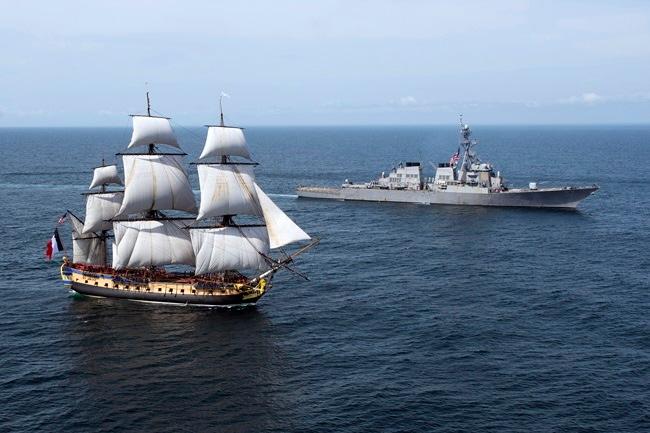
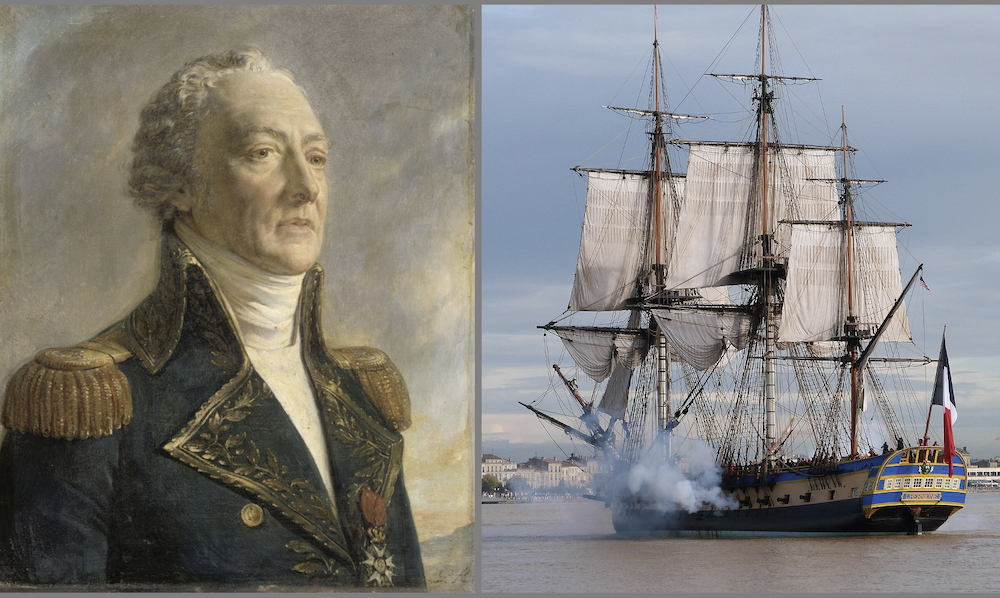
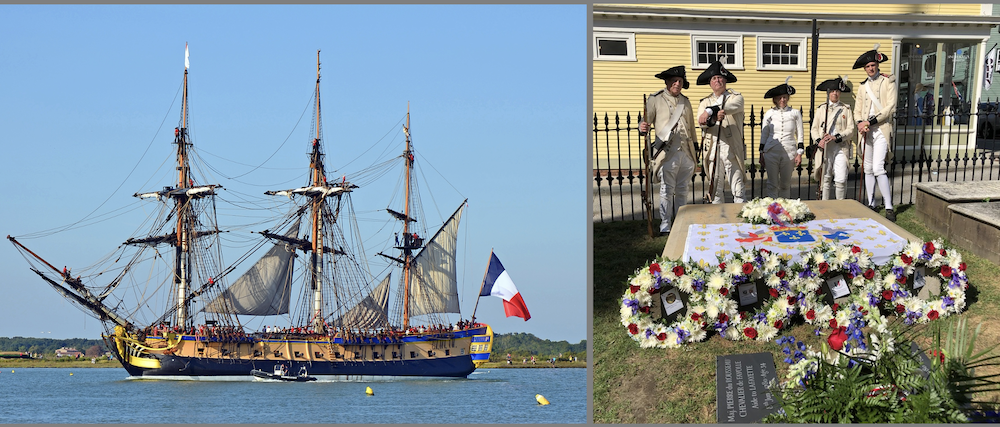
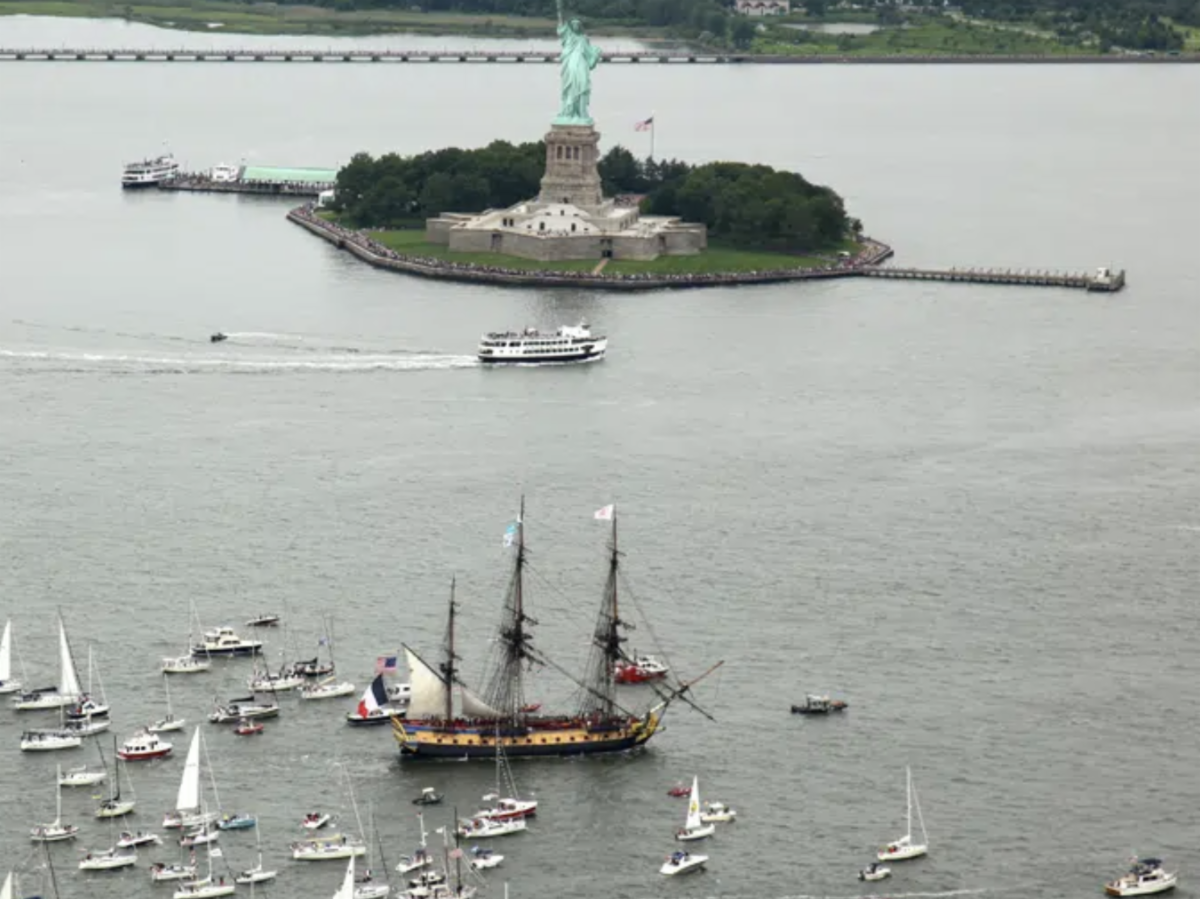
The Hermione at Virginia Capes (June 2, 2015) The Arleigh Burke-class guided-missile destroyer USS Mitscher (DDG 57), right, provides a warm welcome to the French tall ship replica the Hermione in the vicinity of the Battle of Virginia Capes off the east coast of the United States. The original Hermione brought French Gen. Marquis de Lafayette to America in 1780 to inform General Washington that a French army was headed for the United States to assist in the war effort. The symbolic return of the Hermione paid homage to Lafayette and the Franco-American alliance that brought victory at the Battle of Yorktown in 1781. U.S. Navy photo by Mass Communication Specialist 1st Class Michael Sandberg/Released, Public Domain, https://nara.getarchive.net/media/150602-n-oa702-001-virginia-capes-june-2-2015-the-40e551
| | |
Editorial
Anyone who sets eyes on a tall ship cannot forget the awe they inspire. In particular, one of them, the frigate Hermione, a.k.a. the "Freedom Frigate", beloved on both sides of the Atlantic, and currently in dire straits, so to speak, as it rests in dry dock undergoing critical (and expensive) repairs.
A fund raising campaign has been going on for several months now, and much remains to be collected in order to save her and allow her to return to America.
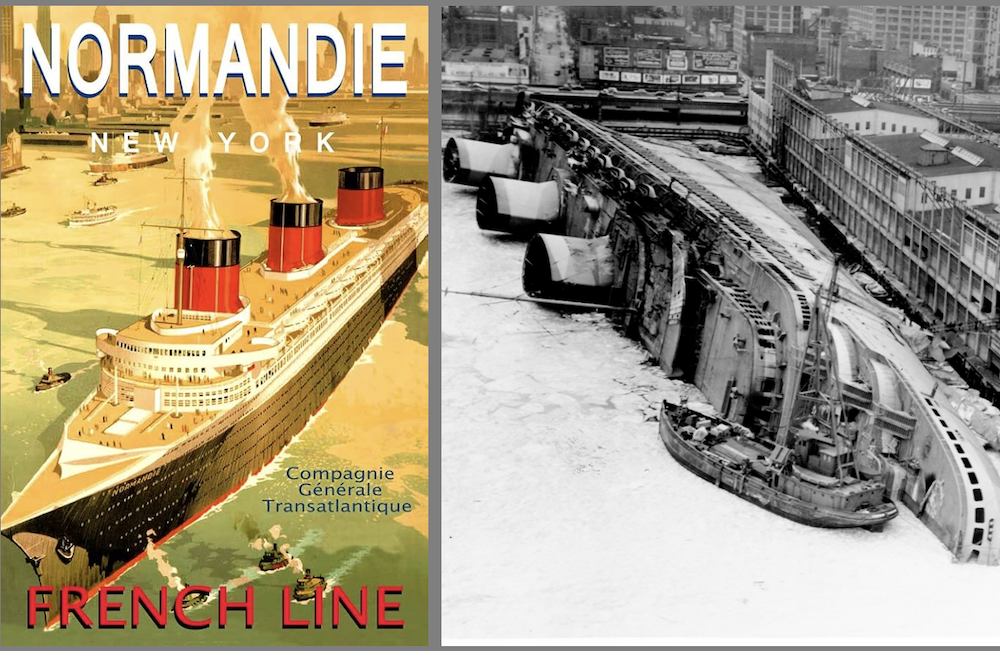
This made us ponder: what if we would narrate and celebrate its extraordinary story, as well as several other French ships, some well known such as the Normandie, and others lesser known, such as the Griffon, all intertwined with American and U.S. history?
We invite you to embark with us on this journey, which will take you from the Atlantic shores to the Great Lakes, and all the way to Texas, California, Alaska, Hawaii and the American Samoa!
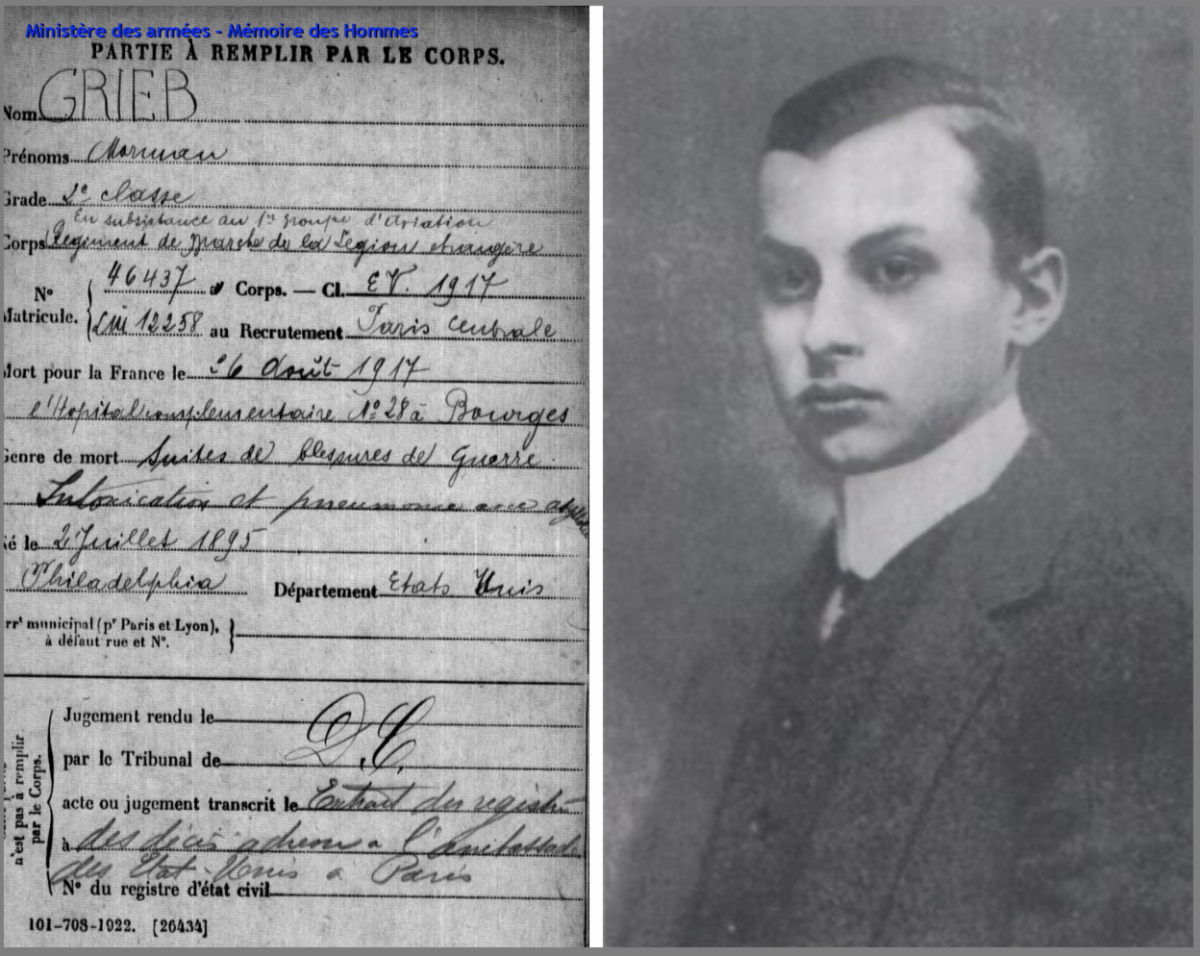
As always, Part Two of our Bulletin will honor this month another brave American volunteer who "Died for France " in World War One: Corporal Norman (Henry) Grieb, who died of injuries following an accident in a military hospital in Bourges, Central France, far from home. He was posthumously awarded the Médaille Militaire.
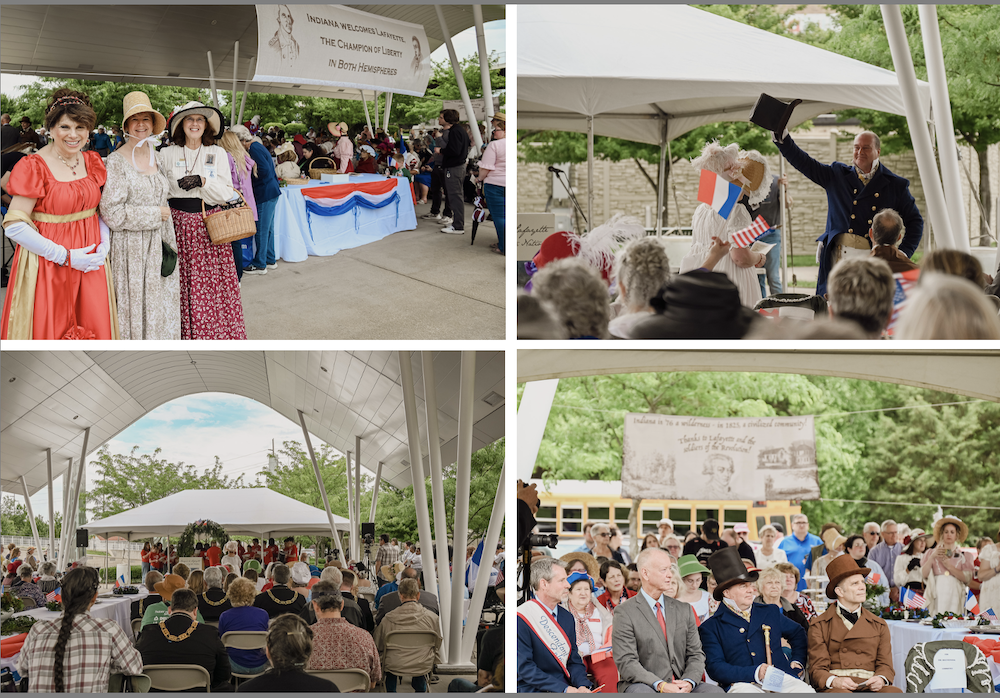
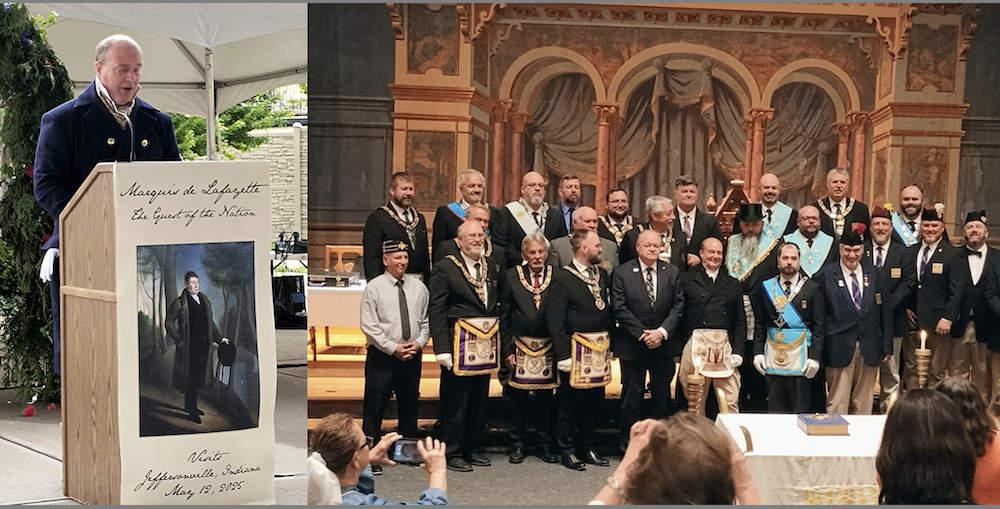
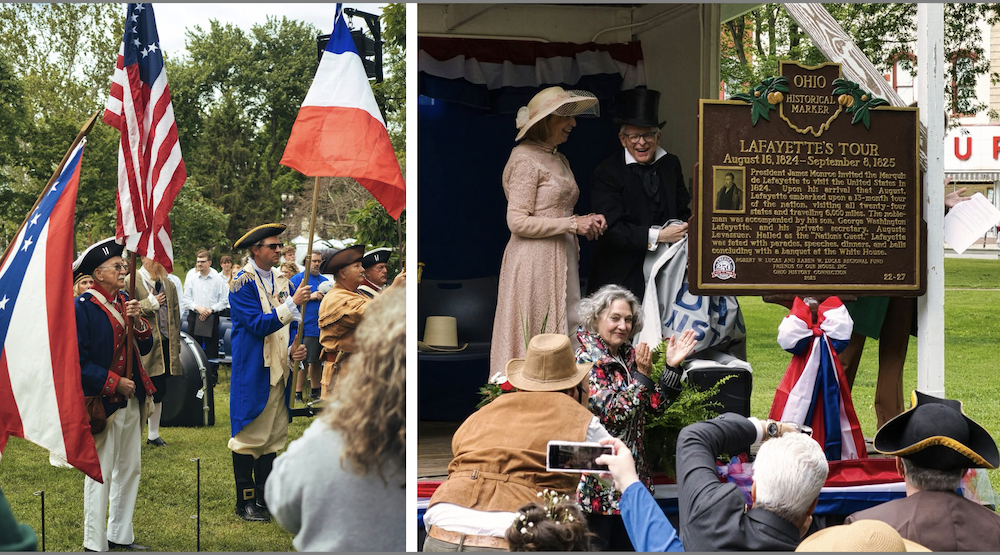
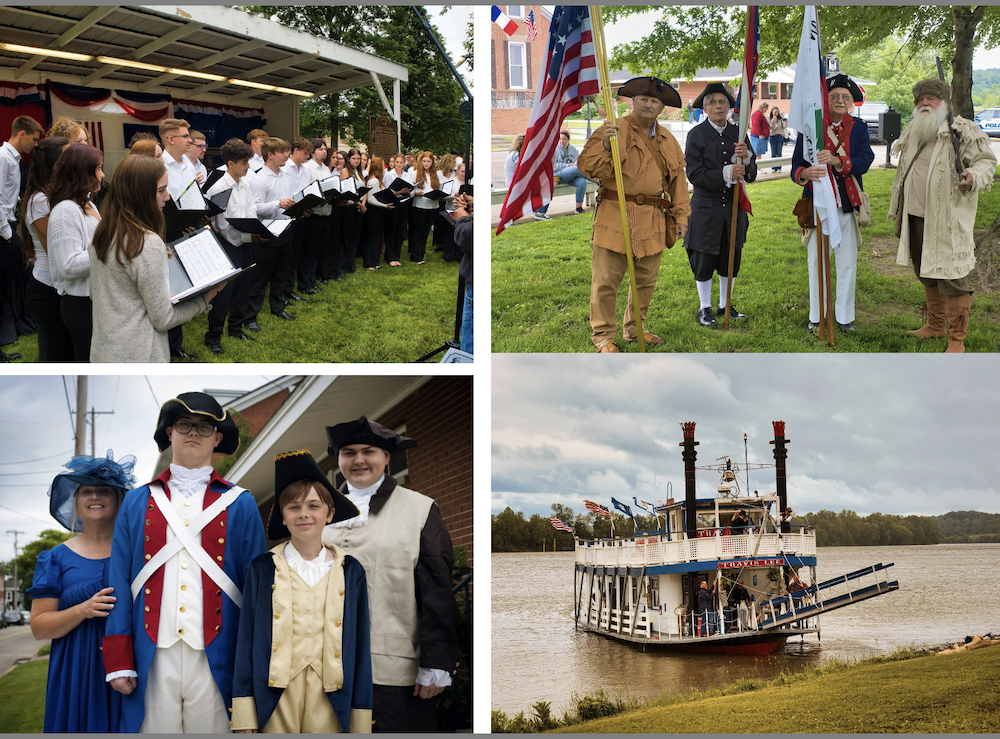
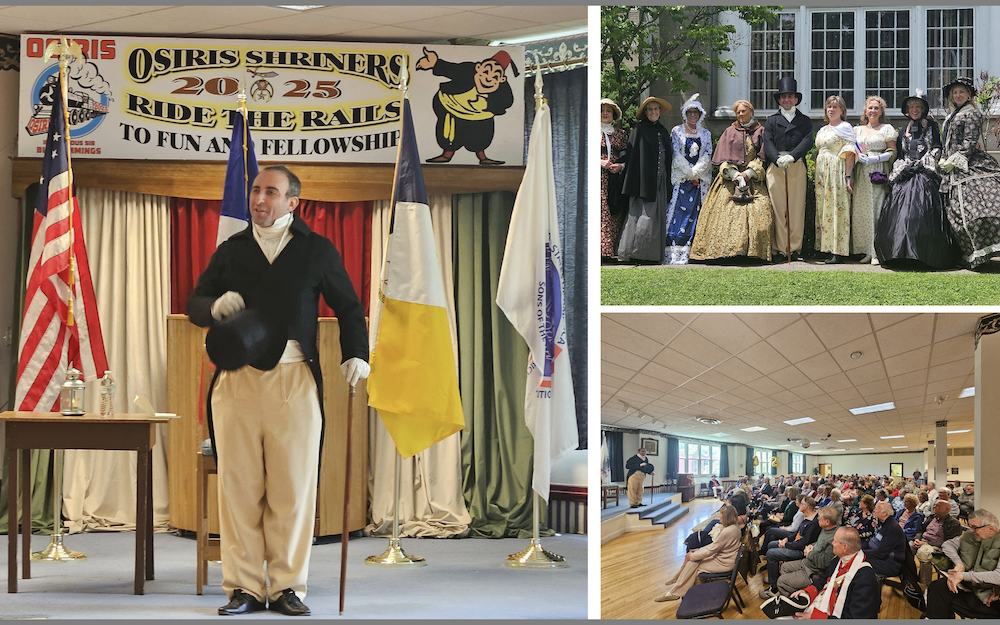
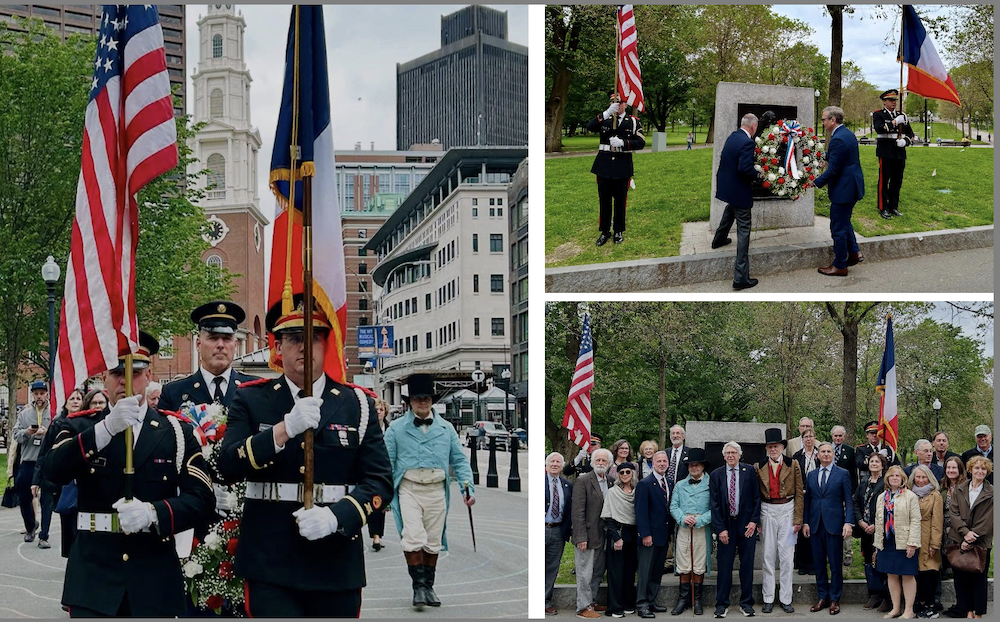
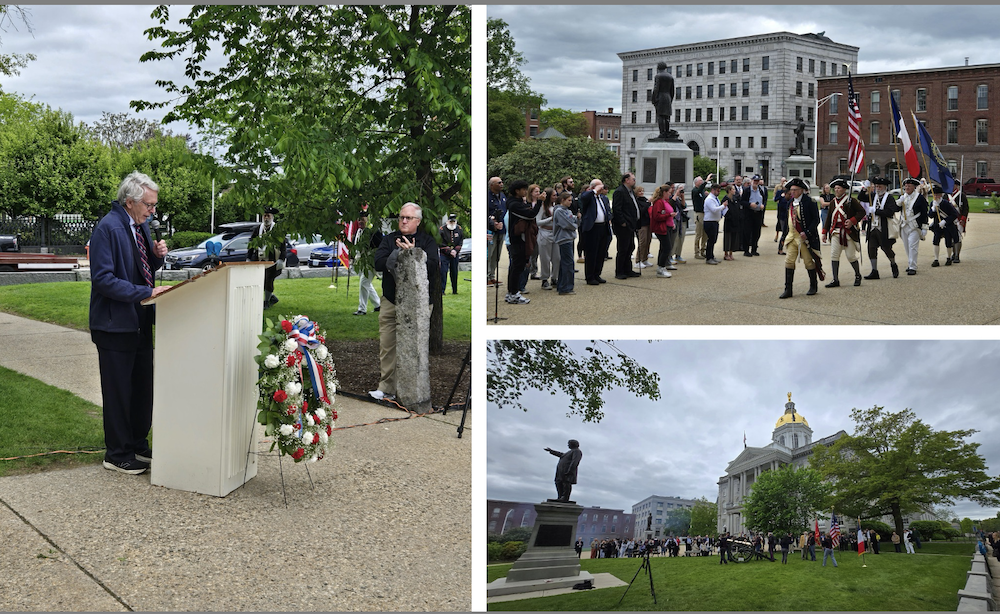
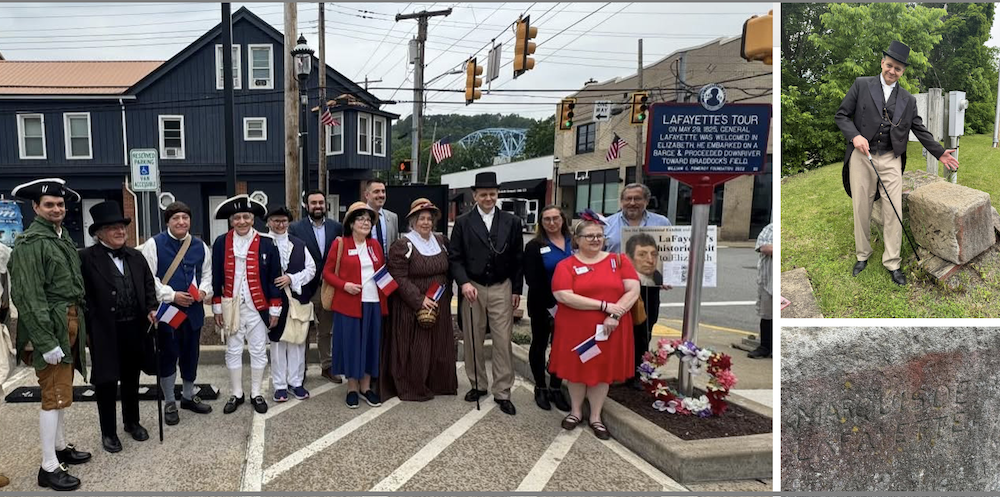
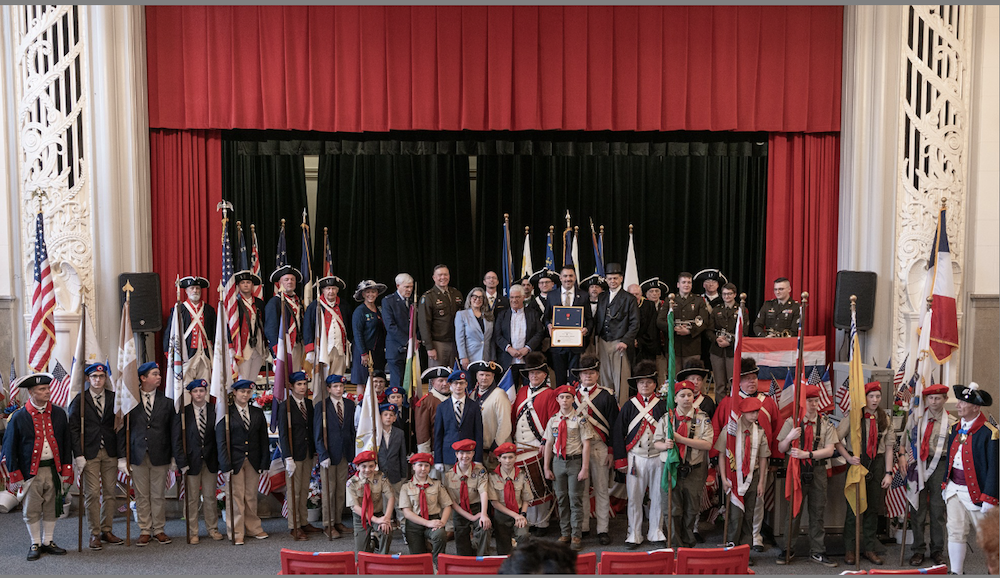
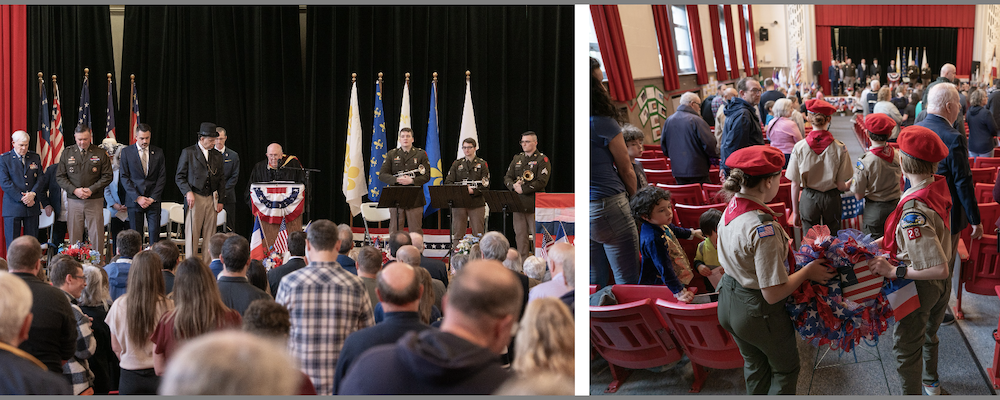
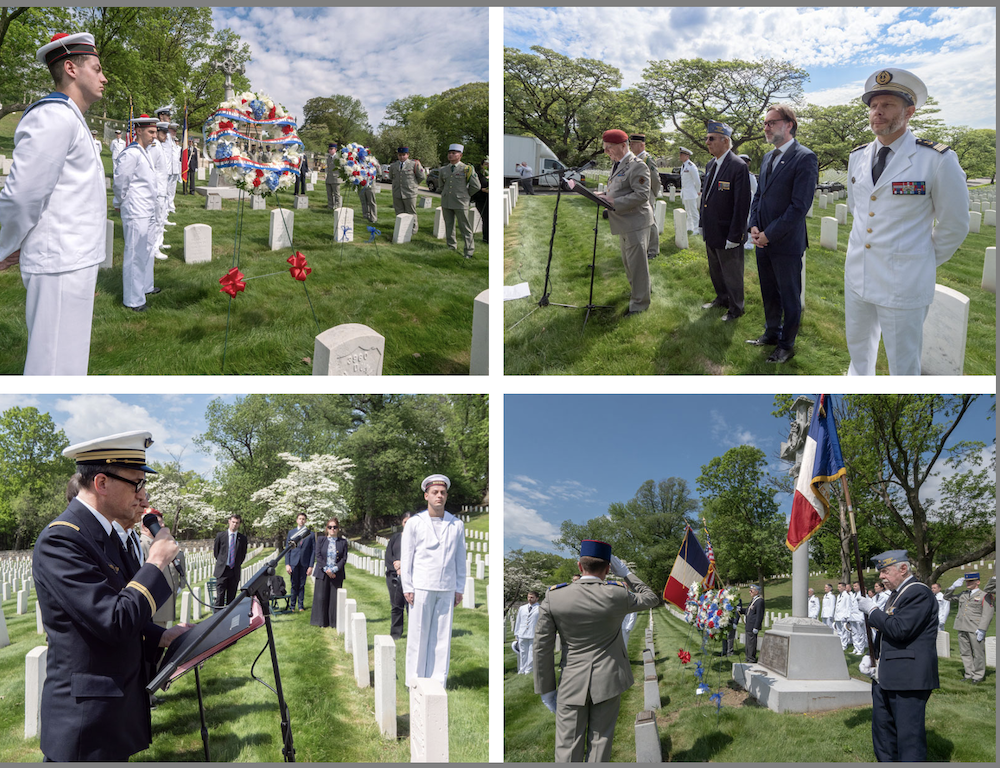
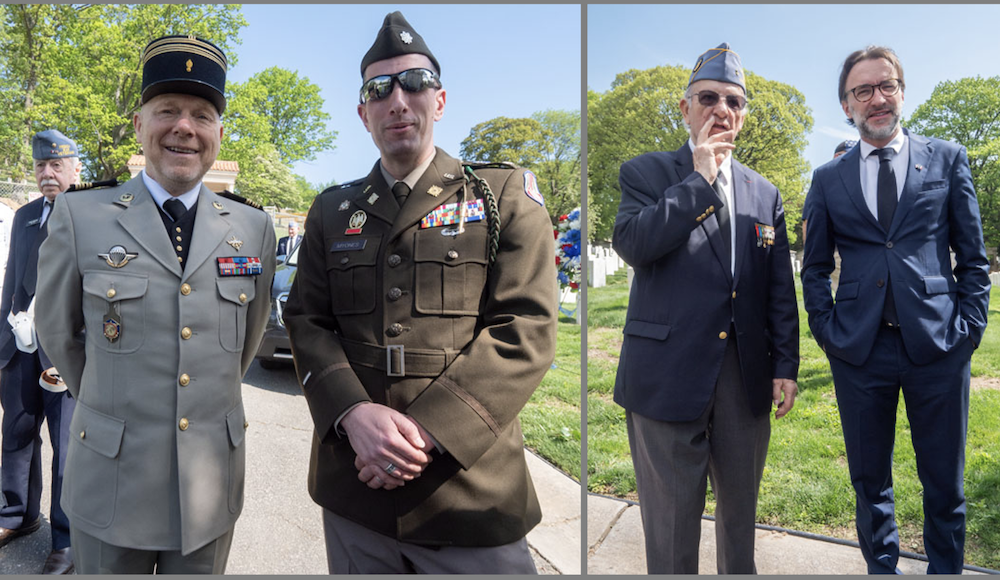
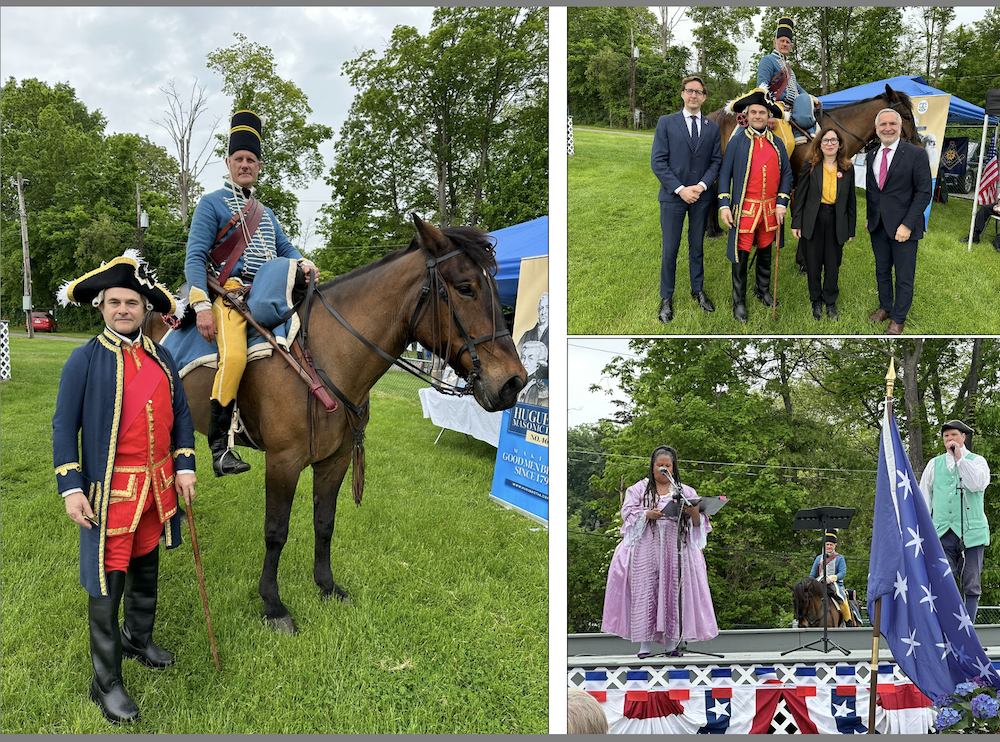
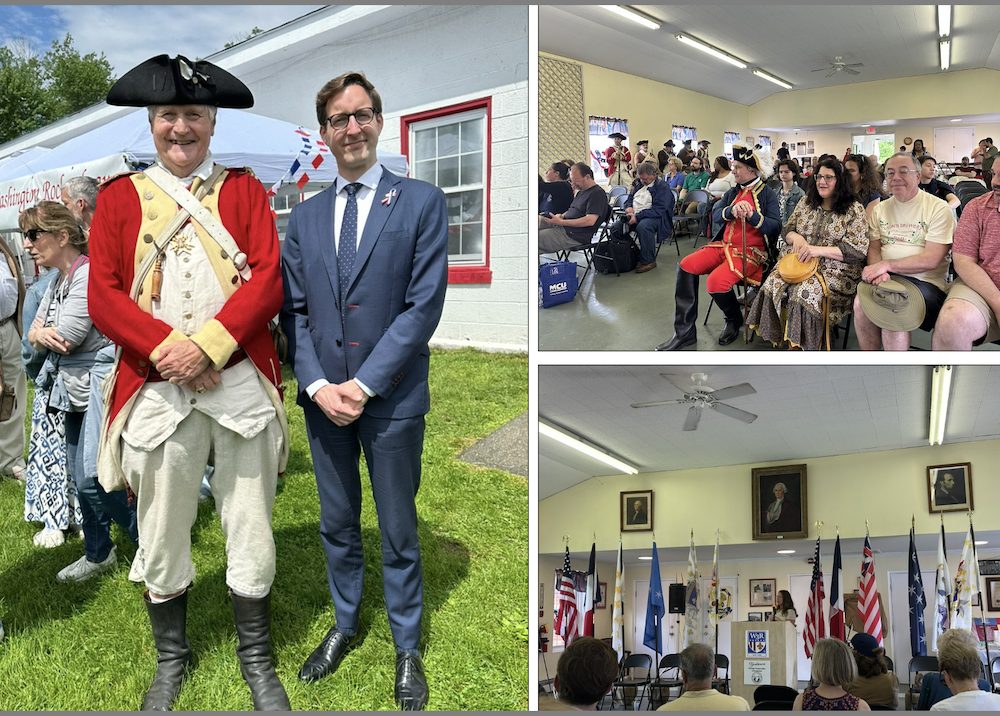
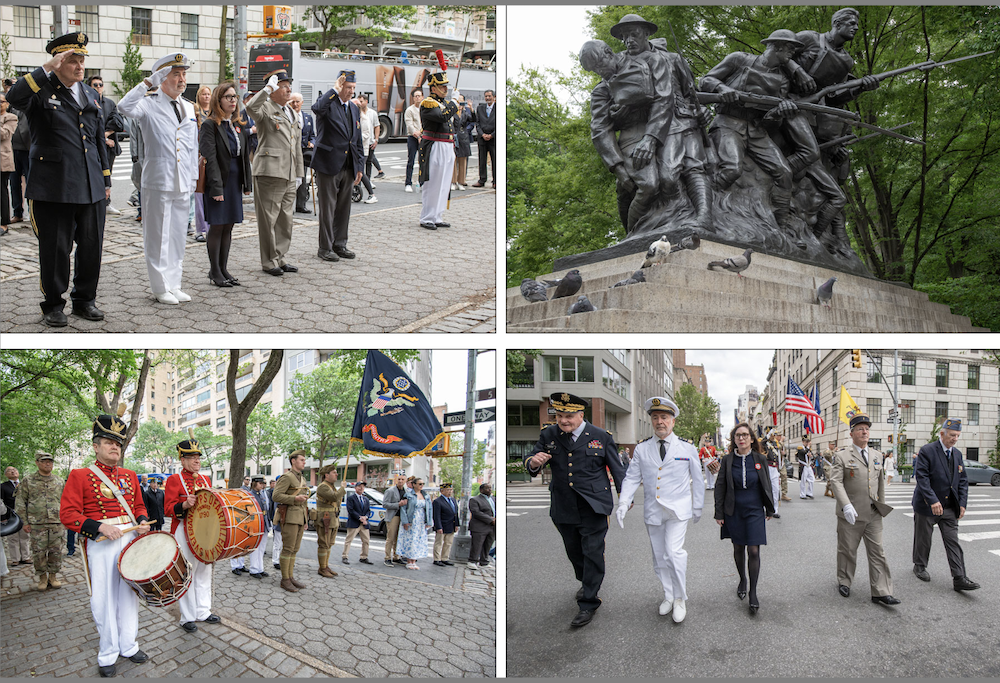
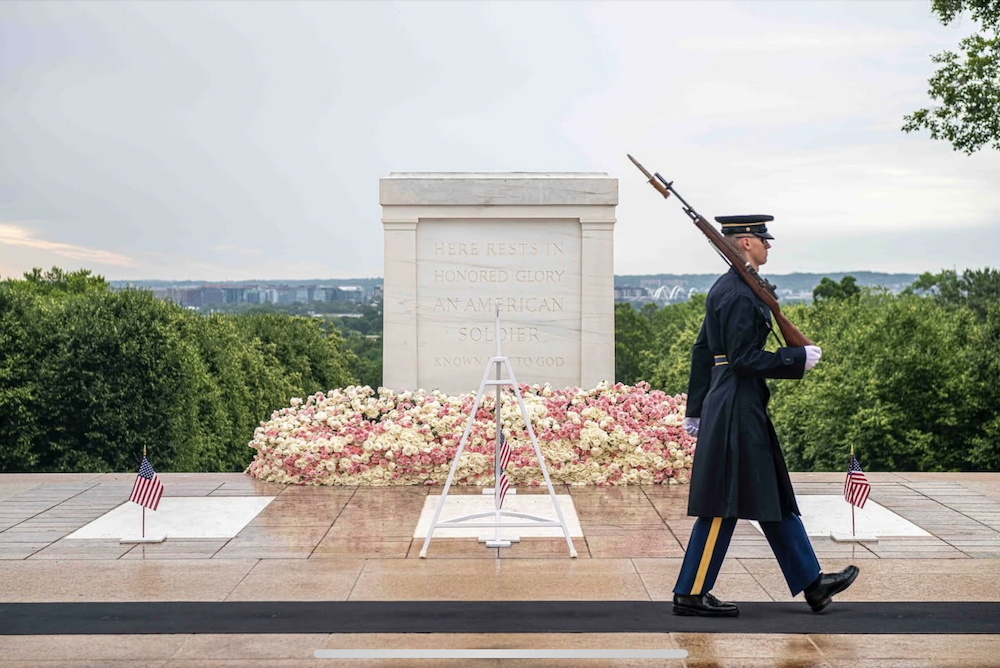
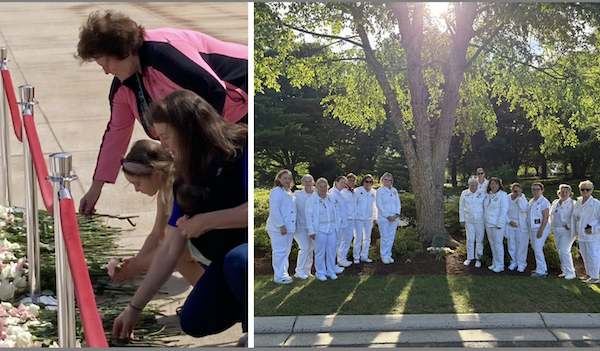
Part Three, “News and Save the Dates” will report on events since our last Bulletin, including several commemorations of the ongoing Bicentennial of Lafayette’s Farewell Tour organized by the American Friends of Lafayette. We also share photos from several recent patriotic events, including the Rochambeau Festival in Yorktown, NY, and Memorial Day in New York and at Arlington National Cemetery.
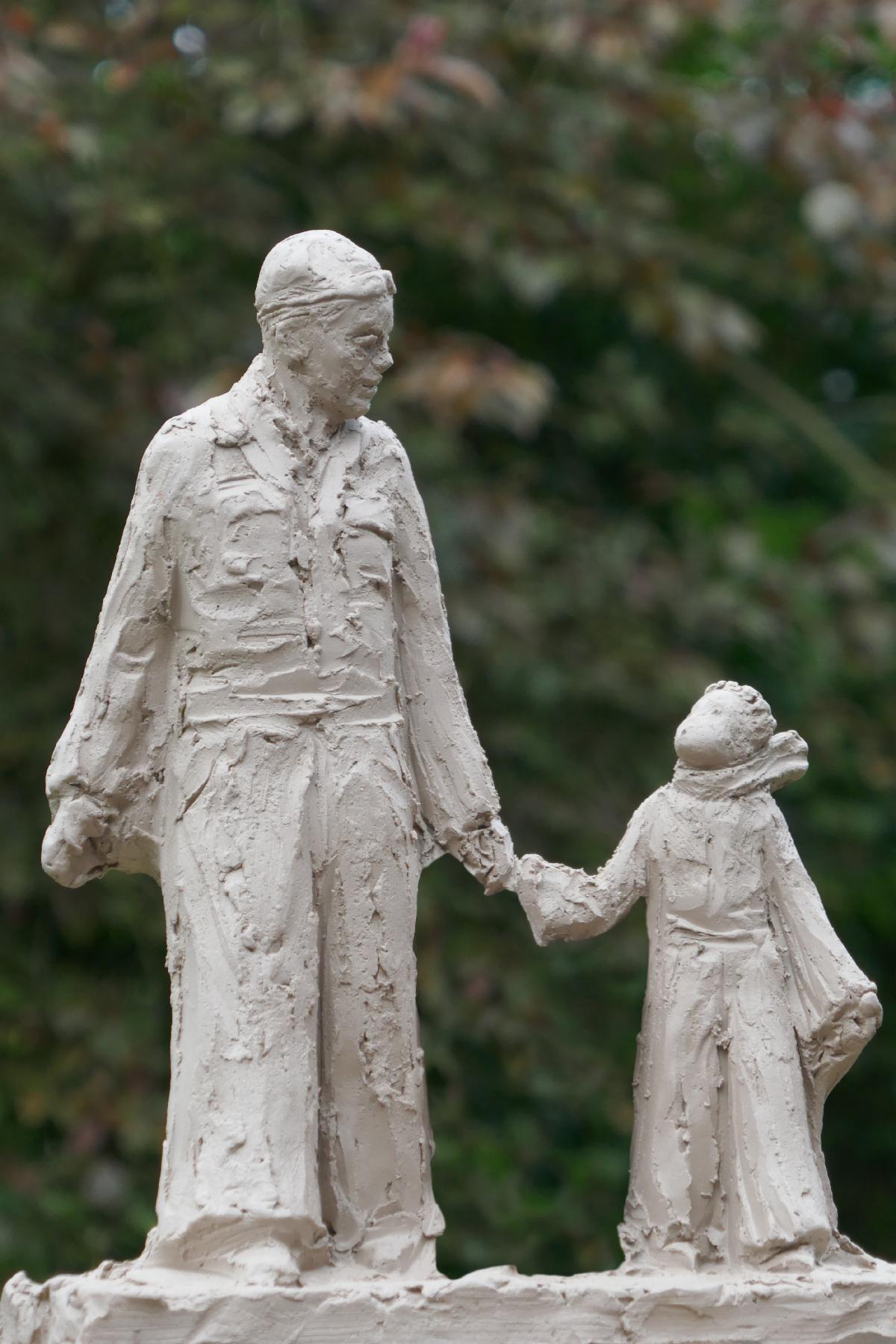
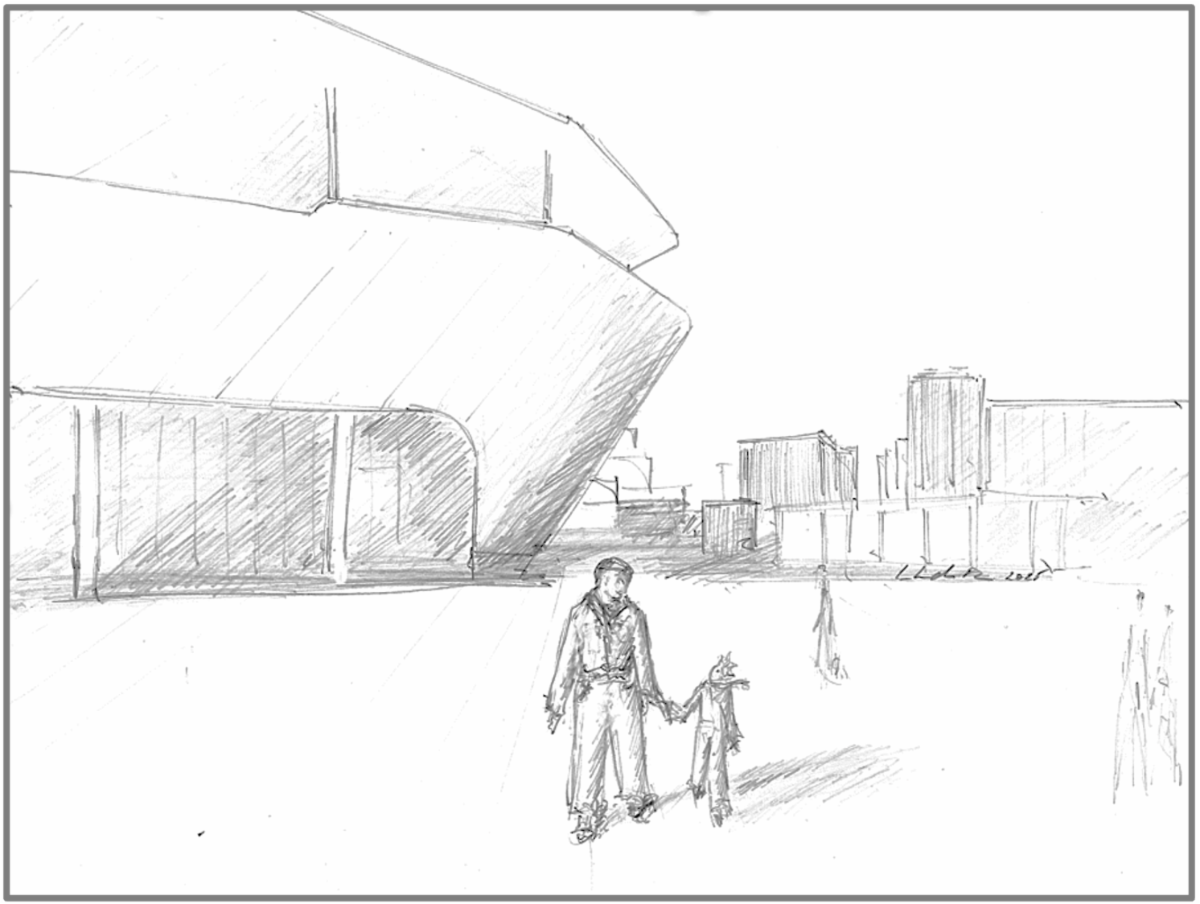
Our fund raising campaign for the sculpture of Le Petit Prince and author Antoine de Saint Exupéry has reached 40% of our goal.
We will publicly acknowledge all donations, small or large, to make this endeavor a reality.
Starting at $1,000, your name (or your company) will be engraved in a plaque inside the Frost Museum of Science and planetarium in downtown Miami, Florida. What is more, the Museum has agreed to display the sculpture for a minimum of thirty years.
As you can see, our Society is all about long-haul journeys!...
May we count on you? Any donation will help us greatly and will be gratefully acknowledged.
On behalf of the Board of Directors,
Thierry Chaunu
President, The American Society of Le Souvenir Français, Inc.
| | |
PART ONE
French ships
that are part of American History
| | |
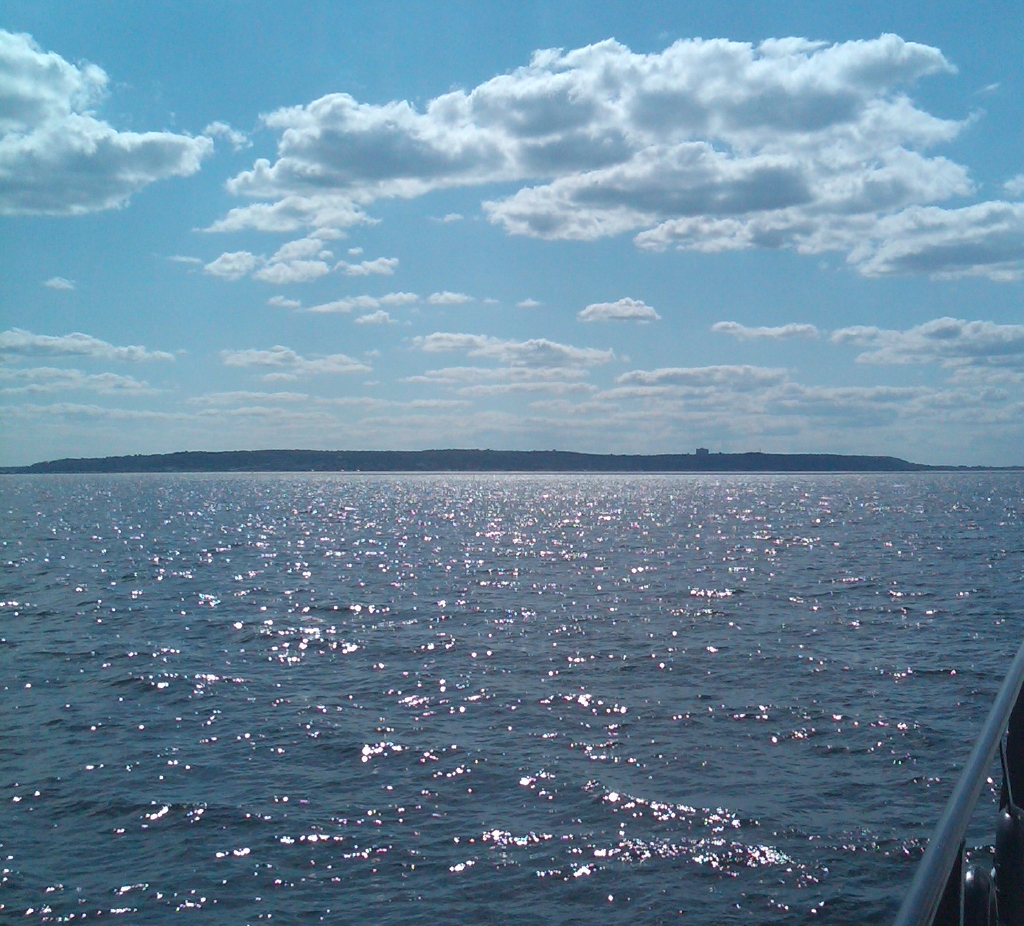
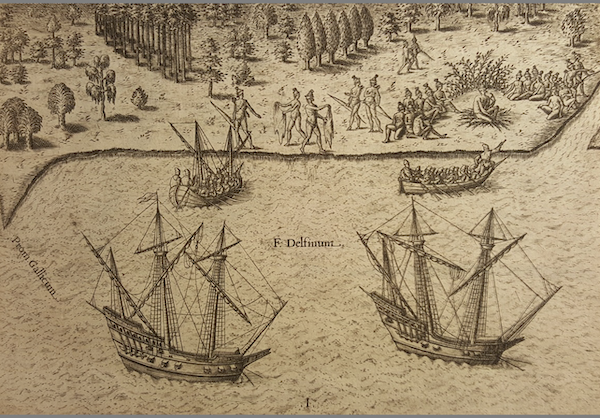
Above: American coastline, as seen by Jean de Verrazane, April 8 to 13, 1524. After Maryland, from April 8 to 13, 1524, his ship La Dauphine sailed past the coast of present-day Delaware and New Jersey where promontories are named Cap Alençon, Cap Bonnivet and the Vendôme river (today the Delaware River).
Marker, “Olde Sinepuxent”, Ferry Landing Rd, Berlin, MD 21811 - GPS: 38.200700, -75.162933
“Ever since explorer Giovanni da Verrazzano sailed through Sinepuxent Bay in 1524, human activty along these waters has helped shape Assateague's history..." Photo: By Lithium6ion - Own work, Public Domain, https://commons.wikimedia.org/w/index.php?curid=16348898
| | |
• Maritime history covers several centuries, and we do not pretend here writing a history of Atlantic crossings between France and North America. We simply would like to offer a survey of twenty ships which left a mark in the history of the United States, often memorialized in American museums, plaques and other interpretive markers.
• Our elders were enterprising and courageous. It is hard today to imagine the hardships and dangers of navigations in treacherous waters. Next time you fly to Europe, observe the deep blue landscape 6 miles under you: these tiny white dots at the surface of the Atlantic ocean are likely 10 feet waves or more...
• It is also a vast cemetery: just during the period of the Revolutionary War, more than 3,500 French sailors and soldiers perished along the Eastern seaboard of the United States. As was the custom at the time, they were thrown overboard to rest at the bottom of the ocean.
• Our Society is currently working to install a granite memorial to their memory along the York river, by the Chesapeake bay, at the Riverwalk in Yorktown, Virginia.
All these ships disappeared, unfortunately. The conservationist efforts culminating in today's maritime museums didn't exist then.
However, we do have several illustrations and historical artifacts to tell the story of these ships and their captains - - and in so doing, episodes from American and U.S. history.
| | |
La Dauphine
Jean de Verrazane, first discoverer of New York
1524
| | |
Above:
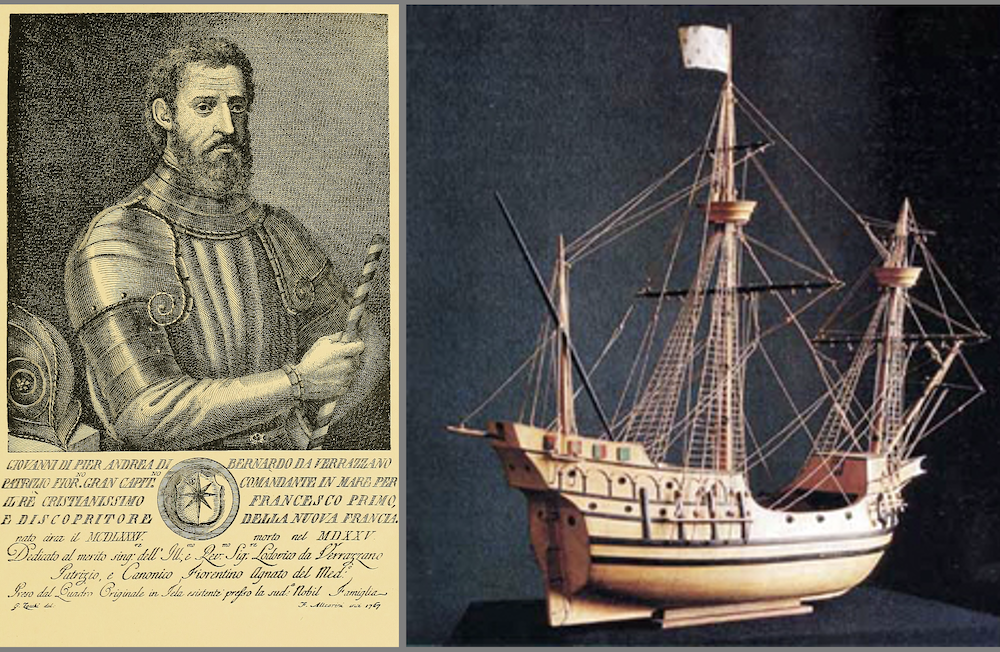
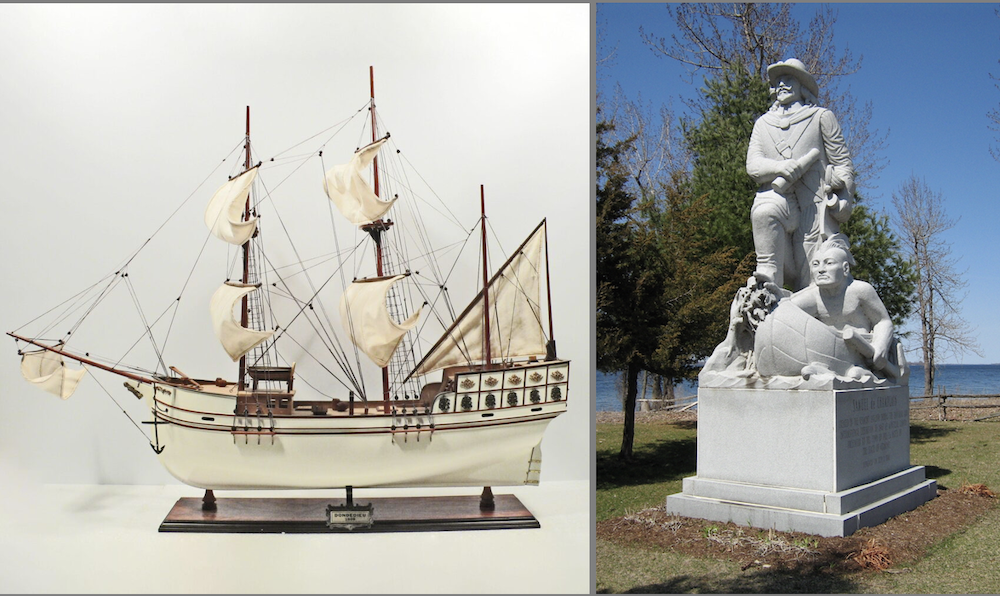
Left: Giovanni di Pier Andrea di Bernardo da Verrazzano, "Captain Commandant at Sea for the Most Christian King François Ier, and Discoverer of New France", By Allegrini, Francesco (1729-17..). Graveur ; Zocchi, Giuseppe (1711-1767). Peintre - Public Domain, https://commons.wikimedia.org/w/index.php?curid=625293
Right: "La Dauphine", replica 1/5 model of the Musée Maritime de Rouen "Nearly five centuries later, a group of enthusiasts wants to give back all its historic place to this extraordinary adventure. The model was done by the volunteers of the association, supervised by the Master Carpenter Patrice Mabire, and by the participation of the students of the Colleges of Haute-Normandie. The 1/5th replica of “la Dauphine” is 7 meters long." 13, Quai Emile Duchemin, 76000 Rouen, France
Photo: https://www1.musee-maritime-rouen.asso.fr/atelier/la-dauphine/
| | |
• It all started with King Francis 1st and his financing of the first French expedition to the New World in 1524 with La Dauphine under the command of Jean de Verrazane a Genovese-born* navigator at the service of the crown of France.
• We narrated his expeditions in our April 2023: Tribute to Jean de Verrazane:
https://conta.cc/3UGnScM (original version in English)
https://conta.cc/3zZ8xuw (version en français)
• Giovanni da Verrazzano? Or Giovanni da Verrazano with one z, as is often the case in English? Or Janus Verrazanus? Or Jehan de Verrazane, as in his will, preserved in the Archives Départementales de Seine-Maritime, dated 11 May 1526 and signed in Rouen, France ? Or Jean de Verrazane, as he is remembered in France?
Whatever the case may be, one thing is certain: every New-Yorker knows the Verrazzano Bridge (the additional "z" was added by Governor Andrew Cuomo on October 1, 2018) linking Brooklyn to Staten Island.
• On April 17, 1524 was the very first to discover New York, which he named La Nouvelle-Angoulême in honor the birthplace of French king François 1er - - 85 years before Henry Hudson...
• Visitors to the French General Consulate at 934 Fifth Avenue can see a bronze plaque in the vestibule entrance of the mansion. Of course, the few words on the plaque do not tell his life story.
• Let us just recall here his main discoveries, North Carolina to Canada, including his discovery of Le Refuge, present-day Newport, Rhode Island memorialized by the following selected plaques:
"Statue of Verrazzano"
State Street and, Battery Pl, New York, NY 10004
GPS: 40.704387, -74.016383
The official description of the monument, plus brief histories of Verrazzano and the statue itself can be read at: https://www.nycgovparks.org/parks/battery-park/monuments/1628
and also at: https://www.italianhistorical.org/monument.html
• Inscription (at the rear of the pedestal):
“ In April 1524
the Florentine-born navigator
Verrazzano
Led the French caravel La Dauphine
To the discovery of the Harbor of New York
And named these shores Angouleme
In honor of Francis I King of France ”
Marker, “Giovanni de Verrazzano”
St. John's Park, Atwells Ave, Providence, RI 02903
GPS: 41.823667, -71.429667
• Unfortunately, this marker doesn’t mention at all that Jean de Verrazane was sent by the King of France François Ier to explore the coastline of America and to find a passage to China. Additionally, the ship “La Dauphine” and the crew were French.
• Inscription:
“To Giovanni Da Verrazzano the navigator from Italy who in 1524 crossed the perilous northern Ocean. First to behold the coast of the future United States cast anchor in this bay explore its islands one of which because of its shape he christened Rhodes name later extended to the entire State of Rhode Island. Donated by Carrara, The Marble City, and by Greve in Chanti, where Verrazzano was born. In pledge of ever growing friendship between the American and the Italian peoples”.
Note: *No conclusive evidence exists about his birthplace: Genoa, Tuscany or Lyon?
| | |
La Trinité
Jean Ribault
and his French colony in Florida
1565
| | |
Above:
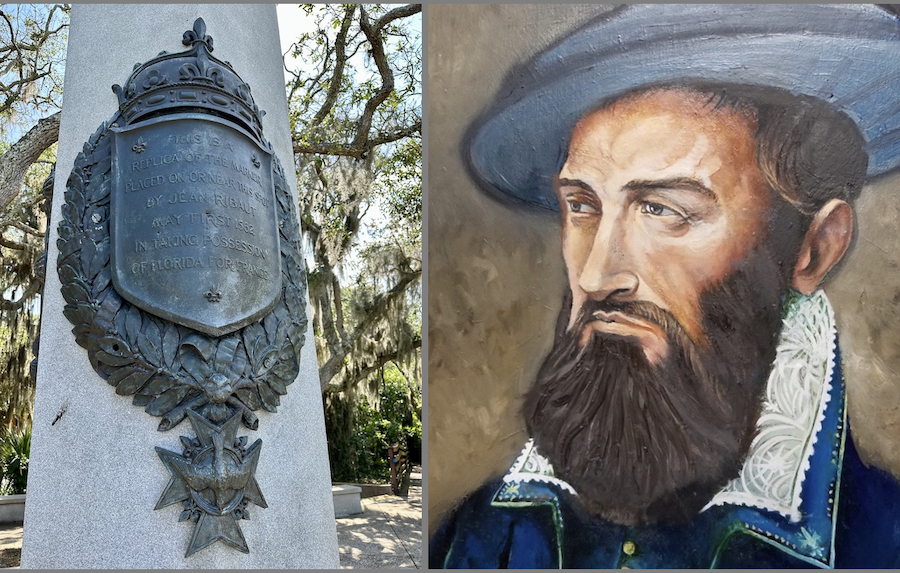
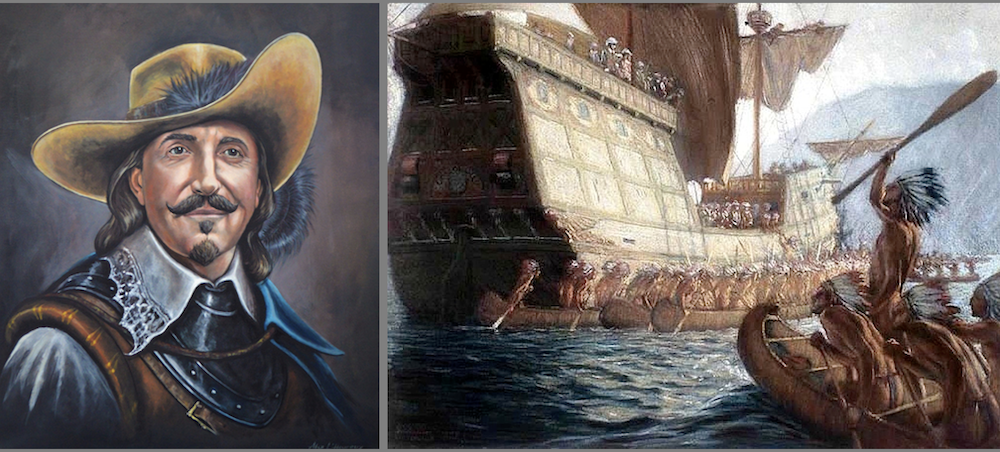
Left: Replica of Jean Ribault's column claiming Florida for France in 1562, Fort Caroline National Memorial, Jacksonville, FL. – Photo: Thierry Chaunu © ASSFI May 2023
Right: French navigator Jean Ribault explored the Florida, Georgia and Carolina coastlines during the years 1562-1565. He was in search of colony locations for French Huguenots fleeing persecution. Jean Ribault’s epic journey’s for religious freedom took place more than 50 years before the Pilgrims landed on Plymouth Rock (1620). Portrait by Calvin Bryant, Florida - Own work, CC BY-SA 4.0 https://commons.wikimedia.org/w/index.php?curid=122061220
| | |
• Jean Ribault (also spelled Ribaut) (born in Dieppe, Normandy 1520 – October 12, 1565) was a French naval officer, navigator, and a colonizer of what would become the southeastern United States. He was a major figure in the French attempts to colonize Florida.
• He entered the French navy under the command of the Huguenot admiral Gaspard de Coligny. After discovering St James river near modern-day Jacksonville where he built Fort Caroline, he built another one in South Carolina named Charlesfort. However, the Spanish viewed the French as heretics and intruders and sent an expedition to expel them. Ribault’s fleet was destroyed by a hurricane near cap Canaveral, and the Spanish were able to attack the lightly defended fort and slaughtered the garrison and 140 civilians, only sparing women and children. Led by Ribault, survivors of the hurricane who made it on shore were captured and massacred by the Spaniards, who hung their bodies with an inscription, "Not as Frenchmen but as Lutherans.” This massacre aroused considerable emotion in France. Three years later, a French expedition led by Dominique de Gourgues, himself a Catholic, exacted revenge by murdering the Spanish garrison and hanging them with the inscription "Not as Spaniards but as murderers.”
• Several places and schools in Florida are named after Ribault.
• We devoted a Bulletin narrating the dramatic story of Jean Ribault and his colonists, 50 years before the English pilgrim of the Mayflower, in our September 2022 Bulletin, "It all happened in September…"
https://conta.cc/3ds6k35 (original version in English)
https://conta.cc/3r6ZG5r (version en français)
• There are several markers and monuments in Florida honoring Ribault.
We selected this one as historians and marine archeologists believe a second original column is located in the shipwreck of La Trinité:
Fort Caroline National Memorial, “Ribault’s Monument”
Fort de la Caroline 13271 Fort Caroline Rd, Jacksonville, FL 32225
GPS: 30.388200, -81.489450
• Inscription:
Front:
“This is a
replica of the marker
placed on or near this spot
by Jean Ribaut
May First 1562
in taking possession
of Florida for France.”
Back:
" Erected by the Florida Daughters of the American Revolution
May First 1924
commemorating the first landing of protestants
on American soil."
| | |
Above: La Trinité and its sister ships, illustrated by Théodore de Bry, 1528-1598. Library of Congress, Rare Book and Special Collections Division, Public domain, https://lccn.loc.gov/02025203
• Jean Ribault's fleet consisted of seven ships. Three of these were under 100 tons, while four were larger.
• The flagship, the 34-cannon La Trinité, was led by Jean Ribault. It was a galleass, a type of warship that combined features of a galleon, using both oars and sails for propulsion, and it was relatively small, weighing about 150-160 tons.
• L’Émérillon (“Little Falcon”), the second flagship with 18 cannons, also registering 150-160 tons. She was a roberge ship (a type of ship used by seafarers in Normandy) also owned by the King. The name "Roberge" itself is an Old French reference to the longships used by the Norsemen (Vikings).
• La Perle, meaning "Pearl," was commanded by Ribault's son Jacques, and • La Levrière, ("Greyhound") which was under the command of Laudonnière.
• There was also another smaller roberge-ship, called the Émérillon II.
• La Truite ("Trout"), most likely also a roberge ship.
• The smallest vessel, l'Épaule de Mouton, ("Leg of mutton") weighed 60 tons.
They are believed to rest at the bottom of the St John's river in Jacksonville.
• In 2016 the shipwreck of Ribault's flagship, La Trinité, was located was found in 2016 by Global Marine Exploration (GME). The wreck lies in about 30 feet of water and is important because it is the oldest known French shipwreck in the New World.
This discovery sparked a legal dispute between GME, which claimed ownership of the wreck and its artifacts, and France, which argued for ownership under international law that protects sunken military vessels.
The court ruled in favor of France, confirmingthat the wreck and its artifacts were inalienable and belonged to the French government.
The wreck included artifacts like French bronze cannons, anchors, ballast stones, a granite monument featuring the French coat of arms (fleur-de-lis), and a grinding wheel. This is an impressive discovery that resembles the monument, which was never found, that French captain Jean Ribault placed at the St. Johns River's mouth in 1562 to claim New France, a large region along the Southeast coast.
• Consequently France and the State of Florida signed a “Declaration of Intention to Embark on a Historic Partnership to Research and Preserve the Trinité Shipwreck”. While a dedicated La Trinité museum has not yet been decided, the artifacts will be displayed in a way that highlights their historical significance. The focus is on sharing the story of this crucial piece of French and North American history with the public.
| | |
La Bonne-Renommée and Don-de-Dieu
Samuel de Champlain &
Pierre Dugua de Mons
1604
| | |
We will devote a future Bulletin to Samuel de Champlain, and the establishments of the first French colonies in North America.
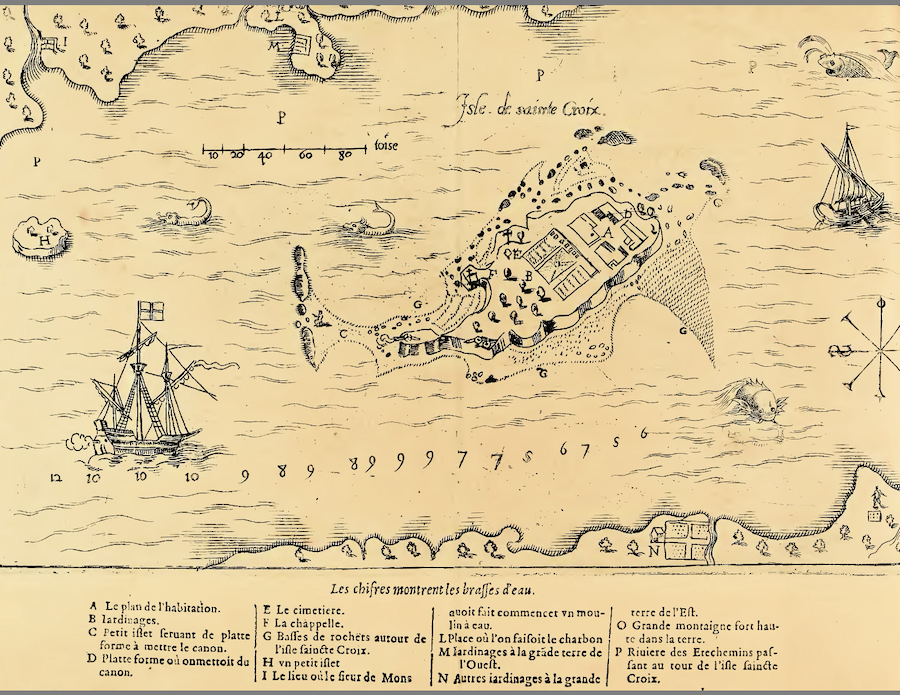
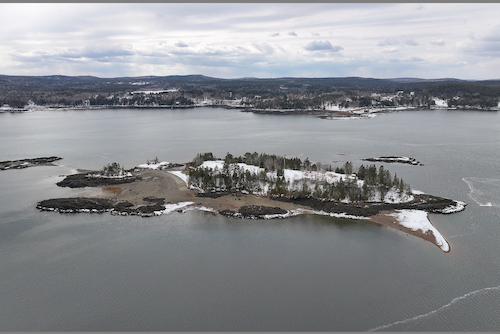
To stay within the scope of this Bulletin we will concentrate on the expedition of 1604 to the île de Sainte Croix in Maine.
• Samuel de Champlain (born c.1567 in Brouage near La Rochelle, or August 13, 1574 according to more recent historians – died in Québec, December 25, 1635) was a French explorer, navigator, cartographer, draftsman, soldier, geographer, ethnologist, diplomat, and chronicler.
• He made between 21 and 29 trips across the Atlantic Ocean, established a colony in Sainte Croix, Maine, in 1604, and founded Quebec City and New France on July 3, 1608.
Champlain was the first European to document the Great Lakes, creating maps of his travels and sharing what he learned from the natives and the French who lived with them.
• A significant figure in Canadian and US history, Champlain produced the first accurate coastal map during his explorations.
• Several statues, memorials, markers and plaques were erected in the States of New York, Massachusetts and Maine.
• Pierre Dugua de Mons (born in Royan, Saintonge, c. 1558 - died 1628 in in Fléac-sur-Seugne, Saintonge) a key figure in early French exploration and colonization, commissioned ships for his expeditions.
• He notably used two ships, the Don-de-Dieu ("Gift of God") and La Bonne-Renommée ("Good Fame"), during his 1604 expedition to Acadia, which was funded by merchants from Rouen, Saint-Malo, and La Rochelle.
• He departed from France with 120 settlers, including François Gravé Du Pont owner of La Bonne-Renommée and serving as Senior officer, Royal cartographer Samuel de Champlain, the Baron de Poutrincourt, a priest named Nicolas Aubry, a protestant clergyman, and Mathieu de Costa, a famous linguist who was the first recorded black man to arrive in North America (Streets in Montreal, Quebec City and Halifax have been named after him. And a francophone primary school in Toronto. But best of all, Canada Post created a stamp with his picture. We will present him at length in our future Bulletin dedicated to Champlain and his crew).
• They founded the colony of Sainte-Croix Island in Maine. Many settlers fell victim to the severe winter conditions and scurvy as they depleted the island's limited natural resources.
• La Bonne Renommée had a tonnage of 120 or 150 tons and 27,5m (90 ft) long. She was used by explorer Samuel de Champlain on his first voyage to America. She was the flagship captained by François Gravé Du Pont, Captain Nicolas Morel as master, and Guillaume Duglas as pilot.
• Don-De-Dieu is remembered in the moto of the city of Québec: Don de Dieu feray valoir, "I shall put God's gift to good use." In his masterful biography "Champlain's Dream", David Hackett Fischer describes Don-de-Dieu as a 150-ton, 100 ft long ship, with Sieur de Mons as her commander, captain Timothée le Barbier as her master, Louis Coman as pilot, and Champlain, making her the "admiral" or flagship of the expedition.
"The average speed of Don-de-Dieu was about five knots, with daily runs that would have been above eight knots - faster than some transatlantic convoys in the Second World War", adds historian Fischer.
| | |
Above: Map of Map of l'île Sainte-Croix, first site of colonization in New France, by Samuel de Champlain - Public Domain https://commons.wikimedia.org/w/index.php?curid=52316563 and Aerial view of Saint Croix Island, Maine, By Quintin Soloviev - Own work, CC BY 4.0, https://commons.wikimedia.org/w/index.php?curid=161100307 . The accuracy of Champlain is simply amazing. He also meticulously surveyed the depths of the entire area.
Plaque, “Ste Croix Island”
Saint Croix Island International Historic Site, Calais ME 04619
GPS: 45.128409, -67.133319
• Inscription:
1604 – 1904
“To commemorate the history and occupation
of this island by
DeMonts & Champlain
Who naming it
L’isle Saincte Croix
Founded here 26 June 1604
The French Colony of Acadia
Then the only settlement
Of Europeans north of Florida
This tablet is erected by
Residents of the Saint Croix Valley, 1904”
Marker, “The French Connection”
Acadia National Park
Paradise Hill Road, Bar Harbor ME 04609
GPS: 44.405383, -68.237032
• Inscription:
“Frenchman Bay, in front of you, and other prominent names commemorate the region’s rich French heritage, “Acadia” stems from “Arcadia,” a term used by Giovanni Verrazano’s expedition to describe the Atlantic coast in 1524. The name “Mount Desert Island” was given by French explorer and cartographer Samuel Champlain during his 1604 visit. “Cadillac Mountain” honors Antoine de la Mothe-Cadillac, a self-proclaimed French noble who received a large land grant, including all of Mount Desert Island, from King Louis in 1688. The French, however, ultimately lost the struggle to control northeastern North America in the mid-1770s, when British troops defeated the French at Quebec. As you travel around Acadia today, look for other place names that signal Acadia’s French connection. Samuel Champlain mapped the coastline from Cape Cod to Canada and westward to the Great Lakes in the 1613 “Map of New France.” His 1604-1618 expeditions laid the groundwork for French colonization of the New World.
The island is high and notched in places so that from the sea it gives the appearance of a range of seven or eight mountains. The summits are all bare and rocky . . . I named it “L’ Ile des Monts-deserts.” Samuel Champlain, 1604 “
| | |
Le Griffon
René-Robert Cavelier de La Salle
1679
| | |
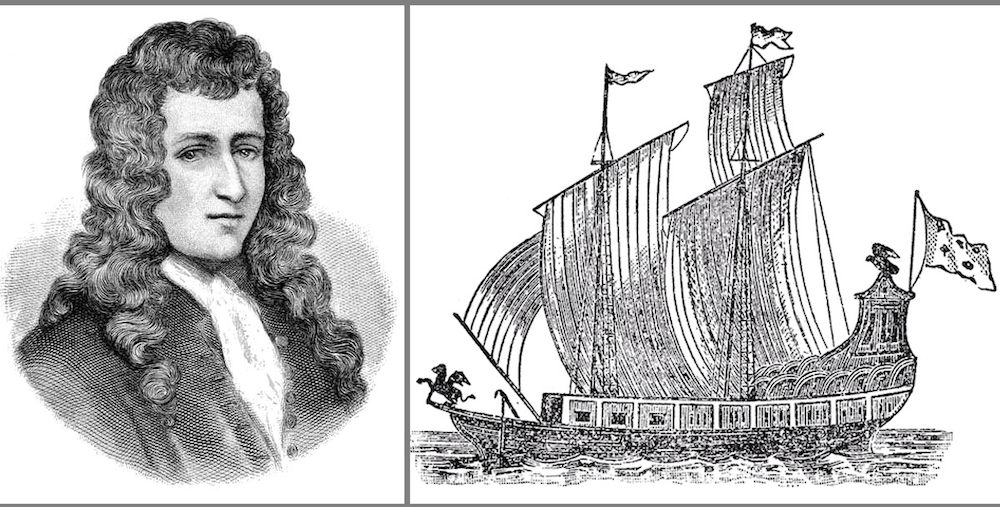
• Robert Cavelier was born on November 22, 1643, into well-off family in Rouen. He became a Jesuit and sailed for New France in the spring of 1666 but was soon released from the Society of Jesus after citing "moral weaknesses”. He received the title Sieur de La Salle with his seigneurial purchase of Lachine near Montréal and soon learned several native languages, such as the Iroquois and Seneca.
• He began to plan for expeditions to find a western passage to China. He built ships such as the Griffon to navigate the Great Lakes and build forts such as Fort Conti and Fort Miami.
• In 1679, with a party of 40 men, he went on to explore the Mississippi River, taking him to today’s Peoria, IL, (Fort Crevecoeur) Memphis, TN, (Fort Prudhomme), reaching the Gulf of Mexico in 1682 where he named the basin Louisiana in honor of King Louis XIV. In 1684 he went on an ill-fated mission to Texas (see further down the expedition of La Belle shipwreck) and after wandering for two years lost in the marshes of the Mississippi delta, he was killed during a mutiny near Navasota, TX on March 19, 1687.
• Dozens of sites throughout the United States bear the name of La Salle, with monuments and markers in several States.
• Le Griffon was a sailing ship built by French explorer Cavelier de La Salle in the Niagara region of New York in 1679. It was launched near Cayuga Island on the Niagara River and had seven cannons. The exact dimensions and design of Le Griffon are unclear, but many believe it was a 45-ton barque. At that time, it was the largest sailing ship on the Great Lakes. La Salle and Father Louis Hennepin began Le Griffon's first journey on August 7, 1679, with a crew of 32. They sailed across Lake Erie, Lake Huron, and Lake Michigan. The ship reached an island in northern Lake Michigan near Green Bay, where local tribes had gathered to trade animal pelts with the French. La Salle and his crew got off the ship and sent it back to Niagara on September 18. However, during its return from the island, it disappeared along with six crew members and its cargo of furs. One significant outcome of building Le Griffon was the discovery of Niagara Falls on the river that connects lakes Erie and Ontario.
Marker, “La Salle Built the Griffon”
Griffon Park, 9551 Buffalo Ave, Niagara Falls, NY 14304
GPS: 43.074783, -78.952000
• Inscription
“Hereabout in May 1679
Robert Cavelier de La Salle
Built the Griffon, "of sixty tons burthen,”
the first vessel to sail the Upper Lakes.”
—————
Erected by Niagara Frontier Historical Society and Presented to Niagara Frontier Landmarks Association, May 1902.”
Erected 1902 by the Niagara Frontier Historical Society”
What became of Le Griffon?
• An article from Discover Magazine explains:
“...We know quite a bit. LaSalle wrote a pretty detailed letter in 1681,” says Brendon Baillod, president of the Wisconsin Underwater Archeology Association. In 1681, La Salle sent two explorers to search for the remains of the ship. They returned with substantial pieces as well as insight from the local Potawatomi people. After La Salle left Le Griffon, he learned the ship sheltered at an island near the tip of Green Bay for the night. The next morning, the Potawatomi recognized a violent storm was imminent and warned the captain not to set sail. “He replied that his ship was not afraid of the winds and he would do as he pleased,” Baillod says. After Le Griffon left the island shelter, it headed out into the storm and was lost at sea."
• Despite many claims, no one has ever found the Griffon at the bottom of Lake Michigan.
| | |
La Belle, Le Joly and L'Aimable
Fort Saint Louis, Texas
1684
| | |
Above:
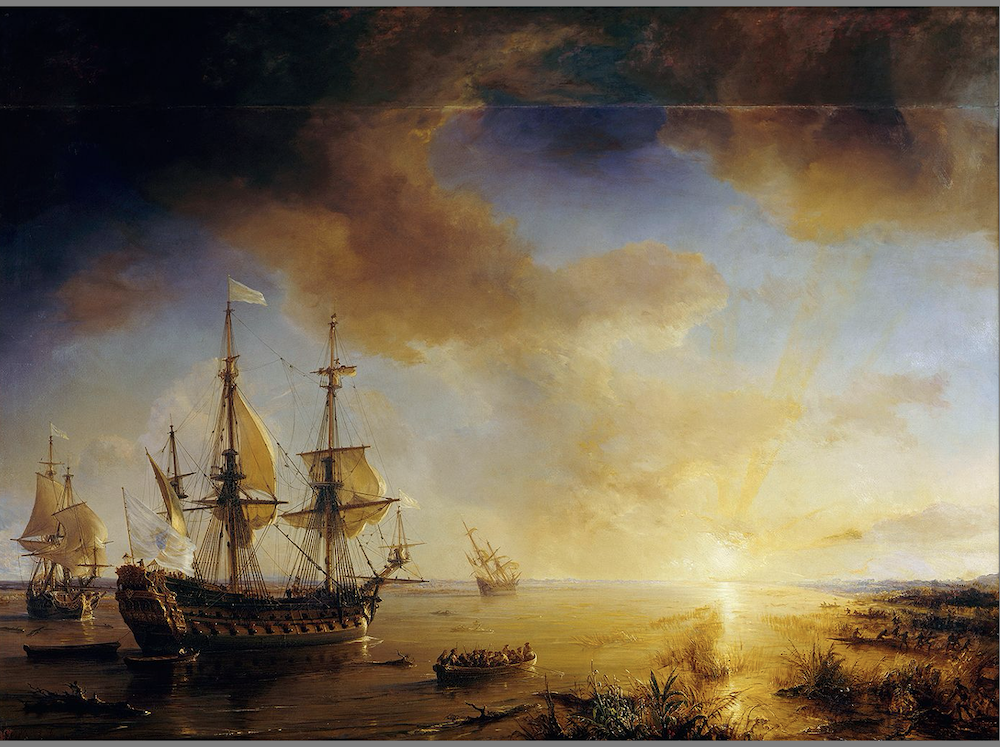
Top: La Salle's Expedition in 1684, painted in 1844 by Jean Antoine Théodore de Gudin. La Belle is on the left, Le Joly is in the middle, and L'Aimable is grounded on the right. The ships are at the entrance to Matagorda Bay, Texas. Public Domain,
https://histoire-image.org/etudes/expedition-cavelier-salle-louisiane
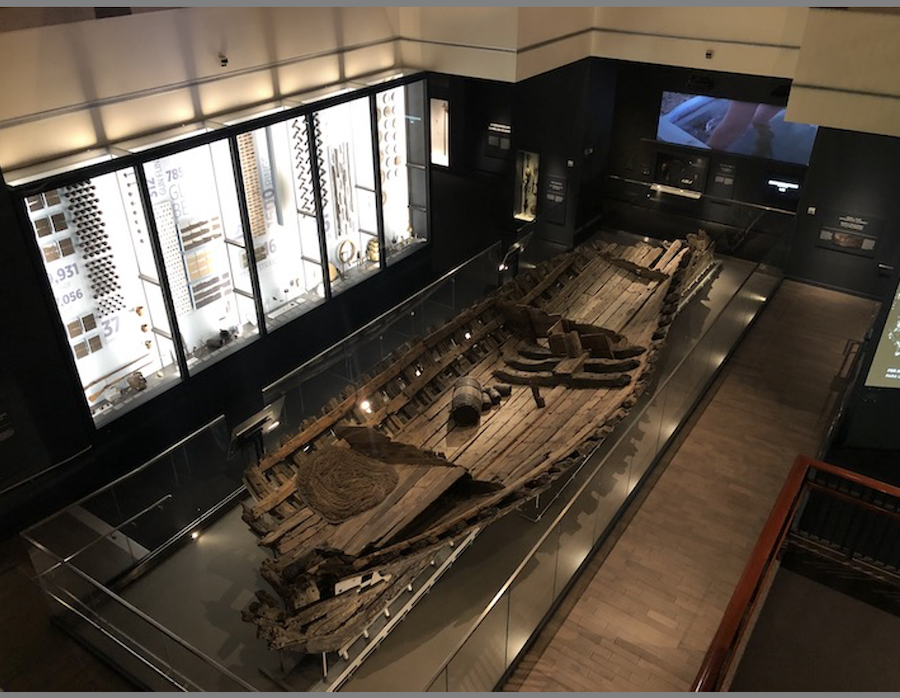
Bottom: La Belle displayed in a dedicated wing of Bullock's Texas State History Museum, Austin, TX. , along with thousands of artifacts. Photo: TC © ASSFI 2021
| | |
• La Belle was one of Robert de La Salle's four ships when he explored the Gulf of Mexico with the ill-fated mission of starting a French colony at the mouth of the Mississippi River in 1685. La Belle was wrecked in present-day Matagorda Bay the following year, dooming La Salle's Texas colony to failure. The wreckage of La Belle lay forgotten until it was discovered by a team of state archaeologists in 1995. The discovery of La Salle's flagship was regarded as one of the most important archaeological finds of the century in Texas, and a major excavation was launched by the state of Texas that, over a period of about a year, recovered the entire shipwreck and over a million artifacts.
• Through a convention between France and Texas, La Belle and its artifacts excavated are owned by France and held in trust by the Texas Historical Commission.
• L'Aimable was referred to as a flyboat, flute, pink, or hooker1, weighing between 250 and 300 tons. The ship was lost while the expedition was first entering the bay at the seaward end of Cavallo Pass in February 1685. Most of the supplies meant to help establish the French colony, which was originally planned to be at the mouth of the Mississippi River, were lost with the vessel.
Her remains were located in 1998, deep under the alluvium and mud in the Pass Cavallo, the natural entrance to Matagorda Bay. The ship was over 100 feet long and transported supplies for de La Salle's doomed colony. This included four cannons, two blacksmith shops, 4,500 pounds of lead, 60 kegs of wine, and the personal items of the crew.
• The Saint François had been seized by Spanish pirates in the Caribbean. As for the Joly, it returned to France in 1685, leaving 180 colonists behind.
Note: * 1: a pink, or pinque in French, was a sailing ship with a very narrow stern. A fly-boat, which evolved from the fluyt, was a mercantile cargo ship. A hooker, or Galway hooker, is a traditional fishing boat used in Galway Bay off the west coast of Ireland and developed for the strong seas. A flute was derived from the fluyt, a Dutch cargo ship.
| | |
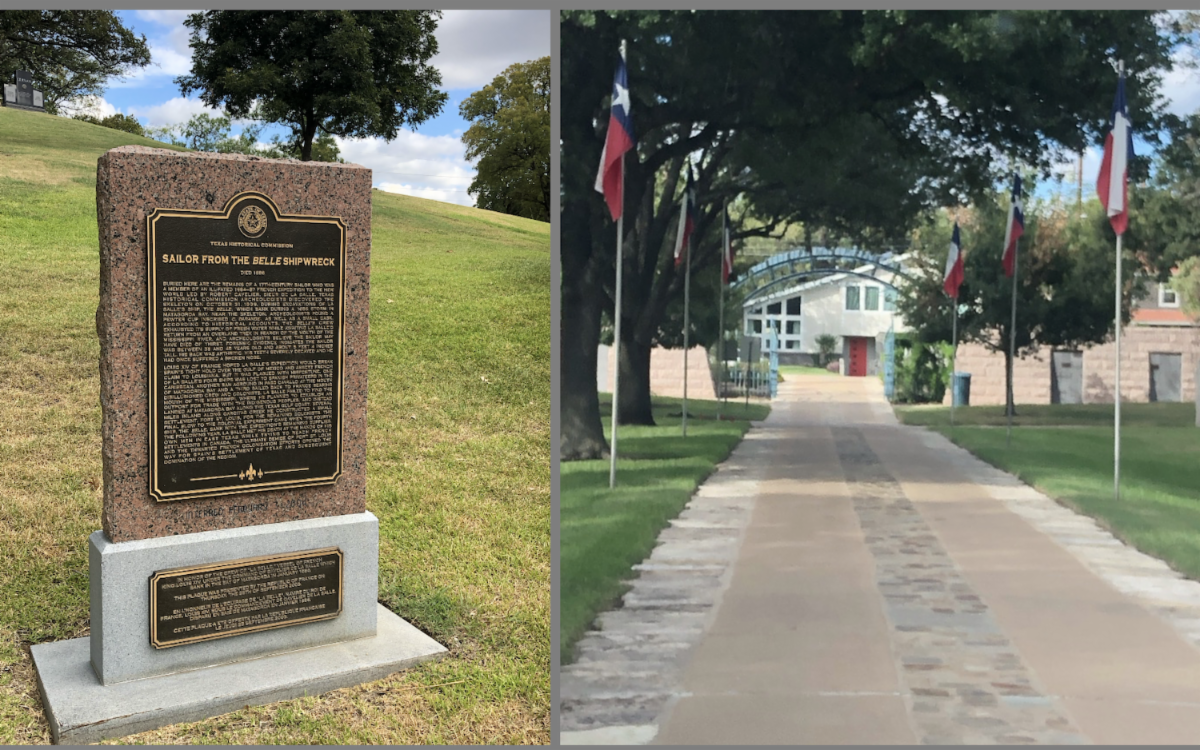
Above: The oldest "resident" at Texas State Cemetery, a sailor of King Louis XIV - Photos: TC © ASSFI 2021
Grave Marker, Sailor from the ”La Belle” Shipwreck
Texas State Cemetery
Monument Hill, Section 2 (H2), Row D, Number 1
909 Navasota Street, Austin TX 78702
GPS: 30.266814, -97.725677
• Inscription:
“Buried here are the remains of a 17th-century sailor who was a member of an ill-fated 1684-87 French expedition to the new world led by Robert Cavelier, Sieur de La Salle. Texas Historical Commission archaeologists discovered the skeleton on October 31, 1996, during excavations of La Salle’s ship, the Belle, which sank during a 1686 storm in Matagorda Bay. Near the skeleton, archaeologists found a pewter cup inscribed C. Barange, as well as a small cask. According to historical accounts, the Belle’s crew exhausted its supply of fresh water while awaiting La Salle’s return from an overland trek in search of the mouth of the Mississippi River, and archaeologists believe the sailor may have died of thirst. Forensic evidence indicates the sailor was between 35 and 45 years old and about 5 feet 4 inches tall. His back was arthritic, his teeth severely decayed and he had once suffered a broken nose.
Louis XIV of France hoped La Salle’s expedition would break Spain’s tight hold over the Gulf of Mexico and assert French claim to Louisiana, but it was plagued with misfortune. One of La Salle’s four ships was lost to Spanish privateers in the Caribbean, another ran aground in Pass Cavallo at the mouth of Matagorda Bay and a third sailed back to France bearing disillusioned crew and colonists. La Salle failed to find the mouth of the Mississippi, where he planned to establish an outpost for trade with the indigenous peoples, and instead landed at Matagorda Bay along the Texas gulf coast. Several miles inland along Garcitas Creek he constructed a small settlement, Fort St. Louis, for the remaining colonists. The final blow to the colonial experiment came when the fourth ship, the Belle, sank with the expedition’s remaining supplies. The following year, La Salle met his death at the hands of his own men in east Texas while trying to reach French settlements in Canada. The ultimate demise of Fort St. Louis and the thwarted French colonization efforts opened the way for Spain’s settlement of Texas and subsequent domination of the region.”
Erected 2004 by Texas Historical Commission
• Inscription of Tablet below the grave marker:
“In Honor of the crew Of “La Belle”
Vessel of French King Louis XIV
under the command of
Cavelier de La Salle
which sank in the Bay of Matagorda in January 1686.
This plaque was presented by The Republic of France on
Thursday the 25th of September 2003.”
| | |
Fier Rodrigue (ex Hippopotame)
Pierre-Augustin de Beaumarchais
1777
| | |
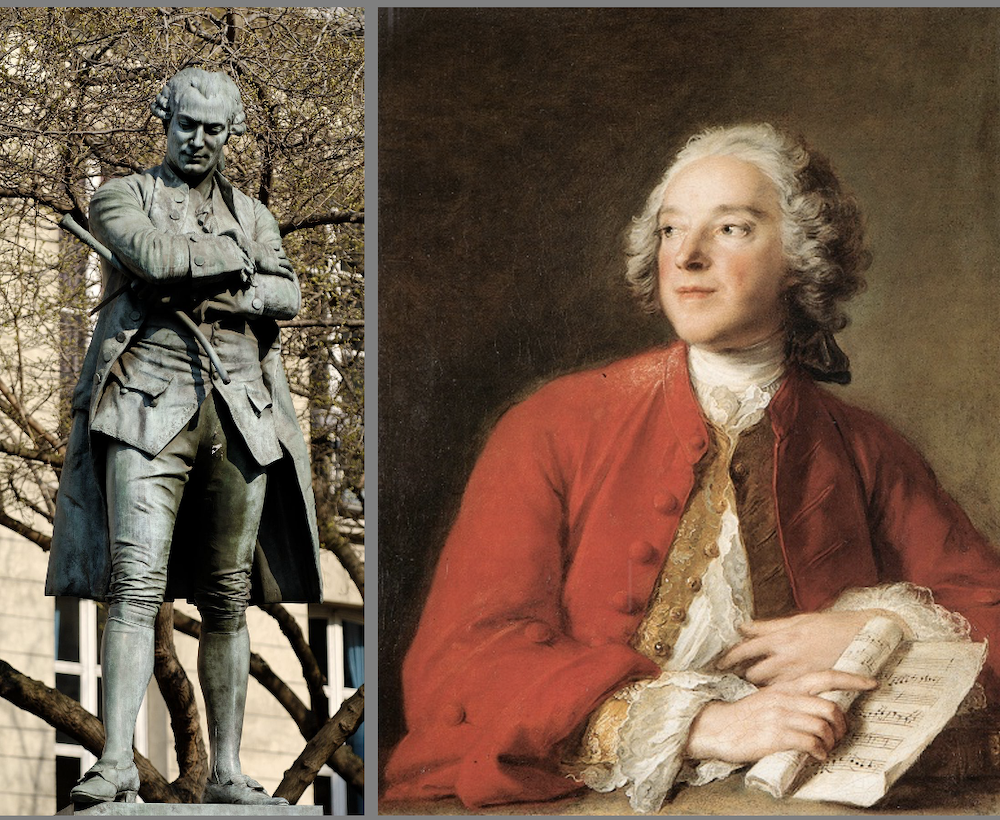
• There are many names that keep coming back when narrating the role of France in the American Revolution, from Louis XVI, Vergennes, to Lafayette, Rochambeau, de Grasse... but in our view Pierre Augustin de Beaumarchais is all too often forgotten. Yet, (like Jacques-Donatien Le Ray de Chaumont), he played a central role in financing and supplying the Insurgents, more than any nation, other than France, may claim to have done...
• Pierre-Augustin Caron de Beaumarchais (born and died in Paris, 24 January 1732 – 18 May 1799) is well-known for being both a playwright and an important supporter of the American Revolution by providing weapons and assistance. His most famous works include "The Barber of Seville" and "The Marriage of Figaro," (later made into operas by Mozart and Rossini)which questioned social norms and the aristocracy. Moreover, he covertly provided arms and resources to the American rebels during the Revolution, playing a vital role in their success.
• Beaumarchais had a crucial, though secretive, role in aiding the American Revolution. He set up a fictional business, "Roderigue Hortalez et Cie," to hide the fact that he was covertly providing the American rebels with weapons, ammunition, and other supplies, even before France officially entered the conflict. This assistance was vital to the American effort and contributed to their independence.
• Beaumarchais was also engaged in various other projects, such as inventing a clock escapement mechanism and publishing the first complete edition of Voltaire's works. He was a multifaceted individual with a diverse career, merging intellectual endeavors with business and political activities.
There are in our opinion too few markers in the United States honoring Beaumarchais.
To the best of our knowledge, there are only two that mention his name:
Marker, “The Enemy of My Enemy is My Friend”
Saratoga Battlefield Tour Road, Stop#3, Stillwater NY 12170
GPS: 42.980150, -73.628483
• Inscription:
“Despite having fought against the Americans in the French and Indian War, France was willing to covertly help the fledgling United States. Massive secret shipments of "unofficial" aid arrived in North America throughout 1777. The French set up a trading firm, Roderigue Hortalez et Compagnie, to send tents, tools, clothing, weapons, powder, and shot to arm the Americans. Their goal? To harm France's greatest rival, Great Britain.
Beaumarchais, a famous playwright, was a outspoken supporter of American independence. The French government asked him to form and manage The Roderigue Hortalez et Compagnie.
The Hortalez trading company shipped over 100 French cannons and tens of thousands of French muskets to America in 1777.
King Louis XVI was a very unlikely ally for the United States. France had warred against Great Britain — and its North American colonies — for generations.”
Erected 2024 by Saratoga National Historical Park.”
Marker, “D’Annae: A French, Swedish-Style 4-pounder"
The Battle of Monmouth – 28 June 1778“
Monmouth Battlefield State Park, Visitors Center entrance, Manalapan, NJ 07726
GPS: 40.263617, -74.319850
• Inscription (excerpts):
“...To support the rebellion, in 1776, the French royal arsenals released tons of surplus weapons. Their conduit to America was a fictitious trading company headed by the flamboyant playwright, Pierre-Augustin Caron de Beaumarchais. During 1777, Beaumarchais’ ships delivered 100, 4-pounders to Portsmouth, New Hampshire, and another 53 to Charleston, South Carolina. A few of these were heavy, old-fashioned (1732) guns. The rest were the lighter, more mobile, “Swedish-style” guns.”
Erected by the Battlefield Restoration and Archaeological Volunteer Organization.
| | |
Above:
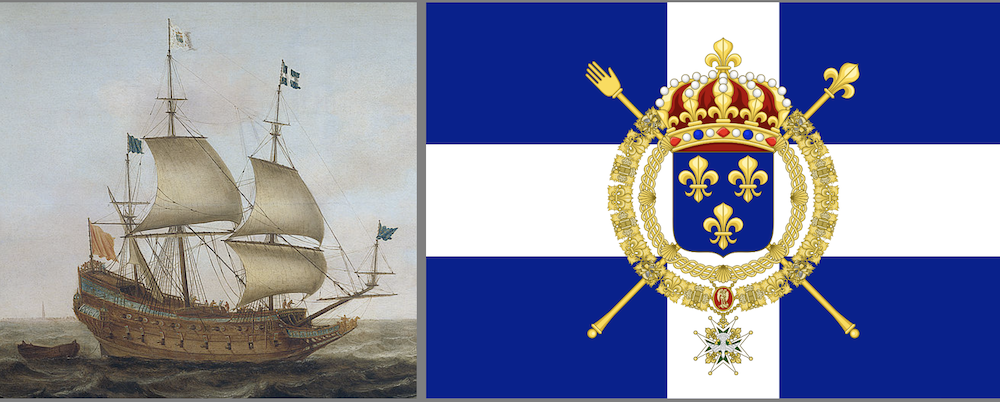
Left: French ship, oil on canvas by Jacob Gerritsz Loef - Rijsk Museum, Public Domain, https://commons.wikimedia.org/w/index.php?curid=3983943
Right: Naval Flag of the Kingdom of France (Civil Ensign, i.e. Merchant Flag of France Pre-1790), By Sodacan - Own work, CC BY-SA 3.0, https://commons.wikimedia.org/w/index.php?curid=32173625
Le Fier Rodrigue, ex-Hippopotame:
• Hippopotame was a old 50-gun ship of the line in the French Navy, launched in 1749., which participated in the Seven Years' War.
In 1777, Beaumarchais bought her from the French Navy to supply arms to the Insurgents. He renamed her Fier Rodrigue (Proud Rodrigue") and from 1778, he used her to transport weapons to the American rebels.
• In July 1779, Fier Rodrigue was escorting a convoy of 10 ships near Grenada. On the 6th, she met the fleet under admiral d'Estaing, preparing for battle. The French Navy requisitioned her, and she participated in the Battle of Grenada. Her captain, Montault, was killed. The requisition of Fier Rodrigue led to the capture of several ships from Beaumarchais' convoy. Beaumarchais protested and sought compensation from the French Crown. She was part of the French battle line at the Battle of Grenada on July 6, 1779, and served as a hospital ship during the Siege of Savannah.
Two months later, the Navy gave her back to Beaumarchais.
Fier Rodrigue called at the Chesapeake and Yorktown, before leaving America on 14 August 1780, heading for Rochefort. She reached Île de Ré, escorting a convoy of 15 ships from New England, along with two prizes taken from the British.
• Fier Rodrigue was condemned in March 1782 and was dismantled in 1784.
| | |
La Victoire
Marquis de La Fayette, age 19
1777
| | |
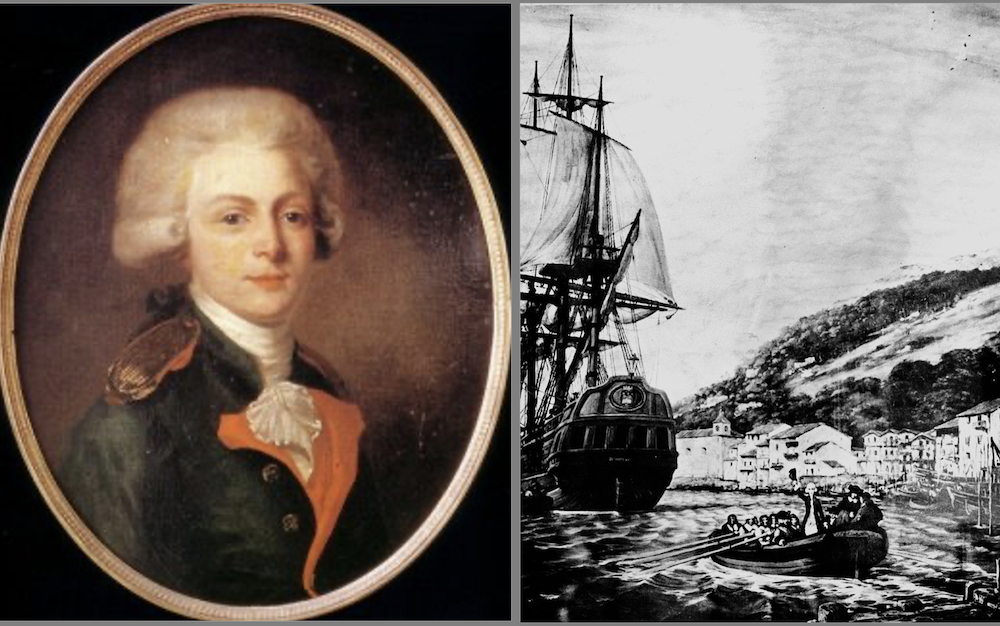
We wrote several Bulletins about general de Lafayette, but none of them described the particular circumstances of his arrival to America on board his ship La Victoire.
• Soon after his decision to disobey King Louis XVI's order and sail to America, the young marquis de Lafayette, not 19 yet, discovered that the Continental Congress had no money, so he purchased from Achille Basmarein, a shipowner from Bordeaux, the Clary which he renamed La Victoire ("Victory") with his own funds for 112,000 livres tournois, about $1.433 million in today's dollars.
Lafayette wrote “I have just bought my vessel…in a month at the latest I hope to be able to carry to your country the zeal which animates me for their happiness, their glory, and their liberty.”
La Victoire, a ship with many names:
• It had been launched 6 years earlier in Bordeaux, was a 268-ton commercial "brig-senau" (in English a "snow", i.e. a square-rigged vessel with two masts, complemented by a snow- or trysail-mast stepped immediately behind the main mast) with just two cannons on board.
Its dimensions make it a modest ship: 22.41 m long, 7.79 m wide, and 3.57 m deep. Built in 1771 at the Bichon shipyard it was called "La Comtesse de Richemond". The first owner was the shipowner Pierre Rivière.
Between 1771 and 1775, she made trips between Bordeaux and the Antilles. After suffering during a crossing and needing major repairs that its owner could not afford, it was sold to the trader Jean Labat, who renamed it "La Bonne Mère." However, in December 1776, "La Bonne Mère" faced damage again. Labat sold the ship on February 12, 1777, to another trader, Louis Lanoix, who renamed it "La Clary."
Strangely, less than a month later, on March 7, 1777, the ship changed owners again. It was acquired this time by the Reculès house of Basmarein. A front for a certain marquis....de La Fayette.
• Victoire departed from Pauillac on the banks of the Gironde on 25 March 1777. However, Lafayette was not on board to avoid detection by British spies or the French Crown; the ship docked in Los Pasajes on the Basque coast and was loaded with 5,000 rifles and ammunition from the factories in Gipuzkoa.
• Lafayette boarded the Victoire and set sail for America on 26 April 1777. . Although seasick and bored during the 56 days at sea, he learned some English en route. The ship's captain Le Boursier planned to stop in the West Indies to sell cargo, but Lafayette feared arrest, so he purchased the cargo to prevent docking at the islands. They sailed for Charleston, but feared they would be seized by British ships offshore, so they landed at North Island, today's Yawkey Preserve, in the Santee Delta.
| | |
• He arrived on North Island near Georgetown, South Carolina on 13 June 1777. Three markers exist to commemorate Lafayette's landing, however, regrettably none mentions his ship La Victoire.
• The American Friends of Lafayette started advocating for a commemorative stamp honoring Lafayette in 1934. The Post Office Department eventually issued the stamp on June 13, 1952, marking the 175th anniversary of his arrival in America to assume a major general's role in the Continental Army. The stamp's First Day of Issue ceremony took place in Georgetown, South Carolina, the site where Lafayette's ship, La Victoire, arrived in 1777.
Plaque, “Landing of Lafayette 1777 - 1952”
1001 Front St, Georgetown, SC 29440
GPS: 33.368300, -79.286400
• Inscription:
“This Tablet Commemorates the 175th
Anniversary Of The Landing Of The
Marquis de Lafayette
at North Island on Winyah Bay
June 13, 1777
and the First Day Issue of the
Lafayette Memorial Stamp
in Georgetown, South Carolina
June 13, 1952
Erected by City of Georgetown, Mayor S.L. Rosen and Councilmen.”
Older Plaque, “Marquis de Lafayette” (150th anniversary of landing)
Harborwalk, Rice Museum (Old City Hall), at the base of the town clock
633 Front Street Georgetown, SC 29440
GPS: 33.365483, -79.282333
• Inscription:
“This tablet commemorates the 150th anniversary of the first landing of
Marquis de Lafayette
accompanied by Baron de Kalb on North Island,
Georgetown County, S. C. June 13, 1777.
He came to draw his sword for the young republic
in the hour of her greatest need.”
Erected 1927 by Georgetown Chapter, Daughters of the American Revolution.”
Marker “Lafayette” – First Night in America
Ocean Highway (Route 17) beside the southbound lanes, Pawleys Island, SC 29585
GPS: 33.364500, -79.235000
• Inscription:
"A lover of liberty, Lafayette left Bordeaux, France, March 26, 1777, “to conquer or perish” in the American cause, and arrived at Benjamin Huger’s summer home near here, June 14, 1777, where he spent his first night in America. He rendered eminent service in our struggle for independence.
Erected 1940 by Georgetown County. (Marker Number 22-8 (A-4).)"
What happened to La Victoire?
• According to a recently found document, "The ... La Victoire, of and for Bordeaux," the document reads, "commanded by Jean Baptiste Le Boursier (who some time ago brought over the Marquis de LaFayette with other French noblemen and others) on the 14th unfortunately struck upon the bar, where the vessel and cargo were entirely lost, but none of the people."
• The bar could have been located near Folly Beach. La Victoire left Charleston on August 14, 1777. It seems the ship ran aground while attempting to navigate the channel, which at that time curved southward along Morris Island and the northern part of Folly.
• Although the bottom of the channel has been dregded mutiple times, one can still hope that someday a canon, an anchor, or other smaller artifacts will be found, if not the ship itself.
| | |
Languedoc
Charles Henri Jean-Baptiste, Comte d'Estaing
1779
| | |
Above:
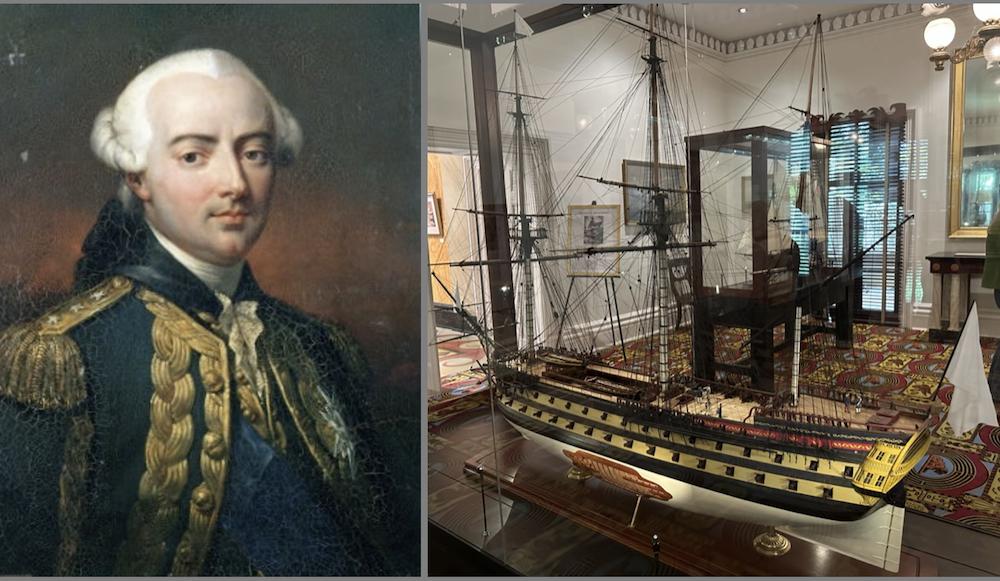
Left: Charles Henri Jean-Baptiste, Comte d'Estaing (1729-94) by Jean-Pierre Franque, Public Domain, https://commons.wikimedia.org/w/index.php?curid=140487
Right: Le Languedoc, model build by William E. Hitchcock, 1992-93, Scale 3/8 inch = 1 foot, on display at the Ships of the Sea Maritime Museum, 41 Martin Luther King Jr Blvd, Savannah, GA.
Photo: TC © ASSFI 2023
| | |
• We presented admiral d'Estaing in our February Bulletin "The Battle of Savannah (1779) and the "Chasseurs Volontaires de Saint Domingue”
https://conta.cc/4ay3TFa (original version in English)
https://conta.cc/4i13c9W (version in French)
• This was the first combined amphibious military operation in modern history, and as such several French ships were involved.
This poetic excerpt from Storm over Savannah by Alexander A. Lawrence describes the majestic and powerful sight of 22 ships deployed along the coastline:
"A mighty French armada lay at anchor in the open sea. To the west stood the coast of Georgia, with the low, long shoreline of the Tybees necklaced by the white sand beaches. From the mastheads of the great ships-of-the-line streamed the fleurette banners of the Bourbons. They stretch, wrote [British] General Prevost, from off Beaufort North, as far to the Southward as we could see from Tybee Light. Most of them were two-deckers though some were of the triple deck class. Some were old ships that had fought in the naval battles of the seventeen-fifties. Others were modern and Nelson was to know the thunder of their guns in the days of Napoleon. Like song from the lips roll the names of these giants of the deep: Languedoc, Annibal, Zélé, Vengeur, Fantasque, Guerrier, Tonnant, Robuste, César, Vaillant, Sagittaire, Provence, Magnifique, Fendant, Hector, Fier Rodrigue..."
A mighty Fleet:
• Le Languedoc, his flagship, a 80-gun ship of the line. She was offered to King Louis XV by the Estates of Languedoc, as part of the "don des vaisseaux", a national effort to rebuild the navy after the Seven Years' War.
• Annibal, a brand new (1778) 74-gun ship of the line, lead ship of her class
• Le Zélé, a 74-gun ship of the line, funded by a don des vaisseaux donation from the Régisseur général des finances. On 6 July 1779, she participated in the Battle of Grenada as a member of the vanguard. Under Bruyères-Chalabre, she was part of the French blockade during Siege of Savannah in 1779.
• Le Fantasque was a Lion-class 64-gun ship of the line, famous for being captained by the French commander Pierre-André, Bailli de Suffren (his statue graces the harbor of Saint Tropez) . In September 1779, Saint-Antonin was given command of Fantasque. He captained her at the Siege of Savannah.
• Le Tonnant was an 80-gun ship of the line, built in 1743 but refurbished in 1770, and participated in the attack on Newport in 1778 and the Battle of Grenada on 6 July 1779 as well as the siege of Savannah. The ship was broken up in 1780.
• Le Protecteur was a Souverain-class 74-gun ship of the line built in 1760, the only to have borne the name.
• Le Vengeur, a 64-gun ship of the line also under the Bailli de Suffren, took part in the Battle of Rhode Island on 29 August 1778, the Battle of Grenada on 6 July 1779, and the Siege of Savannah in September and October 1779, under Captain Croiset de Retz.
• Le Guerrier, a Magnifique-class, 74-gun ship of the line launched in 1753, was part of Bougainville's squadron for the Naval operations in the American Revolutionary War, and took part in the operations before the Battle of Rhode Island, in the Battle of Grenada, and in the siege of Savannah.
• Hector was a 74-gun ship of the line, launched in 1755 and lead ship of her class, who also fought at the Chesapeake.
• Le Fendant, a new 74-gun ship of the line built in 1776 and designated atBrest to be one of the six ships held ready for immediate departure at all times
• Le César, a 74-gun ship of the line launched in Toulon in 1768, who fought superbly everywhere from Norfolk to the Chesapeake to the West Indies, only to explode at the Battle of the Saintes in 1782. César was one of the twenty ships lost by the French Navy during the American War of Independence.
• Le Fier Rodrigue (ex Hippopotame) was used as a hospital ship anchored in Charleston and supporting the siege of Savannah.
Several wounded French soldiers and sailors died onboard this floating hospital. No memorial stele exists to honor their memory, which we hope to erect in Charleston, GA. in the future.
| | |
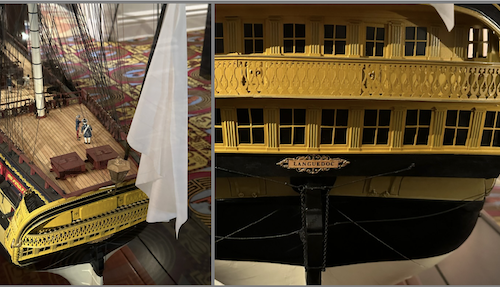
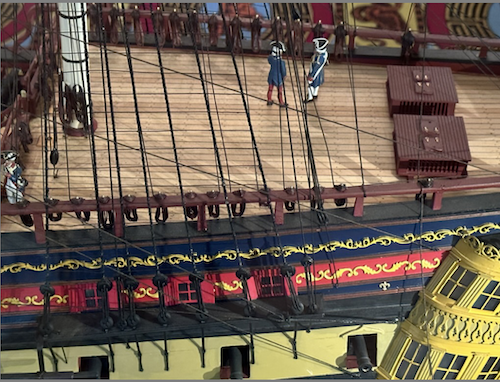
Above: Le Languedoc, Ships of the Sea Maritime Museum, Savannah. Photos: TC © ASSFI 2023
However, a fitting, albeit modest, tribute to admiral d'Estaing's flagship Languedoc can be seen at :
Ships of the Sea Maritime Museum, 41 Martin Luther King Jr Blvd, Savannah, GA.
GPS: 32.0811422, -81.097324
• Text of museum label:
"France proved to be a generous ally of the Americans during our Revolution.
The British occupied Savannah during most of the war, but the French attempted once to recapture the city. In September, 1779, twenty-two French warships sailed from the West Indies to the Savannah River. One of these vessels was the magnificent Languedoc, flagship of the French Admiral Charles Henri Comte d'Estaing—184 feet long, 48 feet wide and armed with eighty cannons. The French and Americans surrounded Savannah, then bombed the city for four days, and finally four thousand soldiers attacked. Despite tremendous losses, the siege was a failure, the French and Americans retreated in humiliation, and the British continued to occupy Savannah until the end of the Revolution."
French ships donated to the American Navy:
• La Truite, launched in Le Havre in1777, was ceded to the South Carolina State Navy in 1780 and scuttled in the Copper River to prevent a British squadron from sailing up the river.
• La Bricole, a fifth-rate flûte, launched in Le Havre in 1764, was also ceded to the South Carolina State Navy in 1780 and took the name... Bricole. She was deliberatly scuttled in front of Charleston, S.C. to impede the entry of British naval vessels.
• La Chimère, a fifth-rate frigate, was launched in Toulon in 1757 and sold in 1783 after being loaned as a merchantman.
• "D'Estaing ordered the Truite, Chimère, and Bricole to proceed up the Savannah River as close to the city as possible"...
There is a marker mentioning the bombardment of Savannah by the French fleet, which was positionned on the back river, just behind the Savannah river.
Marker “Old harbor light”
Emmet Park, between Hudson and East Broad Street, Savannah, GA 31401
GPS: 32.079400, -81.084500
• Inscription (excerpts):
"This beacon light was erected by the Federal government in 1858 as an aid to navigation of the Savannah River.
Standing 77 feet above the river level and illuminated by gas, it served for several years as a guide to vessels passing over the hulls of ships that the British scuttled in 1779 to close the harbor to the French naval forces. During the Siege of Savannah that year by the French and Americans, the warship Truite, commanded by the Count de Chastenet de Puysegur, shelled this area of Savannah from her anchorage in Back River opposite this point..."
| | |
Duc de Bourgogne
Admiral Charles-Henri de Ternay
1780
| | |
Above:
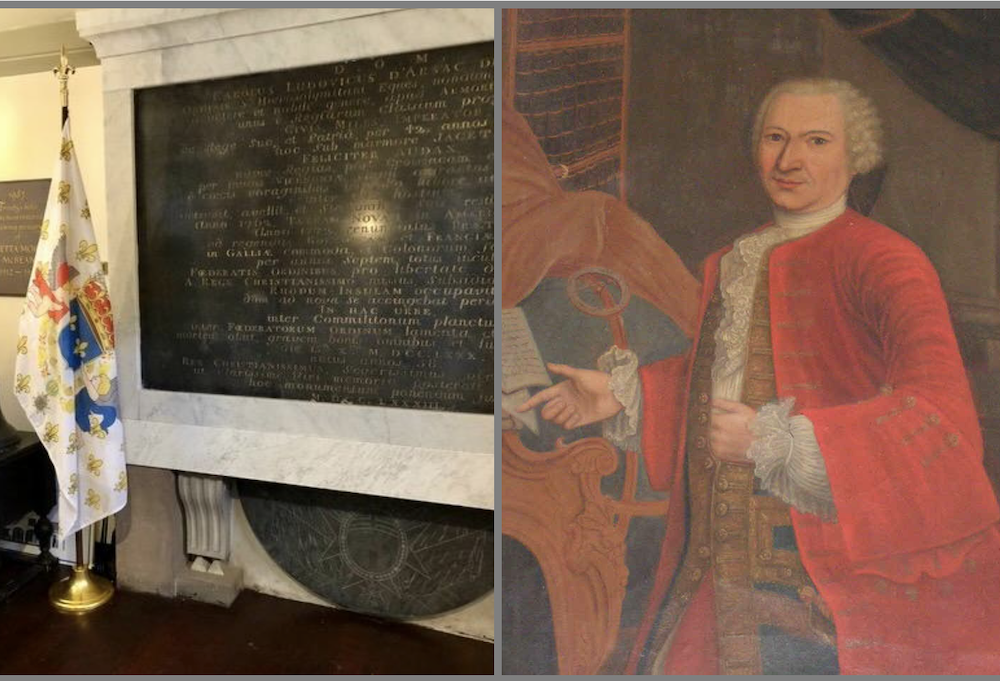
Top Left: The original marble plaque ordered by King Louis XVI was transferred from the top of Admiral de Ternay's tomb to the vestibule entrance of Trinity Church, in order to be protected from the elements. Trinity Church is one of the oldest continuous place of worship in America, where George Washington came to pray, and Queen Elizabeth visited in 1976. The French Royal Navy's standard, which was used at the time (the central coat-of-arms with cherubs in the middle is the personal flag of the King, as warships were his personal property) and offered by The American Society of Le Souvenir Français to Trinity Church in 2021, is on display next to the plaque. Photo courtesy Charlotte Johnson, Trinity Church.
Top right: Amiral d'Arsac de Ternay, by unidentified painter, château de Ternay Public Domain, https://commons.wikimedia.org/w/index.php?curid=15975136
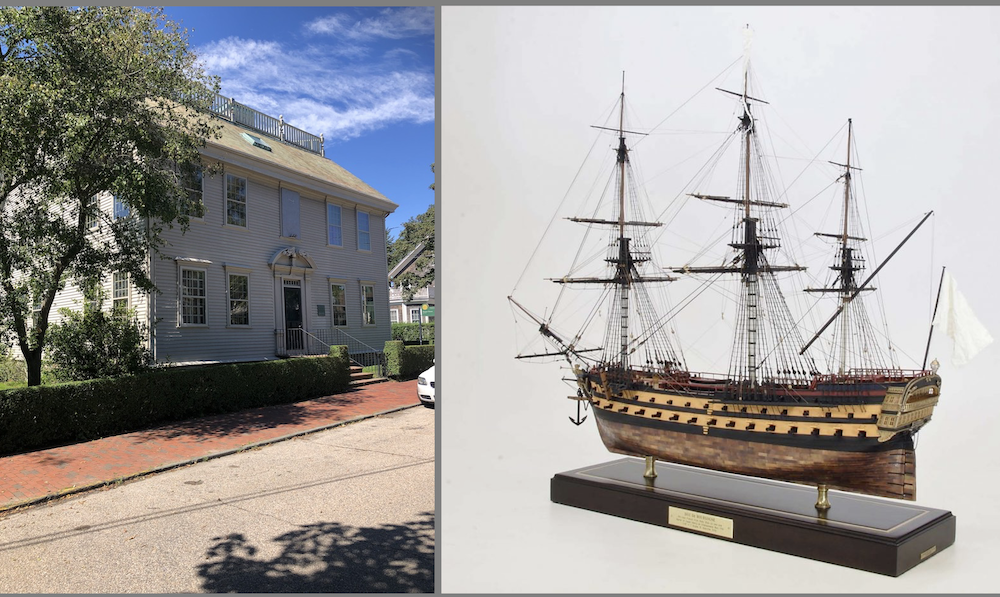
Bottom Left: Hunter House, admiral de Ternay Headquarters, Newport, R.I. Photo TC © ASSFI 2024
Bottom Right: model of the Duc de Bourgogne, Photo: https://www.shipmodel.com
| | |
• Charles-Henri-Louis d'Arsac, chevalier de Ternay (born in Angers, Anjou, on 27 January 1723 – 15 December 1780) was a French naval officer who fought in the Seven Years' War and the American Revolutionary War.
• He had a well deserved reputation for his wisdom and cautious decision-making. Ternay was the naval commander of a 1762 expedition that successfully captured St. John's Newfoundland.
led a French mission that took St. John's, Newfoundland in 1762.
• In November 1776, he was promoted to rear admiral.
• He was appointed commander of the French naval forces whose mission was to successfully transport Rochambeau's army across the ocean. On 2 May 1780, he departed Brest with a 7-ship and 3-frigate squadron, escorting 36 transports carrying troops and heavy artillery. Although fast-running frigates under his command could have captured slower British merchant ships during the crossing, he wisely restrained them and focused on his mission to land the troops to America as fast as possible.
• The squadron included the 80-gun Duc de Bourgogne, commanded by Ternay d'Arsac (admiral) and Médine (flag captain); the 74-gun Neptune, led by Sochet Des Touches, and Conquérant, under La Grandière; and the 64-gun Provence under Lombard, Ardent under Bernard de Marigny, Jason under La Clocheterie, and Éveillé under Le Gardeur de Tilly, along with the frigates Surveillante under Villeneuve Cillart, Amazone under La Pérouse, and Bellone. Amazone, which was the lead ship of the fleet, reached Boston on 11 June 1780.
• Admiral de Ternay died on December 15, 1780 of typhus shortly after meeting George Washington with Rochambeau in October at the Hartford, CT, conference.
• On December 16, 1780, a procession starting from the Hunter House on Water Street (now Washington Street) led by military men and nine Catholic chaplains, wound its way through the streets of Newport. A fifteen-gun salute was fired as soon as the casket came into sight of his flagship, the 80 gun ship of the line Duc de Bourgogne, which was anchored in Newport Harbor. A cannon was fired every half-hour for the rest of the day and flags were at half-mast. Newport residents lined the streets to watch as the French military commemorated Admiral de Ternay and lowered him into the ground.
• He was buried in the cemetery of the Trinity Church where his large tombstone is regularly honored. Inside the church’s vestibule is a memorial plaque given by King Louis XVI and the United States Congress in his honor. He was posthumously enrolled in the Society of Cincinnati for his role in the war. He was laid to rest in American soil, under the protecting care of the flag which he had crossed the Atlantic to defend.
• De Ternay was laid to rest in the churchyard of Trinity Church in Newport, where memorials from King Louis XVI and the United States Congress honor him. He was also posthumously inducted into the Society of the Cincinnati for his contributions during the war. In the Port Glaud area of Mahé, Seychelles, Baie Ternay (a bay) and Cap Ternay (a cape) are named in his memory. Additionally, there is a bay named Ternay in Primorsky Krai, Russia, discovered by La Pérouse on June 23, 1787, which was also named after him. A settlement with a related name exists near that bay.
• The Duc de Bourgogne was an 80-gun ship of the line of the French Navy.
She was refitted twice, in 1761 and 1779, when she received a copper sheathing.
• Washington, Rochambeau, Lafayette, and their aides de-camp, met on board the Duc de Bourgogne in March 1781.
• She took part in the Battle of Cape Henry on 16 March 1781 under Nicolas-Louis de Durfort and in 1782 in the Battle of Les Saintes.
In 1792, the French revolutionaries renamed her Peuple, and later Caton in 1794. She was condemned in February 1798 at Brest, and ultimately dismantled in January 1800.
| | |
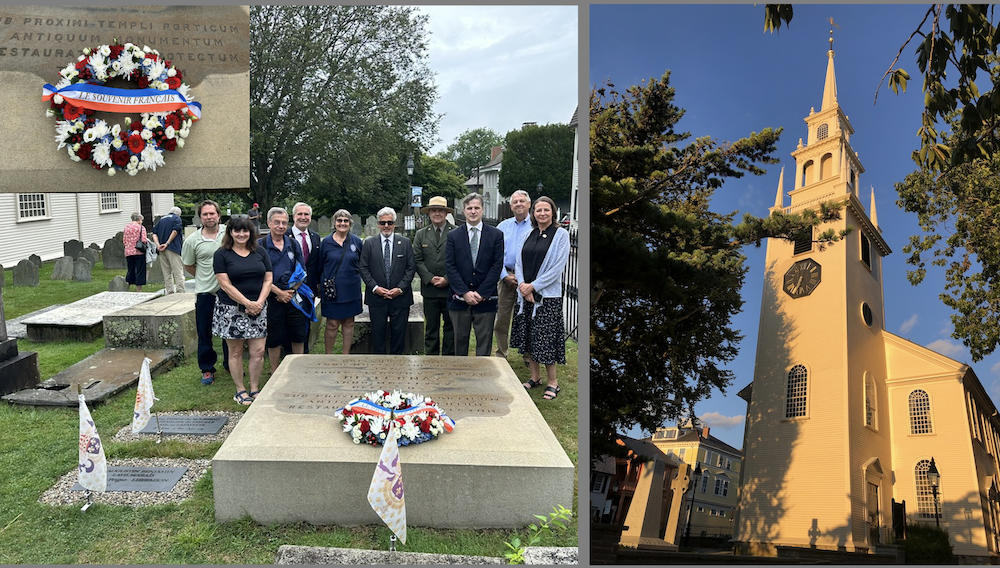
Above Left: annual wreath-laying ceremony at Trinity Churchyard with members of our Society and members of the American Friends of Lafayette, and the National Park Service, July 13, 2024
Above Right: Trinity Church, Newport, R.I. Photos: TC © ASSFI 2024
• Every July, to celebrate the landing of the French army in Newport and the "Tribute to France" weekend organized by the Newport Historical Society, the Alliance Française of Newport and the Town of Newport, our Society pays hommage to the admiral by placing a wreath on his grave at Trinity Churchyard.
Admiral de Ternay’s Tomb & Marble plaque
Trinity Churchyard and trinity Church vestibule, Newport R.I.
141 Spring St. Newport, RI 2840
GPS: 41.487440, -71.313012
• Inscription (translated from latin):
"In the name of God CHARLES LOUIS d'ARSAC De TERNAY
Knight of the Order of St. John of Jerusalem
Though the Vows of the Order he had never acknowledged
descended from an ancient and noble family of Bretagne
One of the Admirals of the King's Fleets a Citizen, a Soldier, a Chief, serviceably faithful to his King and country, for 42 years, now rests beneath this marble."
Plaque, Hunter House, Newport, R.I.
54 Washington Street, Newport R.I. 02840
GPS: 41.492525, -71.320968
• The house was used as the headquarters of Admiral de Ternay, commander of the French fleet when French forces stayed in Newport in 1780. Alas the plaque does not specifically mention the admiral.
• Inscription (excerpts):
Hunter House
"has been designated a
Registered National Historic Landmark [...]
this site possesses exceptional value
in commemorating and illustrating the history of the United States
U.S. Department of the Interior, National Park Service, 1968.”
| | |
L'Hermione
Louis-René Levassor
de Latouche Tréville
1780-1783
| | |
• Vice-admiral Louis-René Madelaine Le Vassor, comte de Latouche-Tréville (born in Rochefort, 3 June 1745 – died in Toulon, 19 August 1804) was a French Navy officer and politician who served in the American Revolutionary War and the French Revolutionary and Napoleonic Wars. At the time of the American revolutionary War, he was a Captain and brilliantly commanded the frigate Hermione.
• In May 1777, he was elevated to the rank of lieutenant and took command of the 20-gun corvette Rossignol, which was responsible for escorting convoys and delivering messages. He successfully captured two British privateers and three merchant ships. His achievements led to his appointment as a Knight of the Order of Saint-Louis. He was later made commander of the 26-gun frigate Hermione.
• From 21 March to 28 April 1780, Latouche transported General Gilbert du Motier, Marquis de Lafayette on the Hermione from France to Boston, carrying news that King Louis XVI was sending an expeditionary force led by Rochambeau to assist General Washington and the Continental Army. Afterward, he joined the fleet commanded by Rear-Admiral Destouches, and under the orders of Barras and Ternay, he oversaw the construction of several artillery batteries to defend Rhode Island.
• Once the batteries were finished, Latouche was permitted to patrol off Long Island and intercept ships heading to New York City. He quickly seized two prizes before encountering four sails on 7 June 1780: these included the frigate HMS Iris and three smaller warships. During the battle on 7 June 1780, Latouche was shot in the arm by a musket ball, and the Hermione suffered ten fatalities1 and 37 injuries.
• On March 16, Latouche-Tréville took part in the Battle of Cape Henry, which occurred at the entrance of Chesapeake Bay.
• He then continued to cruise along the North American coast as part of a squadron led by Lapérouse, whose flagship was the frigate Astrée.
• On July 21, the two frigates came across a British convoy near Nova Scotia. In the ensuing naval battle of Louisbourg, Astrée and Hermione compelled HMS Charlestown to lower her flags, but they were unable to board her, allowing her to escape during the night. However, they did capture the 14-gun escort, Jack, along with three merchant ships, which they brought to Boston.
• The frigates proceeded on their voyage when, on September 12, Latouche, in command of the Aigle, seized the brig HMS Racoon. Latouche then maneuvered into the Delaware River while being pursued by HMS Vestal, HMS Bonetta, and the captured Sophie. He landed his passengers and treasure using boats from the frigates. He then tried to evade his much stronger pursuers by sailing at the mouth of the Delaware River, but the Aigle ran aground; Latouche tried to free his ship, but as the tide receded, she tipped over, making her guns unusable. Realizing his ship was lost, Latouche had the masts cut down and the hull damaged; he then evacuated the crew, staying behind with just a few men, and fired a few shots before surrendering.
• Latouche was captured and taken to New York, then transferred to England. He remained a prisoner until the Treaty of Paris in 1783.
• The rest of his illustrious career falls outside the scope of this Bulletin. French authors and historians frequently liken Latouche-Tréville to Nelson. This is due in part to his victory over Nelson during the raids on Boulogne in 1801, and also because, had he not passed away, he would have faced Nelson in the Trafalgar campaign. In recognition of his contributions, the name Latouche is engraved on the north side of the Arc de Triomphe. Additionally, multiple ships in the French Navy have been named Latouche-Tréville.He died as a Vice-admiral in Toulon on August 19, 1804.
Note: 1* One of them, Lt. Augustin Benjamin de La Villemarais, was honored by our Society, the American Friends of Lafayette and the National Park Service with the dedication on September 10, 2021 of a tombstone next to Admiral de Ternay at Trinity Churchyard, Newport, R.I. See Photo below:
| | |
Above:
Left: 2014 September 17th, Hermione replica, built in Rochefort, comes off the Charente river, and reach open sea for the first time. Thousands of spectators attend this first departure. Photo by By Jp.sembely - Own work, CC BY-SA 4.0, https://commons.wikimedia.org/w/index.php?curid=60749233
Right: Dedication ceremony of two tombstones honoring two Officers of the Hermione who died for the Independence of the United States, Lt. Augustin Benjamin de la Villemarais and Major Pierre du Rousseau, Chevalier de Fayolle, placed next to Admiral de Ternay's tomb, September 10, 2021, Trinity Churchard, Newport, R.I. Along with re-enactors, to the left, is Prof. Norman Desmarais, professor Emeritus at Providence College, Regional Delegate of our Society for New England and the author of numerous books on the American Revolution. Photo TC © ASSFI 2021
| |
The "Freedom Frigate"
The Hermione is justly remembered for transporting Lafayette in a hurry to inform General Washington that King Louis XVI would send Rochambeau and his Expédition Particulière to assist the struggling Continental Army.
However, there is much more to her story. She fought bravely throughout the Eastern seaboard and played a significant role in the American Revolutionary War. Her nicknamme "The Freedom Frigate" is amply justified.
Hermione was a frigate of the French Navy, classified as a 32-gun Concorde-class vessel. Built for speed, she was among the first ships in the French Navy to have copper sheathing. At the start of the Anglo-French War in 1778, she patrolled the Bay of Biscay, escorting convoys and pursuing privateers. She gained fame for transporting General La Fayette to the United States in 1780 to support the American Revolutionary War rebels.
• She reached Boston on April 27, 1780. An official celebration followed, featuring gun salutes for the political and military leaders of France and the Thirteen Colonies.
• On May 2, Latouche proposed to patrol the Bay of Boston to protect it from British privateers and frigates, a plan that the Massachusetts authorities approved the following day.
• On May 28, Latouche got orders from Ambassador La Luzerne to patrol the Delaware River's mouth starting June 26. He chose to use the free time this gave him to cruise near New York and cut off British communications. On June 2, Hermione seized the 100-ton brigantine Thomas, which was carrying butter, candles, and soap. On June 6, she intercepted Rewrery, which was loaded with salt. Latouche sent both ships to Providence.
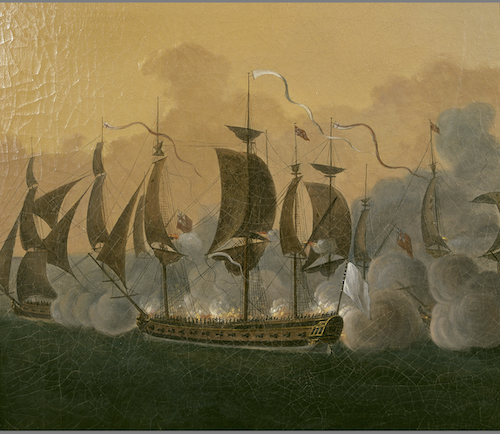
• The following morning, Hermione spotted a Sloop-of-war, a schooner, a snow, and a frigate. As Hermione approached, the snow and the frigate slowed to protect the retreat of the sloop and the schooner. The frigate was the 32-gun HMS Iris. Hermione and Iris raised their flags, leading to the battle on 7 June 1780. After 90 minutes of cannon and musket fire, the ships broke off. Hermione suffered considerable damage to her sails, with 10 crew members killed and 37 injured.
• After the battle, Hermione made her way back to Newport, arriving on the 8th. She unloaded her wounded crew, made necessary repairs, and set sail again on the 15th.
• On 4 July, she fired a 13-gun salute in honor of Independence Day.
• On October 28, 1780, Hermione and the Surveillante left Newport, escorting Amazone, which was heading to France. The following day, near New York, they seized the merchant ship Phillipe, carrying 28 men and 16 4-pound cannons, loaded with oranges, wine, and candied fruit.
• She participated in the Battle of Cape Henry on March 16, 1781, and a significant role in the action on July 21, 1781.
• On 4 May, 1781, a 100-seat State dinner was held aboard for the members of the US Congress, the State Council of Pennsylvania, and various city officials.
• Starting in June 1781, Hermione formed a division under Lapérouse, who was aboard Astrée, with the mission of raiding commerce. The frigates departed from Boston on the 23rd. They seized the 18-gun corvette Thorn on July 12, and Hermione pursued HMS Hind, which managed to escape into St. George's Bay. On the 17th, Hermione and Astrée took the 12-gun merchant ship Friendship; the following day, they captured the 8-gun merchant vessel Phoenix; and on the 19th, they seized the merchantman Lockard Ross.
| |
Above: Battle of Louisbourg, 21 July 1781, Musée National de la Marine, by Rossel de Cercy, https://commons.wikimedia.org/w/index.php?curid=29055301
• On July 21, 1781, Hermione and Astrée came across a British convoy and engaged in battle, resulting in the Naval battle of Louisbourg, where they captured the 14-gun corvette HMS Jack.
• On September 10, 1781, Hermione left Boston with 3 tonnes of gunpowder for the Siege of Yorktown. She arrived on the 29th and was quickly assigned logistic tasks for the fleet. After the Yorktown victory, she sailed to Boston with Diligente and Romulus, transporting artillery and supplies for the Army and escorting convoys.
• Following the conclusion of the American Revolutionary War, Hermione went back to France in February 1782. She was then included in a squadron dispatched to India to assist Suffren against the British. She reached Isle de France (today's Mauritius) on 14 July 1783, but by that time, a cease-fire was already in effect. With the Peace Treaty of Paris in 1783, the mission was called off and Hermione came back to Rochefort in April 1784.
• In 1793, during the War of Coalition agaisnt the First French Republic, Hermione ran aground near Le Croisic, Brittany, due to a pilot error, and was wrecked.
• In 1997, work began on an exact replica in Rochefort, Charente-Maritime.
• The Hermione replica has faced major repairs due to wood-eating fungi and remains in dry dock in Bayonne. A Franco-American fundraising campaign is currently in progress to preserve her and enable her return to America (see details at the end of this Bulletin).
| |
La Ville-de-Paris
Admiral François Joseph Paul
de Grasse
1781
| | |
Above:
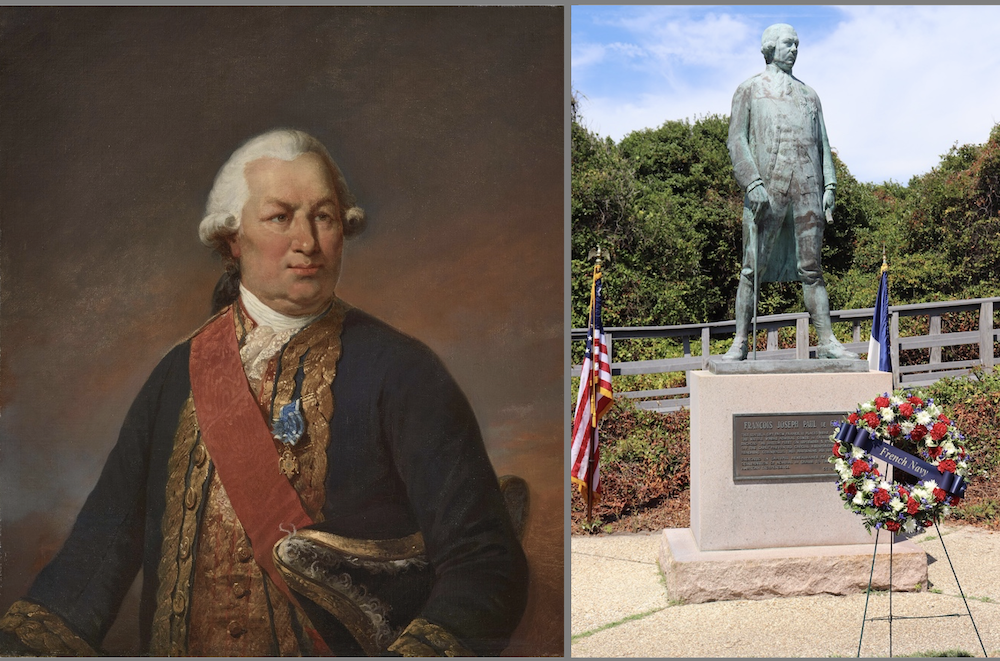
Top Left: François Joseph Paul, comte de Grasse, lieutenant général des armées navales (1723-1788), commander of the French fleet at the Battle of the Chesapeake in 1781, By Jean-Baptiste Mauzaisse - Public Domain, https://commons.wikimedia.org/w/index.php?curid=10628855
Top Right: Statue of French fleet commander Admiral de Grasse, Virginia Beach, VA
Photo: LCL Mathieu Brulais, French Army (2022)
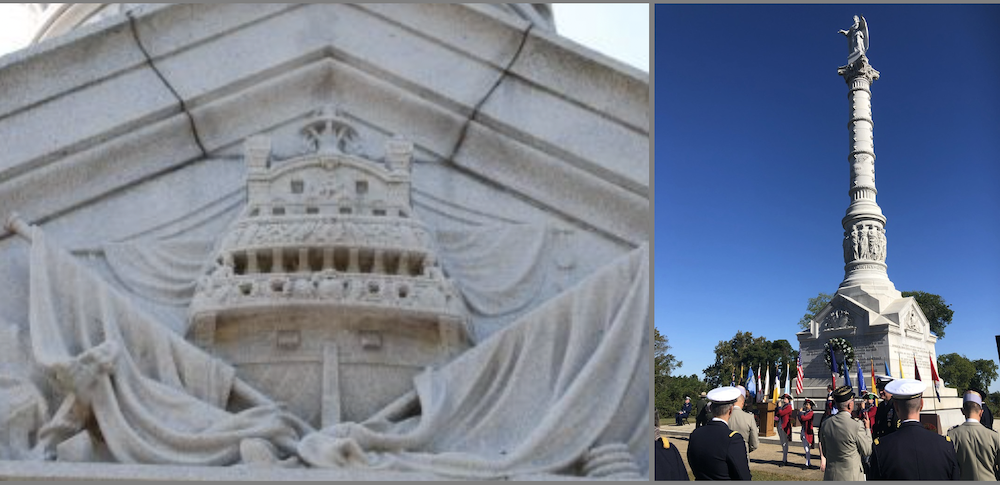
Bottom: Monument to the Alliance & Victory, Battlefield of Yorktown, VA, and detail showing The Ville-de-Paris, Photos: TC © ASSFI 2021
| | |
• Admiral François Joseph Paul, Comte de Grasse, Marquis of Grasse-Tilly (13 September 1722 – 11 January 1788) is best known for his command of the French fleet at the Battle of the Chesapeake in 1781. It led directly to the British surrender at Yorktown ensuring the Independence of the United States.
• In 1779, he joined the fleet of Count d'Estaing in the Caribbean as commander of a squadron. He contributed to the capture of Grenada and took part in the Battle of Martinique (1780) against Admiral Rodney. De Grasse was promoted to lieutenant-general of the Navy (vice-admiral) in March 1781, and was successful in defeating Admiral Samuel Hood and taking Tobago.
• De Grasse responded to Washington and Rochambeau when they appealed for his aid in 1781, setting sail with 3,000 troops from Saint-Domingue. He decisively defeated the British fleet in the Battle of the Chesapeake on September 5, 1781. He drew away the British forces and blockaded the coast until Lord Cornwallis surrendered at Yorktown.
• He acted decisively, had a jovial temper, hosted George Washington for dinner on board his flagship 104-cannon “Ville de Paris”, however didn’t set foot on American soil, which maybe explain while his role, although crucial, is usually overlooked and unjustly forgotten.
• This is when the famous anecdote took place: when greeting on board General George Washington, for a festive dinner, the Admiral, himself 6 feet and almost as tall as the general, embraced the general with the words of welcome: "Bienvenue, mon petit Général"!
His statue at Cape Henry, VA, is inside a US Navy installation and difficult to visit, unfortunately.
• La Ville-de-Paris, a 104-cannon flagship of Admiral de Grasse, was originally laid down in 1757 as the 90-gun Impétueux; she was funded by the City of Paris and renamed Ville de Paris in 1762 as a result of the "don des vaisseaux", the Duc de Choiseul’s campaign to raise funds for the Marine Royale from the cities and provinces of France.
• In 1778, when France joined the American Revolutionary War, she was officially commissioned in Brest and became the flagship for Admiral Guichen. In July, she participated in one of her initial battles during the inconclusive Battle of Ushant.
• In March 1781, she set sail for the West Indies, this time as part of a fleet of twenty ships of the line led by De Grasse. She then engaged in the Battle of Fort Royal and the Battle of the Chesapeake, under Captain Cresp de Saint-Césaire.
• In 1782, she participated in the Battle of St. Kitts, which surrendered to the French on February 12.
• During the Battle of the Saintes on April 12, 1782, the British fleet led by Admiral Sir George Rodney had the upper hand over the French ships commanded by De Grasse, capturing the severely damaged Ville de Paris. Unable to sail due to her masts and rudder being destroyed, the damaged ship was towed to Jamaica, where she underwent repairs and was prepared to return to England for British service. In September 1782, the ship sank along with other vessels when a hurricane struck the fleet off Newfoundland. The Ville de Paris went down with the loss of all but one of her 500 crew members.
Statue of Admiral de Grasse, Cape Henry, VA
Cape Henry Historic Park , Atlantic Ave, Virginia Beach, VA 23459
(Located on Fort Story Military Reservation in Virginia Beach, VA. Be prepared to be stopped and show your Real I.D. at the guarded entrance gate)
GPS: 36.928190, -76.009419
• Inscription:
“This statue, a gift from France, is placed here overlooking the waters where Admiral Comte de Grasse successfully engaged the British fleet on September 5, 1781. The “Battle of the Capes” prevented crucial reinforcements from reaching Cornwallis thus hastening his surrender.
Dedicated in grateful remembrance of the decisive contribution of Admiral de Grasse to the winning of American Independence.”
| | |
L'Astrée, La Boussole & L'Astrolabe
La Pérouse & Fleuriot de Langle
1781-1786
| | |
We narrated the most salient episodes of the American portion of the famous Lapérouse circumnavigation in our April 2024 Bulletin:
"La Pérouse in America"
https://conta.cc/3U58W8r (original version in English)
https://conta.cc/3xHEvxn (version en français)
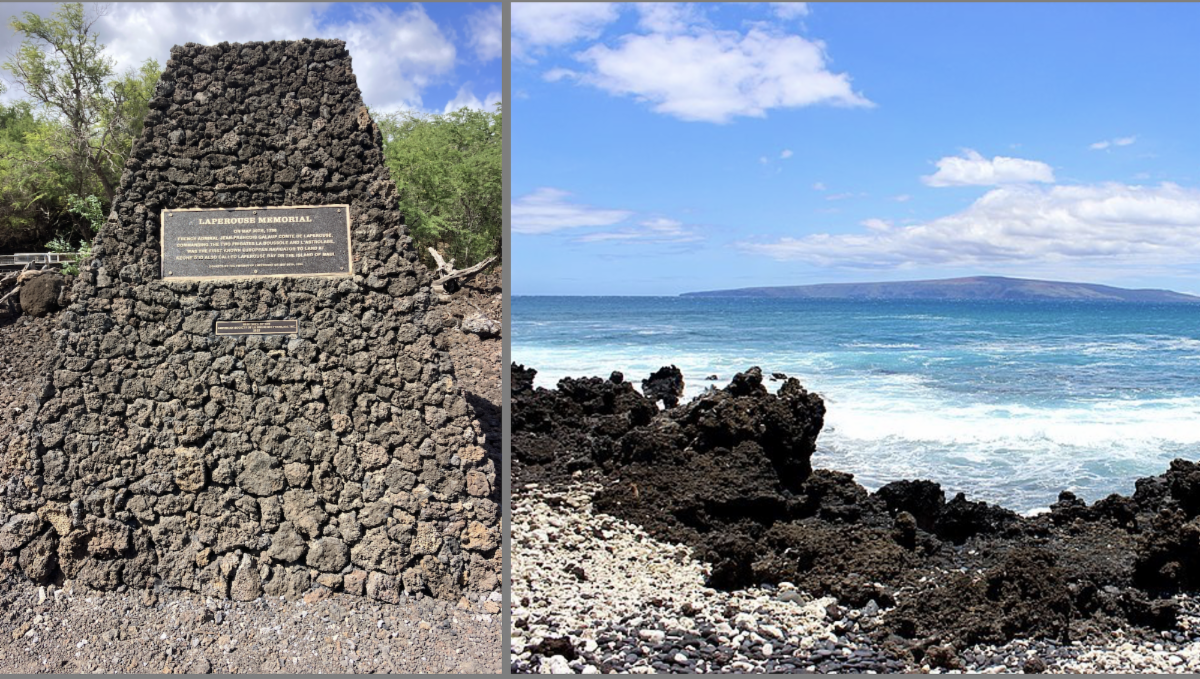
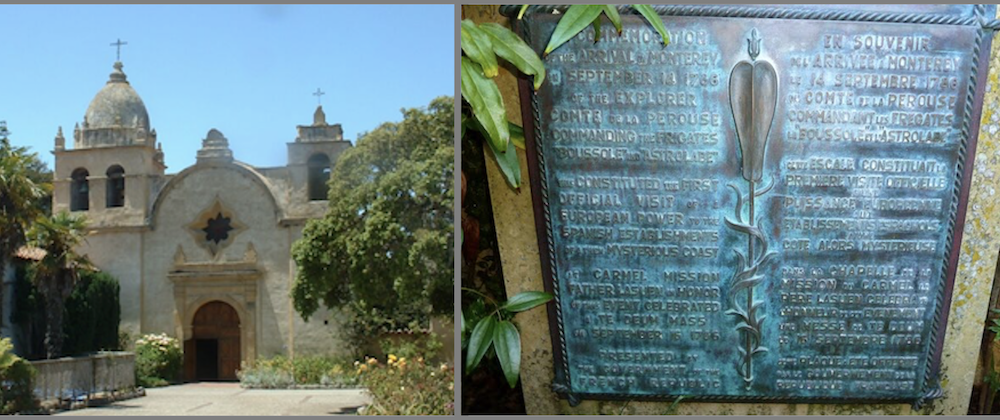
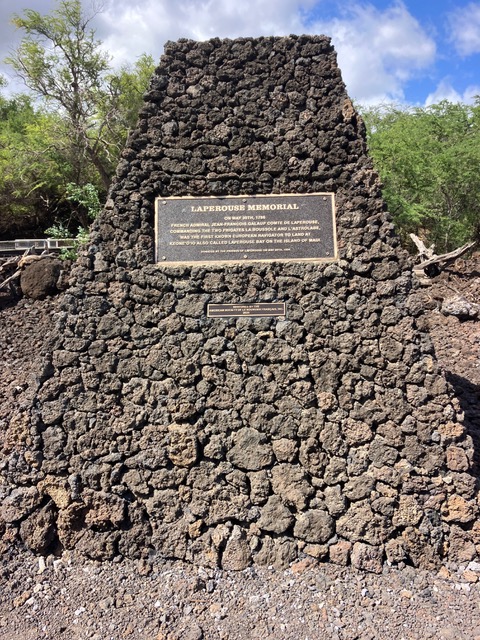
We will revisit a few reasons why his two ships, La Boussole and L'Astrolabe, made an impact on the West Coast, especially among the native population Tingit of Alaska, who recall their journey, and in Maui, where our Society is completing the restoration of the Lapérouse Monument.
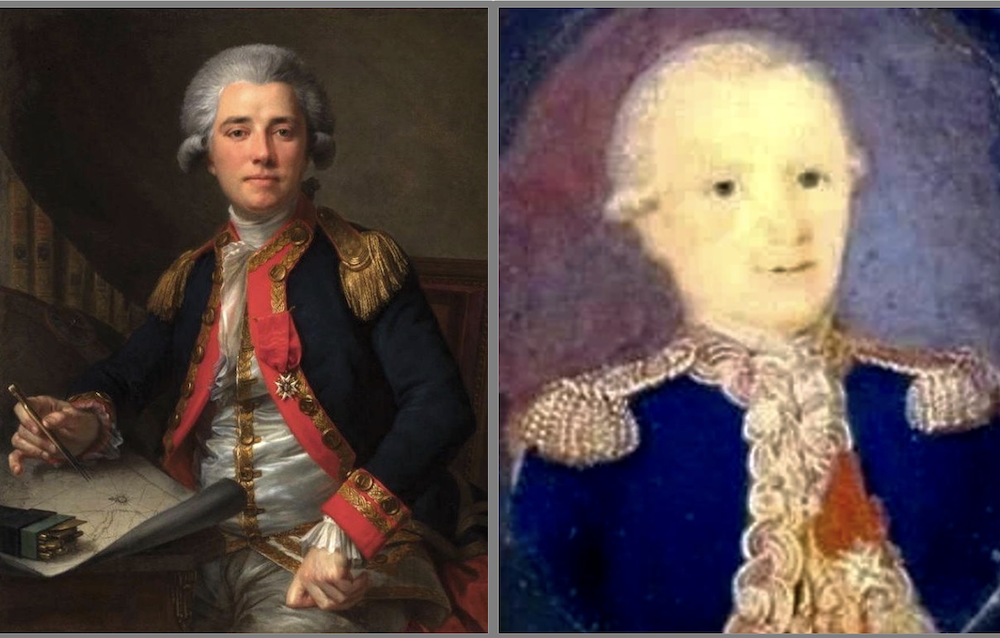
• Jean François de Galaup, comte de La Pérouse, (also spelled Lapérouse) was born at Château du Gô, in the parish of Saint-Julien, two leagues from Albi, France. His family was ennobled in the year 1558.
• A seasoned sailor: La Pérouse received his education at a Jesuit college and entered the Navy as a "Garde-Marine" in Brest on 19 November 1756. In 1757, he was assigned to the French ship Célèbre and took part in a supply mission to the fort of Louisbourg in New France. He also participated in another supply mission in 1758 to Louisbourg, during which the fort was besieged at the early stages of the Seven Years' War, leading the expedition to take a detour around Newfoundland to avoid British patrols. During the Battle of Quiberon Bay in 1759, Lapérouse sustained injuries while serving on the Formidable. He was captured, briefly detained, and later released on parole back to France; he was officially exchanged in December 1760. In 1762, he was involved in a French endeavor to seize control of Newfoundland, managing to escape with the fleet when the British forces arrived in large numbers to expel them.
• When France sided with the Insurgents and declared war to England in 1778, La Pérouse was appointed as the commander of the 32-gun frigate Amazone, a sister-ship of the Hermione, in La Motte-Picquet's division, which left Brest on May 1, 1779 to reinforce Count d'Estaing's squadron. He took part in the Battle of Grenada.
• Comte d'Estaing's squadron reached the coast of Georgia on September 1, 1779 and was sent to Charleston. He captured the 20-gun HMS Ariel* on September 11, 1779. He was present at the siege of Savannah, then captured the frigate HMS Tigre off the coast of Georgia on December 8, 1779.
Lapérouse was promoted to the rank of Captain on 4 April 1780, and was part of the "Expédition Particulière" led by Rochambeau, and served under Admiral Ternay, setting sail from Brest on May, 2nd 1780. Between October and November 1780, Amazone patrolled the waters of Rhode Island, and then proceeded to the Caribbean.
• Subsequently, Lapérouse switched to the Astrée. In the summer of 1781, he was offered the command of the larger 50-gun Sagittaire, but due to his crew being afflicted with scurvy, he sought permission to retain control of Astrée. He was then designated to lead a frigate division, alongside the Hermione, which was under the command of Captain (and future admiral) Latouche-Tréville.
• For his service to the cause of American Independence, La Pérouse was made a Member of the Order of the Cincinnati.
* A note of trivia: The French took the captured ship HMS Ariel into service as Ariel. Ariel underwent repair and refitting at Lorient between March and October 1780. The French then lent her to the American Continental Navy in October, where she served briefly as USS Ariel.
• Paul Antoine Fleuriot de Langle (born on 1 August 1744 at château de Kerlouët in Quemper-Guézennec, Côtes-d'Armor, and died on 11 December 1787 in Maouna (Tutuila Island, American Samoa) was an accomplished naval commander, and intrepid explorer, as well as a renowned académicien de marine. He served as the second-in-command during the La Pérouse expedition.
• Fleuriot de Langle took part in the American Revolutionary War. In April 1781, Fleuriot de Langle was given command of the 32-gun frigate Résolue. From March 1782, he commanded the 50-gun Experiment which had been seized from the British Royal Navy and then commanded the frigate Astrée in the Hudson Bay expedition under La Pérouse's orders. He became a friend and inseparable companion to La Pérouse.
• For Fleuriot de Langle's expertise, knowledge of math and astronomy, and force of character, La Pérouse chose him as his deputy, commanding the 114-man frigate Astrolabe.
• Fleuriot de Langle was a Member of the Order of Cincinnati.
| | |
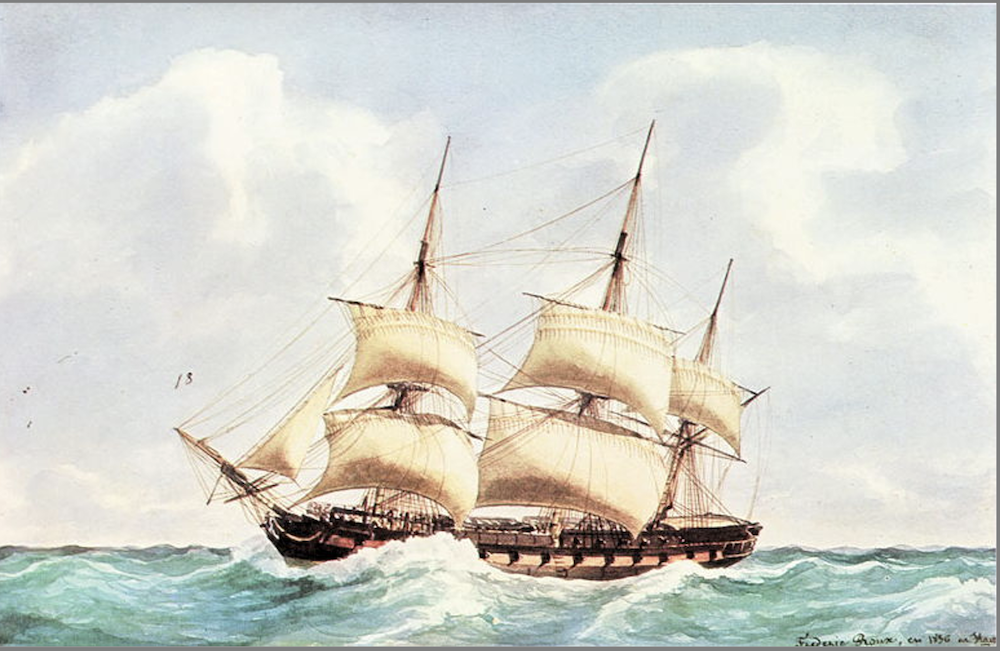
Above, Top: Watercolour portrait of Astrée, by François Roux, commissioned by Willaumez, Public Domain, https://commons.wikimedia.org/w/index.php?curid=90892047
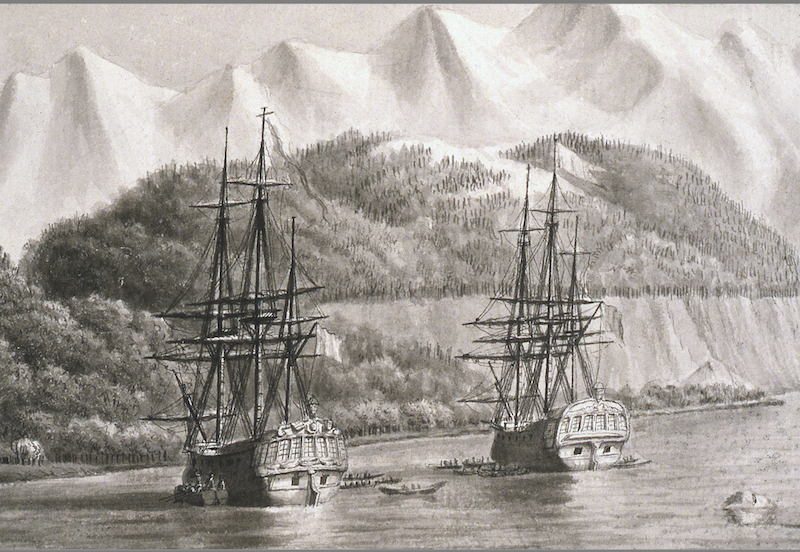
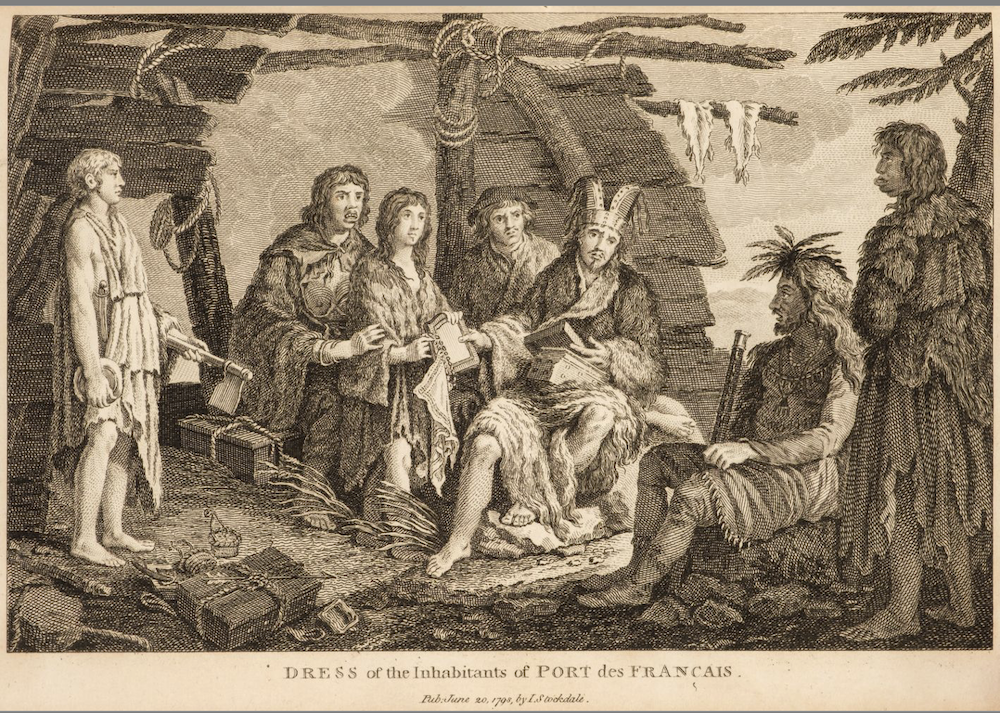
Below: Astrolabe and Boussole at Port des Français, Alaska by Unknown author - Public Domain, https://commons.wikimedia.org/w/index.php?curid=30305726
• L'Astrée was a frigate of the Nymphe class with 32 guns, part of the French Navy. She participated in the War of American Independence under Captain Lapérouse, notably involved in the events of 21 July 1781 and the Hudson Bay expedition.
• She served as the flagship of a division of two frigates, which included Hermione, under Lieutenant Latouche Tréville. They conducted commerce raiding near Boston, as narrated above.
• In August 1782, she participated in the Hudson Bay expedition alongside Engageante and the 74-gun Sceptre, under Fleuriot de Langle.
• Astrée was placed in reserve in Brest in March 1791. In June 1792, under Captain de Cambis, she escorted a convoy to Saint Domingue. She was involved in the Atlantic campaign of May 1794, and was wrecked off Santo Amaro, Azores on 29 January 1796, resulting in the loss of 138 lives.
• La Boussole was a previous flûte of the French Navy, known for its exploration of the Pacific led by Jean-François de Galaup, comte de Lapérouse.
She was constructed in 1781–82 at Bayonne as the flûte Portfaix for the French Navy. In May 1785, she and her sister ship Astrolabe (formerly the Autruche) were renamed, reclassified as frigates, and prepared for a global scientific expedition. They set sail from Brest on 1 August 1785 under Lapérouse, with the Astrolabe under Paul Antoine Fleuriot de Langle.
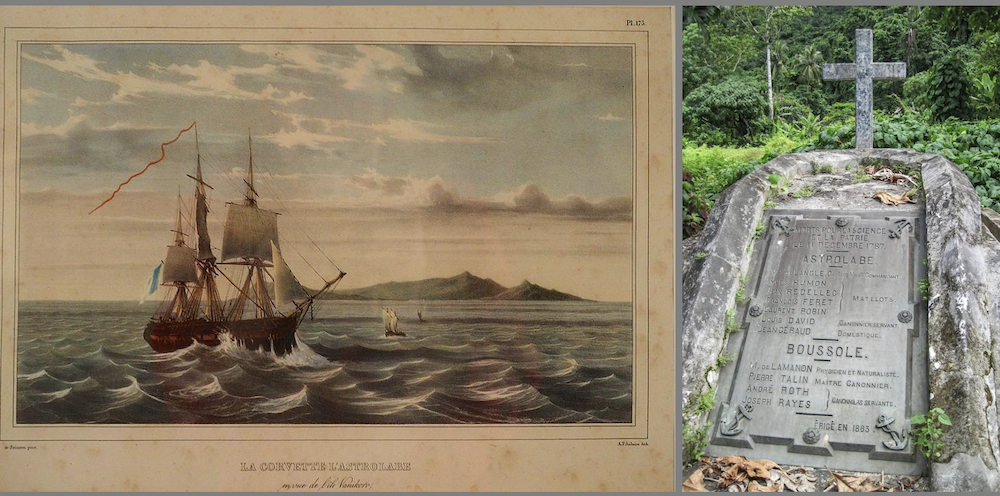
The expedition disappeared mysteriously in 1788 after departing from Botany Bay on 10 March 1788. Captain Peter Dillon in Research uncovered the fate of the expedition when he discovered remains of both ships at Vanikoro Island in the Solomon Islands.
In March 1964, a mission organized by the French Navy located the wreck of the "Boussole" at Vanikoro, outside the reef, at a depth of twenty to sixty meters. Divers retrieved several objects, notably the bell, exhibited at the Musée de la Marine in Paris.
• L'Astrolable was launched at Le Havre in 1781. Items retrieved from the wreck are exhibited at the Musée Maritime of Nouvelle Calédonie.
| | |
Monuments and Markers
in Hawaii, Alaska,
California, American Samoa
from the expedition of Lapérouse (1786-1788)
| | |
Above:
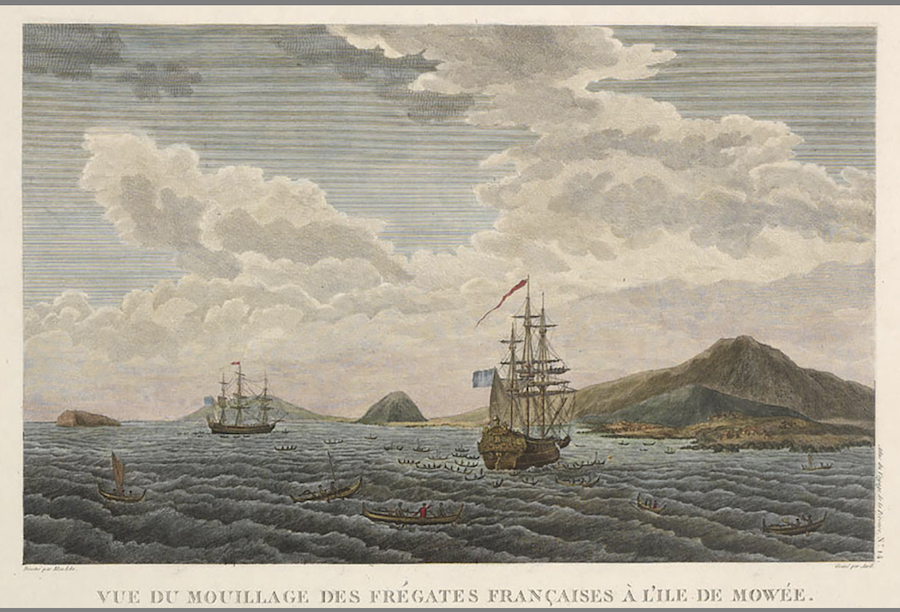
Top: French frigates La Astrolabe and La Boussole in Hawaii. Image courtesy State Library of NSW.
https://talesfromthequarterdeck.com/2022/11/05/loss-of-la-astrolabe-and-la-boussole-a-40-year-mystery/
Below left: Memorial to Lapérouse (restored May 2025), Laperouse Bay, Maui, Hawaii
Off Makena Road, Kihei, HI 96753
GPS: 20.600745, -156.419877 (Photo by Kyle Niehaus, Goodfellow Bros. contractors, June 3, 2025)
Below right: Lava beach at Laperouse Bay, Makena, Maui, Hawaii By Aaron Zhu, CC BY-SA 3.0, https://commons.wikimedia.org/w/index.php?curid=59487582
This monument, erected in 1994 by the "Les Amis de Lapérouse" has seriously deteriorated with the passage of time. Our Society has completed structural work and the restoration of the original bronze plaque. We are now planning the addition of an interpretive signage nearby, to explain to the numerous tourists who was Lapérouse, as well as the humanistic and scientific goals of his explorations.
• Inscription:
"Laperouse Memorial
On May 30th, 1786
French Admiral Jean-françois Galau Comte De Laperouse
Commanding The Two Frigates La Boussole And L’astrolabe
Was The First Known European Navigator To Land At
Keōne’o’io Also Known As Laperouse Bay
Donated By The Friends Of Laperouse On May 30th, 1994"
| | |
Above:
Engraving, "Dress of the inhabitants of Port des Français", from "The Voyage of La Perouse Round the World, in the Years 1783, 1786, 1787, and 1788", 2 volumes, London: John Stockdale, 1798
https://www.dominicwinter.co.uk/Auction/Lot/16-la-perouse-jean-francois-de-galaupthe-voyage-round-the-world-1798/?lot=369669&sd=1#
Marker, “Proud Canoes & Coastal Traders”
210 Front St, Ketchikan, AK 99901
GPS: 55.341250, -131.647150
• Inscription (excerpts):
[...] “Alaska's exploration was hastened by the competing interests of Russia, Spain, England, France and young America to establish a lucrative fur trade here.
Between 1774 and 1792, the Spanish sent many exploratory voyages to Alaska from its outposts in Mexico and California [...]
In 1778, Captain James Cook brought Britain's interests to Alaska during his final World Voyage, and was followed by the English fur trading captains Dixon, Meares and Portlock in 1786. The Frenchman La Pérouse arrived that year, with Marchand following in 1791 [...]
Erected by Historic Ketchikan, Inc.
| | |
Above:
Left: Mission San Carlos Borromeo de Carmelo
By Burkhard Mücke - Own work, CC BY-SA 4.0
https://commons.wikimedia.org/w/index.php?curid=79081037
Right: Plaque, Visit of La Pérouse in Monterey, CA in 1786
The plaque was donated by the French Government in 1947 (photo Marc Onetto)
San Carlos de Borromeo church in Carmel, CA
3080 Rio Rd, Carmel-By-The-Sea, CA 93923
GPS: 36.542669, -121.919696
• Inscription:
“In memory of the arrival at Monterey on September 14, 1786, of the explorer Comte de La Pérouse, commanding the frigates Boussole and Astrolabe. This constitutes the first official visit of a European power to the Spanish establishments on a then mysterious coast. In this chapel of the Carmel mission, Father Lasuen in honor of the event celebrated a Te Deum mass on September 16, 1786.
This plaque was presented by the government of the French Republic.”
| | |
Above Left: Plate from 1833 book showing the french frigate L'Astrolabe near the island of Vanikoro, By Sainson, Louis Auguste de (1801-1887) - Public Domain,
https://commons.wikimedia.org/w/index.php?curid=42930731
Right: Monument Captain de Langle, Massacre Bay, photo by Brenda
https://bksmithdvm.com/2015/01/19/massacre-bay-american-samoa/#jp-carousel-529
• On Dec. 11, 1787, Captain de Langle, La Pérouse trusted friend and commander of the Astrolabe, attempted to go to shore to replenish his ship with fresh water, was surrounded by more than 1,000 natives and followed his instructions not to use force to repel them. He and his party were massacred. The monument, constructed by the French government in 1883, listed on the National Register of Historic Places, comprises a rectangular concrete structure enclosed by a low concrete wall, housing a bronze plaque and cross. The village of Aasu is responsible for the maintenance of the monument.
Memorial, Captain de Langle & French Sailors
Massacre Bay, Aasutuai (old Aʻasu), Tutuila Island, American Samoa
GPS: -14.292289, -170.760369
• Inscription:
“Morts Pour la Science et la Patrie
Le 11 décembre 1787
Astrolabe
Vte de Langle, Capne de Vaisau Commandant
Yves Humon, Jean Redellec, François Feret, Laurent Robin, matelots,
Louis David, (Canonnier Servant) Jean Géraud, domestique
Boussole
M. de Lamanon, Physicien et Naturaliste
Pierre Talin, maître Canonnier, André Roth, Joseph Rayes, Canonniers Servants
Erigé en 1883”
| | |
Circumnavigation, Le Solide
Captain Etienne Marchand
in Alaska and Hawaii
1791-1792
| | |
Above:
Top Left: Captain Etienne Marchand, from Conrad Westermayr, Friedrich Justin Bertuch, Christian Gottlieb Reichard (1805) Allgemeine geographische Ephemeriden, Band 17, Weimar, Public Domain, https://commons.wikimedia.org/w/index.php?curid=17487935
Top Right: Cover of Etienne Marchand’s book “Voyage around the World) Fleurieu, Charles Pierre Claret de: Voyage Autour du Monde, Pendant Les Années 1790, 1791, et 1792 par Etienne Marchand (Voyage Round the World, Performed During the Years 1790, 1791 and 1792, London: T.N. Longman and O. Reese, 1801) https://gallica.bnf.fr/ark:/12148/btv1b86029468/f13.image#
Bottom Left: The Indian chief Gannyaa, from the northern island of Haida Gwaii, formelly Queen Charlotte Islands, near the border of Alaska and B.C. https://www.shfcb.ca/lexploration-francaise-1790-etienne-marchand-notes-sur-les-habitants-des-iles-de-la-reine-charlotte
Bottom Right: Page of a "French-Tchinkitânéens" Lexicon in the book's annex. The Tchinkitans, or Schinkit, are the inhabitants of the island of Sitka, Alaska.
| | |
The expedition of Le Solide (1790-1792) is largely unknown because its main goal was commercial: the fur trade between the Northwest coast of America and China, and eclipsed by the events of the French Revolution.
• The expedition was led by the French navigator Étienne Marchand (born on July 13, 1755, in the Caribbean island of Barbados, which was then a French possession - died May 15, 1793 on Bourbon Island (now the French Departement of La Réunion, in the Indian Ocean).
• He became a captain in the French merchant navy in 1789 and was involved in the spice trade with Bengal, India. At the start of the French Revolution, from 1790 to 1792, he undertook a voyage around the globe aboard his ship, Le Solide, to strengthen France's commercial capabilities in the fur trade between North America and China.
• Launched on December 14, 1790, from Marseille, Marchand's private expedition, funded by the shipowners Baux, crossed the Atlantic, passed around Cape Horn, and then to the Marquesas Islands before reaching present-day Alaska and British Columbia, and then on to China via Hawaii.
• Upon his return from the voyage, Marchand declined the honors offered to him (likely to avoid the bloody turn of the French Revolution) and chose instead to retire to the Isle de France (now Mauritius). He passed away on May 15, 1793, on Bourbon Island (now Réunion) at the age of 38, possibly due to an accident or perhaps by suicide due to gambling debts.
Marchand's journey has a commercial purpose, aiming to establish fur trade between the northwest coast of America and China for France.
During their visit in Alaska , they respected the "Americans" (Natives) they encountered, praising their great intelligence, the sturdiness of their homes and canoes, the uniqueness of their decorations, their art, and their "civilizational progress," noting that they are already in the process of "Europeanizing."
• On August 12, 1791, they enter Whites Cape (in present-day Alaska) where they meet the Natives and begin trading for furs from their anchored ships in the bay (called Tchinkîtâné by the locals). The Marchand expedition traded with the Tlingit for 100 pelts when they were anchored near present-day Sitka, in Alaska, but left after seeing signs of smallpox.
• The consistency of trade between the Natives and the Westerners (mostly Russians and Americans) is evident in the logs of his second officier Prosper Chanal and the surgeon Claude Roblet.
• The next day, August 13, 1791, Marchand, Chanal, and a few other crew members go ashore, visiting their homes, trading with them, and exploring the land. Until August 21, local inhabitants are welcomed aboard the ships daily for fur trading.
• In Hawaii, which he visited from October 4 until October 7, 1791, Captain Marchand "wisely decided to make all his purchases under sail and confined himself to dealing with the only Island o-WHYHEE which was sufficient for his needs. He took pigs from there, poultry in small quantities (they were rare and expensive),
coconuts, bananas, potatoes, yams, sugar canes, and other sugar canes, and the other fruits and produce natural to these islands. It [was] a pleasant surprise to see that, along with the with the native provisions, were mixed with pumpkins and watermelons, kinds of fruit which, not belonging to the soil, must have come from seeds sown by the English or La Pérouse. [The inhabitants] must have felt how useful it would be for them to multiply this new means of subsistence: and the Europeans, by making this useful gift [...], have served their own interests in the future. It was noticed that the pirogues which came from o-WHYHEE to trade with the Vessel, never failed to bring with them confused with the Pigs, and offered, together with the with the filthy Animal, in the refreshments which the Natural offered to foreigners: the crew of Le Solide were prudent enough to stick to edibles." (excerpt, Voyage around the World, by E. Marchand)
• Although a financial loss (the Russians had pressured the Chinese court to keep exclusivity on furs sales, and upon reaching Marseilles, the cargo of furs was confiscated by Revolutionaries) the journey is praised for two reasons. The trip was completed quickly: leaving in December 1790, Marchand returned to France in August 1792. Thus, it took him less than two years to circumnavigate the globe. Additionally, there was only one death among the 50 original crew members.
• The scholarly knowledge gained from Marchand's voyage about the regions he visited is also recognized. It is noted that while English voyages helped locate these lands on Western maps, which were later shared among explorers, they added little to the observations of the visited territories and their inhabitants. Marchand, Chanal, and Roblet significantly contributed to the understanding of the customs and practices of the peoples they encountered.
| | |
Above: No documented illustration of the ship Le Solide has been found. However, a genealogical site about the family of surgeon Claude Roblet, who was part of the crew, shares the drawing above, claiming it is of the ship Le Solide, but without any source. From https://www.shfcb.ca/lexploration-francaise-1790-etienne-marchand-le-navire-le-solide
• The Solide was a three-masted ship specifically prepared for this journey, measuring twenty-three meters in length and eight meters in width, sheathed in copper, and weighing 330 tons. It was well-equipped in terms of materials and has a diverse and efficient scientific crew.
Excerpt from Marchand's notes: "I only requested a ship of 320 tons, with just two decks, completely flat from front to back, with half-flat frames and strong enough to withstand grounding, as I believe that the vessels of this port and of this design are best suited for safe navigation of all kinds. […] The ship was to be sheathed in copper; I had all the keel, bow, and stern fastenings made of this metal, as well as the nails of the small bottom; from there to the bulwarks, they were made half copper and half iron."
Our Society hopes to be able to dedicate in the future a plaque or interpretive marker in Alaska or at the border with B.C. in cooperation with the Tingit or Haida people.
| | |
La Diligente
and the Baratarian fleet
"Heroes" Pirates Jean Lafitte and Dominique Youx
1812-1818
| | |
Although not technically a French ship, we included La Diligente and its captain Jean Lafitte in our story, as it is part of the Louisiana and Texas history and folklore. Jean Lafitte was a French pirate and privateer who operated in the Gulf of Mexico during the early 19th century. He was known for smuggling and privateering, however, he is also remembered for his strategic contribution to the American victory in the Battle of New Orleans during the War of 1812, where he and his men fought alongside Andrew Jackson. This dual identity – a pirate turned patriot – solidified his place in history and made him a figure of both infamy and admiration. Involved in the upheavals and revolutions of nations around the Gulf of Mexico, his exuberant life and exploits have inspired movies and numerous legends. We will narrate his adventures in a future Bulletin. Here are just a few salient facts:
Jean Lafitte (c. 1780 – c. 1823) wrote his last name as Laffite, but documents in English from that time referred to him as "Lafitte".
He is thought to have been born in either Biarritz, located in the French Basque Country, France, or in the French colony of Saint-Domingue in the Caribbean. He stated that he was born in Bordeaux, France, in 1780 to Sephardic Jewish parents. Some reports suggest his father was French and that his mother's family originated from Spain. Lafitte and his brother Pierre also asserted they were born in Bayonne. However, other records from that time indicate his birthplace might be St. Malo or Brest.
• He moved with his family from Saint-Domingue to New Orleans in the 1780s.
• By 1805, shortly after the Louisiana Purchase, Lafitte was running a warehouse in New Orleans to assist in distributing goods smuggled by his brother Pierre Lafitte. The Lafittes relocated their operations to an island in Barataria Bay, Louisiana. By 1810, their new port had become quite successful; the Lafittes had a lucrative smuggling business and also began to engage in piracy with his band of "Baratarians" privateers.
On June 18, 1812, the United States declared war against Great Britain.
Even though he was offered land by King George III in exchange of his support of Great Britain, and even though he had been pursued by U.S. authorities, Lafitte, his fleet and his men supported the United States
Role in the Battle of New Orleans of 1814:
• The US constructed 13 warships in upstate New York to wage war on the Great Lakes, but in other regions, it enhanced its navy by granting letters of marque to privately owned armed ships. New Orleans issued six such letters, mainly to smugglers collaborating with Lafitte at Barataria.
• On December 23, advance units of the British fleet reached the Mississippi River. On December 28, 1814, the British started to move towards the American lines inNew Orleans but were pushed back by an artillery team led by two of Lafitte's ex-lieutenants, Renato Beluche and Dominique Youx.
• As the battle raged on, the former pirate gunners received accolades both on land and at sea. Commodore Patterson commended the Barataria men who were part of a US Navy ship, noting that their artillery skills surpassed those of the British.
• On January 21, General Jackson released a statement recognizing Lafitte's troops, particularly the cannoneers and "Captains Dominique and Beluche, who recently led Barataria privateers, along with some of their old crews and many brave citizens of New Orleans, stationed at Nos. 3 and 4." Jackson also acknowledged Jean and Pierre Lafitte for showing "the same courage and loyalty."
• He officially asked for mercy for the Lafittes and their men. The government granted them a complete pardon on February 6.
| | |
Above: Jean Lafitte’s ship, La Diligente
https://www.facebook.com/permalink.php/?story_fbid=327251237034677&id=100092494097951
A fleet in the making:
• In January 1813, Jean and his brother Pierre Lafitte seized their first prize, a British brig carrying 77 slaves. Selling the slaves and extra cargo brought in $18,000 in profit. The brothers modified the captured ship for piracy and named it Dorada. Within weeks, Dorada took a schooner filled with goods worth over $9,000. Since the captured schooner was not useful for piracy, after unloading its cargo, the Lafittes returned it to its original captain and crew. The Lafittes earned a reputation for treating captured crew members kindly and often gave back seized ships to their original crews.
One ship Jean Lafitte was known to have commanded in 1813 was the 146-ton schooner goëlette La Diligente which mounted 12 guns, probably 12-14 pounders. They also captured a fourth ship, a schooner they renamed Petit Milan ("Little red kyte")
There are several markers in Louisiana and Texas dedicated to Jean Lafitte. A town is even named after him. We are showing here only two:
• Marker, “Jean Laffite”
4688 Common St, Lake Charles, LA 70607
GPS: 30.173783, -93.214083
• Inscription:
“Jean Laffite was a French privateer, pirate and patriot. A hero with his band of baratarians at the Battle of New Orleans in 1815. Reputed to have had a warehouse on Contraband Bayou and to have conducted business with locals, Charles Salier and Arsene Lebleu. His ships flew flags of Cartagena and the Mexican Republic, and maybe the Jolly Roger. Erected by The Buccaneer Society of Lake Charles and The Lafite Society at Galveston, TX.”
Marker, “Town of Jean Laffite”
799 Jean Lafitte Blvd, Lafitte, LA 70067
GPS: 29.760550, -90.100350
• Inscription:
“Named for legendary privateer Jean Lafitte, who helped the United States win the Battle of New Orleans and used area bayous for his smuggling operations. Home to a thriving seafood industry. Incorporated in 1974 as a village. Became a town in 1977. First mayor of village and town was Leo E. Kerner, Jr., from 1974-1991
Erected 2014 by Jefferson Parish Historical Commission.”
| | |
Above Left: Dominique Youx, Modern Day Depiction of the Baratarian Pirate of Jean Lafitte
The Historic New Orleans Collection, 1983.123.8, https://www.nps.gov/jela/learn/historyculture/jean-lafitte-history-mystery.htm
Above Right: tomb of Dominique Youx, By Michael Homan - Flickr: , CC BY 2.0, https://commons.wikimedia.org/w/index.php?curid=31839456
• Dominique You or Youx (born Frederic You or Youx, c. 1775 in Sète, Languedoc –died in New Orleans November 15, 1830) served as an artilleryman in the French Revolutionary Army. In 1802 he accompanied General Charles Leclerc's expedition to quell Toussaint Louverture's Haitian Revolution. He went on to establish himself in New Orleans and became Jean Lafitte’s trusted lieutenant. He was nicknamed "Captain Dominique" by the French and "Johnness" by the Americans. He and other pirates fought particularly well in the Battle of New Orleans. Major General Andrew Jackson's general order of January 21, 1815 cites him for having shown uncommon gallantry and skill in the field. He was buried with military honors at public expense.
Marker “Dominique You”
300 N Claiborne Ave, New Orleans, LA 70112
GPS: 29.960717, -90.075283
• Inscription:
”Intrepid warrior on land and sea in a hundred combats showed his valor this new Bayard without reproach or fear could have witnessed the ending of the world without trembling”
Dominique You was Jean Lafitte's lieutenant at the Battle of New Orleans in 1812 (sic).
Restored in 1977
Erected by New Orleans Archdiocesan Cemeteries.
• “When Dominique Youx died, he had such a funeral as no one had had before in New Orleans. The entire Legion [an organization of the Orleans Artillery, of which Dominique You had been a founder] shouldered their arms to render him military honors and an immense crowd of citizens accompanied his body to its last resting place. He sleeps in a plain brick tomb not far from Gen. Plauche, in the ancient St. Louis No. 2.” From a newspaper article on the anniversary of his death many decades later, Krewe of Dominique Youx.
Tomb of Dominique Youx
Cimetière Saint Louis No 2, 300 N Claiborne Ave, New Orleans, LA 70112
GPS: 29.960796, -90.075882
• Inscription (in French, with masonic symbol):
“Intrépide guerrier, sur la terre et sur l’onde, Il sut, dans cent combats, signaler sa valeur
Et ce nouveau Bayard, sans reproche et sans peur
Aurait pu sans trembler, voir s’écrouler le monde.”
[Translation in English]:
“Intrepid warrior on land and sea. In a hundred combats showed his valor.
This new Bayard without reproach or fear could have witnessed the ending of the world without trembling.”
| | |
Gassendi and La Poursuivante
Admiral Louis Tromelin
in Honolulu
1849
| | |
• Louis François Marie Nicolas Le Goarant de Tromelin, (born on January 11, 1786, in Gourin (Brittany) - Died on May 15, 1867, in Lorient (Brittany).
• On October 6, 1801, he became a midshipman and fought in the Battle of Trafalgar in 1805, where he was injured. He was taken prisoner in England but escaped after two years under perilous conditions and managed to return to France to resume service.
• Promoted to rear admiral on December 17, 1845, his flagship was the frigate La Poursuivante.
• In 1846 he was named commander of the French Navy in the Pacific, where he conducted political and military missions.
• He is credited with the discovery of the Phoenix Islands in the Kiribati archipelago and Fais Island in the Caroline Islands. He also explored Vanikoro.
By the end of his career, he had spent 205 months at sea during peacetime and 92 months during wartime.
• The French occupation of Honolulu, referred to as the "Tromelin Affair", or "the sack of Honolulu" occurred in 1849. This attack on the capital of the Hawaiian Kingdom, was a response to the local mistreatment of Catholics and the suppression of French trade. British advisers at the Court of King Kamehameha III as well as British protestant evangelists were doing everything in their power to evince Catholic priests and French business.
• Already, in 1839, the French frigate Artémise had to intervene to pressure the King to allow catholics to practice their religion. Catholicism was restored in Hawaii in the summer of 1839. Prior to this, Catholic priests had been expelled and persecuted. The Edict of Toleration, issued by King Kamehameha III in July 1839, granted religious freedom to all Catholics. The formal dedication of the Cathedral of Our Lady of Peace took place on August 15, 1843. However all sorts of restrictions against catholics and French missionaries continued unabatted.
• On November 5, 1848, Guillaume Dillon, the French Consul, had informed the French Foreign Office: "I believe that simply displaying a good French corvette in Honolulu for three days will compel this deceitful and hypocritical Government to make concessions."
• On August 12, 1849, French admiral Louis Tromelin arrived in Honolulu Harbor aboard the corvette Gassendi, accompanied by the frigate La Poursuivante. Upset by the Protestant missionaries’ efforts to exclude Catholicism and the King's British advisers to impose outlandish tariffs on French trade, Tromelin collaborated with Dillon to draft demands for King Kamehameha III on August 22.
Among these demands:
- The full and faithful acceptance of the treaty from March 26, 1846 signed earlier between France and the Kingdom of Hawaii.
- The lowering of the tax on French brandy to fifty percent ad valorem.
- The oversight of Catholic schools by the head of the French Mission and special inspectors who are not Protestants, ensuring equal treatment for both faiths and their schools.
- The dismissal of the governor of Hawaii for permitting police officers to violate a priest's residence to make an arrest, or the order for the governor to compensate that missionary.
- The compensation to a French hotel owner for damages caused by sailors from HBM's [His Britannic Majesty's] ship Amphitrite.
• The requirements were not fulfilled by August 25. That afternoon, following a second alert to the civilians about the upcoming invasion, 140 French Marines, along with two field guns and scaling ladders, were brought in by boat. The marines captured an unguarded Honolulu Fort from the two defenders, Governor of Oahu Mataio Kekūanaōʻa and Marshal of the Kingdom Warren Goodale, who did not put up a fight. The marines disabled the coastal artillery, dumped barrels of gunpowder into the harbor, and destroyed all other weapons they encountered, primarily muskets and ammunition. The two ships bombarded Honolulu and the Marines sacked the government buildings.They also seized the king's yacht, Kamehameha III, which was then sailed to Tahiti in French Polynesia, and never returned. After these attacks, the invasion force retreated to the fort. Tromelin eventually called his men back and departed Hawaii on September 5.
• On the account of Tromelin and Dillon, the French government considered the incident as fully justified and did not make reparation for the damages.
Catholicism was reinstated and has been practiced in Hawaii ever since.
| | |
Above: Detail of an 1862 print “The Naval Engagement Between the Merrimac and the Monitor at Hampton Roads on the 9th of March 1862” showing the French Navy corvette Gassendi watching the battle (LOC) 1862. Read below about President Abraham Lincoln's visit on board the Gassendi a month later. Photo: https://thehillishome.com/2016/08/lost-capitol-hill-the-visit-of-the-gassendi/
President Abraham Lincoln on board the Gassendi :
• A few years later, the Gassendi visited the Washington, D.C. in April, 1862.
On Thursday, April 24, 1862, the ship reached the Navy Yard, where Secretary of State Seward was present to welcome her. Seward, along with the rest of the government, was eager to give the ship a grand reception because onboard was Henri Mercier, the French ambassador to the United States. France had not yet recognized the Confederacy as a nation, which was something the United States wanted to prevent. The French ambassador confirmed that France was unlikely to acknowledge the Confederacy.
On Saturday the 26th, President Abraham Lincoln boarded the Gassendi to visit the ship and participate in an official cocktail reception.
• As the President arrived, the Gassendi fired a salute of twenty-two guns to honor him. Following this, "the masts were quickly manned, and in a twinkling more than a score of beautiful signal flags fluttered in the evening breeze," as reported by the Washington Evening Star the following Monday.
Onboard the French ship, the President and his party were greeted by Ambassador Mercier, Vice Admiral Aimé Félix Saint-Elme Reynaud, Captain Gautier with cheers of “Vive le President” from the French sailors.
• Ambassador Mercier proposed a few months later to mediate between the North and the South, but both parties declined and chose to continue the war.
| | |
Couronne
Incidental role
in the American Civil War
1864
| | |
• The French ironclad Couronne, meaning "Crown," was the first iron-hulled warship made for the French Navy, constructed between 1859 and 1862.
Although she was the first to be started, the British armored frigate HMS Warrior was finished before her.
• She was launched in 1861, had a displacement of 6,428 tons, and could reach a speed of 13 knots. She was capable of steaming for 2,410 nautical miles (4,460 km; 2,770 mi) at a speed of 10 knots (19 km/h; 12 mph), with a crew of 570 sailors.
• After the Franco-Prussian War, she served as a gunnery training ship until she was disarmed in 1909. Later, she was converted into a floating barracks in Toulon until she was scrapped in 1934.
• On 19 June 1864, Couronne had a incidental role in the Battle of Cherbourg as she escorted the Confederate commerce raider CSS Alabama out of French waters to engage with USS Kearsarge.
The Battle of Cherbourg:
After five successful commerce raiding missions in the Atlantic Ocean, CSS Alabama and her crew of 149 sailors and officers arrived at Cherbourg Harbor on June 11, 1864. The Confederate States sloop-of-war was led by Captain Raphael Semmes, who aimed to drydock his ship and make repairs at the French port. After 22 months at sea, the Alabama's boilers were burned out; her machinery required repairs; she was loose at every joint, and her copper bottom was damaged.
• Alabama had been chased for two years by the screw sloop-of-war USS Kearsarge, commanded by Captain John Winslow and his crew of 163 sailors and officers.
• On June 14, Kearsarge finally located Alabama while she was undergoing repairs. Kearsarge did not engage, as Alabama was in a neutral port; instead, she established a blockade of CSS Alabama in Cherbourg. Union Captain Winslow sent a telegram to USS St. Louis requesting assistance, but the fighting commenced before help could arrive. Confederate Captain Semmes used this time to prepare his crew for the upcoming battle.
• On June 19, with no other options, Alabama raised the Stars and Bars and left the harbor to confront Kearsarge. She was accompanied by the French Navy ironclad Couronne, which was tasked with ensuring that the battle took place outside the French harbor.
• The battle lasted several minutes; meanwhile, thousands of French spectators on the coast watched the conflict unfold. Reports indicated that Kearsarge's gunnery was more precise than that of the Confederates. Kearsarge fired slowly with well-aimed shots, while Alabama fired quickly. Alabama discharged over 370 rounds during the battle, but the quality of her gunpowder had declined during the lengthy campaign.
• After more than an hour of artillery exchanges, Alabama suffered damage below the waterline from Kearsarge's Dahlgren guns and started to sink. Captain Semmes lowered the Confederate flag, yet Kearsarge kept firing until a white flag was raised by a Confederate sailor. 40 of his brothers-in-arms died, while the Union casualties were only 3.
| | |
Left: The Battle of the Kearsarge and the Alabama, oil painting by Édouard Manet - Philadelphia Museum of Art, Public Domain, https://commons.wikimedia.org/w/index.php?curid=154444
Another similar painting by Manet is at the Metropolitan Museum in New York.
A Manet painting at the Philadelphia Art Museum:
The clash between Kearsarge and Alabama attracted significant attention in the French press. Although Manet was not at the battle, he began painting the scene based on newspaper reports shortly after. Just 26 days later, he showcased the painting at Alfred Cadart's gallery on Rue de Richelieu in Paris. The painting depicts Alabama, on the verge of sinking, with Kearsarge faintly visible in the background. Amidst the thick smoke, the loosely painted masts and ropes can be seen. To the right is likely the British yacht Deerhound, whose crew helped rescue Alabama's captain and sailors from capture. In the foreground, a French fishing boat rushes to assist sailors clinging to debris.
Another Manet oil painting depicting the Kearsarge is at the Metropolitan Museum of Art in New York.
Epilogue - the discovery of the CSS Alabama:
In November 1984, the French Navy mine hunter Circé found the wreck of the CSS Alabama at nearly 200 ft (60 m) underwater. Even though the wreck lies in French territorial waters, the United States Government, as the successor to the former Confederate States of America, owns it. On 3 October 1989, the US and France signed an agreement that acknowledged this wreck as a significant heritage resource for both countries and created a Joint French-American Scientific Committee for archaeological exploration. This agreement set a precedent for international collaboration in archaeological research and the safeguarding of a unique historic shipwreck. In 2002, a diving expedition retrieved the ship's bell along with over 300 other artifacts, such as additional cannons, structural samples, tableware, ornate commodes, and many other items that provide insight into life aboard the Confederate warship. Many of these artifacts are now stored in the Underwater Archaeology Branch at the Naval History & Heritage Command conservation lab.
| |
|
Montcalm, Gloire, La Marseillaise
25 French Navy sailors
Cypress Hills National Cemetery, Brooklyn
1918
| | |
Above:
Top:
Left, top and bottom: Bronze plaque and grave marker of one of the French sailors. Our Society lists their names and other details in its "Honor Roll" at: https://souvenirfrancaisusa.org/honor-roll/
Photos: TC © ASSFI 2023
Right: Ceremony held during the visit of the "Mission Jeanne d'Arc 2025" French Navy ships amphibious assault ship Mistral and the frigate Forbin in New York on May 8, 2025. Photos: Daniel Falgerho, Federation of French War Veterans. For a photo album of this ceremony, please scroll down this Bulletin in the Part III "News and Save the Dates".
| | |
Above:
Left: The Gloire's The forward gun turret and crew, By Agence Rol - Public Domain, https://commons.wikimedia.org/w/index.php?curid=19559418
Right, from top to bottom:
French cuiser Montcalm By Marius Bar , Public Domain,
https://commons.wikimedia.org/w/index.php?curid=2931263
French cruiser La Marseillaise en 1911 Par Agence Rol, Public Domain, https://commons.wikimedia.org/w/index.php?curid=46761467
French cruiser Gloire en rade de Brest, By Agence Rol, Public Domain, https://commons.wikimedia.org/w/index.php?curid=89847867
• Montcalm is a battleship cruiser that was launched in La Seyne-sur-Mer in 1900. It made its maiden voyage to transport the French President Émile Loubet to Kronstadt, (then part of Russia) where he had lunch onboard with Czar Nicholas II on May 23, 1902. At the start of World War I, Montcalm served as the flagship of the French Far East fleet. It took part in the capture of German Samoa by New Zealand on August 29, 1914, and fired artillery on September 23 against the Friedrich Wilhelmshafen during the takeover of German New Guinea. In October 1918, while in New York, the Spanish flu caused significant damage. Two sailors at Cypress Hills were part of the Montcalm's crew. At the beginning of World War II, it was stationed in Brest and was scuttled on June 18, 1940, the day before German troops entered the city, before being completely destroyed in 1943.
• La Marseillaise was an armored cruiser launched at the Arsenal of Brest in 1900. It patrolled the English Channel in 1915 before being sent to the Caribbean and the Atlantic to escort convoys. In 1918, it was one of three French warships assigned to the Cruiser and Transport Force responsible for transporting troops from the United States to Europe. In August 1918, La Marseillaise escorted the armed yacht USS Noma, along with destroyers USS Burrows and USS Smith, as part of convoy HB-8, which included cargo ships USS Montana, West Alsek, and USS West Bridge, along with 12 other cargo vessels heading to France. On August 15, the German U-Boat U-90 torpedoed and sank the cargo ships Montana and West Bridge.
In October 1918, while in New York, the crew was devastated by the Spanish flu. Twelve sailors who were part of her crew were buried at Cypress Hills. In 1920, La Marseillaise was tasked with escorting the SS George Washington, which was bringing American President Woodrow Wilson back to the United States. It was dismantled for scrap in 1933.
• The French cruiser Gloire was launched in 1899 at the Lorient shipyards and was one of five armored cruisers of the Gloire-class built for the French Navy (Marine Nationale) during the early 20th century. In 1916, the cruiser was briefly sent to French West Africa to look for German commerce raiders before being moved to the French West Indies for several months. The rise in commerce raiding in early 1917 led to a permanent assignment in the West Indies to escort convoys as part of the Atlantic Division (Division de l'Atlantique). Gloire stayed there for at least a year after the war concluded in November 1918 before returning home to be put in reserve. The ship was decommissioned in 1922 and sold for scrap the next year. Two sailors buried in Cypress Hills were members of her crew.
| | |
Cerisoles and Inkerman
76 French Navy Sailors
who perished on Lake Superior
November 24, 1918
| | |
Above:
Canadian Car & Foundry Co. Ltd built 12 minesweepers for the French government. From the date indicated, Nov. 12, 1918, the vessels at the dock are likely the Cérisoles and Inkerman. Observe the narrow hull and the cannon on the deck, which might have made the ships unstable during the storm. (All historical photos from City of Thunder Bay Archives)
https://www.mtu.edu/unscripted/2018/10/huskies-help-solve-sunken-minesweeper-mystery.html
| | |
Inkerman and Cérisoles were two French minesweepers that disappeared during their inaugural journey amidst a storm on Lake Superior on November 24, 1918. To this day, none of the two ships have been discovered and remain the only warships to vanish in the Great Lakes. The crews, comprising 76 French sailors and two Canadian captains, were lost with the vessels, the most significant loss of life associated with any shipwreck on Lake Superior.
Background
• Inkerman and Cérisoles were minesweepers of the Navarin class, named after significant French battles, respectively from the Crimean War of 1854 and the Italian War of 1544.
• A $2.5 million contract was given to Canadian Car and Foundry in February 1918 to build 12 minesweepers for the French government. These were constructed in Fort William, Ontario. By early November 1918, half of the order was finished. Each minesweeper measured 135 feet (41 m) in length and had a gross register tonnage of 321.
• A third sister ship, the Sébastopol, also named for a French battle from the Crimean War, was delivered and handed over to a French navy crew at the same time.
| | |
Above:
The ill-fated Cérisoles and Inkerman in transit in the Great Lakes. This original watercolor, owned by Fred Stonehouse, was done by a Jesuit priest, the Rev. Edward J. Dowling.
https://www.lakesuperior.com/the-lake/maritime/405-ils-sont-disparu/
The Tragedy
• On November 23, 1918, the minesweepers Inkerman, Cérisoles, and Sébastopol departed from Fort William, Ontario, located on the northern shore of Lake Superior. They were on their way to the Atlantic Ocean, traveling through the Great Lakes and the St. Lawrence River.
• As they moved deeper into Lake Superior, they faced a blizzard with winds reaching 50 miles per hour and waves as high as 30 feet. The ships quickly lost sight of each other in the heavy snow and rough seas. The storm battered Sébastopol for two days, but it eventually made it to Sault Ste. Marie at the eastern end of Lake Superior. However, it soon became clear that Inkerman and Cérisoles were missing.
An enduring Mystery:
• On December 3, 1918, ten days after the three ships departed from Fort William, a search operation began. On the same day, Canadian and American newspapers announced that the ships were late. A week later, reports indicated that a "final attempt" to find them was underway. The search was called off on December 15.
• Since Inkerman and Cérisoles were never located and no wreckage has been discovered, their exact locations and what happened to them remain a mystery.
• No body, no life jacket, not a single piece of equipment ever surfaced or washed ashore, anywhere. Several attempts to locate the ships at the bottom of Lake Superior, including with satellites in a recent past, have been made, with no result to this day.
| | |
Above: in addition to this list, the two Canadian pilots were Capt. R. Wilson and Capt. W. J. Murphy.
Note: the photo is dated 3 days before the tragedy.
Honoring the 76 Sailors "Morts Pour la France" :
• Probably due to the announcement of the Armistice which ended World War One, this tragedy was overlooked and never received much publicity on both sides of the Atlantic.
• In France, the 76 lost sailors received the mention “Mort Pour la France” which means "Died for France”. It is a legal term in France, giving specific rights to heirs, as well as an honor given to those who lost their lives in conflicts while serving the country. This phrase appears on their death certificates and can be engraved on the tomb, which receive special legal protection. Both French citizens and foreign volunteers can receive this recognition.
• While this recognition was stamped on their individual service records, no material testimony to their bravery exists in the form of a memorial or bronze plaque.
• Our Society has started initial work to erect a proper Memorial listing their names, as well as their two Canadian pilots, to be installed around Sault-Ste-Marie, MI, close to the Canadian border.
| | |
Ocean Liner Normandie
Doors in New York
1935 - 1942
| | |
Above:
Top Left: Poster, French Line, c. 1936, attributed to Walter Thomas (1894-1971), https://www.heritage-posters.co.uk/product/french-line-cgt-poster/
Top Right: the Normandie capsized after a ravaging fire, at Pier 88, New York, Photo: Originally published by the New York Daily News on Feb. 10, 1942, https://www.nydailynews.com/2015/02/08/the-normandie-catches-on-fire-and-capsizes-at-new-york-harbor-in-1942/
Bottom: Doors of the legendary SS Normandie ocean liner dining room,
Our Lady of Lebanon Maronite Cathedral, 113 Remsen St, Brooklyn, NY 11201
GPS: 40.694231, -73.994206, Photos: TC © ASSFI 2022
| | |
• The legendary French ocean liner SS Normandie built in Saint-Nazaire, France, for the French Line Compagnie Générale Transatlantique (CGT) entered service in 1935 as the largest (83,423 tons) and fastest(32 knots) passenger ship afloat. It crossed the Atlantic in a record 4.14 days and remains to this day the most powerful steam turbo-electric-propelled passenger ship ever built.
• Normandie was seized by U.S. authorities at New York after the occupation of France and renamed USS Lafayette. In 1942, it caught fire while being fitted as a transport ship and capsized half submerged, on the bottom of the Hudson River at Pier 88. It couldn’t be salvaged and was dismantled as scarp metal. Fortunately, it had been stripped of all its expensive and lavish decorative elements prior to the fire
• It was a floating palace representative of the Art Deco period. Its First-class dining room was longer than The Gallery of Mirrors in Versailles. Among the hundreds of artefacts, many in museums including the Met, its six-meter-tall (20 ft) doors adorned with bronze medallions by artist Raymond Subes are now on the exterior doors of Our Lady of Lebanon Maronite Cathedral in Brooklyn.
• Nine of the medallions show Norman cities, and one shows a sister ship, the Ile de France. The medallions had to be rearranged because the doors did not fit the church openings. Six of the medallions are located at the Church main entrance on Henry Street, while the remaining four medallions (including the Ile de France) are located on the smaller Remsen Street.
| | |
Georges Leygues
Ticker tape parade on Broadway
November 5, 1947
| | |
• In late 1946, a correspondence took place between the Metropolitan Museum of Art and the French Embassy to the United States regarding the possible loan of a collection of rare tapestries for an upcoming exhibit. Claude Levy-Strauss, the future world renowned anthropologist, was at the time living in New York and teaching at the New School for Social Research, and also assisting the French General Consulate in New York. In April 1947, Claude Levy Strauss informed the Metropolitan Museum "of the formal acceptance by the French Government of your invitation to hold an exhibition of French tapestries . . ."
• Eager to restart after the war a policy of cultural exchanges with America, and to seek economic help to rebuild the country after 5 years of brutal occupation and pillage, the French government designated the cruiser Georges Leygues to carry the precious cargo to New York.
• The Georges Leygues, named after a French politician in the 1920's, had played an active role during the war, including support for the June 1944 D-Day Allied landing at Normandy. In addition to carry tapestries, the cruiser also delivered French gold bullions worth some 80 millions dollars (out of 2,500 tons of gold previously saved from invasion of Metropolitan France to various locations in the US, Halifax in Canada, Martinique, Dakar in Senegal) to buy equipment. This equates to $1,174 billion in 2025 dollars. More can be found on this fascinating story at: https://www.gold-eagle.com/article/french-gold-world-war-ii
• At the disembarkation ceremony, New York Mayor William O'Dwyer noted: "While the countries of the world are thinking in terms of war, France is thinking in terms of culture."
• Each of the six hundred crew members of Georges Leygues received as a welcome gift one pound of chocolate - - a prized commodity after years of wartime rationing. On November 6, a contingent of the ship's sailors and officers, led by Captain Jacques Willaume, marched up Broadway from the Battery to City Hall for a memorable ticker tape parade.
• The New York Times headline read: "Tapestries Show France Remains Bastion of Culture", O'Dwyer says. The article went on "A detachment of ninety-six officers and blue-uniformed sailors from the French cruiser Georges Leygues stepped briskly up Broadway [...] to the stirring music of a French drum and bugle corps that played the "Sambre et Meuse", the "Lorraine" and the "Foreign Legion" marches." [...] "the crew stacked their carbines and marched up to the Board of Estimate room for a brief ceremony"..[...] " their peaceful mission of bringing priceless treasures of French tapestries for exhibition at the Metropolitan Museum of Art " will contribute immensely to the realiation that France remains the great bastion of Western European culture that she has always been" [...]
Captain Willaume, speaking in French, said "You can be sure that all of us, side by side with the American Navy, are ready to cooperate for the peace of the world, with the same spirit of freedom, liberty and happiness".
| | |
Granite strips honoring the Georges Leygues and her crew, embedded in Broadway sidewalk,
Photos: TC © ASSFI 2022.
Granite strip embedded on sidewalk:
55 Broadway, New York, NY 1006
• Inscription of granite strip:
"November 5, 1947 * Crew of Warship Georges Leyques for bringing rare French tapestries to exhibit at the Metropolitan Museum of Art”
Note: The name of the cruiser is mispelt, it should be Leygues, with a “g” and not a “q”.
• We narrated in our October 2022 Bulletin all the ticker tape parades honoring French personalities. For a complete list, visit:
October 2022: The Canyon of Heroes
https://conta.cc/3stoIwe (original version in English)
https://conta.cc/3zlTz1E (version en français)
| | |
Magellan
Merci Train freighter
1949
| | |
• The Merci Train, also known as the French Gratitude Train or the Forty and Eight, was the 1949 French response to the Friendship Train. Composed of 49 cars and filled with "gifts of gratitude", the Merci Train arrived in New York City on February 3, 1949, and was divided amongst the 48 states with the remaining car to be shared by the District of Columbia and Hawaii.
• Forty-and-eights were French 4-wheel covered goods wagons used as military transport cars. The term refers to the cars' carrying capacity, said to be 40 men or eight horses. Built starting in the 1870s as regular freight boxcars, they were originally used in military service by the French army in both World Wars.
• The idea to send a "thank you" gift to the United States for the $40 million in food and other supplies sent to France and Italy in 1947 came from a French railroad worker, and World War II veteran, named Andre Picard.
• The Train and all 49 cars arrived aboard the cargo ship Magellan on February 3, 1949, with over 25,000 onlookers in attendance. On the side of the gift-laden French freighter was painted, "MERCI AMERICA". Immediately the trains were distributed amongst the states.
Many of the trains were opened and turned into exhibits before distributing the gifts inside (dolls, statues, clothes, ornamental objects, furniture, etc..) as each State saw fit. Most states continued to exhibit the boxcars to the public after their gifts were distributed.
• The French freighter Magellan was chartered to transport the Merci Train across the Atlantic. "The ship's services were donated by the Association of French Ship Owners", according to the New York Times, in its January 31, 1949 edition, which adds: " The Association of Stevedoers at Le Havre also donated the loading services of dock men".
• The headline of The New York Times read: " City Roars Thanks to France fro Car of Gratitude Train" - "First of 49 Freight Carriers Paraded from the Battery to City Hall as 200,000 Cheer"
The article went on: "The city put out its traditional welcome mat for the first of forty-nine gift-laden boxcars being sent by the French people in appreciation for the $40,000,000 Friendship Train that America sent to France in the bleak winter of 1947" [...] "Each car contains approximately 10,000 cultural, historical, personal and communal gifts..."[...] "the American Legion accepted a torch lighted in January at the tomb of the Unknown Soldier in Paris"[...]"eventually the torch will be taken to Arlington to be united with t Eternal Flame at the tomb of the Unknown Soldier there, and then turned over to teh American Legion"[...] "Massed thousands, swelled by the noon-hour crowds in the financial district and by 15,0000 public and parochial school children with French and American flags, packed the parade route along Broadway. An avalanche of confetti and ticker tape danced in the sunlight as it fell in the wind".
• A granite strip marker (currently missing, probably due to construction on a building and its portion of adjacent sidewalk) on Broadway reads:
"French gratitude train ("Merci Train") bearing gift from France to the United States in appreciation of the friendship train (February 3, 1949)"
• Dozens of plaques located in most U.S. States memorialize this unique testimony of alliance and friendship between the French and the American people.
• Every month in our Bulletins we recognize and honor the many volunteers who preserve and restore these "Merci boxcars". See further below for the latest news from the "Merci Train".
• We narrated the story of this magnificent gesture of gratitude coming from citizens of France of all condition, age, and provinces in our November 2022 Bulletin. Please visit:
November 2022: The Merci Train, 49 boxcars of French gifts
https://conta.cc/3OLtgJ3 (original version in English)
https://conta.cc/3VpKzRP (version en français)
| | |
Epilogue
From the past to the future
| | |
Above:
Top: Joint exercise La Pérouse: U.S. Navy commenced drills with French Navy aircraft carrier, FS Charles de Gaulle (R 91) and its escort ships while sailing through the Gulf of Bengal, May 16, 2019, Photo credit Marine Nationale, https://www.navalnews.com/naval-news/2019/05/joint-naval-exercise-la-perouse-kicked-off-in-gulf-of-bengal/
Bottom: wreck of Le Protecteur, a ship of the line, showcasing underwater diving
Model by Eugène Leliepvre (1908-2013), model-maker, from a model by Henri-Marc Perrin (19.. -?)1964, 1:37 scale, Wood, metal and paper, Photo: TC © ASSFI 2024
| | |
The first joint amphibious operation in the history of warfare occured in Savannah, Georgia in 1779, when French ships landed troops to fight alongside the Continental Army. Since then, numerous conflicts including two world wars, occurred over several continents. With the exception of a very brief exchange of artillery rounds between Vichy forces and the US Navy during the landing in North Africa in 1942, both US and French Navy have stood side by side.
While many remember the famous 1781 Chesapeake victory which sealed the fate of Lord Cornwallis at Yorktown, and thus paved the way to the independence of the United States, not many realize the dozens of daily episodes of cooperation between the two navies and their allies on all the seven oceans.
May this almost 250 year-old cooperation continue to help all freedom-loving people around the world.
If in Paris, do not hesitate to pay a visit to the recently renovated Musée de la Marine at the Place du Trocadéro, and the magnificent Hôtel de la Marine, Place de la Concorde. You will be amazed!
We also eagerly await for more discoveries of shipwrecks, and recovery of artifacts, along the United States shores!
| | |
PART TWO
Tribute to the American Volunteers
who joined the Lafayette Flying Corps:
We continue our series started in October 2023 with individual tributes to members of the Escadrille Lafayette, later part of the Lafayette Flying Corps. To access our Bulletin dedicated to the Escadrille Lafayette, visit:
https://conta.cc/3Qz0Xjl (original version in English)
https://conta.cc/3QCRqYM (version en français)
This month we are paying tribute to another volunteer who fought for freedom and democracy:
Corporal Norman (Henry) Grieb
"Mort Pour la France"
August 26, 1917
in Bourges (hôpital complémentaire n° 28)
Note*: "Mort pour la France" meaning "Died for France," is a legal term in France. It is an honor given to those who lost their lives in conflicts while serving the country. This phrase appears on their death certificates. Both French citizens and foreign volunteers can receive this recognition.
| | |
• Henry Norman Grieb was born on July 2, 1895, in Philadelphia, PA. He was a student and ROTC Cadet at Yale, graduating in the Class of 1918. In the Spring of 1917, he joined the Yale Ambulance Unit, which was being prepared for service in France. On May 26, 1917, Grieb departed for France with 58 other Yale students on the S.S. Rochambeau.
• Upon arriving in France, on June 13, 1917, Grieb enlisted in the Service Aéronautique.
• On July 1, 1917, Caporal Grieb suffered serious injuries and was taken to the French base hospital in Bourges (Cher, in Central France), where he stayed in the recovery ward until he passed away on 26 August 1917 at the age of 22.
• One account mentioned that he "suffered fractured ribs and a contusion of the lungs" due to an airplane accident. Another account attributed his injuries to "a serious wound caused by the accidental discharge of a revolver." A third source claimed he was injured when an automobile ran over him. A fourth source explained that Grieb "had received his aviator's license and was conducting a trial flight when his engine failed, necessitating a forced landing. While he was working on the engine, an automobile collided with the airplane, and it was later discovered at the hospital that Grieb had fractured ribs and lung contusions." This source added that due to his injuries, he developed pneumonia and passed away. A fifth source, an American comrade, alleged that he contracted a venereal disease from "the d'Avord girls" and, after spending several weeks in the hospital, took his own life with a morphine overdose.
His "Livret Militaire" states: "following his war injuries, intoxication and pneumonia".
• The following day, on August 28, he was laid to rest with full military honors in the historic cemetery at Bourges.
• The French Government awarded Soldat Grieb the Medaille Militaire posthumously.
• In 1928, his remains were moved to the Lafayette Flying Corps Memorial located at St. Cloud.
[Source: "The Lafayette Flying Corps: The American Volunteers in the French Air Service in World War One," by Dennis Gordon. Schiffer Military History, Atglen, PA: 2000. P. 187]
| | |
Lafayette in Jeffersonville, Indiana
and Louisville, Kentucky
| | |
In 1824/1825 the Marquis de Lafayette toured all 24 of the United States at the invitation of President Monroe. On May 12, 1825 he visited Louisville and Jeffersonville on the same day. Lafayette returned to Jeffersonville, 200 years later! SoIN helped welcome a reenactment of the French hero’s 1825 visit. Students, veterans, and Revolutionary War history came together in a powerful celebration at Big Four Station and Veterans Memorial Park.
Lafayette crossed the Ohio River on May 11, and was greeted by a 24-gun salute from the river’s edge. Jeffersonville was the only Indiana town he visited.
Per the Johnson County Daily Journal, “Military officers escorted Lafayette to the home of the late Indiana Territory Gov. Thomas Posey, a mansion overlooking the river. Gov. James B. Ray and veterans of the Revolution were there to meet him. Lafayette attended a public reception followed by a 3 p.m. dinner conducted outside on a 220-foot-long table decorated with roses and other flowers.”
A banner in town proclaimed, “Indiana welcomes LaFayette, the Champion of Liberty in Both Hemispheres!”
Click the link to read more about Lafayette's connection to SoIN! https://bit.ly/4jTygde
Photos by Southern Indiana Tourism of Lafayette’s Historic Visit to Louisville & Jeffersonville
https://shorturl.at/lijW2
See more photos and full credit to:
https://www.facebook.com/GoSoIN
Text: The American Friends of Lafayette
| | |
Lafayette in Louisville, KY and Jeffersonville, Indiana
Crowds gathered at the Big Four Waterfront Park to welcome Lafayette, who was proudly escorted by the Old Guard Army Fife and Drum Corps. Attendees listened as both the U.S. and French National Anthems were played, setting a powerful tone for the event.
Lafayette was further welcomed by historic re-enactors portraying Governor Desha and Colonel Richard Anderson. The audience listened as Lafayette delivered his response, then engaged with students, answering questions and sharing insights.
Lafayette and his entourage were escorted by the U.S. Army Old Guard Fife and Drum Corps across the river to Jeffersonville, IN, where they were warmly welcomed at Big Four Station Park by a gathered crowd that included Indiana Masons, DAR, SAR members, local dignitaries, and descendants of Revolutionary War soldier Zalmon Burritt.
Following the welcome ceremony, the celebration continued at nearby Colston Park with the dedication of the Unknown Revolutionary War Patriots Memorial and the planting of two commemorative trees.
Guests then returned to Big Four Station Park to enjoy food, drinks, and heartfelt toasts honoring George Washington, Nathanael Greene, and other heroes of the American Revolution.
Text & Photos The American Friends of Lafayette
| | |
Louisville, KY- Parade to Jeffersonville
On the Big 4 Bridge-led by The U.S. 3rd Army Infantry
Led by the 3rd U.S. Army Infantry Color Guard and "Old Guard" Fife and Drum Corps, followed by Kentucky Sons of the American Revolution Parade of Historic Flags, Lafayette, Solomon P. Sharp-KY Attorney General (Rod Smothers), KY Governor Desha (Ron Adkisson), Sue Rogers- AFL Co-Chair, Bonny Wise- AFL Co-Chair, Kentucky Masons, Daughters of the American Revolution, Children of the American Revolution, and the General Public.
A special thank you to the Bicentennial Committees who worked so tirelessly on making these events so meaningful and special. Lafayette would be proud.
Text & Photos The American Friends of Lafayette
| | Lafayette in Lexington, Kentucky | | |
'Lafayette belongs to humanity': Direct descendent of the Marquis de Lafayette journeys to Lexington to commemorate his visit.
Helping unveil the new interpretive sign was Sabine Renault-Sablonière, a direct descendant of the famed French general.
"Lafayette belongs to humanity," she said. "And I think that values he embodies —that means courage, love for freedom... and a sense of adventure — are very up-to-date today." Andy Higgins is executive director of the Lexington History Museum. She says Lafayette's appearance in Lexington was more than a historical footnote.
"He comes to Lexington proper on May 16, and he's feted all over town, goes to Transy, goes to a girls' school, and there's a grand ball for him. And it's a big day for Lexington because we're really the first western city in the United States and with all of the connections to the East Coast that's further cemented with Lafayette's visit," she says.
Text & Photos The American Friends of Lafayette
| | Lafayette in Cincinnati, Ohio | | |
On May 19, the Marquis de Lafayette will once again stride up from the banks of the Ohio River to greet the people of Cincinnati. Well, a historical interpreter dressed as Gen. Lafayette will do so. It's part of a celebration commemorating the 200th anniversary of the Revolutionary War hero's grand tour of the United States that occurred 50 years after the American Revolution.
"I think Americans aren't necessarily reminded often enough of how unique that this great experiment of the United States and democracy is," explains Cameron Shandersky, past master of the Cincinnati-Lafayette Masonic Lodge No. 483. "The Marquis de Lafayette left a life of nobility. He had an easy life, wealthy; and even against the king's wishes, came because he supported the ideals of democracy and self determination that Europe had never had.
"He believed in the American ideal, and was willing to not only leave his life of leisure, but was injured in battles ... simply because he wanted to support the ideals of freedom. He tried to take that back to the French, and he was very instrumental in changing the political landscape in France as well. We need to remember that and celebrate that."
Gen. Lafayette's grand tour brought him to Covington, Kentucky, where he took a barge across the Ohio River to Cincinnati's public landing on May 19, 1825. He was quickly whisked to the Cincinnati Hotel and cheered by a large crowd followed by a grand ball.
Along with the historical interpreter, the commemoration will include patriotic music from a children's choir from Cincinnati Public Schools, a soloist from Sycamore High School singing the U.S. and French national anthems, a William Henry Harrison interpreter, and a presentation from Vice Mayor Jan-Michele Lemon Kearney.
Text & Photos The American Friends of Lafayette
| | Lafayette in Marietta, Ohio | | |
Hundreds of people came out for the event, many of whom were dressed in period clothing from 1825.
Speakers detailed Lafayette’s accomplishments in the American Revolutionary War and his lifelong mission to fight for equal rights for all.
Gov. DeWine said that he hopes people walked away with a better understanding of Lafayette’s achievements and that remembering him serves as a reminder that freedom isn’t always free.
“I think when you think about Lafayette, one of the things we think about is freedom is not free. We’re heading into Memorial Day, you know, people from the Revolutionary War to the present day have served in our military, and many of them have made the ultimate sacrifice. So it’s important for us to remember that the freedom we enjoy every day, other people made happen for us,” said Gov. DeWine.
Hood said that the goal of the celebration was to blend history with entertainment.
“We want people to have a good time, enjoy the day, but also learn a lot about history. What General Lafayette brought, we tried to keep it very authentic, we tried to keep it to the period, and we tried to make it a real-life experience,” said Hood.
The celebration concluded with the unveiling of a new Ohio Historical Marker that details Marquis de Lafayette’s 13-month farewell tour across the United States.
Text & Photos The American Friends of Lafayette
| | Lafayette in Gallipolis, Ohio | | |
May 22, 2025, Photos by Mike Thompson
| | Lafayette in Wheeling, West Virginia | | Lafayette in Boston, Massachusetts | | |
Lafayette Day in Boston, May 20
On May 20, 2025, on the occasion of Lafayette Day, the Consul General participated in the bicentennial commemoration of the Marquis de Lafayette’s visit to Boston to celebrate his legacy marked by the memory of his trip to the United States in 1824-1825 and the crucial role he played in strengthening ties between France and the United States.
Photos and text: General Consulat of France in Boston, The American Friends of Lafayette
| | Lafayette in Concord, New Hampshire | | Lafayette in Elizabeth Borough, Pennsylvania | | Lafayette in Pittsburgh, Pennsylvania | | Photos of the 200th Anniversary of the Visit of the Marquis de Lafayette to Pittsburgh courtesy of photographer David Cochran, and the Pittsburgh SAR | | |
SAVE THE DATE
Lafayette's Farewell Tour
Bicentennial
| | |
To celebrate America’s French Alliance and in honor General Lafayette’s Bicentennial visit, Liberty Hall Polo Club is hosting the 1st Annual Colonial Allies Challenge Cup. Teams are comprised of active French and US Military Forces, combined together to compete in this spirted but friendly challenge cup.
This a three games series with the the Championship match held at Liberty Hall’s grass field amphitheater on August 24, 2025.
Championship tickets are available to purchase for the the VIP Hospitality Tent, tailgating and general admission at Liberty Hall.
Thursday August 21 - Game 1 - at Banbury Cross Polo Club in Middleburg has reserved tailgate for Sponsors and free general admission for remaining open areas.
Friday August 22 - Game 2 - at Blue Rock Polo Club in Washington VA has reserved tailgate for Sponsors with a hosted reception following the games. Free general admission for remaining open areas.
Tickets to the Colonial Allies Challenge Cup Polo Championship is now on AVAILABLE! VIP Hospitality Tent with hosted bar and cigar tent - Tailgating and General Admission options available at: Culpeper Minute Men - Historical Research and Virginia Militia
Proceeds from this event, and our Grand Ball, fund our History Week and 5th Grade Muster Call events this October which celebrate the 250th Anniversary of the Culpeper Minute Men. Please come out and enjoy this fabulous events and make History Happen!
| | |
Photo Album
Recent Events Commemorations
| | |
We heartily congratulate
Jean-Hugues Monier
Henri Dubarry
Raphaël de Gouberville
| | |
Above:
Top: Jean-Hugues Monier receiving the Legion of Honor from Mr. Lauren Bili, Ambassador of France to the United States. Photo: Consulate General of France in NY, May 5, 2025
Middle: Henri Dubarry, French War Veteran, and former Board Member of our Society. Photos: by Daniel Falgerho, FFWV, May 8, 2025
Bottom: Raphaël de Gouberville, 7th generation direct descendant of general Comte de Rochambeau, and Honorary Life Member of our Society, standing next to the church door that is adorned with his Family Coat-of-Arms, and his ancestor's name engraved in a stone pillar at George Washington memorial Chapel, Valley Forge, PA., May 8, 2025 - Photos TC © ASSFI 2025
| | |
• On May 5th, 2025, our Society's Board member Jean-Hugues Monier was named Knight of the Legion of Honor by the Ambassador of France to the United States, Laurent Bili, during a ceremony at the Consulate General of France in New York. The French Republic thus honors his commitment to Franco-American cooperation and the promotion of French culture in the United States. A defense engineer turned partner at McKinsey & Company in New York, Jean-Hugues Monier has led a remarkable career at the crossroads of innovation, public service, and Franco-American cooperation. A pioneer in artificial intelligence, he has helped major companies navigate transformation and shaped a shared strategic vision between France and the United States.
Jean-Hugues has been a long time member of our Society and has been involved in numerous fund-raising efforts over the years. Notably, Jean-Hugues has been instrumental in raising funds from American Donors to reconstruct Notre-Dame cathedral, and. to install our sculpture of Le Petit Prince at Villa Albertine in New York. In addition to his high-profile professional activities, Jean-Hugues is also General Delegate of Le Souvenir Français in Argentina, where he has installed several monuments honoring Antoine de Saint Exupéry and the legendary adventures of Aéropostale.
• We were informed recently that Henri Dubarry, former Board Member of our Society, and member of the Federation of French War Veterans, will be made Knight of the French National Order of Merit. Henri, a noted restaurateur and New York resident for decades, has been a pillar of both associations for years. We will be announcing details about his forthcoming medal ceremony when they become available.
• We are also pleased to announce that the Board of The American Society of Le Souvenir Français, Inc. voted unanimously to nominate Mr. Raphaël de Gouberville, as Honorary Member of our Society and of our Board of Directors. Raphaël is a 7th generation direct descendant of Comte de Rochambeau, and works in the financial sector in New York City. We have been honored by his presence and support at several commemorations where his courtesy and intimate knowledge of his illustrious ancestor's history are appreciated by all participants.
To all three, we express our most sincere congratulations and grateful appreciation for their contribution to the cause of French-American friendship.
| | |
Celebration of V-E- Day
at Eglise Notre-Dame, Manhattan
May 4, 2025
| | |
Above:
Top: Plaques of the 463 "Morts Pour la France". FFWV color guard from let to right" Michel Dumerchat, Jean Legall, Henri Dubarry, Paul Garabedian. Below: Prof. Clément Mbom, 3rd VP of our Society after the wreath-laying flanked by Patrick du Tertre, 1st VP of our Society and President of the Association of French Reserve Officers in the United States and Colonel Emmanuel Houzé, Police and Security Adviser at the French Mission to the United Nations.
Bottom: In front of Eglise Notre Dame around Rev. Peter A. Heasley, Pastor, with Jean-Jacques de Saint Andrieu and Thomas Vandenabeele, respectively past and current Presidents of the CAFUSA (Association of French Speaking Societies in NY)
Text & Photos: Daniel Falgerho, FFWV
| | |
• On Sunday May 4, we met at the Church of Notre Dame to hear Mass celebrated by Reverend Peter A. Heasley, Pastor.
After Mass, Patrick du Tertre, President of the Association of French Reserve Officers in the US, Colonel Emmanuel Houzé, Police and Security Adviser at the French Mission to the United Nations and Professor Clement Mbom, Professer at CUNY laid a wreath in front of the plaques bearing the names of the dead of the two World War who served withe the American Field Service, the Escadrille La Fayette and in the French Armed Forces.
We were pleased that our friends Jean-Jacques de Saint Andrieu, formerly President of the Committee of Francophone Associations and Thomas Vandenabeele, President of the Committee of Francophone Associations and André Moisan, Trustee of the Société Culinaire Philanthropique.
Our Federation was represented by Alain Dupuis, President, Henri Dubarry, Treasurer, Paul Garabedian, Vice President, Jean Le Gall, Color Guard, Maria Le Gall, Michel Dumerchat, Color Guard, Nancy Dumerchat and Daniel Falgerho, Vice President. .
After Mass we met for lunch and were pleased that Father Peter Heasley could join us.
Text & Photos: Daniel Falgerho, FFWV
| | |
Ceremony to honor the 25 French sailors of WWI
at Cypress Hill National Cemetery, Brooklyn, N
May 8, 2025
| | |
Since 1945, May 8 is observed as “Victory in Europe Day” which our Federation marks by paying homage to our departed comrades at Flushing Cemetery and at Cypress Hills National Cemetery. These 25 French sailors had participated in naval operations in the Atlantic and succumbed to the Spanish Flu in 1918 while on active duty near the end of the First World War.
This May 8 was special as the French Navy’s “Mission Jeanne d’Arc” made up of Frigate (FLF) Surcouf and Helicopter Carrier (LHD) Mistral was in New York and participated in the traditional ceremony. The naval mission was made up of naval personnel, army aviation (ALAT) and Foreign Legion members.
On this occasion the Mission Commander CAPT Quentin Vieux-Rochas, Cedrik Fouriscot, Consul General of France, Patrick du Tertre, President of the French Reserve Officers Association, FFWV President Alain Dupuis and Lt Pierre Gervois of the American Society of Le Souvenir Français laid a wreath in front of the French Sailors monument.
Our Federation was represented by Alain Dupuis, President, Paul Garabedian, Vice President, Henri Dubarry, Treasurer, Jean Le Gall, Color Guard and Daniel Falgerho, Vice president. We were honored to have with us LTC USARMY NG NYARNG (USA) David Myones, Executive Officer de la 369th Sustainment Brigade (Harlem Hell Fighters) - (pictured above with COL Arnault Rouger)
Text & Photos: Daniel Falgerho, FFWV
| | |
Rochambeau Festival
Yorktown Heights, NY
May 17-18
| | |
Photos: TC © ASSFI 2025
Congratulations to Lynn Briggs, Chairman, Washington Rochambeau Revolutionary Route-New York, Incorporated, for organizing the 3rd edition of the annual Rochambeau Festival in Yorktown, NY. This Festival is held on the Grange Fairgrounds, the very same site where the French Army camped from Sept. 24 until Oct. 20, 1782, on its way back from the victory in Yorktown, VA. a year before, en route to re-embark in Boston. Children and adults could meet General Rochambeau impersonated by Eric Dutaud, and were awed by the equestrian skills of a hussar from the Duc de Lauzun' Legion, impersonated by John Koopman. They were entertained by singers and other re-enactors under their tents. Mme Myriam Gil, Deputy General Consul of France in NY, delivered remarks along with Senator Peter Harckham (40th District, New York State Senate), Senator Shelley Mayer (37th District, New York Senate, Chair, State Senate Education Committee), and Ed Lachterman, Supervisor, (Town of Yorktown, New York). Dr. Robert A. Selig, Ph.D. offered historical background and answered questions from the public.
| | |
Memorial Day in New York
With the Veterans of the Seventh Regiment
May 25, 2025
| | |
We were honored to participate in the Veterans of the Seventh Regiment’s Memorial Day March to the 107th Regiment Memorial and the Presentation of Wreaths by BG Thomas J. Principe, President, Veterans of the Seventh Regiment, MAJ Simon Hu, American Legion Post #107, Ms. Myriam Gil, Deputy Consul General of France, LtCol. Patrick du Tertre, President, Association of French Reserve Officers in the US, LtCdr. Thierry Chaunu, President, American Society of Le Souvenir Français, Inc. and Marc A. Hermann, Military Historian, and Gérard Epelbaum, elected representative of the French community in NY.
We marched back to the Park Avenue Armory. After Posting of the Colors and the National Anthem, BG Thomas J. Principe addressed the audience and introduced the guest speakers, Ms. Myriam Gil and Marc A. Hermann.
Text & Photos: Daniel Falgerho, FFWV
| | |
Flowers of Remembrance
at
The Tomb of the Unknown Soldier Foundation
May 25, 2025
| | |
Above:
Top: Photo: Captain Sean-Paul Stolarski, United States Army, Commander of the Guard, Tomb of the Unknown Soldier.
Bottom Left: Mrs Alexa Fish Ward (Left), with her family, three generations descended from Representative Hamilton Fish III, initiator of both Veterans Day and the Tomb of the Unknown Soldier.
Bottom Right: Gold Star Mothers at Arlington National Cemetery. "This morning, I stood beside a tree planted in 1932—Mother’s Tree—in honor of the mother of an Unknown Soldier. Beneath its branches, I stood with real mothers who have lived the unimaginable—Gold Star Mothers, each of them having lost a son or daughter in service to our country. To be in their presence was humbling. Each woman, dressed in white, carries a story of grief, honor, and enduring love. Their strength moved me to tears."
Photos: Richard A. Azzaro
On Memorial Day, you probably saw all over the cable TV news a mountain of flowers laid by the general public in front of America's most sacred site, the Tomb of the Unknown Soldier.
When the president of the United States laid a wreath, there were thousands of individual stems piled up in front of the tomb.
This was the result of the tireless efforts of the Board of Directors of the Tomb of the Unknown Soldier Foundation and their inspiring volunteers led by Richard A Azzaro.
With one voice, their mission was to promote the powerful symbolic language of flowers to express the nation's gratitude to all those who died for our freedoms.
The National Gold Star Mothers and Family Members of Congressman Hamilton Fish, after placing flowers on the Tomb, volunteered to provide flowers and tutorials about the symbolism of the white rose and the pink carnation to the line of approximately 13,000 visitors.
It is the “Never Forget Garden” program, that is emerging with over 3000 in the States and over 25 in France, such as Jublains (Mayenne) and soon in Gouesnou (Finistère) to memorialize the G.I.'s who died for the liberation of France.
Tomb Guards serve around the clock, every day and every night, regardless of the meteorological conditions. Their Society "adopted" the French Cemetery in Yorktown, VA, by laying a Bouquet of Remembrance every year on the mass grave of some 50 French soldiers and Sailors rest.
🌺 How You Can Help for future ceremonies:
❤️ Donate via GoFundMe: https://gofund.me/ce5f6a3a
💙 Or via PayPal: Pay Tomb of the Unknown Soldier Foundation using PayPal.Me
Every donation ensures another bloom—and another thank you—at the foot of a hero’s grave.
“Watch people as they depart the Tomb of the Unknown Soldier; they leave profoundly changed.” - Richard Azzaro
| | News from the "Merci Train" | | |
"Merci train" story: click above or: https://vimeo.com/18495973
• Our November 2022 Bulletin narrated the incredible story and ongoing legacy of the "Train de la Reconnaissance Française", affectionately called "The Merci Train" (November 2022: "The Merci Train, 49 boxcars of French gifts"
https://conta.cc/3OLtgJ3 (original version in English)
https://conta.cc/3VpKzRP (version en français)
• The Merci Train, the 40&8 National Box Car Association and many other local organizations, custodians of the various "Merci train" boxcars in several States are planning various events throughout the year. We invite you to check their respective websites and follow them on social networks. We express our admiration for the fantastic work they are doing and we are honored to help get the word out.
| | The Utah boxcar is now restored! | | |
Photos: Michael Pannell
https://www.facebook.com/photo/fbid=10235924392105785&set=pcb.10235924393865829
Our gratitude to Michael Pannell and the volunteers in Utah who are restoring in pristine condition the Utah boxcar!
Minnesota Merci Box Car
waiting to be exhibited at the new
Minnesota Military & Veterans Museum
| | |
Photo: Steve Dircks, https://www.facebook.com/groups/natlboxcarassn
From the website of the future Minnesota Military & Veterans Museum: "Don’t miss the rare 40 & 8 boxcar, used to transport American troops and horses, a remarkable gift from the citizens of France to Minnesota after WWII." (https://www.mnvetmuseum.org/new-page-97)
We invite you to check regularly the news posted on Facebook at:
https://www.facebook.com/groups/TheMerciTrain
and the 40&8 National Box Car Association at:
https://www.facebook.com/groups/natlboxcarassn
Administered by Merci Train expert historians and Veterans, these FB groups are very informative. Not only do they report on the progress of restorations such as the one in Utah, they post rare photos that are progressively turning up, from the U.S. as well as France, from descendants of SNCF rail engineers who participated in the Merci Train project. We are impressed by their meticulous attention to historical details. Nothing escapes their sharp eyes, and their knowledge is encyclopedic!
Congratulations to Alexis Kim and David Knutson for sharing your expert knowledge with volunteers and restorers around the nation.
| | |
2025: Tricentennial of Rochambeau
Born July 1st, 1725
| | |
July 1st, 2025 will be the 300th anniversary of his birth, and our Society will continue, more than ever, to celebrate this great general, commander of the Expédition Particulière sent by King Louis XVI to come to the rescue of a beleaguered Continental Army. An excellent general, beloved by his troops, a keen diplomat who developed a close friendship with General George Washington, Rochambeau (along with Admiral de Grasse) deserve much more recognition in elementary and high school history textbooks.
Several events are taking place on or around July 1st, in the United States and France:
At Washington Memorial Chapel
Valley Forge, PA
| | On Tuesday, July 1, 2025, from 2:00 pm – 4:00 pm, the Pennsylvania Washington-Rochambeau Revolutionary Route Association in partnership with Washington Memorial Heritage will be celebrating the comte de Rochambeau’s 300th birthday. This celebration will take place at Washington Memorial Chapel, and we would be honored if you could join us. This is not a worship service, but instead a social gathering in the Chapel’s Bishop White Library (and outdoors, if the weather permits). The dress is business casual. We will have a short program (30 minutes or less), and refreshments, including birthday cake. | | |
Our Society will also celebrate Rochambeau at Yorktown on October 18-19. Details will be announced in our September Bulletin.
Symposium
In France, at Vendôme
(June 27-28)
| | |
Organized by Les Amis de Rochambeau led by descendant Nathalie de Gouberville and her husband Philippe, twenty French and American scholars will be discussing the legacy of the illustrious general (who later became the last Maréchal de France under the Ancien Régime) and among them Members and friends of the American Society of Le Souvenir Français: Dr. Robert A. Selig, Ph.D., général de brigade Vincent de Kytspotter, Ph.D., as well as Dr. Iris de rode, Ph.D. and Rebecca Bertrand, executive Director, Newport Historical Society.
Visit: https://lesamisderochambeau.org/
| | |
Exciting news from
Odell Rochambeau Museum
Greenburgh, NY
| | |
On April 8th the New York State Board of Regents approved a provisional charter for the new museum! Thanks to a wonderful team at O’Melveny law firm, who contributed their services pro bono, all the paperwork was submitted last November. The Friends of Odell House Rochambeau Headquarters has now merged into a new legal educational non-profit, Odell House Rochambeau Headquarters. We will be known as Odell Rochambeau Museum and all our social media will soon reflect that name. Holding the charter allows us to operate the museum under an agreement with the Town of Greenburgh.
As an educational non-profit we can now officially partner with all school systems and any visits to the museum will be part of the NYS social studies curriculum. Our Education Committee has met with the Greenburgh Central School District officials and will be creating pilot programs there. Those will be offered to all the school districts in Greenburgh by the calendar year 2026-2027 and eventually to other schools in Westchester.
We have contracted with Minozzi & Sons in Ardsley to build the memorial on the grounds of the house for the four French soldiers who died while camped in Greenburgh in 1781 which is jointly funded by Le Souvenir Français and OHRH.
Text & Photos: Odell House Rochambeau Headquarters
| | |
Announcing the completion of
Phase One of our restoration of
the Lapérouse Memorial
Maui, Hawaii
| | |
Photo: courtesy of Kyle Niehaus, Goodfellows Bros. contractors, Maui, Hawaii.
After a couple of years, finally, the restoration of the Lapérouse Memorial is complete! Thanks to the generous support of Marc Onetto, Regional Delegate of Le Souvenir Français in the West Coast and keen admirer of this great explorer, the support of the Consulate General of France in San Francisco, as well as the support of Mr. Sumner Erdman, owner of Ulupalakua Ranch on which the monument is erected, our Society has completed the restoration on June 1st.
The structure made of lava rocks was crumbling, and the bronze plaque had become illegible over the years.
The next step will be the installation of an interpretive signage for the edification of the numerous tourists visiting Lapérouse Bay , which will explain who was Lapérouse, recall his navigation exploits, and expound his sincere humanism and his scientific contributions. A rededication in the presence of Mr. Laurent Bili, ambassador of France to the United States, and, we hope, the participation of the French and U.S. Navy, is in the planning stages.
| | |
The Hermione, "the Freedom Frigate",
A Call to Arm
| |
Photo: © Valerie Toebat, 2015
Why the Hermione Matters to America
The Hermione isn’t just any ship. Known as the “Freedom Frigate,” this vessel carried the young Marquis de Lafayette across the Atlantic in 1780 with news that would change the course of American history: France was officially joining our fight for independence.
Without Lafayette’s mission aboard the Hermione, the outcome at Yorktown—and American independence itself—might have been very different
A Living Monument to Freedom
Today’s Hermione is an exact replica of the original 18th-century frigate, rebuilt from 1997 to 2014 using traditional methods at the historic Rochefort shipyard in France. Over 5 million people witnessed this incredible reconstruction—the most complex wooden structure ever built in modern France. Since 2014, the Hermione has sailed over 22,000 miles, including a triumphant voyage to America in 2015 that celebrated the enduring bond between our nations.
The Crisis Is Real—And Urgent
Since September 2021, the Hermione has been in dry dock in France, undergoing critical hull restoration. The damage is severe due to a fungus infection of the solid wood in the hull, but fixable—if we act now.
The Numbers:
- Total restoration cost: $10 million
- Already secured: $5 million
- Still needed: $5 million
- CRITICAL DEADLINE: $1.5 million needed by September 2025 to resume work
- Goal: Return to sea by 2027
Without this funding, restoration stops, the Hermione dies. The ship that helped create America needs America’s help.
Our Call to Action
We call on:
- Elected officials to recognize the Hermione’s importance to American history
- American and French private citizens who value our common heritage
- Major donors and foundations committed to preserving history
- Veterans’ organizations that honor those who fought for our freedom
- Educational institutions that teach the story of American independence
Time Is Running Out
The Hermione carried Lafayette to America when we needed France most. Now America must answer the call to help preserve this symbol of our shared fight for liberty.
The time to act is NOW. Our heritage depends on it.
We Need $1.5 Million by September!
The Bottom Line
Join Americans, French citizens, and freedom-lovers worldwide in supporting the Hermione restoration. Together, we can ensure that future generations will see this magnificent vessel and remember the alliance that made American independence possible.
How to Help:
The Hermione saved American independence. Now we must save the Hermione.
- Corporations: Contact the Hermione-La Fayette organization for partnership opportunities.
- Individuals: Every contribution matters—from $10 to any amount you can afford.
- Politicians: Advocate for grants and official support
- Organizations: Rally your members around this historic cause
Don’t let the ship that helped win American independence sink on our watch.
A similar call for action was published in France and signed by hundreds of personalities and major sponsors. Sign this petition. Contact your representatives. Donate if you can. Share this message!
For more information, please contact: domitille@friendsoffdf.org
DONATE NOW
We thank all the leaders of American civic and patriotic organizations who accepted to add their names to the petition:
Richard A. Azzaro, Co-founder & President, Tomb of the Unknown Soldier Foundation • Thierry Chaunu, President, The American Society of Le Souvenir Français, Inc. • Lynn Briggs, Chairman, Washington Rochambeau Revolutionary Route-New York, Incorporated • Denise Doring VanBuren, Board Chair, The Doughboy Foundation, and Honorary President General, National Society Daughters of the American Revolution • William P. Dunham Jr., past President Mass Lafayette Society • Daun Frankland, Daughters of the American Revolution, Virginia Chapter • Bonnie Fritz, Treasurer/Secretary, American Friends of Lafayette • Peter C. Hein, Secretary, Lower Manhattan Historical Association • Alan R. Hoffman, President, American Friends of Lafayette • Laura Ingenhuyff, Hawaii • James S. Kaplan, Chairman, Lower Manhattan Historical Association • W. Robert Kelly, Jr., Director, Gloucester (Virginia) Museum of History • Paul Jeffrey Lambert - President Williamsburg-Yorktown American Revolution Round Table • Dr. Patti Maclay, M.D., National Chair, Franco-American Memorial Committee, National Society Daughters of the American Revolution • Terri Mitchell, D.A.R., Franco-American Memorial Committee, National Division Vice-Chair, Northwestern Division • Pierre Oury, Colonel (ret), USAF • Lanny R Patten, Sons of the American Revolution of Pennsylvania, W3R • Michael Wingate Rhodes, Past-president, Richard Henry Lee Chapter, Virginia Society, Sons of the American Revolution • Ambrose M. Richardson, President, Lower Manhattan Historical Association • Mark Francis Schneider, Historian • Chuck Schwam, Executive director, & Bicentennial committee chair, American Friends of Lafayette • Susan & David Seal, Lafayette’65 • Joseph Studlick, Founding Director, Battle of Rhode Island Association • Dr John David Thornley, Alaska • Nicole G. Yancey, Honorary Consul of France in Virginia Emerita
| | |
Announcing Bastille Day
Central Park, New York
July 13, 2025
| | In 2025, Bastille Day in New York City will be celebrated on Sunday, July 13th, Central Park. The Consulate General of France in New York will host a free music festival at Rumsey Playfield in Central Park, featuring a variety of French and French-speaking artists, including Patrick Bruel, Bob Sinclar, Big Flo & Oli and ESTL. The event is expected to draw a large crowd, similar to the 12,000 attendees from previous years, and is a partnership with Capital One City Parks Foundation SummerStage and the Comité des Associations françaises et de langue française de New York (CAFUSA) of which our Society is a member. Entrance is FREE. | | |
Announcing our
Projected sculpture of
Antoine de Saint Exupéry & The Little Prince
Phillip & Patricia Frost Museum of Science
Downtown Miami, Florida
| | |
Dear Friends of The Little Prince,
Generations of children -- and with them generations of adults -- have fallen under the spell of Antoine de Saint Exupéry’s The Little Prince since its 1943 publication. Appearing in over 600 languages to date, it is the most translated book of fiction in the world. Dozens of plaques and statues commemorate the Little Prince who touches down from his lonely planet to offer a bouquet of wisdoms to this one.
As an international city, very much a crossroads of the Americas, Miami surely deserves a monument to the Little Prince, that most endearing of cultural ambassadors.
The American Society of Le Souvenir Français, Inc., and the France-Florida Foundation for the Arts, both non-profit 501 (c) 3 organizations, are proposing a bronze sculpture of Saint Exupéry and his most beloved creation for the Phillip and Patricia Frost Museum of Science. The statue would be installed on the esplanade near the museum entrance, in the heart of downtown Miami.
The life-size bronze sculpture designed by renowned artist Jean-Marc de Pas will depict the aviation pioneer, WWII hero, poet, and novelist Antoine de Saint Exupéry in his flight suit, holding the hand of his “petit bonhomme”. Another de Pas sculpture currently sits along a wall opposite Central Park on Fifth Avenue in New York City. It has been an overnight success with the public, who have lined up daily for photos since its 2023 inauguration. We expect the same in Miami, especially at a museum and planetarium frequented by so many families and young children.
This project, a gift to one of Miami’s most vibrant cultural institutions, has received the official endorsement of H.E. Mr. Laurent Bili, Ambassador of France to the United States and Mr. Olivier d'Agay, President of the Antoine de Saint Exupéry Youth Foundation and grand-nephew of the author of The Little Prince. On behalf of our Honorary Committee, we are soliciting your tax-deductible assistance in underwriting the sculptures, along with their transportation and installation. Our goal is to raise $200,000 and to conduct a dedication ceremony in 2026, in the presence of state, county and city officials and dignitaries from both countries.
Any donation of $100 or more will be duly recognized. Names of donors above $1,000 will be engraved on a plaque to be installed inside the Museum, according to the following levels:
Bronze $1,000-$5,000 // Silver $5,000-$10,000 // Gold $10,000-$20,000 Platinum: $20,000 or more.
Our goal is to permanently secure some of the novel’s magic for future generations of Miamians and for millions of Florida tourists from all over the world.
Thank you for your generous response.
Please send your donation (specify: Petit Prince)
by ACH wire to:
The American Society of Le Souvenir Français Inc.
TD BANK - 1031 1st Avenue, New York, NY 10022
Routing # 026013673 - Account# 4326011741
Or by check, made payable to:
The American Society of Le Souvenir Français Inc.
500 East 77th Street #2017, New York, NY 10162
or via PayPal:
https://www.paypal.com/donate/?hosted_button_id=WP5E5SCTBTFMN
| | |
Announcing a new Memorial site
honoring American G.I.'s who died for
the liberation of Brest, Sept. 1944
| | |
We were contacted by the Town of Gouesnou to ask for our assistance in connecting them with U.S. historians, in order to verify the list of the G.I.'s killed in action for the liberation of Brest in September 1944, and make sure no one is left out. Local historians in Brittany had already done considerable research, and listed 171 names to be inscribed on the Memorial.
We reached out to J.R. Neubeiser, who is the historian of the Tomb Guards and who had already assisted the towns of Jublains (Mayenne), Apt (Lubéron) to vet the names, combing through pages and pages of daily reports for units of the U.S. Army, reconciling discrepancies, etc...
J.R Neubeiser was thus able to identify missing "KIA's" which will be added to the list, as the Town of Gouesnou wants to make sure that no American G.I. is left out (while leaving room on the monument if ever more names are found in the future).
It has been a journey, and the exchange of correspondance between both sides of the Atlantic could in itself be the subject of a thesis on the examplarity of French-American friendship and historical cooperation.
We are awed by the dedication and knowledge of J.R. Neubeiser on this very meaningful mission.
Our Society will continue to cover the dedication of this important memorial, planned on November 16, 2025.
| | |
OUR PAST MONTHLY BULLETINS
OUR AIM: To turn the spotlight on a famous, or less famous, episode or historical figure during the long shared history between France and the United States, with illustrations and anecdotes.
You can have access to our past monthly Bulletins
(in English and French) at: www.SouvenirFrancaisUSA.org
Click on each photo for further access to sources and references.
Images available on the Internet and included in accordance with Title 17 U.S.C. Section 107.
| | |
OUR MISSIONS:
• To preserve the memory of the French soldiers, sailors and airmen who gave their lives for freedom, and who are buried in the United States.
• To honor French Citizens who did great deeds in the United States, or with a strong connection with the United States,
• To promote the appreciation for French culture and heritage in the United States, and the ideals that unite our two nations, in order to pass the torch of memory to younger generations.
• To strengthen the long-standing traditional bonds of friendship between the American and French peoples, and to this end: erect or maintain memorials and monuments and encourage historical research, public presentations and publications in the media.
The American Society of Le Souvenir Français, Inc. is an independent American corporation, apolitical, established in 1993 in NY, with 501 (c) 3 non-profit status.
| | |
Board of Directors
2025 - 2028
Directors: Françoise Cestac • Gabriel Chalom • Thierry Chaunu • Yves de Ternay • Patrick du Tertre • Francis Dubois • Alain Dupuis • Daniel Falgerho • Bertrand Jost • Dr. Patti Maclay, MD • Domitille Marchal-Lemoine • Mathias Maisonnier • Clément Mbom • Jean-Hugues Monier • Patrick Pagni • Harriet Saxon • Nicole Yancey
Regional Delegates:
Jacques Besnainou, Great Lakes and Midwest • Bruno Cateni, South
Prof. Norman Desmarais, New England • Alain Leca, Washington D.C. •
Marc Onetto, West Coast • Brigitte Van den Hove – Smith, Southeast • Nicole Yancey, Yorktown & Virginia, former Honorary Consul of France in Virginia
| | |
Join us!
Help us implement several historic commemorative projects!
Your contribution is essential to our activities!
- $ 25 for Veterans and Students
- $ 50 for a membership ($80 for a couple)
- $100 for a Supporting Level membership
- $100 for an civic or patriotic association (US only)
- $150 for a Benefactor Level membership
- We are an IRS-qualified 501(c)3 non-profit organization. Donations are tax deductible.
You can send your donation via PayPal by clicking on:
https://souvenirfrancaisusa.org/donate/
(100% secure - no need to have an account with PayPal - major credit cards accepted)
or
By check, payable to "American Society of Le Souvenir Français, Inc"
Mailing address:
Yves de Ternay, Treasurer
5650 Netherland Avenue #4G Bronx NY 10471
| | |
The American Society of Le Souvenir Français, Inc. is a registered NY State non-profit corporation and has full IRS tax exempt 501(c)3 status. All donations are tax deductible.
Copyright © 2025 The American Society of Le Souvenir Français, Inc.
All Rights Reserved
Merci de nous contacter si vous souhaitez recevoir ce bulletin dans sa version traduite en français.
Contact: Thierry Chaunu, President
Email: tchaunu@SouvenirFrancaisUSA.org
| | | | |