|
The American Society of
Le Souvenir Français Inc.
Monthly Bulletin - Vol. V, No 7
July 2025
| | |
Tribute to Rochambeau
300th Anniversary
July 1, 1725 - July 2025
| | |
Cover illustration:
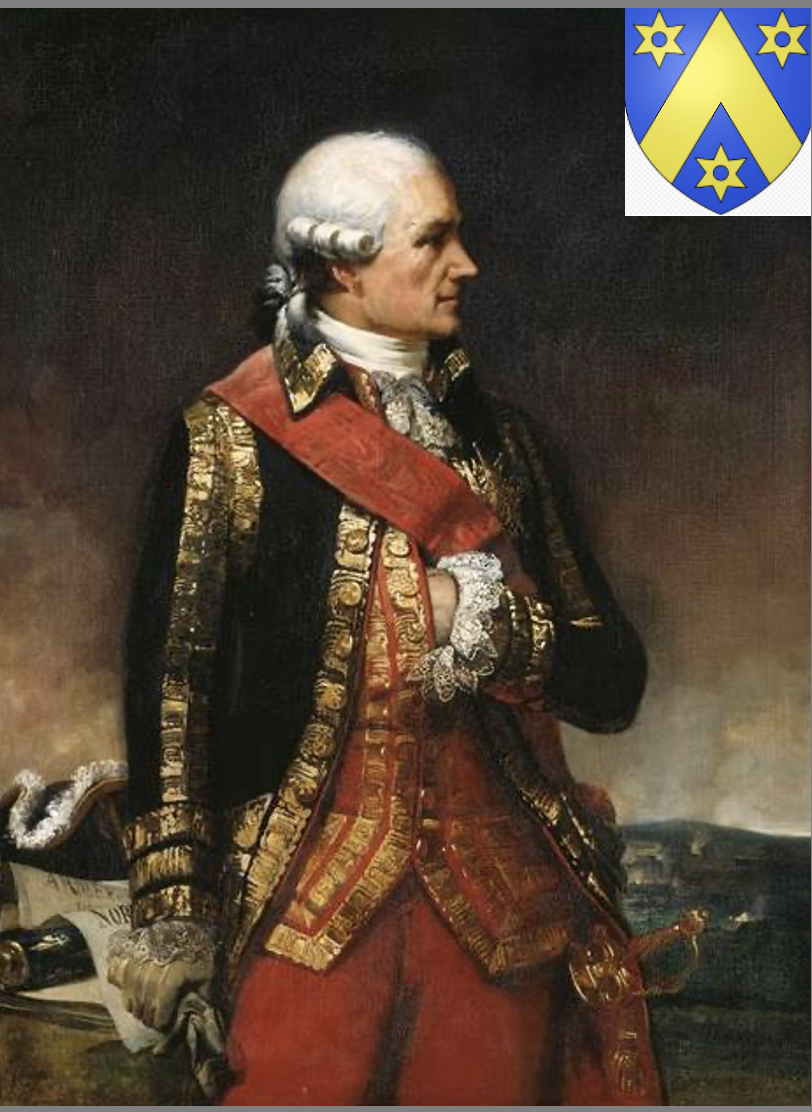
Jean-Baptiste-Donatien de Vimeur, comte de Rochambeau (1725-1807), oil on canvas painting by Charles-Philippe Larivière (1798-1876), c. 1834, on display at the Corps central, Grands Appartements, salle de 1792, Château de Versailles, Public Domain, https://collections.chateauversailles.fr/#/query/769d3cfb-4aab-4c1d-a6a4-f3ce308fdb37
Although none of the Rochambeau oil paintings are claimed to be contemporary, there exists an etching of this pose that is said to be 'after a life portrait'. Rochambeau is depicted in the full dress uniform of a French general: a blue coat adorned with gold lace, a red waistcoat, and breeches. The cordon rouge of the Order of Saint Louis runs across his coat. The gold cast plaque of that order is partially obscured by the left edge of the sash. This specific painting captures the most accurate facial features and uniform decorations from the time of Rochambeau's service in America.
Inset: Coat-of-Arms of the Rochambeau family
| | |
Editorial
On July 1st, we marked the 300th anniversary of the birth of this remarkable general, who eventually became the last Maréchal of the Ancien Régime.
Jean-Baptiste-Donatien de Vimeur, comte de Rochambeau, is often overlooked in favor of Lafayette, which is a form of historical injustice, as he arguably played a different but equally decisive role, at least in military terms.
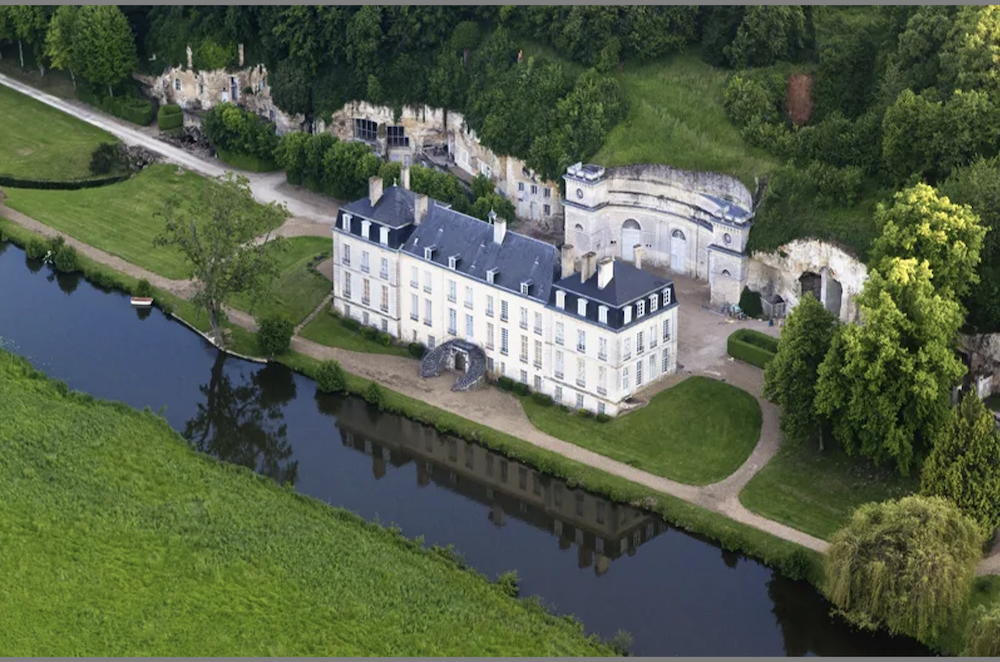
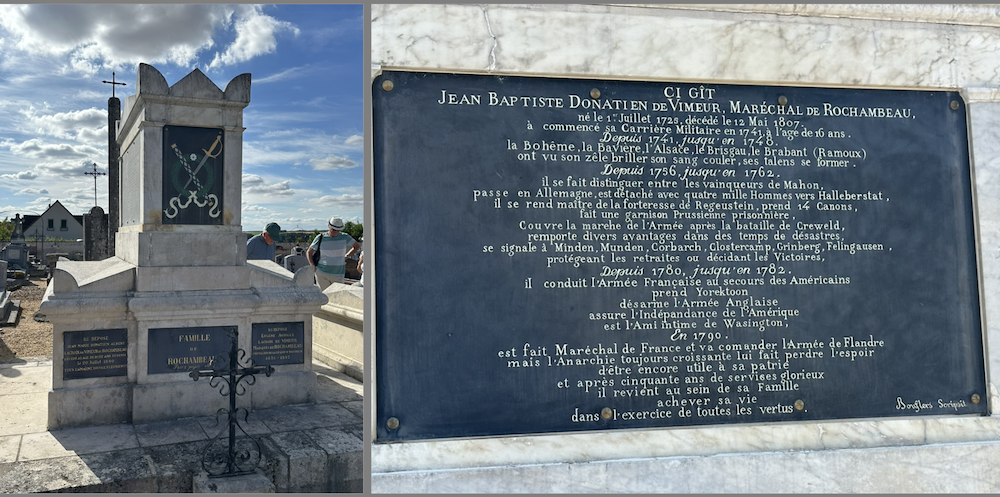
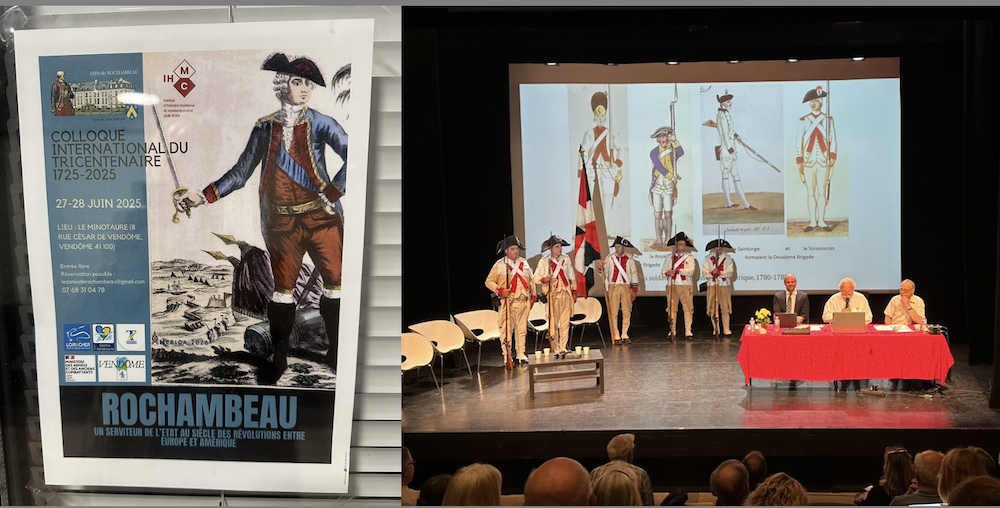
Recently, on June 27 & 28, we had the privilege of attending a symposium focused on his life and accomplishments in the lovely provincial town of Vendôme, near LeMans. This tribute was organized by Les Amis de Rochambeau, and graciously hosted by the de Gouberville family, descendants of Rochambeau, who still reside in his château. A panel of professional historians showcased various aspects of this distinguished general, and we will share some of their insights and remarks in this bulletin. However, this Bulletin is not intended to be a summary of this exceptional gathering. We will merely highlight his contributions to the American Revolution and strive to explain why his role was so significant.
As we do in all our Bulletins, we will highlight some of his numerous interpretive markers and inscriptions on the pedestals of his statues, which are found in different States.
In 2021, we released a five-part series called "In the footsteps of Rochambeau," which followed the important encampments of the French Army from Newport, R.I. to Yorktown, VA, and back to Boston, MA. This was a significant military accomplishment over the roughly 1,500 miles they traveled along the Congress-designated Washington-Rochambeau Revolutionary Route—a unique part of the National Park system in an urban area. Some chapters from that series will be included in this current Bulletin.
We hope that in the coming years, especially by the 250th anniversary of the joint French-American victory in Yorktown that led to the independence of the United States, Rochambeau will finally get the recognition he truly deserves.
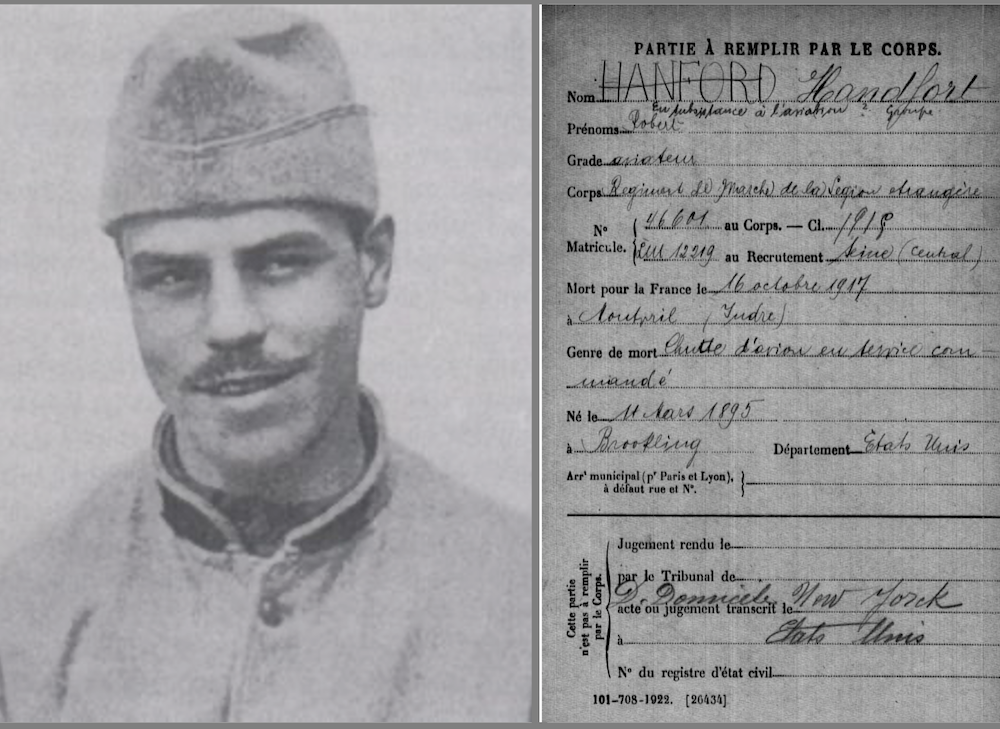
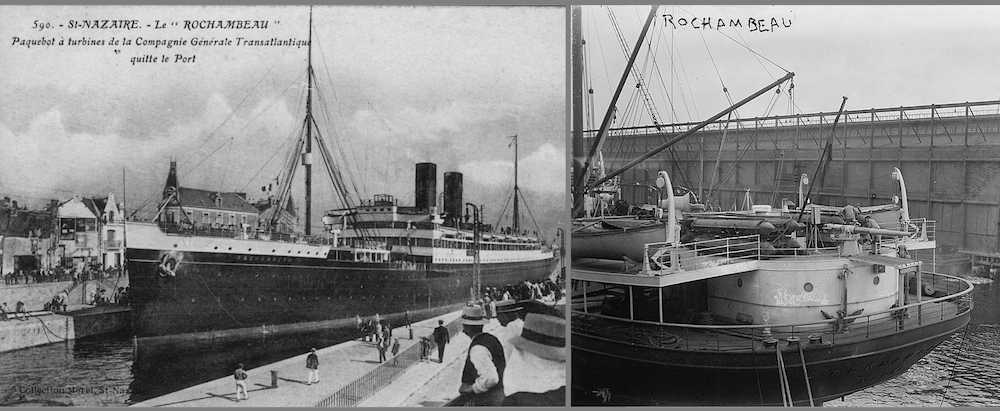
As always, Part Two of our Bulletin will honor this month another brave American volunteer who "Died for France " in World War One: Soldier Second Class Robert Marshall Hanford, who died in an air collision at Avord (Chateauroux, France), far from home. Incidentally, when he volunteered to join the war and fight under the French Air Corps uniform, he crossed the Atlantic on board the... troop transport SS Rochambeau.
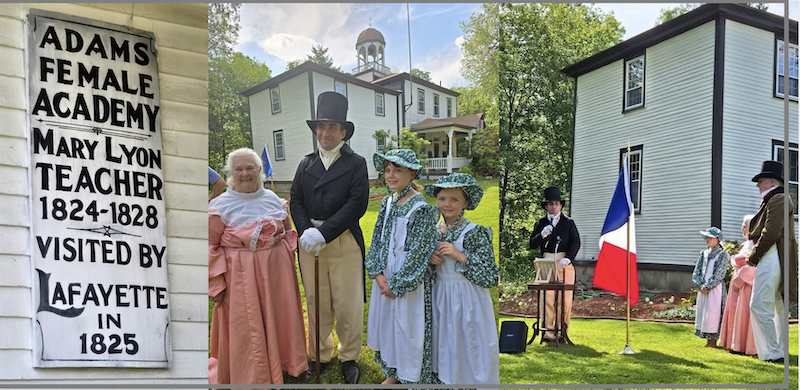
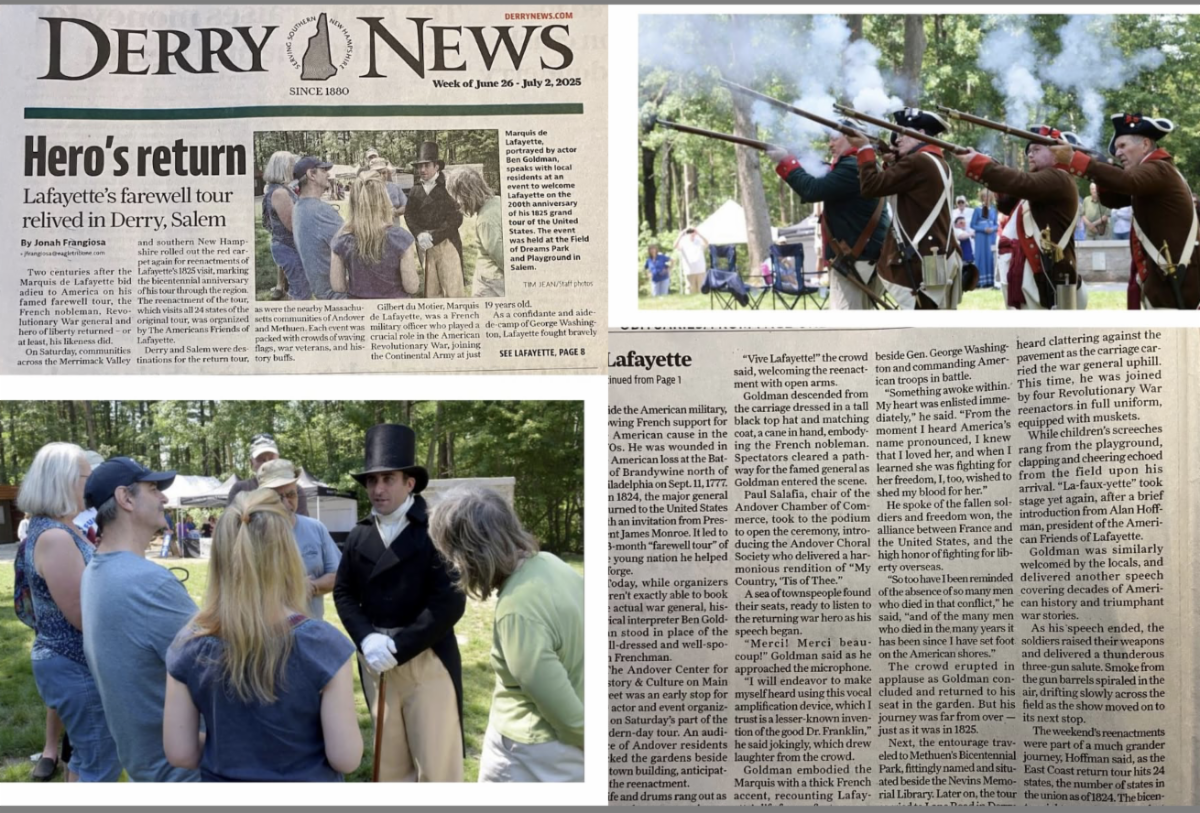
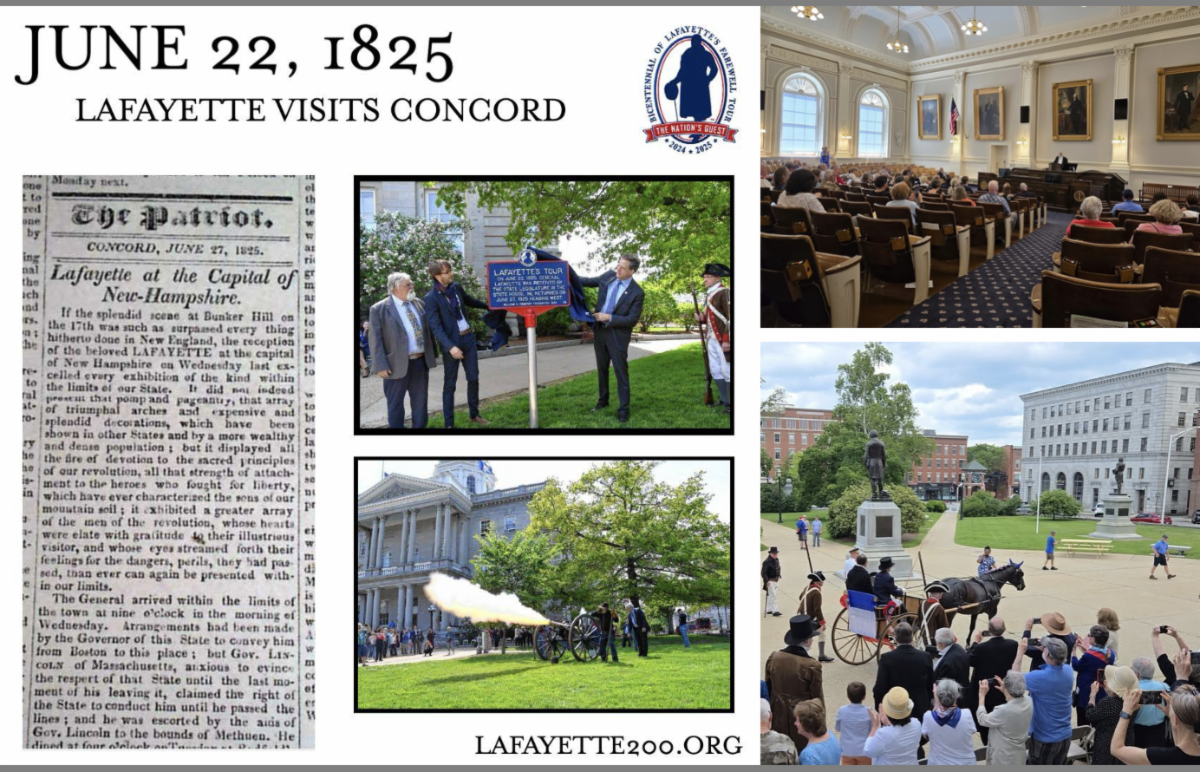
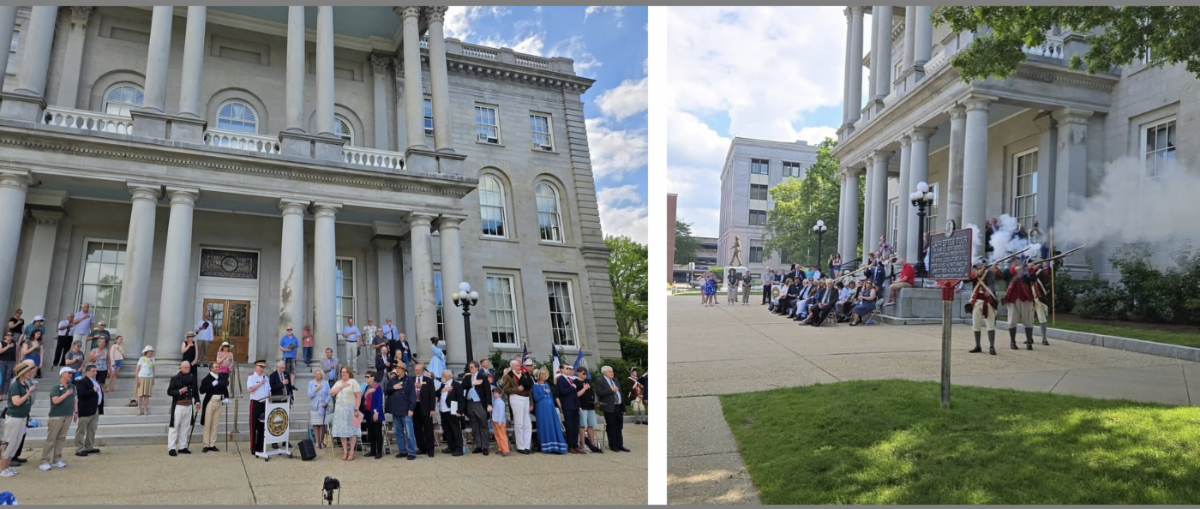
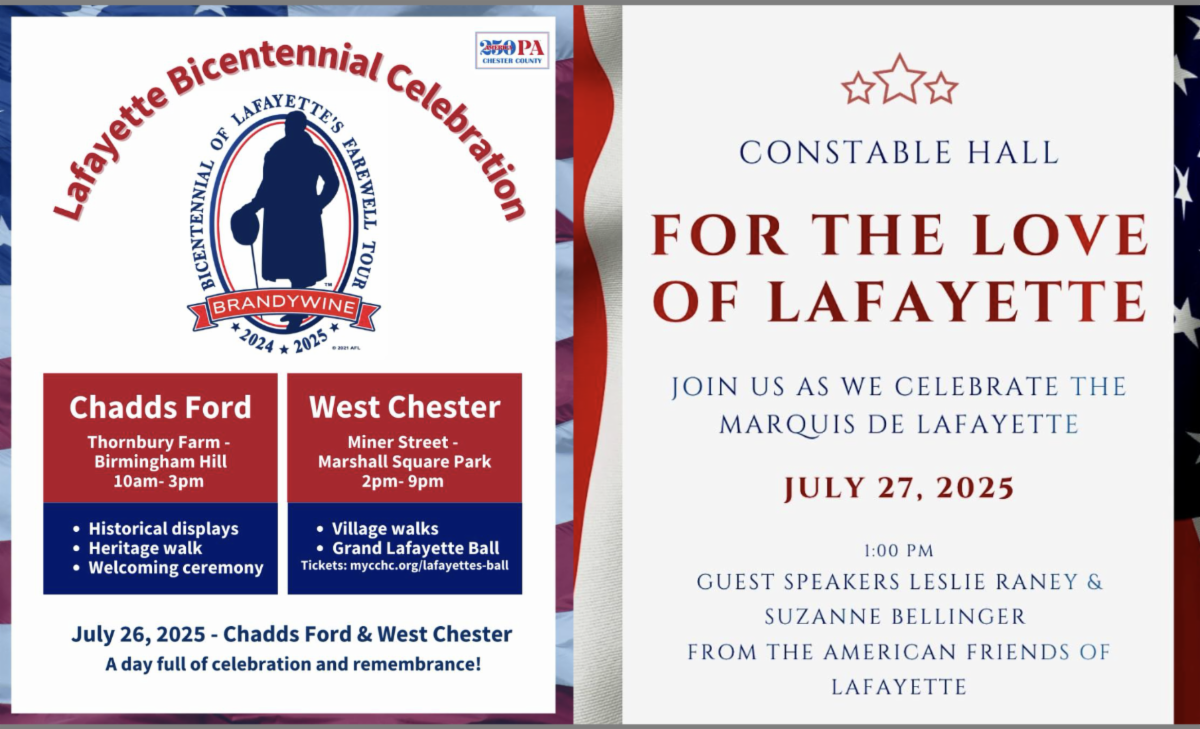
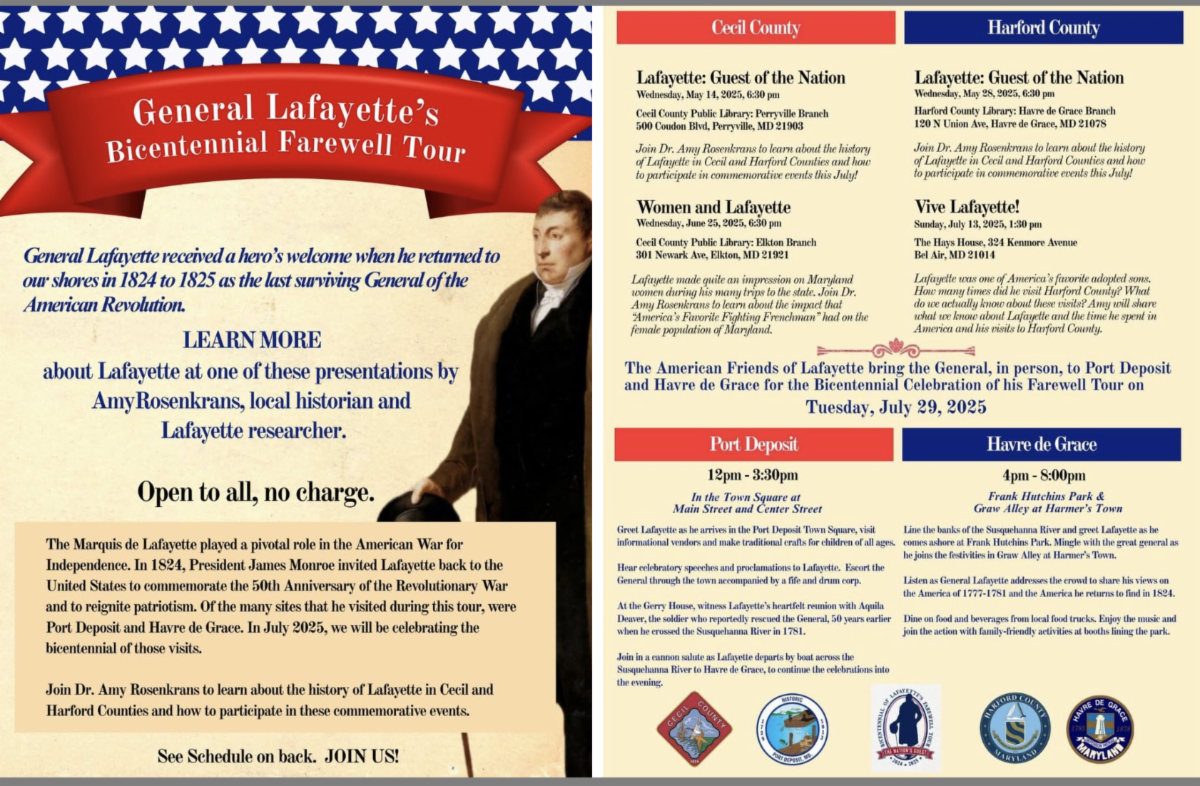
Part Three, "News and Save the Dates" will cover events since our last Bulletin, including several commemorations for the ongoing Bicentennial of Lafayette’s Farewell Tour organized by the American Friends of Lafayette.
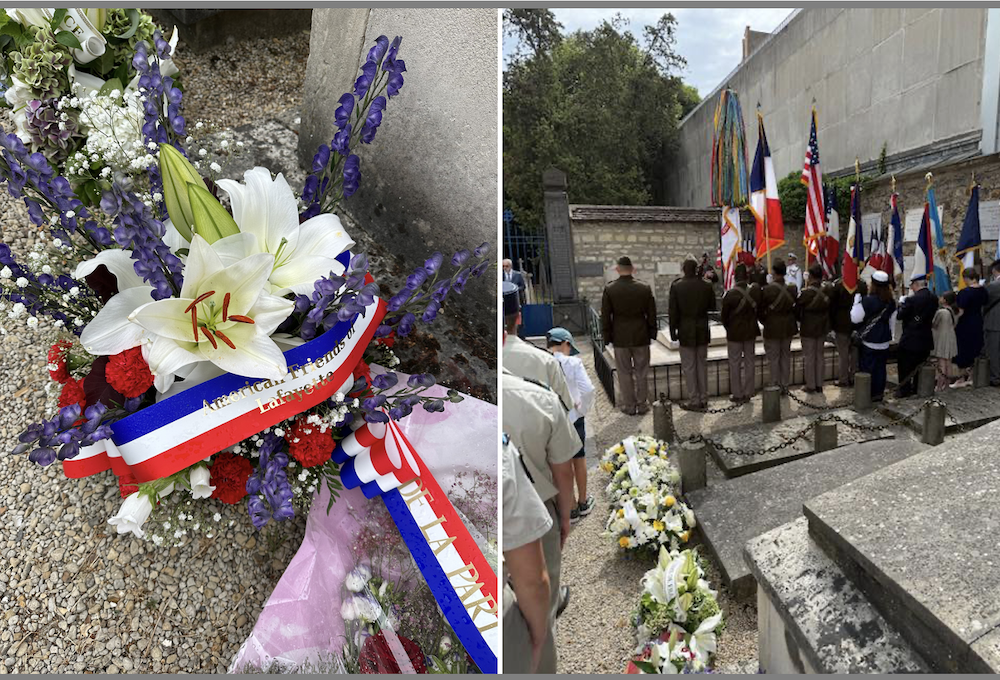
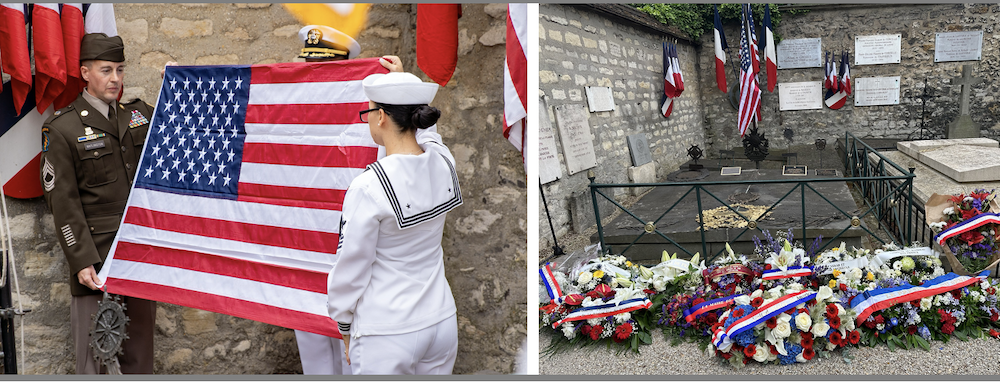
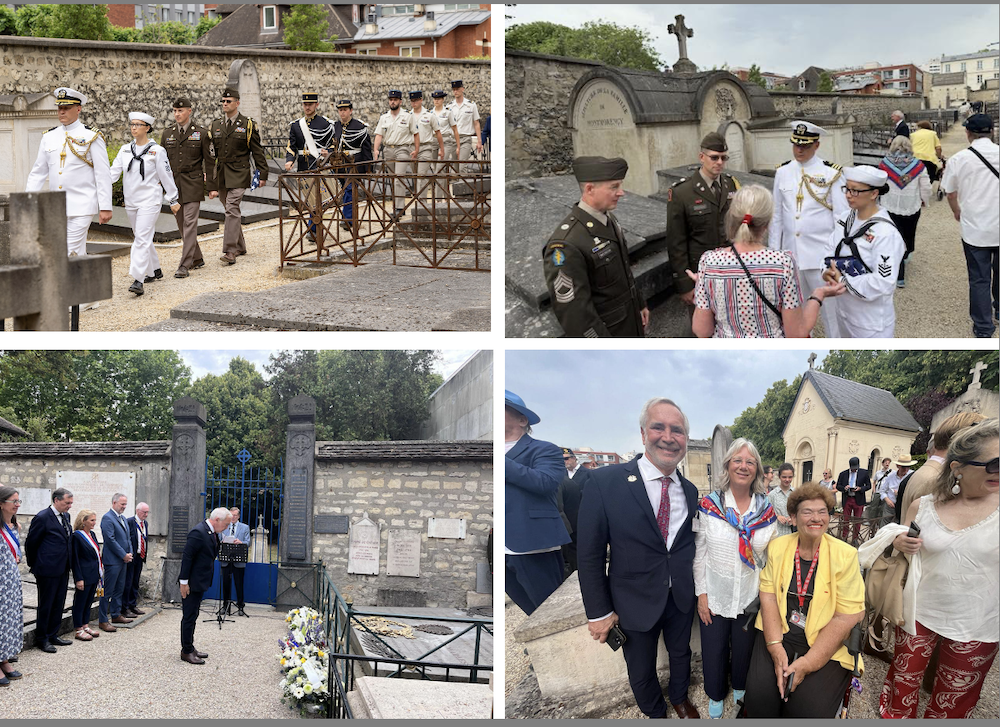
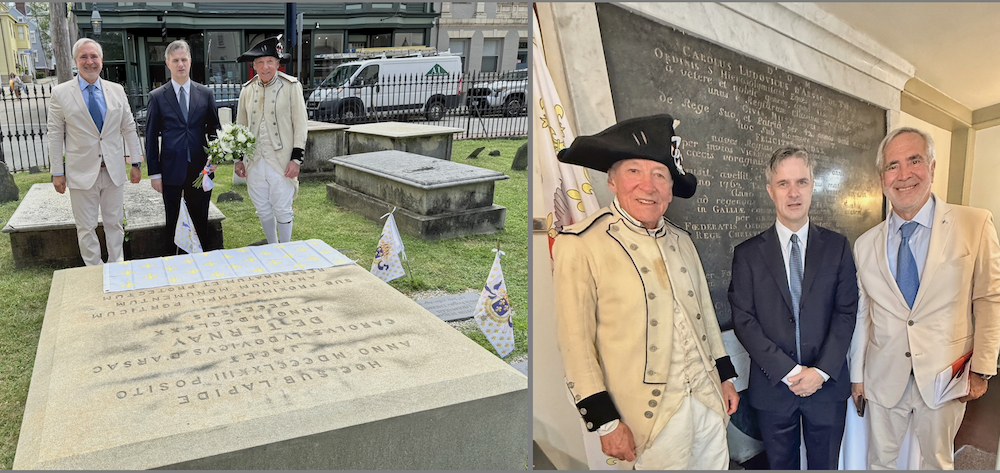
We will also include photos from various recent patriotic events, such as the annual changing of the Star-Spangled Banner over Lafayette's tomb at Picpus Cemetery in Paris, which occurred this year on June 25.
For those planning to visit France this summer, we recommend this historic site in the 12th arrondissement of Paris, and taking a trip (two hours drive) to Vendôme... and visit the birthplace of Rochambeau. If you are staying in the United States and find yourself in Rhode Island, Connecticut, New York, New Jersey, Delaware, Pennsylvania, Maryland, or Virginia, take a look around: Rochambeau is nearby!
We wish you an enjoyable summer vacation.
On behalf of the Board of Directors,
Thierry Chaunu
President, The American Society of Le Souvenir Français, Inc.
| | |
PART ONE
Rochambeau:
"Vivre en Preux, y mourir"
(To live and die valiantly)
A providential General
| | |
Above:
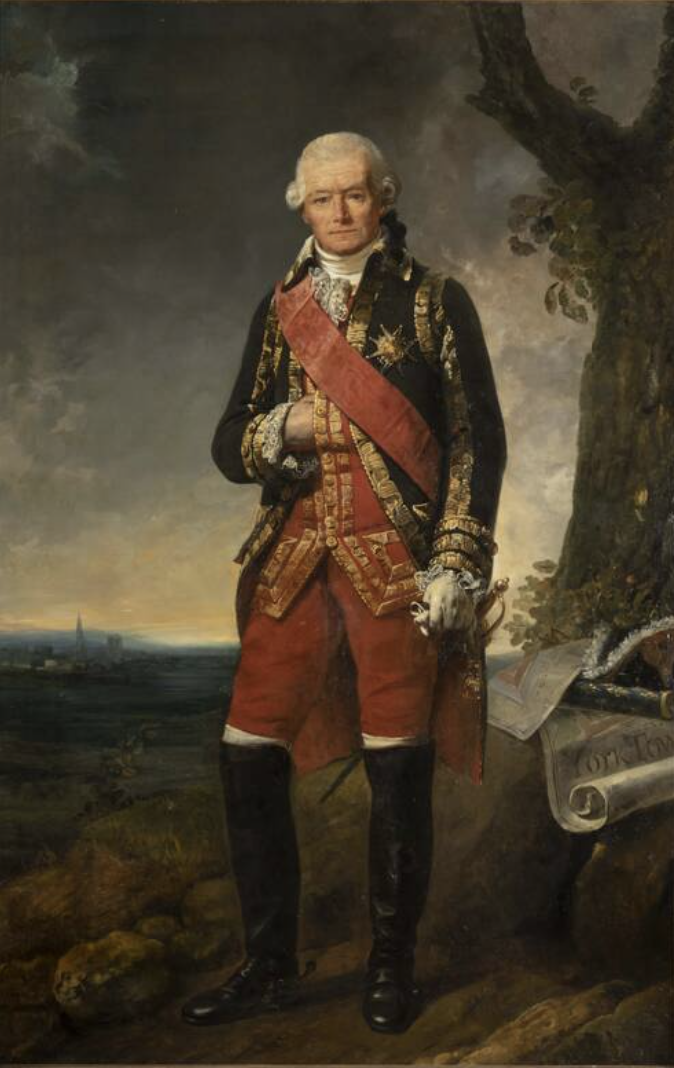
Jean-Baptiste-Donatien de Vimeur, comte de Rochambeau (1725-1807), another oil on canvas, also c.1834, by Charles Philippe Larivière (1798-1876). This painting was deposited at the Ministère des Armées, Hôtel de Brienne, in 1937 (RMN, Réunion des Musées Nationaux)
https://collections.chateauversailles.fr/#/query/bf265a3e-dd5a-4324-967d-11d66aaaafe5
Note the maréchal's baton positioned on the charts to the left of the subject. Rochambeau was honored with the title 'Maréchal de France' on December 28, 1791, the last one of the Ancien Régime.
The red sash depicted in this artwork symbolizes the Saint-Louis. The gold breast plaque features four unique double branches of the Saint-Louis, unlike the five double branches of the Légion d'Honneur that were awarded to Rochambeau in 1804, which could also have been linked to a red sash.
| | |
Rochambeau at 300:
A Legacy of
Service, Leadership, and
the Franco-American Alliance
Rochambeau had a very long military life. We will limit ourselves to his time in America, and his contribution to the independence of the United States. We borrow a few passages (including the title above) from a remarkably concise leaflet edited by the National Park Service, courtesy of Johnny Carawan, Trail Administrator, the Washington-Rochambeau Revolutionary Route, National Historical Trail.
• Jean-Baptiste Donatien de Vimeur, comte de Rochambeau (born in Vendôme, July 1, 1725 - died in his castle at nearby Thoré-la-Rochette, May 12, 1807, at age 81) received a Jesuit education. In 1780, Rochambeau was promoted to Lieutenant General of His Majesty's Armies, and selected by King Louis XVI to be the commander of the French "Expédition Particulière" sent that year to the United States, who later became Marshal of France (the last one of the Ancien Regime), Grand Cross of the Royal and Military Order of St Louis, Member of the Society of Cincinnati... He is in many ways the key enabler of American independence, and yet, is often cast, or confined, as a mere supporting actor.
• His parents were Charles de Rochambeau, a cavalry officer and nobleman and Marie-Claire le Bégon de la Cour. He came from a long aristocratic lineage (one of his ancestor fought in the First Crusade).
• Rochambeau inherited the title of comte (count) at a young age following his father's death. His mother played a pivotal role in his early upbringing and education.
• He received his early education at the Jesuit College in Blois, France.
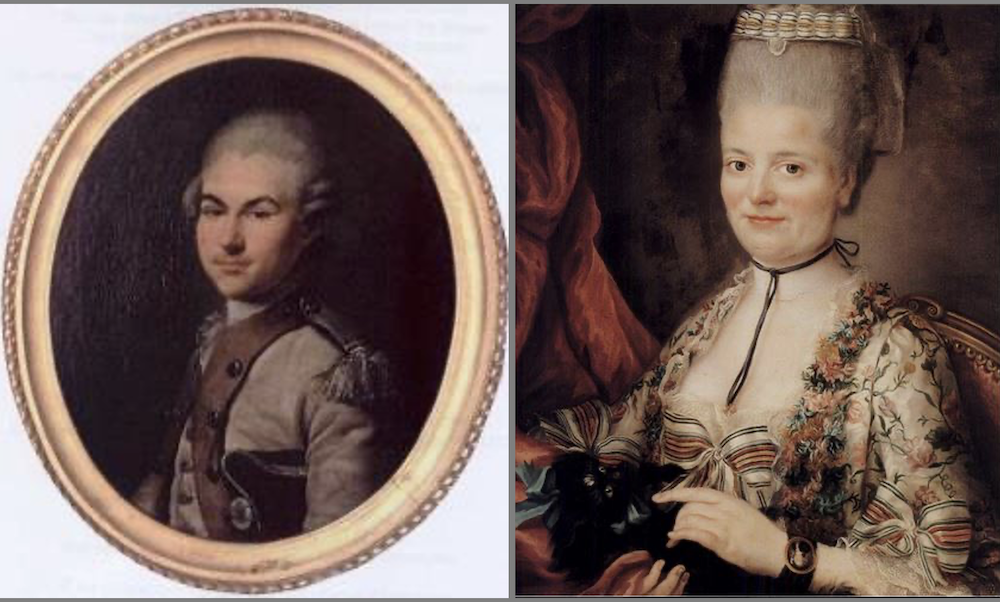
• Married Jeanne Thérèse Tellez d'Acosta in 1749. She was from a noble Spanish-Portuguese family. They had one son, Donatien-Marie-Joseph de Vimeur, vicomte de Rochambeau (1755-1813) who participated in the American campaign as one of his father's aide-de-camp, and who also became a notable general of the French Republic and the Empire.
| | |
Above:
Left: His son Donatien-Marie-Joseph de Vimeur, vicomte de Rochambeau (1755-1813), who also served as his aide-de-camp during the Revolutionary War, and also became a general of the French Republic and the Empire, by Unknown 18th century French portrait painter, Domaine public, https://commons.wikimedia.org/w/index.php?curid=92852769
Right: Jeanne Therese Tilles D'Acosta, Madame la Marquise de Rochambeau, By Catherine Lusurier , Public Domain, https://commons.wikimedia.org/w/index.php?curid=67464392
| | |
Rochambeau, an experienced general:
A long military career:
• 1740 - At just fifteen, he enrolled in a Paris military academy, beginning a career that would span the next seventy years.
• 1742- Enters the French Army at age 17 as a cornet (junior cavalry officer) in the Saint-Simon cavalry regiment.
• 1747 - promoted to Colonel, after taking command of the Régiment de la Marche during the War of the Austrian Succession. He was wounded at the Battle of Lauffeld in 1747.
• 1756 - promoted to Brigadier General, following his distinguished actions during the capture of Minorca at the start of the Seven Years' War. , and again in the Battle of Krefeld in 1758. Additionally, he received several wounds during the battle of Clostercamp in 1758
• 1761 - promoted to Maréchal de camp (Major General) in recognition of his bravery during the Battle of Clostercamp and his leadership throughout the Seven Years'.
| | |
Above:
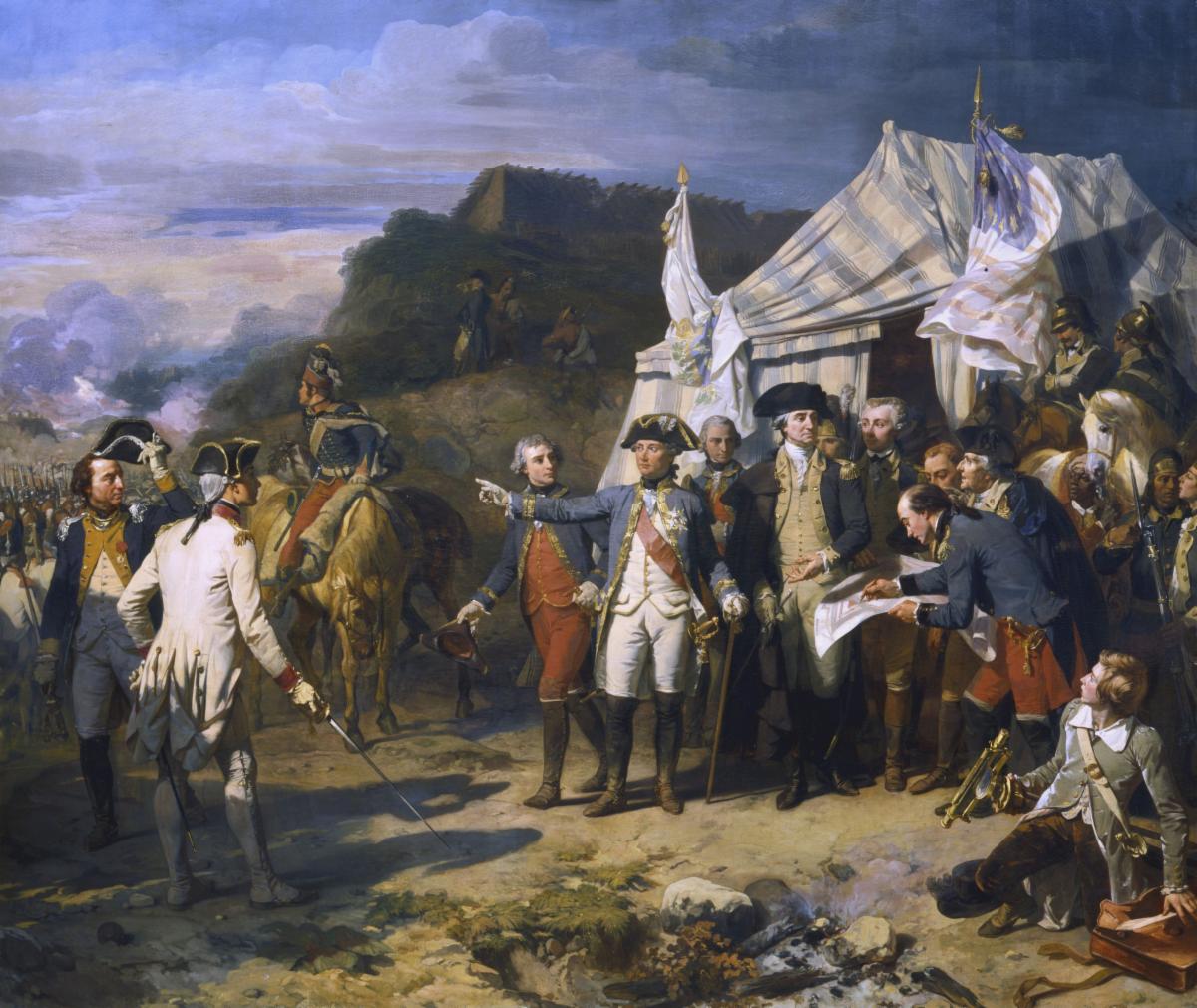
Bataille de Yorktown by Auguste Couder (1789-1873), oil on canvas painted c. 1836, most likely influenced by the 1784 Blarenberghe initial version for King Louis XVI. Rochambeau wears the 'field dress': lighter blue coat and off white waistcoat and breeches. Rochambeau is seen giving orders, flanked by general Washington to his left. Galerie des Batailles, Palais de Versailles, (a copy exists at the French Embassy in Washington DC). Behind the two men, we recognize the Marquis de La Fayette, and to Washington's right is the Marquis de Saint Simon. On the left, on horseback and with his back turned, is the Duke of Lauzun. Public Domain, https://commons.wikimedia.org/w/index.php?curid=7029460
| | |
The American Revolutionary War:
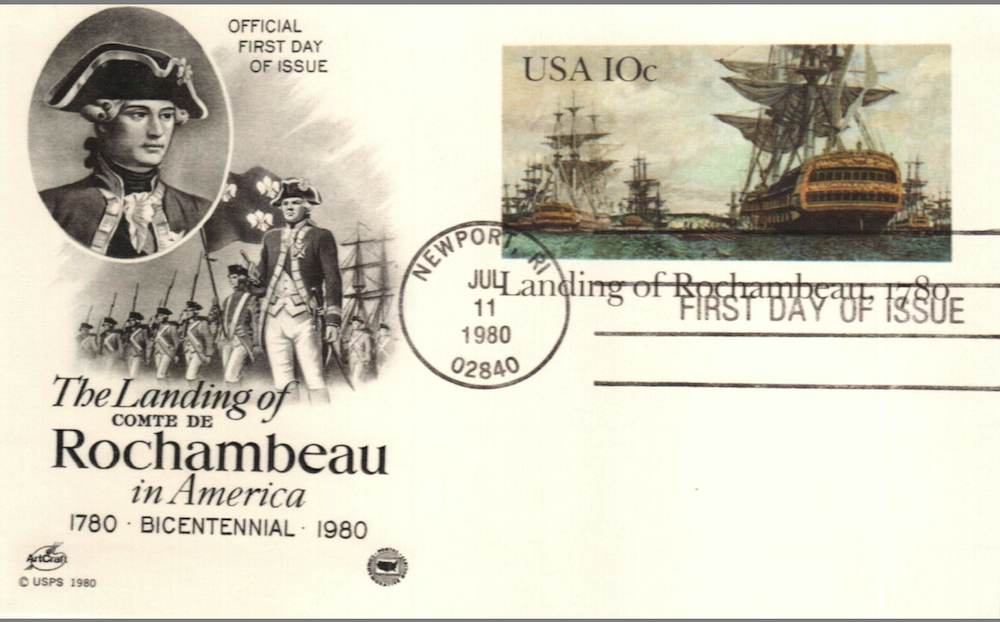
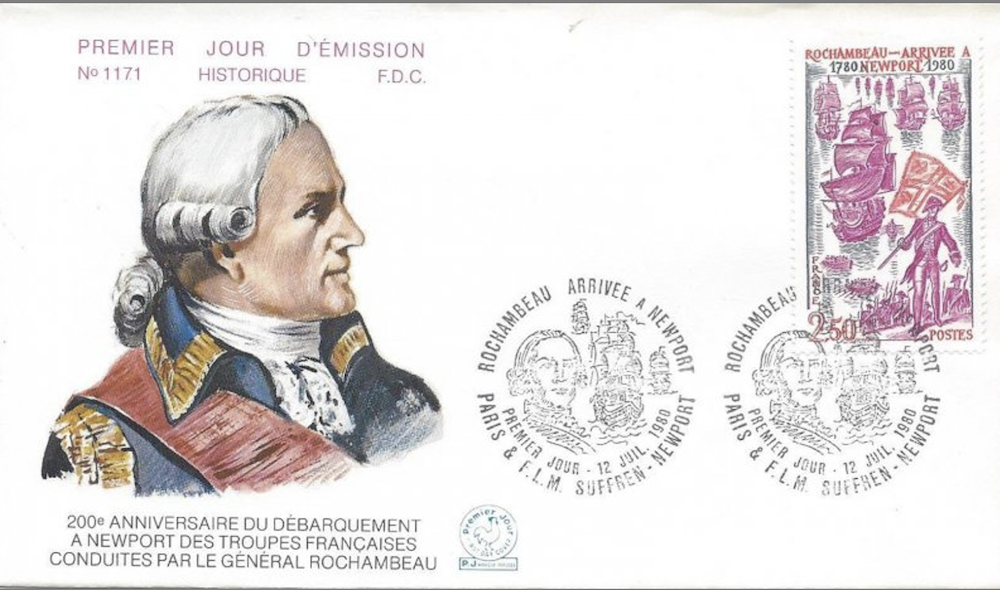
• In 1780, Rochambeau was promoted to Lieutenant General of His Majesty's Armies. His most notable achievement was when King Louis XVI appointed him to lead the French Expeditionary Force sent to support the American colonists against Britain. In 1780, Rochambeau arrived in Newport, Rhode Island, with around 5,500 French soldiers. His task was to collaborate with George Washington and provide essential military aid to a beleaguered Continental Army.
• The soldiers Rochambeau brought to America were elite, hand-picked units of the French army. They were well-disciplined and played a key role in raising morale among the Continental Army forces.
Timeline
• July 11, 1780 - Rochambeau and French forces arrive in Newport, Rhode Island
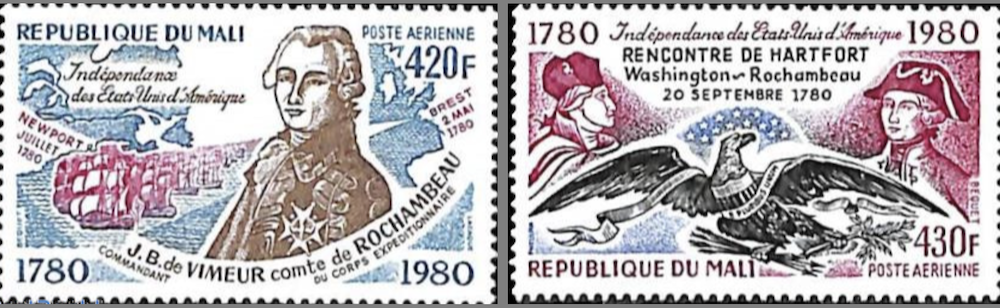
• September 2, 1780 - first meeting between Rochambeau and Washington in Hartford, Connecticut.
• May 20-24, 1781: second meeting with general Washington, at Wethersfield, CT ("The Wethersfield Conference").
• June 19, 1780: The French Army begins its long march of over 680 miles from Newport, Rhode Island, to Yorktown, Virginia.
• August 18-19, 1781 - French and Continental Armies break camp in White Plains, New York, and begin their march south to Yorktown.
• September 28, 1781 - Siege of Yorktown begins.
• October 19, 1781 - The Siege of Yorktown ends with British surrender.
• July 1782 - French forces begin their return march north, departing from Boston,
Massachusetts.
• January 1783 - Rochambeau arrives back in France, landing in Brest.
• September 3, 1783 - Treaty of Paris signed, officially ending the American
Revolutionary War.
Military Philosophy and Leadership:
• Rochambeau's greatest success was his strategic planning and execution of the Siege of Yorktown in 1781. By working closely with Washington, he helped organize the joint Franco-American attack that ultimately resulted in the surrender of British General Cornwallis. This victory effectively concluded major fighting in the Revolutionary War and ensured American independence.
• Rochambeau was recognized for his diplomatic abilities and his capacity to work well with American leaders despite cultural and strategic differences. He respected Washington's leadership and maintained strong relationships with colonial leaders, which was vital for the success of their alliance. He was loved by his soldiers who called him "Papa Rochambeau".
Washington & Rochambeau: A Powerful Partnership:
• He was instructed by King Louis XVI to place himself under the overall strategic command of General George Washington, even though he was a much more seasoned soldier commanding a professional army, with the stipulations that his troops would not be disseminated in several units among the Insurgents and always fight under his command.
• Thanks to his diplomatic skills, wisdom, strategic vision, military experience (in particular with siege warfare, which proved crucial at Yorktown), the impeccable discipline and exemplarity of the French Army, he quickly obtained the unanimous respect and support of all the Americans Insurgents. Although he never reached the same degree of popularity of Lafayette, he was, along with Admiral de Grasse, the real artisan of the victory over the British at Yorktown and a keyenabler of the independence of the United States.
| | |
Later Career:
After returning to France, Rochambeau continued his military career and was promoted to Marshal of France in 1791, the last one of the Ancien Regime. During the French Revolution, he initially backed moderate reforms but was Imprisoned during the Reign of Terror (1793-1794), a period when thousands were executed by the guillotine. His emprisonment was likely due to his aristocratic background and high military rank, but he was never formally charged with treason and was released after the fall of Robespierre and the conclusion of the Reign of Terror.
He was later highly respected by Napoleon, who appointed him a Grand Officer of the Legion of Honor in 1804.
• On May 10, 1807, a few weeks before his 82nd birthday, he passed away at his estate in Thoré-la-Rochette, France, leaving behind a legacy of distinguished military service and enduring Franco-American friendship.
A note on his portraits:
He was awarded the Grand Croix de l'Ordre de Saint-Louis in 1771 and L'Ordre du Saint-Esprit in 1784. Both the Saint-Louis and the Saint-Esprit orders were discontinued in July 1791.
Rochambeau held the title of Maréchal de France from December 28, 1791, until the National Convention abolished it in 1793. He continued to sign his name as "ancien maréchal de France" (which means 'former Marshal of France') until 1804.
Nevertheless, the titles of maréchal de France and the honors of Saint-Louis and Saint-Esprit were still mentioned in letters and artwork. Artists, or those who commissioned the paintings, had the freedom to choose which honors to highlight.
| | |
Above:
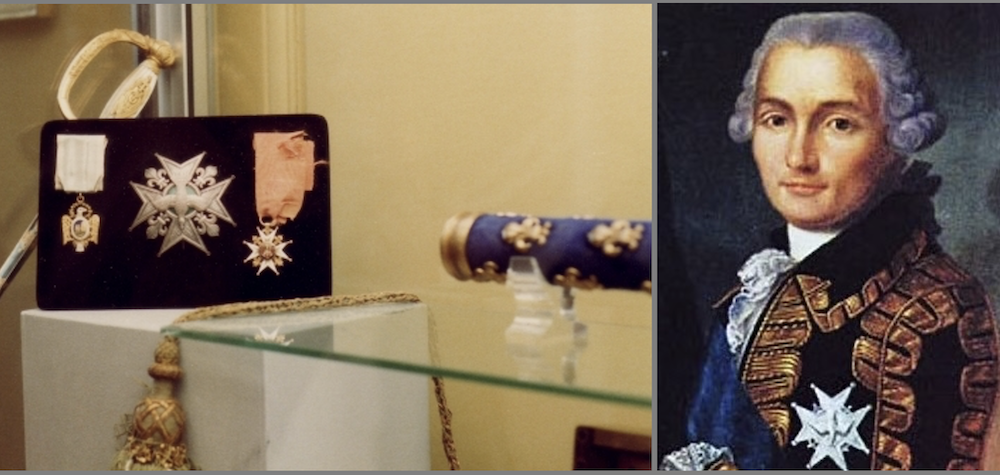
Left: Rochambeau's decorations. Rare photo (photos are not allowed inside the castle), taken in 1983 at Château de Rochambeau, https://losthistory.net/mcjoynt/rochamb.htm
Decorations displayed on the black panel, from left to right: the 'Insigne' of the Society of The Cincinnati; a Saint-Esprit 'plaque' (meant to be worn on a dress coat); and the croix de Saint-Louis. The post-French Revolution insigne de la Légion d'honneur, awarded to Rochambeau by Napoleon Bonaparte in 1804, is not visible. His maréchal de France baton is partially visible on the far right.
Right: Maréchal de Rochambeau, By Unidentified painter / Formerly attributed to Antoine Vestier - Public Domain, https://commons.wikimedia.org/w/index.php?curid=16206025
Rochambeau, a painting by an unknown artist, located at the visitors' center in the commune of Vendôme, depicts a relatively young face for the era indicated by the uniform. The comte is dressed in the full dress uniform coat [blue with extensive gold lace] typical of a French general. The likely accompanying red waistcoat and breeches are not depicted. A cordon bleu of the Order of the Saint-Esprit, awarded to him in 1784, runs across his coat. The silver breast badge [plaque] of that order is also prominently displayed.
| | |
Legacy:
• Rochambeau's legacy centers on his instrumental role in securing American independence and his exemplary model of international military cooperation. His strategic acumen and diplomatic skills made the Franco-American alliance successful and helped establish the United States as an independent nation.
• Several statues, streets, bridges, schools, and dozens of markers have been erected in his memory, several of them as part of the U.S. Congress-designated "Washington-Rochambeau Revolutionary Route, National Historical Trail".
Yet much remains to be done to honor him properly, on both sides of the Atlantic.
As we explore in the following pages these memorials and markers, we will be able to better understand the numerous deeds and endeering personality traits of this great military leader.
| | |
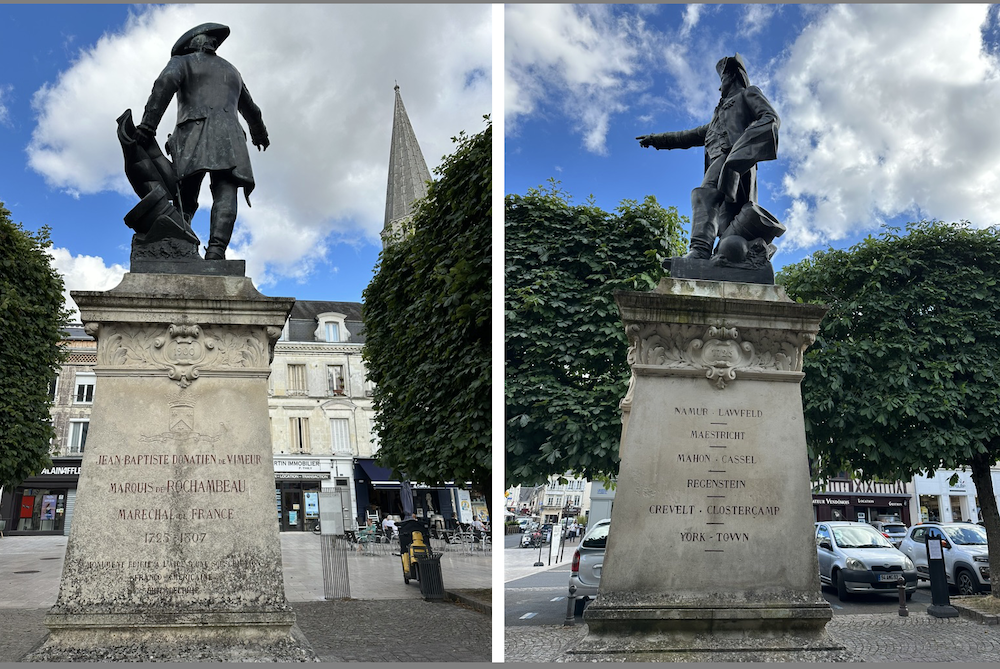
Statue of Rochambeau
Vendôme, France
The birthplace of Rochambeau
| | |
Above:
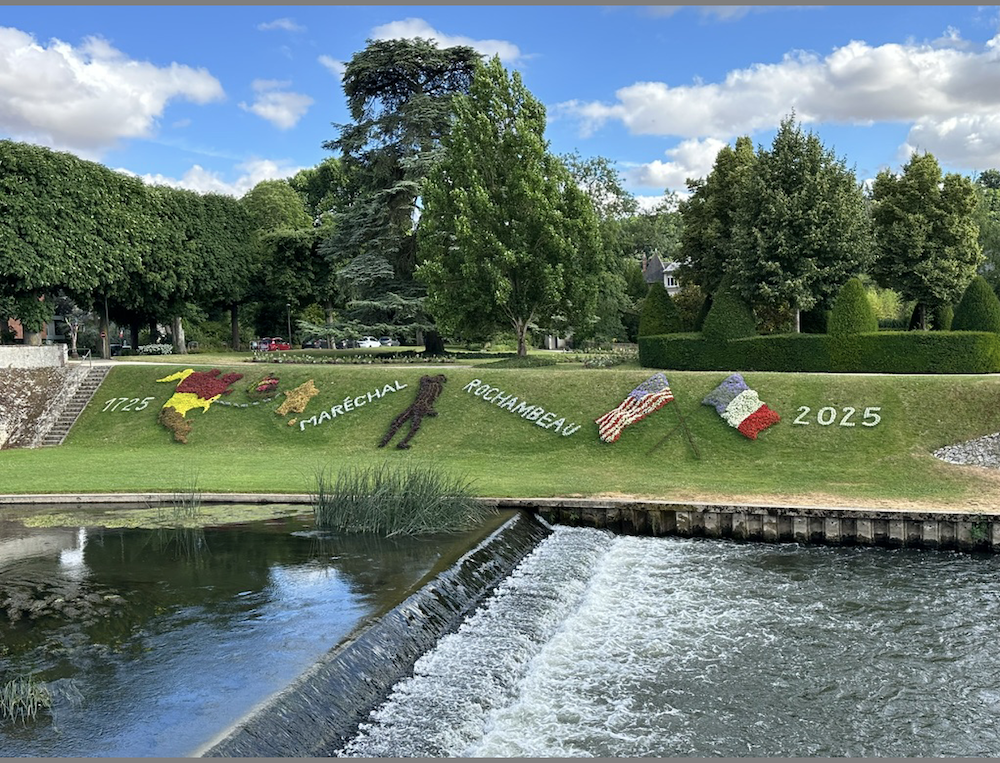
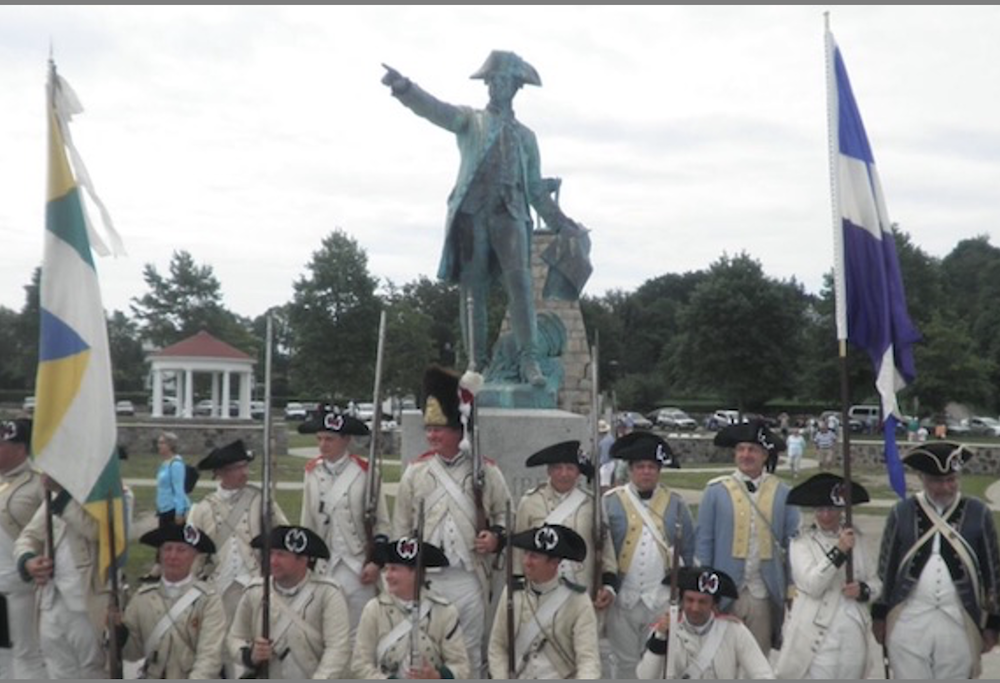
Top: The magnificent floral tribute by the municipality of Vendôme, on the occasion of the 300th anniversary of the comte de Rochambeau's birth, and the symposium which just took place June 27-28, 2025.
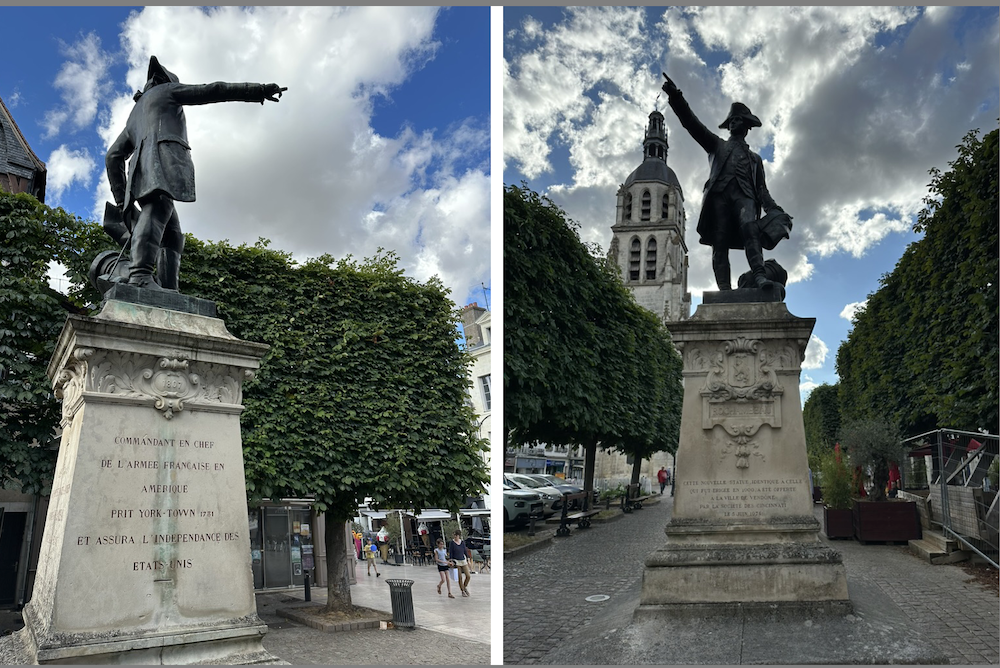
Middle and Bottom: the original statue was erected in June 1900. The current statue is actually a replica of the original and was installed in 1974.
Photos: TC © ASSFI 2025
| | |
Vendôme is a delightful small medieval town in the Touraine province, population 16,000, today in the Loir-et-Cher department. It lies along the Loir River, (a tributary of the Loire river) about 20 miles northwest of Blois and 109 miles southwest of Paris.
• The "original" statue of Rochambeau is the work of French sculptor Fernand Hamar and was unveiled in June 1900.
• As we will see below, a second replica was inaugurated in Washington D.C. across from the White House in 1902, then a third in Paris in 1934, and a fourth one in Newport, R.I. in 1934.
• After the Nazis destroyed the original statue in Vendôme during World War II, the Society of the Cincinnati funded a fifth replica to replace it, which was installed in 1974.
From an article of the New York Times, June 5, 1900:
"
The statue erected by subscriptions opened in France and in the United States in honor of Gen. Rochambeau (the French officer, born here, who in 1780 was sent with 6,000 men to the United States to take part in the Revolutionary War,) was unveiled here this afternoon with great ceremony. The city was richly decorated and the houses were festooned with French and American flags. United States Ambassador Porter arrived yesterday, and was a guest of Comte de Rochambeau.
Gen. Porter's passage through the streets was made the occasion for friendly manifestations. Religious services were held this morning in memory of the soldiers who fell in America.
The unveiling exercises consisted of a speech donating the statue to the city, another by the Mayor of Vendome, and of speeches by Gen. Porter and the Prefect of Loir-et-Cher, the department in which Vendome is situated.
Gen. Porter said, in part:
'It gives me great pleasure to represent my country in the chief republic of the Old World on such an occasion, and to be the interpreter of the good wishes and messages of friendship which the citizens of the United States convey to the citizens of France. The sight of this statue will serve to awaken our sense of gratitude and revive our recollection of the treaty of alliance contracted between these two nations when the American Republic was in its infancy. Permit me to express the wish and belief that the ties of friendship so early established between these two great republics by the services and sacrifices of Rochambeau and his brothers in arms may never be broken.'
At the conclusion of the ceremony those who participated in it visited the tomb of Rochambeau.
The statue is the work of Hamar, a Vendome sculptor. Many Americans attended the ceremony. "
| | |
Statue of Rochambeau
Lafayette Square,
Washington, D.C.
| | |
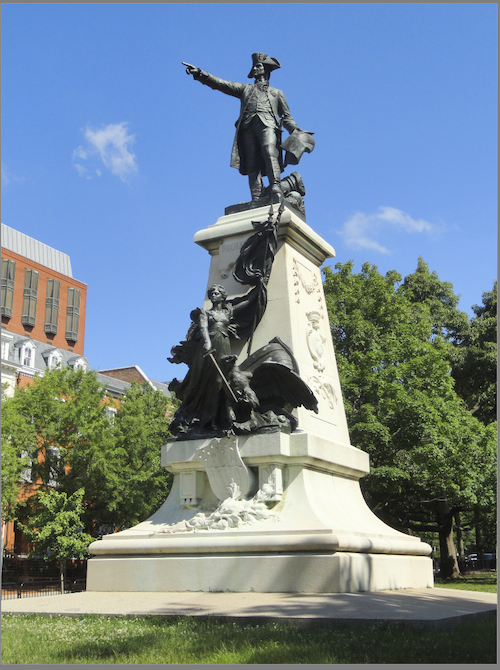
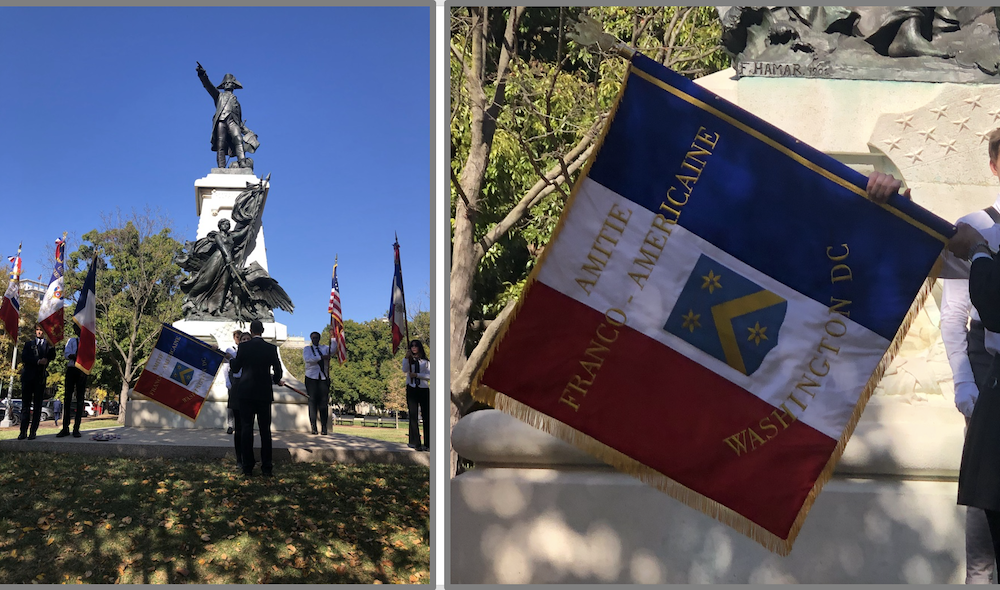
• The Rochambeau statue stands at the southwest corner of Lafayette Square in Washington, D.C., and is positioned at the intersection of Pennsylvania Avenue and Jackson Place NW, directly across from the White House.
• It is the second replica of the original in Vendôme, and was erected in 1902.
Yet even before the dedication of the original statue, the French chancellor to the United States, Jules Boeufvé, had proposed that a replica of the statue be erected in Washington as well. It was cast by the Pal d'Osne foundry in France
• The statue presented an ideal figure to symbolize the official relations between France and the United States. Largely because of the efforts of Boeufvé, Congress provided funds and passed legislation in April 1901 authorizing Fernand Hamar to cast a replica statue for the United States.
• On May 24, 1902, President Theodore Roosevelt, members of Congress, the Diplomatic Corps, and thousands of spectators along with French military and civil delegations dedicated the Rochambeau statue at the southwest corner of Lafayette Square.
• France was represented by ambassador Jules Cambon, Admiral Fournier, and General Henri Brugère, as well as a detachment of sailors and marines from the battleship Gaulois. Representatives of the Lafayette and Rochambeau families also attended.
Rochambeau Statue, Washington D.C.
Southwest corner of Lafayette Park, Washington D.C.
Corner of Jackson Place NW & Pennsylvania Avenue
GPS: 38.899027, -77.037711
• Inscription:
(Base, front below sculpture of Rochambeau:)
ROCHAMBEAU
(Base, north face:)
We have been
contemporaries
and
fellow labourers
in the cause
of liberty
and we have lived
together
as brothers should do
in harmonious friendship
WASHINGTON TO ROCHAMBEAU
February 1, 1784
(Base, north face, bottom:)
BY THE CONGRESS
MAY XXIV MDCCCCII
(Sculpture of Liberty, front near base:)
Fondu par le Pal d'Osne 58 Rue Voltaire
F. Hamar
| | |
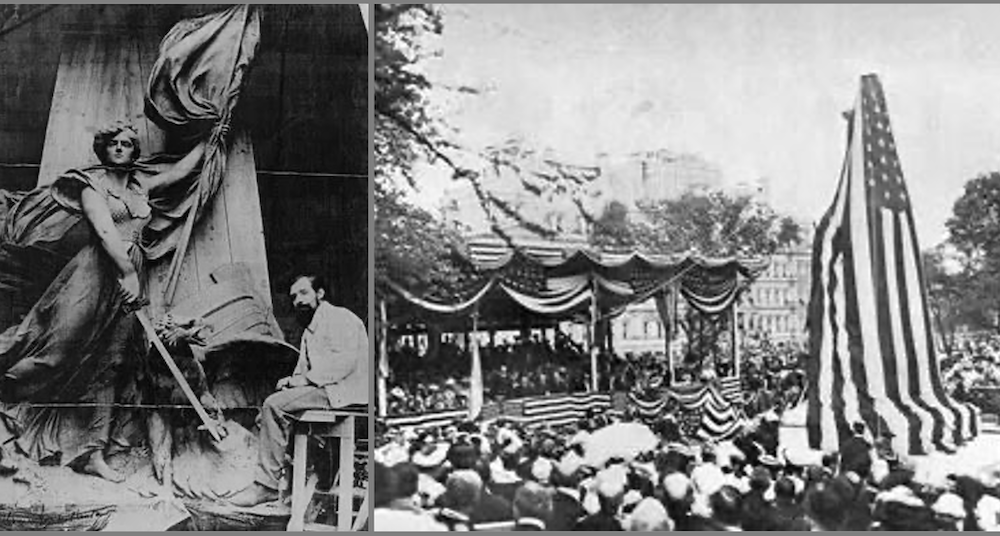
Above:
Left: Fernand Hamar working on the statue, By Unknown - National Park Service, Public Domain, https://commons.wikimedia.org/w/index.php?curid=143734488
Right: Dedication of the statue in 1902, By Unknown - National Park Service, Public Domain, https://commons.wikimedia.org/w/index.php?curid=143734487
• The bronze statue stands 8 feet tall on a 20-foot granite base, depicting Rochambeau in his Marshal of France uniform pointing south with his right hand to direct his troops, while holding siege plans for Yorktown in his left. He wears a three-pointed hat with French cockade and Order of the Saint Esprit medal, with his sword at his left side and military elements like cannonballs and cannons positioned behind his feet, surrounded by laurels.
• The statue features additional elements not found in the original French version, including two bronze figures on the pedestal representing Liberty (an armored woman holding a sword and the flags of France and the United States) and an American eagle clutching a shield with thirteen stars and stripes, both standing on waves symbolizing France's naval arrival to aid the colonies. The neoclassical three-tiered granite base displays the Rochambeau family crest and French coat of arms on decorative shields, with the entire monument positioned on a 55-foot diameter grass mound and adorned with laurel wreaths representing peace.
There is another statue of Rochambeau...
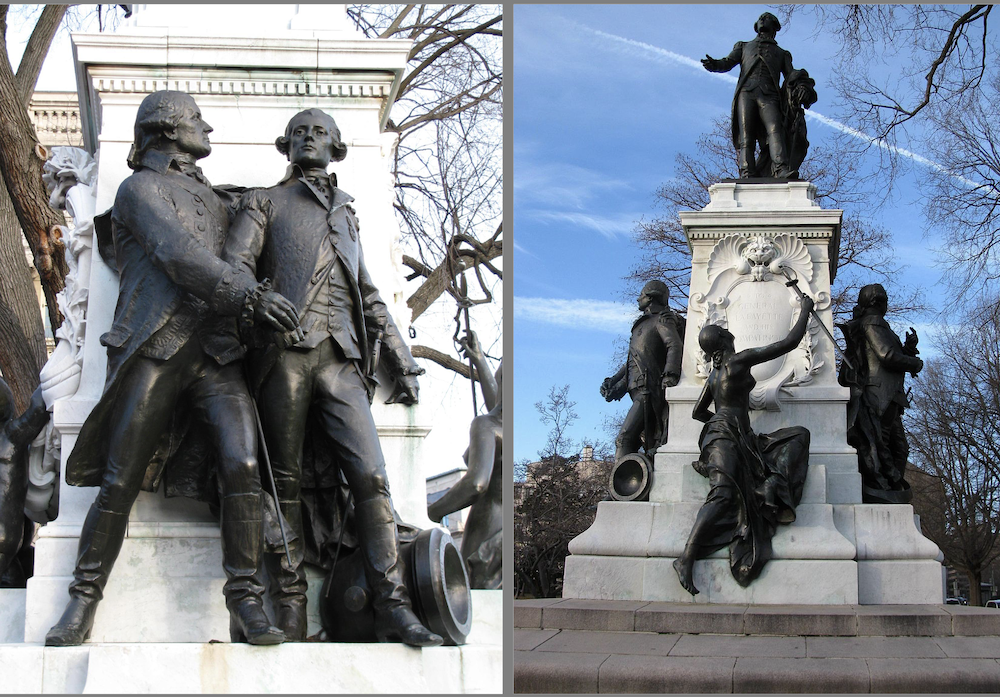
... at the base of the statue of Lafayette:
| | |
Above:
Left: West face of the Statue of Lafayette, Photo by By Slowking4 - Own work, Public Domain, https://commons.wikimedia.org/w/index.php?curid=13257221
Right: Statue of Lafayette, Photo By Slowking4 - Own work, Public Domain, https://commons.wikimedia.org/w/index.php?curid=13257206
• Less well known is the fact that Rochambeau has two statues at Lafayette Square. The statue of Lafayette, located on the southeast side of Lafayette Square, sculpted by Alexandre Falguière and Antonin Mercier, stands opposite the statue of Rochambeau which sits on southwest side. It features statues of the Comte de Rochambeau and the Chevalier du Portail in military uniform, with a cannon symbolizing their command of French armies.
• While most remained well-known revolutionary figures in the late 19th century, the Chevalier du Portail was less familiar to the public. In 1890, The New York Times noted that "The commanders of the fleets are too well known to require comment, and Rochambeau is even better known...but Duportail is not so familiar."
• Indeed the Chevalier du Portail played a key role in Yorktown, implementing all the siege apparatus, under Rochambeau's leadership. Another historical figure often absent from history books.
| | |
Statue of Rochambeau
(and Memorial to the French Fleet)
Newport, Rhode Island
| | |
Above:
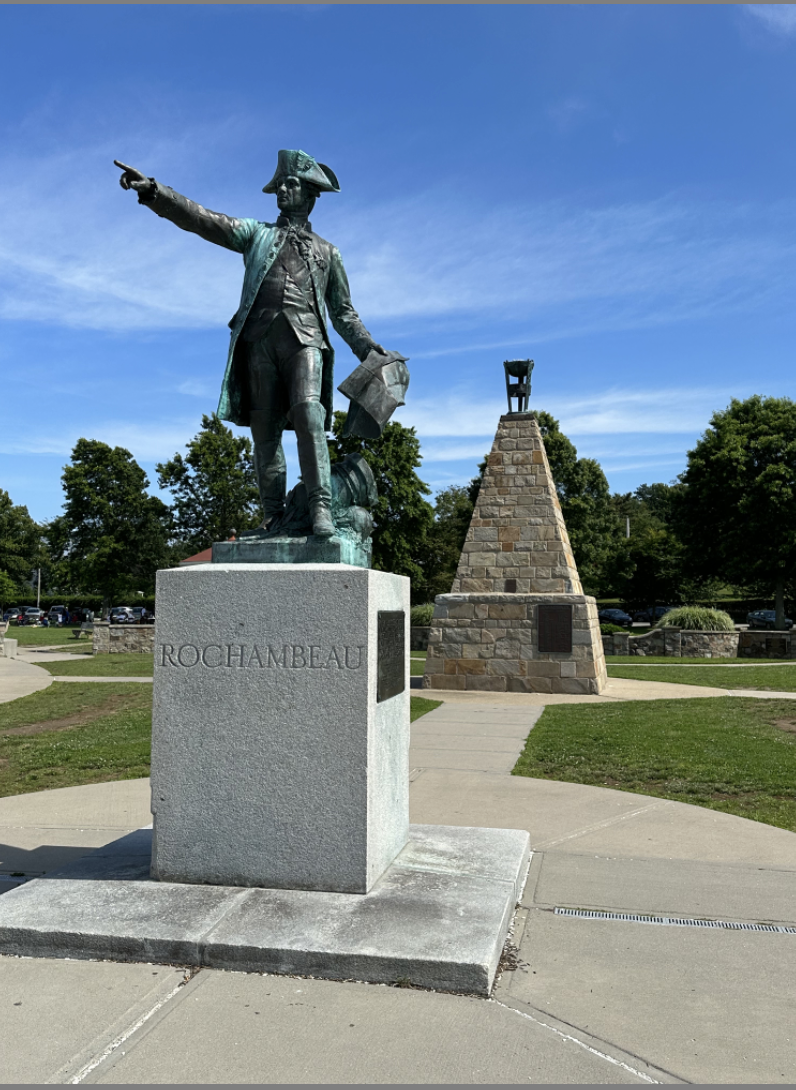
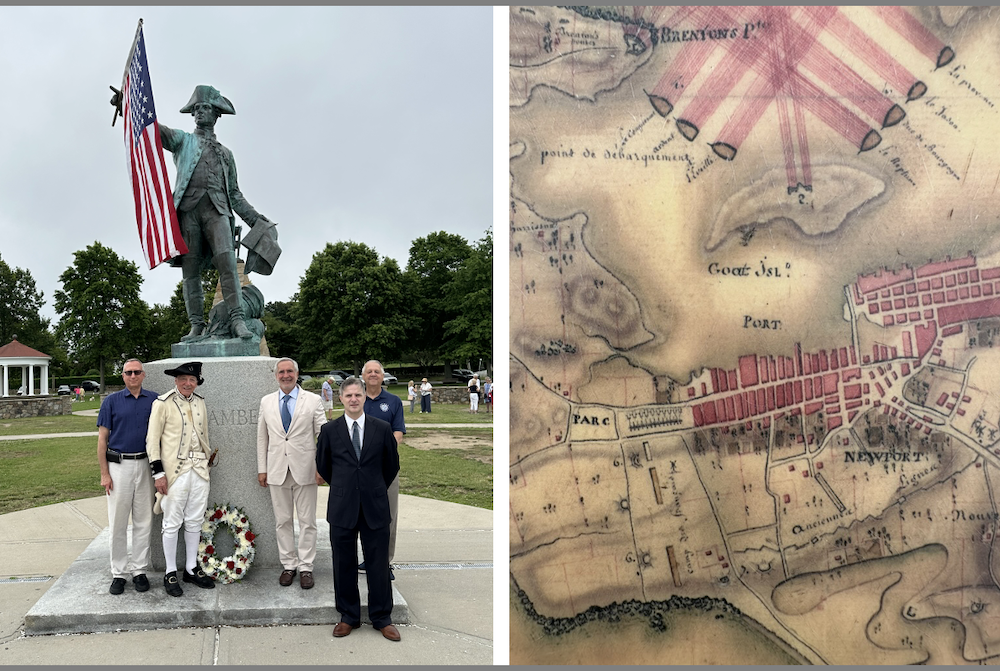
Top: Rochambeau Statue and Memorial to the French Fleet (in the background), Newport, R.
Rochambeau Plaza, King Park, waterfront, Newport R.I.
GPS: 41.476733, -71.321555
Photo: TC © ASSFI 2021. In the background stands the Memorial to the French Fleet.
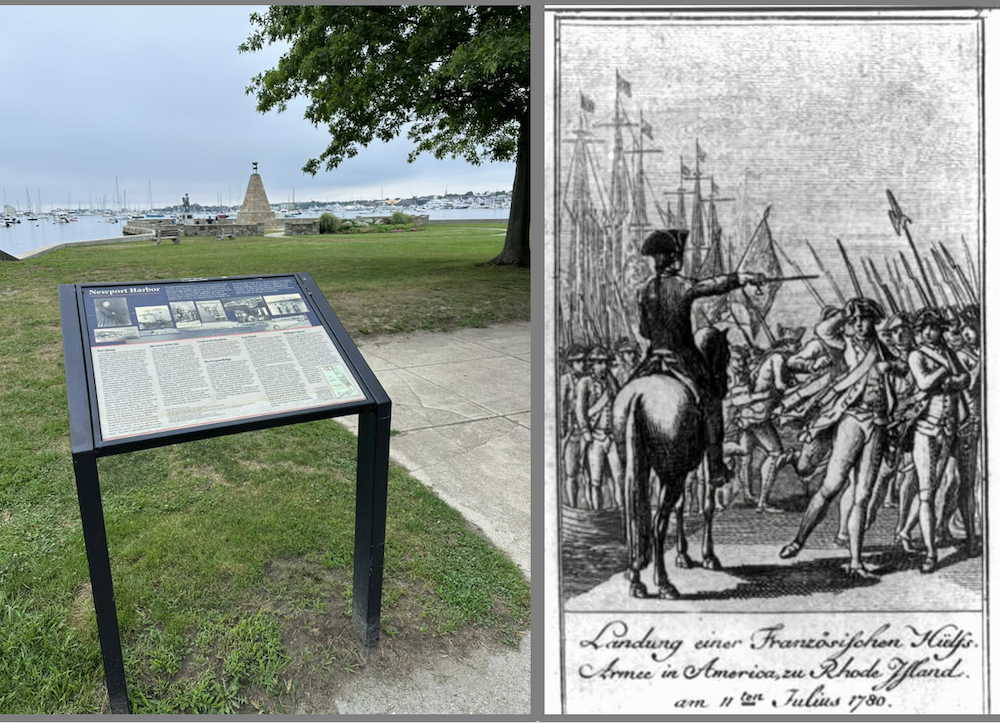
Below Left: View of Newport harbour as seen from marker at King Park. Photo: TC © ASSFI 2025
Below Right: Detail of marker, illustration "Landing of a French auxiliary army in Newport, R.I. on 11 July 1780, under the command of Comte de Rochambeau", Public Domain, https://commons.wikimedia.org/w/index.php?curid=112763
| | |
• The Rochambeau Statue and Memorial to the French Fleet are located on the waterfront in King Park, along the southern edge of Newport Harbor, near Brenton Cove and Fort Adams state park and was erected in 1934.
• The statue was donated by Abraham Kingsley Macomber, an American adventurer, businessman, and philanthropist, who had a profound affection for France:
Around 1919, Kingsley Macomber purchased the Haras de Cheffreville horse breeding farm in France. A few years later he acquired the Haras du Quesnay breeding farm in Normandy and a chateau at Carrières-sous-Poissy.
Thoroughbreds owned by Macomber won major races in France. Part of Parisian high society, Macomber was hailed as the "undisputed head of American society in Europe" and served as president of the American Hospital of Paris from 1926 to 1928.
While living in France, Macomber promoted the important historic relationship between France and the United States. In 1931, he commissioned a monument of Admiral François Joseph Paul de Grasse which was erected at the Trocadéro Palace in Paris. A. Kingsley Macomber died on October 6, 1955, in Paris, France.
• After raising $250,000 for the restoration, members of the Alliance Française of Newport held a ceremony at the bay-side park to unveil the completed project in 2019.
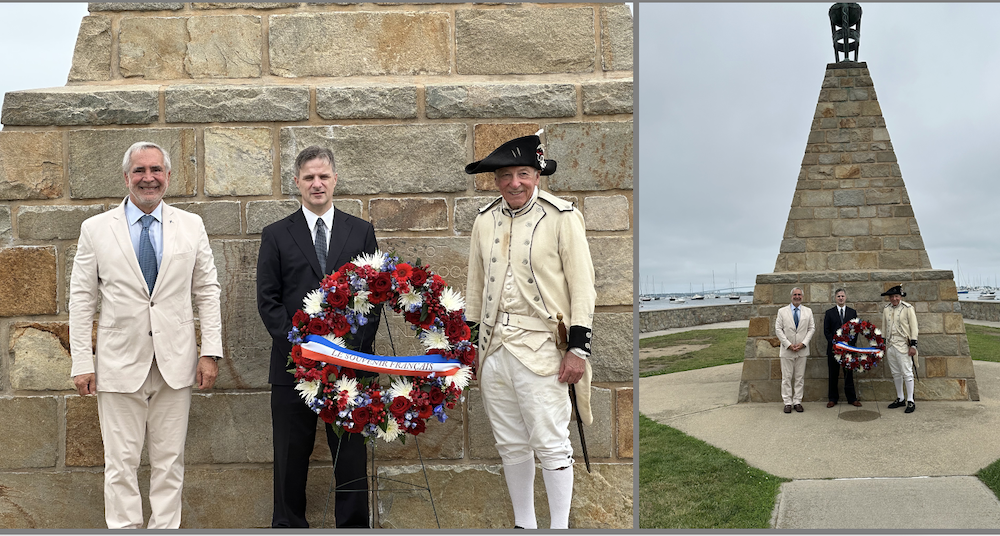
• The American Society of Le Souvenir Français Inc. lays a wreath at the foot of the statue every year around July 11 during a “Tribute to France” weekend organized by the City of Newport, the Newport Historical Society and the National Park Service, along with numerous participating civic and patriotic associations, notably the Alliance Française de Newport, Washington -Rochambeau Revolutionary Route Association (W3R), the American Friends of Lafayette, the Battle of Rhode Island Association.
• Inscription:
[ Left Marker : ]
On June eighteenth, 1781, General Rochambeau left Newport with his army to join the American forces on the Hudson, and on August nineteenth, 1781, the combined armies under command of General Washington began their victorious march to Yorktown.
* * *
This tablet presented by Forsyth – Wickes
[ Right & Back Markers : ]
To Jean Baptiste Donatien de Vimeur Count de Rochambeau Marshal of France 1725 – 1807, Commander-in-Chief of the French Army at the siege of Yorktown – October 6th, 1781
Presented to the City of Newport by Kingsley Macomber – Paris, France
Dedicated July 13th, 1934
Mortimer A. Sullivan – Mayor City of Newport - Willing Spencer – Chairman, Dedication Committee - Rededicated on this site July 4th, 1940 Hon. Perry Belmont – Chairman
Erected 1934 by Kingsley Macomber – Paris, France.
• Another bronze plaque located behind the entrance low wall reads:
" Restoration of The Rochambeau Monument at King Park
June 6 , 2019
Gift from the Alliance Française of Newport to the City of Newport
The Dana Family, The Alliance Française of Newport, Mary-Gail Smith, President, Jennifer Hall, Past President, The City of Newport, Mayor Jamie Bova, Mayor Harry Winthrop 2012-2014, 2016-2018, Consulate General of France in Boston, French Heritage Society and its Boston Chapter, Stéphan Boneu, Development Committee Chairman, Captain Nicholas And Mrs. Diane Brown"
• On the sidewalk is a marker evoking Rochambeau:
(oddly, from a French perspective, the avenue is named after Wellington....)
Marker, “Newport Harbor”
Kings Park, Wellington Avenue, Newport, RI 02840
GPS: 41.476200, -71.321717
• Inscription (excerpts):
[...] “Newport Harbor has been a center of commerce and industry since the days Narragansetts and Wampanoags, Native Americans, fished the waters of this bay. The first European explorer was Giovanni da Verrazzano, an Italian who sailed for the King of France from 1524-1538 and anchored in Newport Harbor for 15 days.
[...]
Fort Adams:
Designed by French military engineer Simon Bernard and American military architect Joseph Totten, construction on the present fort began in the 1800s.
[...]
Count de Rochambeau:
In the summer of 1780, after the British withdrawal, a large French force of five regiments and support troops, led by General Rochambeau, landed in Newport. General George Washington met with Rochambeau in Newport to discuss the strategy to end the war. Subsequent events involving General Rochambeau are outlined on the plaque at the base of the statue.”
[...]
Erected by Friends of the Waterfront.”
| | |
Sculpture of Rochambeau
in Yorktown, Virginia
(in a conversation with
Washington, Lafayette, and de Grasse)
| | |
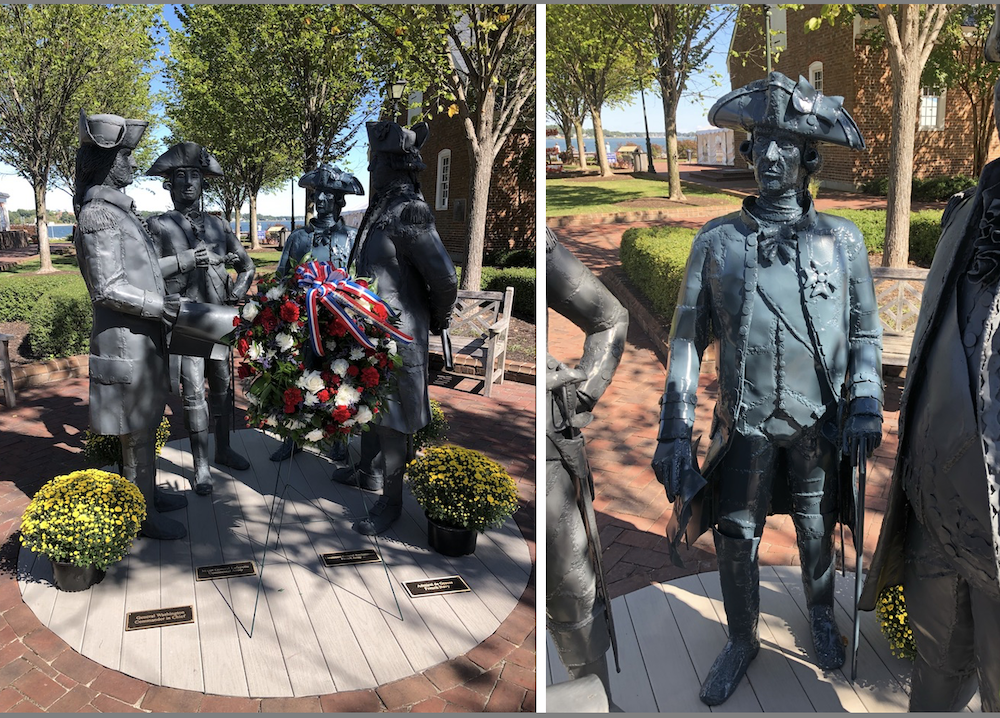
Above:
The four commanders are engaged in a conversation for eternity. Get closer, and you may hear a whisper...
Photos: TC © ASSFI 2021.
| | |
• The statues standing at Riverwalk Landing were only two when inaugurated in 2005: General George Washington, Commander of the American forces and Admiral Francois DeGrasse, Commander of the French Fleet. On October 18, 2017, General Lafayette joined them, and on October 18, 2021, Comte de Rochambeau joined his comrades-in-arms, and the conversation, for eternity.
• The display was celebrated as a symbol of French and American friendship that several people at the ceremony said started with the popularity of Lafayette and his love for the United States.
• Cyd Player, is a Williamsburg-based artist who sculpted the four statues. She spent about 10 months on Lafayette alone.
• The American Friends of Lafayette led the fundraising for the statue and credited the Celebrate Yorktown Committee for being the top donor. The Massachusetts Society of the Cincinnati and members of the Ordre Lafayette contributed as well.
Washington, Lafayette, de Grasse & Rochambeau statues in Yorktown
Riverwalk Landing, sidewalk along Water Street, Yorktown, VA
GPS: 37.238536, -76.508676
• Inscription:
“Although these four great leaders never stood altogether as represented here, each of them rendered critical and significant contributions ot the decisive Franco-American victory at Yorktown in October 1781 that led to American independence. Since late April 1781, General Lafayette, with a modest force of Continental soldiers and Virginia militia, had defended Virginia from the worst ravages of a British invasion and closely followed the British into the area around Yorktown. When the French fleet under Comte de Grasse arrived of the Virginia coast in late August bringing French troops as reinforcements to Lafayette's forces, British General Lord Cornwallis and his army found themselves surrounded, but Lafayette needed more soldiers to lay siege to the British fortifications. General George Washington and the Comte de Rochambeau had marched south from New York with a combined French and American army of over 6,000 men to join Lafayette's carefully positioned troops. On September 5, Admiral de Grasse defeated a British naval force off the Chesapeake Bay, blocking any Royal Navy support from reaching Cornwallis. On September 18, Washington and Rochambeau, accompanied by their staff officers, conferred with de Grasse on his flagship the Ville de Paris to discuss plans for the siege. The arrival of the main allied armies in Williamsburg on September 26 closed of Cornwallis' escape route on land. Cornwallis was trapped. That same day Washington sent Lafayette to de Grasse to finalize the French Fleet's role in the siege and hte positioning of his vessels ni the bay to establish the siege ring on water. The final meeting between de Grasse and Washington occurred on October 21, when the general, accompanied by Lafayette, boarded the Ville de Paris to express his gratitude and to make an unsuccessful attempt to persuade de Grasse to engage in naval operations off the coast of the Carolinas. The leadership, foresight, sacrifice, and courage of these four men and the soldiers and sailors under their command led to recognition of the national independence that Americans had so boldly declared in July 1776.”
In our compilation e-book "Memories of France in the United States", over a hundred markers pay tribute to, or mention, the comte de Rochambeau. Below, we present a small selection to show the unanimous favorable opinions that the general ellicited.
| | |
Selection of memorials, markers,
plazas and bridges
honoring Rochambeau
| | |
Landing of Rochambeau
Newport, Rhode Island
July 11, 1780
| | |
Above:
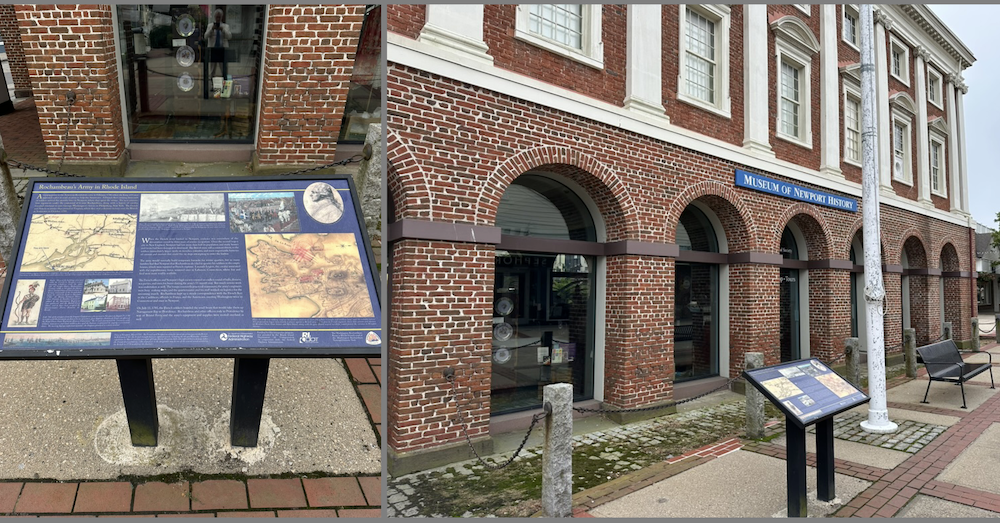
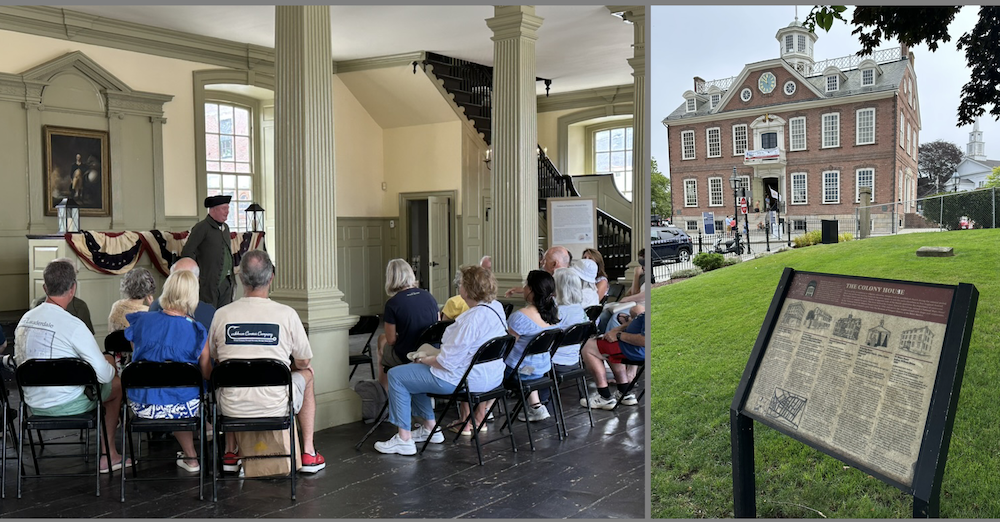
In addition to his statue, the town of Newport, Rhode Island is dotted with markers where Rochambeau is honored.
Top: Pictured above is the Newport Historical Society headquarters and museum.
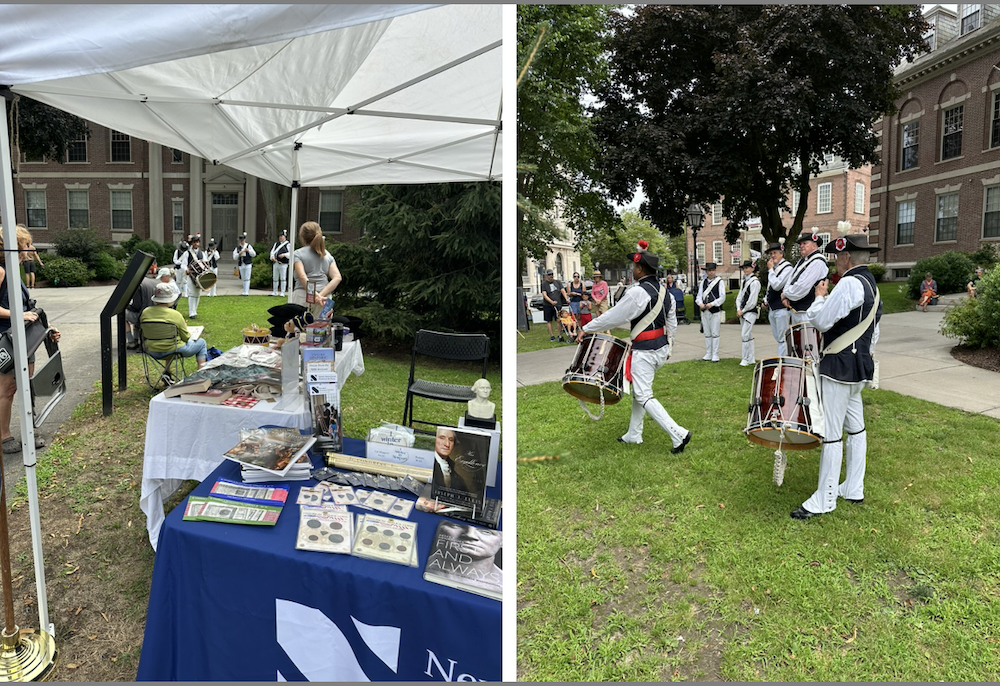
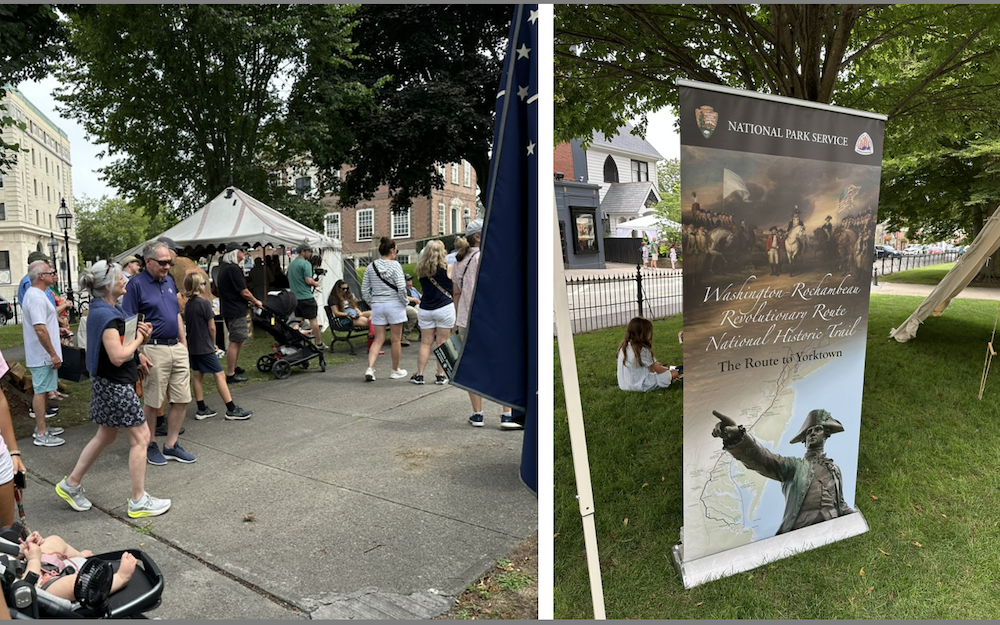
Below: An annual "Tribute to France" is organized every year in July, with re-enactors, historians (Adam Hodges-Claire giving a lecture above), wreath-laying ceremonies, attended by thousands of tourists. Many houses and streets in Newport are unchanged after more than 200 years.
Photos: By TC © ASSFI 2025
See further below for a description of these two markers.
| | |
“I hasten to impart to you the happiness I feel at the welcome news of your arrival; and as well in the name of the American army as my own name to present you with an assurance of our warmest sentiments for allies who have so generously come to our aid. As a citizen of the United States and as soldier in the cause of liberty, I thankfully acknowledge this new mark of friendship from His Most Christian Majesty …
General George Washington to the Comte de Rochambeau, July 16, 1780
• Contrary to George Washington's warm letter of welcome, Rochambeau's arrival in Newport was unexpectedly chilly and uninviting. On July 11, 1780, at 3 PM, Rochambeau ordered the frigate Amazone to dock at Long Wharf, and found no one there to greet him. The Duc de Castries' journal states, "When he disembarked he found no one to receive him. He had to find lodging at the inn and it was only the next day that he could meet the governor of the city".
No government officials, military officers, or soldiers were present to welcome the French troops in Newport. Count de Clermont-Crèvecoeur remarked that Rochambeau "was astonished to find hardly a soul. The shops were closed, and the local people, little disposed in our favor, would have preferred at that moment, I think, to see their enemies arrive rather than their allies".
The only person who initially greeted them was a Quaker named Mr. Wanton, who approached General Rochambeau, lent him some horses, and offered him tea at his home..
| | |
This frosty reception had several underlying reasons:
Political Climate: In 1780, Newport was mainly Loyalist, with most Whigs having left before or during the British occupation from December 1776 to October 1779. The population had halved.
War Fatigue: The British Army had occupied the city for three years, with a force larger than the local population, straining resources and closing the port to trade. Newport was hesitant to host another foreign army.
Historical Prejudices: The French had been enemies in previous wars, especially the French and Indian War, leaving many residents with bitter memories. Additionally, there were religious biases since most French were Catholic.
British anti-French propaganda and smears: The English had made the French seem odious to the Americans by describing them as "the meanest and most abominable people on earth" and portrayed them as "dwarfs, pale, ugly specimens who lived exclusively on frogs and snails—and a hundred other such stupidities" ...Some propaganda even claimed that the French were "monsters who ate babies"... - - Prof. Norman Desmarais, Why Newport Scorned the French 1780
Rochambeau swiftly aimed to alter these views by enforcing strict discipline, compensating fairly for goods and services, and respecting local traditions. During the eleven months of French presence in Newport, these actions slowly gained the support of the people.
| | |
Above:
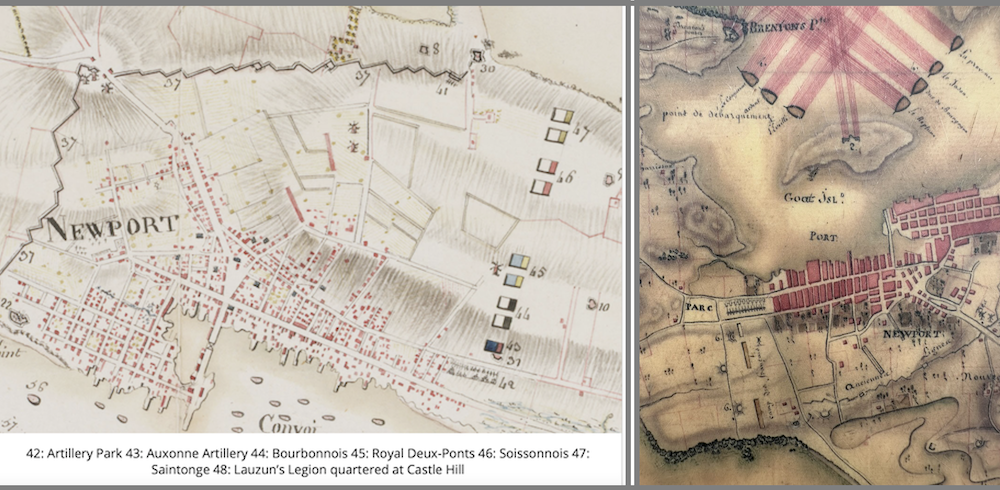
Detail of the marker "Rochambeau's Army in Rhode Island": illustrations from “Plan de la position de l’armée françoise autour de Newport et du mouillage de l’escadre dans la rade de cette ville (1780).“ Plan of the position of the French army around Newport and the anchorage of the squadron in the roadstead of this city. 1780. Map. Retrieved from the Library of Congress, https://www.loc.gov/item/gm71002159/
Newport hasn't changed, ane can clearly locate the troops encampments of the Bourbonnais, Royal-Deux-Ponts, Soissonnais, Saintonge, Auxonne regiments. and the moorings of the French Navy ships Provence, Jason, Duc de Bourgogne, Neptune, Conquérant, Ardent, Eveillé, behind Goat island.
| | |
French forces under General Jean-Baptiste de Vimeur, comte de Rochambeau, had sailed into Narragansett Bay on 11 July 1780 and over the next few days debarked in Newport
The troops had arrived too late to conduct a military campaign in 1780 and many of the men, afflicted with scurvy and other diseases, were too sick to embark on any campaign. “The camp ran from east to west from present-day Spring Street, where at the west end it overlooked a marsh and the squadron anchorage. On the east end, it overlooked Easton’s Beach.”
The infantry regiments camped on the east side, the artillery “on the camp’s west end close to Spring Street. The area across Spring Street and stretching down to Thames Street was laid out as the French Army’s artillery park.” Lauzun’s Legion of Hussars took up positions with their horses at Castle Hill.
Following three months in their encampment the infantry went into winter quarters 1780/81 in Newport in abandoned and/or empty houses while the hussars of Lauzun’s Legion spent in winter in Lebanon, Connecticut. On 10 June 1781, the French infantry which had spent the winter of 1780/81 in Newport received orders to embark the following day in two divisions on dozens of vessels to travel from Newport to Providence.
Marker, “Rochambeau's Army in Rhode Island”
127 Thames St, Newport RI 02840
GPS: 41.489983, -71.315417
• Inscription (excerpts):
“A turning point in the American Revolution came in February 1780, when the King of France approved a plan to send an army to help the Americans. A French fleet carrying thousands of soldiers arrived five months later in Newport, where they spent the winter. [...] When the French army landed in Newport, evidence was everywhere of the devastation caused by three years of enemy occupation. Once the second largest city in New England, Newport had lost more than half its population and many houses and farms had been damaged or destroyed. The British were still a constant threat, so the soldiers immediately began work on trenches, redoubts, and most importantly, batteries of cannon and mortars that could fire on ships attempting to enter the harbor...”
“... The army would normally build temporary barracks for winter quarters, but so many families had fled Newport that Rochambeau decided to quarter his soldiers in the empty houses, which were repaired at French expense. Lauzun's Legion, the cavalry associated with the expeditionary force, wintered over in Lebanon, Connecticut, where hay and feed were more readily available.
The French officers and Newport's high society enjoyed an endless round of balls, dinners, tea parties, and even fox hunts during the army's 11-month stay. But much serious work was undertaken as well. The troops constantly practiced maneuvers, the army's engineers were busy making maps, and the quartermaster and his staff worked on logistics for the upcoming march. Rochambeau kept up a steady correspondence with the French fleet in the Caribbean, officials in France, and the Americans, meeting Washington twice in Connecticut and once in Newport.
On July 11, 1781, the French soldiers boarded the small boats that would take them up Narragansett Bay to Providence. Rochambeau and other officers rode to Providence by way of Bristol Ferry, and the army's equipment and supplies were moved overland as well."
Erected by Federal Highway Administration, U.S. Department of Transportation; Rhode Island Department of Transportation"
When in Newport, a must-see is the Colony House.
Marker, "Old Colony - State House"
Washington Square, Newport, RI 02840
• Inscription (excerpts):
…”Many events during the American Revolution occurred at the Colony House. In 1766, citizens of Newport celebrated the repeal of the Stamp Act here. On July 20, 1776, Major John Handy read the Declaration of Independence from the front steps. During the British occupation of Newport from 1776 to 1779, the Colony House was used as a barracks. The French forces, led by General Rochambeau, came to Newport after the British left the city, and used the building as a hospital. In 1782, General Rochambeau gave a reception here to honor George Washington…”
Note*: Historical records do not indicate that George Washington visited Newport, Rhode Island in 1782. He did visit in March, 1781 when he met with French military leaders before their fleet left for the Chesapeake. According to The Mercury, the local newspaper of the time, both the town and the fleet were "brilliantly illuminated."
| | |
Washington and Rochambeau:
Their first meeting in Hartford, CT.
September 20, 1780
| | |
Above:
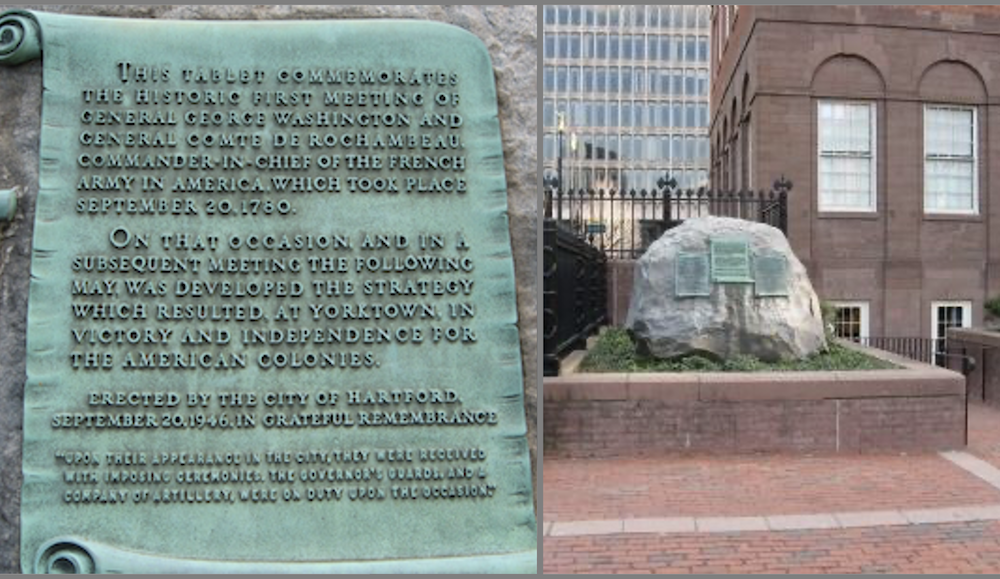
Photos of memorial by Michael Herrick, February 1, 2012
https://www.hmdb.org/m.asp?m=52914
Click on the top photo above or this link to learn more about this first encounter: https://www.youtube.com/watch?v=1mIBdz0g-44
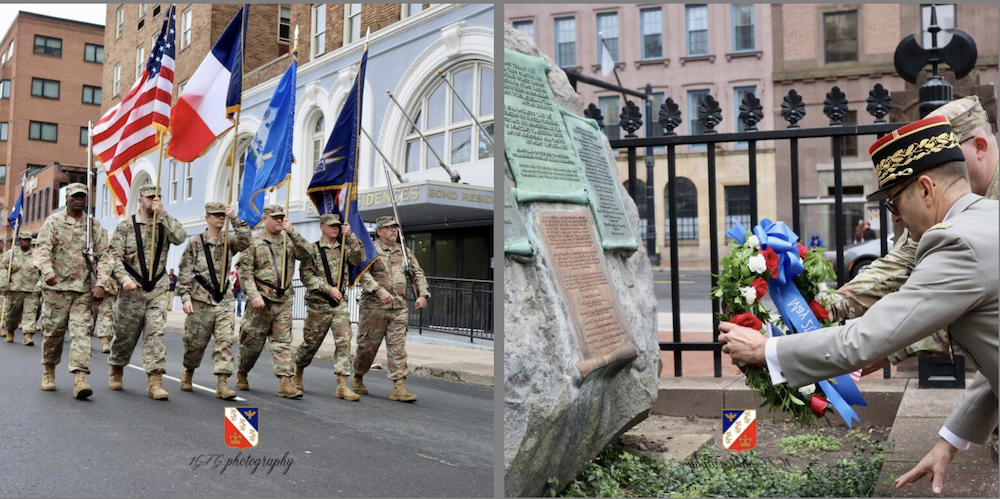
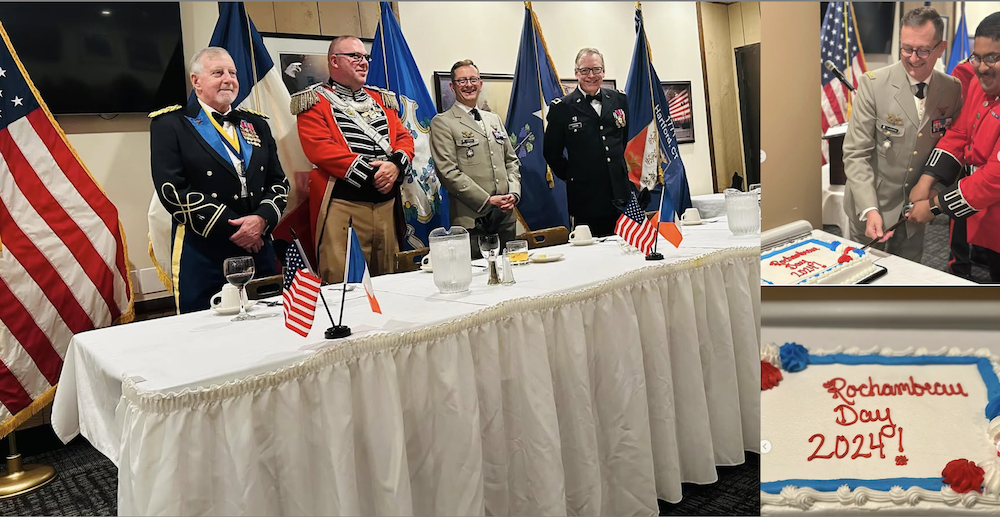
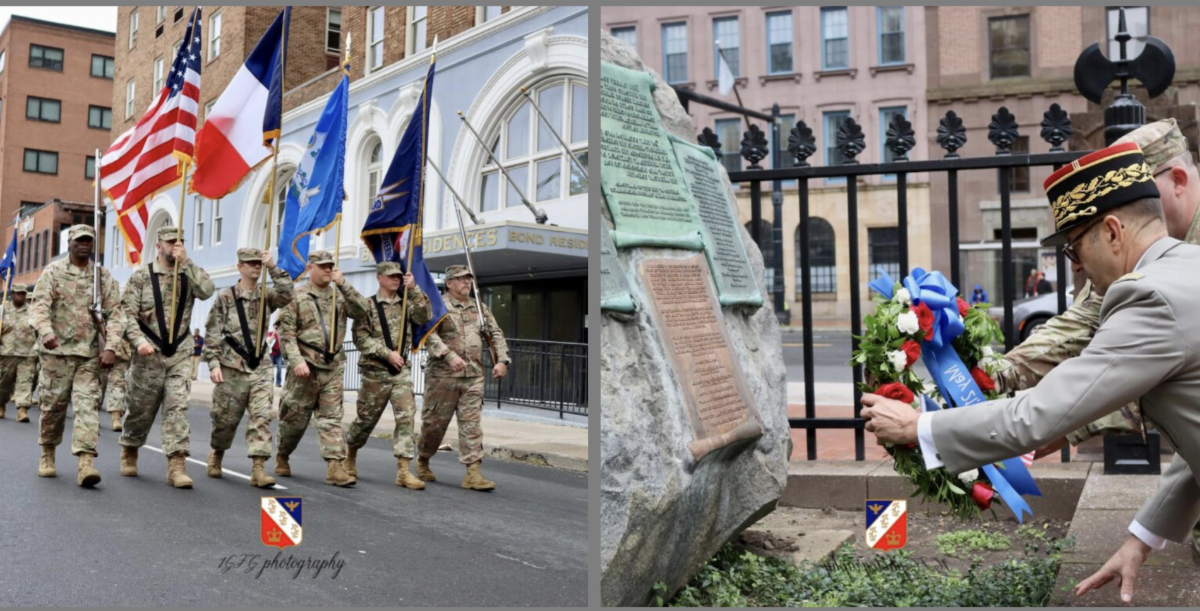
Center & Bottom: every year in September, French dignitaries are invited by the First Company Governor's Foot Guard to join in the celebration of Rochambeau Day in Hartford, CT.
Brig. Gen Vincent de Kytspotter, Ph.D., Head of Military and Defense Mission, French Permanent Mission to the United Nations, laying a wreath at the memorial after the parade (2024). The Association of French reserve Officers in the United States (ACREFEU) also participates regularly.
Photos: https://www.firstgovernorsfootguard.com/
| | |
• After securing his positions in Newport, Rochambeau arrived in Hartford on September 20, 1780 to meet with General Washington.
Rochambeau was greeted by Washington and a 13-gun salute from the Governor’s Guard after crossing the Connecticut River by ferry. Almost all of Hartford’s 5,000 inhabitants lined the route. The meeting was held at the Old State House, 800 Main Street.
• The French were lodged at David Bull’s Tavern, marked by “The Sin of the Bunch of Grapes”, and was used by French officers during the army’s march across Connecticut in 1781 and 1782. A plaque at the Bank of America Building at 777 Main Street marks where Bull’s Tavern once stood.
• It was an important first face-to-face meeting where the bond between the two commanders was born. Washington was keen on attacking the British (who had recently captured New York City), Rochambeau stressed prudence. • • “…The greatest satisfaction was expressed by the parties at this meeting and the highest mark of polite respect and attention were mutual…” The Connecticut Courant and the Weekly Intelligence, Sept 26, 1780.
• Markers in Hartford, CT. memorializes the event:
Marker “The First Meeting of Washington and Rochambeau”
Old State House 800 Main St, Hartford, CT 06103
GPS: 41.765883, -72.672567
• Inscription:
“This tablet commemorates the historic first meeting of General George Washington and General Comte de Rochambeau, commander-in-chief of the French army in America, which took place September 20, 1780.
On that occasion and in a subsequent meeting the following May, was developed the strategy which resulted, at Yorktown, in victory and independence for the American Colonies.
Erected by the City of Hartford, September 20, 1946, in grateful remembrance
"Upon their appearance in the city, they were received with imposing ceremonies. The Governor's Guards, and a company of artillery, were on duty upon the occasion."
Erected 1946.”
Marker “The First Meeting”
Old State House, 800 Main St, Hartford, CT 06103
GPS: 41.765869, -72.673168
• Inscription (excerpts):
“First Meeting
Planning for the joint military venture that eventually led to the British defeat at Yorktown started with an official meeting of General George Washington and comte de Rochambeau near here. Rochambeau agreed to meet Washington to develop a clear plan of attack to defeat the British troops who had already taken New York City. Hartford was a central location between Newport and the Continental Army headquarters in what is now White Plains, New York. When Rochambeau arrived in Hartford on September 20, 1780, he was greeted by Washington and a 13-gun salute from the Governor's Guard after crossing the Connecticut River. Almost all of Hartford's 5,000 inhabitants lined the route from the ferry landing to the site of the current Old State House. The two men then walked a few blocks south to Jeremiah Wadsworth's home, where the Wadsworth Atheneum Museum of Art now stands at 600 Main Street.”
| | |
Above:
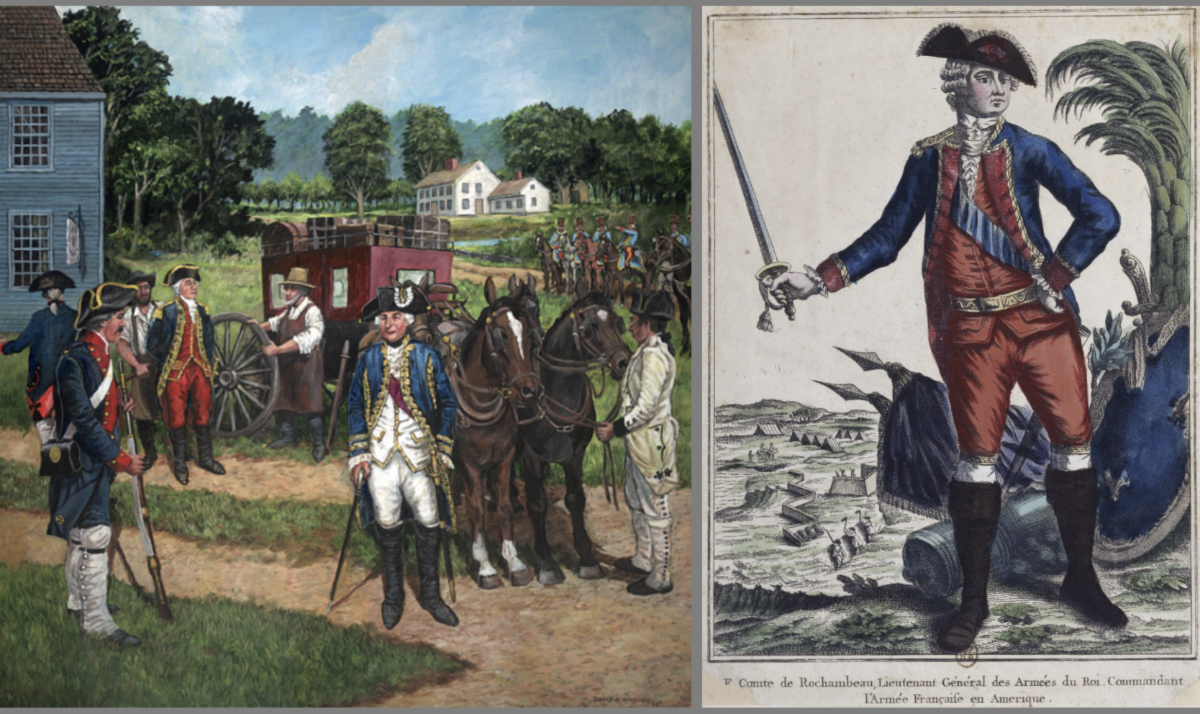
Left: original painting by the very talented Connecticut artist David Wagner depicting the “Scotland incident”, available for sale along several wonderful and historically accurate paintings at: https://www.davidrwagner.com/ct-scotlandincident.htm
Right: Jean-Baptiste Donatien de Vimeur, Count of Rochambeau (1725 - 1807), Lieutenant General of the King's Armées, Commander of the French Armée in America), by Unknown artist, Engraving 1789, Bibliothèque Nationale de France, Picture ID: 922722
https://gallica.bnf.fr/ark:/12148/btv1b7883573k.item
| | |
• One of our favorite anecdotes is taken directly from Rochambeau's Memoirs, which illustrates his deep respect for the American Patriots, a cool headed disposition, as well as a his sense of humor. As Rochambeau and admiral de Ternay were hastening to reach Hartford and meet with George Washington, the wheel of their carriage broke down in the middle of nowhere...
"I will here venture to intrude on the kind attention of the reader with an anecdote, which is strikingly characteristic of the manners of the good republicans of Connecticut. The conveyance in which I proceeded to the conference, in company with Admiral de Ternay, who, by the way, was very infirm, broke down. I dispatched my first aide-de-camp, Fersen, to fetch a wheelwright, who lived about a mile from the spot where the accident occurred. He soon after returned to us, however, and informed us that he had found the man sick with the ague, and that he had positively declared to him that for his hat full of guineas he would do no work at night. I prevailed on the admiral to accompany me to the man's shop, and we repaired thither; we told him that General Washington would arrive at Hartford the same evening, to confer with us the following day, and that unless he could repair our carriage, we should be too late to meet him. " You are no liars, at any rate," he replied; " for I read in the Connecticut paper that Washington was to be there to confer with you ; as it is for the public service I will take care that your carriage shall be ready for you at six in the morning." He kept his word; and we proceeded on at the promised time. As we returned, another wheel broke, and we were once more obliged to have recourse to our old friend. " Well! " said he, " so you want me to work again for you at night? " " Aye! indeed, we do," I replied; "Admiral Rodney has arrived to reinforce threefold the naval forces against which we are contending, and it is of the highest importance that we should return without delay to Rhode Island to oppose him." " But what can you do," he continued, " with your six ships against the twenty English? " " It will be the most glorious day of our life if they attempt to break our line." " Come, come," said he, " you are good honest fellows; your carriage shall be put in repair by to-morrow morning at five o'clock. But tell me, before I set to work, although I do not wish to inquire into your secrets, how did you like Washington, and how did he like you? " We assured him that we had been delighted with him; his patriotism was satisfied, and he kept his word. I do not mean to compare all Americans to this good man ; but almost all the inland cultivators and all the land owners of Connecticut are animated with that patriotic spirit, which many other people would do well to imitate" - - Memoirs of Rochambeau
Author(s): Count de Rochambeau and M. W. E. Wright - The North American Review, May, 1917, Vol. 205, No. 738 (May, 1917), pp. 788-802, 785 Published by: University of Northern Iowa, https://www.jstor.org/stable/25151043
A marker recounts this incident:
“The Scotland Marker”
Huntington Homestead, 36 Huntington Road, (Route CT14) , Huntington CT 06264
GPS: 41.699248, -72.085591
• Inscription (excerpts):
[...]"Poor road conditions in Scotland damaged the wheel of the carriage transporting Rochambeau and French Admiral de Ternay to the Hartford conference. An aide was sent to find a wheelwright. But the wheelwright was ill and resisted the job even for a “hat full of guineas.” But once he learned that the carriage was Rochambeau's on its way to meet Washington, the wheelwright worked through the night to fix it. On the party's return from Hartford the wheel broke again. The same wheelwright fixed it."
| | |
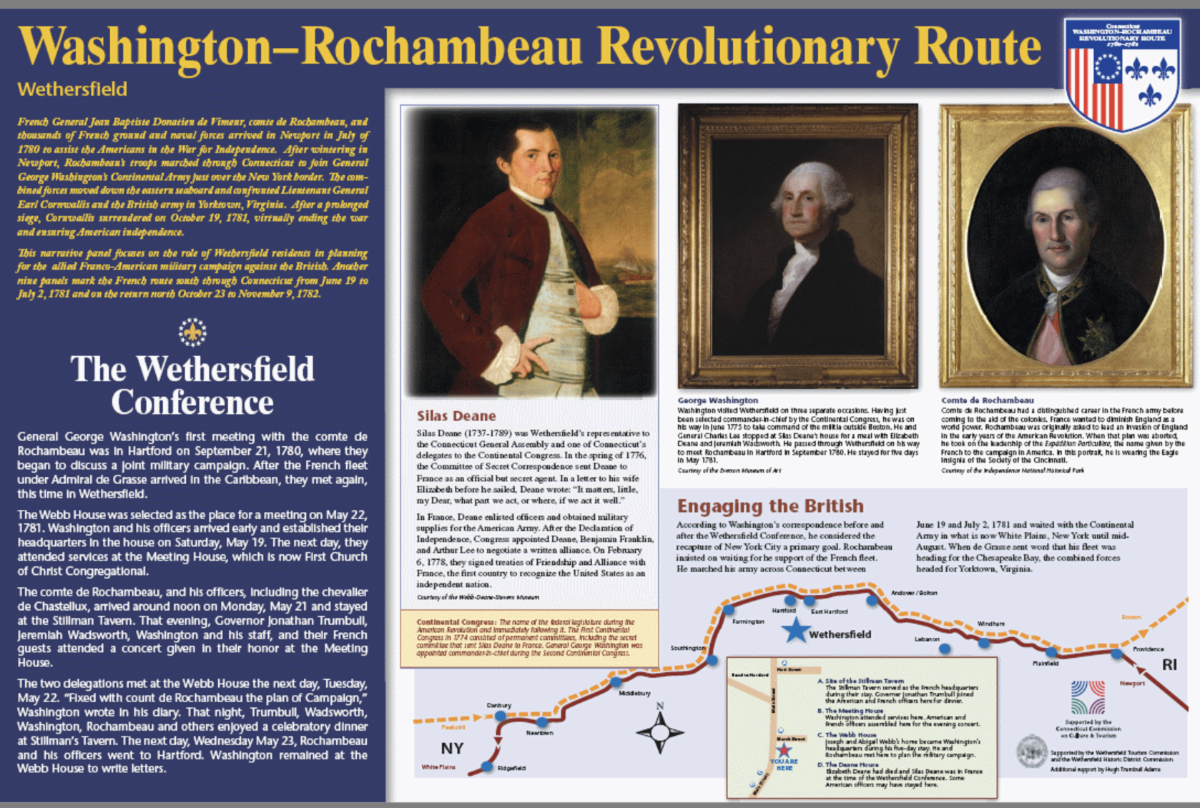
Mural, the Wethersfield Conference
Washington and Rochambeau
Second Meeting, May 21-22, 1781
Wethersfield, CT
| | |
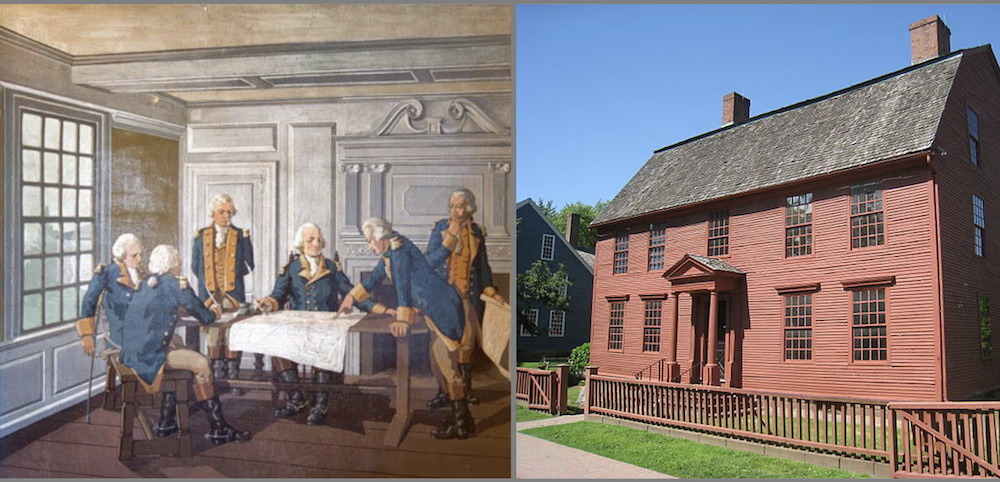
• In May 1781, Washington and Rochambeau held their second strategy meeting at the Joseph Webb House, 211 Main Street.
• The Joseph Webb house, now the Webb-Deane-Stevens museum, was designated a National Historic Landmark for its significance as the location of the five-day military conference held in May 1781 between General George Washington and General Comte de Rochambeau (Commander of the French Army) during the American Revolutionary War that preceded the Siege of Yorktown, the last major battle of the war in North America.
• The Comte de Rochambeau, and his officers, including the chevalier de Chastellux, arrived around noon on Monday, May 21 and stayed at the Stillman Tavern. That evening, Governor Jonathan Trumbull, Washington and his staff, and their French guests attended a concert given in their honor at the Meeting House (now First Church of Christ Congregational)
• The two delegations met at the Webb House the next day, Tuesday, May 22. “Fixed with count de Rochambeau the plan of Campaign” Washington wrote in his diary.
Marker, “Joseph Webb House”
211 Main St, Wethersfield, CT 06109
GPS: 41.712064, -72.653107
• Inscription:
“Webb House
Here Washington and
Rochambeau Planned
The Campaign Ending
At Yorktown, 1781”
| | |
The strategic differences between Washington and Rochambeau in 1781 focused on their chosen targets for the key campaign of the Revolutionary War. Washington immediately thought of his long-desired attack to reclaim New York City; Rochambeau preferred an operation in Virginia on the Chesapeake. George Washington's inclination for New York was understandable - it was the British stronghold in America and had been his strategic focus for much of the war. Regaining New York would have been a significant symbolic victory and would have forced the British from their most crucial base of operations.
Rochambeau's strategy won out for several practical reasons. The Virginia plan provided a more realistic opportunity to capture an entire British army instead of just assaulting a heavily fortified location.
Washington set aside his preference for action against New York City and moved south because the French strategy presented better chances for a decisive victory. Together, the commanders successfully carried out an extraordinary operation that involved quickly moving 12,000 troops, their artillery and supplies, and two French fleets to the Chesapeake without alerting the British commanders in either location. The outcome was a joint Franco-American land and sea campaign that trapped a significant British army on a peninsula at Yorktown.
Marker, “The Wethersfield Conference”
At Village Tavern, 222 Main Street Wethersfied, CT 06109
GPS: 41.712570, -72.652493
• Inscription (excerpts):
“General George Washington's first meeting with the comte de Rochambeau was in Hartford on September 21, 1780, where they began to discuss a joint military campaign. After the French fleet under Admiral de Grasse arrived in the Caribbean, they met again, this time in Wethersfield…The comte de Rochambeau, and his officers, including the chevalier de Chastellux, arrived around noon on Monday, May 21 and stayed at the Stillman Tavern.
The two delegations met at the Webb House the next day, Tuesday, May 22. "Fixed with count de Rochambeau the plan of Campaign," Washington wrote in his diary. That night, Trumbull, Wadsworth, Washington, Rochambeau and others enjoyed a celebratory dinner at Stillman's Tavern…” [...] “According to Washington's correspondence before and after the Wethersfield Conference, he considered the recapture of New York City a primary goal. Rochambeau insisted on waiting for the French fleet. He marched his army across the Connecticut River between June 19 and July 2, 1781 and waited with the Continental Army in what is now White Plains, New York, until mid-August. When de Grasse sent word that his fleet was heading for Chesapeake Bay, the combined forces headed for Yorktown, Virginia.”
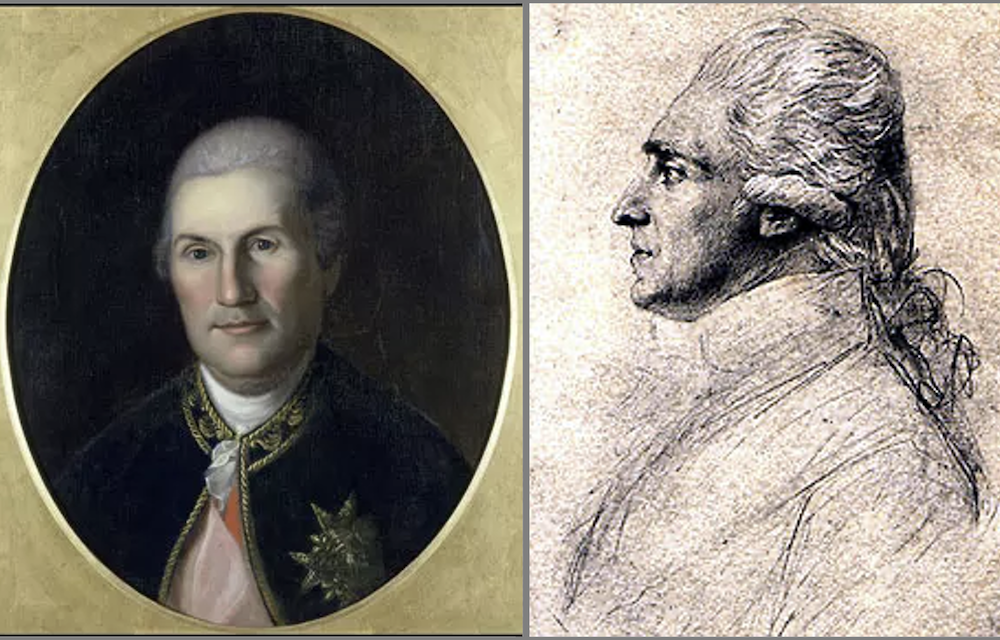
A note about Rochambeau's portraits:
| | |
Above:
Left: Jean Baptiste Donatien De Vimeur, Comte De Rochambeau by Charles Willson Peale (1741-1827), from life, c. 1782, oil on canvas, 55.25 × 48.51 cm. Philadelphia, Independence National Historical Park, INDE14138, Public Domain, https://commons.wikimedia.org/w/index.php?curid=122748477
Right: Portrait de Rochambeau, by Augustin De Saint-Aubin (1736-1807)
This artwork is the officially approved image from Bayonnes Muse Bonnat as part of the French Museum Collection, Réunion des Musées Nationaux, RMN
https://www.wikitree.com/wiki/Vimeur-1
| | |
Interpretative markers often use portraits of Rochambeau to illustrate their narrative, as the ones above.
• In fact, only a few portraits and paintings of Rochambeau exist, some in his uniform of French general (at the time of the War of Independence), some, anachronistically, portraying him in his uniform of French Marshal.
To add to the confusion, a few were painted during his lifetime, and others painted years after his death.
• The illustration of the marker described above chose a portrait of Rochambeau by William Peale. While it is likely that Peale painted this piece from a live model, the facial features are confusing. They do not match those found in various works by French artists, and they closely resemble the features seen in Peale's portraits of George Washington. Nevertheless, Peale adheres to a likely accurate depiction of the uniform from the American Revolution era. The caption in the marker is erroneous "In this portrait, he is wearing the Eagle Insigna of the Society of the Cincinnati". In fact, the portrait features a gold Maltese cross design of the Ordre Royal et Militaire de Saint-Louis Additionally, the red sash is displayed, representing the highest rank within the order.
• The portrait sketch on the right by Saint-Aubin is certainly more accurate, most likely executed after Rochambeau's return from his American campaign.
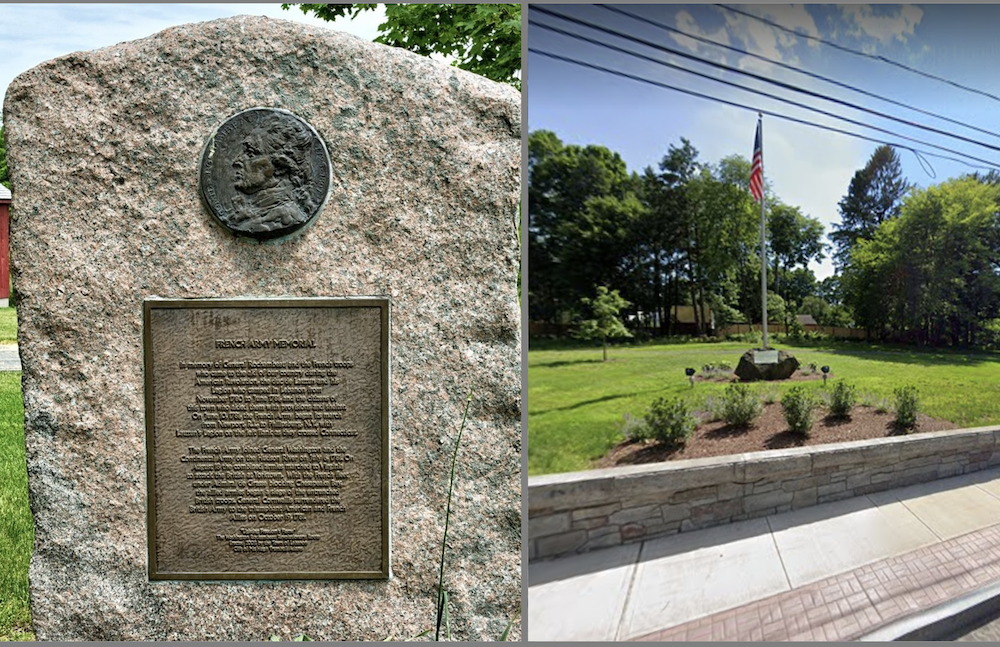
| | Memorials in Lebanon & Farmington, CT | | |
“French Army Memorial”
856 Trumbull Hwy, Lebanon, CT 06249
GPS: 41.637647, -72.21340
• Inscription:
“In memory of General Rochambeau and the French troops who came to the aid of our country during the American Revolution, the duc de Lauzun and his
Legion who camped in Lebanon from November 1780 to June 1781, and the citizens of this town who aided them with provisions and shelter.
On June 10, 1781, the French Army began its march from Newport,RI to Phillipsburg, NY, with Lauzun's Legion on the left flank as they crossed Connecticut.
The French Army joined General Washington and the Continental Army on the Hudson River on July 6, 1781. On August 18 the combined armies march to Virginia to attack the British at Yorktown. With the French fleet, under Admiral De Grasse blocking Chesapeake Bay, the allied Armies began a siege of the entrenched British troops. General Cornwallis surrendered the British Army to the triumphant American and French Allies on October 19, 1781
Lighting Freedom Flame
The Washington Rochambeau Revolutionary Route
Erected 2002 by the Town of Lebanon, Gift of Mr. Hugh Trumball Adams”
Marker, “Lest We Forget”, Farmington, CT
790 Farmington Ave, Farmington, CT 06032
GPS: 41.726017, -72.824061
• Inscription:
“Lest We Forget”
“In honor and grateful remembrance of our French Allies in the Revolution, whose army, under the command of General Count de Rochambeau, marched past this spot enroute from Newport and Providence, R.I., to join General Washington on the Hudson River in 1781, and again on its return from Yorktown, Va. To Boston, Mass., in 1782.”
“The main body of about 4000 men was composed of the Regiments of Bourbonnais, Royal Deux-Ponts, Soissonnais and Saint Onge, and the artillery. The regiments marched in the foregoing order on successive days from Providence, always keeping between each other the distance of a day's march. The artillery followed immediately in the rear of the second regiment. General Count de Rochambeau marched at the head of the main body and the regiments camped successively a little south of Farmington Village June 25, 26, 27 and 28, 1781. On its return the army marched in two columns, keeping between each other the distance of a day's march, and camped successively in the southern part of the village October 28 and 29, 1782.”
“A left flank guard of about 600 Hussars and light infantry, under the command of the Duke De Lauzun, marched from its winter camp at Lebanon, Conn., abreast of, and about fifteen miles from, the main body in 1781.”
“Maps of the marches and camp sites of the army and literature regarding our French Allies in the Revolution may be seen at the village library.
Erected by Colonel Jeremiah Wadsworth Branch, Connecticut Society,
Sons of the American Revolution, 1926”
| | |
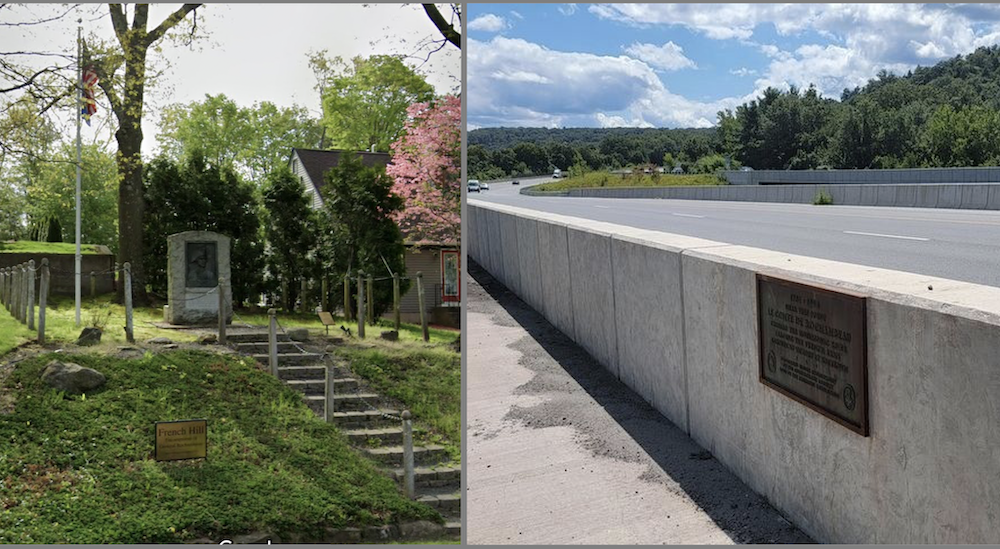
Memorial, Plantsville CT
Bridge, I-84, Southbury, CT
| | |
Above:
Left: Rochambeau Monument, at “French Hill”, Photo; Image capture May 2019 © Google
Right: Rochambeau Bridge, Photo by Michael Herrick, August 22, 2024
https://www.hmdb.org/m.asp?m=6432
| | |
• In 1912, the American Irish Historical Society erected a monument at “French Hill” in Marion to mark the area where the French army camped in 1781 and again in 1782.
Rochambeau Monument, at “French Hill”
1036 Marion Avenue Plantsville CT 06479
GPS: 41.569606, -72.92315
Inscription:
“Rochambeau Lieut. General Commanding
The Auxiliary French Armies Under Washington
July 10, 1780 Jan 11, 1783
Rochambeau's letter to Congress
"We are your brothers. We shall conduct ourselves as such with you.
We shall fight against our enemies at your side as one and the same nation"
Quotation from General's letter”
Back:
“General Rochambeau and 6000 French forces under his command camped here in June 1781 They then continued their march through Connecticut to join General Washington and the American troops in successfully defeating the British at the Battle of Yorktown. The French forces again camped here in Nov 1782 after gallantly helping in our fight for independence. General Count de Rochambeau was an original member of the Society of the Cincinnati formed by General Washington and his officers in 1783 to perpetuate their fellowship. Erected and rededicated 1971”
Marker, Rochambeau Bridge, Newton, CT
I-84, Southbury CT 06488
GPS: 41.438954, -73.24733
• Marker is located on the pedestrian walkway fence on the southern bridge (East-bound). It is at the mid-point, between Southbury, New Haven County and Newtown, Fairfield County. Unfortunately the marker was moved and is no longer visible from the roadway.
• Inscription:
“1781 – 1954”
“Near this point
Le Comte de Rochambeau
crossed the Housatonic River
leading the French Army
enroute to victory at Yorktown”
•The French Army crossed the Housatonic River, called the “Stratford” or “Little Stratford” river by the French, “on a bridge which is rather remarkably constructed, in that all the timber-work is supported, without pillars, by the thrusts of 3 intersecting arches” wrote artillery lieutenant Clermont-Crevecoeur. The bridge called “Carleton’s Bridge,” which was about 1 mile south on the river, sat on piers made of framed boxes filled with pebbles, no longer exists.
| | |
Tavern, site of 56th Birthday
Ridgefield, CT
Marker, Meeting with Washington
Mount Kisco, NY
| | |
Above:
Left: Marker, Photo courtesy of Lynn Briggs
Right: Ensign Samuel Keeler’s Tavern. Rochambeau celebrated his 56th birthday in this tavern, now housing a living Colonial museum with period furnishings & costumed guides
Photo: by Rolf Müller (User:Rolfmueller)
https://commons.wikimedia.org/w/index.php?curid=1361338
| | |
Ensign Samuel Keeler’s Tavern
Ridgebury, CT & 152 Main St, Ridgefield, CT 06877
GPS: 41.27310, -73.49708
• Rochambeau’s troops camped in Ridgefield’s Ridgebury Parish on July 1 and 2, 1781. It was their eleventh and last camp in Connecticut before crossing the border into New York and joining with the Continental Army near what is today White Plains, New York, on July 3, 1781.
• Deployed on the ridge was an advance guard of chasers and grenadiers under Major Alexandre de Berthier. The Hussar Legion of Duc de Lauzun took North Salem Road eight miles to the southwest to screen the French camp from British spies.
• Before leaving for New York, Rochambeau celebrated his 56th birthday in Ridgefield at the Ensign Samuel Keeler’s Tavern.
• On July 1, 1781, Rochambeau and his officers stopped for water at the homestead of Stephen Norris, which still stands along the road linking Danbury and Ridgefield. That morning, Abigail Norris had delivered her sixth child. In honor of the French, the child was named after the Duc de Lauzun: Delazon. The grave marker of nine year-old Delazon Norris may still be found today in Ridgebury cemetery.
• After the victory at Yorktown, Rochambeau’s army returned north in the fall of 1782, passing through the area before reaching camp in Danbury October 23-24, 1782.
• A July 5, 1781 entry in the Journal of French officer, future Field Marshal Chief of Staff of Napoléon’s Grand Army Louis-Alexandre Berthier, reveals that, "During the 4th and 5th (of July) the army made a halt at North Castle .... Gen. Washington came to visit the Comte de Rochambeau and passed down our line. Troops were drawn up before the camp in line of battle without arms and wearing forage caps."
Marker, Meeting of Washington & Rochambeau
Northern Westchester Hospital
400 Main St, Mt Kisco, NY 10549 (by the left entrance, junction of Routes 117 and 172)
GPS: 41.196745, -73.724523
• Inscription:
“On this site on July 5, 1781, after a forced march from Newport, Rhode Island, Comte de Rochambeau arrived with 5,000 men, sent by the French government to aid in the American struggle for independence.
Gen. George Washington met with Gen. Rochambeau and reviewed the troops during the encampment. American and French forces joined in Westchester County, under Washington’s command, for the march to Yorktown, Virginia, and the defeat of Gen. Charles Cornwallis on October 13, 1781.”
| | |
Odell House
Headquarters of General Rochambeau
Hartsdale, NY
July 6 to August 19, 1781
| | |
Above:
Photos: TC © ASSFI 2020
| | |
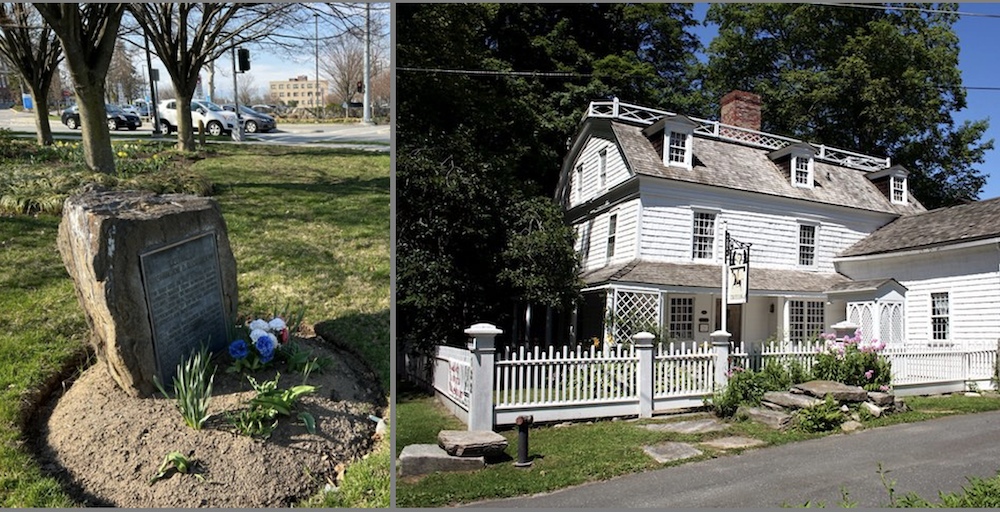
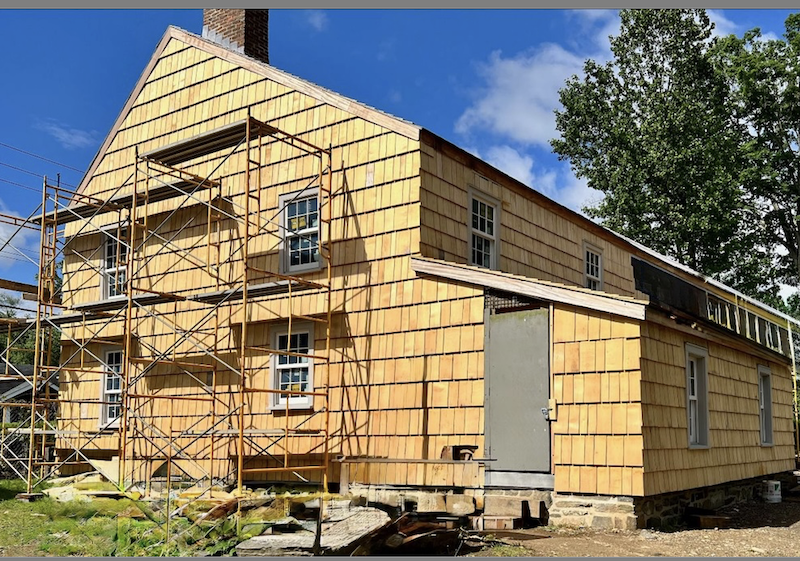
This site, practically unchanged since 1781, will soon become a museum. Please read Part III of our Bulletins for regular announcements on the progress of this exceptional project, conducted by the Friends of Odell House - Rochambeau Headquarters
• Located 21 miles north of New York, off I87 and just south of White Plains, this farm is undergoing renovations and has been bought by the City of Greenburgh (Westchester County) for conversion into a museum.
• Rochambeau established his headquarters on this farm in July-August 1781, while the French Army camped in the neighborhood.
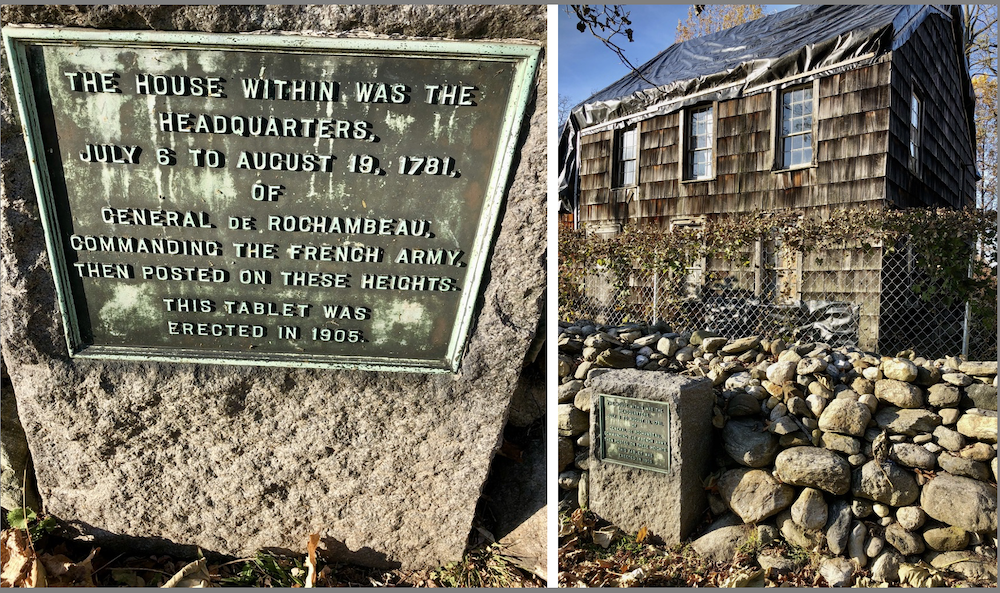
• A plaque was installed in 1905 on a granite rock with the seal of the Daughters of the American Revolution at the top.
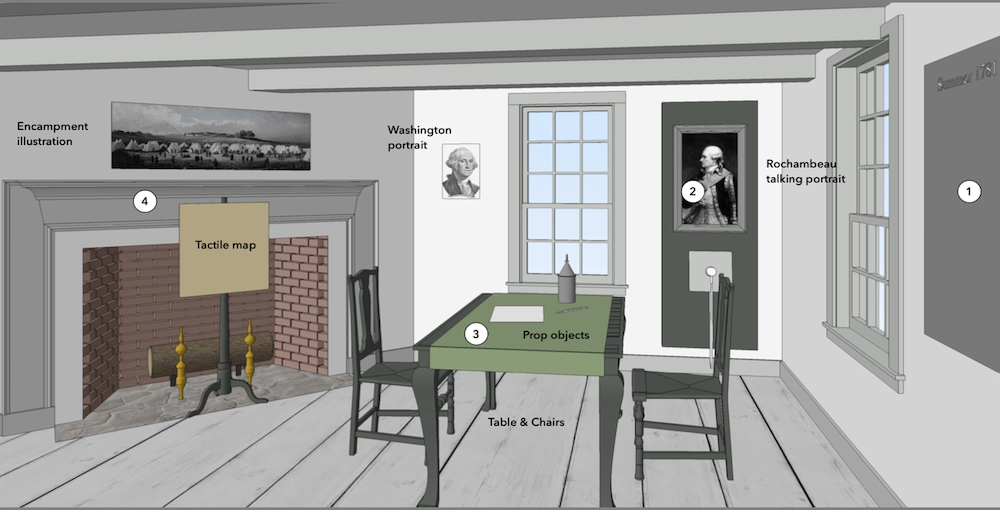
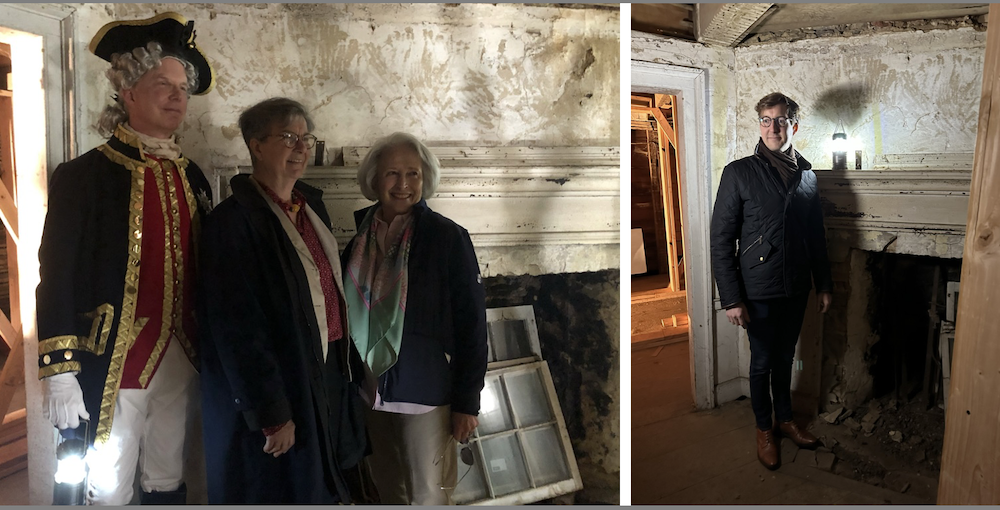
• Washington and Rochambeau met at the Odell House on August 14, 1781 to discuss strategy. The room has been preserved by and large ever since, and one can still see the mantlepiece, wood planks, and remnants of the original wallpaper...
• The decision was to break camp on August 19, quickly march to Yorktown, while de Grasse's fleet was on its way to the Chesapeake Bay.
• On Friday, 3 October 1845, a “Mrs. Churchill, born Taylor, living on the Tuckeyhoe Road near Hart’s corner,” remembered that she "was a girl 15 or 16 years of age in 1781 when "the French army lay south of the Bates House now occupied by Jackson Odell. This house was the Head Quarters of General Rochambeau during all the time (sic) the French army was encamped on the high ground between the [Ikendahl] Allaire road and Sprain Brook on the south side of the Dobbs Ferry Road. While there General Rochambeau gave four or five large dinner parties to the French and American officers in the old barn northwest of the house which was then owned by Mr. Bates, afterwards by Colonel John Odell, and is now owned by Jackson Odell."
Bronze plaque, Odell House, Rochambeau Headquarters
425 Ridge Rd, Hartsdale, NY 10530
GPS: 41.019507, -73.816878
• Inscription:
“The House Within Was The Headquarters,
July 6 To August 19, 1781, Of
General De Rochambeau, Commanding The French Army,
Then Posted On These Heights.
This Tablet Was Erected In 1905 “
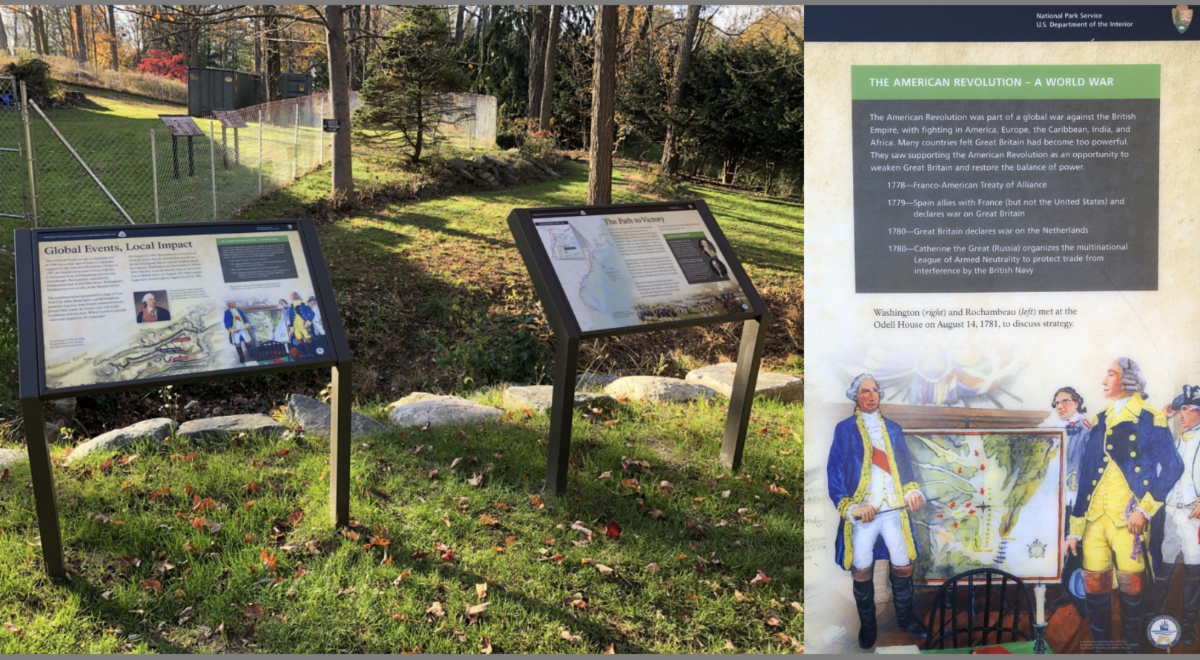
Marker, "Global Events, Local Impact"
Odell House, headquarters of General Rochambeau
425 Ridge Rd, Hartsdale, NY 10530
GPS: 41.019520, -73.816809
• Inscription:
"The arrival of French troops on American soil in 1780 was a clear sign of France's expanded support for the American Revolution. On July 6, 1781, the French Army joined forces with the Continental Army at Philipsburg (present-day Greenburgh). Rochambeau stationed his headquarters here at the Odell House. Washington headquarters was nearby, at the Appleby House.
The combined armies prepared for a siege of New York City while Washington and Rochambeau awaited a response from French Admiral Francois-Joseph Paul, comte de Grasse, who was in the Caribbean with his fleet. Where would he provide vital naval support to the campaign?
On August 14, 1781, Rochambeau received word from de Grasse that the French Fleet would sail for the Chesapeake Bay to support an allied attack. In response, Washington and Rochambeau shifted their objective from the British Army in New York City to British forces in Virginia. The allied armies began their march south on August 18 and 19, 1781."
Captions:
• Illustration "French map of 1781 showing the proximity of the French and American headquarters"
• Portraits of de Grasse, Washington, Rochambeau:
"The decision by French Admiral de Grasse to move his fleet to the Chesapeake Bay was critical to the plan to lay siege to Yorktown, Virginia."
"Washington (right) and Rochambeau (left) met at the Odell House on August 14, 1781, to discuss strategy."
Inset: "The American Revolution, a World War"
"The American Revolution was part of a global war against the British Empire, with fighting in America, Europe, the Caribbean, India, and Africa. Many countries felt Great Britain had become too powerful. They saw supporting the American Revolution as an opportunity to weaken Great Britain and restore the balance of power.
1778 - Franco-American Treaty of Alliance
1779 - Spain allies with France (but not the United States) and declares war on Great Britain
1780 - Great Britain declares war on the Netherlands
1780 - Catherine the Great (Russia) organizes the multinational League of Armed Neutrality to protect trade from interference by the British Navy"
| | |
Memorial, Newark, Delaware
Rochambeau Plaza, Havre de Grace, Maryland
| | |
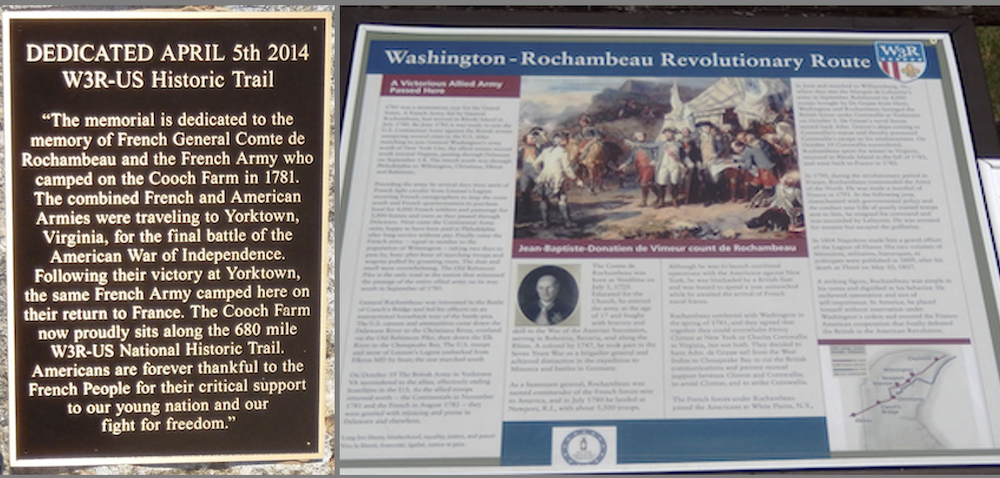
Memorial “Comte de Rochambeau and the French Army”
At Pencader Museum, 2029 Sunset Lake Road, Newark DE 19702
GPS: 39.63958, -75.72992
• Dedicated April 5th, 2014 by the W3R-US Historic Trail
• Inscription:
(Center Plaque)
“The memorial is dedicated to the memory of French General Comte de Rochambeau and the French Army who camped on the Cooch Farm in 1781. The combined French and American Armies were traveling to Yorktown, Virginia, for their final battle of the American War of Independence. Following their victory at Yorktown, the same French Army camped here on their return to France. The Cooch Farm now proudly sits along the 680-mile W3R-US National Historic Trail. Americans are forever thankful to the French People for their critical support to our young nation and out fight for freedom.”
Erected 2014 by W3R-US Historic Trail and the Pencader Heritage Area Association.”
Marker “A Victorious Army Passed Here”, Newark, Delaware
At Pencader Museum, 2029 Sunset Lake Road, Newark DE 19702
GPS: 39.63958, -75.72992
• Inscription (excerpts):
“A Victorious Allied Army Passed Here- 1781 was a momentous year for the United States. A French Army, led by General Rochambeau, had arrived in Rhode Island in July 1780...After marching to join General Washington’s army north of New York City, the allied armies moved south toward Virginia, passing through Delaware on September 1-8. The march south was through Philadelphia to Wilmington, Christiana, Elkton and Baltimore.”
“Preceding the army by several days were units of French light cavalry from Lauzun’s Legion escorting French cartographers to map the route south and French quartermasters to purchase food for 4,000 French soldiers and pasturage for 1,000 horses and oxen as they passed through Delaware...Finally came the French army—equal in number to the population of Wilmington—taking two days to pass by, hour after hour of marching troops and wagons pulled by groaning oxen. ”
“Long live liberty, brotherhood, equality, justice, and peace! Vive la liberte, fraternite, egalite, justice et paix.”
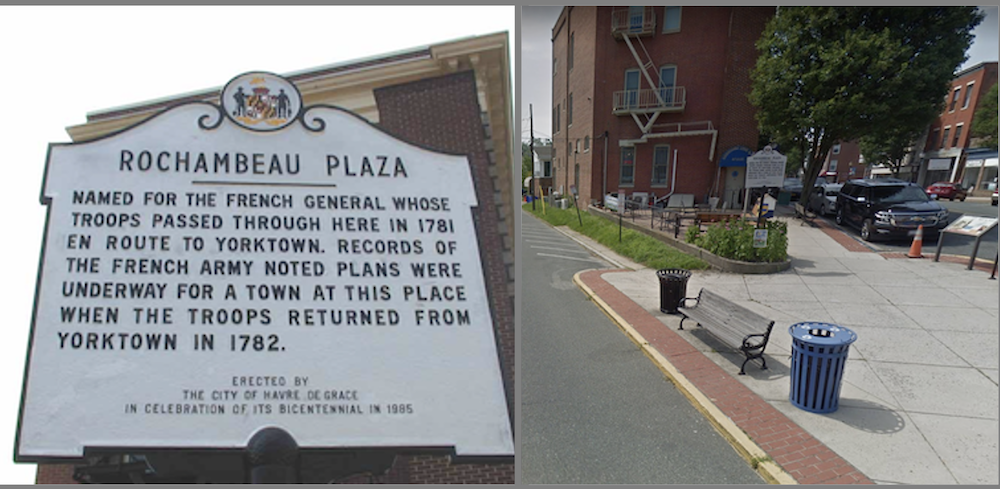
Marker, “Rochambeau Plaza”, Havre de Grace, MD
At the intersection of Washington Street and St. John’s Street, Havre de Grace, MD 21078
GPS: 39.549508, -76.089683
• Inscription:
“Named for the French General whose troops passed through here in 1781 en route to Yorktown.
Records of the French Army noted plans were underway for a town at this place when the troops returned from Yorktown in 1782.
Erected 1985 by The City of Havre de Grace in celebration of its Bicentennial.”
| | |
An account of the powerful
Washington-Rochambeau partnership
Mount Vernon, Virginia
| | |
“Of the happiness I have enjoyed in our private friendship. The remembrance of which will be one of the most pleasing Circumstances of my life.”
– Comte de Rochambeau on his relationship with George Washington
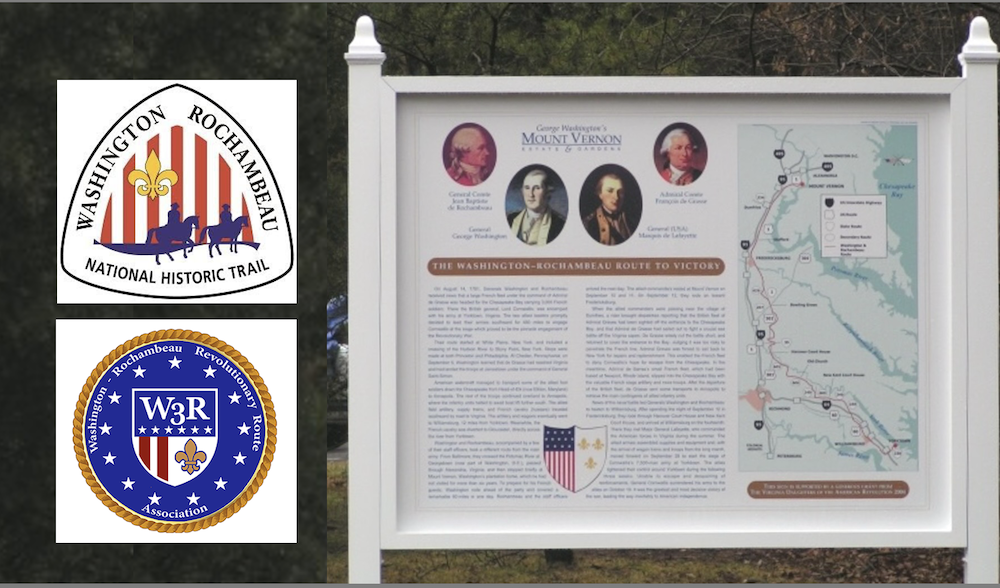
• As stated in its official website, The mission of the Washington-Rochambeau Revolutionary Route National Historic Trail is to "preserve and interpret the routes taken by American and French troop from 1781 – 1782 and to commemorate the role of the critical French-American alliance in the victory over British forces at the siege of Yorktown, Virginia."
Marker, “The Washington-Rochambeau Route to Victory”
September 10-11, 1781
Mt Vernon Memorial Hwy &, VA-235, next to bus parking lot, Mt Vernon, VA 22309
GPS: 38.712033, -77.088400
• Inscription:
“On August 14, 1781, Generals Washington and Rochambeau received news that a large French fleet under the command of Admiral de Grasse was headed for the Chesapeake Bay carrying 3,000 French soldiers. There the British general, Cornwallis, was encamped with his army at Yorktown, Virginia. The two allied leaders promptly decided to lead their armies southward for 450 miles to engage Cornwallis at the siege which proved to be the pinnacle engagement of the Revolutionary War.
Their route started at White Plains, New York, and included a crossing of the Hudson River at Stony Point, New York. Stops were made at both Princeton and Philadelphia. At Chester, Pennsylvania, on September 5, Washington learned that de Grasse had reached Virginia and had landed the troops at Jamestown under the command of General Saint-Simon..”
American watercraft managed to transport some of the allied foot soldiers down the Chesapeake from Head-of-Elk (now Elkton, Maryland) to Annapolis. The rest of the troops continued overland to Annapolis, where the infantry units halted to await boat lift further south. The allied field artillery, supply trains, and French cavalry (hussars) traveled southward by road to Virginia. The artillery and wagons eventually went to Williamsburg, 12 miles from Yorktown. Meanwhile, the French cavalry was diverted to Gloucester, directly across the river from Yorktown.
“Washington and Rochambeau, accompanied by a few of their staff officers, took a different route from the main army. From Baltimore, they crossed the Potomac River at Georgetown (now part of Washington, D.C.), passed through Alexandria, Virginia, and then stopped briefly at Mount Vernon, Washington’s plantation home, which he had not visited for more than six years. To prepare for his French guests, Washington rode ahead of the party and covered a remarkable 60 miles in one day. Rochambeau and the staff officers arrived the next day. The allied commanders rested at Mount Vernon on September 10 and 11. On September 12, they rode on toward Fredericksburg.
When the allied commanders were passing near the village of Dumfries, a rider brought dispatches reporting that the British fleet of Admiral Graves had been sighted off the entrance to the Chesapeake Bay, and that Admiral de Grasse had sailed off to fight a crucial sea battle off the Virginia capes. De Grasse wisely cut the battle short and returned to cover the entrance to the Bay. Judging it was too risky to penetrate the French line, Admiral Graves was forced to sail back to New York for repairs and replenishment. This enabled the French fleet to deny Cornwallis’s hope for escape from the Chesapeake. In the meantime, Admiral De Barras’s small French fleet, which had been based at Newport, Rhode Island, slipped into the Chesapeake Bay with the valuable French siege artillery and more troops. After the departure of the British fleet, de Grasse sent some transports to Annapolis to retrieve the main contingents of allied infantry units.
“News of the naval battle led Generals Washington and Rochambeau to hasten to Williamsburg. After spending the night of September 12 in Fredericksburg, they rode through Hanover Court House and New Kent Court House, and arrived at Williamsburg on the fourteenth. There they met General Lafayette, who commanded the American forces in Virginia during the summer. The allied armies assembled supplies and equipment and, with the arrival of wagon trains and troops from the long march, moved forward on September 28 to start the siege of Cornwallis’s 7,500 man army at Yorktown. The allies tightened their control around Yorktown during the following three weeks. Unable to escape and despairing of reinforcements, General Cornwallis surrendered his army to the allies on October 19. It was the greatest and most decisive victory of the war, leading the way inevitably to American independence.
Erected 2004 by The Virginia Daughters of the American Revolution.
| | |
Meeting of Three Commanders
Virginia Beach
Marker and Postal stamp
| | |
• The meeting occurred Sept. 18, 1781, between Gen. George Washington, commander-in-chief of the combined American and French armies, the Comte de Rochambeau, commander of the French expeditionary army, and Admiral François Joseph Paul de Grasse, commander of a large French fleet of warships. These commanders met aboard de Grasse's flagship on Lynnhaven Bay. It was here that the final strategies were devised that led to the stunning Franco-American victory at Yorktown. The State Highway marker was dedicated on March 6, 2019.
Marker, “Meeting of Three Commanders”
George Washington, Comte de Rochambeau et Admiral de Grasse
September 18, 1781
Lynnhaven Colony Park at 3125 Shore Drive, Virginia Beach, VA 23451
GPS: 36.910066, -76.079953
• Inscription:
“Admiral de Grasse, commander of a large French fleet, gained control of the Chesapeake Bay after defeating a British fleet off the Virginia Capes on 5 Sept. 1781. Gen. George Washington, commander in chief of the combined American and French armies, and the Comte de Rochambeau, commander of the French expeditionary army, met with de Grasse aboard his flagship near here on 18 Sept. The officers planned to entrap the British army at Yorktown. As Washington and Rochambeau left, sailors atop the masts of the French ships saluted them with running musket fire known as a feu de joie while the flagship fired its cannons. The siege of Yorktown began on 28 Sept. The British surrendered on 19 Oct.”
Erected 2019 by Virginia Department of Historic Resources”
| | |
Tribute to Rochambeau
Engraved on the Victory column
Yorktown, Virginia
| | |
Above:
Left: annual patriotic exercises at the combined French-American victory, October 19 at the base of the "Monument to the Alliance and Victory" (the official name of the Victory column).
Note: Only France and the United States, and no other nation, had soldiers fighting the British on these hallowed grounds, which make the display of other foreign flags in the last couple of year incongruous and quite inappropriate, an observation shared by several American patriotic and military associations.
Right: The engraving at the base of the column says it all. Surprisingly, guest speakers often take liberties with historical facts...
Photos: TC © ASSFI 2021
| | |
• The text engraved on the monument tells the exact story and gives due credit to Rochambeau and de Grasse.
Monument to the Alliance and Victory
Main Street, Battlefield of Yorktown, VA 23690
• Inscription front side:
“At York on October 19 1781, after a siege of nineteen days by 5500 American and 7000 French troops of the line, 3500 Virginia Militia under command of General Thomas Nelson and 36 French ships of war, Earl Cornwallis, commander of the British forces at York and Gloucester, surrendered his army, 7251 officers and men, 840 seamen, 244 cannon and 24 standards, to his Excellency George Washington, Commander in Chief of the combined forces of America and France, to his Excellency the Comte de Rochambeau commanding the auxiliary troops of his most Christian Majesty in America and to his Excellency the Comte de Grasse Commanding in Chief the naval army of France in Chesapeake”
Erected 1881 by United States of America
Interpretative markers nearby add useful information:
Marker, next to Monument to the Alliance and Victory
Main Street, Battlefield of Yorktown, VA 23690
GPS: 37.232867, -76.505000
• Inscription:
“Resolved, That … Congress … will cause to be erected at York, in Virginia, a marble column, adorned with emblems of the alliance between the United States and his Most Christian Majesty; and inscribed with a succinct narrative of the surrender of Earl Cornwallis to his excellency General George Washington … to his excellency the Count de Rochambeau … and his excellency the Count de Grasse ….” Journals of Congress, October 29, 1781
Just 10 days after the victory at Yorktown, the Continental Congress directed a monument be built to commemorate the siege and the American-French alliance. However, funds were not legislated for its construction until 1880, as the continental anniversary of the battle approached.
A congressional committee of legislators from the original 13 colonies delegated oversight of the project to the Secretary of War, who in turn, chose architects, Richard M. Hunt and Henry Van Brunt, and sculptor John Quincy Adams Ward to design the new monument. The country’s spirit of reconciliation in the aftermath of the Civil War affected the design, as evidenced by the inscription, “One Country, One Constitution, One Destiny” on the monument’s shaft.
On October 18, 1881, the cornerstone for the monument was dedicated during events commemorating the 100th anniversary of the siege.
Erected by National Park Service, U.S. Department of the Interior.
Marker, “Comte de Rochambeau 1781 Siege of Yorktown”
Colonial National Historical Park, Yorktown, VA 23690
GPS: 37.203500, -76.530317
• Inscription (excerpts):
[...]
One day after the victory, General Washington put out in his General Orders: “The General upon this occasion entreats his Excellency Count de Rochambeau to accept his most grateful acknowledgements for his Counsels and assistance at all times.”
Erected by Colonial National Historical Park, National Park Service.”
| | |
Surrender of the British at Yorktown
October 19, 1781
Rochambeau's extraordinary gesture
| | |
Above:
Rochambeau is seen on the left, in the center. This painting by John Trumbull depicts the forces of British Major General Charles Cornwallis, (who was not himself present at the surrender), surrendering to French and American forces after the Siege of Yorktown (September 28 – October 19, 1781). The United States government commissioned Trumbull in 1817 to paint patriotic paintings, paying for this piece in 1820. It is located in the Rotunda of the U.S. Capitol. By John Trumbull - Public Domain, https://commons.wikimedia.org/w/index.php?curid=1379717
| | |
Humility and military etiquette
• Recounting the famous episode of British General O’Hara surrendering (Lord Cornwallis having feigned illness), Rochambeau writes in his Memoirs
“As he came up to where I was standing, he presented his sword to me; I pointed to General Washington, who stood opposite to me at the head of the American army, and told him that the French army being only an auxiliary on this continent, it devolved on the American General to tender him his orders.”
Memoirs, Marshal Count de Rochambeau, Paris 1838, page 73.
• This is not clearly indicated in the official NPS marker below.
Marker, “Surrender at Yorktown Colonial National Historical Park”
Colonial National Historical Park, Yorktown, VA 23690
Marker is on Cook Road, on the right when traveling north. Marker is located on the Yorktown Battlefield in Colonial National Historical Park, at stop “C” on the Battlefield Tour
GPS: 37.226224, -76.506039
• Excerpts from Marker:
“Near this spot on the afternoon of October 19, 1781 – as silence prevailed among the Allied soldiers and onlookers – all eyes were trained on the approaching British troops. Cornwallis, sending word that he was ill, appointed his second in command, Brigadier General Charles O’Hara, to surrender his sword. O’Hara mistakenly approached French General Rochambeau to present the sword. He was quickly corrected and led to Washington, the supreme commander of the Allied forces. Washington refused to take the blade from O’Hara’s “good hand,” and referred him to Major General Benjamin Lincoln, his second in command. Lincoln, accepting it, escorted O’Hara to an open field about one and a half miles from here, where British and German soldiers, regiment after regiment, grounded their arms.”
Erected by Colonial National Historical Park, National Park Service.
• The oil painting of the Surrender by John Trumbull today hangs in the Capitol rotunda in Washington D.C. It identifies the French, British and American troops, as well as Rochambeau, O’Hara, Lincoln and Washington. Its caption says: “Washington’s former aide-de-camp, Colonel John Trumbull, painted The Surrender of Lord Cornwallis at Yorktown in 1797". By then, many of the American and French officers depicted here were continuing their bond of alliance through the Society of Cincinnati, formed under the leadership of General Henry Knox in 1783.
• After the war, in 1787, Trumbull went to France and drew the different French figures involved in the American Revolution. The facial features depict these men older than they were during the surrender ceremonies in 1781. Trumbull's artwork takes several liberties, depicting some officers at the surrender who were not actually there [for instance, de Grasse stayed on his ship]. Additionally, Trumbull often portrays some details of the uniforms in styles from after the Revolution.
| | |
On the way back to Boston...
Rochambeau's "arrest"
| | |
Above:
Left: Photo of the boulder and plaque, which will be relocated a few feet closer to the entrance of the Yorktown Grange Fairgrounds, where an annual Rochambeau Festival has been taking place with growing success, thanks to the W3R association. Photo: TC © ASSFI 2023
Right: Detail of National Park Service interpretive marker locating in Ossining, NY, featuring one of David Wagner's paintings available at: https://www.davidrwagner.com/revolutionaryrouteseries.htm
| |
Following the victory at Yorktown, the French Army took its winters quarters at nearby Williamsburg before marching back north all the way to Boston, to re-embark on the ships in December 1782. Lauzun's Legion of hussars remained in the fledgling Republic until 1783 and the signing of the Treaty of Paris, as a sort of insurance policy just in case peace negotiations failed and the British would resume fighting. Rochambeau took the same route followed the prior year, and the same encampments, with a few exceptions. Each encampment is thus numbered "south" or "north".
• Thirty-eighth Camp at Yorktown Heights, NY, and Hunt's Tavern. 24 September - 21 October 1782:
This was the scene of a memorable anecdote, which Rochambeau narrates as follows in his Memoirs:
"On the departure from Crampont of the French corps, to proceed to Boston to embark, a captain of American militia, at whose house I had been quartered , conducted himself towards us in a manner which strikingly characterizes the republican liberty. The day before our departure, he called on me to demand payment of fifteen thousand francs, for the wood that the brigade of Soissonois had burned for fuel in their camp. I thought his demand rather exorbitant, and referred him to Villemanzy, the commissary appointed to settle, in concert with the arbiters of the country, all claims for provisions consumed by the army in its respective encampments. On the moment of departure, just as the drums had beaten to arms, and the troops were drawn up in marching order, a man respectfully walked up to me, and addressing me, stated that he was aware of the imminent services I had rendered to his country, that he respected me greatly, but that, at the same time, he was obliged to do his duty. He then presented a paper to me, and tapping me slightly on the shoulder, told me that he constituted me his prisoner. “ Very well, sir, “I replied, jocosely; "but take me if you can." " No, please your excellency, "replied the sheriff's officer; "but I beg you will allow me, after the performance of my duty, to withdraw unmolested."
As I continued on the march, I sent the Commissary Villemanzy to the house of the American, whom he found surrounded by his fellow citizens , who were all upbraiding him loudly for such conduct towards a French officer. The commissary made way through them, and made the captain put his signature to a paper, by which he consented to compromise the matter, by referring it to the decision of an arbitration. The latter reduced the demand to two thousand francs, and cast the plaintiff in the whole of the costs. Rochambeau Memoirs, op. cit., page 94"
Rochambeau marker, Yorktown Heights, NY
38th Camp (North) 24 Sept – 21 Oct 1782
Rochambeau Park, Yorktown Grange Fairgrounds, 99 Moseman Road, Yorktown Heights, NY 10598
GPS: 41.268805, -73.770598
• Inscription:
“Rochambeau Park / So Dedicated In Honor Of / Jean-Baptiste-Donatien De Vilmeur / Comte De Rochambeau / Who Was Encamped Here With / The Armies Of France While / Aiding The American Cause / In The War Of Independence / Yorktown Grangr P. Of H., No. 862 / Sept. 18, 1954”
Marker, "An Arrest after a Long Encampment"
(See photo above)
The exact location of this marker in Ossining, NY, hasn't been ascertained at this time.
• Inscription:
“After the allied victory at Yorktown, Rochambeau brought his army here. The French soldiers camped near Hunt’s tavern east of Crom Pond, from September 24, 1782, until October 23, 1782.
To improve their water supply and keep his troops active, Rochambeau assigned his men to alter the flow of water from nearby Crom Pond. This also helped local mill owner, Mr. Hallock, whose mill was powered by the stream.
On the evening of October 21, 1782 fefore the French Army continued north to Boston for its planned departure from America, the local sheriff attempted to arrest Rochambeau. He was charged for his men’s cutting of wood and damage to fences on Mr. Hallock’s land. Hallock demanded 15,000 livres for compensation. This amount was more than six times what a French military captain in America earned in a whole year.
The arrest was unsuccessful. Rochambeau considered Hallocks’s demand excessive, but he diplomatically agreed to pay 2,000 livres instead, almost enough to purchase a horse.”
“Well, sir,” I replied, jocesely [humorously]; “but take me if you can” - Rochambeau"
| |
Above:
Top: French encampment at East Hartford, CT, in 1782 - Illustration David Wagner, https://www.davidrwagner.com/revolutionaryrouteseries.htm
https://w3r-us.org/historic-sites/french-army-campsite-38-north-at-yorktown/
Bottom Left: Marker Campsite Marker for Camp#52 installed in 1907 - Image capture July 2017 © Google
Bottom Right: NPS - Commemorative marker for the French encampment #54, 2 to 5 December 1782 placed by the Dedham Historical Society in June 1925.
| |
• While in Providence, Rochambeau gave a splendid ball on November 18 to the town residents at Hackers Hall, then on South Main Street. One of his officers, de Broglie, writes of these entertainments :
" M. de Rochambeau, much vexed with the perpetual delays of the fleet, nevertheless behaved at Providence like a thoroughly good French General ; that is to say, in order to divert his army and gratify the ladies of the city, he gave some balls in a handsome and large public apartment intended for such purposes . It was at the first of these balls that I saw for the first time the Misses Bowen, sisters of the Governor of the city. I do not give their portraits because I do not want to turn all the men crazy and render all the women jealous.”
Marker, 52nd Encampment of the French Army
Providence, R.I.
November 13 – December 4, 1782
957 North Main St, Providence, RI 2904 - 1 Brewster Street, Providence R.I. 02906
GPS: 41.849363, -71.397844
• Inscription:
“On this ground between Hope street and North Main street and north of Rochambeau
avenue the French troops commanded by count Rochambeau were encamped in 1782 ontheir return march from Yorktown”
This shaft was erected by the Rhode Island Society of the Sons of the American Revolution."
| |
Above: Rochambeau Bridge, Washington D.C.
Center bridge crossing the Potomac River, I-395 Express Lanes, Washington, DC 20242
GPS: 38.876985, -77.041303
Photo: By Antony-22 - Own work, CC BY-SA 3.0,
https://commons.wikimedia.org/w/index.php?curid=33183682
| |
An effusively warm General Washington
Newburgh, December 14, 1782.
"I cannot, My dear Genl., permit you to depart from this Country without repeating to you the high sense I entertain of the Services you have rendered America, by the constant attention which you have paid to the Interests of it.
By the exact order and discipline of the Corps under your Command, and by your readiness, at all times, to give facility to every measure which the force of the Combined Armies was competent to.
To this testimony of your Public character I should be wanting to the feelings of my heart, was I not to add expressions of the happiness I have enjoyed in your private friendship. The remembrance of which, will be one of the most pleasing Circumstances of my life.
My best wishes will accompany you to France, where I have no doubt of your meeting the Smiles and rewards of a generous Prince; and the warmest embraces of Affectionate friends. I have the honor etc.
[Signed] "Geo. Washington"
George Washington's letter, dated 14 December 1782, to Jean B. Donatien de Vimeur, Comte de Rochambeau: from The Writings of George Washington from the Original Manuscript Sources, 1745-1799. John C. Fitzpatrick, Editor.
Gratitude of the U.S. Congress
“Congress, through the Minister of Foreign Affairs, is desirous of recommending most
pressingly to the special favour of His Majesty, Count Rochambeau , and the army, under the latter's command; being highly satisfied with its bravery, its good conduct, and admirable discipline ; to which latter Congress is most particularly indebted for the perfect harmony that has existed between the French troops and the soldiers and citizens of the United States.
“
Resolved further, that the President of Congress shall return the particular thanks of Congress to his Excellency the Count de Rochambeau, and make known to him the high esteem of Congress for the distinguished talent which he has displayed to the advantage of the States in the various important conjunctures , as well as for the exact and exemplary discipline so remarkably uniform in the troops under his orders , and which have merited the admiration and esteem of the citizens of these States , who will for ever preserve an affectionate remembrance of the imminent services he has rendered, and of the extremely delicate regard he has continually shown for their private interests .
[Signed] " CHARLES THOMPSON, Secretary. "
Marker, “Respect”
Army War College, Army Heritage Trail, Carlisle, PA 17013
GPS: 40.203889, -77.157861
“Our watchword was “Rochambeau”, the commander of the French forces’ name, a good watchword, for being pronounced Ro-sham-bow, it sounded, when pronounced quick, like rush-on-boys…. As soon as the firing began, our people began to cry, “The fort’s our own!” and it was Rush on boys”.
Sergeant Joseph Plum Martin Corps of Sappers and Miners Assault on Redoubt #10, Yorktown October 14th, 1781
Erected by U.S. Army Heritage and Education Center.”
| From one Revolution to another | |
Above:
Rochambeau's tomb and slate plaque at the cemetery of Thoré-la-Rochette, France.
Photo: TC © ASSFI 2025
| |
• After returning to France in 1783, Louis XVI honored him with the Cordon Bleu of the Order of the Saint Esprit. Rochambeau became the commander of the Northern District and experienced four years of peace.
• He actively participated in the Society of the Cincinnati and corresponded with Washington.
• In 1787, he even met with Cornwallis during a twelve-day visit to England.
• He was promoted to Marshal of France in 1791. In 1792, after the fall of the monarchy and the establishment of the First Republic, he faced suspicion from revolutionary authorities as a member of the nobility and a royalist. During the Reign of Terror (1793-1794), he was imprisoned and came very close to being executed. He was fortunate to be released after the fall of Robespierre in July 1794.
• After his release, Rochambeau largely withdrew from public life. The revolutionary government had little use for nobles, even those with distinguished military records. He spent his later years in relative obscurity, living quietly on his estates.
• In 1796, he sent his final letter to Washington.
• Napoléon Bonaparte, upon coming to power, recognized Rochambeau's military contributions and restored some of his honors. In 1804, Napoléon made him a Grand Officer of the Legion of Honor.
• Rochambeau died on May 10, 1807, at the age of 81 at his château in Thoré-la-Rochette.
In France, Rochambeau was soon eclipsed by the glory of a multitude of generals and marshals under Napoléon (several of them were captains serving under "Papa Rochambeau" during the American campaign!).
Shouldn't he deserve, someday, to rest next to Maréchal Turenne or Maréchal Foch under the dome of the Invalides in Paris?
| | |
Above:
Top: Each year in September, the "First Company Governor's Foot Guard" hosts a parade in commemoration of the meeting in Hartford of Rochambeau and Washington at the start of the entry into action of the French army. To honor the historical meeting, French Brigadier General Vincent de Kytspotter, Head of the Defense Mission of the United Nations, joined the event in Sept. 2024 (seen here laying a wreath at the memorial). Photo: State Defense Force
Center & Bottom: The statue of General Rochambeau at King’s Park in Newport near Fort Adams. The author, part of a group of French Army regiment reenactors for American Revolutionary War reenactments, stands in the second row under Rochambeau’s left foot (Photo:Norman Desmarais) - Battle of Rhode Island Association -
| | |
• In the U.S., there are several streets, bridges, and a French high school named after Rochambeau. We celebrate and commend the hard work of the Washington-Rochambeau Revolutionary Route and the W3R association for keeping his memory alive wherever the general traveled.
• Understandably so, his legacy is mostly limited geographically: Rhode Island, Connecticut, New York, New Jersey, Delaware, Pennsylvania, Maryland, D.C., and Virginia. Still, other states also owe much of their freedom, if not their very existence, to Patriots who received support from French soldiers and sailors, with Rochambeau being a key artisan of the final victory.
Lately, thanks to the tireless efforts of the NPS, the W3R, there is a renewed interest in celebrating and commemorating this great military leader.
Why is Lafayette everywhere, while Rochambeau is so often forgotten?
• Lafayette, rightly so, captured the American imagination, being so close to George Washington, and fighting as a Major General in the Continental Army. His early enthusiasm for the Insurgent's cause, his bravery in combat, his military tactical skills, his political network, his triumphal Farewell Tour of 1824-1825, and, last but not least, his unmatched and very modern sense of "public relations", as we would say today, all explain his overwhelming popularity.
Simply put, Lafayette stole the limelight.
• In contrast, Rochambeau always remained first and foremost a military commander of the French Army, scrupulously obeying his King's orders, with a marked disinterest for politics. While deploying crucial diplomatic skills (just as general Eisenhower would towards the Free French 150 years later), one of his main traits of caracters was humility.
But this, in our opinion, is not enough to explain the disparity of treatment.
In the process of nation-building, and the accompanying narrative, Lafayette's considerable deeds and accomplishments remains, to this day, much more expedient to extol.
| | |
Above:
Our Society joined other civic associations to donate a "tricolor" flag to 12th grade students of the History Club at the Rochambeau - The French international school (formerly Lycée Rochambeau). The ceremony took place on October 21, 2022 at the foot of the statue of Rochambeau.
Photos: TC © ASSFI 2022
| | |
List of places and institutions in the U.S.:
• Rochambeau Middle School in Southbury, Connecticut is named after the comte de Rochambeau, as is the Rochambeau Bridge that carries Interstate 84 and U.S. Highway 6 between Southbury and Newtown, Connecticut. Additionally, there are several shopping centers and minor streets throughout Connecticut that honor Rochambeau.
• The French international school (lycée français) located in Bethesda, Maryland was called "Lycée Rochambeau", and renamed a few years ago, presumably to be more inclusive of other nationalities... "Rochambeau - The French international school "
• A bridge spanning the Potomac River in Washington, D.C., is also named after Rochambeau.
• In Greenburgh, New York, there is a Rochambeau Drive named in his honor, as well as in Williamsburg, Virginia, which is close to the Yorktown battlefield.
• In Providence, Rhode Island, there is a Rochambeau Avenue named in his honor, along with a Rochambeau Street in both New Bedford and Hartsdale, NY.
• In the Bronx, NY, an avenue is also named in his honor
• In Springfield, Virginia, there is a Rochambeau Place.
• A Rochambeau Farm exists on the Historic Guard Hill in Bedford Corners, New York.
• On the Brown University campus, there is a mansion called Rochambeau House, which is home to the French Department.
• In the Richmond District of San Francisco, California, there is a Rochambeau Playground...
• Rochambeau is mentioned twice in the American musical Hamilton, in the songs "Guns and Ships" (where Washington sings, "We rendezvous with Rochambeau, consolidate their gifts," and "Yorktown (The World Turned Upside Down)" (where Hamilton sings, "The code word is Rochambeau, dig me?! Rochambeau! You have your order now, go, man, go!"). These songs highlight both Rochambeau's role as a commander and the name Rochambeau sounding like "rush on boys," which was supposedly used as a code word.
• In 1867, the French Navy launched a casemate ironclad frigate called Rochambeau.
• In 1911, CGT introduced a transatlantic liner named Rochambeau.
• In 1942, the US Navy commissioned a troopship known as USS Rochambeau.
• In 2009, President Barack Obama enacted the Omnibus Public Land Management Act, which included a provision to recognize the Washington–Rochambeau Revolutionary Route as a National historic trail.
Stamps:
| | |
Above:
Stamps: USPS stamps issued for the Bicentennial of Rochambeau in America, 1980.
French postal stamp issued in 1980.
Of all places, the republic of Mali in Africa also issued that same year stamps honoring the American campaign of Rochambeau ...
| | |
Books:
Rochambeau's Military, Historical, and Political Memoirs, by Rochambeau, were released by Jean-Charles-Julien Luce de Lancival in 1809. A portion of the first volume was translated into English and came out in 1838 under the name Memoirs of the Marshal Count de R. concerning the War of Independence in the United States.
Rochambeau's letters from the American campaign were published in 1892 in H. Doniol's History of French Involvement in the Formation of the United States.
The American Campaigns of Rochambeau's Army 1780,1781,1782, 1783; Translated and edited by Howard C. Rice, Jr. and Ann S.K. Brown; Jointly published by Princeton University Press and Brown University Press, 1972, Two volumes: Vol I, Journals of French participants; Vol II, Itineraries, maps and scenes. Provides extensive review of primary sources in a well integrated presentation.
The Rochambeau Map Collection consists of 40 manuscript and 26 printed maps, and a manuscript atlas, the originals of which are in the Library of Congress' Geography and Map Division. The personal papers of Rochambeau were purchased by an Act of Congress in 1883.
https://www.loc.gov/collections/rochambeau-maps/about-this-collection/
The French Forces in America 1780-1783 by Lee Kennett, Greenwood Press, Westport, Connecticut,1977. Concise presentation of the strategy and challenges of French-American allied military collaboration. Valuable companion to Whitridge's Biography.
Newport History, Journal of the Newport Historical Society, Vols. 72-73, Fall 2003-Spring 2004, Nos. 249-250. Special issue of the ‘French in Newport', covering before and after the Yorktown Campaign of 1781.
Rochambeau, Washington's ideal Lieutenant by Jini Jones Vail, published in 2020, is also available as an e-book. The title is somewhat demeaning. "Providential" could as well be substituted for "Ideal".
Our Bulletins series "on the footsteps of Rochambeau"
June 2021: On the footsteps of Rochambeau (Part 1 – Connecticut)
https://conta.cc/35mkwmJ (original version in English)
https://conta.cc/3gDm1BX (version en français)
July 2021: On the footsteps of Rochambeau (Part 2 – Connecticut & New York)
https://conta.cc/3BjYRtV (original version in English)
https://conta.cc/2UyNBcH (version en français)
August 2021: On the footsteps of Rochambeau (Part 3– New York/New Jersey to Philadelphia)
https://conta.cc/3D4VF6s (original version in English)
https://conta.cc/3szRR8k (version en français)
September 2021: On the footsteps of Rochambeau (Part 4–Philadelphia to Yorktown, Battle of the Cheasapeake)
https://conta.cc/3nUFof3 (original version in English)
https://conta.cc/3lLqgOr (version en français)
October 2021: On the footsteps of Rochambeau (Part 5 – Victory in Yorktown!)
https://conta.cc/3BOnY8l (original version in English)
https://conta.cc/3AzLSCW (version en français)
Rochambeau, America's Neglected Founding Father by Arnold Whitridge; Collier Books [Macmillan Publishers] New York, 1965. It is a detailed biography, highly informative on personalities and background to major events, and discerning appraisal of historical foundations. Arguably the best single work on his life with focus on his role in America.
This last biography on Rochambeau dates from 1965, however our own Prof. Norman Desmarais, our Society's Regional Delegate for New England, and eminent historian, is currently working on his 52nd book.... Stay tuned!
| | |
Rochambeau would have been proud:
WWII: The Rochambelles
| | |
Rochambeau continued to inspire French volunteers of the Free French in World War Two...Women in an armored division!
The Rochambelles were the female ambulance drivers of the French 2nd Armored Division led by legendary Général Leclerc during World War II.
The unit was the brainchild of Florence Conrad, a wealthy American widow who had lived in France for many years and had driven an ambulance during the 1940 Battle of France. After returning to New York in 1941, she organized this all-women's ambulance corps to support the liberation of France.
The group consisted of about 51 women from diverse backgrounds - some had been proper young ladies stranded abroad by the German invasion of France; others had scaled the Pyrénées by night to escape the Nazi occupation.
These women learned to drive through mortar fire, to pull men from burning tanks, to stanch blood and ease pain.
The Rochambelles were remarkable for their courage and dedication, serving in extremely dangerous conditions on the front lines.
As the name Lafayette had been taken by the volunteer pilots of WWI, they named themselves the Rochambeau Group, and the men in the Division gave them the nickname of Rochambelles. Only three of the fifty-one women who served in the group published a memoir, and their stories almost forgotten for several years.
The book by Helen Hampton reveals their accomplishments, from the beaches of Normandy to Hitler's "Eagle's Nest" of Berchtesgaden.
| | |
Parting Thoughts
In the early 1800s, American identity was formed through a careful process of creating political myths that highlighted some parts of the Revolutionary War while hiding others. The Declaration of Independence and the Constitution became revered documents linked to the Founding Fathers, making the young nation seem politically and morally flawless. However, the Battle of Yorktown, which was a key victory against the British, was largely forgotten because it revealed a somewhat uncomfortable truth: America gained its independence with help from foreign forces, which contradicted the growing idea of American exceptionalism. One has only to consult American history textbooks in schools from the 19th and 20th Century to see only elliptical mentions of France. (French history textbooks fare no better... the War of American independence is eclipsed by the French Revolution, and the Napoleonic Empire...)
Recognizing the military support from France would challenge this grand narrative, so France's important role was downplayed and often reduced to just Lafayette. By honoring Lafayette, it is easier to overlook the thousands of French soldiers led by Rochambeau and thousands of sailors of Admiral De Grasse who were actually vital in achieving victory.
American author Tom Shachtman, author of the recent book "How the French Saved America", regrets that the general ignorance of France's role in the conflict at Yorktown is widespread in the United States today. The comparison with June 6, 1944, is striking: while this date holds a mythical significance in France similar to its importance in American memory, it is clear that the emotional connection between the French and American peoples is marked by a notable asymmetry in memory, with recognition and gratitude being much more pronounced on one side of the Atlantic than the other.
We cannot be grateful enough to all those, on both sides of the Atlantic, who labor so much to give Rochambeau due credit, and all the honors he deserve.
| | |
PART TWO
Tribute to the American Volunteers
who joined the Lafayette Flying Corps:
We continue our series started in October 2023 with individual tributes to members of the Escadrille Lafayette, later part of the Lafayette Flying Corps. To access our Bulletin dedicated to the Escadrille Lafayette, visit:
https://conta.cc/3Qz0Xjl (original version in English)
https://conta.cc/3QCRqYM (version en français)
This month we are paying tribute to another volunteer who fought for freedom and democracy:
Soldier 2nd Class Robert Marshall Hanford
"Mort Pour la France"
October 16, 1917
in Chateauroux, Indre, France
Note*: "Mort pour la France" meaning "Died for France," is a legal term in France. It is an honor given to those who lost their lives in conflicts while serving the country. This phrase appears on their death certificates. Both French citizens and foreign volunteers can receive this recognition.
| | |
Above:
Top Left: Robert Marshall Hanford. His last name was crossed and re-written Hanfort in his French military papers.
Note 1: his unit was the régiment de marche de la Légion étrangère (RMLE, i.e., French Foreign Legion) and maybe this explains the apparently voluntary change of spelling. He then transferred to the Service Aéronautique, i.e., the French Air Force at that time.
The name of the village were his plane crashed is spelled "Aoustpril". We could only find Saint-Aoustrille, located 15 miles west from Chateauroux.
Photo: https://www.uswarmemorials.org/html/people_details.php?PeopleID=1879
Top Right: "Livret Militaire", Mémoires des Hommes, French Ministry of Defense. https://www.memoiredeshommes.sga.defense.gouv.fr/fr/ark:/40699/m005239edc4ce135/5242be373d591
Below Left: Le Rochambeau, Compagnie Générale Transatlantique, vintage postcard By Photographer unknown - Delcampe, Public Domain, https://commons.wikimedia.org/w/index.php?curid=31486474
Below Right: Rochambeau's stern, showing the naval gun on her poop deck. By The Library of Congress - Public Domain, https://commons.wikimedia.org/w/index.php?curid=38392650
Note 2: As we are proceeding by alphabetical order in honoring American volunteers who fought for France, is it totally coincidental that Robert Marshall Hanford appears on this month Bulletin, dedicated to Rochambeau, and that he crossed the Atlantic precisely on board the ship Rochambeau?
| | |
• Robert Marshall Hanford was born in Brooklyn, New York, on March 11, 1895, to Frederick Lewis Hanford. Orphaned early, he was raised by his grandmother, Mrs. E. Marshall, in New York City.
• He enrolled in Georgetown University Law School in Washington, D.C., graduating in 1917. However, he left in 1915 to work as a salesman in Brooklyn.
• On April 4, 1917, Hanford joined the American Volunteer Motor Ambulance Corps in New York City. Ten days later, he sailed to France on the Rochambeau and briefly served with the Ambulance Corps there.
• On May 24, 1917, he enlisted in France's Service Aeronautique. From June 5 to October 15, 1917, he attended aviation school at Avord (11 miles west of Bourges in the Berry, Central France)
• On the day of his test for the French brevet, Soldat Hanford was flying a Caudron from the airbase of Avord to Chateauroux, distant about 50 miles, when he collided with a Farman bi-plane that came from his blind spot. Both planes crashed to the ground, and he was killed instantly at the age of 22.
• He was officially declared "Mort Pour la France".
• He rests at the Lafayette Escadrille Memorial at Marnes-la-Coquette, a western suburb of Paris.
[Source: "The Lafayette Flying Corps: The American Volunteers in the French Air Service in World War One," by Dennis Gordon. Schiffer Military History, Atglen, PA: 2000. Page 216.]
| | |
PART THREE
NEWS, ANNOUNCEMENTS & SAVE THE DATES
Photo Album
Bicentennial Lafayette's Farewell Tour
A selection of June 2025 Events
General Lafayette in New York,
Massachusetts, New Hampshire, Vermont
All photos and captions from https://www.facebook.com/AmericanFriendsofLafayette
| | |
Lafayette in Utica, NY
visiting the Oneida Nation
June 11, 2025
| | |
The Oneida Indian Nation was proud to participate in the celebration of the return of General Lafayette in Utica, NY yesterday, marking the 200th anniversary of the Revolutionary War hero’s return trip to the fledgling United States just 50 years after the end of the war. In 1824, Gilbert du Motier, the Marquis de Lafayette and the last living major general from the American Revolutionary War, revisited the United States. His tour included stops along the Mohawk Valley where Lafayette famously looked for his Oneida friends. The Oneida Indian Nation, known as America’s First Allies, had a strong relationship with Lafayette in the fight for freedom and equality.
Oneida Indian Nation Representative Ray Halbritter, along with several local dignitaries, greeted Lafayette in downtown Utica prior to a dedication of Lafayette Park on Genesee Street. The American Friends of Lafayette and the Daughters of the American Revolution coordinated the event.
Text: The American Friends of Lafayette
Lafayette in Shenectady, NY
June 11, 2025
| | |
Schenectady Welcomes Lafayette!
Activities included a morning horse-drawn carriage procession in Riverside Park, an afternoon authors’ panel at Schenectady Civic Playhouse, musical performances, the unveiling of a historic marker, and a dinner that recreated Lafayette’s famous Schenectady dinner, including the 20-plus toasts he received.
Lunch was prepared by The Healthy Cafe Catering Company and served at the First Presbyterian Church.
Guests enjoyed a presentation, “Local Revolutionary War Masons,” by committee member Frank Karwowski.''
A new historic marker provided by The Lafayette Trail, Inc. with funding from the William G. Pomeroy Foundation was unveiled in Veterans’ Park, commemorating the visit of Lafayette to Schenectady in 1825.
Photos by Denise Tuft - Text: The American Friends of Lafayette
Lafayette in Northampton, MA
June 14, 2025
| | |
An incredibly moving day today celebrating Lafayette 200th Farewell Anniversary Tour at the Betty Allen DAR - VFW Post 8006
Text & Photos The American Friends of Lafayette
Lafayette at Bunker Hill, MA
June 17-19, 2025
| | |
200th Anniversary of Bunker Hill Monument’s Cornerstone Laying
At the Monument Grounds with Michael Douglas “Daniel Webster” reenactor read edited Webster’s speech and Lafayette will gave his historical remarks, followed by Guest Speakers. Accompanied by music from the original 1825 event.
Lafayette at the Bunker Hill
200 years ago, Lafayette helped lay the cornerstone in Charlestown, Massachusetts
Text: The American Friends of Lafayette Photos:by Jean Moniz
| | |
Lafayette in Andover, N.H.
June 21, 2025
| | |
Honoring Lafayette in Andover! Lafayette portrayed by actor Ben Goldman
On Saturday, June 21, 2025, the Andover Center for History & Culture, in collaboration with the American Friends of Lafayette, hosted a free public event marking the 200th anniversary of General Lafayette’s historic 1825 visit to Andover.
Guests gathered at 97 Main Street to celebrate Lafayette’s extraordinary legacy—from his courageous service in the American Revolution to his vital role in forging the Franco-American alliance and his unwavering commitment to human rights.
The morning featured a special appearance by General Lafayette himself, portrayed by a professional reenactor. Attendees enjoyed welcome speeches, a proud American Legion escort, stirring fife and drum music, and a beautiful performance of “My Country, ’Tis of Thee” by the Andover Choral Society. The center also presented special exhibits on Lafayette and life in Andover during the 1820s.
Thank you to everyone who joined us in commemorating this historic moment!
Photos by Jan O’Sullivan Text: The American Friends of Lafayette
Lafayette in Derry, N.H.
June 21, 2025
| | |
Lafayette in Derry!
What a special stop on Lafayette’s return tour—this venue was the actual building he visited in 1825: the Adams Female Academy. Though the building has moved twice since then, it remains a tangible link to the past.
We were warmly hosted on the lawn by the current owners. Lafayette was greeted by General Elias Haskett Derby, Jr., portrayed by local historian and author Richard Holmes.
Back in 1825, 101 schoolgirls welcomed the General. This time, we had two proud young greeters, carrying on the tradition!
A heartfelt thank you to all who made this moment in Derry’s history come alive once again.
Lafayette in the Derry News!
"Two centuries after the Marquis de Lafayette bid adieu to America on his famed farewell tour, the French nobleman, Revolutionary War general and hero of liberty returned – or at least, his likeness did. On Saturday, communities across the Merrimack Valley and southern New Hampshire rolled out the red carpet again for reenactments of Lafayette’s 1825 visit, marking the bicentennial anniversary of his tour through the region. The reenactment of the tour, which visits all 24 states of the original tour, was organized by The Americans Friends of Lafayette. Derry and Salem were destinations for the return tour, as were the nearby Massachusetts communities of Andover and Methuen. Each event was packed with crowds of waving flags, war veterans, and history buffs."
Newspaper photos by: Marilyn Hoffman
Read the entire article HERE
Photos by Jan O’Sullivan
Text: The American Friends of Lafayette
| | |
Lafayette in Concord, N.H.
June 22, 2025
| | |
June 22, 1825: The Marquis de Lafayette, hero of the American Revolution, visits Concord during his Farewell tour of all 24 states.
General Lafayette was honored in a grand bicentennial celebration at the New Hampshire State House—200 years after his historic 1825 visit!
Part 1 – State House Plaza
The day began with Lafayette’s arrival by horse-drawn carriage, welcomed by a crowd gathered on the plaza. The American and French national anthems were sung, followed by remarks from Alan R. Hoffman, President of the American Friends of Lafayette. Greetings were delivered by Speaker of the House Sherman Packard, and Senate President Sharon Carson. The New Hampshire Sons of the American Revolution concluded the opening ceremony with a ceremonial three-gun salute.
Part 2 – Representatives Hall
Speaker Packard convened a joint session of the House and Senate, where Governor Ayotte delivered the original 1825 welcoming speech by then-Governor David Morril. Lafayette then delivered a powerful reprise of his reply from two centuries ago. Speaker Packard officially closed the joint session. Guests then had the opportunity to view Lafayette memorabilia on display in the State House Visitor Center.
Part 3 – State House Plaza
Returning to the plaza, Lafayette addressed the crowd once more and posed for photos with attendees. A lively reenactment of selected toasts from the 1825 State House Lawn banquet followed, with audience members encouraged to raise their own non-alcoholic beverages in tribute. The celebration concluded with a cannon salute by the Lyndeborough Lafayette Artillery as Lafayette bid New Hampshire a fond farewell.
Photos by Jan O’Sullivan Text: The American Friends of Lafayette
Lafayette in Claremont, N.H.
June 27, 2025
| | |
Claremont, NH Historical Society Celebrates 200th Anniversary of General Lafayette’s Historic Tour!
The Claremont, NH Historical Society, in proud partnership with the American Friends of Lafayette, the American Legion, Claremont Mayor Girard, and with the support of Congresswoman Maggie Goodlander, hosted a community celebration honoring the bicentennial of General Marquis de Lafayette’s farewell tour through the region.
Community members gathered at Opera House Square at the Lafayette historical marker to commemorate the 200-year anniversary of Lafayette’s visit to Claremont and surrounding region. The event featured an exciting entry and reenactment by a historical actor portraying General Lafayette, delivering one of his iconic addresses to a captivated audience.
A highlight of the ceremony included Claremont Middle School student, Eli Menjivar, being honored with first place in the Historical Society’s Spring Writing Contest. His writing piece demonstrated further academic interest in our community’s past and its relevance to today.
Mayor Girard offered remarks reflecting on the enduring impact of local history in shaping community identity. Congresswoman Goodlander emphasized the importance of preserving and celebrating our historical narratives, noting how our shared past informs and inspires our present and future.
This event not only honored a remarkable moment in American history but also celebrated the intergenerational importance of civic pride, education, and historical preservation.
This night celebrated a moment in American history and the intergenerational importance of civic pride, education, and historical preservation. It served as a powerful reminder that history is alive and thriving in the Claremont community—reflected in its people, places, and ongoing storytelling. The Claremont, NH Historical Society invites all residents to get involved, whether by attending events, volunteering, or supporting efforts to preserve and share what connects us for generations to come.
Many thanks to Congresswoman Maggie Goodlander, Mayor Girard, the American Legion, and American Friends of Lafayette for hosting and participating!
Photos & Text: The American Friends of Lafayette
Lafayette arrives in Vermont
June 27 - 29, 2025
| | |
Lafayette Arrives in Vermont! | Windsor & West Windsor, VT
June 28, 2025 | Morning Events
The Windsor and West Windsor Historical Societies proudly welcomed General Lafayette to Vermont in a moving tribute marking the 200th anniversary of his historic visit.
The morning began at 7:30 AM with a symbolic procession as Lafayette crossed the Cornish-Windsor Covered Bridge by carriage, greeted by enthusiastic spectators lining Main Street.
At 8:00 AM, a solemn wreath-laying ceremony was held at Old South Church Cemetery, led by the Daughters of the American Revolution, followed by brief historical remarks honoring the Bicentennial.
The celebration concluded with a warm community breakfast at the Windsor Elks Club—bringing neighbors and history-lovers together to commemorate the legacy of liberty and Lafayette.
Photos by Jan O’Sullivan and text: The American Friends of Lafayette
| | Lafayette in Montpelier, VT | | |
Montpelier, Vermont:
Montpelier gave General Lafayette a warm welcome in front of the Vermont Supreme Court—the historic site of the first statehouse, built in 1808. The event featured reenactments of speeches originally delivered during Lafayette’s 1825 visit, along with a fascinating history of the original wooden statehouse presented by State Curator David Schutz. In true bicentennial fashion, Lafayette “returned” to speak from the same spot where he once addressed Vermonters.
Governor Phil Scott and U.S. Senator Peter Welch were among the distinguished guests who offered remarks to honor the occasion. Following the ceremony, attendees gathered next door at the Vermont History Museum for a reception and a compelling talk by historian Alan Hoffman, who translated the original French account of Lafayette’s Farewell Tour, written by his secretary Auguste Levasseur.
Lafayette then enjoyed a private tour of the current Vermont State House, which—along with the museum—remained open throughout the day for the public to explore.
Photos by Jan O’Sullivan - Text: The American Friends of Lafayette
Lafayette in Williston, VT
June 29, 2025
| | |
Williston, Vermont:
The Williston Historical Society proudly hosted a special Lafayette 200 event featuring Julien Icher of The Lafayette Trail and Micheal Halbert portraying General Lafayette himself. Together, they helped commemorate the unveiling of a new Lafayette Trail marker on the Williston Village Green at 7773 Williston Road.
The event marked the anniversary of Lafayette’s 1825 reception in Williston and included remarks from key stakeholders who made the occasion possible. The 30-minute program honored Lafayette’s enduring legacy and his commitment to republican education and the ideals of freedom and democratic equality that helped shape the American nation.
Photos by Jan O’Sullivan - Text: The American Friends of Lafayette
Lafayette in Winooski, VT
June 29, 2025
| | |
Winooski, Vermont:
Winooski! Lafayette made a special appearance during the city’s 20th annual French Heritage Day—and fittingly gave his remarks in French! He was warmly welcomed by Mayor Kristine Lott, Deputy Mayor Thomas Renner, and Lise Veronneau, Honorary Consul of France in Vermont.
French Heritage Day celebrates Vermont’s deep French and Québecois roots, and this year’s festivities were filled with live French music, market vendors offering French-inspired goods, a French bread and Pouding Chômeur baking contest, kids and professional Waiter Races, Petanque lawn games, Plein Air painting, genealogy resources, French language practice, and more—all set within the bustling Winooski Farmers Market.
Photos by Jan O’Sullivan - Text: The American Friends of Lafayette
| | |
SAVE THE DATE
Lafayette's Farewell Tour
Bicentennial
July 26-27
Brandywine, PA
| | The public is invited to learn more about the role of La Fayette during the American Revolution, commemorating the 200th anniversary of his farewell tour of the US. William Constable’s connection as Lafayettes aide-de-camp will also be highlighted. Presenters Leslie Raney and Suzanne Bellinger, members of the American Friends of LaFayette, will share insights regarding LaFayette’s historical significance and the anniversary celebration. | | |
Join us on July 27 for a fabulous concert featuring David and Ginger Hildebrand. The Hildebrands will be playing music from the time when Lafayette was "Guest of a Nation."
Catch a sneak peek of their incredible talent here:
https://youtu.be/ps1MC82U4T0?si=otfGOQnw7r6FtiAF
To buy tickets, click HERE
Don't miss this fun event in Port Deposit on Tuesday, July 29, 2025, brought to you by Town of Port Deposit, the Port Deposit Heritage Museum - Paw-Paw Building and the The American Friends of Lafayette. In Port Deposit the festivities begin at Noon until 3:30pm when Lafayette departs by boat from Lee's Landing Dock Bar with a cannon salute.
The festivities continue in Havre de Grace when Lafayette arrives by boat in Hutchins Park at 4:00pm, welcomed by the Harford County Lafayette Bicentennial Committee, and ends with a grand fireworks display at the Concord Point Park.
| | |
Photo Album
Recent Events Commemorations
| | |
We heartily congratulate
Historian and actor
Mark Schneider
in The New York Times
July 5, 2025
| | |
Huzzah to Mark Schneider for his well deserved write up in the New York Times on his role as Napoleon!
The New York Times published a fun feature on our good friend Mark Schneider (alias Napoleon, alias Lafayette). Read the full article here: https://swll.to/jHxmq
Mark also portrayed the Duke de Lauzun at the dedication ceremony of our memorial at Gloucester on October 18, 2023. Whenever you are in Mark's presence, you can see, feel and touch history alive.
| | |
Annual Changing of the Flag
Ceremony at the tomb of Lafayette
Picpus Cemetery, Paris
June 25, 2025
| | |
Above:
Top: Ceremony at Picpus cemetery, June 25, 2025.
Photos: © Lenka HUDAKOVA, Digital Production Coordinator, U.S. Embassy Paris
| | |
• On June 25, we were honored to lay a wreath of the American Friends of Lafayette at the tomb of Lafayette.
"The Marquis de Lafayette rests in the Cimetière de Picpus in Paris’s 12th arrondissement—a site where his deep and enduring friendship with the United States is forever honored.
At his own request, Lafayette was buried beneath both French and American soil, the latter gathered from Bunker Hill. His son, Georges Washington de Lafayette, carried the sacred earth during their 1824–1825 tour of the United States and covered his father’s casket with it after Lafayette laid the cornerstone of the Bunker Hill Monument.
During World War I, General John J. Pershing and his troops visited Lafayette’s grave on Independence Day. It was then that Colonel Charles E. Stanton delivered the now-famous tribute: “Lafayette, we are here.” To this day, a ceremony is held annually to replace the flag, preserving the symbol of Franco-American solidarity".
Text: The American Friends of Lafayette
| | |
Symposium on the 300th anniversary
of Rochambeau
Les Amis de Rochambeau
Vendôme, France
June 27-28, 2025
| | |
Organized by Les Amis de Rochambeau, led by descendant Nathalie de Gouberville and her husband Philippe, twenty French and American scholars discussed the legacy of the illustrious general, in a two-day symposium held at Vendôme, France, on June 27-28, 2025. Among them Members and friends of the American Society of Le Souvenir Français: Dr. Robert A. Selig, Ph.D., Dr. Iris de rode, Ph.D., Rebecca Bertrand, executive Director, Newport Historical Society.
Brig. Gen. Vincent de Kytspotter, Ph.D., Head of Military and Defense Mission , French Permanent Mission to the United Nations, (seen in the photo at the bottom right) captivated the audience, professional historians and the general public alike, with his insights and remarks rooted in his vast military experience.
Support this remarkable association at: https://lesamisderochambeau.org/
Photos: TC © ASSFI 2025
| | |
A live conference
on YouTube
July 10, 2025
| | |
Our Society establishes Franco-American link.
On July 10, 2025, our Society participated in a live lecture on Zoom presenting the Battle of Brest in September 1944, where 202 American G.I.'s made the ultimate sacrifice.
A few months ago, we were contacted by the Town of Gouesnou to ask for our assistance in connecting them with U.S. historians, in order to verify the list of the G.I.'s killed in action for the liberation of Brest in September 1944, and make sure no one is left out. Local historians in Brittany had already done considerable research, and listed 171 names to be inscribed on the Memorial.
We reached out to J.R. Neubeiser, who is the historian of the Tomb Guards and who had already assisted the towns of Jublains (Mayenne), Apt (Lubéron) to vet the names, combing through pages and pages of daily reports for units of the U.S. Army, reconciling discrepancies, etc...
J.R Neubeiser was thus able to identify missing "KIA's" which will be added to the list, as the Town of Gouesnou wants to make sure that no American G.I. is left out (while leaving room on the monument if ever more names are found in the future).
It has been a journey, and the exchange of correspondance between both sides of the Atlantic could in itself be the subject of a thesis on the examplarity of French-American friendship and historical cooperation.
We are awed by the dedication and knowledge of J.R. Neubeiser on this very meaningful mission.
Our Society will continue to cover the dedication of this important memorial, which will be inaugurated on November 16, 2025.
You can view this live stream conference on YouTube: https://www.youtube.com/live/KScziZFPlyw?si=eRK_E7BQT4dY_W6q
(Or click on the photo above. It is mostly in French, with English live translation, however a new version will be announced with English sub-titles in our Bulletin next month).
Also, our Society is developing a press release for U.S. media, and is in the process of reaching out to several U.S. Army Veterans associations.
| | |
Annual Tribute
to Rochambeau
and to the admiral de Ternay
Newport, R.I.,
July 12, 2025
| | |
Photos: TC © ASSFI 2025
On Saturday, July 12, as we do every year, our Society paid tribute to Rochambeau by laying a wreath at the foot of his statue, on the occasion of a ceremony organized by the Alliance Française of Newport (Barry Bailey, president) and the National Park Service (Johnny Carawan, Trail administrator, Washington Rochambeau Revolutionary Route), during the annual the weekend of festivities celebrating the French presence in 1780-1781 organized by the Newport Historical Society (Rebecca Bertrand, Executive Director). Our General Secretary Yves de Ternay also laid a bouquet on the tomb of his ancestor admiral de Ternay at the historical Trinity churchyard. Prof. Norman Desmarais, Regional Delegate of Le Souvenir Français for New England was present (photo above) and also gave a lecture to the Alliance Française de Newport the following Monday, July 14. We were honored to be joined by the Battle of Rhode Island association co-founder Joseph Studlick and U.S. Ambassador (ret.) George Krol, Board member (photo top left).
| | |
Bastille Day
concert in Central Park, NY
July 13, 2025
| | |
To celebrate Bastille Day, the General Consulate of France in New York organized a concert in Central Park on July 13, featuring performances from Patrick Bruel, Bigflo et Oli, Bob Sinclar, ESTL, Les Cadets Lafayette, led by Jacques Letalon, Marie Viapiano, who had the crowd of over 12,000 people moving all night.
Alain Dupuis, president, Henri Dubarry, (below left) Daniel Falgerho, Federation of French War Veterans, attended with Les Cadets Lafayette, a marching band emanating from the Federation of French War Veterans, shown below right.
Photos: Top: General Consulate of France in New York, Below: Daniel Falgerho, Federation of French War Veterans.
| | News from the "Merci Train" | | |
"Merci train" story: click above or: https://vimeo.com/18495973
• Our November 2022 Bulletin narrated the incredible story and ongoing legacy of the "Train de la Reconnaissance Française", affectionately called "The Merci Train" (November 2022: "The Merci Train, 49 boxcars of French gifts"
https://conta.cc/3OLtgJ3 (original version in English)
https://conta.cc/3VpKzRP (version en français)
• The Merci Train, the 40&8 National Box Car Association and many other local organizations, custodians of the various "Merci train" boxcars in several States are planning various events throughout the year. We invite you to check their respective websites and follow them on social networks. We express our admiration for the fantastic work they are doing and we are honored to help get the word out.
| | News from Kansas, California and Utah | | |
Top:
Visited the North Carolina 40 & 8 today with family and friends! The museum has an exceptional video about their boxcar. The history museum in Raleigh holds the majority of the gifts that arrived with the boxcar in 1949. Amazing!
https://youtu.be/AKydBxfYOQA
Below: From Merci Train member Laura Bailey: “This is my friend and WWII veteran Vern Schmidt. We recently visited the 40 & 8 Merci Train in California in early June. He rode this style train for 3 days in 1945 being transported to the front. I am on a mission to send Vern a photo of these with a WWII enthusiast from all that remain. If one is ever on a convenient path for you, will you please take a snap (with you in it) so I can send it to him. He is 99 now and recently lost his wife. Trying to keep those spirits up. I am visiting NC's on July 8th. -- If you know anyone to ask to do the same in their area...please do. Thanks so much.”
BBC
| | |
A delightful first hand recount of the Gratitude Train done by Jane Wilkinson of the BBC World Service. Her guest was June Cutchins of Alabama. June has gifts from the Florida Merci Boxcar that were given to her mother who was a school teacher in 1949. They were handed down to June and remain a treasure in her family. You can see photos of the drawings at mercitrain.org under Florida. [https://www.bbc.co.uk/programmes/w3ct7466]
We invite you to check regularly the news posted on Facebook at:
https://www.facebook.com/groups/TheMerciTrain
and the 40&8 National Box Car Association at:
https://www.facebook.com/groups/natlboxcarassn
Administered by Merci Train expert historians and Veterans, these FB groups are very informative. Not only do they report on the progress of restorations such as the one in Utah, they post rare photos that are progressively turning up, from the U.S. as well as France, from descendants of SNCF rail engineers who participated in the Merci Train project. We are impressed by their meticulous attention to historical details. Nothing escapes their sharp eyes, and their knowledge is encyclopedic!
Congratulations to Alexis Kim and David Knutson for sharing your expert knowledge with volunteers and restorers around the nation.
| | |
Exciting news from
Odell Rochambeau Museum
Greenburgh, NY
| | |
Odell Rochambeau Museum announcement
"As an educational non-profit we can now officially partner with all school systems and any visits to the museum will be part of the NYS social studies curriculum. Our Education Committee has met with the Greenburgh Central School District officials and will be creating pilot programs there. Those will be offered to all the school districts in Greenburgh by the calendar year 2026-2027 and eventually to other schools in Westchester.
We have contracted with Minozzi & Sons in Ardsley to build the memorial on the grounds of the house for the four French soldiers who died while camped in Greenburgh in 1781 which is jointly funded by Le Souvenir Français and OHRH."
Text & Photos: Odell House Rochambeau Headquarters
Photos last row: Taken in 2022, Raphaël de Gouberville, his mother Nathalie de Gouberville, direct descendants of Rochambeau, Susan Seal, president of the Odell House-Rochambeau Headquarters and the driving force behind the future museum, in the same room where Washington and Rochambeau agreed to bypass New York and fight the British in Yorktow instead. The room will undoubtedly be one of the highlights of the museum.
| | |
Update on our restoration of
the Lapérouse Memorial
in Maui, Hawaii
Phase Two
| | |
La Pérouse Memorial, Maui, Hawaii
Off Makena Road, Kihei, HI 96753
GPS: 20.600745, -156.419877
Photo: image capture Google maps
| | |
• After a couple of years, finally, the restoration of the Lapérouse Memorial is complete! Thanks to the generous support of Marc Onetto, Regional Delegate of Le Souvenir Français in the West Coast and keen admirer of this great explorer, the support of the Consulate General of France in San Francisco, as well as the support of Mr. Sumner Erdman, owner of Ulupalakua Ranch on which the monument is erected, our Society has completed the restoration on June 1st.
• The structure made of lava rocks was crumbling, and the bronze plaque had become illegible over the years.
Phase Two now underway: Interpretative marker
We are now working with a local signage manufacturer to install an illustrated interpretive marker explaining to the tourists who was Lapérouse, the scientific and peaceful purpose of his 1786 circumnavigation exploring the Pacific, Alaska and California, and notably his friendly relations with the natives of Maui. This signage is made possible by the generosity of Marc Onetto and board member Jean-Hugues Monier.
A rededication in the presence of Mr. Laurent Bili, ambassador of France to the United States, and, we hope, the participation of the French and U.S. Navy, is in the planning stages.
| | |
The Hermione, "the Freedom Frigate",
A Call to Arms
| |
Photo: © Valerie Toebat, 2015
Why the Hermione Matters to America
The Hermione isn’t just any ship. Known as the “Freedom Frigate,” this vessel carried the young Marquis de Lafayette across the Atlantic in 1780 with news that would change the course of American history: France was officially joining our fight for independence.
Without Lafayette’s mission aboard the Hermione, the outcome at Yorktown—and American independence itself—might have been very different
A Living Monument to Freedom
Today’s Hermione is an exact replica of the original 18th-century frigate, rebuilt from 1997 to 2014 using traditional methods at the historic Rochefort shipyard in France. Over 5 million people witnessed this incredible reconstruction—the most complex wooden structure ever built in modern France. Since 2014, the Hermione has sailed over 22,000 miles, including a triumphant voyage to America in 2015 that celebrated the enduring bond between our nations.
The Crisis Is Real—And Urgent
Since September 2021, the Hermione has been in dry dock in France, undergoing critical hull restoration. The damage is severe due to a fungus infection of the solid wood in the hull, but fixable—if we act now.
The Numbers:
- Total restoration cost: $10 million
- Already secured: $5 million
- Still needed: $5 million
- CRITICAL DEADLINE: $1.5 million needed by September 2025 to resume work
- Goal: Return to sea by 2027
Without this funding, restoration stops, the Hermione dies. The ship that helped create America needs America’s help.
Our Call to Action
We call on:
- Elected officials to recognize the Hermione’s importance to American history
- American and French private citizens who value our common heritage
- Major donors and foundations committed to preserving history
- Veterans’ organizations that honor those who fought for our freedom
- Educational institutions that teach the story of American independence
Time Is Running Out
The Hermione carried Lafayette to America when we needed France most. Now America must answer the call to help preserve this symbol of our shared fight for liberty.
The time to act is NOW. Our heritage depends on it.
We Need $1.5 Million by September!
The Bottom Line
Join Americans, French citizens, and freedom-lovers worldwide in supporting the Hermione restoration. Together, we can ensure that future generations will see this magnificent vessel and remember the alliance that made American independence possible.
How to Help:
The Hermione saved American independence. Now we must save the Hermione.
- Corporations: Contact the Hermione-La Fayette organization for partnership opportunities.
- Individuals: Every contribution matters—from $10 to any amount you can afford.
- Politicians: Advocate for grants and official support
- Organizations: Rally your members around this historic cause
Don’t let the ship that helped win American independence sink on our watch.
A similar call for action was published in France and signed by hundreds of personalities and major sponsors. Sign this petition. Contact your representatives. Donate if you can. Share this message!
For more information, please contact: domitille@friendsoffdf.org
DONATE NOW
We thank all the leaders of American civic and patriotic organizations who accepted to add their names to the petition:
Richard A. Azzaro, Co-founder & President, Tomb of the Unknown Soldier Foundation • Thierry Chaunu, President, The American Society of Le Souvenir Français, Inc. • Lynn Briggs, Chairman, Washington Rochambeau Revolutionary Route-New York, Incorporated • Denise Doring VanBuren, Board Chair, The Doughboy Foundation, and Honorary President General, National Society Daughters of the American Revolution • William P. Dunham Jr., past President Mass Lafayette Society • Daun Frankland, Daughters of the American Revolution, Virginia Chapter • Bonnie Fritz, Treasurer/Secretary, American Friends of Lafayette • Peter C. Hein, Secretary, Lower Manhattan Historical Association • Alan R. Hoffman, President, American Friends of Lafayette • Laura Ingenhuyff, Hawaii • James S. Kaplan, Chairman, Lower Manhattan Historical Association • W. Robert Kelly, Jr., Director, Gloucester (Virginia) Museum of History • Paul Jeffrey Lambert - President Williamsburg-Yorktown American Revolution Round Table • Dr. Patti Maclay, M.D., National Chair, Franco-American Memorial Committee, National Society Daughters of the American Revolution • Terri Mitchell, D.A.R., Franco-American Memorial Committee, National Division Vice-Chair, Northwestern Division • Pierre Oury, Colonel (ret), USAF • Lanny R Patten, Sons of the American Revolution of Pennsylvania, W3R • Michael Wingate Rhodes, Past-president, Richard Henry Lee Chapter, Virginia Society, Sons of the American Revolution • Ambrose M. Richardson, President, Lower Manhattan Historical Association • Mark Francis Schneider, Historian • Chuck Schwam, Executive director, & Bicentennial committee chair, American Friends of Lafayette • Susan & David Seal, Lafayette’65 • Joseph Studlick, Founding Director, Battle of Rhode Island Association • Dr John David Thornley, Alaska • Nicole G. Yancey, Honorary Consul of France in Virginia Emerita
| | |
Update on our
Projected sculpture of
Antoine de Saint Exupéry & The Little Prince
Phillip & Patricia Frost Museum of Science
Downtown Miami, Florida
| | |
Dear Friends of The Little Prince,
Generations of children -- and with them generations of adults -- have fallen under the spell of Antoine de Saint Exupéry’s The Little Prince since its 1943 publication. Appearing in over 600 languages to date, it is the most translated book of fiction in the world. Dozens of plaques and statues commemorate the Little Prince who touches down from his lonely planet to offer a bouquet of wisdoms to this one.
As an international city, very much a crossroads of the Americas, Miami surely deserves a monument to the Little Prince, that most endearing of cultural ambassadors.
The American Society of Le Souvenir Français, Inc., and the France-Florida Foundation for the Arts, both non-profit 501 (c) 3 organizations, are proposing a bronze sculpture of Saint Exupéry and his most beloved creation for the Phillip and Patricia Frost Museum of Science. The statue would be installed on the esplanade near the museum entrance, in the heart of downtown Miami.
The life-size bronze sculpture designed by renowned artist Jean-Marc de Pas will depict the aviation pioneer, WWII hero, poet, and novelist Antoine de Saint Exupéry in his flight suit, holding the hand of his “petit bonhomme”. Another de Pas sculpture currently sits along a wall opposite Central Park on Fifth Avenue in New York City. It has been an overnight success with the public, who have lined up daily for photos since its 2023 inauguration. We expect the same in Miami, especially at a museum and planetarium frequented by so many families and young children.
This project, a gift to one of Miami’s most vibrant cultural institutions, has received the official endorsement of H.E. Mr. Laurent Bili, Ambassador of France to the United States and Mr. Olivier d'Agay, President of the Antoine de Saint Exupéry Youth Foundation and grand-nephew of the author of The Little Prince. On behalf of our Honorary Committee, we are soliciting your tax-deductible assistance in underwriting the sculptures, along with their transportation and installation. Our goal is to raise $200,000 and to conduct a dedication ceremony in 2026, in the presence of state, county and city officials and dignitaries from both countries.
Any donation of $100 or more will be duly recognized. Names of donors above $1,000 will be engraved on a plaque to be installed inside the Museum, according to the following levels:
Bronze $1,000-$5,000 // Silver $5,000-$10,000 // Gold $10,000-$20,000 Platinum: $20,000 or more.
As of today, we have raised close to $50,000, however we still need $100,000 in order to have the sculpture completed and sent to the foundry. Five corporate donations of $20K are activelsought by the end of the summer!
Thank you for your generous response.
Please send your donation (specify: Petit Prince)
by ACH wire to:
The American Society of Le Souvenir Français Inc.
TD BANK - 1031 1st Avenue, New York, NY 10022
Routing # 026013673 - Account# 4326011741
Or by check, made payable to:
The American Society of Le Souvenir Français Inc.
500 East 77th Street #2017, New York, NY 10162
or via PayPal:
https://www.paypal.com/donate/?hosted_button_id=WP5E5SCTBTFMN
| | |
Announcing
The Rochambeau Monument Project
Meadowview Park, Middlebury, CT
2026
| | |
The Rochambeau Memorial Project
in Middlebury, Connecticut
Needs Your Help!
Middlebury’s Role in the American Revolution
The Rochambeau Monument Project is a major initiative of the Middlebury Historical Society, commemorating a pivotal moment in our town’s Revolutionary War history.
Timed to coincide with the 250th anniversary of the Declaration of Independence and the start of the Revolutionary War, the monument honors the French troops who marched through Middlebury in 1781 under the leadership of General Jean-Baptiste de Rochambeau. Their presence was part of the critical French-American alliance that helped turn the tide of the war. More than 2,000 of these soldiers died in the fight for American independence.
The monument will be installed at Meadowview Park in 2026.
This monument will honor the encampment of General Rochambeau’s French army in Middlebury on June 27-30, 1781 during their historic march to join General Washington.
As Ms. Alice DeMartino, Board Secretary of the Middlebury Historical Society wrote:
"What makes this monument especially distinctive is that it does not portray a general or statesman— instead, it honors the French foot soldiers themselves: the men who marched, suffered, and in many cases died for American independence. Their courage and sacrifice are too often overlooked. Our project includes a major fundraising effort, a commissioned sculpture by Tony Falcone, and educational materials for the public".
We invite you to visit our dedicated website to learn more:
https://www.middleburyhistoricalsociety.org/
A more detailed article and updates on this very exciting project will be forthcoming in our next bulletins. Stay tuned!
| | |
Fund-raising Appeal to help
a Memorial site
honoring American G.I.'s who died for
the liberation of Brest, Sept. 1944
To be inaugurated November 16, 2025
| | |
We are honored to announce that Pennsylvania Governor Josh Shapiro and Major General John R. Pippy, Adjutant General of Pennsylvania, have awarded The Pennsylvania Cross for Valor to Major General Lafayette, Continental Army, American Revolution, for Act of Valor Above the Ordinary Gallantry for the battle of Brandywine on September 11, 1777.
The award is the first medal from the United States recognizing Lafayette’s military valor, and will be presented during the 200th
Anniversary Celebration of Lafayette’s visit to the Brandywine
battlefield on July 26, 2025.
After the ceremony, which includes an appearance by ‘Lafayette’,
we invite you to join us for a Heritage Walk to the spot where the
20-year-old Marquis was wounded in his first fight for liberty.
LAFAYETTE IN BRANDYWINE
Bicentennial Celebration and Military Medal Presentation
July 26, 2025 at 10:00 AM
THORNBURY FARM
1256 Thornbury Road, West Chester
on the Brandywine Battlefield
Chuck Schwam
Executive Director
Bicentennial Committee Chair
American Friends Of Lafayette
(240) 676-5010
Lafayette200.Org
| |
SAVE THE DATE
August 17, 2025
| The Washington-Rochambeau Revolutionary Route New Jersey presents its 6th Annual March to Yorktown Day Commemoration & Encampment Festival on Sunday, August 17th from noon to 4:00pm in Westfield, NJ, commemorating the historic 1781 march of French and Continental troops through Westfield on their way to the decisive Battle of Yorktown. The event begins at Town Hall with an opening ceremony at noon, followed by a symbolic march reenactment at 12:30 along East Broad Street featuring historical figures, color guards, and living history groups, including wreath-laying at the Presbyterian burial grounds where over 70 Revolutionary War veterans are buried. From 1:00-4:00pm, Mindowaskin Park will host a history festival with children's games, musket demonstrations, military drills, an exhibit by The Bruce Springsteen Archives & Center for American Music, educational displays from numerous local historical organizations, a talk on African American Revolutionary War experiences by Dr. Sean Dineen, and a period encampment with cooking demonstrations, all supported by the Town of Westfield and a Union County HEART Grant. | | |
OUR PAST MONTHLY BULLETINS
OUR AIM: To turn the spotlight on a famous, or less famous, episode or historical figure during the long shared history between France and the United States, with illustrations and anecdotes.
You can have access to our past monthly Bulletins
(in English and French) at: www.SouvenirFrancaisUSA.org
Click on each photo for further access to sources and references.
Images available on the Internet and included in accordance with Title 17 U.S.C. Section 107.
| | |
OUR MISSIONS:
• To preserve the memory of the French soldiers, sailors and airmen who gave their lives for freedom, and who are buried in the United States.
• To honor French Citizens who did great deeds in the United States, or with a strong connection with the United States,
• To promote the appreciation for French culture and heritage in the United States, and the ideals that unite our two nations, in order to pass the torch of memory to younger generations.
• To strengthen the long-standing traditional bonds of friendship between the American and French peoples, and to this end: erect or maintain memorials and monuments and encourage historical research, public presentations and publications in the media.
The American Society of Le Souvenir Français, Inc. is an independent American corporation, apolitical, established in 1993 in NY, with 501 (c) 3 non-profit status.
| | |
Board of Directors
2025 - 2028
Directors: Françoise Cestac • Gabriel Chalom • Thierry Chaunu • Yves de Ternay • Patrick du Tertre • Francis Dubois • Alain Dupuis • Daniel Falgerho • Bertrand Jost • Dr. Patti Maclay, MD • Domitille Marchal-Lemoine • Mathias Maisonnier • Clément Mbom • Jean-Hugues Monier • Patrick Pagni • Harriet Saxon • Nicole Yancey
Regional Delegates:
Jacques Besnainou, Great Lakes and Midwest • Bruno Cateni, South
Prof. Norman Desmarais, New England • Alain Leca, Washington D.C. •
Marc Onetto, West Coast • Brigitte Van den Hove – Smith, Southeast • Nicole Yancey, Yorktown & Virginia, former Honorary Consul of France in Virginia
| | |
Join us!
Help us implement several historic commemorative projects!
Your contribution is essential to our activities!
- $ 25 for Veterans and Students
- $ 50 for a membership ($80 for a couple)
- $100 for a Supporting Level membership
- $100 for an civic or patriotic association (US only)
- $150 for a Benefactor Level membership
- We are an IRS-qualified 501(c)3 non-profit organization. Donations are tax deductible.
You can send your donation via PayPal by clicking on:
https://souvenirfrancaisusa.org/donate/
(100% secure - no need to have an account with PayPal - major credit cards accepted)
or
By check, payable to "American Society of Le Souvenir Français, Inc"
Mailing address:
Yves de Ternay, Treasurer
5650 Netherland Avenue #4G Bronx NY 10471
| | |
The American Society of Le Souvenir Français, Inc. is a registered NY State non-profit corporation and has full IRS tax exempt 501(c)3 status. All donations are tax deductible.
Copyright © 2025 The American Society of Le Souvenir Français, Inc.
All Rights Reserved
Merci de nous contacter si vous souhaitez recevoir ce bulletin dans sa version traduite en français.
Contact: Thierry Chaunu, President
Email: tchaunu@SouvenirFrancaisUSA.org
| | | | |