|
The American Society of
Le Souvenir Français Inc.
Monthly Bulletin - Vol. V, No 9
September 2025
| | |
Acadians and Cajuns
From Maine to Louisiana
| | |
Cover illustration:
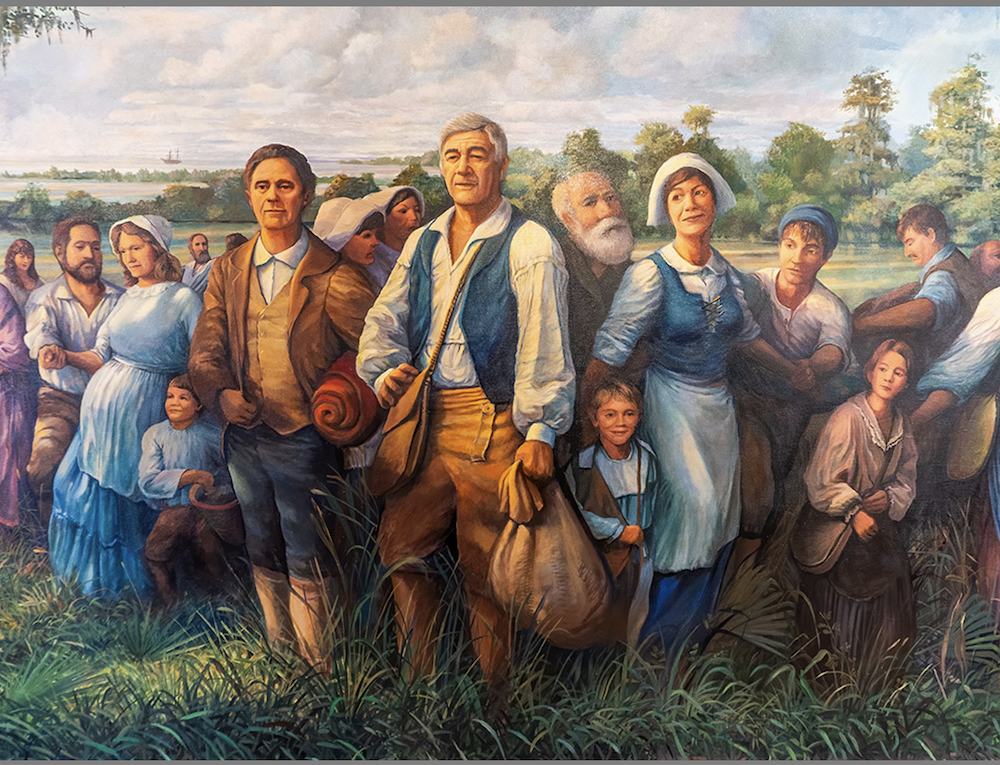
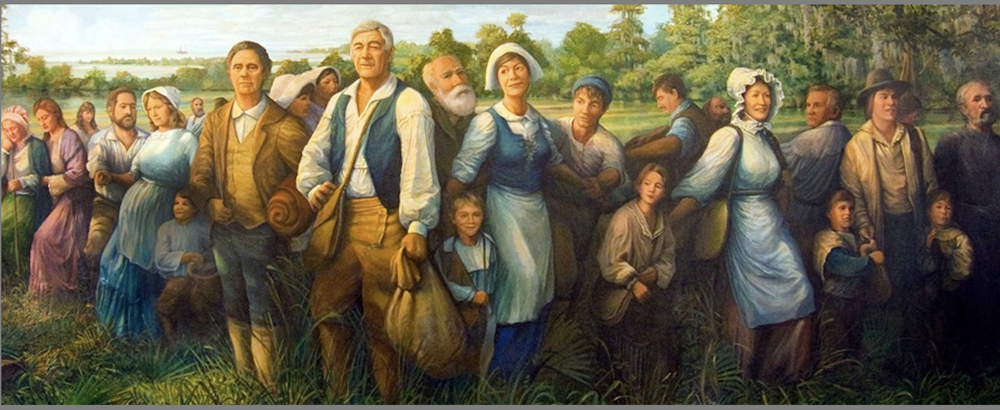
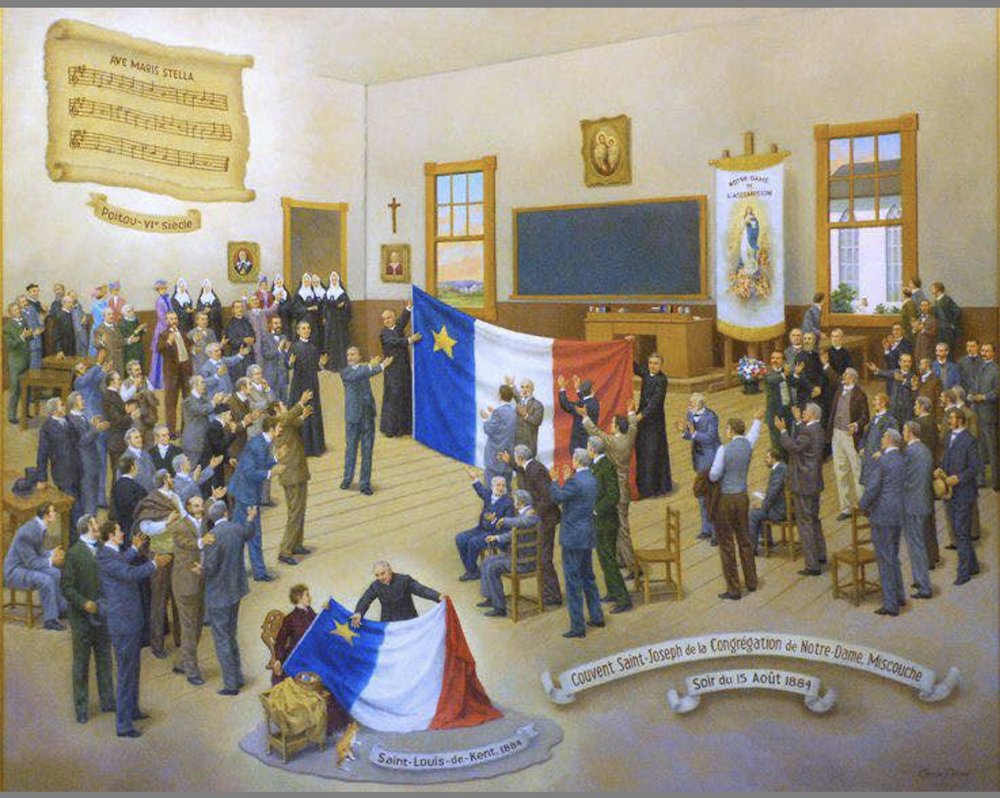
Part of a large mural of the arrival of first Acadian settlers in Louisiana, on display at the Acadian Memorial Foundation, St. Martinville, Louisiana. The museum is presented further down in this Bulletin.
https://acadianmemorial.org/
| | |
Editorial
Last month's Bulletin was dedicated to Samuel de Champlain, the Founder of New France. It was sent on August 15, precisely the National Day of the Acadians. It is therefore logical to dedicate this month's Bulletin to these early French settlers on the American continent: the Acadians in the north and the Cajuns in Louisiana. While our Society only concerns itself with today's United States, it is important to remember that, not so long ago, they and their families straddled the borders between present-day Canada and the United States. Inevitably, we will encroach a bit on our Northern neighbor's history.
The Deportation of French settlers in Acadia started on September 10, 1755. On that tragic day, 315 British soldiers and militiamen gathered Acadian families to transport them using 16 requisitioned boats, mainly to New England territories (mostly Massachusetts). Out of an estimated population of about 13,500 Acadians, over 12,600 were deported. The others managed to reach Quebec and the remaining French Acadia (which included Gaspésie, Cape Breton Island, and Prince Edward Island). Thus started a long and tragic odyssey. However, their story is a remarkable tale of resilience and fighting spirit, in spite of suffering what would be called 'ethnic cleansing' today. Two hundred and seventy years later, they still share a strong cultural unity with Quebecers, their French Canadian brethren.
From Maine to Louisiana, you will find dozens of memorials, plaques, and markers celebrating their common roots and, we dare say, the "joie de vivre" that is typically part of French culture. Come travel with us in the following pages, listen to their upbeat music, taste their wonderful cuisine, and remember with us that if history repeats itself in various latitudes, the determination to survive vanquishes all odds.
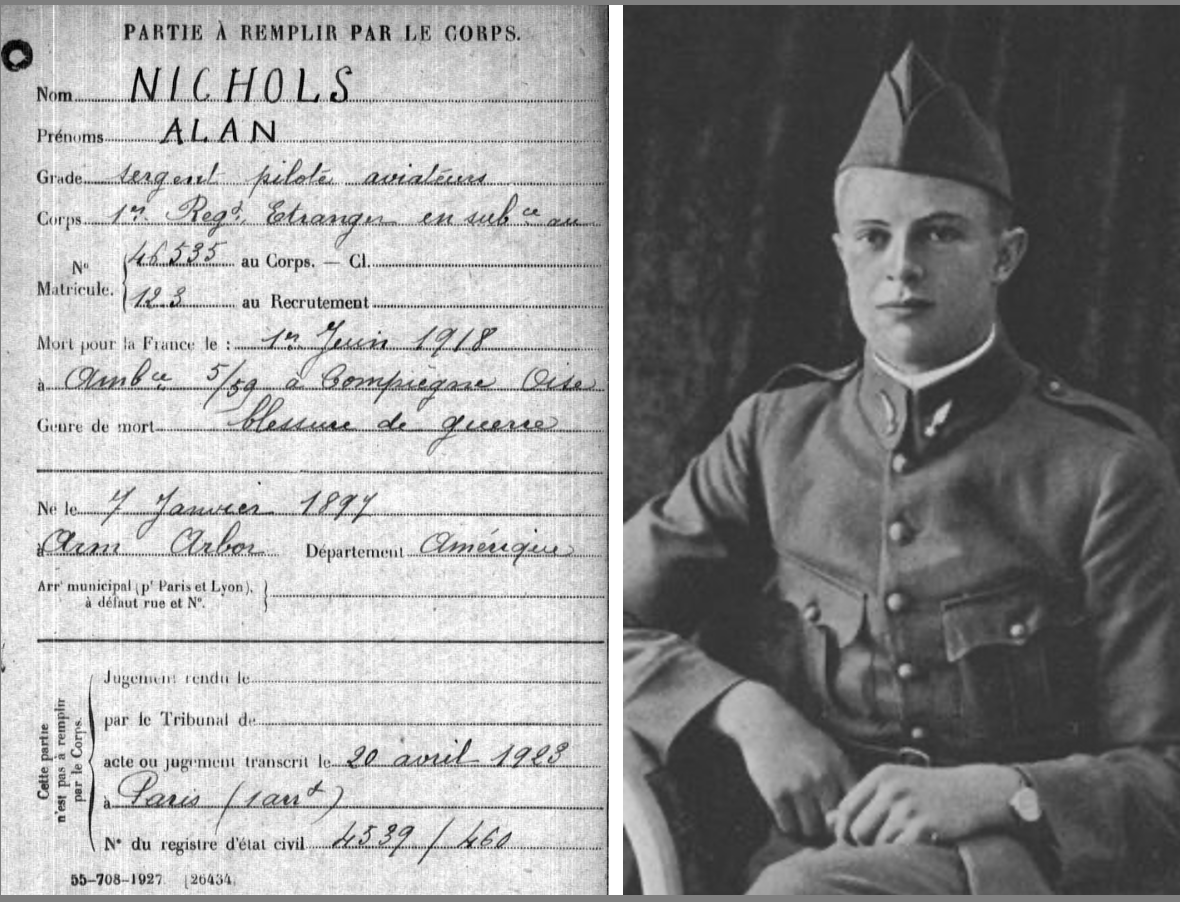
As always, Part Two of our Bulletin will honor this month another brave American volunteer who "Died for France " in World War One: Sergent Allan Hammond Nicols, of California, who was killed in action on June 1st, 1918 near Compiègne, in the Oise département in Northern France.
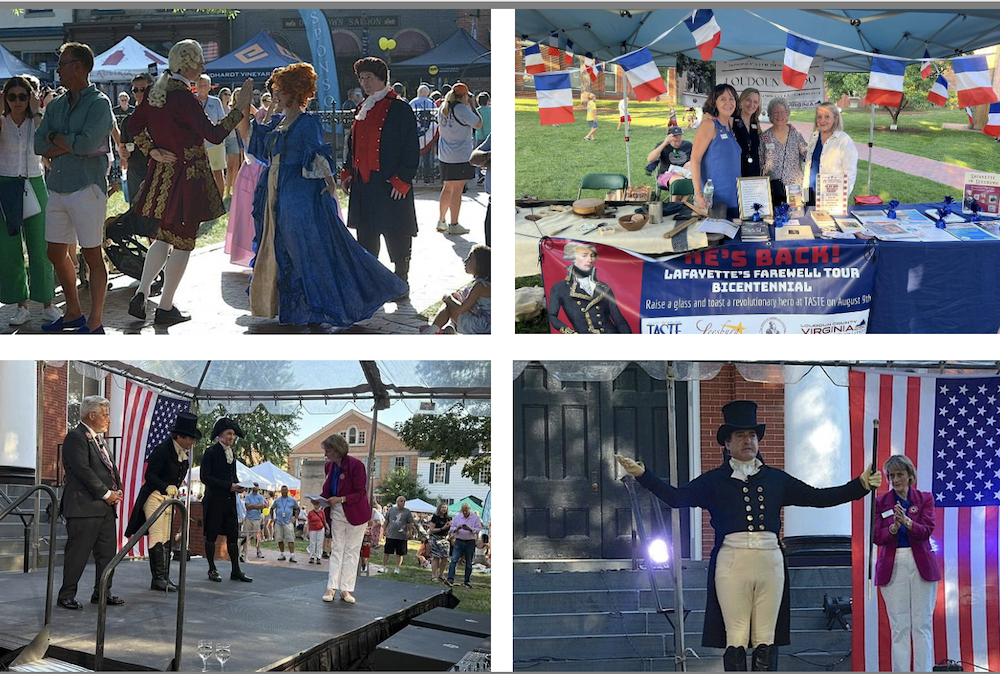
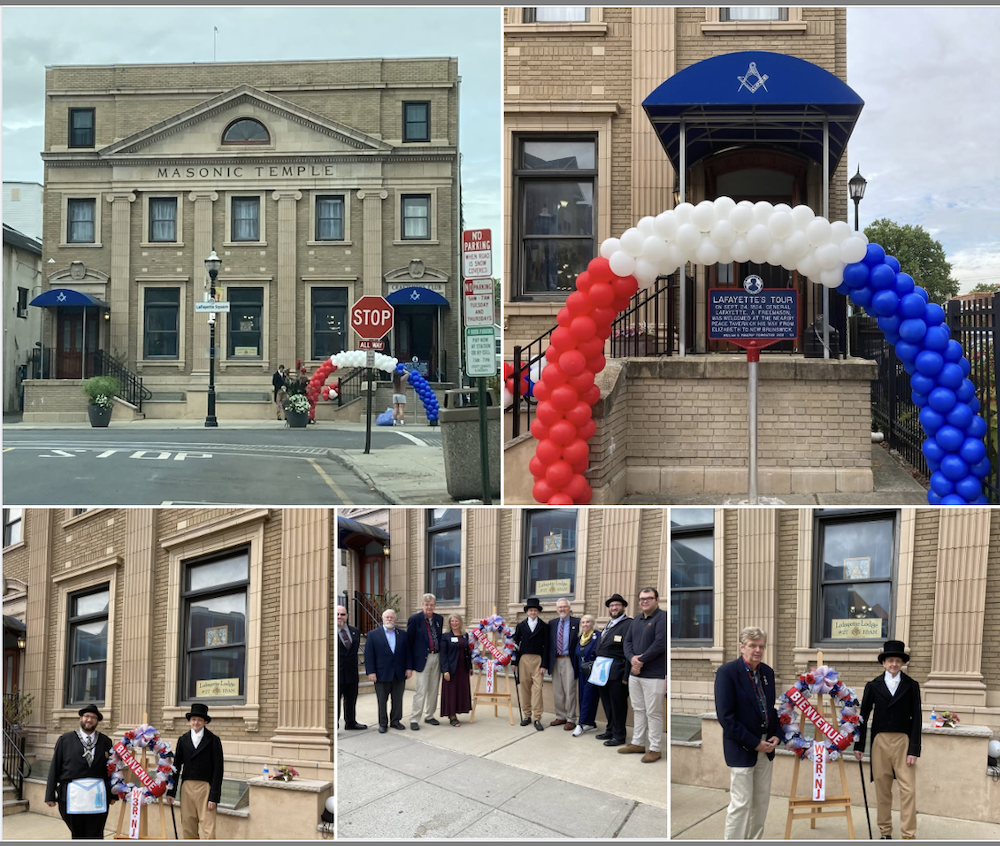
Part Three, "News and Save the Dates" will cover events since our last Bulletin. As the Bicentennial of Lafayette's Farewell Tour is now over, we sincerely extend our praise to Alan Hoffman, Chuck Schwam, Bonnie Fritz, Susan and Mark Minker, Dr. Patti Maclay, Robert Kelly Jr., Kat Smith and the hundreds of volunteers working tirelessly at the American Friends of Lafayette, who did so much to educate thousands of our contemporaries on the legacy of the general, who remains to this day the very best friend of America. We will also share the latest news from other civic and patriotic associations, as well as our own updates on several important projects your Society has been actively pursuing. As you will see, Rochambeau is very much celebrated, and rightly so.
We thank you for sharing our Bulletins and activities with friends and acquaintances, and for encouraging them to join us or support one of our worthy causes - - all furthering the long historical ties between the United States and France.
On behalf of the Board of Directors,
Thierry Chaunu
President, The American Society of Le Souvenir Français, Inc.
| | |
PART ONE
The Acadians and the Cajuns
Two destinies for the same people
| | |
Who are the Acadians? Who are the Cajuns?
• The Acadians were French settlers who established colonies in what is now the Maritime provinces of Canada, particularly Nova Scotia (then called Acadia), beginning in the early 1600s. They developed a distinct culture and identity over more than a century, becoming skilled farmers who reclaimed marshlands and built prosperous communities.
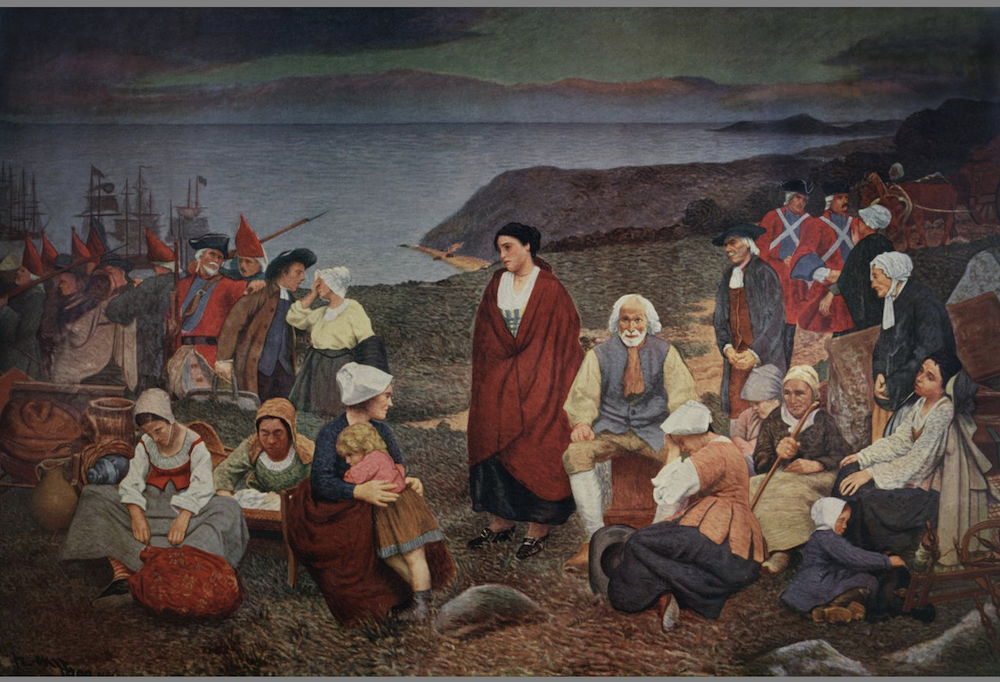
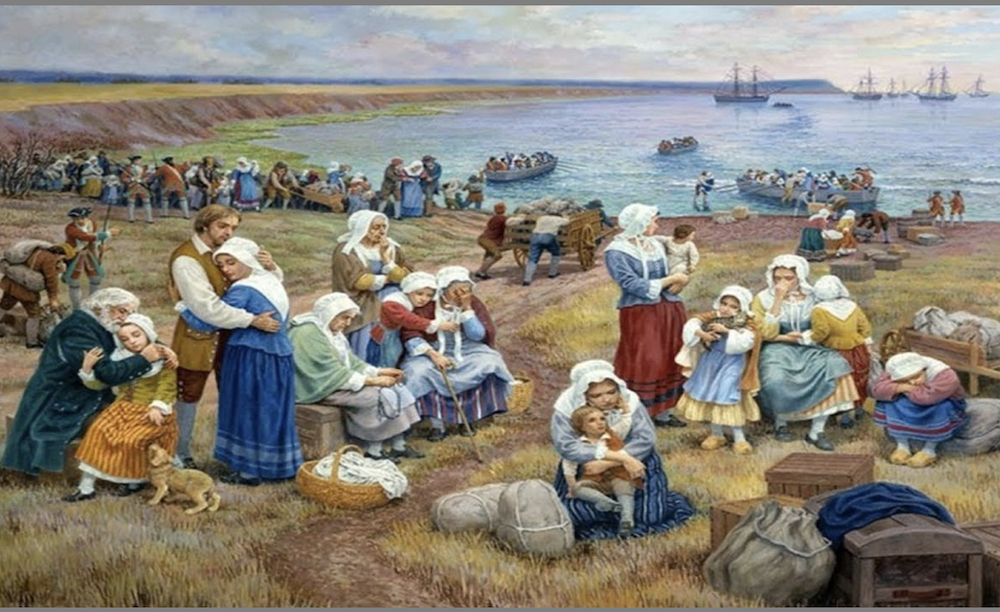
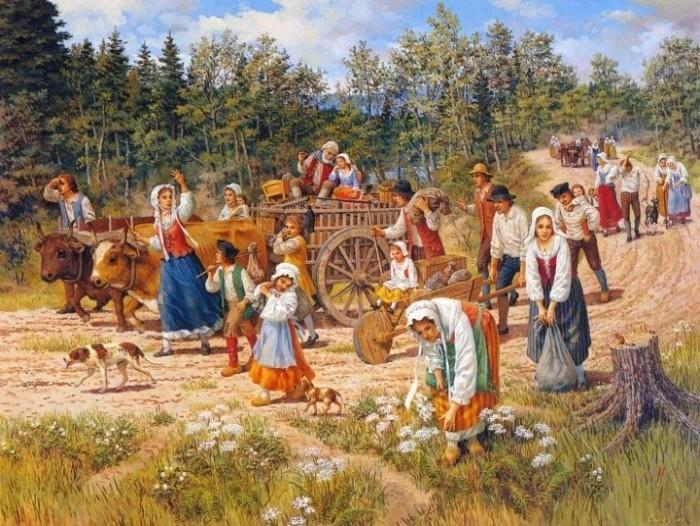
• The tragic turning point came in 1755 during the Great Deportation, or "Le Grand Dérangement," when British forces forcibly expelled thousands of Acadians from their homeland. Families were separated and scattered across various locations, including the American colonies, the Caribbean, or back to France. Many died during this traumatic displacement, and entire communities were destroyed.
• The connection to Cajuns comes through those Acadians who eventually settled in Louisiana, particularly after 1765. "Cajun" is actually a linguistic evolution of "Acadian" - over time, "'cadien" became "Cajun." These Louisiana Acadians adapted to their new environment, blending with other cultures including Spanish, German, Anglo-American, and African influences, while preserving core elements of their Acadian heritage. They developed the distinctive Cajun culture we know today, with its unique cuisine, music, and dialect of French.
• So while all Cajuns can trace their ancestry back to the original Acadians, not all Acadians became Cajuns - many settled elsewhere or remained in the Maritime provinces after later returning. The Acadians represent the original French colonial culture, while Cajuns represent the specific Louisiana evolution of that heritage after the deportation.
| | |
Above:
"Exile of the French Settlers in Acadia by William H. Withrow (1887)", Painting by Claude Picard of St-Basile, New Brunswick, Canada. This and five other such paintings depicting the Deportation and losses of the Acadians from their lands hang in the Grand-Pre Memorial Church at Grand-Pre, Nova Scotia, Canada. Everything was destroyed including homes, farms, livestock and cemeteries. These paintings hang at the Grand-Pré Historic Site, Nova Scotia.
| | |
• Early Period (1604-1713): Acadians first settled in 1604 in what the French called "Acadie" (roughly today's Nova Scotia, New Brunswick, and parts of Maine). For over a century, control of this territory ping-ponged between France and Britain through various wars.
• Treaty of Utrecht (1713): This treaty ended the War of Spanish Succession and permanently transferred Acadia to Britain, renaming it Nova Scotia. However, the Acadians were allowed to stay and practice their Catholic faith, with the understanding they should remain neutral in future conflicts. This created a problematic situation - French Catholic subjects living under British Protestant rule in a strategically important border region.
• Growing Tensions (1713-1755): For four decades, the Acadians lived under British rule while maintaining their French culture and refusing to take an unconditional oath of allegiance to the British Crown. The British became increasingly suspicious, especially as conflicts with France continued (King George's War, 1744-1748). In 1747, French troops caught off guard and defeated a group of New England militia stationed in Grand-Pré.
The founding of Halifax in 1749 brought more British settlers and military presence.
• The Great Deportation (1755): During the French and Indian War (called Seven Years' War in Europe), British Governor Charles Lawrence decided the Acadian population posed too great a security risk. The deportation scattered 12,600 Acadians across the American colonies, the Caribbean, and back to Europe.
• Post-Deportation Movements: After the Treaty of Paris (1763) ended the Seven Years' War and gave Britain control of all of New France, displaced Acadians began seeking new homes. Many who had been sent to other American colonies gradually made their way to Louisiana, which Spain had received custody from France in 1762. The Spanish welcomed them as Catholic settlers who could help populate and defend Louisiana. Some tried to return to their ancestral land in today's Nova Scotia and Maine.
In the following pages, we will visit together all the memorial sites, principally in Maine and Louisiana, and share the inscriptions of the many markers and plaques, which narrate this poignant and inspiring story.
But first, we let Prof. Norman Desmarais, professor Emeritus at Providence College, and our Regional Delegate for New England, share with us his personal views on the resiliency and legacy of this most valiant people.
| | |
The Acadians
by
Prof. Norman Desmarais
| | |
"King Henry IV signed the Edict of Nantes in April 1598, putting an end to the religious wars in France and Europe and establishing a period of religious toleration which lasted 87 years. King Louis XIV’s revocation of the edict in 1685 renewed the hostility of the predominantly Catholic country against French Protestants, mainly the Huguenots (French Calvinists). Many French Protestant families emigrated to the northeastern region of North America in the 17th and 18th centuries. They settled in Acadia, comprising what is now the Canadian Maritime Provinces of New Brunswick, Nova Scotia and Prince Edward Island, the Gaspé peninsula in eastern Québec, and the Kennebec River in southern Maine. They also settled in major seaport cities like Boston, Massachusetts and New Rochelle, New York.
Between 1755 and 1764, the British embarked on a program of ethnic cleansing called Le Grand Dérangement (The Great Upheaval), or the Acadian Expulsion. It involved the forced removal of the Acadian people from the Maritime provinces of Canada, primarily Nova Scotia. The British employed deceptive tactics, luring Acadian men into churches and then locking them inside. Others were seized from their homes and fields. The Acadian families were boarded onto ships that were sent away to God knows where. Many of the ships arrived in Louisiana where the families settled and became known as Cajuns, a corruption of the word Acadiens or Acadians.
About a century later, the poor harvests and harsh winters in Québec spurred many Québecois to move to mill towns along New England rivers where they could make as much money in a month as they could on the farm in a year. Many of the mill owners came from Belgium and France and welcomed a work force that spoke their language.
Many people wanted to assimilate quickly into the American culture. Some anglicized the pronunciation of their names, such as Beaudoin who were called Bowdoin. Others adopted English names, such as Apollos Rivoire who changed it to Paul Revere (the grandfather of the midnight rider). Others translated the French names to English such as Boulanger or Charpentier who became Baker and Carpenter. Later, immigration officials who didn’t know the language of the immigrants transcribed the names phonetically, introducing spelling variations. All of these practices contribute to making Franco-American geneology a nightmare.
The Québecois settled in homophone communities that became known as p’tits Canadas, Little Canadas, to preserve their language, faith and traditions. They came in such large numbers that some of the mill towns, like Woonsocket, Rhode Island, was noted as having more French speakers than Montréal in the 1920s. By the 1960s, the “ethnic ghettos” – French, Italian, German, etc. -- had deteriorated to the point that they were torn down in urban renewal projects. These projects were also a sort of ethnic cleansing as the various ethnic minorities were now broken up and forced to disperse and assimilate with the rest of the population."
-- Prof. Norman Desmarais
| | |
Some of the 13 colonies refused to accept those "internal enemies" who would not swear loyalty to the British crown since 1713, when Acadia was ceded to England by the Treaty of Utrecht.
Essentially, the leaders of the 13 colonies were unsure how to handle the Acadian refugees: Were these "French Neutrals" truly enemies of England or just displaced British subjects?
This is why the treatment of Acadians varied from one American colony to another, as is recounted in the following pages.
| | |
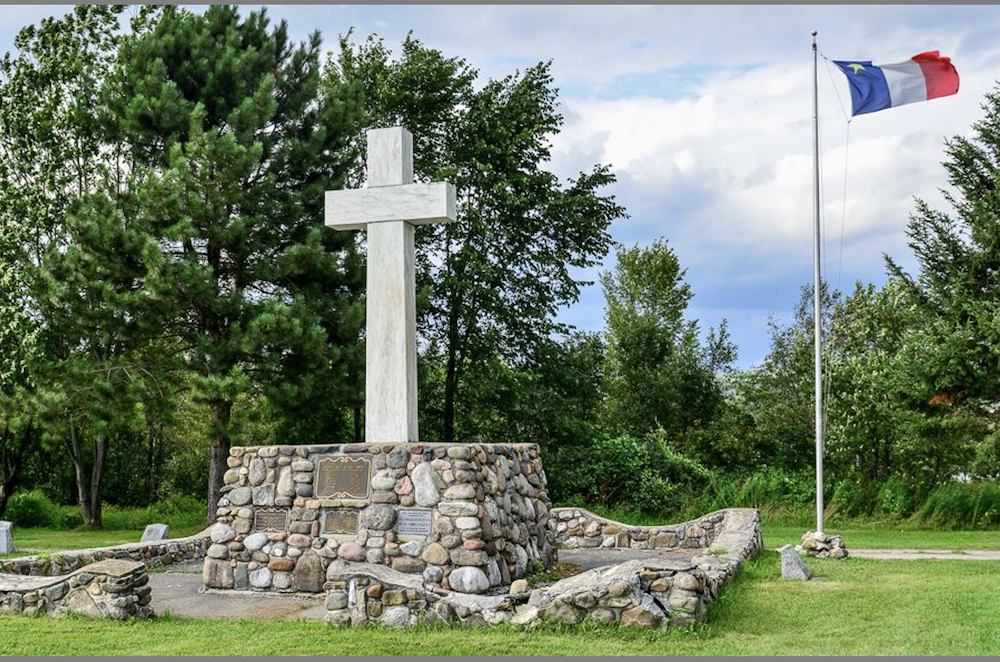
• The Acadian Landing Site, referred to as the Acadian Cross Historic Shrine, holds historical importance for the French-American Acadian community in far northern Maine. Situated on the southern side of the Saint John River, east of Madawaska, and distinguished by a large marble cross, it is traditionally recognized as the location where the first Acadians arrived to settle in this area of the upper Saint John River.
• The site is marked by a large marble cross, erected in 1922.
• The site was listed on the National Register of Historic Places in 1973.
• The first Acadians traveled up the St. John River from the Fredericton area and arrived in the Madawaska area in the summer of 1785. They first camped on the south side of the river, two miles below the Native American village. It was on this spot that they erected a cross. The spread out, making their homes along the banks of the St. John, Green, and Madawaska Rivers.
• The erecting of the first Cross in June 1785, upon setting foot on the banks of the river at St. David. Sixteen original settlers had expressed their faith in God and in the new land. Today, it is referred to as “The Acadian Cross”, “The Landing Site” and “Cross on the Flats”. The Cross and the Cross site is used as a point of reference, from which all Acadian history in the St. John Valley, starts.
Cross, “Acadian Landing Site”
Acadian Cross Historic Shrine
774B Main Street, Madawaska ME 04756
GPS: 47.353317, -68.273183
Plaques:
• Inscription:
1785
Acadian Cross Historic Shrine
En Honneur de Nos Pionniers
In Honor of Our Pioneers
Alexander Ayotte / Charlotte Saucier • Antoine Cyr / Genevieve Violette • Firmin Cyr / Ursule Rol, Euphrosine Cyr • Francois Cyr / Marie Anne Guilbeau • Jacques Cyr / Elisabeth Belanger • Olivier Cyr / Anastasie Lebrun, Madeleine Theriault • Pierre Cyr / Madeleine Ayotte • Joseph Daigle / Charlotte Lefebvre • Joseph Daigle, Fils-son / Theotiste Cyr • Pierre Duperre • Baptiste Fournier / Felicite Martin, Marie Mazerolle • Louis Mercure / Madeleine Thibodeau • Michele Mercure / Angelique Potvin • Paul Potier / Judith Thibodeau • Louis Sansfacon / Magdeleine Thibodeau, Marie Anne Savoie • Baptist Thibodeau / Marie Leblang
"Plaque Donated by American Legion Thomas O. Cyr Post 147"
1985
• Inscription:
Kchidamidput — En Honneur — In Honor
”Bemkiskok, Milowtehmbitin, Nmusshun, Gogimilkoon, Youd Mootkin.”
Negoot–Gook Sagam Francois – Xavier
• • •
"Aujourd’hui, la main ouverte, mon coeur te donne une partie de ce pays."
Chef Malecite Francious-Xavier
• • •
”Today, hand extended, my heart gives you a part of this country.”
Malecite Chief Francois-Xavier
Bicentennial Project
Madawaska Historical Society
1785-1985
| | |
Tante Blanche Museum
St. David, Maine
| | |
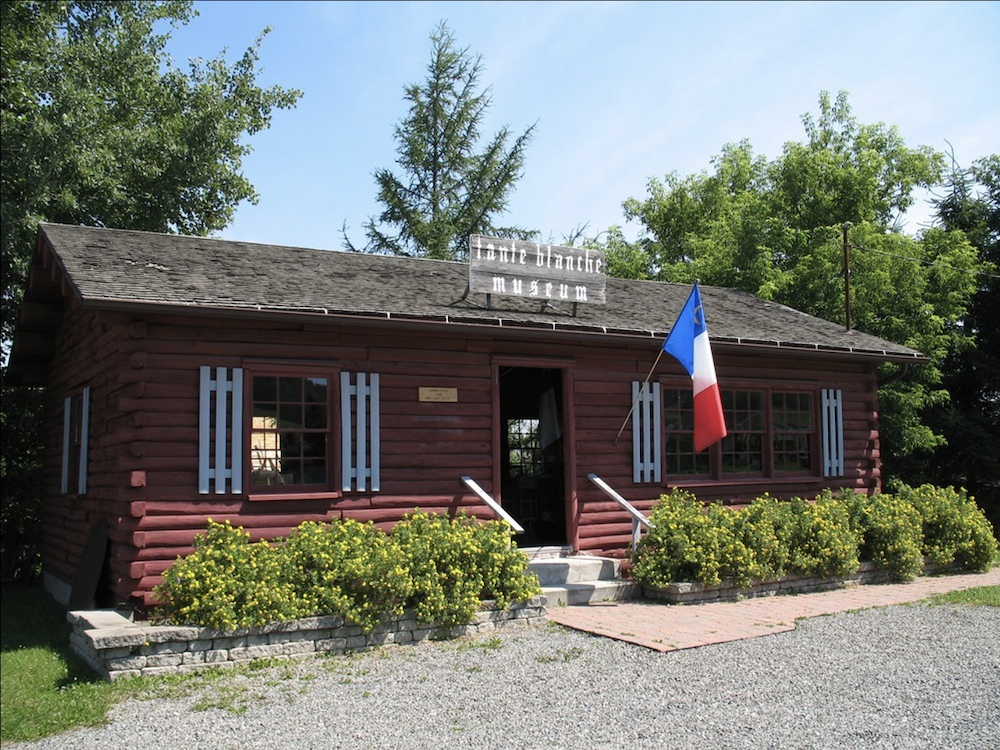
Tante Blanche ("Aunt Blanche") was a remarkable figure - she became such a legendary and beloved leader during those difficult early years in the Madawaska Valley. Her story is a wonderful example of the resilience and community spirit of the Acadian people who settled in northern Maine.
This interpretive marker says it all:
Marker & Museum, “Acadian Heroine: Tante Blanche”
Acadian Cross Historic Shrine
774B U.S. Rte 1, St David, ME 04773
GPS: 47.353317, -68.273183
• Inscription (bilingual):
“Two years of flooding, early frosts, and harsh winters forced many settlers to flee in the winter of 1797. While the remaining men were away hunting, an eight day storm descended. Tante Blanche strapped on snowshoes and loaded a sled with spare provisions gathered from neighbors, including her brothers Firmin and Olivier. She traveled door-to-door, caring for the sick and sharing the collected food and warm clothes. She helped to save the settlement facing la misère noire (black famine). Her story has come to embody the Acadian community: close-knit and generous in time of need. The Madawaska Historical Society named this museum in her honor.
Voices of the Valley
”Tante Blanche is our very own Evangeline. She was related to almost everyone because she married a Cyr (and they never let you forget it). Snowshoes are not just a good sport but remind us how she saved the Valley.” —Father Jacques LaPointe”
Did You Know that Tante Blanche was a real person?
Marguerite-Blanche Thibodeau [1735-1810] was the granddaughter of the only real person Acadian Heroine: in Longfellow's poem Evangeline. Married to Joseph Cyr, one of the first settlers. She was related to so many of her neighbors that she was called Tante (Aunt) Blanche. So renowned was Tante Blanche that she was buried inside her parish church across the river in Saint-Basile, an honor reserved for clergy. In 1981 a family reunion attracted about 4,000 of her Cyr relations from around the world."
| | Madawaska Territory, Maine | | |
Above:
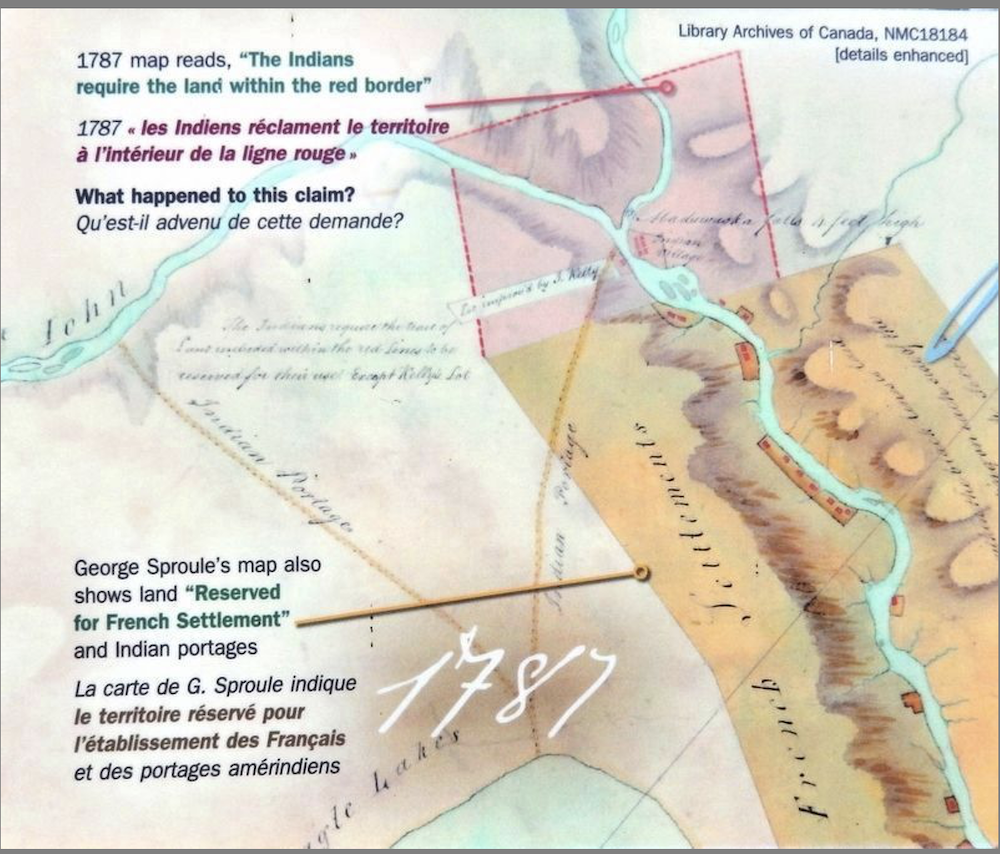
Map 1787 Courtesy Library Archives of Canada (reproduced as part of the marker)
| | |
The Historical Republic of Madawaska (1827-1842)
• The area was actually an unrecognized country that existed from 1827 to 1842 . The origins of the unorganized republic lie in the Treaty of Paris (1783), which established the border between the United States of America and the British North American colonies but it ignored the area around the confluence of the St. John and Madawaska rivers.
• This border ambiguity left the region in limbo. In 1825 an American settler, John Baker, petitioned for his area of New Brunswick to become part of Maine and the United States; his wife Sophie Rice was involved in the effort as well.
• When both Britain and the United States claimed the territory but neither effectively governed it, the residents essentially declared themselves an independent republic.
• Later, it was the center of the bloodless "Aroostook War". The final border between the two countries was established with the Webster-Ashburton Treaty of 1842 which ended the republic's existence.
The Modern "Republic of Madawaska"
• In 1949, under the impetus of two Edmundston citizens (on the Canadian side), the concept of the Republic of Madawaska was officially put forward in order to accentuate the region's particular tourist flavor. Its promoters give it a coat of arms, then a flag. They even created an "Order of the Knights of the Republic”.
• In Maine, the Madawaska region is unique because over 90% of the county's population speaks French. Its Francophone population are known as "Brayons".
Marker, “Territoire de Madawaska”
Acadian Cross Historic Shrine
774B Main Street, Madawaska ME 04756
GPS: 47.348967, -68.276350
• Inscription (bilingual – English version):
— Acadians settling where faith, farms, and family could grow —
British encourage the settlement of the Madawaska Territory. The British — having lost many American colonies in 1783 — wanted settlers to help secure the St. John/Grand Portage route. They offered 200 acres here to any settlers willing to move to the Territory.
Acadians land here with faith, family, and assets. In 1784, several groups of Acadians did petition and were given permission to settle here. They sold their property in the newly-crowded lower St. John Valley where British Loyalists were being relocated from the United States. The French-Acadians wanted to resettle upriver here in the Valley where land was free, plentiful and fertile, attracted in part by the proximity of priests in nearby Quebec. They arrived with knowledge and strong regional family ties — able to create a thriving French-speaking community. By 1790, the rapidly growing French-Acadian settlement numbered nearly 200 people.
Why did Acadians settle here? In 1783, the Lower St John’s Valley had been home to only 1,400 white people including a number of Acadians. Suddenly, they were overwhelmed by the arrival of 12,000 Loyalists, refugees from the United States.
Crowded out? It seemed clear that soon there would be too little land for Acadian sons to farm. Now, surrounded by Protestants and with so few Catholics, it also was unlikely they would be able to attract a priest. The prospect of a land where their families could prosper and grow made the upper St. John Valley an attractive place to settle.”
Erected 2014 by Maine Department of Transportation.
| | |
The Musée Culturel du Mont Carmel
Grand Isle, Maine
| | |
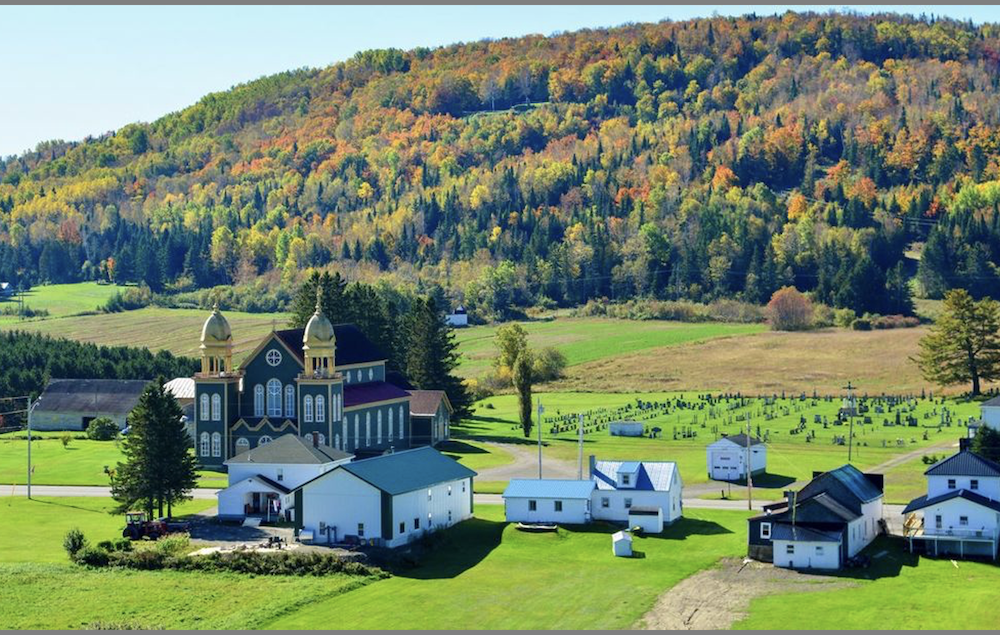
• The Musée culturel du Mont-Carmel, a former Roman Catholic Church that is now a non-profit cultural museum, is located in the charming parish village of Lille-sur-St-Jean. This institution is focused on preserving and promoting Acadian and Québecois culture and history in the St. John Valley, situated in the far northern part of Maine.
• Established in 1984 after the church was decommissioned and religious services ended, the museum is managed by the Association culturelle et historique du Mont-Carmel, its parent organizatio• n.
• The site was added to the National Registry of Historic Places in 1973 and has been undergoing significant restoration. It features a remarkable collection of religious artifacts and vestments, sculptures, folk and decorative art, Acadian and Québecois pine furniture, and items dating back to the 18th century.
• "The grounds of the Musée and its former parish are the ancestral homelands inhabited by the Maliseet (Wolastoqiyik) people for thousands of years.
We recognize that we are on indigenous land. In addition to the Maliseet, the broader place we now call Northeastern Maine is home to the sovereign people of the Wabanaki Confederacy, which include the Penobscot, Passamaquoddy, Abenaki, and Mi’kmaq peoples. We exist on their unceded homelands." (Museum website)
| | The Acadian Village of Van Buren, Maine | | |
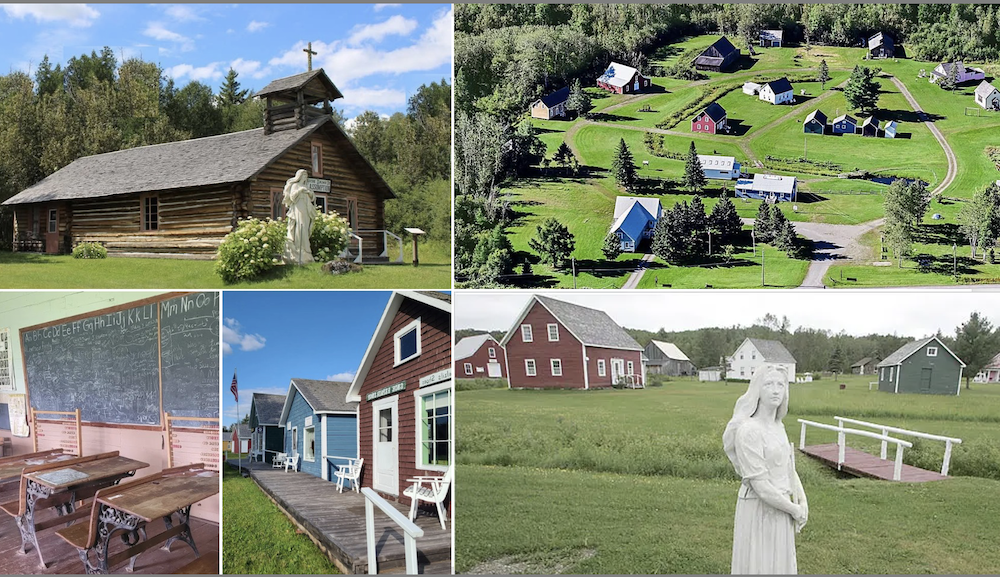
• The 17 buildings that overlook the St. John River in the Acadian Village preserve the cultural heritage of the Acadians who settled in the St. John Valley in the mid-1700s.
• The settlement showcases and includes traits that are characteristic of the Acadians. These skills involve fishing, lumbering, and shipbuilding. Several of these homes are notable for their unique Maine Acadian architecture, featuring nautical elements like "ship knees" that are used as supports in construction, which can be observed in the Morneault house and the Acadian barn.
• Morneault House
Constructed from 1855 to 1857, this is the oldest residence in the valley. The house showcases numerous instances of Acadian architecture, featuring nautical elements in its design, such as "ship knees" for support. The walls are sealed with unburned lime and flax. In the early 1900s, the Morneault house functioned as a post office. It was originally located in Grand Isle, Maine.
• The Levasseur-Ouellette House, constructed in Cyr Plantation, Maine, in 1859, exemplifies the homes built by prosperous Maine Acadians during the mid-nineteenth century. These houses reflect the Georgian massing style that was favored on both sides of the North Atlantic in the early 19th century. The walls of these one-and-a-half-story homes are made of square-hewn logs (pièce-sur-pièce) and are covered with clapboard siding.
The buildings have either been relocated to the village or constructed on-site. The site is managed by Notre Héritage Vivant/Our Living Heritage. The Acadian Village is listed on the National Register of Historic Places.
| | |
• As per the Commonwealth of Massachusetts Archives (Volumes 23 and 24), in December 1755 and during the early months of 1756, British ships including the Dove, Edward, Elizabeth, and Two Sisters, along with an unidentified schooner, reached New London, Connecticut's main seaport, carrying over 1000 Acadian deportees.
• Overall, the roughly 1,000 Acadians sent to Connecticut were treated well. Before they arrived, the colonial Legislature passed a law regarding their distribution in the settlement, which helped citizens prepare for living together. In some instances, Connecticut residents offered empty homes to Acadian families. Others helped fund the journey of Acadians wanting to move back to Quebec via the Albany, Hudson, and Richelieu rivers, passing through lakes George and Champlain.
• Norwich anticipated 19 Acadians, Fairfield 17, Hartford 13, New London 12, and Bolton 3.
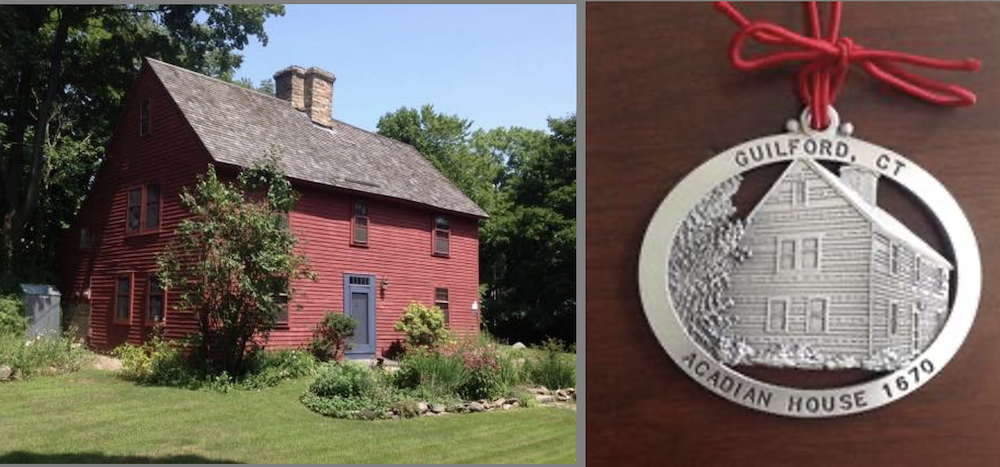
• Guilford welcomed 11 French Acadians in the spring of 1756, including at least 8 members of the Hebert family—Rene dit Groc Hebert and Marie Boudreau, along with their adult son, Pierre, his wife, Elisabeth Dupuis, and their four children, Fabien, Marie Isabelle, Anastasie, and Simon. Five additional children were born to them in Guilford. Marie Hebert likely passed away in Guilford, but Rene Hebert eventually returned to Montreal, a journey partially supported by the town of Guilford. Their children and grandchildren stayed in the English colony, their lives and those of their descendants becoming part of Guilford's history over time.
The "Acadian House"
37 Union Street, Guilford, CT 06437
GPS: 41.285422, -72.679534
• Inscription:
"In Guilford, the house at 37 Union Street, constructed in 1670 by Joseph Clay, is fittingly called the “Acadian House.” In 1756, Samuel Chittenden owned it. Local legends say the house was empty, so its owner chose to offer it to René Hébert and his family. This charming house has been listed on the National Register of Historic Places in the United States since 1975. To our knowledge no marker exists, which would be a worthy project for our Society in the future."
| | |
Acadians in Massachusetts,
New York and Pennsylvania
| | |
Above:
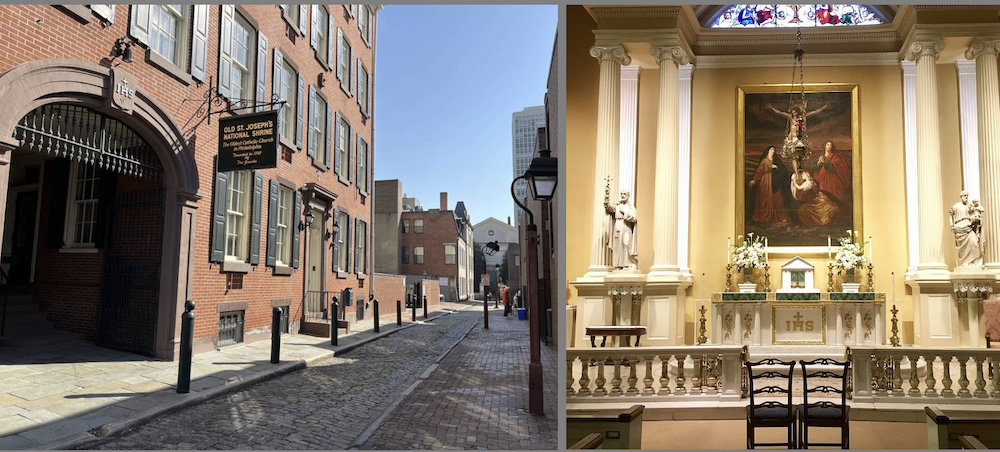
Left: Old St Joseph National Catholic Shrine in Philadelphia, where Acadian deportees worshipped. The Marquis de Lafayette and the Comte de Rochambeau both attended St. Joseph during their stay in America. Soldiers from the American and French armies held a high mass at St. Joseph's following the victory at Yorktown. https://phillyguides.org/event/5979/
Right: Altar of St Joseph Catholic Church, https://www.facebook.com/OSJ19106/
| | |
Massachusetts
• In Massachusetts, with a few exceptions, the 961 Acadian deportees were distributed across more than 100 communities in Massachusetts with kindness, following the Massachusetts Act of March 6, 1756, which made provisions for the recently arrived inhabitants of Nova Scotia. This humanitarian law mandated that local authorities supply necessary farming tools, weaving, spinning, and other crafts, with a limit of forty shillings per person. Additionally, suitable housing was to be provided for all family heads who agreed to be self-sufficient: see Laws of the province of Massachusetts, 1755-1756, Chapter 35.
• For instance, in the 18th century, Joseph and Anne Doucet lived in Gloucester with their ten children, along with 72-year-old widow Eliza Janvire, whose husband was Jean Cyr. Champlain referred to Gloucester as "Le Beau Port" in 1606.
• Another example, in Boston, 174 Acadians resided near the Paul Revere House, which was built around 1680 at 19 North Square, which is now a museum.
• Aside from a few petitions to the House of Representatives and some motions in the Massachusetts General Court to claim their rights, the Acadians' presence in the "Old Colony" (of Plymouth) is largely undocumented.
Still, from what we know, he kindness of the local people and the generosity of the political leaders should be acknowledged.
New York
• New York, in 1756, was a town of migrants with over 13,000 residents.
• In April and August of that year, three groups of Acadians arrived in New York. The first group, consisting of 94 people, reached the city on April 28th from Cape Sable, Acadia (Nova Scotia), aboard the schooner Mary. Two days later, the tall ship Experiment docked in New York with 150 passengers. The third ship left Annapolis Royal, Acadia, on December 8, 1755, carrying 200 Acadians, and arrived in New York in late August 1756.
• Acadian exiles were held and counted on Governors Island in front of New York City before being distributed across six nearby rural counties in May 1756. Often, their names were badly misrecorded because the enumerators wrote them phonetically or created their own versions. Examples include Ba Selena, Francis Quela, John Malie, Globe Daucet, Louis Giroid, and Peter Lorne. Small groups of Acadians were sent to the counties of Westchester (Bronx), King’s (Brooklyn), Queen’s (Queens), Richmond (Staten Island), Orange, and Suffolk.
• New York law required justices of the peace in the six host counties to ensure that any orphaned teenager was bound to a reputable master for a period of 4 to 7 years, a practice known as indenture, similar to that in New France. “Indentured servants” were provided with housing, food, clothing, and training at the cost of their “master”.
Pennsylvania
• In November 1755, the first Acadians arrived at Province Island, where today's runway 8/26 of Philadelphia International Airport is situated. They were among the poorest in the Quaker City, which had around 13,000 residents. For these Philadelphian humanists, beliefs in equality, charity, and religious freedom were essential. The people of this city known for its "brotherly love" were deeply moved by the suffering of the exiled Acadians, even though they were still reeling from a significant defeat of British troops four months prior against the French at Monongahela, near Pittsburgh (formerly Fort Duquesne). This major loss for the British likely played a role in the decision to expel the Acadians from their home in Nova Scotia.
In October 1755, the British ships Boscowan, Hannah, Swan, and Three Friends departed from Beaubassin, Grand-Pré, and Pisiguit in Nova Scotia, carrying around 500 Acadians to Philadelphia. They arrived on November 18 and 20, 1755, with 454 of them making it to shore. The deportees were taken to the home of plague victims on Province Island, a quarantine area set up in 1743, located at the meeting point of the Delaware and Schuylkill rivers. A fifth ship, the Union, tragically sank at sea with 392 Acadian deportees.
• With assistance from Antoine Bénézet, a Huguenot educator from Philadelphia who was born in Saint-Quentin, France, the Acadians were provided with suitable wooden homes on the north side of Pine Street, between 5th and 6th Streets, in the St. Joseph Catholic parish.
• St. Joseph’s Church (shown above), established in 1733 and attended by many Acadians, is the oldest Catholic church in Philadelphia. Their cemetery is now the northeast quadrant of Washington Square Park.
Marker, "Old St. Joseph's"
321 Willings Alley, Philadelphia, PA 19106
• Inscription (excerpts):
"When the first public Catholic Mass was celebrated here in 1733, Philadelphia was the only place in the thirteen colonies where public Catholic services could be celebrated legally. Those principles of religious freedom enjoyed here, which later became a part of the Constitution of the United States, make Old St. Joseph's a national historic shrine. [...]
From the beginning, the Jesuits at St. Joseph's helped give the growing number of arriving Catholics a foothold in a new land. In the 18th century, they ministered to Acadian exiles in 1755 and refugees from Santo Domingo in the 1790s. [...]
Erected by Old Philadelphia Congregations."
| | |
• In November 1755, four ships with more than 900 Acadian exiles reached Maryland. The exiled Acadians, known as "French Neutrals," were abruptly left on Maryland's shores to take care of themselves. They settled in places like Princess Anne, Snow Hill, Oxford, Newtown (now Chestertown), Georgetown, Fredericktown, Baltimore, Annapolis, Upper Marlboro, Lower Marlboro, and Port Tobacco.
• The Acadian refugees in Maryland faced a hostile reception marked by legal restrictions, economic hardship, social ostracism, and government suspicion. While some individual colonists showed kindness, the overall colonial response was characterized by viewing the Acadians as potential enemies rather than refugees in need of assistance.
• The Maryland government was particularly restrictive, even preventing Catholics from helping their fellow Catholics. Government policy contributed to the appalling conditions by forbidding Catholics to house the exiles. Charles Carroll, the well known and prosperous planter, wrote to his son that: "Many of them would have met with very humane treatment from the Roman Catholics here, but a real or pretended jealousy inclined this government not to suffer them to live with Roman Catholics."
• The colonial government enacted severe restrictions on the Acadians' movement and activities. A 1756 Maryland law prohibited them from traveling more than ten miles from their residence without a pass, and violations could result in imprisonment. The law stated that "if any of the said Inhabitants of Nova-Scotia commonly called French Neutrals, shall be found traveling above the Distance of ten miles from the Place of his or her Abode, or out of the County where he, she or they shall reside, without a Pass from some Provincial or County Magistrate... it shall and may be lawful for any Person or Persons to take up such French Neutral or Neutrals."
• Many Acadians eventually left Maryland for Louisiana, with several boatloads of exiles making an exit from Maryland to the more hospitable government of Louisiana – now under Spanish rule. Starting in 1766, there was a boatload of exiles bound for the mouth of the Mississippi each year for four years. The total number of relocated exiles is estimated to be about 600 persons.
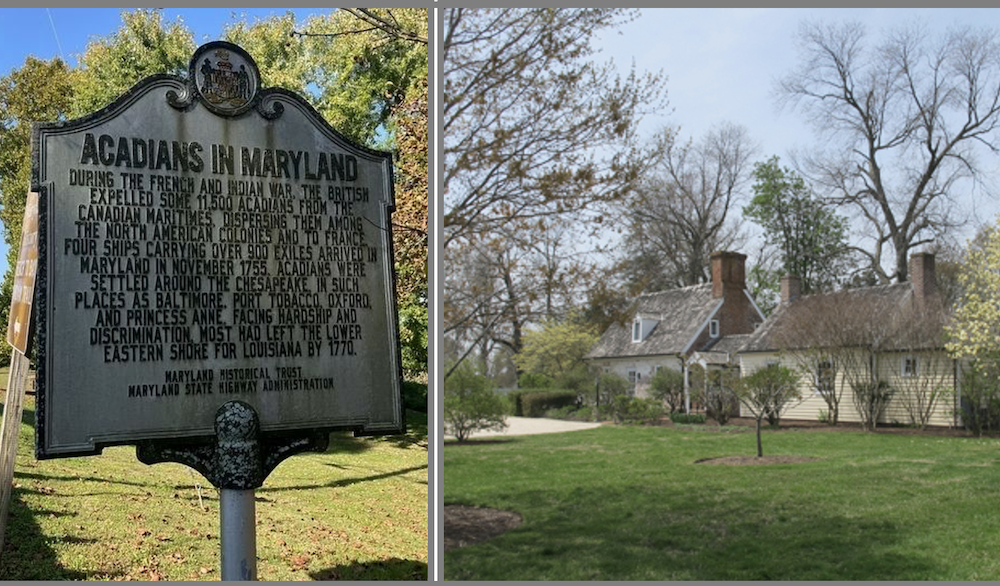
• There are, of course, a number of generous colonists who lent a helping hand. For instance, in 1756, around 50 Acadians were accommodated at Wye House, the residence of Colonel Edward Lloyd III, (photo above). Very detailed information can be found in websites such as: https://www.acadianswerehere.org/ and https://francomaryland.com/
Marker, "Acadians in Maryland"
11754 Mansion St, Princess Anne MD 21853
• Inscription:
"During the French and Indian War, the British expelled some 11,500 Acadians from the Canadian Maritimes, dispersing them among the North American colonies and to France. Four ships carrying over 900 exiles arrived in Maryland in November 1755. Acadians were settled around the Chesapeake, in such places as Baltimore, Port Tobacco, Oxford, and Princess Anne. Facing hardship and discrimination, most had left the lower Eastern Shore for Louisiana by 1770.
Erected 2013 by Maryland Historical Trust, Maryland State Highway Administration."
| | |
Above:
Left: Painting of the Acadian Expulsion order being read by colonel Winslow in the parish church of Grand-Pré, Nova Scotia, Canada, 1755. By Charles William Jefferys - DOUGHTY, Arthur G. Chronicles of Canada, vol. 9, Toronto, Glasgow, Brook & Company, 1916, p. iv. Uploaded from University of MonctonLibrary and Archives Canada Site Page Picture, Public Domain, https://commons.wikimedia.org/w/index.php?curid=503264
Right: Marker, Photo by Brandon D Cross, January 18, 2020, https://www.hmdb.org/m.asp?m=144939
| | |
• Over 600 Acadians were sent to Georgia. On Monday, October 13, 1755, the British ships Jolly Phillip and Prince Frederick departed from Chignecto, Beaubassin in Nova Scotia, carrying around 400 Acadians to Savannah, Georgia, where they arrived after two long months at sea.
• Governor John Reynolds saw their arrival with some concern because his sparsely populated and underdeveloped settlement had only 3,000 residents, half of whom were black slaves, and the Native Americans to the west of Georgia were allied with the French in Colonial Louisiana.
• Still, Acadians were given the option to settle their families in several small villages along the Georgia coast. Those who chose to remain in Savannah built their cabins on the west bank of the Savannah River.
• They had a hard time. Their experience was marked by poverty, religious persecution due to Georgia's anti-Catholic laws and lack of support, leading many to leave for the north or the French colony of Haiti.
• Acadians who wanted to leave their settlement were allowed to construct boats. About 200 Acadians returned to the sea, with some heading north, carried by the Gulf Stream and the wind, while others went south, drawn to Saint Domingue (Haiti).
By the end of 1763, few were left from that first wave of immigration.
• A second wave occurred later, in the early 1790s, when Acadians fleeing slave revolts in Haiti came to Georgia.
• St. Marys was created by a state legislature act on December 5, 1792. However, it wasn't officially incorporated until November 1802.
• Shortly after the town of St. Marys was established, it became a refuge for Acadian exiles. They found there a welcoming community, and their presence continues to be recognized today.
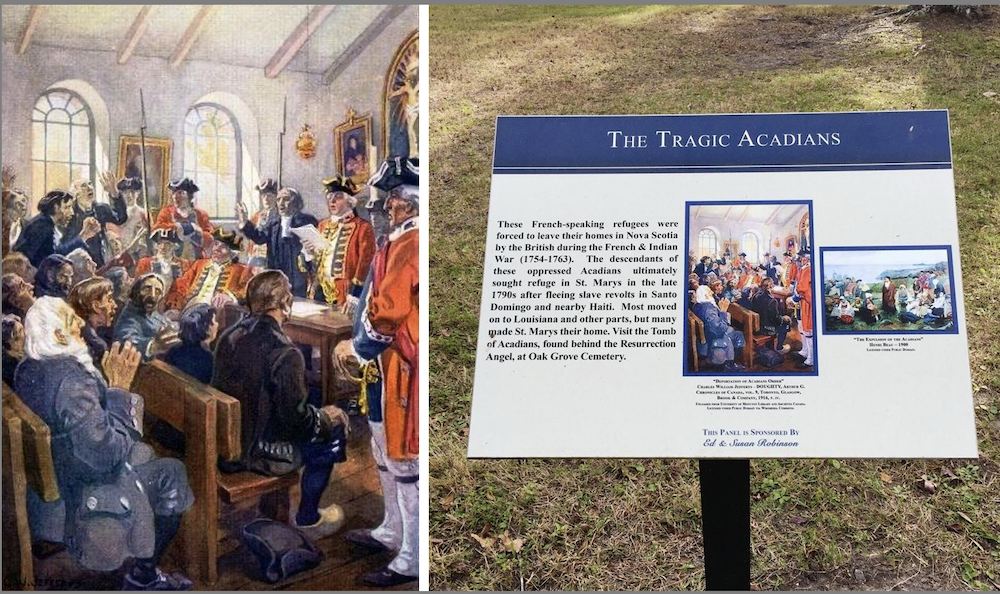
Marker “The tragic Acadians”
Oak Grove Cemetary, Bartlett Street, St Marys, GA 31558
GPS: 30.721800, -81.553817
• Inscription:
“These French-speaking refugees were forced to leave their homes in Nova Scotia by the British during the French & Indian War (1754-1763). The descendants of these oppressed Acadians ultimately sought refuge in St. Marys in the late 1790s after fleeing slave revolts in Santo Domingo and nearby Haiti. Most moved on to Louisiana and other parts, but many made St. Marys their home. Visit the tomb of Acadians, found behind the Resurrection Angel, at Oak Grove Cemetery.”
Erected 2016 by Ed & Susan Robinson.
| | |
Oak Grove Cemetery
St Marys, GA.
| | |
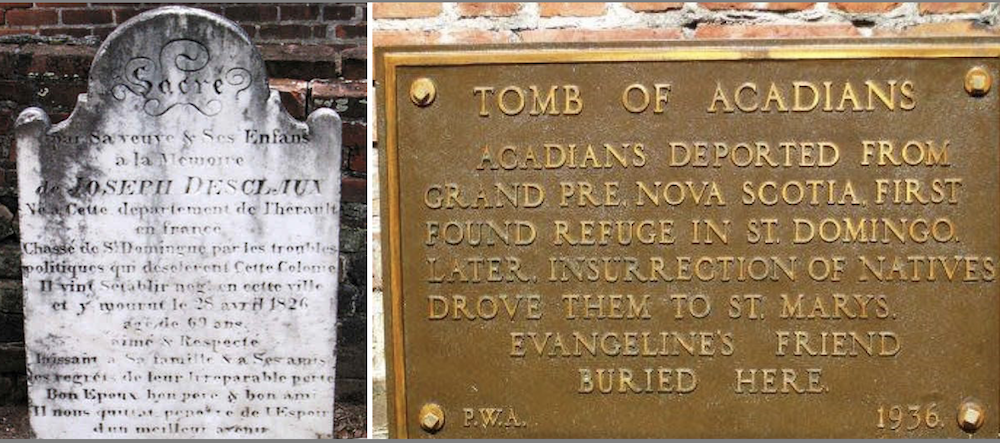
• At the start of the Haitian revolution in August 1791, many Acadians returned to Georgia's coast. Among them was Joseph Desclaux, who was born in Sète (also known as Cette), France, as indicated on his gravestone above.
• Sadly, the unmarked graves in Oak Grove Cemetery will remain unidentified. Even worse, many tombs are believed to be lost forever, buried beneath walls, buildings, and roads. Additionally, during a yellow fever outbreak, entire families perished within days and were buried in mass graves that resembled trenches.
• According to a popular belief, the fate of Joseph Desclaux and his fellow Acadians from Beaubassin was guided by the star Stella Maris of Mary until his death in St. Marys, Georgia.
Plaque, Tomb of Acadians:
Oak Grove Cemetary, Bartlett Street, St Marys, GA 31558
GPS: 30.721800, -81.553817
• Inscription:
"Acadians deported from Grand Pré, Nova Scotia, first found refuge in St. Domingo*. Later, insurrection of Natives* drove them to St Marys. Evangeline's* friend buried here"
P.W.A. 1936
Notes *:
- It is Saint Domingue (today's Haiti), and not Santo Domingo, the Spanish part of the island (today's the Dominican Republic), a frequent mistake.
- Should have been "Black slaves", as there were hardly any Natives left.
-
We will narrate the tale of Evangeline in the pages below dedicated to Louisiana's Cajuns.
| | |
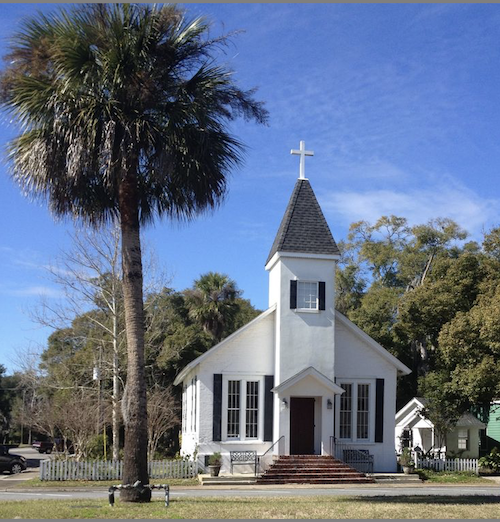
Chapel of Our Lady Star of the Sea
St Marys, GA.
| | |
Eventually, after many years of hard work, several Acadians were able to achieve financial security and contribute to the prosperity of the burgeoning United States.
• For a long time they practiced their Catholic faith in a grocery store, before they could have their own church.
• When a bank went under in 1840, Mrs. Marie Ponce Defour (1793-1851) and her husband, Louis Alexandre Dufour (of a family of Acadian refugees who had been sent back to France, born in Dunkirk, June 8, 1784 - died in St Marys on August 17, 1847), bought the building and turned it into a chapel, which they dedicated to Stella Maris, "Our Lady Star of the Sea" (photo above)
• A bell tower was added to the structure, and the chapel remained in use until 1957 when a new, much larger church was constructed. This building is also thought to be the oldest standing masonry bank building in the State of Georgia.
| | The Acadians in the Carolinas | | |
• In 1755, almost a thousand Acadians were sent to South Carolina. Out of the 24 makeshift cargo ships, which were modified and hired in Boston for the deportation of two people per ton (a fixed rule), six anchored in Charleston harbor.
• The Edward Cornwallis, like many others, did not follow the two passengers per ton rule. This 130-ton ship left Beaubassin, Nova Scotia on October 13, 1755, carrying 417 Acadians. It arrived in Charleston five weeks later with only 207 passengers: 24 men, 25 women, and 158 children. During the journey, 210 deportees died at sea, leading to a mortality rate of 50%. With 157 extra people to feed, the food supply, which was based on the number of passengers, ran out. Many records indicate that most British cargo ships transported about one-third more deportees than their capacity, causing a quick shortage of drinking water and food, and pointing out to a deliberate genocide.
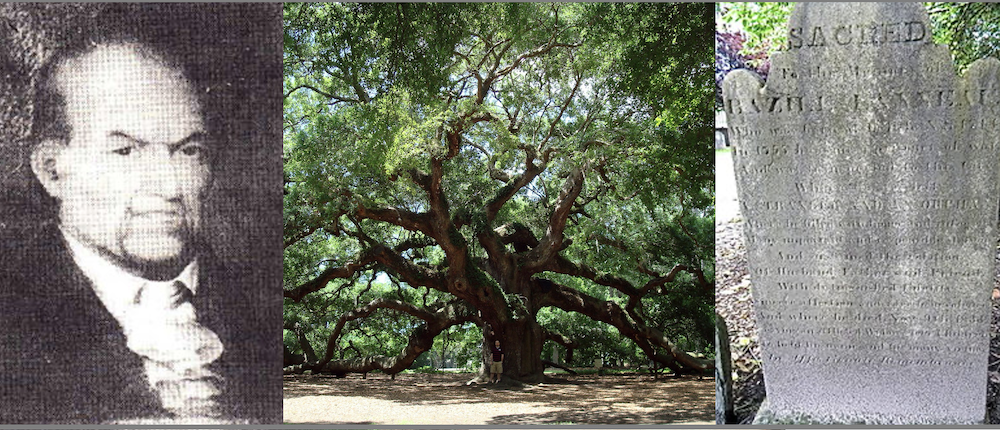
• Still, some Acadians demonstrated their incredible survival skills. On example is Bazile Lanneau, born Basile La Noue in Acadia on November 11, 1746. At nine years old, Basile, along with his mother and two brothers, was deported to Charleston. Soon after, his mother and one brother died from smallpox. Left an orphan, Basile was taken in by a local family and his name changed to Bazile Lanneau.
He taught himself, built a successful business, and became a bank director in Charleston, as well as a city official and Commissioner. He was also elected to the South Carolina State Legislature in 1796, 1798, and 1802. Bazile passed away on November 9, 1833, and left many descendants: 30 grand-children!
Grave marker, Circular Congregational Church Burying Ground
150 Meeting St, Charleston, SC 29401
GPS: 32.778988, -79.930723
• Inscription:
"Sacred to the memory of Bazile Lanneau who was born at Balisle Nova Scota 1744. In 1755 he became a prisoner of war and was transported to this city where he was left a stranger and an orphan where he filled with honor and integrity many important and responsible stations and sustained the relation of husband, father and friend with distinguished fidelity, sincere affection and rare benevolence and where he died Nov 9, 1833 leaving an afflicted widow and four children to hold his name and many virtues in affectionate remembrance."
| | |
Acadians in Louisiana:
The Cajuns
| | |
Above:
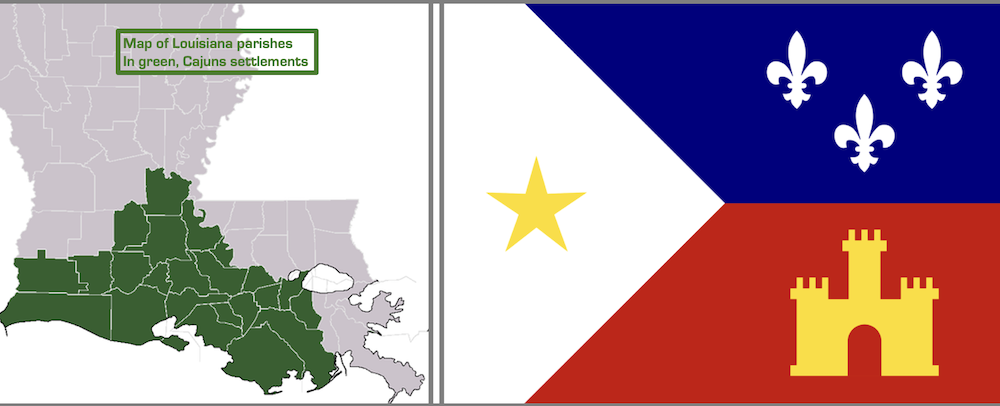
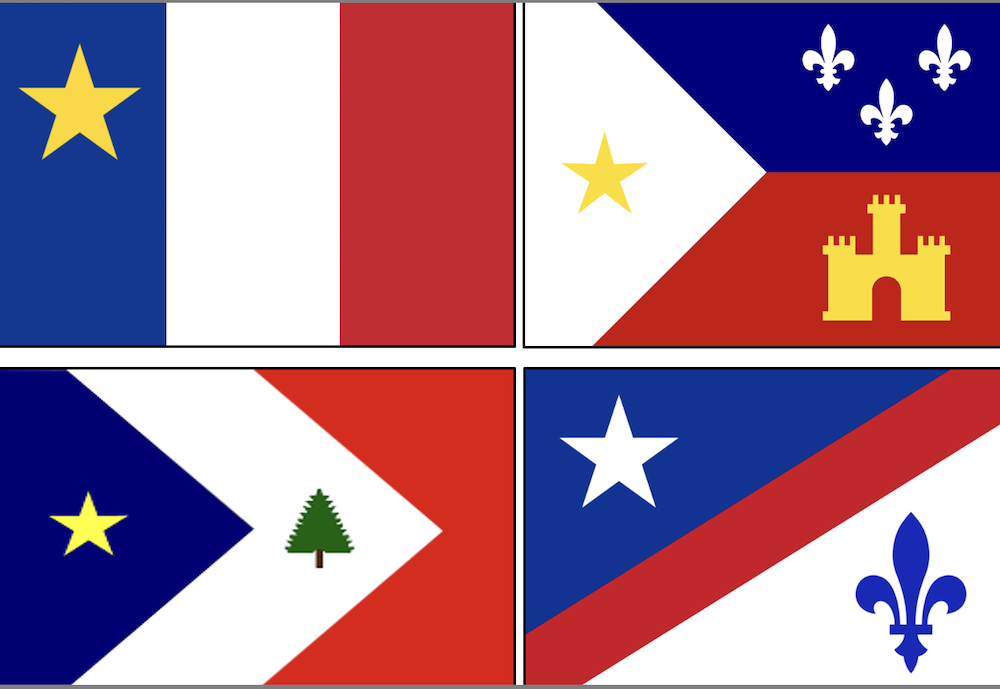
Left: Map of Louisian parishes. In green, Cajuns settlements
Right: Cajun Flag, different from the Acadiens.
| | |
As explained above, the Cajuns developed over time their own identity from the Acadians.
In the pages that follow, we will visit a few important sites in Louisiana. A complete compilation can be found in our e-book "Memories of France".
| | |
The Acadian Memorial
St. Martinville, Louisiana
| | |
The Museum of the Acadian Memorial tells about the Acadians who settled Louisiana and their legacy, featuring interactive exhibits, the Acadian Odyssey Quilt, and images from the Claude Picard Deportation Series.
It serves as both a place of remembrance and a genealogical research center where modern Cajun descendants can trace their Acadian ancestry. It is an essential stop for understanding the connection between the historic Acadian deportation and modern Cajun culture in Louisiana.
Monument & marker, “Deportation Cross - La Croix de la Déportation”
121 S New Market St, St Martinville, LA 70582
GPS: 30.122567, -91.827133
• Bilingual Inscription:
“The original Deportation Cross, near Grand-Pré National Historic Site in Nova Scotia is located in the vicinity of the embarkation of the victims of the Acadian Diaspora of 1755. Dedicated on July 24, 1924.”
At the Acadian Memorial this faithful replica of the cross commemorates the first large Acadian community in Louisiana that settled in the area of St. Martinville in 1765. Dedicated June 15, 2003."
| | |
• The mural named "The Arrival of the Acadians in Louisiana" by Robert Dafford is 12 x 30 feet in size.
• Its figures depict real documented Acadian refugees who came to Louisiana between 1764 and 1788, settling in various areas of the state.
• Some of the models are direct descendants of the figures they represent!
• This mural is paired with another in Nantes, France, also created by Robert Dafford, which shows the Acadians leaving for Louisiana from the port of Nantes in 1785.
| | |
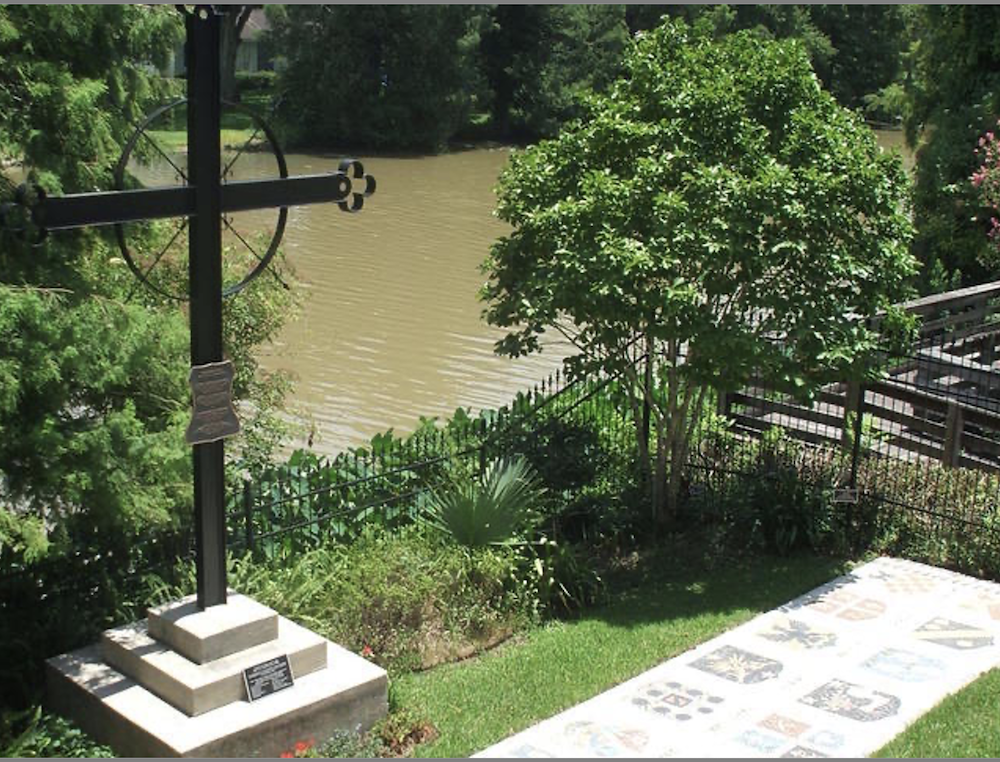
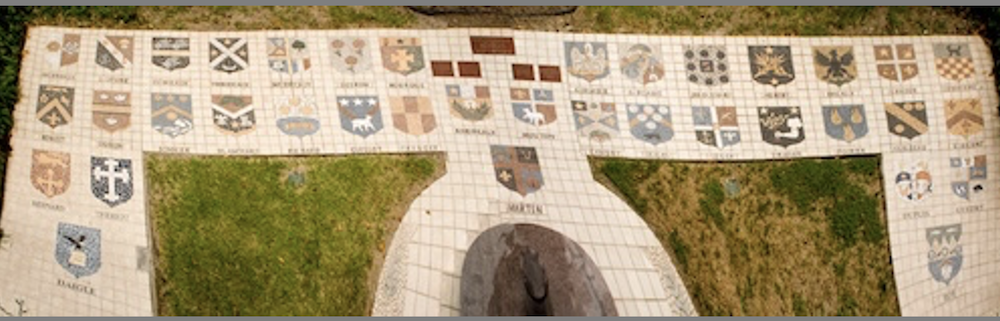
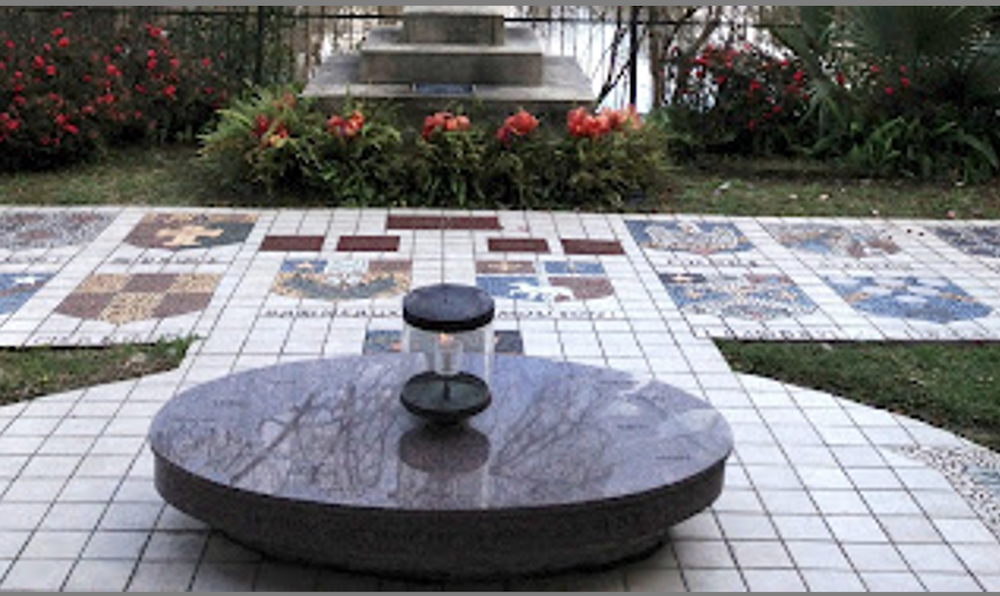
• The sidewalks in the Acadian Memorial Meditation Garden, located at the base of the Deportation Cross, feature mosaic Acadian Family Coats of Arms. The soft hues of shattered Italian tiles blend together to create a piece of art, representing the families torn apart by exile and later reunited in Louisiana.
•These mosaics serve as meaningful tributes to the Acadian families they depict and help us remember these brave individuals.
• At the heart of this multi-tiled artwork, right beneath the Deportation Cross, are the family crests of Louisiana's First Elected Acadian Governor, Alexandre Mouton (1843-1846), and the First Female Acadian Governor, Kathleen Babineaux Blanco (2004-2008).
• These crests have sparked great interest and pride, both for the families they symbolize and for the Acadian heritage.
| | |
• The eternal flame is located in the Acadian Memorial Garden, along with the Coat of Arms Mosaics and the Deportation Cross.
• The Eternal Flame represents how a culture can revive itself even in tough times.
• The flame emerges from the middle of a smooth granite oval located in the Acadian Memorial garden.
• The stone features an engraving of the Atlantic rim, highlighting the key settlement areas of the Acadian refugees.
• Inscription on the apron:
“ Un peuple sans passé est un peuple sans futur”
(A people without a past are a people without a future.)
"The Louisiana Jaycees sponsor the flame".
| | |
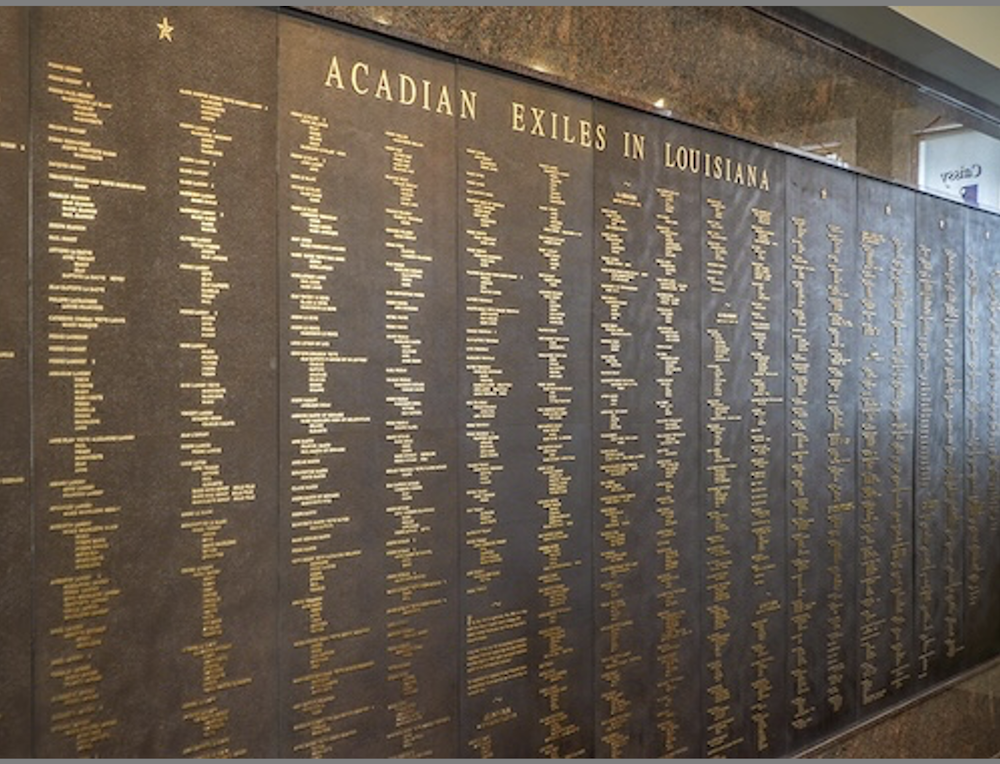
• The Wall of Names is a testiment to the over 3,000 Acadian Refugees in early Louisiana
• These 3000 individuals are recognized as Acadian refugees in the early records of Louisiana.
• Their names are etched on twelve bronze plaques set in granite. Visitors with Acadian heritage are invited to utilize the wall or the online database, Ensemble Encore, as a foundation for genealogical research.
• These resources will help reconnect numerous Acadian families.
• Inscription on the Wall (bilingual):
" Pause ami, lis mon nom et souviens-toi... "
"Pause friend, read my name and remember..."
| | |
Evangeline
St Martinville, Louisiana
| | |
• American poet Henry Wadsworth Longfellow introduced the tale of the exiled Acadians through his epic poem, Evangeline, A Tale of Acadie, which was published in 1847.
• The poem narrates the Acadians’ journey by focusing on Evangeline and her quest to find her lost love, Gabrielle.
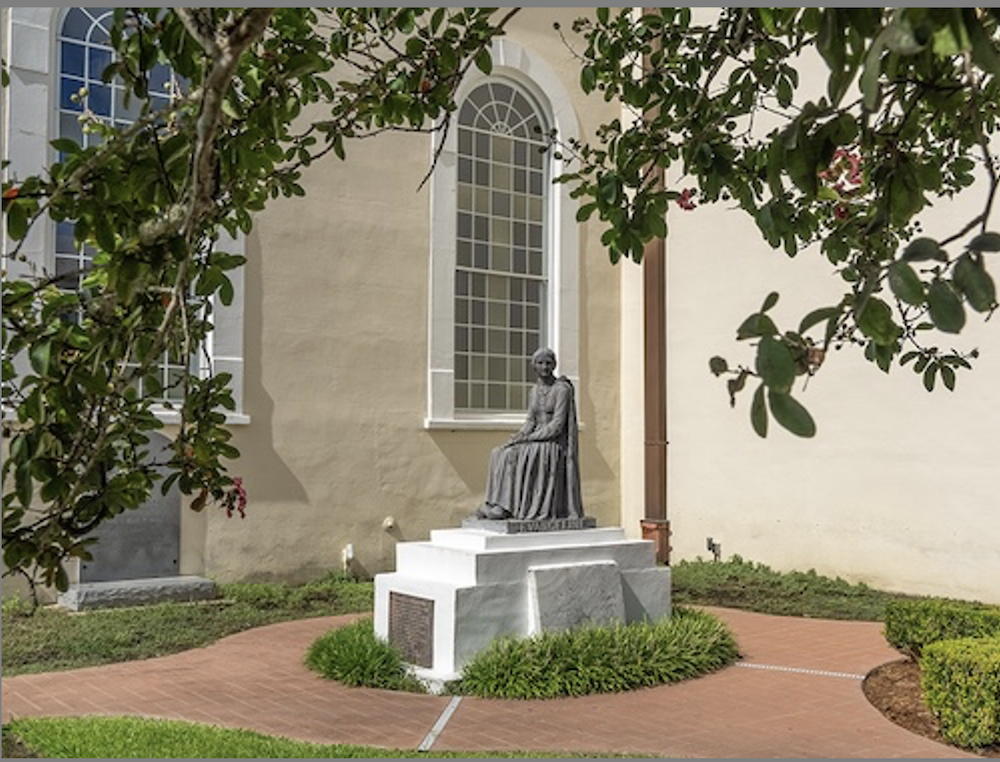
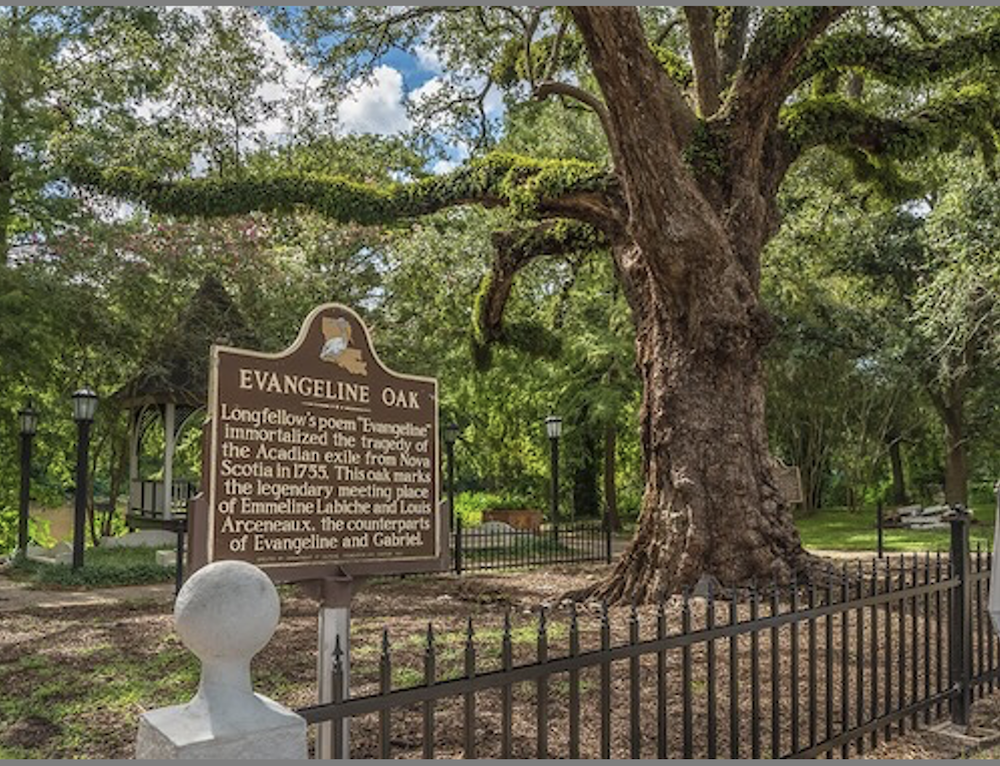
In St. Martinville, Evangeline is commemorated with a statue in the courtyard of the Catholic Church, along with a large tree known as the Evangeline oak. Both attractions are situated close to the Acadian Memorial Museum and are popular destinations for tourists.
• Model was Delores del Rio , the Actress who played Evangeline in the 1929 movie named Evangeline.
Statue, “Evangeline”
133 South Main Street, Saint Martinville LA 70582
GPS: 30.123150, -91.828383
• Inscription:
“Evangeline, the prototype of the Acadian maiden, was immortalized by Henry Wadsworth Longfellow in his epic poem of the same name. The monument was donated by Delores del Rio after she starred in the motion picture production of Evangeline which was filmed in the area in 1929. The statue was sculpted by Marcelle Rebecchini. Cast at the Departo Studios in Chicago, Illinois and dedicated by Miss Del Rio in St. Martinville on April 19, 1931.
Erected 1931 by St. Martin de Tours Landscape Committee.”
| | |
Marker, “Evangeline Oak”
South Main St, St Martinville, LA 70582
GPS: 30.122100, -91.827500
• Inscription:
"Longfellow's poem "Evangeline" immortalized the tragedy of the Acadian exile from Nova Scotia in 1755. This oak marks the legendary meeting place of Emmeline Labiche and Louis Arceneaux, the counterparts of Evangeline and Gabriel.
Le Chêne D'Evangeline
Longfellow a immortalisé dans "Evangeline" la tragédie des Acadiens exilées de leur pays à partir de 1755. Ce chêne se trouve là où, selon la légende, Emmeline Labiche et Louis Arceneaux (Evangeline & Gabriel) se sont rencontrés.
Erected 1982 by Louisiana Department of Culture, Recreation and Tourism.”
Locations called Evangeline:
• Evangeline Parish, Louisiana
• Evangeline, Louisiana, a community in Acadia Parish known for having the first oil well drilled in the state.
• Evangeline Hall, a dormitory constructed in 1936 at Louisiana State University.
In films:
• Besides the 1929 classic, Evangeline is mentioned in the 2009 Disney movie The Princess and the Frog, where a Cajun firefly named Raymond loves her, as she is seen as a star. After he dies, they come together again and are seen together in the night sky.
In music:
• There are too many songs, musicals, operatic productions, and references to Evangeline in Southern popular culture to list them all. We will share one:
• While the direct connection with Longfellow is subject to debate, one can feel the poem's powerful emotion by watching this cut from Martin Scorsese's 1977 classic featuring Emmylou Harris and The Band:
Click on: "The Last Waltz"
In pop culture:
• The poem's influence extends beyond individual works - it fundamentally shaped how Acadian/Cajun history and culture are remembered and celebrated in Louisiana and the broader South.
| | |
Site of First Landing
St James, LA.
| | |
Marker, “Site of first Acadian settlers in Louisiana”
6564 LA-18, St James, LA 70086
GPS: 30.015600, -90.841450
• Inscription:
“Refugees came overland 1756-57. In vicinity was 1762 grant to Jacques Cantrelle, Sr. of France after whom Church and Parish were named. Section once included in Les Oumas, Eveche of Quebec.
Erected 1961 by Department of Commerce and Industry”
• St. Jacques de Cabahannoce is the original site of what has historically been known as the first “Côte des Acadiens” (Acadian Coast). The St. Jacques de Cabahannoce Parish was established between 1750 and 1757. Organized in 1750, the first documented ceremonies to be found are from the year 1757 for which the technical establishment date is given.
• The first actual worshiping structure was built in 1770. The St. James church was known as St. Jacques de Cabahanoce when it began. Cabahannoce was an Indian term meaning "mallards' roost".
Marker & Plaque “St Jacques de Cabahanoce”
6613 LA-18, St James, LA 70086
GPS: 30.016233, -90.841917
• Inscription of marker:
“An organized ecclesiastical parish prior to 1757. The church was then in charge of Fr. Barnabé, a French Capuchin and Pastor of St. Charles (Destrehan), on east bank of river. The registers were kept in French until 1786. The diocese came under Havana, Cuba, in 1771.
Erected 1957 by Louisiana Department of Commerce and Industry.”
• Inscription of plaque:
“Dedicated to the descendants of the first Acadiens settlers of Saint James Parish, who visited this site August 8, 1999 on the occasion of Congress Mondial Acadien – Louisiane 1999”
| | |
Bayou Terrebone
Houma, LA.
| | |
• Bayou Terrebonne is approximately 70 kilometers long and flows into the Gulf of Mexico. This waterway is significant for Terrebonne Parish, which was established in 1822 from a portion of Lafourche Parish. In Louisiana, a parish is equivalent to a county in other American states.
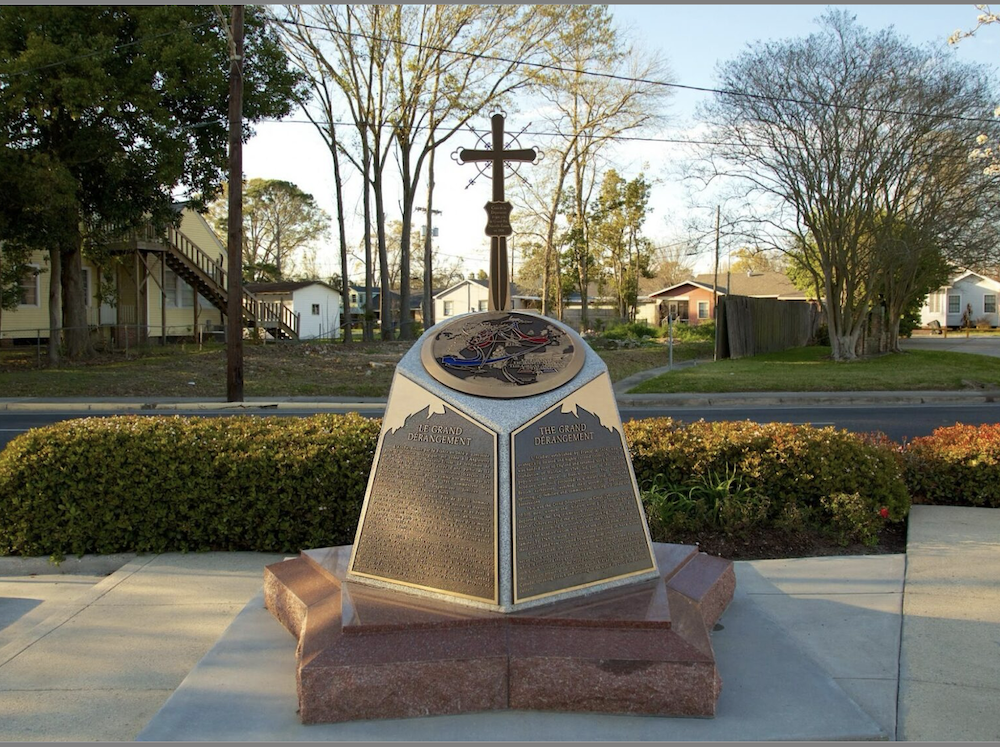
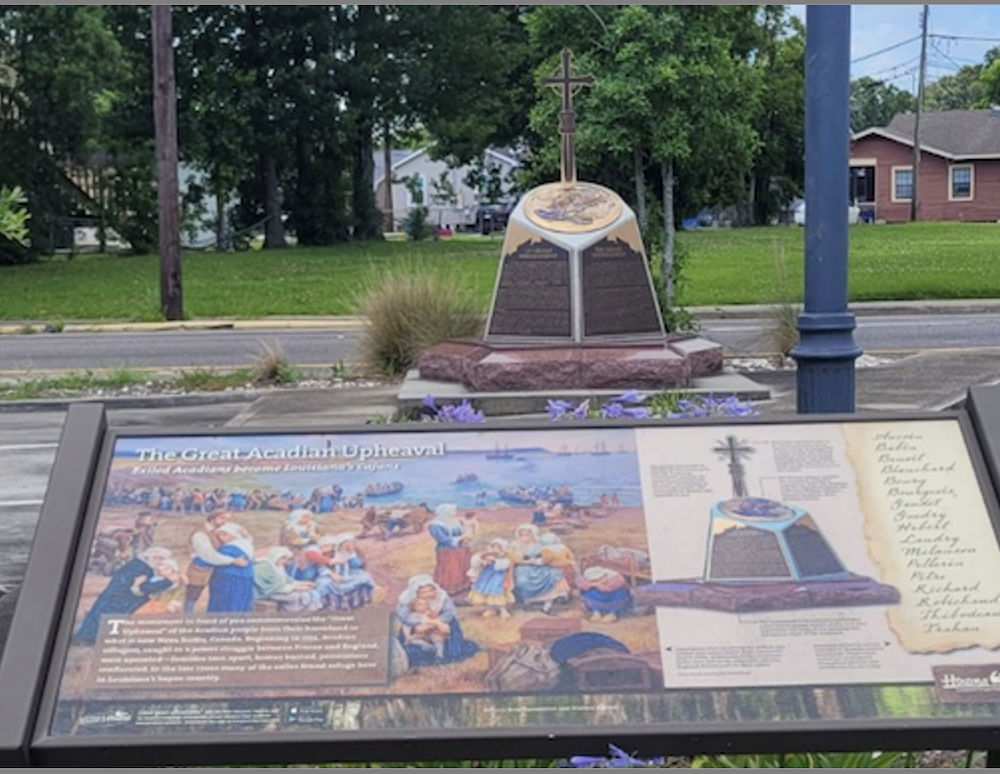
• In Houma, the parish seat, a monument honoring the 'Great Acadian Upheaval' was unveiled in the city center on October 11, 2011. It features a replica of the Grand-Pré Deportation Cross on top. The base serves as a reminder that most Acadians were granted land along the Teche, Lafourche, and Terrebonne bayous.
• This monument, the first of its kind in the United States, is a key part of the Acadian Odyssey, which consists of various markers placed over the years at locations associated with the deportation of Acadians. It also emphasizes that Louisiana has become New Acadia for many of the exiles.
• The Bayou Terrebonne Waterlife Museum hosts an annual day of remembrance on July 28th to honor the Acadian ancestors who were exiled. As part of the commemoration, students from École Pointe-au-Chien participate in a wreath-laying ceremony at the monument.
In addition, the museum also celebrates National Acadian Day on August 15th with other cultural events, such as French Table lunches and music performances.
The Cross of the Deportation:
• The cross is a 12-foot-tall replica of the Deportation Cross, a historical symbol of Acadian resilience and heritage.
• It is a Latin cross designed in Gothic style. The three ends are finished with trilobes, representing hope, understanding of the essence of the Triune God, and the cardinal directions. At the crossing of the pale and the fess, there is a circle intersected in saltire by four spears. The circle represents the universe, while the spears remind us of the suffering faced by the deportees. Decorative elements and spikes highlight the violence of these events.
Plaque on the cross (in French):
"Croix de la
Déportation
erected near
Grand-Pré
Nova
1924"
Interpretive marker in front of the memorial:
• Inscription:
“The monument in front of you commemorates the "Great Upheaval" of the Acadian people from their homeland in what is now Nova Scotia, Canada. Beginning in 1755, Acadian villagers, caught in a power struggle between France and England were uprooted - families torn apart, homes burned, possessions confiscated. In the late 1700s many of the exiles found refuge here in Louisiana's bayou country.The Sociétè Nationale de l'Adadie of New Brunswick, Canada, is placing monuments around the world to commemorate the 250th anniversary of these tragic events. The monument in Houma was unveiled in 2011.
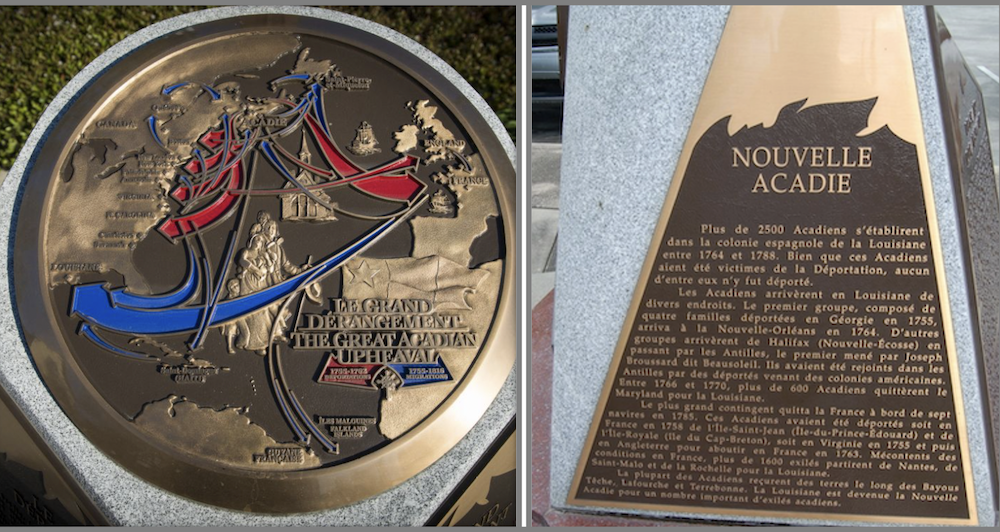
•The cross replicates the 12 ft. tall Deportation Cross which stands at Grand-Pré in Nova Scotia, the official site of Le Grand Dérangement. The paddle shape at the bottom of the cross recalls the journeys across the waters. The bronze plaque depicts the Acadians' complex migrations. Note the Acadian flag, the church of Grand-Pré, and Louis Phillipe Hébert's famous sculpture of an Acadian family.
The monuments foundation symbolizes a star which guides sailors across the sea, and also represents Our Lady of the Assumption, the patron saint of the Acadians. Deportation from Acadia by the British, 1755. Loaded onto overcrowded ships, thousands died in filthy, unbearable living conditions. Exiles were sent to the American colonies, England, France and the West Indies. Examples of family names recorded in Acadian census documents. These Cajun names are evidence throughout Houma and Terrebonne Parish today.
Erected by Houma Area Convention and Visitors Bureau.
Memorial, “Le Grand Dérangement”
(Two plaques, English/French)
Parking lot of the Bayou Terrebonne Waterlife Museum
7910 West Park Avenue, Houma LA 70364
GPS: 29.598684, -90.720094
• Inscription English side:
"L'Acadie, established by France in 1604, was a strategically located and highly coveted colony. In 1713, it was handed over to England and renamed Nova Scotia. The foundation of Halifax, in 1749, led part of the. Acadian population to move to French territory. The remaining Acadians were still perceived as a threat, and in 1755, the British authorities launched their systematic deportation, splitting up families and communities, seizing all lands and possessions.
This was the Grand Derangement, or Great Upheaval. Nearly 10,000 men, women and children were piled into ships and deported to the Anglo-American colonies, to England and to France. Others escaped the deportations, seeking refuge in French territory and forming a resistance. Over the next ten years, almost half of the Acadian nation was lost at sea or died from disease and famine. By 1765, a mere 1,600 survivors remained in Nova Scotia, their fertile land now occupied by settlers from other areas.
Some Acadian families returned to their former home, but most never again set eyes on Acadie. Many took root in Quebec and France, while in Louisiana they gave rise to a new community that produced the rich Cajun culture. Yet, the Grand Derangement was unable to wipe out the Acadian presence on its native soil. L'Acadie lives on in Atlantic Canada, speaking French and offering to the world is proud and dynamic culture."
Plaque, “New Acadia / Nouvelle Acadie”
(Two plaques, English/French)
Parking lot of the Bayou Terrebonne Waterlife Museum
7910 West Park Avenue, Houma LA 70364
GPS: 29.598684, -90.720094
• Inscription English side:
"Over 2,500 Acadians settled in the Spanish colony of Louisiana between 1764 and 1788, Although victims of the Deportation, none were deported directly to Louisiana. Acadians made their way to Louisiana from various locations. The first group, four families deported to Georgia in 1755, arrived in New Orleans in 1764. Several groups arrived from Halifax (Nova Scotia) via the Caribbean, the first one led by Joseph Broussard dit Beausoleil. They were joined in the Caribbean by Acadian refugees from the American colonies. Between 1766 and 1770, over 600 Acadians left Maryland for Louisiana.
The largest contingent arrived in seven boats from France in 1785. These Acadians had either been deported to France in 1758 from Ile-Saint-Jean (Prince Edward Island) and Ile-Royale (Cape Breton Island), or to Virginia in 1755 and then to England, finally arriving in France in 1763. Dissatisfied with conditions in France, about 1,600 of them sailed for Louisiana from the ports of Nantes, Saint-Malo and La Rochelle.
Most Acadian refugees were granted land along the Bayous Teche, Lafourche and Terrebonne. Louisiana thus became the New Acadia for a large number of Acadian exiles."
| | |
A typical Cajun village:
Historical Village, Lafayette, LA.
| | |
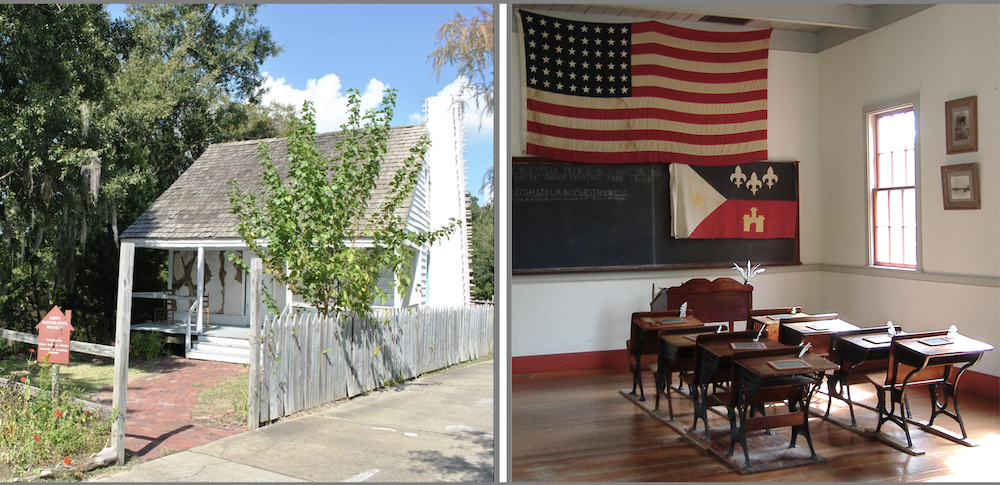
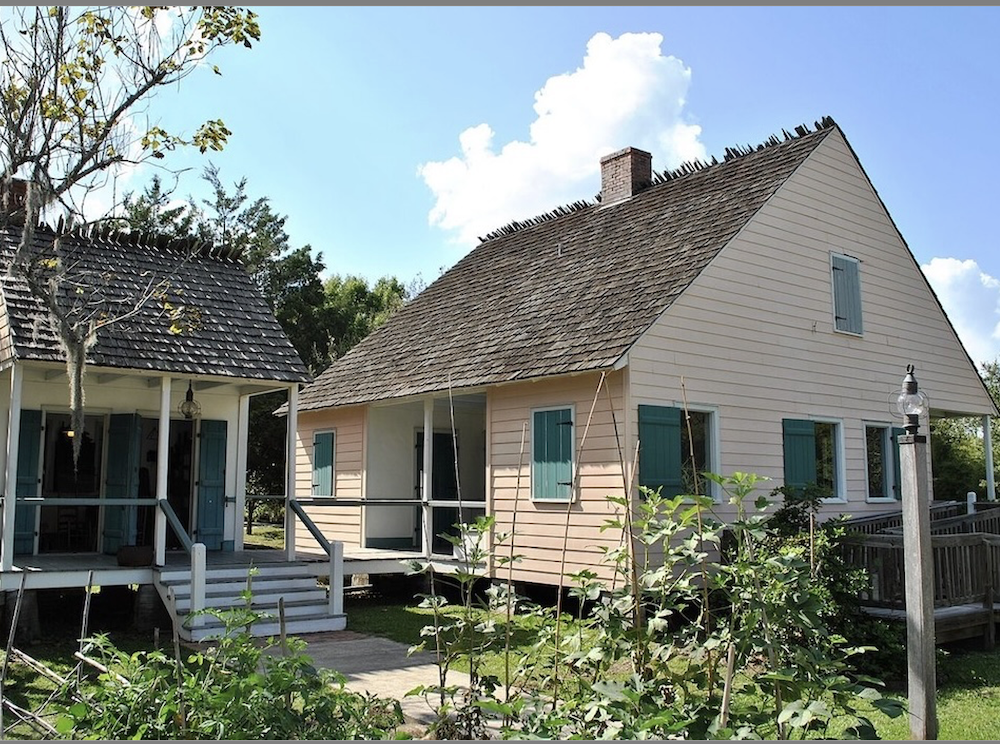
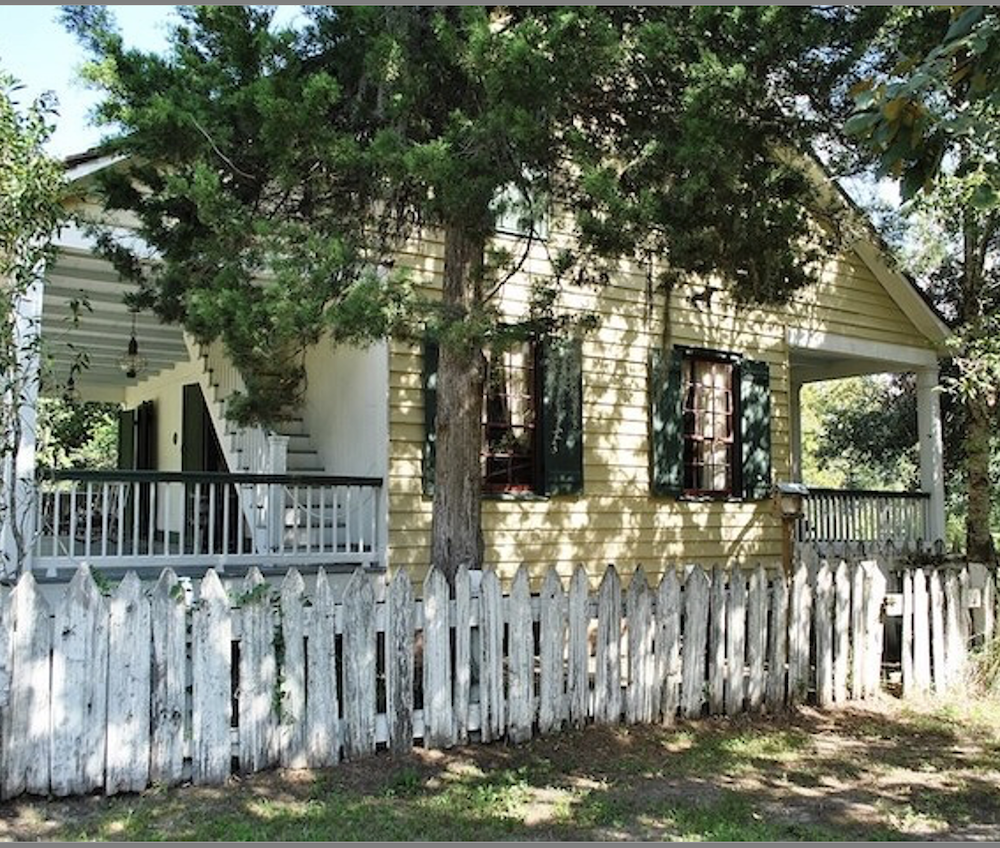
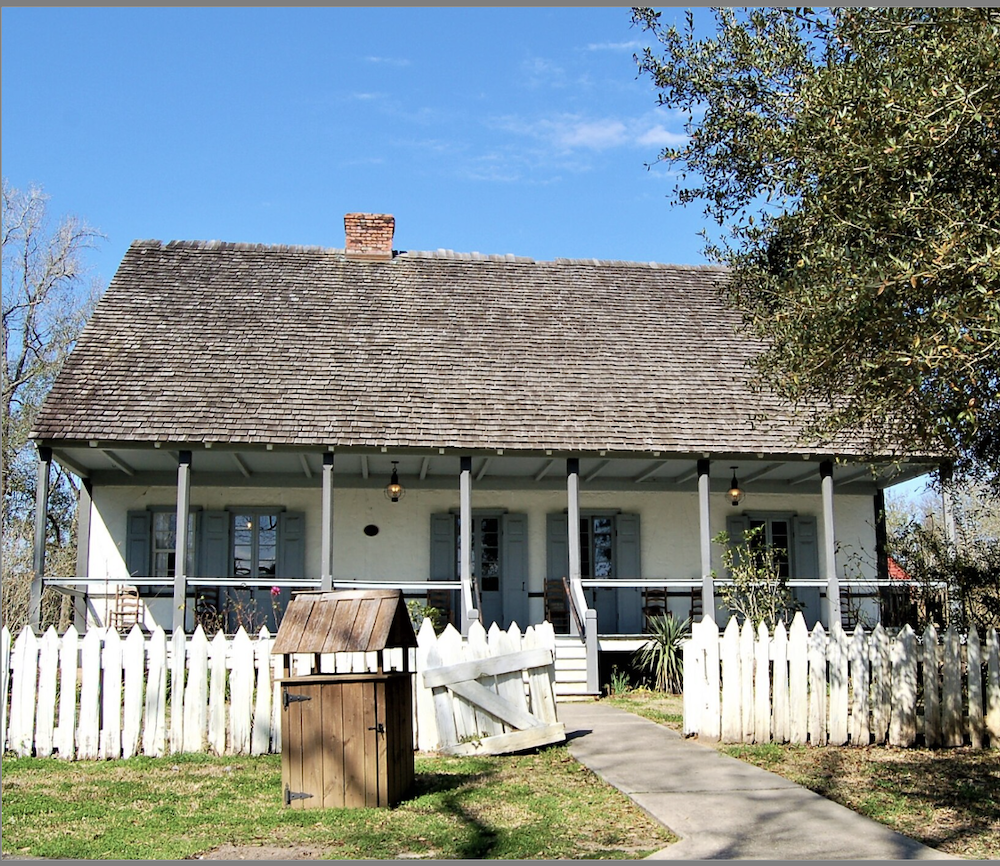
This historical village has been preserved. Markers inform the tourists on the traditions of the Acadians.
Marker, “Historic Village Map”
Vermilionville Historical Village
300 Fisher Road, Lafayette LA 70508
GPS: 30.215033, -91.995733
• Inscription:
"From where did the word "Cajun" come?
The refugees from Acadian Canada, called themselves Acadians. Over time, the word transformed into more vernacular pronunciation Cajun
Can you be Cajun if your family was NOT from Acadian Canada?
Some Cajuns claim that if your ancestors were not part of the Acadian refugee migration to Louisiana, you can still be considered Cajun if you marry into a Cajun family or even be welcomed into the community as a "cultural" Cajun.
What is a "swamper"?
A swamper is someone who lives in the swamp and knows how to survive in the unique environment. Not all swampers are Cajun. For centuries, Native Americans, as well as immigrants from Africa, Spain, Germany, Ireland and the eastern U.S. have called the swamp home.
Can you be a Creole if you are NOT descended from French, Africa, Native American or Spanish heritage?
Creole, like Cajun, is often identified by one's ancestry. However, Creole culture can be embraced and adopted by anyone. While you may not be a Creole by birth, you can be “creolized” if you can cook Creole food and celebrate Creole heritage.
Where are there French-speaking people in southern Louisiana?
French-speaking people reside largely in rural communities of south Louisiana. The Cajun and Creole dialects are still spoken by the older generations, as mainstream media and the suppression of French in school has made English more common. Organizations like CODOFIL continue to promote French language and Francophone culture in Louisiana, despite these trends."
Marker, “School House” – “L’école”
Vermilionville Historical Village
300 Fisher Road, Lafayette LA 70508
GPS: 30.215333, -91.994933
• Inscription:
“School House:
Banning of the French Language
L'école is a reproduction of a typical schoolhouse of the late 1800s. In southwest Louisiana, French was the dominant language until the mid-1900s. Native Americans along with Spanish, German, African, and English arrivals and their descendants learned to speak French to conduct business and socialize with neighbors. In the 1910s, new laws banned the French language in schools as an attempt to Americanize the non-English speaking population. The lines "I will not speak French” on the blackboard recall that time period.
Cajun and Creole French dialects: What are the Differences?
In southwest Louisiana, Creole and Cajun French dialects are distinct. Creole French borrows vocabulary and grammar from West African (especially Senegambian) and American Indian languages, and is distinct from the Creole languages of the French-speaking Caribbean islands. As such, the Louisiana Creole dialect represents an important linguistic legacy of the African diaspora in the Americas. In contrast, Cajun French incorporates an French dialect from the 1700s and is different from modern continental French. Both Cajun and Creole French use many expressions unique to southwest Louisiana. distinct.
Side Bar: Many rural pockets of Creole and Cajun French-speaking communities continue to exist in southern Louisiana, and the region remains one of the only places in the U.S. where the native population speaks distinct French dialects. Both Creole and Cajun dialects are in danger of becoming extinct as younger generations speak English predominantly. Nonetheless, there is growing interest for French among young people. Since 1968, the Council for the Development of French in Louisiana (CODOFIL) has promoted the speaking of French language, and the preservation of both Creole and Cajun cultures.”
Erected by Vermilionville Historic Village."
| | |
Marker, “Mouton House” – “Maison Mouton”
Vermilionville Historical Village
300 Fisher Road, Lafayette LA 70508
GPS: 30.215500, -91.994783
• Inscription (excerpts):
Mouton House:
The House of a Middle-Class Acadian Family
...”The founder of Vermilionville (present-day Lafayette) Jean Mouton built his wealth by acquiring land and developing a large cotton plantation that used slave labor. The site of the Vermilionville Historic Village was once part of the plantation owned by Jean's son Alexandre, who served as governor from 1843-1846.
[...]
Side Bar:
The Mouton family was influential in the founding of the original Vermilionville settlement (present-day Lafayette). As Acadians moved west from settlements along Bayou Teche, some acquired land and became prosperous. French-speaking Acadian Jean Mouton purchased land on the bayou in 1816 and founded the village of Vermilionville in 1821. The following year, Mouton donated five acres to the Church of St. John the Evangelist, the present-day site of St. John the Evangelist Cathedral in Lafayette. In 1836, Mouton also donated the lands for the parish courthouse, and the town grew around the lands he owned. In 1884, the town name officially changed to Lafayette, honoring the Marquis de Lafayette, the French general who was a hero in the U.S. War for Independence."
Erected by Vermilionville Historic Village."
| | |
Marker, “Beau Bassin House” – “Maison Beau Bassin”
Vermilionville Historical Village
300 Fisher Road, Lafayette LA 70508
GPS: 30.215200, -91.995183
• Inscription (excerpts):
"La Maison Beau Bassin
Honoring a Lost Home in Acadian Canada
The Beau Bassin House was originally built in the 1840s by Louis Arceneaux, a Cajun rancher who lived between Carencro and Lafayette. The house is unique in the village because it blends Cajun/Creole and American architectural influences. The squared columns on the front porch are characteristic of American Greek Revival design, but the colombage and bousillage construction techniques are Cajun and Creole. Beau Bassin was named in memory of the village of Beaubassin Acadia (present-day Nova Scotia, Canada), which was destroyed during the conflict between France and Britain in the 1750s
[...]
Side Bar:
Louis Arceneaux was the son of Pierre Arceneaux, an Acadian immigrant who purchased his land with the dream of starting a farm and ranch after arriving in Louisiana. Pierre was a refugee from Acadia as a result of le Grand Dérangement (Great Expulsion), when Great Britain expelled French-speaking Catholics from eastern Canada during the 1750s. Pierre came to Louisiana along with over a thousand fellow-Acadian refugees with the offer of free land grants from Spain. He named his ranch to honor the French settlement Beaubassin in his former home-land. Upon Pierre's death in 1793, Louis inherited the land and developed the small ranch.
Erected by Vermilionville Village"
| | |
Marker, “Maison Broussard”
Vermilionville Historical Village
300 Fisher Road, Lafayette LA 70508
GPS: 30.215983, -91.993533
• Inscription (excerpts):
A Large Acadian Plantation Home
“La Maison Broussard dates to 1790 and is the oldest building in Vermilionville. It was the home of Armand Broussard, who immigrated to Louisiana as a child from Acadian Canada. Armand was the son of Joseph "Beausoleil" Broussard, the famous Acadian resistance fighter who brought over two hundred Acadian refugees from Canada to the Poste des Attakapas in 1765. At the age of sixteen, Armand registered his first cattle brand and eventually became a prosperous rancher with his wife Anne Benoit and their fourteen children. Broussard was also a military veteran who served in both the American Revolution and at the Battle of New Orleans in 1815.
Enslaved Workers: A Diverse Group in Southwest Louisiana
The Broussard Plantation like most large farming operations used slave labor. Enslaved persons in southwest Louisiana were a culturally diverse group, comprised of native-born Africans of numerous different ethnic groups from across western and central Africa, French-speaking Creole persons of color, and English-speaking persons of color from the eastern states. Enslaved workers performed skilled jobs in the construction trades, blacksmithing, cattle droving, laundering and cooking, as well as less skilled jobs such as field hands and general labor.
Side bar: Enslaved persons in southwest Louisiana worked a variety of occupations. Males often specialized in skilled trades such as livestock management and droving, blacksmithing, and various construction trades such as carpentry, masonry, and plastering. Females often performed skilled jobs such as domestic work, washing, and child-care. Enslaved persons of African descent often served as cooks in many households and thereby integrated many African dishes such as jambalaya (known as jolof in western Africa) and other rice-based dishes, coush-coush, okra, and sweet potatoes. As such, the foods of the region represent an important cultural legacy of the African diaspora in the Americas.”
Erected by Vermilionville Historic Village."
| | |
Le Vieux Village
Opelousas, LA.
| | |
Marker “Le Vieux Village”
828 E Landry St, Opelousas, LA 70570
GPS: 30.531483, -92.074000
• Inscription (excerpts):
“French for "the old village," Le Vieux Village is a park created by a collection of restored historic structures from Opelousas and surrounding areas of St. Landry Parish. The village depicts the unique and diverse historical and cultural heritage that is Opelousas. Although the village showcases structures from the mid-1700s to the mid-1900s, Opelousas is interwoven into the development of Louisiana at a much earlier dateThe city takes its name from the Opelousa Indians, a small band of the historic Attakapa Tribe, which lived in the area for thousands of years. The Native Americans have been here since prehistoric times. As early as 1706, the Opelousas Country was known to Frenchman.
France sent a military exploration team to the Opelousas area to establish a French governing presence here in 1719. By 1720, Opelousas had become the mid-way stopping point for travelers going between Natchitoches and New Orleans. Opelousas in Louisiana's third oldest city, founded in 1720.
In 1763, Louis Pellerin, a French soldier stationed at Opelousas, received a land grant to establish a permanent settlement. The original streets of Opelousas were laid out during this time. Acadians (Cajuns) began arriving in the Opelousas region two years later in 1765. [...]”
Erected by City of Opelousas, Louisiana.”
| | |
Marker, “Venus House, circa mid to late 1700s”
Le Vieux Village, 828 East Landry Street, Opelousas LA 70570
GPS: 30.531600, -92.074217
• Inscription (excerpts):
"The Venus House was the first building to be relocated to Le Vieux Village in 1973. This French Creole style home was donated by the Earl Fontenot family. The home was originally located in the small community of Grand Prairie. In 1975, the house was restored and opened as the new Opelousas Tourist Center, under the direction of the Opelousas Tourist Commission. It later housed the Jim Bowie Museum.
The house is named after its former owner and occupant, Marie Francois Venus, a free Creole woman of color, who lived in the home during the 18th century. Other former owner names include Guillory, Doucet, Bourque, Perkins and Fontenot.
The Venus House is one of the oldest houses of its kind in the Lower Mississippi Valley. The house was constructed entirely of mortise and tenon construction. It features bousillage, a natural insulation that was once common in the walls of Cajun and Creole dwellings. It was usually made by mixing mud with moss or animal hair and held into place by a series of wood bars (barreaux), set between the posts, which resulted into the walls. Sometimes hay or prairie grass was substituted for Spanish moss.
Although porches of many Louisiana Creole houses have been enclosed, the home's open porch survives. In addition, the early and unusual French mantel inside the home has survived. The house has become the center piece of Le Vieux Village.
[...]
Érigé par la ville d'Opalousas, Louisiane"
| | |
A few famous Acadians
Who gave their names
to Louisiana settlements
| | |
Firmin & Scholastique Breaux
Pont Breaux, LA
| | |
• Pierre Firmin Breaux (1747-1808) was an Acadian pioneer who came here after being expelled by the British from what is now eastern Canada. He is believed to have arrived in the region in early 1765, following the British victory over the French in 1763. By 1774, he had registered his branding iron. He was also a Revolutionary War Patriot. By 1786, he had become one of the largest landowners in the Bayou Têche area.
• In 1799, Breaux constructed a footbridge over the Bayou Têche to assist his family and neighbors in crossing. This initial bridge was a suspension footbridge, probably made from rope and small planks. It was secured by being tied to small pilings at each end and to two large live oak trees on either side of the bayou. When giving directions, locals would often tell others to "go to Breaux's bridge . . ." This eventually became the name of the city.
Marker, “Pont Breaux”
Bridge Street, Breaux Bridge LA 70517
GPS: 30.273633, -91.899433
• Inscription:
“Named for the
Firmin Breaux
Family
Settled by
Acadians ca. 1766,
Founded 1829,
Incorporated 1859.
Erected by The Breaux Bridge Historical Society.”
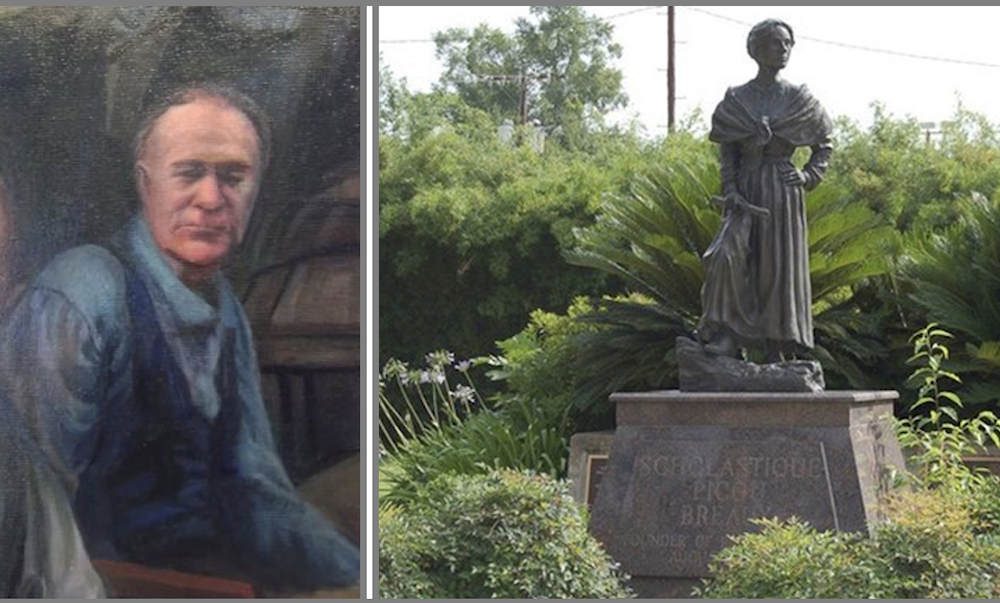
• On August 25, 1829, Scholastique Breaux, (Firmin’s daughter-in-law), established Breaux Bridge, Louisiana at the age of 33. She was born Scholastique Melanie Picou on July 25, 1796. When she was young, she married Agricole Breaux, and they had five children together. In 1817, they replaced the Bayou Têche suspension footbridge, which Agricole's father Fermin had built, with a vehicular bridge that allowed wagons to pass and supported the growing commerce in the area. After her husband died when she was 32, Scholastique became a widow.
• A resolute Acadian woman, Scholastique created the Plan de la Ville du Pont des Breaux ("Plan for the City of Breaux Bridge"), which featured a detailed map and street layout of the area. She developed the region by selling land lots to fellow Acadian settlers. In 1847, a church parish was established, and twelve years later, the area was officially incorporated. After founding the town, Scholastique remarried and had two more children with her second husband.
Statue and Marker, “Scholastique Picou Breaux”
Berard Street (State Highway 31) and Martin Street, Breaux Bridge LA 70517
GPS: 30.274083, -91.901783
•As no images of Scholastique were found in the research, Celia’s daughter, who is Scholastique’s great-great-great-granddaughter, served as the model for the statue. With assistance from Audrey Bernard, a resident of Breaux Bridge and an expert in Acadian textiles, it was established that Scholastique wore typical attire of her era, which included a handwoven skirt, chemise, and shawl.
• Inscription:
“Scholastique Picou Breaux founded our wonderful city when she was just 33 years old. A determined Acadian woman, she drew up Plan de la Ville du Pont Breaux, the plan for the Village of Breaux Bridge. Her plan included land for a school, a church, a diagram of streets, and a detailed map of the area that included her late husband's bridge. She then proceeded to sell lots and established Breaux Bridge's founding date of August 5, 1829.
Scholastique was born Scholastique Melanie Picou on July 25, 1796. She married young, had five children and was widowed at the age of 32. Her financial troubles motivated her to begin developing a plan for the Village of Breaux Bridge. Later she remarried and bore two more children.
The story of Scholastique Breaux speaks of the unflagging determination and indomitable courage of the Acadian women. She symbolizes the Acadians of Louisiana.”
Breaux du Monde
In August 1999 a reunion of over 500 Breaux descendents was held in Breaux Bridge in conjunction with Congres Mondial. Breaux du Monde made a significant contribution to the statue erected to Scholastique Picou Breaux.
Erected 1999 by Breaux du Monde.”
| | |
Joseph & Alexandre Broussard
Broussard, LA.
| | |
• “Côte Gelée”, which means Frozen Hill, was the original name given to the community due to its hilly ridge region and the harsh winter experienced in 1784. The establishment of Broussard took place in 1884 and it was named after Valsin Broussard, a well-known local merchant. Valsin Broussard played a significant role in the community by organizing the first vigilante committee after his own store was robbed. He was a direct descendant of Joseph Broussard de Beausoleil, who was among the initial group of 200 Acadians to arrive in Louisiana on February 27, 1765, aboard the Santo Domingo.
Marker, “Historic downtown Broussard, founded 1884”
730 W Main St, Broussard, LA 70518
GPS: 30.150817, -91.977817
• Inscription (excerpts):
“The City of Broussard is located in Lafayette and St Martin Parishes. French trappers and Native Americans lived in the area, but permanent settlement did not start until around 1765. Around this time is when exiled Acadians first arrived in the area and among these immigrants were Joseph and Alexandre Broussard. The land consisted of tree lined coulees, open prairies and swamps which provided rich fertile soil that made the land great for settlement. The area would later be known as Cote Gelee (Frozen Hills) for its hilly ridge and the severe winter of 1784. During the 1850's Government was limited to the settlements of St. Martinville, New Iberia, and Vermilionville which would later become Lafayette. Valsin Broussard along with other early leaders developed the area to become Broussardville originally. In 1884 it would be named Broussard after Valsin Broussard who donated the land for a church, cemetery site, a private school, a public-school railroad depot and streets among many other things. [...]’
Erected by City of Broussard.”
| | |
Ozaire Joseph Loreau
Loreauville, LA.
| | |
Marker, “Welcome to Loreauville”
110 Bridge St, New Iberia LA 70563
GPS: 30.056617, -91.740050
• Inscription (excerpts):
“Like many communities along the Teche, early life in the village of Loreauville revolved around the church. Ozaire Joseph Loreau donated a piece of property in 1871 with the stipulation that a church be constructed in what was then called Fausse Pointe. Loreauville became a church parish in 1873, and Fr. Charles Beaubrien from Canada was named the first pastor of St. Joseph's Catholic Church [...]
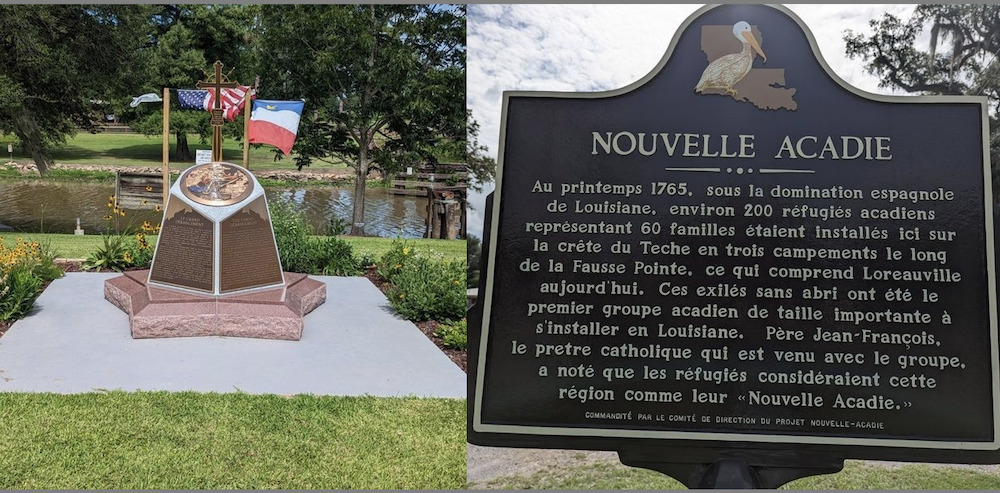
New Acadia: Who knows what could be hiding beneath the bayou banks? A search for the original Acadian settlers along the Teche Ridge has been ongoing since 2013. Archaeologists from the University of Louisiana at Lafayette believe the Acadians settled on high ground along Bayou Teche south in a peninsula formed by the bayou and known at the time as la fausse pointe, near Loreauville. Led by rebel Joseph Beausoleil Broussard, these more than 200 refugees arrived in the spring of 1765 following their expulsion from Nova Scotia. They called their new home "New Acadia."
Erected by the Teche Project
| | |
Other Sites of Acadian memory
and celebrated early Cajuns
| | |
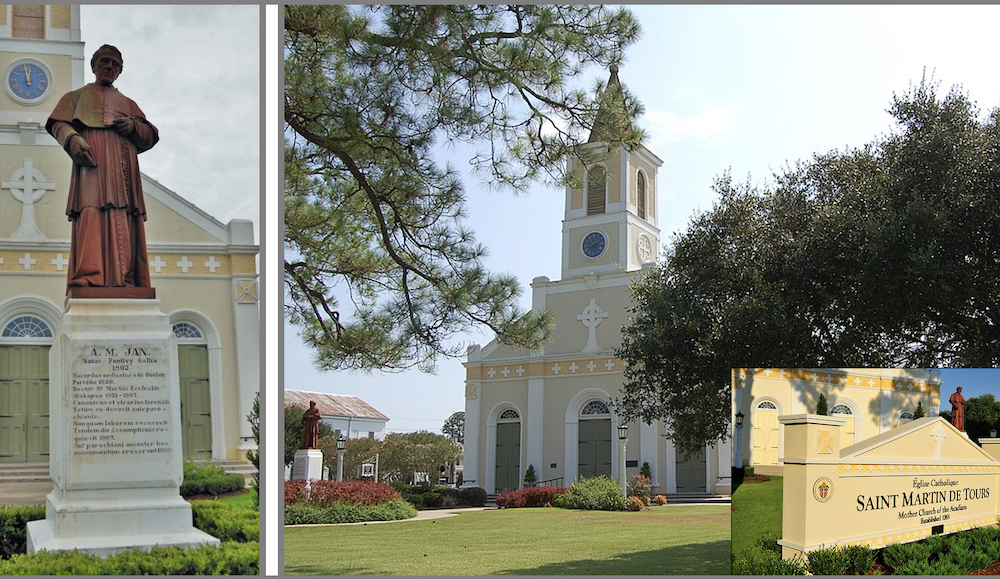
Église catholique Saint Martin de Tours
St Martinville, LA.
| | |
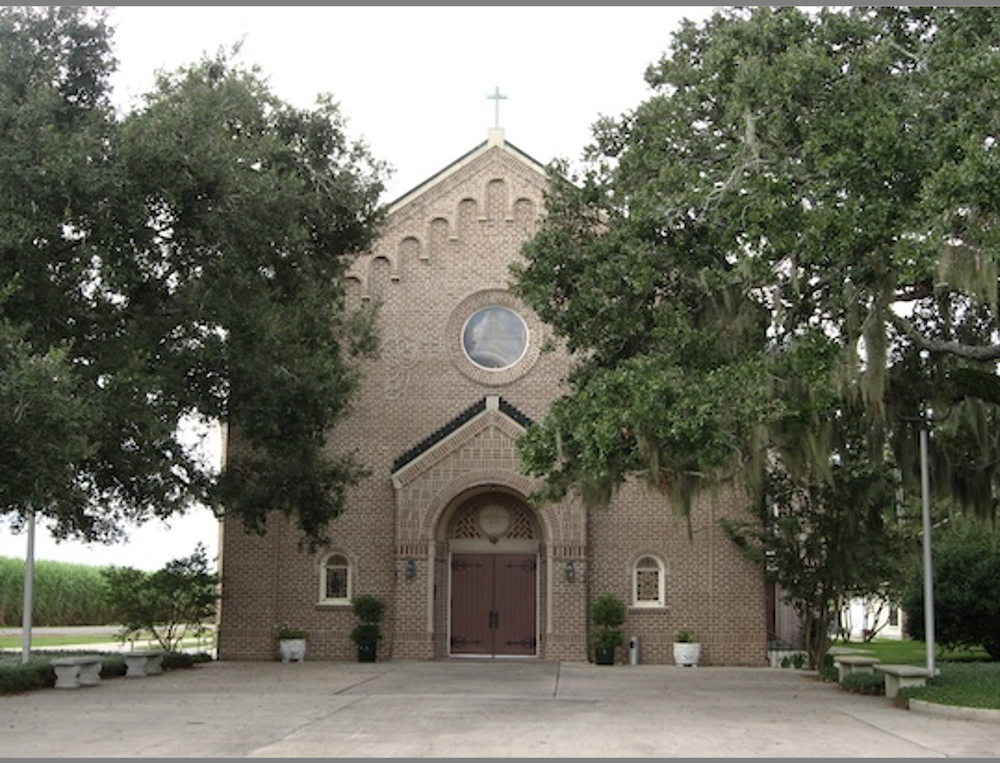
• Saint Martin of Tours Catholic Church (French: Église catholique Saint Martin de Tours) is a historic church located at 133 S. Main Street in Saint Martinville, Louisiana. It was added to the National Register in 1972.
• Founded in 1765 by Acadian refugees who settled in Atakapa country, the first church was likely designed by French military engineer Lieutenant Louis Andry. The church was incorporated in 1814 through an act of the Louisiana legislature. In 1820, another act allowed the congregation to hold a lottery to raise money for a new church. The current building was completed in 1840 and consecrated in 1844.
Plaque, “St. Martin Catholic Church”
South Main St, St Martinville, LA 70582
GPS: 30.123100, -91.828900
• Inscription:
“One of the oldest in the state. Established in 1765 by Rev. Jean Francois, Capuchin priest and missionary. It is just the same as when it was built having been repaired but not changed.”
• Statue of French priest, Ange Marie Jan (1802-1887) who served at the Church of St. Martin de Tours in St. Martinville, Louisiana starting in 1851. Belgian sculptor Auguste Verrebout (1836-1889) created the statue which was completed in 1888, a year after Jan's death.
Statue & Plaque, “Ange Marie Jan Natus Pontivy Gallia —1802—”
South Main St, St Martinville, LA 70582
GPS: 30.123100, -91.828900
• Inscription:
A. M. Jan.
[Fr. Ange Marie Jan
Born in Pontivy, Gallia [France]
1802
Ordained priest by Quelen [Archbishop of] Paris in 1826.
Rector, St. Martin's Church in Attakapas [St. Martinville] 1851-1887.
The canon and vicar of the court has devoted himself entirely to his parishioners.
He never refused work. He finally rested on Assumption Day, 1887.
His parishioners lovingly erected this monument in 1888.
Erected 1888 by Saint Martin de Tours Catholic Church parishioners.”
| | |
Église Catholique St. Gabriel
St Gabriel, LA.
| | |
• St. Gabriel Catholic Church, thought to be the oldest existing church building in the whole Louisiana Purchase Territory. Built in 1769, it has been moved several times throughout history and was added to the National Register of Historic Places in 1972.
Marker “St Gabriel 1761-1763”
3625 LA-75, Saint Gabriel LA 70776
GPS: 30.254283, -91.102567
• Inscription (in French):
“Eglise de la côte d'Iberville construite en 1769 par les exilés acadiens. En 1773 elle était sur le Manchac espagnol offert par ce gouvernement. Des colons allemands arrivèrent du Maryland en 1784.”
English translation:
"Church on the Iberville riverbank built in 1769 by Acadian exiles. In 1773 it was part of the Spanish Manchac (land grant) offered by the Government. German settlers arrived from Maryland in 1784.
Erected by Codofil & Commission Du Tourisme."
| |
Acadian Odyssey Monument
New Acadia – Nouvelle Acadie
Fausse Point of Bayou Teche
Loreauville, LA
| |
Above:
Left: Acadian Odyssey Monument, Photo by Cajun Scrambler, July 14, 2023
https://www.hmdb.org/m.asp?m=228254
Right: Marker, Nouvelle Acadie, Photo by Cajun Scrambler, July 14, 2023
https://www.hmdb.org/m.asp?m=228283
| |
A bayou is not a river. A river flows in one direction, wheras a bayou is almost stagnant. In Louisiana's wetlands, you'll often find bayous branching off from rivers or connecting lakes and swamps. They're crucial to the ecosystem there and are part of what makes the Louisiana landscape so distinctive. The word "bayou" comes from the Choctaw word "bayuk," meaning small stream.
Acadian Odyssey Monument
This memorial is similar to the one in Houma, Terrebone Paris and the plaques "The Grand Dérangement" share the same text.
However, it has a different set of plaques in French and English "Fausse Pointe of Bayou Teche":
Plaque, “Fausse Point of Bayou Teche”
(Two plaques, English/French)
• Inscription:
“About 200 destitute Acadians, former prisoners of the British in Halifax, Nova Scotia, arrived in New Orleans in February 1765. Offered fertile land in the Attakapas District of what is now south-central Louisiana, these exiles reached Bayou Teche in May to settle a region soon called Nouvelle-Acadie (New Acadia). At least 39 of these Acadians died soon after in an epidemic, and some families subsequently relocated to land along the Mississippi River. However, most remained on the oxbow of the Teche called Fausse Pointe, centered around present-day Loreauville. The Fausse Pointe families tended crops, raised cattle, and grew in numbers. Some moved north along the Teche in 1770-1771 to establish another settlement at what is now the village of Parks. Familes from these two communities began to spread in 1776 to the upper and lower Teche, as well as to Bayous Tortue, Vermilion, and Carencro. From there, new generations of Acadians would populate the vast prairies of southwestern Louisiana. The Acadians of Fausse Pointe made a lasting mark on local culture and history. Their descendants now reside not only in south Louisiana's bayou country, but also all along the central Gulf Coast.”
Marker, “New Acadia – Nouvelle Acadie”
110 Bridge St, Loreauville, LA 70552
GPS: 30.056683, -91.739783
• Inscription (English side):
“In Spring 1765, during the Spanish Rule of Louisiana, approximately 200 Acadian refugees representing 60 families were settled here on the Teche Ridge in three encampments along the "Fausse Pointe" that includes present-day Loreauville. These homeless exiles were the first Acadian group of significant size to settle in Louisiana. The Catholic priest, who came to minister to this group. Father Jean-Francois. recorded that the refugees considered this area their "New Acadia.”
Erected by New Acadia Project Steering Committee / Commandité Par Le Comité De Direction Du Project Nouvelle-Acadie"
| |
Judge Félix P. Poché
St. James, LA.
| |
Above:
Left: Judge Poché Plantation, By Z28scrambler - Own work, CC BY-SA 3.0, https://commons.wikimedia.org/w/index.php?curid=21187067
Right: Louisiana Justice Félix P. Poché, Photo: By The Green Bag , Public Domain
https://commons.wikimedia.org/w/index.php?curid=75024391
| |
• Félix Pierre Poché, born on May 18, 1836, and passed away on June 21, 1895, served as a justice of the Louisiana Supreme Court from April 5, 1880, to April 5, 1890. He hailed from St. James Parish, Louisiana, and came from a family of French Acadian descent.
• Initially admitted to the bar in Kentucky, he later pursued his legal studies under Judge Roman of Thibidiaux in the Parish of Lafourche, Louisiana. In 1859, he was admitted to the bar of Louisiana.
• His Journal Diaries of the Civil War were published in 1972, entitled "A Louisiana Confederate, Diary of Félix Pierre Poché" edited by Edwin C. Bearss. His ideas are clearly communicated in both French and English, which he wrote with nearly the same level of comfort, as one would expect from someone who practiced law in pre-Civil War Louisiana.
• Following the Civil War, Poché played a significant role in state politics and was elected to the Louisiana State Senate in 1866.
• Notably, in 1878, he became one of the founding members of the American Bar Association.
• In 1880, he was appointed as the senior associate justice of the reconstituted Louisiana Supreme Court, a position he held for ten years. After his passing, his plantation was listed on the National Register of Historic Places.
Marker, “Judge Poché Plantation House”
6564 LA-18, St James, LA 70086
GPS: 30.015600, -90.841450
• Inscription:
“Felix Pierre Poché, Civil War diarist, Democratic party leader, prominent jurist and one of founders of American Bar Association, built this Victorian Renaissance Revival style plantation with unusual front dormer c. 1870.
Erected 1981 by Department Culture, Recreation and Industry.”
| |
Judge Émile Édouard (Edward) Simon
St. Martinville, LA.
| |
Above:
Photo: Judge Émile Edouard (Edward) Simon
Marker, photo by Mike Waldon, June 28, 2013
https://www.hmdb.org/m.asp?m=66359
| |
We insert this marker in this Bulletin as it relates directly to the epic poem Evangeline.
• Florent Edouard was born in Tournai in 1799, département of Jemmape. He was not born Belgian, as erroneously indicated on most bios, but French, as it was part of the First French Republic and the first French Empire from 1794 until 1815. Florent Edouard emigrated to the United States in 1817.
• He became a lawyer and eventually sat on the Louisiana Supreme Court.
• He was the first of 6 generations of Louisiana lawyers.
• His son Judge Émile Edouard (Edward) Simon was therefore not from an Acadian family. The spelling Edward was frequently used to differentiate him from his father.
Marker, “Judge Émile Édouard (Edmmw, Inscription:
“A native of St. Martinville, Simon studied law at Harvard under Joseph Story and Simon Greenleaf, earning his degree in 1846. As 14th Judicial District Judge from 1853 to 1865, Simon was to become the second of four generations of judges. While Henry Wadsworth Longfellow was writing the epic poem Evangeline and teaching at Harvard, Simon was a student there. Family tradition holds that Simon told Longfellow about the establishment of Acadian exiles here in 1765 and described for him the geography and local color of the Teche country. May this plaque forever honor our distinguished native son!
Erected by City of St. Martinville.”
| |
Site of the Bourgeois Family
Remy, LA.
| | |
• The saga of the Bourgeois family is told in the website http://www.acadiansingray.com. Here is an excerpt that illustrates the incredible upheaval experienced by these Acadian families:
... “Jean, son of probably Joseph Bourgeois and Marie Cyr, born probably at Chignecto in c1739, ended up as a prisoner at Halifax, Nova Scotia, in the early 1760s. He married his first wife, whose name has been lost to history, probably during Le Grand Dérangement. They came to Louisiana from Halifax via Cap-Français, St.-Dominique, in 1765 and settled with dozens of other Halifax refugees at Cabanocé/St.-Jacques. They had no children.
Jean remarried to fellow Acadian Louise-Ludivine, called Ludivine, Granger at Cabanocé in January 1768. She gave him all of his children. Their daughter married into the Arceneaux family. In 1779, Jean owned 2 slaves on his farm at St.-Jacques. All four of his sons married, but only two of their lines survived. They remained on the left, or east, bank of the river in St. James Parish”.
Marker “Bourgeois Homeplace / Site Familial des Bourgeois”
Remy, LA 70763
GPS: 30.020800, -90.741000
Inscription
"Among the first Acadian exiles to Louisiana, eleven Bourgeois families settled this area in 1765. Site of lands granted 1803 to Widow Jean Bourgeois and sons. Bourgeois descendants still live on-site.
Erected by the St. James Historical Society.”
| | |
Gabriel Moulaison, a.k.a. Recontre
Brusly, LA.
| | |
• Gabriel Moulaison aka Recontre, born in Limoges, France, in 1685, came to Acadia by 1702 and started a family there. Since the family was relatively new to Acadia, its members were more or less together in 1755, on the eve of Le Grand Dérangement.
• Some of the Moulaisons who came to Louisiana from France in 1785 settled in river communities, where their name evolved into Molaison.
• Jacques Molaison, fils, age 38, wife Marie-Blanche Doiron, age 41, and three of their children--Marie-Rose, called Rose, age 10; Marie-Sophie, called Sophie, age 9; and Jacques III, age 6--crossed on Le Beaumont, the third of the Seven Ships from France, which reached New Orleans in August. They followed most of their fellow passengers to the Baton Rouge area.
• There are two websites we recommend, that are specialized in Acadian and Cajun genealogy:
https://www.thecajuns.com/surnames.htm
https://www.acadian.org/genealogy/
Marker, “Brusly, Louisiana, oldest settlement in West Baton Rouge”
610 S Vaughn Drive, Brusly LA 70719
GPS: 30.386200, -91.244533
• Inscription:
“Following the 1755 exile from Nova Scotia Acadians & descendants received Spanish land grants and settled the area. Among those arriving in 1785 was Jacques Molaison, who began a business. A settlement grew around his land; the name Brusly Landing evolved as steamboats stopped to pick up locally grown cotton. Today residents and descendants of early settlers call Brusly home.”
Erected 2003 by West Baton Rouge Historical Association.”
Marker “West Baton Rouge Parish Bicentennial”
850 8th Street, Port Allen LA 70767
GPS: 30.459852, -91.209866
• Inscription:
“On March 14, 1699, Iberville and Bienville arrived in the “Bayagoula nation,” where the Bayougoula Indians inhabited the country west of the Mississippi River near Bayou Manchac. The parish’s original 600 square miles were bordered by the Mississippi, Atchafalaya, and False rivers with a boundary across from Bayou Manchac. In 1717, the French Company of the West began issuing land grants in the Territory of Louisiana. The next large group of immigrants were Acadian refugees who settled there in the latter part of the 18th century.
On March 31, 1807, Governor William C. C. Claiborne approved a measure dividing the Territory of Orleans into 19 parishes.”
| | |
• The initial French settlers were primarily 100% French, descendants of the original French families who migrated to Louisiana in 1720.
• The Acadians, who have different surnames, settled in the parishes south of Avoyelles. Avoyelles was an accessible and secure location, situated on a high prairie that was safe from floods.
• The second wave of settlers consisted of English-speaking Americans who began arriving in Avoyelles after Louisiana achieved statehood in 1812.
• The third wave included direct immigrants from France. During the 1800s, Avoyelles flourished, continuing to draw French settlers. This migration from France persisted from the 1790s throughout the next century, ringing in merchants, tradespeople, and professionals, many of whom were more educated than the local 19th-century population.
Marker, « Poste des Avoyelles»
North Main Street, Marksville LA 71351
GPS: 31.137267, -92.068533
• Inscription:
“A Spanish military post was established c.1780 in Marksville by Carlos de Grandpré, Civil Lieutenant Governor of the Red and Ouachita River Settlements to protect the Avoyel Indians from the encroachment of white settlers on Indian lands and to provide civil and military jurisdiction to the local settlers. Presumably at first near the Prehistoric Indian Park site at Old River, the post was later moved to this area. Post commanders were Jacques Gainard, Noel Soileau, Domingo de Apereto and Estevan de la Morandier, brothers-in-law of Soileau. Spanish authorities remained at the Avoyelles Post until 1805 when American authorities assumed control following the Louisiana Purchase of 1803."
• The Bordelon Family is listed on the https://www.thecajuns.com/surnames.htm website. It may be that another branch of the Bordelon family already established in Louisiana in the 1730’s built the house.
• The house now is a museum and serves as the Marksville Chamber of Commerce Tourism center. It was added to the National Register of Historic Places in 1980.
• It is distinctive for its double-pitched roof. Constructed from cypress and pine, its walls are made of bousillage (a mixture of mud and moss).
• The house was relocated to its current site and restored.
Marker, «Hypolite Bordelon House»
242 Tunica Dr W, Marksville LA 71351
GPS: 31.125683, -92.072567
• Inscription:
“This c. 1820 Creole house is typical of the dwellings of early Avoyelles Parish families. The Bordelon family, who built the house, was one of the parish's pioneer families. Listed on the National Register of Historic Places in 1980.
Erected 1981 by Department of Culture, Recreation and Tourism.”
| | |
Naquin Settlement
Thibodaux, LA.
| | |
• Originally from Acadia, this branch of the Naquins was deported to France but came back to America in 1785. Joseph Jacques was the son of Ambrose Naquin and Isabel Elizabeth Bourg Naquin natives of Nova Scotia. He arrived in Louisiana from France with his parents and twin, Pierre Paul Naquin, around 1785 aboard Le Saint Rémi- the fourth of the seven ship from France. On 17 Apr 1787 he married Marie-Josèphe Arcement. The Naquin family stayed in the bayous and have thousands of descendants today in the region.
• Naquin Settlement is a part of Labadieville, originally called "Brûlée Labadie", which takes its name from a French pioneer and resident, Jean-Louis L'Abadie.
• One can get a glimpse of the fascinating history of the Naquin family, and all the intricacies of The Grand Dérangement, at: http://www.acadiansingray.com/Appendices-ATLAL-NAQUIN.htm
Marker, « Naquin Settlement, Established Sept. 10, 1785»
2352 St Mary St, Thibodaux, LA 70301
GPS: 29.828800, -90.920550
• Inscription:
“Naquin Settlement”
Land grant by France to Joseph Jacques Naquin. American patent by order of President James Buchanaan. Recorded 7th June 1858. 6th and 7th generation Naquins on land.”
| | |
Above:
Top: Tricolour in vertical bands of blue, white and red, with the star of the Virgin Mary in the blue band: on the evening of 15 August 1884 in Miscouche (Prince Edward Island), the Acadian flag was adopted, unfurled and recognised the very next day, making it the oldest recognised Francophone emblem in North America. One of six paintings by Claude Picard in the Grandes heures du peuple acadien series, produced for the celebrations of the 400th anniversary (1604-2004) of Acadia.
https://www.museeacadien.org/galerie-claude-picard
Bottom, Clockwise: The Acadian Flag, the Acadiana (i.e., Cajun) flag, the Acadian flag in New England, and the Franco-American flag
| | |
• The Acadian flag, known as the starred tricolor, is the most recognized emblem of Acadian nationality. Additionally, it is commonly used by Acadian organizations. It was officially adopted during the second National Convention of the Acadians on August 15, 1884, in Miscouche, Prince Edward Island (Canada) and was first displayed the following day. As a result, it stands as the oldest symbol representing francophone people in North America.
In the speech accompanying the presentation of the flag, Father Marcel-François Richard explained its symbolism and ideology when he said: “We need to have a national flag flying over our heads on days of our national meetings or celebrations. Several kinds of flags have been suggested. I do not want to belittle the suggestions made in this regard, but I cannot agree with those who argue that we must choose a flag altogether different from the one which represents our motherland. The tricolor is the flag of France from which we are the descendants … However, I would like Acadia to have a flag that reminded her not only that her children are French speaking, but also Acadians. I therefore suggest, and I do propose to the delegates of this Convention, the following design for the (our) national flag. The tricolor as it already exists would be that of Acadia with the addition of a star in papal golden colour in the blue background. The star representing Mary’s Star or Stella Maris will be used as an escutcheon in the manner that the United Kingdom flag represents Confederation on the flag of Canada (which has since become a flag of the past) …”
• The flag of Acadiana
Acadiana, often referred to as "Cajun Country", is the official designation for Louisiana’s area influenced by French culture, home to most Cajuns who are descendants of French-speaking individuals expelled from Acadia.
Of the 64 parishes in Louisiana, 22, or roughly one-third, make up Acadiana. This name originates from an official declaration by the State of Louisiana. Currently, Acadiana has around 1.4 million residents, with 250,000 speaking "Louisiana French", also known as "Cajun French".
In 1971, Louisiana’s General Assembly formally acknowledged Acadiana as a unique cultural area, which includes the following parishes: Acadia, Ascension, Assumption, Avoyelles, Calcasieu, Cameron, Evangeline, Iberia, Iberville, Jefferson Davis, Lafayette, Lafourche, Pointe Coupee, St. Charles, St. James, St. John the Baptist, St. Landry, St. Martin, St. Mary, Terrebonne, Vermilion, and West Baton Rouge.
The current Acadiana flag was officially adopted by the General Assembly in 1974. Known as the "Louisiana Acadian Flag" (or the Cajun Flag), it was created in 1965 by Dr. Thomas Arceneaux from the University of Southwest Louisiana (now the University of Louisiana at Lafayette) to commemorate the 200th anniversary of the Acadian deportees' arrival in Louisiana.
The three silver "fleurs de lys" on a blue background signify the French heritage of Acadiana. The golden star on a white background represents "Our Lady of the Assumption", the patron saint of Acadia, as well as the involvement of Cajuns in the American Revolution. The gold tower on a red background symbolizes Spain, which governed Louisiana when the Acadians first arrived.
• The flag of Acadians in New England is a version of the national Acadian flag (French tricolor with a yellow star) with the addition of a pine tree, symbolizing New England. This flag was endorsed by New England Acadians in 2004 and is based on the traditional Acadian flag's symbolism but tailored to the New England region.
• The Franco-American flag: there isn't one flag that represents all French Americans, but this is the most widely recognized:
This flag was adopted in 1983 by the Assemblée des francophones du Nord-Est to symbolize communities in New England and other areas of the northeastern United States.
It has a blue background with a white five-pointed star and a white fleur-de-lis.
Symbolism:
* Blue and White: These colors reference the American, Québécois, Acadian, and French flags.
* White Star: The star signifies the United States.
* White Fleur-de-lis: This symbol represents the French culture and heritage of Franco-Americans.
• Besides the Northeast flag, there are other symbols for specific groups:
* Midwest Franco-Americans: This community uses a version of the royal banner of France, which has three gold fleurs-de-lis on a dark blue background. It represents the history of French explorers in the area.
* St. John Valley (Maine): Many in this Acadian-descended community often display the Acadian flag, which is a French tricolor with a gold star on the blue stripe.
* St. John the Baptist Union (Maine and Rhode Island): This organization has its own flag, which features a white background with a blue cross, six white stars for the New England states, and green maple leaves alternating with blue fleurs-de-lis.
| | |
270 years later,
Resilience, Pride and Vitality
| | |
Above:
Photos from Acadian National Day, August 15, celebrated in many communities from Canada to the United States "Le Grand Tintamarre".
| | |
• "Le Grand Tintamarre" is an Acadian tradition of marching through one's community making noise with improvised instruments and other noisemakers, usually in celebration of National Acadian Day. The word comes from Acadian French meaning "clangour" or "din."
• In many towns with an Acadian community, a merry parade where crowds march and dance to the sound of bells, horns, pots, wooden spoons and other noisy devices to show their pride and their legendary joie de vivre. It's essentially a joyful, noisy celebration where people make as much racket as possible using anything that creates sound.
• The tradition was revived in 1979 by the Société des Acadiens du Nouveau-Brunswick to mark the 375th anniversary of Acadia. Now, every year on National Acadian Day on August 15, this noisy, festive parade celebrates the pride, joy and solidarity of Acadians around the world.
• The Tintamarre takes place throughout Acadian communities, particularly in:
New Brunswick: Moncton and Dieppe organize their own Tintamarre, as do Bouctouche and Cheticamp, Shippagan and Petit-Rocher, Nova Scotia: Prince Edward Island, Louisiana (Acadian/Cajun communities), and other Acadian diaspora communities worldwide
• It has become a powerful symbol of Acadian resilience and cultural pride, turning the act of "making noise" into a declaration of cultural survival and celebration.
We recommend....a few sites to visit:
• Video featuring local Cajun musicians, including Jourdan Thibodeaux from Cypress Island, performing at a Cajun and Zydeco festival in Brooklyn, NY, called Swamp in the City.
https://www.facebook.com/reel/1602820504454808
• Fete-Dieu du Teche August 15 at St Martinville – Petit Paris
https://www.facebook.com/americamag/videos/10154732908577882
• Louisiana French du Jour podcast:
https://www.facebook.com/search/top?q=cajun
• and CBS 60 Minutes segment of May 30, 2025, "Music of Cajun country enjoying unlikely renaissance" :
https://www.youtube.com/watch?v=U_6TTlEOu88
| | |
• Acadian music from Canada is a diverse musical tradition, historically rooted in French folk songs and evolving to incorporate influences from Celtic, country, and bluegrass styles, particularly in the maritime provinces like New Brunswick and Nova Scotia. While it traditionally featured fiddles and ballads, modern Acadian music includes contemporary genres like folk, pop, and hip-hop, blending traditional roots with new sounds to celebrate Acadian identity.
• Cajun music is a lively, dance-oriented folk tradition from Louisiana that features accordion and fiddle as lead instruments, supported by triangle, guitar, and washboard percussion. The music uses simple two-step and waltz rhythms with repetitive melodies, often sung in Cajun French, telling stories of daily life, love, and community. Originally developed by Acadian settlers and influenced by various cultures in Louisiana, Cajun music is designed for social dancing at community gatherings, creating a raw, emotional sound that celebrates the joy and resilience of Cajun culture.
• Zydeco music is a dynamic Louisiana genre that evolved from Cajun music but incorporates strong African American influences, featuring the accordion as the lead instrument alongside the distinctive washboard (frottoir), guitar, bass, and drums. Created primarily by Creole musicians of mixed African, French, and sometimes Native American heritage, zydeco blends Cajun folk traditions with blues, R&B, and gospel elements, resulting in a more syncopated, rhythmically complex sound than traditional Cajun music. The music is typically sung in both English and Creole French, with lyrics often focusing on dancing, partying, and social commentary, and like Cajun music, it's designed to get people moving at dance halls and festivals throughout Louisiana and beyond.
• The first time you listen to Zydeco music, you can tell right away that it’s unique. It perfectly reflects the sounds of the swamp and the happiness of its people. This genre combines blues, R&B, and native Creole music. A key part of its distinct sound is the amplified accordion and scrub board, along with electric guitar, bass, and drums. The songs can be performed in English, Cajun French, or a mix of the two.
• The name "zydeco" comes from the Creole French phrase "les haricots" (French for beans) which sounds something like "zydeco" when spoken in French Creole. More specifically, it derives from the popular Cajun song "Les Haricots Sont Pas Salés" (The Beans Are Not Salty), where this idiom was commonly used to express hard times...
Which is a perfect transition to evoke this unique legacy of our Acadian and Cajun friends... Cuisine!
| | |
• The first Acadians to settle in Canada were mostly farmers, soldiers and craftspeople. Many came from rural areas of mid-west France and brought with them the agrarian and culinary traditions of their native France. Their diet resolved around the agricultural products that they brought with them from France and those introduced to them by the Amerindians such as, seasonal fruits of nature, fishing and hunting. During the Spring and Summer months, wild game and fish provided settlers with a steady source of protein, while the family gardens provided peas and a large variety of other vegetables.
• Cajun cuisine is a bold, hearty cooking tradition from Louisiana that emphasizes one-pot meals like gumbo, jambalaya, and étouffée, built on a foundation of roux (flour and fat mixture) and the "Holy Trinity" of onions, celery, and bell peppers. The cuisine makes extensive use of local seafood (crawfish, shrimp, oysters), andouille sausage, and rice, seasoned generously with cayenne, paprika, and hot peppers to create rich, spicy flavors. Rooted in the resourceful traditions of Acadian settlers, Cajun cooking focuses on slow-cooked, deeply flavored dishes that make the most of available ingredients while feeding large groups, reflecting a community-centered approach to food that wastes nothing and satisfies everyone.
So, whenever you are in Nova Scotia, Maine, or Louisiana, in keeping with Samuel de Champlain's Ordre de Bon Temps ("Order of Good Cheer") we strongly encourage you to celebrate, sing, dance and eat with the Acadians and the Cajuns :
"Laissez les bons temps rouler!"
(let the good times roll)
| | |
Let us leave the final word to the Acadiens themselves:
• In 1965, Acadians spoke out about their origins in a TV interview.
Many spoke of the pride and privilege of their Acadian heritage.
Source: Aujourd'hui, August 18, 1965, Radio-Canada Archives (in French).
• View it by clicking:
https://youtu.be/_TBt1lvzC2w?si=sk3J4d_MUS-f_x5t
• Translation into English of the interviews (excerpts):
"
Q: To be Acadian in 1965, it’s not just folklore, it’s not just tradition. What is it?
A: It’s to be French, really. Uh, we call ourselves Acadian, but we belong to the broader French Canada, to the province of Quebec—who are our cousins, our brothers, if I can put it that way.
Q: Is it a difficulty to be Acadian, or… I don’t know, maybe something else? For us, perhaps it sometimes appears like one more difficulty.
A: Oh no, it’s not a difficulty, not in my mind.
Q: Then what is it especially, for you?
A: Well, it’s something good, something of great privilege. Oh yes, it’s certainly a privilege. To be Acadian is something great. It means being a descendant of a martyred people, the children of the deported.
Q: If you’ll excuse me, I’m speaking as someone who isn’t one. It feels a little folkloric. When you’re your age—how old are you?
A: 20.
Q: 20 years old... Well, the past isn’t pretty, but we mostly think of the future, I would think.
What I mean is: being Acadian in 1965, apart from the past, what does it mean for you?
A: It’s about maintaining our French rights in an Anglo-Saxon country, in an Anglo-Saxon province. You could say that when there is a person who is Acadian at heart, then there is an Acadia. "
| | |
PART TWO
Tribute to the American Volunteers
who joined the Lafayette Flying Corps:
We continue our series started in October 2023 with individual tributes to members of the Escadrille Lafayette, later part of the Lafayette Flying Corps. To access our Bulletin dedicated to the Escadrille Lafayette, visit:
https://conta.cc/3Qz0Xjl (original version in English)
https://conta.cc/3QCRqYM (version en français)
This month we are paying tribute to another American volunteer who fought for freedom and democracy:
Sergent Alan Hammond Nichols
"Mort Pour la France"
2 June 1918 (aged 21)
Compiègne, Dépt. de l'Oise, Picardie, France
Note*: "Mort pour la France" meaning "Died for France," is a legal term in France. It is an honor given to those who lost their lives in conflicts while serving the country. This phrase appears on their death certificates. Both French citizens and foreign volunteers can receive this recognition.
| |
Sergeant Alan Nichols: A Life of Service and Sacrifice
January 7, 1897 – June 2, 1918
Alan Nichols was born on January 7, 1897, in Ann Arbor, Michigan, to Professor Walter H. and Esther Connor Nichols. His family later moved to Palo Alto, California, where he was raised. He attended schools in Monrovia and Pasadena before enrolling at Leland Stanford University, graduating with the Class of 1919.
Service in World War I
Nichols' military service began on February 14, 1917, when he joined the American Field Service and was attached to Section Fourteen, a Stanford-recruited ambulance unit. His letters home describing his experiences became a feature in the local Palo Alto newspaper, helping to shift his community's pacifist sentiment toward support for the Allied cause. Despite his dislike of publicity, Nichols reluctantly agreed to their publication as a patriotic duty.
After serving nearly six months with the ambulance corps, Nichols enlisted in the French Aviation service in July 1917. He received flight training at Avord, Tours, Pau, and Plessis-Belleville before being assigned to Spad Escadrille 85 as a pursuit pilot. During the German advance of 1918, he saw continuous combat service over enemy lines.
Character and Philosophy
Those who knew Nichols remembered him for his modest and utterly selfless attitude toward life. His letters revealed an impersonal perspective on the war, demonstrating his belief that "it is not the individual that counts, but the cause for which he labors." He understood the insignificance of the individual in such a massive conflict, except for one's responsibility to millions of others. This philosophy sustained him throughout his military career.
Nichols possessed the self-awareness that made him an ideal soldier. After one air battle, he wrote reflectively, "Looking back over the day's action, I decided that I was too hasty, too excited, and too wild. I determined to take my time and be sure the next time."
Final Mission and Death
On June 2, 1918, during a dawn patrol over enemy lines beyond Soissons, Sergeant Nichols spotted two enemy aircraft above his formation near Montdidier and rose to attack. As he opened fire, a third unseen enemy fighter attacked him from behind, shooting him through the stomach. Despite his mortal wound, Nichols demonstrated remarkable composure, disengaging from combat and successfully landing his aircraft within French lines behind Compiègne.
He was transported by ambulance to Royallieu Hospital at 2:30 that afternoon. Due to the chaos of the German offensive, it was nine hours before he could be operated upon. According to a Red Cross witness, "the boy was game to the last and smilingly thanked the nurse for her kindness as he died." Sergeant Nichols died just before midnight on June 2, 1918, at the age of 21.
Honors and Recognition
For his heroic service and valor in combat, Nichols was awarded the Croix de Guerre with two palms, representing two German aircraft officially credited to him. He received two French army citations, with one characterizing him as "An American citizen who is serving with the French Army for the duration of the war, an energetic pilot, brave, high spirited, a model of calmness and devotion to duty. Very grievously wounded while attacking an enemy plane, he nevertheless retained sufficient coolness and presence of mind to bring his machine back to our lines."
Though recommended for the Médaille Militaire, he did not receive this honor, as it was conferred only upon the living.
Final Rest
Sergeant Nichols was buried with full military honors at the army cemetery in Royallieu, Oise. His body was later transferred to the American Cemetery near Ploisy, Aisne, and in 1928, his remains were re-interred at the Lafayette Flying Corps Memorial near St. Cloud, France.
A friend wrote after his death, "And this is the price that we must pay to beat the Hun — Alan Nichols. A finer, cleaner-lived boy I never knew."
His legacy stands as a testament to selfless service and the courage of a generation that sacrificed everything for their ideals.
| | |
PART THREE
NEWS, ANNOUNCEMENTS & SAVE THE DATES
Photo Album
Bicentennial Lafayette's Farewell Tour
A selection of August 2025 Events
and
"Farewell to the Farewell Tour"
"At long last, the day of departure had arrived after a thirteen-month journey rekindling old friendships, celebrating past triumphs, and inspiring renewed patriotism in the hearts of the American people. The “nation’s guest,” was finally ready to return home. On the morning of September 7, 1825, banks closed and business was suspended as the people of Washington gathered around the White House in anticipation of Lafayette’s departure.Two hundred years ago, on September 7, 1825, a tearful Marquis de Lafayette embraced President John Quincy Adams after delivering a farewell speech at the White House. The ceremony signified the end of the famed Frenchman’s triumphant return to the United States from 1824 to 1825. This visit inspired patriotic celebrations and expressions across a young country during the waning days of the “Era of Good Feelings.”
Originally intended as a four-month tour, the general’s visit soon stretched into a thirteen-month journey to all twenty-four states. He was received with great enthusiasm throughout the country as cities and towns honored the Revolutionary War hero with parades, monuments, songs, dances, and ceremonies. Not to be outdone, the White House hosted meetings, dinners, and celebrations for Lafayette throughout his tour. When Lafayette departed the White House for the final time, he had undoubtedly left a profound impression on the American people. "
https://www.whitehousehistory.org/the-nations-guest
All photos and captions from https://www.facebook.com/AmericanFriendsofLafayette
| | |
Lafayette in Leesburg, VA.
Loudoun County
August 10, 2025
| | |
Everything Lafayette in Leesburg ( Loudoun County), Virginia
Lafayette Returns; Celebrates Beacon of Freedom, Independence
On the 200th anniversary of his Aug. 9, 1825, visit to Leesburg, Lafayette returned to town Saturday to meet with residents and address a large crowd from the steps of the courthouse.
Protrayed by Mark Schneider, Lafayette talked with residents at the Loudoun Museum and other locations downtown before joining a formal ceremony at the courthouse that commemorated a community celebration held there 200 years ago.
The event was held in conjunction with The American Friends of Lafayette.
Source: https://www.loudounnow.com/.../article
Text & photos: The American Friends of Lafayette
Lafayette in Rahway, N.J.
| | |
"Lafayette at Lafayette Lodge #27 in Rahway, NJ
W3R-NJ, Lafayette Lodge #27 and American Friends of Lafayette placed a wreath at the Lafayette Lodge #27 in Rahway, NJ to honor the 200th Anniversary of General Lafayette’s visit to Rahway, NJ on his triumphant final return tour of the United States in 1824-1825.
Lafayette Lodge No. 27, named in honor of Major General Marquis de Lafayette, received its original charter at the Annual Communication of Grand Lodge on November 9, 1824.
We are honored to have so many disguinshed guests and the Mayor of the City of Rahway together at one place to remember and honor Lafayette's legacy."
Text & photos: The American Friends of Lafayette
Farewell weekend
Lafayette in Washington, D.C.
September 6-7, 2025
| | |
On September 6, The National WWI Memorial Washington, The American Friends of Lafayette and The Doughboy Foundation hosted a ceremony honoring Marquis de Lafayette on his 268th birthday.
"The program opened with prelude music by the Maryland Military Band and the national anthems of France and the United States, beautifully performed by Miss Laura Heydt and the Band.
Welcoming remarks were offered by Marquis de Lafayette, followed by inspiring words from Mr. Chuck Schwam of the American Friends of Lafayette, Colonel Thibaud Thomas of the French Embassy, Ms. Theresa Karlson of the American Gold Star Mothers, The Honorable Colby Jenkins, Assistant Secretary of Defense, Mrs. Ginnie Storage, President General of the DAR, and Mr. Geoff Chapman, nephew of Lafayette Escadrille pilot Victor Chapman.
The audience enjoyed the stirring musical selection “Lafayette, We Are Here!” and a moving reading of Colonel Charles Stanton’s historic 1917 address at Lafayette’s grave. Wreaths were presented, accompanied by Aux Morts and Taps, performed on the original 1918 bugle presented to General John Pershing.
Special thanks to the National Park Service, the Maryland Military Band, and Mark Schneider for helping make this historic commemoration so memorable."
Text & photos: The American Friends of Lafayette
Post by
Ginnie Sebastian Storage
President General of the NSDAR
| | |
"I was truly honored to speak and present a wreath at the Lafayette Birthday Celebration event held at the World War I Memorial, sponsored by the Doughboy Foundation and the American Friends of Lafayette.
This occasion provided a profound opportunity to reflect on the extraordinary service of the Marquis de Lafayette during the American Revolution and to pay tribute to the valiant individuals who fought in World War I. Their sacrifices have paved the way for our freedom and continue to inspire us today.
I would like to extend my sincere gratitude to Jari Villanueva, Executive Director of the Doughboy Foundation, and Chuck Schwam, Executive Director of the American Friends of Lafayette, for their leadership and dedication to preserving our shared history as well as the invitation.
It was also a privilege to be in the company of many fellow DAR members, including Patti Maclay, the National Chair of the Franco-American Memorial Committee. Your commitment to honoring our heritage is commendable.
Let us continue to illuminate and honor the legacies of those who have fought for liberty and justice." Ginnie Sebastian Storage, President General of the NSDAR
Lafayette at the Capitol
| | |
"Members of the American Friends of Lafayette were given the rare privilege of a private viewing of Ary Scheffer’s historic portrait of General Lafayette in the House Chambers at the U.S. Capitol. This powerful painting, commissioned in 1824 during Lafayette’s Farewell Tour of America, has long symbolized the deep gratitude of the United States to the French hero of the Revolution.
Scheffer, a Dutch-French Romantic painter and close friend of Lafayette, captured him not only as a military leader but also as a statesman and symbol of liberty. The portrait was presented to Congress in 1824 as a tribute to Lafayette’s service and his enduring bond with the nation he helped secure.
To stand before this portrait, in the very halls where Lafayette was once welcomed as the “Nation’s Guest,” was a moving reminder of his lasting legacy and of the historic ties between France and the United States.
*of note: we were not allowed to take photos in the House Chambers* "
Text & Photos: The American Friends of Lafayette
Lafayette at Mount Vernon, VA.
| | |
"We had the honor of laying a wreath with General Lafayette at George Washington’s tomb at Mount Vernon. Nearly two centuries ago, Lafayette made a deeply personal pilgrimage to Mount Vernon to honor the memory of his “adopted father” and the great champion of American independence.
Standing before Washington’s tomb, he reflected on their friendship, forged in the crucible of the Revolution and carried through a lifetime of loyalty and shared ideals.
By retracing this historic moment, we paid tribute not only to Washington and Lafayette, but also to the enduring values of liberty, sacrifice, and friendship between nations that their bond continues to represent."
"On August 29, 1825, the Marquis de Lafayette left Washington, D.C., to visit Mount Vernon for the final time before leaving for France. He had spent the previous year touring the United States and meeting with his many surviving friends and colleagues from the Revolutionary War. The 68-year-old hero of the Revolution was greeted with adulation as he visited America's 24 states. Learn more about Lafayette and his contributions to American independence in our online classroom resource Shaping the Constitution: https://edu.lva.virginia.gov/.../the-marquis-de-lafayette...
• Learn more about Lafayette's visit in The UncommonWealth blog: https://uncommonwealth.virginiamemory.com/.../lafyettes.../"
Photos & Text: The American Friends of Lafayette
END OF LAFAYETTE BICENTENNIAL FAREWELL TOUR
| | |
Illustration above: Le Général Lafayette, engraved by Achille Moreau after Jean Auguste Dubouloz, [Paris, 1825]. The Society of the Cincinnati, The Robert Charles Lawrence Fergusson Collection.
"Lafayette’s triumphal tour of the United States in 1824-1825 focused the attention of Americans on the heroes of the Revolutionary War and confirmed Lafayette’s own place among them. In this allegorical image of Lafayette’s return voyage to France in 1825 on board the frigate Brandywine, the old general remembers the heroes who achieved American independence."
| | |
"Farewell, Lafayette! On this day, September 7, 1825, the marquis de Lafayette departed from the City of Washington to return home to France, concluding his 13-month farewell visit to the U.S. The previous day, Lafayette had spent his 68th birthday at a White House dinner hosted by President John Quincy Adams. While seeing Lafayette off at the White House on September 7, President Adams said, “it were scarcely an exaggeration to say, that it has been, to the people of the Union, a year of uninterrupted festivity and enjoyment, inspired by your presence.” The secretaries of state, treasury, and navy then escorted Lafayette in a carriage to the Potomac River, where a steamboat waited to take Lafayette to his ship, the Brandywine.
Later that year, a French engraver produced this scene, rich with symbolism, imagining Lafayette’s journey home from the U.S. Lafayette sails back to France on the Brandywine with “the spirits of the defenders of the American liberty”—led by George Washington—visiting him. On the other side, the genii—godlike spirits in Roman dress—drive away dark clouds that threaten the American republic." The American Revolution Institute.
| | News from the "Merci Train" | | |
"Merci train" story: click above or: https://vimeo.com/18495973
• Our November 2022 Bulletin narrated the incredible story and ongoing legacy of the "Train de la Reconnaissance Française", affectionately called "The Merci Train" (November 2022: "The Merci Train, 49 boxcars of French gifts"
https://conta.cc/3OLtgJ3 (original version in English)
https://conta.cc/3VpKzRP (version en français)
• The Merci Train, the 40&8 National Box Car Association and many other local organizations, custodians of the various "Merci train" boxcars in several States are planning various events throughout the year. We invite you to check their respective websites and follow them on social networks. We express our admiration for the fantastic work they are doing and we are honored to help get the word out.
| | |
Above:
Stopped at a Military Museum outside Fort Wayne, IN, to see their Merci Boxcar. What a beautiful park and museum, and the Boxcar is in its own temp/humidity controlled building. In fantastic condition and the guys in the Museum were super helpful. Well worth my route detour to see it!
(Post on Facebook by Jennifer Brylinski, https://www.facebook.com/groups/TheMerciTrain )
News from Amiens, France
| | |
Above:
"Here are two archive documents from the municipal archives of Amiens.
The city was destroyed by bombings in 1940 and 1944. She lacked the financial means to send large gifts.
She did, however, send a ceramic with the city's emblem (the unicorn), books on the First World War, and the reconstruction of the city in 1945.
The documents are archived in the Amiens municipal archives.
The city of Amiens had not received the objects contained in the train sent by Drew Pearson in 1947. The mayor of the city wrote to express his displeasure. For him, the city had been a martyr in 1918, 1940, and 1944. The city received American aid. And the city offered gifts.
At the same time, the city received 300 American barracks."
Post by Louis Teyssedou, from Amiens, France, https://www.facebook.com/groups/TheMerciTrain
Translation into English:
"City of Amiens
December 27, 1948
Dear Sir,
As a follow-up to the meeting of the local committee responsible for organizing the collection of donations for the Train of the French Reconnaissance to the American People, which was held on the 17th current, I have the honor of informing you that, due to the very short time available (the latest date
for the delivery of the packages at the Orsay train station having been set for 25 December), The municipal administration sent on 23:
1° a mosaic cartouche depicting the Coat of Arms of the City of Amiens, created by an artist from Picardy and
which appeared at the 1906 International Exhibition;
2° six works entitled "Amiens pendant la guerre de 1914-1918" (Amiens during the 1914-1918 war);
3° six brochures on the Reconstruction of the City, published by the Délégation départementale du M. R.U.
Please accept, Sir, the assurance of my highest consideration
The Mayor,
(Maurice Vast) "
News from Pennsylvania
| | |
Above:
"Visited the PA Merci Boxcar on August 15 at the Pennsylvania National Guard Military Complex, Fort Indiantown Gap, in Annville, PA. A bit of red tape to gain access, but well worth it!
t is unfortunate that it is on a Military facility and difficult to visit. However, it has been shown the respect it deserves there and my understanding is that volunteers have restored/maintained it very well. Note that it is not enclosed and the adornments can be seen close up."
Post by Bill Dodge, https://www.facebook.com/groups/TheMerciTrain
News from Idaho
| | |
"During a recent visit to Boise, Idaho, we were chagrined to see the Idaho Merci train boxcar locked up in a room, visible only at a distance from a window. It was not possible to get in and see it up close, nor was it mentioned on the flyers distributed by the Museum. We were told by a docent that the room is only open on special occasions. Although it appears to be in fair condition, with a plaque and an easel, it is regretful that this symbol of friendship is kept away from visitors. We sincerely hope that the Board of the Museum will take steps to properly display the Idaho boxcar, just as so many organizations, public and private, have done in most states."
https://www.facebook.com/groups/TheMerciTrain
| | |
Update on our restoration of
the Lapérouse Memorial
in Maui, Hawaii
Phase Two
| | |
La Pérouse Memorial, Maui, Hawaii
Off Makena Road, Kihei, HI 96753
GPS: 20.600745, -156.419877
Photo: Image capture Google maps
| | |
• After a couple of years, finally, the restoration of the Lapérouse Memorial is complete! Thanks to the generous support of Marc Onetto, Regional Delegate of Le Souvenir Français in the West Coast and keen admirer of this great explorer, the support of the Consulate General of France in San Francisco, as well as the support of Mr. Sumner Erdman, owner of Ulupalakua Ranch on which the monument is erected, our Society has completed the restoration on June 1st.
• The structure made of lava rocks was crumbling, and the bronze plaque had become illegible over the years.
Phase Two now underway: Interpretative marker
We are now working with a local signage manufacturer to install an illustrated interpretive marker explaining to the tourists who was Lapérouse, the scientific and peaceful purpose of his 1786 circumnavigation exploring the Pacific, Alaska and California, and notably his friendly relations with the natives of Maui. This signage is made possible by the generosity of Marc Onetto, Regional Delegate of our Society for the West Coast, and board member Jean-Hugues Monier.
A re-dedication in the presence of Mr. Laurent Bili, ambassador of France to the United States is now slated for Wednesday, November 12. We are actively preparing this important event and all details will be announced in the Ocotber Bulletin.
| | |
The Hermione, "the Freedom Frigate",
A Call to Arms
| |
Photo: © Valerie Toebat, 2015
Why the Hermione Matters to America
The Hermione isn’t just any ship. Known as the “Freedom Frigate,” this vessel carried the young Marquis de Lafayette across the Atlantic in 1780 with news that would change the course of American history: France was officially joining our fight for independence.
Without Lafayette’s mission aboard the Hermione, the outcome at Yorktown—and American independence itself—might have been very different
A Living Monument to Freedom
Today’s Hermione is an exact replica of the original 18th-century frigate, rebuilt from 1997 to 2014 using traditional methods at the historic Rochefort shipyard in France. Over 5 million people witnessed this incredible reconstruction—the most complex wooden structure ever built in modern France. Since 2014, the Hermione has sailed over 22,000 miles, including a triumphant voyage to America in 2015 that celebrated the enduring bond between our nations.
The Crisis Is Real—And Urgent
Since September 2021, the Hermione has been in dry dock in France, undergoing critical hull restoration. The damage is severe due to a fungus infection of the solid wood in the hull, but fixable—if we act now.
The Numbers:
- Total restoration cost: $10 million
- Already secured: $5 million
- Still needed: $5 million
- CRITICAL DEADLINE: $1.5 million needed by September 2025 to resume work
- Goal: Return to sea by 2027
Without this funding, restoration stops, the Hermione dies. The ship that helped create America needs America’s help.
Our Call to Action
We call on:
- Elected officials to recognize the Hermione’s importance to American history
- American and French private citizens who value our common heritage
- Major donors and foundations committed to preserving history
- Veterans’ organizations that honor those who fought for our freedom
- Educational institutions that teach the story of American independence
Time Is Running Out
The Hermione carried Lafayette to America when we needed France most. Now America must answer the call to help preserve this symbol of our shared fight for liberty.
The time to act is NOW. Our heritage depends on it.
We Need $1.5 Million by September!
The Bottom Line
Join Americans, French citizens, and freedom-lovers worldwide in supporting the Hermione restoration. Together, we can ensure that future generations will see this magnificent vessel and remember the alliance that made American independence possible.
How to Help:
The Hermione saved American independence. Now we must save the Hermione.
- Corporations: Contact the Hermione-La Fayette organization for partnership opportunities.
- Individuals: Every contribution matters—from $10 to any amount you can afford.
- Politicians: Advocate for grants and official support
- Organizations: Rally your members around this historic cause
Don’t let the ship that helped win American independence sink on our watch.
A similar call for action was published in France and signed by hundreds of personalities and major sponsors. Sign this petition. Contact your representatives. Donate if you can. Share this message!
For more information, please contact: domitille@friendsoffdf.org
DONATE NOW
We thank all the leaders of American civic and patriotic organizations who accepted to add their names to the petition:
Richard A. Azzaro, Co-founder & President, Tomb of the Unknown Soldier Foundation • Thierry Chaunu, President, The American Society of Le Souvenir Français, Inc. • Lynn Briggs, Chairman, Washington Rochambeau Revolutionary Route-New York, Incorporated • Denise Doring VanBuren, Board Chair, The Doughboy Foundation, and Honorary President General, National Society Daughters of the American Revolution • William P. Dunham Jr., past President Mass Lafayette Society • Peter Feinman, Founder & President, the Institute of History, Archaeology, and Education • Daun Frankland, Daughters of the American Revolution, Virginia Chapter • Bonnie Fritz, Treasurer/Secretary, American Friends of Lafayette • Peter C. Hein, Secretary, Lower Manhattan Historical Association • Alan R. Hoffman, President, American Friends of Lafayette • Laura Ingenhuyff, Hawaii • James S. Kaplan, Chairman, Lower Manhattan Historical Association • W. Robert Kelly, Jr., Director, Gloucester (Virginia) Museum of History • Paul Jeffrey Lambert - President Williamsburg-Yorktown American Revolution Round Table • Dr. Patti Maclay, M.D., National Chair, Franco-American Memorial Committee, National Society Daughters of the American Revolution • Terri Mitchell, D.A.R., Franco-American Memorial Committee, National Division Vice-Chair, Northwestern Division • Pierre Oury, Colonel (ret), USAF • Lanny R Patten, Sons of the American Revolution of Pennsylvania, W3R • Michael Wingate Rhodes, Past-president, Richard Henry Lee Chapter, Virginia Society, Sons of the American Revolution • Ambrose M. Richardson, President, Lower Manhattan Historical Association • Mark Francis Schneider, Historian • Chuck Schwam, Executive director, & Bicentennial committee chair, American Friends of Lafayette • Susan & David Seal, Lafayette’65 • Joseph Studlick, Founding Director, Battle of Rhode Island Association • Dr John David Thornley, Alaska • Nicole G. Yancey, Honorary Consul of France in Virginia Emerita
| | |
Update on our
Projected sculpture of
Antoine de Saint Exupéry & The Little Prince
Phillip & Patricia Frost Museum of Science
Downtown Miami, Florida
| | |
Dear Friends of The Little Prince,
Generations of children -- and with them generations of adults -- have fallen under the spell of Antoine de Saint Exupéry’s The Little Prince since its 1943 publication. Appearing in over 600 languages to date, it is the most translated book of fiction in the world. Dozens of plaques and statues commemorate the Little Prince who touches down from his lonely planet to offer a bouquet of wisdoms to this one.
As an international city, very much a crossroads of the Americas, Miami surely deserves a monument to the Little Prince, that most endearing of cultural ambassadors.
The American Society of Le Souvenir Français, Inc., and the France-Florida Foundation for the Arts, both non-profit 501 (c) 3 organizations, are proposing a bronze sculpture of Saint Exupéry and his most beloved creation for the Phillip and Patricia Frost Museum of Science. The statue would be installed on the esplanade near the museum entrance, in the heart of downtown Miami.
The life-size bronze sculpture designed by renowned artist Jean-Marc de Pas will depict the aviation pioneer, WWII hero, poet, and novelist Antoine de Saint Exupéry in his flight suit, holding the hand of his “petit bonhomme”. Another de Pas sculpture currently sits along a wall opposite Central Park on Fifth Avenue in New York City. It has been an overnight success with the public, who have lined up daily for photos since its 2023 inauguration. We expect the same in Miami, especially at a museum and planetarium frequented by so many families and young children.
This project, a gift to one of Miami’s most vibrant cultural institutions, has received the official endorsement of H.E. Mr. Laurent Bili, Ambassador of France to the United States and Mr. Olivier d'Agay, President of the Antoine de Saint Exupéry Youth Foundation and grand-nephew of the author of The Little Prince. On behalf of our Honorary Committee, we are soliciting your tax-deductible assistance in underwriting the sculptures, along with their transportation and installation.
Any donation of $100 or more will be duly recognized. Names of donors above $1,000 will be engraved on a plaque to be installed inside the Museum, according to the following levels:
Bronze $1,000-$5,000 // Silver $5,000-$10,000 // Gold $10,000-$20,000 Platinum: $20,000 or more.
We gratefully acknowledge a generous donation from Venturi, via Mr. Gildo Pallanca Pastor, the Consul General of Monaco in New York, and from Christian Dior Parfums. Their names will be added to the plaque and we will continue to express our gratitude to them in the coming months and the future inauguration, hopefully in a year from now.
As of today, we have raised close to $70,000, however we still need addin order to have the sculpture completed and sent to the foundry. Individual or corporate donations are actively sought!
Please contribute what you can—and inform us if you know any organizations or individuals who might be able to make significant donations.
Please send your donation (specify: Petit Prince)
by ACH wire to:
The American Society of Le Souvenir Français Inc.
TD BANK - 1031 1st Avenue, New York, NY 10022
Routing # 026013673 - Account# 4326011741
Or by check, made payable to:
The American Society of Le Souvenir Français Inc.
500 East 77th Street #2017, New York, NY 10162
or via PayPal:
https://www.paypal.com/donate/?hosted_button_id=WP5E5SCTBTFMN
| | |
Announcing
The Rochambeau Monument Project
Meadowview Park, Middlebury, CT
2026
| |
Above:
Top: Rendering of the Rochambeau Memorial Statue at Meadowview Park, Middlebury, Connecticut by Tony Falcone.
Middle top: Sculptor Tony Falcone in his studio with a model of the future statue
Middle bottom : French soldiers marching on the aptly-named Breakneck Road, on their way to camp in Middlebury, CT. Illustration by Don Troiani: https://www.middleburyhistoricalsociety.org/rochambeau-project/
Bottom: The field were the French Army camped on June 27-29, 1781 has been left untouched for 244 years, thanks to generations of land owners. Photo: TC © ASSFI, 20225
| | |
The Rochambeau Memorial Project
in Middlebury, Connecticut
Needs Your Help!
Middlebury’s Role in the American Revolution
The Rochambeau Monument Project is a major initiative of the Middlebury Historical Society, commemorating a pivotal moment in our town’s Revolutionary War history.
Timed to coincide with the 250th anniversary of the Declaration of Independence and the start of the Revolutionary War, the monument honors the French troops who marched through Middlebury in 1781 under the leadership of General Jean-Baptiste de Rochambeau. Their presence was part of the critical French-American alliance that helped turn the tide of the war. More than 2,000 of these soldiers died in the fight for American independence.
The monument will be installed at Meadowview Park in 2026.
This monument will honor the encampment of General Rochambeau’s French army in Middlebury on June 27-30, 1781 during their historic march to join General Washington.
As Ms. Alice DeMartino, Board Secretary of the Middlebury Historical Society wrote:
"What makes this monument especially distinctive is that it does not portray a general or statesman— instead, it honors the French foot soldiers themselves: the men who marched, suffered, and in many cases died for American independence. Their courage and sacrifice are too often overlooked. Our project includes a major fundraising effort, a commissioned sculpture by Tony Falcone, and educational materials for the public".
We invite you to visit our dedicated website to learn more:
https://www.middleburyhistoricalsociety.org/
A more detailed article and updates on this very exciting project will be forthcoming in our next bulletins. Stay tuned!
| | |
Fund-raising Appeal to help
a Memorial site
honoring American G.I.'s who died for
the liberation of Brest, Sept. 1944
To be inaugurated November 16, 2025
| | |
A few months ago we were approached by the Municipality of Gouesnou, a suburb of Brest in Brittany, regarding their projected memorial. The overriding concern was to make sure all the American soldiers who died in Gouesnou during the Liberation of Brest in 1944 have their names engraved on the 6 piers of the Memorial, and none would be left behind.
We in turn reached out to our partners and friends Mr. Richard Azzaro, Founder and president, and Mr. J.R. Neubeiser, historian at the Tomb of the Unknown Soldier Foundation. In close coordination with local historians in Brittany, and after combing through hundreds of documents from all U.S. Army units engaged, a total of 229 G.I.'s have been formally identified as having made the ultimate sacrifice during this epic and protracted battle.
The granite pillars were installed this month. Landscaping work will begin shortly, and at the end of October, the life-size bronze sculpture of a G.I. will be installed on site.
Invitations to families, U.S. Army Veterans and active duty personnel will be sent soon, for what promises to be a very moving dedication. Stay tuned!
| | |
Announcement
from
Elite French Tutoring
| | |
Elite French Tutoring propose des cours de français personnalisés pour adultes et enfants, y compris les professionnels
internationaux, les diplomates et les familles sensibles à la culture.
Notre méthode associe immersion culturelle et expression orale, rendant le français vivant, accessible et enrichissant à tous les
niveaux.
For more information, please visit:
elitefrenchtutoring.com
| |
Lecture on Rochambeau
and the French Army in Westchester, NY
1781-1782
Scarsdale Public Library, NY
September 24, 2025 at 7:00PM
| | |
Join Zoom Meeting by clicking HERE
One tap mobile
+16469313860,,81615937075#,,,,*464499# US
+16465588656,,81615937075#,,,,*464499# US (New York)
Meeting ID: 816 1593 7075
Passcode: 464499
| | |
Announcement from BoRIA
Battle of Rhode Island Association
| | Dr. Norman Desmarais, Professor Emeritus, Providence College, Regional Delegate of the American Society of Le Souvenir Français, Inc. for New England, and author of more than 50 books on the American Revolution, will be one of the distinguished panelists. | | |
Following on the heels of General Lafayette’s triumphant Farewell Tour (1824-1825), we find him communing, as he often did, with his dear departed wife, Adrienne. They share with us their thoughts, their reminiscences, and their love.
Do not miss this beautiful love story!
This program is free and open to the public.
Co-hosted by the Gloucester Museum of History, American Friends of Lafayette, and the Gloucester250 Committee
| | The Neoliner Origin is the world's largest wind-powered cargo ship, developed by the French company Neoline and launched in January 2025. It uses SolidSail rigs to harness wind for primary propulsion, aiming to significantly reduce fuel consumption and carbon emissions in the maritime industry. The ship is designed as a roll-on/roll-off (RoRo) vessel, capable of transporting a wide range of freight, including light and oversized items. It will make its inaugural transatlantic crossing in October and a welcome ceremony is planned in October in Baltimore on October 29. | | |
This monument, inaugurated in 1994 by Les Amis de Lapérouse had fallen in disrepair and its bronze plaque was partially illegible. The American Society of Le Souvenir Français, inc., undertook its renovation and added an interpretive signage for the edification of tourists, as well as the celebration of 240 years of French Hawaiian friendship.
Excerpt from Lapérouse Journal:
“Although the French are the first to have stepped onto the island of Mowee (Maui) in recent times, I did not take possession of it in the King’s name.” [...]
“This European practice is too utterly ridiculous, and philosophers must reflect with some sadness that, because one has muskets and canons, one looks upon 60,000 inhabitants as worth northing, ignoring their rights over a land where for centuries their ancestors have been buried, which they have watered with their sweat, and whose fruits they pick to bring them as offerings to the so-called new landlords.”
“Modern navigators have no other purpose when they describe the customs of newly discovered people than to complete the story of mankind. Their navigation must round off our knowledge of the globe, and the enlightenment which they try to spread has no other aim than to increase the happiness of the islanders they meet.”
We acknowledge with gratitude the following contributors
who made this restoration possible:
Marc Onetto – Jean-Hugues Monier – Consulate General of France in San Francisco
And those who supported us throughout this renovation project:
Erdman Sumner, Owner, Ulupalakua ranch – Daniel Ornellas – Anders Lyons
Barbara Kenrich, Regent, Haleakala Chapter, NSDAR – Ekela Kaniaupio-Crozier
| | |
OUR PAST MONTHLY BULLETINS
OUR AIM: To turn the spotlight on a famous, or less famous, episode or historical figure during the long shared history between France and the United States, with illustrations and anecdotes.
You can have access to our past monthly Bulletins
(in English and French) at: www.SouvenirFrancaisUSA.org
Click on each photo for further access to sources and references.
Images available on the Internet and included in accordance with Title 17 U.S.C. Section 107.
| | |
OUR MISSIONS:
• To preserve the memory of the French soldiers, sailors and airmen who gave their lives for freedom, and who are buried in the United States.
• To honor French Citizens who did great deeds in the United States, or with a strong connection with the United States,
• To promote the appreciation for French culture and heritage in the United States, and the ideals that unite our two nations, in order to pass the torch of memory to younger generations.
• To strengthen the long-standing traditional bonds of friendship between the American and French peoples, and to this end: erect or maintain memorials and monuments and encourage historical research, public presentations and publications in the media.
The American Society of Le Souvenir Français, Inc. is an independent American corporation, apolitical, established in 1993 in NY, with 501 (c) 3 non-profit status.
| | |
Board of Directors
2025 - 2028
Directors:
Françoise Cestac, Honorary President • Gabriel Chalom • Thierry Chaunu, President • Yves de Ternay, General Secretary • Patrick du Tertre, 1st Vice President • Francis Dubois • Alain Dupuis, 2nd Vice President • Daniel Falgerho • Bertrand Jost • Dr. Patti Maclay, MD • Domitille Marchal-Lemoine • Mathias Maisonnier, Treasurer • Clément Mbom, 3rd Vice President • Jean-Hugues Monier, Auditor • Patrick Pagni • Harriet Saxon • Nicole Yancey
Regional Delegates:
Jacques Besnainou, Great Lakes and Midwest • Bruno Cateni, South
Prof. Norman Desmarais, New England • Alain Leca, Washington D.C. •
Marc Onetto, West Coast • Brigitte Van den Hove – Smith, Southeast • Nicole Yancey, Yorktown & Virginia, former Honorary Consul of France in Virginia
| | |
Join us!
Help us implement several historic commemorative projects!
Your contribution is essential to our activities!
- $ 25 for Veterans and Students
- $ 50 for a membership ($80 for a couple)
- $100 for a Supporting Level membership
- $100 for an civic or patriotic association (US only)
- $150 for a Benefactor Level membership
- We are an IRS-qualified 501(c)3 non-profit organization. Donations are tax deductible.
You can send your donation via PayPal by clicking on:
https://souvenirfrancaisusa.org/donate/
(100% secure - no need to have an account with PayPal - major credit cards accepted)
or
By check, payable to "American Society of Le Souvenir Français, Inc"
Mailing address:
Yves de Ternay, General Secretary
5650 Netherland Avenue #4G Bronx NY 10471
A Membership card and a donation receipt will be adressed
| | |
The American Society of Le Souvenir Français, Inc. is a registered NY State non-profit corporation and has full IRS tax exempt 501(c)3 status. All donations are tax deductible.
Copyright © 2025 The American Society of Le Souvenir Français, Inc.
All Rights Reserved
Merci de nous contacter si vous souhaitez recevoir ce bulletin dans sa version traduite en français.
Contact: Thierry Chaunu, President
Email: tchaunu@SouvenirFrancaisUSA.org
| | | | |