|
The American Society of
Le Souvenir Français Inc.
Monthly Bulletin - Vol. V, No 5
May 2025
| | |
222 years ago:
The Louisiana Purchase
| | |
Cover illustration:
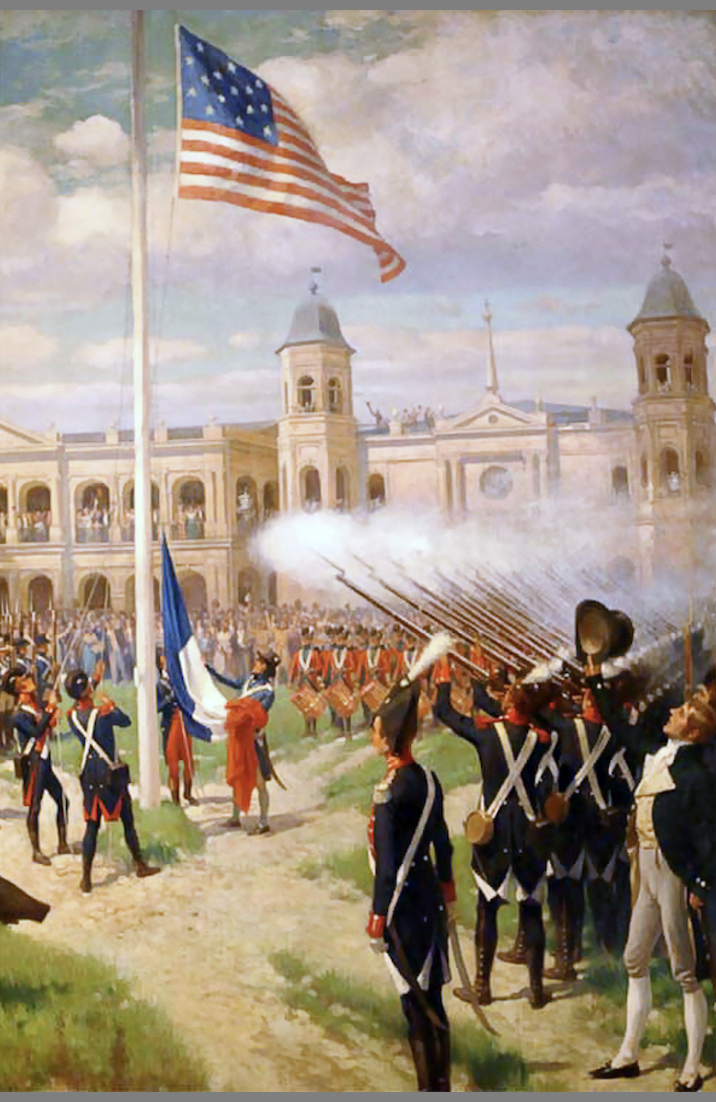
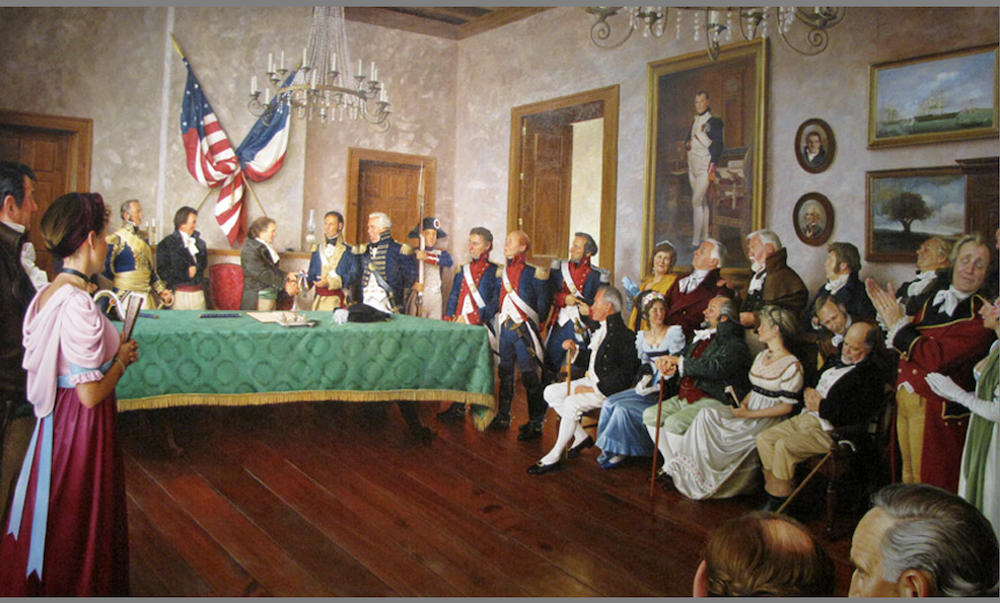
Hoisting American colors, Louisiana Cession, December 20, 1803, oil on canvas, by Thure de Thulstrup (Swedish-American illustrator, circa 1903) - Louisiana State Museum, Public Domain, https://commons.wikimedia.org/w/index.php?curid=19310406
Thure de Thulstrup (1848-1930) served in the French Foreign Legion in the Franco-Prussian War. He also served in North Africa as a member of the First Zouave Regiment.
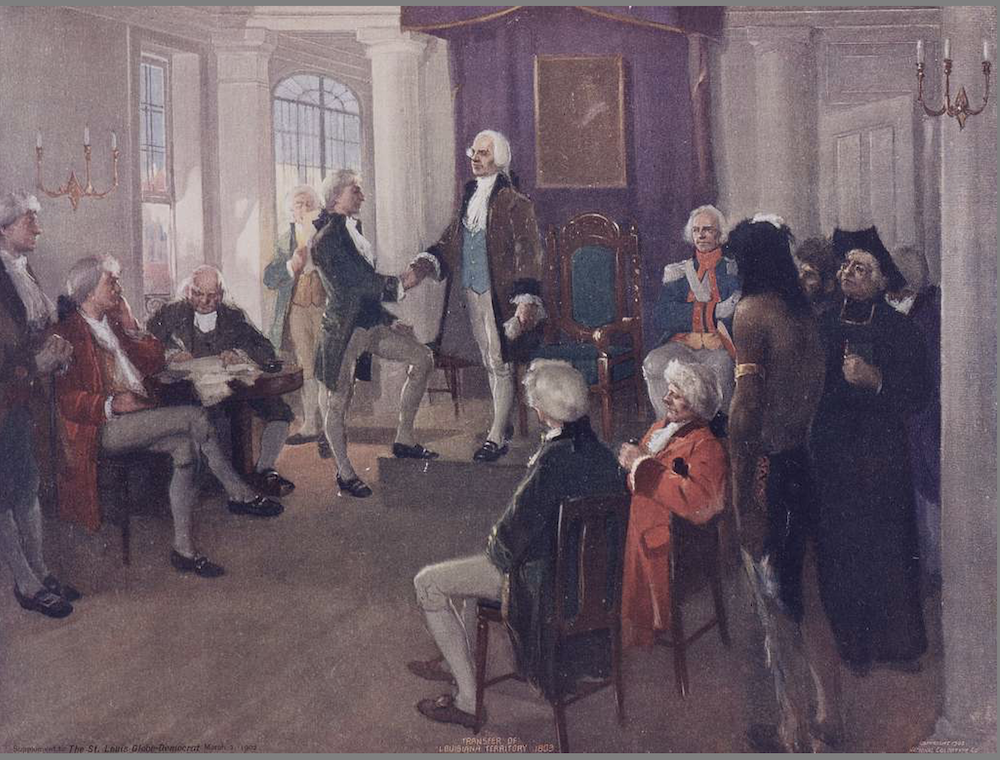
The dramatic moment on December 20, 1803 when the American flag was raised in place of the French flag in front of St. Louis Cathedral, modern day Jackson Square in New Orleans, marking the transfer of the Louisiana Territory from France to the United States.
Scroll down for photo credits and click on illustrations to access interpretive links.
| | |
Editorial
Two Hundred and twenty two years ago, almost to the day, the largest land deal in modern history was agreed upon between two sovereign nations.
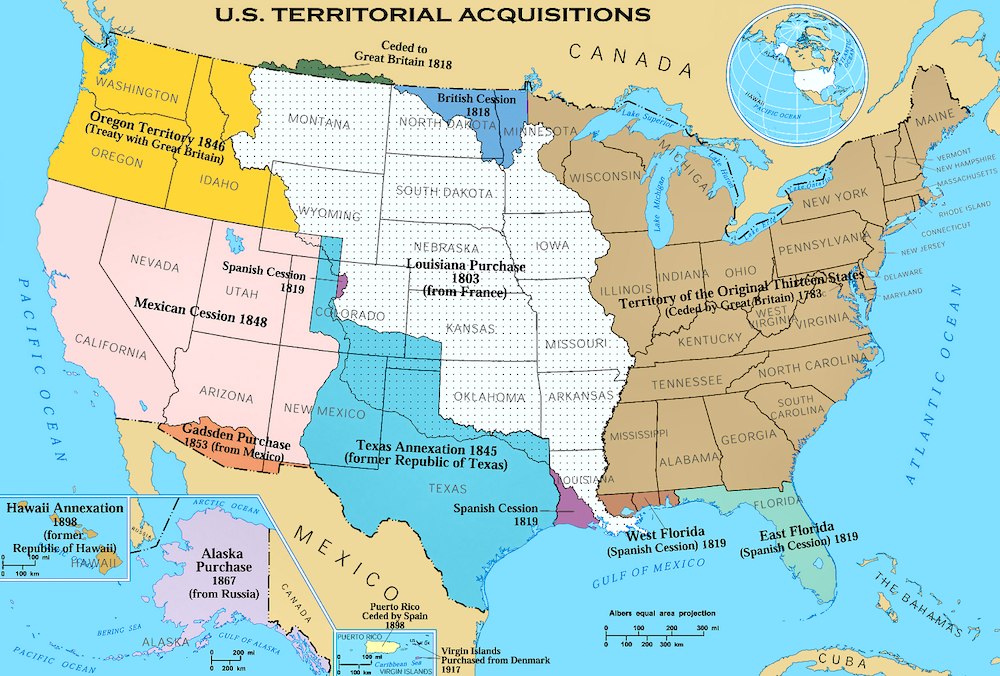
The acquisition of the territory of Louisiana by the United States from the French First Republic in 1803, which effectively doubled the size of the United States at the time, added sizeable territories that would become the States of: Louisiana, Arkansas, Missouri, Iowa, Oklahoma, Kansas, Nebraska, North Dakota, South Dakota, and parts of Minnesota, New Mexico, Montana, Wyoming, and Colorado (as well as portions of Alberta and Saskatchewan in today's Canada).
We will start narrating the history of this transaction by first paying hommage to the intrepid French explorers who claimed this vast land for France a hundred and fifty years before: Robert Cavelier de La Salle, Pierre Le Moyne d'Iberville, Jean-Baptiste Le Moyne de Bienville, Henry Tonti, Pierre de la Vérendrye, and who are memorialized with statues and markers in several States.
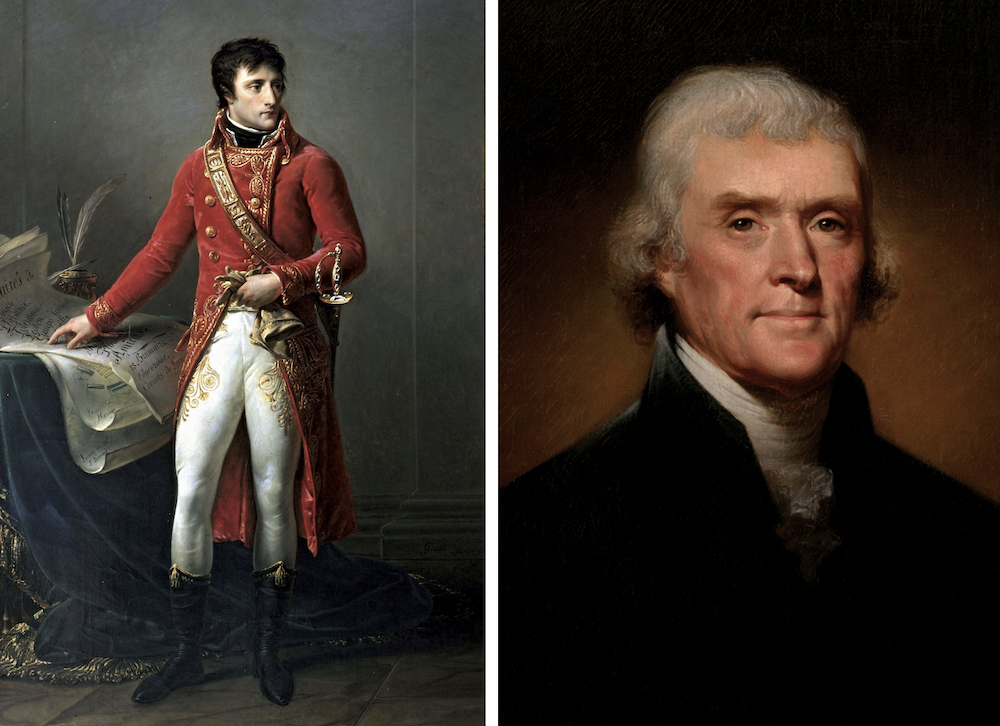
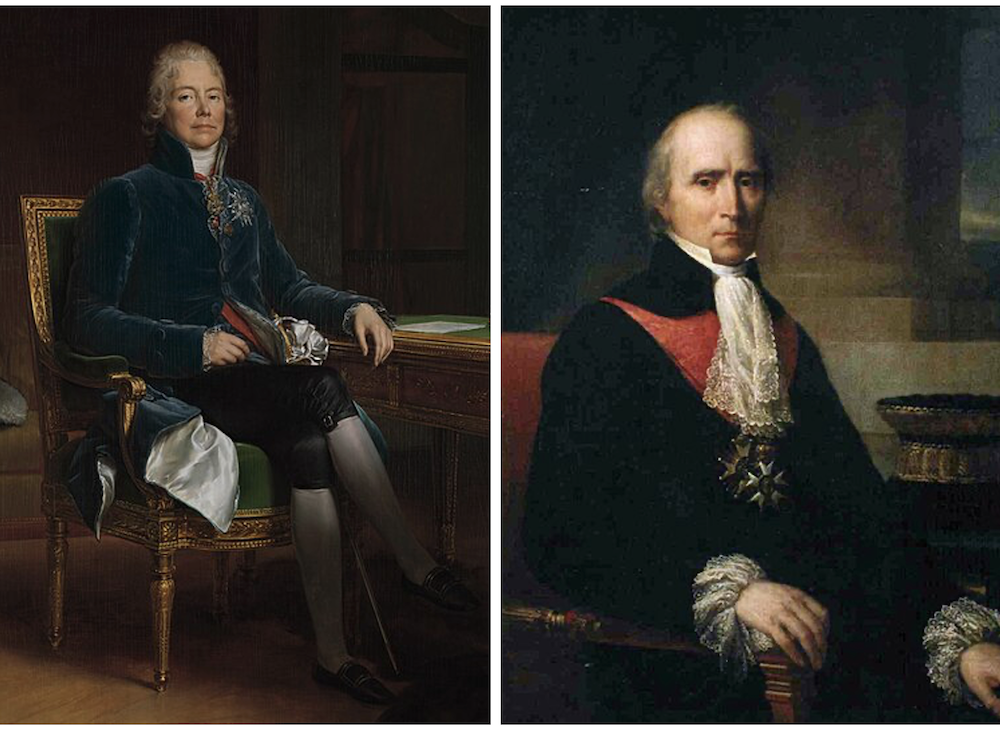
We will then introduce the main protagonists: First Consul Napoléon Bonaparte, Talleyrand and Barbé-Marbois on the French side, President Thomas Jefferson, Robert R. Livingston and James Monroe on the American side. And, to complete the story, we will visit several places that memorialize this historic event, with a few anecdotes about Frenchmen established in Louisiana who embraced their new nation.
This summer, if you happen to travel out South, or West, make sure you visit these sites and detect pervasive traces of French cultural influences throughout many communities!
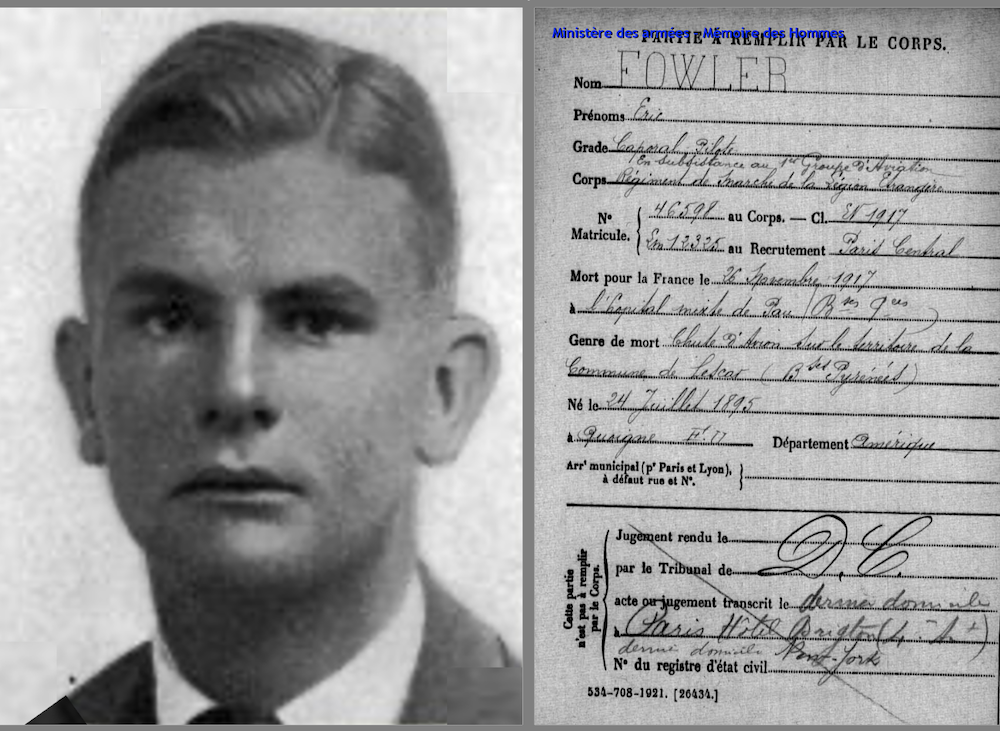
As always, Part Two of our Bulletin will honor this month another brave American volunteer who "Died for France " in World War One: Corporal Eric Fowler, who lost his life right upon graduating from the French flying school at Pau in the Pyrennées Atlantiques in Southern France. This vividly echoes the fate of all the French Air Force cadets buried in he United States who crashed while training in World War Two. May they be in your thoughts as well while reading our Bulletin.
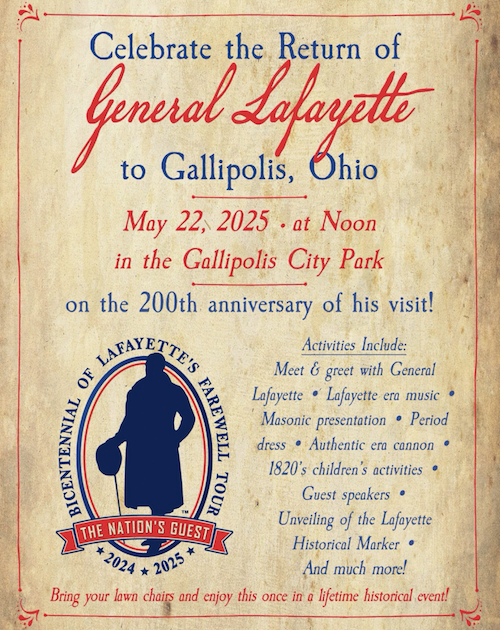
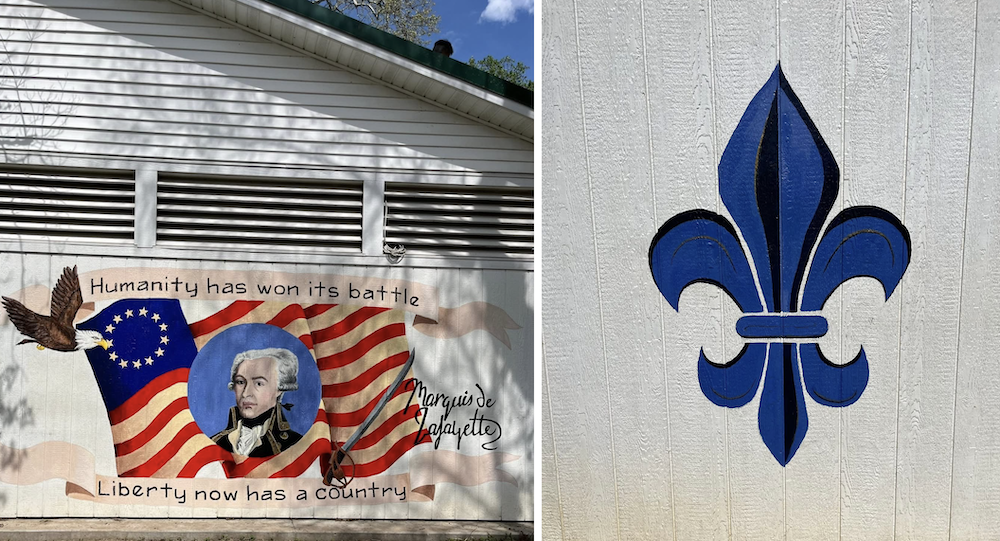
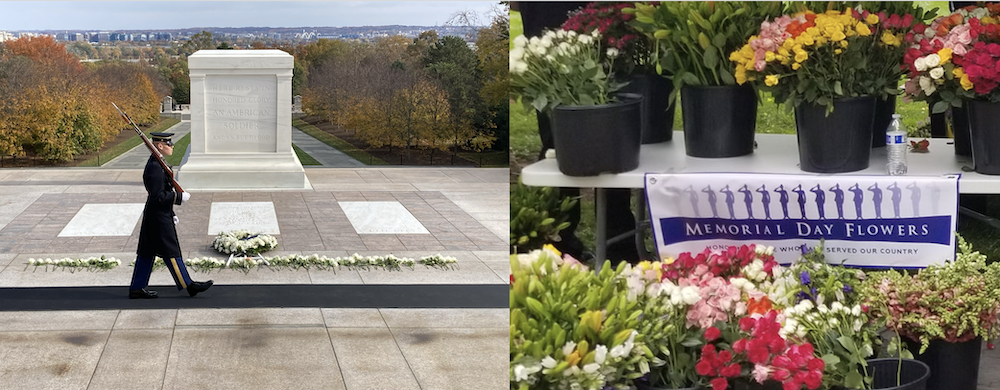
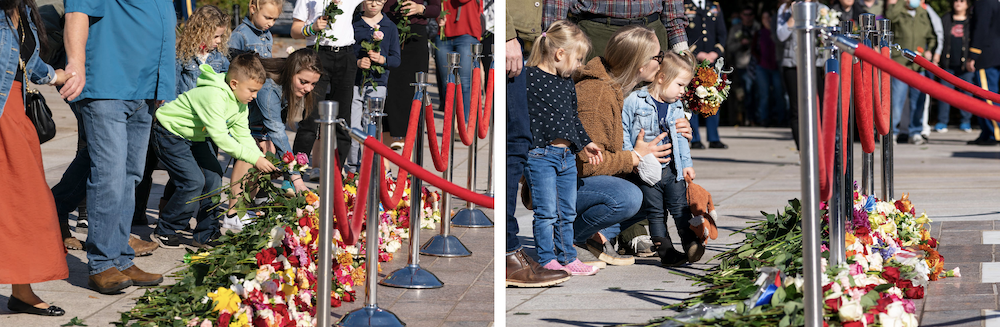
Our third part “News and Save the Dates” will report on events since our last Bulletin, including several commemorations of the ongoing Bicentennial of Lafayette’s Farewell Tour organized by the American Friends of Lafayette. We also share several recent and upcoming patriotic events, notably Memorial Day, to which those of you in New York are invited to join.
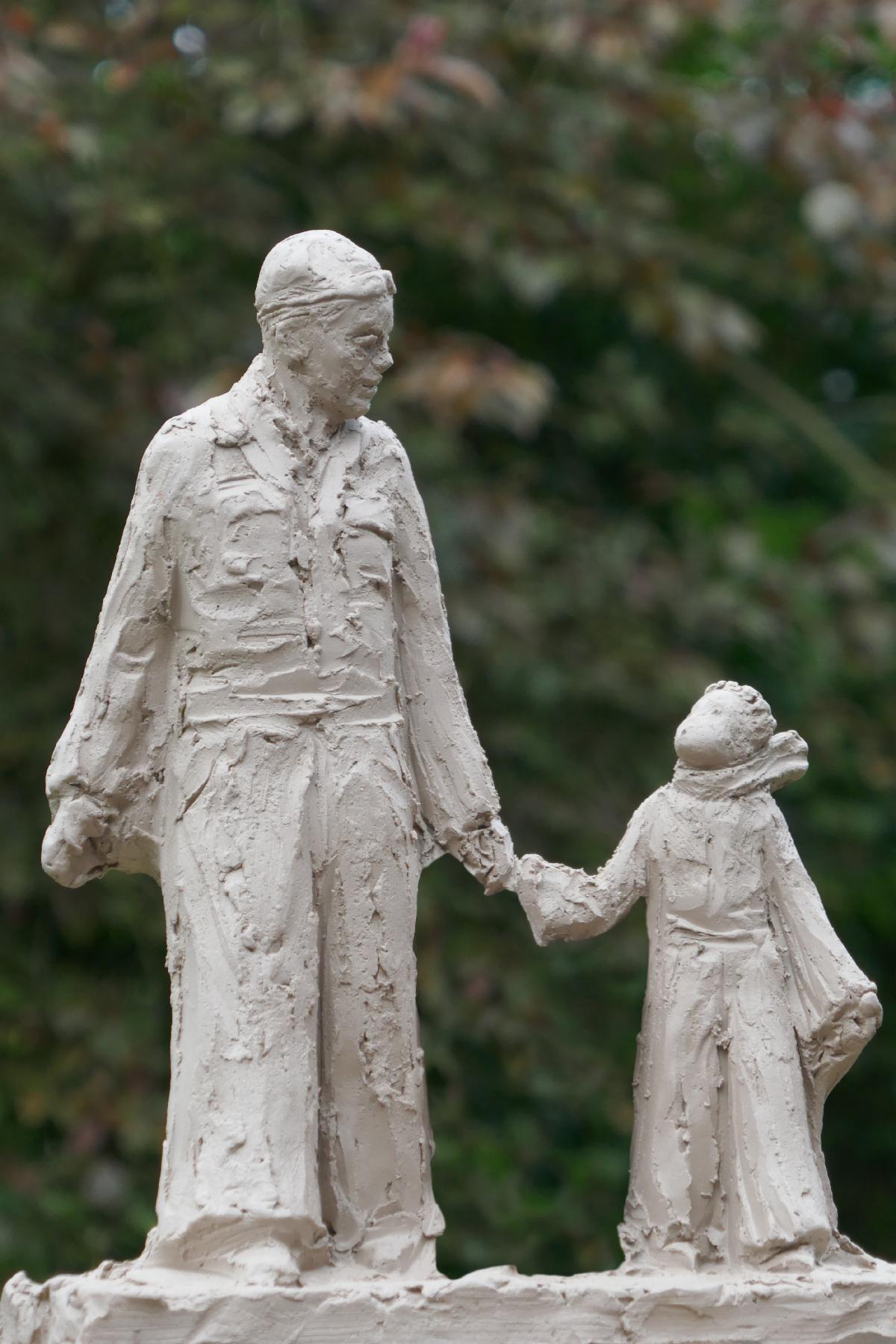
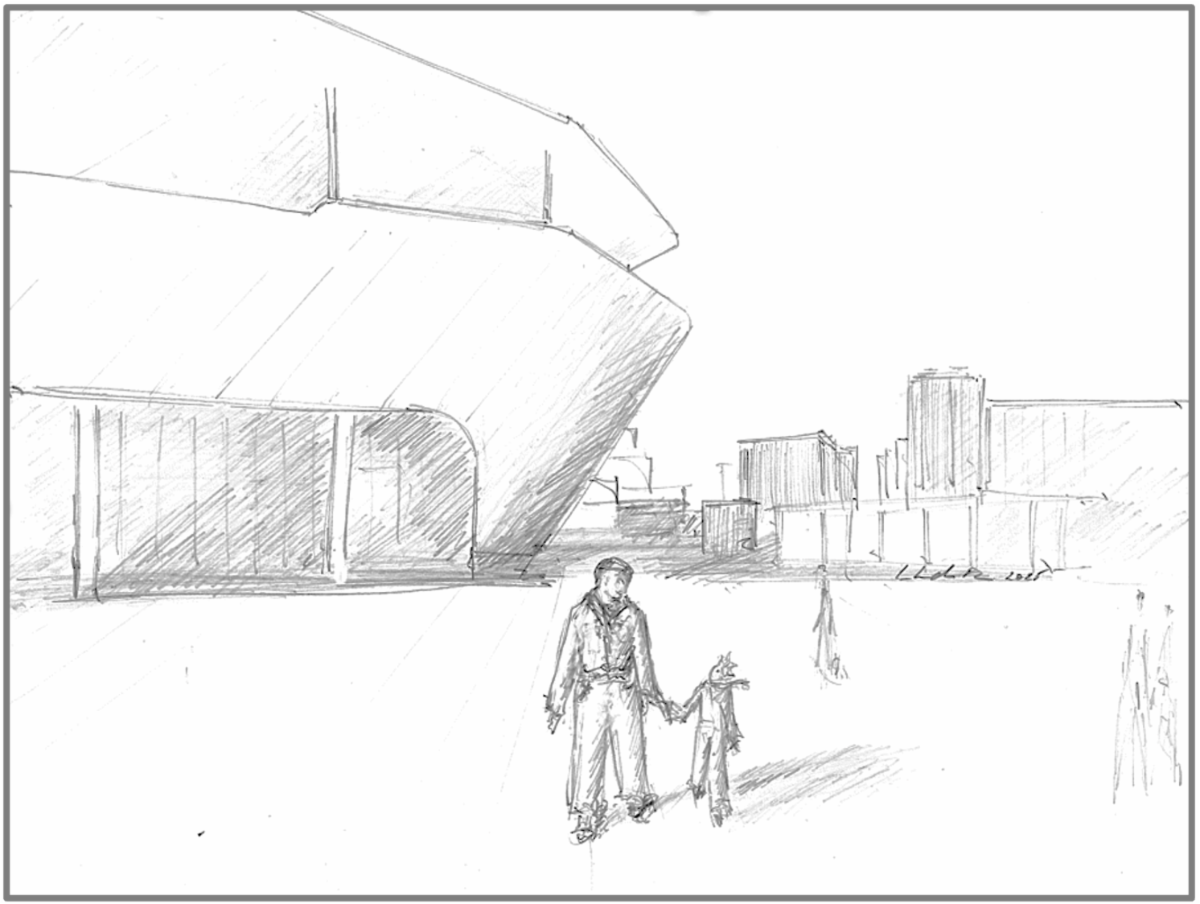
Finally, our fund raising campaign for the sculpture of Antoine de Saint Exupéry and his Little Prince has started in earnest! We welcome all donations, small or large, to make this endeavor a reality. Please consider telling your friends and business acquaintances. Starting at $1,000 your name (or your company) will be engraved in a plaque inside the Frost Museum of Science and planetarium in downtown Miami, Florida, a few steps from the sculpture which will be placed outside near the main entrance!
Thank you for your support,
On behalf of the Board of Directors,
Thierry Chaunu
President, The American Society of Le Souvenir Français, Inc.
| | |
Historical Context:
A vast and pristine empire
| | |
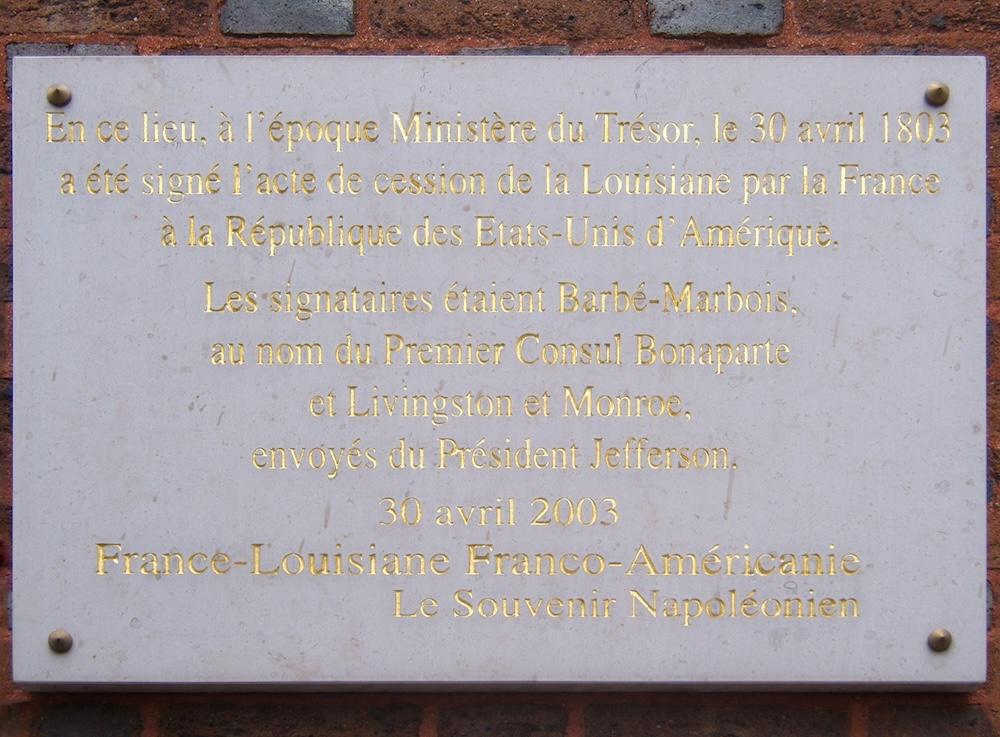
• The Louisiana Purchase, known in French as Vente de la Louisiane, refers to the acquisition of the Louisiana territory by the United States from France. The Treaty was signed on April 30, 1803 (10 Floréal XI in the French Republican calendar) at the Hôtel Tubeuf in Paris.
• The Kingdom of France governed the Louisiana territory from 1682 until its transfer to Spain in 1762, as stipulated in the secret Treaty of Fontainebleau.
• Subsequently, in 1800, Spain returned the Louisiana territory to France under Napoleon's covert Third Treaty of San Ildefonso.
• The later Treaty of Aranjuez in 1801 clarified that Spain's transfer of Louisiana was a 'restoration' to France rather than a retrocession. This distinction was important because it confirmed that France was reclaiming territory it had previously owned, not that Spain was giving up something it now possessed.
• It is important to note that France only exercised control over a minor segment of this vast and pristine piece of the North American continent, the majority of which was populated by Native American tribes. In fact, the territory remained officially under Spanish administration until the power transfer to France on November 30, 1803.
• This transaction encompassed a significant portion of the land within the drainage basin of the Mississippi River, situated to the west of the river. In exchange for fifteen million dollars, which equates to roughly eighteen dollars per square mile, the United States ostensibly secured a total area of 828,000 square miles (2,140,000 km²; 530,000,000 acres) that is now part of the Central United States.
| | |
A history of French claims:
The Founding Fathers
of Louisiana
| | |
René-Robert Cavelier,
Sieur de La Salle
Explorer of Mississippi Basin
| | |
Above:
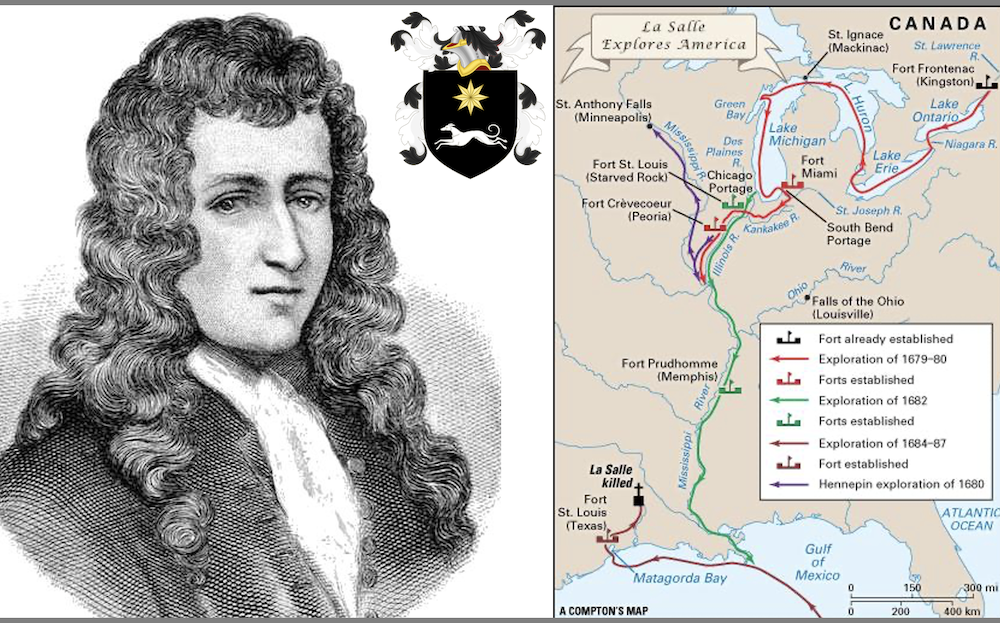
Left: Top: René-Robert Cavelier, Sieur de La Salle, By Charles André Waltner (1846-1925) - Sulte - Histoires des Canadiens-français, 1608-1880, tome II, 1882 (page 3), Public Domain, https://commons.wikimedia.org/w/index.php?curid=25673
Right: Map of La Salle's Exploration in North America. Image available on the Internet and included in accordance with Title 17 U.S.C. Section 107
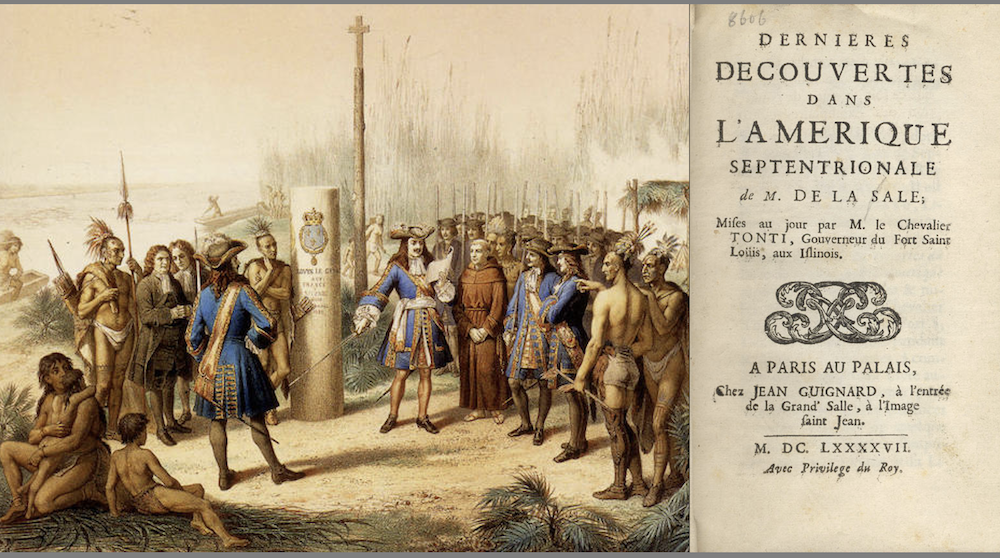
Bottom Left: Color lithograph entitled Prise de possession de la Louisiane et du Fleuve Mississipi (sic, at the time this was the French spelling); Taking Possession of Louisiana and the river Mississippi By Jean-Adolphe Bocquin (French lithographer, fl. 19th cent.); Public Domain, https://commons.wikimedia.org/w/index.php?curid=11641683
Bottom Right: Bibliothèque Nationale de France, Public Domain , https://gallica.bnf.fr/ark:/12148/bpt6k5679353b.texteImage
Markers, “La Salle Landing”
33 Williams Blvd, Kenner, LA 70062
GPS: 29.972883, -90.246850
https://64parishes.org/entry/la-salle-expeditions
| | |
• Robert Cavelier was born on November 22, 1643, into well-off family in Rouen. He became a Jesuit and sailed for New France in the spring of 1666 but was soon released from the Society of Jesus after citing "moral weaknesses”. He received the title Sieur de La Salle with his seigneurial purchase of Lachine near Montréal and soon learned several native languages, such as the Iroquois and Seneca.
• He began to plan for expeditions to find a western passage to China. He built ships such as the Griffon to navigate the Great Lakes and build forts such as Fort Conti and Fort Miami.
• In 1679, with a party of 40 men, he went on to explore the Mississippi River, taking him to today’s Peoria, IL, (Fort Crevecoeur) Memphis, TN, (Fort Prudhomme), reaching the Gulf of Mexico in 1682 where he named the basin Louisiana in honor of King Louis XIV. In 1684 he went on an ill-fated mission to Texas (see further down the expedition of La Belle shipwreck) and after wandering for two years lost in the marshes of the Mississippi delta, he was killed during a mutiny near Navasota, TX on March 19, 1687.
• Dozens of sites throughout the United States bear the name of La Salle, with monuments and markers in several States.
| | |
Pierre Le Moyne d'Iberville
Founder of Louisiana
| | |
Above:
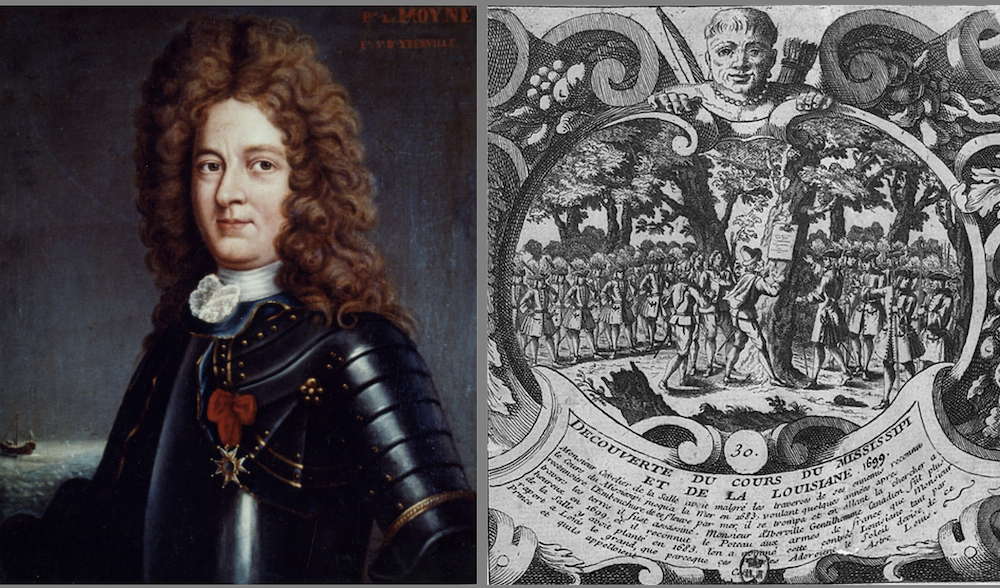
Left: Portrait of Pierre Le Moyne d'Iberville, French explorer and naval commander, founder of the Colony of Louisiana, Knight of the Order of Saint Louis, and a veteran of King Williams' War and the War of the Spanish Succession, By Unknown author - Centre d'archives de Montréal. Bibliothèque et Archives nationales du Québec, Fonds Armour Landry, P97., Public Domain, https://commons.wikimedia.org/w/index.php?curid=76586860
Right: A depiction of d'Iberville and Cavelier de La Salle exploring Louisiana, by Unknown author - Gallica.fr, Public Domain, https://commons.wikimedia.org/w/index.php?curid=27061846
| | |
• Pierre Le Moyne d'Iberville (16 July 1661 – 9 July 1706) or Sieur d'Iberville was a soldier, ship captain, explorer, colonial administrator, knight of the order of Saint-Louis, founder of the French colony of Louisiana in New France.
• He became a French Navy officer and in the years 1690, he fought against the British in the Hudson Bay area and captured several forts.
• In 1699, he led an expedition to ascertain the exact location of the mouth of the Mississipi, following La Salle claim of the region for France, and established Fort Maurepas in Old Biloxi as the temporary capital of L ouisiane. On his second voyage in 1700 he built a second Fort Maurepas in Biloxi, and on his third voyage in 1701 he built a fort in Mobile. His brother Jean-Baptiste Le Moyne de Bienville founded New Orleans in 1718.
Dozens of sites are named after him, such as:
• The city of D'Iberville, Mississippi, Iberville Parish, Louisiana
• Rue Iberville in New Orleans, Louisiana
• He has a statue in Mobile, Alabama, erected in 2002
| | |
Jean-Baptiste Le Moyne de Bienville
Founder of New Orleans
| | |
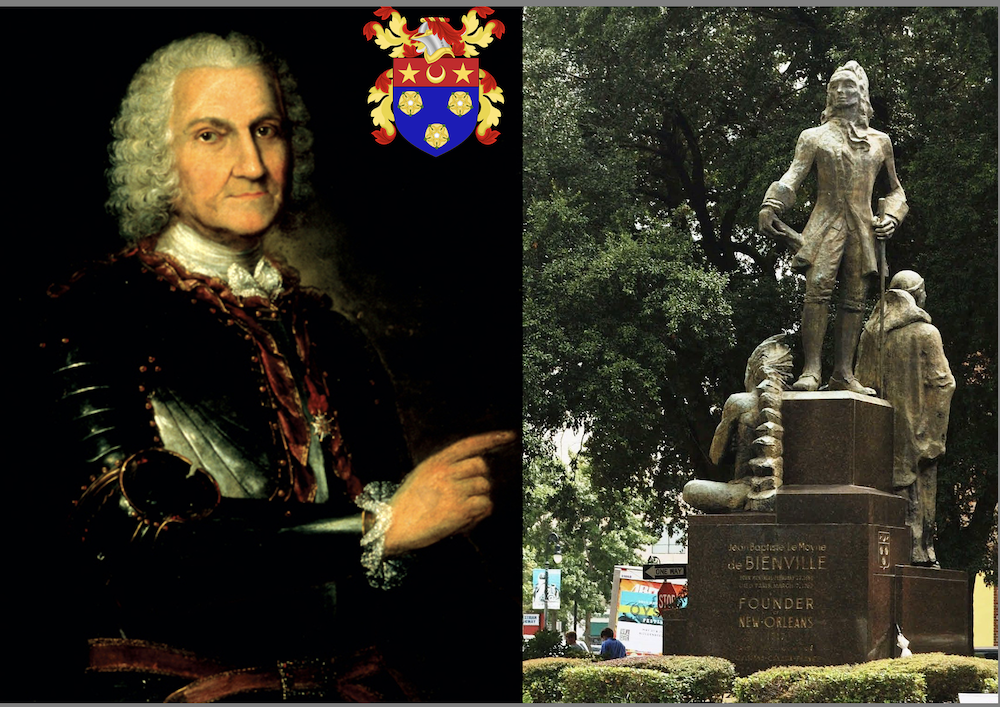
• Jean-Baptiste Le Moyne de Bienville (1680-1767) also known as Sieur de Bienville, was a French colonial administrator in New France. Born in Montreal, he was an early governor of French Louisiana, appointed four separate times during 1701–1743. He was the younger brother of explorer of Pierre Lemoyne d’Iberville.
In addition to being the co-founder of Mobile in Alabama, is he known as the Father of New Orleans, founding the city in the spring of 1718 (May 7 has become the traditional date to mark the anniversary, but the actual day is unknown).
Statue “Jean-Baptiste Le Moyne de Bienville”, Founder of New Orleans, Louisiana
French Quarter at the south end of Bienville Place & Decatur St., New Orleans, LA 70116
GPS: 29.954419, -90.064733
• Inscription on base of statue:
Jean Baptiste LeMoyne de Bienville
born Montreal, February 23, 1680
died Paris, March 7, 1767
Founder of New Orleans
1717
with homage of Louisiana * Canada * France
Erected 1955 by Louisiana Purchase Sesquicentennial Commission.
Marker on the south side of the statue: “In commemoration of the 250th anniversary of the founding of New Orleans, a wreath was placed here by his excellency, Charles Lucet ambassador of France to the United States and the honorable Victor H. Schiro, Mayor of New Orleans, on May 9, 1968.”
| | |
Henri de Tonti
"Father of Arkansas"
| | |
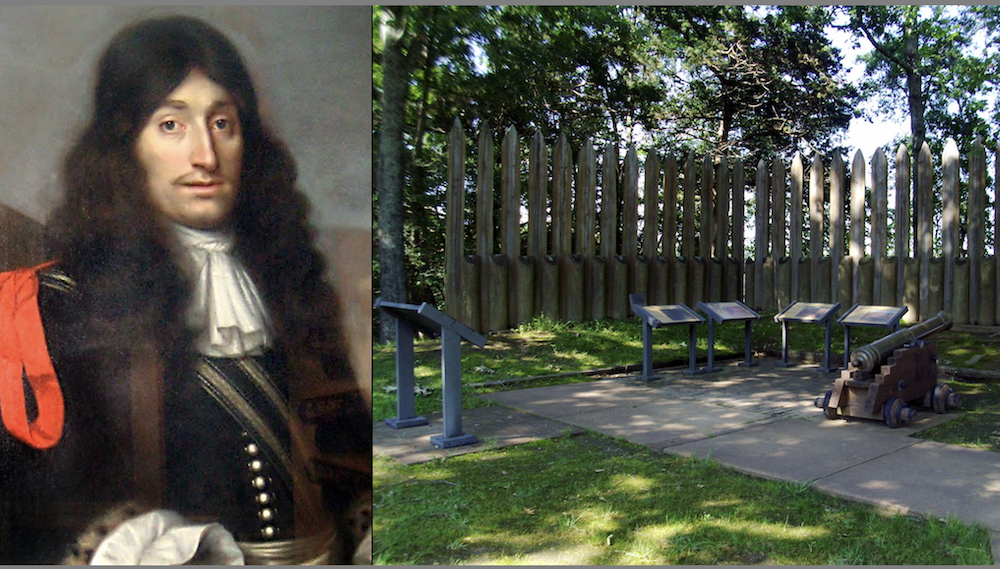
• Henri de Tonti (né Enrico Tonti (c. 1649 – 1704), also spelled Henri de Tonty, was a Sicilian-born French military officer, explorer, and voyageur who assisted René-Robert Cavelier, Sieur de La Salle, with North American exploration and colonization from 1678 to 1686. De Tonti was one of the first explorers to navigate and sail the upper Great Lakes. He also sailed the Illinois and the Mississippi, which they traveled to its mouth and claimed for Louis XIV of France. De Tonti established the first permanent European settlement in the lower Mississippi valley, known as Poste de Arkansea, making him "The Father of Arkansas" as per the Encyclopedia of Arkansas.
• Henri's brother Alphonse was born in 1659 and later became one of the founders of what is now Detroit.
• Tonti established a trading post in Arkansas leaving six Frenchman to secure a permanent French settlement in which trade with the Quapaw became possible, and to hinder English invasion in the east by establishing a presence in the middle of North America.
Marker, « First Post of Arkansas»
1741 Old Post Rd, Gillett, AR 72055
GPS: 34.015767, -91.344350
• Inscription:
“Spanish Explorer Hernan de Soto passed this way in 1542. Nearly 130 years later Father Marquette, the French missionary and explorer, reached the nearby mouth of the Arkansas. In 1682 Robert Cavelier, Sieur de la Salle, claimed this territory for France. But not until 1686 did any European establish a settlement in the lower Mississippi Valley. La Salle's lieutenant, Henri de Tonti, settled the first Arkansas Post.
Tonti's post was perhaps only a mile or two from here on the banks of the Arkansas. The exact site is unknown. He called it Poste de Arkansea after the Arkancas (Quapaw) Indians with whom he traded. The small post survived fourteen years, strengthening France's claim to the lower Mississippi.
Erected by National Park Service, U.S. Department of the Interior.”
| | |
Pierre Gaultier de Varennes,
Sieur de La Vérendrye,
and his sons
Discoverers of the Rocky Mountains
| | |
Above:
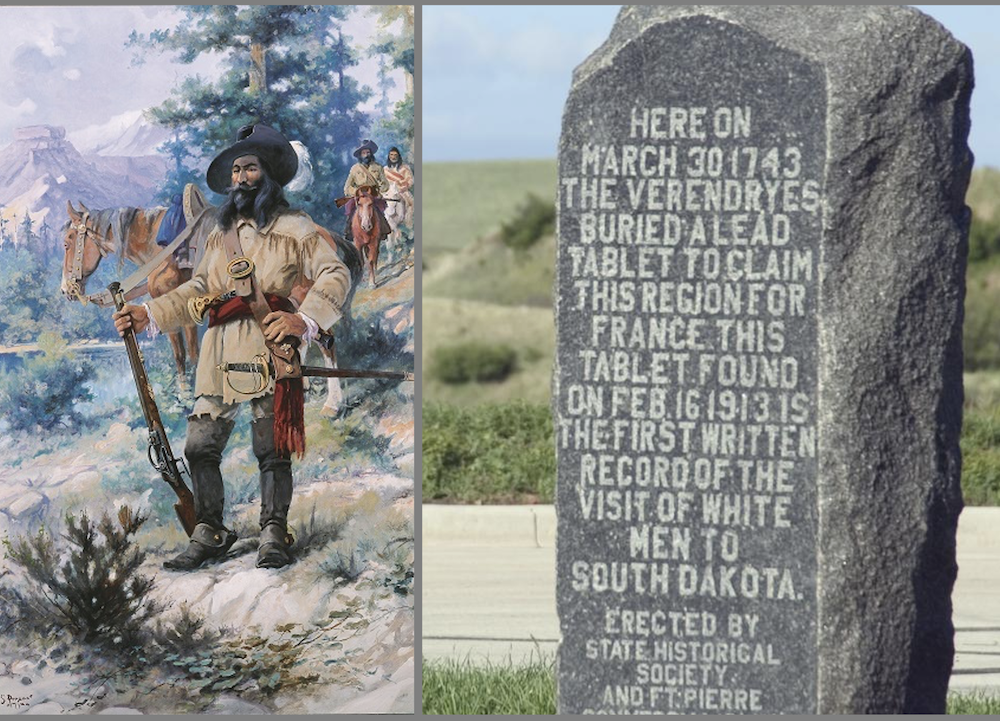
Top Left: Art In the House, Pierre de La Verendrye, by Edgar S. Paxson, oil on canvas, 1912, 81" x 39”, (Photo by Don Beatty, Personal photograph taken at Montana State Capitol, Public Domain) https://mhs.mt.gov/education/Capitol/Capitol-Art/House-Of-Representatives-Lobby
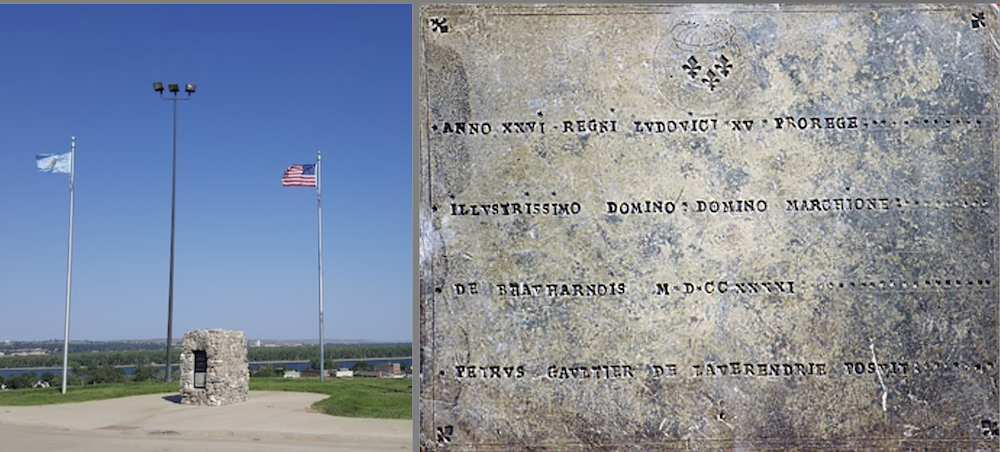
Top Right: Verendrye Tablet Site, South Dakota State Historical Society, By Naawada2016 - Own work, CC BY-SA 4.0, https://commons.wikimedia.org/w/index.php?curid=59582275
Bottom Left: Vergil Noble, administrator for archaeological National Historic Landmarks in the Midwest Region, Public domain, via Wikimedia Commons
Bottom Right: original lead plate left by the Sieur de la Verendrye, left in 1743, and found in 1913, By Guerinf - Own work, CC BY-SA 4.0, https://commons.wikimedia.org/w/index.php?curid=88856745
”In the twenty-sixth year of the reign of Louis XV, the most illustrious Lord, the Lord Marquis of Beauharnois being Viceroy, 1741, Pierre Gaultier de La Verendrye placed this.” Back: "Placed by the Chevalier Verendrye, (his brother) Louis (and) La Londette and A. Miotte. 30 March 1743"
| | |
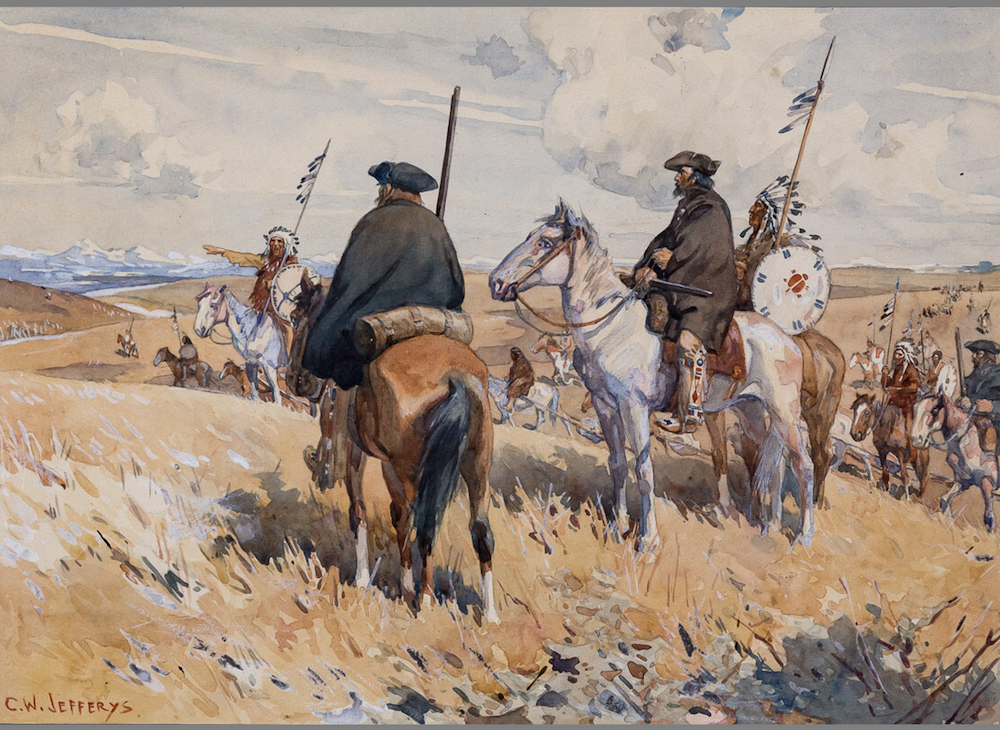
• Pierre Gaultier de Varennes, sieur de La Vérendrye was a leading explorer for New France, and with his four sons he led many early exploratory expeditions into the northern plains of North America. By the 1730s, the Vérendryes had established several trading posts in what are now North Dakota and Canada. Their expedition of 1742-43 sought to extend the range of influence further west, with an ultimate goal of reaching the Pacific Ocean. In this they were unsuccessful.
• In 1742 two of his sons (probably Louis-Joseph and François) made another expedition to the Missouri. Because of the difficulty of identifying places(...) they may have been the first European explorers to view the Rocky Mountains. This was more than 60 years before the expedition of Lewis and Clark.
• They are believed to have explored into present-day Montana and Wyoming, but there is significant scholarly debate about exactly which Native American peoples they encountered and where they went. They told the local Native Americans that the cairn they built over the site was a memorial of their passage, but it marked their claim of the territory for France.
• An officer of the Compagnies Franches de la Marine, Pierre de la Vérendrye was the first to map and describe a region that has been a key part of French North America since the mid-18th century, known for its rich heritage. La Vérendrye is seen as a symbol of the ideal voyageur for many Canadians, but he is particularly significant for French Manitoba. He belongs to a legendary era. The challenges he faced foreshadowed the struggles that would come for both the Métis and the French. He is undeniably a foundational figure of the French-Catholic tradition that is still strong in Manitoba today.
“Verendrye National Historic Landmark”
Verendrye Dr, Fort Pierre, SD 57532
GPS: 44.355325, -100.378322
• A plaque at the monument reads:
“Established June 29, 1917. To commemorate discovery of this area in 1742 by the Sons of Verendrye, celebrated French explorer. Crowhigh Mountain was used as an observation station to spy out unknown land farther west. In 1738 the elder Verendrye and one son made a trip to within a day's journey of the Missouri River, and were the first white men to enter what is now North Dakota. This was in the course of a journey from Verendrye's trading post in Manitoba, Canada, in an effort, which was unsuccessful, to reach the western sea by an overland route.”
• The Verendryes penetrated further into the heartland of North America than any previously known European explorers. They reached the area in South Dakota where Pierre and Fort Pierre are now located 61 years before Meriwether Lewis and William Clark first arrived in the area. At the end of March, 1743, after visiting with local Arikaras, they buried a lead plate at the site to lay the basis for French sovereignty on the upper Missouri
• A group of school children playing on the hill found the lead plate in 1913. The inscription on the plate translates: “In the twenty-sixth year of the reign of Louis XV, the most illustrious Lord, the Lord marquis de Beauharnois, 1741, Pierre Gaultier de la Vernedrye, Louis La Londette, and A. Miotte. 30 March 1743.”
“Verendrye Tablet Site”
Verendrye Dr, Fort Pierre, SD 57532
GPS: 44.355325, -100.378322
• Inscription:
“Here on March 30, 1743 the Verendryes buried a lead tablet to claim this region for France. This tablet found on Feb. 16, 1913, is the first written record of the visit of white men to South Dakota. Erected 1933 by the South Dakota State Historical Society and the Fort Pierre Commercial Club. (Marker Number 49.)”
| | The reasons behind the sale | | |
One may wonder why a world power like France would willingly accept the cession of such a vast territory.
The conditions in 1800 were, nonetheless, quite favorable for the nascent United States.
At that time, the First French Republic was just emerging from ten years of absolute turmoil and continuous war against all the kingdoms of Europe. The young victorious general Napoléon Bonaparte had been named First Consul of the Republic, and well on his way to become the absolute master of France.
He has initially thought of restoring French power in North America, however his plans were thwarted by the failure to suppress the slave rebellion in Saint-Domingue (modern-day Haiti) led by Toussaint Louverture was devastating.
In December 1801, a contingent of 30,000 seasoned French soldiers arrived in Saint-Domingue; soon thereafter, Spain ratified the restoration of Louisiana to France. The deployment of French forces in the Caribbean raised significant alarm in the United States, yet by October 1802, it became evident that the mission was a disastrous failure; General Charles Leclerc, the commander, succumbed to yellow fever, along with approximately 22,000 of his troops.
There were other factors as well:
• Impending war with Britain: Napoleon was preparing for renewed conflict with Great Britain (the Peace of Amiens was crumbling) and needed to consolidate his resources for a European war rather than defending distant American territories.
• Financial needs: The sale provided 60 million francs ($15 million) in immediate cash to fund Napoleon's military campaigns in Europe. France's treasury was depleted, and the Louisiana Territory was proving expensive to maintain.
• Difficulty defending the territory: Napoleon recognized that France lacked resources to control such a vast territory, especially with war looming in Europe.
• Strategic realignment: Napoleon concluded that strengthening the young United States as a potential rival to Britain served French interests better than maintaining a vulnerable colony.
• Focus on Europe: Napoleon had shifted his imperial ambitions to concentrate on building a European empire rather than an overseas colonial empire. He would soon crown himself Emperor of France in 1804.
• Preventing British acquisition: By selling to the Americans, Napoleon ensured the territory wouldn't fall into British hands, which would have strengthened France's primary enemy.
Napoleon reportedly remarked after the sale: "This accession of territory affirms forever the power of the United States, and I have given England a maritime rival that will sooner or later humble her pride." The decision reflected his pragmatic assessment of France's strategic priorities at that moment in history.
Initially, the American envoys sent by president Thomas Jefferson were sent to Paris to negotiate the sale of New Orleans. Little did they know that a much more sizeable offer would be made....
| | |
Above:
Top to bottom, Left to Right:
First Consul Bonaparte By Antoine-Jean Gros – 1803 Public Domain, https://commons.wikimedia.org/w/index.php?curid=391878
Official Presidential portrait of Thomas Jefferson By Rembrandt Peale - Public Domain, https://commons.wikimedia.org/w/index.php?curid=20179140
Talleyrand by François Gérard in 1807 , oil on canvas, Domaine public, the Metropolitan Museum of Art https://www.metmuseum.org/art/collection/search/441969
Barbé-Marbois By Jean François Boisselat - [1], Public Domain, https://commons.wikimedia.org/w/index.php?curid=6604561
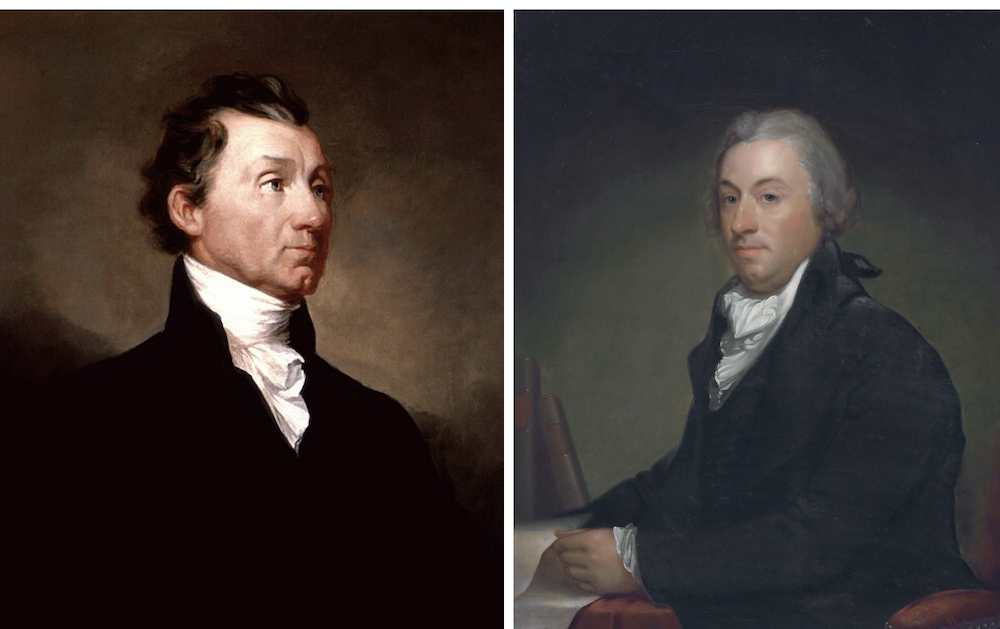
Robert R. Livingston oil on canvas 35¼ x 28½ inch, attributed to Gilbert Stuart - Christie's, Public Domain, https://commons.wikimedia.org/w/index.php?curid=19780311
Portrait of James Monroe, The White House Historical Association, by Samuel Finley Breese Morse , Public Domain, https://commons.wikimedia.org/w/index.php?curid=152490913
| | |
• In an effort to gain control over the mouth of the Mississippi River, President Jefferson dispatched Livingston to Paris in 1801 with the mandate to acquire New Orleans.
• In 1803, Pierre Samuel du Pont de Nemours, a French nobleman residing in the United States, was enlisted by Jefferson to assist in negotiations with France. Du Pont, who had established strong connections with both Jefferson and influential French politicians, engaged in discreet diplomatic discussions with Napoleon on behalf of Jefferson during his visit to France. He proposed the concept of the expansive Louisiana Purchase as a means to mitigate potential conflicts between the United States and Napoleon regarding North America.
• Aiming to avert a possible war with France, Jefferson sent James Monroe to Paris in 1803 to negotiate a resolution, with directives to proceed to London for alliance discussions should the Paris negotiations fail.
• Despite opposition from Foreign Minister Talleyrand, on April 10, 1803, Napoleon informed Treasury Minister François Barbé-Marbois of his consideration to sell the Louisiana Territory to the United States.
• Just a day before Monroe's arrival, on April 11, 1803, Barbé-Marbois presented Livingston with an offer for the entirety of Louisiana for $15 million, which translates to less than three cents per acre (7¢/ha). This sum of $15 million is roughly equivalent to $381 million in 2025 currency, or 70 cents per acre.
• The American delegates had initially been prepared to spend up to $10 million for New Orleans and its surrounding areas, but they were astonished when the significantly larger territory was proposed for $15 million. Although Jefferson had only authorized Livingston to negotiate for New Orleans, Livingston was confident that the United States would accept the generous offer.
| | |
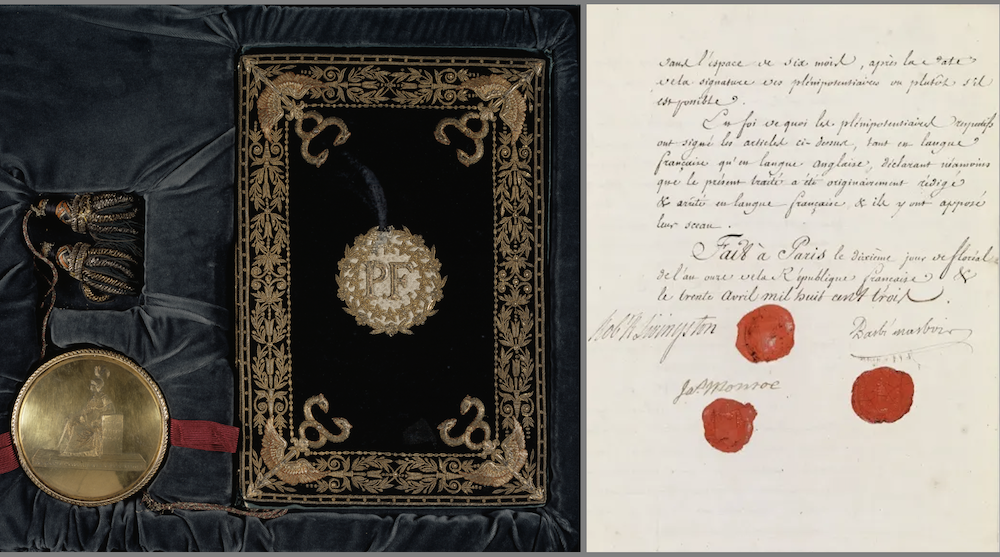
• Robert R. Linvingston and James Monroe were flabbergasted when they were offered the entire territory, which far exceeded their mandate. However they were concerned that Napoleon might retract his offer at any moment, which would hinder the United States' acquisition of New Orleans. Consequently, they consented to and executed the Louisiana Purchase Treaty on April 30, 1803 (10 Floréal XI in the French Republican calendar) at the Hôtel Tubeuf in Paris.
• The signatories included Robert Livingston, James Monroe, and François Barbé-Marbois. Following the signing, Livingston famously remarked, 'We have lived long, but this is the noblest work of our whole lives ... From this day the United States take their place among the powers of the first rank.'
• The treaty was publicly announced on July 4, 1803, although the official documents did not reach Washington, D.C. until July 14.
• In November 1803, France withdrew its remaining 7,000 troops from Saint-Domingue, where over two-thirds had perished, thereby relinquishing its aspirations in the Western Hemisphere. In 1804, Haiti proclaimed its independence; however, fearing a potential slave uprising domestically, President Jefferson and Congress declined to acknowledge the new republic, which was the second in the Western Hemisphere, and enacted a trade embargo against it.
| | |
The Treaty memorialized
throughout the United States
| | |
Above:
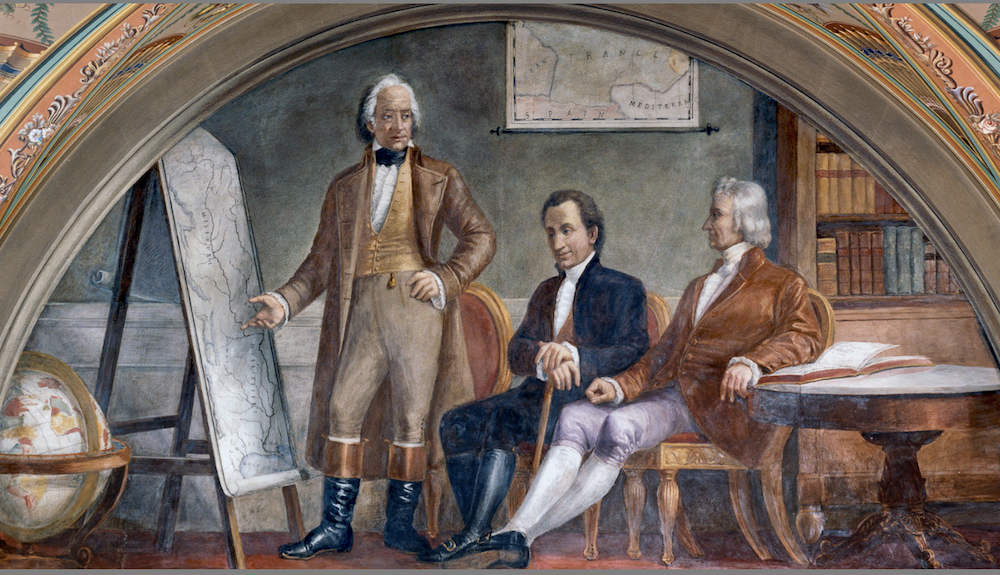
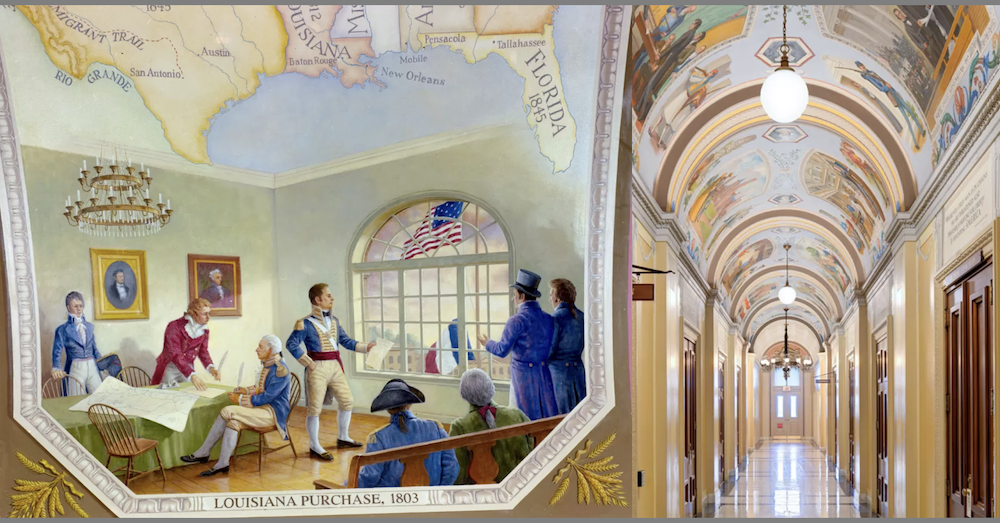
Top: Fresco in the Senate wing of the U.S. Capitol in Washington, D.C. depicting the negotiations for the Louisiana Purchase, painted by Italian artist Constantino Brumidi in 1875. The fresco shows the French government representative, Barbé-Marbois, presenting a map to Livingston and Monroe. The three men had a close relationship that contributed to the success of the Louisiana Purchase.
Photo: https://highland.org/teacher-resources/negotiating-for-louisiana/
Bottom: United States Congress, Cox Corridors Murals
Washington, DC 20004
GPS: 38.889938, -77.009050
The third signing of the Louisiana Treaty, which occurred in New Orleans, is depicted. By Allyn Cox, oil on canvas, 1994, Photo: https://www.aoc.gov/explore-capitol-campus/art/louisiana-purchase-1803
| | |
Above:
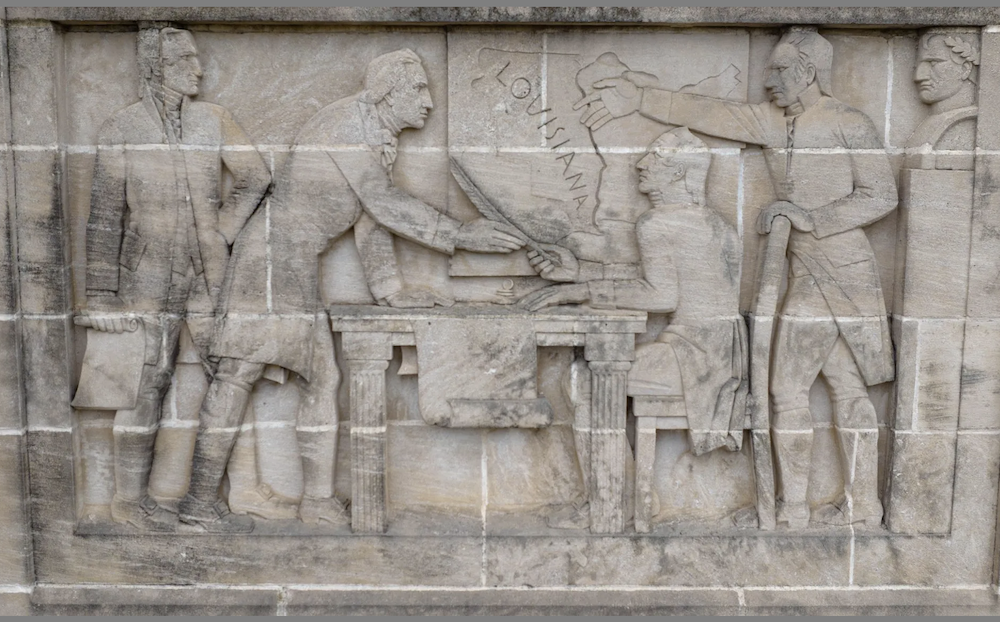
Relief, “Territory and State of Nebraska”
Nebraska State Capitol, 1445 K St, Lincoln, NE 68508
GPS: 40.808056, -96.699722
Napoleon is often erroneously depicted as an emperor (here on a pedestal at the right) when in fact he was the First Consul of the First French Republic at the time of the Louisiana Purchase.
Designed by New York architect Bertram Grosvenor Goodhue, and constructed between 1922 and 1932, the reliefs on the promenade circuit are clad in Indiana limestone and the work of Lee Lawrie, a German-American artist.
| | |
State Capitol, Missouri
Memorial, The Louisiana Purchase
| | |
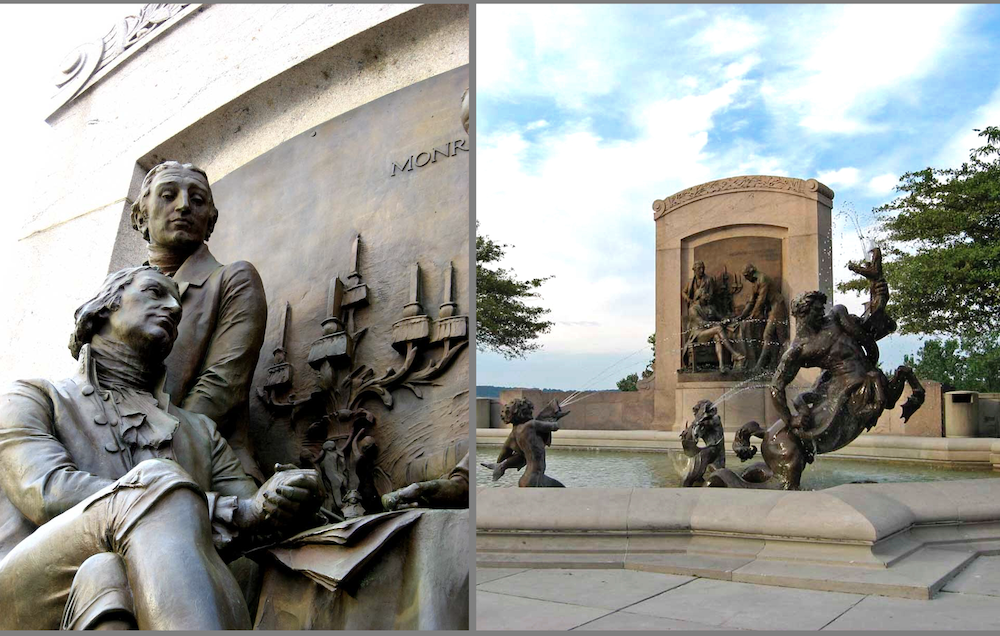
Above: The Louisiana Purchase Monument and the Fountain of the Centaurs
Missouri State Capitol
201 W Capitol Ave, Jefferson City, MO 65101
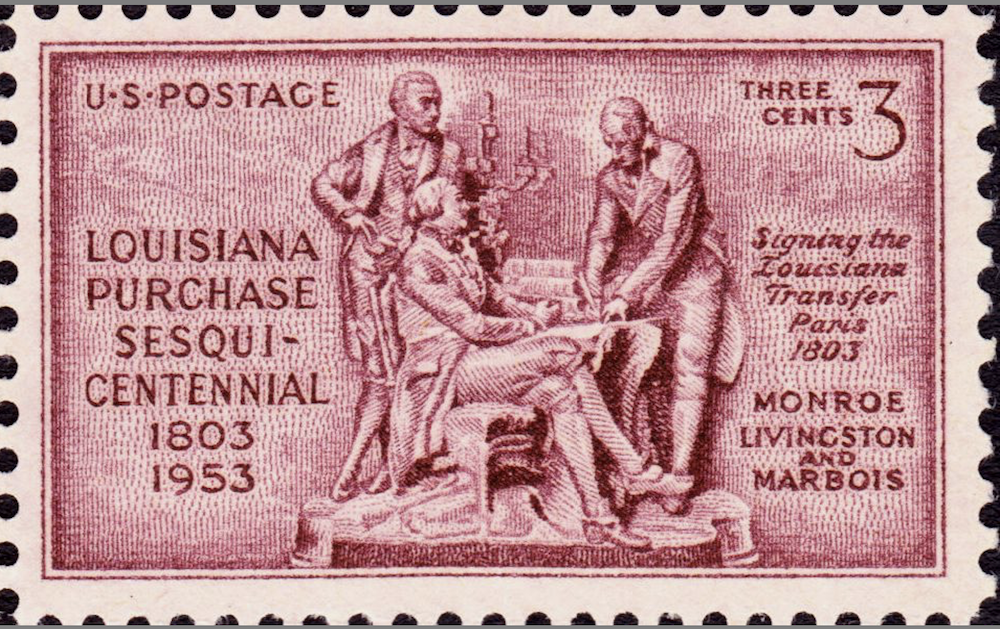
This bronze by Karl Bitter shows Robert Livingston (standing), James Monroe (seated), and François Barbé-Marbois signing the document more commonly known as the 'Louisiana Purchase' in which the United States purchased the land west of the Mississippi River. The sculpture was originally designed for the 1904 St. Louis World's Fair and made out of staff, a temporary plaster and fiber material. It was recast in bronze for the Capitol Complex.
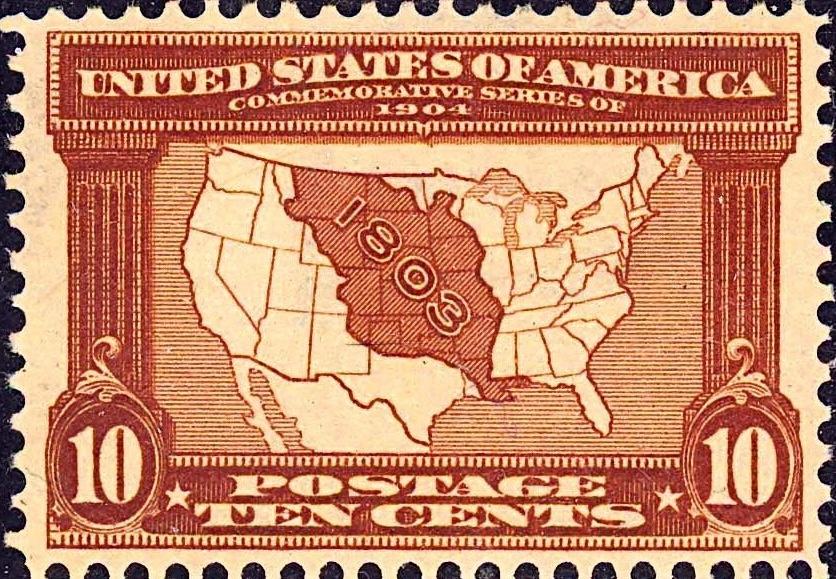
The relief also appeared on a U.S. postage stamp issued around 1953 to celebrate the 150th anniversary of the Louisiana Purchase.
Photos By Karl Bitter - my photo (Einar Kvaran), Public Domain, https://commons.wikimedia.org/w/index.php?curid=68335451
Mural, Cape Girardeau, Missouri
| | |
Above:
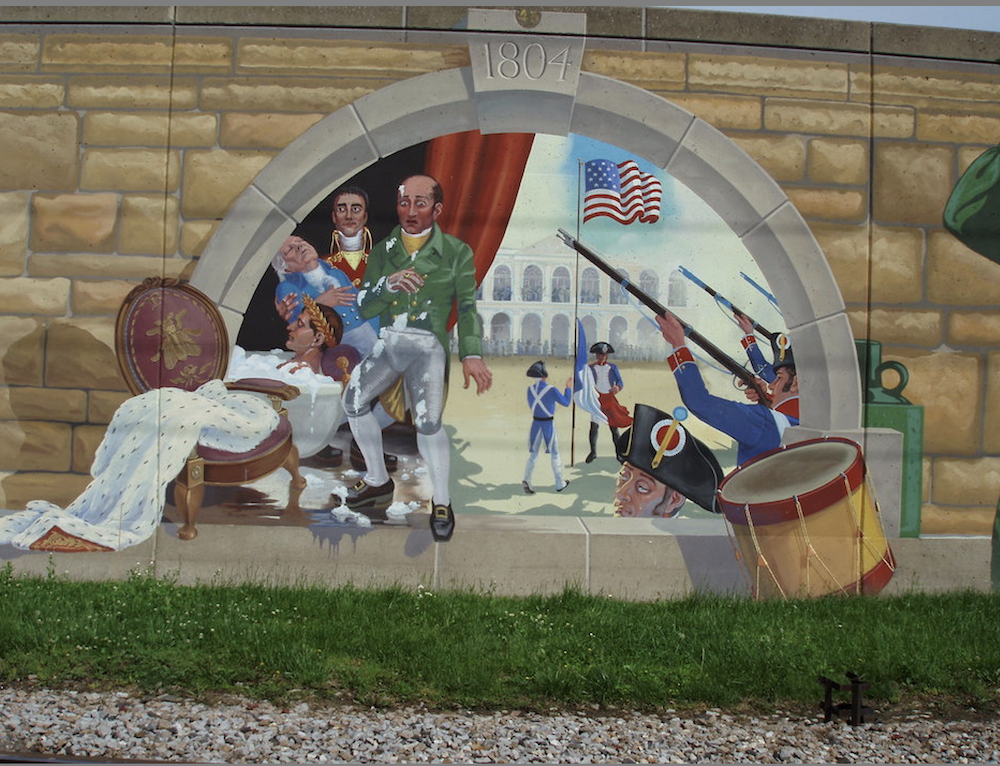
Mural «1804, The Louisiana Purchase”
Mississippi River Tales, painted by Tom Melvin et. al. Chicago IL. Mural 3 of 24
125 N Water St, Cape Girardeau, MO 63701
GPS: 37.305467, -89.517583
For a description on the scene, see further below in the Chapter dedicated to Missouri
Photo: By Larry J. Summary, Cape Girardeau, MO. - Own work, CC BY 3.0, https://commons.wikimedia.org/w/index.php?curid=3788511
| | |
Above:
Mural “Louisiana Purchase - 1803”
Montana State Capitol, 1301 E 6th Ave, Helena, MT 59601
GPS: 46.585800, -112.018466
By F. Pedretti’s Sons, oil on canvas, 1902, 168" x 204"
Photo: by John Reddy, https://tinyurl.com/ye23amvy
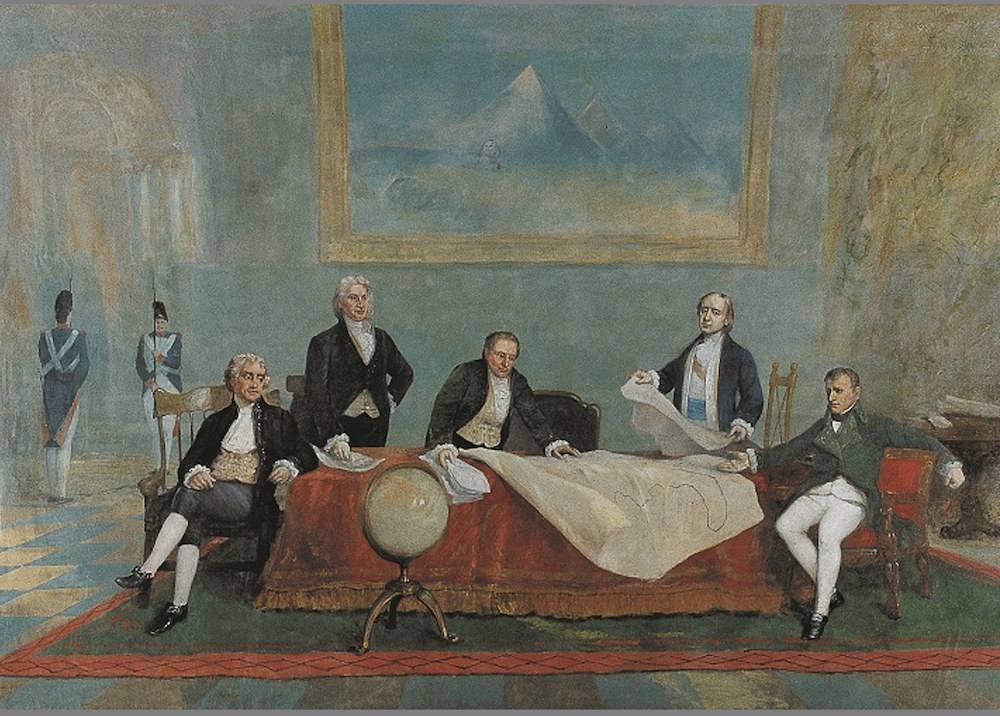
This prominent mural celebrates the 1803 Louisiana Purchase, which allowed Americans to settle the West. It shows Napoleon Bonaparte and U.S. President Thomas Jefferson (who never met), along with the French negotiator Marquis de Barbé-Marbois, U.S. delegate Robert Livingston, and future president James Monroe, who handled the talks. In the background, there is an image of the Sphinx and Egyptian pyramids, likely referencing either Napoleon's campaign in Egypt or Masonic symbols.
| | South Dakota State Capitol | | |
Above:
Mural, “Louisiana Purchase"
State Senate Chamber, South Dakota State Capitol, 500 E Capitol Ave, Pierre, SD 57501
GPS: 44.367129, -100.346368
Photo: https://boa.sd.gov/capitol/capitol-tour/completedcap2.htm
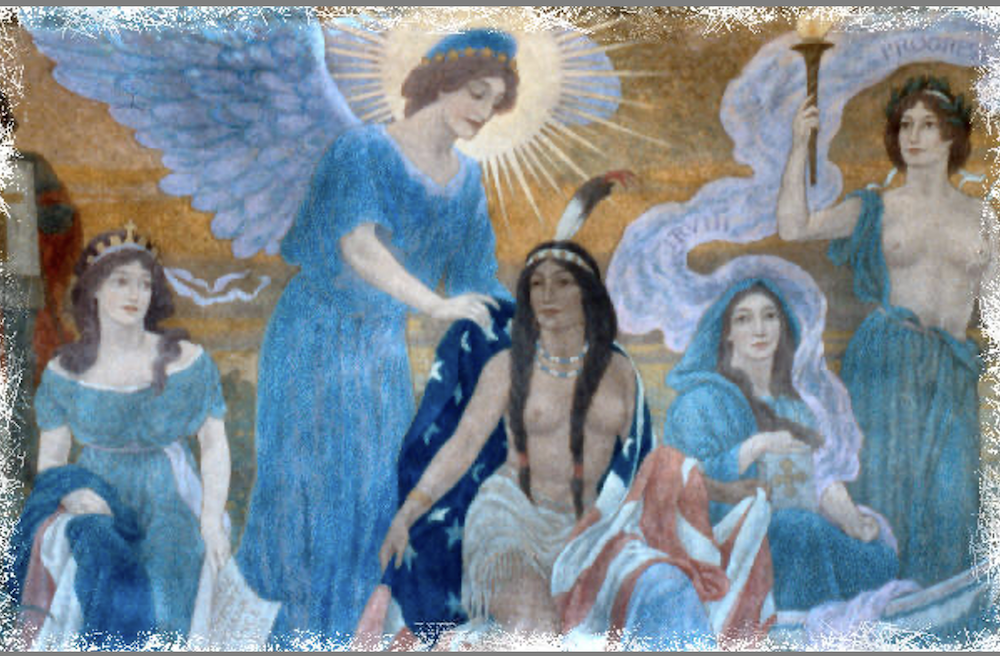
One can see France, seated to the left, her flag folded on her laps, observing America placing its flag on the shoulders of an American Indian, all under the watchful eye of a bare-breasted Lady Liberty.
Charles Holloway was the artist who created three murals for the Capitol building. Little is known about him before he painted The Mercy of the Law, The Louisiana Purchase, and The Peace that Passes Understanding in South Dakota.
Even though the nudity is classical in nature, in the 1980s, there was a proposal in the Legislature to cover the mural in the State Senate chamber, but it did not pass, and it is still displayed today.
Originally, the Louisiana Purchase Mural was painted for a competition at the St. Louis Fair, where it won first place and a prize of $3,000, equivalent to about $100,000 today. The 1920 brochure Guide to South Dakota Capitol stated that this painting was deemed very suitable for the Capitol.
| | |
Markers and tablets
throughout several States
| | |
Above:
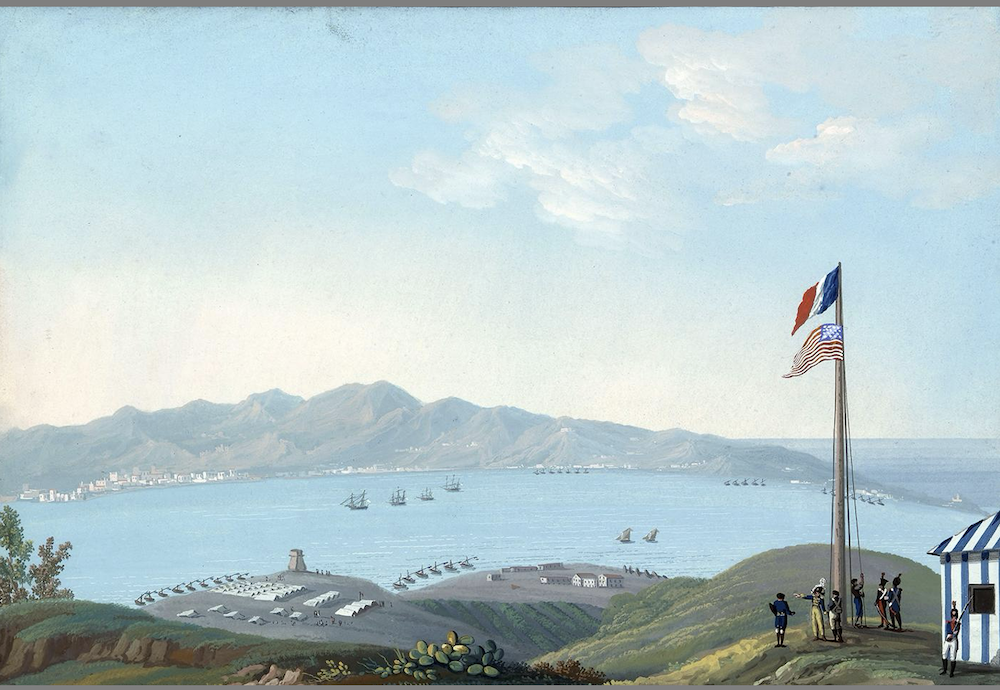
Top: Le Dernier Lever Des Couleurs - La Cession De La Nouvelle-Orléans, ("The Last Flag Raising Ceremony: Cession of New Orleans (1803)"), Musée franco-américain du château de Blérancourt
© GrandPalaisRmn by Anonymous artist, By anonymous - Public Domain, photo Gérard Blot, https://commons.wikimedia.org/w/index.php?curid=41588063
This painting presents an original composition, giving pride of place to the blue of the sky (top half) and that of the Mississippi River and its contact with the sea (middle quarter). In the distance, at the foot of the mountains that bar the horizon, we can make out a few traces of the French settlement. On the river, the boats in single file underline the fact that the city is first and foremost a trading post. The main scene is drawn in the foreground, in a rural setting that barely evokes the New World. Overhead, French and American soldiers can be seen lowering the tricolor and raising the star-spangled banner. The two national emblems float in the wind, symbolizing the rediscovered friendship of the two great nations.
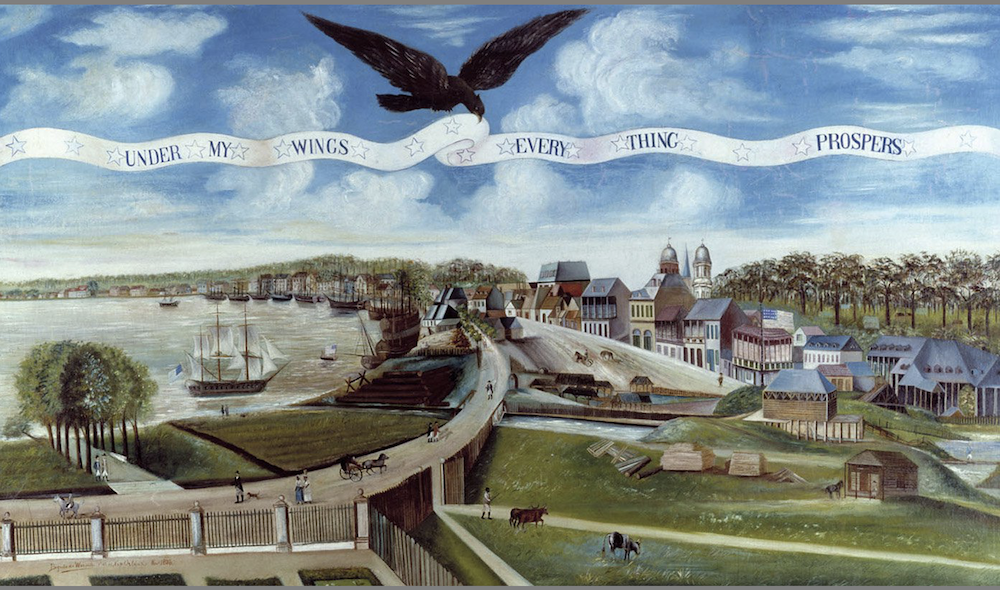
Bottom: "Under my wings everything prospers", Oil on canvas, by By John L. Boqueta de Woiseri, (Jean-Louis Bousquet de Woiseri) French, 1797–1815
https://lsintspl3.wgbh.org/en-us/lesson/louisiana-purchase/7?as_guest=True
The bald eagle, seen holding the banner, has been the symbol of the United States since 1789.
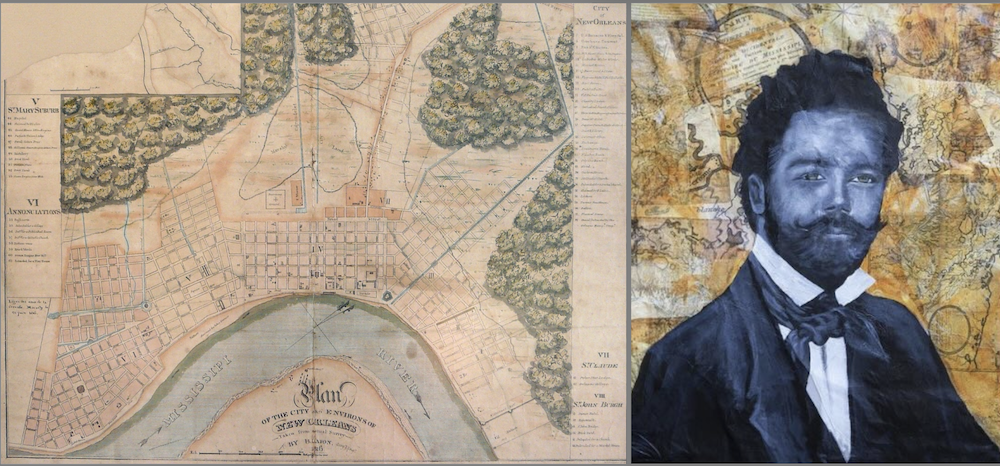
An itinerant artist, Jean-Louis Bousquet de Woiseri announced his arrival in New Orleans on May 28, 1803. His painting, A View of New Orleans Taken From the Plantation of Marigny (Nov. 5, 1803), is the first known painting of New Orleans as an American city. Published six weeks before the Louisiana Purchase was officially effective on December 20, the painting reveals early New Orleans to be a vibrant city with an active port and numerous substantial buildings. Boqueta de Woiseri painted the panoramic view of the city from the vantage point of Bernard de Marigny’s plantation grounds (present day Esplanade Avenue at the Mississippi River), soon to be developed to accommodate the city’s growing population.
| | |
Bronze plaque at the Cabildo:
National Historic Landmark, Louisiana State Museum
701 Chartres Street, New Orleans LA 70116
GPS: 29.957533, -90.063833
• Inscription (excerpts):
....”Here on December 20, 1803, were signed the documents transferring the Louisiana Purchase Territory from France to the United States. In 1825 the Cabildo was converted into a fine residence for the visiting General Lafayette.On this site stood a French colonial Corps de Garde [police station] - 1724 - and a prison and criminal court room (chambre criminelle) - 1730.
The Corps de Garde, rebuilt in 1751, burned in 1788. The remains of its massive brick walls were incorporated in the present Cabildo building in 1795. [...]
The Cabildo has been designated a Registered National Historic Landmark.
Under the provisions of the Historic Sites Act of August 21, 1935, this site possesses exceptional value in commemorating and illustration the history of the United States.
U.S. Department of the Interior, National Park Service.
Erected 1963 by the Orleans Parish Landmarks Commission and the National Park Service.”
| | |
Marker “Louisiana Purchase – West Baton Rouge Early History”
Old Ferry Landing, 198-100 S River Rd, Port Allen, LA 70767
GPS: 30.452573, -91.202159
• Excerpts from Marker:
Panel 1: Life in Early Nineteenth Century West Baton Rouge…
“...In 1803, very few Americans lived in West Baton Rouge Parish. It was populated by various Native American tribes; Creoles, who descended from original French and Spanish settlers; Acadians, exiles from Canada; and African slaves.”...
Panel 2: You have bought Louisiana for a song.”
"…Were were you on April 30, 1803? On this day in our nation's history, Robert Livingston and James Monroe were busy closing the "Real Estate Deal of the Millennium!" For the amazing price of $15 million, President Thomas Jefferson authorized his emissaries to purchase the entire Louisiana Territory from France. Imagine the amount of land - what the United States acquired covered an area larger than the European countries of Great Britain, France, Germany, Italy, Spain and Portugal combined!”...
Panel 3: What a $15 million dream could buy in 1803…
“ Louisiana, as originally settled, was the land drained by the Mighty Mississippi and her tributaries, stretching over 800.000 square miles! Did you know 17 states (sic) resulted from this purchase? Did you know Yellowstone National Park was once part of Louisiana?...”
| | |
Marker, “Fort Saint Jean Baptiste”
"Transfer ceremony of France to the United States"
2nd St #200, Natchitoches LA 71457
GPS: 31.754450, -93.091167
• Inscription:
“At this site on April 26, 1804, Fort St. Jean Baptiste was one of six garrisons in Louisiana where the American Flag was raised in ceremonies commemorating the transfer of the Louisiana Purchase. On behalf of the United States, Commissioner William C.C. Claiborne ordered Capt. Edward D. Turner to Natchitoches to take command of the Natchitoches fort from Commandant Felix Trudeau and a garrison of thirty-two Spanish soldiers. The ceremony began at eleven a.m. when the Spanish flag was lowered and the French flag raised. One hour later the French flag was lowered and the American flag raised as soldiers saluted and guns fired.
Erected by Louisiana Society Daughters of the American Revolution, St. Denis Chapter NSDAR and Woodman of the World Lodge 907.”
Plaque, “The American Transition”
750 2nd St, Natchitoches LA 71457
GPS: 31.762883, -93.087900
• Inscription:
"President Thomas Jefferson negotiated the Louisiana Purchase with French Emperor* Napoleon Bonaparte in 1803. The Louisiana Purchase was the largest peacetime land acquisition in U.S. history, containing territory that eventually comprised 15 states. In order to learn what the newly acquired land was like, Jefferson ordered two exploratory expeditions - the Lewis and Clark expedition in the North and the Freeman and Custis expedition in the South.
For Natchitoches, the Louisiana Purchase meant a radical change from governance by French and Spanish Catholic monarchies to democratic, secular government. Also, the population increased dramatically in the years immediately following the Louisiana Purchase as many people sought economic opportunities west of the Mississippi River. Natchitoches citizens adapted to the new government and their new neighbors, eventually adding distinctly American elements to the diverse cultures already here.
A Changing Government: Following the Louisiana Purchase, Natchitoches was once again in a strategic location near the border of Spanish Texas. Fort Claiborne, founded by the U.S. in 1804, contained the first American public structures built in the newly acquired territory. It stood on this site, the current location of the Natchitoches Events Center. To the outrage of French residents, Fort Claiborne was built on land that they considered to be in communal use, but that the Americans considered to be empty. The fort did not remain on the contested site for long. In 1822, Fort Jesup was constructed west of Natchitoches. This controversy represents one of the many social, cultural and political differences that arose in the transition from colonial rule to American democracy.”
Note: * Bonaparte was not emperor yet
Plaque, “The Louisiana Purchase”
Front Street & St Denis Street, Natchitoches LA 71457
GPS: 31.761550, -93.085817
• Inscription (excerpts):
"Let the Land rejoice, for you have bought Louisiana for a Song." —Gen, Horatio Gates to President Thomas Jefferson, July 18, 1803
“In 1803 the United States paid France $15 million for the Louisiana Territory- 828,000 square miles of land west of the Mississippi River. The lands acquired stretched from the Mississippi River to the Rocky Mountains and from the Gulf of Mexico to the Canadian border. Thirteen states were carved from the Louisiana Territory. The Louisiana Purchase nearly doubled the size of the United States, making it one of the largest nations in the world. The sale included over 600 million acres at a cost of less than 3 cents an acre. For President Thomas Jefferson it was a diplomatic and political triumph. The purchase of Louisiana ended the threat of war with France and opened up the land west of the Mississippi to settlement. Initially Jefferson, through his minister to France Robert Livingston, offered Napoleon $2 million for a small tract of land on the lower Mississippi. There Americans could build their own seaport. Impatient at the lack of news, Jefferson sent James Monroe to Paris to offer $10 million for New Orleans and West Florida. Almost at the same time, and unbeknownst to Jefferson, France had offered all of Louisiana to Livingston for $15 million...” [...]
| | |
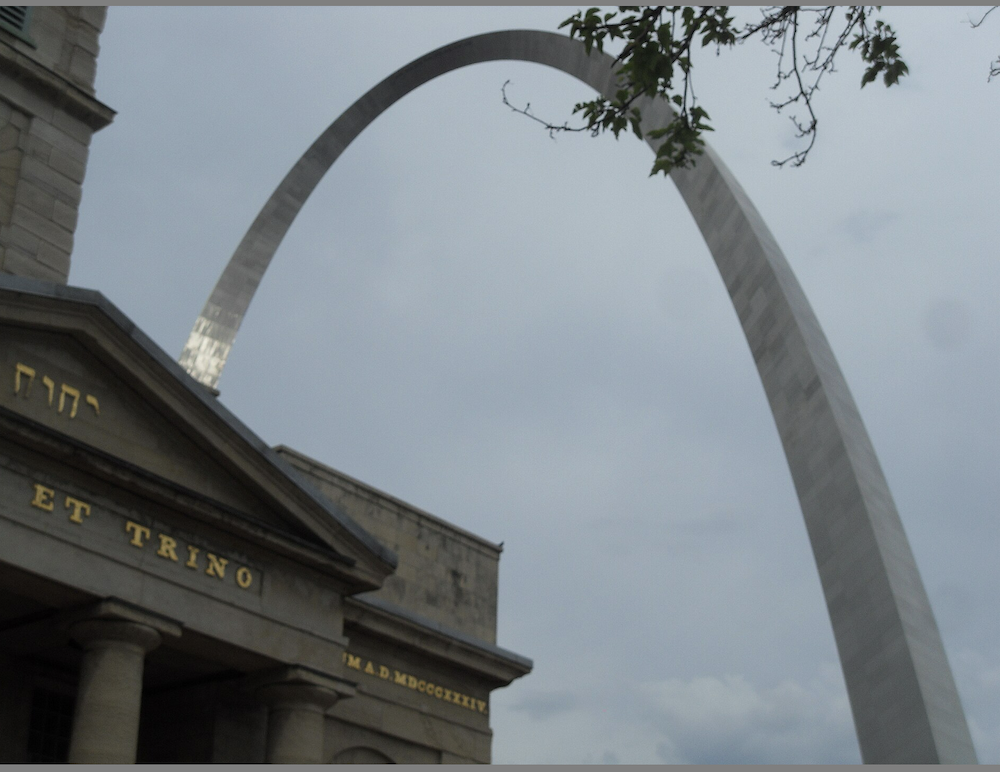
A small diplomatic issue arose during the transfer of control from France to the United States. Due to winter, the news of the Louisiana Purchase did not arrive in Saint Louis on time. It was still effectively under Spanish control. The Spanish flag was taken down, the French flag was raised, and then after 24 hours, the French flag was lowered and the American flag was raised. This showed that France had governed that area, not Spain. This event is still remembered today as "Three Flags Day".
Marker, « One Day – Three Nations»
Gateway Arch Trail, St. Louis, MO 63102
GPS: 38.623333, -90.185783
• Inscription:
“Here on March 9, 1804, Spanish Lieutenant Governor Charles Dehault Delassus met with US Army Captain Amos Stoddard to complete the Louisiana Purchase. Stoddard accepted the Upper Louisiana territory first for France and then for the United States. Spanish and American troops witnessed the momentous event—the territory transferred into American hands. Although the United States purchased the land from France, Spain had governed the territory for nearly forty years.
After the official transfer was signed, troops lowered the Spanish civilian flag and raised the French flag. The next day, they lowered the French flag and raised the American Stars and Stripes.
In one day, the United States doubled in size. New Orleans (Orleans Territory, later the State of Louisiana) was transferred earlier on December 20, 1803.”
Erected par National Park Service, U.S. Department of the Interior.
Marker, «1804, The Louisiana Purchase”
125 N Water St, Cape Girardeau, MO 63701
GPS: 37.305467, -89.517583
• Inscription:
“In 1803 the Mississippi River Valley was an important area in international diplomacy and intrigue. Napoleon's brothers, Lucien and Joseph, sought to dissuade him from selling the entire Louisiana Territory to the newly established United States. Napoleon, in his bath, reportedly stood up and declared, "I renounce Louisiana," He then sat down, splashing soapy water and causing the servant to faint in Lucien's arms. In 1803 at New Orleans, the French colors were lowered and the U.S. flag raised. A French soldier shed a tear. In March 1804 Upper Louisiana was officially transferred to the United States in St. Louis.”
“Panel Sponsors: Harry and Fran Rediger
Erected by Mississippi River Tales, River Heritage Mural”
| | |
Above:
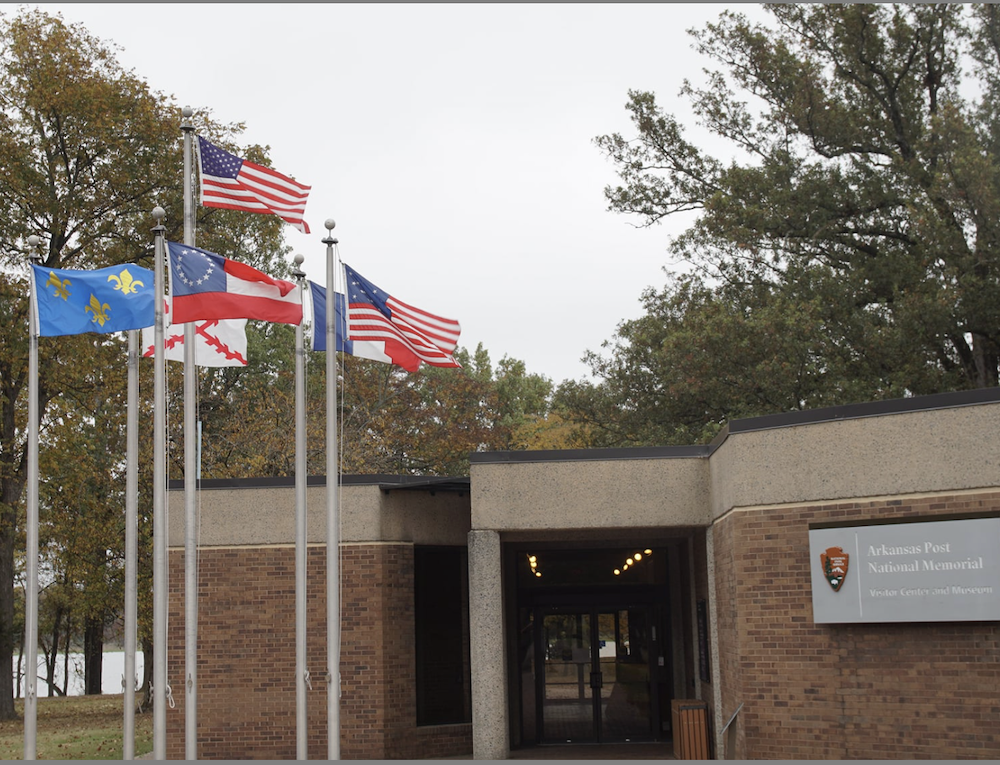
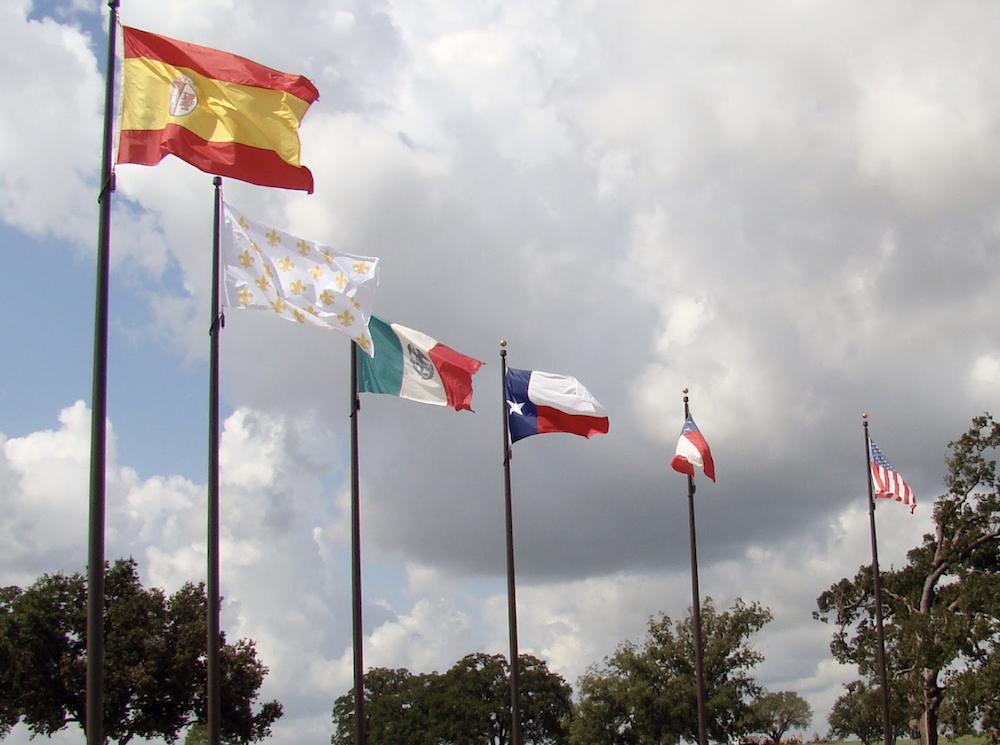
Fluttering at the Arkansas Post National Memorial visitor center are five national flags that have flown here — those of Bourbon France, Spain, Napoleonic France, the United States and the Confederate States of America. A Quapaw tribal flag is also hoisted.
Photo: https://www.facebook.com/arkansaspostnps/photos
| | |
Marker, « Louisiana Territory: 1682-1800”
“Louisiana Purchase Historic State Park”
Louisiana Purchase State Park, AR-362, Holly Grove, AR 72069
GPS: 34.644900, -91.052817
• Inscription:
“Development:
In 1682, one hundred and forty years after Hernando de Soto and his conquistadors searched for treasure in the vast regions west of the Mississippi River, the French explorer, LaSalle, claimed all the land, resources and peoples of the "country of Louisiana" in the name of King Louis XIV of France.
During the following years, trading centers such as St. Louis, Natchez and New Orleans evolved as the mighty Mississippi carried skins, pelts, bear oil and other frontier products to market. By 1721, 8,000 people crowded the French colonies with fierce rivalries developing between the French and the steadily growing numbers of English traders.
In 1762, France ceded the entire Territory to Spain in payment for the aid provided during the bloody French-Indian War (Seven Years' War). Spain, fearing growing American influence in the area, attempted to protect her new territory by placing controls on river trade. But the controls failed, and in July, 1800, Napoleon opened negotiations with Spain for the return of Louisiana to France. A temporary treaty stipulated France would not "sell or otherwise dispose of the Territory to any third party," leading Spain to believe their interests were free from American control.”
Resources:
Lands along the Mississippi often proved unsuitable for settlement, but did provide an excellent environment for wildlife, especially fur-bearing mammals. Frenchmen recognized the potential trade value and quickly set up a trade network with the Indians along the Mississippi and its tributaries.
Fur markets in Europe provided financial incentives to early Anglo-Americans in this area. Some of the mammals which fed early explorers and clothed Europeans still thrive in the remaining wetlands of eastern Arkansas. Beaver, mink, raccoon, swamp rabbits, opossum, gray squirrels, and occasional deer have adapted to these conditions and tend to live here year-round.”
Marker, « The Purchase: 1801-1803”
“ Louisiana Purchase Historic State Park”
Louisiana Purchase State Park, AR-362, Holly Grove, AR 72069
GPS: 34.644900, -91.052817
• Inscription:
“President Thomas Jefferson learned Spain had ceded the Louisiana Territory back to France in early 1801. Fearing Napoleon would close the Mississippi to American trade, the President sent Ambassador Robert Livingston to Paris (September, 1801) to warn France the United States would not tolerate a loss of its trade outlet or American colonies. In 1802, as Napoleon readied to occupy New Orleans with military troops, President Jefferson dispatched Pierre du Pont de Nemours to France to inform the French the United States would form a military alliance with England should they annex Louisiana. With the growing threat of French occupation, the President then sent James Monroe to Paris with the authorization to purchase the port of New Orleans and West Florida for $9,375,000. Monroe and Livingston were instructed to: 1) negotiate a peaceful settlement; and 2) if France resisted, form an immediate alliance with England. Considering Napoleon's views on world conquest, there seemed to be little chance of settlement. Suddenly, on April 11, 1803, Napoleon announced his plans to cede the entire Territory to the United States. By 30, 1803, a treaty binding the United States to the purchase of the entire 830,000 square mile area for $15,000,000 was signed. At less than three cents per acre, the Louisiana Purchase must be considered the greatest real estate deal of all time. This happening shaped the destiny of the United States, ended Napoleon's dreams of a French empire, and confirmed Spain's fears of America's westward expansion."
Marker, « Republican France », Arkansas Post National Memorial
1741 Old Post Road, Gillett AR 72055
GPS: 34.017433, -91.347716
• Inscription:
“When Napoleon I became Emperor of France in 1799 *, he envisioned the establishment of a vast "French Empire in America". He began in 1800 when he won control of Louisiana from Spain.
Constant threat of war with England soon forced him to abandon his plans. In late 1803, negotiations were consummated between France and the United States which culminated in the Louisiana Purchase. Thus ended the long struggle by European powers to dominate the Mississippi Valley.
Erected by National Park Service, U.S. Department of the Interior.”
Note: * The First French Republic was transformed into the French Empire on May 18, 1804, 12 months and 18 days after the sale of Louisiana.
| | |
Above:
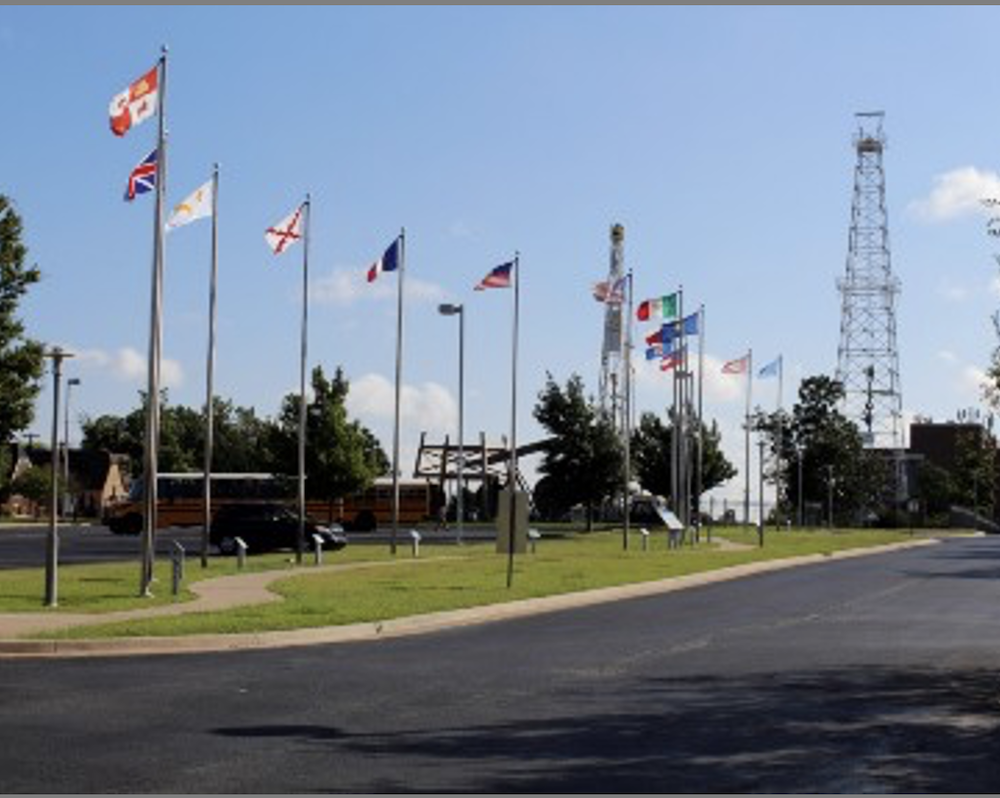
"14 flags over Oklahoma" exhibit, sponsored by OGE (Oklahoma Gas & Electric) Energy Corp, Oklahoma History Center, Oklahoma City, OK
Photo: https://www.okhistory.org/historycenter/story
The exhibit includes flags like the Spanish royal standard, the Great Union of Great Britain, the French royal standard, the Spanish Empire standard, the French Republic standard, the United States flag (various versions), the flag of Mexico, the flag of the Republic of Texas, the Lone Star Flag of Texas, the Choctaw flag, the Confederate flag (a controversy arose about this), Oklahoma's first flag, and the current Oklahoma flag.
| | |
Markers, Royal Flag of France & Standard of the French Republic
Oklahoma State Capitol View, 800 Nazih Zuhdi Drive, Oklahoma City OK 73105
GPS: 35.494567, -97.498583
Also: 14-Flag Museum, 400 E Cherokee Ave, Sallisaw, OK 74955
GPS: 35.460698, -94.785953
• Inscriptions:
Royal Flag of France, third flag* to fly over Oklahoma
“French claims on North American land go back to 1682 when Rene-Robert Cavelier Sieur de la Salle declared all the country associated with the Mississippi River and its branches. The land was named the Louisiana Territory in honor of King Louis XIV. Jean-Baptiste Bernard de la Harpe brought the royal flag from France to present day Oklahoma in 1719. He visited and established trading posts among the Wichita people along the Arkansas River in what is now Muskogee County. The flag features a field of white with the fleur-de-lis (lily flower). This stylized lily is most closely associated with the French monarchy.”
Standard of the French Republic, fifth flag to fly over Oklahoma
“The Standard of the French Republic flew over all French territories in North America, including what is now Oklahoma. In 1800 Spain gave the area known as the Louisiana Territory back to France when French Emperor Napoleon Bonaparte** reclaimed the land. Napoleon had conquered a large area of the European continent and planned to create an empire in North America. However, he later sold the Louisiana Territory to the United States.”
Note: * The Great Union flag is listed as the second flag to fly over Oklahoma, with the explanation that "in 1663 King Charles II of England gave a strip of land extending from the Atlantic Ocean to the Pacific Ocean to several members of the nobility as a reward for their support", however this is a bit of a stretch, as no Englishman set foot in Oklahoma back then.
Note: ** Same error again, Bonaparte became emperor Napoléon Ier in 1804.
Marker, "100th Meridian Oklahoma/Texas State Line"
US 62, Hollis OK 73550
GPS: 34.681650, -100.000200
• Inscription:
"The 100th meridian first marked the boundary between the Republic of Texas and the vast Louisiana Purchase establishing this boundary was one of the most far reaching events in which the nation engaged.
In 1927 the U.S. Supreme Court established the OK/TX state line along this boundary. The 100th meridian chapter, NSDAR dedicated this project to identify this state line located 4 miles west of Hollis, OK, on U.S. Highway 62.
Erected by Harmon County Historical Society and 100th Meridian Chapter Daughters of the American Revolution."
| | |
Marker “Louisiana Purchase - 1803”
110 N Main St, Three Forks, MT 59752
GPS: 45.896639, -111.551417
• Inscription:
“The Missouri and Mississippi drainage determined the boundaries of the Louisiana Purchase.
The acquisition, as well as the expiration, of the Mississippi-Missouri by the white man was carried out against a background of European power politics. In selling the Louisiana territory to the U.S., Napoleon of France acquired money to further his own ambitions against England, while at the same time setting up against England "a maritime rival who will humble her pride."
For the United States, the Louisiana Purchase was "an event of such magnitude that its results are beyond measurement. It doubled the area, adding resources of incalculable value, providing a potential that was certain to make the U.S. a great power and guaranteeing our expansion beyond the Rockies to the Pacific... There is no aspect of our national life, no part of our social and political structure, and no subsequent event in the course of our history that it has not affected." - Bernard DeVoto
Marker “European Interest in the Missouri”
110 N Main St, Three Forks, MT 59752
GPS: 45.896639, -111.551417
• Inscription:
“Throughout the 16th and 17th centuries, England, France and Spain competed in the search for a water route across North America. Explorers such as DeSoto, La Salle and de la Verendrye believed that the Mississippi-Missouri was the fabled Northwest Passage to the wealthy Orient.
By 1760, the French had penetrated farther up the Missouri that any other nation, but England emerged from the French and Indian Wars as the strongest power on the continent. With the birth of the United States in 1776, a fourth nation entered the contest for domination of the western lands. The power struggle continued for another 25 years, with the United States siding with one European nation, then another. In the end, the desire of France to limit England's power made possible the purchase of the western territory by the United States.”
| | |
Above:
Top: Monument “René Robert Cavelier Sieur de la Salle”, Photo by Larry D. Moore, CC BY-SA 4.0, https://commons.wikimedia.org/w/index.php?curid=48099060
Middle Left: Bust “René Robert Cavelier Sieur de la Salle”, Photo by Paul Ridenour, https://www.paulridenour.com/wotb.htm
Middle Right: Statue & Marker “René Robert Cavelier Sieur de la Salle”, Photo: By Larry D. Moore, CC BY-SA 4.0, https://commons.wikimedia.org/w/index.php?curid=48425758
Bottom: Six Flags Over Texas Monument, with the French Royal "fleur-de-lys" standard
400 Veteran's Memorial Dr, Navasota, TX 77868
GPS: 30.372118, -96.111997
Photo: https://visitnavasota.com/business_detail_T25_R114.php
| | |
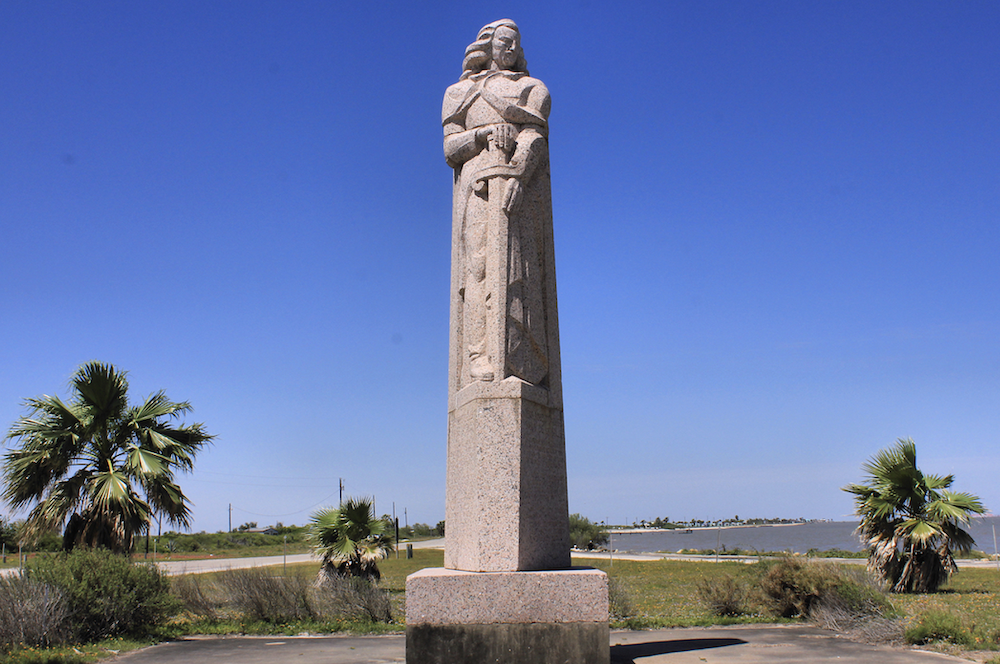
Monument “René Robert Cavelier Sieur de la Salle”
2 TX-316 road, Port Lavaca, TX 77979
GPS: 28.527367, -96.508650
• The René Robert Cavelier Sieur de La Salle Monument is a 22-foot-tall pink Texas granite statuary figure in Indianola, Texas, overlooking Matagorda Bay. Commissioned for the 1936 Texas Centennial, sculptor Raoul Josset and architect Donald S. Nelson designed the monument that was dedicated in 1939 and listed on the National Register of Historic Places on July 27, 2018.
• Inscription:
“Born in Rouen France November 22, 1643. Came to Canada in 1668. Founded a first settlement near Montreal. Led several expeditions on the Great Lakes and the Ohio and Illinois rivers. Completed the exploration of the Mississippi, 1682. On July 24, 1684, La Salle sailed from France to establish a colony at the mouth of the Mississippi. Landed at Matagorda Bay February, 15, 1685. There established Fort St. Louis. While on his way to Canada he was murdered near the Trinity River March 19, 1687.”
(side 2)
“A gentleman but not a courtier, a proud independent yet timid nature, an explorer of bold vision and untiring energy. La Salle's colony on Matagorda Bay gave the United Statues its first claim to Texas as a part of the Louisiana Purchase.
America owes him an enduring memory for in this masculine figure she sees the pioneer who guided her to the possession of her richest heritage. ---- Francis Parkman”
Erected 1936 by State of Texas
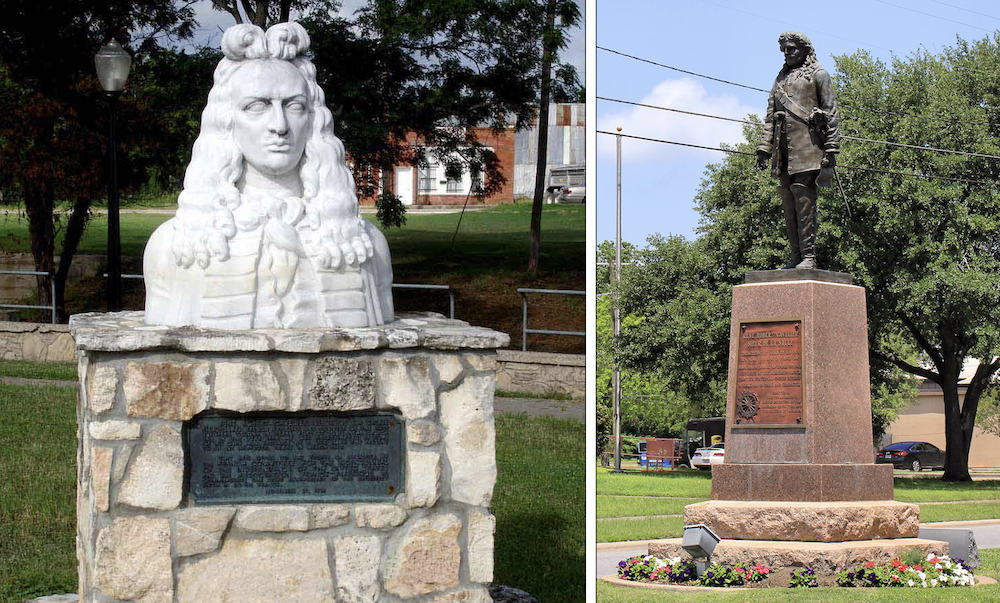
• Navasota is the only town in the U.S. with two statues of Robert Cavelier de la Salle, who helped set the stage for the Louisiana Purchase. One statue was erected in 1936 by the DAR, and the other was a gift from France. No other Texas town has honored this French hero as much or attracted as much interest from the French government.
Bust “René Robert Cavelier Sieur de la Salle”
August Horst Park Pavilion, 104 County Rd, Navasota, TX 77868
GPS: 30.377545, -96.108537
• The bust was donated to the City by the French government in 1978. It was previously in downtown, but was re-dedicated by the French consulate in May 2012 at August Horst Park.
Statue & Marker “René Robert Cavelier Sieur de la Salle”
Corner of Washington Ave and Old McMillican Rd, at 40 Old Millican Rd, Navasota, TX 77868
GPS: 30.389200, -96.086983
• The Daughters of the American Revolution commissioned and erected a bronze statue of La Salle in Navasota during the Texas Centennial in 1930.
• Inscription:
“Treacherously slain by his own men near this spot in March 1687
Born Rouen France November 22 1643
Explorer of the Mississippi River
Frontier Statesman - Empire Builder
A Nobleman in Rank and Character”
“Erected 1930 by Texas Society of the Daughters of the American Revolution and the citizens of Navasota.”
• The bust was donated to the City by the French government in 1978. It was previously in downtown, but was re-dedicated by the French consulate in May 2012 at August Horst Park.
• Inscription:
“From a time before recorded history the area around the confluence of the Brazos and Navasota Rivers, along the La Bahia trail has been a magnet to travelers and a place to rest and reflect on the heritage of Texas. This monument celebrates that heritage with a timeline of flags, representing the Nations who built Texas unique character.
[...]
| | |
Above:
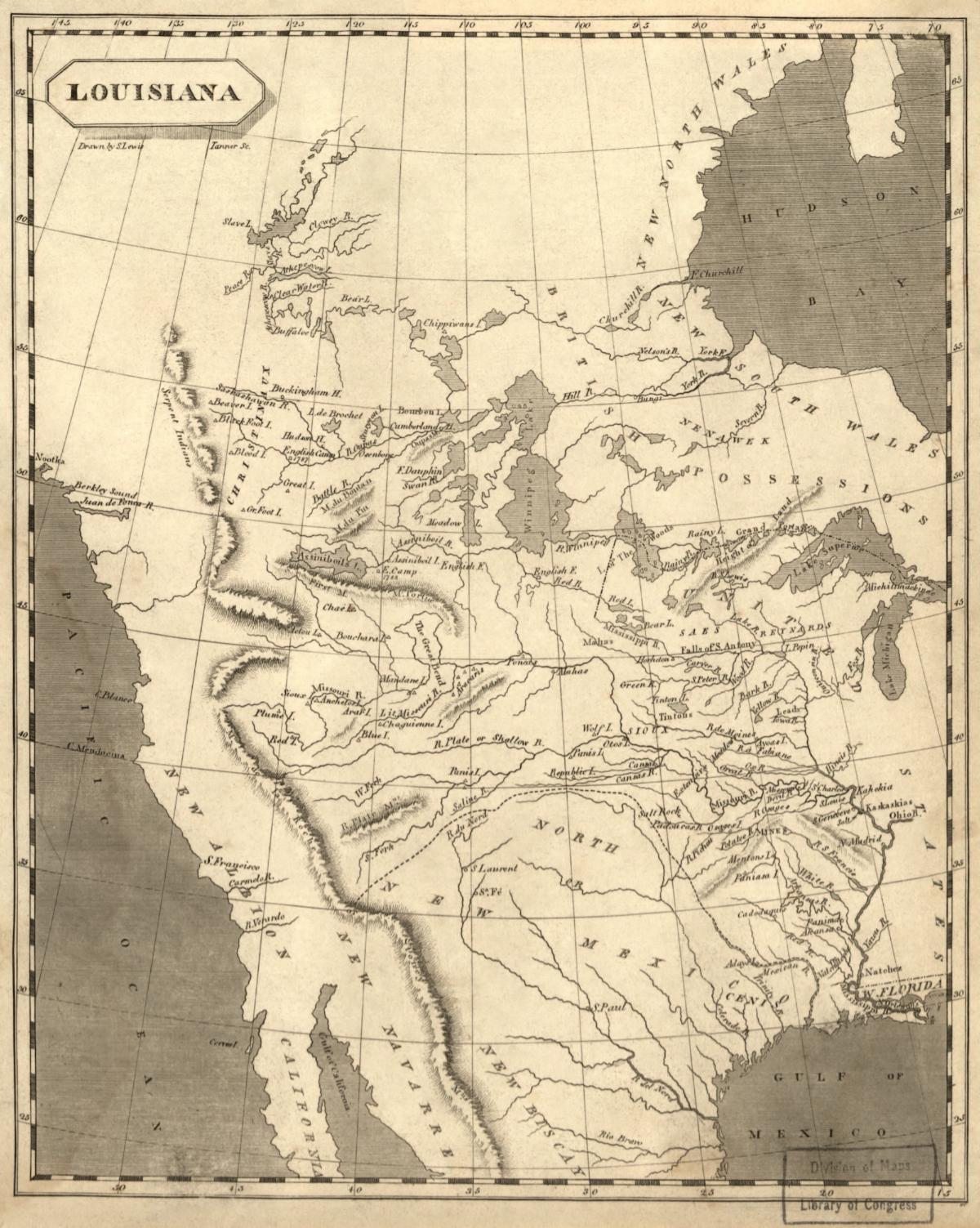
1804 map of "Louisiana", bounded on the west by the Rocky Mountains, By Samuel Lewis (ca.1753-1822) - United States Library of Congress.
The map shows South Fork, Colorado, fairly close to San Francisco, California. Because much of the land to be exchanged was never fully explored, surveyed, or mapped by any European country or the United States, the negotiators could not include clear boundaries for the Louisiana Purchase treaty.
https://commons.wikimedia.org/w/index.php?curid=3478932
| | |
Markers, “Early History of Clear Creek”, and “Settlement of Clear Creek Valley”
Clear Creek Trail, Golden, CO 80401
GPS: 39.756867, -105.222833
• Inscription (excerpts):
“... In the 1700s French trading parties came to trade with the Utes”...
[...]
“For thousands of years native peoples have lived, hunted, and battled along this creek. The earliest western nation to claim the creek was France when it created the New World Province called Louisiana in 1682. In 1765 the French ceded the province to Spain. In 1800 France, under Napoleon’s rule, regained Louisiana, and in 1803 sold it to the United States as part of the Louisiana Purchase. This creek had two names before it became Clear Creek. Its first known name was Cannon Ball Creek—so named by Frenchmen. In 1820 the American military exploration team led by Stephen H. Long noted it was named Cannon Ball Creek “from the size and form of the stones in its bed.” The creek’s second name came in 1832 when Louis Vasquez, a fur trader, built a fort upstream of the creek’s mouth. The creek then was called Vasquez Fork or Vasquez River. Louis Vasquez, for whom Vasquez Street in Golden is named, trapped and traded with natives and mountaineers along the river until around 1848. In 1859 gold rushers renamed the body Clear Creek reflecting the clarity of the waters.” ....
| | |
Talleyrand & Barbé-Marbois
Keen observers of the United States
| | |
Let's start with a note about Talleyrand, a key figure in the negotiation of the Louisiana Purchase Treaty.
During the French Revolution, Talleyrand lived in the United States from 1794 to 1796.
• Charles-Maurice de Talleyrand-Périgord (born in Paris Feb. 13, 1754 – died in Paris, May 17, 1838), one of the most legendary diplomats of all times, spent a couple of years in the US during the height of the Terror during the French Revolution.
• In December 1792, the National Convention ordered Talleyrand's arrest. By March 1794, as war loomed, he was expelled from Britain by Pitt and went to the neutral United States. He and his friend Bon Albert Briois de Beaumez traveled through the northern United States as far north as Maine and into western New York. They remained in America until 1796, when Talleyrand returned to France and Beaumez left for India.
• While in the US, Talleyrand worked as a bank agent, engaging in commodity trading and real estate, amassing a small fortune.
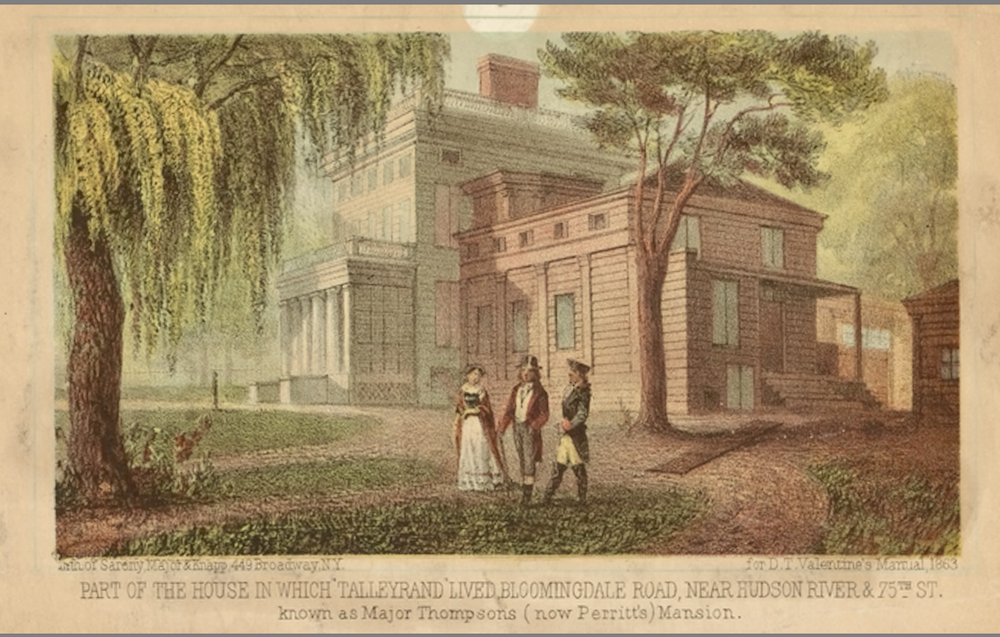
• He stayed with Aaron Burr in New York, at Major Thompsons House on 75th Street and Hudson River, the Claremont Inn at 124th Street in Riverside, lived 6 months in Newark, NJ, and worked with Theophile Cazenove ( a Dutch banker) in Philadelphia.
• On May 19, 1794, Philadelphia's mayor, Matthew Clarkson, received Talleyrand's oath of allegiance to the United States. Talleyrand also visited Boston.
• Later, when Aaron Burr sought refuge at Talleyrand's home during his European exile from 1808 to 1812, Talleyrand refused to help him because Burr had killed his friend Alexander Hamilton in a duel in 1804.
• Talleyrand returned to France in 1796. He eventually became Napoléon’s famous Minister of Foreign Affairs.
Marker, “Greene Settled”
17 Genesee Street, Greene NY 13778
GPS: 42.329200, -75.769967
• Inscription:
“Greene settled in 1792 by Stephen Ketchum and French refugees.
Talleyrand visited his contemporaries here in 1795.”
Marker, “Early Settlers”
91 South Chenango Street, Greene NY 13778
GPS: 42.324000, -75.775667
• Inscription:
“Early Settlers included
Joseph Juliand, Simond Barnett, and Stephen Ketchum.
In 1795 Talleyrand visited early French Settlement here.”
• Joseph Juliand was born in Lyon, France, on Jan. 17, 1749 and died in Greene, Chenango County, NY on Oct.13, 1821.
• Stephen Ketchum was also an early settler and built a log cabin in 1792.
• The city of Bellefonte, in Pennsylvania, gets its name from the natural spring "la belle fonte," which was named by Charles Maurice de Talleyrand-Périgord during a land visit to central Pennsylvania in the 1790s.
• There is a Park named Talleyrand at Bellefonte.
Marker, “Bellefonte”
High Street and Allegheny Street, Bellefonte PA 16823
GPS: 40.912017, -77.777950
• Inscription:
“Laid out by James Dunlop and James Harris, 1795. Named by Talleyrand for "beautiful fountain". Early center of the iron industry. One-time home of five of Pennsylvania's governors.
Erected 1947 by Pennsylvania Historical and Museum Commission.”
| | |
Barbé-Marbois
Former envoy to the United States
| | |
Above:
US postage stamp (c. 1953) commemorating the Louisiana Purchase; Barbé-Marbois is pictured alongside James Monroe and Robert Livingston. By Bureau of Engraving and Printing; Imaging by Gwillhickers - U.S. Post Office; Smithsonian National Postal Museum, Public Domain, https://commons.wikimedia.org/w/index.php?curid=2957315
| | |
• François, marquis de Barbé-Marbois (January 31, 1745 – February 12, 1837) was born in Metz, where his father operated the local mint.
• He educated the children of the Marquis de Castries, who later served as Louis XVI's Navy secretary from 1780 to 1789.
• In 1779, he became the secretary for the French legation in the United States. The next year, he sent a questionnaire to the governors of all thirteen former American colonies to collect information about their geography, natural resources, history, and government. Thomas Jefferson, finishing his last term as governor of Virginia, responded with a manuscript that became his famous work, Notes on the State of Virginia.
• When Minister Chevalier de la Luzerne returned to France in 1783, Barbé-Marbois remained in America as chargé d'affaires in 1784. That same year, he married Elizabeth Moore, daughter of former Pennsylvania governor William Moore.
• In 1785, he became intendant for the colony of Saint-Domingue (now Haiti). He returned to France in 1789 and survived the French Revolution. Accused of treason, he was exiled to French Guiana but was released by First Consul Napoléon Bonaparte in 1799.
• He became Director of the Treasury in 1801, a Senator in 1802, and served as Minister of the Treasury from 1801 to 1807.
• In 1803, he negotiated and signed on behalf of Napoléon Bonaparte the Louisiana Purchase treaty, transferring Louisiana to the United States. Covering 820,000 square miles, sold at roughly 4 cents an acre for $15,000,000 (about $340,000,000 in today's dollars), the largest land deal in the history of the world.
• Barbé-Marbois had a special connection with James Monroe and Robert Linvingston that surely played a key role in the success of the Louisiana Purchase. As Barbé-Marbois recalled in his book, History of Louisiana, “the three negotiators had seen the origin of the American republic, and … had established between them… an intimacy, which does not always exist between foreign envoys.” They approved the sale of the Louisiana Territory for fifteen million dollars on April 29, which Napoleon confirmed on May 1. The same day, Monroe dined with the First Consul at the Louvre, where they discussed Monroe’s journey to France, Franco-American relations, and President Jefferson, "who Monroe spoke highly of..."
• As a reward, the First Consul gave him a gift of 152,000 francs, about $646,000 in today's dollars. He was made Grand Officer of the Legion of Honor and count in 1805, and appointed as the First President of the Cour des Comptes, France's top auditing body, from 1807 to 1814.
• A skilled courtier, he supported the Bourbons during the Restoration and was appointed Peer of France by King Louis XVIII. He briefly served as Minister of Justice and was confirmed as President of the Cour des Comptes (equivalent to the US GAO) by King Charles X and King Louis Philippe until he turned 89 in 1834. He passed away in 1837 and is buried in the village of Noyers in Normandy.
Legacy in the United States:
• There are no known markers or plaques mentioning him in the United States, even though he was instrumental in doubling the size of the fledgling Republic.
• He is, however, immortalized in a fresco in the Senate wing of the US Capitol.
• In 1829, he wrote a book "History of Louisiana and of Its Cession to the United States of Northern America; Preceded by a Discourse on the Constitution and Government of the United States".
| | |
Some notable
Frenchmen and women
of Louisiana
| | |
Above:
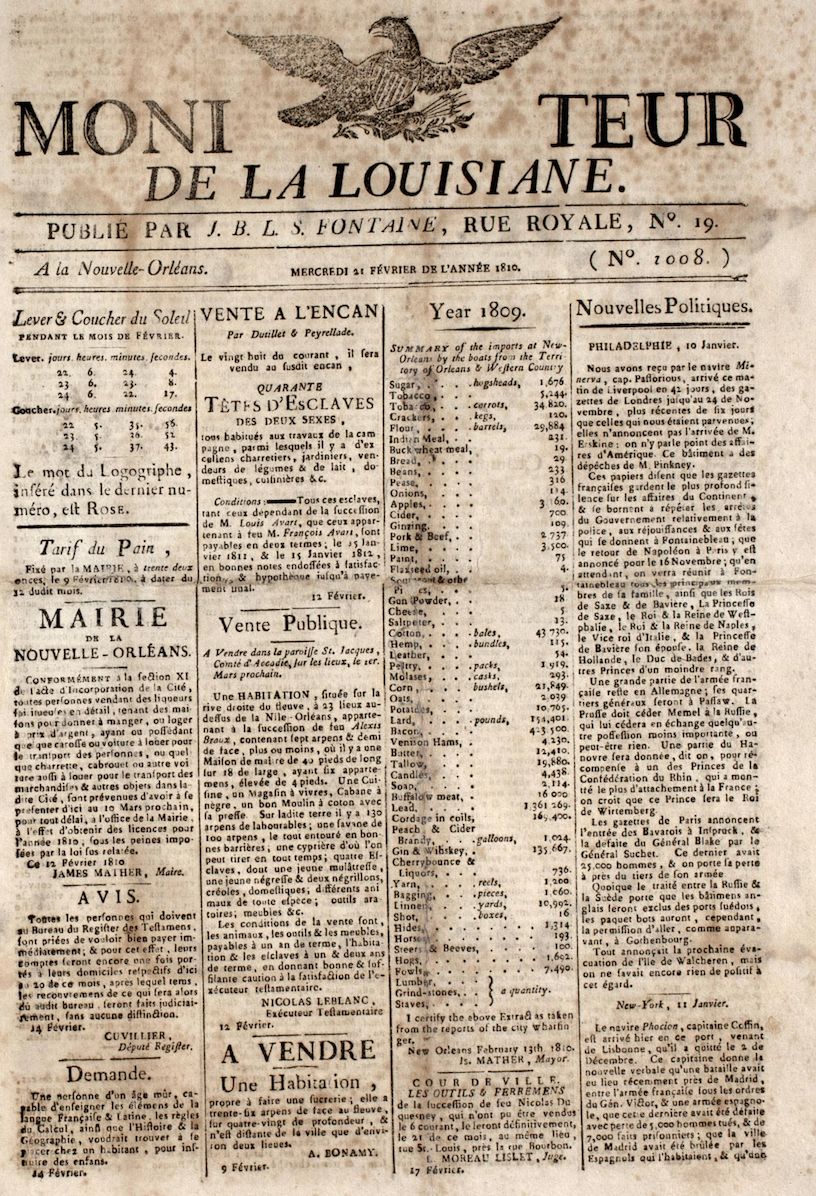
The Moniteur de la Louisiane, established in 1794, was Louisiana’s first newspaper. So few early issues survive, its history is difficult to piece together. The earliest known issue—now only available in facsimile—was dated Aug. 25, 1794; all other extant issues are from the 1800s. This issue includes advertisements, notices, and reprinted news from London and Paris. Although mostly printed in French, articles and lists of goods often also appear in English.
In the same year, a new journal called La Lanterne magique was established. Then in 1803, L'Union was created to promote harmony between the old French communities and the new American settlers.
https://blog.rarenewspapers.com/a-gem-from-the-american-antiquarian-society-3/
| | |
At the time of the Louisiana Purchase in 1803, the population of French-speaking people in the territory was estimated to be around 60,000. This population included Creoles, French immigrants, and descendants of earlier settlers. The territory was a mix of French, Spanish, Acadian, and German settlements.
The Creoles, who were born in Louisiana, were a significant part of the French-speaking population, and they spoke French and maintained a strong French cultural identity.
Louisiana had been under Spanish rule for over 30 years before the purchase, and there were also Spanish-speaking residents
A substantial portion of the non-native population in Louisiana was enslaved Africans, representing roughly half of the total populatio
The article III of the Treaty stipulated that "The inhabitants of the ceded territory shall be incorporated in the Union of the United States and admitted as soon as possible according to the principles of the federal Constitution to the enjoyment of all these rights, advantages and immunities of citizens of the United States, and in the mean time they shall be maintained and protected in the free enjoyment of their liberty, property and the Religion which they profess."
Overall, while the Louisiana Purchase marked a significant shift in sovereignty, many French citizens continued to live in the region and adapted to the new American context while preserving aspects of their cultural identity.
Initially, Louisiana recognized French as an official language. The House of Representatives conducted its business in French, and the laws were based on an updated version of the Custom of Paris. Wealthy Créoles sent their children to France for education. There were numerous newspapers published in French, sometimes incorporating elements of Kouri Vini, the local Créole language. However, following the secession of southern states into the Confederacy, the defeat in the war, the Yankees' prohibition of French, and the assimilation plan implemented by the United States in 1921, French influence diminished significantly.
| | |
Jacques-Philippe Villeré
2nd U.S. Governor of Louisiana
| | |
• Jacques Phillippe Villeré (April 28, 1761 – March 7, 1830) was the second US Governor of Louisiana after the Louisiana Purchase. Jacques Villeré's grandfather, Etienne Roy de Villeré, had accompanied Iberville on a voyage from France to the Gulf coast in the late 17th century during the reign of Louis XIV. Joseph Antoine de Villeré, the father of Jacques Villeré, held a position in the French Navy during the reign of King Louis XV.
• Jacques Philippe Villeré joined the French Army and received education in France for two years, funded by the Crown, following his father's death. In 1776, he was assigned as a first lieutenant in the artillery in Saint-Domingue.
• During the War of 1812, from 1814 to 1815, Jacques Villeré served with distinction as a major general commanding the 1st Division of the Louisiana Militia in the Battle of New Orleans. He also participated in the convention that drafted Louisiana's first state constitution. In 1816, Jacques Villeré was elected as the second governor of the state. He retired after his term and was interred at St. Louis Cemetery No. 2 in New Orleans.
Plaque, “Jacques Philippe Villeré”
St. Louis Cemetery No. 2, 300 N Claiborne Ave, New Orleans, LA 70112
GPS: 29.960717, -90.075300
•Inscription:
“Jacques Phillippe Villere
First native - born governor of Louisiana
Restored 1972
New Orleans Archdiocesan Cemeteries
Erected by New Orleans Archdiocesan Cemeteries.”
Tomb, “Jacques Philippe Villeré”
St. Louis Cemetery No. 2 , 300 N Claiborne Ave, New Orleans, LA 7011
GPS: 29.960717, -90.075300
• Inscription (engraved in French):
“Jacques Phillippe Villeré
First Native Born Governor of Louisiana”
“Cette Tombe Renferme Aussi les Restes
Du Vertueux Villere
L'estime de ses Concitoyens fit sa Gloire
L'Union de sa Famille Son Bon Bonheur
VILLERÉ
Décédé le 7 Mars 1830”
(translation in English):
“This Tomb Also Contains The Remains
Of The Virtuous Villere
The Esteem Of His Citizens Made His Glory
The Union Of His Family His Good Happiness
VILLERE
Died March 7, 1830"
Marker, “Plantation Jacques Philippe Villeré”
2324 E St Bernard Hwy, Meraux, LA 70075
GPS: 29.930600, -89.946017
• Inscription:
“First native-born Louisianan to serve as governor of Louisiana (1816-1820); Served as major-general commanding the 1st Division of Louisiana Militia during the Battle of New Orleans; British forces reached Mississippi River at Villere Plantation December 23, 1814, and established their headquarters in main house of the Villere Plantation. Villere retired to this plantation known as Conseil where he successfully cultivated sugar until his death.
Erected by Valero Energy Foundation”
| | |
Pierre Derbigny
Sixth U.S. Governor of Louisiana
| | |
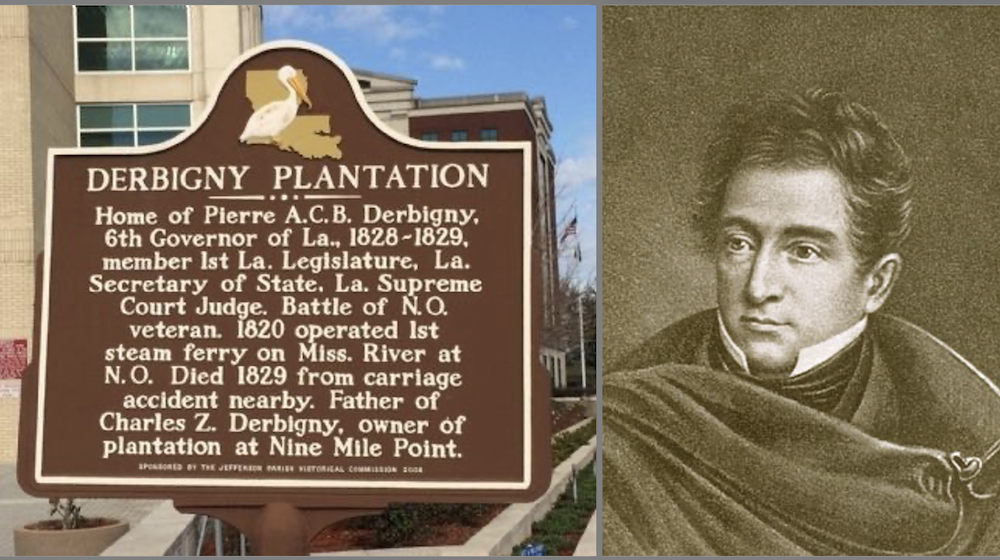
• Pierre Augustin Charles Bourguignon Derbigny (June 30, 1769 – October 6, 1829) served as the sixth Governor of Louisiana. He was born in Laon, France, as the eldest son of Augustin Bourguignon d'Herbigny, who held positions as President of the Directoire de l'Aisne and Mayor of Laon, and Louise Angélique Blondela.
• Derbigny studied law at Ste. Genevieve but left France in 1791 due to the French Revolution. He initially went to Saint-Domingue, then to Pittsburgh, Pennsylvania, where he married Felicité Odile de Hault de Lassus, with whom he had five daughters and two sons. He later moved to Missouri, then Florida, and finally to Louisiana, reaching New Orleans, then a Spanish colony, in 1797.
• In 1803, he became the private secretary to Etienne Bore, the mayor of New Orleans, and was appointed Secretary of the Legislative Council. That same year, Governor Claiborne named him the official language interpreter for the territory. After the U.S. annexed the Louisiana Purchase in 1803, Derbigny represented the new Americans in Washington, advocating for self-governance for the Orleans Territory. His speech on July 4, 1804, also called for the reopening of the slave trade.
• As the area became part of the United States, Derbigny opposed British common law in Louisiana and supported keeping the civil law practices from the French and Spanish colonial times. After the Governance Act of 1804 established Louisiana's territorial government, Derbigny, along with Jean Noel Destréhan and Pierre Sauve, took a protest from the citizens to Washington, D.C. This protest was called 'Remonstrance of the People of Louisiana against the Political System Adopted by Congress for Them,' and it was eventually presented to President Thomas Jefferson by the three men from Louisiana.
• In 1828, he was elected Governor. During his inauguration speech, Derbigny called for internal improvements, which the legislature backed. These included setting up a gas light company for New Orleans, several navigation companies for the Mississippi River and key bayous, and building and repairing levees. Unfortunately, on October 3, 1829, after ten months in office, he was thrown from a carriage and died three days later in Gretna, Louisiana. Pierre Derbigny was buried in Saint Louis Cemetery Number 1 in New Orleans.
| | |
French mayors of New Orleans
After the Louisiana Purchase:
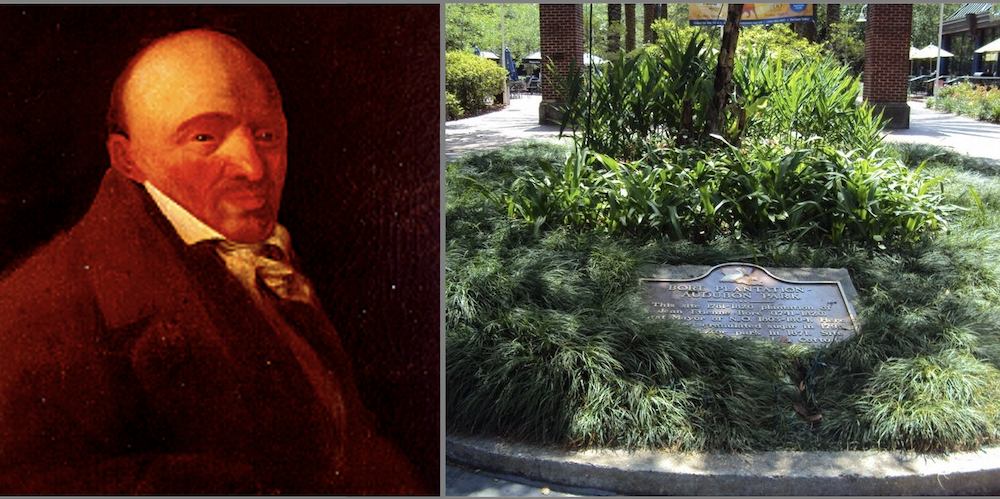
Etienne de Boré, first Mayor
| | |
The appointment of Etienne de Bore in 1803 established the office of Mayor of New Orleans, following the Louisiana purchase.
• Jean Étienne de Boré, (27 December 1741 – 1 February 1820) born Kaskaskia, Illinois, is renowned for pioneering the production of granulated sugar in Louisiana.
• He was sent to France for his education by his parents. Upon completing his schooling, he joined the elite Musketeers of the Guard in the French military. After reaching the rank of captain, de Boré settled in the French colony and became a planter.
• His groundbreaking innovation transformed sugar cane into a profitable commodity crop. De Boré's expansive plantation eventually became part of New Orleans in 1870, and today it serves as the location for Audubon Park, Tulane University, and Audubon Zoo.
• In 1803 De Boré was appointed as the first mayor of New Orleans under U.S. rule. He died at the age of 78 and is buried at Saint Louis Cemetery No. 1 in New Orleans. Boré street is named after him in the suburb of Metairie, LA.
Marker, “Boré Plantation - Audubon Park”
Audubon Zoo, 6500 Magazine Street, New Orleans LA 70118
GPS: 29.922650, -90.131733
• Inscription:
“This site 1781-1820 plantation of Jean Etienne Boré (1741-1820) First Mayor of N.O. 1803-1804. Here Boré first granulated sugar in 1795. Purchased for park in 1871. Site of World's Industrial & Cotton Centennial Exposition 1884-1885.
Erected 1961 by The Department of Commerce and Industry.”
| | |
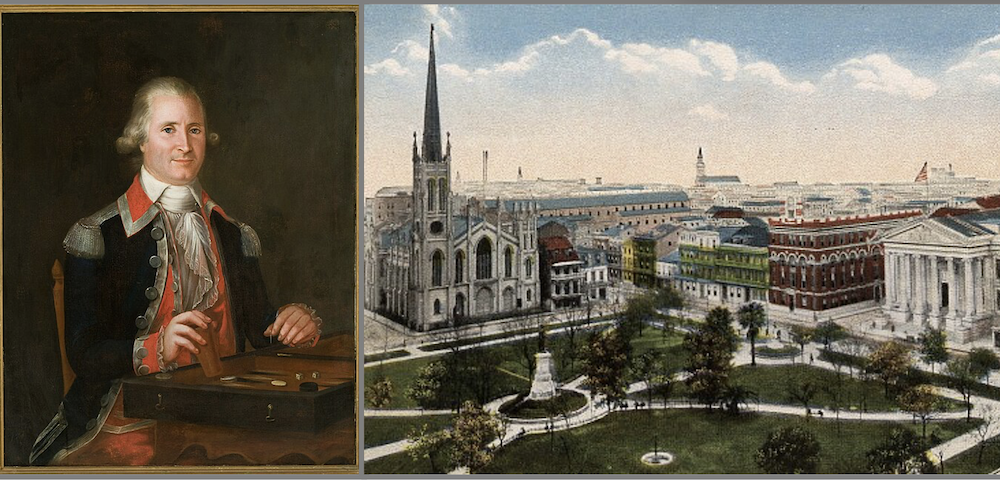
Charles Leveau Trudeau
Fourth Mayor
| | |
Above:
Left: Trudeau depicted in a circa 1746-1816 portrait by José Francisco Xavier de Salazar y Mendoza - Public Domain, now housed at the Newcomb Art Museum https://commons.wikimedia.org/w/index.php?curid=102082178
Right: Lafayette Square, the second oldest public park in New Orleans. The park was designed in 1788 by Charles Laveau Trudeau aka Don Carlos Trudeau (1743–1816), Surveyor General of Louisiana under the Spanish government; who later served as New Orleans' acting mayor in 1812, after Louisiana statehood.
Photo: http://old-new-orleans.com/NO_Lafayette_Square.html
| | |
• Charles Laveau Trudeau (1743–1816), also called Charles Trudeau dit Laveau or Don Carlos Trudeau, was the acting mayor of New Orleans from May 23 to October 8 in 1812. His name includes the French term 'dit Laveau,' a tradition used to honor a respected woman in the family, specifically his great-great-grandmother, Marie Catherine de Lavaux (1621–1688).
• Charles Trudeau was born in New Orleans during the French regime to Jean-Baptiste Trudeau and Marianne Carrière. He married Marguerite D'Arcantel, a "free woman of colour", and he is the father of Marie Laveau, (a renowned dedicated practitioner of Voodoo, a healer, an herbalist, and an entrepreneur, also known as a prominent female religious leader and community activist).
• Charles Laveau Trudeau held the position of Surveyor General of Spanish Louisiana from the early 1780s until his resignation in 1805, a tenure lasting approximately two decades during the U.S. Territory of Orleans period. His name appears on maps and grants as Don Carlos Trudeau. Subsequently, he took on the roles of recorder and president of the city council. Notably, during his time as recorder, he assumed the role of interim mayor following the resignation of James Mather.
| | |
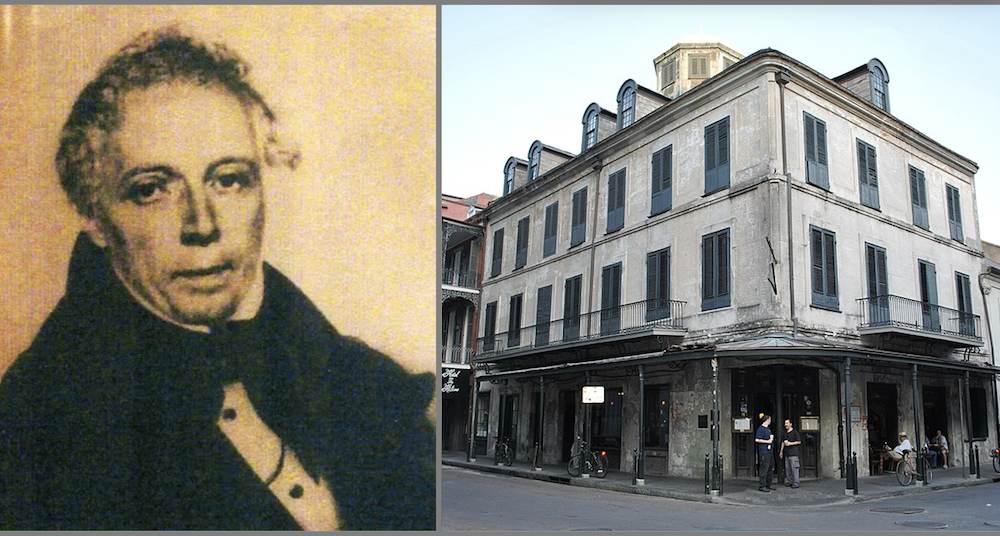
Nicolas Girod
French-speaking only
Fifth Mayor
| | |
Above:
Left: Mayor Nicolas Girod, Mayor of New Orleans and owner of what would become The Napoleon House. Portrait: https://www.napoleonhouse.com/history/
Right: Napoleon House, located in the French Quarter of New Orleans, boasts a rich history dating back to the early 19th century. Built in 1797, the building originally served as the residence of Nicholas Girod, the then-mayor of New Orleans. The property earned its name from the mayor's offer, in 1821, to provide refuge to Napoleon Bonaparte during his exile. By Elisa Rolle - Own work, CC BY-SA 3.0, https://commons.wikimedia.org/w/index.php?curid=21201262
| | |
• Nicolas Girod, who lived from April 1751 to September 1840, was the fifth mayor of New Orleans, serving from late 1812 until September 4, 1815. He was the first mayor after Louisiana became a state.
• Born into a wealthy family in Savoy, he moved to Spanish Louisiana in the late 1770s with his brother Claude François and brother-in-law André-Marie Quetant, later joined by his brother Jean François.
• He became successful as a merchant and owned significant property in New Orleans, particularly in the American quarter, engaging in business with local planters.
• Girod was the first elected mayor of New Orleans after Louisiana joined the Union, serving until September 4, 1814, when he was re-elected but resigned a year later.
• Some US Americans complained he did not speak English.
“His inauguration ceremony was conducted in French because Girod did not speak English. When it was proposed that, as a mayor of an American city, he should learn English, he responded that, since he was mayor, more citizens should learn to speak French.”
• During his term, he prepared the city for the War of 1812 and welcomed General Andrew Jackson, who imposed martial law in December 1814.
• In the spring of 1821, New Orleans buzzed with excitement as Girod renovated a house he inherited on Chartres Street, now called the Napoleon House. He was a key financial backer of a plan to rescue Napoleon from exile in Saint Helena and bring him to live in New Orleans. The ship Seraphine was built for this mission, led by Capt. Bossier and Louisiana pirate Dominique You. However, the expedition turned back after receiving word from a French merchant ship that Napoleon had died on May 5, 1821.
• Girod was also a philanthropist, leaving $100,000 in his will for a facility for French orphans in Orleans Parish, along with donations to other institutions. He passed away on September 1, 1840, at his home on Chartres and St. Louis streets.
• Girod Street in New Orleans and Mandeville is named in his honor, and he never married or had children.
| | |
Count Louis Philippe de Roffignac
Seventh Mayor
| | |
• Count Louis Philippe de Roffignac, also known as Joseph Roffignac, was a rich merchant and banker from Louisiana who served as the Mayor of New Orleans from 1820 to 1828.
• Born on September 13, 1773, in Angoulême, he started his career as a page at fourteen and joined the French army at seventeen. He fought in Spain and later moved to Louisiana in 1800.
• Roffignac served ten terms in the state legislature and was honored as a brigadier general for his role in the Battle of New Orleans. As mayor, he focused on rapidly developing the city, borrowing money to fund improvements like tree planting, street paving, and introducing street lighting. He also established the first public education system and organized the city's first fire department, while attempting to regulate gambling.
• He stepped down in 1828 and went back to France for a relaxed retirement focused on writing and social activities. He passed away at his château near Périgueux under strange circumstances: a medical examiner found that he was sitting in his chair, looking at a loaded pistol, when he suddenly had a stroke and fell; during the fall, the pistol went off and shot him in the head.
• Roffignac Street in New Orleans is named after him, and his name is also remembered in the Roffignac cocktail, created about 40 years after he was mayor, which was popular until the 1960s.
• According to the book Beverages De Luxe (1911) : “Its inventor was once the mayor of the Mayor of New Orleans during the ancient regime, and tradition tells us that Monsieur le Maire was the most popular official the Crescent city ever had. On afternoons the mayor’s office was always thronged with visitors desirous of both paying their respects to the Knightly Rofignac and also enjoying one or two of his delicious ‘Rofignacs'”.
• If you would like to make one at home, here is the receipe: Combine 3/4 oz of VSOP Cognac and 1 oz of raspberry shrub in a Highball glass with ice. Add club soda, stir, and garnish with fresh raspberries.
| | |
Barthélémy Lafon
Cartographer extraordinaire
| | |
• Barthélemy Lafon (1769–1820) was a prominent French architect, engineer, city planner, and surveyor in New Orleans, Louisiana. He led a dual life as a respected professional and as a privateer, smuggler, and pirate. His connections to piracy, particularly with Jean and Pierre Lafitte, became known later in his life.
• Born in Villepinte, France, he moved to New Orleans around 1790, where he designed various public buildings, including plans for public baths in 1797 (though they were never constructed) and a lighthouse, along with many private residences like the Benachi cotton brokers' house and the Vincent Rillieux house.
• After the Louisiana Purchase in 1803, as the Mississippi River opened for free trade, landowners near the Vieux Carré hired Lafon to subdivide their land and create an American suburb. From 1806 to 1809, he was also the deputy surveyor of Orleans Parish during the territorial period before statehood.
Marker, “Barthélémy Lafon (1769-1820)”
425 Basin St, New Orleans LA 70112
GPS: 29.959183, -90.071600
• Inscription:
“Born in France, Lafon spent 30 years in Louisiana and was employed in a myriad of careers, including that of an engineer, architect, cartographer, surveyor, land speculator, publisher, politician, urban planner, and soldier. His life and work had a profound effect upon the landscape of New Orleans and beyond.”
Erected 2022 by Louisiana Colonials.
| | |
Bernard de Marigny
First Mardi-Gras in New Orleans
| | |
• Jean-Bernard Xavier Philippe de Marigny de Mandeville (1785–1868), known as Bernard de Marigny was a French-American nobleman who held various roles such as planter, politician, duelist, writer, horse breeder, land developer, and President of the Louisiana State Senate from 1822 to 1823.
• In 1798, Louis-Philippe, Duke of Orléans, along with his brothers, visited the Marigny plantation and were extravagantly entertained by the family. An anecdote even tells of special gold dinner ware being made for the occasion and then thrown into the river after the visit, deeming none worthy of using it again.
• He served as aide-de-camp for Louisiana governor, William C. C. Claiborne, during the battle of New Orleans.
• Marigny funded the first organized New Orleans Mardi Gras celebration in 1833.
• He also founded the "Louisiana Race Course," now the Fair Grounds Race Course
• In 1834, he laid out the town which bears his family name, Mandeville, Louisiana.
Plaque, “Bernard de Marigny”
429 Basin Street, New Orleans LA 70112
GPS: 29.959250, -90.071883
• Inscription:
“Bernard de Marigny de Mandeville (1785-1868) a wealthy land-owner, served in the U.S. Army, participated in framing the first and second constitutions of Louisiana, and served in the Louisiana Territorial Legislature. He also was elected President of the Louisiana State Senate in 1822. Lost most of his wealth before his death. Mandeville, Louisiana was founded by him in the 1830’s. Two streets of New Orleans, Mandeville and Marigny, carry the family name.
Erected 1983 by New Orleans Archdiocesan Cemeteries.”
| | |
Général Jean Humbert
A Private in the U.S. Army
| | |
• General Jean Joseph Amable Humbert (August 22, 1767 – January 3, 1823) was a French military officer involved in key conflicts during the late 18th and early 19th centuries. He was born in La Coâre Saint-Nabord, near Remiremont Vosges, and started as a sergeant in the National Guard of Lyon. He quickly rose to brigadier general on April 9, 1794, and fought in the Western campaigns before joining the Army of the Rhine.
• He was chosen to lead a French expeditionary force to help the Irish Rebellion of 1798. His forces mainly included infantry from the 70th demi-brigade, along with some artillery and parts of the 3rd Hussar Regiment. By the time he reached the Irish coast, the rebellion had already been put down by the British. The expedition landed in Ireland at Killala on Thursday, August 23, 1798, and initially succeeded in the Battle of Castlebar, where they defeated the British Army. Humbert then announced the creation of an Irish Republic and headed towards Dublin. However, his small army was defeated at the Battle of Ballinamuck by the British Army, and he was captured. Humbert and his French soldiers were transported to Dublin, where they were swapped for British prisoners. In his first communication with the British, Humbert asked for fair treatment of his Irish officers, but he was upset when several of them were ordered to be executed by general Gerard Lake because they had been British subjects before.
• After being called back a short time in Napoléon's Grand Army, Humbert moved to New Orleans in 1810, where he met the French pirate Jean Lafitte. In 1813, he tried to help start a rebellion in New Spain with revolutionary Juan Bautista Mariano Picornell y Gomila, but it failed. In 1814, Humbert left New Orleans to support the Patriot cause in the Argentine War of Independence, where he briefly led a corps before going back home.
• A year later, he joined the U.S. Army as a private and fought in the Battle of New Orleans during the War of 1812, wearing his old Napoleonic French uniform.
• In 1815, he created a Foreign Legion, but the war ended before they could fight.
• After the American victory in January 1815, General Andrew Jackson thanked him for his help, and Humbert then lived a quiet life as a schoolteacher until he passed away.
Marker, “General Humbert”
1208 Conti St, New Orleans LA 70112
GPS: 29.959167, -90.071733
• Inscription:
“ In memory of French General Jean Joseph Amable Humbert
'Vainqueur de Castlebar' who is buried in this cemetery.”
“In August, 1798, a gallant native of St. Nabord, France, General Jean Joseph Amable Humbert commanding a small army of 1019 French troops landed in County Mayo on the west coast of Ireland. A rising star of the French Republic, this daring and courageous soldier arrived at the behest of The Society of The United Irishmen to assist them in their struggle for independence from British rule. Following a signal victory over the British at Castlebar, Humbert established the Republic of Connacht. A short time later his small Franco-Irish army was cruelly defeated by a British force twenty times their number. Living in New Orleans, Humbert valiantly served General Andrew Jackson at the Battle of Chalmette, January 8th, 1815.”
Erected 2015 by Association 3ème Bataillon de Chasseurs des Montagnes - Béarn, France & the County of Mayo, Ireland.
| | |
Suzanne Douvillier
née Vaillande, aka
"Madame Placide"
First Ballerina in the United States
| | |
• Suzanne Théodore Vaillande Douvillier (born September 28, 1778 at Dôle, Jura, France – August 30, 1826) was a French ballerina, mime, and choreographer. She was the first trained ballerina to perform in the U.S., the first female choreographer in the U.S., the first woman to appear on an American stage en travesti, the first female set designer in the U.S, and perhaps the first woman to open and manage a theater in New Orleans.
• She studied in Paris, leading to speculation that she trained in ballet at the Paris Opera. During her teenage years, the French Revolution was happening, and she moved to Saint-Domingue (today's Haiti), around 1790, at the age of 13. There, she met Alexander Placide (who was 28 years older), a talented theatrical figure skilled in fencing, acrobatics, and play directing. He would play a significant role in her career, both professionally and romantically.
• In 1791, the couple relocated to America following the Haitian rebellion. She made her debut on January 25, 1792, at the John Street Theatre in New York City, performing in The Bird Catcher, which is considered the first ballet in New York. She was known as "Madame Placide", even though they were not married. They spent several months there, showcasing various ballets and pantomimes together. Later in 1792, they moved to Philadelphia and Boston, and in 1793, they went to Newport, Rhode Island, where they were joined by Louis Boucher Douvillier (1761 - 1821), a scenic painter.
• In 1794, they traveled south to Charleston, South Carolina. By this time, she had become the most popular and skilled dancer in America, and in 1796, at just 18 years old, she made history as the first female choreographer in the United States with her ballet Echo and Narcissus. In June 1796, tensions flared between Douvillier and Placide, leading to a duel over Vaillande's affections. Although Placide won, Douvillier married Suzanne, and in 1799, they moved to New Orleans. She began choreographing frequently while still dancing. In 1808, she became the first woman to perform as a male in America, a bold move at the time. By 1813, she ventured into set design, becoming a trailblazer for women in that field as well.
• Suzanne debuted on a U.S. stage in Annapolis on October 29, 1791. It was the first full ballet ever performed in the U.S. She made her New York debut on January 25, 1792, at the John Street Theatre in New York City, performing in The Bird Catcher, which is often seen as the first ballet in New York.
• In 1808, she became the first woman to perform as a man in America, a bold move at the time, although men performing as women was common. In 1813, she began working on set design and is recognized as a trailblazer in that field as well.
• According to actor Noah Ludlow, her face was disfigured in her later years. Her last performance was in Don Juan in 1818, where she wore a mask to hide it. She passed away in New Orleans in 1826 at 48, in total poverty, five years after her husband. They are buried together in St. Louis Cemetery, New Orleans. She is recognized as a trailblazer for women's roles in society and choreography.
Plaque, “Suzanne Douvillier”
401 Treme St, New Orleans LA 70112
GPS: 29.959617, -90.071800
• Inscription:
“ Née Vaillande choreographer and ballet mistress
at Le Théâtre St. Philippe
the United States' first female choreographer
born September 28, 1778, Dole, France.
Died August 30, 1826, New Orleans, Louisiana
reputedly interred within this section of wall vaults.”
| | |
Other notable sites and residents
of the Louisiana Territory
| | The historical Village of Vermillon, Louisiana | | |
The preservation of French culture has been a struggle. In 1882, a teacher of French was quoted:
“We must notice here, my children, what importance our ancestors gave to the upholding of the French language in Louisiana. They understood well the introduction of a foreign language would make them lose some rights. Because this is not a vain issue that this issue of the language, it is an issue of independence and nationality. Also the Louisianians must consider the use of the French language as a fraternal link that unites them with each other. It was spoken by their fathers, it must be spoken by their children.”
(Laure ANDRY, Histoire de la Louisiane racontée aux enfants louisianais, 1882.)
Marker, “School House” – “L’école”
Vermilionville Historical Village
300 Fisher Road, Lafayette LA 70508
GPS: 30.215333, -91.994933
• Inscription:
“School House:
Banning of the French Language
"L'école is a reproduction of a typical schoolhouse of the late 1800s. In southwest Louisiana, French was the dominant language until the mid-1900s. Native Americans along with Spanish, German, African, and English arrivals and their descendants learned to speak French to conduct business and socialize with neighbors. In the 1910s, new laws banned the French language in schools as an attempt to Americanize the non-English speaking population. The lines "I will not speak French” on the blackboard recall that time period."
Cajun and Creole french dialects: What are the Differences?
"In southwest Louisiana, Creole and Cajun French dialects are distinct. Creole French borrows vocabulary and grammar from West African (especially Senegambian) and American Indian languages, and is distinct from the Creole languages of the French-speaking Caribbean islands. As such, the Louisiana Creole dialect represents an important linguistic legacy of the African diaspora in the Americas. In contrast, Cajun French incorporates an French dialect from the 1700s and is different from modern continental French. Both Cajun and Creole French use many expressions unique to southwest Louisiana. distinct.
Side Bar: Many rural pockets of Creole and Cajun French-speaking communities continue to exist in southern Louisiana, and the region remains one of the only places in the U.S. where the native population speaks distinct French dialects. Both Creole and Cajun dialects are in danger of becoming extinct as younger generations speak English predominantly. Nonetheless, there is growing interest for French among young people. Since 1968, the Council for the Development of French in Louisiana (CODOFIL) has promoted the speaking of French language, and the preservation of both Creole and Cajun cultures.”
Marker, “Attakapas Chapel - Chapelle des Attakapas”
Vermilionville Historical Village
300 Fisher Road, Lafayette LA 70508
GPS: 30.215233, -91.993900
• Inscription:
Attkapas Chapel: The Church in a Catholic Region
This chapel is a reproduction based on St. Francis Catholic Church in Point Coupee (1760) and St Martin de Tours Catholic Church in St. Martinville (1773) [...] The Catholic Church was the only church recognized by the French and Spanish in Louisiana during the colonial period. The large majority of immigrants from Acadia, Spain, France, and Germany were Catholic. For this reason, the region has a strong Catholic culture and faith compared to neighboring regions, which are majority Protestant The Code Noir, which regulated slavery, stipulated that enslaved persons must be baptized in the Catholic Church. However, in local churches, free persons of color and enslaved persons sat in separate seating areas from white parishioners.
Unique Catholic Celebrations in New Acadia
The celebrations of Mardi Gras and All-Saints Day are traditions first brought by the earliest French and Spanish immigrants. With origins in the European Medieval period, Le Courir de Mardi Gras is a unique tradition where people in colorful home-made costumes travel from farm to farm on money, chickens or other ingredients to make a gumbo. On horseback in a ritual to "beg” for All-Saints Day November 1st, families clean and adorn their ancestors'' graves to honor their memories."
| | |
Typical Acadian Homes
circa 1803
| | |
• Marker, “Mouton House” – “Maison Mouton”
Vermilionville Historical Village
300 Fisher Road, Lafayette LA 70508
GPS: 30.215500, -91.994783
• Inscription (excerpts):
Mouton House:
The House of a Middle-Class Acadian Family
...”The founder of Vermilionville (present-day Lafayette) Jean Mouton built his wealth by acquiring land and developing a large cotton plantation that used slave labor. The site of the Vermilionville Historic Village was once part of the plantation owned by Jean's son Alexandre, who served as governor from 1843-1846.
[...]
Side Bar:
The Mouton family was influential in the founding of the original Vermilionville settlement (present-day Lafayette). As Acadians moved west from settlements along Bayou Teche, some acquired land and became prosperous. French-speaking Acadian Jean Mouton purchased land on the bayou in 1816 and founded the village of Vermilionville in 1821. The following year, Mouton donated five acres to the Church of St. John the Evangelist, the present-day site of St. John the Evangelist Cathedral in Lafayette. In 1836, Mouton also donated the lands for the parish courthouse, and the town grew around the lands he owned. In 1884, the town name officially changed to Lafayette, honoring the Marquis de Lafayette, the French general who was a hero in the U.S. War for Independence.
Marker, “Maison Broussard”
Vermilionville Historical Village
300 Fisher Road, Lafayette LA 70508
GPS: 30.215983, -91.993533
• Inscription (excerpts):
Broussard House:
A Large Acadian Plantation Home
“La Maison Broussard dates to 1790 and is the oldest building in Vermilionville. It was the home of Armand Broussard, who immigrated to Louisiana as a child from Acadian Canada. Armand was the son of Joseph "Beausoleil" Broussard, the famous Acadian resistance fighter who brought over two hundred Acadian refugees from Canada to the Poste des Attakapas in 1765. At the age of sixteen, Armand registered his first cattle brand and eventually became a prosperous rancher with his wife Anne Benoit and their fourteen children. Broussard was also a military veteran who served in both the American Revolution and at the Battle of New Orleans in 1815.
Enslaved Workers: A Diverse Group in Southwest Louisiana
The Broussard Plantation like most large farming operations used slave labor. Enslaved persons in southwest Louisiana were a culturally diverse group, comprised of native-born Africans of numerous different ethnic groups from across western and central Africa, French-speaking Creole persons of color, and English-speaking persons of color from the eastern states. Enslaved workers performed skilled jobs in the construction trades, blacksmithing, cattle droving, laundering and cooking, as well as less skilled jobs such as field hands and general labor.
Side bar: Enslaved persons in southwest Louisiana worked a variety of occupations. Males often specialized in skilled trades such as livestock management and droving, blacksmithing, and various construction trades such as carpentry, masonry, and plastering. Females often performed skilled jobs such as domestic work, washing, and child-care. Enslaved persons of African descent often served as cooks in many households and thereby integrated many African dishes such as jambalaya (known as jolof in western Africa) and other rice-based dishes, coush-coush, okra, and sweet potatoes. As such, the foods of the region represent an important cultural legacy of the African diaspora in the Americas.”
| | |
Denis de la Ronde
Major General of the Louisiana State Militia
| | |
Pierre Denis de La Ronde is the Founder of Versailles, Louisiana.
Versailles was established by Major-General Pierre Denis de la Ronde, a wealthy plantation owner in Louisiana and a descendant of the French Canadian judge and poet, René-Louis Chartier de Lotbinière. In 1805, during the U.S. territorial period, he and other local investors planned to create Versailles along the Mississippi River and dig a barge canal through the swamps to Lake Pontchartrain, where they intended to build another town named 'Paris.' These communities were inspired by the French cities of Paris and Versailles, aiming to replicate their style. Denis de La Ronde hoped this Versailles would become larger and more popular than New Orleans. However, development was hindered by political turmoil, leading to the War of 1812. In 1814-15, Colonel de La Ronde led the Louisiana militia's Third Regiment during the Battle of New Orleans, which took place at his plantation and the nearby Chalmette plantation owned by his half-brother, Ignace Martin de Lino de Chalmette.
Marker “Denis de la Ronde Site”
135 W St Bernard Hwy, Chalmette, LA 70043
GPS: 29.937617, -89.967850
• Inscription (excerpts):
Pierre Denis de La Ronde was born in New Orleans in 1766, the son of Pierre Denis de La Ronde and Marie Magdelaine Broutin. [...] Denis de La Ronde helped to settle Canary Islanders in St. Bernard between 1779 and 1783 and served in the Galvez Expedition during the American Revolution between 1779 and 1781. He also served as the second commandant of the Poblacion de San Bernardo from 1788 until 1802. After the Louisiana Purchase, Denis de La Ronde served as colonel commanding the Third Regiment of the Louisiana Militia. Additionally, Denis de La Ronde helped to draft the first constitution of the State of Louisiana in 1812 as a member of the first state constitutional convention. Denis de La Ronde was major general of the Louisiana State Militia when he died in 1824. He was buried with pomp and circumstance in St. Louis Cemetery No. Two in New Orleans in a tomb maintained by his descendants..” [...]
Erected by Chalmette Refining.
| | |
Ignace de Chalmet
Planter, Revolutionary War Veteran
| | |
• Chalmette was established by Louis-Xavier Martin de Lino de Chalmette, a plantation owner from Quebec and the grandson of René-Louis Chartier de Lotbinière of Maison Lotbinière. The town was named after him. His oldest son, Louis Xavier Martin de Lino de Chalmette, was born in Chalmette and later married the sister of Antoine Philippe de Marigny, who was the grandfather of Bernard de Marigny.
• During the Battle of New Orleans in January 1815, the Chalmette plantation, which was owned by Ignace Martin de Lino de Chalmette (1755–1815), the second son of the family, served as the battleground. Ignace Martin de Lino de Chalmette was the maternal half-brother of Col. Pierre Denis de La Ronde, who was the founder of Versailles, Louisiana, and commanded the Louisiana militia's Third Regiment during the battle.
• In 1817, the 22-arpent Chalmette property was purchased by Hilaire and Louis St. Amand, affluent free men of color. The St. Amand brothers, who were slaveowners, transformed the property back into a sugarcane plantation and constructed the essential production facilities and servants quarters to sustain this enterprise.
Marker “Chalmette Plantation”
Intersection of Cemetery Road and W St Bernard Hwy, Chalmette, LA 70043
GPS: 29.944717, -89.985833
• Inscription:
“Named for Ignace Francois Martin de Lino de Chalmet (1755-1815), veteran of the American Revolution. Attained the rank of captain of infantry in the Spanish Army; retired about 1794. Purchased plantations below New Orleans and began acquisition of properties in 1805, which would become the Chalmette Plantation stretching 22 arpents along the Mississippi River; main house, sugar mill and almost all out buildings destroyed in the Battle of New Orleans. Decisive engagement on January 8, 1815.
Erected by St. Bernard Tourist Commission.”
| | |
Col. Jean de Goutin Bellechasse
Planter, Revolutionary War Veteran
| | |
• Joseph Deville de Goutin Bellechasse, a prominent figure in the history of the French colony of Louisiana, played a significant role as the commander of the militia during the transfer of the territory to the United States in 1803.
• Born in New Orleans in 1761, Bellechasse began his military career in the service of Spain in 1779.
• He actively participated in the American Revolution, fighting alongside Don Bernardo de Galvez against the British forces stationed at Fort Bute in Manchac and Baton Rouge.
• After retiring from the military in 1803, Bellechasse ventured into various business endeavors in New Orleans before rejoining the military. In 1810, he was elected as the president of the legislative council.
• Although Bellechasse's plantation, located six miles below New Orleans, was demolished in 1960, the plantation bell was preserved and now stands as a memorial in front of the Belle Chasse City Hall.
Marker, “Bellechasse Plantation”
8442 Highway 23, Belle Chasse LA 70037
GPS: 29.852600, -89.986833
• Inscription:
“Site once part of Bellechasse plantation. Established by Col. Jean de Goutin Bellechasse, commander of colonial troops at the Louisiana Purchase transfer in 1803 and prominent early state official. Purchased in 1844 by Judah P. Benjamin, noted attorney and Louisiana U.S. Senator. He was known as the "Brains of the Confederacy" for his service in the Confederate cabinet. The main house was originally located about 1900 feet NNE of this site near the present ferry landing. It was razed in March 1960.
Erected by Plaquemines Parish Historical Association and Chevron Chemical - Oronite.”
| | |
Louis de Mun
Large landowner, Arkansas
| | |
• Louis De Mun was reportedly a page of Queen Marie-Antoinette who fled the French Revolution with his brothers and bought large tracts of land in today’s Arkansas.
Marker, “Lewis deMun”
N Bettis St, Pocahontas, AR 72455
GPS: 36.261300, -90.970017
• Inscription:
“deMun, a French aristocrat (Chevalier or Knight), emigrated to the U.S. in the 1790s. A trained draftsman, he became the right hand man of Benjamin Latrobe, architect of the U.S. Capitol. deMun oversaw the construction of the west wing of the Capitol building as well as other structures in the capital and the Baltimore Cathedral. While in Washington D.C. deMun became associated with Vice President Aaron Burr. He became involved with Burr's plans (which remain unclear) in the newly purchased Louisiana Territory. When Burr was put on trial for treason (he was acquitted), deMun relocated to the wilderness –his family-owned hundreds of acres in south central Randolph County. In 1813, deMun established deMun Mills on the Mill Creek in what's now south Pocahontas. This included the first grist mill in what would become Arkansas. In 1815, he was appointed as administrator of Lawrence County, Missouri territory-a vast area from which 44 counties in north Arkansas and southern Missouri would later be formed. He chose a spot near his family lands in what became Randolph County for the County Seat of the new county. This became the town of Davidsonville, eight miles south of Pocahontas. He was also Commander of the Militia in the county. De Mun township is named for him.”
Marker, « Initial Point of the Louisiana Purchase Survey”
Louisiana Purchase State Park, AR-362, Holly Grove, AR 72069
GPS: 34.645700, -91.051933
• Inscription:
“This stone marks the base established Nov. 10, 1815 from which the lands of the Louisiana Purchase were surveyed by the United States Engineers. The first survey from this point was made to satisfy the claims of the soldiers of the War of 1812 with land bounties.
Erected 1926 by Arkansas Daughters of the American Revolution.”
| | |
Above:
Illustration of early scene of Ste. Genevieve in its original location on the banks of the Mississippi River. Cropped from a mural painted in 1924 that is located in the Missouri State Capitol building in Jefferson City, MO. Artist: Oscar E. Berninghaus (1874–1952). Missouri State Capitol
– Public Domain, https://www.nps.gov/stge/learn/historyculture/stories.htm
| | |
• Sainte Genevieve is the county seat of Ste. Genevieve County, Missouri. It was founded in 1735 by French colonists and settlers from Canada on the east side of the river. It was the first organized European settlement west of the Mississippi River in present-day Missouri. Today, it is home to Ste. Genevieve National Historical Park, the 422nd unit of the National Park Service.
Marker, “Sainte Genevieve”
155 Market St, Sainte Genevieve MO 63670
GPS: 37.979067, -90.043983
• Inscription (excerpts):
“...Oldest permanent settlement in Missouri founded ca. 1735 by Illinois French as river depot for lead and salt. Moved 3 miles to present site after 1785 flood. Named for the patroness saint of Paris...”..."A vivid reminder of claims of France and Spain to the Mississippi Valley and of the westward expansion of the United States...” ...”Ornithologist John James Audubon was in a merchandising partnership here with Ferdinand Rozier, 1811”...”Here were established a Catholic church, 1749... Among many fine examples of early architecture are the Louis Bolduc House, one of oldest in the Valley...”
Erected 1953 by State Historical Society of Missouri and State Highway Commission.”
| | |
Louis Bolduc,
a Missouri Pioneer
| | |
• Louis Bolduc, born in 1739 in Québec and passing away in 1815, established his residence in Ste. Genevieve during the early 1760s. He married Agathe Govreau, a native of Kaskaskia. Three of their four children reached adulthood. Despite his illiteracy, Bolduc displayed remarkable vigor, ambition, and prosperity in agriculture, lead mining, salt production, and commerce. He was respected, wealthy, and influential within the community, and was elected church warden, a prestigious role. Despite becoming a US citizen following the Louisiana Purchase of 1803, Bolduc never spoke English.
• The Louis Bolduc House, constructed in 1792, exemplifies the poteaux sur solle ("posts-on-sill") architectural style. This historic dwelling is a remarkable representation of the traditional French Colonial architecture prevalent during the early 18th century in North America. The property was owned by Bolduc’s descendants until the 1940s, preserved by the Colonial Dames of America in 1949, and listed as a National Historic Landmark in 1970.
Marker, “Maison de Louis Bolduc”
103 S Main St, Ste. Genevieve, MO 63670
GPS: 37.978933, -90.043050
• Inscription:
“Louis Bolduc House
has been designated a
National Historic Landmark
This site possesses national significance
In commemorating the history of the United States of America”
| | |
Auguste Chouteau
The Chouteau dynasty
Main actors of the expansion to the West
| | |
• The Chouteau Family is perhaps the best example of the role French pioneers played before, during and after the Louisiana Purchase in the settlement, trade and expansion of the American West.
An entire Bulletin would not suffice to narrate the story of this large family, still prominently established with numerous descendants today. We will cite here only one marker out of several which memorialize their significant deeds, all the way to South Dakota (Fort Pierre, which grew out of Fort Pierre Chouteau)
Marker, « Auguste Chouteau, Founder of St Louis"
6358 Delmar Boulevard, Saint Louis MO 63130
GPS: 38.655783, -90.303617
• Inscription :
“Born René Auguste Chouteau in New Orleans, he was raised by his stepfather, Pierre Laclède, and his mother, Marie Therèse Chouteau. As Laclede's clerk and Lieutenant, the 14-year-old Chouteau led the workers who began building St. Louis on February 15, 1764. He prospered as the village grew into a commercial hub, adapting to Spanish rule in 1770 and U.S. control in 1804. Diversifying into banking and real estate as the fur trade declined, Chouteau, the town's business and social leader, was the first board of trustees chairman upon its incorporation in 1809. As an early historian of the city wrote, "Laclede founded, and Auguste Chouteau built, St. Louis.”
Erected 1993 by St. Louis Walk of Fame.
| | |
Marker « The Old French Cemetery”
655 W 11th ST, Kansas City MO 64105
GPS: 39.101050, -94.591783
• Inscription (excerpts, side in English):
“Kansas City in the very early 1800s was an exclusively French-speaking community and its religious (and much of its social) life centered around its little log Catholic Church erected on a plot of ground near present 11th and Pennsylvania...”
...”A cemetery was located behind (south) and west of the Church, and over the years the French who comprised almost the entire population of Kansas City from about 1799 to 1844, were buried there. The early death records were kept by the Church in Latin and French. The number of burials was fairly substantial, particularly after a cholera epidemic nearly filled the cemetery. In about 1880 supposedly all the French burials were moved to St. Mary’s cemetery, and the roll of interments was deposited with the Trustees of the new cemetery. Most of the ancient remains, of necessity somewhat poorly segregated and identified, were interred en masse”...
...”Probably the most interesting is the monument of Jacques Fournais (“Old Pino”) who lived to be 125 and who witnessed the tumultuous Battle of Montreal in 1760 while splitting fence rails with his father.”
Erected by The Chouteau Society & the Mildred Lane Kemper Fund.
Marker «The French Bottoms - Early Day Kansas City”
1800 Genessee Street, Kansas City MO 64102
GPS: 39.093550, -94.605117
• Inscription (excerpts, English Side):
“One of America’s oldest and most prestigious livestock expositions, the American Royal, is situated in the very spot where Kansas City, the gateway to the agricultural West, had its beginnings. This little French-speaking enclave below the imposing bluffs, still today sometimes called the French Bottoms, was settled in the very early 1800’s by French-Indians who came down from the Northern Missouri River with their Blackfoot wives. They were part of the genesis of the vast cornucopia of riches of food and fiber which was to become the American West”...
...”The French Commandant of the Missouri, referring to the general area from present Kansas City on Westward said, circa 1717: “This is the finest country and the most beautiful in the world; the prairies are like the seas, and filled with wild animals, especially oxen (buffalo), cattle, hind and stag, in such quantities as to surpass the imagination...”
...” These country French had week “bals” where the tasty pot de bouillon and friendly cup of wine went around and the chansons and fiddles and laughter rang out. But after the great flood of 1844, all was washed away, and the village priest said that all one could hear wafting up from the little French clearings were the songs of the birds and the chattering of the squirrels”... Erected by Chouteau Society & the Mildred Lane Kemper Fund
| | |
Jean-Pierre Cabanne
Nebraska Pioneer
| | |
• Jean Pierre Cabanne, born in Pau, Bearn, France on October 18, 1773 – died in St. Louis, MO on June 27, 1841, was a French merchant and trader. After acquiring a solid education and training in the merchandise industry, he emigrated to America.
• Initially involved in the sugar trade in Charleston, SC, he later moved to New Orleans, then St. Louis, MO, where he ventured into the fur trade business.
• By 1801, he was actively engaged in trading with the Kanza Indians, and by 1805, he had acquired licenses to conduct official trade with tribes as far north as Sioux country along the Missouri River. He dedicated part of each year to exploring the wilderness.
• Jean Pierre Cabanne collaborated with renowned fur traders such as Pierre Chouteau, Jr., and in 1822, he established Cabanne’s Trading Post on the Missouri River between Omaha and Fort Atkinson, which later transformed into Fort Robidoux in North Omaha, NE. He was a partner in the Pratt, Chouteau & Co. for several years before merging into the American Fur Company in 1826, during which time he accumulated a substantial fortune.
• In 1830, he briefly participated in the Santa Fe trade, and in 1840, he co-founded an opposition company named Pratte and Cabanne with Bernard Pratte.
• Additionally, Jean Pierre Cabanne played a pivotal role in establishing the Bank of Missouri, and among the first incorporators of the city of St. Louis. His legacy continues through many of his descendants who still reside in the city.
Marker, “John Pierre Cabanne”
The marker was in bad shape for many years and was recently restored by the United States Daughters of 1812 in Nebraska, along with the Daughters of the American Revolution, who installed the Pierre Cabanne marker nearby. Both markers were rededicated in a ceremony on October 11, 2008.
2800 Hummel Rd, Omaha, NE 68112
GPS: 41.373350, -95.953617
• Inscription:
“John Pierre Cabanne's pioneer fur-trading post was 385 feet southeast of this spot.
Erected 1927 by Mary Katharine Goddard Chapter Daughters of the American Revolution (DAR).”
| | |
Above:
From Left to Right, Top to Bottom:
• The Flag of Iowa, Public Domain, https://commons.wikimedia.org/w/index.php?curid=526966
• The Flag of Arkansas,Public Domain, https://commons.wikimedia.org/w/index.php?curid=324281
• Flag of Franco-Americans of Upper Louisiana, By Ec.Domnowall - Franco-American.gif, CC BY-SA 3.0, https://commons.wikimedia.org/w/index.php?curid=17800376
• Flag of Acadiana, Public Domain, https://commons.wikimedia.org/w/index.php?curid=1217239
| | |
Flags tell a story, and some of them continue to this day to manifest, in varying degrees, a link to France.
Flag of Iowa
• The Iowa State Flag was designed by Dixie Cornell Gebhardt in 1917. She was The Daughters of the American Revolution State Regent. The flag shows a bald eagle holding in its beak a banner bearing the state motto: "Our Liberties We Prize, and Our Rights We Will Maintain.” Blue and red were added to the flag's ratification in 1921, so that the flag's colors became those of the French tricolor, to commemorate Iowa's past in French North America.
Marker, Tribute to Dixie Cornell Gebhardt (also known as Iowa’s Betsy Ross).
214 East Main Street, Knoxville IA 50138
GPS: 41.318200, -93.096817
• Inscription:
“Mrs. Gebhardt, who was DAR State Regent in 1917, appointed a flag committee who, after soliciting more than 81 chapters’ and state officers’ anonymous suggestions, selected Dixie’s typically neat handiwork to become Iowa’s flag. Governor Harding approved her design that year and once referred to Dixie as Iowa’s Betsy Ross. In 1921 Mrs. Gebhardt was issued a copyright for her design which she immediately transferred to the state of Iowa.
Iowa became the 29th state in 1846. Nearly 75 years later, in 1921, Iowa was the 46th state to officially adopt a state flag. The original 1917 drawing was designed to identify Iowa military regiments during World War I. Blue, white and red which represented loyalty, purity and courage were inspired by the American flag and the flag of France, who claimed the land twice until the Louisiana Purchase in 1803. By incorporating the National bird carrying the state’s motto, Gebhardt conveys Iowa is an integral part of the United States.”
The Flag of Arkansas
One of the three bottom stars on the flag symbolizes France
Marker, the Flag of Arkansas
US63/79, Wabbaseka AR 72175
GPS: 34.361717, -91.79585
• Inscription:
“In 1912, [...] the Flag Selection Committee chose a simple diamond design created by Jefferson County school teacher Willie Kavanaugh Hocker. She explained the flag's multiple symbols thus:
- Red , white and blue - The color of the U.S. Flag.
- 25 stars in the diamond border - Arkansas was the 25th state admitted to the Union
- Diamond - Arkansas is the nation's only diamond producing state
- Three stars on a single centered horizontal line-
- Three nations have ruled Arkansas: Spain, France and the United States.
- Arkansas was the third state created from the Louisiana Purchase (1803). [....]”
The Flag of Acadiana
The Acadiana flag symbolizes the Cajun region in southern Louisiana. It features two horizontal stripes, blue on top and red below, with three white fleurs de lis and a gold castle. There is also a white triangle on the left side with a gold star inside. Designed in 1965, it was officially adopted on July 5, 1974. It is commonly known as the Cajun flag.
In 1965, Thomas J. Arceneaux of Lafayette Louisiana, former dean of Agriculture at the University of Southwestern Louisiana designed the Louisiana Acadian flag. A description of this flag follows: To symbolize the French heritage and origin of the Acadians there are three silver fleur-des-lis on a blue background. To symbolize Spain, who governed Louisiana for 40 years and was in possession of the Louisiana territory when the Acadians arrived, the old arms of the Castille, a gold tower on a red field. The gold star on a white field represents “Our Lady of the Assumption”, Patroness of the Acadians. The star also symbolizes the active participation of the Acadians in the American Revolution. It was adopted in 1965 by the Comité acadien and in 1972 by the Louisiana state.
Flag of Franco-Americans of Upper Louisiana
It is based on the traditional Standards of the Valois Kings and ceremonial banner under the Bourbons in use prior to 1700 with the fleur-de-lys (lily flower), symbol of Royal France.
Names of States:
(including outside the Louisiana Purchase)
• Illinois comes from French, as evidenced by the suffix "ois", and is derived from Ilinwek in the Illinois language. The Illinois River is named after them. The French referred to Chicago as 'la rivière Chékagou' before it became Chicago in English.
• Missouri was named in French before the US arrived, after the Missourite/Missouria people who inhabited the area.
• Kansas originates from 'le Pays des Canzes,' meaning the Country of the Canzes, which evolved into Kaws and Kansas in English.
• Arkansas is also derived from French, named after an indigenous nation known as Okappas, and it retains its French pronunciation in English, with even a legislative resolution 1-4-105 passed in 1881 against mispronunciation! As is the norm in French, the "s" is the sign of plural and is always silent, so it must be pronounced "Arkansa". Ironically, the French in France today assume it is correct English to pronounce "Arkansass".
• Alabama comes from the French name for an indigenous nation, les Alibamons, and its city Mobile was originally Le Mobile.
• Iowa is named after 'le Pays des Aiouez,' another indigenous group.
• The name Mississippi was first recorded by explorer Louis Joliet, originally spelled with one P in French, while other names like fleuve Saint-Louis were rarely used.
• Tennessee is derived from Tanasi, a Cherokee village noted on French maps Chéraquis.
• Wisconsin was borrowed through French, originally spelled Ouisconsing.
• Michigan is named after a lake, which was called Michigami by native tribes, and although the French had other names for it (Lac des Illinois, Lac Dauphin), the indigenous name prevailed by 1744.
| | |
Above:
Top: Louisiana Purchase Centennial Exhibition, Saint Louis, MO, 1904, From the Collection: Neurdein frères, Yale University, Illustration: https://collections.library.yale.edu/catalog/2029220
Bottom: Poster for the Louisiana Purchase Exposition, informally known as the St. Louis World's Fair, painted by artist Alphonse Mucha (Czech, 1860-1939) - Library of St. Louis, Public Domain, https://commons.wikimedia.org/w/index.php?curid=61961594
| | |
We shall leave the last (prophetic) word to Napoléon Bonaparte:
“The day may come when the cession of Louisiana to the United States shall render the Americans too powerful for the continent of Europe.
Let the Louisianans know that we separate ourselves from them with regret; that we stipulate in their favor everything that they can desire, and let them, hereafter, happy in their independence, recollect that they have been Frenchmen, and that France, in ceding them, has secured for them advantages which they could not have obtained from a European power, however paternal it might have been.
Let them retain for us sentiments of affection; and may their common origin, descent, language, and customs, perpetuate the friendship.”
— Napoleon Bonaparte, 1803
| | |
Another Epilogue:
A new Pope with Louisiana Creole ancestry
| | |
Above:
Top: Pope Leo XIV waves from the balcony of St. Peter's Basilica to the people gathered in St. Peter's Square in his first public appearance as pope, May 8, 2025, By Edgar Beltrán / The Pillar - CC BY-SA 4.0, https://commons.wikimedia.org/w/index.php?curid=164968160
Bottom Left: Pope Leo XIV Coat of Arms, released May 11, 2025, Secretary of State of the Holy See, featuring a fleur-de-lys (white lily) https://x.com/TerzaLoggia/status/1921168763774251016
Bottom Right: Robert Prevost's first year, or novitiate, as an Augustinian took place at Immaculate Conception Church in St. Louis, Missouri, By Parker Botanical - Own work, CC BY-SA 3.0, https://commons.wikimedia.org/w/index.php?curid=21393833
| | |
• As we started writing this Bulletin, Pope Leo XIV was elected. According to his official biography, the new Bishop of Rome was born as Robert Francis Prevost on September 14, 1955, in Chicago, Illinois, to Louis Marius Prevost (1920-1997), of French and Italian descent, and Mildred Agnes Martínez (1912 -1990), of Spanish descent. He has two brothers, Louis Martin and John Joseph.
• The Pope's paternal grandparents were Jean Lanti Prevost (1876–1960), an Italian individual of both French and Italian heritage, and Suzanne Fontaine (1894–1979), a French national from Le Havre. His maternal grandparents included Joseph Martínez, a mixed-race individual born in Hispaniola, and Louise Baquié (also spelled Baquiet, or Baquiex), a mixed-race Black Creole born in New Orleans...
• Léon XIV's maternal grandmother, Louise Bacquié, was born in New Orleans. She was the daughter of a shoemaker and a mixed-race woman. This family tree, available on Geneanet, traces back to a French soldier named François Lemelle, who was the son of a Breton couple. The Bacquié family also has roots in Guadeloupe. Léon XIV's great-great-grandfather, Aristide Bacquié, was born in Pointe-à-Pitre in 1811 to an apparently unmarried couple. Aristide later moved to Louisiana, and his son, Léon XIV's great-grandfather, was born in New Orleans.
• The coat of arms, features a white lily on a blue background in the top left-hand corner, a Marian symbol of purity. Cajun catholics will likely see a link with the French Louisiana ancestry and the fleur-de-lys symbol!
| | |
PART TWO
Tribute to the American Volunteers
who joined the Lafayette Flying Corps:
We continue our series started in October 2023 with individual tributes to members of the Escadrille Lafayette, later part of the Lafayette Flying Corps. To access our Bulletin dedicated to the Escadrille Lafayette, visit:
https://conta.cc/3Qz0Xjl (original version in English)
https://conta.cc/3QCRqYM (version en français)
This month we are paying tribute to another volunteer who fought for freedom and democracy:
Corporal Eric Fowler
"Mort Pour la France"
November 26, 1917
(Pau, Pyrénées-Atlantiques)
Note*: "Mort pour la France" meaning "Died for France," is a legal term in France. It is an honor given to those who lost their lives in conflicts while serving the country. This phrase appears on their death certificates. Both French citizens and foreign volunteers can receive this recognition.
| | |
• Eric Anderson Fowler was born on July 24, 1895, in Quogue, Long Island, New York, as one of fourteen offspring of Anderson Fowler, a meat-packing executive, and Emily (Arthur) Fowler. He received his education at St. Bernard's School in New York, The Hill School in Pottstown, Pennsylvania, and graduated from Princeton University in the Class of 1919.
On August 6, 1916, Eric Fowler enlisted in the American Ambulance Field Service, where he served in Section Four until June 9, 1917, when he joined France's Service Aeronautique. From June 20 to November 27, 1917, he underwent training at aviation schools located in Tours, Avord, and Pau, ultimately earning his brevet on the Caudron on October 21, 1917.
After completing his initial training, Fowler proceeded to Pau, in the Basses-Pyrénées, for acrobatic training. Tragically, on November 27, 1917, the day of his graduation from acrobatic school, he was flying at an altitude of 700 feet among forty other aircraft when his training plane was observed to spiral out of control and crash behind a hangar. Caporal Fowler was killed instantly at the age of 22. It was suspected that he had fainted during flight, as the controls were found to be intact and no parts were missing from the aircraft. An American comrade, Charles Chapman, who witnessed the incident, remarked:
'He (Fowler) worked all morning doing acrobatics then went to the next class without eating and fainted in his machine.'
Eric Fowler's funeral took place at the Episcopal Church in Pau, attended by two of his sisters serving in the Ambulance Corps and his brother, Major Harold Fowler, who commanded the American Aviation Squadrons assigned to the British Expeditionary Forces. He was interred at Pau on November 28, 1917, with full military honors, and his remains were later relocated to the Lafayette Flying Corps Monument in St. Cloud.
A cenotaph exists at Woodlawn Cemetery, Bronx, NY (ID 272459291)
| | |
"A Hero of Two Worlds Returns to New Orleans
In 1825, Lafayette’s arrival in New Orleans was more than a visit—it was a powerful tribute to liberty, dignity, and the enduring fight for self-determination. Nearly 200 years later, we’re still inspired by the legacy he left behind.
Now, visitors can step into history—hearing Lafayette’s words in an immersive soundscape and standing in the very room where he stayed during his tour.
Special thanks to the Spirit of ’76 Chapter, Daughters of the American Revolution, for helping bring this tribute to life, and to everyone who came together to honor Lafayette’s timeless impact on both France and the United States.
Here’s to the legacy of a true revolutionary—and to the friendships that stand the test of time."
Text & Photos The American Friends of Lafayette
| | |
"At Chalmette Battlefield, Consul General Rodolphe Sambou joined Brigadier General de Kytspotter, Head of the French Military and Defense Mission to the UN, to pay tribute to the legacy of the Marquis de Lafayette.
It was on this very ground in 1825 that Lafayette first set foot in Louisiana, greeted with ceremony by the governor and local dignitaries. Nearly two centuries later, we gathered to remember his bold commitment to liberty and the enduring friendship between France and the United States. A heartfelt thank you to @FranceInLouisiana for capturing and sharing this powerful moment."
https://www.youtube.com/watch?v=phHkP0VtGmE
Text & Photos The American Friends of Lafayette
| | |
A Grand Evening of Elegance and Opera!
"Guests were welcomed by the New Orleans Women’s Opera Guild at their stunning mansion on Prytania Street in the historic Garden District—once the City of Lafayette, named in honor of General Lafayette before becoming part of New Orleans. The beautifully preserved home now serves as the headquarters of the New Orleans Opera Women’s Guild and the New Orleans Opera Association.
An elegant dinner was served, and guests were serenaded by talented opera singers in a setting as rich in history as it was in music. A night to remember—filled with fine dining, breathtaking vocals, and timeless charm."
Text & Photos The American Friends of Lafayette
| | |
A Theatrical Evening with Lafayette in the French Quarter
"The New Orleans Spring Fiesta Association graciously hosted us for A Theatrical Evening with Lafayette at their beautifully preserved early 19th-century historic townhome in the heart of the French Quarter. Guests stepped back in time for an unforgettable night filled with rich ambiance, warm hospitality, and the presence of our favorite French general.
Dinner was served in true Southern style, surrounded by the charm and elegance of the historic setting. A talented youth musical theater quartet brought the evening to life with performances from Hamilton, staying in character as they mingled with guests throughout the night.
It was a magical celebration of history, music, and camaraderie—an evening that beautifully honored Lafayette’s legacy in New Orleans."
Text & Photos The American Friends of Lafayette
| | |
Lafayette Returns to Baton Rouge!
"On April 16, 1825, General Lafayette visited the historic Tessier Building—and nearly 200 years later, we honored that moment in the very same spot.
Hosted by Bold Strategies, this commemorative event celebrated Lafayette’s enduring legacy, with a special proclamation presented by Louisiana Secretary of State, Nancy Landry.
Thank you to everyone who helped bring history to life in Baton Rouge!"
Additional photos available: https://www.quic.pics/LJVlzr2kl2/4KamQWAval
Text & Photos The American Friends of Lafayette
| | Lafayette in Saint Louis, MO | | |
Lafayette’s St. Louis Adventure – 1825 To-Do List!
"Step into history where it all began! Follow in Lafayette’s footsteps with these must-see stops:
Visit the Lewis and Clark Museum — honor the spirit of exploration and discovery!
Marvel at the St. Louis Arch — a modern symbol soaring where westward dreams took flight!
Explore Carondelet — founded in 1767 by Clement DeLore de Treget, a French naval officer turned pioneer! (Fun fact: Carondelet grew just north of an early Catholic mission at the River des Peres in 1702!)
Wander through Lafayette Park — land once part of the St. Louis Common, set aside in 1836, and now the oldest urban park west of the Mississippi!
Cheer at Ballpark Village — where today's excitement meets yesterday’s spirit of celebration!
From early settlements to soaring monuments, Lafayette’s tour reminds us how history continues to shape St. Louis!"
Text & Photos The American Friends of Lafayette
| | |
Lafayette in Louisville, KY and
Jeffersonville, IN.
| | |
"The American Friends of Lafayette – Louisville and Jeffersonville Committees, along with the American Friends of Lafayette, Sons of the American Revolution, Daughters of the American Revolution, and the Kentucky Masons, hosted a day full of commemorative events honoring the bicentennial of Lafayette’s arrival in Louisville, KY and Jeffersonville, IN.
At the Old Portland Wharf, attendees experienced a powerful re-enactment of Lafayette’s historic 1825 arrival—dry and unharmed after a shipwreck—complete with a color guard and performances of the National Anthem and La Marseillaise. A new historic road marker was unveiled, detailing Lafayette’s journey and visit.
The celebration continued with food and refreshments provided by the Louisville Thruston Chapter-SAR, the Louisville Committee, and Good Shepherd Catholic Church, followed by a guided tour to the original Portland Wharf site.
The day concluded with a walk along the old Portland-Louisville Plank Turnpike to the Portland Museum, where guests enjoyed a presentation on Lafayette’s visit and the local history of the time.
It was a meaningful and memorable tribute to a moment that helped shape the bonds between France and the United States. "
Text & Photos The American Friends of Lafayette
| | |
"The French nobleman Marquis de Lafayette fought alongside George Washington during the Revolutionary War, endearing him to everyone in the forming nation. Some four decades later, in 1824-25, Lafayette took a victory lap around the United States, stopping in towns large and small to greet the grateful Americans.
Some 200 years hence, Lafayette is making a return visit – sort of – during the Bicentennial of Lafayette's Farewell Tour. The war hero’s trail is in the process of being honored by reenactors who are stopping in every town Lafayette visited two centuries ago, including Louisville and Jeffersonville, May 10-12, 2025.
Lafayette returned to Jeffersonville, 200 years later!
SoIN helped welcome a reenactment of the French hero’s 1825 visit. Students, veterans, and Revolutionary War history came together in a powerful celebration at Big Four Station and Veterans Memorial Park.
Click the link to read more about Lafayette's connection to SoIN! https://bit.ly/4jTygde
#GoSoIN The American Friends of Lafayette"
| | |
SAVE THE DATE
Lafayette Bicentennial
| | |
Lafayette in Cincinnati, OH
May 19-20, 2025
| | |
A Cincinnati-area Committee with representatives from multiple local and national organizations including Daughters of the American Revolution, Sons of the American Revolution, Free & Accepted Masons, Alliance Francaise de Cincinnati, Cincinnati History Library & Archives, American Friends of Lafayette, the Lafayette Trail, Inc, and others, have collaborated to Celebrate, Commemorate, and Educate about Lafayette and his visit to Cincinnati.
Join us this May 19th-20th as we honor him with several delightful activities, including:
- May 19, 11:00 am: Opening Ceremony, Welcoming Lafayette at the Historic Marker near the Paddle Wheel sculpture on the Public Landing. Lafayette will be portrayed by a historical interpreter. The Mayor will provide a Proclamation. Join members of the Daughters of the American Revolution (DAR) and Sons of the American Revolution (SAR) in wearing period attire (admired but not required). The SAR Color Guard will provide a salute. Open to all, free of charge
- May 19, 6:30 pm: The Lafayette Gala Formal Dinner & Ball, Enjoy delicious French cuisine, greetings from many Dignitaries of local and national organizations including DAR and Freemasons, Lafayette (portrayed by AFL Interpreter), SAR Color Guard, Keynote Speaker Julien Icher, President and Founder of The Lafayette Trail, Inc., Cincinnati Civic Orchestra and Ballroom Dancing (with a professional instructor). This will be a ticketed public event.
- May 20, 10:30 am: Tribute to Lafayette and Fanny Wright at Spring Grove Cemetery and Arboretum, Rose Garden Gazebo. A tribute to Fanny Wright, close friend of Lafayette and fellow abolitionist and supporter of equal rights for women. Educational speakers, Lafayette and Fanny Wright will be portrayed by historical interpreters. Following the presentations will be a visit to Fanny’s grave to lay flowers. Open to all, free of charge
You can register for events by clicking: HERE
| | |
Lafayette in Gallipolis, Ohio
May 22, 2025
| | |
We join the American Friends of Lafayette
in congratulating
River Valley Middle School student Brielle McCombs
| | |
"Look at this stunning work by Gallia County Local Schools / River Valley Middle School student, Brielle McCombs!
We extend our sincerest appreciation to the Gallia County Local School District! This artwork was created by River Valley Middle School student Brielle McCombs, and we think it’s pretty amazing and want to congratulate her for winning the art competition.
Teachers Amber Caudill, Charles Maxam, Jerry Waters, and Angie Petrie generously volunteered their time to bring this project to fruition for our community’s enjoyment. Just one more reason to get excited about the Gallipolis Lafayette Bicentennial on May 22"
Text & Photos The American Friends of Lafayette
| | |
An invitation from
The Tomb of the Unknown Soldier Foundation
Flowers of Remembrance
May 25, 2025
| | |
This Memorial Day weekend, you are warmly invited to join us for a profoundly moving tribute: Flowers of Remembrance at the Tomb of the Unknown Soldier in Arlington National Cemetery, on Sunday, May 25, 2025, starting at 8:00 AM.
This is a rare and meaningful opportunity to stand on the plaza and personally lay a flower at the Tomb—in honor of those who gave everything for our freedom.
This year, over 7,000 flowers will be placed in solemn tribute. Each one is a promise that we remember. But we need your help to make it possible.
🌺 How You Can Help:
❤️ Donate via GoFundMe: https://gofund.me/ce5f6a3a
💙 Or via PayPal: Pay Tomb of the Unknown Soldier Foundation using PayPal.Me
Your gift helps us provide flowers. Every donation ensures another bloom—and another thank you—at the foot of a hero’s grave.
🌟 RSVP to Join Us
To attend in person, please RSVP here:
👉 https://forms.gle/MKS37cRrCqnVJzYo9
“Watch people as they depart the Tomb of the Unknown Soldier; they leave profoundly changed.”
Thank you for being part of this meaningful mission of remembrance.
Richard A. Azzaro
Co-founder and President, Tomb of the Unknown Soldier Foundation
Co-founder and Past President, Society of the Honor Guard, Tomb of the Unknown Soldier
Cell Phone and Message: 443-472-0717
| |
Announcing commemorations with
The Federation of French War Veterans, Inc.
The American Society of Le Souvenir Français, Inc.
ACREFEU
(Association of French Reserve Officers in the United States)
| | |
You are cordially invited to join us at the following commemorations:
• Sunday, May 25, 2025 at 10:00AM: Invitation by Brig. Gen. (Ret) Tom Principe at Park Avenue Armory (between 66th and 67th Streets) - to celebrate Memorial Day, we will participate in the parade with the US Army NY National Guard from the Armory to the Seventh Regiment Memorial at Central Park and 67th Street, where our Society will lay a wreath.
• Memorial Day, Monday May 26, 2025 at 11:00AM: Parade at Douglaston, NY (Little Neck Parkway and 25A)
We look forward to seeing you at these events and to celebrate the unbroken ties of alliance between United States and France.
| | |
Photo Album
Recent Events Commemorations
| | |
A memorable visit of
French vocational high school students
to Washington D.C.
April 8, 2025
| | |
Photos: courtesy Louis Teyssedou
Students from the vocational high school Edouard Gand in Amiens, Somme, France, led by their history professor Mr. Louis Teyssedou, brought to Washington DC a US flag recently discovered in a trench where American units fought during WWI near Cantigny, where the monument to General Pershing is located.
During their stay, the students visited the American Red Cross archives center, met Eleanor Roosevelt's granddaughter to give her the book written last year, and spend a day at the Rochambeau high school in Washington.
A most memorable moment was their visit to Arlington Military Cemetery to pay hommage to the Unknown Soldier and General Pershing's grave. Thanks to Richard Azzaro, Co-founder and President, Tomb of the Unknown Soldier Foundation, Co-founder and Past President, Society of the Honor Guard, Tomb of the Unknown Soldier, they were able to meet with the famous "Tomb Guards" in their inner sanctum, where they were taught how to properly fold the Star Spangled Banner.
With COL Pierre Oury, US Air Force (Ret) and COL Thomas Labouche, French Army, they also visited the graves of French soldiers who died for France in the United States in 1918, when they were part of the French Military Mission set up by French Ambassador Jean-Jules Jusserand following the Viviani-Joffre mission.
We extend our congratulations to Mr. Teyssedou and his students for this initiative, and our appreciation to all those who facilitated their visit in Washington D.C.
| | |
French Alliance Day
May 4, 2025
George Washington Memorial Chapel
Valley Forge, PA.
| | |
Photos: TC ASSFI 2025
French General Consul in Washington DC was the honored keynote speaker this year and spoke about the historic alliance between the United States and France, its oldest ally.
Raphaël de Gouberville, direct descendant of general Rochambeau, and Honorary Life Member of our Society, standing next to the church door that is adorned with his Family Coat-of-Arms, and his ancestor's name engraved in a stone pillar. Our Society's wreath was laid in front of a newly ddicated marker honoring Lafayette, who spent the winter of 1777 with general Washington and the Continental Army .
As every year, our Society is honored to be invited on Sunday, May 4th by the Washington Memorial Heritage Society to participate at the Annual Mass at George Washington Chapel, Valley Forge, PA. and to lay a wreath to celebrate the Treaties of Alliance, Friendship and Commerce between France and the United States, signed in Paris on February 6, 1778, by which France was the first nation to officially recognize, by treaty, the independence of the United States.
This memorial service was decreed by General George Washington to be held in perpetuity the first Sunday of May (Congress ratified the Treaty on May 4, 1778).
Our gratitude to Father Tommy Thompson, Rector, and to David Lauhoff, president, Mark R. Thompson, Executive Director, Gardiner Pearson, past president, Pat Nogar, past Warden, and all Members of the Washington Memorial Heritage Society for their warm welcome and friendship.
| | |
Upon the visit of the French Navy ships
Amphibious assault ship Mistral
Frigate Surcouf
Tribute to the 24 French Navy sailors from WWI
Cypress Hills National Cemetery
V-E Day, May 8, 2025
| | |
Photos: Daniel Falgerho, Federation of French War Veterans
In the presence of a color guard from both French Navy ships, joined by a detachment of the French Foreign Legion, Captain Quentin Vieux-Rochas, Commander of the Mission Jeanne d'Arc 2025, Consul General of France in New York Mr. Cédrik Fouriscot, The Federation of French War Veterans, Inc. led by its president Alain Dupuis,
The American Society of Le Souvenir Français, Inc. represented by LT(R) Pierre Gervois and ACREFEU (Association of French Reserve Officers in the United States) led by its president LCL(H) Patrick du Tertre, laid wreaths in honor of the 24 French Navy sailors who died in New York in October 1918 and who rest among their American brothers-in-arms at Cypress Hills National Cemeterey, Brooklyn, NY.
| | |
News from the "Merci Train"
| | |
"Merci train" story: click above or: https://vimeo.com/18495973
• Our November 2022 Bulletin narrated the incredible story and ongoing legacy of the "Train de la Reconnaissance Française", affectionately called "The Merci Train" (November 2022: "The Merci Train, 49 boxcars of French gifts"
https://conta.cc/3OLtgJ3 (original version in English)
https://conta.cc/3VpKzRP (version en français)
• The Merci Train, the 40&8 National Box Car Association and many other local organizations, custodians of the various "Merci train" boxcars in several States are planning various events throughout the year. We invite you to check their respective websites and follow them on social networks. We express our admiration for the fantastic work they are doing and we are honored to help get the word out.
| | The Utah boxcar is being restored! | | |
Photos: Michael Pannell
https://www.facebook.com/photo/fbid=10235924392105785&set=pcb.10235924393865829
Our gratitude to Michael Pannell and the volunteers in Utah who are restoring in pristine condition the Utah boxcar!
News from the New Hampshire boxcar
| | |
Photos: Kristin Sanchez
https://www.facebook.com/100003491264029/videos/pcb.3547877195392748/987183310188493
Eagle Scout project was to repaint the building, foundation, retaining wall, flag area, landscape, and redo the drainage at the sides of the building. They received an award from the 40 and 8 and Mr. John Tousignant, Honorary French Consul to New Hampshire at the ceremony.
We join the Société des 40 Hommes & 8 Chevaux to congratulate the Scouts for their beautification project.
A Fund raising Appeal to restore
the newly found New Jersey Merci boxcar!
New Jersey's "Merci Train" Boxcar, believed to have been destroyed for more than 60 years has been found—and it is returning home to New Jersey!
"URHS is thrilled to announce that the National WWI Museum and Memorial has donated this historic boxcar to our organization, and it will undergo a full restoration at our shop in Boonton, NJ.
Learn more and donate today at https://www.urhs.org/mercitrain
For corporate sponsorships, visit https://www.urhs.org/mercitrainsponsorship
To learn more about the story of the "train de la reconnaissance Française" aka the "Merci Train", please read of November 2022 Bulletin:
November 2022: The Merci Train, 49 boxcars of French gifts
https://conta.cc/3OLtgJ3 (original version in English)
https://conta.cc/3VpKzRP (version en français)
| | |
2025: Tricentennial of Rochambeau
Born July 1st, 1725
| | |
Just as we are in the midst of celebrating the 200th anniversary of General Lafayette's Farewell Tour, it is also high time that we pay proper tributes to Jean-Baptiste-Donatien de Vimeur, comte de Rochambeau, who played a major and decisive role in the war of American Independence.
July 1st, 2025 will be the 300th anniversary of his birth, and our Society will continue, more than ever, to celebrate this great general, commander of the Expédition Particulière sent by King Louis XVI to come to the rescue of a beleaguered Continental Army. An excellent general, beloved by his troops, a keen diplomat who developed a close friendship with General George Washington, Rochambeau (along with Admiral de Grasse) deserve much more attention in history books.
A message from David Meredith, President
Washington-Rochambeau Revolutionary route (W3R) Association
Family, Friends, and Fellow Patriots,
July 1, 2025, is rapidly approaching, at which time we will celebrate the 300th anniversary of the birth of General Rochambeau ( https://w3r-us.org/page/3/?s=rochambeau&jsearch ). See details below and attached. Last year's 299th anniversary was a tremendous success, and we are optimistic this year will be even better. Please RSVP as soon as possible and not later than June 1, 2025.
Thank you for your consideration and continued support!
Dave Meredith
President, W3R-VA
(757) 696-1781
| | |
Announcing
"Living History Day"
in Hatfield, PA.
May 31, 2025
| | Our Society will be represented by its president, Thierry Chaunu, who will be talking about the crucial role of Comte de Rochambeau in the independence of the United States. | | |
The Hermione, "the Freedom Frigate",
still in needs of funds to sail again to America
| | Click above to view a recent news report on French TV. Funds are urgently needed to finish the repairs and enable this other symbol of the shared history between the United States and France to sail again in New York harbor, and salute Lady Liberty. | | |
Announcing the 2025 poetry contest
The Hermione & Lafayette
| | |
Announcing our
Projected sculpture of
Antoine de Saint Exupéry & The Little Prince
Phillip & Patricia Frost Museum of Science
Downtown Miami, Florida
| | |
Dear Friends of The Little Prince,
Generations of children -- and with them generations of adults -- have fallen under the spell of Antoine de Saint Exupéry’s The Little Prince since its 1943 publication. Appearing in over 600 languages to date, it is the most translated book of fiction in the world. Dozens of plaques and statues commemorate the Little Prince who touches down from his lonely planet to offer a bouquet of wisdoms to this one.
As an international city, very much a crossroads of the Americas, Miami surely deserves a monument to the Little Prince, that most endearing of cultural ambassadors.
The American Society of Le Souvenir Français, Inc., and the France-Florida Foundation for the Arts, both non-profit 501 (c) 3 organizations, are proposing a bronze sculpture of Saint Exupéry and his most beloved creation for the Phillip and Patricia Frost Museum of Science. The statue would be installed on the esplanade near the museum entrance, in the heart of downtown Miami.
The life-size bronze sculpture designed by renowned artist Jean-Marc de Pas will depict the aviation pioneer, WWII hero, poet, and novelist Antoine de Saint Exupéry in his flight suit, holding the hand of his “petit bonhomme”. Another de Pas sculpture currently sits along a wall opposite Central Park on Fifth Avenue in New York City. It has been an overnight success with the public, who have lined up daily for photos since its 2023 inauguration. We expect the same in Miami, especially at a museum and planetarium frequented by so many families and young children.
This project, a gift to one of Miami’s most vibrant cultural institutions, has received the official endorsement of H.E. Mr. Laurent Bili, Ambassador of France to the United States and Mr. Olivier d'Agay, President of the Antoine de Saint Exupéry Youth Foundation and grand-nephew of the author of The Little Prince. On behalf of our Honorary Committee, we are soliciting your tax-deductible assistance in underwriting the sculptures, along with their transportation and installation. Our goal is to raise $200,000 and to conduct a dedication ceremony in 2026, in the presence of state, county and city officials and dignitaries from both countries.
Any donation of $100 or more will be duly recognized. Names of donors above $1,000 will be engraved on a plaque to be installed inside the Museum, according to the following levels:
Bronze $1,000-$5,000 // Silver $5,000-$10,000 // Gold $10,000-$20,000 Platinum: $20,000 or more.
Our goal is to permanently secure some of the novel’s magic for future generations of Miamians and for millions of Florida tourists from all over the world.
Thank you for your generous response.
Please send your donation (specify: Petit Prince)
by ACH wire to:
The American Society of Le Souvenir Français Inc.
TD BANK - 1031 1st Avenue, New York, NY 10022
Routing # 026013673 - Account# 4326011741
Or by check, made payable to:
The American Society of Le Souvenir Français Inc.
500 East 77th Street #2017, New York, NY 10162
or via PayPal:
https://www.paypal.com/donate/?hosted_button_id=WP5E5SCTBTFMN
| | |
Announcing a new Memorial site
honoring American GI's who died for
the liberation of Brest, Sept. 1944
| | |
OUR PAST MONTHLY BULLETINS
OUR AIM: To turn the spotlight on a famous, or less famous, episode or historical figure during the long shared history between France and the United States, with illustrations and anecdotes.
You can have access to our past monthly Bulletins
(in English and French) at: www.SouvenirFrancaisUSA.org
Click on each photo for further access to sources and references.
Images available on the Internet and included in accordance with Title 17 U.S.C. Section 107.
| | |
OUR MISSIONS:
• To preserve the memory of the French soldiers, sailors and airmen who gave their lives for freedom, and who are buried in the United States.
• To honor French Citizens who did great deeds in the United States, or with a strong connection with the United States,
• To promote the appreciation for French culture and heritage in the United States, and the ideals that unite our two nations, in order to pass the torch of memory to younger generations.
• To strengthen the long-standing traditional bonds of friendship between the American and French peoples, and to this end: erect or maintain memorials and monuments and encourage historical research, public presentations and publications in the media.
The American Society of Le Souvenir Français, Inc. is an independent American corporation, apolitical, established in 1993 in NY, with 501 (c) 3 non-profit status.
| | |
Board of Directors
2025 - 2028
Elected at our General Assembly of April 10, 2025
(New Directors in italics)
Directors: Françoise Cestac • Gabriel Chalom • Thierry Chaunu • Yves de Ternay • Patrick du Tertre • Francis Dubois • Alain Dupuis • Daniel Falgerho • Bertrand Jost • Dr. Patti Maclay, MD • Domitille Marchal-Lemoine • Mathias Maisonnier • Clément Mbom • Jean-Hugues Monier • Patrick Pagni • Harriet Saxon • Nicole Yancey
Regional Delegates:
Jacques Besnainou, Great Lakes and Midwest • Bruno Cateni, South
Prof. Norman Desmarais, New England • Alain Leca, Washington D.C. •
Marc Onetto, West Coast • Brigitte Van den Hove – Smith, Southeast • Nicole Yancey, Yorktown & Virginia, former Honorary Consul of France in Virginia
| | |
Join us!
Help us implement several historic commemorative projects!
Your contribution is essential to our activities!
- $ 25 for Veterans and Students
- $ 50 for a membership ($80 for a couple)
- $100 for a Supporting Level membership
- $100 for an civic or patriotic association (US only)
- $150 for a Benefactor Level membership
- We are an IRS-qualified 501(c)3 non-profit organization. Donations are tax deductible.
You can send your donation via PayPal by clicking on:
https://souvenirfrancaisusa.org/donate/
(100% secure - no need to have an account with PayPal - major credit cards accepted)
or
By check, payable to "American Society of Le Souvenir Français, Inc"
Mailing address:
Yves de Ternay, Treasurer
5650 Netherland Avenue #4G Bronx NY 10471
| | |
The American Society of Le Souvenir Français, Inc. is a registered NY State non-profit corporation and has full IRS tax exempt 501(c)3 status. All donations are tax deductible.
Copyright © 2025 The American Society of Le Souvenir Français, Inc.
All Rights Reserved
Merci de nous contacter si vous souhaitez recevoir ce bulletin dans sa version traduite en français.
Contact: Thierry Chaunu, President
Email: tchaunu@SouvenirFrancaisUSA.org
| | | | |