| |
|
Greetings!,
We hope that your spring has been off to a great start! 🌷
Read on to explore how the Southwestern Medical District Transformation team is shaping a greener, healthier future as we highlight recent progress, lessons learned, and what continues to inspire our work.
| | | | |
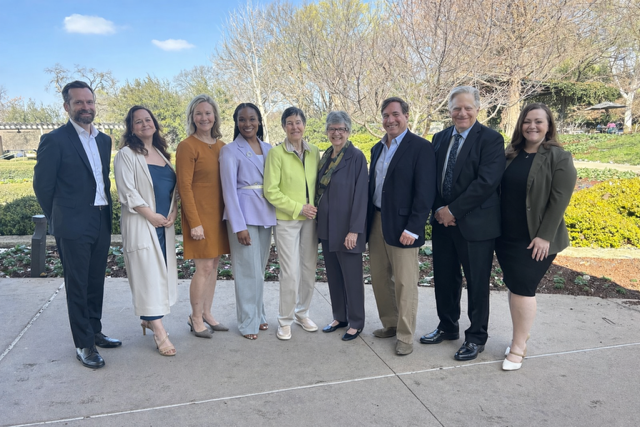
Pictured: The people who helped us pull off a beautiful event for Growing Love and those who help to make the SWMD Transformation project possible each day. From left, Justin Jackson, Field Operations, Jennifer Preston, HKS, Lannie McClelen, Texas Trees Foundation, Candace Sweat, NBC-DFW, Lyda Hill, Lyda Hill Philanthropies, Janette Monear, Texas Trees Foundation, Bill Browning, Terrapin Bright Green, Robert Prejean, Southwestern Medical District, and Heather Stevens, Texas Trees Foundation (Not pictured, Abby Voyles and David Whitley of Texas Trees Foundation). | | When was the last time you truly fell in love with nature? 🌿 Cherished the fleeting, soft golden hues and dappled light of golden hour? ☀️ Paused to admire birdsong or plant life rustling in the breeze? 🐦 Stood in awe of towering tree canopies or blooming wildflower meadows?🌼 | | |
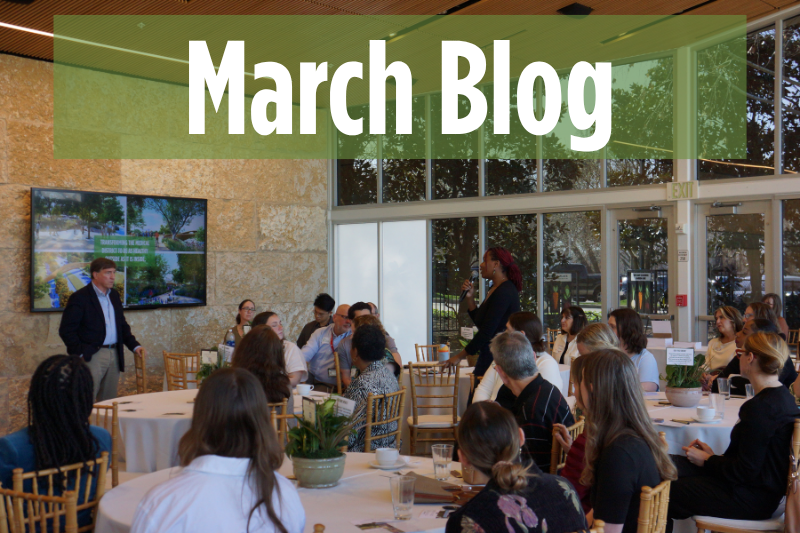
We were thrilled to convene leaders in architecture, planning, design, and healthcare, government officials, philanthropic partners, and faculty and students from local universities for Growing Love: A Biophilic Conversation on Health, Nature, and the Future of Dallas, hosted at the Dallas Arboretum last month.
Together, we explored how biophilic design embeds humans’ innate connection with nature into the built environment, inspiring health benefits such as stress relief, improved focus, mental health, and more. Our conversation focused on the Southwestern Medical District Transformation Project as a key case study of biophilia in action.
A special thank you to our featured speakers, whose palpable descriptions of biophilia and illumination of the science and research behind it left us truly inspired – Bill Browning of Terrapin Bright Green, captivated us with insights on how biophilia engages all the senses and, supported by evolving research, is enhancing all areas of health and all kinds of environments. Jennifer Preston of HKS shared design strategies that bridge human well-being and ecological intelligence, highlighting how investments in tree canopy and green space can be complemented by design initiatives that bring us closer to nature even when we’re indoors. Justin Jackson, PLA, ASLA, of Field Operations, detailed his thoughtful approach to shaping spaces that reflect the varied experiences of people in the Medical District, drawing on his horticultural expertise to create locally familiar and sensory-rich landscapes.
We were honored to have Lyda Hill join us at this event. As the founder of Lyda Hill Philanthropies, she is a lifelong entrepreneur, visionary philanthropist, and unwavering champion for science-driven solutions to the world’s greatest challenges. Her early investment and steadfast belief in the power of science-led transformation within the Southwestern Medical District have been catalytic in bringing this project to life, and her presence was a powerful reminder of the impact and momentum behind this work.
Thank you to everyone who joined us for this inspiring conversation. We hope this gathering planted a seed—one that continues to grow in how we observe, design, and advocate for nature-centered spaces. 🌱
| | |
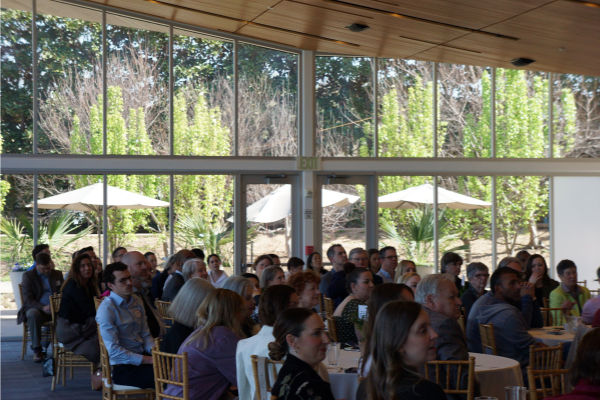
Pictured: An engaged audience gathers in a space that could not have been more fitting for the subject of biophilia. A captivating conversation combined with beautiful views toward the Arboretum and White Rock Lake created a morning that left us feeling energized and inspired. Image Credits: Eric Novelo
Also, a special thank you to the Turtle Creek Conservancy for inviting our team and Southwestern Medical District: Prehistory to the Future of Medicine author, Dr. Evelyn Montgomery, and special contributor, Robert Prejean, to participate in their Write Stuff local author series. Evelyn and Bob took us on a fascinating journey from the native populations and natural landscape to the civic leaders and medical advancement that nurtured the neighborhood into the prominent center for health, healing, research, and innovation we know it to be today.
They illuminated the growth of each institution – from Children Health’s humble beginnings as ‘Baby Camp’, where they cared for Dallas’s youngest in tents on the lawn of Parkland Hospital, to Parkland’s evolution in excellent care that’s known no bounds across the campuses its occupied throughout its 132-year history, and finally, UT Southwestern, which evolved out of a mission to educate Dallas’s next generation of medical professionals, keeping education and innovation at the core of who the Medical District is.
As part of our dynamic conversation, we also had the opportunity to highlight the transformation that will help usher in the Southwestern Medical District’s next chapter. We highlighted how green space will stitch together the Medical District into a cohesive campus, serving as a place for respite, connection, and movement, and how the book has been a unique tool that’s equipped our team with design insights across interwoven themes of history, place, identity, and community.
Thank you again to the Turtle Creek Conservancy staff and members, and all who gathered with us with a spirit of reverence for Dallas’ past and enthusiasm for its future!
| | | | |
👆 In case you missed it, we published a blog on the link between Cardiovascular Health and trees and green space in February - with a multitude of connections that may surprise you. | | |
👆 Explore how biophilia has evolved into a practical design framework — and how it's being applied right at home in the Southwestern Medical District by checking out our latest blog.
Image Credits: Eric Novelo
| | | | |
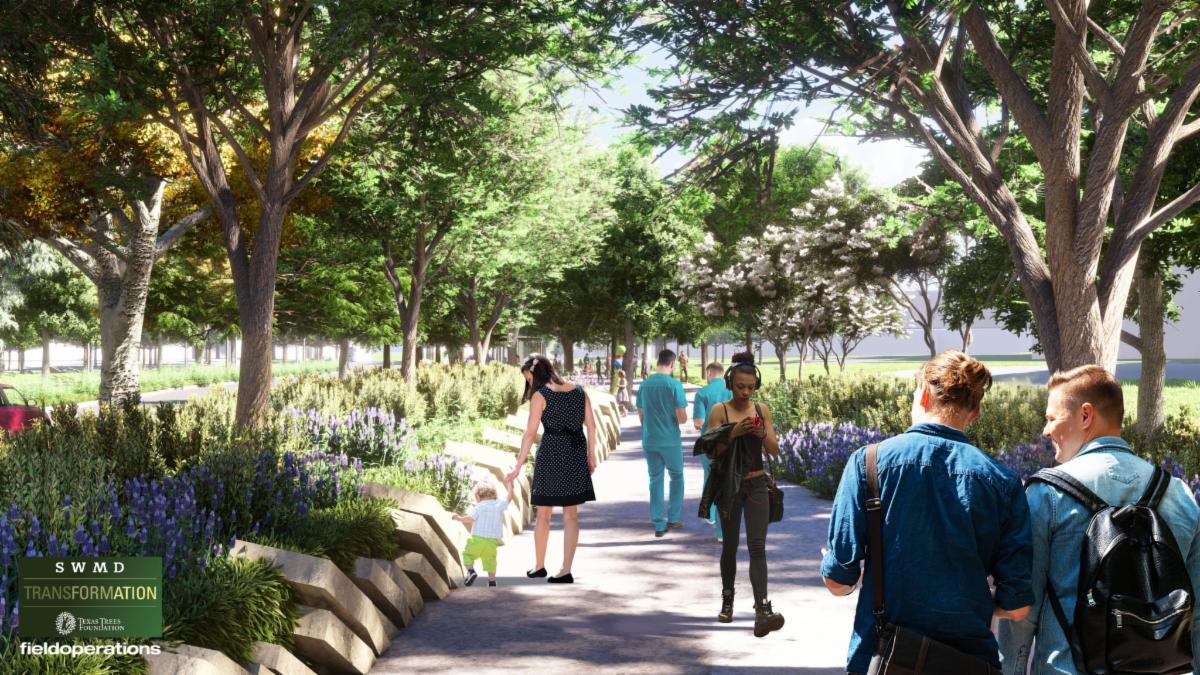
Pictured: A rendering illustrates the future Green Spine along Harry Hines Boulevard, where a redesigned pedestrian experience, supported by a dense tree canopy and layered plantings, creates a more comfortable and restorative environment that promotes health and well-being in the Medical District. | | |
Design for Phase I, the Green Spine, is actively progressing, informed by ongoing coordination with the project team and a broad set of agency and institutional partners, including the City of Dallas, Dallas County, and the Texas Department of Transportation, and leaders from across the Southwestern Medical District, including representatives from the forthcoming Children’s Health and UT Southwestern joint pediatric campus. A recent working session at Dallas City Hall convened this full group of partners, bringing together project leaders shaping change across the district. Participants also iincluded those leading the reconstruction of the Harry Hines and Mockingbird Interchange, an infrastructure upgrade being led by the City that will improve traffic flow and safety at the District’s northern boundary.
This level of coordination reflects the significant and aligned investment occurring across the Harry Hines corridor, from the Mockingbird Interchange at the northern gateway, through the future Texas Trees Foundation Green Park at Inwood, and continuing south along Harry Hines Boulevard through the Green Spine led by Texas Trees Foundation in partnership with the City of Dallas.
Our progress is supported by a strong framework of collaboration, efficiency, and aligned implementation. To build on ongoing coordination efforts, a more formalized structure has been established to align partners consistently. The City of Dallas, the Mockingbird Interchange engineering team, the Harry Hines corridor engineering team, and Texas Trees Foundation’s landscape design team will convene bi-weekly to coordinate design and implementation along the corridor. In addition, the City will host quarterly coordination meetings that expand participation to include the Texas Department of Transportation, Dallas County, hospital institutions,utility providers, and broader Medical District leadership.
This approach brings partners together on a regular cadence, strengthening integration across projects, reinforcing clear and well-defined scopes, and creating ongoing opportunities to align and amplify collective impact at the district scale.
With the continued support of our Owner’s Representative, Pritchard Associates, and in close collaboration with the City of Dallas’ Harry Hines Boulevard redesign, utilities coordination is advancing across the corridor. Engagement with private utility providers across the Medical District is focused on ensuring uninterrupted service while proactively accommodating robust tree canopy and green infrastructure—aligning these priorities to be delivered in tandem.
| | | | |
|
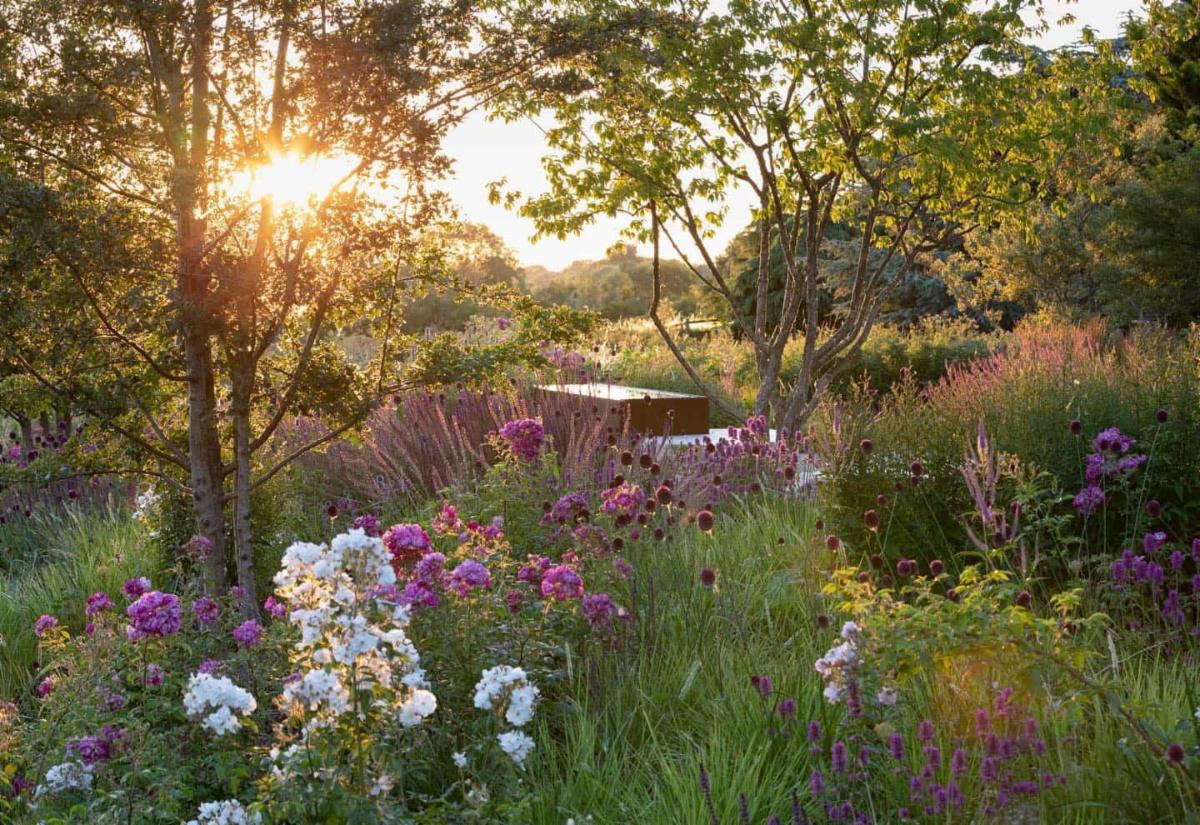
How can a space incorporate seasonal planting strategies that symbolize the passing of time? Or how can it embody intentional contrast between the ordered and natural – integrating an open clearing with site furnishings among a garden growing wild?
Image Credits: richardbloomphoto on Instagram
| Image Credits: Terrapin Bright Green | | |
There's more to design than what meets the eye. When we ponder how good design can engage our senses, we tend to think of the common five – sight, hearing, smell, taste, and touch – with sight playing a particularly dominant role. Beautiful landscapes draw us in and encourage us to linger, but human beings are complex and perceptive.
Across geographies and cultures, different ways of experiencing the world hold deep significance.
This article equips designers with insights on how to consider various sensory elements, such as time or balance.
| |
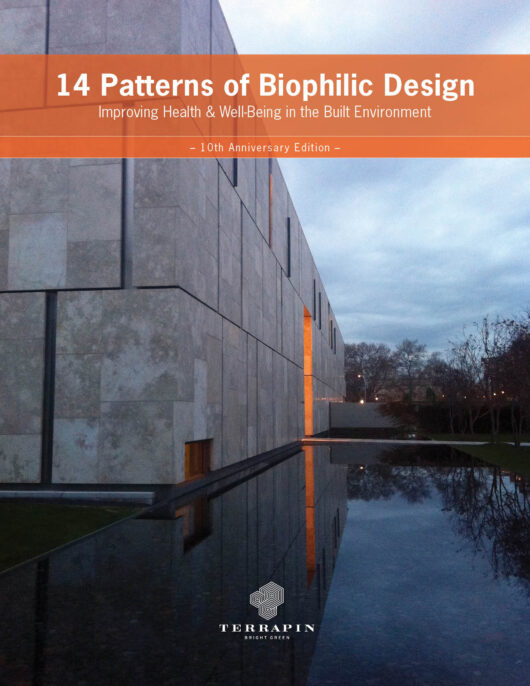
14+ Patterns of Biophilic Design: Improving Health and Well-Being in the Built Environment
Terrapin Bright Green’s 14+ Patterns of Biophilic Design truly captivated us at our Growing Love event. This framework takes what biophilia reveals to be true about humans’ innate connection to nature and assembles it into actionable design strategies. The patterns provide ways that designers can incorporate strategies such as natural materials and sensory plantings, or sensations like mystery and refuge, into the environments they are designing, and the unique health benefits associated with each. We encourage you to dive in further – we promise your fondness for nature will only grow, as will your ability to spot biophilia in your daily life, or apply it to your own projects.
| | | |
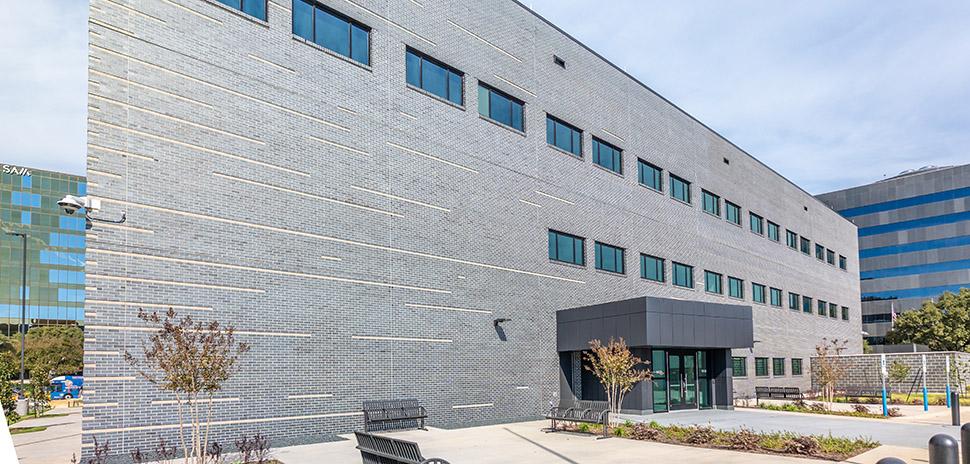
“For years, our public health laboratory operated out of a basement—a space never designed for the work we were asking it to do. Today, Dallas County has the facility its residents have always deserved—one that will help us detect threats faster, contain outbreaks sooner, and respond to tomorrow’s unknowns with the scientific capability this community expects.” - Dr. Elba Garcia, Dallas County Commissioner District 4
Image Credits: Dallas Innovates
| | |
The concentration of talent and innovation happening in our Medical District is truly inspiring, and the opening of Dallas County Health and Human Services’ new $52M Public Health Laboratory on West Mockingbird Lane is no exception.
Congratulations to our partners at Dallas County on this incredible achievement for our City that will no doubt change the lives of North Texans for the better!
| | | |
The pedestrian data was made open source, with other municipalities such as Boston already expanding upon its findings, observing where high foot traffic areas and extreme heat spots overlap.
Image Credits: Georgia Tech University
| | |
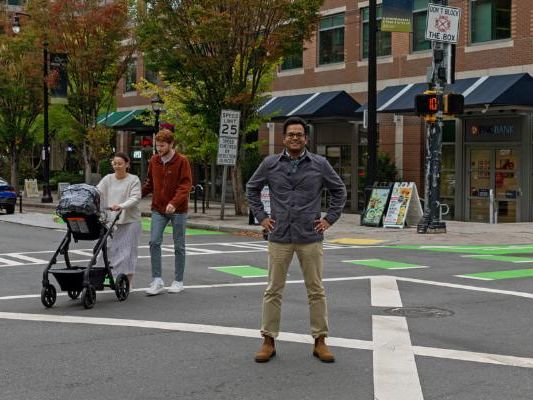
A group of MIT researchers accomplished an unparalleled feat in the urban planning field, successfully capturing the first comprehensive model of pedestrian activity in any major U.S. city.
The study took place in New York City, but its findings go far beyond the Big Apple. By modeling pedestrian volumes on both designated sidewalks and crosswalks, and unofficial desire paths and cut-throughs, the data captures how pedestrians move organically throughout a city.
By studying actual pedestrian volumes across the city beyond the streets commonly understood to be busy thoroughfares, the data can inform more robust pedestrian improvements regarding access, safety, and comfort.
| | | | | |
Thanks so much for reading! Have an idea, question, or want to connect further in the meantime? To reach our team, drop us a line at swmdproject@texastrees.org.
| | | | |
| |
| |