Dear Angelenos:
It is important to understand and respect the contributions of Asian Americans and Pacific Islanders to the life of our City. Designated historic neighborhoods such as Chinatown, Little Tokyo, Historic Filipinotown, Koreatown, and Thai Town honor the roles Asian American and Pacific Islander communities have played in shaping Los Angeles and enriching our distinctive local culture.
SurveyLA, the City's comprehensive inventory and evaluation of historic resources that finished in 2017, published a collection of informative Historic Context Statements on the histories of different ethnic and cultural groups in Los Angeles. No fewer than five of these statements trace the stories of Asian Americans and Pacific Islanders through the City's history.
As we celebrate Asian American and Pacific Islander Heritage Month in May, I invite you to read about the experiences of the Chinese, Filipino, Japanese, Korean, and Thai communities in Los Angeles.
Sincerely,
|
|
Vince Bertoni,
Director of Planning
|
|
|
|
Fair Share Housing Report |
On May 25, City Planning released a report that outlines strategies to assist with the equitable distribution of affordable housing. The Fair Share Report proposes the establishment of housing targets by community to ensure that equity is at the forefront of future land use considerations.
The centerpiece of the report is the introduction of a new methodology that prioritizes the fair distribution of affordable units. By addressing issues related to zoning capacity, the new methodology will ensure that Los Angeles’s community-by-community approach to planning complements citywide objectives for accommodating growth in a way that furthers equity.
The report also calls on the City Council to consider the development of additional housing incentive programs that would streamline the approval process for affordable units and expand the City’s existing programs across more neighborhoods where housing is needed.
|
|
|
|
On May 20, the City Council took action to approve the Mayor’s proposed budget for Fiscal Year 2021-22. The proposed budget as adopted by the City Council will increase City Planning’s budget appropriation and add new funded position authorities to the Department.
The new positions will largely support case processing for various housing initiatives, including dedicated units that will assist with the intake and review of project applications in the Valley. The Department also intends to utilize these positions to establish an office in South Los Angeles to assist with neighborhood engagement and outreach as well economic development.
Other planning programs that received funding include the Home-Sharing Unit, which will add critical staffing capacity to support its administration and enforcement efforts, and the Priority Housing Program, which will further streamline the review of projects with affordable units.
|
|
|
|
Case Processing Fee Update |
On May 18, the Los Angeles City Council voted in favor of the Department’s proposed revisions to its case processing fee schedule. In the coming weeks, the Office of the City Attorney will prepare the final ordinance for form and legality. This ordinance will require Council approval, after which the new fee schedule will take effect 60 days upon publication by the Clerk’s Office.
The updated fee schedule aims to increase the Department’s cost recovery from 64 to 83 percent, resulting in nearly $8 million in annual savings to the City’s General Fund. Additionally, it right-sizes the Department’s case processing fees to accurately reflect the current cost of services based on hours spent processing development projects based on their overall volume.
To determine the appropriate level of cost recovery, the Department retained the services of a third-party consultant to conduct a full assessment of its development services. This analysis informed City Planning’s final recommendations, including which services to subsidize.
|
|
|
|
On May 13, the City Planning Commission advanced the Department’s proposed Mello Act Ordinance to the City Council. The ordinance aims to protect existing residential units while increasing the current supply of affordable housing along California’s Coastal Zone, in neighborhoods such as Pacific Palisades, San Pedro, Venice, and Wilmington.
The ordinance would institute permanent regulations and procedures on the demolition and construction of housing projects. It would also implement new requirements for housing projects that apply for a change of use, or which require planning approval for the conversion or subdivision of land.
Upon adoption by the City Council, the Mello Act Ordinance would establish more rigorous provisions for the preservation of existing units, while creating additional units through inclusionary zoning to increase access to housing in Los Angeles’s Coastal Zone.
|
|
|
|
On May 4, the Department released a draft ordinance for the Wildlife Pilot Study. The ordinance aims to preserve wildlife and promote habitat connectivity within the Santa Monica Mountains between the 405 and 101 freeways, with the overall goal of maintaining larger contiguous areas suitable for local wildlife and native species in Los Angeles’s hillsides.
To meet these objectives, the Department has proposed new development regulations to protect biological resources where sensitive habitat may exist, particularly around waterways, riparian areas, and highly vegetated areas. These regulations are intended to minimize grading and disturbances to soil and native vegetation, and offer new requirements for fencing, lighting and trash enclosures, among other protections.
In the coming months, the Department will be conducting outreach to collect additional feedback from neighboring residents and environmental groups. The public input received will inform the updated ordinance the Department will ultimately advance to the City Planning Commission. For more information, visit http://planning4la.org/wildlife.
|
|
UrbanizeLA’s CitySpeak Podcast Sits Down with City Planning |
|
An idea that has generated some buzz even outside the planning world is the concept of the “15-minute city.” The idea is that cities can be designed so that all of a resident’s basic needs—work, food, healthcare, entertainment, etc.—are within 15 minutes of home.
In a recent interview with UrbanizeLA’s CitySpeak podcast, Director of Planning Vince Bertoni shared how planning for Los Angeles as a 15-minute city is a sustainable way to make sure Angelenos have access to resources ranging from affordable housing to transportation, and how that work begins at the Community Plan level.
Today's Community Plans guide neighborhoods toward providing access to jobs, housing, and local amenities within close proximity of city centers, concentrating most high-density development in established commercial centers that are served by rapid transit.
|
|
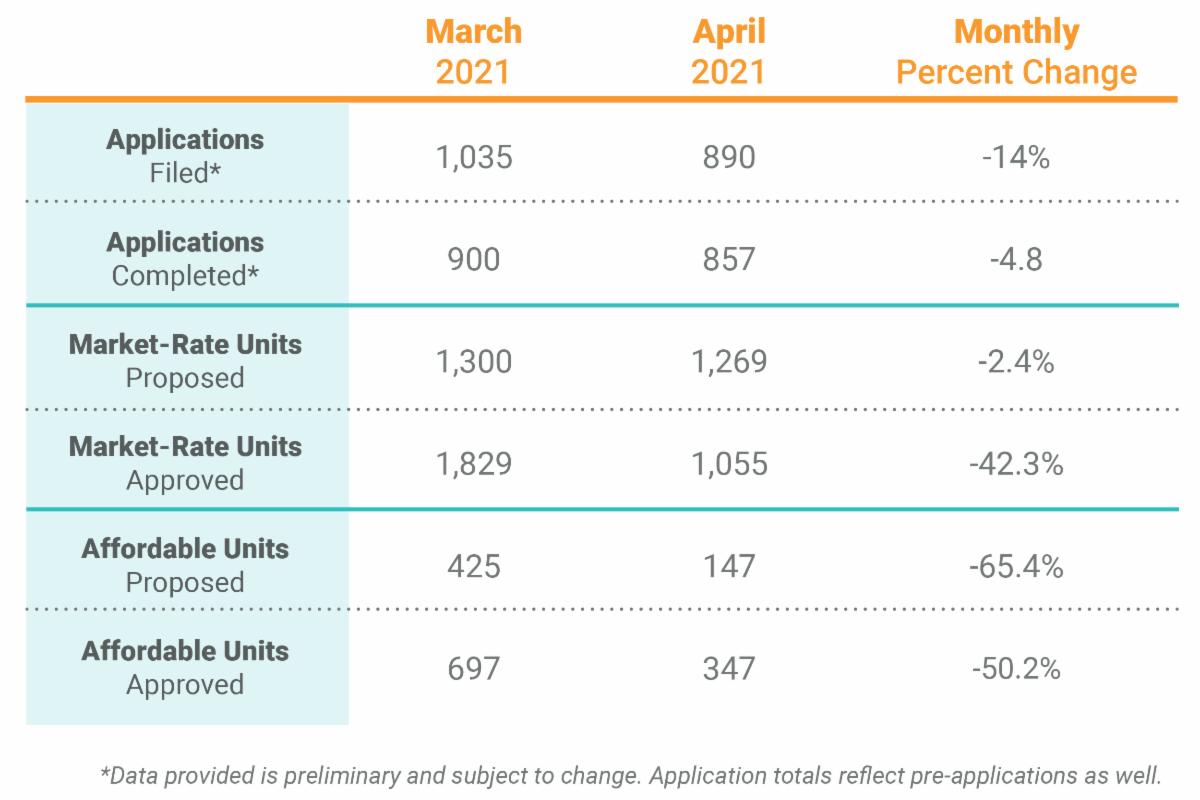
Rates of application filing and completion remained high in April, exceeding the previous year's monthly average of 638—despite a month-over-month decrease of 14% compared to March. Nearly 60% of all planning applications filed in April were administrative (non-discretionary) cases, a result of the Department's ongoing efforts to streamline case processing through ministerial review. |
|
|
|
- Preparing Plan and Zoning for upcoming City Planning Commission hearing, anticipated for Summer
- Extended the comment period for the Draft Environmental Impact Report (EIR) to December 4, 2020 and Draft Plan to January 13, 2021 to allow for additional input
- Held Public Hearing and virtual open house events in December 2020
-
Facilitated Community Planning 101 webinar sessions in November 2020
-
Released updated Draft Zoning, Plan Text, Land Use Map, and Community Benefits Program in November 2020
- Conducted virtual office hours in September 2020
- Released updated Draft Zoning, Plan Text, Land Use Map, and Community Benefits Program in August 2020
-
Released Draft Environmental Impact Report (DEIR) in August 2020 for a 120-day comment period
|
|
|
|
- Preparing Draft EIR for the Wilmington-Harbor City Plan Update, along with the corresponding Draft Zoning to implement the proposed policies for the Harbor LA Plans
-
Released the Draft Policy Document for the Wilmington-Harbor City Plan Update in May 2021, with the Draft Policy Document for the Harbor Gateway Plan Update slated for public release later this spring
-
Scheduled Office Hours in November 2020 to collect feedback on the Draft Land Use & Zoning
-
Released Interactive Story Map for Harbor LA Community Plans in October 2020
|
|
|
|
-
Preparing to release of General Plan Land Use Map in Fall 2021
-
Conducted a series of Office Hours in February 2020
- Preparing to Conduct Workshops in Conjunction with Release of Draft General Plan Land Use Map in Fall 2021
|
|
|
|
-
Released recorded webinars of the Draft Land Use Designations in December 2020
-
Developed an interactive StoryMap in December 2020 to detail the proposed Draft Land Use Designation maps and proposed Draft Zoning
|
|
|
|
- Refining Draft Plan Concepts
- Preparing for continuous outreach efforts to diversify and expand public participation
-
Summarized community feedback in April 2021
-
Held a virtual public workshop to kick off the Venice Survey 2021 in November 2020
- Conducted a series of Office Hours and virtually attended community meetings, including neighborhood council meetings in September/October 2020 and early 2021
-
Released Draft Concepts and held Virtual Webinars in July 2020
|
|
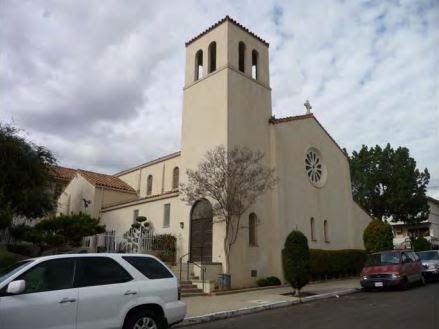
Source: Wilshire Center and Koreatown Recovery Redevelopment Area Historic Resources Survey, 2008
St. Mary’s Episcopal Church, located at 961 S. Mariposa Avenue in the Wilshire Community Plan Area, is significant for its association with the Japanese American community, in particular the historic enclave of Uptown, or Uemachi. In the early 20th century, Japanese Americans began settling in the area roughly bounded by San Marino Street, Pico Boulevard, Western Avenue, and Vermont Avenue.
St. Mary’s Episcopal Church, located along Uptown’s northern border, played a central role in the lives of local Japanese Americans, serving as a place of worship and as a community hub. The congregation was founded in 1907 by Mary Louise Paterson, a former missionary to Japan, and Reverend John Misao Yamazaki. The church shuttered when the Spanish flu pandemic of 1918 forced Los Angeles into quarantine, but Reverend Yamazaki continued to make home visits to local families, successfully growing the membership of the congregation.
In 1919, Uptown’s Japanese American residents faced organized resistance by a group of white homeowners who sought to expel them from the neighborhood by raising rents or through outright eviction. Despite these exclusionary actions, the congregation maintained its presence in the neighborhood and the current church building, designed by architects Allison and Allison in the Spanish Colonial Revival style, was constructed in 1932.
However in the 1940s, much of the congregation was forcibly removed from Uptown as part of the federal government’s broader displacement of Japanese Americans to internment camps during the Second World War. After the war, the church served as a temporary shelter for the many congregants who no longer had homes or livelihoods to return to following internment.
Today, St. Mary’s Episcopal Church continues to serve a diverse community and provides English and Spanish-language services. Its outreach includes its use as a site for Safe Parking LA, a nighttime program for unhoused persons who use their vehicles to sleep at night. The church has been determined eligible for listing on the National Register of Historic Places.
Click here to learn more about the Asian American Ethnic Context studies.
|
|
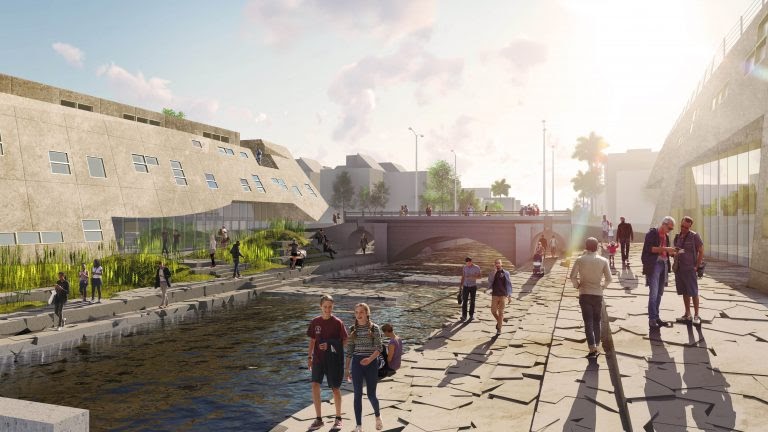
On May 27, the Reese Davidson Community project, a new 100% affordable, mixed-use housing project in the Venice Community Plan Area, appeared before the City Planning Commission. The project requested planning approvals for the demolition of an existing building with four residential units to accommodate the construction of a new structure with 140 units, including seven for Extremely Low Income households (those earning $33,800 or less, for a family of four), 129 for Low Income households (those earning $90,100 or less, for a family of four), and four management units.
Approximately 7,405 square feet will be reserved for residential and public amenities, including supporting social services, retail uses, an indoor restaurant, an outdoor restaurant service area, and an art studio space. The project will convert a beach parking area managed by the Los Angeles Department of Transportation (LADOT) into a new residential/public parking structure that will remain under LADOT's management.
The project will also provide residents with 16,250 square feet of open space, 30% of which will be landscaped, and will include public access to the canal.
|
|
June City Planning Commission Meetings: |
|
|
June Area Planning Commission Meetings: |
|
Central: June 8 and 22
South Los Angeles: June 1 and 15
South Valley: June 10 and 24
West: June 2 and 16
East: June 9 and 23
Harbor: June 1 and 15
North Valley: June 17
|
|
LOS ANGELES
CITY PLANNING
|
|
Sign up to receive citywide planning updates by email
|
|
@Planning4LA
Planning4LA.com
|
|
|
|
|
|
|
|