|
Who wrote this?
Do you know?
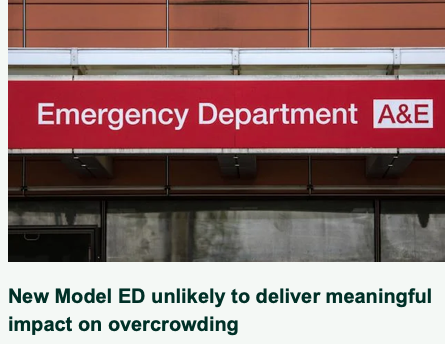
I have no idea who wrote the new The Model Emergency Department: High-Performing Urgent and Emergency Care Pathways document.
Whoever it was must think; we’re stupid, can’t work a calculator, have no memory and as dull as a dungheap in December.
If it wasn't a report, it’d be the script for a management pantomime…
‘The patients have all gone!’
‘No, they’re behind you!’
If this report were a play, it would be Shakespeare’s Othello, whose downfall is driven by his gullibility and impulsive trust in the wrong people.
As a script, it’s banal. As if the service has somehow failed to notice A&E problems, over the past twenty years.
If it were a map, it would be a road to where we already are.
If it were a package, it would be a recycled box full of stuff experienced clinicians and managers already know.
Underestimating their understanding, avoids the central constraint that determines emergency department performance…
… capacity across the whole system.
In doing so, it treats its audience not as professionals grappling daily with reality, but as if they need elementary instruction in flow, streaming and layout.
The most striking example is the introduction of ‘Extended Emergency Medicine Ambulatory Care’ (EEMAC).
This is not a new model of care; it is a new name for an old coping mechanism.
If the report were a watch, it would have no hour-hand.
Patients are still to be; corralled, parked, held longer, reviewed again, and remain notionally within emergency medicine, for no reason other than to fiddle, time-based metrics and targets.
- No beds are created.
- No staff materialise.
- No downstream services suddenly become available.
People are warehoused in an old place with a new name. Whilst the authors congratulate themselves for having solved… something?
Actually, nothing.
This is precisely what Henry Mintzberg has warned us about for decades.
'When organisations are unable or unwilling to confront the real sources of failure, they retreat into restructuring, redesign and relabelling.'
Activity replaces progress. Motion substitutes for improvement. The organisation feels busy, but nothing material changes. Rearranging internal structures becomes a proxy for leadership.
Mintzberg was blunt about this;
‘… reorganisation is often undertaken as a substitute for thinking.’
Ouch!
That observation is tailor made for this guidance. Emergency departments are not overwhelmed because of poor zoning or insufficiently imaginative pathways.
They are overwhelmed because;
- wards are full,
- community services are thin,
- social care is broken
- the workforce is exhausted and
- System wide productivity cannot recover.
The document also exemplifies what Chris Argyris described as ‘single-loop learning’.
'Processes are adjusted, terminology is refreshed, and behaviours are nudged but the governing variables, causes, are left untouched.'
Argyris encourages us to think about 'double loop learning'...
'... the assumptions that constrain performance, particularly the mismatch between demand and capacity.'
In the NHS they are seldom challenged. To do so falls foul of the political decisions that have got us into this mess.
This can only get worse when NHSE people become civil servants, and discover, they are not allowed to criticise ministers.
This is adaptation without learning, compliance without insight. Targets and blindfolds.
There is an implicit suggestion running through this report that if only trusts implemented these models properly, performance would improve.
That is cunningly, devious…
... it tries to shift responsibility away from national policy, funding decisions and workforce planning, and...
... pushes it back onto local leaders who are already managing risk rather than delivering care.
It is hard not to see this as; kissing up - kicking down.
What is most dispiriting is that this approach is now familiar. When the system fails under pressure, guidance proliferates.
New frameworks appear. Old ideas are rebadged, but…
… the difficult conversations about; beds, capital, social-care reform, workforce supply, productivity and political trade-offs, are deferred yet again.
We end up, optimising fragments of a system whose central constraint is never addressed.
Management experience and theory exists precisely to help leaders avoid these traps. To ignore it, and to issue documents that embody the very behaviours Mintzberg and Argyris cautioned against, is not just disappointing…
… it’s irresponsible.
Emergency medicine does not need another diagram. It needs space, people and somewhere for patients to go.
Take the crayons away from the children and give the grown-ups the pen, or...
... documents like this will continue to land badly. Not because they are unread, but because they add nothing to what everyone already knows.
Until national guidance is grounded in management thinking and an understanding of whole-systems...
... the service will continue to be treated as if it can be fixed with just...
... more words.
|