AJA Weekly Recap

2026 | February 23

Greetings!


Here is your weekly market commentary. We hope you enjoy receiving our newsletters. If you have any questions about the following content, please let us know!


- The AJA Team

This Week….

  • The Markets
  • Mortgage Rates
  • Leadership Change

The Weekly Focus


Think About It

“Courage is what it takes to stand up and speak; courage is also what it takes to sit down and listen.”


― Winston Churchill, Former British Prime Minister

The Markets

Stocks Rebound


The major U.S. stock indexes recovered most of the ground they lost the previous week, extending the market’s meandering start to 2026. The NASDAQ finished 1.5% higher — snapping a string of five consecutive weekly declines — while the S&P 500 gained 1.1% and the Dow added 0.3%.  


U.S. large-cap growth stocks narrowed their year-to-date performance deficit relative to their value counterparts, as a growth equity benchmark outperformed a value index. The growth benchmark, the Russell 1000 Growth Index, finished around 1.5% higher for the week, while the Russell 1000 Value Index added 0.7%.


Yields of U.S. government bonds rose modestly but remained well below a recent peak reached a couple of weeks earlier. The yield of the 10-year U.S. Treasury finished the week around 4.08%, up from the year-to-date low of 4.05% at the end of the previous week. As recently as January 20, the yield had climbed as high as 4.31% — the highest since last August.


In a 6-3 decision, the U.S. Supreme Court on Friday ruled that the Trump administration exceeded its legal authority last year when it imposed tariffs on imported goods from most of the nation’s biggest trading partners. The ruling didn’t appear to resolve whether the government must repay tariff revenue that it has already collected.


The U.S. economy expanded at a slower pace than expected at the end of 2025. GDP grew at an annualized rate of 1.4% in the fourth quarter, below economists’ consensus estimate of roughly 2.5% growth and far behind the third quarter’s 4.4% rate. One negative factor was a decline in federal spending amid the fourth quarter’s prolonged government shutdown.


The U.S. Federal Reserve’s preferred inflation gauge showed that prices rose at the fastest pace in nearly a year. Friday’s Personal Consumption Expenditures Price Index release showed that inflation rose in December at an annual rate of 2.9% — the highest since March 2024. The report came a week after another gauge, the Consumer Price Index, showed that inflation eased to 2.4% in January.


The price of U.S. crude oil climbed nearly 6% for the week after rising to the highest level in more than six months. Oil was trading above $66 per barrel — up 17% year to date — amid rising tensions between the United States and Iran.     


Bitcoin fell for the fourth week out of the past five, although the price of the most widely traded cryptocurrency stabilized relative to a sell-off that began in late January. On Friday, Bitcoin was trading below $68,000 — down about 23% year to date and well below the record high of about $126,000 set last October. 


Source: John Hancock Investment Management

Mortgage Rates

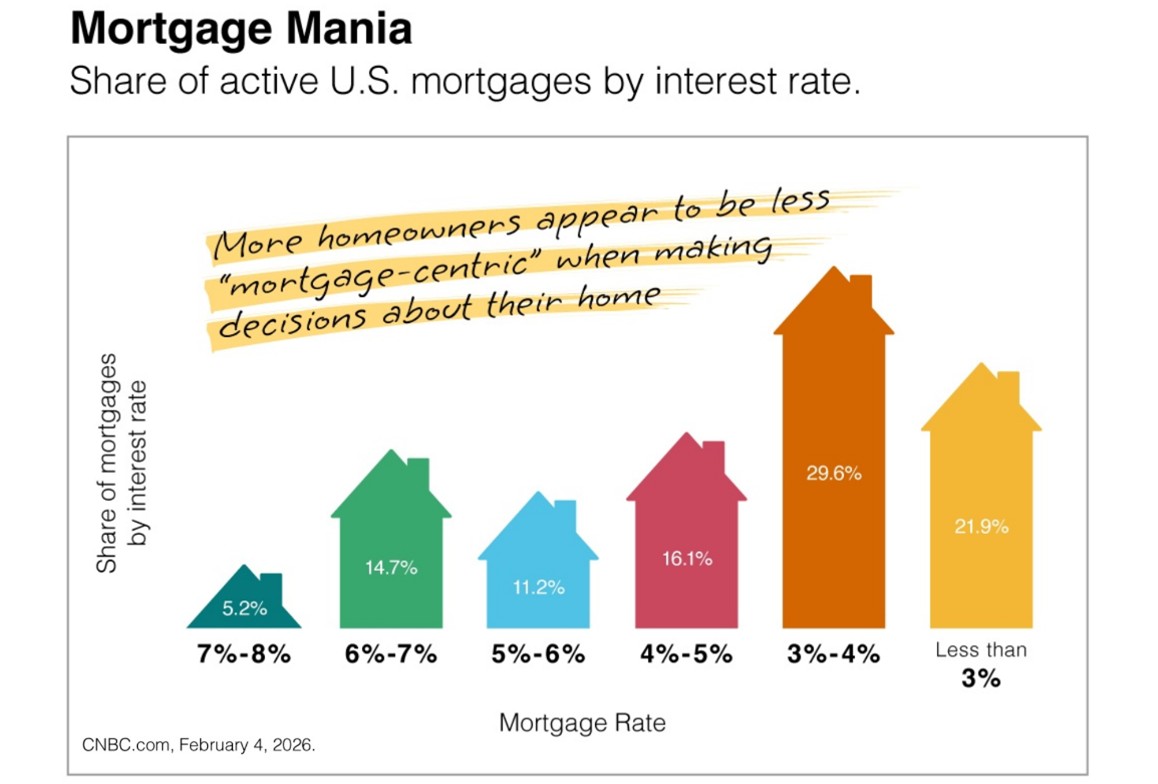
Just over 50% of homeowners still have mortgages with rates under 4%. But that number has been trending lower, especially in the past year. Homowners with those rates can often feel stuck in their home, as they might essentially pay more for a smaller house if they move.


The good news is mortgage rates are on the decline with the average 30-year fixed rate mortgage hovering near 6%. The market still anticipates two more rate cuts by the Federal Reserve in 2026. This could help push interest rates across the board even lower and provide homeowners with the chance to refinance their loans if they took them on since 2022. Or, it could give homeowners the opportunity to consider moving and not taking as big of a hit by incurring a higher interest rate on their mortgage. 

A Change in Leadership

The Fed is the central bank of the United States. It is responsible for keeping the financial system running smoothly. In 2026, the Fed will see its leadership change. The current chair will retire, and former Fed Governor Kevin Warsh has been nominated to replace him.


A new approach monetary policy


Mr. Warsh is a vocal critic of certain Fed policies. He has argued that quantitative easing (QE), which is the Fed’s practice of purchasing U.S. government bonds to stabilize the financial system, encouraged Congress to spend more than it otherwise might have.


In an April 2025 lecture, Warsh explained:


“In the 2008 crisis, we cut interest rates to near zero and sought new ways to make monetary policy looser and bring liquidity to illiquid markets. I strongly supported this crisis-time innovation, then and now. But when the crisis ended, the Fed never retraced its steps…QE – with some fits and starts in the 2010s – has become a near permanent feature of central bank power and policy. Fiscal policymakers – that is, elected members of Congress – found it considerably easier appropriating money knowing that the government’s financing costs would be subsidized by the central bank.”


Retracing the Fed’s steps


One of Warsh’s priorities as Fed Chair may be reducing the central bank’s balance sheet, and there has been considerable speculation about how this might be accomplished. Alex Harris of Bloomberg reported on several possibilities. These included:


  • Reducing Treasury purchases. The Fed ended its latest round of quantitative tightening (QT) in December because bank reserves (the cash banks are required to keep on hand to ensure the stability of the system) were falling too low, creating stress in the system. The stress became significant enough that the Fed resumed bond purchases.


“While restarting QT is unlikely, the Fed could gradually reduce the pace of T-bill purchases from $40 billion a month currently, or stop them altogether,” according to analysts cited by Harris.


  • Changing regulations. If bank reserve requirements were modified, the effect of QT on bank reserves could be reduced. “Regulators could relax the liquidity coverage ratio or internal liquidity stress test requirements, so lenders need to hold less cash,” suggested bank strategists cited by Harris.


  • Exchanging assets. Another option is for the Fed to sell longer-term Treasuries and buy shorter-term Treasury bills, which mature in 12 months or less. “But without close coordination with Treasury, long-dated debt issuance needs and costs would rise significantly as the Fed retreats,” wrote Harris. One estimate suggested the change could push “borrowing costs up by 40 to 50 basis points.”


Warsh has expressed support for a more coordinated approach between the Fed and the U.S. Treasury Department, which could help mitigate the effects of Fed balance sheet reduction efforts, according to Ye Xie, Michael MacKenzie, and Maria Eloisa Capurro of Bloomberg. However, greater coordination could also raise questions about whether the Fed is acting independently.


The Fed will face another significant challenge during Warsh’s tenure: managing monetary policy in an economy being transformed by AI. We’ll explore that next week.

AJ Advisors
www.ajadvice.com

Phone: (615) 709-8709

Fax: (615) 709-8709

eMoney

Charles Schwab

Advyzon

John Stauffer, CFP®
Partner

Andrew Quinn, CFP®
Partner

Emily Triano

Operations Manager


emily@ajadvice.com


Maya Laws

Operations Associate


maya@ajadvice.com


Past performance does not guarantee future results. Different types of investments involve varying degrees of risk, and there can be no assurance that the future performance of any specific investment, strategy, or product (including those recommended or undertaken by AJ Advisors, LLC), or any non-investment related content, made reference to directly or indirectly in this communication will be profitable, equal any indicated historical performance level(s), be suitable for your portfolio or individual circumstances, or prove successful. Due to various factors, including changing market conditions and/or applicable laws, the content may no longer be reflective of current opinions or positions. You should not assume that any discussion or information contained in this communication serves as the receipt of, or as a substitute for, personalized investment advice. To the extent that a reader has any questions regarding the applicability of any specific issue discussed above to their individual situation, they are encouraged to consult with the professional adviser of their choosing. AJ Advisors, LLC is neither a law firm nor a certified public accounting firm and no portion of the content herein should be construed as legal or accounting advice. If you are an AJ Advisors, LLC client, please remember to contact the firm, in writing, if there are any changes in your financial situation or investment objectives or if you wish to impose, add, or modify any reasonable restrictions on our investment advisory services. Until so notified, AJ Advisors, LLC will continue to rely on the most recent information provided. A copy of our current written disclosure statement discussing our advisory services and fees continues to remain available upon request.