June 2023
Overview
Motor Vehicles, Motor Vehicle Use
 
Almost all organizations use motor vehicles in some form or another. In some cases, like the trucking industry, vehicles are the central feature of the organization. In others, like schools and churches, vehicles are ancillary to the organization’s primary purpose.

Whether central or not, the law holds an organization accountable to the same “reasonable person” standard of care. That’s why every organization should adopt a policy for motor vehicle use.

Vicarious Liability

Ignorance is no defense – at least not for employers. That’s because the “buck” stops there.

The law makes employers responsible for the acts of its agents under a form of strict secondary liability called vicarious liability.

Strict secondary liability means the employer is liable regardless of fault. The only relevant facts are (1) whether the employer had the right of control and (2) whether the agent was acting within the course and scope of his or her duties at the time of the accident.

In this case, an employer’s best defense is accident prevention. And when it comes to drivers, that starts with putting the right person behind the wheel.

Duty of Care

Duty of care is a legal obligation to take the same care a reasonable person would take to prevent harm to others.

The care a reasonable person takes depends on the situation. For example, it’s fair to assume a reasonable person would take greater care for activities involving children as compared to adult activities. A reasonable person would also exercise a greater duty of care to adult participants than they would to employees or adult volunteers.

At the one end of the spectrum is the highest duty of care, children, and on the other end, employees and adult volunteers. The shift from a high duty of care to a low (relative) duty of care is a shift in responsibility and ultimately legal liability.

When it comes to drivers, the duty of care is greatest when an organization organizes transportation of minors and adult participants.

Driver Selection

According to the National Highway Transportation Safety Association, over 90% of all auto accidents are caused by driver error. That’s why preventing auto accidents starts with putting the right person behind the wheel.

Most people think they are good drivers – just ask them. In fact, a study by Esurance found that nearly three-quarters of respondents considered themselves good drivers. But what makes someone a good driver? Studies show that the secret is age and experience.

According to the Centers for Disease Control and Prevention, teen drivers ages 16-19 have the greatest frequency of accidents and are three-times more likely to be involved in a fatal accident than drivers age 20 and older.

In addition, according to neurologists, the rational part of the brain does not reach full maturity until age 25, long after age 18, which in most states is the legal age of maturity. Rational thinking involves using good judgement and being aware of long-term consequences. Teens tend to make decisions with the emotional part of their brain.

Taken together, this suggests the minimum age for driving “on the job” should be around 21 and that the best age for driving high capacity (high risk) vehicles is age 25 or older.

But age is only half the story, the other half is experience. A driving record is a history of motor vehicle violations and accidents and as such is a statement about the quality of a person’s driving experience.

A good driver is one with long periods without accidents and moving violations. Shorter periods of experience require near perfect driving histories because only time can differentiate good drivers from bad ones.

Driver Training

Studies show that driver training reduces accidents, particularly among younger drivers. However, with smart phones, everyone can benefit from distracted driving training.

Distracted driving is anything that takes your hands off the wheel, your eyes off the road, or your mind off of driving. It is now the most common cause of auto accidents.

Texting is incredibly dangerous because it involves all three possibilities. Texting usually takes a driver’s eyes off the road for 5 seconds. At 55 mph, it is like driving the length of a football field blindfolded. Texting is also 6 times more likely to cause an accident than drunk driving. Think about that - it’s actually safer to drink and drive than to text and drive.

External Resources

Guidelines
Motor Vehicles, Motor Vehicle Use

The following guidelines represent the risk management practices for motor vehicle use as mandated by the Archdiocese. Failure to comply with this standard will result in a double collision deductible. In addition, to qualify for the Risk Excellence Award, drivers must be screened and trained in accordance with this standard.

Motor Vehicle Use

1.   Restrict use of location owned or rented vehicles to approved drivers.

2.   Restrict use of driver-owned or driver-rented vehicles to approved drivers whenever the location is organizing the transportation of passengers in driver- owned vehicles. Approved drivers are not required to transport fellow employees or adult volunteers.

Approval Process

1.   Provide copy of the Motor Vehicle Use Policy to every driver requiring approval or re-approval and retain the driver’s signed acknowledgement in their personnel file.

2.   Secure copy of a physician’s report of driver fitness for any driver age 75 or older requiring approval or re-approval.

3.   Require drivers to pass a Defensive Driver Training Program quiz prior to seeking approval or re-approval. Upload a copy of the passing quiz to the driver record in Quadra.

4.   Screen drivers in Quadra in the Drivers module. Quadra requires the driver name, driver email address, and requested driving privileges. There is also an optional driver ID that allows individual driver records to be linked together over time. Quadra partners with Checkr to process driver decisions. Checkr will email the driver and ask them to enter their driver information in the Checkr system for processing. Checkr will then notify Quadra and the driver of the decision. Quadra will update the driver record and transmit a notification to the requestor.

Administration

1.   Resubmit drivers under all of the following circumstances by adding them again in Quadra in the Drivers module. An optional Driver ID field is available to allow driver records relating to the same person to be linked together. Approved drivers must be rescreened:

  • After an at-fault accident or moving violation whether on the job or not;

  • Every year if they transport passengers or if the driver is age 75 years or older; or

  • Every three years for all other drivers.

2.   Monitor expiration dates of approved drivers in Quadra in the Drivers module and resubmit in advance of expiration dates.

Internal Resources


You're Invited!
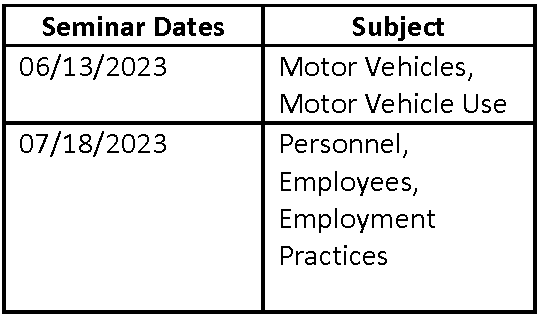
Monthly Virtual Risk Seminar

Every month we will host a live virtual 15 minute meeting on your most recent newsletter topic per the schedule below.

Learn more about this new standard on Tuesday, June 13th at 9am EST, using this link:


Please download Zoom to your device and contact RiskServicesAOP@PorterCurtis.com if you have connectivity issues the day of the meeting.

Meetings are recorded and will be available as an internal resource in each standard, or email us for the link!
Video Shorts
Integrated Risk Management

Only have 5 minutes? Video Shorts are another way to consume your integrated risk management content.

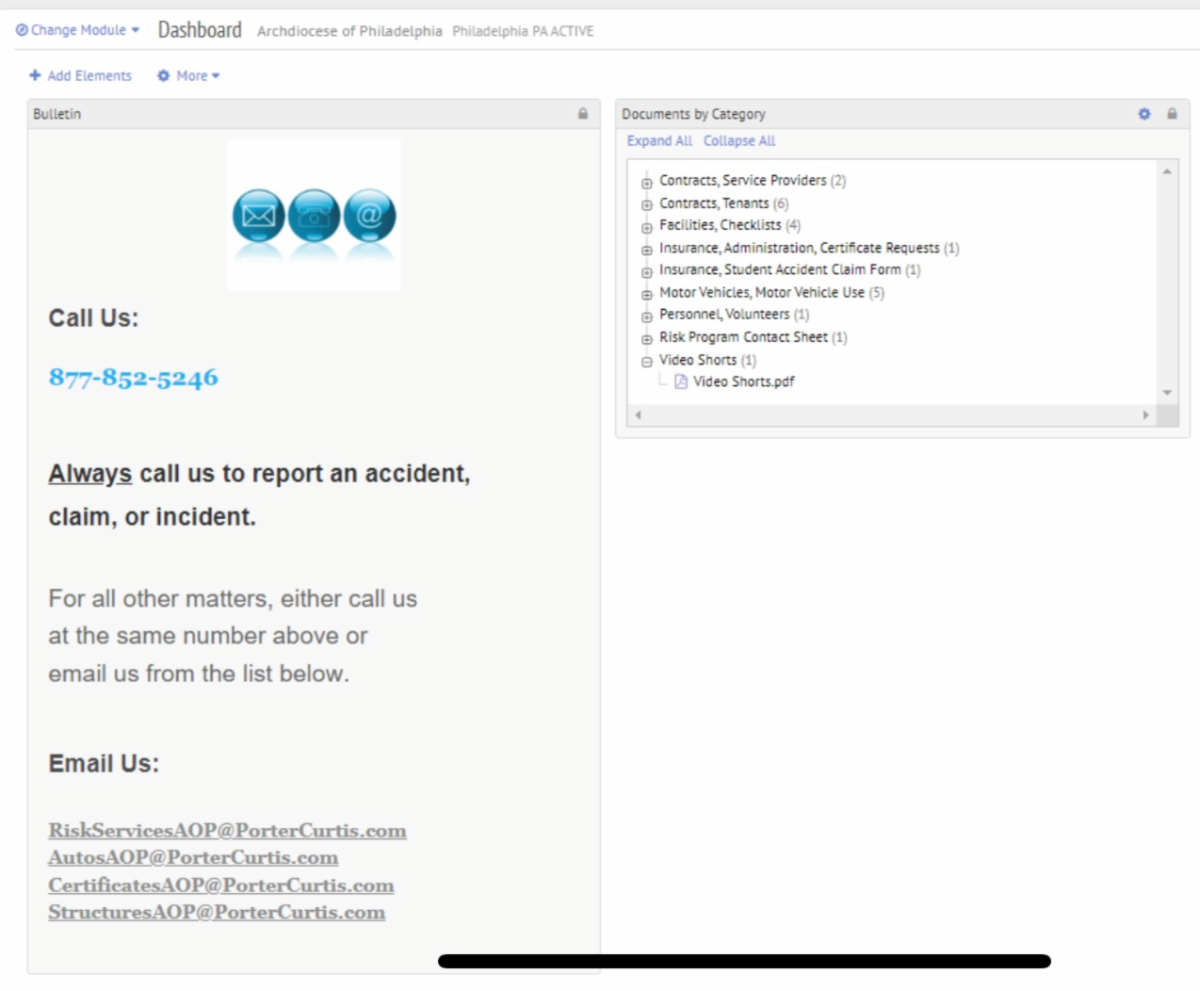
You can access each in Quadra Dashboard, Quadra Risk Standards Module, or by clicking on the picture links below.

Enter a survey to let us know what you think!
The Latest and Greatest

Changes to internal resources occur periodically. So, to be on the safe side, download internal resources as needed. That way you know you are always using the latest and greatest.

Find internal resources on Quadra Dashboard or by using the Content Search feature in Quadra Risk Standards Module.

For help, please contact us.
Keep it Together! 

A certificate of insurance received by another party is typically a requirement of a contract with that party. So keep it together – with the contract – all in one place. Set diaries for the policy expiration dates as necessary. You no longer need to send these certificates to the Archdiocese or Risk and Insurance Program. 
Report Early and Often

Accidents are not like fine wines. They do not get better with time. A month or two later, it becomes difficult to remember what happened, never mind one or two years later. That’s why it’s important to report every accident regardless of how minor it may seem.

Always call us to report an accident,
claim, or incident by phone using the toll free Risk and Insurance Call Center number 877-852-5246.
Please Rate Our Service
Just One Click
You Can Provide Suggestions Also!
Please Call Us:
877-852-5246