|
One date in the Massachusetts legislative calendar has been singularly regarded: July 31 (of even-numbered years).
Let’s zoom out.
Legislative sessions in Massachusetts are two years long. We’re in the 2025-2026 legislative session. Historically, the Legislature’s joint rules prohibited formal sessions (where substantive legislation can pass) after July 31 of the second year of a legislative session.
But constituents made it clear that you wanted a more productive state legislature — and your sharp advocacy helped drive changes to these rules that were necessary to avert biannual end-of-session logjams.
As a result, in early 2025 the Senate and House agreed to new and much-improved rules for this session, including a stipulation that the Legislature can convene in formal session after July 31 in the second year of the legislative session to take up:
- Reports of conference committees formed on or before July 31,
- Appropriation bills filed after July 31, and
- Gubernatorial vetoes or amendments.
A summary of the rules changes is here, including changes to increase transparency and strengthen public access to the committee process.
I wanted you to have this context as we unpack what happened in July and what can still happen in the fall. The short answer is that a LOT happened and a LOT will happen, both in terms of the legislature and what you can expect here at home.
Mindful of the pull to be outside or away from screens during summer, this newsletter is short and to the point.
Let’s get into it. Make it to the P.S. for a Massachusetts Senate resolution on nuclear disarmament, especially relevant at this moment.
Here are two tech tips based on constituent feedback:
- If the letter ends abruptly, look for instructions at the bottom of your screen on how to "view the full message."
- If the message appears without images, you may need to click “allow blocked content.”
| | TL;DR (that's a "too long; didn't read" digest) | |
-
Rounding up the bills that are on Governor Maura Healey’s desk or have just had her signature.
-
Tracking ongoing conference committees.
-
Investing in agritourism is no laughing matter.
-
Thank you to our all-star interns and legal fellows.
-
Blue envelopes legislation signed into law.
-
Moving (shoving) the needle here at home toward true and lasting regional equity.
-
Sharing more from MassHealth and the Group Insurance Commission on GLP-1 coverage.
-
A tribute to the incredible Jane Yolen.
| | Bills now law or on the Governor's desk | | |
The end of July is often described as “fast and furious” in the State House, though with a striking lack of Vin Diesel puns floating around the building.
Here’s a snapshot of some of the legislation that is currently on the Governor’s desk:
An Act enhancing child welfare protections
I co-chaired the conference committee that negotiated the differences between the House and Senate versions of the legislation, alongside House Chair Jay Livingstone.
Many of the provisions my team and I pushed forward in the Senate bill are contained in the final version, including establishing a Foster Child Bill of Rights and provisions ensuring the Office of the Child Advocate is more independent from the Department of Children and Families.
An Act regarding free expression
This bill guards against politically-motivated book removals from public schools and libraries by establishing clear, uniform guidelines for how schools and libraries choose materials, how local officials evaluate whether a book should remain available or be taken off the shelf, while shielding librarians from liability.
I collaborated with constituent, keen advocate, and award-winning author Jarrett Krosoczka on a video following the Senate’s debate. Thanks to Jarrett for prompting and supporting a successful amendment my team and I filed and passed to ensure that decisions around books must consider the entire work, not just one picture, word, paragraph, or page.
| | |
An Act to improve Massachusetts home care
I have heard from countless constituents over the years about the need to update the regulations governing the home care industry in the Commonwealth. This legislation addresses many of the issues folks have raised but does not include the bill I have filed requiring MassHealth to pay spouses as caregivers. However, we are making progress through the inclusion of a well-constructed commission to look at myriad ways to support all family caregivers including through pay. Thanks to my partner in this work, Representative Mike Kushmerek, for his leadership in securing this commission.
An Act prioritizing patient access to care
Medical decisions belong between patients and their physicians, not with politicians. This bill removes certain restrictions governing abortions, allowing doctors to use their training and professional judgement rather than a one-size-fits all law that cannot account for every pregnancy.
I discuss these and other key bills in this video:
| | |
On August 5, the Governor signed An Act promoting rule of law, oversight, trust and equal constitutional treatment (PROTECT Act) into law.
The PROTECT Act safeguards the Constitutional rights of all Commonwealth residents and ensures that locations like schools, hospitals, and courthouses remain safe and accessible for everyone. I have no end of gratitude, especially to Senators Cindy Friedman, Pavel Payano, Lydia Edwards, Adam Gómez, Liz Miranda, and Vanna Howard for bringing this home.
Like many of you, my team and I are disappointed that some of the bills you and we have prioritized this session, like the End of Life Options Act, comprehensive PFAS legislation, a bill to ban Native athletic mascots, and Medicare for All, did not pass. We are already gearing up for next session with these (and other) key still-to-pass bills in mind.
At the same time, with House colleagues, we’re focused on legislation like the FARM bill, which has passed the Senate this session, but still needs to clear the House. Fingers crossed.
| | A conference committee update | | |
To help you track and engage with the conference committees currently underway, we’ve compiled an updated list here.
With important issues like primary care, energy affordability, economic development, and equity for the Quabbin region and Connecticut River Valley still being negotiated, our legislative advocacy this fall will focus on these committees. Yours can too.
| | Investing in agritourism is no laughing matter | | |
On July 23, the Senate debated and passed an economic development bill to create jobs, put guardrails on AI, and boost economic growth in the Commonwealth.
I filed 13 amendments, six of which were included in the final bill. More on that here.
One of my amendments authorized $5 million to bolster agritourism, as part of a “fun agenda” well-led by Senator Julian Cyr (more about that here).
In response to Boston Public Radio hosts who missed the strategic necessity of agritourism, I filmed an open letter to clear up misunderstandings and invite them to our part of the state. It’s here.
| | I received a reply from the show’s producers and we can look forward to a fall visit from Jim and Margery. And hopefully more of Monte and Kaliis and their Fabulous 413 will be aired in Boston. | | Thank you and big love to our summer interns and fellows | | |
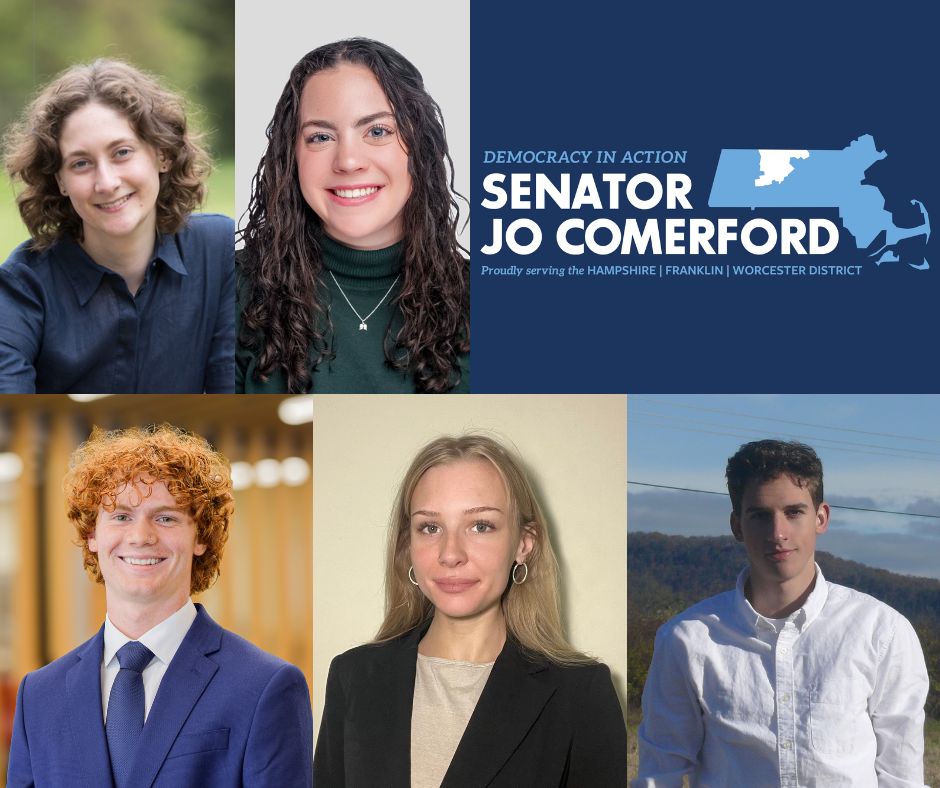
This summer, my team and I worked with a superstar team of interns and fellows. They tackled a dizzying range of projects with and for our team, expanding our capacity immeasurably.
From left to right, starting at the top: Cat Hackett (Northeastern University School of Law), Rebecca Steere (UMass Amherst), Will Hood (UMass Amherst), Isabella Ervin (UMass Amherst), and Jonathan Parker-Yourga (Georgetown University).
Please join me in cheering them on as they leap into new adventures. Our future is in very good hands.
| | Blue envelopes signed into law | | |
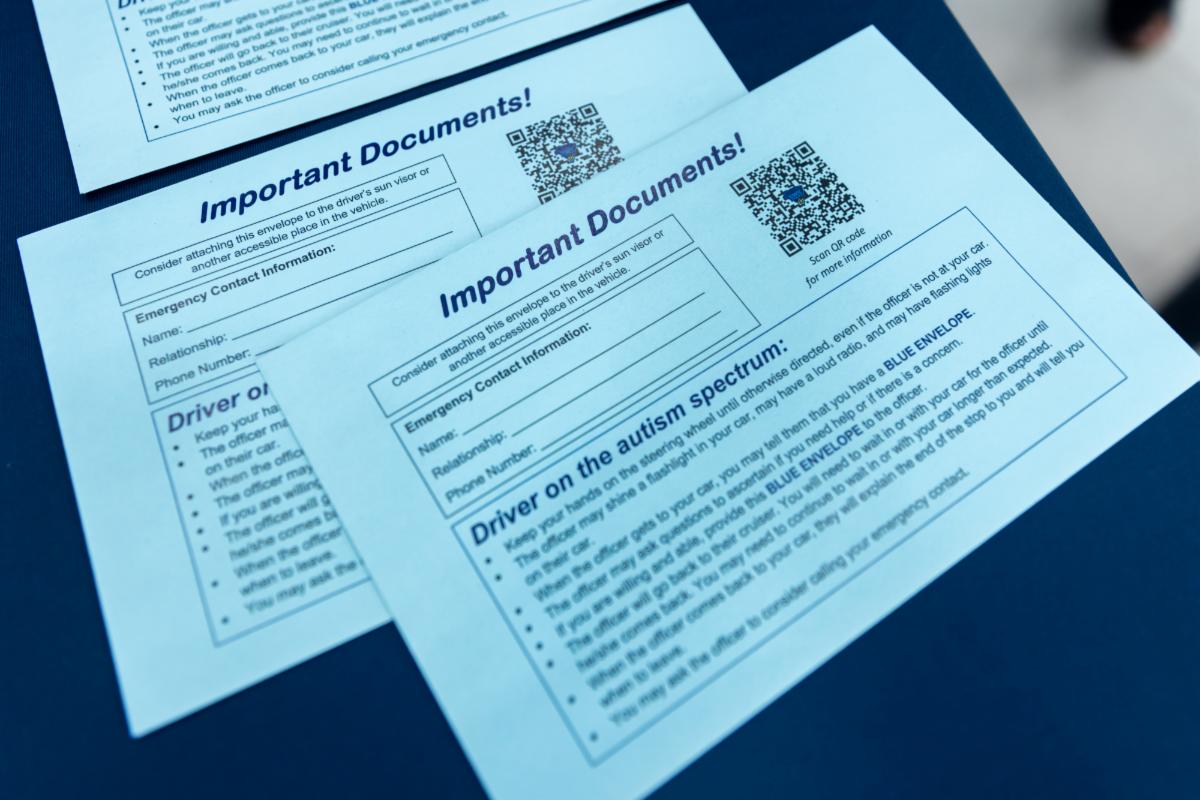
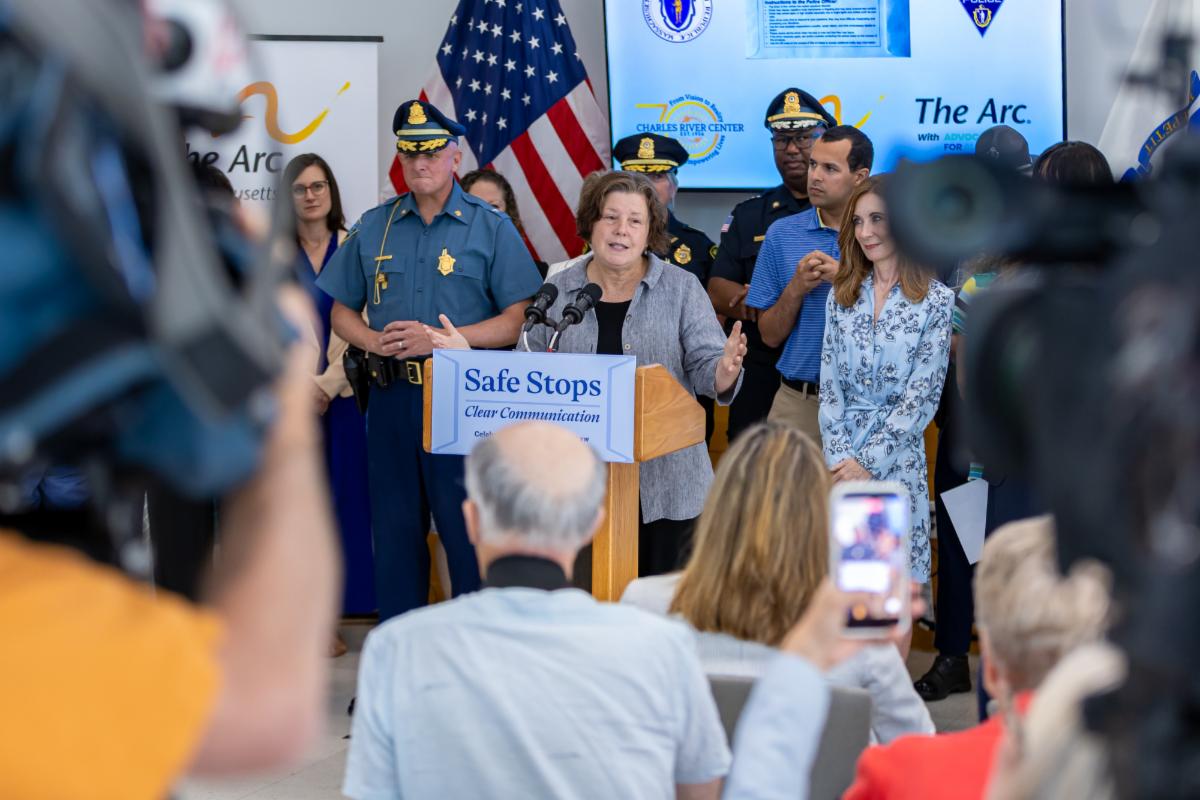
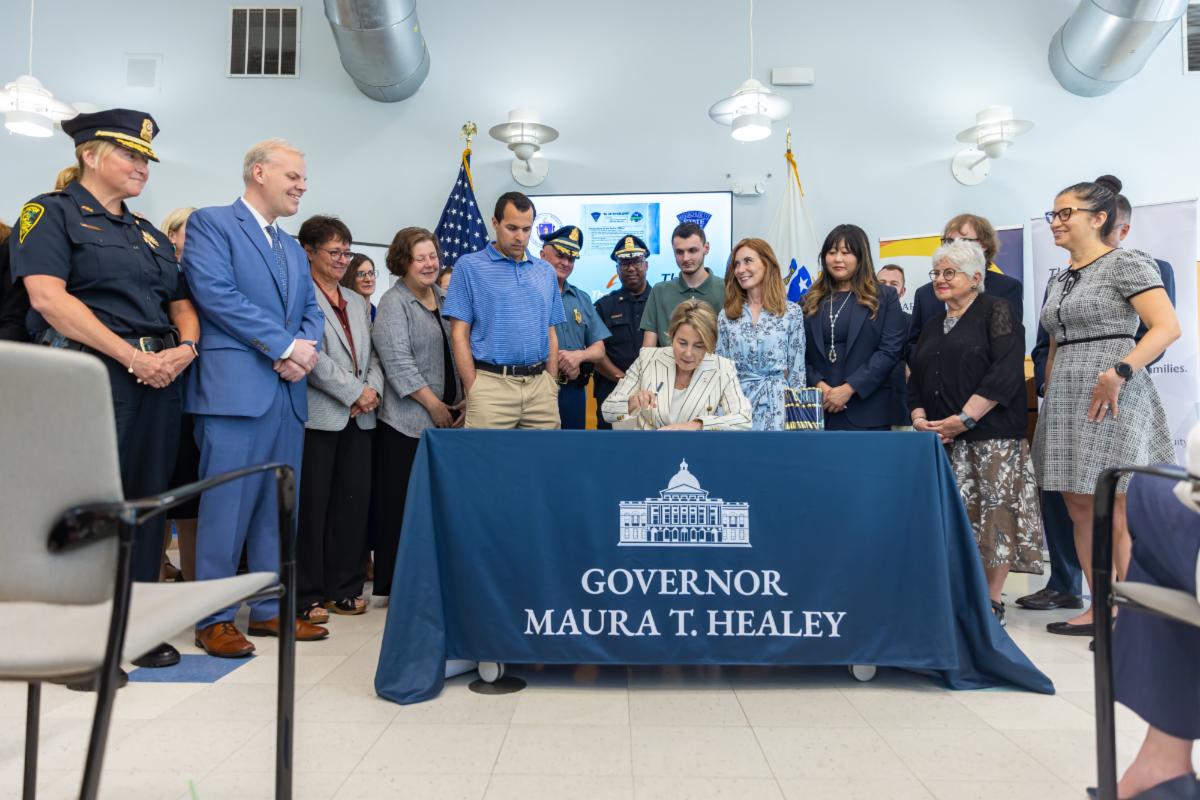
On July 16, I joined Governor Healey and Representatives Mindy Domb and Sean Garballey at The Arc of Massachusetts in Needham for a ceremonial signing of the Blue Envelopes legislation into law.
Here's what the law does: motorists living with autism spectrum disorder (ASD) can receive a blue envelope from the Massachusetts State Police or the RMV to hold their license, registration, and insurance. The envelope flags that the driver has ASD and offers guidance for both the driver and law enforcement, to help facilitate and de-escalate interactions.
Immense thanks to Max Callahan-Grower and Mark Sena of the Massachusetts Inclusive Concurrent Enrollment Initiative (MAICEI) at UMass Amherst, UMass Chief Tyrone Parham and Deerfield Chief John Paciorek, and Ilyse Levine-Kanji and Sam Kanji of Advocates for Autism of Massachusetts.
| | Photo credits: Emily Boyle, Photographer, Office of Governor Maura Healey | | Moving (shoving) the needle here at home | | |
The status quo is shifting, friends. Intractable issues that once appeared unmoveable are moving.
I tip my hat to you, the western and north central state legislative delegation, municipal officials, and the Healey-Driscoll Administration — especially Kristen Elechko. The gains reflect a wide, deep, and long-haul commitment to real and lasting regional equity.
Here’s a quick round up with more news to come. Please understand that it only includes a fraction of what I see changing and doesn’t include news on road and bridge money getting fairer, grant programs that work for smaller communities, and more. I’ve written to you previously about issues like these and I’ll keep writing so that you know your advocacy is effective.
A wave across the Quabbin
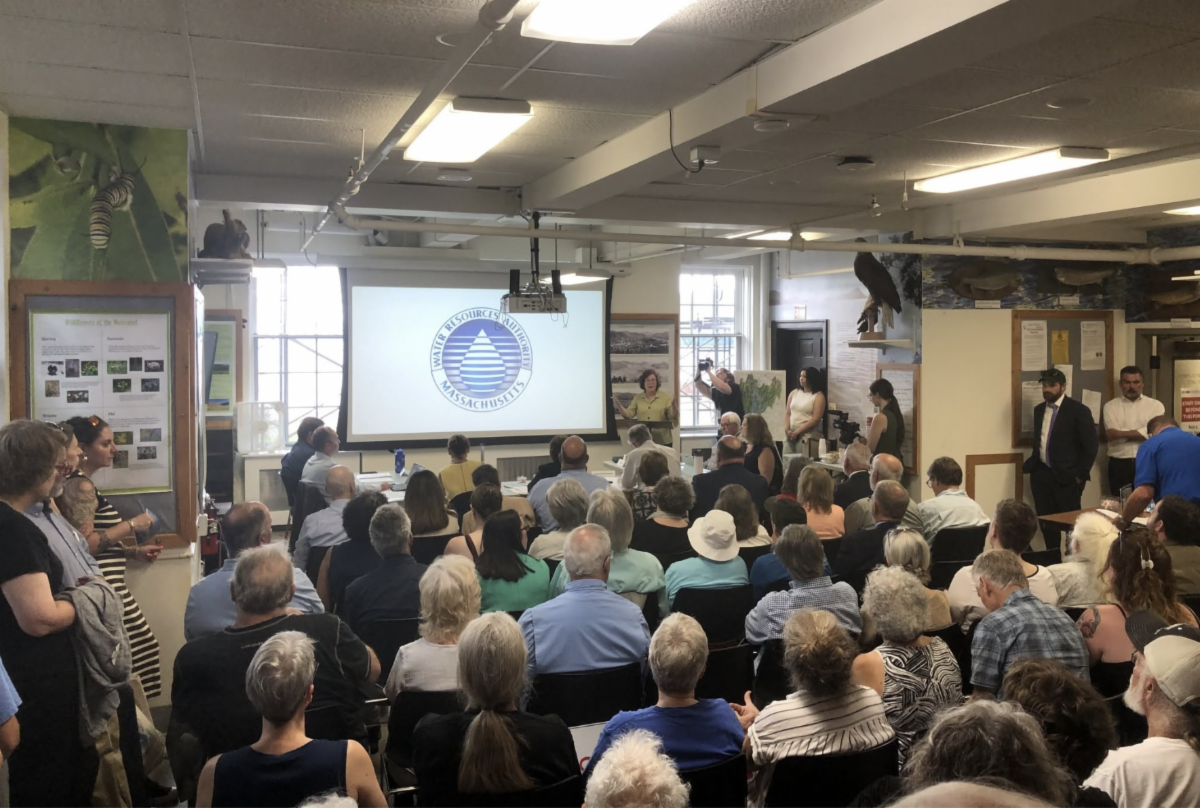
On July 10, the Quabbin Visitor Center in Belchertown was filled to the brim with community members and municipal leaders.
We gathered to speak directly to the Massachusetts Water Resources Authority (MWRA) Board of Directors whose members traveled from eastern Massachusetts, at our invitation, to listen to the people who call the Quabbin Watershed home.
For over two hours, residents and local officials shared stories of sacrifice and stewardship, and articulated clear ways the state and MWRA can more equitably support the region on which Metro Boston relies for its water, housing, and economy. Their testimony built on local organizing in every Quabbin community throughout the winter and spring so that ever speaker was, essentially, representing all of their neighbors. It was breathtaking.
Thanks to Belchertown Community Access Television for filming. The recording is here.
Don’t miss Shutesbury’s Dr. Matteo Pangallo’s beautiful piece in CommonWealth Beacon, here.
| | |
Frustration and concerns about Eversource
Constituents are frustrated with Eversource’s smart meters, its transmission line clearing project from Northfield to Ludlow, and significant tree cutting to clear power lines in Northfield.
In addition to holding public feedback sessions, we have channeled these concerns to Eversource and to Energy and Environmental Affairs Secretary Rebecca Tepper, and asked for their deep engagement and response. Expect a great deal of follow up from us, including walking sections of the proposed line clearing with Eversource and constituents.
K-12 education
In the last months we have worked to:
-
Establish a much-needed Foundation Budget Review Commission via the fiscal year 2027 budget, which will kick off in the fall,
- Launch and fund a new $16.5 million shared services and regionalization-support initiative at the Department of Elementary and Secondary Education (DESE), and
- Engaged the new DESE Commissioner and Education Secretary to address the crisis in rural and declining enrollment school districts, including through a Back to (Rural and Declining Enrollment) School Fall Tour — in partnership with regional superintendents and school committee members.
It’s been a hive of work with statewide advocates and local leaders. We’re also tracking DESE’s current review of what’s called the “target local contribution to schools,” which hasn’t been open to review in 18 years.
Overhauling PILOT
Governor Healey’s Executive Order 645 established a Commission on PILOT for State-Owned Land, which will recommend changes to the formula for payments in lieu of taxes (PILOT) on state-owned and watershed land.
Having filed PILOT legislation for years in partnership with former Representative Natalie Blais, I am glad to serve on this Commission for the Senate along with Senator Jamie Eldridge. Throughout July, the commission travelled the state holding listening sessions. It’s been transformative to hear directly from community members.
Didn’t get a chance to attend a listening session? Not to worry. Write to the Commission here. (And stay tuned for more in-person events.)
Launching the state’s first-ever disaster relief program
Since passing legislation I led with former Rep. Blais to create a state disaster relief and resiliency fund, the Legislature and Administration have capitalized it with $14 million, with an additional $34 million to be deposited by the end of this fiscal year. Thanks to Governor Healey for including this in her fiscal year 2025 budget, vaulting the bill forward.
Establishing the fund and capitalizing it is 50% of the work. Now we have to implement the fund and agree on a permanent revenue stream.
The Executive Office for Administration and Finance has issued regulations to implement the fund, and will hold a virtual public hearing on Wednesday, August 26, 2026 at 2:00 p.m.
Any person requesting to comment orally on the proposed regulation at the virtual hearing must submit to anf.regs@mass.gov a Notice of Intent to Comment no later than Tuesday, August 25, 2026, at 5:00 p.m. Any other person requesting to attend the hearing must register at anf.regs@mass.gov no later than 12:00 p.m. on Tuesday, August 25, 2026. All notices or requests must include the person’s name, telephone number, and email address.
In terms of finding a revenue stream — those conversations are ongoing.
Pushing forward on Northern Tier Rail
In partnership with Congressman Jim McGovern and Congresswoman Lori Trahan, along with the leadership of the Franklin Regional Council of Governments (FRCOG), the delegation continues to work with MassDOT to move planning for Northern Tier Rail forward. We’re organizing a fall action and expect the launch of an economic and population impact analysis — with news coming soon!
Finding a path for municipal building construction support
Municipal officials have made it clear that they need support to build and repair municipal buildings. That’s why, in the Senate’s economic development bond bill, I advocated for an amendment that establishes a commission to develop a comprehensive framework for a Municipal and Public Safety Building Authority, which would be an independent state authority to assist municipalities with the construction and rehabilitation of public safety and municipal buildings. This could be a municipal game changer and we’re advocating now to make sure this provision is retained in the final bill.
| | |
Join the Governor’s Youth Climate Council — The Governor's Youth Climate Council is seeking new members. The deadline to apply is September 11 with the first meeting on September 29. Here's the application: https://www.mass.gov/forms/apply-for-the-youth-climate-council.
Office hours in September — Constituent Services Director Jessie Cooley will be hosting remote office hours via Zoom on Thursday, September 10, 2026 from 11 a.m. to 1 p.m. Sign up here. Thanks to Jessie for leading!
| | |
Jessie and our team continue to hear from constituents with concerns related to the changes in insurance coverage for GLP-1 medications. We are regularly in touch with leadership at MassHealth and the Group Insurance Commission (GIC) to convey the serious concerns of our constituents, and to advocate for inclusive and equitable health care policy.
As you may know, GLP-1 medications are still covered for many patients. If you haven't seen it yet, here is the GIC webpage with an overview of current coverage and an explanation of the change.
MassHealth also still covers GLP-1 medications, yet will no longer cover those used solely for obesity management. If you have specific questions on MassHealth coverage for GLP-1 prescriptions, please reach out to Jessie at jessie.cooley@masenate.gov.
| | Celebrating the life and work of Jane Yolen | | |
In June, the literary world and our region lost one of the greats. Jane Yolen, the prolific and beloved author whose stories reshaped children’s literature, died peacefully at home with her family by her side.
On July 16, Representative Lindsay Sabadosa and I were joined in the Senate chamber by Jane’s daughter, Heidi E. Y. Stemple and Heidi’s partner Dennis Wehrly, as we adjourned a formal Senate session in memory of Jane.
Read the adjournment and watch the moment on the Senate floor here.
My wife Ann and I raised our kids on Jane’s beautiful books. In preparing for the adjournment, I was struck by the enormity of her limitless impact. May Jane’s memory and legacy forever be a blessing to those who knew and loved her.
| | |
We could go on, but we'll stop here and send our love to you.
Jo, Rachel, Jared, Katelyn, Elena, and Jessie
| | |
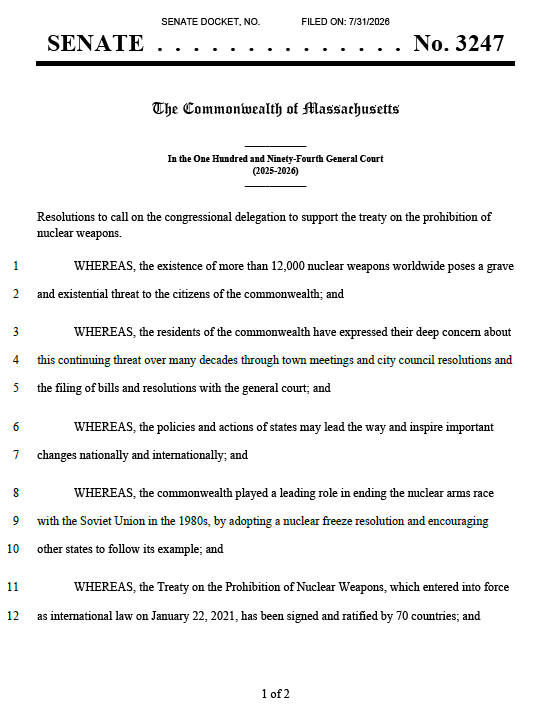
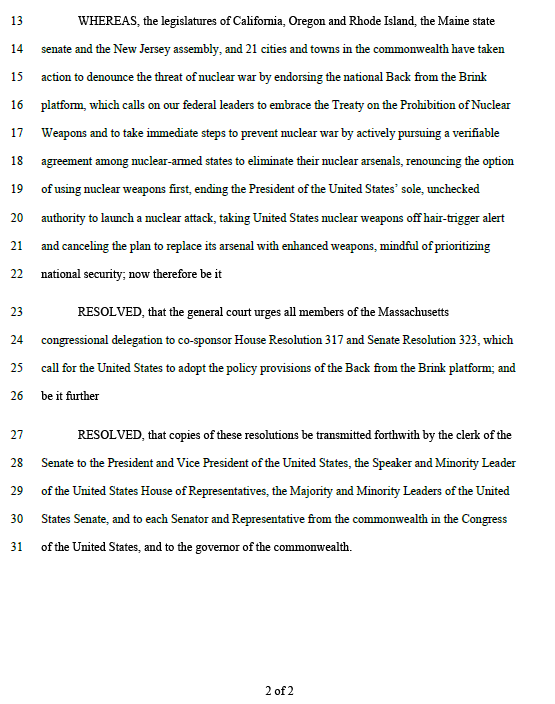
P.S. On July 31, the Massachusetts State Senate became the ninth state legislative body in the nation to pass a resolution calling on its Congressional delegation to support the treaty on the prohibition of nuclear weapons (see below).
I joined a Republican colleague, Senator Patrick O’Connor, to lead this bi-partisan resolution (which you can read below) calling for support of H.Res.317, sponsored by Congressman McGovern which urges “the United States to lead the world back from the brink of nuclear war and halt and reverse the nuclear arms race,” and S.Res.323 led by Senator Ed Markey.
The 81st anniversaries of the U.S. bombings of Hiroshima (August 6) and Nagasaki (August 9) are upon us and I believe that states can and should issue calls to action to federal lawmakers when the well-being of their residents is threatened — as it is right now by the Trump Administration.
In the 1980s, the Commonwealth (including many people and organizations from our district) played a leading role in ending the nuclear arms race with the then Soviet Union by adopting a nuclear freeze resolution and encouraging other states to follow our example.
Once again, with Congressman McGovern and Sen. Markey in the lead, Massachusetts is helping to propel a national movement.
The international Treaty on the Prohibition of Nuclear Weapons, which entered into force as international law on January 22, 2021, has been signed and ratified by 70 countries. The United States is not among them.
Thanks to Greater Boston Physicians for Social Responsibility and especially Dr. Ira Helfand, Co-Founder, Back from the Brink, for their skilled and thoughtful advocacy.
| |
| Did you find the content of this email useful? | | | | |
Boston office
(617) 722-1532
State House
Room 410
24 Beacon Street
Boston, MA 02133
| |
Amherst office
(413) 367-4656
UMass Amherst
| | Please send all mail correspondence to the Boston office. | | | | |