Greetings!
Last fall, several labs in the Initiative launched pilot projects to apply fNIRS to their ongoing research programs. This spring, these projects have progressed into submissions to conferences, new funding applications, and many follow-up research proposals. This month we'd like to share some important updates about changes we're making to keep up with the growing Multimodal Neuroimaging Initiative.
First, a big "Congratulations!" to graduate student Emma Holmes, Dr. Douglas Barrett, and Prof. Francisco Gonzalez-Lima. Their fNIRS study on the effects of transcranial infrared laser stimulation (
details here
) won the Best Poster in Neuroscience prize at the Texas Academy of Science meeting in March.
As more labs begin making the transition from pilot studies to published research, we are working on better ways to support your work at all stages of project development. Please read below about a project registration form that must be completed to make future equipment reservations. We have also added new resources for project planning and grant-writing on our website.
Finally, this spring we're teaming up with the Optical Bioimaging Lab at University of Houston to test a new software package that can speed up NIRS capping and make 3D head modeling with the Polhemus system easier. Details below!
As always, we hope you'll stay in touch and let us know about your own news and publications via Twitter (
@UT_MultiNeuro
) or the
website
.
Best,
Tunc Akbas, Rachel Reetzke, and Ben Zinszer
Your Multimodal Neuroimaging communications team
|
|
In this newsletter...
New Project Registration Form
Website Hosts New Tools for Projects & Grants
Testing PHOEBE Software
Announcements
| Resources
|
|
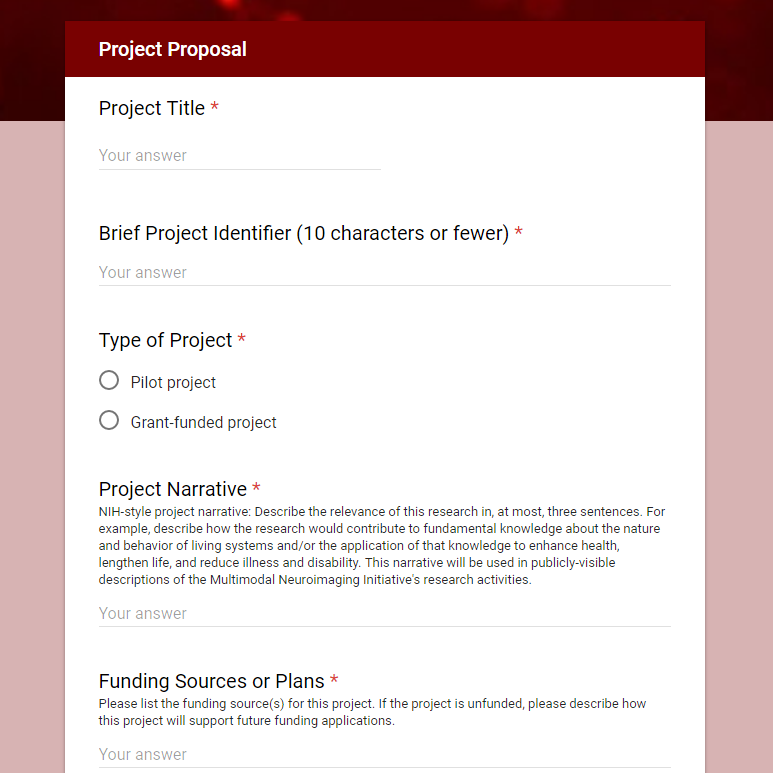
With six teams running fNIRS projects this semester and new labs preparing to join in the coming weeks, it's important that we plan ahead for equipment availability and maintenance needs. To help gather this information, we are formalizing the process for scheduling new fNIRS projects with a brief, online project registration.
In the past months, information about the project details, IRB approval, and equipment scheduling needs were gathered informally by email. Now all of this information can be entered in
one convenient form, accessible (with a UTmail account) from the Reservations page. The answers you provide will help us to plan more effectively for future scheduling needs, report on the kinds of research we are doing at the Initiative, and apply for future funding to keep the equipment up-to-date.
|
|
|
|
Information needed to complete the new project registration:
- A UTmail account to log in
- Researcher's name & Lab or PI name
- Project title
- A brief identifier (e.g., “BenTones1”)
- NIH-style project narrative (2-3 sentences for a general audience)
- Funding sources or plans for future funding applications
- IRB approval for fNIRS research (document upload)
- Equipment needed, location of use, and amount of time requested
|
|
|
When this form is completed, you'll be able to schedule time on the NIRS system for your project. As always, please feel free to
email Ben Zinszer with questions or concerns at any time in the process.
|
|
Website Hosts New Tools for Projects & Grants
|
|
The Multimodal Neuroimaging Initative website (
http://sites.utexas.edu/multimodal/) has new resources to support our current and prospective users at all stages of their projects. Aiming to help new fNIRS research teams plan, pilot, and fund their research more quickly, we are steadily updating the website's content to address common questions and facilitate major tasks like literature review and grant preparation.
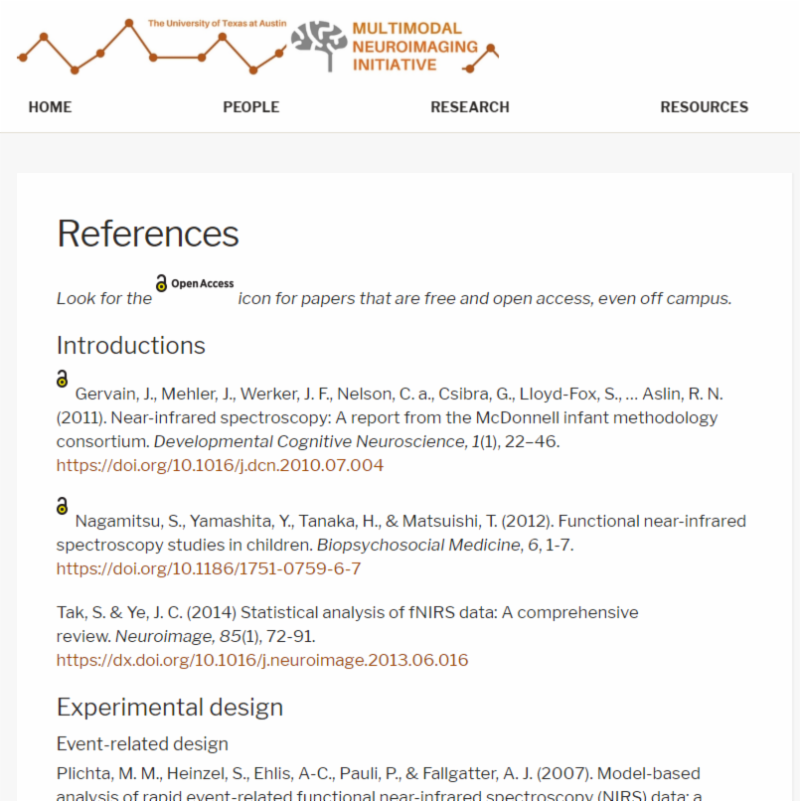
Whether you're wondering "Can fNIRS be useful in my research?" or "How do I use short-channel regression to remove physiological artifacts?" the new
References List (pictured in left panel) offers a thematically-organized set of papers and links to help you find answers. In addition to the new references, you can also find video tutorials, online documentation, and information about training opportunities on the
Resources page.
|
|
List of categorized references and links to papers on fNIRS design and analysis.
|
|
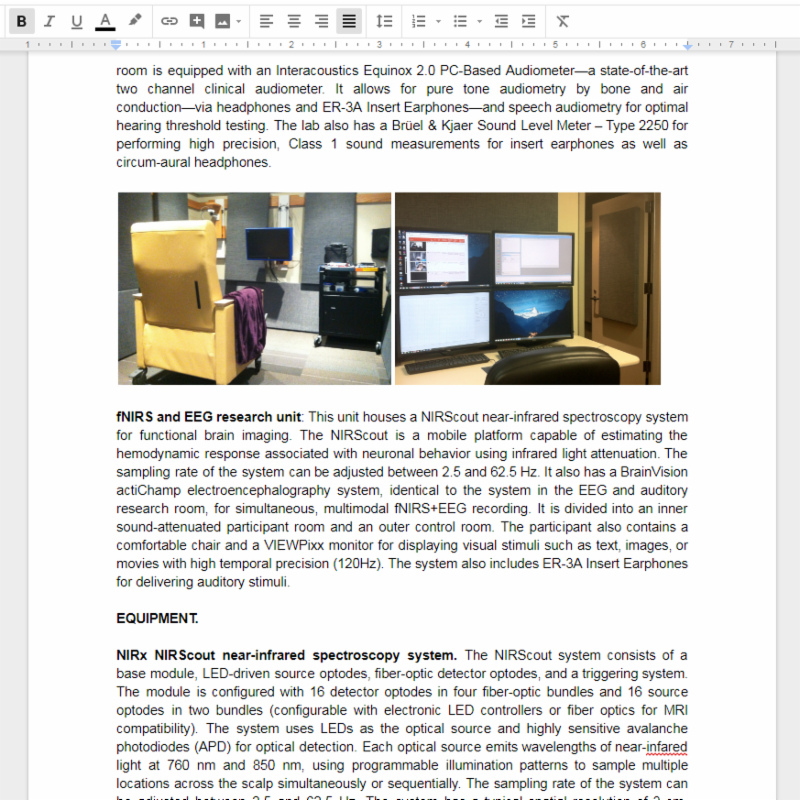
Google Doc containing facilities and equipment details for use in grant applications.
|
|
Some of our member labs have begun to apply for extramural funding for multimodal and fNIRS research, and we would like to make it easier for every lab to secure funding for their work. The new
Grant Support page provides information about the Initiative's ongoing grants and useful documentation for new applications. Presently, you can find a Google Doc containing detailed
Facilities and Equipment descriptions typically required for NIH applications (pictured in right panel).
If you currently have an fNIRS-related grant not listed on the Grant Support page, or if you need assistance with additional documentation for your grant applications, please
contact Ben Zinszer. We will work to make the necessary resources available online for all users.
|
|
Testing PHOEBE Software for Probe Placement
|
|
The Multimodal Neuroimaging Initiative has begun testing a new software package to improve NIRS optode placement, calibration, and modeling. Written by Dr. Luca Pollonini and the
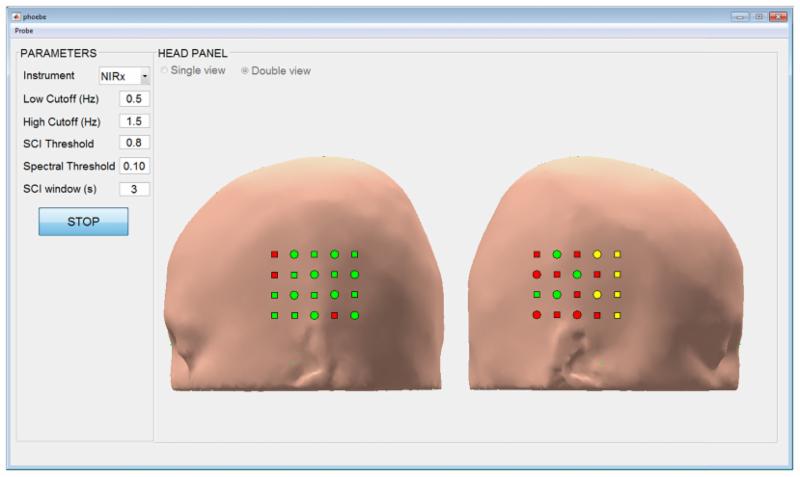
Optical Bioimaging Lab at University of Houston, PHOEBE connects with the NIRScout hardware to evaluate the signal quality for each optode during capping and calibration. This tool is a significant improvement over previous trial-and-error approaches to diagnosing and correcting bad channels, illustrated in the screenshot below.
|
|
A screenshot of the optode placement tool in PHOEBE, depicting good, acceptable, and bad scalp contact for each source and each detector in the montage.
https://doi.org/10.1364/BOE.7.005104
|
|
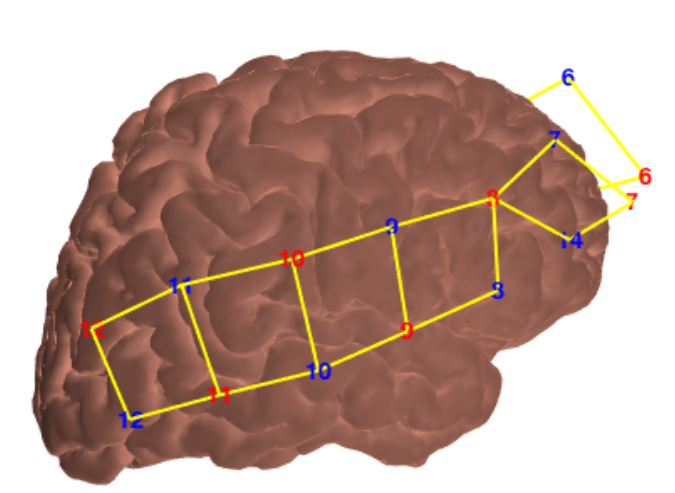
PHOEBE also interfaces with the Polhemus Patriot 3D digitizer system to help researchers build 3D digital models of participants' heads and probe placements. These digital models allow translation of the probe placement data into a standard space so that fNIRS measurements can be projected onto a normalized brain for source localization using nirsLAB or Homer (pictured to the right).
|
|
|
Because the software is still in the beta testing (pre-release) phase, we are currently evaluating its performance with our hardware, identifying bugs, and coordinating with Dr. Pollonini to make updates. PHOEBE should be available to MultiNeuro labs for use in your experiments by early summer.
|
|
- Registration is still open for Ted Huppert's fNIRS Advanced Data Analysis course at the University of Pittsburgh on May 25-26. The course will cover experimental design strategies, data preprocessing, first level statistical analysis (GLM), group level analysis models, image reconstruction, connectivity, and multimodal imaging using NIRS-toolbox software package. Registration fee is $200, and computer access is provided.
- Today is the last day to submit abstracts for the 2nd International Neuroergonomics Conference. The conference will be hosted by Drexel University, June 27-29, in Philadelphia, PA. This conference puts a special emphasis on portable neuroimaging, biofeedback, and neurostimulation.
- fNIRS 2018, the biennial meeting of the Society for fNIRS will take place in Tokyo, Japan on October 5-8. See website for further information: http://fnirs2018.org/. Abstract submission deadline is June 1st.
- Neurophotonics, the official journal of Society for fNIRS, will go fully Open Access in January 2019. More information here: http://bit.ly/2yEG6Qw
|
|
|
- Visit our Resources webpage to view tutorial videos, download training materials, and connect with other users for support.
|
|
|
The Multimodal Neuroimaging Intiative would like to thank:
Office of the Vice President of Research
Moody College of Communication
Cockrell School of Engineering
College of Liberal Arts
College of Education
Applied Research Laboratories
for their generous support!
|
|
|
|
|
|
|
|