Greetings!
Our new year is off to a running start at the Multimodal Neuroimaging Initiative, and we have an extended newsletter this month to accommodate all the good news.
We're very pleased to report that two of our research teams recently won grants for fNIRS projects. One project will develop new 3D-printed hardware for fNIRS users, and the other is integrating fNIRS and EEG measures to understand speech comprehension. Details on those grants are shared below.
In another major development, the Multimodal Neuroimaging Suite has added eye tracking to our toolbox. In this month's Spotlight, we're featuring one of UT Austin's experts on eye tracking, Prof. Zenzi Griffin. You can read more about her work and how eye tracking informs neuroscience research in the articles below.
Finally, there are several important announcements about upcoming conferences and workshops. Please have a look!
As always, we hope you'll stay in touch and let us know about your own news and publications via Twitter (
@UT_MultiNeuro) or the
website.
Best,
Tunc Akbas, Rachel Reetzke, and Ben Zinszer
Your Multimodal Neuroimaging communications team
|
|
In this newsletter...
Multimodal Neuroimaging Researchers Win Two Grants
Spotlight: Zenzi Griffin
| Eye Tracking in the MultiNeuro Suite
Announcements
| Resources
| Publications
|
|
MultiNeuro Researchers Win Two Grants
|
|
Last fall, we completed major outreach and training efforts for neuroscience researchers at UT Austin and nation-wide. These events have resulted in new scientific collaborations and ultimately led to the submission of two grants. We are excited to share that members of the Multimodal Neuroimaging Initiative were successful in both of these collaborative grant submissions and have received research funding for fNIRS hardware development and fNIRS+EEG brain imaging.
|
|
Customizable 3D-printed fNIRS head montages
|
|
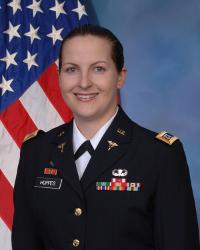
Maj. Mark Lester, Ph.D. (left) and Maj. Carrie Hoppes, Ph.D. (center) of Army-Baylor University are collaborating with UT Austin’s Prof. James Sulzer (right) on 3D printing fNIRS montages.
|
|
UT Austin and Army-Baylor University have teamed up to create the next generation of fNIRS head montages, which align imaging sensors on a participant’s scalp. Maj. Mark Lester, Ph.D. and Maj. Carrie Hoppes, Ph.D. recently acquired a portable NIRSport imaging device and attended the “Introduction to fNIRS” Workshop hosted by NIRx Medical Technologies and UT Austin in October. They approached Dr. James Sulzer (Mechanical Engineering) regarding UT's efforts towards 3D printed custom montages, and together they acquired $40,000 in seed funding from the Army Medical Department Advanced Medical Technology Initiative (AAMTI) Rapid Innovation Fund (RIF) for development. The goal of this project is to have a single part, customized montage design printable in an hour. They plan on making this technology available to all users.
|
|
Natural speech comprehension in Mandarin and English
|
|
Prof. Taomei Guo (left) of Beijing Normal University is collaborating with UT Austin’s Prof. Bharath Chandrasekaran (center) and Dr. Benjamin Zinszer (right) on a study of language learning and aging.
|
|
Dr. Benjamin Zinszer (Multimodal Neuroimaging Initiative) and Dr. Bharath Candrasekaran (Communication Sciences and Disorders) are working with Prof. Taomei Guo, an EEG and language expert from Beijing Normal University to develop fNIRS+EEG imaging methods for speech studies. They applied for the National Key Laboratory of Cognitive Neuroscience and Learning Open-Project Grant, an intramural award at Beijing Normal University, winning $14,000 to study continuous, natural speech processing in speakers of Mandarin Chinese and English. This research will examine how brain processes that support speech comprehension for these two populations are affected by the challenges of language learning and aging. Their work combines neuroimaging modalities to understand differences across languages in both young and old populations by relating the neural measures to behavioral performance and to computational models of language.
|
|
Multimodal Neuroimaging Spotlight
|
|
Zenzi Griffin, Cognition and Communication Lab
|
|
Zenzi M. Griffin has worked as a Professor of Psychology and director of the Cognition and Communication Lab at The University of Texas at Austin since 2008. Her PhD is in Cognitive Psychology from the University of Illinois at Urbana-Champaign, where she was one of the first researchers to study the relationship between what speakers look at and the timing of their speech when describing scenes.
|
|
|
|
"
Eye tracking offers a wealth of measures that reflect different aspects of the mind and often correlate with other measures. For example, pupil dilation and galvanic skin response both vary with arousal and cognitive load. I think one of the greatest strengths is that information about gaze location can more intuitively support inferences about the contents of processing. For example, when a response takes more time and is more effortful in one condition than another, gaze location can distinguish between the difference stemming from, say, difficulty retrieving information about one particular object as opposed to difficulty deciding between multiple objects.
"
|
|
|
Dr. Griffin has been particularly concerned with how people select words, order phrases, and the way that they manage (and mismanage) the timing of word retrieval. Recent work has examined the learning and retrieval of people’s names as well as language production in bilinguals and individuals with various language disorders. She occasionally teaches a graduate seminar on using eye trackers to study language processing.
|
|
Eye Tracking in the MultiNeuro Suite
|
|
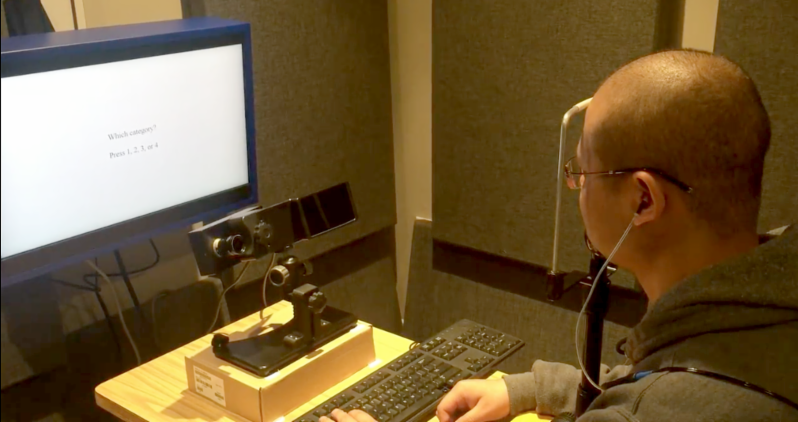
The Multimodal Neuroimaging Suite has opened in Communications Building B, under the multi-group Brian and Behavioral Science Lab. This new space hosts the NIRScout fNIRS system, a Brain Vision EEG system, and ViewPixx high precision visual display. In January, the BBSL received an Eyelink 1000 Plus eye tracker, which is now also available in the Suite. This acquisition will enable simultaneous eye tracking and neuroimaging to support projects on attention, arousal, and cognitive load.
|
|
Graduate student Zilong Xie performs a categorization task with the EyeLink 1000 Plus (left). During calibration, the eye tracker camera shows Zilong's face and marks the location of his right eye (right).
|
|
Graduate students Zilong Xie and Rachel Tessmer in the SoundBrain Lab have started developing the first experiment to run on the Eyelink. Based on prior research showing that pupil size can change as a function of listening effort or cognitive load, they're measuring participants' pupil sizes during a language learning and categorization task. This work complements previous EEG studies in the SoundBrain Lab and will help shed light on the attentional factors contributing to neural measures of language processing.
|
|
- The 2nd International Neuroergonomics Conference has released its call for abstracts, with special emphasis on portable neuroimaging, biofeedback, and neurostimulation. The conference will be hosted by Drexel University, June 27-29. Submission deadline is March 15th.
- fNIRS 2018, the biennial meeting of the Society for fNIRS will take place in Tokyo, Japan on October 5-8. See website for further information: http://fnirs2018.org/. Abstract submission deadline is June 1st.
- Ted Huppert and lab will be hosting an Advanced fNIRS Data Analysis Hands On Course at the University of Pittsburgh on May 25-26. Further information is available via the Society for fNIRS Facebook page, with a detailed syllabus forthcoming.
- Neurophotonics, the official journal of Society for fNIRS, will go fully Open Access in January 2019. More information here: http://bit.ly/2yEG6Qw
|
|
|
- Visit our Resources webpage to view tutorial videos, download training materials, and connect with other users for support.
- Follow us on Twitter: @UT_MultiNeuro and be sure to share your research and announcements!
|
|
|
The Multimodal Neuroimaging Intiative would like to thank:
Office of the Vice President of Research
Moody College of Communication
Cockrell School of Engineering
College of Liberal Arts
College of Education
Applied Research Laboratories
for their generous support!
|
|
|
|
|
|
|
|