Greetings!
The last month has given us many opportunities to share our work, and in this issue of the newsletter, we'll share the details of a few such opportunities.
The BBSL welcomed the UT Conversation Club to their facility to explore the human brain and our many brain imaging tools in the Multimodal Neuroimaging Suite. Read more about the activities and see photos below.
Members of the Initiative also presented their research at recent conferences. You can learn about Fernando Llanos and his neurofeedback project in this month's Spotlight. Read on for a story on Emma Watson and her colleagues in the Gonzalez-Lima Lab presenting their fNIRS study at the Texas Academy of Science.
Finally, we have announcements about upcoming training and conferences, and there were several exciting papers published on stroke recovery, gait rehabilitation, tDCS, and fNIRS and EEG methodology published in the last month. Details below!
As always, we hope you'll stay in touch and let us know about your own news and publications via Twitter (
@UT_MultiNeuro) or the
website.
Best,
Tunc Akbas, Rachel Reetzke, and Ben Zinszer
Your Multimodal Neuroimaging communications team
|
|
In this newsletter...
UT Conversation Club Visits BBSL for Brain Day
Spotlight: Fernando Llanos
|
Poster at Texas Academy of Science
Announcements
| Resources
| Publications
|
|
UT Conversation Club Visits BBSL for Brain Day
|
|
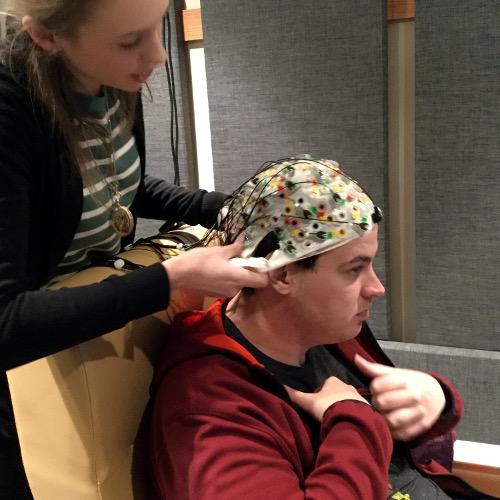
On February 14th, the Brain and Behavioral Science Lab hosted the Conversation Club for "Brain Day," a brain-themed interactive event. The Conversation Club is a UT organization, directed by Prof. Jessica Franco. "We are a group of young adults with developmental disabilities and UT undergraduate students who meet every week to interact during fun, theme-based activities," explains Prof. Franco. A group of 20 Conversation Club members, student clinicians, mentors, and parents joined the BBSL students, faculty, and staff for a morning of human brain exploration and demonstrations.
|
|
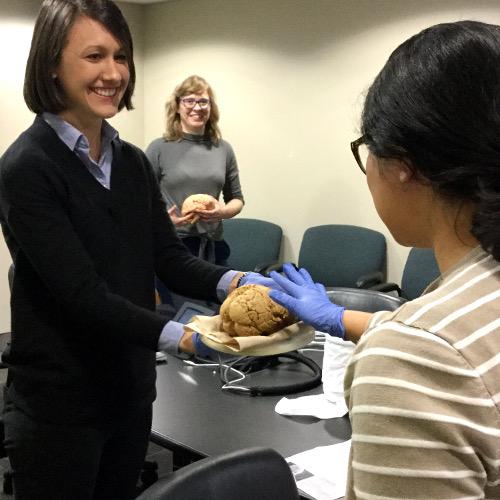
Left: Lab manager Jacie McHaney puts an electroencephalography (EEG) cap on a Conversation Club member for the multimodal brain imaging demonstration. Right: Graduate student Rachel Reetzke and Professor Liberty Hamilton exhibit real and model human brains.
|
|
The event kicked off with viewing (and touching) a preserved human brain. Next, participants toured the mock-MRI scanner and looked at pictures of brain activation. The club members visited the Multimodal Neuroimaging Suite to participate in demonstrations of functional near-infrared spectroscopy (fNIRS), EEG, and eye-tracking. Experiments included neural processing of speech and real-time changes in brain activity associated with arm waving. The Brain Day events concluded with home-made brain-decorated cupcakes, which were enjoyed by all!
|
|
Multimodal Neuroimaging Spotlight
|
|
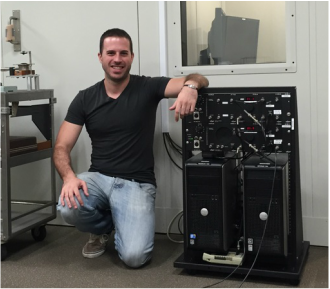
Fernando Llanos, SoundBrain Lab
|
|
Fernando Llanos is a postdoctoral researcher in the SoundBrain Lab, Department of Communication Sciences and Disorders. Dr. Llanos completed his Ph.D. at Purdue University, where he investigated the perception of speech sounds in monolingual and bilingual populations. Prior to Purdue University, he received his M.A. from the Spanish National Research Council (CSIC; Madrid, Spain), studying experimental phonetics and automatic speech recognition.
|
|
|
|
Dr. Llanos' research focuses on the automatic recognition of EEG features and the effects of neurofeedback and vagus nerve stimulation on speech processing and speech learning. His most recent study on neurofeedback has been recently presented at the meeting of the Association for Research in Otolaryngology. In this study, Dr. Llanos and colleagues showed that listeners can self-regulate their neural activity to improve early auditory processing of speech sounds from a foreign language.
|
|
|
MultiNeuro Poster at Texas Academy of Science
|
|
This week, Psychology graduate student Emma Holmes and co-authors Dr. Douglas Barrett and Prof. Francisco Gonzalez-Lima are presenting their poster
Cerebral hemodynamic effects of transcranial infrared laser stimulation measured with functional near-infrared spectroscopy
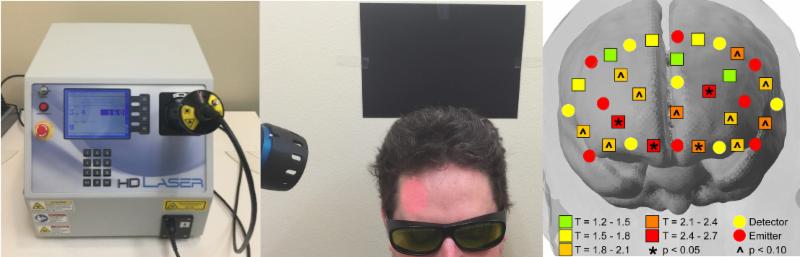
at the Texas Academy of Science meeting in Midland, TX. Their research uses safe, non-invasive transcranial infrared laser stimulation (TILS) to locally increase brain energy metabolism. TILS can result in improvements in sustained attention and visuospatial short-term memory.
|
|
Left: The transcranial infrared laser stimulation (TILS) device. Center: TILS applied to a participant's forehead. Right: Pre- vs. Post-TILS changes in blood oxygenation during a sustained attention task
|
|
Holmes and colleagues used fNIRS to measure oxygenated and deoxygenated hemoglobin in healthy adults' frontal brain regions before and after TILS. They found a significant increase in blood oxygenation after TILS for the sustained attention task, but no such change in the visuospatial short-term memory task. These findings may be useful in the future for monitoring the success of laser stimulation on cerebral oxygenation.
|
|
- Registration has opened for Ted Huppert's fNIRS Advanced Data Analysis course at the University of Pittsburgh on May 25-26. The course will cover experimental design strategies, data preprocessing, first level statistical analysis (GLM), group level analysis models, image reconstruction, connectivity, and multimodal imaging using NIRS-toolbox software package. Registration fee is $200, and computer access is provided.
- The 2nd International Neuroergonomics Conference has released its call for abstracts, with special emphasis on portable neuroimaging, biofeedback, and neurostimulation. The conference will be hosted by Drexel University, June 27-29. Submission deadline is March 15th.
- fNIRS 2018, the biennial meeting of the Society for fNIRS will take place in Tokyo, Japan on October 5-8. See website for further information: http://fnirs2018.org/. Abstract submission deadline is June 1st.
- Neurophotonics, the official journal of Society for fNIRS, will go fully Open Access in January 2019. More information here: http://bit.ly/2yEG6Qw
|
|
|
- Morias, Balardin, and Sato released fOLD, a toolbox for designing NIRS montages to target specific brain regions of interest. See their paper published in Nature's Scientific Reports for details.
- Visit our Resources webpage to view tutorial videos, download training materials, and connect with other users for support.
|
|
|
The Multimodal Neuroimaging Intiative would like to thank:
Office of the Vice President of Research
Moody College of Communication
Cockrell School of Engineering
College of Liberal Arts
College of Education
Applied Research Laboratories
for their generous support!
|
|
|
|
|
|
|
|