A Weekly Newsletter from David Pickler | | |
TODAY'S TOPIC:
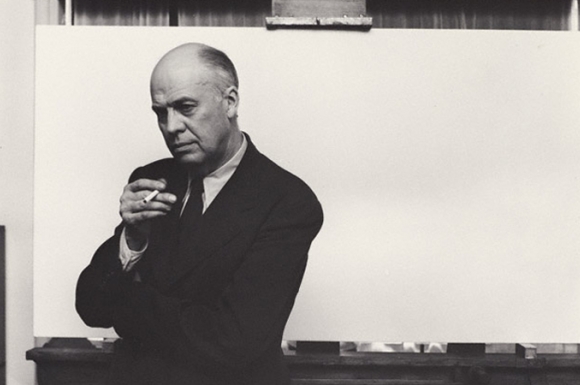
Edward Hopper
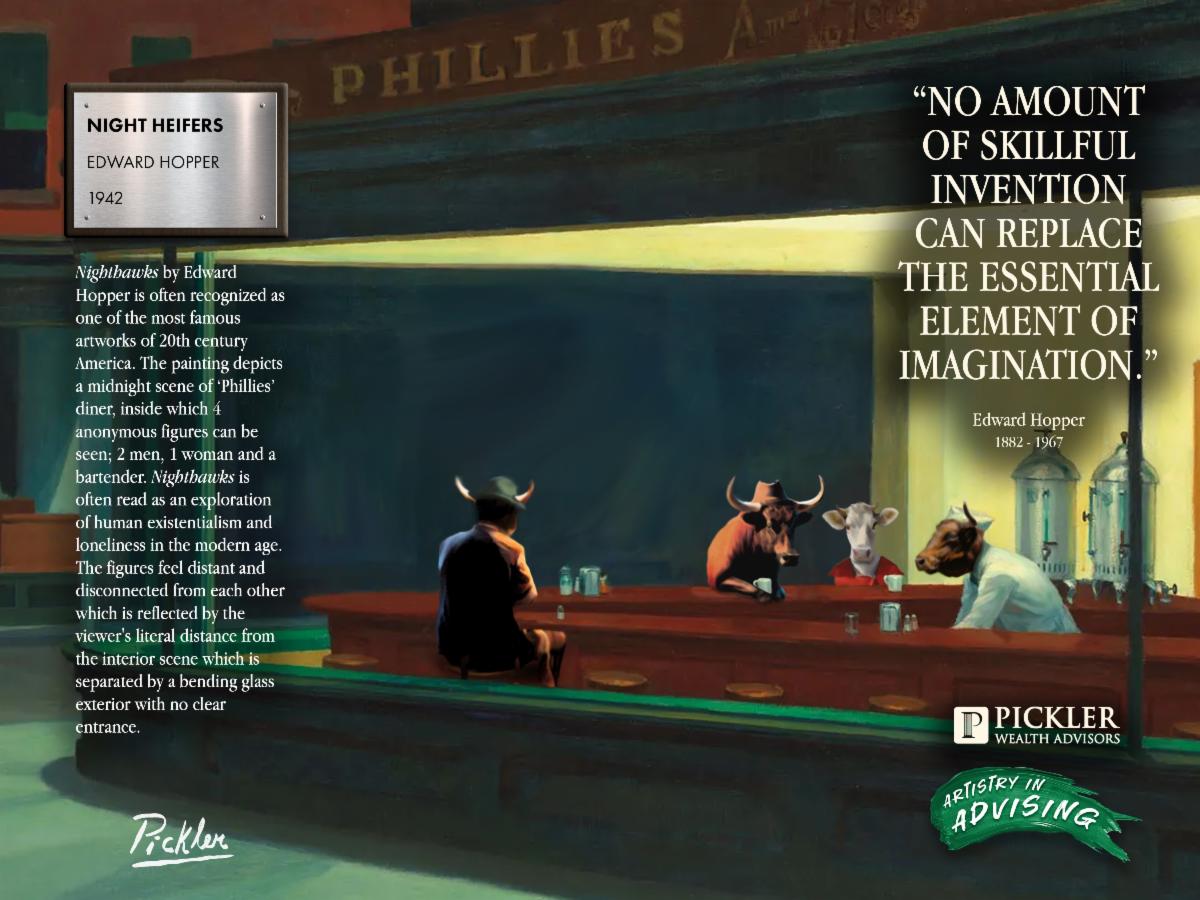
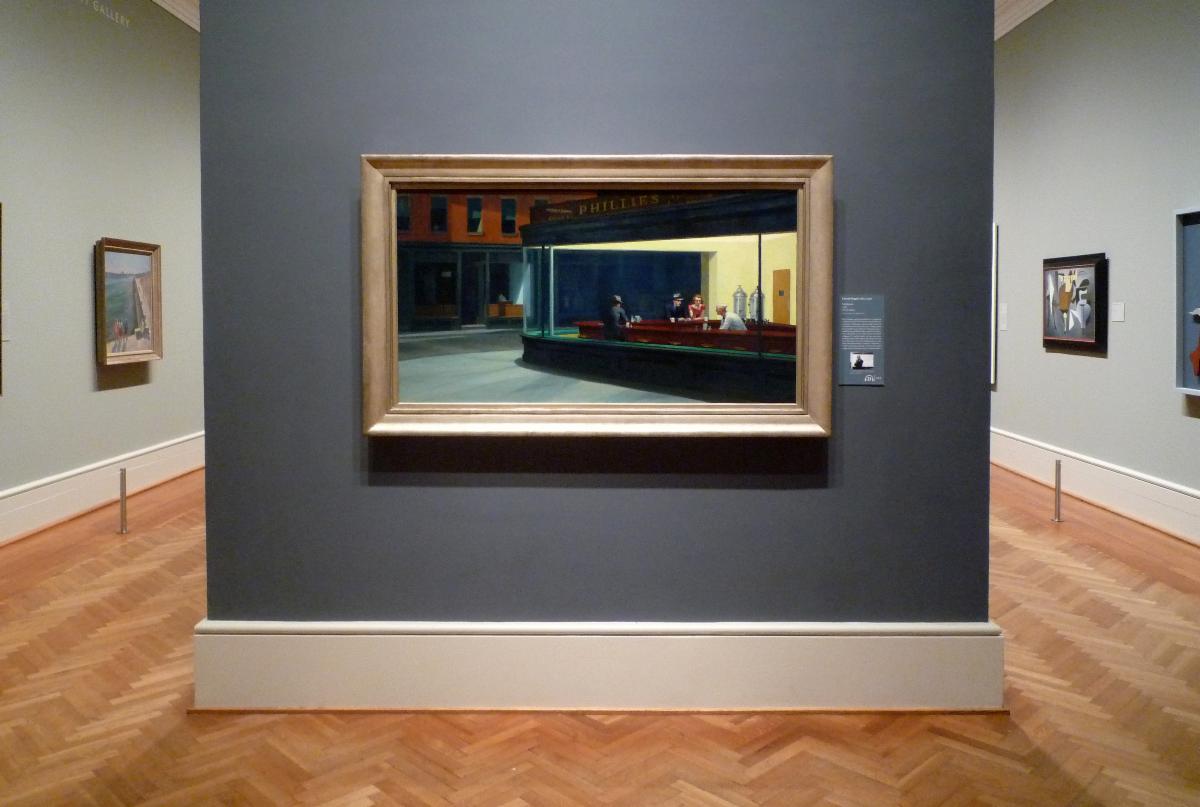
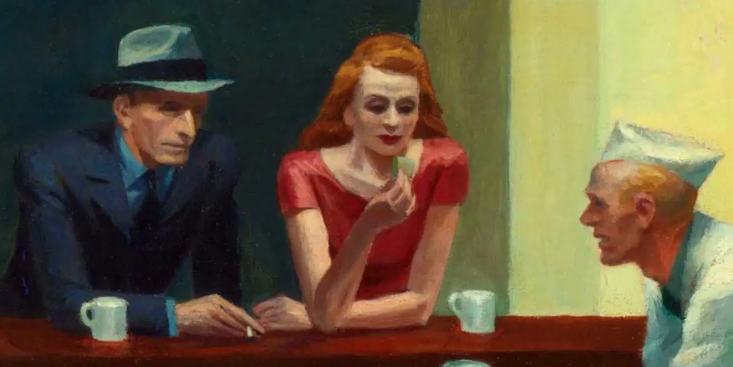
| | Edward Hopper was an American realist painter known for his evocative depictions of solitude and urban isolation. His most famous work, Nighthawks (1942), captures a quiet, late-night scene in a brightly lit diner, where three customers sit in silence while a server works behind the counter. The painting's sharp angles, use of light and shadow, and lack of visible interaction between the figures create a mood of stillness and emotional distance. Through this haunting image, Hopper conveys a powerful sense of loneliness and detachment, making Nighthawks a timeless reflection on modern life. You can read more about Hopper and his artistic legacy below. | | |
Artistry in Advising
Night Heifers
| | Created by Pickler Wealth Advisors' Chief Branding Officer, Cameron Spann | | |
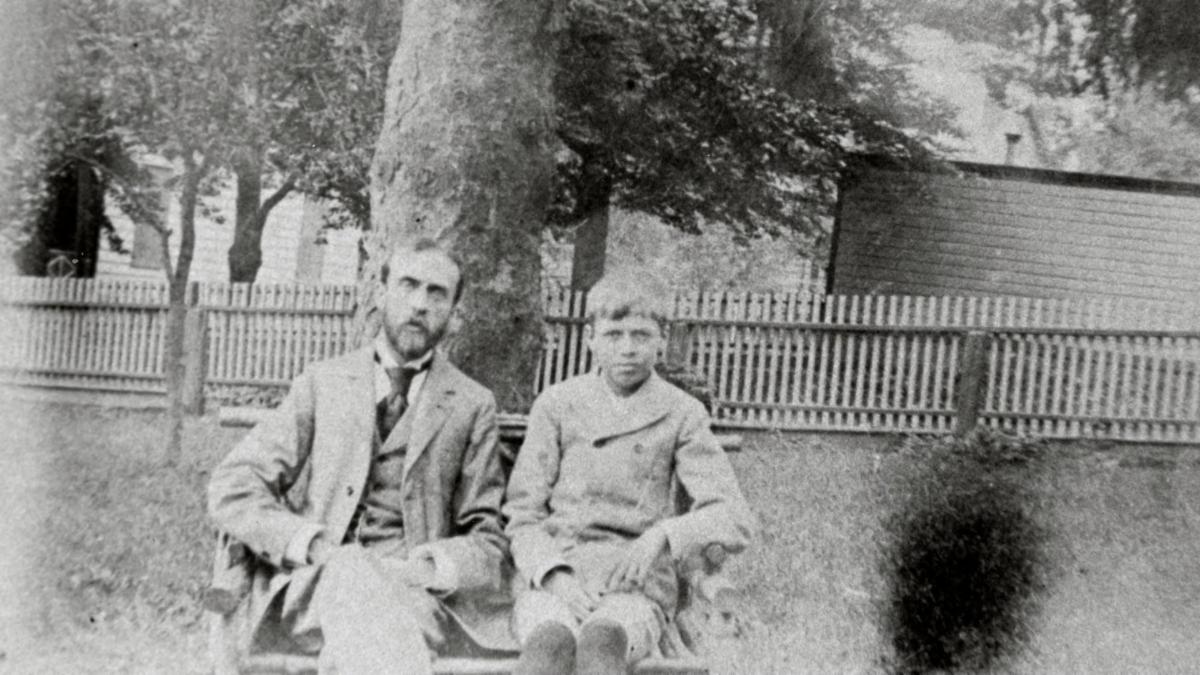
Edward Hopper was born in Nyack, New York, in 1882 to a middle-class family. After he graduated high school in 1899, his parents, though supportive of his artistic ambitions, encouraged him to pursue commercial illustration. He studied at the Correspondence School of Illustrating in New York City for a year before enrolling in classes at the New York School of Art in 1900, where he switched his focus to fine art. There, Hopper studied under William Merritt Chase and Robert Henri, who encouraged their students to paint the everyday realities of the world around them. In 1906 he briefly worked part-time as an illustrator and then, over the next four years, made three extended trips to Paris and other European cities, where he was particularly influenced by the works of Edgar Dégas and Édouard Manet.
In 1910, Hopper moved to 3 Washington Square North in Greenwich Village, where he would live and work for the rest of his life (although from 1930 on he spent nearly every summer on Cape Cod and built a house in South Truro in 1934). For the next decade, as Hopper sought recognition from the art world, he continued to earn his living as an illustrator—work he disliked and would later attempt to conceal. During this period Hopper exhibited his paintings in a number of group shows in New York City, including the Exhibition of Independent Artists in 1910 and the 1913 Armory Show.
| | |
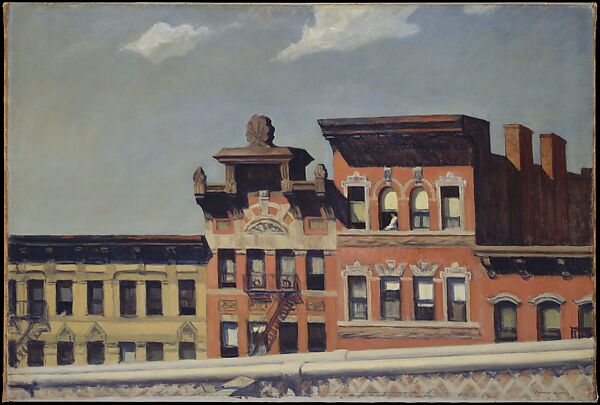
Hopper took up printmaking in 1915, and although he continued to paint in oil, it was the artist’s etchings that first achieved both critical and commercial success. It was also in this medium that Hopper developed a recognizable style in which ordinary places—motels, gas stations, restaurants—while realistically rendered, are pervaded with a sense of estrangement or loneliness. His human figures, if they appear at all, are solitary and pensive. In these etchings, and later paintings, mysterious moods are often reinforced through dramatic lighting, both natural and artificial. Both as a painter and a printmaker, Hopper used realism’s contemporary subject matter and structured compositions to explore the alienation and anxieties of modern life.
In 1923 six of Hopper’s watercolors were accepted to the Brooklyn Museum’s International Watercolor Exhibition, from which the museum purchased Mansard Roof (1923) for $100. The following year he gave up commercial work to paint full time and married Josephine “Jo” Verstille Nivison, a fellow pupil from Robert Henri’s class and herself an accomplished painter. Jo would prove indispensible to Hopper’s artistic success: not only did she pose for many of his female figures and encourage his work in watercolor, but she took over from her husband the task of keeping detailed records of his artistic production, including where works were shown and to whom they were sold, ultimately producing an impressive archive of Hopper’s long career.
Throughout his career, Hopper was the subject of several more retrospective exhibitions and was chosen to represent the United States at the 1952 Venice Biennale. Though some critics at midcentury failed to see the abstract structures underlying Hopper’s realism and dismissed his work as “illustrative,” by the 1960s a new generation of artists working in pop art and photorealism claimed him as an important influence on their work.
| | |
A Window into
Edward Hopper's World
| | Things You Might Not Know About Nighthawks | | |
Nighthawks was an instant classic
When Daniel Catton Rich, director of the Art Institute of Chicago, first laid eyes on the painting a few short months after Hopper put on the final touches, he declared it was as “fine as Homer,” referencing the 19th-century American painter.
Rich was quick to purchase Nighthawks for the Art Institute for $3000 (roughly $57,700 adjusting for inflation). The Hopper classic is still on display in the institute’s galleries.
It's bigger than you might expect
A quiet scene that could be the beginning or end of a million different stories, Nighthawks seems like it might be a small painting like the Mona Lisa. In fact, it measures 33 1/8 inches by 60 inches, roughly 2.75 feet by 5 feet.
Both Edward and Josephine Hopper were models for Nighthawks
In a letter to his sister Marion, Josephine wrote, “Ed has just finished a very fine picture—a lunch counter at night with 3 figures. Night Hawks would be a fine name for it. E. posed for the two men in a mirror and I for the girl. He was about a month and half working on it.”
| |
For Hopper, it was about feeling alone in a crowd
Many of the artist’s works reflected the isolation that could be felt amid the bustle of New York City. Of Nighthawks, the Nyack, New York native said, “Unconsciously, probably, I was painting the loneliness of a large city.”
The diner's fluorescent light made Hopper's job harder
In the early 1940s, commercial use of fluorescent lighting was a relatively new phenomenon. To properly capture its luminance, Hopper experimented with a zinc white paint instead of a lead white one. However, in a lengthy interview recorded on June 17, 1959, Hopper explained how the zinc white ultimately cracked, demanding a renovation, where it was replaced by the lead white. Because of this bad experience, Hopper never used zinc white again.
The actual location of this inspiration is a matter of debate
Popular opinion favors Mulry Square, a small triangular lot at Greenwich Avenue and Seventh Avenue. However, historical records show that a gas station occupied the lot in the early 1940s, not a diner.
In 2014, a now-closed restaurant on Greenwich Street declared itself Nighthawks’ inspiration after a Chicago native wandered in and noted the similarities between the place’s layout and the famous painting. That’s why Classic’s Café at 679 Greenwich Street changed its name to Nighthawks.
| | PAYING IT FORWARD WITH PASSION AND PURPOSE | | |
WATCH NOW!
Episode 1: Why Do We Need Money
In this episode, Miles travels with Captain Cashflow to Earnfield—a land full of builders, artists, and farmers all working hard to support their community. There, Miles learns that money isn’t just something we spend—it’s something we earn by contributing value through work. From planting seeds to understanding different jobs, Miles discovers that all work matters, and that earning money takes effort. Join us as we explore how currency works, why people get paid, and how that money helps us get the things we need and want in life. Will Miles earn his first Cashara Coin and help restore the land of Earnfield? Watch to find out!
| | Kinder & Griffin's Picture of the Week | | Julianne's Picture of the Week | | Coralyn's Picture of the Week | | Stay connected with me on social media | | | | |